3
Agricultural sciences
INFLUENCE OF COORDINATION COMPOUNDS OF MICROELEMENTS
ON COTTON PRODUCTIVITY
pirakhunova f.n., abzalov a.А., maxmudov a.a.
Tashkent Pharmaceutical Institute, Tashkent Pediatric Medical Institute, Tashkent, е-mail: [email protected]
the article presents the data of field experience which show that the increase of the yield of raw cotton when using the coordination compounds of microelements of cobalt and copper on the optimal nutritional background –
n250 p175 K125 increases by 4.5 and 5.8 c / ha, respectively, relative to the cotton crop, grown without microele
-ments, and by 2.8 and 3.2 c / ha in the variants with the use of inorganic salts. also, research has found that the use of coordination compounds of microelements has a positive effect on the course of physiological and biochemical
processes and the yield of various cotton varieties. it is noted that the increase of the yield obtained from the intro
-duction of coordination compounds of trace elements, an average in three years increase of yield was from 12.4 to 17.7 %, compared with the control. coordination compounds co-31, co-34 and cu-12 significantly improve the technological properties of the fiber and increase the oil content of the nucleus’ seeds. thus, the greatest increase of cotton yield is observed in the variants with the coordination compound of cobalt – 5.8 q / ha; the share of the first harvest of raw cotton in the variant is 74.6 %, i.e. by 12.3 % more than in the control variant, and in the variant with the coordination compound of copper is 4.3 centners per hectare, compared to the control. the share of the first harvest in these conditions increases by 8.3-12.9 % compared with the control options and 1.5-2 to 2 times more than in the variant with the addition of inorganic cobalt and copper salts to the cotton. the coordination compounds of microelements in combination with the optimal norms of mineral fertilizers improve the technological properties of the fiber and increase the oil content of seeds more than their inorganic compounds.
Keywords: microelements, growth, development, variety, cotton, fruit trees, copper, cobalt
an important factor of increasing of raw
cotton’s production, along with the introduc
-tion of advanced methods of cotton cultiva-tion
technology, the use of new high-yielding varie
-ties is the rational and effective use of mineral and organic fertilizers [1].
as is known, trace elements are found in plants in small quantities. however, the lack, like the excess of many trace elements, causes
adverse consequences for the growth and pro
-ductivity of plants, which affects the provi
-sion of human and animal nutrition of a cer
-tain qualitative composition. in this regard, the
problem of supplying plants with microele
-ments is increasingly acquiring a general bio
-logical significance [1].
When studying the effect of two biologi
-cal products rizoKom-1 and SerhoSil on the content of trace elements such as zinc, copper and arsenic in cotton plants and saline soils, the researchers noted that the content of these elements was not within the normal range and toxic effects on plants were not detected. the use of these biologics contributed to the improvement under the action of the state of saline soils under cotton, which had a positive impact on the yield of raw cotton, an increase
of 13.4 centners per hectare compared with tra
-ditional cotton sowing [2].
Studying, using the method of neutron-activation analysis, the content of 6 macro-and microelements in medicinal plant raw materials was determined. it was determined
that the content of macronutrients in all pro
-posed plants is comparable. the content of
trace elements allows to select more promis
-ing species [3].
Studies with the use of trace elements in
the composition of mineral fertilizers for cot
-ton show low efficiency of inorganic salts of trace elements in carbonate soils of cotton areas of the republic of uzbekistan. it is connected
with the fact that inorganic salts of microele
-ments in the soil are transformed into insoluble forms that are inaccessible to plants [4, 5].
in recent years, as is well known, much
attention has been paid to intracomplex coor
-dination compounds of microelements called complex or chelates.
Some researchers have considered the role of trace elements in plant life and highlighted theoretical and practical issues regarding the use of complex micronutrients on crops, rice, which provide increase yields, seed quality
and grain. metal complexonates, used as mi
-cronutrients, are effective form of microele
-ments by regulating the production process of agricultural crops, both when treating seeds before sowing and when conducting non-root dressings of vegetative plants. their inclusion in the rice fertilizer system allows to balance the mineral nutrition necessary for plant life, which provides increase of yield, seed quality and grain [6].
4
Agricultural sciences
in addition, entering to the plant, coordination compounds of microelements exhibit great biological activity, remain in soil solution in a form accessible to plants for a long time, have high resistance to microbiological cleavage
and are not deposited in an alkaline environ
-ment, which determines the high efficiency of their application under crops [7].
Purpose of the study
in recent years, the agrochemistry of plant nutrition with microelements and the practice of their application in agriculture have paid much attention to intracomplex compounds of
microelements. the aim of the study is identi
-fying ways to increase the yield of the cotton
varieties, which we study, by using the coor
-dination compounds of microelements. espe
-cially, the effectiveness of the using of trace elements of copper and cobalt for cotton has not been studied enough [5, 6].
the limited information about the effec
-tiveness of microelement coordination com
-pounds in increasing cotton productivity deter
-mined the direction of our research. Materials and research methods the influence of coordination compounds of trace elements copper and cobalt on the
growth and development of cotton varieties na
-mangan-34, S-6524, Bukhara-102 and omad
was investigated in field conditions. field ex
-periments were conducted in the experimental
area of the uzbek research institute of cotton.
the dependence of cotton yield on the ap
-plication of inorganic salts and coordination
compounds of microelements on typical siero
-zem has been studied in field conditions. the initial content in the soil of the arable layer of field experiments of humus, gross nitrogen, phosphorus and potassium was 1.10; 0.09; 0.11 and 2.3 %. the humus content and the gross amount of nutrients are reduced in the subsoil horizon of the soil. the initial content of nitrates in the soil is 20.4 – 21.2 mg / kg of soil. available phosphorus in soil, soluble in ammonium carbonate, was 22.3–23.2 mg / kg in arable and 11.3–11.9 mg / kg in subarable horizons, exchange potassium, respectively, 190–201 and 130 –134 mg / kg of soil.
the content of conditionally digestible forms of microelements averaged: cobalt 0.12-0.14; copper 0.30-0.34 mg / kg and, therefore, the soil of the experimental plots belongs to the low-provided by these trace elements soils. field experiments were located in 2 tiers, with eight-row strips, where 4 middle eight-rows were used to account for growth and development, to conduct
agrochemical studies, and 2 extreme rows as de
-fensive measures. the plot area is 67.2 m2 (14.4 and 4.8 m). the repetition of the experiment is fourfold. the layout of plants 60x15-1 with
a thickness of 105-110 thousand. Before sow
-ing, cotton seeds were soaked with an aqueous solution of inorganic, as well as coordination compounds of microelements with subsequent addition to the budding phase of ammophos or superphosphate at a depth of 14-16 cm.
from a large number of coordination com
-pounds of microelements by the two-three-year field tests, the following are most effective for the growth, development and yield of the cotton: co-31 – cobalt trismethioninate – co (c 15 h16 n3S3o9) with a cobalt content of
14 %; cu-12 – bis-glutaminatocuproat tetrahy
-drate [cu (c5h7o4n) 2] · 4h2oc with a cop
-per content of 13.2 % and co-34 bis (glutamine cobalt) cobalt (ii) co [cu (gluta-2h2)] · 4h2o with cobalt content of 11 %, copper 13 %.
Research results and discussion researchers have found that the absorbtion of microelements of copper, molybdenum, and especially zinc by artemisia leucodes Schrenk and Sophora Japonica l ....is increased
at combined using of nitrogen, phosphorus, po
-tassium and half-dead manure.
thus, to obtain sustainable yields with high quality raw cotton, the use of trace elements is becoming increasingly important along with balanced nitrogen-potassium and phosphate nutrition. So, they play an important role in the metabolism of plants, their lack can lead to
significant disturbances in growth and devel
-opment, decreasing of yield and a deterioration of product quality.
the long-term results of scientific research and the practice of using trace elements in the composition of mineral fertilizers for cotton show the low effectiveness of inorganic salts of trace elements in the carbonate soils of cotton regions of central asia. this is due to the fact that with the introduction of inorganic salts of microelements in the soil are transformed into insoluble, inaccessible to plant forms [7].
We have established that the use of coordina
-tion compounds of trace elements of cobalt and copper by setting seeds at 0.3 % in their solutions and the subsequent application of 6.0–8.0 kg / ha
increases the productivity (biomass) of worm
-wood on average 3, 2-2.0 q / ha in two years. the results of research have shown that the
use of coordination compounds of trace ele
5
Agricultural sciences
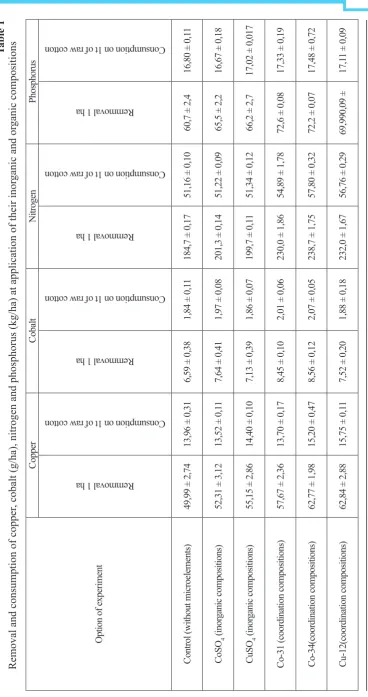
Table 1
r
emoval and consumption of copper
, cobalt (g/ha), nitrogen and phosphorus (kg/ha) at application of their inor
ganic and or
ganic compositions
o
ption of experiment
Copper
Cobalt
Nitrogen
Phosphorus
remmoval 1 ha consumption on 1t of raw cotton remmoval 1 ha
consumption on 1t of raw cotton remmoval 1 ha
consumption on 1t of raw cotton remmoval 1 ha
consumption on 1t of raw cotton
control (without microelements)
49,99 ± 2,74 13,96 ± 0,31 6,59 ± 0,38 1,84 ± 0,1 1 184,7 ± 0,17 51,16 ± 0,10 60,7 ± 2,4 16,80 ± 0,1 1 СоS o4 (inor ganic compositions) 52,31 ± 3,12 13,52 ± 0,1 1 7,64 ± 0,41 1,97 ± 0,08 201,3 ± 0,14 51,22 ± 0,09 65,5 ± 2,2 16,67 ± 0,18 CuSO 4 (inor ganic compositions) 55,15 ± 2,86 14,40 ± 0,10 7,13 ± 0,39 1,86 ± 0,07 199,7 ± 0,1 1 51,34 ± 0,12 66,2 ± 2,7 17,02 ± 0,017
co-31 (coordination compositions)
6
Agricultural sciences
it is noted that the difference in the yield
increase, obtained by making the coordina
-tion compounds of microelements, depending on the varietal characteristics of cotton, is not significant. on average, over three years, the yield increase was between 12.4 and 17.7 % compared to the control.
according to the research results, it was es
-tablished that the content of copper and cobalt in the tissues of the cotton organs does not differ significantly when introducing inorganic salts
and coordination compounds of these trace ele
-ments. With the introduction of cobalt alone, the copper content in the tissues of the plant organs in the variant with the introduction of copper. in terms of cobalt and copper content, when they are introduced in the form of inorganic salts, the options differ slightly, and when cotton is grown using coordination compounds, they are marked to a greater increase in the organs of cotton.
the removal of copper and cobalt by a sin
-gle plant when these batteries are introduced in the form of coordination compounds exceeds the indicator in the variant with the use of their inorganic compounds (table 1).
it confirms the opinion that the coordina
-tion compounds of microelements are less fixed in the soil than their inorganic salts again. The total removal of copper and cobalt by plants
with the addition of their coordination com
-pounds is 57.6 and 62.8 g / ha, respectively,
while in the control (with the addition of inor
-ganic salts) it is 52.3 – 55.1. currently, it is es
-tablished that copper, manganese, zinc, cobalt,
boron and other trace elements increase the ac
-tivity of many enzymes and enzyme systems,
redox processes, are involved in photosynthe
-sis, carbohydrate and protein metabolism and other biological processes. enzymes can form with microelements various metal-organic and
intracomplex compounds. the effect of indi
-vidual microelements on growth processes,
fruiting and the quality of agricultural prod
-ucts, including cotton, has been widely studied.
Studies have established that the height in
-crease of the main stem of cotton varies con
-siderably depending on the use of inorganic
and coordination compounds of microele
-ments. on variants (by 5.Vi) of inorganic salts
of cobalt and copper, the length of the stem in
-creases by 1.8–2.3 cm, while their coordination compounds – by 2.5–6.0 cm relative to control plants (without trace elements). coordination
compounds of microelements (cobalt and cop
-per) increase the growth of the main stem to a greater extent than their inorganic salts.
according to the research results, it was es
-tablished that the content of copper and cobalt
in the tissues of the cotton organs does not dif
-fer significantly when the inorganic salts of the coordination compounds of these trace elements are introduced. When only cobalt is introduced,
the copper content in the tissues of the plant or
-gans is higher than in the or-gans of the control plants, but lower than that of the plants in the variant with the addition of copper. the content of cobalt and copper when they are introduced in the form of inorganic salts varies slightly, and when growing cotton using coordination compounds, there is a tendency for their large increase in the organs of cotton.
the introduction of trace elements in the
composition of ammophos has a positive ef
-fect on the fruiting of cotton. inorganic salts of cobalt and copper increase the formation of
ovaries and 5.Viii by 0.6 – 0.8 and their co
-ordination compounds by 1.3 – 1.8. the num
-ber of fully formed bolls is more formed in the variants using the coordination compounds of microelements – 13.2; 13.0 and 12.5 pieces per plant versus 10.6 pieces in the control. When using inorganic salts (option 2 and 3), the number of boxes was 11.4 and 11.2 pieces. inorganic cobalt salts increase the yield of raw cotton by 3.2 centners per hectare on average over 3 years, and copper sulphate increases by 2.8 centners per hectare. at the same time, an increase in the yield of first-stage raw cotton in
the variant with cobalt sulphate by 6.2 and cop
-per sulphate is 5.8 % higher compared to the control (without trace elements).
the greatest increase of cotton yields is
observed in the variants with a cobalt coordi
-nation compound of -5.8 c / ha; the share of the first harvest of raw cotton in the variant is 74.6 %, i.e. by 12.3 % more than in the control
variant, and in the variant with the coordina
-tion compound of copper is 4.3 centners per hectare compared to the control. the share of the first harvest in these conditions increases
by 8.3-12.9 % compared with the control op
-tions and 1.5-2 to 2 times more than in the vari
-ant with the addition of inorganic cobalt and copper salts to the cotton.
the use of inorganic salts of microele
-ments for cotton increases the fiber length by 0.1-0.3 mm, the breaking load is 0.2-0.4 gf / tex, and the weight of 1000 seeds is 0.5-1.2 g
relative to to control. at the same time, an in
-crease in the oil content of the seed kernel is
observed as compared with the variant with
7
Agricultural sciences
T
able 2
c
otton yield at application of inor
ganic salts and coordination compositions of microelements on the optimal background of mineral nutrition
(f
ield experiment 2009-2010 y
.)
№
o
ption of experiment
a
nnual rate of fertilizer
,
kg/hа
c
oncentration of the
solution for seed lock before sowing,
%
feed by micro
-elements kg/hа
r
aw cotton crop, c/hа
3 years average Increase to control
the first harvest i
average
%
N
P
К
1
c
ontrol (without microelements)
250
175
125
-36,1
±
1,9
-60,9
±
2,7
2
СоS
o4
(inor
ganic compositions)
250
175
125
0,03
2,0
39,3
±
0,8
3,2
±
0,2
67,1
±
1,3
3
CuSO
4
(inor
ganic compositions)
250
175
125
0,03
2,0
38,9
±
0,7
2,8
±
0,3
66,7
±
1,4
4
c
o-31 (coordination compositions)
250
175
125
0,03
0,8
41,9
±
0,3
5,8
±
0,6
74,6
±
0,6
5
c
o-34(coordination compositions)
250
175
125
0,02
0,6
41,3
±
0,5
5,2
±
0,4
73,8
±
0,7
6
c
u-12(coordination compositions)
250
175
125
0,03
0,8
40,9
±
0,4
4,8
±
0,3
69,2
±
8
Agricultural sciences
thus, coordination compounds of micro
-elements in combination with optimal norms of mineral fertilizers improve the technological
properties of the fiber and increase the oil con
-tent of seeds more than inorganic compounds.
Studies have established that growing cot
-ton using inorganic salts, the content of gross nitrogen in leaves and stems increases to 0.1
and 0.4 %, respectively, in leaflets and raw cot
-ton, to 0.1 and 0.8 %. there is a tendency for a larger increase in gross nitrogen when the coordination compounds of trace elements are
introduced, especially cobalt. When using in
-organic salts and coordination compounds of trace elements on the content of phosphorus in the organs of cotton there is a similar pattern.
as one would expect, the greatest removal
of nitrogen and phosphorus occurs in raw cot
-ton than other cot-ton organs, but also in their total removal.
the results of research also found that the content of cobalt and copper in plant organs
when they are introduced in the form of inor
-ganic salts is, respectively, from 3.1 to 7.2 and from 0.34 to 1.37, and coordination compounds from 3.4 to 3 , 3 and from 0.41 to 1.47 mg / kg of dry matter versus from 3.9 to 6.7 and from 0.25 to 1.28 mg / kg in the control. it confirms
that the coordination compounds of trace ele
-ments are less fixed in the soil than their inor
-ganic salts again. the total removal of copper and cobalt by the plant when the coordination compounds of these elements are introduced is 57.6-32.8 and 7.5–8.6 g per hectare, and when inorganic salts are introduced, 52.3– 56.1 and 7.1 – 7.6 g hectare, where as in the control 50.0 and 6.6 g.
Conclusions
in this way, the using of coordination com
-pounds of microelements of cobalt and copper
compared with their inorganic salts by locking
seeds and adding ammophos in the cotton bud
-ding phase enhances growth processes, fruit
-ing, improving the technological properties of the fiber and increasing the yield of raw cotton. the increase of the yield of raw cotton with the
use of coordination compounds of trace ele
-ments of cobalt and copper on an optimal nutri
-tional background –n250 p175 K125 increases by 4.5 and 5.8 c / ha, respectively, relative to
the yield of cotton grown without microele
-ments, and by 2.8 and 3.2 centners / ha in the variants with the use of inorganic salts of these microelements.
References
1. turakulov a.a. the influence of coordination com
-pounds of trace elements of copper and cobalt on the efficiency of the use of whitewood nitrogen fertilizers. collection of articles
of the Vii international scientific-practical conference. agricul
-tural science of agriculture. Book 2, Barnaul. 2012. Р. 269-270. 2. Gundareva a.n. the effect of trace elements on the growth and development of cereal plants (for example, wheat). J. Bulletin of astrakhan State technical university. 2009. № 3. Р. 197-201.
3. Babina a.e., Jumaniyazova G.i., narbaeva Kh.S., za
-kiryaeva S.i., mirsagatova a. the content of trace elements
in saline soil and cotton plants when using bioprepates rizo
-Kom -1 SerhoSil. J. Scientific electronic library liBrary. ru.2017. № 2 (36). Р. 28-31.
4. fedko i.V. medicinal plants are possible sources of ma
-jor macro and micronutrients. Scientific and methodical elec
-tronic magazine “concent”. 2013. no. 3. p. 526-530.
5. maksimenko e.p., Sheudzhen a.Kh. Scientific basis for
the use of complex microfertilizers in rice cultivation. polythe
-matic network electronic scientific journal Kuban Gau. № 107. (03) 2015.С.56-57.
6. pirukhunova f.n., abzalov a. patterns of interrelation
of the content of trace elements with fruit formation and abscis
-sion of the cotton plant organisms. J. Scientific review. Biologi
-cal sciences. publishing house “academy of natural Sciences” № 3. 2017. Р. 93-98.
7. Sattorov zh.S., holiulov S.o. Va Va Kuzgi Bouda uc