Original Research Article
Knowledge and attitude about leprosy among medical students and
interns at tertiary care centre of central India: a cross-sectional study
Ashok R. Jadhao, Hitesh C. Tayade*, Abhijit N. Kherde, Punam M. Dambhare
INTRODUCTION
Leprosy is often referred to as the oldest disease known to man. Amongst all the communicable diseases, leprosy is known for leading permanent and progressive physical disability.1 It is an infectious disease caused by
Mycobacterium leprae. It affects peripheral nerves, the skin and the mucosa of the upper respiratory pathways.2 Leprosy often results in intense stigma and social discrimination of patients and their families and is associated with psychological trauma too.3 India has
succeeded with the implementation of Multi Drug Therapy in bringing the national prevalence down to “elimination as a public health problem” of less than 1/10,000 population in December 2005 and even further down to 0.67/10,000 in 2017. New cases detected during the year 2017-18 were 1,26,164, resulting in Annual New Case Detection Rate (ANCDR) of 9.27 per 100,000 population.4Leprosy cases are sometimes missed or are misdiagnosed by primary health centre staff, also leprosy is a great mimicker and occasionally confuses even the experienced professionals.5 There are Prejudices and lack
ABSTRACT
Background: Leprosy has been known to the Indians since the Vedic period. Leprosy is synonymous with social stigma due to reasons like mystery around its transmission, lack of knowledge on available treatment, deformities and religious views. Prejudice and lack of knowledge about leprosy exist even among medical practitioners and healthcare professionals around the world. Considering above mentioned facts, this study was conducted to study knowledge and attitude of medical students and interns towards leprosy.
Methods: A cross-sectional study was conducted at IGGMC, Nagpur, among Third MBBS part one of 7th semester medical students who were exam going for community medicine and interns of IGGMC between October 2018 to January 2019. Questionnaire comprised of 27 knowledge-based and 22 attitude–oriented questions. In all total 210 subjects, 99 Interns and 111 students were enrolled for the study.
Results: Mean age of interns was 23.52±0.66 years and that of students was 21.45±0.85 years. There was no significant difference in knowledge regarding cause and modes of transmission and clinical features of leprosy between interns and student however interns were having significant higher knowledge regarding diagnosis, treatment, prevention of deformity limitation and precaution to be taken against leprosy. Only 13(6.19%) participants were having knowledge regarding targets of NLEP that was to be achieved by year 2017. Though both interns and students both showed good attitude towards leprosy but only 34 interns and 31 students had ever rendered service or donated money for cause of leprosy.
Conclusions: Knowledge regarding national program is limited in both groups, curriculum should be strengthen pertaining to National program.
Keywords: Leprosy, Knowledge and attitude, NLEP, Cross-sectional study
Department of Community Medicine, Indira Gandhi Government Medical College, Nagpur, Maharashtra, India
Received: 29 May 2019
Accepted: 15 July 2019
*Correspondence:
Dr. Hitesh C. Tayade,
E-mail: [email protected]
Copyright: © the author(s), publisher and licensee Medip Academy. This is an open-access article distributed under the terms of the Creative Commons Attribution Non-Commercial License, which permits unrestricted non-commercial use, distribution, and reproduction in any medium, provided the original work is properly cited.
of knowledge about leprosy even among medical practitioners and healthcare professionals around the world.6
The status of elimination of leprosy, less than one per 10,000 populations give a sense of false satisfaction. Also, the disease has a very long incubation period which vary from 6 months to 30 years. Hence the cases are detected even after long period. Medical students who are to be medical officer in near time as it is compulsory in Maharashtra for Government Medical College students to serve one-year bond in rural settings. Hence it is important for these students to be well aware about the signs and symptoms and management of leprosy and National program for leprosy functioning in India. Considering above mentioned facts, this study was conducted to study knowledge and attitude of medical students and interns towards leprosy and leprosy affected patients and compare knowledge and attitude amongst them.
METHODS
This cross-sectional study was done at Indira Gandhi Government Medical College and Hospital, Nagpur, from October 2018 to January 2019. The participants of the study were third MBBS part one 7th semester medical students who were exam going for Community Medicine and Interns of Indira Gandhi Government Medical college and Hospital, Nagpur. All consecutive students and interns those who were willing were enrolled for the study. 99 interns and 111 third MBBS part one students participated in the study. Hence, in total 210 subjects participated in study. Pre-designed, pre-tested, self-administered questionnaire was used for collecting data. The questionnaire was prepared in English in order to maintain consistency as well as in confirmation with the medium of instruction for medical students in India. Questionnaire was filled in presence of investigator. Care was taken that no conversation happens amongst participants while filling the questionnaire. For both knowledge and attitude each correct response was scored by giving +1. 0 score were recorded for incorrect, incomplete and no response, no negative marking done. Questionnaire was consisting of 27 knowledge-based questions and 22 attitude-oriented questions. 27 knowledge-based questions were grouped as: cause and modes of transmission-6, clinical features-7, diagnosis and treatment-7, prevention against leprosy and deformities limitation in leprosy-4, national program-3. Twenty-two attitude-oriented questions were grouped as: Towards changes in society- 4, towards personal attitude or behaviour with a person who had leprosy-13, Attitude at workplace and at home /neighbourhood - 5. Time limit of 20 minutes was allocated to participants for filling the questionnaire. Grading was done based on correct answers given by participants. Those who scored 60% and above were graded as good, those scoring 30% to 59% were graded as fair and less than 30% score was graded as poor.
Statistical analysis
Data was entered in excel, descriptive statistics were calculated by using SPSS ver. 20., Epi info version 7 was used to calculate chi-square test. Percentage, mean and standard deviation was used to describe different variable.
RESULTS
In this study 210 study participants were enrolled, of whom 99 were interns and 111 were third part one MBBS students.
Table 1 show that means age of interns was 23.52±0.66 years and that of students 21.45±0.85 years. Majority of interns and students were female, 57.58% and 56.75% respectively.
Table 2 shows that, 197 participants were having good/fair knowledge about leprosy. When overall knowledge was compared it was found that Interns were having statistically significant higher knowledge than students. More numbers of interns were having good/fair attitude towards leprosy patients as compared to students but the difference was not statistically significant.
respectively. Nerve involvement is cause of deformity in leprosy is correctly answered by 125 (59.52%) participants. only 68 (32.38%) and 62 (29.52%) participants knew that physiotherapy, splints, wax bath, MCR sandals helps in deformity reduction and vaccine
against leprosy is in trial respectively. 148 (70.47%) participants recognised correctly that ASHA act as link worker but only 13 (6.19%) knew the targets of national leprosy eradication program that were to be achieved by year 2017.
Table 1: Age and gender wise distribution of participants.
Participants Age (Mean±SD) years Male Female Total
No. % No. %
Interns 23.52±0.66 42 42.42 57 57.58 99
Students 21.45±0.85 48 43.25 63 56.75 111
Table 2: Knowledge and attitude score of participants.
Participants Good Fair Poor Total P value*
No. % No. % No. %
Knowledge
Interns 46 46.46 52 52.52 1 1.02 99
0.007
Students 5 4.50 94 84.68 12 10.82 111
Attitude
Interns 72 72.72 24 24.24 3 3.04 99 0.43
Students 63 56.75 41 36.93 7 6.32 111
*Clubbing good and fair against poor.
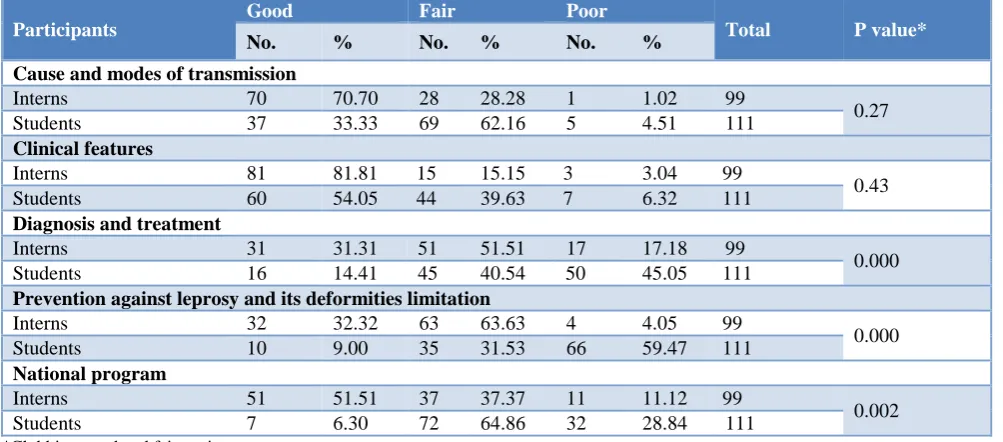
Table 3: General and in-depth knowledge score of participants.
Participants
Good Fair Poor
Total P value*
No. % No. % No. %
Cause and modes of transmission
Interns 70 70.70 28 28.28 1 1.02 99
0.27
Students 37 33.33 69 62.16 5 4.51 111
Clinical features
Interns 81 81.81 15 15.15 3 3.04 99
0.43
Students 60 54.05 44 39.63 7 6.32 111
Diagnosis and treatment
Interns 31 31.31 51 51.51 17 17.18 99
0.000
Students 16 14.41 45 40.54 50 45.05 111
Prevention against leprosy and its deformities limitation
Interns 32 32.32 63 63.63 4 4.05 99
0.000
Students 10 9.00 35 31.53 66 59.47 111
National program
Interns 51 51.51 37 37.37 11 11.12 99
0.002
Students 7 6.30 72 64.86 32 28.84 111
*Clubbing good and fair against poor.
Table 4: Attitude score of participants towards leprosy.
Participants Good Fair Poor Total P value*
No. % No. % No. %
Attitude towards changes in society
Interns 76 76.76 16 16.16 7 7.08 99
0.48
Students 79 71.17 20 18.01 12 10.82 111
Attitude towards personal attitude or behaviour with a person who had leprosy.
Interns 79 79.79 17 17.17 3 3.04 99
0.29
Students 60 54.05 43 38.73 8 7.22 111
Participants Good Fair Poor Total P value*
No. % No. % No. %
Attitude at workplace and at home /neighbourhood.
Interns 68 68.68 24 24.24 7 7.08 99
0.057
Students 61 54.95 32 28.82 18 16.23 111
*Clubbing good and fair against poor.
Table 4 shows that interns and students both showed good attitude towards leprosy, difference between their attitude was less and it was not statistically significant. Out of 210 participants, 158 (75.23%) Participants agreed to share public toilet with patients of leprosy and 170 (80.95%) participants consented to attend public functions with them.
Though both interns and students both showed good attitude towards leprosy but only 34 (34.34%) interns and 31 (27.92%) students had ever rendered service or donated money for cause of leprosy. 121 (57.61%) participants were not having any problem in marrying a person who had leprosy. 139 (66.19%) participant were not reluctant on letting their children to play with person who had leprosy.
DISCUSSION
Overall knowledge of interns was significantly more than students (p=0.007). There was no significant knowledge gap between two groups in terms of cause, modes of transmission and clinical features of leprosy. But when In-depth knowledge regarding diagnosis and treatment, prevention of leprosy and deformities limitation in leprosy and knowledge regarding National Program of Leprosy was accessed it was found that interns had more knowledge than students and it’s highly significant.
In our study 96 (96.96%) interns and 108 (97.29%) Students knew that leprosy is cause by mycobacterium leprae, in study conducted by Leena et al, all the final year students and 74.46% (70/94) of first year students knew that leprosy is an infection caused by bacteria.7 In study conducted by Stephen et alon patients and family members they found that about 32% of the patients and 37% of family members informed that that leprosy is due to an infection caused by a germ.8 But many of these respondents also held other multiple reasons contributing to the causation of the disease like overwork, malnutrition, heredity, tiredness, insect bite, excess heat, sin, alcohol consumption etc. Barkataki et al conducted comparative study in leprosy patients, non-leprosy patients and community members, they found that Bad blood is answered as the cause of leprosy by most of the respondents, including leprosy patients.9 However, significantly higher percentage of literates in all the groups were able to mention infection as the chief cause of leprosy.
In our study 68 (68.68%) interns and students 48 (43.24%) cited correctly that Mycobacterium leprae Bacilli are not secreted in the breast milk whereas in a
study conducted by Tiwari et althey found that, out of 95 pre-final year students 23 answered it correctly in pre-test and 88 in post-test.10
In our study 83 (83.83%) interns and 70 (63.06%) students knew about slit skin smear is done for diagnosis. In study conducted by Leena et al.7 Only 60.52% (46) of final year students knew about the slit skin smear and it is 54.25% (51) in first year students.
In our study 100% of participant was aware about typical skin features seen in leprosy, whereas in study by Giri et al, 50% of interns and 40% of undergraduates were unaware of the cardinal signs of the disease.11 In our study all the participants were knowing correctly about confirmation of Mycobacterium leprae by Zeihl Neelsen staining which is similar with study conducted by Sharma et al where staining of lepra bacilli was correctly known to 100% of final year, third year and second year medical student.12
In our study 162 (77.14%) participants were aware about the drugs that are used in multi drug therapy. 65 (30.95%) interns and 55 (26.19%) students were aware about complete treatment of paucibacillary and multibacillary leprosy which is in contrast to study conducted by Sharma et al in which 100% of final year medical students were totally aware about it whereas 92% third year and 79% 2nd year medical students were having correct knowledge about leprosy treatment.13 Niranjan et al conducted a study on effectiveness of educational intervention on patients and community members, 40% respondents reported that leprosy could be treated with anti-leprosy drugs recommended for the treatment of leprosy before educational intervention but after intervention it was increased to 80%.14 While 36.8% also believed in medicinal herbs as a cure of leprosy, but after educational intervention it declined to 13%, the role of avoiding taboo food and religious rituals in the treatment of leprosy before the intervention stated by 24.3% and 70% but after the intervention it falls to 12% and 2% respectively.
In our study only 93.81% participants were lacking knowledge regarding targets of national leprosy eradication program. In study conducted by Jain et al, 70.3% participants did not know about existence of national leprosy eradication program.6
conducted by Jain et al.6 Most of the participants had a positive attitude regarding leprosy patients should be treated in general hospitals, allowed to use public transport and attend public functions without any discrimination.
In our study 126 (60%) of participants was comfortable in sharing room with person who had leprosy, 142 (67.61%) in shaking hands and 157 (74.76%) in sharing food with them. A study conducted by Simi, et al shows that 46.5% of their first year medical (MBBS) and paramedical participants are reluctant to shake hand, 54.8% to share a room and 52.3% to share a meal with even a treated leprosy case.15
CONCLUSION
This study was conducted to study knowledge and attitude of interns and medical students about leprosy. It had help us to know that changes should be done while deciding the curriculum of medical students. This is a necessity if we have to achieve the goal of leprosy free status for the people of India. In our study, both groups were having good knowledge regarding cause, modes of transmission and clinical features of leprosy, whereas interns were having better knowledge about diagnosis, treatment, prevention and deformities limitation of leprosy.
Though knowledge regarding national program was higher among interns as compared to those of medical students, only 9% of intern was having knowledge regarding targets of national program of leprosy. There was no difference regarding attitude of interns and medical students towards leprosy. Knowledge regarding national program is limited in both groups, hence curriculum should be strengthen pertaining to National program. Medical undergraduates and interns should be incorporated in functioning and implementation of national programs apart from clinical postings so as future medical professionals would get a comprehensive knowledge.
Limitation
This study has used self-administered questionnaires. Social acceptability bias may be there, however, confidentiality of participants was maintained as name and other identity characteristics was not asked so as to minimize social acceptability bias. Also, demographic data was kept minimum, to ensure confidentiality of the participants.
Funding: No funding sources Conflict of interest: None declared
Ethical approval: The study was approved by the Institutional Ethics Committee
REFERENCES
1. Scambler G. Health-related stigma. Sociol Health Illness. 2009;31(3):441–55.
2. Hastings RC, Gillis TP, Krahenbuhl JL, Franzblau SG. Leprosy Clin. Microbiol. Rev. 1988;1(3):330-48.
3. Monika P, Wijeratne T. Knowledge, attitudes and practices relating to leprosy among public health care providers in Colombo, Sri Lanka. Lepr Rev. 2017;88:75-84.
4. NLEP Annual Report 2017-2018. Central Leprosy Division, Directorate General of Health Services, Ministry of Health and Family Welfare Government of India, Nirman Bhavan, New Delhi, 2018.
5. Kumar B. World Leprosy Day 2015: Renewing
commitment for a leprosy free world! Indian J Med Res. 2015;141:1-4.
6. Meena J, Ankur S, Knowledge and Attitude about Leprosy among Indian Dental Students in Faridabad, Clin Diagn Res. 2016;10(3):48–52. 7. Leena R, Priya KS. A study of Knowledge and
Attitude about Leprosy among Medical Students. Indian J Lepr. 2017;89:91–7.
8. Stephen T, Selvaraj I, Parameswari PJ. Assessment of Knowledge, Attitude and Practice about leprosy among patients and their families in a rural community in Tamil Nadu. Indian J Lepr. 2014;86(1):7-14.
9. Barkataki P, Leprosy T, Trust M, Kumar S. Knowledge of and attitudes to leprosy among patients and community members :a comparative study in Uttar Pradesh, India. Lepr Rev. 20060;77(1):62-8.
10. Tiwari R, Srivastava DK, Bansal M, Adhikari P, Mishra S. An assessment of the impact of one day training programme on knowledge and attitude of undergraduate students on leprosy at G. R medical college, Gwalior, Madhya Pradesh. National J Community Med. 2013;4(2):344-8.
11. Giri PA, Phalke DB, Aarif SM. A study of knowledge, attitude and practices regarding leprosy among undergraduates and interns of a medical college and hospital from rural India. Indian J Lepr. 2011;83:75-80.
12. Sharma A, Garima G, Sharma N, Sharma S, Singh N, Vohra P, et al. Comparative Study of Knowledge and Awareness about Leprosy among Medical College Students Pre and Post State Leprosy Sensitisation Program in Mewat, Haryana, India. J Clin Diagnos Res. 2018;12(8):BC29-BC32. 13. Sharma S, Singh N, Garima G, Sharma A, Vohra P,
Sharma N, et al. Presensitization Assessment of Knowledge and Awareness about Leprosy among Medical College students in Mewat Region of Haryana. J Med Sci Clin Res. 2017;5(10):28720–3. 14. Niranjan A, Teja KD, Deepak T, Devi KG, Reddy
Areas of Guntur District. IOSR J Pharmacy Biological Sci. 2017;12(6):8–12.
15. Simi PS, Philip M, Samson JF, Ebenezer S, Nishana K. A study on the basic knowledge, attitude and practices about leprosy among the first year medical and paramedical students of a medical college in South Kerala. Indian J Clin Exper Dermatol. 2018;4(4):324–6.