Available online at: www.ijcncs.org
E-ISSN 2308-9830 (Online) / ISSN 2410-0595 (Print)
Performance Evaluation of Real Time Applications for RIP, OSPF
and EIGRP for flapping links using OPNET Modeler
ARSALAN IQBAL1 and SAMEER LIAQAT ALI KHAN2
1
Network & Communications Infrastructure, IT Department, Georgian College, Barrie, ON, Canada
2
Computer Networks Department, Ryerson University, Toronto, ON, Canada
E-mail: [email protected], [email protected]
ABSTRACT
Present day Internet and communication systems heavily rely on the basis of IP Routing protocols. These different routing protocols are mainly categorized as static, dynamic and hybrid routing protocols. The selection of these routing protocols depends upon the network requirement and performance parameters of different real time applications. This paper investigates the performance of voice and video traffic in RIP, OSPF and EIGRP for flapping unstable links. We are considering the use of OPNET simulation tool to analyze the performance of these routing protocols i.e. RIP, OSPF and EIGRP. In this investigation the impact of flapping links on convergence time, packet end-to-end delay, packets drop in IP network, voice jitter, video packet delay variation and HTTP page response time is considered. The simulated results showed that flapping links have a significant impact on the overall performance of IP based networks affecting specially the network convergence time and packet drops in the network.
Keywords:Routing Protocols, Real Time Applications, Link flapping, Unstable networks.
1 INTRODUCTION
Today's technology is based on IP routing [1], [14],[15]. There are commonly used routing protocols like Routing Information Protocol (RIP), Open Shortest Path First (OSPF) and Enhanced Interior Gateway Routing Protocol (EIGRP). Communication through routing protocols depends on the algorithm which in turn is based on the metrics. These metrics are used to calculate the optimum path to transfer data from one network to the other. Routing protocols are essentially separated into two categories. First type is the interior gateway routing protocols which are distance vector, link state and hybrid routing protocol. RIP, OSPF, IGRP and EIGRP are the cases of interior gateway routing protocols. Second type is the exterior gateway routing protocols. BGP and MP BGP are the examples of exterior gateway routing protocols. The basic routing protocols move traffic across the networks [4] and the corresponding routers should be aware of where they forward the data in order to reach the correct
destination node. For the success of network, routing protocols play the crucial role.
In this paper three routing protocols, RIP (distance vector protocol), OSPF (link state protocol) and EIGRP (hybrid protocol) are analyzed on the basis of convergence time, point-to-point link utilization, queuing delay, packet drop, voice/video data packet delay and HTTP page response time. The scheme of the paper is as follows:
• Implementation of routing protocols on simulation tool
• Setting up performance metrics • Analysis of results of simulation
• Comparison of results
2 RELATED TECHNOLOGIES
2.1 Routing Information Protocol (RIP)
packets are sent through the network using UDP. Each router using this protocol has limited knowledge of the network around it. This simple protocol uses a hop-count mechanism to find an optimal path for packet routing [1], [18]. A maximum of 16 hops are employed to avoid routing loops, thus limiting the size of the networks that this protocol may support. The popularity of this protocol is largely due to its simplicity and easy configuration. Its disadvantages are slow convergence times, and its limit on scaling further. So, this protocol performed well for small networks.
2.1.1 Hold-Down and Triggered Update
There are different timers associated with RIP and these timers become very important in making RIP one of beneficial routing protocols. Split horizon is a process of avoiding loops in RIP but there are some situations when Split horizon fails. This failure can be avoided by wisely using different timers in RIP. This can be avoided by 'triggered update' means a node sends update as soon as it discovers any change in its cost. It allows fast re-convergence.
Hold down time is a situation when a node does not accept route from other side for this hold down time and so when it receives an update from any other node with higher cost, then it sets up the hold down timer for that route, means put the route in hold down state. During this time, it does not accept any route, sets the route unreachable and advertises that it is unreachable. Hold down time adds skepticism to accepting new high cost path, because if high cost path has been propagated throughout the system it may potentially cause loop. Triggered updates may cause excessive load in the network, e.g. broadcasts any change in the route to N1 to A and B on N2. This causes both A and B generate triggered update on N3 so to avoid generating excessive load, triggered updates are generated at a random interval of 1-5/Sec.
2.1.2 Equal Cost Multipath Routing
When a router learns multiple routes to a network (or subnet) with similar cost, then the selection among those routes is regarded as equal cost multipath routing. It allows load sharing among equal cost routes. There are two approaches to use equal cost multipath routes:
a) Process Switching
• Round robin – select different route for every packet in a round robin fashion
• Route lookup for every packet – load balancing on per packet basis
• It disables route caching which is not suitable for high speed interfaces
• It can be configured on an interface with the command: no iproute-cache
b) Fast Switching
• Route lookup for the first packet to a destination
• Then installs that route in the route cache to forward subsequent packets for the same destination along the same route • Selects different routes for different
destinations – load balancing on per destination bases
• The default mode in CISCO routers • It can be configured on an interface with
the command: iproute-cache
Express Forwarding: iproute cache cef – FIB + Adjacencies to keep L2 information
Distributed Forwarding: iproute cache distributed – FIB is distributed in every line card.
2.2 Open Shortest Path First (OSPF)
Open Shortest Path First is a routing protocol that was developed by the Interior Gateway Protocol (IGP) working group of the Internet Engineering Task Force for Internet Protocol (IP) networks. OSPF is a protocol based on link state routing that is used to distribute information within a single autonomous system [8], [12], [13]. In 1989, the first version of OSPF was defined as OSPFv1, which was published in RFC 1131. The OSPFv2 was introduced in 1998, found in RFC 2328. In 1999, OSPFv3 was released for IPv6, published in RFC 2740 [14].
2.2.1 OSPF Cost
The path cost of an interface in OSPF is called metric that indicates standard value such as speed. The cost of an interface is calculated on the basis of bandwidth. Cost is inversely proportional to the bandwidth. Maximum bandwidth is achieved with a lower cost [12].
Where 108 (100000000 bps) is a default value which is called reference bandwidth.
2.2.2 Shortest Path First (SFP) Algorithm
• For any change in routing information, link state information is created by router. This advertisement gives all link states information on that particular router.
• All routers exchange LSAs by flooding. The link state information is collected by each router and its copy is stored in link state database. This link state update is forwarded to all other routers.
• After creation of database, routers begin calculation of shortest path tree to the destinations. For finding the small path, the router uses Dijkstra Algorithm.
• If any changes present in the OSPF network such as link cost, new network being included or deleted, Dijkstra Algorithm is calculated again to get the least cost path.
All other router uses this algorithm at the root of the tree to get the shortest path on the base of cost to reach the destinations [10], [15].
2.3 Enhanced Interior Gateway Routing Protocol
(EIGRP)
Enhanced Interior Gateway Routing Protocol (EIGRP) is a Cisco proprietary protocol, which is an improved version of the interior gateway routing protocol (IGRP) [12]. EIGRP is being used as a scalable protocol in both medium and large scale networks since 1992. EIGRP is said to be an extensively used IGP where route computation is done through Diffusion Update Algorithm (DUAL) [2]. However, EIGRP can also be considered as hybrid protocol because of having link state protocol properties [1].
2.3.1 EIGRP Metrics
With the use of total delay and minimum link bandwidth, it is possible to get the routing information like metrics in EIGRP. Composite metrics which consists of bandwidth, reliability, delay and load are considered for the purpose of calculating the preferred paths in the networks. The EIGRP routing update [7] takes the hop count into account though EIGRP does not include hop count as a component of composite metrics. The total delay and the minimum bandwidth metrics can be achieved from values [3] which are put together on interfaces. The formula used to compute the metric is shown in the figure below:
Fig. 1. EIGRP metric calculation formula
For weights, the default values are: K1=1, K2=0, K3=1, K4=0, K5=0
These default values efficiently trim down the above formula to:
Fig. 2. EIGRP default metric
The formula that EIGRP uses to calculate scale bandwidth is:
Here ( ) is in kilobits per seconds that represents the minimum bandwidth on the interface to destination. The formula that EIGRP uses to calculate scale bandwidth is:
Delay= D (n)*256
Where D (n) represented in microseconds and it is the sum of delays configured on the interface.
2.3.2 Diffusion Update Algorithm
Anytime an input event occurs that changes an existing route, the router performs local computation. When router performs local computation the route remains in passive state. If one or more feasible successors are found, select one with the lowest distance as the new successor. The route distance is changed but the FD may not. If no feasible successor is found, the route is changed to active state and diffusing computation is initiated. The router sends query to all its neighbors, which contains its new distance it keeps the route in active state until it either receives replies to all its queries or active time expires. It calculates new feasible successors and update distance and FD values. If the diffusing computation does not result into a positive distance, the destination is declared unreachable. The Diffusion Update Algorithm (DUAL) uses following provisions and theories which have significant role in loop-avoidance mechanism [6], [12], [17]:
2.3.3 Feasible Distance (FD)
2.3.4 Reported Distance (RD)
A router has a cost for reaching the destination and it is denoted as reported distance.
2.3.5 Successor
A successor is basically an adjacent router which determines the least-cost route to the destination.
a) Feasible Successor (FS)
FS is an adjacent router which is used to offer a loop free backup path to the destination by fulfilling the conditions of FC.
b) Feasible Condition (FC)
After the condition of FD is met, FC is used in order to select the reasonable successor. The RD advertised by a router should be less than the FD to the same destination for fulfilling the condition.
2.3.6 EIGRP Convergence
Local computation does not involve message exchange among routers. Feasible successor is central to fast convergence, because when feasible successors are available then the router performs local computation and avoids diffusing computation. It also helps in reducing the diffusing computation cost as the query chain stops at a router that performs local computation.
3 REAL TIME APPLICATION (RTA)
A real time application [5], [9], [11] is a program that works in a time duration which user senses as current. The latency must be less than a decided value, generally calculated in seconds. Whether or not a given application qualifies as RTA is based on bad execution time (WCET), the max length of time a predefined task or group of actions requires on a provided hardware. The use of real time application is known as real-time computing (RTC).
Examples of RTAs include: • Videoconference applications • VoIP (voice over Internet Protocol) • Online gaming
• Community storage solutions • Some e-commerce transactions
• Chatting
• IM (instant messaging
4 SYSTEM DESIGN
For this research, the system is designed using
[16] OPNET modeler version 15. The
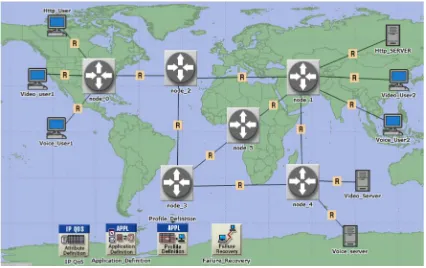
implementation is done for RIP, OSPF and EIGRP routing protocols. To get accurate results the topology has been implemented exactly with the same number of devices (routers, servers and clients). The parameters are convergence time, packet drop, packet end-to-end delay for voice/ video traffic, queuing delay, link utilization and HTTP page response time. Standard application definition, profile definition, IP QoS and failure-recovery has been applied for the voice, video and http traffic for all the three routing protocols i.e. RIP, OSPF and EIGRP. Figure 3 shows the RIP implementation for voice, video and HTTP traffic.
To accomplish more real world statistics, some background traffic has been generated using the demand model of OPNET modeler. The demand model is set in a way that background traffic is running in the whole network between the clients and servers through the routers. For the demand model the parameters set for traffic intensity are 900,000 bits/sec and 900 packets/ sec.
Fig. 3. RIP implementation main topology
5 IMPLEMENTATION
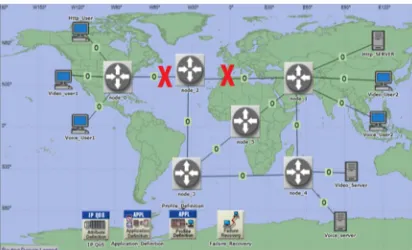
Fig. 4. OSPF Single link flapping topology
Table 1 show the flapping (failure and recovery) timings for the links between node 0 and node 2.
Table 1: Node_0 to Node_2 link failure and recovery
Link 1 (Node 0 to Node 2) Failure and Recovery timings
Time Status
240 Seconds Failure 400 Seconds Recovery 450 Seconds Failure 510 Seconds Recovery 620 Seconds Failure 630 Seconds Recovery 639 Seconds Failure 800 Seconds Recovery 850 Seconds Failure 945 Seconds Recovery
For the second scenario, two links are set to flap between three nodes. The first link is node_0 to node_2 and the second link is node_2 to node_1.
Fig. 5. OSPF multilink flapping between three nodes
Table 2 shows the failure and recovery timings for the second flapping link (Node_2 to Node_1). The failure and recovery timings for the first flapping link are kept the same as the first scenario
and are shown in table 1.
Table 2: Node_2 to Node_1 link failure and recovery
Link 2 (Node_2 to Node_1) Failure and Recovery timings
Time Status
410 Seconds Failure 450 Seconds Recovery 490 Seconds Failure 610 Seconds Recovery 660 Seconds Failure 697 Seconds Recovery 820 Seconds Failure
6 RESULTS AND ANALYSIS
For both scenarios the results have been categorized as follows:
6.1 One Link Flapping Network
6.1.1 Network Convergence time (in seconds)
Figure 6 below shows the network convergence time for all the three routing protocols. From the figure we can observe that EIGRP takes the least amount of time for convergence, followed by RIP and then OSPF.
Figure 6: Network convergence for RIP, OSPF and EIGRP
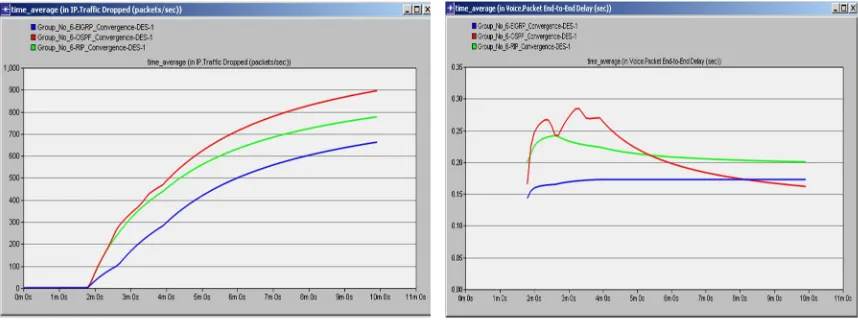
6.1.2 Packet Drop (packets/ sec)
Fig. 7. IP network packets drop
6.1.3 Video Packet end-to-end delay
EIGRP and RIP showed a better performance for the video conferencing packet end-to-end delay as compared to OSPF. This is shown in figure 8 below.
Fig. 8. Video conferencing packet end-to-end delay
6.1.4 Voice packet end-to-end delay
The graph in figure 9 shows a steady performance of EIGRP for voice traffic. In the OSPF network, for a single flapping link the performance initially was not optimal. However, once the network was converged, a significant improvement in the performance is observed.
Figure 9: Voice packet end-to-end delay
6.1.5 HTTP page response time
EIGRP did not show an optimal performance for web browsing. For HTTP traffic the response time of EIGRP network trend to be higher as compared to OSPF and RIP. The HTTP page response time is showed in figure 10 below.
Fig. 10. HTTP page response time
6.1.6 Link Utilization
Fig. 11. Node_0 to Node 2 link utilization
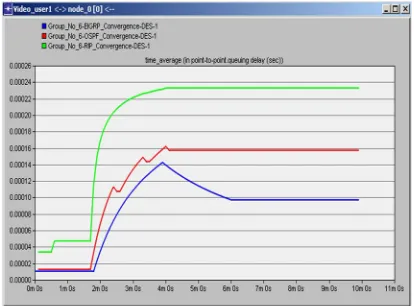
6.1.7 Queuing Delay
We can see from figure 12 that RIP utilized the least amount of links in the topology. This has a direct impact on the queuing delay in links. Figure 12 shows that RIP has the most queuing delay in network as compared to EIGRP and OSPF networks.
Fig. 12. node_0 to video_user1 queuing delay
6.2 Two Links Flapping Network
6.2.1 Network Convergence time (in seconds)
As a network grows in size the chances of network instability also increases. Figure 13 shows the convergence time for RIP, OSPF and EIGRP for multiple instable links. The graph shows that RIP take the most amount of time for network convergence as compared to OSPF and EIGRP for voice and video traffic.
Fig. 13. Network Convergence time two links flapping
6.2.2 Packet Drop (packets/ sec)
The following figure shows the number of packets drop in IP network for two flapping links. The graph shows that RIP has the most number of drop packets in an IP network. OSPF performed the best.
Fig. 14. Packet drop in IP networks two link flapping
6.2.3 Video Packet end-to-end delay
Figure 15: Video conferencing packet end-to-end delay two flapping links
6.2.4 Voice packet end-to-end delay
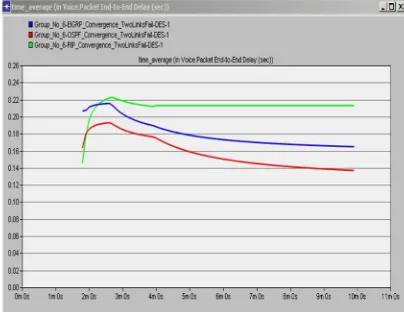
Taking into consideration the voice traffic, OSFP performed best. OSFP has the least end-to-end delay in unstable network for voice traffic. This can be seen in the figure below.
Fig. 16. Voice packet end-to-end packet delay two links
6.2.5 HTTP page response time
RIP and OSPF had a significant edge over EIGRP for the HTTP traffic. Figure 17 shows the performance of EIGRP for web browsing. Initially, the response time is recorded as high but latter on once the network is converged, the HTTP response time becomes stable.
Fig. 17. HTTP page response time two links flapping
6.2.6 Link Utilization
In a network having two flapping links, still OSPF utilized the most number of links in the network. This can be seen in figure 18.
Fig. 18. node_2 to node_0 (incoming traffic)
6.2.7 Queuing delay
Fig. 19. node_0 to node_2 queuing delay (outgoing traffic)
7 COMPARASION OF LINK FAILURE STATISTICS
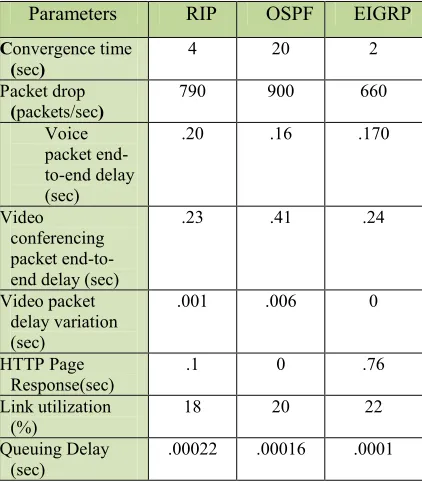
In this section a comparison has been done to see the performance of RIP, OSPF and EIGRP for Voice and Video application. Table 1 and table 2 shows the collected statistics for one and two link flapping respectively.
7.1 Single link flapping
Table 3: One Link Flapping Statistics
Parameters RIP OSPF EIGRP
Convergencetime (sec)
4 20 2
Packet drop (packets/sec)
790 900 660
Voice packet end-to-end delay (sec)
.20 .16 .170
Video conferencing packet end-to-end delay (sec)
.23 .41 .24
Video packet delay variation (sec)
.001 .006 0
HTTP Page Response(sec)
.1 0 .76
Link utilization (%)
18 20 22
Queuing Delay (sec)
.00022 .00016 .0001
7.2 Two links flapping
Table 4: Two Links Flapping Statistics
Parameters RIP OSPF EI
GRP Convergencetime
(sec)
6.7 5 2
Packet drop (packets/sec)
945 700 740
Voice packet end-to-end delay (sec)
.21 .119 .17
Video conferencing packet end-to-end delay (sec)
.225 .26 .245
Video packet delay variation (sec)
.001 .0021 .001
49 HTTP Page
Response(sec)
0 0 2.3
Link utilization (%) 16 68 15 Queuing Delay (sec) .0028 .0026 .001 6
8 CONCLUSION
In this paper the general concepts of most widely used routing protocols i.e. RIP, OSPF and EIGRP are discussed. The concept of voice and video applications is presented in order to understand the performance related issues behind it.
The paper presented a detailed OPNET simulation approach to assess the IP network running RIP, OSPF and EIGRP for support of voice, video and HTTP traffic. The simulation results presented in this paper can help network designers understand how well OSPF and EIGRP perform in unstable links for voice and video traffic. The simulation results are concluded as follows.
The parameters observed for voice traffic were jitter and packet end-to-end delay. From the results it has been noticed that the performance of EIGRP was better as compared to OSPF and RIP for one link failure. But among OSPF and RIP the performance of OSPF was gradually improving in the packet end-to-end delay. When we observed instability in two links, the performance of RIP was the worst in both jitter and packet end-to-end delay as compared to both OSPF and RIP.
In the paper we also observed packet end-to-end delay and packet delay variation for video traffic. From the simulated results we observed that for video traffic OSPF did not perform well in both single flapping link and two flapping links. EIGRP was stable and the performance of RIP was the best amongst the three.
In both, one and two flapping links RIP had the most queuing delay in the network. This resulted in the most number of lost packets. OSPF and EIGRP were considerably the same in terms of queuing delay.
In terms of page response time, this was for the first time that EIGRP performance was worst as compared to both OSPF and RIP. The behavior of RIP and OSPF for page response time was the same.
OSPF outclassed EIGRP and RIP in link utilization. OSPF utilized the most number of links in the network. EIGRP performed better than RIP, while RIP utilized the least number of links in the network.
The conclusion of this research is that for flapping links the performance of EIGRP was stable most of the time. OSPF performance was improved when there were more flapping links in the network. As the network grows in size the performance of RIP becomes worst with respect to convergence time.
9 REFERENCES
[1] Shen Yang, Dai Hao; Qi Qang-dong “Performance comparisons between OSPF and EIGRP in tactical IP networks” (Inst. of Command Autom, PLA Univ. of Sci. & Tech. Nanjing, China); Source: Journal of PLA University of Science and Technology (Natural Science Edition), v 6, n 3, p2 41-5, June 2000. [2] Garcia-Luna-Aceves, J,J.; Zaumen, W.T
“Area-based loop-free internet routing” Source: Proceedings IEEE INFOCOM 94. The Conference on Computer Communications. Networking for Global Communications (Cat. No. 94CH3401-7), 1000-8 vol.3,1994.
[3] Kisten, S. Ping-Tsai Chung.”Analysis and experimentation on dynamic routing protocols:EIGRP and OSPF”(Dept. of Comput. Sci., Long Island Univ., Brooklyn, NY, USA); Source: International Conference on Internet Computing - IC'03, p 591-3 Vol.2, 2003 [4] Thorenoor, S.G. ”Dynamic Routing Protocol
implementation Decision between EIGRP, OSPF & RIP Based on Technical Background
Using OPNET Modeler” (Wipro
Technol.,Bangalore, India) Source:
Proceedings of the 2010 Second International Conference on Computer and Network Technology (ICCNT 2010), p 191-195, 2010 [5] Baranski, J.; Crocker, M.; Lazarou,G.
”Dynamic routing protocol performance in a fault-tolerant Ethernet-based IP network” (Dept. of Electr. & Comput. Eng., Mississippi State Univ., MS, USA Source: The 8th World Multi-Conference on Systemics, Cybernetics and Informatics, p 1-5 Vol. 8, 2004.
[6] Yee, J.R.”On the International routing protocol enhanced interior gateway routing protocols: is it optimal?” (Dept. of Electr. Eng.,Hawaii Univ., Honolulu, HI, USA) Source: International Transactions in Operational Research, v 13, n 3, p 177-94, May 2006 [7] Al-Saud, K.A. Tahir, H.M.; El-Zoghabi, A.A.;
Saleh, M.”Performance evaluation of secured versus non-secured EIGRP routing protocol” (Dept. of CS & Eng., Qatar Univ., Doha, Qatar); Source: Proceedings of the 2008 International Conference on Security & Management (SAM 2008), p 292-7, 2008 [8] Nohl, A.R, Molnar, G “The convergence of the
OSPF routing protocol” (Ericsson Res., Ericsson Hungary Ltd., Budapest, Hungary); . Source: Periodica Polytechnica Electrical Engineering, v 47, n 1-2, p 89-100, 2002 [9] Chuanqiang Zhao, Yuanan Liu; Kaiming Liu
“A more efficient diffusing update algorithm for loop-free routing” (Sch. of Electron. Eng., Beijing Univ. of Posts & Telecommun., Beijing, China); Source: Proceedings of the 2009 5th International Conference on Wireless Communications, Networking and Mobile Computing (WiCOM), p 4 pp., 2009
[10]Talal Mohamed Jaffar, “Simulation-Based Routing Protocols Analysis (Thesis)” Ph.D. Dept. Elect. Eng., Georgia Institute of Technology, 2007
[11]Xianhui Che, Lee J. Cobley , “VoIP Performance over Different Interior Gateway Protocols”, Faculty of Applied Design and Engineering, Swansea Metropolitan University
Swansea,SA16ED,UK{xianhui.che; lee.j.cobley}@smu.ac.uk
[12]Rick Graziani and Allan Jonson, “Routing protocols and concepts: CCNA exploration companion guide” Pearson Education. London,2008.
[13]Javvin network management and security. “IS-IS: Intermediate System to Intermediate
system routing_protocol”
http://www.javvin.com/protocolOSPF.html [14]Todd Lammle, “Cisco Certified Network
Associate” 5th edition, 2005
[15]Cisco “OSPF Design Guide”
http://www.cisco.com/en/US/tech/tk365/techno logies_ White_paper09186a0080094e9e.shtml [16]“Introduction to OPNET Simulator”
http://bolero.ics.uci.edu/~
ypan/OPNET/Introduction%20to%20OPNET %20 simulator.pdf
[17]Esuendale Lemma; Syed Hussain;
Wendwossen Anjelo; “Performance
Comparison of EIGRP/ IS and OSPF/
IS-IS” Blekinge Tekniska Hogskolan.
Sweden,2010
[18]Jagdeep Singh and Dr. Rajiv
Mahajan,"Simulation Based Comparative Study Of RIP, OSPF and EIGRP", International Journal of Advanced Research in Computer Science and Software Engineering, Volume 3, Issue 8, August 2013.
AUTHOR PROFILES:
Arsalan Iqbal received his Masters degree in Computer Science with distinction from University of Peshawar, Pakistan in 2006. He received Masters of Engineering (M.Eng) degree in Computer Networks from Ryerson University, Toronto, ON, Canada in 2014. He holds reputable international recognized certifications which include CCNP(R&S), CCNP (DC), CCDP, VCP-DCV (VMware), MCP (Microsoft), BCEFP (Brocade) and SCP (Solarwinds). He is currently working as an infrastructure support technologist, Georgian College, Barrie, Canada. Along with extensive industry experience he is an active researcher on emerging technologies and his current research interests include Cloud Computing, Data Center Networking, Storage Area Networking and Virtualization.
Sameer Khan received Masters of Engineering (M.Eng) degree in Computer Networks from Ryerson University, Toronto, ON, Canada in 2014. He achieved well known and competitive certifications that include
CCNP (Routing &