Original Research Article
Assessment of cardiovascular risk among diabetic patients in an urban
area of Kancheepuram district, India: a cross sectional study
Mareeswaran N., R. Umadevi, A. K. Savitha*
INTRODUCTION
Diabetes mellitus is a chronic disease that occurs when the pancreas is no longer able to produce insulin or when the body is unable to make use of the insulin produced.1 Based on a multi centric survey done by Indian Council of Medical Research (ICMR) thirty years ago, the prevalence of diabetes mellitus was around 2% in urban and 1% in rural India. Within a span of three decades the prevalence rates have raised to 12-16% in Urban and 3-8% in Rural India.2
Diabetes mellitus is an “Iceberg disease” which is characterized by a state of chronic hyperglycemia,
resulting from a multifactorial etiology which includes genetic factors and environmental factors like obesity, low living standard, steady urbanization and life style changes.3 There are two major types of diabetes mellitus namely type 1 and type 2. Type 1 diabetes mellitus results from the destruction of insulin producing cells in the pancreas. This is an autoimmune process usually, but not always associated with detectable auto antibodies to the components of beta cells. Type 2 diabetes mellitus accounts to about 85-95% of all diabetes, which results from the combination of insufficient production of insulin and increased resistance to the action of insulin. Gestational diabetes is the other common type of diabetes that is detected for the first time during pregnancy.
ABSTRACT
Background: Diabetes mellitus is a major public health problem. Non communicable diseases like coronary artery disease (CAD), stroke, obesity are increasing in number and overtakes the communicable diseases with respect to morbidity and mortality. Diabetic populations have a higher risk of developing CAD than the general population. The aim of this study was to assess the risk of developing cardiovascular diseases among diabetic patients.
Methods: This is a cross sectional study done among the urban adult population in Kancheepuram district. Sample size of 400 diabetic patients was studied by using consecutive sampling method. Data was collected by administering a pre tested structured questionnaire. Cardiovascular risk was assessed based on PROCAM scoring, a 10 years risk assessment score. The study was done for a period of three months from January to March 2018. Data analysis was done in SPSS software version 22.
Results: Among the diabetic patients, 53.5% of them are in high risk category based on PROCAM score for developing cardiovascular disease. A statistical significant association was found between cardiovascular risk and factors like socioeconomic status and overweight/obesity.
Conclusions: This study reveals that the diabetic populations are at higher risk of developing cardiovascular diseases. Hence awareness about the risk should be created and appropriate intervention at early stages should be implemented at primary health care level.
Keywords: Obesity, PROCAM, Socioeconomic status, Type 2 diabetes mellitus
Department of Community Medicine, Sree Balaji Medical College and Hospital, Kanchipuram, Tamil Nadu, India
Received: 19 June 2018
Accepted: 25 July 2018
*Correspondence:
Dr. A. K. Savitha,
E-mail: [email protected]
Copyright: © the author(s), publisher and licensee Medip Academy. This is an open-access article distributed under the terms of the Creative Commons Attribution Non-Commercial License, which permits unrestricted non-commercial use, distribution, and reproduction in any medium, provided the original work is properly cited.
Gestational diabetes is associated with obesity and sedentary lifestyle. It typically resolves after delivery.4
Globally 422 million adults were living with diabetes in 2014. Around half of the prevalence is from the South East and Pacific regions. It is the eighth leading cause of death among both sex and the fifth leading cause of death in women in 2012.5 The total burden of death from high blood glucose in 2012 has been estimated to be 3.1 million in which 1.5 million deaths were due to diabetes and its complications only and 2.2 million deaths were due to co morbidities of diabetes such as cardiovascular diseases, chronic kidney disease and tuberculosis5. Forty-three percent of all the deaths are due to high blood sugar after the age of 70. Globally, the diabetic prevalence among adults over 18 years of age had a rapid increase from 4.7% in 1980 to 8.5% in 2014.6 According to Wild et al statement in 2006, the global prevalence of diabetes is 171 million and will reach 366 million by the next 25 years, but we had reached 422 million within a span of eight years from 2006.7
India has the highest proportion of more than 62 million people living with diabetes and had become the “Diabetes Capital of the World”.6
Indian Council of Medical Research preliminary results on a large community based study shows that a smaller proportion of the population is affected from North-Indian states like Jharkhand and Manipur when compared to Maharashtra and Tamilnadu.7
In Tamil Nadu, the prevalence rates of diabetes mellitus is 10.4% which is the second highest in India and stands next to Chandigarh which is 13.4%.8 Chennai had the prevalence of around 2.9% and the prevalence rates tends to be higher when the age was standardized, which shows 10% prevalence when age is more than 40 years.9
The complications of diabetes mellitus are classified into
microvascular and macrovascular. Microvascular
complications include diabetic retinopathy, neuropathy, nephropathy and diabetic foot disorders. Macrovascular complications includes cardiovascular diseases (CVD) and stroke. There is increased risk of CVD mortality in diabetic patients in both sexes.10 There is evidence suggestive of 1 to 3 times and 2 to 5 times higher risk for CVD mortality and morbidity in men and women with known diabetes respectively.10 Chennai Urban population study shows the prevalence of cardiovascular diseases in Chennai is around 11% in 2010, which is 10 times higher when compared to 1970, this may be due to the grouping of risk factors like hyperglycemia, central obesity, dyslipidemia and systemic hypertension.11
Hence this study was conducted to assess the cardiovascular risk among diabetic population. There are many standard scorings to assess the cardiovascular risk namely Framingham score, PROCAM score, SCORE,
PROCAM (Prospective Cardiovascular Munster) risk score
This scoring helps to assess the risk among individuals in developing cardiovascular diseases in a span of 10 years. The calibrated risk score includes age, history of diabetes, LDL cholesterol, smoking, HDL cholesterol, systolic blood pressure, family history of premature myocardial infarction and triglycerides which are considered in calculating the risk.
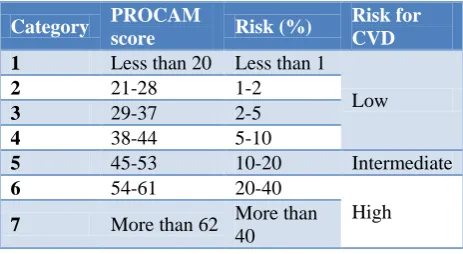
A score below 10% is considered as low risk, 10%-20% as intermediate risk and more than 20% is considered as high risk for developing cardiovascular diseases(Table 1).12
Table 1: Scoring to assess cardiovascular risk among study participants.
Category PROCAM
score Risk (%)
Risk for CVD
1 Less than 20 Less than 1
Low
2 21-28 1-2
3 29-37 2-5
4 38-44 5-10
5 45-53 10-20 Intermediate
6 54-61 20-40
High
7 More than 62 More than
40
METHODS
Study design
This study is a hospital based cross sectional descriptive study.
Study area
This study was carried out in the diabetic outpatient department attached to a medical college and hospital in Kancheepuram district, Tamil Nadu.
Study population
All patients attending diabetic outpatient department of the medical college and hospital for two months from January to February 2018.
Study period
The study was carried out for three months from January to March 2018.
precision of 3.5% and with 10% non-response rate, the sample size was calculated as 378. The final sample size was rounded off to 400. The sampling method used to select the study participants was consecutive sampling. Every successive diabetic patient attending the outpatient department was interviewed until the desired sample size achieved.
Data collection
Data was collected using a pre tested structured questionnaire consisting of socio-demographic profile and PROCAM scoring indicators which includes risk factors such as tobacco use, family history of diabetes, family history of premature myocardial infarction, systolic blood pressure and lipid profile. All the blood
parameters were recorded from recently taken
investigation reports available with the study participants.
Informed consent
Informed consent was obtained from the participants in the local language (Tamil) after explaining to them the objective of the study in detail.
Inclusion criteria
The inclusion criteria for including participants in the study were known patients of type 2 diabetes mellitus who attended the diabetic out-patient and who consented to participate in the study.
Exclusion criteria
The exclusion criteria for not including the individuals in the study were those patients who were not willing to give consent to participate in the study and patients with known case of cardiovascular diseases.
Statistical analysis
Data analysis was done using the software SPSS version 22. The data analysis was done using descriptive and analytical statistics. The descriptive statistics analyzed were presented as frequency distribution and percentage. The analytical statistics used were Chi–square and P value <0.05 was considered as statistically significant value.
RESULTS
Table 2 shows the socio demographic profile of the study population. In this study, 50.5% (202) males and 49.5% (198) females were included. Almost 83.5% (334) of the study participants belong to middle class (upper middle, middle, lower middle). Around 66% (264) of the participants were overweight and 22% (88) of them were obese as per their body mass index.
Table 3 shows the association between the determinants like gender, socio-economic status and BMI (Body Mass Index) with the cardiovascular risk based on PROCAM scoring. Among 400 study participants, 73.2% (145) females were at high risk for cardiovascular diseases when compared to males as per PROCAM score. But this association was not statistically significant. Almost 45% (180) participants belong to upper socio-economic class and are at high risk for cardiovascular diseases, when compared to participants who belong to lower socio economic status. (x2=25.2, p=0.001). Among the study participants, 52% (210) were overweight/ obese and are at high for developing cardiovascular diseases when compared to individuals with normal BMI as per PROCAM scoring. (x2=35.7, p=0.001).
Table 2: Socio - demographic characteristics of the study participants.
S. No Characteristics Frequency Percentage (%)
1
Gender
Male 202 50.5
Female 198 49.5
2
Socio-economic status (modified Kuppusamy scale- 2017)
Upper class 44 11
Upper-middle class 120 30
Middle class 130 32.5
Lower middle class 84 21
Lower class 22 5.5
3
Body mass index (BMI)
Normal 66 16.5
Overweight 264 66
Table 3: Association between the determinants and cardiovascular risk of the study participants
S. No Determinants
Cardiovascular risk
Chi-square
test P value
Low risk (Category 1 to 4) (%)
High risk (Category 5 to 7) (%)
1
Gender
1.264 0.261
Female 53 (26.8) 145 (73.2)
Male 133 (66) 69 (34)
2
Socio-economic Status
25.257 0.0003
Upper 114 (28.5) 180 (45)
Lower 72 (18) 34 (8.5)
3
Body mass index
35.752 0.00052
Normal 62 (15.5) 4 (1)
Overweight/Obese 124 (31.25) 210 (52)
P value less than 0.05 is significant.
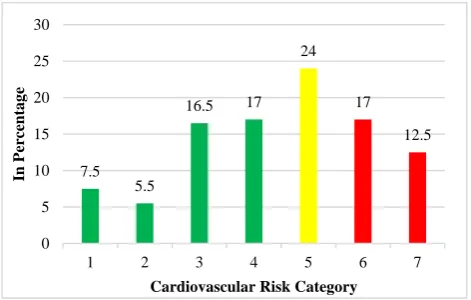
Figure 1: Distribution of study participants into cardiovascular risk categories as per PROCAM score.
Figure 1 shows the distribution of study participants into various categories of cardiovascular risk as per PROCAM score. Almost all the study participants who were diabetic are at risk of developing cardiovascular complications. This figure shows nearly 29.5% of study populations are at high risk (Category 6, 7) and 24% of the study populations are at an intermediate (Category 5) risk of developing cardiovascular complications.
DISCUSSION
This study was conducted to assess the cardiovascular risk among diabetic patients visiting a medical college hospital. There are many standard scorings to assess the risk and in this study, PROCAM scoring was used. Based on the scoring the study participants who were known diabetic patients were categorized to be of low, intermediate and high risk of developing cardiovascular complications. This study shows around 29.5% of the study population are at high risk of developing cardiovascular complications.
This study shows that females have higher chance of
Möller-Leimkühler.10,13 The former study shows that there is three to five fold increased risk of developing cardiovascular risk among the female population.
In this study there is a statistically significant association between body mass index and cardiovascular risk. The overweight population in this study was around 81% which is comparable with the findings of another study done by Tripathi et althat shows around 73.3% of them were overweight.14 Such similar association between BMI and diabetes was found in other studies done by Tripathy et al and Ravikumar et al.14,15 Obesity is a co morbid condition and itself is a modifiable risk factor for
developing non communicable diseases like
hypertension, cardiovascular diseases and diabetes mellitus due to poor lifestyle conditions.
This study shows that participants who belong to upper socio-economic status had higher risk of developing cardiovascular complications. The results of this study are consistent with other studies done by Corsi and Subramanian which shows that people belonging to upper socio economic class in India appear to be at greatest risk for type 2 diabetes.16 The probable reason could be the lifestyle changes that include sedentary lifestyle,
unhealthy food habits, cigarette smoking and
consumption of alcohol which is more common among the higher socio economic group having such lifestyle.
This study shows that 53.5% of the study participants are on high and intermediate risk categories for developing cardiovascular disease which is similar to the study done by Garg et al who used Framingham risk score and showed that 51.9% were on high risk of developing the same.17
CONCLUSION
This study done among 400 diabetic patients in an urban area in Kancheepuram district shows that 29.5% of them 7.5
5.5
16.5 17
24
17
12.5
0 5 10 15 20 25 30
1 2 3 4 5 6 7
In Perce
ntag
e
epidemiological transition and though national health programs are implemented to combat the burden through various interventions, more emphasis on awareness creation for early detection and periodical follow up is vital to prevent the complications.
ACKNOWLEDGEMENTS
I would like to thank my department and my college management for supporting me to do this study. I would also like to extend my thanks to our department HOD & Professor Dr. R. Umadevi, and my Assistant professor Dr. A.K. Savitha for guiding me throughout the study. A special mention to the HOD of Diabetology department in Sree Balaji Medical College and Hospital, for helping me to complete the study.
Funding: No funding sources Conflict of interest: None declared Ethical approval: Not required
REFERENCES
1. International Diabetes Federation. Belgium: About Diabetes; cited 2017. Available at: https://www. idf.org/about-diabetes/what-is-diabetes.html. Accessed on 7 February 2018.
2. Tripathy BB, Chandalia HB, Das AK. RSSDI
textbook of diabetes mellitus. JP Medical Ltd; 2012. 3. Park K. Park’s textbook of preventive and social medicine. 24th ed. Jabalpur: M/s Banarasidas. Bhanot Publishers; 2017.
4. Detels R, Holland WW, Knox GE, editors. Oxford textbook of public health. Sixth edition. New York: Oxford University Press; 2015.
5. Switzerland. World Health Organization. Global report on diabetes. Geneva: World Health Organization; 2016. Available at http://apps. who.int/iris/bitstream/handle/10665/204871/978924 1565257_eng.pdf;jsessionid=88CA54124215CE7A 313838F130CAD13F?sequence=1. Accessed on 7 February 2018.
6. Hariharan S, Umadevi R, Stephen T, Pradeep S. Burden of diabetes and hypertension among people attending health camps in an urban area of Kancheepuram district. Int J Community Med Public Health. 2017;5(1):140-3.
7. Kaveeshwar SA, Cornwall J. The current state of diabetes mellitus in India. Australas Med J. 2014;7(1):45.
8. Anjana RM, Deepa M, Pradeepa R, Mahanta J, Narain K, Das HK, et al. Prevalence of diabetes and prediabetes in 15 states of India: results from the
ICMR–INDIAB population-based cross-sectional study. Lancet Diabetes Endocrinol. 2017;5(8):585-96.
9. Asha PB, Murthy BN, Chellamariappan M, Gupte MD, Krishnaswami CV. Prevalence of known diabetes in Chennai City. J Assoc Physicians India. 2001;49:974-81.
10. Leon BM, Maddox TM. Diabetes and
cardiovascular disease: Epidemiology, biological mechanisms, treatment recommendations and future research. World J Diabetes. 2015;6(13):1246.
11. Mohan V, Venkatraman JV, Pradeepa R.
Epidemiology of cardiovascular disease in type 2 diabetes: the Indian scenario. J Diabetes Sci Technol. 2010;4(1):158-70.
12. The Calculator. Health; PROCAM score for
Cardiovascular risk Calculator. Available from https://www.thecalculator.co/health/PROCAM- Score-For-Cardiovascular-Risk-Calculator-985.html. Accessed on 6 June 2017.
13. Möller-Leimkühler AM. Gender differences in cardiovascular disease and comorbid depression. Dialogues Clin Neurosci. 2007;9(1):71.
14. Tripathy JP, Thakur JS, Jeet G, Chawla S, Jain S, Pal A et al. Prevalence and risk factors of diabetes in a large community-based study in North India: results from a STEPS survey in Punjab, India. Diabetol Metabol Syndrome. 2017;9(1):8.
15. Ravikumar P, Bhansali A, Ravikiran M, Bhansali S, Walia R, Shanmugasundar G et al. Prevalence and risk factors of diabetes in a community-based study in North India: the Chandigarh Urban Diabetes Study (CUDS). Diabetes Metabol. 2011;37(3):216-21.
16. Corsi DJ, Subramanian SV. Association between socioeconomic status and self-reported diabetes in India: a cross-sectional multilevel analysis. BMJ open. 2012 Jan 1;2(4):e000895.
17. Garg N, Muduli SK, Kapoor A, Tewari S, Kumar S, Khanna R, et al. Comparison of different
cardiovascular risk score calculators for
cardiovascular risk prediction and guideline
recommended statin uses. Indian Heart J.
2017;69(4):458-63.
Cite this article as: Mareeswaran N, Umadevi R, Savitha AK.Assessment of cardiovascular risk among diabetic patients in an urban area of