Original Research Article
Knowledge, attitude, practice and learning needs of nursing personnel
related to domestic violence against women: a facility
based cross sectional survey
Kamlesh Kumari Sharma
1*, Manju Vatsa
1, Mani Kalaivani
2, Daya Nand Bhardwaj
3INTRODUCTION
“Violence against women is a manifestation of historically unequal power relations between men and women. The term ‘domestic violence’ (DV) includes violence against women and girls by an intimate partner, including a cohabiting partner, and by other family members, whether this violence occurs within or beyond the confines of the home.1,2 Domestic violence is a global
issue reaching across national boundaries as well as socio-economic, cultural, racial and class distinctions.3-7 Globally 20 to 50 percent women continue to suffer from domestic violence.1 In India, the third National Family Health Survey (NFHS-3) shows that at least 37.2% ever-married women have ever experienced spousal violence.8 Domestic violence against women, DVAW is widely recognized as an important public health problem having
ABSTRACT
Background: Domestic violence against women (DVAW) is widely recognized as a public health problem. In India, health sector response to DVAW is suboptimal. Present study aimed to assess the knowledge, attitude, practice and learning needsof nursing personnel regarding women’s health issues related to domestic violence.
Methods: This facility based cross sectional study was carried out among 100 nursing personnel from Public sector in Delhi, selected using stratified random sampling. Data were collected using a validated, pretested, structured self reported questionnaire with a few open ended questions. It included knowledge, attitude, practice and learning needs of nursing personnel relevant to DV. Descriptive statistics were used for data analysis using Stata 11.0 (College Station, Texas, USA).
Results: Two third of nursing personnel (67%) had moderate knowledge scores and 27% had poor knowledge scores; 19% had favourable attitude scores towards DV; 57% had good practice scores; 44% reported moderate to high need for learning and majority lacked preparedness to manage DV victims. The knowledge was significantly associated with younger age, single, graduate/ Post graduates, B.Sc. Nursing degree holders, working in tertiary hospital, as staff nurse/public health nurse/sister in charge and those with lesser experience, (p<0.05). The attitude was significantly associated with younger age, single, graduate/post graduates, and those with lesser experience, (p<0.05).
Conclusions: Nursing personnel had substantial gap in their knowledge, attitude and practice related to DV and a large unmet learning need highlighting the need for relevant pre service and continuing education.
Keywords: Domestic violence, Nursing personnel, Knowledge, Attitude, Practice,Learning needs,Preparedness
1
College of Nursing, 2Department of Biostatistics, 3Department of Forensic Medicine, All India Institute of Medical Sciences, New Delhi, India
Received: 08 October 2017
Revised: 21 January 2018
Accepted: 23 January 2018
*Correspondence:
Dr. Kamlesh Kumari Sharma, E-mail: [email protected]
Copyright: © the author(s), publisher and licensee Medip Academy. This is an open-access article distributed under the terms of the Creative Commons Attribution Non-Commercial License, which permits unrestricted non-commercial use, distribution, and reproduction in any medium, provided the original work is properly cited.
far-reaching physical, gynaecological and psychological consequences, some with fatal outcomes.1 Women who reported poor health are more likely to report violence and vice versa.9 Studies also indicates that 30% to 45% of the victims required medical care.9,10
Most services currently available for victims of DV are on the legal front. The main focus is on the secondary and tertiary levels of prevention. There is a lack of public health-oriented approach. Health providers need to be sensitive to the needs of the victims of domestic violence.11
A nurse-midwife may be one of the first professionals DV victims talk to about the abuse. They have a special opportunity to identify, intervene, and support victims of domestic violence.12 Some nurses may have the barrier of personal abuse preventing them from responding to their abused patients.13 In a pilot study in Delhi it was found that prevalence of physical, psychological, sexual violence against nurses by their marital partners was 43.3%, 65% and 30% respectively.14
For effective role implementation, nurses need to be competent, especially in addressing the reluctance of abused women to seek help. The evidence regarding knowledge, attitude and practices of nursing personnel across different settings is inconsistent.13,15-21 globally and is very scarce nationally.22 The present study sought to assess the knowledge, attitude, practice and learning needs of nursing personnel regarding women’s health issues related to domestic violence; and to study their association with demographic characteristics of nursing personnel.
METHODS
This facility based cross -sectional survey was carried out among nursing personnel [public health nurses (PHNs), ward in-charges, staff nurses, lady health visitors (LHV) and auxiliary nurse midwives (ANMs)] working in selected public health care institutions in Delhi, India.
Stratified random sampling technique was used to sample 100 nursing personnel, 25 each from randomly selected three primary health centres (PHCs), three maternal and child welfare (M&CW) centres/units, one general hospital and one tertiary hospital in the National Capital Territory (NCT), Delhi. Nursing personnel who were available in the study setting, understood Hindi or English and consented to participate were enrolled in the study.
The outcome measures included knowledge, attitude, practices and perceived learning needs of nursing personnel regarding women’s health issues related to domestic violence against women (DVAW).
Data were collected on one to one basis from September 2010 to December 2011 using a validated, pretested, structured self administered questionnaire with a few
open ended questions. It included items on demographic profile of nursing personnel and their knowledge, attitude, practice and learning needs. The knowledge questionnaire had 96 items; 88 structured (Yes/ No) and 8 open ended. The correct responses were scored as 1 and incorrect ones as 0. The overall knowledge score was further calculated by just summing up the correct responses and was divided into three categories namely, good (score: >67 (>75%)), moderate (score: 4566 (50 -75%)) and poor (score : <44 (<50%)) knowledge.
Attitude was assessed using a 28 item Attitude scale, rated on a 5-point scale from strongly agree to strongly disagree scored from 5 to 1 respectively. Maximum score was 140. The overall attitude score was further calculated by just summing up the correct responses and was divided into three categories namely favorable (score >84 (>60%)), neutral (score 57-84 (40-60%)) and unfavorable (score <55 (<40%)) attitude.
The practice scalehad 31 items. Of these 16 items were rated on a 3-point scale ranging from almost always or always to seldom or never and scored from 3 to 1 respectively. For analysis, due to low number of answers to some answer alternatives, these 16 items were dichotomised into two groups, always/sometimes and never and scored as 1 and 0 respectively. The remaining 15 items were yes/ no items, scored as 1 and 0 respectively. The total score was 31. The overall practice score was further calculated by just summing up the correct responses and was divided into three categories namely good (score >20 (>60%)), fair (score 13- 19 (40- 60%)) and poor (score <12 (<40%)) practice.
The learning needs scale included 19 items. First 17 items pertaining to perceived level of confidence and learning needs of nursing personnel in identification and management of health issues of women experiencing DV were rated on a 3-point scale ranging from confident/no need to learn to not confident/need to learn and scored from 3 to 1 respectively. Thus the total score was 51. In addition there were 2 other yes/no items on preparedness of nursing personnel i.e. availability of resources/ training to identify and manage victims of domestic violence. The overall learning need score was further calculated by just summing up the correct responses and was divided into three categories namely low need (score >32 (>60%)), moderate need (score 21-31 (40- 60%)), and high need (score <20 (<40%)).
Ethical clearance for the study was obtained from The Institutional Ethics Committee. Permission was obtained from the respective authorities of health care institutions for data collection. Written informed consent from nursing personnel was obtained based on Participant information sheet. Confidentiality and privacy of study subjects was ensured.
RESULTS
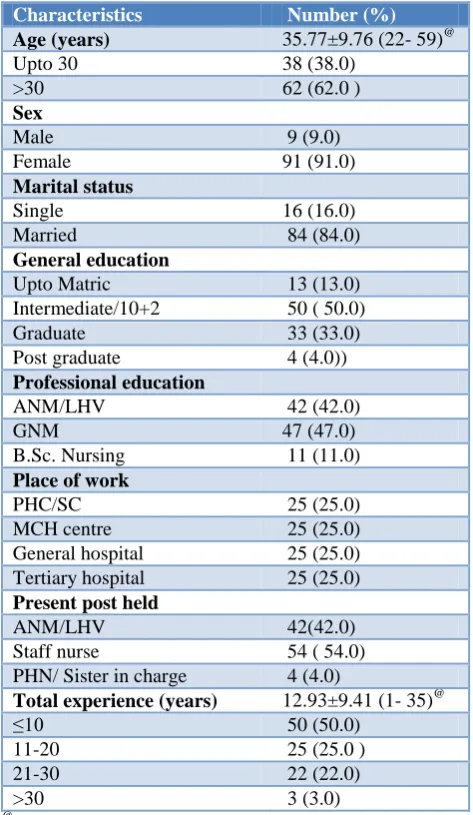
There was 100% response rate of the target population of 100 nursing personnel approached. The mean age of the participants was 35.7±9.7 (22-59) years, 62% being over 30 years age. As per the study design, a quarter (25%) of the nursing personnel worked in PHCs, M&CW centre/unit, general hospital and tertiary hospital each. Majority of the participants were females (91%) and were married (84%). At the time of data collection, 42% worked as ANM/LHV, 54% as staff nurses and merely 4% as public health nurse or Sister in charge (Table 1).
Table 1: Demographic characteristics of nursing personnel (n=100).
Characteristics Number (%) Age (years) 35.77±9.76 (22- 59)@
Upto 30 38 (38.0)
>30 62 (62.0 )
Sex
Male 9 (9.0)
Female 91 (91.0)
Marital status
Single 16 (16.0)
Married 84 (84.0)
General education
Upto Matric 13 (13.0)
Intermediate/10+2 50 ( 50.0)
Graduate 33 (33.0)
Post graduate 4 (4.0))
Professional education
ANM/LHV 42 (42.0)
GNM 47 (47.0)
B.Sc. Nursing 11 (11.0)
Place of work
PHC/SC 25 (25.0)
MCH centre 25 (25.0)
General hospital 25 (25.0)
Tertiary hospital 25 (25.0)
Present post held
ANM/LHV 42(42.0)
Staff nurse 54 ( 54.0)
PHN/ Sister in charge 4 (4.0)
Total experience (years) 12.93±9.41 (1- 35)@
≤10 50 (50.0)
11-20 25 (25.0 )
21-30 22 (22.0)
>30 3 (3.0)
@
Data presented as mean± SD (min- max)
Knowledge
Overall mean knowledge score of nursing personnel was 0.62±0.11 (0.60-0.64) (Figure 1). It was found that two third of nursing personnel (67%) had moderate knowledge, and over one fourth (27%) had poor knowledge (Figure 2).
Figure 1: Bar graph showing the domain wise mean knowledge of nursing personnel regarding health issues related to DVAW (Error bars showing the
standard deviation).
Domain 1: Definition, magnitude & pattern of DV; Domain 2: Causes & Consequences of DV; Domain 3: Management of DV; All: Domain 1+ Domain 2+ Domain 3.
Figure 2: Bar graph showing the knowledge, attitude, practice and leaning need grades of nursing personnel regarding health issues related to DVAW (n=100).
Attitude
Overall mean attitude score of nursing personnel was 3.50±0.50 (2.30-4.58) (Table 2), with 19% of them having favourable attitude, while majority (79%) remained neutral (Figure 2).
But the response of subjects in individual items regarding attitude towards domestic violence was not consistent. Majority of nursing personnel agreed that all families are vulnerable to violence against women (74%), nurses need to know the nursing care of health problems related to DVAW as well as its other aspects (85%). Most participants believed that nurses should identify signs of DV inflicted on women clients/ patients and report (76%), nursing management of health issues related to DV would improve physical and psychological health status of women (89%) and that nurses must educate women suffering from DV to report to appropriate agencies to seek justice/ guidance (87%). Most of them also agreed that there should be routine screening of women for violence related injuries and trauma (70%), screening for DV should be mandatory/a must during
0.4 0.45 0.5 0.55 0.6 0.65 0.7 0.75 0.8 0.85 0.9
Domain 1 Domain 2 Domain3 All
M
ea
n
Kn
o
w
le
d
g
e
sco
re
nnn= 100
0 50 100
Knowledge Attitude Practice Learning
Need
Pe
rc
en
ta
g
e
history taking (77%), health facilities should have a protocol for handling cases of DV (77%) and that care
currently given to victims of DV by health personnel is not adequate (64%).
Table 2: Domainwise attitude scores of nursing personnel regarding domestic violence against women, DVAW (n=100).
Domains of DV Items Chronbach alpha Attitude Scores Mean±SD (min- max) 1: Definition, magnitude and pattern 2.1- 2.4, 2.6, 2.27, 2.28 0.55 3.4±0.58 (2- 4.7)
2: Causes and consequences 2.17, 2.18 0.65 3.6± 0.85 (1.5- 5)
3: Management 2.5, 2.7- 2.16, 2.19- 2.26 0.75 3.3 ±0.47 (0.23- 4.46)
All : 1 +2+ 3 2.1 – 2.28 0.80 3.50±0.50 (2.30- 4.58)
Table 3: Domain wise learning need scores of nursing personnel regarding domestic violence against women DVAW (n=100).
Domains of DV Items Chronbach alpha Learning need scores Mean ± SD (min- max) 1: Definition, magnitude & pattern 6.1, 6.2 0.78 1.7±0.64 ( 1- 5)
2: Causes and consequences 6.3, 6.4, 6.5 0.71 2.1±0.50 (1- 3)
3: Management 6.6- 6.17, 7.1, 7.2 0.70 1.8±0.56 (1- 3)
All : 1 +2+ 3 6.1- 6.17, 7.1, 7.2 0.79 1.9±0.33 (1-2.65)
Table 4: Association of knowledge, attitude, practice and learning need scores of nursing personnel regarding DVAW with their demographic characteristics (n=100).
Demographic characteristic
Overall scores
Knowledge Attitude Practice Learning need
Mean±SD Mean±SD Mean±SD Mean±SD
Age (years)
Upto 30 0.65±0.11 3.65±0.51 0.63±0.16 2.00±0.34
>30 0.60±0.12 3.40±0.47 0.64±0.13 1.88±0.32
P value 0.038* 0.015* 0.587 0.099
Sex
Male 0.69±0.09 3.57±0.50 0.64±0.18 2.12±0.31
Female 0.61±0.11 3.49±0.50 0.64±0.14 1.91±0.33
P value 0.057 0.635 0.989 0.072
Marital status
Single 0.69±0.08 3.73±0.49 0.60±0.16 2.05±0.42
Married 0.61±0.12 3.45±0.49 0.64±0.14 1.90±0.31
P value 0.017* 0.045* 0.305 0.105
General education
Upto Matric 0.54±0.13 3.30±0.47 0.62±0.11 1.82±0.35
Intermediate/10+2 0.63±0.10 3.38±0.50 0.64±0.15 1.96±0.30
Graduate/ Post graduate 0.64±0.12 3.72±0.45 0.63±0.14 1.92±0.37
P value 0.033* 0.002* 0.876 0.417
Professional education
ANM/LHV 0.58±0.11 3.42±0.50 0.66±0.11 1.90±0.34
GNM 0.64±0.11 3.51±0.51 0.63±0.17 1.93±0.32
B.Sc. Nursing 0.70±0.09 3.74±0.43 0.58±0.11 2.03±0.36
P value 0.0009* 0.176 0.207 0.491
Place of work
PHC/SC 0.62±0.13 3.47±0.54 0.67±0.13 2.03±0.35
MCH centre 0.56±0.10 3.41±0.50 0.65±0.10 1.87±0.34
General hospital 0.63±0.10 3.48±0.46 0.61±0.18 1.82±0.29
Tertiary hospital 0.67±0.11 3.64±0.50 0.62±0.4 1.99±0.32
Demographic characteristic
Overall scores
Knowledge Attitude Practice Learning need
Mean±SD Mean±SD Mean±SD Mean±SD
Present post held
ANM/LHV 0.58±0.11 3.42±0.50 0.66±0.11 1.90±0.34
Staff nurse/ PHN/ Sister in charge 0.65±0.11 3.55±0.50 0.62±0.16 1.95±0.33
P value 0.0008* 0.204 0.157 0.433
Total experience (years)
≤10 0.7±0.10 3.6±0.49 0.6±0.16 2.0±0.33
11-20 0.6±0.12 3.4±0.43 0.6±0.12 1.9±0.24
>20 0.6±0.11 3.3±0.51 0.7±0.12 1.9±0.41
P value 0.006* 0.009* 0.414 0.297
Chi-square/Fisher’s exact test/ANOVA as appropriate.
However, 43% nurses believed that screening women for DV related health problems will become an extra burden for nurses. Majority of nursing personnel agreed that DV against women is a social problem and not a public health problem (71%). Over one third of the participants (36%) agreed that prevalence of DV among woman patients is very rare. Majority of the nurses either agree or remain neutral to the statement that they feel very anxious if they have to ask about history of DV (54%), dealing with DV is not a nurse’s job (55%), nurses do not have time to address DV cases (62%), asking about violence will upset the patient/ victim (73%), and will lead to many legal problems (56%).
Practice
The self reported mean practice score of nursing personnel was 0.64±0.14 (0.61-0.66); 57% had good practice, 33% had fair practice and 10% had poor practice (Figure 2).
It was reported that 52%-54% of the nurses sometimes/ never asked about DV on seeing a woman patient with injury, depression or anxiety. Majority of the nurses (60%-88%) sometimes/ never asked about DV on seeing a woman patient with sleeping problems, chronic pelvic pain, headache, irritable bowel syndrome, unexplained intrauterine growth restriction (IUGR), premature labor, lack of prenatal care, a history of attempted suicide or suicidal thoughts, if woman were too weak/ too thin or extremely obese, display of socially unacceptable sexual behavior, and having difficulty with or avoiding pelvic examination.
Over two third (68%) of the participants ever identified an abused woman, 44% identified at least one abused woman in the past one year and 31% ever identified a perpetrator.
When asked if they would take specific probable actions on identifying a DV victim, majority (61% -90%) answered in the affirmative that they would maintain confidentiality, reassure the woman that DV is not her fault, ask about children’s safety, (if having children), provide information and telephone numbers for local
resources, help the woman begin planning for safety, and schedule a follow up visit. A little over half of them agreed that they would explore for past violence (51%) and acknowledge / validate her feeling of shame, anger, fear, depression (54%). But some reported that they would direct the partner to remain in the examination room (55.7%), would provide treatment only for injuries (52%) and would tell the woman that beating the wife is a husband’s legal right (89%).
Learning need
Overall mean learning need score of the participants was 1.9±0.33 (1-2.65) with least score (i.e. more learning need) in definition, prevalence and pattern domain (1.7±0.64 (1- 5)) (Table 3). It was found that almost half of participants (44%) had moderate to high need for learning regarding DV (Figure 2).
Majority of the participants (76% - 92%) expressed the need (some/ more) to gain knowledge about various aspects of DVAW. Most of them reported lack of confidence in asking about sexual behavior (75%), about emotional abuse (67%), about physical abuse (73%) and about sexual abuse (90%). On the other hand most participants reported that they were confident in asking for history of smoking (58%) and alcohol (62%).
Figure 3: Self reported preparedness of nursing personnel regarding management of health issues
related to DVAW (n=100). 0
20 40 60 80 100
Resources
to manageTraining to
identify Training to manage
66 83 89
34 17 11
Per
ce
n
t
Appropriate preparedness n= 100
Further, majority of nursing personnel reported inadequate preparednessin management of health issues related to DV against women i.e. lack of appropriate resources to manage victims (66%), appropriate training to identify (83%) or manage (89%) victims of domestic violence (Figure 3).
Association of knowledge, attitude, practice and learning need with demographic characteristics
The association of knowledge, attitude, practice and learning need scores of nursing personnel regarding DVAW with their demographic characteristics is presented in (Table 4).
DISCUSSION
The findings of the present study that the knowledge of nursing personnel regarding DV against women is poor to moderate is comparable with other studies.19,23 Among a variety of healthcare workers in different specialities in UK, knowledge about many of the issues surrounding DV was inconsistent and there were fundamental deficiencies.19 In Uganda many respondents had poor knowledge of DV management or prevention.23
In our study a significantly higher knowledge and attitude scores among those participants who were younger (upto 30 years), single, graduate/ post graduates and with lesser total experience (≤10 years) suggest that at younger age and with less experience the knowledge is still fresh and attitudes favourable; and later there is need for continuing education.
The attitude of nursing personnel in the study was mainly
neutral with mixed comparability with other
studies.16,18,19,22-24 The evidence varies widely in different settings worldwide. Major barriers to Intimate partner violence (IPV) screening reported are a perceived lack of time and fear of offending or insulting patients as was also found in present study.16,18 The attitude of healthcare workers to DV in UK, was generally sympathetic and supportive.19 Gender, role and specialty were independently associated with more positive attitudes. Baraldi et al in Brazil reported majority understand that gender violence has become a public health problem which is not in agreement with our findings.24 Many health workers in Uganda, neither knew how to, nor did routinely screen for DV.22 Few believed that victims might hesitate to seek care, 43.6% did not perceive DV as a major cause of ill health, while more than 24% did not perceive it as a major public health issue.
Forty percent of the nursing personnel believed that dealing with DV is not a nurse’s job which is also reported by Baraldi et al.24 Health professionals generally tend to perceive domestic violence as part of the scope of legal system; health services being responsible for merely treating injuries.
In present study even though majority of the nursing personnel had good or fair practices, their response to individual items varied widely. Their self reported probable action on identifying a DV victim was mostly desirable. The practices related to DV are not uniform in different countires. Sundborg et alreported only half of nurses always asked women about violence and mostly when a woman was physically injured.15 Eighteen (10%) encountered victims of IPV once a week to once a month, 137 (73%) less than once a month and 32 (17%) had never encountered IPV victims. Gutmanis et al reported that 32% of nurses and 42% of physicians routinely initiated the topic of IPV in practice in Canada.21 Comparable to present study, in Malaysia 68.9% clinicians reportedly asked their patients regarding DV 'at times' but 26.2% had never asked at all.16
In this study a large proportion of the nursing personnel reported lack of confidence in asking about sexual behavior and different forms of abuse, inadequate preparedness to identify or manage such victims and expressed moderate to high need for learning regarding various facets of DV against women. These findings are corroborated by other studies too.15,16,18,24 Sundborg et al reported that 86% participants felt insufficiently prepared to provide nursing care to women exposed to IPV and 82% were interested in receiving training.15 Othmanet al noted that only 20% of the clinicians and 6.8% of the nursing staff had ever attended any educational program related to domestic violence.16 Roelens et al cited merely 6.8% (17/249) respondents ever received or pursued any kind of education on IPV.18 They felt insufficiently skilled to deal with IPV, yet sufficiently capable of recognizing IPV.
Strengths
The main strength of our study is that this included participants from all levels of health care settings and provides the information on nurses’ knowledge; attitudes and practices that can help managers understand what their staff knows and believe about violence, what issues need to be addressed during training, and what resources are lacking in the health care settings.
Limitations
This study had certain limitations as well. Data were collected through self reports, rather than actual observations especially for the practices which could lead to reporting bias. The cross-sectional design does not allow for making conclusions focused on associations. A small sample size of nursing personnel could have affected the generizability of the study.
CONCLUSION
of nursing personnel regarding women’s health issues related to domestic violence.
Evidence from other parts of the world suggests that the response of health providers to domestic violence against women is suboptimal and preparedness of nurses for this task is inadequate. The present study confirms thatthere are considerable gaps in the knowledge, attitude and practices of nursing personnel, in Delhi too, and that they feel largely unprepared for addressing women’s health issues related to domestic violence. This shows a potential scope for imparting DVAW related pre- service and in- service training and ensuring relevant protocols in health care settings. There is a pressing need to develop and test the efficacy of educational activities regarding DVAW for nursing personnel.
Funding: No funding sources Conflict of interest: None declared
Ethical approval: The study was approved by the Institutional Ethics Committee
REFERENCES
1. Innocenti UO of R-. Domestic Violence against Women and Girls. UNICEF- IRC. Available at: https://www.unicef-irc.org/publications/213/ Accessed on 26 September 2011.
2. The Protection of Women from Domestic Violence Act, 2005. No 43 of 2005. Available at http://wcd.nic.in/wdvact.pdf. Accessed on 26 September 2011.
3. Garcia-Moreno C, Jansen HAFM, Ellsberg M, Heise L, Watts C. WHO Multi-country study on Women's Health and Domestic Violence against Women. Initial results on prevalence, health outcomes and women's responses. Geneva: World Health Organization; 2005.
4. Mayhew SH, Watts C. Global rhetoric vs. individual realities: linking violence against women and reproductive health. In: Lee K, Fustukian S, Buse K, editors. Health Policy in a globalising world. Cambridge: Cambridge University Press; 2002. Available at: http://researchonline.lshtm.ac.uk/ 15348. Accessed on 3 August 2017.
5. Campbell JC. Health consequences of intimate partner violence. Lancet. 2002;359(9314):1331–6. 6. Garcia-Moreno C, Heise L, Jansen HAFM, Ellsberg
M, Watts C. Public health. Violence against women. Science. 2005;310(5752):1282–3.
7. WHO. Multi country study on Women's health and domestic violence against women. Geneva: World Health Organization; 2007.
8. National Family Health Survey III, India.
Factsheets. Available at:
http://www.nfhsindia.org/factsheet.html. Accessed on 15 February 2010.
9. International Clinical Epidemiologists' Network. Domestic violence in India. A summary report of a
multisite household survey. Available at
http://www.icrw.org/files/publications/Domestic-
Violence-in-India-3-A-Summary-Report-of-a-Multi-Site-Household-Survey.pdf. Accessed on 20
February 2013.
10. Jain D, Sanon S, Sadowski L, Hunter W. Violence against women in India: evidence from rural
Maharashtra, India. Rural Remote Health.
2004;4(4):304.
11. Charlette SL, Nongkynrih B, Gupta SK. Domestic violence in India: Need for public health action. Indian J Public Health. 2012;56(2):140.
12. Orloff LE. Effective advocacy for domestic violence victims. Role of the nurse-midwife. J Nurse Midwifery. 1996;41(6):473–94.
13. Natan MB, Rais I. Knowledge and attitudes of nurses regarding domestic violence and their effect on the identification of battered women. J Trauma Nurs. 2010;17(2):112–7.
14. Sharma K, Vatsa M. Domestic violence against nurses by their marital partners. Indian J Community Med. 2011;36(3):228-33.
15. Sundborg EM, Saleh-Stattin N, Wändell P, Törnkvist L. Nurses’ preparedness to care for women exposed to Intimate Partner Violence: a quantitative study in primary health care. BMC Nursing. 2012;11:1.
16. Othman S, Adenan NAM. Domestic violence
management in Malaysia: A survey on the primary health care providers. Asia Pacific Family Medicine 2008;7:2.
17. Zacharoula A, Michalis R, Dimitrios T, Anastasios M, Zacharias Z, Kyriakos K, et al. The phenomenon of women abuse: attitudes and perceptions of health professionals working in health care centers in the prefecture of HSJ. Health Sci J. 2008;2(1):33-40. 18. Roelens K, Verstraelen H, Van Egmond K,
Temmerman M. A knowledge, attitudes, and practice survey among obstetrician-gynaecologists on intimate partner violence in Flanders, Belgium. BMC Public Health. 2006;6:238.
19. Cann K, Withnel S, Shakespeare J, Doll H, Thomas J. Domestic violence: a comparative survey of levels of detection, knowledge, and attitudes in healthcare workers. Public Health. 2001;115:89-95.
20. Alkhabaz A, Hammadi T, Alnoumas S, Ghayath T, Kamel M, El-Shazly M. Comparison of attitude of primary health care physicians and nurses towards domestic violence against women. Alexandria J Med. 2010;46(4):371-4.
21. Gutmanis I, Beynon C, Tutty L, Wathen CN, MacMillan HL. Factors influencing identification of and response to intimate partner violence: a survey of physicians and nurses. BMC Public Health. 2007;7:12.
22. Agrawal S, Banerjee A. Perception of violence against women among future health professionals in an Industrial Township. Ind psychiatry J. 2010;19(2):90-3.
prevention and management of domestic violence. Afr Health Sci. 2005;5(4):315–8.
24. Paulin Baraldi AC, de Almeida AM, Perdoná G, Vieira EM, dos Santos MA. Perception and Attitudes of Physicians and Nurses about Violence against Women. Nurs Res Pract. 2013;2013.