Original Research Article
Study of association between psychological stress and depression
among medical students in Mangalore
Animesh Gupta
1, Leena Rahul Salunkhe
1*, Shahul Hameed
2, A. B. Halappanavar
1INTRODUCTION
Depression is a common mental disorder, characterized by persistent sadness and a loss of interest in activities that you normally enjoy, accompanied by an inability to carry out daily activities, for at least two weeks.1 Depression is highly common and according to WHO, by 2020, it would the second most prevalent condition worldwide.2 Globally its prevalence rate is 15-20% and recurrence rate is 60-70% whereas in India it is reported as 11.2%.2
WHO has also identified depressive disorder of adolescence as “priority mental health disorder”.
A variety of factors which include their educational life, social factors like alcohol use, drug addiction, family problems, family history of depression, and staying away from home were associated with stress and depression among medical students. Among various factors, academic-pressure, social-pressure and financial-problems were most common.3 These stressors often have a negative impact on the students‟ academic performance, physical health, and psychological well-being, making them more susceptible to depression.4,5 Medical students are a valuable human resource for our future and depression in them leads to less productivity, reduced quality of life, learning difficulties and may negatively affect patient care.6,7
ABSTRACT
Background: Depression is common mental disorder and most prevalent condition worldwide. Medical education carries great burden of stress that can result in depression and it is an area of concern worldwide. The present study was aimed to assess the magnitude of depression among medical students and its association with psychological stress.
Methods: Cross sectional study was conducted among medical students at an institution in Mangalore. Students from 1st to 4th years were included in the study, and the level of psychological stress and depression was assessed by using General Health Questionnaire (GHQ -12) and Beck Depression Inventory (BDI) scale respectively.
Results: The prevalence of psychological stress and depression was 83.7% and 72.9% respectively. Among depressed students, 24.2% had mild mood disturbances followed by 21.1% had moderate depression. There was a strong association between psychological stress and depression.
Conclusions: Depression is highly prevalent among medical students and most of them had symptoms of psychological stress, which was associated with depression.
Keywords: Depression, Beck depression inventory scale, GHQ-12, Medical students, Psychological stress
Department of Community Medicine, 1Srinivas Institute of Medical Sciences and Research Centre; 2K. S. Hegde Medical Academy, Deralakatte, Mangalore, Karnataka, India
Received: 07 July 2018
Revised: 10 August 2018
Accepted: 11 August 2018
*Correspondence:
Dr. Leena Rahul Salunkhe, E-mail: [email protected]
Copyright: © the author(s), publisher and licensee Medip Academy. This is an open-access article distributed under the terms of the Creative Commons Attribution Non-Commercial License, which permits unrestricted non-commercial use, distribution, and reproduction in any medium, provided the original work is properly cited.
Early onset depression among medical students interferes with psychological, social, and academic functioning, placing him or her at greater risk for problems such as substance abuse and suicidal behavior.8 Therefore, it is very important to prevent the ill effects of depression on one's educational attainment and career through early detection and proper interventional measures. Studies from other parts of world have shown a high prevalence of depression in medical students.9,10 but studies on Indian medical students are lacking. This study was aimed to assess the magnitude of depression among medical students and its association with psychological stress.
METHODS
The present cross-sectional study was conducted among medical students at an institution in Mangalore, Karnataka for a period of 3 months (December 2016 to February 2017). Ethical approval was obtained from the institutional ethics committee. All the students who participated in this study were informed about the objectives of the study and the information regarding depression was delivered to all students in the form of lectures. Informed written consent was obtained from all the participants for this study. All students who were studying in MBBS phase I to phase IV were included in this study. Students who refused or not willing to participate in this study and absent on the day of study were excluded from this study. A total of 417 students from 1st year to 4th year were enrolled in the study. The data were collected by using a self-administered, standardized, semi-structured questionnaire, which includes socio-demographic characteristics, General Health Questionnaire (GHQ -12) and Beck Depression Inventory Scale (BDI).11,12 General Health Questionnaire (GHQ -12) consists of 12 questions to screen for symptoms of psychological stress. It had four responses which was scored as 0,0,1 and 1 respectively. (eg., felt constantly under strain were scored as 0- No more than usual, 0- Not at all, 1- Rather more than usual, 1- Much more than usual). The total score ranges from 0-12. Total scores of 4 and above were considered to be positive for psychological stress.11
BDI was used to screen for depression among the students. The validated questionnaire consisted of 21 multiple choice questions and is composed of items relating to symptoms of depression in last two weeks. Each question has a set of four possible answer choices, ranging from 0 to 3 score and total score being 63. BDI scores were categorized into normal (1–10), mild mood disturbance (11–16), borderline clinical depression (17– 20), moderate depression (21–30), severe depression (31– 40) and extreme depression (more than 40).12
The data was entered into Microsoft Excel 16.0 and analyzed in SPSS trial version 18. Descriptive statistics such as mean, percentage, and tests of significance like Chi-square test were used and the statistical significance level was fixed at p<0.05.
RESULTS
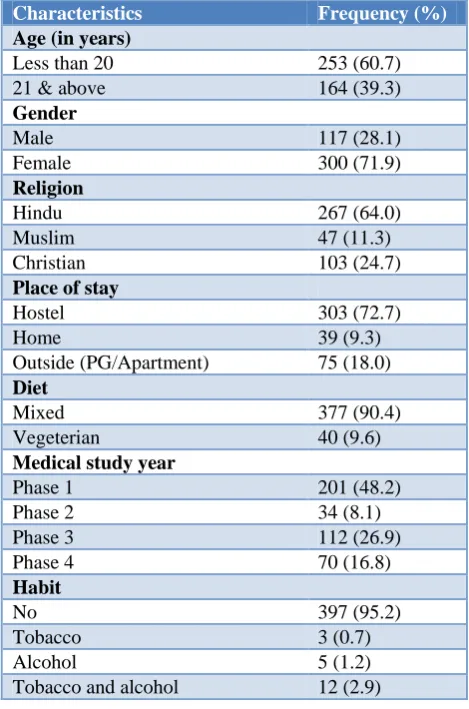
Among 417 students, 300 (71.9%) were females and 117 (28.1%) were males. The student‟s age ranged from 17-25 years, with the mean age of 19.80±1.85 years. Maximum students (60.7%) were below 20 years of age.
Table 1: Sociodemographic characteristics of students.
Characteristics Frequency (%)
Age (in years)
Less than 20 253 (60.7) 21 & above 164 (39.3)
Gender
Male 117 (28.1)
Female 300 (71.9)
Religion
Hindu 267 (64.0)
Muslim 47 (11.3)
Christian 103 (24.7)
Place of stay
Hostel 303 (72.7)
Home 39 (9.3)
Outside (PG/Apartment) 75 (18.0)
Diet
Mixed 377 (90.4)
Vegeterian 40 (9.6)
Medical study year
Phase 1 201 (48.2)
Phase 2 34 (8.1)
Phase 3 112 (26.9)
Phase 4 70 (16.8)
Habit
No 397 (95.2)
Tobacco 3 (0.7)
Alcohol 5 (1.2)
Tobacco and alcohol 12 (2.9)
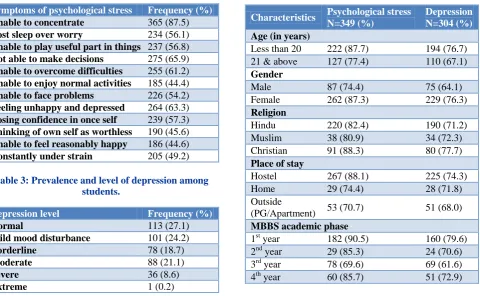
Among symptoms of psychological stress, majority of students were unable to concentrate (87.5%), followed by not able to take decision (65.9%), feeling unhappy and depressed (63.3%), and unable to overcome difficulties (61.2%) (Table 2).
The prevalence of depression was 72.9% with 24.2% mild mood disturbance, 18.7% borderline depression, 21.1% moderate depression, 8.6% severe depression and 0.2% extreme depression (Table 3).
Table 2: Prevalence of symptoms of psychological stress among students.
Symptoms of psychological stress Frequency (%)
Unable to concentrate 365 (87.5)
Lost sleep over worry 234 (56.1)
Unable to play useful part in things 237 (56.8)
Not able to make decisions 275 (65.9)
Unable to overcome difficulties 255 (61.2)
Unable to enjoy normal activities 185 (44.4)
Unable to face problems 226 (54.2)
Feeling unhappy and depressed 264 (63.3)
Losing confidence in once self 239 (57.3)
Thinking of own self as worthless 190 (45.6)
Unable to feel reasonably happy 186 (44.6)
Constantly under strain 205 (49.2)
Table 3: Prevalence and level of depression among students.
Depression level Frequency (%)
Normal 113 (27.1)
Mild mood disturbance 101 (24.2)
Borderline 78 (18.7)
Moderate 88 (21.1)
Severe 36 (8.6)
Extreme 1 (0.2)
Table 4: Prevalence of depression and psychological stress in relation to general characteristics of students.
Characteristics Psychological stress N=349 (%)
Depression N=304 (%)
Age (in years)
Less than 20 222 (87.7) 194 (76.7) 21 & above 127 (77.4) 110 (67.1)
Gender
Male 87 (74.4) 75 (64.1) Female 262 (87.3) 229 (76.3)
Religion
Hindu 220 (82.4) 190 (71.2) Muslim 38 (80.9) 34 (72.3) Christian 91 (88.3) 80 (77.7)
Place of stay
Hostel 267 (88.1) 225 (74.3) Home 29 (74.4) 28 (71.8) Outside
(PG/Apartment) 53 (70.7) 51 (68.0)
MBBS academic phase
1st year 182 (90.5) 160 (79.6) 2nd year 29 (85.3) 24 (70.6) 3rd year 78 (69.6) 69 (61.6) 4th year 60 (85.7) 51 (72.9)
Table 5: Association of symptoms of psychological stress with depression.
Symptoms of psychological stress Depression present
Depression
absent Total P value
Odds ratio (95% CI)
Unable to concentrate 273 92 365 0.021* 0.791 (0.383-1.635)
Lost sleep over worry 190 44 234 0.000** 1.816 (1.095-3.010)
Unable to play useful part in things 189 48 237 0.000** 1.400 (0.836-2.345)
Not able to make decisions 218 57 275 0.000** 1.631 (0.965-2.755)
Unable to overcome difficulties 202 53 255 0.000** 0.972 (0.559-1.691)
Unable to enjoy normal activities 151 34 185 0.000** 1.128 (0.644-1.973)
Unable to face problems 190 36 226 0.000** 1.940 (1.125-3.347)
Feeling unhappy and depressed 220 44 264 0.000** 2.302 (1.349-3.926)
Losing confidence in once self 193 46 239 0.000** 1.088 (0.636-1.863)
Thinking of own self as worthless 158 32 190 0.000** 1.417 (0.817-2.459)
Unable to feel reasonably happy 154 32 186 0.000** 0.949 (0.527-1.711)
Constantly under strain 172 33 205 0.000** 1.742 (1.009-3.007)
*p<0.05, **p<0.0001.
There was significant association between psychological stress symptoms and depression among study participants. The students complaining of „lost sleep over worry‟, „not able to make decision‟, „unable to face problems‟, “feeling unhappy and depressed”, “thinking of own self as worthless” and „constantly under strain‟ had 1.8, 1.6, 1.9, 2.3, 1.4 and 1.7 times higher risk of having depression respectively.
DISCUSSION
There are very few documented studies to establish association between psychological stress and depression among medical students.13,14 In this study, BDI was used to assess the prevalence of depression among medical students and the prevalence of depression was 72.9%. In a study done by Kittu, the prevalence of depression among medical student in Pondicherry was 71%, which was similar to our finding.13 Kumar et al done a study among medical students in Karnataka showed prevalence of depression was 71.25%.15 Among those students who were depressed, 21.1% moderately depressed and 8.6% had severe depression. This finding was similar to a study done by Kittu and Kumar.13,15 In this study, females have high prevalence of psychological stress (87.3%) and depression (76.3%) compared to males, which was also observed in a study by Marzo et al and Kumar et al.14,15 In this study, depression was higher among 1st year of medical students compared to other years of study. However, Rawat et al also showed the prevalence of depression among 1st year student was 72.6%, which was similar to our study findings.16 The symptoms of psychological stress like unable to concentrate, lost sleep over worry etc, all were significantly associated with depression. Similar result was found in Kittustudy.13 In this study, the students complaining of „lost sleep over worry‟, „not able to make decision‟, „unable to face problems‟, and „constantly under strain‟ had 1.8, 1.6, 1.9 and 1.7 times higher risk of having depression respectively. However, these finding are comparatively lower than Kittu study.13
This study provides an idea about the magnitude of depression among medical students and its association with psychological stress. The reason for the high prevalence of psychological stress symptoms and depression among medical students could be a result of the students' awareness and academic pressure. As it was a cross sectional study, it was difficult to assess the causal relationship of stress and depression. But, with the sufficient sample size and use of valid depression scale (BDI) for the assessment and classification of depression among medical students increases the validity of this study.
CONCLUSION
Depression is an important and significant hidden problem in India and it is highly prevalent among medical students. Most of the medical students had symptoms of psychological stress and it was associated with depression. The findings of this study accentuate the importance of screening among medical students and recommends appropriate interventional measures to prevent the complications of depression.
ACKNOWLEDGEMENTS
We, the author thank the Interns namely Dr Roshan Rose, Dr Gurjar Sumit Kumar, Dr Shaikh Sameer Anjum, Dr Aathira R, Dr Narendra Ballal, Dr Pranjali Rai, Dr Pawan
Kumar B and Dr Balasubramani G of concerned college for their co-operation in data collection and conduct of this study. Authors also acknowledge valuable participation and co-operation of medical students.
Funding: No funding sources Conflict of interest: None declared
Ethical approval: The study was approved by the Institutional Ethics Committee
REFERENCES
1. Friedrich M. Depression Is the Leading Cause of Disability Around the World. JAMA. 2017;317(15):1517.
2. World Health Organization. Mental and neurological disorders. Fact sheet No. 265; 2001. 3. Morrison J. More on medical students stress.
Medical Educ. 2001;35:617-8.
4. Ahmed I, Banu H, Al-Fageer R, Al-Suwaidi R. Cognitive emotions: depression and anxiety in medical students and staff. J Crit Care. 2009;24(3):1-7.
5. Benevides-Pereira A, Gonçalves M. Emotional disorders during medical training: a longitudinal study. Rev Bras Educ Med. 2009;33(1):10-23. 6. Dyrbye LN, Thomas MR, Shanafelt TD. Systematic
review of depression, anxiety, and other indicators of psychological distress among U.S. and Canadian medical students. Acad Med. 2006;81:354-73. 7. Rosvold EO, Bjertness E. Physicians who do not
take sick leave. Scand J Public Health. 2001;29:71-5.
8. Birmaher B, Ryan ND, Williamson DE, Brent DA. Childhood and adolescent depression: A review of the past 10 years, Part I. J Am Acad Child Adolesc Psychiatry. 1996;35:1427-39.
9. Khan MS, Mahmood S, Badshah A, Ali SU, Jamal Y. Prevalence of Depression, Anxiety and their associated factors among medical students in Karachi, Pakistan. J Pak Med Assoc. 2006;56:583-6. 10. Goebert D, Thompson D, Takeshita J, Beach C, Bryson P, Ephgrave K. Depressive symptoms in medical students and residents: a multischool study. Acad Med. 2009;84:236-41.
11. Goldberg DP. The General Health Questionnaire (GHQ). Companion to Psychiatric studies. 1972; 172-173.
12. Beck AT, Ward CH, Mendelson M, Mock J, Erbaugh J. An inventory for measuring depression. Arch Gen Psychiatry. 1961;4:561-71.
13. Kittu D, Patil R. Study of Association of Psychological Stress and Depression among Undergraduate Medical Students in Pondicherry. Natl J Community Med. 2013;4(4):555-8.
15. Kumar GS, Jain A, Hegde S. Prevalence of depression and its associated factors using Beck Depression Inventory among students in Karnataka. Indian J Psychiatry. 2012;54:223-6.
16. Rawat R, Kumar S, Manju L. Prevalence of depression and its associated factors among medical students of a private medical college in south India. Int J Community Med Public Health. 2016;3:1393-8.