A Framework for Performance Evaluation of
Decentralized Eventual Consistency Algorithms
Mehdi Ahmed-Nacer
1,2,∗, Pascal Urso
2,†1Computer Science Department. University of Sciences and Technology Houari Boumediene, Algiers, Algeria. 2Université de Lorraine. INRIA, LORIA.
Abstract
Eventual Consistency (EC) model is adopted by numerous large-scale distributed systems. To ensure performance and scalability, this model allows any replica to accept updates without remote synchronization. Nowadays, many EC algorithms are developed to control the behavior of the replicated data in the face of concurrent updates. Among them, those using a central server to order the updates, while others support the decentralization. In this paper, we focus on decentralized EC algorithms. Suitability of such algorithms under users and devices constraints such as execution time, memory requirements, messages size and quality of the result remains to be investigated under different conditions. Evaluate such algorithms in different context and under different parameters require a framework.
In this paper, we propose a generic framework designed to evaluate different decentralized EC algorithms, in different context by controlling different parameters. Our framework provides a generic simulator that generates a runnable data following different parameters.
Keywords: Distributed Systems, Eventual Consistency, Operational Transformation, Commutative ReplicatedData Types,Collaboration,Benchmark,PerformanceAnalysis,Framework,DataReplication.
1. Introduction
Replication is a key feature in any large distributed systems. When the replicated data are mutable, the consistency between the replicas must be ensured. A different model of consistency can be established. In the strong consistency model (aka atomic or linear consistency), a mutation seems to occur instantaneously on all replicas. Within a strong consistency model, integrity constraint on the data manipulated can be ensured through transactions. However, the CAP theorem [6, 10] states that it is impossible to achieve simultaneously strong consistency (C), availability (A) and to tolerate network partition (P).
In Eventual Consistency (EC)model, the replicas are
allowed to diverge, but must eventually reach the same value if no more mutations occur. Eventual consistency promises better availability, performance and can be obtained in large-scale systems [29, 41]. To handle the structured eventual consistent data types, many mechanisms were proposed [1, 15, 31, 39] to control the behavior of the replicated data in the face of concurrent updates. Set [31], Text[1,24,45] and Tree
∗
Email:[email protected] †
Email:[email protected]
[19] are different data types used in different context. They guarantees the consistency of the shared data following EC model. For instance, with a replicated structured document, adding concurrently two titles conflicts if the document type accepts only one title. To obtain a consistent document, set data type can be used. In collaborative editing systems, the effect of the concurrent modification must be the same for each user. Operational Transformation (OT) [8, 12,27] and Commutative Replicated Data types (CRDTs) [24, 31] were proposed as the text data type to maintain the consistency of the document during the concurrent editing. However, tree data type are widely used to manage the concurrent updates for structured or semi-structured documents such as XML files and distributed file systems.
For each data type, many algorithms were proposed and claim that satisfy the EC model and suitable for users devices [7, 17, 26,30, 33, 35]. Among of them, some need a central server to order the updates, while the other supports decentralized architecture. CRDT [1, 7, 24, 26, 31, 45] approaches were proposed in order to ensure convergence without blocking client operations and without having to deal with consensus. OT approaches [8,27] for a decentralized architecture have been proposed also. While, Oster et al. show that
1
on
Collaborative Computing
Research
Article
EAI Endorsed Transactions on Collaborative Computing 12 2016 - 06 2017 |Volume 3 |Issue 11 |e1
Copyright© 2017 Mehdi Ahmed-Nacer and Pascal Urso,licensedto EAI.Thisisanopenaccessarticledistributedunderthe
termsoftheCreativeCommonsAttributionlicense(http://creativecommons.org/licenses/by/3.0/),whichpermits
unlimiteduse,distributionandreproductioninanymediumsolongastheoriginalworkisproperlycited.
most of them are incorrect [12]. The most representative OT algorithms that do not make any assumption on using a central server for a total order broadcast of operations are SOCT2 [33] and GOTO [35] algorithms. In this paper, we focused on EC algorithms that support the decentralization.
Analyze the performances of such algorithms, study their behaviors and their suitability according to different applications is not easy. In addition, a theoretical evaluation is not sufficient sometimes to meet the requirements. For instance, in collaboration editing many algorithms support well the number of operations during the edition, while they lose in performance when the number of copy/paste is important [1]. Due to their different natures, one can expect a different performance level than others. Until now, there is no open-source framework that allows researchers to evaluate their EC algorithms and compare them with others. The choice of the most suitable approach remains open, and the suitability of the algorithm is a question of performance and result quality. Therefore, we require a general and objective framework for performance comparison and analysis that allow users to choose the suitable algorithms according to their needs.
In this regards, we seek to provide an open source experimental framework that provides different decentralized EC algorithms, of different data types (set, text and tree), and to propose an evaluation methodology to compare them and its results on a set of representative algorithms. We present a principled framework that runs different algorithms in the same experimental setting and measures their performances. The proposed framework allows to determine if the performances of a given approach are suitable for some application context. It allows also to detect which factor most affects each algorithm’s performance in term of execution time, memory usage, messages size and quality of merge results. Thus, depending on these factors we help to select which algorithm is the most adapted to which situation.
Because we are proposing a generic framework for performance comparison and analysis, it is important to design a mechanism in the framework that generates the needed data. Indeed, the framework integrates a simulator that generates a simulated data by giving to users the complete control of the parameters. In addition, the framework integrates a mechanism to extract a real traces and re-play them by using different EC algorithms. The framework supports two kinds of data: synchronous and asynchronous data.
The framework allows to each data type algorithm to generate an operation on their own format. It ensures also the causality order [36] between the operations during the experiment.
All the elements of the approach – algorithms and simulator implementations, as well as collaboration traces – are open-source and publicly available.
This paper is structured as follows. We begin in Section 2 by presenting our open-source framework that allows to compare eventual consistency algorithms on real and simulated traces. Afterwards, we present the different approaches evaluated. We establish then, the theoretical space and time complexity of these algorithms. In Section 3, we conduct the experiments and then we analyze the experimental measurements of the representative algorithms performance. In sections 5we discuss about related work and finally in Section 6, we provide concluding remarks and directions for future works.
2. The Framework
The framework is called ReplicationBenchmark. It is developed in Java and open sourced under the terms of the GPL license 1. It runs the different algorithms in the same experimental conditions and it measures their performances. It allows to understand which experimental variables influence most the different algorithms performances.
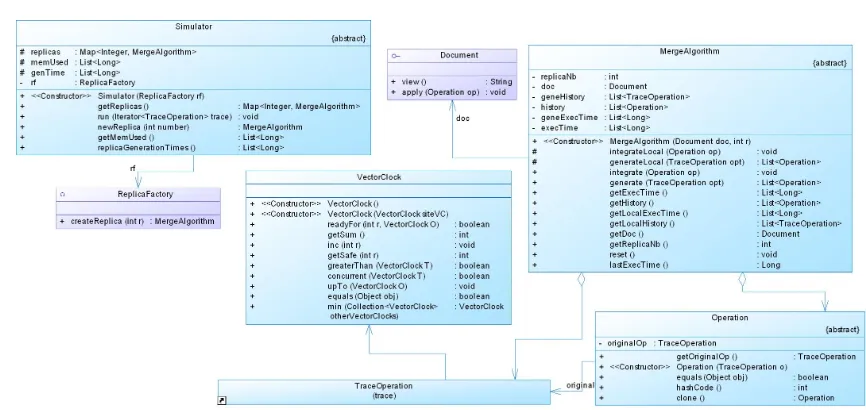
The Framework provides common base classes for different real-time collaborative editing algorithms, such as document, vector clocks [4], operations and simulator that disseminates the operations. Each algorithm can be implemented by derived classes. The Framework asks the replicas of each algorithm to generate an operation in its own format based on
the trace operation. In our Framework, the operations
generated by users (one character or copy/paste) are represented by theTraceOperationclass, whileOperation
represents the operation ready to be executed by the algorithms. Figure1shown an overview of classes used in the framework.
The VectorClock class is used by some algorithms
(see next section) to detect the concurrency between the operations. In addition, this class is used by the simulator to disseminate the operations in the same order than generated by the users in case of real traces.
TraceOperationclass represents the operation generated
by the user. It contains some information such as the type of operation(insert or delete), the number of replicas, the vector clock of the current operation and the content of the operation in case of insertion or the size of the deletion.
However, the framework provides an interface Trace
as presented in Figure2. Following the traces desired, this interface is implemented in order to generate simulated or real traces:
1https://github.com/score-team/replication-benchmarker
2 EAI Endorsed Transactions
Figure 1. Framework core classes
1. Simulated traces: the framework can generate
linear traces such as text used by textual data type algorithms, or structured traces such as XML traces used by tree data type algorithms.
The TextTrace class allows to generate textual
operations following the parameters specified in
OperationProfileclass. The latter class is controlled
by the developers. Indeed, from this class, the developer can manage the traces by controlling many parameters such as the proportion of insertion, number of replicas, the proportion of copy/paste, etc. The different parameters that can influence the experiment, are controllable by the users. In Section2.2, we detail more.
XMLTrace class takes in the constructor, the
XML document and an iterator from the root to traverse the tree.XMLTraceclass generates a list of operations ready to be executed in tree data type algorithms.
2. Real traces: the framework generates also a real traces from a log – specified by the developer before the execution – or from DVCS histories. In [1], we made a real collaborative editing experiment with students. The operations made by users have been stored in a file. The
TraceFromFileclass extracts these operations from
the file and allow the framework to reproduce the same collaboration as in real collaboration. The framework dispatches the operations in the same order as produced in the experiment.
GitTraceclass generates an operation from DVCS
repositories such as Git. The framework traverses the histories of git repositories and simulate a col-laboration composed of concurrent modifications. To simulate this collaboration, we adapted an open-sourced replication performance evaluation tool of distributed optimistic replication mecha-nisms [1].
<< interface >> Trace
Enumeration<TraceOperation> enumeration();
XMLTrace
numDoc: int children: Iterator ...
<Constructor> XMLTrace(int docnum, Iterator children) <@Override> enumeration(): Enumeration<TraceOperation> ....
GitTrace
TextTrace
commitCRUD: GenericRepository<Commit> patchCRUD: GenericRepository<Patch> initCommit: List<Commit> diffAlgorithm: DiffAlgorithm gitRepo: Repository ...
numberOperation: long delay: long replicas: int states: VectorClock[]; operation: OperationProfile ....
<Constructor> TextTrace(long numOp, long d, long rep, Operation Profile op) <@Override> enumeration(): Enumeration<TraceOperation>
<Constructor> GitTrace(GenericRepository<Commit> dbc, GenericRepository<Patch> dbp) <@Override> enumeration(): Enumeration<TraceOperation> diff(byte[] aRaw, byte[] bRaw): List<Edition> ....
TracefromFile
fileName: File ....
<Constructor> TraceFromFile(File file)
<@Override> enumeration(): Enumeration<TraceOperation> ...
OperationProfil
perAdd: int perBlock: int sizeCopyPast: int ....
<Constructor> OperationProfil(int add, int block, int sizeCopyPast)
Figure 2. Framework trace classes
3
Figure 3. Framework simulation classes
Operation and Simulator are abstract classes. Their
implementation is in the derived classes. Operation
class is implemented by each algorithm. It contains
trace operation described previously, in addition to
other methods of comparison. Simulator class is used to disseminate the operations. It contains the main method run implemented inCausal Dispatcherclass as presented in Figure3.Causal Dispatcherclass, allows to each replica to generate atrace operationand dispatches the correspondent operationsin correct order. Indeed, before disseminate or integrate the operations, run method calls insertCausalOrder to ensure the causality.
Document class is an interface with two methods:
view()method to display the content of the document
and apply() method to integrate a remote operation
locally.MergeAlgorithmis an abstract class and extends by each algorithm. It initializes the document and it provides different methods to manage local and remote operations. For instance, generate procedure takes a
traces operation in parameter and returns a list of
operations in format of specific algorithms. In other
words, it transforms the operation generated by the users to the list of operations ready to be executed by the algorithms. The implementation of this method is in the derived classes for generate a specific operation for each algorithm.
Finally, to measure the performances of different algorithms, we can summarize the framework operation through three fundamental phases:
1. Generate corpus: The framework gives to the users an entire choice of the corpus that will be used to evaluate the algorithms. Indeed, the users can choose between simulated or real data. In case of simulated data, the framework generates the operations following the parameters specified by the users such as: number of users, the proportion of insertions, number of operations, etc. In case of real data, the framework launches a mechanism
to extract the operations from a log. In Section 2.2, we detail about the different data that can be generated by the framework. Whatever the mode used, the traces generated are a sequence of <Operation, replica, vector clock>, where the operation specifies the type of operations and their content, the replica is a unique identifier given to each user, while the vector clock is a structure used to ensure the causality [36] between the operations. The framework allows to each data type algorithm to generate an operation on their own format.
2. Specify format of operations and dissemination: The framework includes a dispatcher that dissem-inates the operations to the replicas following the order in the corpus. The operations are dissemi-nated while respecting the causal order.
According the order in the corpus and the replica that generates the operations, the framework allows the correspondent replica to generate a
local operation in their format. The replica
executes the operation locally and the dispatcher broadcasts this operation to all other replicas. Each replica that receives thisremote operation,
it integrates it in their copies.
3. Compute the performances: To measure the response time of algorithms during the sim-ulation, the framework stores the execution time of each local and remote operation using
java.lang.System.nanoTime(). However, even using iso-lated systems, the garbage collector of java may affect the execution time. Thus, the framework is able to make several runs and to analyze the results in order to purge inconsistent values. To measure memory occupation and message size, the framework uses the default serialization inter-face of Java to estimate the memory footprint of a replica. The framework computes also the effort
4 EAI Endorsed Transactions
made by users to correct their document after merges the updates.
To integrate a new algorithm in our framework, the developer has just to implement the different class described previously – Document, Operation and MergeAlgorithm–, in addition to the specific classes of the algorithm.
In the following section, we describe the different EC algorithms implemented and integrated into the framework.
2.1. Algorithms supported
Until now, the framework supports three different data types: Set, Text and Tree. For each data type, numerous algorithms that support the decentralization are implemented. However, the framework is implemented in generic way, it is easy to integrate another algorithm to the existing data type or integrate another data type such as Graph.
Set Data Type
. In our framework, the set ensures the eventual consistency by using Commutative Replicated Data Type (CRDT) approach [31]. A CRDT can be state-based or operation-state-based. In state-state-based CRDTs – aka Convergent Replicated Data Type (CvRDT) – the data are computed by merging the state of the local replica with the state of another replica. Eventual consistency is achieved if the merge relation is a monotonic semi-lattice. In the operation-based CRDTs – aka Commutative Replicated Data Type (CmRDT) – the data are computed by executing remote operations on the local replica. Eventual consistency is achieved if operations are delivered in a certain order and if the execution of the non-ordered operation commutes. For instance, using causal order, the execution of concurrent (in Lamport’s definition [16]) operations must commutes. Our framework supports both cases: CvRDT and CmRDT. The different algorithms implemented are published an detailed in [5, 18, 31]. In the following, we give a brief description of each algorithm integrated into the framework:
LWW-Set In a Last Writer Wins Set (LWW-Set), each
element is associated with a timestamp and a visibility flag. A local operation adds the element if not present and updates the timestamp and the visibility flag (true for add, false for rmv). The CvRDT merge mechanism makes the union of all elements and for each element the pair (timestamp, flag) of the maximum timestamp. In the CmRDT, the execution of a remote operation updates the element only if the timestamp of the operation is higher than the
timestamp associated with the element. The both CRDTs requires tombstones and thelookup
returns elements which have a true visibility flag.
Counter-Set In this variation a counter is associated to
each element. Letk be the value of the counter of an element. Initially 0 ,Adding an element increments the associated counter, and removing an element decrements it. In CmRDT A localadd
can occur only ifk≤0 and sets the counter to 1
(δ=−k+ 1). A localdelcan occur only ifk >0 and
sets the counter to 0 (δ=−k). The CvRDT (also
call PN-Set) payload contains the set of element, and for each element a setP of increment and a setN of decrement. A localadd, resp.del, adds|δ|
element inP, resp.N. The merge operation is the union of the sets. The lookup contains elements with|P|>|N|.
In the CmRDT, each operation contains the differenceδobtained during local execution. The remote operation execution addsδto the counter. An element with a counterk= 0 can be removed, the others must be kept. The lookup contains elements withk >0.
OR-Set In an Observed Remove Set (OR-Set) each
element is associated with a set of unique tag. A local add creates a tag for the element and a localrmv removes all the tag of the element. The CvRDT contains the set of element, and for each element a set T of tags added and a set R of tags removed. The merge operation is the union of each set. The lookup contains elements with
T ∩R,{}.
In the CmRDT, each operation contains the tag(s) added or removed. Since causal ordering is ensured and since tag are unique, the removed tag (and element with no tag) can be removed in the payload. Thelookupcontains the elements of the payload.
Optimized OR-Set In [5], the authors optimize the
traditional OR-Set algorithm by minimizing the required meta-data. In OptORSet, each replica maintains a vector that indicates the observed
n successive identifiers generated in others replicas. When a replica generates an operation, it increments its local counter. However, when theaddis delivered, the element should have an effect only if it has not been previously delivered. Otherwise, it updates the counter of the remote replica and deletes the previous tags of the same element delivered from the same replica.
OptORSet reduces the memory requirement by keeping only the last tag of the element peer replica.
5 EAI Endorsed Transactions Collaborative Computingon
Text Data Type
. For text data type, the framework supports two approaches that ensure the eventual consistency: Operational Transformation (OT) approach [8, 12, 27] and Commutative Replicated Data Types (CRDT) approach [24,31].
Operational Transformation (OT) Algorithms: The
Operational Transformation approach was introduced to overcome the problem of divergent copies in syn-chronous collaborative editors by serializing concurrent operations [8, 27, 34, 46]. It has been successfully employed in the massive context of GoogleDocs [13] which uses a centralized variation of the Jupiter algo-rithm [23]. The OT approach transforms a remote oper-ation against its concurrent operoper-ation, i.e. ones that have changed at the same time the state of the object. It is based on the syntactic properties of the operations to preserve the user intentions. OT replicas store the history of all operations received. These histories are not necessarily the same, since the order of reception of concurrent operations is different for each replica. To ensure eventual consistency the transformation func-tions should satisfy some properties known asC1 and
C2[27]. By using a central server or a continuous global
order [37,40], the system only requires the condition
C1. Satisfying C1 require to obtain the same result
by executing in any order a pair concurrent operation defined on the same document state. In the general decentralized context [43], condition C2 is required.
C2 expresses the equality between an operation
trans-formed against two equivalent sequences of operations. ConditionsC1 andC2 ensure that transforming any
operation with any two sequences of the same set of concurrent operations in different execution orders always yields the same result. Unfortunately, many proposed transformation functions fail to satisfy these conditions, as shown in [12]. To our best knowledge, the only existing transformation functions for collaborative editing that satisfy conditions C1 and C2 are the
Tombstone Transformation Functions (TTF) [25]. To overcome problems, TTF approach keeps all characters in the model of the document, i.e. deleted characters are replaced by tombstones.
SOCT2 [34] is a representative decentralized
opera-tional transformation algorithm that requires the properties C1 and C2 to ensure convergence of
replicas. As other decentralized algorithms [27, 35], it maintains a vector clock to ensure causality. When a user generates an operation, it is imme-diately executed locally, added to the local history buffer, and sent to all other replicas. The operation is broadcasted to other replicas with the identi-fier of the source site and its vector clock. The principle of this algorithm is that before a remote
operation integration, the history of already exe-cuted operations is traversed and reordered. After reordering, causally preceding operations come before concurrent ones in the history buffer. Traversing the history buffer is a costly operation, but mandatory to achieve correctness. The history buffer size can be reduced by removing entries seen by every replica, but such a garbage collection mechanism requires a consensus or a fixed and known number of replicas [14] which is not feasible in the general distributed context.
Commutative Replicated Data Types Algorithms:
Commutative Replicated Data Types (CmRDT) are operation-based conflict-free replicated data types (CRDT) [31]. CRDTs ensure consistency of highly dynamic contents on peer-to-peer networks. Unlike OT algorithms, CRDTs require no history of operations, and no concurrency control to ensure consistency. Instead, CmRDT are designed for concurrent operations to be natively commutative by actively using the characteris-tics of abstract data types such as lists or ordered trees. However, CRDT algorithms have not yet been applied to massive collaborative editing in an industrial context.
WOOT [24] merge operations contain the element to be inserted with the preceding and the following element. In case where two elements have not a precedence relation between them, the priority is given according to their identifier. To ensure the consistency of the replicas, the deleted elements are not deleted but just marked as invisible to users.
WOOTO [42] improves WOOT complexity by using
element degrees to compare unordered elements instead of the respective placement of the preceding and next elements. This optimization sightly improves computing time and model space but not message size since insertions operations still specifies the identifiers of the preceding and the next elements along with the degree.
WOOTH [1] is a new version of WOOT that improves
its performance by using a hash table.
RGA [28] specifies on the identifiers (aka s4vector) the last previous element visible during its generation. Thus, the tombstones also remain after the deletions.
Logoot [44] CRDT generates identifiers composed of
a list of positions. The identifiers are ordered with a lexicographic order. A position is a 3-tuple containing a digit in a specific numeric base, a replica identifier and a clock value. Identifiers
6 EAI Endorsed Transactions
are unbounded to allow for arbitrary insertion between two consecutive elements. Unlike RGA and WOOT algorithms, Logoot does not need to store the tombstones since elements are not linked through insertion operations.2
LogootSplit Unlike Logoot that takes use a single
elements granular, LogootSplit [3] algorithm identifies a continuous sequence generated by a user operation. Continuous sequences can be produced by real-time copy/paste, version patches, or operation buffering.
The major advantage of LogootSplit algorithm is the number of identifiers which is reduced, whereas the algorithm performance depends on the proportion of continuous sequences inserted.
Treedoc [26] is a CRDT algorithm that represents the
document by a binary tree structure. The element identifier is the path to the element in the tree. If two users insert concurrently at the same position, Treedoc creates a major-node that contains the two elements.
Tree Data Type
. Trees are a fundamental data structure for many areas of computer science and system engineering. in addition, the eventual consistency is more difficult to achieve facing complex conflict resolution. Indeed, more the data type is complex, more conflicts appear. For instance, in a structured data such as XML files and file systems, modifications such as adding and removing an element, or adding a child node while removing the father to which it belongs, or setting concurrently two same elements conflict. Tree data types are useful to manage such conflicts [21]. Our framework provide a collection of tree algorithms based on OT and CRDT designed for hierarchical documents and semi-structured documents. In addition, the framework proposes a generic design to ensure eventual consistency and control the conflicts in such structures.
TreeOpt and OTTree TreeOPT (tree OPerational
Transformation) [11] is a general algorithm designed for hierarchical documents and semi-structured documents. Each node contains an instance of an operation transformation algorithm [8, 27, 35]. The algorithm applies the operational transformation mechanism recursively over the different document levels. In our experimentation, we have used this algorithm with SOCT2 [33] algorithm and TTF (Tombstone
2Since the Logoot algorithm generates its identifiers by using a
random function and the order of these identifiers is not necessarily the same in two different executions, we conducted four executions and we computed the average metric.
Transformation Functions) approach [25]. For little optimization, we save only insertion operation in log of SOCT2 [34].
The OTTree, an unpublished algorithm, uses only one instance of SOCT2 for entire the tree (not on each node) and TTF on each child list. The operation of TTF and its integration function were modified to include the path information.
FCEdit FCEdit [20] is a CRDT designed for
collab-orative editing of semi-structured documents. It associates to each element a unique identifier. FCEdit mapsidentif ier →node. So it uses just a
hash table to find an element in the tree. Each child is ordered by a position identifier. Unlike OTtree, FCEdit does not need to store an element in tombstone. The elements are really deleted from the tree making it more efficient in memory. The framework proposes also a different policies to manage the concurrent modification for trees [19]:
1. Skip: drops the orphan path.
2. Reappear: recreates the path leading to the orphan path
3. Root: places the orphan subtree under the root 4. Compact: places the orphan subtree under its
longest non-orphan prefix.
2.2. Obtaining corpus
To observe the behavior of different EC algorithms and study their performance, the framework needs to run these algorithms on a large corpus. The framework gives to users the entire choice of the evaluation: by using a realistic data or a simulated data. Indeed, the framework integrates a mechanism to extract a real data and a simulator that generates a simulated corpus following different parameters. In the following, we explain how the framework produces both corpus. Real Traces
. The framework can produce two kinds of real corpus:
1. Synchronous editing corpus: There is no publicly available corpus of collaborative editing traces. The existing studies [17, 26, 45] were conducted on purely randomized and private traces or Wikipedia and/or SVN traces which are centralized and synchronous. Centralized traces do not contain concurrency between editions. In [1] we performed user studies on real-time peer-to-peer collaboration and we collected usage traces. We modified a real-time collaborative editor called TeamEdit [38] to log the user
7
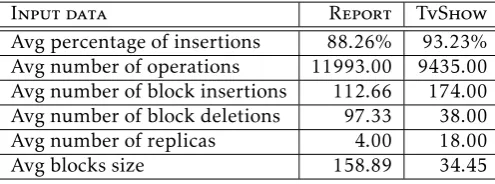
operations generated during an experiment. For both operations insert/delete, we store a position, a version vector that represents concurrency, a replica identifier and a document identifier. In addition, for insert operations, we store the character or the block of characters inserted, while for delete operations, we store the number of characters deleted. We made two collaboration experiments with groups of students. The first collaboration was performed with three groups of four master students during two hours. We asked the students to write collaboratively a report without using any other communication tools except TeamEdit. In the second experiment, we asked two times eighteen students to watch two TvShow and to produce a transcription of the episode while watching it. In Table 1we present some characteristics of the traces collected in [1].
Input data Report TvShow
Avg percentage of insertions 88.26% 93.23% Avg number of operations 11993.00 9435.00 Avg number of block insertions 112.66 174.00 Avg number of block deletions 97.33 38.00
Avg number of replicas 4.00 18.00
Avg blocks size 158.89 34.45
Table 1. Characteristics of the collected synchronous traces
The framework can reproduce the same real traces by adjusting the features presented in Table1.
2. Asynchronous editing corpus: A large quantity of distributed asynchronous collaborative editing data is publicly available. Several web-based hosting service for software development projects such as GitHub, Assembla, or SourceForge host numerous open-sourced software code bases. When this code is managed with a distributed version control system such as Git, Mercurial, or Bazaar, anyone got access to the history of concurrent editing. However, these histories must be treated to be run by other algorithms.
The real concurrency information is not available in DVCs. The most used DVCS – git, Mercurial or Bazaar – do not manage replica information in their data storage. The only available information is the email of the user who produced a given commit and the merge history. The user’s email is not reliable since it may be invalid, a same user may work on several replicas, or it may change its email while working on the same replica. The merge information is more reliable. A merge is a commit that has more than one parent. Different
parents are different replicas or branches.3 The inverse is not true since two consecutive commits without merge can be produced by different replicas.
Our framework is able to parse git repositories to obtain large runnable traces of asynchronous collaborative editing. First, it begins by assigning a replica identifier to commit. It heuristically minimizes the number of replicas.
A commit replica identifier is assigned to one of the parents of the commit. Thus, if two commits have the same replica identifier, there exists a path between them.
Second, for each commit that has only one parent the framework computes the diff [22] between the two states. The diff result is a list of insert, delete or update operations concerning block of lines. For merge commits, the framework store the state of the resulting merge commit. The relation between the commits is represented by vector clocks. All commits (diffs and merge states) and their vector clocks, are stored in Apache CouchDB database [9] in order to be used by all the runs of the different algorithms.
In DVCSs, merging is not a fully automated process. When a user merges, it obtains a best-effort result – computed using three-way-merge techniques. The user must change this result in case of conflicts. He may also change the result, if, for instance, the merged source code does not compile. The stored merge state is the result of the whole process. Our framework simulate the same behavior during collaborative editing algorithm
evaluation. A best-effort merge is obtained using
the evaluated algorithm and a “correction” is computed on-the-fly to obtain the result intended by the real user that done the merge. In addition, an algorithm that requires more corrections will loss in performances since it will have more operations to treat.
Simulated Traces
. Our framework implements a generator that enables to produce randomized traces by controlling one of the following characteristics :
(1) the proportion of user operation which are insertion, (2) the proportion of user operation which concern blocks, (3) the number of operations generated, (4) the number of replica that will produce operations, (5) the probability at each iteration that a replica produce one operation, (6) the average delay (in number of iteration) between generation of user operation and
3We consider branching as concurrent editing.
8
reception of corresponding operation in other replicas. (7) average size of copy/past.
The simulation ensures that each replica receives operations in the order as defined in the logs. The framework lets replicas of every algorithm generate operations in its own formats for the given trace operations provided from the simulated logs.
3. Synchronous Experiment Results
In the following, we present the experimental results retrieved through our framework, by using syn-chronous corpus.
Firstly, we present the different corpus obtained and some experiments made as an example. Secondly, we present a performance evaluation of some algorithms for different data types.
The experiments were performed on virtual machines of Amazon Elastic Compute Cloud (EC2). We run each experiment a virtual machine with Intel(R) Xeon(R) 5160 one-core processor (4096K Cache, 2.27GHz, 2266.746 MHz FSB, 3.75 GiB of memory), that has installed GNU/Linux ubuntu 12.04.
3.1. Corpus obtained
Real synchronous Traces
. Based on the characteristics presented in Table1, we parameter the simulator to produce the same traces. It also provides a controlled simulation environment that replays a trace of operations and measures the performance of the replicated algorithms. The simulation ensures that each replica receives operations in the order as defined in the logs.
Simulated Traces
. To evaluate the algorithm’s performance, we pro-duced through the framework several sets of traces. In each experiment, the framework controls one character-istic and keep the others static at values similar to the [1] experiments.4. Table2resume our experiment.
3.2. Performance in Set Data Type Algorithms
The performance of different algorithms designed for
set data type are presented in this section. Even if the framework supports CvRDT and CmRDT (Section ), we present as an example in this paper only results of CmRDT.
Since the different algorithms have different seman-tics, we run each algorithm one hundred time and each time in different simulated data (except for OR-set and OptORSet in the same data since they have the same
4To simplify algorithm analysis, we do not modify the delay and
generation probability. Also, these characteristic mostly affect the concurrency degree which is also affected by the number of replicas.
semantics). In the following, we present the results of two experiments: by changing the size of the data set and the percentage of insertions. In Figure4(a)and4(b) we present respectively the average execution time for each algorithm during the generation and integration of operations. The results of execution time indicate that:
• OptORSet and ORSet algorithms are the worst in execution time. In local, both algorithms take time to generate a unique tag for each element. While, during the integration, both algorithms treat each remote operation as a new element since they have a different tag,
• OptORSet takes more time than ORSet in local, since it updates the local vector while ORSet algorithm does not,
• LWWSet and CounterSet outperforms ORSet(s) algorithms. Indeed, they don’t need to generate a tag for elements,
• LWWSet takes slightly more time than Coun-terSet. This is due to the management of the timestamp for each element. Indeed, LWWSet traverses its model to find the previous value of the element, and increment it. While, CounterSet algorithm generates directly a counter.
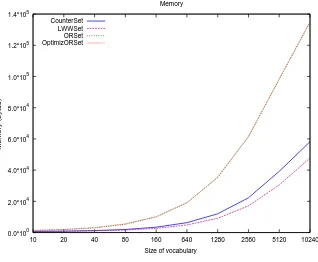
In Figure 5(a) and 5(b) we present respectively the memory requirement for each algorithm per percentage of insertion and size of data set. The performances obtained indicate that:
• Contrary to what we expect, OptORSize does not reduce the memory size. Indeed, the vector used to detect the partial order of elements hide the memory saved,
• The memory used by LWWSet and CounterSet algorithms remains stable. Whatever the percent-age of insertion, these algorithms keep all ele-ments (inserted and deleted),
• More the percentage of insertion grows and more the replica lost in memory. Gradually, the memory becomes stable since the elements will be existed in the set,
• The memory requirements are proportional with the size of the data set. Indeed, the number of elements in the replica set depends on the size of data used.
To validate this analysis and make sure that this difference is significant, we use ANOVA technique5.
5one-way analysis of variance. The result is significant ifp−value
<.05
9
Experiment Operations Insertions
Blocks vocabulary
Replicas for text for set
Operations 20 000−−−−−−−−−+100000→40 000 10 000 10 000 10 000 10 000
Replicas 10 10 10 10 2−−−×→550
Blocks % 15% 15% 0%−−−−−−+10%→100% - 15%
Insertions % 80% 50%−−−−−+5%→100% 80% 80 80%
vocab. size - - - 10−−−×→210240
-Avg blocks size 100 100 100 - 100
Generation w.p. 0.1 0.1 0.1 0.1 0.1
Delay 5 5 5 5 5
Table 2. Experiment for Text/Set data type algorithms.
1.6*103
1.7*103
1.8*103
1.9*103
2.0*103
2.1*103
2.2*103
2.3*103
2.4*103
2.5*103
2.6*103
10 20 40 80 160 640 1280 2560 5120 10240
Time (in nanoseconds)
Size of vocabulary Local CounterSet
LWWSet ORSet OptimizORSet
(a) Local execution time
2.5*103
3.0*103
3.5*103
4.0*103
4.5*103
5.0*103
5.5*103
10 20 40 80 160 640 1280 2560 5120 10240
Time (in nanoseconds)
Size of vocabulary Remote CounterSet
LWWSet ORSet OptimizORSet
(b) Time of integration
Figure 4. Execution time in set data type
The (p−value) obtained from the results of algorithms,
demonstrate clearly that all results are very significant. Indeed, for execution time, p−value= 0.00 and for
memory p−value= 0.03. In both experiments, p−
value <0.05.
3.3. Performance in Text Data Type Algorithms
In [1], we evaluated through our framework different collaborative editing algorithms in real traces described
1.0*103
2.0*103
3.0*103
4.0*103
5.0*103
6.0*103
7.0*103
8.0*103
50 60 70 80 90
Memory (bytes)
insertion (%) Memory CounterSet
LWWSet ORSet OptimizORSet
(a) Memory requirement per % insertion
0.0*100
2.0*104
4.0*104
6.0*104
8.0*104
1.0*105
1.2*105
1.4*105
10 20 40 80 160 640 1280 2560 5120 10240
Memory (bytes)
Size of vocabulary Memory CounterSet
LWWSet ORSet OptimizORSet
(b) Memory requirement per size of data set
Figure 5. Memory occupation in set data type
above. However, in this paper we extend the perfor-mance evaluation with two other algorithms that we did not in [1]. In addition, we perform another kind of performance evaluation such as memory requirements and size of messages in different large corpus.
In this section, we present the results of two exper-iments: i) the performance of algorithms on simulated data inspired from collectingsynchronousreal traces, ii) algorithm’s performance in a real asynchronous traces
10 EAI Endorsed Transactions
obtained from github. As an example, we measured the performances of six algorithms: SOCT2/TTF, WOOTH, RGA, TreeDoc, Logoot, and LogootSplit. We conducted four experiments, each one varying a different charac-teristic of the simulated traces. To obtain a significant results, we ran each experiment five times.
In this section, we conducted an experiment in two different traces: synchronous and asynchronous. In [44] the authors evaluated Logoot algorithm on Wikipedia traces, and assume that such histories as traces extracted from synchronous collaborative editing. Also, in [26] Treedoc algorithm was evaluated on SVN repositories. In this experiment, we evaluate the algorithms on Git repositories to validate the result of synchronous experiment.
To understand the behaviors of algorithms during the experiment, we conduct in the following a theoretical evaluation before presenting the results.
Theoretical Evaluation
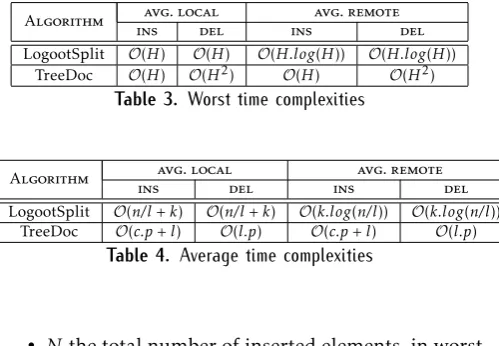
. In [1], we provided a comparison in time complexity of Logoot, WOOTs, RGA and SOCT2 algorithms (Section 2.1). In the following, we specify the time complexity of two other algorithms that we do not presented in [1]. These algorithms are Treedoc and LogootSplit. In contrary to the previous algorithms that are based on character operations, Treedoc and LogootSplit support block granularity.
In addition, in the previous work [1], we do not provide a comparison of space complexity. Then, we presented also a comparison of all algorithms described above in space complexity.
Average-case Time Complexity Analysis Considering
the execution time complexity we differentiate the local execution time – treatment of a user operation – and the remote execution time – treatment of a remote operation. The dissemination mechanism is not taken into account since it is independent of the merge mechanism.
During local execution, the algorithms treat either an insert operation (ins) or delete operation (del). These operations may concern a continuous sequence of elements (e.g. cut or paste a block of text). The algorithms must find in their inner model the position of the user operations. During local operation execution the remote operations that will be sent to other replicas are generated. During remote execution, operations are specific to each algorithm. The average case complexity for each of the above described algorithms is presented in 4. We denote by :
• Rthe number of replicas,
• H the number operations that had affected the document,
Algorithm
avg. local avg. remote
ins del ins del
LogootSplit O(H) O(H) O(H.log(H)) O(H.log(H))
TreeDoc O(H) O(H2) O(H) O(H2) Table 3. Worst time complexities
Algorithm
avg. local avg. remote
ins del ins del
LogootSplit O(n/l+k) O(n/l+k) O(k.log(n/l)) O(k.log(n/l))
TreeDoc O(c.p+l) O(l.p) O(c.p+l) O(l.p)
Table 4. Average time complexities
• N the total number of inserted elements, in worst caseN =H,
• cthe average number of operations concurrent to a given one,6in worst casec=H,
• nthe size of the document view ,
• kthe average size of Logoot identifier : in best case
k= 1 and in worst casek=N,
• pthe average length of TreeDoc paths : in best case
p= 1 and in worst casep=N,
• l the size of elements present in one operation (blocks), in worst casel = 1 orl =N depending if the algorithm manages continuous sequence or not,
Both algorithms have its computational complexity impacted byl, the average number of elements present in user operations.
• LogootSplit algorithm uses identifier of O(k)
average size. Its model containsn/l blocks, and the local operations must sum up the block sizes to retrieve operation effect position. The local insertion generates n/l new identifier, while the remote complexity is impacted by the binary search upon identifier in O(k.log(n/l)) average
complexity [3].
• TreeDoc algorithm must follow one path of length
pin the tree to find user operation effect position and remote operation identifiers. Each node along this path which is a super node [26] must be linearly traversed. So there will bec.pin average, nodes traversed. ins operations of a continuous sequence produce only one remote operation whiledeloperations producelremote operations.
6cdepends on the network latency and user operations frequency.
11
Space complexity We establish the space occupied by the models used by each algorithm and the size of the message composed of remote operations corresponding to one user operation.
• SOCT2/T T F stores the history of operations
O(H) each one with a vector clock O(R). The l
remote operations contains also a vector clock
O(R).
• W OOT algorithm family and RGA store O(N)
elements with their fixed-size identifiers. A user operation produceslremote operations.
• Logoot storesO(n) elements with their identifier
of size O(k). A user operation produces l remote
operations with identifier. A user operation produceslremote operations.
• LogootSplit stores only O(n/l) elements. A user
insert operation produces one operation of size
O(k+l): an identifier and a content. A user delete
operation produce in averagen/l2– the number of elements divided byl– remote operations with an identifier.
• T reedoc stores a tree of O(n) elements. A user
insert operation produces one operation of size
O(p+l). A user delete operation produces l
remote operations with identifier inO(p).
Algorithm model message
SOCT2/TTF O(H.R) O(l.R)
WOOTs O(N) O(l)
RGA O(N) O(l)
Logoot O(k.n) O(l.k)
LogootSplit O(k.n/l) O(k+l)|O(k.n/l2)
TreeDoc O(n) O(p+l)|O(p.l)
Table 5. Space complexity analysis of meta-data
Discussion The theoretical analysis shows that no
algorithm performance surpass all the others whether in worst case or average case. However, RGA and TreeDoc seem good candidates, but must be compared with each other and with LogootSplit which follows a different approach. Since the theoretical analysis is not sufficient to rank the different algorithms, an experimentation is required. Why, an implementation of a framework that allows an experimental evaluation is needed. In the following section, we present a framework to experiment the algorithms in realistic settings.
Remote execution time
. The figures 6(a) and 6(b) present the performance of the remote operations execution in two different experiments: number of operations and number of
replicas. The figures vertical axis presents the average time taken to execute the remote operation – or the set of remote operations – corresponding to a user operation appearing in the trace. This axis uses a logarithmic scale. The horizontal axis presents the experimental parameter value, one label per trace.
102
103
104
105
106
107
108
109
20000 40000 60000 80000 100000
Time (in nanoseconds)
Operation
Logoot LogootSplit RGA Treedoc Soct2/TTF WOOTH
(a) Number of operations
102
103
104
105
106
107
108
2 5 10 15 20 25 30 35 45 50
Time (in nanoseconds)
Replica
Logoot LogootSplit RGA Treedoc Soct2/TTF WOOTH
(b) Number of replicas
Figure 6. Remote execution time in text data type
Operations experiment WOOTH and RGA perform
very stably. Logoot performance decrease when the number of operations grows. This is due to a growing identifiers for Logoot. Identifier growing also affect TreeDoc and LogootSplit but only slightly.
Replicas experiment We can observe that the CRDT
algorithms perform very stably when the number of replica increases. The SOCT2/TTF performance eventually degrades but less quickly than the number of replicas. This loss is due to increasedcconcurrency and not the number of replicas, since the algorithm does not traverse the vector clocks during remote execution.
12 EAI Endorsed Transactions
Local execution time
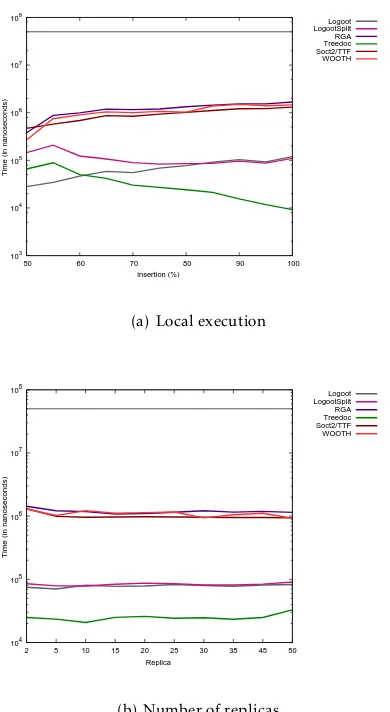
. The figures 7(a) and 7(b) present respectively the average local execution time for the user operations by insertions proportion and replica numbers. The vertical axis uses a logarithmic scale. The execution of a user operation includes the creation of the corresponding remote operations.
103
104
105
106
107
108
50 60 70 80 90 100
Time (in nanoseconds)
insertion (%)
Logoot LogootSplit RGA Treedoc Soct2/TTF WOOTH
(a) Local execution
104
105
106
107
108
2 5 10 15 20 25 30 35 45 50
Time (in nanoseconds)
Replica
Logoot LogootSplit RGA Treedoc Soct2/TTF WOOTH
(b) Number of replicas
Figure 7. Local execute time in text data type
Insertion experiment The algorithms using
tomb-stones (RGA, WOOTH and TTF) perform worst when the proportion of insertion grows. Indeed, the must traverse their model – which becomes slightly larger – to find user effect operation position. Logoot per-forms worst due to growing Logoot identifiers. The TreeDoc and LogootSplit algorithms performances have improved since, in both algorithms, an insert operation requires only one treatment per block contrary to delete operations.
Replicas experiment As for remote execution,
Tree-Doc, Logoot and LogootSplit perform very stably facing
the increasing number of replicas. RGA and WOOTH sightly loss in performance due to increased concur-rency. In contrary to remote execution, SOCT2 remains stable since it does not use the vector in local.
Memory requirement
. In this subsection we present algorithm’s perfor-mance concerning memory usage. Figure8(a)presents the average memory, computed using Java serialization, required by one replica during the replicas experiment. The results also include the average size of the docu-ment (Lookup), i.e. the size of the view presented to the user. The difference between the document size and the replica size indicates the overhead of an algorithm.
104
105
106
107
108
2 5 10 15 20 25 30 35 45 50
Memory (bytes)
Replica
Lookup Logoot LogootSplit RGA Treedoc Soct2/TTF WOOTH
(a) Number of replicas
103
104
105
106
107
108
0 10 20 30 40 50 60 70 80 90
Memory (bytes)
bloc (%)
Lookup Logoot LogootSplit RGA Treedoc WOOTH Soct2/TTF
(b) proportion of blocks
Figure 8. Memory occupation in text data type
As for execution time, the number of replicas does not affect the memory required by the algorithms, except for SOCT2/TTF since it uses vector clocks to detect concurrent operations. All other algorithm behaviors remains very stable during the whole experiment. The worst algorithm is SOCT2/TTF that requires tombstones and buffer history. More surprisingly, and
13
contrary to [44] experiments that use a line granularity, the second worst algorithm is Logoot which does not require tombstones but non-bounded identifier for each character. Logoot requires an overhead of one hundred times the document’s size. The following are, in order, RGA, WOOTH, TreeDoc, and LogootSplit. Despite having the best performance, LogootSplit requires an overhead of a twenty times the document’s size.
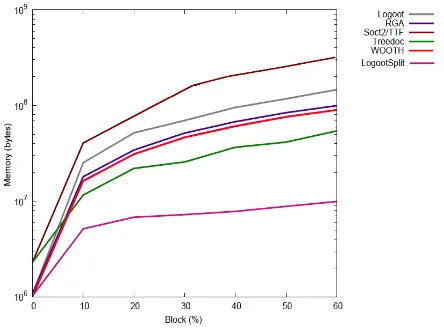
Figure 8(b) presents the average memory occupied by one replica during the block experiment. Except LogootSplit, the memory occupied increases for all algorithms and for the document view, since more blocks implies more characters. The ranking between the algorithms and their relative overhead remains the same than in the replica experiment. LogootSplit performance has a different behavior. With 0% block it has similar performance than the other. With more than zero block, its performance is stable even if the document size increases. With 60% block, its overhead is only three times the document size, far below the other algorithms.
Message size
. To evaluate the bandwidth required the algorithms, we compute the size of the remote messages generated by the algorithms. Figure 9 presents the average size of the message serialized depending on proportion of operations that manipulate the blocks. Not surprisingly, the behavior and the ranking between the algorithm is the same than for the model size results. However, in the experiment with 0% block, TreeDoc performs worse compare to all other CRDT algorithms and as badly as SOCT2/TTF. Indeed, in the TreeDoc model the identifiers representation is compacted into the tree, but not into the remote message. Over the time, SOCT2/TTF produces an important flow in the network. The algorithm sends in its messages the vector clock of the current operation. That is why, SOCT2/TTF does not scale.
Figure 9. Size of messages in text data type
3.4. Performance in Tree Data Type Algorithms
In [19], we measured through the framework a performance evaluation of tree data type algorithms: TreeOpt, OTTree and FCEdit algorithms. We evaluated these algorithms with different policies described in section2.1, and compared them with other algorithms deployed on layered approach[19].
3.5. Discussion
The results obtained trough our framework are consis-tent with the theoretical analysis. Such consistency val-idates the evaluated implementation of the algorithms. Despite the random nature of our different experi-ments, their results are consistent with each other.
Our experiments demonstrate that our framework is able to detect which parameter has more effect on the algorithms. In addition, Analyzing the results obtained by our framework, we were able to select which algorithm is adapted to which situation.
The framework provided also for the first, an experimental evaluation of set data type algorithms, and provided a more performance evaluation of text data type algorithms than published in [1]. For instance, study the impact of execution time by number of replicas, the memory requirement and sizes of messages for text data type has never been studied.
As shown by our experimental results, the choice of the best algorithm depends highly on the application and user context. For the set data type algorithms, CounterSet is the best choice in execution time and for application with a large dataset. While, LWWSet algorithm is good for applications that require low memory. We found also, OptORSet algorithm designed to reduce the memory requirement does not. Indeed, the vector used to detect the partial order of elements hide the memory saved.
For text data type algorithms, TreeDoc is a very good generic algorithm. It performs the best or among the best for almost all experiment. However, we cannot recommend it for every usage. For collaborative activities with a very large number of participants, RGA and WOOTH are more suitable. Indeed, their remote execution times are the best. For usages on limited devices, LogootSplit is a good choice since it has a low memory and bandwidth overhead and good execution time performance.
4. Asynchronous Editing Experiment
In asynchronous editing, the documents are modified in a different manner compared to synchronous editing. Operations are grouped in patches and the users usually control when they apply remotes modifications, introducing more concurrency. In this Section, we evaluate the behavior of the studied collaborative
14
editing algorithms in the context of asynchronous collaboration.
As explained Section 2.2, our framework is able to extract collaborative editing corpus from git repositories and to run a different algorithm against these histories. These experiments are run in the same Amazon EC2 setting than above.
We use different statistical metrics to evaluate the algorithms. We establish the average performance of an algorithm to manage three whole repositories and to treat a user operation: commit or merge. We analysis the correlation between their performances and the edition characteristics per file. Finally, we evaluate the quality of the automatic merge result.
4.1. Corpus obtained
In Table 6 we present the characteristics of some projects retrieved from the GitHub repository. The head commits sha1 used to run our experiments is presented above each repository name. The characteristics are computed per file. For each file, we extracted the number of commits that affected the file, the total number of lines modified, the number of simulated replicas, the proportion of insertions, the average block size in number of lines (as computed by the diff), and the number of merge commits. These repositories are selected among the most popular projects available on GitHub web site.7
General performance The Table 7 presents the
execution time of the different algorithms on three git repositories (git/git,joyent/nodeandtwitter/bootstrap). The “commit” measure is the time required to execute all the local operations affecting the files in a repository divided by the number of commits. The “merge” measure is the time required to execute all the remote operations affecting the files in a repository divided by the number of commits. Thus, these measures correspond to the relative performance a user should observe in a DVCS based on one of these algorithms.
In local execution, the ranking between the perfor-mances of the algorithms is the roughly the same than in the synchronous experiment. we can classify the algorithms on three sets: algorithms based on blocks which perform better – LogootSplit and Treedoc – algo-rithms based on tombstones which perform worse – WOOTH, RGA and SOCT2/TTF – and Logoot some-where in the middle. However, the rankings within these sets can vary due to collaboration characteristics. For instance, LogootSplit seems more stable than Tree-Doc, and RGA seems more stable than WOOTH.
7https://github.com/popular/starred
In remote execution, the results are more sur-prising compared to the synchronous experiments. SOCT2/TTF performances remain the worst, requiring hundreds time more than the average CRDT. RGA, TreeDoc, Logoot and LogootSplit performance remains very good. However, contrary to asynchronous experi-ment, Logoot performs slightly better than LogootSplit. Also, WOOTH behavior was not expected. It is the worst CRDT algorithm on bootstrap and node project. This behavior seems due to few of the most edited files in these projects that cause problems to the WOOT lineari-sation algorithm. Indeed, Table6shows that these two projects contains files which are much more edited than the git one.
Tendencies To detect which characteristic affect the
algorithms performances, we correlate the performance to the editions characteristic. We consider the inde-pendent performances result of each file edited of one repository:git/git.8 The presented results consider only the most edited files, i.e. more than the average which is 60 block edited.
We computed the bivariate analysis correlation between each local and remote execution time and four characteristics. The execution time is the average execution time per line edited. The four characteristics are the average size of blocks, the proportion of insertion operations, the number of lines, and the number of simulated replicas. We noticed that the execution times correlate strongly with the average size of blocks. So, we computed the partial correlation between execution time and each other characteristic controlling the block size.
4.2.
Remote Editing Experiment
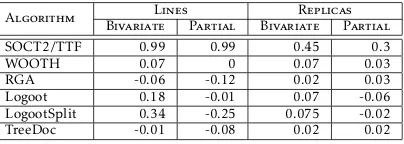
Table 8 presents the correlations between remote execution time and edition characteristics. Figures10(a) and 10(b) present respectively, the scatter graph for execution time and number of lines and number of replicas. The execution time is presented on logarithmic scale.
Algorithm
Lines Replicas Bivariate Partial Bivariate Partial
SOCT2/TTF 0.99 0.99 0.45 0.3
WOOTH 0.07 0 0.07 0.03
RGA -0.06 -0.12 0.02 0.03
Logoot 0.18 -0.01 0.07 -0.06
LogootSplit 0.34 -0.25 0.075 -0.02
TreeDoc -0.01 -0.08 0.02 0.02
Table 8. Correlation on remote execution time.
8The two other projects contains less files and/or few heavily edited
files which makes the tendencies more difficult for analysis.
15 EAI Endorsed Transactions
Project git/git twitter/bootstrap joyent/node
Head sha1 8c7a786b6c8 cd42f56178 9f29785783
Files 2496 250 2588
Characteristics max min avg max min avg max min avg
Commits 1742 2 75.75 633 12 84.21 631 2 21.75
Merge 451 0 12.92 55 0 7.44 37 0 0.88
Lines edited 25304 149 1953.49 119594 964 18104.65 123340 276 7400.23 Avg block size 28.13 1.84 6.78 80.93 12.35 32.06 761.25 7.65 97.45
Table 6. Projects characteristics
Algorithm git node bootstrap
Commit Merge Commit Merge Commit Merge
SOCT2/TTF 337 6723 1816 18153 1373.0 33485.8
WOOTH 306 15 2232 133 1936.9 612.4
RGA 365 13 1662.2 49.3 1709.1 64.1
Logoot 159 24 1138.2 64.7 1337.0 76.0
LogootSplit 99 63 135.2 90.1 188.5 97.7
TreeDoc 96 18 200.4 41.9 595.0 76.1
Table 7. Average commit and merge time (inµs)
The table and the figures obtained through the framework demonstrates that
• the tendency remote performances and ranking between the algorithms are consistent with synchronous editing experiments;
• all CRDT performances are very stable against all edition characteristics with negative or very low (under 0.1) partial correlations;
• the SOCT2 algorithm remote performances are impacted by the number of operation and number of replica;
• LogootSplit gains in performance during the edition process – number of lines, -0.25 partial correlation.
4.3.
Local experiment
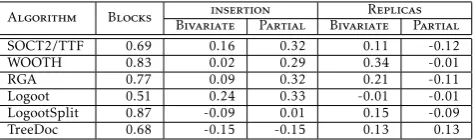
The visual analysis of the scatter charts is less obvious than for remote execution. Why, statistical analysis of the data may require to ensure consistency with our other experimental results. The analysis of the local execution time is presented in Table9.
Algorithm Blocks
insertion Replicas Bivariate Partial Bivariate Partial
SOCT2/TTF 0.69 0.16 0.32 0.11 -0.12
WOOTH 0.83 0.02 0.29 0.34 -0.01
RGA 0.77 0.09 0.32 0.21 -0.11
Logoot 0.51 0.24 0.33 -0.01 -0.01
LogootSplit 0.87 -0.09 0.01 0.15 -0.09
TreeDoc 0.68 -0.15 -0.15 0.13 0.13
Table 9. Correlation on local execution time
The correlation values indicate that:
• The local performances and ranking between the algorithms are consistent with synchronous editing experiments;
• The performance of all algorithms does not affected by the number of replicas;
• Treedoc algorithm has the best performance. It improves the performance since it identifies each line by unique identifier and the size of major-nodes decreases by the percentage of insertion. However, LogootSplit remains stable since all operation on Git are based on line. However, Logoot algorithm and the algorithms based on tombstones (RGA, WOOTH and SOCT2) are less efficient;
• The partial correlation shows that the insertion proportion impact tombstone-based algorithms (similar to synchronous experiments);
16 EAI Endorsed Transactions Collaborative Computingon
100000 10000
1000 100
1000000
100000
10000
1000
100
Number of lines
Time(nanosec)
(a) Remote execution -number of
lines-100
10
1
1,000E-5
1000000
100000
10000
1000
100
LogootS WootH Tree Soct RGA Logoot LogootS WootH Tree Soct RGA Logoot
Replica
Time(nanosec)
(b) Remote execution -number of
replica-Figure 10. Remote execution time
• All algorithms, including SOCT2, performs very stably when the number of replicas grows. The partial correlation in Table 9 is around 0 for all algorithms;
• As for remote execution, the hierarchy between the performance scalability of LogootSplit and TreeDoc is less obvious than in synchronous experiment.
4.4.
Memory requirement
Table 10 presents the total memory occupied by the algorithms during the experiments and their average message size. We also present the space occupied by the git software in its .git directory. The
obtained results are consistent with the synchronous experiment. The ranking between the algorithm is respect except than Logoot performs relatively better in the asynchronous one. The algorithms based on tombstones – SOCT2/TTF, RGA and WOOTH in this order – have the worst performances since they do not delete the elements. TreeDoc and LogootSplit obtain the best performances.
CRDT algorithms memory is lower or comparable to the corresponding .git directory size despite the poor performances of the Java serialization mechanism and the compression made by the git software.9 However, git software is able to retrieve any past states of the document. This feature is achievable in OT and in CRDT by using tombstones, thus, without supplementary memory cost for RGA and WOOTH. Indeed, any element identifier in a CRDT model contains a clock.
4.5.
Message size
The message size of the algorithms in asynchronous traces presented in table 10, follow the same ranking to the one obtained through synchronous experiment. Indeed, the worst algorithm is SOCT2. It produces the largest message size since it sends the vector clock. SOCT2 does not scale. RGA and WOOTH specifies the previous and next element in their messages, while Logoot adds its identifier. Treedoc and LogootSplit that are based in blocks are the best, since their identifiers are not voluminous.
4.6.
Merge quality
In [2], we proposed a methodology to evaluate the algorithms in merge quality. The framework reproduces the same collaboration as in the histories of DVCS and observe the effort made by users when conïňĆicts occur. The framework returns the number of blocks that conflict and number of lines introduced by users to correct their document. Depending of the algorithms, the collaboration produces less conflict and then user makes less effort to correct the document.
4.7. Discussion
This experiment on asynchronous traces validate the result obtained in synchronous experiment. The hier-archy between the algorithms in term of local/remote performances and messages size is similar to the one obtained through synchronous experiment. The frame-work re-plays the traces in the same conditions and uses the same technique to compute the performances.
9gitsoftware stores supplementary information concerning
manage-ment of directory states. However, this information can be considered much smaller than file states.
17 EAI Endorsed Transactions Collaborative Computingon