© Global Society of Scientific Research and Researchers http://ijcjournal.org/
An Alternative Model to Overcoming Two Phase Commit
Blocking Problem
Hassan Jafar Sheikh Salah
a*, Dr. Richard M. Rimiru
b,
Dr. Michael W. Kimwele
ca,b,cComputer Science, Jomo Kenyatta University of Agriculture and Technology Kenya a
Email: [email protected]
b
Email: [email protected]
cEmail: [email protected]
Abstract
In distributed transactions, the atomicity requirement of the atomic commitment protocol should be preserved.
The two phased commit protocol algorithm is widely used to ensure that transactions in distributed environment
are atomic. However, a main drawback was attributed to the algorithm, which is a blocking problem. The
system will get in stuck when participating sites or the coordinator itself crashes. To address this problem a
number of algorithms related to 2PC protocol were proposed such as back up coordinator and a technique
whereby the algorithm passes through 3PC during failure. However, both algorithms face limitations such as
multiple site and backup coordinator failures. Therefore, we proposed an alternative model to overcoming the
blocking problem in combined form. The algorithm was simulated using Britonix transaction manager (BTM)
using Eclipse IDE and MYSQL. In this paper, we assessed the performance of the alternative model and found
that this algorithm handled site and coordinator failures in distributed transactions using hybridization
(combination of two algorithms) with minimal communication messages.
Keywords: Distributed transactions; atomicity; two phase commit protocol; three phase commit protocol.
1. Introduction
In databases, transactions are unit of work that should be treated as whole. Transactions are required to keep the
consistence of the database prior to the initiation and after the execution of the transactions.
---
The transactions have four properties; atomicity, consistence, isolation and durability. These properties should
be ensured. The atomicity property defines that transactions should be done or nothing. The consistence
property states that transaction should leave the database in a consistence state. These two properties are
concerned when transaction become distributed. And distributed transactions might involve in processes at
different sites. This phenomenon raised the concern about commit/ abort decisions when transactions are
distributed [1]. However, a number of distributed algorithms were developed among them; one phase commit
protocol (1PC) two phase commit protocol (1PC), three phase commit protocol (3PC).
1.1. Transactions in Distributed Systems
Transaction is a sequence of operations performed on a single logical unit of work. In other words, is a
collection of operations performed against the data items of the database [2]. To preserve the integrity of
database ACID properties of transactions should be ensured i.e., atomic, consistency, isolated and durable.
Atomicity
The atomicity property is referred to as all-or-nothing, which means that all of transaction’s operations should
be done all or not at all. This keeps the atomic requirement of the transaction whether transactions are
centralized or distributed. Atomic commitment protocol algorithms such as 2PC and 3PC were designed to obey
the atomicity of transaction in distributed environments. Atomicity mainly deals with distributed transaction.
Consistency
This property ensures the consistence of database prior to initiation and after transactions. Data should be
consistent when transactions were completed. Transactions are moving database from consistent state to a
consistence state. This is consistency basic requirement.
Isolation
The isolation property requires that transaction should not interfere each other. Transactions should be
independent. Transaction should be visible to other
1.2. Two Phase Protocol
According to Lin and his colleagues [3], in the field of distributed databases, the most commonly used protocol
is the two-phase commit protocol. As the term two describes the algorithm consist of two phases as explained in
the following scenarios:
Phase 1: Site 1 (the coordinator) sends the transaction to site 2 (the only slave). Site 2 starts the local transaction,
executes the transaction but doesn’t commit. If the execution is successful, site 2 sends a “YES” message too
site 1 to commit; otherwise it sends “NO” message to abort. Phase 2: Site 1 receives the response (vote) from
message [2]. This shows that algorithm is composed two phases. Some scholars argue that the execution of the
transaction should be recognized as phase, however, researchers call the algorithm two phase commit protocol.
This scenario above works when there is no failure in the system. The main problem of this algorithm appears
when site or coordinator fails. The following diagram is going to show the states of the algorithm. The picture
consists of two finite state machines one for the coordinator and the other for the participant.
Figure1: finite state machine for the coordinator [4]
Figure 2: finite state machine for the coordinator [4]
ABORT
INIT
WAIT
COMMIT
Vote-abort
Vote-commit
commit
Vote-abort
Global-INIT
READY
ABORT
COMMIT
Vote-commit
Global-commit
vote-1.2.1. Problems associated with two phase commit protocol
According to the diagram, a blocking can occur in one of the following states
1. Participant P can be in initial state waiting response from coordinator, if that message not received, the
participant aborts the transaction.
2. Coordinator can be blocked in waiting for a vote in each of the participant, after sometime, the
coordinator aborts the transaction
3. Participant can be blocked in ready state, waiting a global-commit message, it continues blocking till
the coordinator recovers [4]
The two phase commit protocol is referred to as blocking protocol when a participant is in a ready state and the
coordinator has failed [5]. To overcome this blocking problem another algorithm was proposed, most probably
is the three phase commit protocol
2. The three phased commit protocol
The three phase commit protocol was designed to overcome to the blocking problem of the 2pc. It consisted of
three phases
Voting phase
1. Coordinator multicasts vote-request message to all participants Each participant receiving the message,
if it commits the transaction, it sends “YES”, if it is not committing it sends “NO”
Pre-commit phase
Coordinator waits response from all participant
i) If all participants vote “YES”, prepare-commit is sent to the participant
ii) If at least of the participant voted “NO”, a Global-abort is sent to the participant that replies NO
2. Participants wait for reply from coordinator
i) If participant receive prepare commit message from the coordinator, the participant commits
transaction and sends ready commit acknowledge to the coordinator
ii) If Global-abort message is received from the coordinator. Participant abort the transaction.
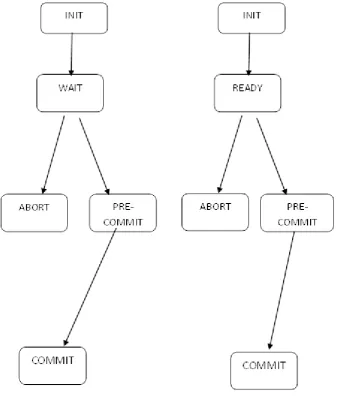
The three phase commit protocol goes through three states, INI, WAIT and Pre-commit as explained in the
Figure 3: three phase commit protocol states
2.1. Problems associated with the three phase commit protocol
The biggest problem to the algorithm is when there are multiple site failures. To understand it, let’s illustrate
this case. A coordinator is in pre-commit state and fails before or after sending commit message, and participant
fails before or after sending receiving message. In this condition, the coordinator moves to the committed state
without acknowledgement from participant, and the participant moves to the aborted without acknowledgement
[6]. Although, it is widely referred in literature, it is not used in practice and real distributed systems because the
blocking problem of the 2pc is rarely encountered. On the other hand, initially 3PC was introduced as an
extension of 2PC, however it brought overhead problems [7]. A number of messages are being transferred hence
causing network overhead and congestion when participating sites increase.
3. Review of 2PC Proposed Algorithm
To overcome the 2PC blocking protocol a number of algorithms relating 2PC were proposed. Manikandan and
middleware in which the server components manage the workload. The algorithm added backup coordinator and
middleware to the 2PC protocol architecture to ensure recovery and minimize blocking problem. This algorithm
used statistical method to prove the probability that the backup coordinator and the coordinator fail. However,
the algorithm was not simulated and blocking is still there when both the coordinator and backup coordinator
fail. The most widely known non-blocking protocol is the 3PC protocol which we discussed it above.
Kumar and his colleagues [9] made an enhancement of 3PC protocol algorithm worked on 2PC protocol and
runs 3PC upon failure. They made modifications on 2PC protocol algorithm and an extra phase of pre-commit
worked like the 3PC in the times of failure. The extra phase is performed at sending time of sender-side. It sends
pre-commit message to all receiver sites and was stored in multiple site. However, using a lot message
transference is hindrance to the efficiency of the network since each sending site sends message to all receiving
site. This exceeded the communication problem that was criticized to the 3PC protocol. Also the algorithm
might not have backup coordinator that could minimize the possibility of encountering any blocking problem.
This algorithm is an enhancement of 2PC protocol added with pre-commit message thus suggesting problems
associated with 3PC such as multiple site failures are still existing.
Teresa [10] proposed an improved failure recovery algorithm for overcoming 2PC blocking problem. Though
the main trigger of 2PC blocking is the failure of a coordinator and one of the participating sites is in ready state
for committing the transaction, Teresa used a backup coordinator with reduced communication overhead. The
algorithm was simulated in MYSQL server as back end server and JCRETOR as front end. The algorithm
revealed it consisted of only operation according to Teresa. It had sub transactions partially for inserting,
updating and others for error-handling. These sub transactions are executed at the same time. Hence they fail as
a group and rollback as group. However, what if the backup coordinator itself failed? This is a question not
answered yet and it is not known its consequence on the proposed algorithm.
Teresa [10] proposed another algorithm named a clustering algorithm in 2PC protocol for overcoming
distributed transaction failures. Teresa made a simulation to investigate how the algorithm handles site failures
using Kisii, Nairobi and head office as replicated sites. The table consisted of five columns; customer ID,
Customer Name, Address, City and AccountBalance. The Nairobi of the sites was intentionally modified one of
the its columns form AccountBalance to AccountBalance1 and the algorithm was re-run. The transaction was
marked as roll back, the two sites did not vote a TRANSACTION_COMMIT. The algorithm ensured the
atomicity requirement of the transaction that should be committed as cluster otherwise rolled back.
However, it is unclear how the algorithm handles coordinator failure. Though site failure was simulated and the
algorithm handled it successfully, no one knows how it will overcome the blocking problem related to the 2PC
protocol when the coordinator fails. Also algorithm redesign is needed so that explicit transaction commit
message sent by the other participants, knowing they haven’t voted and the coordinator had rolled back the
transaction.
Having mentioned that 2PC has blocking problem, a number of algorithms were proposed. The 3PC protocol
communication problems and not dealt well with the multiple site failure. A clustering 2PC protocol algorithm
was designed that transaction should be committed or rolled back as clusters. This algorithm minimized site
failure but not the coordinator failure. Teresa proposed a backup coordinator as means of recovering failure.
Kumar and his colleagues [8] proposed an algorithm that is working in 2PC protocol and runs 3PC protocol
during failure. In spite of different methods proposed to overcoming 2PC blocking problem, there is a gap in the
literature yet to be filled. There is hybrid method, in other words, combined method for overcoming 2PC
protocol. In our paper, we are proposing this hybrid. We are combining Kumar algorithm and Teresa’s
algorithm to overcome the problem in a combined form rather a single method. Therefore, this makes it
necessary to fill the gap left by the current existing algorithms. That is why we are proposing an alternative
model for overcoming 2PC blocking problem by redesigning the algorithm.
4. Tools and methods
We conducted simulation of the alternative model to measure the performance and efficient of the proposed
algorithm. We used MYSQL AND Eclipse IDE to provide us the simulation environment. We used JTA (Java
Transaction API) as coordinator of transactions in distributed environment with the help of the open source
Bitronix transaction manager as the implementation of JTA. The experiment also includes JDBC driver for
establishing connections with MYSQL server.
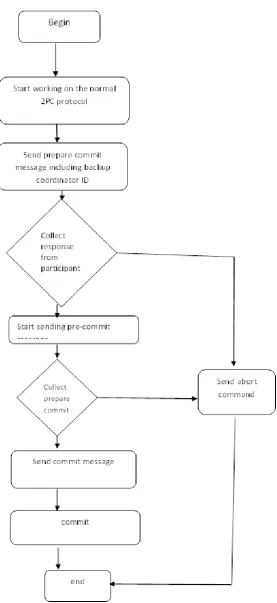
4.1. flowchart of proposed algorithm
4.2. Simulation Component
The simulation we have conducted in this experiment comprises of the following components:
• Resource manager: each database has its own resource manager for executing transactions locally as
coordinated by the transaction manager i.e., Bitronix transaction manager
• Participants: there are site MYSQL SERVERS namely, MYSQL SERVER 1 in site1,
MYSQLSERVER 2 in site 2, and MYSQL SERVER 3 in site 3 as distributed database.
• Bitronix transaction manager is the open source transaction manager for managing transaction from
different resource manager in each MYSQL SERVER. The version of Bitronix transaction manager
btm.2.1.3.jar.
• Resource adaopter: mysql-java-connector is the JDBC driver for connecting to MYSQL SERVERS.
• Database connection do the role of establishing connections to each of MYSQL SERVER connection
1, connection2, connection3 respectively
• Maven for managing dependencies such as MYSQL Connector jar and BTM jar.
Connection con1 =DriverManager.getConnection("jdbc:mysql://localhost:3306/site1-db","root","root");
Connection con2 =DriverManager.getConnection("jdbc:mysql://localhost:3306/site2-db","root","root");
Connection con2=DriverManager.getConnection("jdbc:mysql://localhost:3306/site3-db","root","root");
The picture below depicted the overall simulation
4.3.2. PC Coordinator Failure Simulation
To show 2PC site failure, the figure below shows an output adopted from Teresa’s work of clustering algorithm
in two-phased commit protocol for optimizing distributed transaction failure. The output clearly shown
coordinator failure as the figure below indicated
Figure 6: 2PC Site Failure. Teresa [10]
The snippet above has given Bitronix Transaction file log details while conducting 2PC coordinator failure. The
Bitronix Transaction manager services was initialized and assigned a unique ID with localhost address of the
MYSQL Server. TwopcCoordinator Class representing main class of java has failed and It was marked as
resource failure in the output of the log file. bitronix.tm.recovery.RecoveryException was raised
4.4. Pseudo Code of Algorithms
In this part, we have shown pseudo code of algorithms namely, 2PC, 2PC using back up coordinator, and the
alternative model-the proposed algorithm. We clearly pinpointed coordinator failure and the backup coordinator
failure and how the modified algorithm overcame failures. The bold text inside pseudo code shows changes
made and differences between algorithms
4.4.1. Pseudo code of 2PC without backup coordinator
In phase 1: Voting Phase
Begin
“Feb 5, 2015 7:12:52 AM
bitronix.tm.recovery.Recoverer recoverAllResources WARNING: error running recovery on resource 'TwoPCCoordinatoFailureClass1', resource marked as
failed (background recoverer will retry recovery) bitronix.tm.recovery.RecoveryException: cannot start
recovery on a PoolingDataSource containing an XAPool of resource TwoPCCoordinatoFailureClass1
Coordinator sends prepare message
Participants receive prepare message by sending Ready Message “YES”
Coordinator collects all the RM
If one of the participants replied “NO” or Times out
Coordinator Sends GLOBAL ABORT message by locally aborting the transaction
All participants also abort the transaction
In phase 2: Decision Phase
Coordinator Receive RM “YES” from the participants and send Commit Message CM GLOBAL COMMIT
MESSAGE
If one of the participants fail it checks with the coordinator upon recovering from failure
Participants receive CM from coordinator by replying acknowledge message and locally committing
transaction
Coordinator commits transaction
If coordinator fails when sending CM message and non-participant receive,
Alive participant cannot make a decision and the algorithm gets in stuck.
End of algorithm
4.4.2. Pseudo code of 2PC with backup coordinator
There is no much difference between the algorithms apart from writing transaction logs in a single coordinator
alone, we also use back up coordinator in case of failures.
In phase 1: Voting Phase
Begin
Coordinator sends prepare message with back up coordinator ID
Participants receive prepare message by sending Ready Message “YES”
If one of the participants replied “NO” or Times out
Coordinator Sends GLOBAL ABORT message by locally aborting the transaction
All participants also abort the transaction
End of Algorithm
In phase 2: Decision Phase
Coordinator Receive RM “YES” from the participants and send Commit Message CM GLOBAL COMMIT
MESSAGE
If one of the participants fail it checks with the coordinator upon recovering from failure
Participants receive CM from coordinator by replying acknowledge message and locally committing transaction
If coordinator and backup coordinator fails when sending CM message and non-participant receive,
Alive participants cannot make a decision and the algorithm gets in stuck
End of Algorithm
4.4.3. Pseudo code of the Proposed algorithms using hybridization
In this pseudo code, we have shown the pseudo code of the algorithm clearly stating how this algorithm
bypasses blocking problem caused by coordinator failure using hybridization, combination of back up
coordinator and 3PC. Both coordinators and participants register locally pre-commit with no broadcast or
sending to coordinator or participant as a means of reducing communication overhead associated with 3PC. The
bold text in the code modification made in the previous pseudo code. As its predecessor, it consists of two
phases namely, phase I and phase II. The pseudo code of the algorithm is shown below.
In Phase I: Voting Phase
Start of the algorithm
Coordinator sends prepare message with back up coordinator ID
Participants receive prepare message by sending Ready Message “YES”
Coordinator collects all the RM
Coordinator Sends GLOBAL ABORT message by locally aborting the transaction
All participants also abort the transaction
In phase 2: Decision Phase
Coordinator Receive RM “YES” from the participants and before send message it locally registers Pre-Commit
state and send Commit Message CM GLOBAL COMMIT MESSAGE.
If one of the participants fail it checks with the coordinator upon recovering from failure
Participants register pre-commit state upon receive CM from coordinator by replying acknowledge message and
locally committing transaction
If coordinator and backup coordinator fails when sending CM message and non-participant receive,
Alive participant start communicating to each other to check for pre-commit state
If any participant has locally registered pre-commit state, they commit the transaction
If non-participant has registered pre-commit state, they abort the transaction.
End of the algorithm
4.4.5. Simulation of Coordinator and Backup Coordinator Failure
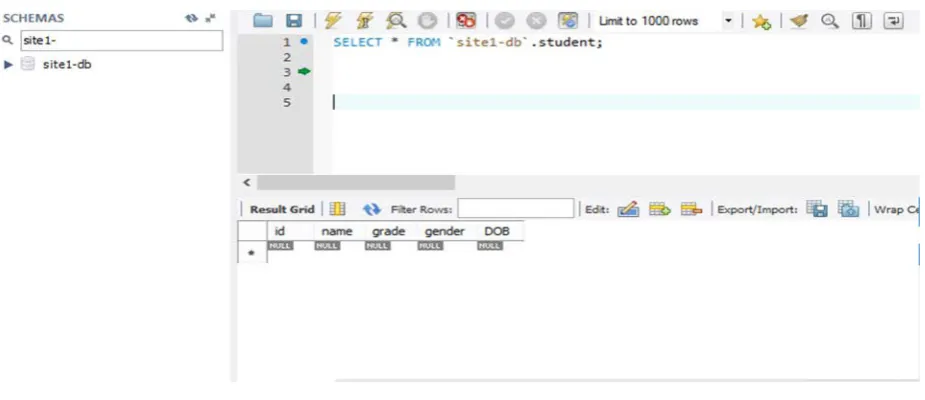
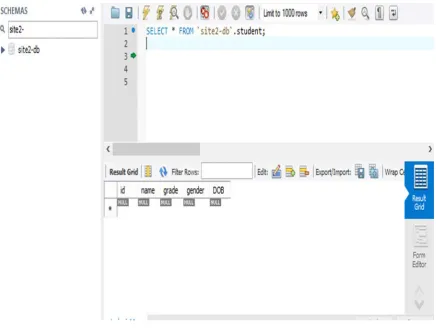
To demonstrate coordinator and backup coordinator failure, we ran the simulation by making insertion to the
student table created in the three database sites namely site1-db, site2-db, and site3-db. The data tried to insert
was the following:
Table 1: Data Inserted In Three Databases
ID NAME ADDRESS GENDER DOB
1 HASSAN MOGADISHU MALE 1988
After running, the Bitronix output in the console window of Eclipse IDE appeared like this
As shown above, Bitronix Transaction manager started beginning, and the coordinator and backup coordinators
were coordinating transaction between different sites of the database. There happened a serious communication
error where both coordinators have failed. Then, the participants
depicted. No rows were affected. The details of the student table in three databases were shown below.
Figure 7: Bitronix output in the console window of the eclipse IDE.
Figure 9: Status of site2-db after running the simulation: Console log of MYSQL Workbench
4.4.6. Simulation of the proposed algorithm
To demonstrate how the alternative model overcame blocking problem, we run the simulation using the same
insertion scenario we did in the simulation of the coordinator above. After running, the Bitronix Transaction log
displayed output below.
As shown in the figure above, the same failure has occurred i.e., both coordinator and backup coordinator has
failed. Instead participants get stuck in blocking state, they made communication by accessing each site’s status
of pre-commit state as we have in the pseudo code. As shown in the figure above, the same failure has occurred
i.e., both coordinator and backup coordinator has failed.
Instead participants get stuck in blocking state, they made communication by accessing each site’s status of
pre-commit state as we have in the pseudo code of the proposed algorithm.
It was stating that the algorithm should run to 3PC in case of failure. As evident in the output above, one of the
participants has not reached pre-commit before coordinators has failed and the participants unanimously agreed
Figure 10: Bitronix output in the console of Eclipse IDE after running the alternative model
5. Conclusion
we conducted a research in the distributed algorithms specifically the commonly used 2PC protocol. The main 1 [main] INFO bitronix.tm.BitronixTransactionManager -
Bitronix Transaction Manager version 2.1.3
3 [main] DEBUG bitronix.tm.BitronixTransactionManager - JVM version 1.8.0_101
8 [main] DEBUG bitronix.tm.Configuration - loading default configuration
27 [main] INFO bitronix.tm.Configuration - JVM unique ID: <192.168.8.102>
514 [main] DEBUG bitronix.tm.BitronixTransaction - transaction status is changing from ROLLING_BACK to
ROLLEDBACK - executing 0 listener(s)
514 [main] DEBUG bitronix.tm.BitronixTransaction - successfully rolled back a Bitronix Transaction with GTRID [3139322E3136382E382E313032000000002A4D6C10000
00001], status=ROLLEDBACK, 0 resource(s) enlisted (started Fri Jan 09 08:08:37 EAT 1970)
514 [main] DEBUG
bitronix.tm.internal.XAResourceManager - clearing XAResourceHolder states on 0 resource(s)
515 [main] DEBUG bitronix.tm.BitronixTransaction - after completion, 1 synchronization(s) to execute
517 [main] DEBUG bitronix.tm.BitronixTransaction - executing synchronization a ClearContextSynchronization
for a Bitronix Transaction with GTRID
[3139322E3136382E382E313032000000002A4D6C10000 00001], status=ROLLEDBACK, 0 resource(s) enlisted
(started Fri Jan 09 08:08:37 EAT 1970) with status=ROLLEDBACK
BOTH COORDINATOR AND BACK UP COORDINATOR HAS FAILED
a live participants stated communicating each other Site 3 has not reached pre-commit and transaction was aborted
drawback related to this algorithm was blocking problem that occurs when participants are in the 2nd phase of
the algorithm and the coordinator has failed. The participants were forced to wait until the coordinator recovers
thereby leading them to get in stuck and blocked. To overcome this, a number of algorithms were proposed
among them is the clustering algorithm, 3PC, non-blocking 2PC, and improved failure recovery algorithm.
However, each has its own limitations as explained in the literature review. Therefore, in this study, we
proposed an alternative model to overcoming 2PC blocking problem by combining two techniques the use of
backup coordinator adapted from TRESA’S work of improved failure recovery algorithm and the technique
whereby the algorithm runs to 3PC in case of failure. This part adapted from Kumar and his colleagues [8]. To
reduce communication issues, we modified the algorithm thereby not sending pre-commit message at the same
time each participant has declared and registered locally it has reached pre-commit state.
The proposed algorithm i.e., the alternative model has achieved its objectives of the study. We proposed an
alternative model using hybridization. We also evaluated and studied existing algorithms overcame 2PC
blocking problem. Though we were combining two algorithms we reduced communication overhead. Lastly we
have assessed the performance of the alternative model by comparing other algorithms in terms of failure
resilience and communication cost. The alternative model has outperformed existing 2PC algorithm.
6. Recommendation
Failure was a common problem in 2PC whether it is a site or coordinator. To address this, different algorithms
were proposed among them is the alternative to overcoming two phase commit blocking problem. we simulated
the algorithm using Eclipse IDE and MYSQL Server. the algorithm combined two algorithms using backup
coordinator and technique where it runs to 3PC in case of failure. The algorithm has achieved its objectives
using hybridization. However, further redesign of the algorithm is recommended during failure when it runs to
3PC, so that each participating sites’ states are already known to every other site instead of communicating
between them. We also recommend testing the algorithm in other backend databases such as ORACLE and
NoSQL database such as MongoDB.
References
[1]. H. Garcia-Molina, J. D. Ullman, and J. Widom, Database systems: the complete book. Upper Saddle River,
New Jersey Pearson Prentice, 2008. pp. 1020-1021.
[2]. S. K. Rahimi and F. S. Haug, Distributed Database Management Systems: A Practical Approach. John
Wiley & Sons, 2010. pp.185.
[3]. L. Lou, F. Tang, I. You, M. Guo, Y. Shen, and L. Li, “An Effective Deadlock Prevention Mechanism for
Distributed Transaction Management,” 2011 Fifth International Conference on Innovative Mobile and Internet
Services in Ubiquitous Computing, 2011.
Saddle River, New Jersey: Pearson Prentice Hall, 2007. pp 355-363.
[5]. Lannhult, & B. Lindblom, “Review of Non-Blocking Two-Phase Commit Protocols. Master Program in
Computer System Engineering”, Emausgatan C, 29. Available: http://
http://www.idt.mdh.se/kurser/ct3340/ht09/ADMINISTRATION/IRCSE09-submissions. [Mar 5, 2016].
[6] M. Atif, “Analysis and verification of Two-Phase Commit & Three-Phase Commit Protocols,” in proc.
DOI: 10.1109/ICET.2009.5353152. Dec 2009, pp. 326-331. Available: http://ieee.exolpre.org [12 march, 2016].
[7] P. Singh, P. Yadav, A. Shukla, and S. Lohia, “An Extended Three Phase Commit Protocol for Concurrency
Control in Distributed Systems,” International Journal of Computer Applications, vol. 21, no. 10, pp. 35–39,
2011. Available: http://www.ijcaonline.org/archives/volume21/number10/2596-3608 [Jan 15, 2016]
[8] V. Manikandan, R. Ravichandran, R. Suresh, & F. S. Francis,. “An Efficient Non-Blocking Two Phase
Commit Protocol for Distributed Transactions”. International Journal of Modern Engineering Research, Vol.2,
Issue.3, pp. 788-791 may 2012. Available: http://www.ijmer.com. [Feb 25, 2016].
[9] N. Kumar, L. Sahoo, and A. Kumar, “Design and implementation of Three Phase Commit Protocol (3PC)
algorithm,” 2014 International Conference on Reliability Optimization and Information Technology (ICROIT),
pp. 116–120, 2014.
[10] T. K. Abuya, R. M. Rimiru, & W. K. Cheruiyot, “AN IMPROVED FAILURE RECOVERY
ALGORITHM IN TWO-PHASE COMMIT PROTOCOL FOR TRANSACTION ATOMICITY”. Journal of
Global Research in Computer Science, vol.5, Issue.12, pp 01-11, Dec 2014. Available: http://www.jgrcs.com.
[Feb 20, 2016].
[11] T. K. Abuya, R. M. Rimiru, & W. K. Cheruiyot, “A Clustering Algorithm in Two-Phase Commit Protocol
for Optimizing Distributed Transaction Failure”. International Journal of Computer Science and Mobile
![Figure 2: finite state machine for the coordinator [4]](https://thumb-us.123doks.com/thumbv2/123dok_us/8398679.1685673/3.595.184.408.171.379/figure-finite-state-machine-for-the-coordinator.webp)
![Figure 4: JTA architecture:"(understanding JTA")[11]](https://thumb-us.123doks.com/thumbv2/123dok_us/8398679.1685673/7.595.94.502.391.731/figure-jta-architecture-understanding-jta.webp)

![Figure 6: 2PC Site Failure. Teresa [10]](https://thumb-us.123doks.com/thumbv2/123dok_us/8398679.1685673/10.595.179.418.180.432/figure-pc-site-failure-teresa.webp)