Available online on 15.07.2019 at http://jddtonline.info
Journal of Drug Delivery and Therapeutics
Open Access to Pharmaceutical and Medical Research© 2011-18, publisher and licensee JDDT, This is an Open Access article which permits unrestricted non-commercial use, provided the original work is properly cited
Open Access
Review Article
Formulation, Optimization and Evaluation of Bilayer Tablet of
Antihypertensive Drug
Swetanshu*, Vijay Sharma
Department of Pharmaceutics, Jaipur College of Pharmacy, Jaipur, Rajasthan, India
ABSTRACT
Hypertension or high blood pressure occurs when the high cardiac output exerts pressure on the arterial wall as the blood flow increases. Bi-layer tablets are prepared with one Bi-layer of drug for immediate release while second Bi-layer designed to release drug later, either as second dose or in an extended release manner. Bi-layered tablet is suitable for sequential release of two drugs in combination, separate two incompatible substances, and also for sustained release tablet in which one layer is immediate release as initial dose and second layer is maintenance dose. Bilayer tablet is suitable for sequential release of two drugs in combination, separate two incompatible substances and also for sustained release tablet in which one Layer is immediate release as initial dose and second layer is maintenance dose. The preparation of tablets in the form of multi layers is used to provide systems for the administration of drugs.
Keywords: Hypertension, Bi-layered tablet, Enalapril, Immediate release and Sustained release.
Article Info: Received 15 May 2019; Review Completed 24 June 2019; Accepted 03 July 2019; Available online 15 July 2019
Cite this article as:
Swetanshu, Sharma V, Formulation, Optimization and Evaluation of Bilayer Tablet of Antihypertensive Drug, Journal of Drug Delivery and Therapeutics. 2019; 9(4):704-708 http://dx.doi.org/10.22270/jddt.v9i4.3098
*Address for Correspondence:
Swetanshu, Department of Pharmaceutics, Jaipur College of Pharmacy, Jaipur, Rajasthan, India
1.INTRODUCTION:
Hypertension or high blood pressure occurs when the high cardiac output exerts pressure on the arterial wall as the blood flow increases. The present available conventional dosage form used in the treatment of hypertension cannot produce the desired therapeutic effect for prolonged period of time and thus dose fluctuation and missing of dose chances are more.1
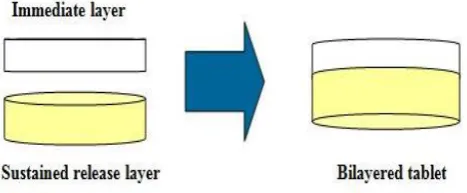
Figure 1: Bi-layered tablet
Bi-layer tablets are prepared with one layer of drug for immediate release while second layer designed to release drug later, either as second dose or in an extended release manner. Bi-layered tablet is suitable for sequential release of two drugs in combination, separate two incompatible substances, and also for sustained release tablet in which one layer is immediate release as initial dose and second layer is
maintenance dose. The basic goal of therapy is to achieve a steady state drug in blood level for an extent period of time2.
1.1 Advantage of Bi-layered tablets3-4
Bi-layered execution with optional single-layer conversion kit.
Cost is lower compared to all other oral dosage form. Greatest chemical and microbial stability over all oral
dosage form.
Objectionable odor and bitter taste can be masked by coating technique.
Flexible concept.
They are unit dosage form and offer the greatest capabilities of all oral dosage form for the greatest dose precision and the least content variability.
Easy to swallowing with least tendency for hang-up. Suitable for large scale production.
1.2 Disadvantage of Bi-layered tablets5,6
Some drugs resist compression into dense compacts, owing to amorphous nature, low density character, Bitter tasting drugs, drugs with an objectionable odor
Difficult to swallow in case of children and unconscious patients.
Drugs with poor wetting, slow dissolution properties, optimum absorption high in GIT may be difficult to formulate as a tablet that will still provide adequate or full drug bioavailability.
1.3 Advantage of Bi-layered tablets over conventional tablets7:
Blood level of a drug can be held at consistent therapeutic level for improved drug deliver, accuracy, safety and reduce side effects.
Reduction of adverse effect can be accomplished by targeting the drug release to the absorption site as well as controlling the rate of release, enabling the total drug content to be reduced.
Patient convenience is improved because fewer daily doses are required compared to traditional systems. Patient compliance is enhanced leading to improved drug regimen efficacy.
Bi-layered tablets readily lend themselves to repeat action products; where in one layer provide initial dose, the other layer provide maintenance dose. Separate physically or chemically incompatible
ingredients.
2. TYPES OF BI-LAYERED TABLET PRESS8-12
Single sided tablet press. Double sided tablet press.
Bi-layered tablet press with displacement monitoring. 2.1 Single sided tablet press:
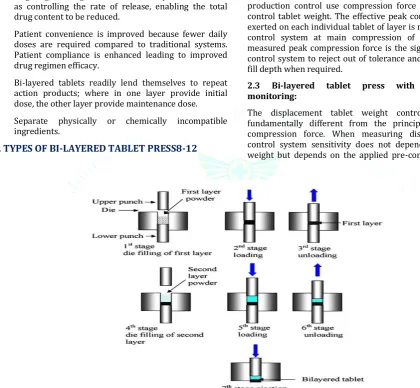
The single design is a single sided press with both chambers of the doublet feeder separated from each other. Each chamber is gravity or forced fed with different power, producing the two individual layers of tablets. When die passes under the feeder, it is first loaded with the first layer powder followed by the second layer powder. Then the entire tablet is compressed in one or two steps.
2.2 Double sided tablet press:
In most double sided tablet presses with automated production control use compression force to monitor and control tablet weight. The effective peak compression force exerted on each individual tablet of layer is measured by the control system at main compression of the layer. This measured peak compression force is the signal used by the control system to reject out of tolerance and correct the die fill depth when required.
2.3 Bi-layered tablet press with displacement monitoring:
The displacement tablet weight control principle is fundamentally different from the principle based upon compression force. When measuring displacement, the control system sensitivity does not depend on the tablet weight but depends on the applied pre-compression force.
Figure 2: Stages of Bi-layered tablet manufacturing
3. ANTI-HYPERTENSIVE DRUGS WITH BRAND
NAME
13:
Enalapril (Vasotec) Captopril (Capoten)
Lisinopril (Zestril and Prinivil) Benazepril (Lotensin) Quinapril (Accupril) Perindopril (Aceon) Ramipril (Altace) Trandolapril (Mavik)
4. PRE-FORMULATION STUDIES:
4.1 Determination of λmax14
APIs was dissolved in solvent further diluted with the same and scanned for maximum absorbance in UV Visible spectrophotometer.
4.2 Solubility15
The solubility of APIs was determined in distilled water, methanol, ethanol, acetone, chloroform and pH 6.8 phosphate buffer by shake flask method. Absorbance is measured by UV-Visible Spectrophotometer. The drug content is calculated by using the standard graph.
4.3 Melting point15
Melting point of the APIs was determined by capillary method in triplicate.
4.4 Standard Curve for APIs15
100 mg of APIs was accurately weighted and dissolved in 100 ml of solvent to prepare first stock solution. 10 ml of above solution was taken and diluted to 100 ml with the same solvent to prepare II stock solution. The aliquot amount of II stock solution was further diluted to get 5, 10, 15, 20, 25 and 30 g of drug per ml of the final solution. Then the absorbance was measured in a UV spectrophotometer. 4.3.5 Compatibility studies15
The compatibility studies of the drug with polymers are studies using FT-IR spectroscopy.
FT-IR Spectroscopy16
FT-IR spectroscopy was carried out to check the compatibility between drug and excipients. Infrared spectroscopy was conducted using s thermo Nicolet FTIR and the spectrum was recorded in the region of 4000 to 400 cm-1. The sample (drug and drug-excipient mixture in 1:1
ratio) in KBr (200-400mg) was compressed in to discs by applying a pressure of 5 tons for 5 min in hydraulic press. The interaction between drug-excipients was observed from IR-spectral studies by observing any shift in peaks of drug in the spectrum of physical mixture of drug-excipients.
DSC Analysis for formulation17
Thermal properties of the pure drug and the physical mixture of drug and excipients were analyzed by Different Scanning Calorimeter. The samples were heated in a thermetically sealed aluminium pans. Heat runs for each sample were set from 25 to 350 °C at a heating rate of 10 °C /
min, using nitrogen as blanket gas.
5. PARAMETER CONSIDER DURING FORMULATION
DESIGN:
5.1 Calculation of dose18
The total dose of APIs for once daily formulation was calculated by the following equation, using available pharmacological data.
Dt = Dose (1 + 0.693 x t / t1/2) Where, Dt = Total dose of drug,
Dose = Dose of immediate release part.
t = Time in hr during which the sustained release is desired t1/2 = Half life of the drug
5.2 Formulation of Immediate release layer19:
Table 1: Formulation of Immediate Release Layer (IRL)
S. No. Ingredients
1 APIs
2 Lactose
3 Croscarmellose sodium 4 Sodium starch glycolate 5 Microcrystalline cellulose
6 Ponceau 4R
7 Magnesium stearate
8 Talc
9 Total
5.3 Formulation of sustained released layer19
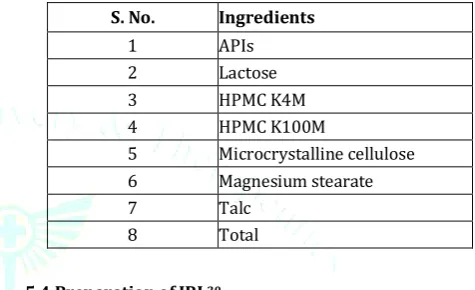
Table 2: Formulation of Sustained Release Layer (SRL)
S. No. Ingredients
1 APIs
2 Lactose
3 HPMC K4M
4 HPMC K100M
5 Microcrystalline cellulose
6 Magnesium stearate
7 Talc
8 Total
5.4 Preparation of IRL20:
IRL of APIs was prepared by wet granulation by using different Superdisintegrants such as SSG and Croscarmellose sodium. PVP K30 solution with containing coloring agent was used as binding solution. As DS was oily in characteristics, MCC was used as adsorbent. Manufacturing steps-Pass all the ingredients though sieve #80. Mix APIs with MCC geometrically and then mix with lactose. Add Superdisintegrants and mix for 10 to 15 min in mortar and pestle. Make wet mass using binding agent PVP K 30 solution containing color. Pass the cohesive mass through sieve # 16 to get uniform granules. Dry the granules at 500C for 15 min
in hot air oven. Lubricate the granules with lubricating agent and compressed into 250 mg each tablet weight by adjusting hardness.
5.5 Preparation of SRL20:
Accurately weighed APIs and polymer and others ingredients were taken in mortar and pestle and mixed well. The powder were mixed with sufficient quantity for PVP K30 solution until wet mass formed. The cohesive mass obtained was passed though sieve # 16 and the granules were dried in a hot air oven at 500C for 20 min. The dried granules again
passed through sieve # 22 to break the large lumps. Then granules were mixed with talc and magnesium stearate and compressed into 300 mg each tablet by adjusting hardness. 5.6 Preparation of bi-layered tablet20,21:
6. EVALUATION OF PRE-FORMULATION
PARAMETERS:
6.1 Angle of Repose22
The angle of repose of granules was determined by the funnel method. The accurately weighed granules were taken in a funnel. The height of the funnel was adjusted in such a way that the tip of the funnel just touched the apex of the heap of the granules. The granules were allowed to flow through the funnel greely onto the surface. The diameter of the powder cone was measured and angle of repose was calculated using equation.
h
Whe e, he gle of epose, h = height of the heap of the powder, r = radius of the heap of the powder
Table 3: Angle of Repose
S. No Angle of Repose (θ) Type of flow
1 ˂ 25 Excellent
2 25-30 Good
3 30-40 Passable
4 ˃ 40 Very poor
6.2 Determination of bulk density and tapped density23 A quantity of 2 g of the powder (W) from each formula was introduced into a 25 ml measuring cylinder. After the initial volume was observed, the cylinder was allowed to fall under its own weight onto a hard surface from the height of 2.5 cm at 2 sec intervals. The tapping was continued until no further change in volume was noted. The bulk density, and tapped density were calculated using following formulas. LBD and TDB were calculated using the following equations.
BD= Weight of the powder blend/Untapped Volume of the packing BD=Weight of the powder blend/Tapped Volume of
the packing 6.3 Carr’s Index / Compressibility Index24
It helps in measuring the force required to break the friction between the particles and the hopper. It is expressed in % and given by;
s e ( ) ppe e si l e si ppe e si 6.4 Hausner’s Ratio25
Hausner’s ratio is a indirect index of ease of powder flow. Hausner’s ratio was measured by the ratio of tapped density to bulk density.
Whe e ρ ppe e si , ρ = bulk density Table 4: Scale of flowability
Flow Character Compressibility Index (%) Hausner’s Ratio
Excellent < 10 1.00 – 1.11
Good 11 – 15 1.12 – 1.18
Fair 16 – 20 1.19 – 1.25
Passable 21 – 25 1.26 – 1.34
Poor 26 – 31 1.35 – 1.45
Very poor 32 – 37 1.46 – 1.59
7. EVALUATION OF PREPARED FORMULATIONS:
7.1 Evaluation of APIS, IRL, SRL and Bi-Layered tablet 26-29:
The tablets prepared were evaluated for the following parameters:
Weight variation Hardness Friability Drug content
In-vitro Dissolution Studies 7.1.1 Weight Variation Test:
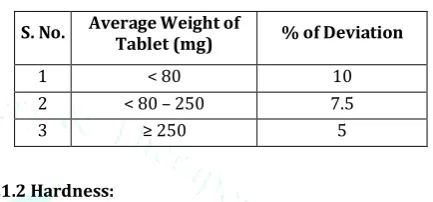
To study weight variation, 20 tablets of each formulation were weighted using electronic balance and the test was performed according to the official method.
Table 5: Scale of flowability
S. No. Average Weight of
Tablet (mg) % of Deviation
1 < 80 10
2 < 80 – 250 7.5
3 ≥ 250 5
7.1.2 Hardness:
The resistance of tablets to shipping or breakage under condition of storage, transportation and handling before usage depends on its hardness. The hardness of each batch of tablet was checked by using Monsanto hardness tester. The hardness was measured in the terms of kg/cm2. 5 tablets
were chosen randomly and tested for hardness. The average hardness of 5 determinations was recorded.
7.1.3 Friability:
Friability generally refers to loss in weight of tablets in the containers due to removal of fines from the tablet surface. Friability generally reflects poor cohesion of tablet ingredients. 10 tablets were weighed and the initial weight of these tablets was recorded and placed in Roche friabilator and rotated at the speed of 25 rpm for 100 revolutions. Then tablets were removed from the friabilator dusted off the fines and again weighed and the weight was recorded. Percentage friability was calculated by using the formula.
ria ilit Initital eight inal eight eight Initial 7.1.4 Tablet thickness:
Thickness of the tablet is important for uniformity of tablet size. Thickness was measured using Vernier Calipers. It was determined by checking the thickness of ten tablets of each formulation. Vernier caliper consists of metric and imperial scales. The main matric scale is read first then read “hundredths of mm” of imperial scale (count the number of division until the lines concedes with the main metric scale. The imperial scale number is multiply with 0.02. Then that number obtained from imperial scale added with main metric scale to get final measurement.
7.1.5 In Vitro dissolution studies:
performed using 900 ml of 0.1 N HCl, at 37 0.5C and 75 rpm.
8. CONCLUSION:
Bilayer tablet is improved beneficial technology to overcome the shortcoming of the single layered tablet. There is various application of the bi-layer tablet it consist of monolithic partially coated or multilayered Matrices. Bilayer tablet is suitable for sequential release of two drugs in combination, separate two incompatible substances and also for sustained release tablet in which one Layer is immediate release as initial dose and second layer is maintenance dose. The preparation of tablets in the form of multi layers is used to provide systems for the administration of drugs, which are incompatible and to provide controlled release tablet preparations by providing surrounding or multiple swelling layers. Bilayer tablet quality and GMP-requirements can vary widely.
9. REFERENCES:
1. V.T. Iswariya, A Hariom Prakash Rao , V Lokeswara Babu , Mohd
Abdul Hadi1, A Srinivasa Rao Formulation and Evaluation of Bilayer Tablet of Amlodipine and Metoprolol in the Treatment of HypertensionInt. J. Pharm. Sci. Rev. Res., 28(1), September – October 2014; Article No. 21, Pages: 111-118
2. M. D. Bhosale and K. S. Kulkarni Bilayer Tablet- A
Comprehensive Review EJPMR, 2017,4(9), 241-251
3. Shaikh T.K, Gadhave M.V, Jadhav S. L, Gaikwad D.D, Different
Techniques of Bilayer Tablet: A Review, International Journal of Universal Pharmacy and Life Sciences, March-April 2012; 2(2): 450-460.
4. Mayavanshi A.V. and Gajjar S. S Floating drug delivery systems
to increase gastric retention of drugs: A Review. J Pharm Tech, 2008; 1(14): 345-348.
5. Patra C.N, Kumar A. B, Pandit H. K, Singh S. P, Devi M. V. Design
and evaluation of sustained release bilayer tablets of Propranolol hydrochloride, Acta Pharm. 2007; 57: 479–489.
6. Deshpande R. D, Gowda D. V, Mahammed M, Maramwar D.N,
Bi-Layer Tablets-An Emerging Trend: A Review, International Journal of Pharmaceutical Science & Research, 2011; 2(10); 2534-2544.
7. Yadav B.V, Yadav V. A. Enhancement of solubility and dissolution
rate of BCS class II pharmaceuticals by nonaquious International Journal of Advances in Pharmaceutics 5 (5) 2016 126 granulation technique. International Journal of Pharma Research and Development. 2010; 1: 1‐12.
8. Serajuddin A. T. M, Solid dispersion of poorly water‐soluble
drugs: early promises, subsequent problems, and recent breakthroughs. J. Pharm. Sci 1999, 88: 1058‐1066.
9. Barar F. S. K. Essentials of Pharmacotherapeutics, S. Chand & Company Limited, Fourth edition, 2007; 239-249.
10. Indian Pharmacopoeia: Controller of Publications, Govt. of India,
Ministry of Health & Family Welfare, New Delhi, vol.1, 1996:7: 511-513.
11. Y. Lalitha, Lakshmi P. K, et al. Enhancement Of Dissolution of Nifedipine By Surface Solid Dispersion Technique, International Journal of Pharmacy and Pharmaceutical Sciences, 2011; 3( 3): 41-46.
12. Sonar G. S, Jain D. K, More D.M, Preparation & Invitro evaluations
of Bilayer and floating-bioadhesive tablets of rosiglitazone maleate Asian Journal of Pharmaceutical Sciences 2007; 2 (4): 161-169.
13. Subramanyam C. V. S, Text book of Physical pharmaceutics. 2nd
ed. New Delhi; Vallabh prakashan; 2001:211-215.
14. Madan J, Avachat A, Banode S, Dangi M, Formulation and
evaluation of a bilayer floating drug delivery system of nizatidine for nocturnal acid breakthrough. Ars Pharm. 2012; 53(2): 09-14.
15. Banker G. S, Rhodes C. T, Modern Pharmaceutics 4th edition,
Drug & Pharmaceutical Sciences, 2005, Vol. 121; 607- 625.
16. Seta Y, Higuchi F, Kawahara Y, Nishimura K, Okada R. Design and
preparation of captopril sustained-release dosage forms and their biopharmaceutical properties. Int J Pharm. 1988;41:245– 254.
17. Bera H, Boddupalli S, Nayak AK. Mucoadhesive-floating
zinc-pectinate-sterculia gum interpenetrating polymer network
beads encapsulating ziprasidone HCl. Carbohyd
Polym. 2015;131:108–118.
18. Diós P, Nagy S, Pál S, Pernecker T, Kocsis B, Budán F, et al. Preformulation studies and optimization of sodium alginate based floating drug delivery system for eradication of Helicobacter pylori. Eur J Pharm Biopharm. 2015;96:196–206.
19. Pawar HA, Lalitha K, Ruckmani K. Alginate beads of captopril
using galactomannan containing Senna tora gum, guar gum and locust bean gum. Int J Biol Macromol. 2015;76:119–131.
20. Chen YC, Ho HO, Liu DZ, Siow WS, Sheu MT. Swelling/floating
capability and drug release characterizations of gastroretentive drug delivery system based on a combination of hydroxyethyl
cellulose and sodium carboxymethyl cellulose. PloS
one. 2015;10:e0116914.
21. Kumar Giri T, Verma S, Alexander A, Badwaik H, Krishna
Tripathi D. Prospective and new findings of hydroxypropyl methylcellulose (HPMC) as a potential carrier for
gastrorententive drug delivery systems. Drug Deliv
Lett. 2012;2:98–107.
22. Pahwa R, Saini N, Kumar V, Kohli K. Chitosan-based
gastroretentive floating drug delivery technology: an updated review. Expert Opin Drug Deliv. 2012; 9:525–539.
23. Chen YC, Ho HO, Chiu CC, Sheu MT. Development and
characterization of a gastroretentive dosage form composed of chitosan and hydroxyethyl cellulose for alendronate. Drug Des Devel Ther. 2014; 8:67–78.
24. Kajale AD, Chandewar AV. Recent advancement in
gastroretentive drug delivery system- a review. Indo Am J Pharm Res. 2013; 3:5221–5232.
25. N Abduljabbar H, M Badr-Eldin S, M Aldawsari H.
Gastroretentive ranitidine hydrochloride tablets with combined floating and bioadhesive properties: factorial design analysis, in vitro evaluation and in vivo abdominal x-ray imaging. Curr Drug Deliver. 2015; 12:578–590.
26. G M, Kavitha K, Kumar MR, Singh SJ. Novel mucoadhesive
polymers - a review. J Appl Pharm Sci. 2011; 1:37–42.
27. Bhanja SB, Ellaiah P, Martha SK, Kar RK, Panigrahi BB.
Buccoadhesive drug delivery system of captopril: formulation and in vitro evaluation. J Pharm Res. 2010; 3:335–340.
28. McElnay JC, al-Furaih TA, Hughes CM, Scott MG, Elborn JS,
Nicholls DP. The effect of pH on the buccal and sublingual absorption of captopril. Eur J Clin Pharmacol. 1995; 48:373– 379.
29. Emami J, Tavakoli N, Movahedian A. Formulation of