Comparison of 2 Naltrexone Regimens in the Maintenance
Therapy of Acute Methadone Overdose in Opioid-Naïve
Patients: A Randomized Controlled Trial
Introduction
Opioid intoxication is a major health problem in many countries including Iran. In fact, opioid toxicity is the main cause of mortality and morbidity with an annual rate of nearly 13 000 admissions to the greatest tertiary poisoning center in Tehran and a case fatality ratio of approximately 4 (1). Methadone intoxication as a very common poisoning is increasingly growing in Iran. The rate of intoxication by opioids grew 12%-14% during 2006-2011. The main cause of intoxication was the growing use of methadone syrup by the addicts to overcome addiction. The incidence of acute methadone poisoning per million population of Tehran rose from 0.43 to 37.62% during 2000-2010 (2,3).
Methadone is a long-acting opioid with a long elimination half-life of about 25-52 hours which may even increase after serious overdoses (2). Therefore, clinical symptoms of methadone overdose may reveal late and last for longer.
This may be another cause of increased mortality and morbidity rates following methadone ingestion. Naloxone administration is the current approach to treat methadone overdose. Naloxone is tapered after drip initiation based on the patients’ condition and is discontinued subsequently. The patients are discharged approximately 4-6 hours after naloxone discontinuation (4). However, naloxone administration may lead to serious problems including respiratory arrest, endotracheal intubation, and mortality in managing the patients (5-7).
Naloxone has a short half-life of nearly 60-90 minutes (8). Its administration may be complicated in settings other than the intensive care unit (ICU). Patients probably need continuous drip or repeated doses of naloxone boluses which may be a difficult approach, especially in busy wards. For instance, the patients’ drip may be discontinued leading to apnea in a short time when there Abstract
Objectives:Substituting antidotes with longer half-lives may decrease the danger of unobserved respiratory depression in opioid overdose. The present triple-blind controlled trial aimed to compare two different doses of naltrexone (i.e., 50 vs. 100 mg) in the maintenance therapy regarding methadone-overdosed in opioid-naïve patients.
Materials and Methods: Seventy opioid-naïve methadone-intoxicated patients with a mean age of 26 ± 9 years were prospectively included in this study and were treated with naloxone. They were then consecutively assigned to A or B groups (including 35 patients each) receiving 100- and 50-mg naltrexone capsules, respectively. The patients were followed for 48 hours in the hospital and re-evaluated by a phone call follow-up after discharge. Finally, they were compared regarding re-development of the toxicity signs and symptoms, a need for re-administration of naloxone, and the final outcome.
Results: Based on the results, only diastolic blood pressure, serum bicarbonate, and base excess were significantly different between the groups. During hospitalization, one patient in group A experienced apnea while none of the patients in group B had such an experience (P > 0.05). In addition, in follow-up evaluations and after the hospital discharge, the mean venous blood gas (VBG) parameters were found to be identical between both groups. Hospitalization period was similar (all P values were greater than 0.05).
Conclusions: In general, 2 different 50- and 100-mg regimens of naltrexone have the same efficacy in preventing the apnea and respiratory depression in methadone-intoxicated opioid-naïve patients. However, the 50-mg dose is the superior regimen recommended in this respect.
Keywords: Methadone, Overdose, Intoxication, Opioid-naïve, Naltrexone
Ali Ostadi1,2ID, Nasim Zamani2,3, Hossein Hassanian-Moghaddam2,3, Navid Khosravi2, Shahin Shadnia2,3*ID
Open Access Original Article
Crescent Journal of Medical and Biological Sciences
Received 5 January 2018, Accepted 22 June 2018, Available online 17 July 2018
1Department of Internal Medicine, Tabriz University of Medical Sciences, Tabriz, Iran. 2Toxicological Research Center, Loghman Hakim Hospital, Shahid Beheshti University of Medical Sciences, Tehran, Iran. 3Excellence Center of Clinical Toxicology, Iranian Ministry of
eISSN 2148-9696
is a lack of nursing observation. Several other patients may insist on discharging themselves before tapering the naloxone drip which thus exposes them to the great danger of redeveloping apnea and respiratory depression.
Substituting antidotes with longer half-lives possibly decrease the danger of unobserved respiratory depression and further complications including death, as previously practiced by Aghabiklooei et al (9). These treatment options seem superior to naloxone mainly due to their longer half-lives. Aghabiklooei et al for the first time, introduced 50-mg oral naltrexone capsules as a possible substitute for opioid-naïve patients referring with methadone overdose hoping for promising results. Based on their results, one case experienced apnea and needed naloxone. Considering the above-mentioned study, we compared 2 different doses of naltrexone (50 vs. 100 mg) employed in maintenance therapy related to the methadone-overdosed in opioid-naïve patients who referred to our center. In addition, it was attempted to determine the superior regimen of naltrexone for maintaining an acceptable level of consciousness and respiratory drive among all patients. In fact, we sought to find the safe and enough dose of naltrexone in order to prevent respiratory depression in all patients, a goal which other researchers such as Aghabiklooei et al were unable to achieve.
Materials and Methods
Totally, 70 opioid-naïve methadone-intoxicated patients who referred to the poisoning ward of Loghman Hakim hospital during (September) 2015-(March) 2016 were prospectively included in this triple-blind controlled trial. Those patients with a positive history of multidrug toxicity, addiction to opioids, respiratory complications, a history of cardiovascular diseases, and age younger than 12 and older than 65 years were excluded from the study. Methadone poisoning was diagnosed based on the positive history of methadone ingestion informed by the patients or their relatives. Further, it was confirmed by positive urine screening tests used for checking methadone and development of poisoning signs and symptoms including loss of consciousness and respiratory depression (bradypnea or apnea). Based on the Goldfrank’s Toxicologic Emergencies, the patients were first treated by administering naloxone with the initial dose of 0.4 mg which was increased to 2- and 10-mg doses, if needed (10). After regaining consciousness and normalization of the respiratory rate, the patients were consecutively assigned in either A or B groups and received 100- and 50-mg naltrexone capsules, respectively. At first, opioid dependency was ruled out by performing the naloxone challenge test. Then, three different doses of naloxone (i.e., 0.2, 0.6, & 1.2 mg) were administered at 0, 3-5-, and 20-minute intervals, respectively (9). In the case, the patients demonstrated no signs and symptoms of withdrawal with this dose, they were considered
opioid-naïve and thus received naltrexone. Furthermore, 2 containers named A and B were used for storage of the 100- and 50-mg naltrexone capsules, respectively. Both containers and capsules were completely similar in terms of the shape and color. None of the observing and administrating physician or patient was aware of the dose and amount of the naltrexone capsule which was administered to the patients. Only one of the colleagues in the Toxicology Ward knew if the A box contained 100-mg or 50-mg naltrexone capsules. A tailor-made questionnaire was completed for every single patient containing information on the patients’ demographic characteristics (age and sex), amount of ingested methadone, form of the ingested methadone (syrup versus tablet), elapsed time between ingestion and presentation, signs and symptoms regarding presentation, on-arrival vital signs and venous blood gas (VBG) analyses, on-arrival lab tests including complete blood count, blood sugar, blood urea nitrogen (BUN), creatinine (Cr), aspartate aminotransferase (AST) and Alanine aminotransferase (ALT), alkaline phosphatase (ALP), creatine phosphokinase (CPK), lactate dehydrogenase (LDH), serum sodium and potassium, group of the patients (A vs. B), follow-up complications, and final outcome of the patients. Moreover, an electrocardiogram was performed before administering the naloxone. The patients were followed for 48 hours in the hospital regarding any signs or symptoms of opioid intoxication recurrence such as cyanosis, bradypnea, apnea, and respiratory acidosis and intubated if required. This was mainly because most of the patients were in a good condition and had no tendency to reside in the hospital for more than 48 hours. Most of them gave consent to be discharged. On discharge, they were warned about the possible dangers of their toxicity and requested to contact the leading author in case of observing any complications. Additionally, all the patients were re-evaluated by a phone call follow-up approximately 4-5 days after the discharge. Such a follow-up was performed by the leading author in order to assure of no complications. The patients in both groups were finally compared in terms of re-development of the toxicity signs or symptoms, the necessity of naloxone re-administration, hospital stay, and final outcome. The data were entered into the Statistical Package for the Social Sciences (SPSS) software, version 18 and analyzed using a
t test, Fisher exact test, as well as, chi-square and Mann-Whitney U tests. A P value less than 0.05 was considered statistically significant.
Results
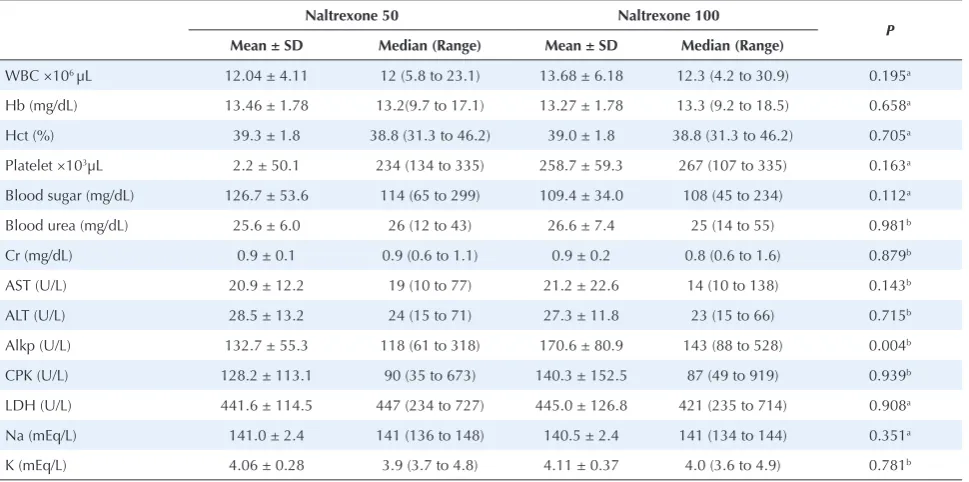
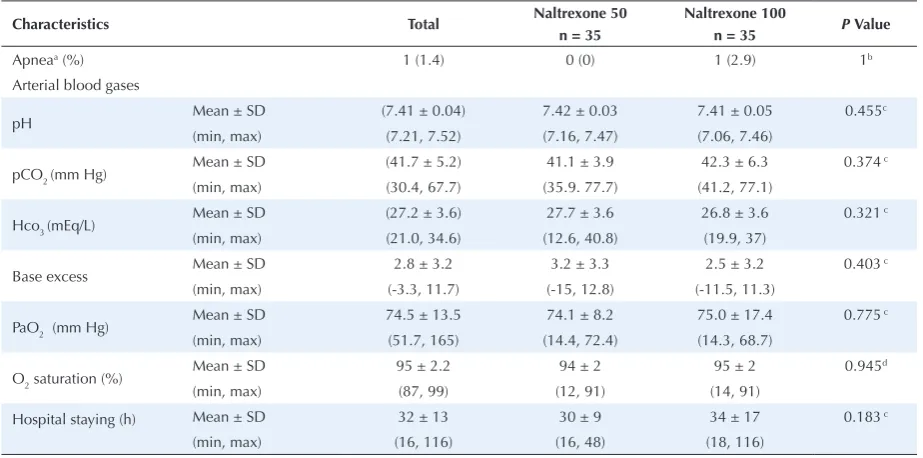
patients (47 patients, 67.1%) ingested syrup formulation and the median (IQR) ingested dose included 100 mg ranging from 20 to 500 mg (IQR: 60, 150). Further, the median time elapsed between ingestion and presentation was 165 minutes ranging between 60 and 600 minutes (IQR: 120, 240). Patients in both groups were similar in terms of their age, sex, the cause of toxicity, ingested amount of methadone, and the time between ingestion and presentation. Diastolic blood pressure, serum bicarbonate, and base excess, among the vital signs and VBG characteristics on presentation, significantly varied between the 2 groups (P = 0.04, 0.04, & 0.03, respectively). However, none of the lab tests were significantly different between the 2 groups (Table 1). The clinical status of the patients during hospitalization is provided in Table 2.
Based on the results, one patient (who received 100-mg naltrexone due to the history of ingesting 500 100-mg of methadone) in group A experienced apnea while none of the cases in group B had such an experience during hospitalization. However, such a difference was not significant. Therefore, only this single patient needed naloxone during the trial. Furthermore, the mean pH, pCO2, HCO3, BE, paO2, and O2 saturation were identical between the 2 groups during the follow-up evaluations. Moreover, both groups were hospitalized during the same period of time. Finally, none of the patients reported any complications in the phone call follow-ups performed one week after the hospital discharge.
Discussion
Using sustained-release naltrexone implant was first described as a possible method for prophylaxis against the heroin overdose in Australia (11-13). Hulse et al found
that the patients on the transplant treatment had a shorter hospital stay (14). Additionally, Ngo et al emphasized a lower morbidity rate in patients who underwent such treatment (13). However, they suggested that further studies might be required to elucidate the efficacy of transplant treatment in that setting since there were reports on the increased risk of a drug overdose following the naltrexone treatment mainly due to decreased opioid tolerance after the treatment.
Aghabiklooei et al introduced treatment with naltrexone capsules, for the first time, in patients with acute methadone intoxication (9). They found that naltrexone capsules were efficient enough in preventing re-development of opioid overdose signs and symptoms while decreasing the length of hospital stay compared to intravenous naloxone. The researchers used 50-mg naltrexone capsules and observed that the risk of respiratory depression, hypoxia, and the need for ICU care was significantly less in the naltrexone group compared to the placebo group (9). However, possible limitations were highlighted for these results. It was reported that severe and even life-threatening opioid withdrawal syndrome might develop if naltrexone is administered to opioid-dependent patients (5). In addition, there was a fear of re-development regarding the signs and symptoms of toxicity after vanishing of the naltrexone effects since many patients demanded early discharge. As it is known, a 25-mg naltrexone capsule can block the effects of 10 mg of morphine for 24 hours (10). Therefore, it was supposed that the patients’ symptoms would reverse after the first 24 hours. However, the patients were not followed by the researchers after the discharge.
The current study aimed to identify if a higher dose of
Table 1. Laboratory Tests of the Patients in Both Groups
Naltrexone50 Naltrexone 100
P
Mean ± SD Median (Range) Mean ± SD Median (Range)
WBC ×106 µL 12.04 ± 4.11 12 (5.8 to 23.1) 13.68 ± 6.18 12.3 (4.2 to 30.9) 0.195a
Hb (mg/dL) 13.46 ± 1.78 13.2(9.7 to 17.1) 13.27 ± 1.78 13.3 (9.2 to 18.5) 0.658a
Hct (%) 39.3 ± 1.8 38.8 (31.3 to 46.2) 39.0 ± 1.8 38.8 (31.3 to 46.2) 0.705a
Platelet ×103µL 2.2 ± 50.1 234 (134 to 335) 258.7 ± 59.3 267 (107 to 335) 0.163a
Blood sugar (mg/dL) 126.7 ± 53.6 114 (65 to 299) 109.4 ± 34.0 108 (45 to 234) 0.112a
Blood urea (mg/dL) 25.6 ± 6.0 26 (12 to 43) 26.6 ± 7.4 25 (14 to 55) 0.981b
Cr (mg/dL) 0.9 ± 0.1 0.9 (0.6 to 1.1) 0.9 ± 0.2 0.8 (0.6 to 1.6) 0.879b
AST (U/L) 20.9 ± 12.2 19 (10 to 77) 21.2 ± 22.6 14 (10 to 138) 0.143b
ALT (U/L) 28.5 ± 13.2 24 (15 to 71) 27.3 ± 11.8 23 (15 to 66) 0.715b
Alkp (U/L) 132.7 ± 55.3 118 (61 to 318) 170.6 ± 80.9 143 (88 to 528) 0.004b
CPK (U/L) 128.2 ± 113.1 90 (35 to 673) 140.3 ± 152.5 87 (49 to 919) 0.939b
LDH (U/L) 441.6 ± 114.5 447 (234 to 727) 445.0 ± 126.8 421 (235 to 714) 0.908a
Na (mEq/L) 141.0 ± 2.4 141 (136 to 148) 140.5 ± 2.4 141 (134 to 144) 0.351a
K (mEq/L) 4.06 ± 0.28 3.9 (3.7 to 4.8) 4.11 ± 0.37 4.0 (3.6 to 4.9) 0.781b
naltrexone could block the receptors enough to prevent re-development of the toxicity signs and symptoms during the following 48 hours which are the most dangerous periods in the follow-up of methadone-intoxicated patients. Based on the results, 50-mg and 100-mg naltrexone capsules had the same efficacy in preventing the recurrence of toxicity in our patients and only one patient in group A (100-mg naltrexone) with a history of ingesting 500 mg of methadone had re-experienced apnea. This may indicate that although not statistically significant, high doses of methadone (even one 100-mg naltrexone capsule) may not be enough and thus its administration may prevent re-development of intoxication. However, such a claim is subject to further clarifications.
In every human attempt, no doubt, there exist some limitations and problems which need to be acknowledged. Lack of using 25-mg capsules is considered a possible limitation of the current study. However, administering such capsules may not either lead to the recurrence of toxicity. These capsules were included since it was supposed that a higher dose of naltrexone would protect the patients in longer follow-ups. Conversely, after detecting that 50 and 100-mg capsules have the same efficacy for such a purpose, the idea for evaluating the 25-mg capsules is more encouraging. Therefore, studies focusing on lower doses of naltrexone are subject to further investigation.
The patients’ willingness for self-discharge is another limitation of this study. Although all patients were followed by phone calls, close monitoring in the hospital may lead to better understanding of their conditions. Actually, they might have the recall bias
on their follow-up calls which limits the validity of our findings. Accordingly, future studies with close monitoring of the patients are therefore warranted in other particular contexts.
Conclusions
In general, 50-mg naltrexone capsules can be safely administered to the opioid-naïve patients who overdosed methadone in order to obviate the need for their long follow-up. However, large doses of methadone, even 100-mg capsules may not have such efficacy and therefore re-administration of naltrexone capsule, probably on an outpatient basis, may prevent recurrence of the signs and symptoms of toxicity.
Conflict of Interests
Authors have no conflict of interests.
Ethical Issues
The study was approved by the Ethics Committee in Shahid Beheshti University of Medical Sciences and registered in the Iranian Registry of Clinical Trials (No.
IRCT201603083913N2).
Financial Support
None.
References
1. Hassanian-Moghaddam H, Zamani N, Rahimi M, Shadnia S, Pajoumand A, Sarjami S. Acute adult and adolescent poisoning in Tehran, Iran; the epidemiologic trend between 2006 and 2011. Arch Iran Med. 2014;17(8):534-538. doi:014178/aim.003
2. Aghabiklooei A, Shadnia S, Hassanian-Moghaddam H, Table 2. Comparison of Patients’ Clinical Status During Hospitalization
Characteristics Total Naltrexone 50 Naltrexone 100 P Value
n = 35 n = 35
Apneaa (%) 1 (1.4) 0 (0) 1 (2.9) 1b
Arterial blood gases
pH Mean ± SD (7.41 ± 0.04) 7.42 ± 0.03 7.41 ± 0.05 0.455
c
(min, max) (7.21, 7.52) (7.16, 7.47) (7.06, 7.46)
pCO2 (mm Hg) Mean ± SD (41.7 ± 5.2) 41.1 ± 3.9 42.3 ± 6.3 0.374
c
(min, max) (30.4, 67.7) (35.9. 77.7) (41.2, 77.1)
Hco3 (mEq/L) Mean ± SD (27.2 ± 3.6) 27.7 ± 3.6 26.8 ± 3.6 0.321
c
(min, max) (21.0, 34.6) (12.6, 40.8) (19.9, 37)
Base excess Mean ± SD 2.8 ± 3.2 3.2 ± 3.3 2.5 ± 3.2 0.403
c
(min, max) (-3.3, 11.7) (-15, 12.8) (-11.5, 11.3)
PaO2 (mm Hg) Mean ± SD 74.5 ± 13.5 74.1 ± 8.2 75.0 ± 17.4 0.775
c
(min, max) (51.7, 165) (14.4, 72.4) (14.3, 68.7)
O2 saturation (%) Mean ± SD 95 ± 2.2 94 ± 2 95 ± 2 0.945
d
(min, max) (87, 99) (12, 91) (14, 91)
Hospital staying (h) Mean ± SD 32 ± 13 30 ± 9 34 ± 17 0.183 c
(min, max) (16, 116) (16, 48) (18, 116)
Zamani N. Acute respiratory distress syndrome caused by methadone syrup. Arh Hig Rada Toksikol. 2013;64(3):439-443. doi:10.2478/10004-1254-64-2013-2347
3. Soltaninejad K, Hassanian-Moghaddam H, Shadnia S. Methadone related poisoning on the rise in Tehran, Iran. Asia Pac J Med Toxicol. 2014;3(3):104-109. doi:10.22038/ apjmt.2014.3378
4. Boyer EW. Management of opioid analgesic overdose. N Engl J Med. 2012;367(2):146-155. doi:10.1056/ NEJMra1202561
5. Farsi D, Mirafzal A, Hassanian-Moghaddam H, Azizi Z, Jamshidnejad N, Zehtabchi S. The correlation between prolonged corrected QT interval with the frequency of respiratory arrest, endotracheal intubation, and mortality in acute methadone overdose. Cardiovasc Toxicol. 2014;14(4):358-367. doi:10.1007/s12012-014-9259-x 6. Shadnia S, Rahimi M, Hassanian-Moghaddam H,
Soltaninejad K, Noroozi A. Response to letter: “Methadone toxicity: comparing tablet and syrup formulations during a decade in an academic poison center of Iran”. Clin Toxicol (Phila). 2014;52(2):154. doi:10.3109/15563650.2014.88017 3
7. Hassanian-Moghaddam H, Soltaninejad K, Shadnia S, Kabir A, Movahedi M, Mirafzal A. Risk Factors for Mortality and Endotracheal Intubation after Methadone Intoxication. Basic Clin Pharmacol Toxicol. 2016;118(3):231-237. doi:10.1111/bcpt.12476
8. Barsan WG, Seger D, Danzl DF, et al. Duration of antagonistic effects of nalmefene and naloxone in
opiate-induced sedation for emergency department procedures. Am J Emerg Med. 1989;7(2):155-161.
9. Aghabiklooei A, Hassanian-Moghaddam H, Zamani N, et al. Effectiveness of naltrexone in the prevention of delayed respiratory arrest in opioid-naive methadone-intoxicated patients. Biomed Res Int. 2013;2013:903172. doi:10.1155/2013/903172
10. Howland MA, Neslon L. Opioid antagonists. In: Nelson LS, Lewin NA, Howland MA, Hoffman RS, Goldfrank LR, Flomenbaum NE, eds. Goldfrank’s Toxicologic Emergencies. 9th ed. New York: McGraw-Hill; 2011:579-585.
11. Fareed A, Stout S, Casarella J, Vayalapalli S, Cox J, Drexler K. Illicit opioid intoxication: diagnosis and treatment. Subst Abuse. 2011;5:17-25. doi:10.4137/sart.s7090
12. Tait RJ, Ngo HT, Hulse GK. Mortality in heroin users 3 years after naltrexone implant or methadone maintenance treatment. J Subst Abuse Treat. 2008;35(2):116-124. doi:10.1016/j.jsat.2007.08.014
13. Ngo HT, Tait RJ, Hulse GK. Comparing drug-related hospital morbidity following heroin dependence treatment with methadone maintenance or naltrexone implantation. Arch Gen Psychiatry. 2008;65(4):457-465. doi:10.1001/ archpsyc.65.4.457
14. Hulse GK, Tait RJ, Comer SD, Sullivan MA, Jacobs IG, Arnold-Reed D. Reducing hospital presentations for opioid overdose in patients treated with sustained release naltrexone implants. Drug Alcohol Depend. 2005;79(3):351-357. doi:10.1016/j.drugalcdep.2005.02.009