IJSRSET1844243 | Received : 15 March | Accepted : 29 March 2018 | March-April-2018 [(4) 7 : 164-169]
© 2018 IJSRSET | Volume 4 | Issue 7 | Print ISSN: 2395-1990 | Online ISSN : 2394-4099 Themed Section : Engineering and Technology
164
Smart Home Security Using Raspberry-Pi
Md Amjad Ali
B.Tech ECE,
Lords Institute Of Engineering & Technology,
Hyderabad
Zubaid Ahmed
B.Tech ECE,
Lords Institute Of Engineering & Technology,
Hyderabad
Md Awais
B.Tech ECE,
Lords Institute Of Engineering & Technology,
Hyderabad
Shaik Faisal Ahmed
B.Tech ECE,
Lords Institute Of Engineering & Technology,
Hyderabad
Shaik Asra Tabassum
Assistant Professor ECE,
Lords Institute Of Engineering & Technology,
Hyderabad
ABSTRACT
The project proposes an efficient implementation with the help of Raspberry Pi used for monitoring and controlling the security of the house via Internet. Home security system uses the portable devices as a user interface. They can communicate with home security network through an Internet gateway, by means of low power communication protocols like Wi-Fi. This project aims at controlling the home security via mail using Wi-Fi as communication protocol and raspberry pi as server system. when the power is switched on raspberry pi turns on and the sensors are also automatically switched on and starts working. Whenever a intruder comes near the door pir sensor senses the person and sends command to the raspberry pi and at the same time the controller sends the signal to camera to capture the image of the person. Now this image is sent to the owner via email for security purposes and then owner decides whether to give access or not, if access is provided then the controller sends the commands to the motor and the door is opened. On the other hand when the access is denied by the owner to the person then an alarm beeps and door does not open. An extra couple of features that enhances the facet of security in our project is that lpg sensor and fire sensors are used so the sleuthing capability of sensors will sense the smoke ,gas and flame in order that within the event of any fireplace, associates an alerting alarm and an image is sent to the owner via mail. By this we provide a climbable and price effective Home Automation system.
Keywords : Raspberry-Pi, LPG Sensor, PIR Sensor, Camera, Wi-Fi
I.
INTRODUCTION
E The Home Security project is based on an Raspberry Pi 3 processor, which is supported by 1GB RAM and running at 1.4 GHz CPU which is over clocked at 1 GHz without damaging the board. In this project an image of the person will be clicked when
project can be customized a lot as it has multiple GPIO ports that can be programmed and they can give the user control over various things from his smart phone like security, surveillance, lighting, energy management, access control, entertainment etc. These interfaces are all possible by the help of the GPIO ports in the Raspberry Pi 3 board. In present times there is an increasing need for Home security due to thefts and threats. And the benefits of automation are obvious. In Addition to that this project provides the security for household appliances for the leakage of gas, fire, smoke etc.MQ-6 Sensor is used to detect the gas and it is a universal sensor whereas FIRE Sensor detects in the combination of light and heat. There is also a need for surveillance in today's world. Nowadays the increase in various computing devices such as laptop, computers, mobiles etc. shows that users prefer things which are more comfortable to use i.e. rather than physically going to the place and controlling it doing the same thing remotely saves time. For example, if the Admin receives a message saying that there was a break in his house, he/she can connect to the internet and watch the video from the camera which is in the house to know what is happening. By receiving alerts on your device the user are informed of all possible issues occurring in the house and it gives them various possibilities to deal with the problems. This is how an automated system proves useful to people in providing them security, comfort and easily accessible.
II.
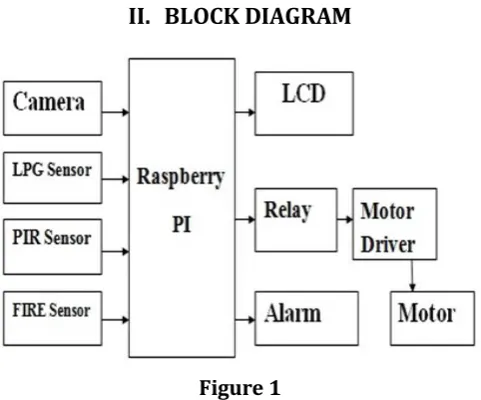
BLOCK DIAGRAM
Figure 1
III.
HARDWARE DESCRIPTION
A. Raspberry Pi:
The Raspberry Pi is a credit-card-sized single-board computer developed in the UK by the Raspberry Pi Foundation with the intention of promoting the teaching of basic computer science in schools.
The Raspberry Pi is manufactured in two board configurations through licensed manufacturing deals with Newark element14 (Premier Farnell), RS Components and Egoman. These companies sell the Raspberry Pi online.Egoman produces a version for distribution solely in China and Taiwan, which can be distinguished from other Pis by their red coloring and lack of FCC/CE marks. The hardware is the same across all manufacturers. The Raspberry Pi has a Broadcom BCM2835 system on a chip (SoC), which includes an ARM1176JZF-S 700 MHz processor, Video Core IV GPU, and was originally shipped with 256 megabytes of RAM, later upgraded to 512 MB. It does not include a built-in hard disk or solid-state drive, but uses an SD card for booting and persistent storage. The Foundation provides Debi an and Arch Linux ARM distributions for download. Tools are available for Python as the main programming language, with support for BBC BASIC (via the RISC OS image or the Brandy Basic clone for Linux),C, Java and Perl.
Figure 2. Raspberry Pi Board
B.USB CAMERA:
A webcam is a video camerathat feeds or streams its image in real time to or through a computer to a computer network. When "captured" by the computer, the video stream may be saved, viewed or sent on to other networks via systems such as the internet, and emailed as an attachment. When sent to a remote location, the video stream may be saved, viewed or on sent there. Unlike an IP camera (which connects using Ethernet or Wi-Fi), a webcam is generally connected by a USB cable, or similar cable, or built into computer hardware, such as laptops.
Figure 3. USB Camera
C.PIR Sensor:
More advanced security systems include passive infrared (PIR) motion detectors. The "motion sensing" feature on most lights (and security systems) is a
passive system that detects infrared energy. These sensors are therefore known as PIR (passive infrared) detectors or pyro electric sensors. These sensors "see" the infrared energy emitted by an intruder's body heat. When an intruder walks into the field of view of the detector, the sensor detects a sharp increase in infrared energy.
In order to make a sensor that can detect a human being, you need to make the sensor sensitive to the temperature of a human body. Humans, having a skin temperature of about 93 degrees F, radiate infra red energy with a wavelength between 9 and 10 micrometers. Therefore, the sensors are typically sensitive in the range of 8 to 12 micrometers. The devices themselves are simple electronic components not unlike a photo sensor. The infrared light bumps electrons off a substrate, and these electrons can be detected and amplified into a signal.
Figure 4. PIR Sensor
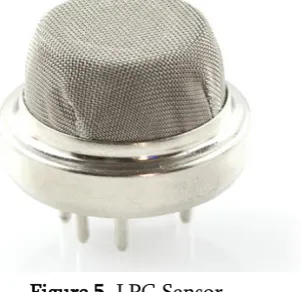
D.LPG Sensor:
This is a simple-to- use liquefied petroleum gas (LPG) sensor, suitable for sensingLPG (composed of mostly propane and butane) concentrations in the air.
The drive circuit is very simple; all you need to do is power the heater coil with 5V, add a load resistance, and connect the output to an ADC.
Figure 5. LPG Sensor E.Fire Sensor:
There are several types of flame detector. The optical flame detector is a detector that uses optical sensors to detect flames. There are also ionization flame detectors, which use current flow in the flame to detect flame presence, and thermocouple flame detectors.
Infrared flame detectors work within the infrared spectral band. Hot gases emit a specific spectral pattern in the infrared region, which can be sensed with a thermal imaging camera a type of thermo graphic. False alarms can be caused by other hot surfaces and background thermal radiation in the area as well as blinding from water and solar energy. A typical frequency where single frequency IR flame detector is sensitive is in the 4.4 micrometer range. Typical response time is 3-5 seconds.
It can detect flame within 760nm~1100nm. Greater the flame, farther the test distance.
Detect angle: 60 degree, very sensitive with flame spectrum. The sensitivity is adjustable (the blue digital potentiometer).
Figure 6. Fire Sensor
F.LCD:
A liquid-crystal display (LCD) is a flat-panel display or other electronically modulated optical device that uses the light-modulating properties of liquid crystals. Liquid crystals do not emit light directly, instead using a backlight or reflector to produce images in color or monochrome.LCDs are available to display arbitrary images (as in a general-purpose computer display) or fixed images with low information content, which can be displayed or hidden, such as preset words, digits, and 7-segment displays, as in a digital clock. They use the same basic technology, except that arbitrary images are made up of a large number of small pixels, while other displays have larger elements. LCDs are used in a wide range of applications including computer .Small LCD screens are common in portable consumer devices such as digital cameras, watches, calculators, and mobile telephones, including smart phones. LCD screens are also used on consumer electronics products such as DVD players, video game devices and clocks.
Figure 7. LCD
G.MOTOR DRIVER (L293D):
L293D is a dual H-bridge motor driver integrated circuit (IC). Motor drivers act as current amplifiers since they take a low-current control signal and provide a higher-current signal. This higher current signal is used to drive the motors. It is used to boost the voltage of motor and act as interface between controller and motor.
the enable input is low, that driver is disabled, and their outputs are off and in the high-impedance state.
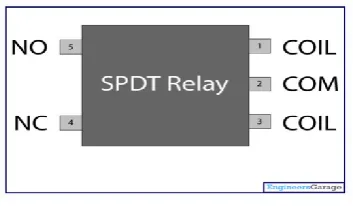
Figure 9. L293D H.RELAY:
Relay is an electromagnetic device which used to isolate two circuits electrically and connect them magnetically.Relay is used for automatic switching loads DC to AC.Relay consists of 5 pins.RELAY is use to change state of source or load when energized.
Figure 10. Relay Pin Diagram
I.BUZZER:
A buzzer or beeper is an audio signalling device, which may be mechanical, electromechanical, or piezoelectric (piezo for short).Typical uses of buzzers and beepers include alarm devices.
Figure 8. Buzzer
IV.
SOFTWARE DESCRIPTION
1. LINUX
Linux was originally developed as a free operating system for Intel x86-based personal computers. It has since been ported to more computer hardware platforms than any other operating system. It is a leading operating system on servers and other big iron systems such as mainframe computers and supercomputers. Linux supports a vast variety of hardware devices, probably more than any other os. Linux supports a huge variety of applications and networking protocols. Linux is scalable, from small consumer-oriented devices to large, heavy-iron, carrier-class switches and routers. Linux can be deployed without the royalties required by traditional proprietary embedded operating systems. Linux has attracted a huge number of active developers, enabling rapid support of new hardware architectures, platforms, and devices.
2. PYTHON
Python is an interpreter, interactive, object-oriented programming language. Python is a widely-used high level programming language. Its elegant syntax allows you to clearly define application behavior using fewer lines of code than would be required in other languages like VB. It supports multiple programming paradigms including imperative, functional and object oriented styles, allowing a wide range of tasks to be performed.
3. PUTTY
ports have been contributed to platforms such as Symbian, Windows Mobile and Windows Phone.
V.
APPICATIONS AND ADVANTAGES
This security can be involves the security hardware properties like locks, doors, alarm system and security cameras.
It protects your Home and Family from Intruders, Fire and Gas leakage
Low power consumption, easy to implement More Secured
Low cost
VI.
CONCLUSION
The project provides various ways to secure the house from any theft or unauthorized person and also helps in detection if there is any leakage of gases and flames. Also it makes ones living comfortable and at the same time easily accessible through any portable internet accessible devices like tablet, mobile phone etc. It gives the administrator all the rights to decide which makes it reliable as it always asks before taking a decision, which helps when there are necessary decisions to be taken and they can be taken fast in case of an emergency
VII.
REFERENCES
[1]. Tiwari and Motghare "Flash drive to ash drive data transfer" International Refereed Journal of Engineering and Science (IRJES) ISSN (Online) 2319-183X,(Print) 2319-1821Volume 2, Issue 3(March 2013),PP.17-23
[2]. Gawali, KetanPandurang Kale, Mahesh Sanjay Gund, GaneshBalasahebGarware. "Communication In USBs For Data Transfer" International Journal of Engineering and Advanced Technology(IJEAT) ISSN: 2249 8958, Volume-2, Issue-4, April 2013
[3]. Subhash S and Shinde A. A. "Data Transfer Between Two USB Disk WithoutUse of Computer".International Journal of Emerging Technology and Advanced Engineering, 2013; 3:595-598
[4]. Gawali V S and Agarkar A M. "Pen Drive to Pen Drive and Mobile Data Transfer Using ARM". IOSR Journal of Electronics and Communication Engineering,:43-47
[5]. J. Axelson, "USB COMPLETE" Second Edition, Madison, WI: Lakeview Research LLC