INTRODUCTION
Plants of Hibiscus cannabinus Linn. were raised from seeds collected from naturally growing plants of different places in Nagpur and its environs. They were allowed to grow till they attained the flowering and at this stage plants were plants were sprayed with different concentrations of oxyfluorfen. The aqueous solution of herbicide ranging from 100 to 5000 ppm was prepared. Ten pots for each concentrations (100 to 2000 ppm) containing 2 to 3 plants were sprayed. If 2000 ppm was found higher; the lower concentrations were tried to determined lethal dose. Asppe- poly sprayer of one litter capacity did spraying. A small quantity of sodium lauryl sulphate as a surfactant added in the herbicide solution. The spraying was started in month of October 1996 and same experiments were repeated next year also. Spraying was done twice in an hour to make it more effective in the evening hours, when the wind was slow and temperature comparatively lower than that of the day. This help in less evaporation and more absorption of herbicide solution by the leaves. To avoid contamination of different concentrations of herbicide, cardboard was used at the time of spraying application. Six pots
Biosciences, Biotechnology Research Asia Vol. 5(2), 799-803 (2008)
Effect of spray application of goal (Oxyfluorfen) on
morphological characters of Hibiscus cannabinus Linn
SANJAY I. KAMBLE
Department of Botany and Department of Seed Technology, Phulsing Naik Mahavidyalaya, Pusad, District Yavatmal (India). (Received: November 10, 2008; Accepted: December 14, 2008)
ABSTRACT
In present investigation, the herbicidal activities of oxyfluorfen on Hibiscus cannabinus Linn. have been studied. The plants were sprayed with aqueous solution of different concentrations of herbicide from 100 to 5000 ppm. Oxyfluorfen was efficient in killing the weed by burning effect. The chlorosis and necrosis of leaves, petioles and stems were noted. The lethal dose of oxyfluorfen was 800 ppm.
Key words: Herbicide, Oxyfluorfen, Spray application, Morphological characters and Hibiscus cannabinus Linn.
were sprayed with water used as control. Field trials were conducted on naturally growing plants in randomly designed plots of size approximately 3 x3 feet’s.
The fresh and dry weights of shoots and roots of control as well as treated plants were taken to determined desiccation of plants. Morphological changes were observed daily till the death of plants.
RESULTS
Fig. 1: C- Control field photograph
Fig. 2: C- Control, 1 to 5 – Showing burning effect and chlorosis on leaves at 100, 200, 300, 400. 600 and 800 ppm of oxyfluorfen, respectively
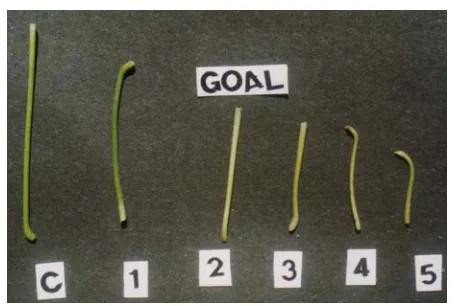
Fig. 4: C- Control, 1 to 5 – Showing progressive decrease in length of root at 100, 200, 300, 400. 600 and 800 ppm of oxyfluorfen, respectively
Fig. 5: Field photograph at 800 ppm of oxyfluorfen
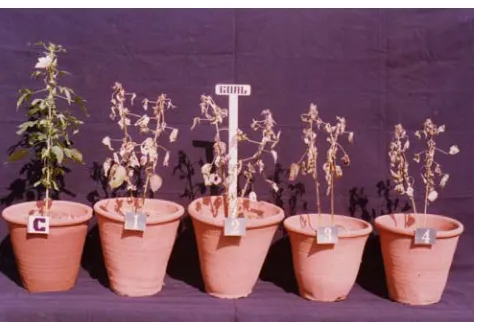
Fig. 6: C- Control, 1 to 4 – Plant after spray application at 200, 400, 600 and 800 ppm of oxyfluorfen, respectively
at 400, 600 and 800 ppm (Figs. 2 and 3).
On sixth day, leaves fell off between the concentrations 100 and 800 ppm and petiole dried off at 400, 600 and 800 ppm. The roots of treated plants were affected badly and their growth was stunted with less number of lateral root formations as compared to control (Fig. 4). On seventh day, the inflorescence axis was started drying and plants
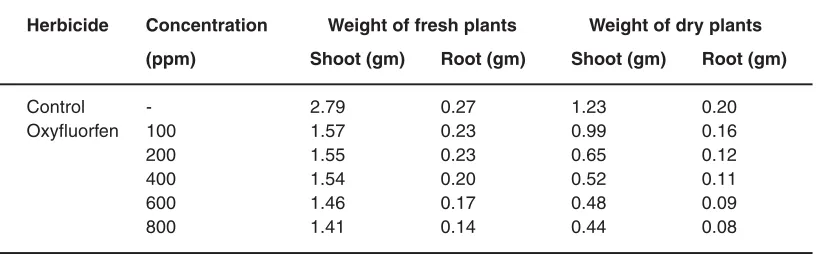
were dried up. The vegetative growth of apices was stopped with injury. The terminal axillary’s buds became deformed and fell down. On eighth day, all plants dried up completely at 800 ppm, which was determined as lethal dose, field trial also showed similar results (Figs. 5 and 6). The fresh and dry weight of roots and shoots of the plants was found to be decreased gradually as the concentrations of herbicide increased (Table 1).
Table 1: Effect of herbicide on fresh and dry weights of Hibiscus cannabinus Linn Herbicide Concentration Weight of fresh plants Weight of dry plants
(ppm) Shoot (gm) Root (gm) Shoot (gm) Root (gm)
Control - 2.79 0.27 1.23 0.20
Oxyfluorfen 100 1.57 0.23 0.99 0.16
200 1.55 0.23 0.65 0.12
400 1.54 0.20 0.52 0.11
600 1.46 0.17 0.48 0.09
800 1.41 0.14 0.44 0.08
Note- Average weight based on ten plants
DISCUSSION
This herbicide was found to be efficient to induce morphological changes in weed Hibiscus cannabinus Linn. The chlorosis and necrosis of leaves were observed at all concentrations. In the beginning margin of the leaves were affected and later on leaves enrolled and changed its colors from green to yellow. The whole lamina of the leaf wilted, crumpled and dried. Chlorosis on the leaves was due to depletion of chloroplast in the mesophyll tissues. Similar results were reported by Vanstone and Stobe (1979) on Fagophrum esculentus, Cynodon dactylon, Chloris barbata, Dactyloctenium aegyptium, Digitaria sanguinalis, Acanthospermum hispidum, Amaranthus spp. and Borreria hispida, Gopal (1993) on Medicago sativa, Josan (1995) on Cyprus rotundus, Cynodon Dactylon, Sorghum halpense, Medicago spp., Oxalis corniculata and Euphorbia microphylla, Silva et.al. (1995) on Cynodon dactylon, Bidens pilosa, Branchira plantaginea and Emilia sonchifolia and Kulkarni (1998) on Crotalaria medicaginea var. laxurians. Oxyfluorfen inhibited stem growth and induced
chlorosis in the present study. Similar results were reported by Dhanpal et.al. (1989) on several weeds, Singh and Singh (1992) on Glycine max, Gopal (1993) on Medicago sativa and Kulkarni (1998) on Crotalaria medicaginea var. laxurians.
The inflorescence started draying after 48 hours and then fell down due to application of oxyfluorfen. Flowers production completely inhibited after treatment was observed in the present study. Gopal (1993) on Medicago sativa reported reduction in flower production and plant height. Singh and Arya (1994) on Galinsaga parviflora reported suppression of flowers. Laskar and Jana (1995) on Cyanotis oxillaris, Cynodon Dactylon, Cypurus rotundus, Digitaria sanguinalis, Ageratum conyzoides, Blainvillealatifolia, Blumea lacera, Commelina benghalensis, Eclipta alba, and Tridax procumbens and Kulkarni (1998) on Crotalaria medicaginea var. laxurians reported similar results.
(1996) on Solanum tuburosum and Kulkarni (1998) on Crotalaria medicaginea var. laxurians reported reduction of root growth following treating by oxyfluorfen.
In present study, there was gradual decrease in dr y and fresh weight as the concentrations of herbicide increased from 100 to 800 ppm. Similar observations were reported by Gopal (1993) on Medicago sativa, Singh and Lal (1994) on several weeds. Shivkumar and muniyappa
(1994) on berr y garden, Porwal (1994) on Chenopodium album, Anagallisar vensis, Melilotus indica, Oxalis spp., Xanthium strumarium, Euphorbia hirata, Argemom mexicana, Cyperus rotundus, Cynodon dactylon and Parthenium hysterophorus, Jaiswal and Lal (1996) on Trianthema protulacastrum, Chenopodium album, Rumex spp., Coronopus didymus, Cyperus rotundus, and Poa annua and Kulkarni (1998) on Crotalaria medicaginea var. laxurians.
1. Dhanpal, G. N., Venkata Reddy, B. M., Ramegowda and Bommegowda, A., Screening of herbicides for crops under Bangalor condition. Mysore J. Agric. Sci. 23: 159-163 (1989).
2. Gopal, K. R., Herbicidal effects on cytomorphology of weed Medicago sativa Linn. Ph.D. Thesis, Nagpur University, Nagpur (1993).
3. Jaiswal, V. P. and Lal, S. S., Efficiency of cultural and chemical weed control method in Solanum tuberosum. Indian J. Agro. 41(3): 454-456 (1996).
4. Josan, J. S., Preliminary studies on the chemical weed control in Citrus nursery. Indian J. Weed Sci. 27(1-2): 75-79 (1995). 5. Kulkarni, G. B., Effects of agrochemicals on
Crotolaria medicaginea var. laxurians. Ph.D. Thesis, Dr. Babasaheb Ambedkar Marathwada University, Aurangabad (1998). 6. Laskar, M. A. and Jana, B. K., Effects of herbicides on weed control and plant growth, flowering and corn production of Gladiolus. Indian Agric. 39(1): 43-50 (1995).
7. Porwal, M. K., Integrated weed management in Allium sativum under vertisole. Indian J.
weed sci. 27(1-2): 16-18 (1995).
8. Shivakumar, H. R. and Muniyappa, T. V., Effect of chemical control on growth and yield of Morus indica Linn. Indian J. weed sci. 26(3-3): 71-76 (1994).
9. Silva, W., Da, Silva, J. F., Cardosa, A.A. and Barros, N.E., Use of Trifluralin 600 and oxyfluorfen for the culture of Eucalyptus grandis. Hill ex. Maidens Rrvista. Arvore. 19(1): 1-17 (1995).
10. Singh, K. and Lal, S. S., Herbicidal weed control efficiency and nutrients removal by weed in Solanum tubersum under North-Eastern hills condition. 39(2): 336-339 (1994). 11. Singh, R. V. and Arya, M. P. S., Studies on the chemical weed control in Galinsaga parviflora under rain fed condition. Indian J. weed sci. 26(3-4): 45-51(1994).
12. Vanstone, D. E. and Stobbe, E. H., Light requirement of diphenyl ether and oxyfluorfen. Weed Sci. 27: 88-91(1979).
13. Singh, G. and Singh, D., Weed control efficiency of oxyfluorfen, acifluorfen, metribuzin and linurol in Glycine max Linn. Ind. J. Weed Sci. 24(1-2): 97-99 (1992).
REFERENCES