R E S E A R C H
Open Access
Performance of integrated workload
scheduling and pre-fetching in multimedia
mobile cloud computing
Kaveh Khorramnejad, Lilatul Ferdouse, Ling Guan and Alagan Anpalagan
*Abstract
This paper focuses on an integrated workload scheduling and pre-fetching model in a multimedia mobile cloud computing environment to enhance the performance of response time and reduce the cost to process multimedia data. The response time and cost optimization problems are presented along with the computation resources such as virtual machines (VMs) allocation, workload conservation, queueing stability constraints, and to overcome the total response time and cost, a heuristic approach of workload scheduling method is proposed. The integrated workload scheduling at pre-fetcher and cloud are considered to study the effects of various parameters such as VM’s processing speed, pre-fetcher’s utilization, the user requests arrival rate. The performance analysis results reveal that the cost and transmission speed are directly relevant factors, meaning that, once the rate of data transmission is increasing, the cost is also increasing and vice versa. Hence, the time and cost efficient workload scheduling is essential to satisfy both delay and cost in pre-fetcher enabled multimedia cloud systems.
Keywords: Multimedia mobile cloud computing, Workload scheduling, Pre-fetcher, VM allocation
Introduction
Multimedia communication over the cellular network with minimum latency become critical with the ever increasing number of cellular users along with multi-media data traffic. The evolution of cloud computing technology, data transmission methods have changed. Since cellular devices (e.g., smart phones, tablets etc.) face some limitations such as power, memory and com-puting power, the cloud providers offer services such as scalable and reconfigurable computing, storage and network services [1, 2]. Moreover, the cloud comput-ing is a technology with growcomput-ing popularity for many organizations. The main advantages that lead to this popularity are unlimited storage, backup and recovery, cost efficiency, easy maintenance and quick deployment
[1]. Even though cloud computing has made our life
much easier, there are many challenges to face. Latency along with security is the most important factor to sat-isfy when it comes to delay-sensitive transactions like
*Correspondence:[email protected]
Department of Electrical and Computer Engineering, Ryerson University, 350 Victoria St., Toronto, Canada
banking, stock market and real time multimedia data transfer.
Another challenging issue is to process multimedia ser-vices in cellular network environment [3]. Cellular data transmission was so successful until battery lives could not keep up with the users’ need. The cellular users, mostly cell phone users do not have unlimited storage to store all the information they require. To overcome this challenge, mobile cloud computing was introduced [4,5]. In mobile cloud computing, mobile users utilize cloud servers, known as virtual machines (VMs) to process high computational services such as real time multimedia data processing (e.g., video on demand (VoD), online gaming, etc). Utilizing cloud computing with mobile networks do not need to consider storage capacity and battery life. However, delay became a new challenge in mobile cloud computing. Pre-fetching was one of the techniques that was proposed to reduce the delay in multimedia delay sensitive mobile communication [6]. This technique can reduce the delay significantly if it is well designed and implemented.
This paper investigates the performance of response time and cost in the integrated workload scheduling and pre-fetching model in mobile cloud computing envi-ronment to process multimedia data requests. In this paper, we propose a heuristic based workload scheduling method which utilizes both cloud and pre-fetcher to dis-tribute workload to minimize the total response service time and cost.
The remainder of this paper is organized as follows. In the section system model and assumptions, the pre-fetcher enabled multimedia cloud computing model, fol-lowed by the description of system model and problem formulation is presented. Response time and cost opti-mization problem sections present the analytical formu-lation of time and cost minimization problems along with a combined pre-fetcher in a cloud system. The solution of workload scheduling in multimedia cloud networks is discussed in Heuristic approach of workload scheduling section. Performance analysis section provides the results of our proposed model. Finally, conclusion section con-cludes the paper and provides some insights of future research in multimedia mobile cloud computing model.
Related work
The topic of cloud computing is undergoing a grow-ing popularity among practitioners, and scientific researchers. The cloud provides services such as software, platform, infrastructure and these services are maintained by cloud providers (e.g., AWS, Google cloud platform, Microsoft azure etc.)[1,2]. The cloud technologies help service providers to provide faster and more secure com-puting services to users. The vast comcom-puting resources led to the selection of cloud as the integrating stage for the mobile environment. The core of the cloud is data center, consisting of different type of the servers, e.g., master, computing, etc.
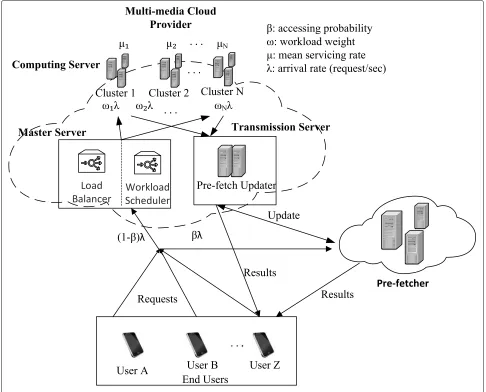
Authors in [7, 8] present a three-tier architecture for multimedia data center which comprises three different types of servers; master, computing and transmission, as depicted in Fig 1. In the beginning phase, the master servers distribute the workload to the computing servers and the cloud provider utilizes different types of VM clusters to complete each service task. In the end phase, the transmission server allocates bandwidth resources to transfer the results to the users. One of the challenges considered in [7, 9] is to schedule the workload among the VM clusters in such a way that each service utilizes minimum number of computing resources (e.g., VMs) and simultaneously ensures the quality of experience (QoE) among users.
Authors in [10, 11] allocate VMs at both user level and task level. In [11], authors proposed a task based workload scheduling method where each multimedia ser-vice is decomposed into independent tasks. The authors
proposed three types of workload scheduling methods (e.g., serial, parallel, and mixed) where one VM is allocated to one task. However, in [11] the authors did not consider the dependency among tasks, total independent paths and the scheduling weight among paths. The Bayesian based workload scheduling method, proposed in [12] resolves the aforementioned issue and utilizes both task and user level scheduling to minimize the mean service time.
Multimedia processing enforces new challenges to cloud computing, according to attributes such as being delay sensitive, high computation intensity and signifi-cant bandwidth demands [13]. For delay sensitive appli-cations, the authors in [8] consider the total round trip time (RTT) (e.g., both service time and transmission time), whereas in [12] only service time is considered. Moreover, to minimize delay, authors in [6,14] proposed cloudlets model to process multimedia service requests. The cloudlets represent a small scale data center which resides within the proximity to the users and minimize the transmission delay. On the other hand, authors in [15] consider data processing delay in the mobile edge com-puting model. Similar to the above concepts, we proposed the pre-fetcher enabled multimedia mobile cloud comput-ing model, shown in Fig.1, where the pre-fetcher is located in close proximity to the users and contains high speed VMs and storage servers. The next section presents the pre-fetcher enabled multimedia cloud computing model.
System model and assumptions
Multimedia mobile cloud computing with pre-fetcher
We consider a pre-fetcher enabled multimedia cloud com-puting model, depicted in Fig.1to enhance the multime-dia end user communication process. Introduced model consists of three main components: multimedia cloud provider, pre-fetcher and end users. Multi-media cloud provider follows the three-tier architecture, presented in [7,8,10,12]. The multimedia data center has a core which is called master server. Master server receives the portion of the workload sent to computing server. The workload scheduler and load balancer are responsible for distribut-ing the workload over N server clusters for processing. In addition, we consider a pre-fetch updater which is the intelligent core of the transmission server which calculates the probability of the next call on the same request and sends a copy to pre-fetcher. Each server cluster receives a portion of the total workload and processes it with different processing speed until the entire workload is pro-cessed. Then pre-fetch updater gradually fills the storage clusters in it by sending a copy of the critical data for next call.
Fig. 1Data transmission between cloud and end users in the presence of pre-fetcher
the main focus of this paper. For caching, we assume that the storage clusters store data which is more likely to be requested next. Once the memory is full, it will be overrid-den based on adaptive replacement algorithm (ARA) [16]. For pre-fetching, we develop an integrated model that utilizes workload scheduling and pre-fetching operation both in the pre-fetcher and in the cloud with minimum cost and time.
There areZend users considered in the model, and the probability of end users reaching pre-fetcher is βλ ver-sus the probability of reaching multimedia cloud which is(1−β) λ. β denotes the accessing probability of pre-fetcher andλdenotes the number of user requests arrival per second. All symbols and parameters in the optimiza-tion problem are listed in Abbreviaoptimiza-tion.
Response time optimization problem
We assume that the multimedia cloud data center supports Bayesian method based workload scheduling
[12] where each multimedia service request is represented by directed acyclic graph (DAG) [11] and is decomposed into tasks. Hence, the service requests are modeled by parallel structure of tasks and inter-connected by path.
One VM is allocated to one task. Assume that Mtasks
are scheduled into each path and served by VM clus-ter i with scheduling weight wi. Thus, Ni=1θij class-i
VMs work together as the class-i virtual cluster with the mean service rate Ni=1Mj=1θijμij, and the service
time of a request is assumed to be exponentially
dis-tributed with an average of N 1
i=1
M
j=1θijμij. Similar to [10],
the service process of each path follows an M/M/1
queu-ing model. The average response time of pathk can be
calculated as:
Tk= N
i=1
ωk,cloud
N
i=1
M
j=1θijμi,cloud−ωk,cloudλi,cloud
The total mean response time is considered as the QoS requirement of the system and can be formulated as:
TQoS=(1−β)TCloud+(β)TPF (2)
whereβis the probability (or percentage of time) of using pre-fetcher in time slott,
β=
⎧ ⎨ ⎩
1, if only pre-fetcher is used, 0, if only cloud is used,
>0 and<1 otherwise.
(3)
TCloud = Kk=1Tk represents the total mean response
time in the cloud and TPF represents the total mean
response time in the pre-fetcher. The pre-fetcher’s mean response timeTPF can be formulated as:
TPF = K
k=1
ωk,PF
N
i=1
M
j=1αijμi,PF−ωk,PFλi,PF
. (4)
The response time optimization problem for workload scheduling in cloud system with pre-fetcher can be formu-lated as:
P1: Minimize
ω,θ,α :TQoS =(1−β)TCloud+βTPF,
Subject to:θij= {1, 0},αij= {1, 0},γ >1,
C1: Mj=1θij=1 ∀i∈N,
C2: Ni=1θij≥1 ∀j∈M,
C3: Mj=1αij=1 ∀i∈N,
C4: Ni=1αij≥1 ∀j∈M,
C5: Kk=1ωk,Cloud=1
C6:ωk,Cloudλi,Cloud ≤Ni=1
M
j=1θijμi,Cloud,
C7: Kk=1ωk,PF =1 C8:ωk,PFλi,PF ≤
N
i=1
M
j=1αijμi,PF,
C9:μi,PF =γ μi,Cloud.
The objective of P1 is to minimize the total mean
response time of the system. Constraints C1 and C3 illus-trate that at time instance t, each VM serves only one task whereas constraints C2 and C4 indicate that one task needs more than one VM. Constraint C5 is the work-load conservation constraint for cloud. Constraint C6 is the queuing stability constraint associated with cloud. Constraint C7 is the workload conservation constraint related to pre-fetcher, constraint C8 is pre-fetcher’s queu-ing stability constraint, and C9 shows the processqueu-ing capacity relation between the VMs in multimedia-cloud and pre-fetcher. Note pre-fetcher is assumed to process the requests faster,γ times faster than the processor in multimedia-cloud.
Cost optimization problem
According to our system model in Fig. 1, there is delay associated with pre-fetcher’s functionality denoted by
T$(sec). The delayT$was chosen in a way that it is
expo-nentially increasing with γ and β in our model. This
delay is a time frame that pre-fetcher requires to react towards the received request. The cost problem for work-load scheduling presence of pre-fetcher can be formulated as follows in (5).
TTotal =TQoS+T$
TQoS =(1−β)TCloud+βTPF
T$=βg(γ )=βCγmβm
,C>0
(5)
The cost optimization problem can be formulated as
P2: Minimize
ω,θ,α :TTotal=TQoS+T$,
Subject to:θij= {1, 0},αij= {1, 0},β=[0, 1] ,
γ >1, C>0.
C1 : to C9: ,
C10: 0 < TCloud−TPF <
m+1Cγm.
The objective ofP2is to minimize the cost of the system. Constraint C10 is the cloud and pre-fetcher’s response time difference threshold constraint that ensures that the difference is always a positive number and less than a maximum.
Heuristic approach of workload scheduling
Since the response time (P1) and cost (P2) problem are known as a convex mixed-integer problem, it is not easy to solve with mathematical and theoretical solu-tions. Hence, we propose a heuristic (exhaustive search) approach to optimize the response time and cost prob-lems. However, the access probability for pre-fetcher(β) in our cost optimization problem can be analytically found as follows:
TTotal =TQoS+T$
TQoS =(1−β)TCloud+βTPF T$=β
Cγmf(β)
(6)
Assumef(β)=βm,C>0, 0≤β≤1
A=Kk=1Ni=1 ωk,Cloud N
i=1
M
j=1θijμi,Cloud−ωk,Cloudλi,Cloud
A=Kk=1Ni=1 ωk,PF N
i=1
M
j=1αijμi,PF−ωk,PFλi,PF
,
ThenTTotal=(1−β)A+β A+Cγmβm
,
=(1−β)A+βA+Cγmβm+1, ∂T/∂β= −A+Am+1Cγmβm =0,
⇒ β=
A−A
(m+1)Cγm
1/ m’
, whenA>A
In our assumption, initially, we consider a function of βto relate the cost problem to the probability of received workload in pre-fetcher, as well as replace the cloud’s and the pre-fetcher’s objective functions withAandAto simplify (6).
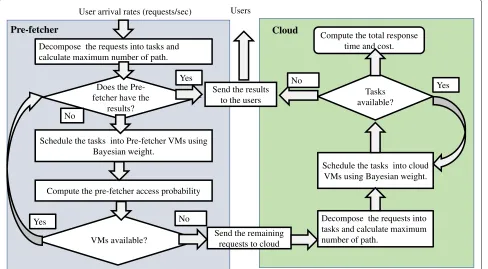
As it was discussed previously, heuristic approach for workload scheduling is proposed and algorithms are provided for pre-fetcher (Algorithm 1) and cloud (Algorithm 2). In every algorithm, there are several steps to be followed in order to achieve the optimized solution. The scheduling procedure of heuristic approach is shown in Fig.2and works as follows:
Algorithm 1:Workload scheduling in pre-fetcher with access probabilityβ
Input:μPF,μCloud,λi, Number of VMs
Output:β,λi,Cloud,TPF
1 Computeγ = μμPF
Cloud which is the cost of using one
class-iVM to process one unit request, respectively. 2 Decompose the requests into tasks and compute the
maximum number of path [12]. 3 forall the VMs are processeddo
4 Select the smallestγ from theγ set.
5 ifNi=1μi,PF >Ni=1λi,PFis satisfied.then 6 Calculate Bayesian weight of each path (ωk,PF)
from [12]then
7 Check the constraintKk=1ωk,PF=1 .
8 Computeβ =
A−A (m+1)Cγm
1/m
.Reservetheithclass VM and
schedule theβλi,PFworkload among VM.
9 Compute the remaining arrival requests for Cloud λi,Cloud=λi−βλi,PF .
10 Compute time/cost (TPF) using (4).
11 returnβ,λi,Cloud,TPF.
Pre-fetcher: The pre-fetcher executes Algorithm 1 to distribute the workload among high speed VMs to faster processing. In the integrated model, we assume that VMs in pre-fetcher are γ times faster than Cloud VMs. For workload scheduling, the pre-fetcher receives requests from users. At first, each multimedia service request is decomposed into tasks based on directed acyclic graph
(DAG) method [11] and then the maximum number of
path and Bayesian weight is estimated [12] for the alloca-tion of VM clusters. In this process, if the pre-fetcher finds the requested results in the storage servers, the results are served to the users. Otherwise, the lowest cost VMs are selected with Bayesian scheduling weight until all the VMs are occupied. During the workload scheduling stage the
Algorithm 2: Workload scheduling at cloud with access probability(1−β)
Input:λi,Cloud,β,μCloud,TPF
Output: Time/Cost:TTotal,TQoS
1 SortithClass VM in accessing order of cost.
2 Decompose all(1−β) λi,Cloudrequests to tasks and compute the maximum number of path [12]. 3 forall(1−β) λi,Cloudrequests are processeddo
4 ifNi=1μi,Cloud>Ni=1λi,Cloudis satisfied.then
5 Compute Bayesian/Optimum weightωk,Cloud
from [12]then
6 Check the constraintKk=1ωk,Cloud=1 .
7 Reserve theithclass VM and schedule the
workload among VM.
8 ComputeTTotal,TQoS.
9 return TTotal, TQoS.
access probability (β) and the remaining requests (λi,cloud)
are estimated if any further processing needed for cloud.
Cloud: The cloud executesAlgorithm 2to distribute the workload among VMs in cloud. The cloud starts the work-load scheduling when the requested results are not found in the pre-fetcher and all the pre-fetcher VMs are occu-pied withβλi,PFservice requests. The remaining requests
λi,cloud are scheduled at cloud with access probability
(1−β). Similar to the pre-fetcher workload scheduling, the cloud decomposes each service into tasks based on DAG method, estimates the maximum number of path and schedules the workload among VMs using Bayesian weight.
Performance analysis
All simulations are written and done in Matlab scripts. The results are categorized based on whether the values ofγ andβare fixed or changing.γ is the speed indicator in pre-fetcher’s processor andβ is the distribution prob-ability of received workload in pre-fetcher and accord-ingly(1−β) is the probability of workload reaching to multimedia cloud in our system model. The simulation variables and their value/range are depicted in Table1.
Response time performance analysis
User arrival rates (requests/sec)
Decompose the requests into tasks and calculate maximum number of path.
Does the Pre-fetcher have the
results?
Send the results to the users
Schedule the tasks into Pre-fetcher VMs using Bayesian weight.
Compute the pre-fetcher access probability
Send the remaining requests to cloud VMs available?
Decompose the requests into tasks and calculate maximum number of path.
Tasks available?
Schedule the tasks into cloud VMs using Bayesian weight. Compute the total response
time and cost.
No
Yes No
No Yes
Yes Users
Pre-fetcher Cloud
Fig. 2Heuristic approach of workload scheduling between cloud and end users in the presence of pre-fetcher
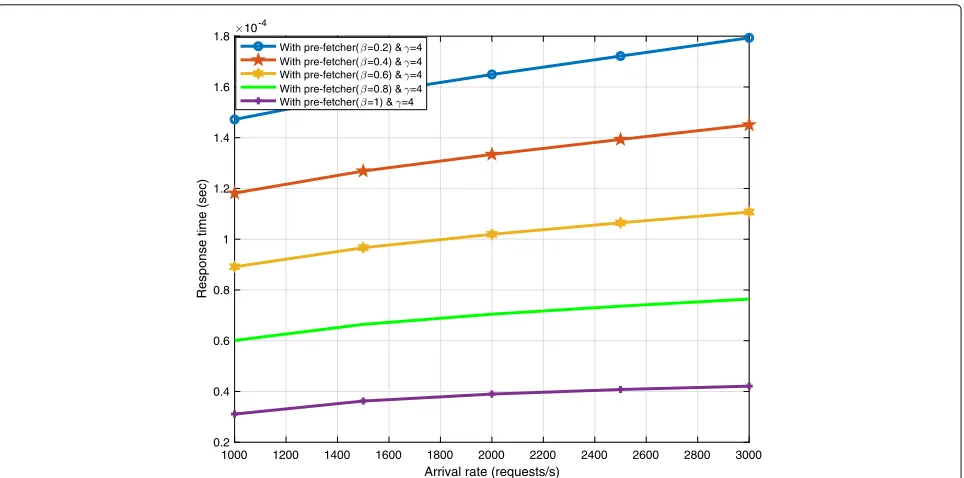
Response time study with fixed γ and changing β: We compare the proposed pre-fetching enabled cloud computing model with the former model [12] where pre-fetcher was not considered(β=0). The processing speed in pre-fetcher is assumed to be fixed (γ =4) which is four times faster than processing time in multimedia cloud.
As expected, the response time in the results is ascending, while using pre-fetcher benefits us by saving a significant amount of time in the long run. This means, instead of financially investing on data transmission, a portion of the investment can be done to improve and maintain the processor in pre-fetcher.
Table 1 Simulation setup and variable value/range
Variable Symbol Value/Range
PF processing speed multiplier γ 1-50
PF utilization β [0,1]
Arrival rate (requests/sec) λ 1000-9000
Processing delay (sec) C 1×10⁻⁴
PF processing cost factor m [0.2,0.25]
PF utilization cost factor m 1
Processing speed (sec) μ [10,20,30]
Number of clusters N 3
As presented in Fig. 3, the top curve represents the response time of multimedia cloud based on the arrival rate without considering pre-fetcher. According to Fig.3, as the number of the requests/sec increases, there is a slight elevation in the curve which means requests will need slightly more time to process and send back the requests to the source. The curve with lower response time represents the solo use of pre-fetcher without consid-ering any load being shared or sent to multimedia cloud. The results show that there is a remarkable performance enhancement in response time when only pre-fetcher is responding to requests. The reason behind the perfor-mance enhancement is because the requests already exist in the memory of the pre-fetcher and they just need to be located and sent back, versus in multimedia cloud, there is an extra step required to compute the request. Therefore, their response process in the pre-fetcher is significantly faster. In Fig.4, metrics and increment units are consid-ered to stay the same similar to the previous figure. The value ofγ is also is fixed and deemed to be four whileβis changing.
In Fig. 4, we increase the workload distribution
1000 1200 1400 1600 1800 2000 2200 2400 2600 2800 3000 Arrival rate (requests/s)
0.2 0.4 0.6 0.8 1 1.2 1.4 1.6 1.8 2 2.2
Response time (sec)
10-4
Without pre-fetcher( =0) & =4 With pre-fetcher( =1) & =4
Fig. 3Response time vs. arrival rate in solo use of the pre-fetcher or multimedia cloud. Without the pre-fetcher (β=0 andγ =4), With pre-fetcher (β=1 andγ=4)
the response time drops, and it is minimum in the
purple curve when β = 1. All the results show that,
with the assumption of γ = 4, the processor in
pre-fetcher is running four times faster than in multimedia cloud.
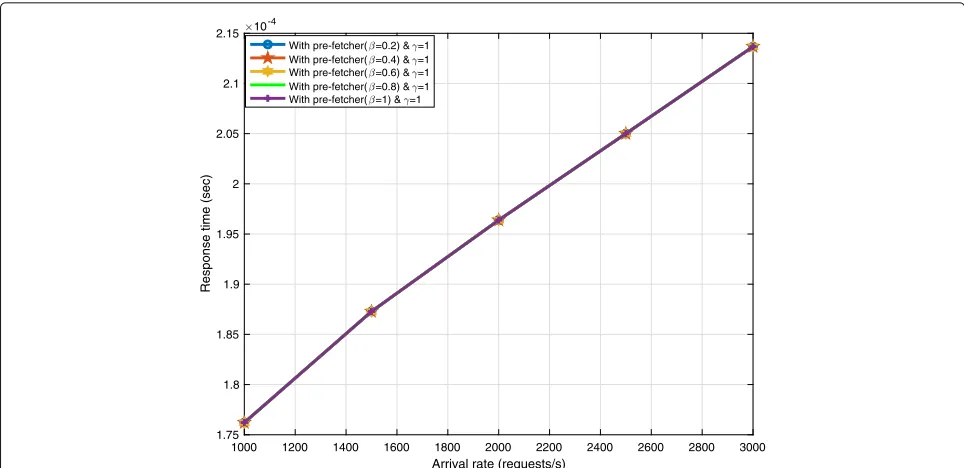
Response time study on fixedβand changingγ: It is also shown that Fig.5, with fixedβregardless of whether we increase the pre-fetcher utilization factor, the increase is still linear and at all various utilization levels there is no difference between using cloud and pre-fetcher.
1000 1200 1400 1600 1800 2000 2200 2400 2600 2800 3000 Arrival rate (requests/s)
0.2 0.4 0.6 0.8 1 1.2 1.4 1.6 1.8
Response time (sec)
10-4
With pre-fetcher( =0.2) & =4 With pre-fetcher( =0.4) & =4 With pre-fetcher( =0.6) & =4 With pre-fetcher( =0.8) & =4 With pre-fetcher( =1) & =4
1000 1200 1400 1600 1800 2000 2200 2400 2600 2800 3000 Arrival rate (requests/s)
1.75 1.8 1.85 1.9 1.95 2 2.05 2.1 2.15
Response time (sec)
10-4
With pre-fetcher( =0.2) & =1 With pre-fetcher( =0.4) & =1 With pre-fetcher( =0.6) & =1 With pre-fetcher( =0.8) & =1 With pre-fetcher( =1) & =1
Fig. 5Response time vs. arrival rate while the workload is shared between multimedia cloud and pre-fetcher at probability distribution ofβ. With pre-fetcher (β=0.2) andγ=1, With pre-fetcher (β=0.4) andγ=1, With pre-fetcher (β=0.6) andγ =1, With pre-fetcher (β=0.8) andγ =1, With pre-fetcher (β=1) andγ=1,
Even though, increasing processing speed in pre-fetcher decreases response time, it also increases the cost (pro-cessing delay) associated with pro(pro-cessing time. The delay is also considered and optimized using proposed heuristic approach. Results are shown and compared later. Initially, we perform simulations on pre-fetcher while consider-ing the impact of delay and later, after considerconsider-ing the impact of cost (processing delay), we compare the results and show how an integrated model using pre-fetcher and cloud computing is beneficial towards minimization of total response time. Note that in our model we only study the dynamic communication of multimedia cloud, pre-fetcher and end users. We will also find the opti-malβ for different situations, since it changes based on circumstances from time to time.
In this part, we study the response time behaviour of the arrival rateλ =[1000, 3000, 500] and,γ = [1, 4, 1] at the probability distribution ofβ=0.6. As presented in Fig.6, we observe the speed enhancement while speed multiplier γ is increasing as expected, the shortest response time belongs to the bottom curve withγ =4. Another notice-able result in Fig.6is that the response time gap between each curve is significantly decreasing as a result of speed enhancement. Here all the results and the performance analysis are on using pre-fetcher without considering the delay associated with its processor.
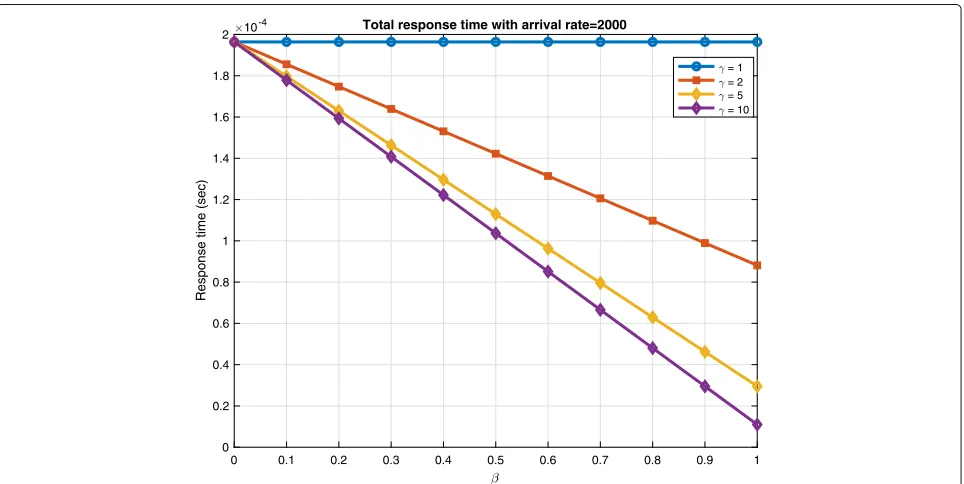
Response time study while β is changing: Figure 7 could be one of the most interesting comparisons. In this
figure we have total response time (sec) on Y axis versus workload distribution probability(β)changing on X axis from 0.2 to 1 with 0.1 increment unit. As can be inter-preted, when the response time increases and the load is pushed toward the pre-fetcher, only the top line is con-stant value at γ = 1 , since is it running at the same speed as the cloud and the other curves are all descending. Descending curves show that the response time decreases as the processor’s processing time increases and it reaches its minimum on the bottom curve.
As the workload is leaning more towards pre-fetcher, the processing speed is highlighted more than before. As we can observe in Fig. 7, the bottom curve has the minimum total response time, and the total response time is minimized when entire workload is sent to pre-fetcher. Accordingly, a faster processor is needed which means higher cost, and we will study that in the next part.
Performance analysis of cost
In this section, we investigate the cost improvements based on the simulation results. We will change the values ofβ,γ andλto observe the changes in total cost and total response time.
1000 1200 1400 1600 1800 2000 2200 2400 2600 2800 3000 Arrival rate (requests/s)
0.8 1 1.2 1.4 1.6 1.8 2 2.2
Response time (sec)
10-4
With pre-fetcher( =0.6) & =1 With pre-fetcher( =0.6) & =2 With pre-fetcher( =0.6) & =3 With pre-fetcher( =0.6) & =4
Fig. 6Workload response time vs. arrival rate while the workload is shared between multimedia cloud and pre-fetcher at probability distribution of
β=0.6. With pre-fetcher (β=0.6) andγ=1, With pre-fetcher (β=0.6) andγ=2, With pre-fetcher (β=0.6) andγ=3, With pre-fetcher (β=0.6) andγ=4,
total cost is increasing while the number of requests/sec increases. This cost is associated with the delay that occurs when pre-fetcher is processing the requests.
As presented, the initialγ is set to be 1 in all curves, which means processor of the multimedia cloud and pre-fetcher are both running at the same speed.
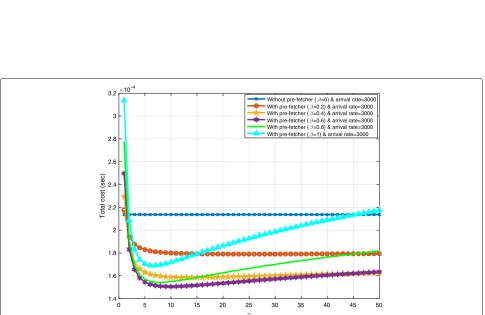
Total cost improvement whileλ = 3000 and PF uti-lization is increasing: As presented in Fig. 9, in this simulation arrival rate is set at 3000 while the use of pre-fetcher is increasing. Total cost is linear and con-stant when there is no pre-fetcher. While pre-fetcher is operating, initiallyβ =1 has the minimum total cost and,
0 0.1 0.2 0.3 0.4 0.5 0.6 0.7 0.8 0.9 1 0
0.2 0.4 0.6 0.8 1 1.2 1.4 1.6 1.8 2
Response time (sec)
10-4 Total response time with arrival rate=2000
= 1 = 2 = 5 = 10
0 5 10 15 20 25 30 35 40 45 50 1.2
1.4 1.6 1.8 2 2.2 2.4 2.6
Total cost (sec)
10-4
With pre-fetcher ( =0.6) & arrival rate=1000 With pre-fetcher ( =0.6) & arrival rate=1500 With pre-fetcher ( =0.6) & arrival rate=2000 With pre-fetcher ( =0.6) & arrival rate=2500 With pre-fetcher ( =0.6) & arrival rate=3000
Fig. 8Impact of increasing arrival rate andγon Total cost whenβ=0.6. With pre-fetcher (β=0.6) and arrival rate=1000, With pre-fetcher (β=0.6) and arrival rate=1500, With pre-fetcher (β=0.6) and arrival rate=2000, With pre-fetcher (β=0.6) and arrival rate=2500, With pre-fetcher (β=0.6) and arrival rate=3000,
0 5 10 15 20 25 30 35 40 45 50 1.4
1.6 1.8 2 2.2 2.4 2.6 2.8 3 3.2
Total cost (sec)
10-4
Without pre-fetcher ( =0) & arrival rate=3000 With pre-fetcher ( =0.2) & arrival rate=3000 With pre-fetcher ( =0.4) & arrival rate=3000 With pre-fetcher ( =0.6) & arrival rate=3000 With pre-fetcher ( =0.8) & arrival rate=3000 With pre-fetcher ( =1) & arrival rate=3000
0 0.1 0.2 0.3 0.4 0.5 0.6 0.7 0.8 0.9 1 1.4
1.5 1.6 1.7 1.8 1.9 2 2.1
Response time (sec)
10-4 Response time (ms) with varying for =15 and arrival rate=2000
Simulation results for different s Theoretical optimum =0.48661
Fig. 10βvs. Response time (sec) with forγ=15, and arrival rate=2000. Simulation results for differentβ, Theoretical optimumβ=0.48661,
asγ is increasingβ=0.6 takes its places and becomes the overall optimumβfor this particular instance.
The value of optimalβ varies as we change the simu-lation criteria and change the arrival rate or pre-fetcher’s processing speed. For example, if we takeγ = 50, the optimum value forβis 0.4 and similarly optimalβchanges its place based on the condition applied in the simulation.
In other words, the percentage of using pre-fetcher varies from time to time, and it is not always best to allocate the entire workload to pre-fetcher even though it operates faster than cloud.
Response time Vs. β while PF is processing at fixed speedγ = 15: One of our goals is to find the optimal
0 0.1 0.2 0.3 0.4 0.5 0.6 0.7 0.8 0.9 1 1.3
1.4 1.5 1.6 1.7 1.8 1.9 2 2.1 2.2
Response time (sec)
10-4
Arrival Rate = 1000 Arrival Rate = 2000 Arrival Rate = 3000 Theoretical optimum
0 0.1 0.2 0.3 0.4 0.5 0.6 0.7 0.8 0.9 1 1.5
1.6 1.7 1.8 1.9 2 2.1 2.2 2.3 2.4 2.5
Response time (sec)
10-4
= 15 = 25 = 35
Theoretical optimum
Fig. 12Comparison of optimumβvalues whileγis changing andλ=2000.γ=15,γ=25,γ =35, Theoretical optimumβ
response time for the amount of workload sent to pre-fetcher. In order to study that, we performed a simulation where arrival rate is set to be 2000 requests/sec and γ = 15. Values ofmare considered to be 0.25 andmis considered as 1.
Based on the results, response time is optimum when (β=0.48) almost half of the workload is sent to
pre-fetcher when γ = 15. The theoretical optimum β
is also calculated and marked on Fig. 10 to show that
both simulation and theoretical results are aligned at the same point. Staring from β = 0, response time (sec) is considerably high, and it decreases slowly while the use of pre-fetcher increase up to 0.5, and after that, it starts rising again until it hitsβ =1. It is understandable that if
4000 4500 5000 5500 6000 6500 7000 7500 8000 8500 9000 Arrival rate (requests/s) with =0.2
2 2.2 2.4 2.6 2.8 3 3.2 3.4 3.6 3.8 4
Response time (sec)
10-4
Optimal solution without cost Optimal solution with cost Heuristic solution without cost Heuristic solution with cost
only pre-fetcher is used, it is not the optimum condition, since response time and accordingly costs are increasing.
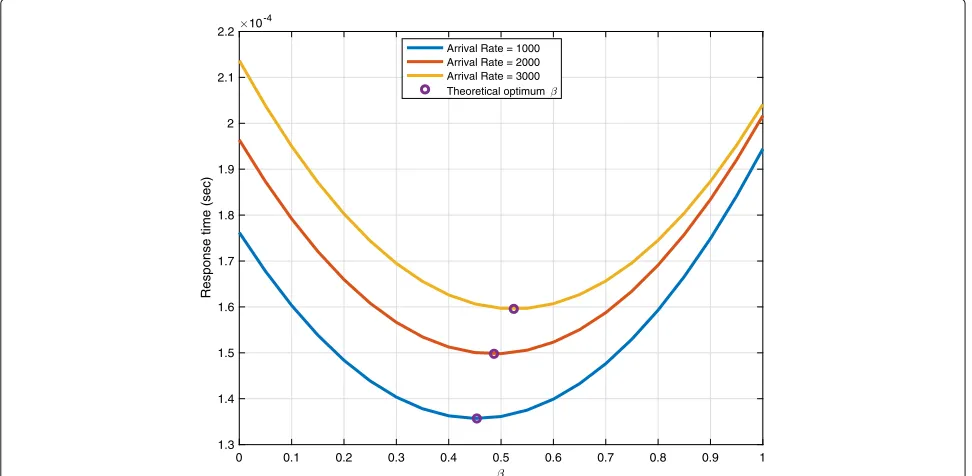
In Figs.11and12, we investigate the impact of chang-ingγ andλ, on optimumβ. As presented, in both figures theoretically calculated optimumβ is marked as well. As we can observe from the trends as increase in the arrival rate of the response time slightly increases, theβoptimum point moves to the right. In other words, if the amount of the requests/sec is increasing, it is more beneficial to push the load toward pre-fetcher.
As shown in Fig.11, all the curves for response time are slowly decreasing to the optimal point, and then it increases. The gap between all curves is also shrinking as we move away from the optimal point using (6) and we allocate more load toward pre-fetcher to handle. The opti-mum point ofβ aligns with the theoretical valueβ in all the curves. The response time gap between curves is also maximized at the optimal point and minimized atβ=1.
In Fig.12, we study the changing trend of the curves according to the processing speed, while arrival rate is fixed at λ = 2000. Unlike the previous figure, in this figure, the gap between curves is slowly increasing as we push more load toward pre-fetcher.
As we push more load to pre-fetcher, initial response time decreases to the optimal point and after that, increases to maximum where all the workload is allocated to pre-fetcher. All the curves start basically from the same starting point and initially, their response time decrease is linear toβ=0.5. Using pre-fetcher is most advantageous at pre-fetcher’s utilization optimum point. Similar to the previous figure, the optimum point ofβaligns with theo-retical valueβin all the curves. In both Figs.11and12, we can observe the impact of varyingγ andλwhenβ =[0, 1].
Optimal and heuristic optimization performance analysis
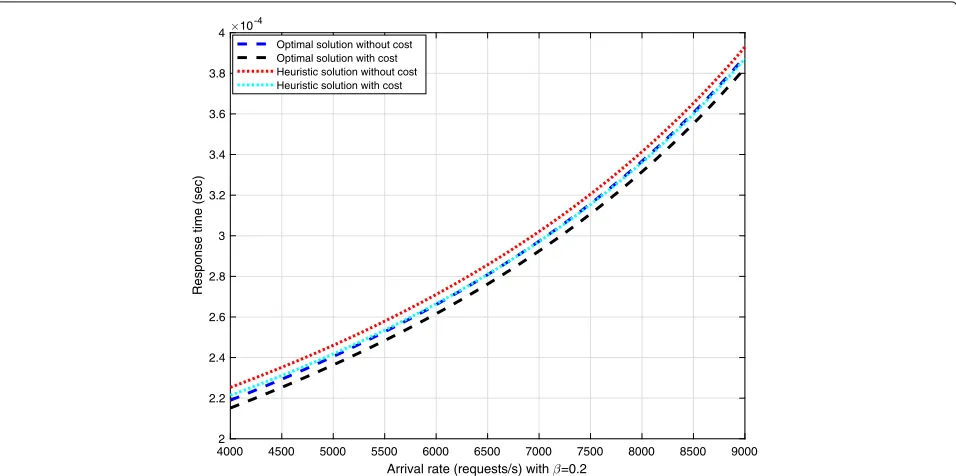
Figure 13 compares optimal and heuristic
optimiza-tion approaches with and without cost factor. We per-formed both optimal and heuristic approaches on the total response time. In this simulation, pre-fetcher processing speed,γ is at 3, pre-fetcher utilization factor,β, is set at 0.6 while arrival rate changes from 4000 requests/sec to 9000 requests/sec. The heuristic scheme has longer response time than the optimal scheme with a small difference. The optimal scheme weights vary with the change ofλ, while weights in the heuristic scheme are constant since it is normalized by the service rate.
Conclusion and future works
Our previous work was done with the primary objec-tive in convex workload scheduling problem for cloud based multimedia applications. In this paper, we pro-pose path selection algorithm to reduce response time by adjusting weights among the paths of tasks both in pre-fetcher and cloud. The considered problem was more
complex compared to previous similar work, and hence the heuristic algorithm was considered to be the solu-tion. In this study, we used a pre-fetcher that adopts and learns new frequent requests to cache and store them prior to the actual request. Even though our goal was to design and develop an intelligent pre-fetcher, there are times that request does not exist within the storage of the pre-fetcher (miss-ratio). The multimedia cloud commu-nication method is becoming one of the major focuses of researchers nowadays, yet intelligent pre-fetching and caching learning schemes can be improved and reduc-ing miss-ratio of intelligent cachreduc-ing schemes would be an interesting topic to work on in future studies.
Abbreviations
ARA: Adaptive Replacement Algorithm; DAG: Directed Acyclic Graph; MCC: Mobile Cloud Computing; PF: Pre-fetcher; RTT: Round Trip Time; RT: Response Time; VM: Virtual Machine;M: number of given tasks;N: number of VM clusters; K: maximum number of paths;i: VM indexing indicator;j: task indexing indicator;k: path indexing indicator;β: accessing probability associated with pre-fetcher;λ: arrival rate (requests/sec);μ: mean servicing rate,μirepresents
the mean servicing rate for VMi;γ: processor’s speed multiplier;α: allocation index,αijrepresents the allocation index between the VMiand the taskjfor
pre-fetcher;θ: allocation index,θijrepresents the allocation index between the
VMiand the taskjfor cloud;ω: workload weight,ωiis the workload weight
associate withithVM cluster;g(γ ): cost function(delay) associated with
pre-fetcher;C: constant delay value in cost function;m: pre-fetcher processor’s speed increment indicator in the cost function;m: pre-fetcher usability increment indicator in the cost function
Acknowledgements
The authors thank Dr. X. Nan for his initial contributions.
Authors’ contributions
The work presented in this paper is based on KK MASc research and thesis, which was supervised by Prof. Anpalagan and Prof. Guan. LF is a PhD candidate and she contributed to this work with the system model and problem formulation, and writing a part of this paper. All the authors read and approved the final manuscript.
Authors’ information
K. Khorramnejad was a MASc student (2015-17) and L. Ferdouse is a PhD candidate (2016-) in Ryerson University. L. Guan and A. Anpalagan are professors in the Department of Electrical and Computer Engineering, Ryerson University, Toronto, Canada.
Competing interests:
The authors declare that they have no competing interests.
Publisher’s Note
Springer Nature remains neutral with regard to jurisdictional claims in published maps and institutional affiliations.
Received: 20 April 2018 Accepted: 6 July 2018
References
1. Amazon Elastic Compute Cloud.https://aws.amazon.com/ec2/. Online; accessed 1-July-2017
2. Bartolini C, El Kateb D, Le Traon Y, Hagen D (2018) Cloud providers viability. Electronic Markets.https://doi.org/10.1007/s12525-018-0284-7 3. Harnal S, Chauhan RK (2016) Multimedia support from cloud computing:
4. Zhu W, Luo C, Wang J, Li S (2011) Multimedia cloud computing. IEEE Signal Processing Magazine 28(3):59–69.https://doi.org/10.1109/MSP. 2011.940269
5. Fernando N, Loke W, WennyRahayu S (2013) Data processing delay optimization in mobile edge computing 29(1):84–106.https://doi.org/10. 1016/j.future.2012.05.023
6. He Y, Yu FR, Zhao N, Leung VCM, Yin H (2017) Software-defined networks with mobile edge computing and caching for smart cities: A big data deep reinforcement learning approach. IEEE Communications Magazine 55(12):31–37.https://doi.org/10.1109/MCOM.2017.1700246
7. Nan X, He Y, Guan L (2012) Optimal allocation of virtual machines for cloud-based multimedia applications. IEEE 14th International Workshop on Multimedia Signal Processing (MMSP):175–180
8. Nan X, He Y, Guan L (2014) Towards optimal resource allocation for differentiated multimedia services in cloud computing environment. International Conference on Acoustics, IEEE, Speech and Signal Processing (ICASSP):684–688
9. Gong W, Chen Z, Yan J, Qianjun S (2014) An optimal VM resource allocation for near-client-datacenter for multimedia cloud. IEEE International Conference on Ubiquitous and Future Networks (ICUFN)l:149–254
10. Nan X, He Y, Guan L (2013) Optimization of workload scheduling for multimedia cloud computing. IEEE International Symposium on Circuits and Systems (ISCAS):2872–2875
11. Nan X, He Y, Guan L (2013) Optimal task-level scheduling for cloud based multimedia applications. International Conference on Acoustics, IEEE, Speech and Signal Processing (ICASSP):3771–3775
12. Ferdouse L, Li M, Guan L, Anpalagan A (2016) Bayesian workload scheduling in multimedia cloud networks:83–88.https://doi.org/10.1109/ CAMAD.2016.7790335
13. Zhu W, Luo C, Wang J, Li S (2011) Multimedia cloud computing. IEEE Signal Processing Magazine 23(3):59–69
14. Zhijun H, Grande RED, Boukerche A (2017) Towards efficient data access in mobile cloud computing using pre-fetching and caching. In: 2017 IEEE International Conference on Communications (ICC). pp 1–6.https://doi. org/10.1109/ICC.2017.7997078
15. Guangshun Li, JW Jiping Wang, Song J (2018) Data processing delay optimization in mobile edge computing:83–88.https://doi.org/10.1155/ 2018/6897523