Educational Networks 2.1
Social media, collaborative environments
and teaching-learning processes
ARTICLE
Diego Levis
[email protected]Lecturer, Faculty of Social Sciences, University of Buenos Aires
Submitted in: June 2010 Accepted in: October 2010 Published in: January 2011
Recommended citation
LEVIS, Diego (2011). “Educational Networks 2.1. Social media, collaborative environments and teaching-learning processes” [online article]. Revista de Universidad y Sociedad del Conocimiento (RUSC). Vol. 8, No 1, pp. 25-42. UOC. [Accessed: dd/mm/yy].
<http://rusc.uoc.edu/ojs/index.php/rusc/article/view/v8n1-levis/v8n1-levis-eng> ISSN 1698-580X
“No one knows everything, everyone knows something, all knowledge resides in networks.”
Pierre Lévy (1994)
Abstract
The Redes Educativas 2.1 (Educational Networks 2.1) project attempts to investigate the potential of social media and collaborative environments on the Internet for teaching-learning processes. To that end, we used a Web 2.0 application for social network creation on face-to-face courses and on blended-learning teacher training courses. The application was configured in accordance with the pedagogical needs of every course included in the project. A space restricted to course participants was created, and students of the same subject on several courses and/or years were incorporated, as were the lecturers.
The versatility of educational networks allows various teaching-learning methods to be combined in a single study space. Alongside teaching practices that are more traditional, it is possible to generate contexts that include collaborative and cooperative practices based on horizontality. Finally, the meaning of educational networks is linked to the pedagogical project into which each experience falls. Technology in itself does not innovate; rather, it is the social appropriation of technology – educational in this instance – that leads to change.
Keywords
social media; collaborative environments; teaching; networks
Redes educativas 2.1. Medios sociales, entornos colaborativos
y procesos de enseñanza y aprendizaje
Resumen
El proyecto Redes Educativas 2.1 se propone indagar en las posibilidades que ofrecen los medios sociales y
los entornos colaborativos en internet en los procesos de enseñanza y aprendizaje. Para ello, utilizamos en
cursos presenciales y en cursos de capacitación docente en modalidad semipresencial una aplicación de
la web 2.0 destinada a la creación de redes sociales. La aplicación se configuró de acuerdo con los objetivos
pedagógicos de cada uno de los cursos incluidos en el proyecto. Se estableció que el espacio fuera de
ac-ceso restringido a los participantes en los cursos, y se integró a los estudiantes y a los docentes de distintas
comisiones y/o turnos de la misma materia.
Las redes educativas en tanto entornos colaborativos no se refieren a computadoras, cables y satélites
o programas informáticos, sino que describen a los participantes en una experiencia educativa concreta,
comunicados a través de un sistema telemático que haga posible la interacción libre entre ellos.
La versatilidad de las redes educativas permite compaginar en un mismo espacio de estudio distintas
formas de enseñanza y aprendizaje. Es posible generar contextos que incluyan prácticas colaborativas y
cooperativas basadas en la horizontalidad junto con didácticas más tradicionales. En última instancia,
la significación de las redes educativas se vinculará al proyecto pedagógico en el cual se enmarque cada
experiencia. La tecnología por sí misma no innova socialmente, son los modos de apropiación social, en
este caso educativa, los que producen las transformaciones.
Palabras clave
1. What Is the Redes Educativas 2.1 Project?
The Redes Educativas 2.1 (Educational Networks 2.1) attempts to investigate the potential of so-called
social networks as collaborative learning environments at different levels of teaching and modes
of study. To that end, from early 2009, we used a Web 2.0 application for social network creation on
face-to-face courses and blended-learning teacher training courses. The application was configured
in accordance with the pedagogical needs of every course included in the project. A space restricted
to course participants was created, and students of the same subject on several courses and/or years
were incorporated, as were the lecturers. The aim was to look into the potential of collaborative work
between peers with similar interests, irrespective of whether or not they knew each other personally.1
On the basis of Begoña Gros’s definition of collaborative learning (2008), our project considered
a student as someone who interacts with others, and not as an isolated individual. In addition,
we considered that a computer connected to the Internet fulfilled a fundamental function as a
mediating instrument that scaffolds the process. In order to implement the project, in early 2009 we
selected and used a commercial application for social network creation as a collaborative learning
environment in our classes.2
It is important to underscore that, although communication and digital education technologies
are a crucial factor, in themselves they are not enough for Educational Networks 2.1 to have true
socio-educational meaning. As pointed out earlier, the practices of both lecturers and students within
a defined context and with defined pedagogical objectives are the fundamental aspects. In order to
obtain the expected results, within the scope of our project, we developed activities designed to
foster collaborative practices and habits among our students.
2. Education and ICTs: About the Promises
What are the goals of teaching-learning processes and of education in the widest of senses? To gain
useful knowledge? In what sense is it useful? Should schools and higher education institutions limit
themselves to teaching students how to store and regurgitate information, ideas and knowledge
generated by others? Should teachers innovate? Can creativity be taught? Is the aim to train critical
citizens or effective workers? Does the former preclude the latter? Are critical thinking, freedom and
1. Throughout 2009 and the first semester of 2010, the Redes Educativas 2.1 project experimented with the use of social networks for educational purposes on one subject taught on three bachelor’s degree and teacher training courses in face-to-face mode at a public university in Buenos Aires, Argentina. Approximately 45 students took part in each of these courses. Also included in the project were two subjects of a face-to-face bachelor’s degree at a private university in Buenos Aires (a total of 11 groups). Between 70 and 110 students took part in each of the four networks created for the latter of the courses. In addition, two educational networks were set up for a blended-learning teacher training course in ICT use, organised by CENDIE (an organisation reporting to the Education Secretariat of the Province of Buenos Aires). Some 140 teachers from four different school regions took part in the first of these networks, and 340 from eight regions in the second.
collaborative intelligence incompatible with training people to be capable of working in any line of
business? Are, or should, students be considered human resources (the concept used in business
management to refer to workers)?
As Jean Piaget pointed out over 40 years ago, each society as a whole should define the goals of
education through multiple forms of collective action, the intermediation of which conserves and
transforms societies, and through bodies of the State or private institutions, depending on the type
of education sought (Piaget, 1967). In this context, public debate on the incorporation and use of
digital technologies at different levels of education is inevitable. Decisions should not be delegated
to external bodies or be made subject to the corporate interests of business sectors or market forces.
We human being are not (or should not be considered as) goods or economic resources.
Aside from some differences in nuance, analysts and researchers, as well as multilateral bodies
and education authorities, all agree on underscoring the underlying capacity of information and
communication technologies (ICTs) to transform and enhance teaching-learning processes.3
The rapid spread of the Internet over the last 15 years has multiplied and revitalised discourse on
the education potential that had been attributed to computers and other electronic devices several
decades earlier. Certain forecasts, based on academic research that was either lacking in thoroughness
or merely speculative, concerning the transformative capacity of using computers, local networks,
the Internet, videogames and, more recently, the so-called Social Web or Web 2.0 in classrooms,
have gradually taken account of the most relevant characteristics of subsequent technological and
social innovations. Initially, attention was focused on technological devices (mainly computers and
electronic networks). Content, teaching strategies and sociocultural appropriation of digital media
by educational community stakeholders (students, teachers, directors and parents) were relegated
to the background (or directly ignored).
However, with one or two exceptions, earlier expectations have not been met. The disparate and
sometimes chaotic incorporation of computers and networks into educational processes over the
last 20 years highlights the difficulties. Among other factors, the lack of defined pedagogical projects
has caused the incorporation of ICTs into education to have a negative impact on results. In this
respect, David Buckingham found that “there has been little definitive evidence that the widespread
use of technology has contributed to raising achievement – let alone to generate more creative or
adventurous forms of learning for the majority of young people” (2008, p. 225).
One of the main difficulties resides in finding – conceiving developing, implementing –
pedagogically meaningful uses that foster the process of socio-educational appropriation of
digital media by teachers and students (Levis, 2007). In most cases, the actions taken are limited to
supplying schools with hardware/software, and to teaching students how to use computers and
certain office automation applications that are widely used in working environments, as if the sole
objective were purely and simply to train efficient workers. This is a paltry objective, one that does not
take advantage of the huge pedagogical and teaching potential of digital media; and the know-how
fails to differentiate between the instrumental and the useful in terms of their educational potential.
According to Gros (2004), the objective is not to use technology, but to adapt education to today’s
needs, and, therefore, a methodological change is necessary.
These and other possible observations and comments on the most widespread form of
introducing ICTs into education do not fundamentally question the potential that digital media has
for teaching-learning processes at different levels and modes. To confirm this potential, we believe
that it is essential to do away with the instrumental view, albeit prevalent, and to concentrate efforts
on developing pedagogically meaningful and innovative uses focused on transforming
teaching-learning methods.4
A first step towards reaching this goal is to clearly establish the pedagogical objectives of
incorporating these technologies into teaching-learning processes and the best ways to do so (Why?
and How?). To that end, it is essential to start by knowing what the possibilities and constraints are in
terms of integrating various technologies into education in different social and cultural settings. In
this context, account should be taken of the fact that what is conceivable is not always achievable,
and what is achievable is not always desirable. For example, Begoña Gros (2004) points out that the
use of technology does not always lead to innovation and reflection on learning.
Over the last five years, especially with the development and spread of social media5 on the Internet,
ICTs have begun to be viewed as an appropriate tool for the collective construction of knowledge.
We agree with Gros’s assertion that artefacts constitute a fundamental support for learning, and we
are particularly interested in the role of technology understood as such: in other words, technology as
a mediating support in the process of collaboration and knowledge construction (Gros, 2008, p. 89).
The Redes Educativas 2.1 moves in the aforementioned direction, and implements the use of
social media in teaching-learning processes on the basis of an integrative socio-educational and
educational conception (Levis, 2007). The idea suggests that digital media (computers, networks,
mobile devices, etc.) should be used to develop innovative pedagogical practices. It considers that
teaching-learning is an active process in which people construct their own understanding of the
world through exploration, experimentation, debate and reflection. The combined use of digital
devices and networks allows new learning conditions to be conceived and new knowledge to be
developed.
3. Educational Networks: What For?
In our opinion, the creation and use of educational networks holds particular interest for education
in general, and for higher education in particular. They are easy-access, cheap and very versatile
4. What we understand by pedagogical innovation is the set of initiatives that encourage professionals to think anew about the way they need to carry out their tasks. It is not about an ambitious handling of the concept in the sense that the changes coming from the innovation should be radical or total, but rather that these new ways of doing things should lead to a beneficial change (…) what is important is the development process and not the end result (De Pablos, 2008).
applications that are commonly used by a high percentage of Latin American youths and adults.
Our proposal seeks to provide an innovative methodological perspective for work in education,
which must be adapted to the particular needs of teaching levels, knowledge areas, modes of
study and the characteristics of student groups and institutions in which it is intended to be
implemented.
Educational networks as collaborative learning and communication environments:
· Foster group activities by interest and/or thematic areas.
· Facilitate interdisciplinary work.
· Encourage horizontality in relationships between teachers and students.
· Promote the design of collaborative and cooperative study and research dynamics.
· Cultivate the collective production of knowledge.
· Demolish the classroom wall.
· Allow reading lists and other documents to be published in various formats for use in course monitoring.
· Offer a versatile communication platform, enabling various methods of online interpersonal communication (public or private, synchronous or asynchronous) that promotes the formation
of personal and group relationships.
· Stress the meaning of belonging to a group and foster the creation of teaching-learning communities.
· Let students and teachers discover and develop teaching-learning methods that are not based on hierarchical positions or on punishment/reward incentives.
· Play a part in students’ sharing of information and documents in various formats on topics of interest to them, whether linked to the curricular content of the course or not.
· Promote a better use of prior knowledge, interests, curiosity and capacity to explore in every student taking part in the development of a joint study project, which helps to modify the way
in which ownership of ideas is currently conceived (considered as the property of the author).
1. Starting Points
In recent years, in academic areas related to “technologies for communication and education” (a
term that we propose as an alternative to “educational technologies”), much has been written and
discussed about the potential of online digital media to develop educational projects based on what
are generically called collaborative environments, understood as being learning spaces that meet
certain optimal conditions for teamwork and joint learning. This necessarily includes both support
technology and the use made of it (…) We can find technologies specifically designed to support
collaborative environments, or technologies that, while not having been developed for that purpose,
are used and occasionally adapted to it in a more or less spontaneous way.6
The successive launch of new online applications that facilitate file sharing, the publication of
different kinds of content and collaborative practices (P2P, wikis, blogs, so-called “social networks”,
streaming audio and video, etc.) is a return to the original functions of the World Wide Web as a
medium for collaboration and for the publication and sharing of content that inspired its inventor,
Tim Berners Lee, in the early 1990s. This use of the Web, conventionally called the “Social Web” or “Web
2.0”, acquires meaning from the production of content and from the communication flows generated
by its users, who are, at one and the same time, creators, editors, transmitters and receivers. This is
how, in the construction of meaning on the Web, computer and telecommunications systems come
together to make it work technically, and people come together to make it work socioculturally.
In this context, the Redes Educativas 2.1 project attempts to create online collaborative and
cooperative teaching-learning dynamics capable of establishing positive synergies between the
students’ and lecturers’ day-to-day technical/technological practices, and the needs and conditions
particular to each teaching-learning process. Begoña Gros points out that, in learning environments
like the ones proposed, we can distinguish between functional and social facilities. Functional
facilities offer information relating to the processes that can be activated on a particular interface,
while social facilities serve to create competencies in users, by making them participants in the code
that regulates interactions and is shared by the same community (2008, p. 97).
On the basis of ideas by authors from very different eras and schools (Plato, Paulo Freire, Pierre Lévy
and Edgar Morin, among others), we consider each student to be an active subject in his/her learning
process and, at the same time, a source of knowledge for the community to which he/she belongs.
For the purposes of our research, we consider a “community” to be the members of an educational
network (a study space on the Web), who are brought together by it. We understand knowledge as
a complex construction in which particular pieces of knowledge cannot be disconnected from their
context or from the multiple factors intervening in them.
Ideally, we consider an open academic space to be a place where, similar to the Platonic Academy,
the task of teachers is to help students develop the capacity to produce knowledge collaboratively,
so that they [the students] can reach levels of complexity and depth that would be difficult to achieve
alone, while, in the same process, not forgetting about the individual acquisition of knowledge and
competencies on specific content.
Going back to the proposals put forward by Pierre Lévy (1994), we assume that one of the main
functions of ICTs is to foster the construction of intelligent collectives where the social and cognitive
potential of each one can be mutually developed. Lévy points out that, by connecting people, ICTs
as intellectual technologies structure a collective intelligence network that helps to strengthen the
cognitive capacity of each individual forming part of it. In this sense, we consider that social media,
as collaborative environments, generate synergies that foster collective intelligence and, in turn, are
the outcome of the latter. Hence, social media used as learning spaces constitute a valuable tool for
promoting the generation of knowledge capable of dealing with global and fundamental problems
as the step prior to imprinting local and partial pieces of knowledge on it. A kind of knowledge that,
in agreement with Edgar Morin (1999), we consider necessary, not to say essential, for education in
The working dynamics employed for over two decades on the collective creation and
development of open-source software highlights the potential for knowledge construction based
on a peer-to-peer (P2P) horizontal structure using the possibilities that collaborative environments
and online networks offer.
It is not an entirely new way of working. The scientific development of humanity is the result of
the sum total of contributions made by countless people over the centuries. Knowledge construction
draws on things that others have created, thought about and developed previously. Something that
is very important for us to convey to our students is that the work and intelligence of every individual
is strengthened by collaborative work, and that every piece of knowledge is connected to another.
Independent pieces of knowledge do not exist. “We should teach methods of grasping mutual
relations and reciprocal influences between parts and the whole in a complex world” (Morin, 1999).
Recovering the collaborative spirit has a positive impact on different knowledge areas in that it allows
knowledge to be expanded. It may also give rise to a positive transformation in human and social
relationships by questioning hierarchical power relationships based on knowledge ownership.
2. Features of the
Redes Educativas 2.1
Project
In a technocultural context that facilitates means of horizontal communication and access to hundreds
of information sources, the schooling methods used in teaching-learning processes do not seem to
be the most appropriate ones for training people to think critically and enabling them to construct
new knowledge. The educational networks that we have developed in the context of our project
retain the function of content publishing and dissemination, and the appropriate interpersonal
communication tools (public and private) that are a distinctive feature of the most commonly-used
social networks. In addition, they allow learning practice communities to be created, where members
can share interests and objectives connected with the specific content of a subject or course they are
taking, in a collaborative environment to which people outside the educational network do not have
access. The integration of the functionalities of open social networks into the structure of a restricted
online educational community (irrespective of the mode of study) is one of the main features of the
Redes Educativas 2.1 project.
In addition, the versatility of the software applications used facilitates the development of
innovative pedagogical activities, basically collaborative and cooperative practices founded on
horizontality coexisting alongside traditional or fairly traditional teaching practices.
Favouring socio-educational innovation over technical innovation, the Redes Educativas 2.1 project
constructs spaces of meaning (educational, affective, social, aesthetic, etc.) that aim to help groups
participating in the network to strike up and strengthen personal relationships, in both face-to-face
and e-learning modes. They try to foster the construction of a community, allowing students to share
experiences and interact with fellow students without the need to arrange a physical meeting, which
4. Object of Analysis
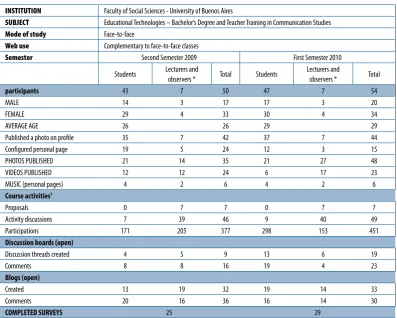
This article pulls together the results observed during project set-up and implementation for two
courses of the Educational Technologies subject that was part of the bachelor’s degree and teacher
training in Communication Studies at the University of Buenos Aires in the second semester of 2009
and the first semester of 2010. The use of the Web in these instances was complementary to
face-to-face classes. Worthy of note is that the curricular content of the subject is connected with the
incorporation of digital media into teaching-learning processes. Consequently, besides being used
as support media for course implementation, for the students, these educational networks were also
an object of reflection and study on their own practices.
The formal structure of the networks included the following options:
A. Home page: containing information, news, a description and links to all the sections and
subsections of the environment.
1. A personal page for each member of the network: the design could be customised. Among
other functions, the personal page gave the option to publish posts on a personal blog and
on music topics. It combined all the activities carried out by each participant on the network.
2. List of network members: included their names, surnames and photos (adding a photo was
optional).
3. “Activities”: use of this section was compulsory for monitoring the “academic” activity of the
course. The section was divided into subsections for work on each of the course activities.
These subsections had a space for posting contributions and a “discussion board” for
discussing topics connected with the respective activity. These topics could be put forward
by any member of the group.
4. “Resources”: publication of the compulsory and optional reading list for the course in digital
format.
5. “Discussion board”: a space for launching discussions and opinion exchanges between
members of the network on topics put forward by the participants themselves. Lecturers and
department collaborators took on the role of discussion facilitators in order to encourage
student participation.
6. “Blog”: an open space for sharing materials, information and opinions, whether connected
with the subject or not.
7. “Photos”: an open space for publishing and sharing images, whether connected with the
subject or not.
8. “Video”: an open space for publishing and sharing videos, whether connected with the
subject or not.
B. Internal e-mail service
The project as a whole looked into a variety of aspects from a number of perspectives. Here,
we shall analyse the characteristics observed with regard to rupture and continuity that occurred
between instances of meeting in the university’s classrooms and the practices of using a social medium
adapted to a collaborative learning environment, which was complementary to face-to-face classes.
1. Methodology
A case-study methodology was used for this research project, combining quantitative and qualitative
techniques. The techniques used were:
· Participant and non-participant observation.
· A self-administered survey containing multiple-choice and open questions.
· Content analysis of materials published by students.
Table 1. Summary of Main Study Data
INSTITUTION Faculty of Social Sciences - University of Buenos Aires
SUBJECT Educational Technologies – Bachelor’s Degree and Teacher Training in Communication Studies
Mode of study Face-to-face
Web use Complementary to face-to-face classes
Semester Second Semester 2009 First Semester 2010
Students Lecturers and
observers * Total Students
Lecturers and
observers * Total
participants 43 7 50 47 7 54
MALE 14 3 17 17 3 20
FEMALE 29 4 33 30 4 34
AVERAGE AGE 26 26 29 29
Published a photo on profile 35 7 42 37 7 44
Configured personal page 19 5 24 12 3 15
PHOTOS PUBLISHED 21 14 35 21 27 48
VIDEOS PUBLISHED 12 12 24 6 17 23
MUSIC (personal pages) 4 2 6 4 2 6
Course activities7
Proposals 0 7 7 0 7 7
Activity discussions 7 39 46 9 40 49
Participations 171 205 377 298 153 451
Discussion boards (open)
Discussion threads created 4 5 9 13 6 19
Comments 8 8 16 19 4 23
Blogs (open)
Created 13 19 32 19 14 33
Comments 20 16 36 16 14 30
COMPLETED SURVEYS 25 29
Observation: the students taking part in the experiment formed part of a uniform group in terms of age and socioeconomic background.
2. Findings and Results
After analysing the data, it was clear that continuity, tension and rupture were present between
face-to-face classes and network-use practices. The most significant ones were:
a. Group identity
Among the members of the networks analysed, a particular scheme of identity construction was
found, in which individual identities dissolved into a collective identity, although the latter did not
manage to become a group identity.
It is important to point out that in the case of face-to-face courses, the network members were
fellow students in the same class. However, given the characteristics of the mode of study in the
institution in question,8 it was unlikely that instances of exchange between students would have
developed spontaneously, which might have given rise to a feeling of belonging to a group. One of
the objectives of the social medium proposed by the department was precisely that of offering ways
of overcoming that limitation.
In both of the cases studied, a connection was found between the students’ level of participation
in class and on the network. Generally speaking, the most active students in the classroom were also
the most active students on the network.9 By the same token, the least active, quiet students in the
classroom behaved in a similar way in the digital environment. From the students’ own comments
and the observations of our analysis, worthy of note was a degree of “fear” and “resistance” to using
the publication possibilities of the subject’s educational network for showing work done and
opinions formed throughout the course to fellow students, which could be read and judged by
them.
b. Distinction between “obligation” and “entertainment”
Regarding the use of the digital environment, a clear distinction was found between “obligation” and
“entertainment”. Several students were reticent about incorporating the educational network into
their study and learning practices because they associated this type of application with their free
time.
Some of the testimonials gathered revealed that students feared that the use of the network might
be detrimental to face-to-face classes, understood as being “the place for teaching and learning”. In
this respect, it was felt that the educational network was a useful tool for searching for information;
for the purpose of studying the subject, moreover, this information should only be “hinted at”.
We also found that, when work spaces and proposals have unconventional degrees of autonomy
and flexibility, many of the students prefer to assume a passive, known role rather than exploring new
ways of learning that “expose” them to their fellow students and lecturers.
8. Faculty of Social Sciences, University of Buenos Aires
c. Prevalence of “invisible uses”
We distinguished between two practices of using the educational network, with regard to visibility
or the trace potential:10
· “Visible uses”: ones that leave a trace of actions, such as publishing, posting comments, taking part in discussion forums, sharing materials or chatting publicly.
· “Invisible uses”: ones that do not leave traces on the network (chat and personal or group messages not addressed to lecturers, queries, material downloads, etc.). In the application used to build
the network, the only way to find out about these uses was via surveys and personal interviews.
According to the data gathered, by the end of the courses, invisible uses were much more
widespread and represented the most common uses that our students made of the Internet.11
d. Lack of internalisation and habit in tasks
of cooperation and collaboration
Many of the students expressed their reticence in terms of effective participation in collaborative
dynamics due to:
· The implications of public exposure.
· A degree of fear of jeopardising a fellow student.
These reservations were initially manifested in the classroom when discussing other students’
work and continued on the network.12 On this point, it was found that there were difficulties in
formulating work proposals other than known or usual ones. To a large extent, we think that this is
due to:
· A lack of internalisation of the use and validity of innovative pedagogical methodologies.
· A lack of competencies and experience in the proposed teaching-learning modes.
It should be pointed out that the modification of lecturers’ and students’ traditional roles arising
from the incorporation of educational networks in teaching-learning processes engendered a certain
degree of tension and resistance that could not entirely be overcome during the semester.
An added obstacle for setting up and consolidating novel pedagogical proposals is the
institutional context and the routines and roles that it imposes. In the case studied, these are heavily
10. It is necessary to clarify here that the application used did not allow the network administrators to access information . It is necessary to clarify here that the application used did not allow the network administrators to access information on the actions carried out by participants or to statistics or activity records. The administration attributes were limited to matters of form and the possibility of deleting content.
11. Between two thirds and the entire cohort of students said that they had used the platform for “Activity queries” (100%), . Between two thirds and the entire cohort of students said that they had used the platform for “Activity queries” (100%), “Assignment monitoring” (90%), “Reading list download” (72%) and “Browsing” (58%).
conditioned by the impact of lectures and the minimal and uncommon use of students’ work as
teaching-learning materials.
Finally, we should mention the difficulties that a large number of students had in getting to grips
with the network’s operational and organisational structure, which had a negative impact on the
spontaneous use of it. To a large extent, these usability problems could be put down to the fact that
the tool used had not been designed for educational purposes.
Table 2. Evaluation of the Experience
Students’ comments on the use of the educational network on their course13
Positive evaluation
I think it’s a very interesting way to stay in touch with fellow students and the lecturer; we can solve any queries about the subject any day we want.
It brings us together, keeps us communicated and up to date, brings us closer, etc.
The possibility that the platform offers of getting to know fellow students on the course is positive in my view. It’s a known fact that, at the University of Buenos Aires, relationships in classrooms tend to be impersonal and individualistic.
I think it’s good because it provides a meeting point for everyone taking the subject, for everyone taking the same degree. They also published some cool things and some really good things; if it weren’t for this site, I’d never have known about them.
I felt that it was useful; I think it’s a good complement to the course. I think that uploading information to a place that only fellow students and the lecturer can access is safer. I don’t think that a public space on the Internet would make me feel secure enough to do a practical assignment in the way we actually did it.
Every three days on average, I logged on to the platform to find out if there was any news, mainly in the Activities, Blog post and Discussion forum sections. That meant I could keep on top of what everyone was doing in each of part of the subject, as well as finding out about other participants’ interests through their publications (…).
In general, I think it’s essential to have a social network for any subject. Not only to facilitate the lecturer’s work in terms of receiving or transferring assignments or tasks, but also as a tool for looking up bibliographical materials or classes.
I found the network very useful as a study tool, and also for looking up materials and getting to know my fellow students’ likes, etc.
I think it’s a good idea to create a social network as a course support tool because, although it doesn’t apply to me, the vast majority of my friends and acquaintances would rather study in front of a computer than read books, notes and photocopies. Maybe it’s more fun or less tedious for them if they use a computer. On top of that, on the platform we get the chance to see loads of videos and photos (this would be impossible to do in a classroom, mainly because of a lack of time).
If I had my way, on the platform there’d be a space where we could publish summaries, notes and texts for the exams, so that we could share them with our fellow students and other people taking the subject (…)14
(…) lecturers and students have the chance to share things on a level playing field and, on top of that, to generate new topics or intervene in those already published, based on the premise that we all generate content or express opinions and/or concerns that are equally as valid and enriching for the whole community.
I think that the platform offers the potential to complement practical classes. It allows for smoother exchanges between students and lecturers. It allows practicals to be monitored. It allows the experiences of academic work done to be shared. It allows for bibliographical consultation.
I think that beyond the issues discussed in the classroom, the platform is a good tool and means of communication between the class, the lecturers and the academic proposal because it allows you to keep on top of what’s being discussed and produced. It also provides a space for collaboration, where we can publish our own work for others to see.
It fosters feedback among students, generating a collaborative space for getting answers to questions and a social space for discussing topics on discussion boards that could not be dealt with in class time (either because they are unrelated to the subject or because of a lack of time).
The students’ work is no longer addressed solely to the lecturer.
(It is the end) of “closed” times for traditional education. Some (few) discussion boards created by fellow students allowed reflections to be furthered outside the classroom. I think that this is one of the most interesting possibilities, because it enables the construction of a communication space between fellow students and lecturers that is more horizontal (anyone – lecturers and students – can launch a “discussion” and post replies if they find it interesting or feel they want to), and the reflections are enhanced by this extension of time.
[It] encourages creativity, which goes beyond the work done in the classroom.
Negative evaluation
I think it’s a good resource for gaining access to relevant materials for the degree course, but I think that the compulsory use of it makes students lose interest in taking part.
The benefits of using something that is compulsory are, in principle, rather complex. Using the social network in this context becomes yet another activity for the purposes of passing the subject, which alters its role in educational practice.
I think that the social network works well as an information repository, in the sense that I was able to access the bibliography that was available.
I was also able to find out about some of my fellow students’ interests, through the comments or opinions posted. However, I don’t think that these actions turn the network into a means of communication, because there was very little conversation between the participants. That said, while research projects were being done, we were able to find out about the different teams’ progress and stumbling blocks, but how often were there any exchanges between the members of these teams? As a pedagogical tool, I think that its scope is even more limited.
As a consequence of the way it has been approached and the students’ behaviour on it, the platform is ineffective as a socialisation space. Socialisation, by that I mean getting to know fellow students, establishing relationships of trust with them, getting on with each other, even though it might only be within the context of the faculty, cannot be achieved through content alone, but through easygoing chats on any topic, sarcastic winks, revealing individual quirks, etc.
Greater use of the platform means spending more time in front of the computer, more time thinking about the subject outside the classroom, and more things to do – sometimes all at once – on the computer.
Controversial
I really value the support that the platform offered me and the effort that the lecturers put into it. And I think that the implementation of it was innovative in comparison to the other subjects, which we’ve never used any platforms for. However, I think more is expected of the platform than using it really offers, and that these expectations work against it. I place greater value on spontaneous experiences and not so much on attempts “to make” something work.
In my opinion, the platform is useful as a practical tool for focusing on some academic concepts. While the faculty is a space that indeed generates a lot of academic theory, as future professionals we also need practice. I had a positive feeling about its usefulness during the course, nothing at all like the feelings of disinterest or rejection that it aroused among some fellow students.
It is a channel of communication with the department, a space where materials are available and that offers the students flexibility in terms of time; it allows all assignments to be deposited in one place, and it allows lecturers to monitor students.
Another possibility is that this [the use of the platform] didn’t interest the students. Neither did their own practices or habits make its appropriation possible. This underlying possibility does not explain why some people made a more frequent or varied use of the network resources.
The network cannot replace classroom work. It acts as a complement and as a base of available materials for the purposes of dealing with the subject proposal.
The reasons for non-use of the network may have something to do with resistance to change. Any change is usually critical and more so when it comes to matters of education. These changes are hard for students to accept, possibly because it takes us longer, or requires more effort and commitment, to assimilate them. The incorporation of social networks may eventually be understood over a relatively long period of adaptation, involving many other changes.
5. Conclusions
The incorporation of educational networks and collaborative learning environments into
teaching-learning processes implies a need to rethink day-to-day pedagogical practices.
The use of social media and methodologies based on collaboration in formal education poses
a significant paradox: from primary school to university, the educational system usually fosters
individual competence and achievement. Those who stand out receive various privileges, from
honorary awards at primary school to grants, awards and subsidies at higher levels. This type of
operation is based on a hierarchical structure that ensures its own reproduction, and adapts well to
the needs of the political and social system in which schools and universities exist.
In this context, which is detrimental to the development of collaborative habits, the prevalent
teaching-learning model is based on a vertical structure of unilateral transmission (teaching) and
acritical repetition (learning) of content, and not on the construction of knowledge based on the
development of critical thought and creative stimulus. Over the years, these types of practices (and
principles), based on valuing individual work and on the practically incontestable knowledge of
the lecturer, have stratified routines within lecturers and students that hinder the incorporation of
collaborative dynamics and horizontal structures of teaching and learning.
In order to contribute to a reduction in levels of mistrust and reticence that the use of educational
networks arouses, it is necessary to stress the value of collaborative work from both ethical and social
viewpoints, and from exclusively academic perspectives. In this respect, we should point out that a
large number of students, despite being habitual users of digital media, stated that they felt more
comfortable with the traditional teaching-learning format based on the lecturer/transmitter and
student/receiver structure. It is within this same trend that we find certain degrees of reticence to
taking part in non-compulsory activities outside the space-time constraints of the “classroom”, and
the lack of willingness to exchange pieces of knowledge and opinions with fellow course students.
These types of attitude end up impacting negatively on the level of collaboration reached. These
difficulties corroborate the findings of previous research on the incorporation of collaborative
learning into higher education (Gros, 2007; Gros, 2008).
Another challenge that needs to be overcome is that of getting institutions, teachers and students
to stop associating the use of social media on the Web with a free-time use, which disparages and
underestimates the potential that they offer for other types of activity. That is why it is important
to contextualise the various uses of technologies available and to develop creative practices for
educational networks that allow their educational potential to be used to the full, thus modifying
the scepticism (or preconceived ideas) that different stakeholders in the academic sphere still often
have towards proposals of habitually using Internet tools in general, and social media in particular, in
teaching-learning processes.
The initial results of our project and of other similar experiences demonstrate the potential that
the use of social media in teaching-learning processes has. But we should not promise or expect any
immediate changes; time in education runs at a slower pace than time in technological innovation
Finally, even though we consider it important to create digital environments adapted to
collaborative teaching and learning, once again we would like to point out that educational quality
does not reside in the technological devices used, but in the personal work of the teachers, their
training and their commitment to students, as well as the students’ commitment to their own
learning processes. No technological or pedagogical innovation is a panacea in itself.
Bibliography
BECTA (British Educational Communications and Technology Agency, 2008). “Web 2.0 technologies
for learning at KS3 and KS4 - Project overview”. [Accessed: April 2010].
<http://partners.becta.org.uk/index.php?section=rh&catcode=_re_rp_02&rid=1454>
BRUNNER, J. J. (2003). Educación e internet: ¿la próxima revolución? Santiago de Chile: Fondo de Cultura
Económica.
BUCKINGHAM, D. (2008). Más allá de la tecnología. Buenos Aires: Manantial.
CABERO ALMENARA, J. (2004). “Las TIC como elementos para la flexibilización de los espacios
educativos: retos y preocupaciones”. Comunicación y Pedagogía, No 194. Spain: Universidad de
Sevilla. [Accessed: April 2010].
<http://tecnologiaedu.us.es/bibliovir/pdf/agosto05.pdf>
DE PABLOS PONS, J. (2008). “Algunas reflexiones sobre las tecnologías digitales y su impacto social y
educativo”. Quaderns Digitals, No 51. [Accessed: April 2010].
<http://www.quadernsdigitals.net/index.php?accionMenu=hemeroteca.VisualizaArticuloIU.
visualiza&articulo_id=10420>
DOMINGO, C.; GONZÁLEZ, J.; LLORET, O. (2008). “La Web 2.0. Una revolución social y creativa”. Telos,
No 74. Madrid.
FREIRE, P. (2003). El grito manso. Buenos Aires: Siglo XXI.
GROS, B. (2004). “De cómo la tecnología no logra integrarse en la escuela a menos que… cambie la
escuela”. Jornada Espiral 2004. [Accessed: September 2010].
<http://firgoa.usc.es/drupal/files/begonagros.pdf>
GROS, B. (2007): “El diseño de entornos colaborativos en la enseñanza universitaria”. In: R. Cabello, D.
Levis (eds.). Mediosinformáticos en la educación a principios del siglo XXI. Buenos Aires: Prometeo.
GROS, B. (2008). Aprendizajes, conexiones y artefactos. La producción colaborativa del conocimiento.
Barcelona: Gedisa.
HINAMEN, P. (2002). La ética del hacker. Madrid: Destino.
KAPLÚN, M. (1998). “Procesos educativos y canales de comunicación”. Comunicar, No 11.
<http://redalyc.uaemex.mx/redalyc/pdf/158/15801125.pdf>
LEVIS, D. (2006): “Perspectivas en el sistema educativo. Sociedad de escribas o sociedad de letrados”.
In: J. Borello,G.Yoguel (eds.). La informática en la Argentina. Desafíos a la especialización y a la
LEVIS, D. (2007). “Enseñar y aprender con informática; enseñar y aprender informática. Medios
informáticos en la escuela argentina”. In: R. Cabello, D. Levis (eds.). Medios informáticos en la
educación a principios del siglo XXI. Buenos Aires: Prometeo.
LÉVY, P. (1994). L’intelligence Collective. Paris: La Découverte.
MORIN, E. (1999). Los siete saberes necesarios para la educación del futuro. UNESCO.
PAPERT, S.; RESNICK, M. (1995). Technological Fluency and the Representation of Knowledge. Proposal to
the National Science Foundation. Cambridge, MA: MIT Media Laboratory.
PIAGET, J. (1967). Educación e Instrucción. Protea: Buenos Aires.
SCHMUCLER, H. (1984). “La educación en la sociedad informatizada”. In: G. Rodríguez. La era
teleinformática. Buenos Aires: ILET/Folios.
SIERRA CABALLERO, F. (2006). Políticas de comunicación y educación. Barcelona: Gedisa.
ZUCKERBERG, M. (2007). “The Future of Facebook”. Time. [Accessed: March 2010].