1
IFRS for SMEs: the current perception of
South African practitioners
A research report submitted by:Waheeda Mohamed Student number: 0508408K Ethics clearance number: CACCN/1114
A research report submitted to the Faculty of Commerce, Law and Management at the University of the Witwatersrand in partial fulfilment of the requirements for the degree of Masters in Commerce
Supervisors: Mr Yaeesh Yasseen and Professor Robert Garnett 02 August 2017
2 Declaration
I hereby declare that this research report is my own unaided work. It is submitted in partial fulfilment of the requirements for the degree of Masters of Commerce at the University of the Witwatersrand, Johannesburg. It has not been submitted elsewhere for the purpose of being awarded a degree or for examination purposes at any other university.
Waheeda Mohamed 02 August 2017
3 Acknowledgements
I would first like to thank my God for giving me the ability to complete this research study.
I would also like to thank my supervisors, Yaeesh Yasseen and Professor Robert Garnett, for their extensive guidance and encouragement throughout the process.
A sincere thank you to my family members who are always there to support me.
I would also like to thank Dina Venter for her assistance with the statistical analyses contained in this report.
4
Abstract
The purpose of this study was to obtain an understanding of the current perceptions of South African practitioners regarding the application of the IFRS for SMEs in the South African SME sector. This understanding would help assess whether the initial scepticism displayed when the IFRS for SMEs was first introduced in South Africa, has changed, and would also help assess what the drawbacks and benefits of the application of the IFRS for SME’s in South Africa are.
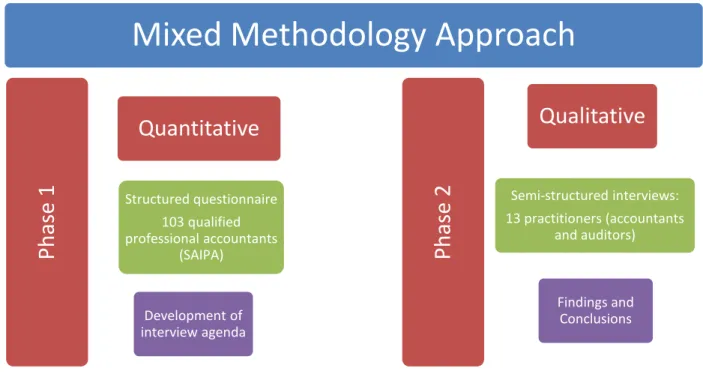
The perceptions of South African practitioners were analysed by reference to two phases- first according to the results of a structured questionnaire that was issued to a sample of SAIPA practitioners, and then according to the results of semi-structured interviews conducted with thirteen South African practitioners.
The primary conclusion drawn is that there appears to be an overall acceptance of the IFRS for SMEs in South Africa although there are also certain challenges of its application and certain aspects that affect the value of using the IFRS for SMEs as an accounting reporting framework. The uniformity that the IFRS for SMEs brings seems to be one of the more significant advantages. Factors, however, such as the age of the population of the practitioners; the use of automated software systems; and the legislative requirements regarding the application of the IFRS for SMEs, affect the relative merit of using the standard.
5
Table of Contents
Chapter 1: Introduction ... 9
1.1 Purpose of the study ... 9
1.2 Context and significance of study ... 10
1.3 Research questions ... 12
1.4 Assumptions, limitations and delimitations ... 13
1.5 Definition of terms ... 13
1.6 Chapter layout ... 14
Chapter 2: Literature Review ... 14
2.1 Theoretical framework ... 15
2.2 Definition of SMEs ... 17
2.2.1 The IASB’s definition of SMEs ... 18
2.2.2 The National Small Business Act ... 19
2.2.3 The Companies Regulations 2011 ... 20
2.2.4 Definition of an SME for the purpose of this study ... 21
2.3 The development of the 2009 standard of the IFRS for SMEs and its adoption in South Africa ... 22
2.4 Need for differential reporting ... 25
2.5 Perceived advantages and disadvantages of the IFRS for SMEs ... 27
2.6 Content of the IFRS for SMEs ... 29
2.7 2015 Amendments to the IFRS for SMEs ... 32
2.7.1 Background (IASB, 2015b) ... 32
2.7.2 2013 Exposure Draft (2013ED) ... 32
2.7.3 Amendments to the IFRS for SMEs as a result of the initial comprehensive review ... 34
Chapter 3 - Methodology ... 37
3.1 Research design ... 37
3.2 Population and sampling ... 39
3.2.1 Structured questionnaire ... 39
3.2.2 Semi-structured interviews ... 40
3.3 Data collection instrument and data collection ... 41
3.3.1 Structured questionnaire ... 41
3.3.2 Semi-structured interviews ... 41
6
3.4.1 Structured questionnaire ... 43
3.4.2 Semi-structured interviews ... 44
3.5 Validity and reliability ... 45
Chapter 4: Findings ... 45
4.1 Question 1 and 2: Practitioners’ involvement with the IFRS for SMEs ... 46
4.1.1. Question 1: The extent of the practitioners’ involvement with the various types of profit companies ... 46
4.1.2. Question 2: The extent to which a framework other than the IFRS for SMEs was applied for profit companies ... 48
4.2 Question 3: Relief from the financial burden of reporting ... 49
4.3 Question 4: Users of the financial statements... 51
4.4 Questions 5 and 6: Advantages and disadvantages of applying the IFRS for SMEs ... 52
4.4.1 Perceived advantages ... 53
4.4.2 Perceived disadvantages of applying the IFRS for SMEs ... 53
4.5 Questions 7, 8 and 9: Contents of the IFRS for SMEs ... 56
4.5.1 Question 7: The extent to which the selected components of the IFRS for SMEs are encountered in practice ... 56
4.5.2 Question 8: Rate of difficulty in applying components of the IFRS for SMEs ... 58
4.5.3 Question 9: Significance of the components of the IFRS for SMEs in a South African context ... 59
4.6 Question 10: Measurement of the concepts contained in the IFRS for SMEs ... 61
4.7 Question 11: Amended version of the IFRS for SMEs ... 62
Chapter 4A ... 64
4A.1 Alternate accounting frameworks ... 64
4A.2 Relief of the burden of financial reporting ... 64
4A.3 Advantages and disadvantages of applying the IFRS for SMEs ... 64
4A.4 Users of the financial statements based on the IFRS for SMEs ... 65
4A.5 Contents of the IFRS for SMEs ... 65
4A.6 Amended version of the IFRS for SMEs ... 65
Chapter 5: Results of the semi-structured interviews ... 66
5.1 Perceptions of the South African SME sector ... 67
5.2 Relief from the financial burden ... 68
7
5.2.2 Factors influencing the value of the IFRS for SMEs ... 68
5.3 Perceived advantages of applying the IFRS for SMEs in South Africa... 72
5.3.1 The IFRS for SMEs helps the transition involved in growing SMEs to full IFRS ... 73
5.3.2 The IFRS for SMEs improves the efficiency and effectiveness of a company’s reporting system . 73 5.3.3 Other advantages ... 74
5.4 Perceived disadvantages of applying the IFRS for SMEs in South Africa ... 75
5.4.1 Onerous nature of the IFRS for SMEs for micro-entities ... 75
5.4.2 Affordability ... 76
5.4.3 Narrative style of the IFRS for SMEs ... 77
5.5 Users of the financial statements prepared for SMEs ... 78
5.6 The contents of the IFRS for SMEs ... 80
5.6.1 Investment property ... 81
5.6.2 Financial instruments ... 82
5.6.3 Other areas of the financial statement identified as significant... 82
5.7 2015 Amendments to the IFRS for SMEs ... 83
5.7.1 PPE’s revaluation model ... 83
5.7.2 Deferred tax ... 84
Chapter 6: Analysis of results ... 85
Chapter 6A: The overall perceptions of the South African practitioner regarding the adoption and application of the IFRS for SMEs ... 85
6A.1 Diverse nature of an SME and a one-size-fits-all standard ... 85
6A.2 The merit of a third-tiered reporting system in South Africa ... 87
6A.2.1 Use of automated drafting software ... 89
6A.3 Contents of the IFRS for SMEs ... 92
6A.4 The perceived usefulness of financial statements prepared according to the IFRS for SMEs ... 98
6B: Do the overall perceptions of the South African practitioner indicate a change in attitude towards the application of the IFRS for SMEs in South Africa? ... 102
6C: Amended version of the IFRS for SMEs ... 103
Chapter 7: Conclusion ... 105
7.1 Summary and concluding remarks... 105
7.2 Contribution ... 107
8 8. References ... 109 Appendix A: Structured questionnaire ... 112 Appendix B: Interview Agenda ... 122
9
Chapter 1: Introduction
1.1 Purpose of the study
The purpose of this research study was to obtain an understanding of the current perceptions of South African practitioners of the International Financial Reporting Standards for Small-Medium sized Entities (IFRS for SMEs) as a follow-up to a prior South African study that was conducted by Van Wyk and Rossouw (2009). In their study, Van Wyk and Rossouw (2009) investigated whether or not South African accounting practitioners believed that the then proposed IFRS for SMEs would ease the burden of financial reporting. The results of the study indicated that the simplifications contained in the IFRS for SMEs, especially those relating to a relaxation of the disclosure requirements, may not be sufficient to meet the financial reporting needs of smaller entities. The study also identified a relatively small pool of users of the financial statements of SMEs, thus suggesting that the financial statements produced for SMEs may be for limited purposes only. The IFRS for SMEs constitute a framework for the preparation of general purpose financial reports in order to meet the needs of a variety of users who are not in a position to demand tailor made reports. It was, therefore, recommended that a formal set of differential reporting standards be developed for smaller entities(Van Wyk and Rossouw, 2009). Initiatives aimed at the development of a simpler framework was promulgated but were subsequently abandoned on the basis that the IFRS for SMEs and the proposed simpler framework were too similar. Consequently, in South Africa, there are two formal, internationally recognised accounting frameworks only, namely, full IFRS and IFRS for SMEs.
As in the case of the study conducted by Van Wyk and Rossouw (2009), the researcher in this study believed that the insights of practitioners would reveal useful and valuable information about the application of IFRS to SMEs in South Africa because they are involved in the reporting of the financial information of entities, including SMEs. It was therefore deemed necessary for the purpose of the study to define what is meant by “practitioner”. In the context of this report, a practitioner is defined as a professional member in practice who has practical experience of the application of the IFRS to SMEs by virtue of their experience with SMEs. These practitioners include auditors, reviewers, preparers and analysts of financial statements prepared according to the IFRS for SMEs, and who may, although they are not required to, belong to a profession. As such practitioners in this context may include professional accountants (SA) or Chartered Accountants (SA).
10 This study was exploratory in nature and adopted an interpretative approach. Interpretive research usually adopts a qualitative approach (Coetsee, 2011). Qualitative research focuses on the discovery of common emergent themes as opposed to the interpretation of data (Donalek and Soldwisch, 2004). This study used a mixed methodology approach which consisted of two distinct phases. Firstly, the opinions of a sample of SAIPA practitioners were obtained through the administration of a survey and then analysed quantitatively and thereafter the qualitative results of in-depth discussions held with a sample of thirteen practitioners were explored. Although more weighting was given to the qualitative phase as compared to the quantitative phase, the results of both phases enabled the researcher to gain a detailed understanding of the current perception of practitioners in South Africa and to gauge whether or not these perceptions differed from those expressed in prior studies. It was the opinion of the researcher that neither phase in isolation could have provided the level of understanding acquired by the researcher. Furthermore, at the time of writing the report, the researcher was not aware of any study that has, since the adoption of the IFRS for SMEs in South Africa, explored the opinions of practitioners in such detail as did this study.
1.2 Context and significance of study
Several commentators have noted that existing research on IFRS for SMEs is scarce (Tudor and Mutiu, 2008; Eierle and Schönefeldt, 2010; Aboagye-Otchere and Agbeibor, 2012; Uyar and Güngörmüş, 2013). Prior research in South Africa into the IFRS for SMEs has focused on their early adoption and relevance in the South Africa context (Stainbank, 2008; Van Wyk and Rossouw, 2009; Schutte and Buys, 2011a; Van Wyk and Rossouw, 2011; Kriel, 2014). South Africa adopted the IFRS for SMEs in 2009. Prior to that date South Africa had been involved in the field testing of the proposed standard by adopting the exposure draft of the IFRS for SMEs (SAICA, 2012). It is generally believed that the time lapse of 10 years after its initial introduction in South Africa allowed practitioners a sufficient length of time to familiarise themselves with the intricacies of the framework, including acquiring an understanding of both its benefits and drawbacks. In the meantime the SME landscape in South Africa has also changed in a number of ways. The global financial crisis of 2008 and 2009, the new administration changes in government (SEDA, 2016) and effective as of May 2011 the inclusion of the IFRS for SMEs in legislation in terms of the Companies Act no 71 of 2008 are among the important factors that have impacted on the SME sector. It was thus within this context that this study explored the perceptions of practitioners in the contemporary, South African, SME market.
11 SMEs may play an important role in the development of a country’s economy, particularly in relation to the creation of employment opportunities (DTI, 2008; Bartůňková, 2012). The global economic crisis in recent years has triggered a knock-on effect in South Africa which in turn has increased the rate of unemployment in the country (DTI, 2013). In a country such as South Africa it becomes important that support be given to the promotion of SMEs to enable them to have a meaningful impact on the South African economy as a whole. Despite the low-growth economic environment prevalent in South Africa, the results of the 2016 National Small Business Survey showed that a large portion of small businesses were planning to expand their operations by seeking a broader customer base and increasing turnover (NSBC, 2016). A further illustration of growth prospects is grounded in results which show that a relatively large portion would consider expanding operations cross-broader(NSBC, 2016). This highlights the importance of SMEs from a global standpoint.
The DTI’s mandate also includes promoting the level of employment in South Africa while, at the same time, fostering the country’s economic growth rate (DTI, 2013). In order to do this the DTI has recognised the need to create an environment which balances good governance and effective regulation with the economic flexibility required to promote the economy (DTI, 2013). The accountability and reporting of an SME are some of the important factors that may contribute to the success of the SME. The provisions of the Companies Act 71 of 2008, which became effective in May 2011, provided for a regulatory framework that, among other things, enhanced governance and provided clarity on the accounting frameworks for businesses. In terms of the Companies Act 71 of 2008, the choice of accounting frameworks is between the full IFRS or the IFRS for SMEs (Act, 2008). As in any accounting framework, the accounting practices contained in the framework for SMEs should provide information that is relevant and complete, thus enabling users to make economic decisions (Maseko and Manyani, 2011). In July 2009 the International Accounting Standards Board (IASB) issued the IFRS for SMEs – a simplified version of the International Financial Reporting Standards (IFRS) and designed to meet the needs of SMEs (IASB, 2015b). Although, as argued by Van Wyk and Rossouw (2009), the adoption of the IFRS for SMEs was a step in the right direction the adoption was also, arguably, premature as evidenced by the fact that the South African Institute of Chartered Accountants (SAICA) subsequently called for further simplification of the IFRS for SMEs and later began a process of developing micro GAAP (Schutte and Buys, 2011b; Ludolph, 2012). In 2012 the IASB embarked on a comprehensive, initial review of the IFRS for SMEs to assess the experiences of entities that had implemented the standards on SME. The updated version of the
12 IFRS for SMEs is currently available. The majority of the changes made were intended to clarify existing requirements thereby reducing the burden of financial reporting by removing doubt. Three changes were significant in relation to policy choices and decreased the burden of resistance of adoption of the IFRS for SME’s. These three policy changes included the addition of the option to use the revaluation model for property, plant and equipment; the alignment of the main recognition and measurement requirements for deferred income tax with IAS 12, and the alignment of the main recognition and measurement requirements for the exploration and evaluation of assets with IFRS 6 (IASB, 2015b). These changes are discussed in greater detail in section 2.7.
The financial reporting framework applicable to SMEs may be said to be a relevant area of accounting research in view of the worldwide debate on the necessity of creating simplified frameworks for such entities – the so-called “differential reporting” regime (Quagli and Paoloni, 2012). Within the South African context initiatives for a framework for smaller, non-public entities, commonly referred to as micro GAAP were considered in 2008 (Ludolph, 2012). More recently the South African Financial Reporting Standards Council (FRSC) has proposed a reduced disclosure framework applicable to subsidiary companies, the parent of which applies full IFRS (FRSC, 2016). This study was significant as it was envisaged that it would contribute to the body of existing literature in a number of ways. Firstly, it encapsulated the practitioners’ views on the IFRS for SMEs thereby contributing to the ongoing discussion on the benefits and challenges of applying the IFRS for SMEs within a South African setting. Secondly, it measured whether or not the initial scepticism expressed by practitioners regarding the IFRS for SMEs had changed since prior studies. Lastly, in view of the recent issue of the amended version of the IFRS for SMEs, this was one of the first studies to consider the impact of these changes on reporting for SMEs. All these aspects are important to the various regulatory bodies, such as SAIPA and SAICA, and which are actively involved in the promotion of differential reporting in South Africa.
1.3 Research questions
As discussed above, this research study aimed to investigate the perceptions of South African practitioners regarding the implementation of the IFRS for SMEs. This research objective was encapsulated in the following research questions:
13 R2: Do the current perceptions of South African practitioners indicate a change in attitude as compared to the scepticism which was initially displayed when the IFRS for SMEs were first implemented in South Africa?
R3: Have the 2015 amendments to the IFRS for SMEs, that were made as part of the IASB’s initial comprehensive review of the IFRS for SMEs, adequately addressed the concerns of practitioners regarding the application of the IFRS for SMEs in South Africa?
1.4 Assumptions, limitations and delimitations
This study was exploratory in nature and adopted an interpretive approach. It was assumed that accounting and financial reporting is a social science. The study was limited to the views on the IFRS for SMEs from the perspective of South African practitioners and not the users of financial statements prepared according to the IFRS for SMEs (Wyk and Rossouw, 2009; Wyk and Rossouw, 2011). It was assumed that the purposeful selection of South African practitioners, who were members of SAIPA and who possessed an adequate level of knowledge on the IFRS for SMEs and were, thus, in the best position to answer the survey questions, would ensure the collection of the data required to address the research questions (Wyk and Rossouw, 2009; Wyk and Rossouw, 2011). Furthermore, it was expected that the respondents would answer questions truthfully and to the best of their ability (Leedy and Ormrod, 2013). The use of a mixed methodology approach (administration of a questionnaire followed by semi-structured interviews) was considered to be an appropriate way in which to obtain the data required to answer the research question. There was, however, no intention to draw conclusions about the entire population based on the statistical measures applied to the answers to the questionnaire.
1.5 Definition of terms
DTI – Department of Trade and Industry
IFRS – International Financial Reporting Standards
IFRS for SMEs – International Financial Reporting Standards for Small-Medium Sized Entities SAICA – South African Institute of Chartered Accountants
14 SME – Small-Medium Sized Entity
1.6 Chapter layout
This research report is presented as follows. Chapter 2 begins with an in-depth analysis of prior literature on relevant aspects of SMEs and the IFRS for SMEs. The results of prior studies conducted both internationally and in South Africa are also analysed as a means of formulating the questions that were included in the structured questionnaire. Chapter 3 describes the research methodology that was applied, including the techniques used to analyse the results of both the surveys and the semi-structured interviews. Chapter 4 presents a discussion of the observations on the results obtained from the first phase of the research. Chapter 4A is a bridging chapter which explains the link between the results of the survey and the questions posed during the interview process. Chapter 5 presents a summary of and extracts from the second phase of the study during which the interviews were conducted. In Chapter 6 the researcher offers an analysis of the two phases of the study. Finally, a summary of the study, concluding remarks and areas for future research are presented in Chapter 7.
Chapter 2: Literature Review
The purpose of this chapter was to provide an overview of the existing literature on SMEs and on the IFRS for SMEs, and also to discuss the theoretical stance adopted by the researcher. The chapter also discussed the process that had led to the amendments that had been made as a result of the IASB’s first review of the IFRS for SMEs as well as the amendment themselves. The chapter was divided into a number of sections. Section 2.1 presented a discussion of the entity theory which provided a theoretical framework to evaluate the evidence obtained in this study. Section 2.2 provided an in-depth consideration of the type of entity that is deemed to meet the definition of the term SME. Sections 2.3 and 2.4 contained a historical discussion of the development of the IFRS for SMEs as a way of explaining the context in which the IFRS for SMEs were developed by discussing the need for differential reporting. Sections 2.5 and 2.6 discussed the results of prior studies on the IFRS for SMEs in relation to the perceived advantages and disadvantages of the standard as well as its content. Lastly, section 2.7 presented a discussion of the development of the most recent accounting standard on IFRS for SMEs.
15
2.1 Theoretical framework
This research study was undertaken with the aim of soliciting the opinions of South African practitioners on the application of an accounting standard (the IFRS for SMEs) intended to apply to the general purpose financial statements of entities that, in many countries, are referred to by a variety of descriptions, including SMEs(IASB, 2015b). The main objective of the IASB in developing accounting standards suitable for SMEs was to produce a single set of high quality, globally enforceable standards intended for non-publicly accountable entities that publish general purpose financial statements for external users (IASB, 2015b). The IFRS for SMEs is based on the full IFRS but with simplifications and modifications that were deemed to be appropriate in light of both the needs of users and the cost-benefit considerations. Thus, the IASB believes that the objectives of financial statements as per the framework of full IFRS are also appropriate for SMEs. According to the standards of the IFRS for SMEs, the objectives of financial statements of small and medium-sized entities may be stated as follows (IASB, 2015c):
To provide information about the financial position, performance and cash flows of the entity that is useful for economic decision making by a broad range of users of the financial statements who are not in the position to demand reports tailored to meet their particular information needs. Financial statements also show the results of the stewardship of management – the accountability of management for the resources entrusted to it (para 2.2 & 2.3).
The IFRS for SMEs was developed with reference to the fundamental concepts contained in the framework pertaining to the full IFRS (IASB, 2015b). According to the IFRS Conceptual Framework for Financial Reporting:
BC 1.8 The vast majority of today’s businesses have legal substance separate from their owners by virtue of their legal form of organisation, numerous investors with limited legal liability and professional managers separate from the owners. Consequently, the Board concluded that financial reports should reflect that separation by accounting for the entity (and its economic resources and claims) rather than its primary users and their interests in the reporting entity (IASB, 2010)
From this perspective, the financial statements of an entity that applies the full IFRS are based on entity theory. Entity theory recognises the personality of the entity as opposed to its proprietors
16 and, thus, it recognises that transactions, events and conditions that occur are separate from the owners and, therefore, should be accounted for separately. Shareholders are, in effect, considered to be no different to other third party creditors except with regards to the hierarchy of their claims (Suojanen, 1954). The IFRS for SMEs may be analogised to the full IFRS, thus making the entity theory applicable to those entities that prepare financial statements in accordance with the IFRS for SMEs. Both the IFRS and the IFRS for SMEs are used in the preparation of general purpose financial statements which are, in turn, financial statements intended to service the information needs of a broad range of users who are not in the position to demand tailor made reports. Owner-managers are not acknowledged by the IASB as users of the IFRS for SMEs. Theoretically, owner-managers may use the financial statements of SMEs for several purposes. The purpose of the IFRS for SMEs was not, however, to provide information to owner-managers to assist them in the making of management decisions despite the fact that general purpose financial statements do provide management with an insight into the business’s financial position, performance and cash flows (IASB, 2015b).
The IFRS for SMEs is applicable to a wide variety of entities despite the type of entity envisaged by the term SME and which may include forms of ownership that do not entail a distinction between management and proprietors. In this regard, however, two different considerations are important. Firstly, the majority of the total, active businesses of known size in South Africa are private companies or close corporations, both of which have legal personality (DTI, 2008). Secondly, this study considered focused on entities as defined in the Companies Act no 71 of 2008. In terms of the Companies Act, only those entities with a PI score of less than 100 points and that produce financial statements internally may opt not to adopt the IFRS for SMEs.
Management stewardship features as part of the objectives of financial reporting. According to Rosita (1975) the stewardship concept impacts on accounting theory. The concept of stewardship is affected by the prevalent social philosophy which in turn is determined by the business ideology in vogue. There are two business ideologies, namely, the classical and the managerial and these, in turn, result in two stewardship concepts, namely, the classical and the managerial. In terms of the classical stewardship concept, it is management’s sole responsibility to service the interest of the owners. Proprietary theorists, thus, see the business from the perspective of the owner. The classical stewardship concept was typically characterised by small firms held by owners. The
17 managerial stewardship concept, in contrast, holds management accountable for social interests, including those of the owners. Thus, this view is that of an entity theorist who considers the perspective of the business. The growth of firms from small owner-held firms has led to the prevalence of the managerial stewardship concept (Chen, 1975).
It would appear that the IFRS for SMEs was written in the spirit of entity theory. The proprietary theory, which supports the classical management stewardship concept, may be appropriate for owner-managed firms. While the structure of many SMEs may be owner-manager type ventures, there is always the potential for the entity to expand and adopt a different ownership structure. In addition, the results of management stewardship as being the objective of financial reporting appear to be somewhat secondary to the main objective of the IFRS for SMEs which is to provide useful information to a wide range of users, excluding the owner-manager. This study was exploratory in nature and viewed accounting as a social science moulded by both society and the structure of organisations. The study used the entity theory as a theoretical lens with which to evaluate the opinions of practitioners on a single set of accounting standards that was specifically tailored to meet the needs of a specific type of entity.
2.2 Definition of SMEs
The meaning encapsulated in the term “SME” was of the utmost importance to the aims of this research study. An SME may be described in a number of ways according to a number of different thresholds. It appears to be used as a general term that may encompass a wide range of ownership structures which range from very small to relatively larger entities. This seems to be the case both in the global context and in a local South African setting. The literature on SMEs does not provide a definitive definition of an SME (Maseko and Manyani, 2011) and there is no one definition that captures the concept’s parameters in terms of size, locality, industry and stage of development (Tudor and Mutiu, 2008; Maseko and Manyani, 2011). It is this variety that exists in terms of the definition that is one of the factors that make the adoption of a global reporting framework such as IFRS for SMEs difficult (Schutte and Buys, 2011c)
The IASB acknowledges that several jurisdictions have developed their own definition of the term SME for a wide variety of purposes. National and regional definitions include quantitative criteria
18 based on the entity’s revenue, assets, employees and other factors. The term is often used to describe entities, including very small entities, without regard to whether or not they publish general purpose financial statements for external users (IASB, 2015b). In South Africa, legislation such as the National Small Business Act and the Companies Act, has defined SMEs in different ways. The IASB has also developed its own definition for the purposes of correctly selecting those entities which may apply the IFRS for SMEs. The definitions are explained in greater detail below.
2.2.1 The IASB’s definition of SMEs
In developing the standards of the IFRS for SMEs, one of the primary issues that confronted the IASB was the class of entities for which the IFRS for SMEs would be intended. However, ultimately, the decision regarding which entities would use the IFRS for SMEs would rest with the national regulatory authorities and standard-setters. A clear definition of SMEs was, however, developed by the IASB for the purposes of the application of the IFRS for SMEs (IASB, 2015b). In section 1 the IFRS for SMEs describes the characteristics of small and medium-sized entities as follows:
1.2 Small and medium-sized entities are entities that
(a) Do not have public accountability and;
(b) That publish general purpose financial statements for external users (IASB, 2015b).
1.3 An entity has public accountability if:
(a) its debt or equity instruments are traded in a public market or if it is in the process of issuing such instruments for trading on a public market (a domestic or foreign stock exchange or an over the counter market, including local and regional markets.) or
(b) It holds assets in a fiduciary capacity for a broad group of outsiders as one of its primary businesses. This is typically the case for banks, credits unions, insurance companies, securities brokers/dealers, mutual funds and investment banks.
This definition envisaged by the IASB was not restricted to one form of legal ownership (Wyk and Rossouw, 2009) and neither was the element of size quantified to define an SME (Aboagye-Otchere and Agbeibor, 2012). In this regard, the IASB noted that its standards are used in several countries,
19 thus making any form of quantification difficult. Jurisdictions may, however, choose to prescribe either quantified size criteria or what is meant by economically significant for the purposes of prescribing the IFRS for SMEs for use by entities (IASB, 2015b). Consequently, the definition of an SME is not restricted to private companies but may also include other legal forms or micro-entities such as sole traders, partnerships, trusts and non-profit organisations (Van Wyk and Rossouw, 2009).
2.2.2 The National Small Business Act
The National Small Business Act, 1996, classifies small businesses as micro, very small, small or medium-sized (SMMEs) according to a complex set of thresholds per industry (South Africa, 1996). According to the National Small Business Act, 1996, the Department of Trade and Industry (DTI) defines a small business as:
… a separate and distinct business entity, including cooperative enterprises and non-governmental organisations, managed by one owner or more which, including its branches or subsidiaries, if any, is predominantly carried on in any sector or subsector of the economy mentioned in column I of the Schedule and which can be classified as a micro-, a very small, a small or a medium enterprise by satisfying the criteria mentioned in columns 3, 4 and 5 of the Schedule opposite the smallest relevant size or class as mentioned in column 2 of the Schedule.
The National Small Business Act, thus, recognises the range of the possible sizes of an SME. It is not, however, within the scope of this research study to explore the complex set of thresholds by which the Act classifies an entity as an SME. Consequently, no further consideration is given to this aspect of the definition as cited above. What is, nevertheless, important is that these SMMEs include formally registered enterprises such as close corporations, private companies and co-operative entities, as well as informal enterprises such as street trading enterprises and backyard manufacturing and services. Entities falling towards the upper end of the range are comparable to the SMEs in developed countries (DTI, 2008a). As such, for the purposes of this research study, the definition of an SME included only those formally registered enterprises.
20 2.2.3 The Companies Regulations 2011
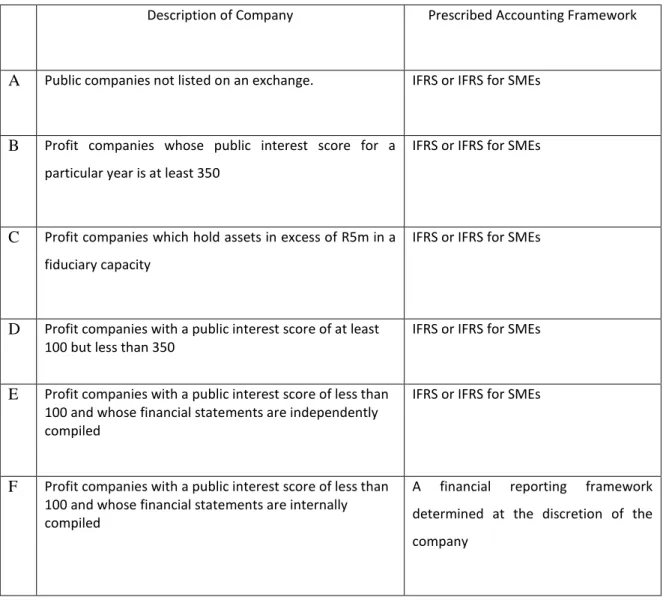
The Companies Regulations 2011, issued in terms of section 223 of the Companies Act 2008 (Act no 71 of 2008) by the DTI, prescribes the reporting framework to be used by different entities with reference to a public interest (PI) score (DTI, 2011). Table 1 below outlines the financial reporting standards to be used by the various categories of companies (DTI, 2011).
Table 1: Table showing the frameworks prescribed by section 27 of the Companies Regulation, 2011
Description of Company Prescribed Accounting Framework
A Public companies not listed on an exchange. IFRS or IFRS for SMEs
B Profit companies whose public interest score for a particular year is at least 350
IFRS or IFRS for SMEs
C Profit companies which hold assets in excess of R5m in a fiduciary capacity
IFRS or IFRS for SMEs
D Profit companies with a public interest score of at least 100 but less than 350
IFRS or IFRS for SMEs
E Profit companies with a public interest score of less than 100 and whose financial statements are independently compiled
IFRS or IFRS for SMEs
F Profit companies with a public interest score of less than 100 and whose financial statements are internally compiled
A financial reporting framework determined at the discretion of the company
The Companies Regulation defines a “medium” sized firm as a public company whose most recent PI score is less than 500 or any other company whose most recent PI score is less than 500 or more than 100. Small companies are defined as those companies with a PI score of less than 100.
21 According to Regulation 26 (2) of the Companies Regulations 2011, the calculation of the PI score of a company is calculated for each year by attributing a number of points to various aspects apparent in that company for a given financial year. These include the number of employees of the company; the level of third party liability; the level of turnover and the number of individuals who have a beneficial interest in the securities of a company. More specifically, an entity’s PI score is calculated according to Table 2 below (DTI, 2011)
Table 2: Calculation of the Public Interest Score in terms of Regulation 26 of the Companies Regulation, 2011
a A number of points equal to the average number of employees of the company during the financial year
b One point for every R 1 million (or portion thereof) in third party liability of the company at the financial year end
c One point for every R 1 million (or portion thereof) of turnover during the financial year d One point for every individual who, at the end of the financial year, is known by the company
i. in the case of a profit company, to directly or indirectly have a beneficial interest in any of the company’s issued securities; or
ii. in the case of a non-profit company, to be a member of the company, or a member of an association that is a member of the company.
2.2.4 Definition of an SME for the purpose of this study
In short, it was important to understand how the term SME was used in this study. The study is uniquely South African and specifically recognised the growing importance of SMEs in South Africa. The study paired the requirements set by the IASB with those enacted in legislation. The definition given by the IASB was deemed to be relevant as it serves as a pivotal point of reference in determining whether an entity should use the IFRS for SMEs. The definition excludes any reference to size of entity or form of ownership although elements related to the size of an entity are taken into account in the calculation of the PI score which, in turn, is used as a determining factor in the applicability of the IFRS to SMEs. Consequently, for the purposes of this report, the definition of an SME incorporated those entities as envisaged by the IASB. In addition, the study also included those formally registered entities that are either required to or have the option to adopt the IFRS for SMEs in terms of South African law. This includes entities with a PI score of less than 100. Despite the fact that no specific accounting framework is prescribed in the Companies Act 71 of 2008 for entities with a PI score of less than 100, the IFRS for SMEs remains a reporting framework option.
22
2.3 The development of the 2009 standard of the IFRS for SMEs and its
adoption in South Africa
The development of the IFRS for SMEs was a five year long process. In 2001, the IASB embarked on a project to develop a set of accounting standards that would be suitable for small and medium-sized entities. A discussion paper, Preliminary Views on Accounting Standards for Small and Medium-sized Entities, was published by the IASB in 2004. The response to this discussion paper indicated a clear demand for accounting standards suited to SMEs while there was clearly a preference in many countries to adopt these standards in place of the relevant national standards that may have existed. Accordingly, the IASB decided to develop an exposure draft of an IFRS for SMEs. An exposure draft of a proposed IFRS for SMEs was published in February 2007 (IASB, 2015b). A field test programme involving 20 countries, one of which was South Africa, was conducted (SAICA, 2012; IASB, 2015b). Despite the resistance from several countries to accept the exposure draft on an IFRS for SMEs as its own, South Africa became the first country in the world to adopt this exposure draft as a Statement of GAAP for SMEs. This was done in order to provide relief for the limited-interest companies defined in the Corporate Laws Amendment Act of 2007 and in existence at the time. The adoption of the exposure draft was regarded as an interim measure until the IASB issued the 2009 edition of the standard. This provided the platform necessary to shape the way in which SMEs report on financial information (Mackenzie, 2009). However, as cited by Schutte and Buys (2011b), two months after the adoption of the IFRS for SMEs, the SAICA reported to the IASB that further simplification of the standard was needed and also that the requirements contained in the IFRS for SMEs were still too complicated, given the level of knowledge of both those drafting financial statements and the needs of users.
The IASB does not have the power to force entities to apply its standards. Instead, this power is vested in a country’s legislators and regulators (IASB, 2015b). The implementation of the Companies Act 71 of 2008, effective 01 May 2011, brought the IFRS for SMEs within South Africa’s legal ambit. South Africa is a country in which entrepreneurship is much encouraged and, thus, a burdensome regulatory reporting framework, such as a full IFRS, may be a potential hindrance to growth (SAICA, 2014). The implementation of the Companies Act of 2008 brought with it the vision of promoting entrepreneurship, reducing the regulatory burden of smaller companies and enhancing the transparency and accountability of larger corporations, particularly in view the fact that company law had become more aligned with contemporary trends and international best practice than had
23 previously been the case (DTI, 2010). In terms of the Companies Act 2008, South African GAAP may no longer be used to prepare financial statements. Table 1 in section 2.2.3 provides a description of companies that either have the option or are required to apply the IFRS for SMEs(DTI, 2011).
Van Wyk and Rossouw (2009) conducted empirical research using accounting practitioners as a representative sample. The majority of the respondents were affiliated with the SAIPA. Members of SAIPA traditionally have as their clients smaller, non-listed entities. Regarding whether or not they felt that the IFRS for SMEs would reduce the burden of financial reporting 45% of respondents only felt that this would, indeed, be the case. However, the majority of the respondents were sceptical and of the opinion that the IFRS for SMEs would not address the burden of a full IFRS or of the opinion that the IFRS for SMEs would relieve the burden to some degree only (Wyk and Rossouw, 2009).
A later study, also conducted by Van Wyk and Rossouw (2011), investigated in part whether practitioners believed that a three-tiered reporting framework was needed and whether there was a need for a third reporting framework to which entities this framework would apply. The majority of the respondents were in favour of a less complicated framework than the IFRS for SMEs with the majority also believing that the IFRS for SMEs was best suited to non-owner managed, private companies and that micro GAAP would be more suitable for owner-managed, private companies (Wyk and Rossouw, 2011). At the time of the study conducted by Van Wyk and Rossouw, the DTI published a comprehensive report on the SMME sector in South Africa (DTI, 2008a). The report indicated that, according to annual turnover, 3% only of economically active enterprises of known size were larger enterprises. The remaining 97% consisted of medium (4%); small (11%); very small (46%) and micro sized (36%) entities (DTI, 2008a). Furthermore, private companies and CCs comprised 98% of the total of active businesses of known size in South Africa (DTI, 2008a). Table 3 below presents the business register figures for the 2007 year according to the DTI’s report.
Table 3: Business Register count of SMMEs in 2007 Enterprise Category Business Register Count Percentage
24 Very small 251 920 47.0 Small 63 193 11.8 Medium 20 750 3.9 Total SMMEs 536 240 100.0 Large 17 251 --
The number of SMMEs in South Africa has since increased although only marginally (3%) with the greater proportion of this growth being attributable to the informal sector (SEDA, 2016).
Most of the respondents in Van Wyk and Rossouw’s (2011) study also indicated that micro GAAP should be required by South African law. As discussed above, the implementation of the Companies Act no 71 of 2008 in South Africa introduced differential reporting with reference to an entity’s PI score. At the time of this study only entities which compiled their financial statements internally and with a PI score of less than 100 were permitted to apply an accounting framework of their own choice (DTI, 2011). A relevant consideration in this research study included the reporting framework of an entity with a PI score of less than 100.
Based on the above, the following statements were included in the data collection instrument:
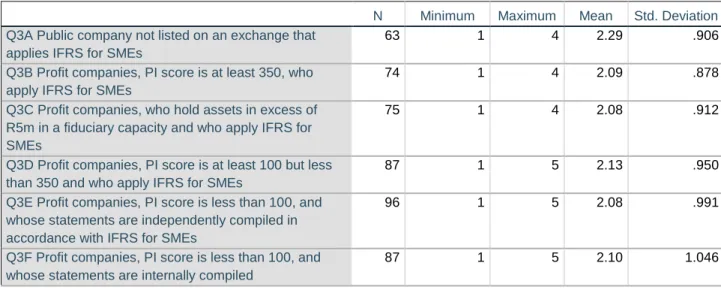
R1: Please indicate to what extent you are involved with the following types of entities that have the option to use IFRS for SMEs as per the Companies Act no 71 of 2008: (1 = Involved to a very large extent; 5 = N/A (Not involved at all)
A. Public company not listed on an exchange that applies IFRS for SMEs B. Profit companies, PI score is at least 350who apply IFRS for SMEs
C. Profit companies, who hold assets in excess of R5m in a fiduciary capacity and who apply IFRS for SMEs
25
E. Profit companies, PI score is less than 100, and whose statements are independently compiled in accordance with IFRS for SMEs
F. Profit companies, PI score is less than 100, and whose statements are internally compiled.
R2: To what degree does each category of companies listed in question 1 (R1) apply a framework other than IFRS for SMEs? (1 = large degree; 5 = Not at all)
R3: To what extent do you agree that the adoption of IFRS for SMEs has relieved the burden of financial reporting for the companies listed in question 1 (R1) that have the option to apply IFRS for SMEs? (1 = Strongly agree; 5 = Strongly disagree)
2.4 Need for differential reporting
Differential reporting pertains to the situation in which different accounting frameworks are more suited to different entities and are applied as such (ASB, 2011). The choice of accounting frameworks before the formal adoption of the IFRS for SMEs in South Africa was South African Generally Accepted Accounting Statement (SA GAAP) which had been aligned with the full IFRS since 2005 (Stainbank, 2008). The requirement to apply full IFRS was a requirement irrespective of a company’s type ,size, and the users of its financial statements – all of which may have differed from those of other companies (Stainbank, 2008). The full IFRS has been recognised as one of the most important systems of financial reporting (Bartůňková, 2012) and was developed to meet the reporting requirements of large and listed entities (Di Pietra et al., 2008). Most stock exchanges require listed companies to adopt full IFRS to facilitate cross-border investments and access to global capital markets (Schutte and Buys, 2011b; IASB, 2015b). However, the needs of SMEs may be different from those of larger, publicly accountable entities in terms of the users of the entity’s financial statements and their information needs; the manner in which the financial statements are utilised by the users; the extent to which accounting expertise is available to the entity and the ability of the SME in question to bear the costs involved in adopting the standards of larger entities (Hussain et al., 2012; IASB, 2015b). This, thus, suggests that the full IFRS may not serve the purpose of SMEs, therefore making a simpler framework such as the IFRS for SMEs a more attractive reporting option for smaller entities.
The introduction of the IFRS for SMEs in South Africa also meant the inception of differential reporting, thus enabling some entities to apply a less onerous accounting framework than before (ASB, 2011). The need for differential reporting is determined on both the basis of the needs of
26 users and an analysis of its costs versus its benefits (IASB, 2015b). The IASB’s objectives in developing the IFRS for SMEs included the provision of high quality, understandable , globally accepted and enforceable standards that enabled the participants in various capital markets of the world and other users of information to make economic decisions (IASB, 2015b). The users of the financial statements prepared in respect of SMEs may have less interest in some of the information contained in general purpose financial statements prepared under full IFRS. For example, the users of the financial information of SMEs may show a greater interest in short-term cash flows, liquidity of the entity and less interest in information that that is intended to assist in the formulating of predictions of long-term cash flows, profit and value (IASB, 2015b).
The benefits of a country adopting a globalised set of accounting standards have been cited in several studies (Neag et al., 2009; BUNEA and SACARIN, 2012; Hussain et al., 2012). The consistent application of global financial reporting standards may enhance the quality and comparability of financial information while the presentation of high quality, comparable information improves the efficiency of the allocation and pricing of capital. In addition, global standards improve the consistency of audit quality and facilitate education and training. The benefits of global financial reporting standards are not, however, limited to those entities that trade their securities in public capital markets and SMEs and those that use the financial information of SMEs may benefit from a common set of accounting standards (IASB, 2015b).
In the main the users of financial statements of SMEs are not regarded as experts (Van Wyk and Rossouw, 2009). In developing the IFRS for SMEs, the IASB had in mind a certain category of users who would, hopefully, benefit from financial statements prepared according to the IFRS for SMEs. These users included banks that make loans to SMEs; vendors that sell to SMEs and use SME financial statements to make credit and pricing decisions; credit rating agencies, customers of SMEs that use SME financial statements to decide whether or not to do business with the SME and shareholders of SMEs who are not also managers of their SMEs. Taxation authorities and owner-managers were not included as users (IASB, 2015b). Hattingh (2001) argued that, in respect of the majority of non-listed companies, the users comprise the following three groups, namely, bankers, owners and tax authorities. The results of the study carried out by Van Wyk and Rossouw(2009) also showed that the most prominent users of such financials statements were the banks, SARS and owner-managers. However, these groups are all able to obtain further information if required and,
27 thus, there is no need for complex reporting (Hattingh, 2001). Owner-managers, for example, may have access to the management accounts and usually have a sound understanding of the trading operations of the business. Consequently, they do not need the information presented in the form of financial statements, suggesting impartiality towards the accounting framework used. In practice entities are required to complete a tax return in the form of the ITR14 form which contains various fields to facilitate the collection of financial information. The Tax Administration Act does not state that financial statements are required to accompany the tax return (SARS, 2011).
In light of the above the following questions were included in the data collection instrument:
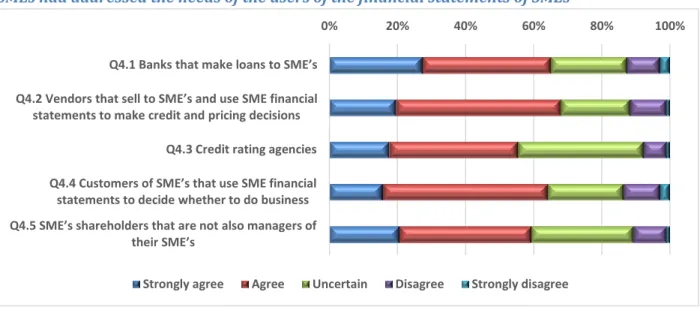
R4: To what extent has the application of IFRS for SMEs addressed the needs of the following users? (1 = Strongly agree; 5 = Strongly disagree)
R4.1 Banks that make loans to SMEs
R4.2 Vendors that sell to SMEs and use SME financial statements to make credit and pricing decisions R4.3 Credit rating agencies
R4.4 Customers of SMEs that use SME financial statements to decide whether to do business R4.5 SMEs shareholders that are not also managers of their SMEs
2.5 Perceived advantages and disadvantages of the IFRS for SMEs
Prior studies have identified both the advantages and the disadvantages associated with the implementation of the IFRS for SMEs as perceived by those who prepare the accounting information (Arsoy and Sipahi, 2007; Bartůňková, 2012; Uyar and Güngörmüş, 2013; Kiliçaa et al., 2014). Arsoy and Sipahi (2007), for example, provided an analysis of the strengths, weaknesses, opportunities and threats (SWOT analysis) involved in the adoption of the IFRS for SMEs while Uyar and Güngörmüş (2013) explored the perceptions of accounting practitioners within a Turkish context. The main perceived obstacles arising from the adoption of the IFRS for SMEs were found to be the inadequate training of personnel and the lack of training provided by professional bodies(Uyar and Güngörmüş, 2013). Hussain et al. (2012) argued that the major challenge encountered in the successful adoption of the IFRS for SMEs is the adequate provision of the training necessary to equip practitioners with the ability to prepare financial statements while an even bigger challenge faced practitioners who
28 have not prepared reports in accordance with the IFRS. These sentiments were echoed by Bartůňková (2012) who found that main factor that reduced the willingness to prepare financial statements was a lack of knowledge of the accounting standard.
The perceived advantages of the adoption of the IFRS for SMEs included the ease in soliciting financing sources, the comparability of the financial statements of SMEs, the increased reliability of the SME financial statements, enhanced efficiency in auditing, ease of rating SMEs by credit rating agencies, ease in transition to full IFRS, and increase in efficiency of cross-border activities(Uyar and Güngörmüş, 2013). Kiliçaa et al. (2014) based the questionnaire they used in their study on prior literature in order to ascertain the perceptions of accounting practitioners. A list of the advantages and disadvantages arising from the use of the IFRS for SMEs was compiled and included in the questionnaire as follows:
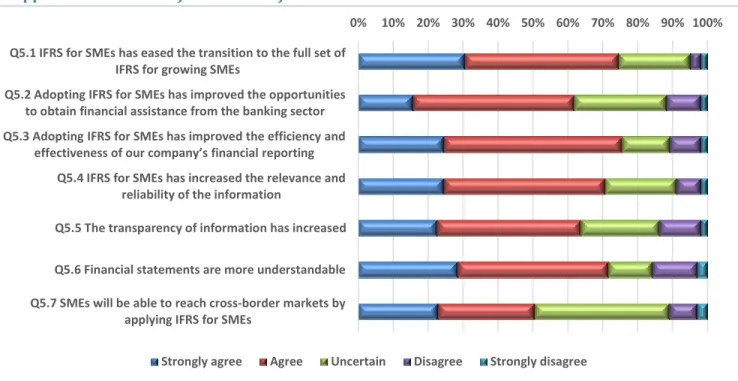
R5: To what extent, do you agree that the following are advantages of applying IFRS for SMEs in South Africa? (1 = Strongly agree; 5 = Strongly disagree)
R5.1 IFRS for SMEs has eased the transition to the full set of IFRS for growing SMEs
R5.2 Adopting IFRS for SMEs has improved the opportunities to obtain financial assistance from the banking sector
R5.3 Adopting IFRS for SMEs has improved the efficiency and effectiveness of our company’s financial reporting
R5.4 IFRS for SMEs has increased the relevance and reliability of the information R5.5 The transparency of information has increased
R5.6 Financial statements are more understandable
R5.7 SMEs will be able to reach cross-border markets by applying IFRS for SMEs
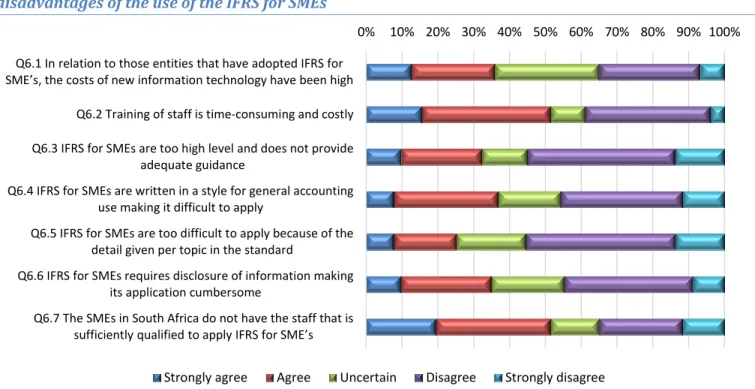
R6: To what extent do you feel the following are disadvantages of implementing IFRS for SME’s? (1 = Strongly agree; 5 = Strongly disagree)
R6.1 In relation to those entities that have adopted IFRS for SMEs, the costs of new information technology have been high
R6.2 Training of staff is time-consuming and costly
29
R6.4 IFRS for SMEs are written in a style for general accounting use making it difficult to apply R6.5 IFRS for SMEs are too difficult to apply because of the detail given per topic in the standard R6.6 IFRS for SMEs requires disclosure of information making its application cumbersome
R6.7 The SMEs in South Africa do not have the staff that is sufficiently qualified to apply IFRS for SMEs
2.6 Content of the IFRS for SMEs
The standards of the IFRS for SMEs were developed by extracting the fundamental concepts contained in the framework and by taking into account the modifications that were deemed to be appropriate in light of the users’ needs and cost-benefit considerations. The intended simplification process included, in part, the omission of certain topics found to be irrelevant to SMEs (IASB, 2015b). Schutte and Buys (2011b) classified the sections of the IFRS for SMEs according to various levels of importance within the South African context. The table below highlights the results of this study by Schutte and Buys (2011b):
Highly Important Moderately Important Low Importance Financial assets and liabilities
Property, plant and equipment Income taxes Revenue Equity Inventories Leases Employee benefits Investment property
Accountings policies, estimates and errors
Provisions and contingencies Agriculture
Borrowing costs
Intangible assets other than goodwill
Impairment of non-financial assets
Events after the end of the reporting period
Government grants
Hyperinflationary economics Foreign currency translation Share-based payments Extracting activities Service concessions
The measurement and recognition principles contained in the full IFRS were also simplified by the inclusion of the simpler option only in cases where the full IFRS provided more than one option (IASB, 2015b). Uyar and Güngörmü (2013) found that practitioners were moderately informed in respect of certain measurement or valuation concepts (Uyar and Güngörmüş, 2013). A survey conducted by SAICA in order to gain an understanding of the experiences encountered when applying the IFRS for SMEs indicated that the more difficult concepts contained in the IFRS for SMEs included the investment
30 property’s fair value model; the residual values of PPE and reassessing the useful life of PPE; the components approach in the PPE section; the identification of intangible assets in a business combination and the accounting for deferred payment in the revenue section (Kriel, 2014). However, the SAICA survey included a limited number of concepts only when soliciting views on the level of either ease or difficulty involved in applying the IFRS for SMEs framework. The level of difficulty or ease when applying other concepts contained in topics that were either regarded as highly important or moderately important is, thus, significant. The degree to which these concepts are applied in practice would assist in gaining an understanding of the perceptions surrounding the application of the IFRS for SMEs. As suggested by Hussain et al. (2012) this consideration is important as, while the IFRS for SMEs relieved the burden of financial reporting, there was already relief in a region such as Fiji as the simplification of disclosures and certain issues had had no impact on SMEs in that area.
Based on the above results, the following statements were included in the questionnaire as the data collection instrument (Appendix A):
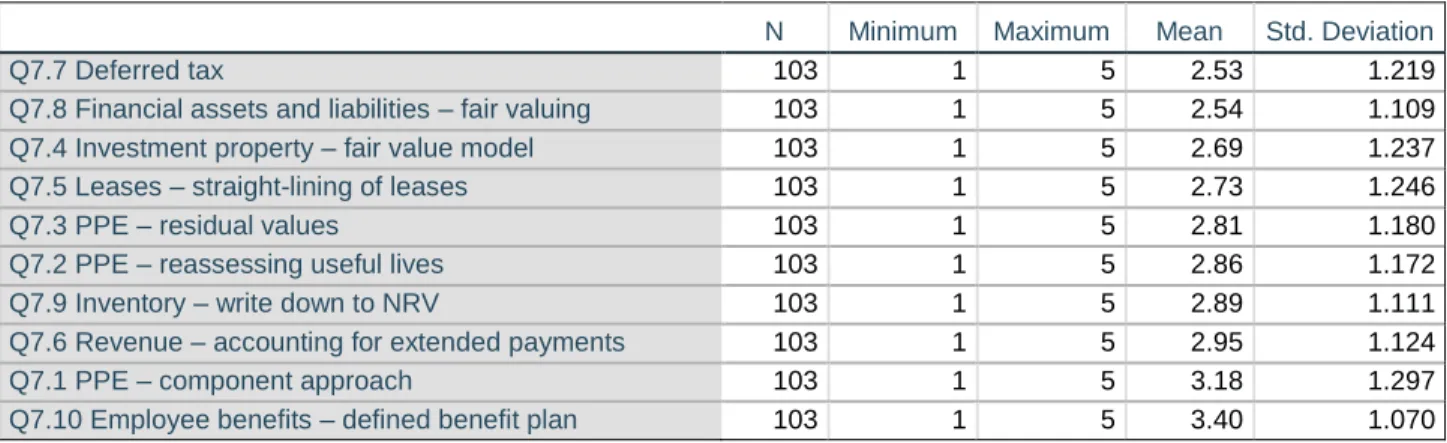
R7: To what extent are the following components encountered in practice? (1 = Very often; 5=N/A)
R7.1 PPE component approach R7.2 PPE reassessing useful lives R7.3 PPE residual values
R7.4 Investment property- fair value model R7.5 Leases-straight-lining of leases
R7.6 Revenue accounting for extended payments R7.7 Deferred tax
R7.8 Financial assets and liabilities fair valuing R7.9 Inventory write down to NRV
R7.10 Employee benefits-defined benefit plan
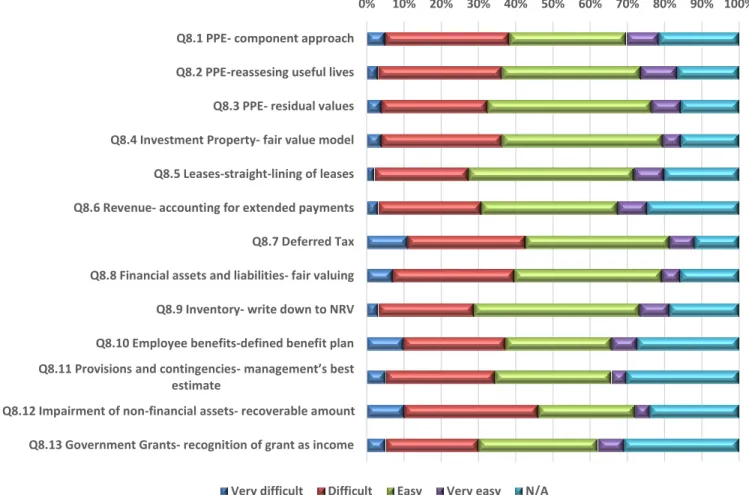
R8: To what degree is it easy or difficult to apply the following components of IFRS for SMEs? (1 = Very difficult; 5 = N/A)
31
R8.2 PPE reassessing useful lives R8.3 PPE residual values
R8.4 Investment property fair value model R8.5 Leases-straight-lining of leases
R8.6 Revenue accounting for extended payments R8.7 Deferred tax
R8.8 Financial assets and liabilities fair valuing R8.9 Inventory write down to NRV
R8.10 Employee benefits-defined benefit plan R8.11 Employee benefits-defined benefit plan
R8.12 Provisions and contingencies – management’s best estimate R8.13 Impairment of non-financial assets – recoverable amount
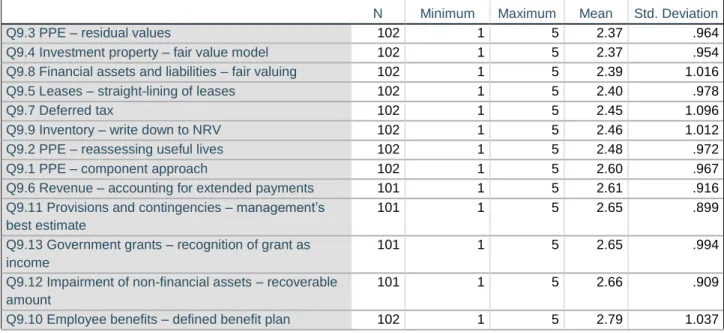
R9: To what degree are the following components of IFRS for SMEs significant in a South African context? (1= Very significant; 5 = Very insignificant)
R9.1 PPE component approach R9.2 PPE reassessing useful lives R9.3 PPE residual values
R9.4 Investment property fair value model R9.5 Leases-straight-lining of leases
R9.6 Revenue accounting for extended payments R9.7 Deferred tax
R9.8 Financial assets and liabilities fair valuing R9.9 Inventory write down to NRV
R9.10 Employee benefits-defined benefit plan R9.11 Employee benefits-defined benefit plan
R9.12 Provisions and contingencies – management’s best estimate R9.13 Impairment of non-financial assets – recoverable amount
32
2.7 2015 Amendments to the IFRS for SMEs
2.7.1 Background (IASB, 2015b)
The IASB commenced its initial review of the IFRS for SMEs in 2012 with the aim of assessing the experience of entities which had adopted the IFRS for SMEs and also of determining whether there was a need for any amendments. The first step in the initial review involved the issuing of a Request for information (RFI), the objective of which was to obtain an understanding of the views of those who had been applying the IFRS for SMEs in order to determine whether there was a need to make any amendments to the standard, and, if so, the type of amendments to be made. An advisory body to the IASB, the SME Implementation Group (SMEIG), the mandate of which was to support the international adoption of the IFRS for SMEs and to monitor its implementation, was established in 2010. Comment letters were received on the RFI and details contained in these letters presented to the SMEIG members. 2.7.2 2013 Exposure Draft (2013ED)
Based on the commentary received, the IASB issued an Exposure Draft (2013ED) of the proposed amendments to the IFRS for SMEs in October 2013. Fifty seven amendments were proposed in the 2013 ED. Section 29 Income Tax was altered significantly by aligning its principles with those of the full IFRS in IAS 12. Besides these fifty-seven amendments the other amendments affected a few sentences or words only in the IFRS for SMEs. The majority of these amendments were intended to clarify existing requirements or to provide additional guidance. The amendments were, thus, expected to enhance the understanding of existing requirements, thereby reducing the burden of doubt (IASB, 2015b).
Most of the changes proposed in the 2013ED were supported by the respondents to the ED, although a number of other issues were raised. The most common criticism voiced was the IASB’s decision not to introduce an option to revalue items of property, plant and equipment (PPE). Subsequently, the option to revalue items of PPE was included in the 2015 amendments of the IFRS for SMEs. This was the result of the IASB acknowledging that the exclusion of the revaluation option had appeared to be a significant impediment to the adoption of the IFRS for SMEs in some jurisdictions. This was primarily based on the response that not including the revaluation model may affect an entity’s prevailing borrowing arrangement and also impact on the entity’s ability to raise finance in the future (IASB, 2015b). The ability of SMEs to raise finance is of particular concern in a country such as South Africa where it is becoming difficult to raise finance (NSBC, 2016; Panday, 2017). The results of the study conducted by Van Wyk and Rossouw (2009), revealed that PPE was one of the topics considered “fundamental” to
33 SMEs in South Africa. Likewise Schutte and Buys (2011b) also found PPE to be an important section. Consequently, the option to revalue PPE is discussed in further detail in Section 2.7.3.
Income taxes were also found to be a relevant topic in the context of South African(Van Wyk and Rossouw, 2009; Schutte and Buys, 2011b). The majority of respondents to the 2013ED supported the alignment of Section 29 with IAS 12 although further simplifications or modifications were requested (IASB, 2015b). This particular change is discussed in further detail in Section 2.7.3.
The full IFRS is designed to meet the needs of public capital markets by providing information for the investors and creditors in such markets. As such the full IFRS is appropriate for publicly accountable entities. A common concern raised by the respondents to the 2013ED was the scope of the IFRS for SMEs. More specifically, the general consensus was that the scope should not be restricted to non-publicly accountable entities. As a result, the IASB considered whether the scope was too restrictive and whether jurisdictions should have the ability to allow publicly accountable entities to use the IFRS for SMEs. In this regard, the IASB noted that the IFRS for SMEs were specifically designed for SMEs and, as such, would not be appropriate for a wider group of entities. In addition, a widening of the scope to include some publicly accountable SMEs may have created pressure to change the requirements of the standard to accommodate a wider group of entities, thereby increasing the complexity of the standards for SMEs. Consequently, the IASB decided not to widen the scope of the IFRS for SMEs (IASB, 2015b).
In terms of the Companies Regulation 2011, public companies that are not listed may choose to adopt the full IFRS or IFRS for SMEs as their reporting structure. The choice of the IFRS for SMEs is subject to the entity meeting the scoping requirements developed by the IASB (DTI, 2011).
Another common concern raised in relation to the scope of the IFRS for SMEs was the disparity that existed between the scope of the IFRS for SMEs and the primary aim of the IASB in developing the IFRS for SMEs. The primary aim of the IASB in developing the IFRS for SMEs was the provision of a stand-alone, simplified, reporting framework for non-publicly accountable entities that, as compared to other entities, are characterised by less complex transactions and possess limited resources to apply the full IFRS. On the one hand, the respondents also expressed concern over whether this would mean that the reporting requirements of larger, more complex, non-publicly accountable entities would be met. The