The Financing of Higher Education –
A Broader View
P Nair* and Deepak Kumar**
Introduction
New developments in science and technology, competition, media revolution and internationalization are revolutionizing the education sector and the world is experiencing an unprecedented change, creating the urgency of re-appraisal of the traditional roles and functions of the Indian education system and looking after the present administrative structure/finances of university management. This has been happening because we are witnessing a paradigm shift in higher education, from ‘national’ to ‘global education, from
This article talks about the development of higher education in India and addresses possible means of financing it. The current educational system in the country is discussed and the concentration by the State on higher and technical education is looked at. The article further says that the financing of Higher Education in the country by the State, is a drain on its exchequer and that more methods have to be found out to move the financial obligations outside the State coffers. The experience of other countries is looked at briefly, and parameters are looked at, which need to be concentrated on to get results. For money to flow to this sector, it is very important also, to look at providing adequate legislative protection to these self-financed universities, which attract funds from sponsors, financing agencies and corporates. The need for adaptability to the job market and the synchronization between job creation and higher education has been explained in detail. Various development models are hinted at with concentration on specific parameters, but the article stops short of getting into very definitive models itself, due to the still complicated setup, as regards the status of private educational institutions in India. Once the ground rules are clearly laid down, it may become possible to develop several models, which may be accepted by the financial agencies, for funding higher education in India.
* Consulting Editor of The ICFAI Journal of Infrastructure. * *Associate Consultant, The ICFAI University Press, Hyderabad.
‘state controlled’ to an ‘open market economy, ‘from ‘general education’ to an ‘educational system driven by market forces, ‘from’ one time education for a few’ to ‘life long education for all, from ‘teacher centered’ to ‘learner centered’ education’. The need to change the financial model has come up because of new upcoming private universities/institutes and overburdening of the government to grant the funds to the public education sector. Bulk of the funds received by both Central and State universities are from public sources. Private contribution to education in the form of donations and endowments, which were the hallmarks of the pre-Independence period, has dwindled. The internal resources of universities have been dwindling as a percentage of their annual maintenance expenditure. Investment in higher education is far too inadequate in maximum cases. Cost recovery from students has not kept pace with the requirements. Most of the expenditure is on salaries, especially on the non-teaching staff, which in some universities number five times the teaching staff. Salaries and perquisites have grown precipitously with no corresponding reduction in numbers. A situation like this calls for a multi-pronged strategy with substantive and innovative schemes, which relate to providing the platform to bring in substantial private investment. Thus, two things are absolutely essential in the present context, a) An enabling framework to make investors comfortable and b) Proper financial models.
Current Education Scenario in India
In India, over the last few years there has been a phenomenal increase in enrolment. The number of universities increased from 28 in 1950-51 to 193 in 2001 and colleges from 695 to 8,613 during the same period. The student population increased from 2.5 lakhs to over 60 lakhs while the number of teachers increased from 12,000 to 3,00,000. We have now 238 universities, over 11,000 colleges and 3,42,000 teachers with a total student enrolment of nearly 7.5mn. It may, however, be pointed out that while India has the second largest system of higher education, next only to the US, the total number of students hardly represent 6% of the relevant age group aged between 18 and 23 years, which is much below the average of developed countries (47%) and less than that of developing countries which is 7%. • Education is on the concurrent list of the Constitution. The technical education system
at the Union level consists of All India Council for Technical Education (AICTE), six Indian Institutes of Technology (IITs), six Indian Institutes of Managements (IIMs), three deemed-to-be universities, 17 Regional Engineering Colleges (RECs) and other technical institutes in the central sector such as the National Institute of Foundry and Forge Technology (NIFFT), Mumbai, Sant Longowal Institute of Engineering and Technology (SLIET), Longowal (Punjab), and the North Eastern Regional Institute of Science and Technology (NERIST), Itanagar. Besides these, each State has a large number of engineering colleges approved by the AICTE.
• Some State governments have started conducting common entrance tests for engineering institutions falling in their respective jurisdiction. But, students are also supposed to apply to individual institutions after the declaration of results. In case a student fails to apply in a particular institution, he is not considered for that institution at the time of the interview.
• At present separate entrance tests are held for IITs, RECs, other institutions by the Center, deemed universities and State universities by respective State governments. Recently, the Punjab and Haryana High Court quashed the entrance test for engineering colleges held by Hisar’s Guru Jambeshwar Technical University and directed it to hold the test afresh.
Structures for Financing Public
Universities
At the time of independence, the facilities available for higher education were very less, which in turn has resulted the urgency to upgrade the education system. To meet the social demand, the traditional method of financing the higher educational institutes is still a challenge to the government because the investment is still regarded as much
below optimum. Such a rapid growth in public financing of higher education in India has been necessary for building up a new socioeconomic system as the end of the colonial rule required large-scale manpower with varied skills; so the government had to expand investment in higher education.
• The very development models emphasized high skilled labor force, and building up of huge social infrastructure for excellence in science and technology, and R&D. • Government policies towards equality in education led to the growth in public investment
in education, since it involves huge subsidies at all levels of education to a substantial number of students, belonging to weaker sections.
• The rapid growth of school education naturally pushed the demand for higher education. Recently, efforts are being made to mobilize resources, and it has been recommended that while the government should make a firm commitment of funding higher education, colleges and universities should also make efforts to raise their own resources. The various sources of finances for higher education in India are: (a) Government sector—central government and State government; and (b) Non-governmental sector—students/parents (or families), e.g., fee, and other maintenance expenditure, and the rest of the community at large such as, donations and endowments.
The relative shares of various sources in ‘total’ expenditure on higher education in India have changed considerably over the years. The share of the government has increased in financing higher education, and correspondingly that of every other source, viz., student fee,
States 1947 2001 Enrolment 2000-2001
Table 1: UGC Recognized Universities and Institutions UP 5 21 1,141,364 WB 1 11 4,49,908 Delhi 1 5 1,59,437 TN 1 15 6,16,388 Orissa 1 8 2,86,927 Maharasthra 1 18 11,59,031 Kerala 1 7 2,23,476 Karnataka 1 13 5,52,290 Bihar 1 11 6,42,333 AP 2 16 5,90,532 MP 1 14 4,72,429 Others 0 54 17,06,120 Total 16 193 80,00,235
Source: Naushad Forbes Science, Technology and Society, Stanford University
community contributions, and other internal sources declined steeply, though in absolute money terms there has been a significant increase in the contribution of these sources as well. All this was fine, as long as there was not a viable alternative to the public funding of higher Education. The authorities, in our opinion, went about it in an appropriate manner. Institutions of specialized learning were set up, funding was provided for general higher education of the Bachelors and Masters degrees. This, in time, created professionals, entrepreneurs and jobs but education still continued to be very much in the public domain. With the success of the professional courses, particularly MBA, the interest of the private sector was very much attracted and a number of Private Medical, Engineering and Management colleges came up. They were primarily playing on the demand for higher education of the type that leads to good confirmed jobs, in government and industry. However, the process was unregulated and lead frequently to situations, bordering on extortion. At the same time, there were a number of reputed education groups, which came up, and these contributed heavily in the above mentioned sectors. However, the finance they used were mostly their own, often in the form of educational trusts. The full-fledged university was still regarded as being outside the public domain.
However, if private universities come in on a big way, it will ease the pressure on the public exchequer and increase quality, then it is imperative that proper regulatory frameworks be created to protect the interests of all the concerned. It is one thing to start a small college, and quite another to invest around Rs.50-100 cr in a full-fledged campus-based University. This would definitely require quite a bit of external finance and
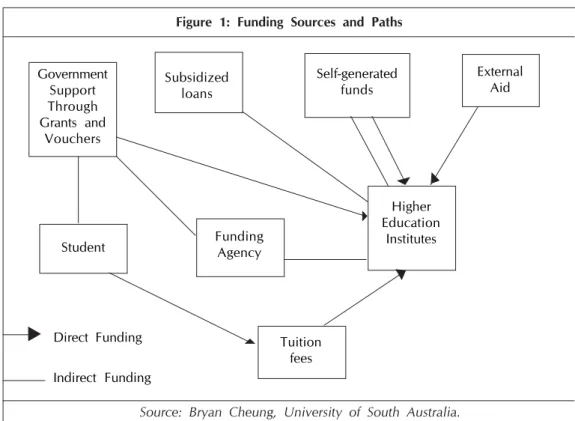
Government Support Through Grants and Vouchers Subsidized loans Self-generated funds External Aid Higher Education Institutes Funding Agency Student Tuition fees Direct Funding Indirect Funding
Source: Bryan Cheung, University of South Australia. Figure 1: Funding Sources and Paths
it is in the interests of both the sponsor, as well as the financier that there should be a clear-cut framework under which they operate, which cannot be easily overturned. This can only be legislation. The importance of regulation and proper ground rules to the dispensing of finance has often been underestimated, in all investment proposals in this country. While the sponsor, management, location and assets are important; they also operate in a macro and microenvironment. All major lenders tend to take these factors into account while considering an investment and lending proposal.
Public universities traditionally live on grants from the government and 95% of the grants provided to them goes towards fee and establishment expenses. There are hardly any disposable funds to develop the institutions or to do original research. Methods of teaching are outdated, and using the traditional technology has become pathetic. In order to get out of this situation, it is imperative that more funds be diverted to productive purposes. Far too much money is wasted on frivolous administrative expenditure. External Finance has a rigor of its own, and is usually accompanied by continuous monitoring by the financier. The very rigor will ensure better financial discipline, as there would be an awareness that the money has to be paid back. It is suggested therefore that all external funding be linked to development activities, preferably to those, which have some commercial payback value. Upgrade of the technology such as teaching equipment, laboratory equipment and projects etc., could also be externally financed, as these assets have a commercial value, and could be mortgaged/hypothecated to the lender.
Structures for Financing Universities: International Examples
There are various options, which are used in various developed and developing countries. In order to resolving rigidities and inefficiencies in the public sector, some governments tried to give more autonomy to higher education institutes so as to resolve the problems of inflexibility and inefficiency.
For example, in China, the Line Item Budget has been replaced by block grants, and institutes now can decide how to spend the money. The government exercises only audit and supervisory functions. While the details are given in Box 1, we could evaluate some of the methodologies with respect to their suitability to Indian Conditions.
There is another method to allocate the budget to inefficient institutions. These institutions should not see it as an incentive because too much dependence on the budgetary allocation may lead to collapse of many educational institutions, especially in case of public funded educational institutions. However, it is suggested to grant the educational institutions based on the performance indicators, which could be looked at in the Indian context and these indicators may be helpful to the government to allocate the budgetary support funds. Moreover, students depending on the nature of the education and degrees they pursue can refund a portion of tuition fee. In china, it has been seen that 15% income of a university comes from publishing, research and consultancy activities, which reduce the overburden to the government. This method to generate the fund may also be adopted in the Indian context. Another method is block grant based on running cost, may be workable
Box 1: International Examples: Funding Models to the Higher Education
Source: Funding Models to the Higher Education, Article—Higher Education Financing Policy: Mechanisms and Effects, Bryan Cheung.
Australia has adopted the ‘Relative Funding’ model that is a normative allocation model. Student numbers is one of the key elements in calculating the funding amount. If it turns out that the number of student units taught is lower (at least 2%) than the number of funded student places, this may result in a reduction of funds allocated in the next academic year. If it turns out that the number of students exceeds the target number set by the ministry, an institute will be paid the amount that is about 40% of average tuition costs (DETYA, 2000). This arrangement can introduce competition for students, and at the same time reduce government subsidies.
Denmark has adopted the ‘Taximeter’ model. The fund allocated for teaching is based on a unit-cost principle that accounts for, on an average, one-third of total revenue an institute will receive. The number of students that pass examinations determines the available budget. In England, higher education institutes are funded by two main sources: Block grants and tuition fee. Block grants are largely determined by the formula set by the Higher Education Funding Council for England (HEFCE). In general, the formula is based on running cost. For Example, laboratory-based subjects received more funding than non-laboratory-based ones. Part-time students receive only 50% of grant than a full-time student, as their learning activities are relatively less than full-time students. Institutes in London get more grants due to, for example higher living costs (HEFCE, 2002).
In Singapore, higher education institutes are mainly State funded. After the mid-1980s, the government decided to shift the funding from largely government-funded towards cost-recovery through tuition fee (Selvaratnam, 1994), the target was to provide public funding to cover the subsidy level ranging from 75%-84% for undergraduate courses (NUS, 2001). However, in reality, the tuition fees have risen just 1.64% for the year of 2001-02, whereas the subsidy for universities has risen 10% for the same period (Ministry of Finance, 2001).
China introduced significant reforms in higher education finance that covered financial decentralization, new funding mechanisms and resource mobilization (World Bank, 1997). Before the reforms in the 1980s, almost all the funding was exclusively from the government, and funds were allocated according to the unitary State budgetary plan. In the plan, historically based adjustments were adopted and unused funds had to be returned to the government. Such a system provided no incentive for efficiency gains and improvements. With financial decentralization, the central government has delegated financial responsibilities to provincial governments and line ministries to increase flexibility. With the new funding mechanisms, the line item budget has been replaced by a block grant, letting institutions decide how to spend the money, and institutes can retain unspent funds. With resource mobilization, institutes have been encouraged to generate their own revenue and to charge tuition fee so as to reduce the overdependence on government funds. Other than releasing the fiscal burden from the public funds, another goal of the reform is to encourage institutes to make innovations and develop their own skills to meet the developmental needs of the changing society (World Bank, 1998).
but could be described as a slightly outdated model, when we want institutions to take care of themselves.
Therefore, costs need to be linked to revenue at least to the extent of no-profit no-loss.
All these methodologies can aid and abet structured products for the financing of educational institutions. They can be combined also, or can be adopted in various singular or hybrid methodologies. (see Box 1)
External Finance
There has to be some methodology which would accommodate the existing structures, to some extent, and at the same time get the job done, i.e. enable and facilitate the entry of external finance, on suitable terms and conditions. In order to do this, it is imperative that the financier should be completely protected as regards his security and returns. Bundling together all the “productive” courses, creating an appropriate structure and “escrowing” this structure to the financier in some form best accomplish this. It has also been seen that over 60 countries have student loan facilities, which are mostly public schemes because governments see loan schemes important. However, there are many barriers in accessing such educational loan facility. The upcoming private banks have made this process comparatively simpler. This has created the competition among private and public banks and government is also making the process simpler, like applying for the education online. But this creates the situation to the future government underwriting the risk in mobilizing private banks. • All kinds of structures are possible. Firstly, the concept of bundling and unbundling various kinds of fee and educational assets should be adopted as a basic premise. It is not an “all or nothing” but a “case by case” approach.
• Secondly, the idea of a statutory or legal structure. An SPV of some time, independent of the university or educational body, and yet connected to the same body, must take hold. Without these basic approaches, no innovative structure is possible. It is not practically possible to change the basic structural framework in a hurry. There would be tremendous resistance to this.
• K Venkatasubramanian, Member, Planning Commission, is of the opinion that sources of income for private/public universities will be boosted up by encouraging private donations and endowments, strengthening community participation and establishing industry-university linkages from which both the universities and the industrial sector benefit.
Regulatory Needs to Ensure Proper Finances
Permission to set up independent educational structures is the single most important issue. Without these structures, the comfort level of the financier goes down dramatically. These
Table 2: Technical Education Institutions
Source: Naushad Forbes Science, Technology and Society, Stanford University Forbes Marshall, Pune.
Engineering 1500
Computer Applications 1006
MBA 930
Pharma & Medical sciences 116
structures could be a whole institution, a series of institutions, or a series of operations, belonging to several institutions. There should be flexibility on this. Public institutions have been operating in a format, where fiscal discipline is not a key criterion. This has to be set right, and fast. Budget has to come in and fund and cash flow statements must become compulsory.
The Indian Regulatory Scenario
All the structures in the Indian Regulatory scenario are geared towards the public financing of higher education. For this reason, there has not been
sufficient emphasis on academic rigor and concentration on output. Essentially, parents pay large sums of money to educate their wards in higher and technical education, to ensure that they get vocational openings, with matching remunerations. Therefore, it is incumbent on the educational institution to attach sufficient importance to this area. Placement ensures subscriptions, which in turn ensure a ready flow of cash and hence repayment. Repayment ensures the flow of cash from financial Institutions, and so the cycle goes on.
The Present
At present, most of the institutions of higher Education, belong to the government. The core regulatory bodies, such as the AICTE, UGC etc., have been established under Acts, which have the implicit understanding that professional education would be funded by the government. The structures, therefore, only address issues of immediate importance to the government, such as extent of grant, government representation on the Board and regulation of courses etc. There has really been very little emphasis on the quality of education, and its suitability and relevance to the job market. That is why it needs change, particularly in the light of expected changes in job profile, following the WTO developments.
The Future
In the future, professional jobs in India are likely to be very much more service oriented and this would require a total different approach from an industry and public sector oriented society framework. A great deal of input in subjects such as marketing, IT, ERP and other such areas is required for almost any specialization. Qualified experts can only do the determination of the need and quality, and non-professionals are basically rule-oriented. Therefore, the regulatory framework would need to absorb all these innuendos and redraft the legislation to best adapt to it. Student loans are freely available for professional education. The banks know that most students would be able to pay these loans back in comfort. There is a possibility of these loans being bundled together to make cohesive legal structures, which can then be traded on debt markets (as in USA). This would tend to be regarded as one of the better securities.
Table 3: Institutions in Higher “Technical” Education
Source: Naushad Forbes Science, Technology and Society, Stanford University Forbes Marshall, Pune.
Bachelor of Engineering 1203 MCA 1006 MBA 930 MSc in Pharmacy 116 Master, PhD in Engineering 314 MSc, PhD in Applied Sciences 51
The legislative body, whether center or state, which frames the best regulations, The UK tends to have substantial subsidized education and currently, there is a row going on about “burdening young shoulders with Educational loans”. Whatever the rights and wrongs of this situation.
Suggestions
• There needs to be an independent regulatory body, which will oversee the financing of higher education. An eminent panel of educationists who will oversee the operations, and ensure that financing goes only to respected and reputed bodies would run this body. In this way, they can protect the interests of both the financiers and the students. The Council can have government representation at the Board level.
• Outsourcing of academic operations: Another way to attract more finance would be to unbundle all the operations of the academic institution or university and see which of these are financeable. As research and development grows, perhaps sponsorships from corporate and educational trusts could be considered for specific parts of the entity like library, laboratory, playground etc. Administrative and academic operations could be outsourced or subcontracted to various agencies. These agencies could then approach the banks and financial institutions for funds and can work for say 25-30 academic institutions for academic operations, against fixed fee. This is another form of outsourcing. These fee could then be escrowed. It is very common practice in the USA for example to name Labs, Research Facilities and Scholarships after sponsors. This could be utilized to good effect in India, to draw adequate finances towards the education sector. This is an absolutely controversial method of raising funds and the sooner it is adopted, as a policy, the better. Getting corporate sponsors involved in the activities of the educational institution will also tend to fine-tune the courses towards progressively higher levels of placement and that is no mean thing.
Financial Modeling
It is not the objective of this article to go into the detailed specifics of financial models, nor would it be fruitful to do so. But, a few basic themes are suggested to get the thought processes moving.
Theme-I: Unbundling the fee and escrowing them for repayment to the financier. Theme-II: Mortgaging/hypothecating physical assets to the banks/institutions, against cash. Theme-III: Outright grants from Sponsors or Corporates.
Table: 4 Education Expenditure (in Percentage) by Source of Funds, all
Levels of Education Combined, Selected Countries, 1991
Source: Notes 1991: OECD 1993; Tilak 1993; World Bank.
Country Public Private Sources Sources Japan 73.9 26.1 Unites States 78.6 21.4 Haiti 20.0 80.0 Denmark 99.4 0.6 India 89.0 11.0 Australia 85.0 15.0
Theme-IV: Escrowing Research, Consultancy or Publishing fee.
Theme-V: Subcontracting various operations of the university or educational institution, creating an SPV or legal structure for the same and getting financing help in that structure. This need not be only for one university or educational institution. Several universities, located in a particular region could pool together their common operations in a single entity and get that entity financed.
Theme-VI: Another methodology, could be to develop an Education “cess” fund, by charging 0.1% of the Tax Deducted at Source to this fund. This could be quite a productive way of raising money for higher and technical education. Tax deduction could be given for corporates who contribute to this fund. The fund could then operate as an external financing agency, managed by a board of competent directors and having a staff of suitable professionals to manage it. The State should have some observational representation on this Board. The rest should consist entirely of educationists of high repute.
But whatever the model followed, one thing is clear that unbundling of educational insitutions will have to follow in the same way or the other, and mindsets towards this do not change easily, especially in the public domain. Therefore, a good selling job will have to be done with the authorities, if this has to gather pace.
Private universities are the norm, as regards countries, such as UK and US. Southeast Asia is also structuring their higher education accordingly. Worldwide surveys indicate that, in the field of higher and professional education, 70% or more of students are fully capable of meeting their fee and expenses on their own. This is a steady figure, despite numerous surveys on the same. This means that there is really no reason, why the State should keep on funding students who can readily pay at the considerable expense of their brothers who stop at school education and who cannot afford to pay.
The Pooling of Finance
Over the past decades, there has seen a significant and consistent worldwide reform agenda for higher education financing policy. However, it is better to analyze the factors affecting the pooling of finance that keep driving. Among these, there is the necessity to identify the reasons why governments and higher education keep searching funding alternatives; to show the relationship among funding sources and paths; to discuss funding mechanisms and models adopted by some Asian and Western countries; and to discuss the effects of funding policy on student access, institute autonomy, competition, stability of institutes, quality and performance of education, responsiveness to market demands and fiscal burden.
The USAID and other bodies have come out with interesting pooled structures, when studying the Indian education and health framework. While these cannot be used verbatim, some interesting innovations, which are adapted to the local situation could arise. This is especially true regarding—
• The pooling and securitization of student educational loans. • The pooling and securitization of fee.
• Pooling and Securitization of assets both tangible and intangible. Tangible assets would include the campus, labs and library etc. Intangible assets could include the research and intellectual potential, future earnings etc.
These variables could be played with, and suitable structures evolved. It would be immensely helpful, if the various conferences centered on the streamlining of higher education, would focus on the evolution of suitable structures to take care of the financing of the same. Then, all would fall into place.
The Trading of Education Instruments
The trading of securities, pertaining to higher education, has not really taken off, except for a few countries. This is because (till recently), education has been regarded as something, which the State provided, which the State regulates, and which is good for the society but not immediately profitable. Everyone agrees that the rise in quality and skills benefits the society greatly, without being able to produce identifiable pockets of cash, which can be escrowed to provide returns to money invested. With the new identification of professional education as a possible venture which serves the corporate sector and other public institutions, in a viable way, the student loans and fee have become more commercial and less government controlled. At the same time, corporate and government sponsorship (as distinct from controlled grants) are coming in for various specific functions. The viability of the institution, commercially leads to the natural flow of finance to the sector. This gives rise to the need for exit options and
a debt market is a natural corollary.
Education and the Job Market
There can be no conclusion about the financing of professional education without a reference to the market. The market is basically split segment wise into the medical, engineering, MBA and other professional courses. Each of these has its own dynamics. With the WTO reforms looming ahead for the service sector as a whole, it is clear that this whole sector will have to gear up to face the competition. At the same time opportunities will loom large for existing, well-run and financially strong educational institutions to ply their trade abroad. Experience suggests that Indian education is rather good, for the price offered, and the chances are more thanTable 5: Finance Checklist for a Prospective Lender
1. Eligibility of borrower, track record etc. 2. Organizational Structure.
3. Assets to be hypothecated.
4. Modalities of Regulator and administrator. 5. Type of Financial Aid Required.
6. Regulations of the University. 7. Quality of Academic Staff.
8. Presence of libraries and research facilities. 9. Security-bundling of Educational loans. 10. Availability of Contingency Funds.
11. Historical Relations of Institution with Banker. 12. Corporate Sponsorship of various facilities. 13. Placement Record of Institution.
14. Competition in the sector. Cost competitiveness of the incumbent.
15. Any track record of conducting Courses overseas. 16. Impact of WTO and other International Regulation
in the sector.
even, that there would be enormous export earnings for educational services. It would therefore be a very important function of the financier to do the segregation and classification of the winners and losers of the newly defined market, in each segment of professional
Subsidized Loans: Although public funding plays a prominent role in many countries, it does not cover all of the operating costs, so students have to be responsible for a fraction of the costs. For example, student fee accounted for 20% of total operating costs in Singapore in 1992 (Selvaratnam, 1994). In order to ensure that no deserving student is deprived of higher education because of a lack of financial support, many governments offer student loan schemes, such as the Tuition Loan Scheme (TLS) in Singapore that cover up to 65% of tuition fee. Students can repay the loan within a period of 20 years after graduation.
Student Grants and Voucher: In order to give students more choice in education and to incorporate market mechanisms into higher education, some governments offer grants or vouchers. With grants and vouchers, students can make their own curricular and institutional choices. Another goal of such student centred funding is to increase competition among institutes so as to provide incentives for institutes to improve quality and efficiency (Albrecht & Ziderman, 1992; West, 1997).
Tuition Fee: In China, tuition fee have been increased substantially since 1990. The average tuition fee in many institutes were between 25% and 30% of recurrent costs in 1995 (Zhang, 1997). Hong Kong imposed uniform fee across all public institutions, and fee cover 18% of recurrent costs. In Singapore, for arts and social sciences, fee were increased from 10% of recurrent cost in 1986 to 20% in 1992 (Selvaratnam, 1994). In Australia, the tuition fee and charges, including Higher Education Contribution Scheme (HECS), accounted for 36% (CDEST, 2002). The tuition fee in the United States accounted for 19% (NCES, 1997).
Self-generated Funds: With limited public funds, some institutes need to acquire other funding sources from productive activities. For instance, in the United States, the funds generated from sales and services accounted for 22.2% (NCES, 1997). In Australia, the self-generated income only accounted for 5.4% (CDEST, 2002). In China, the total self-generated funds amounted to 18.2% of universities' total revenue in 1992, such independent funds were generated from: university enterprises (3.7%), commissioned training for enterprises (2.3 %), educational services (1.1%), research and consultancy (1.3 %), logistic services (0.7 %), donations (0.8%), student tuition fee (4.6%), and other funded activities (3.7 %) (World Bank, 1997).
External Aid: External aid for education has played an important role in many developing countries. For instance, in Indonesia, external aid came from three major external agencies: United Nations Development Program, World Bank, and Asian Development Bank (Wirjomartono et al. 1997). During the period of 1983-1988, external aid accounted for 11.1% of total educational budget, from which 48.4% had been used in higher education. In 1988-1993, external aid accounted for 12.1% of total education budget, from which 16.6% had been allocated for higher education. Higher percentage of external aid was recorded for Cambodia in 1994 where nearly half the government budget for education was financed by bilateral and multilateral agencies (ADB, 1996).
Donation: It can also be regarded as a kind of external aid, but such funds are not stable and it accounts for only a small part of the operating revenue. For instance, in Australia, donations and bequests accounted for only 1.3% of operating revenue (DETYA, 1999). In China, donations contributed only 0.8% of income (World Bank, 1997). Based on the funding sources and paths discussed above, a map showing the relationship between funding sources and funded institutes can be constructed.
Source: Higher Education Financing Policy: Mechanisms and Effects, Bryan Cheung. Box 2: Types of Pooling
education. A checklist is for the benefit of readers, about the salient features that any prospective financier may look at, for considering the financing of an Institution of Professional Education (Table 4).
A dilemma for many governments in funding higher education is how to bring the highest benefits to students and to meet the labor market demands without setting detailed guidelines of what institutes should do, which leads to the discussion of demand-driven funding. The core idea of demand-driven funding is that money moves with students. Moreover, as public authorities are the major sources of influence, they can determine the level and scope of control. Controls can be channelled through the negotiation of budget, contract management, and student intake quotas. Such direct government funding may impose a centralized and rigid control over institutes (Albrecht and Ziderman, 1992). Some public authorities regard block grants as a form of autonomy, but it only increases the flexibility of internal funding allocation. To gain more actual autonomy, increasing self-reliance funding enables universities to pursue diverse missions and meet varying community needs (Kaiser et al. 2001). Many countries have adopted the close-ended and distributive funding methods, that is a fixed amount of funding has been determined for the total public funding for higher education, and the outcomes of the funding formulae are used to determine what part of the total public funds available are allocated to particular institutions. With the distributive funding method, institutes have to compete for funding, but such competition may not improve education quality due to the fact that the assessment of quality and performance may be based on just promises (contract or profile) and not on results. Although many factors, such as student enrolment numbers and quality, have been included in the negotiation or calculation of fund allocation, stability of institutes is often a major concern for many governments. This can be explained by the fact that the budget amount of a previous allocation to an institute is often one of the major starting points in calculating the new allocation amount. Thus, historically determined or incremental budgeting can be found in many countries, such as UK and Germany.
Conclusion
It is clear that the compulsion of the State is geared towards financing primary education in its entirety. If there are any surplus funds, it is clear that the national interest dictates a movement into secondary education. In any case, there is really no need (except in exceptional circumstances) for the State to be involved in any way, in the financing of professional and technical education. Note that the State should be completely “hands off” to get the best investment. It would be in the interest of the center to encourage competition among the states and to develop the best framework.
There are various modalities and themes regarding the financing options available to an educational institution, particularly one involved in higher and technical education, which has a commercial market value. The various approaches taken by different countries have been discussed and tabulated. Various models and hybrids of models have been discussed. The purpose is to look at all of these and try to find a practical solution to the problems of financing higher education in India.
References
1. http://www.education.nic.in/htmlweb/unhighedu.htm#pertinenceok
2. Higher Education in India Vision and Action Country Paper, UNESCO World Conference on Higher Education in the Twenty-First Century Paris, 5-9 October 1998
3. International Examples: Funding Models to the Higher Education, Article -Higher Education Financing Policy: Mechanisms and Effects, Bryan Cheung
4. A PowerPoint Presentation titled “Higher Education, Scientific Research and Industrial Competitiveness: Reflections on Priorities for India” of Naushad Forbes Science, Technology and Society, Stanford University.
Reference # 27J-2004-06-02-01
It is not often appreciated, that regulation is a dynamic process. It requires the State to upgrade its manpower and stay in tune with things. Dynamic Regulation is very different from mere controlling. The State should have the keen appreciation that it is trying to promote the good and not just stop the bad, at the expense of all that is good. To do this requires a finer appreciation, of all the nuances, that go towards making the sector tick. It is therefore critical that the government should restructure its own regulatory bodies first, to meet the new challenges—either upgrade them or come out with a new body, in the manner of the Capital Market and Telecom sector. Only then they would fulfil their dual role of protecting the student interest and giving financiers and sponsors, a decent return for their money.