0022-538X/06/$08.00⫹0 doi:10.1128/JVI.80.4.1752–1761.2006
Copyright © 2006, American Society for Microbiology. All Rights Reserved.
Rectal Immunization with Rotavirus Virus-Like Particles Induces
Systemic and Mucosal Humoral Immune Responses and
Protects Mice against Rotavirus Infection†
Nathalie Parez,
1,2,3* Cynthia Fourgeux,
4Ali Mohamed,
4Catherine Dubuquoy,
4Mathieu Pillot,
4Axelle Dehee,
3Annie Charpilienne,
2Didier Poncet,
2Isabelle Schwartz-Cornil,
4‡ and Antoine Garbarg-Chenon
3‡
Service des Urgences Me´dicales Pe´diatriques, Hoˆpital Armand Trousseau AP-HP, Paris,1Unite´ de Virologie
Mole´culaire et Structurale, UMR CNRS 2472—INRA 1157, Gif sur Yvette,2Laboratoire de Virologie,
Universite´ Pierre et Marie Curie-Paris6, EA 3500, AP-HP, Hoˆpital St. Antoine, Paris,3and
Unite´ de Virologie et d’Immunologie Mole´culaires, INRA, Jouy en Josas,4France
Received 8 July 2005/Accepted 2 December 2005
To evaluate whether the rectal route of immunization may be used to provide appropriate protection against enteric pathogens such as rotaviruses (RV), we studied the antibody response and the protection induced by rectal immunization of mice with RV virus-like particles (VLP). For this purpose, 6-week-old BALBc mice were rectally immunized twice with RV 8-2/6/7-VLP derived from the bovine RV RF81 strain either alone or combined with various adjuvants including four toxins [cholera toxin (CT) and three attenuatedEscherichia coli-derived heat-labile toxins (LTs), LT(R192G), LT(R72), and LT(K63)] and two Toll-like receptor-targeting adjuvants (CpG and resiquimod). Six weeks after the second immunization, mice were challenged with murine RV strain ECw. RV VLP administered alone were not immunogenic and did not protect mice against RV challenge. By contrast, RV VLP combined with any of the toxin adjuvants were immunogenic (mice developed significant titers of anti-RV immunoglobulin A [IgA] in both serum and feces and of anti-RV IgG in serum) and either efficiently induced complete protection of the mice (no detectable fecal virus shedding) or, for LT(K63), reduced the amount of fecal virus shedding after RV challenge. When combined with RV VLP, CpG and resiquimod failed to achieve protection, although CpG efficiently induced an antibody response to RV. These results support the consideration of the rectal route for the development of new immunization strategies against RV infection. Rectal delivery of a VLP-based vaccine might allow the use of adjuvants less toxic than, but as efficient as, CT.
Rotaviruses (RV) are the leading cause of viral gastroenter-itis in young children worldwide and are responsible for more than 500,000 deaths per year in developing countries (40). The high mortality rate in developing countries and the heavy social and economical burden in industrialized countries due to RV infections underline the need for the development of an effi-cient vaccine. Every candidate RV vaccine that has been de-veloped to date has consisted of orally delivered, live attenu-ated RV strains or reassortants (8, 9, 14, 20, 36, 54, 56). Most of these vaccines confer significant protection against severe diarrhea but only limited protection against RV infection or mild symptoms. Moreover, live vaccines can be associated with various adverse effects, intussusception being the most severe (33). Thus, the development of new safe vaccine strategies based on nonliving RV should be considered.
Virus-like particles (VLP) are nonreplicating structures that mimic virus counterparts in morphology and immunogenicity and could be safe and efficient vaccine candidates. Parenteral immunization with RV VLP has been shown to induce
immu-nogenicity and protection in animal models, particularly in the mouse model (7, 11, 30). However, RV is commonly transmit-ted via the fecal-oral route and infects intestinal epithelial cells. Thus, vaccine strategies inducing effective intestinal mu-cosal immunity responses should be suitable against this patho-gen and need to be assessed. RV VLP can be delivered via various mucosal routes of administration in order to induce mucosal effectors. When delivered via the oral route, which is common and handy for vaccine administration, RV VLP duce weak immune responses and do not protect against in-fection (3, 49). When administered by the nasal route, RV VLP efficiently induce both local and systemic specific immune responses in mice (6, 29, 34, 35) and gnotobiotic pigs (21). However, because of the regional specialization in the mucosal immune system, nasally primed lymphoid cells home mainly to the upper respiratory tract and the urogenital tract and home little to the gut, which is the site of RV infection (4). Further-more, intranasally administered RV VLP require the use of a potent mucosal adjuvant such as cholera toxin (CT) to induce strong protective immunity. Under these conditions, both an-tigen and CT have been reported to be located in the neural epithelium of the olfactory bulb (17). Thus, the nasal route may potentially lead to neurological side effects, precluding its use in humans. Consequently, the assessment of an alternate mucosal route of administration of RV vaccines is needed. The rectal route has been recently proposed for immunization
* Corresponding author. Mailing address: Service des Urgences Me´dicales Pe´diatriques, Hoˆpital Armand Trousseau, 26 ave. du Dr Arnold Netter, 75571 Paris cedex 12, France. Phone: 33 1 4473 6487. Fax: 33 1 4473 6985. E-mail: [email protected].
† Dedicated to the memory of Jean Cohen, our close friend and mentor.
‡ I.S.-C. and A.G.-C. share senior authorship.
1752
on November 8, 2019 by guest
http://jvi.asm.org/
against several pathogens such asMycobacterium bovis(1, 28), hepatitis A virus (32), and human immunodeficiency virus (HIV) (2, 22, 52), and it should be considered for enteric pathogens such as RV as it may induce appropriate immune effectors in the intestinal mucosa.
In this study, we investigated the protection and humoral immune responses induced by rectal immunization of mice with 8-2/6/7-VLP either alone or combined with different types of adjuvants which could be considered for further use in humans. This is the first report showing the efficiency of the rectal route at immunizing and protecting mice against an enteric pathogen. Our results indicate that RV VLP adminis-tered intrarectally should be considered for further RV vaccine development.
MATERIALS AND METHODS
VLP production.The production of RV VLP in the baculovirus expression system has been previously described in detail (5). All RV proteins used for VLP synthesis were obtained from bovine RV strain RF81 (group A, G6, P7[5]). Because VLP including VP4 on the outer shell could not be produced in suffi-cient quantities and because such VLP were not stable, we took advantage of the dispensable position 1 to 92 first amino-terminal domain of VP2 and replaced it with VP8, a cleavage product of VP4 containing immunogenic determinants (5). The sequence encoding the VP8-2 fusion protein was cloned into baculovirus vector pFASTBAC1 (Gibco, Paisley, United Kingdom). 8-2/6/7-VLP were pro-duced from the coinfection of Sf9 insect cells (approximately 5 PFU/cell) with three recombinant baculoviruses expressing VP8-2, VP6, and VP7, respectively. VLP were purified from infected Sf9 cell cultures by density gradient centrifu-gation in cesium chloride (CsCl), and the protein concentration of the VLP preparations was determined with a micro bicinchoninic acid protein assay kit (Pierce, Rockford, Ill.) (41). Protein content of the purified VLP was determined by polyacrylamide gel electrophoresis with Coomassie blue staining and Western blotting. Polyclonal antibody 8143 raised in a rabbit against purified bovine RV was used in Western blotting experiments. 8-VLP are as stable as 2/6/7-VLP and can be kept at 4°C in CsCl for several months without detectable loss of viral protein.
Animals, immunization, and challenge.Six-week-old female BALB/c mice were housed under RV-free conditions until RV challenge. Mice were identified in order to follow each mouse individually along the study and to establish correlation between immune responses and protection. During the challenge,
groups of mice were housed in an A3 animal facility (Unite´ d’Expe´rimentation
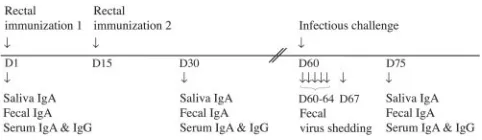
Animale Rongeurs, Jouy en Josas, France). The experimental schedule used for immunization and challenge is shown in Fig. 1.
Before each immunization, mice were anesthetized by intraperitoneal admin-istration of a mixture of ketamine (100 mg/kg of body weight) and xylazine (10 mg/kg). Groups of mice were vaccinated twice, at days 1 and 15, by gentle intrarectal delivery with a micropipette tip. Twenty microliters was administered
containing 10g of 8-2/6/7-VLP either alone in RPMI medium (Gibco, Paisley,
United Kingdom) or mixed with an adjuvant. Two different types of adjuvant were tested including four toxins and two Toll-like receptor (TLR)-targeting adjuvants. In each of the groups that received toxin, seven mice were vaccinated
with 8-2/6/7-VLP mixed with 10g of either CT (Sigma, St. Louis, Mo.) or one
of the following three detoxifiedE.coliheat-labile toxins (LTs): LT(R192G),
generously provided by John Clements (13); LT(R72) (Chiron, Siena, Italy); and LT(K63) (Chiron, Siena, Italy). In each of the groups receiving the TLR-target-ing adjuvants, seven mice were vaccinated with 8-2/6/7-VLP mixed with either 50
g of resiquimod (PharmaTech, Shangai, China) or 10g of CpG
oligonucleo-tide (51). A group of seven mice mock immunized with RPMI medium was used as a control. Additionally, mice were immunized with each toxin adjuvant given
alone, e.g., CT, LT(R192G), LT(R72), or LT(K63) (n⫽5 per group). Six weeks
after the second immunization (D60), mice were challenged by oral gavage with
10450% shedding doses of murine RV strain ECw (Cambridge, group A, G3,
P10[16]). The stock of ECw consisted of intestinal homogenates from 4-day-old BALB/c neonates and was titrated as previously described (47). The same stock of ECw was used in all experiments. All procedures were performed in accor-dance with institutional guidelines and under accreditation number 7820 from La
Direction des Services Ve´te´rinaires, Versailles, France.
Detection and quantification of RV shedding.To assess the protective efficacy of rectal immunization with RV VLP, virus was detected in stool samples har-vested on the day of challenge (D60) and on days 2, 3, 4, 5 (D61 to D64), and 8
(D67) postchallenge (Fig. 1). All samples were stored at⫺20°C until testing.
Before being tested, stool samples were weighted, diluted in appropriate volumes of buffer to obtain a 6% (wt/vol) suspension, and clarified by centrifugation. Detection of group A RV antigen in mouse feces was performed with a com-mercial enzyme-linked immunosorbent assay (ELISA) (IDEIA RV; Dako, Cambs, United Kingdom) according to the manufacturer’s recommendations. A
sample was considered positive if the optical density at 450 nm (OD450) was⬎0.1
plus the mean of the OD values of the negative control wells. To quantify RV antigen shedding, fourfold serial dilutions of CsCl-purified RF 81 (ranging from
4g/ml to 62.5 ng/ml) were assayed to establish a standard curve. The amount
of RV antigen shed in each stool sample was inferred from the standard curve and expressed as nanograms of RV antigen per milliliter of sample. The assay was sensitive enough to detect 30 ng of RV antigen per ml. For each mouse, a total fecal virus shedding value was calculated with Microcal Origin 5.0 software by integrating the area under the curve defined by the quantity of RV antigen of
each feces sample (yaxis) over the 8-day period of feces collection (xaxis). A
value of zero was assigned when no virus shedding was detected. For each group of mice, these integrated values were used to calculate the median values of fecal virus shedding and for statistical comparison between groups.
Detection of RV-specific antibodies.The immune response to rectal immuni-zation with RV VLP was evaluated on the day of the first immuniimmuni-zation (D1), 15 days after the second immunization (D30), and 15 days postchallenge (D75) (Fig. 1). Specific anti-RV immunoglobulin A (IgA) levels were quantified in saliva, stool, and sera and specific anti-RV IgG in sera only. Saliva and stool samples were first harvested. Blood samples were collected by retroorbital capillary plexus puncture under general anesthesia. RV antibody titers were determined by ELISA as previously described (47). Briefly, 96-well plates were coated with 2/6-VLP of bovine origin as the antigen (200 ng per well in carbonate buffer). Samples to be tested were added, and plates were incubated for 2 h at 20°C. After three washes, peroxidase-conjugated anti-mouse IgA (Caltag Laboratories, Bur-lingame, Calif.) or anti-mouse IgG heavy- and light-chain (Jackson Immuno-Research, West Grove, Pa.) antibodies were added to the plates for 1 h and then
the plates were washed. Theo-phenylenediamine peroxidase substrate was used
for revelation. A sample was considered positive if the OD450of the sample well
was⬎0.1 plus the mean of the OD values of the negative control wells. To
calculate RV IgA and IgG antibody titers, standard curves were established with serial dilutions of sera with known IgA and IgG titers. For each sample, IgA and
IgG antibody titers were inferred from the OD450values with the corresponding
standard curve. Samples with OD450values outside the linear range of the
standard curve were retested at higher dilutions. For each group of mice, IgA and IgG geometric mean titers (GMTs) were calculated with titers of 50 and 5
for IgG-negative (⬍100) and IgA-negative (⬍10) samples, respectively.
In order to evaluate neutralizing antibodies against the RF strain of RV in mouse sera, a plaque reduction assay with MA104 cells was used as previously described (43).
Statistical analysis.Statistical analysis was performed with StatView software (SAS Institute), version 4.2, by using nonparametric tests. The number of non-shedding mice and the number of mice with detectable antibody responses in
each vaccinated group were compared to the mock-immunized group with the2
[image:2.585.43.284.68.138.2]test. The Mann-Whitney U test was used to compare antibody titers and virus
FIG. 1. Experimental schedule. Mice were rectally immunized twice (D1 and D15) with 8-2/6/7-VLP of bovine origin, either alone or in combination with adjuvant, and challenged with 10450% shedding doses of murine RV strain ECw 6 weeks after the second immuniza-tion (D60). RV-specific antibodies were measured by ELISA on saliva, stool, and serum samples on the day of immunization (D1), 15 days after the second immunization (D30), and 15 days postchallenge (D75). Virus antigen was detected by ELISA in stool samples har-vested on the day of challenge (D60) and on days 2, 3, 4, 5 (D61 to D64), and 8 (D67) postchallenge.
on November 8, 2019 by guest
http://jvi.asm.org/
shedding (expressed as the area under the curve) between groups. APvalue of
⬍0.05 was considered significant.
RESULTS
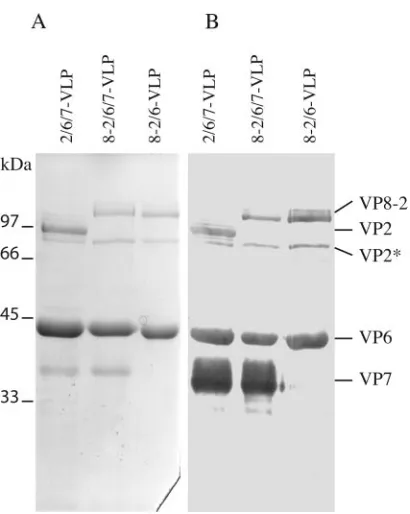
Antigen production.8-2/6/7-VLP of bovine origin were pro-duced as plate form particles including a large representation of RV antigens, namely, inner shell protein VP2 fused to the VP8 determinant, major capsid protein VP6, and outer shell protein VP7. VP8 fused to VP2, VP6, and VP7 readily assem-bled and produced properly formed 8-2/6/7-VLP, as judged by electron microscopy (data not shown). Coomassie blue staining and Western blot analysis of purified 8-2/6/7-VLP preparations confirmed the presence of the expected structural proteins in the VLP (Fig. 2).
Rectal immunization with RV VLP protects mice against heterologous RV challenge.In order to determine the fecal RV shedding profile after RV infection, five mice were experimen-tally infected with murine RV (strain ECw). Fecal RV shed-ding was investigated each day over the 8-day period postin-fection. Fecal RV shedding showed a reproducible profile (Fig. 3A). At days 6 and 7, only low levels of RV antigens were detectable, and at day 8, RV shedding was negative. In the subsequent experiments, fecal RV shedding was investigated on days 1 to 5 (D60 to D64) and on day 8 (D67) to confirm that fecal virus shedding became negative. To examine whether
[image:3.585.61.266.65.322.2]8-2/6/7-VLP administered rectally affords protection and whether the nature of the adjuvant influences the protective efficacy, adult BALB/c mice were rectally immunized twice with 8-2/6/7-VLP of bovine origin, either alone or in combina-tion with seven different adjuvants, and challenged with heter-ologous ECw murine virus 6 weeks after the second immuni-zation (D60). The number of protected mice in each group is given in Table 1 [one mouse each in the CT and LT(R72) groups and two mice in the resiquimod group died before the challenge]. The amount of fecal virus shedding, expressed as the area under the curve of RV antigen shed each day, over the 8-day period of feces collection is shown Fig. 3B. The groups of mice mock immunized with RPMI medium alone or in com-bination with a toxin adjuvant (CT or LTs) were used as con-trols, and as expected each mouse in these groups shed RV after challenge. Pairwise comparison of fecal virus shedding
[image:3.585.311.527.71.418.2]FIG. 2. Analysis of 8-2/6/7-VLP protein content. 8-2/6/7-VLP of bovine RV origin were produced in the baculovirus expression system and purified from infected insect cell cultures by density gradient centrifugation in CsCl. Protein content of the purified VLP was ana-lyzed by polyacrylamide gel electrophoresis with Coomassie blue stain-ing (A) and Western blottstain-ing (B) with antiserum 8143 directed against bovine RV. 2/6/7-VLP and 8-2/6-VLP were used as controls. The positions of molecular size markers and locations of the individual RV proteins are indicated on the left and right, respectively. VP2* indi-cates a VP2 degradation product usually observed in VLP containing the VP2 and VP8-2 proteins.
FIG. 3. Fecal virus shedding after murine RV infection. (A) Nor-mal fecal RV shedding profile of five mice experimentally infected with murine RV. Stool samples were collected each day after infection during an 8-day period. RV antigen was quantified in mouse feces with an ELISA. (B) Fecal virus shedding in vaccinated mice after RV challenge. The amount of fecal virus shedding by each mouse was calculated by integrating the area under the curve defined by the quantity of RV antigen in each fecal sample over the 8-day period of feces collection. Formulations of vaccine are indicated along thexaxis. For groups including shedding mice, bars show the median fecal virus shedding values and the interquartile range.
on November 8, 2019 by guest
http://jvi.asm.org/
was performed between each vaccinated group and the mock-immunized group by the Mann-Whitney U test. Rectal immu-nization with 8-2/6/7-VLP alone neither efficiently protected mice against RV challenge (virus shedding remained detect-able in every mouse) nor efficiently reduced the amount of fecal virus shedding compared to mock-immunized mice. When 8-2/6/7-VLP was administered in combination with CT, every mouse was free from virus shedding, indicating that com-plete protection was achieved. However, since CT is potentially toxic and thus unsuitable for human use, we evaluated three partially detoxified heat-labileE.colitoxins that could be used in humans. When combined with 8-2/6/7-VLP, two of these adjuvants, LT(R192G) and LT(R72), induced complete pro-tection, with no mouse shedding RV. LT(K63) combined with 8-2/6/7-VLP was efficient enough to protect five mice out of seven (P⫽0.0256, chi square test) and to reduce the amount of fecal virus shedding (P⫽0.0021, Mann-Whitney U test). It is noteworthy that none of the toxin adjuvants (CT or LTs) given alone reduced the amount of fecal virus shedding (data not shown). Regarding the efficacy of the TLR-targeting adju-vants, CpG induced protection in only one out of seven mice and resiquimod in one out of five mice. Although some mice in these groups excreted smaller amounts of virus in stool, no significant difference was evidenced in comparison with mock-immunized mice.
Taken together, our results indicate that rectal delivery of RV VLP combined with the appropriate adjuvants, CT or the LTs, either efficiently induces complete protection of mice or reduces fecal virus shedding after heterologous RV challenge, depending on the adjuvant used. Furthermore, diarrhea, which could be an adverse effect of CT or LT, was observed in no
mouse, suggesting that these adjuvants are well tolerated at the doses used when delivered by the rectal route.
The humoral immune response induced by rectal adminis-tration of 8-2/6/7-VLP was then evaluated and compared to the protection conferred.
Rectal administration of RV VLP induces specific mucosal and systemic humoral immune responses. To evaluate the humoral immune responses induced by two rectal administra-tions of 8-2/6/7-VLP alone or in conjunction with an adjuvant, serum IgG and saliva, fecal, and serum IgA RV antibodies were measured by ELISA with 2/6-VLP as the coating antigen on the day of the first immunization (D1) and 15 days after the second immunization (D30).
No mouse had detectable mucosal or systemic RV antibod-ies on the day of the first immunization (D1). In addition, every mock-immunized mouse remained negative for RV antibodies at D30. These observations confirmed that during these assays, mice housed under RV-free conditions were not exposed to the pathogen.
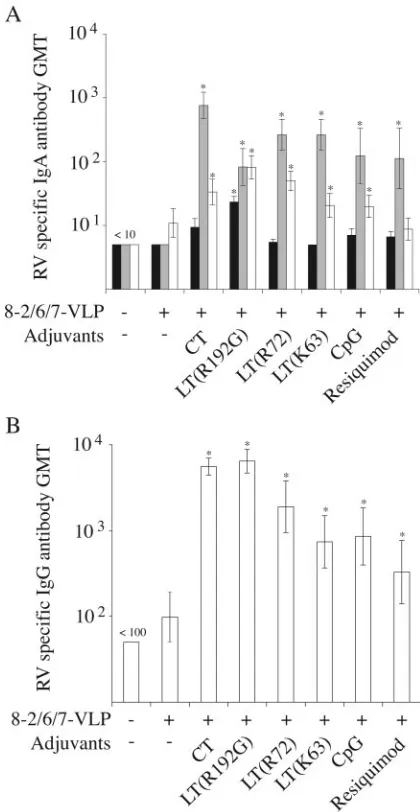
Humoral responses, expressed as the numbers of mice with detectable RV antibodies, at D30 (ⱖ10 for IgA andⱖ100 for IgG) are given in Table 2, and the RV antibody titers are shown in Fig. 4.
[image:4.585.39.543.82.159.2]Compared to mock-immunized mice, rectal administration of 8-2/6/7-VLP alone did not induce any significant RV anti-body response in either the IgA or the IgG class. By contrast, a significant number of mice which had received 8-2/6/7-VLP with either CT, LTs, or CpG as an adjuvant developed fecal IgA, serum IgA, and serum IgG RV antibody responses. Ad-ditionally, pairwise comparisons of RV antibody titers indi-cated that fecal IgA, serum IgA, and serum IgG RV antibody
TABLE 1. Protection against murine RV challenge conferred by two rectal immunizations with RV VLP
Immunogen None (RPMI
medium) 8-2/6/7-VLP
Adjuvant None Any
toxina None CT LT(R192G) LT(R72) LT(K63) CpG Resiquimod
No. of nonshedding mice/
total no. of miceb 0/7 0/20 0/5 6/6 7/7 6/6 5/7 1/7 1/5
Pc NSd 0.0023 0.0013 0.0023 0.0256 NS NS
aMice were immunized with each of the following toxin adjuvants given alone: CT, LT(R192G), LT(R72), or LT(K63) (n⫽5 per group).
bFrom the groups of mice vaccinated with VLP, one mouse each in the CT and LT(R72) groups and two mice in the resiquimod group died before challenge.
cSignificance of the chi square test between vaccinated and mock-immunized (no VLP) groups.
dNS, no significant difference.
TABLE 2. RV antibody responses of mice after rectal immunization with RV VLP
Immunogen None (RPMI
medium) 8-2/6/7-VLP
b
Adjuvant None None CT LT(R192G) LT(R72) LT(K63) CpG Resiquimod
No. of miceawith:
Saliva IgA 0 0 3 7** 1 0 2 2
Stool IgA 0 0 7** 7** 7** 7** 5* 5*
Serum IgA 0 2 6** 7** 7** 5* 5* 2
Serum IgG 0 1 7** 7** 6** 5* 5* 3
Total no. of mice 7 5 7 7 7 7 7 6
aNumber of mice with a detectable IgA (ⱖ10) or IgG (ⱖ100) RV antibody response 15 days after the second immunization (D30).
bSignificant differences between vaccinated and mock-immunized groups (RPMI medium) as measured by the chi square test: *, 0.01ⱕP⬍0.03; **, 0.001ⱕP⬍
0.01.
on November 8, 2019 by guest
http://jvi.asm.org/
[image:4.585.40.543.601.700.2]titers were significantly higher in these vaccinated groups than in the mock-immunized group but were not significantly dif-ferent among the vaccinated groups.
In the resiquimod group, a significant IgA response was detected in stool but not in serum. Furthermore, although serum IgG RV antibody titers were significantly higher than in the mock-immunized group, three out of six mice had no detectable IgG response. Thus, it was considered that
immu-nization with 8-2/6/7-VLP combined with resiquimod did not effectively induce an RV antibody response. Lastly, LT(R192G) was the only adjuvant for which a significant IgA RV antibody response was detected in saliva. Taken together, these results indicate that rectal vaccination with RV VLP in combination with any of the toxins and CpG adjuvants effi-ciently induced a mucosal and systemic humoral immune re-sponse against RV.
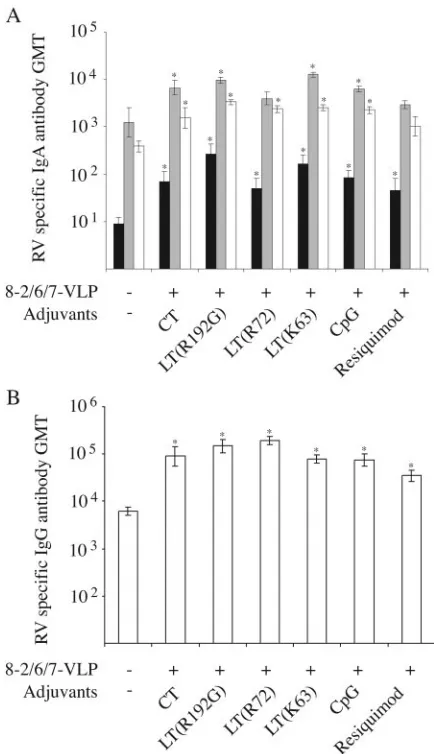
We further evaluated whether, and to what extent, RV in-fection could boost the RV antibody response in vaccinated mice compared to naive mock-immunized mice. For that pur-pose, RV antibody responses (serum IgG and saliva, fecal, and serum IgA) were tested 15 days after challenge (D75) in the groups where CT, LTs, CpG, and resiquimod had been used as adjuvants and where a significant RV antibody response at D30 had been demonstrated. RV antibody titers were com-pared to those obtained for naive mock-immunized mice after murine RV infection (Fig. 5). In groups vaccinated with RV VLP in combination with any of the toxins or TLR adjuvants, saliva IgA and serum IgG RV antibody titers were significantly higher than those in the mock-immunized group, for which the antibody response was only related to RV infection. Fecal and serum IgA RV antibody titers were also significantly higher, except for fecal IgA in the LT(R72) group and for fecal and serum IgA in the resiquimod group. Furthermore, pairwise comparison between IgA or IgG RV antibody titers before (D30) and after (D75) challenge indicated a significant in-crease (Mann-Whitney U test,P⬍0.05) in saliva, fecal, and serum RV antibody titers in every vaccinated group (compare Fig. 4 to Fig. 5). These results indicate that, in most cases, the mucosal and systemic humoral immune response is boosted after RV infection in mice previously immunized by the rectal route with RV VLP combined with an appropriate adjuvant, with resiquimod being the least effective of the adjuvants tested.
Correlation between protection and humoral immune re-sponses. The correlation between the humoral immune re-sponse at D30 and protection status after RV challenge was evaluated individually for each mouse vaccinated with RV VLP alone or combined with an adjuvant. Table 3 shows the number of mice protected against RV challenge (as judged by RV detection in stool samples) compared to the number of nonprotected mice according to the RV antibody responses. A significant correlation was found between protection against RV challenge and fecal or serum IgA or serum IgG RV anti-body responses obtained 2 weeks after the second rectal im-munization (D30). Furthermore, pairwise comparison of RV antibody titers at D30 indicated that saliva, fecal, and serum IgA and serum IgG RV antibody titers were significantly higher in protected than in nonprotected mice (Fig. 6).
[image:5.585.56.266.69.475.2]The correlation between humoral immune responses and protection against RV infection is consistent with the fact that rectal vaccination with RV VLP combined with CT or LTs induces significant mucosal and systemic RV antibody re-sponses and confers protection, whereas vaccination with RV VLP alone or in combination with resiquimod induces little or no RV antibody response and does not protect against RV challenge. However, the correlation between RV antibody and protection is only relative, since mice vaccinated with RV VLP combined with CpG developed significant fecal IgA and serum
FIG. 4. GMTs of RV-specific antibodies after rectal immunization with 8-2/6/7-VLP. RV antibodies were tested by ELISA 15 days after the second rectal immunization. IgA and IgG RV antibody titers were determined for individual mice and used to calculate the GMT for each group of mice. For IgA-negative (⬍10) and IgG-negative (⬍100) samples, titers of 5 and 50, respectively, were used to calculate the GMT. (A) IgA GMT in saliva (black), stool (gray), and serum (white) samples. (B) IgG GMT in serum samples. For each group, formula-tions of vaccine are indicated along thexaxis. Mice mock immunized with RPMI medium were used as a control. Error bars indicate stan-dard errors of the geometric means. Asterisks indicate significant dif-ferences in pairwise comparisons of RV antibody titers between vac-cinated and mock-immunized groups (Mann-Whitney U test,P ⬍ 0.05).
on November 8, 2019 by guest
http://jvi.asm.org/
IgA and IgG RV antibody responses, even though this vaccine conferred no protection. Considering that mice were immu-nized with VLP of bovine RF strain origin which are serotypi-cally unrelated to the challenge murine ECw strain, protection was not expected to be mediated by neutralizing antibodies in this model. To further investigate this point, we looked for neutralizing antibodies against RF in the serum of mice vac-cinated with the protective vaccine formula (8-2/6/7-VLP in combination with CT or LTs) by a plaque reduction assay. This assay failed to evidence significant neutralization activity against the RF strain. Alternatively, we evaluated the protec-tion conferred by the rectal administraprotec-tion of 2/6-VLP in com-bination with CT. Indeed, if neutralizing antibodies were the effector of protection, one would expect no protection with 2/6-VLP which lack VP7 and VP8 antigens. Following the same experimental schedule and conditions as for 8-2/6/7-VLP, rectal administration of 2/6-VLP in combination with CT con-ferred complete protection, since no mouse (n⫽5) shed RV antigen in stool after challenge. Taken together, these results indicate that the immunogenicity of RV VLP when delivered via the rectal route is necessary but not sufficient to confer protection against RV. Furthermore, protection conferred by rectally administered RV VLP is probably not related to neu-tralizing antibodies in this model.
DISCUSSION
We show here for the first time that rectal administration of RV 8-2/6/7-VLP combined with an appropriate adjuvant can induce high levels of mucosal and systemic anti-RV antibodies, as well as full protection against a high-dose heterologous RV challenge. We also show how critical the selection of an ap-propriate adjuvant can be and determined that detoxified,E.
coli-derived toxins provide the highest levels of protection. Thus, the rectal route may be considered to be excellent for RV VLP vaccination, as it is not only extremely efficient but also probably very safe. VLP delivery via the rectal route has much better efficacy than that reported for delivery via the oral route (35). Oral administration has been proven to be poorly immunogenic for nonreplicating RV structures, requiring re-peated administration of large quantities (hundreds of micro-grams) of viral proteins together with adjuvants and providing only partial protection (6, 35). Degradation by gastric and intestinal secretions, dilution in the intestinal fluids, poor
[image:6.585.53.270.68.445.2]sam-FIG. 5. GMTs of specific antibodies after RV challenge. RV-specific antibodies were measured by ELISA 15 days after challenge with the heterologous murine RV (D75). IgA and IgG GMTs were calculated as for Fig. 4. (A) IgA GMT in saliva (black), stool (gray), and serum (white) samples. (B) IgG GMT in serum samples. For each group, formulations of vaccine are indicated along thexaxis. Mice mock immunized with RPMI medium and challenged with murine RV were used as a control. Error bars indicate standard errors of the geometric means. Asterisks indicate significant differences in pairwise comparisons of RV antibody titers between vaccinated and mock-immunized groups (Mann-Whitney U test,P⬍0.05).
TABLE 3. Correlation between humoral immune responses and protection in vaccinated mice
Parameter
No. of micea
with:
Saliva IgA Fecal IgA Serum IgA Serum IgG
Positive
(ⱖ10)
Negative
(⬍10)
Positive
(ⱖ10)
Negative
(⬍10)
Positive
(ⱖ10)
Negative
(⬍10)
Positive
(ⱖ100)
Negative
(⬍100)
No. of miceb:
Protected 11 15 26 0 25 1 24 2
Nonprotected 3 14 9 8 6 11 7 10
P(chi square test) NSc ⬍10⫺3 ⬍10⫺4 ⬍10⫺3
aRV-specific antibodies were measured 15 days after the second immunization (D30).
bProtection as judged by RV detection in stool samples over the 8-day period after RV challenge: protected, negative for RV; nonprotected, at least one stool sample
positive for RV.
cNS, no significant difference.
on November 8, 2019 by guest
http://jvi.asm.org/
[image:6.585.38.544.587.692.2]pling via Peyer’s patches, and a strong propensity for tolerance induction in the gut may all be parameters that contribute to the limited efficacy of the oral route. Rectal route delivery of VLP induces immunity and protection in mice with an effi-ciency similar to that reported for the nasal route, which, to date, is considered the most efficient (6, 10, 34, 35). Notably, our findings indicate that limited amounts (10g) of RV VLP given twice rectally with an adjuvant are sufficient to be immu-nogenic and to confer protection in mice.
Little is known about the mechanisms by which rectal im-munization can induce immunity and confer protection against a pathogen. The rationale for rectal immunization is mainly based on the observation that the rectal mucosa possesses lymphoepithelial structures (solitary follicles) that resemble mucosal inductive sites found in the gut-associated lymphoid tissue (48). Solitary follicles are suitable and effective inductive sites in several species, including mice (1, 32), large animals (48), and humans (26). Additionally, the rectal route might benefit from little enzymatic degradation and minimal fluid dilution of the delivered antigen. Rectal immunization can induce an antibody response in intestinal (24) and rectal (26) fluid secretions in humans, as well as in gastric secretions in mice (25). In mice, rectal immunization with alum-adsorbed, inactivated hepatitis A vaccine induces stronger systemic and local responses than parenteral immunization (32). In various animal models, rectal immunization with HIV synthetic pep-tide or HIV DNA-based vaccines is efficient at inducing hu-moral and cellular immune responses and protection (2, 22, 52). Furthermore, in humans, rectal immunization with Salmo-nella enterica serovar Typhi Ty21A (24) and with the CT B subunit (44) generates specific antibody-secreting B cells that mostly express the␣47 mucosal homing integrin while only a minority of B cells express the peripheral L-selectin homing molecule. A similar profile has been reported for RV-specific B cells during natural RV infection in children (23). By
con-trast, it was recently shown that intranasal immunization with 2/6-VLP did not induce a significant number of RV-specific B cells with an intestinal homing profile (38). In our model, most of our vaccine regimens induced coproantibodies to RV. In addition, the detection of systemic and saliva anti-RV antibod-ies also suggests that B-cell homing is not restricted to the intestine. Thus, the rectal route of immunization may be the most suitable for locating immune effectors in the intestinal tract.
In order to induce an immune response to and protection from RV via the rectal route, proper adjuvants were manda-tory. When administered alone, 8-2/6/7-VLP were not immu-nogenic at the dose used. Under the same conditions, VLP delivered by the nasal route could be immunogenic but did not provide significant protection (35). Differences in VLP immu-nogenicity between the rectal and other mucosal routes in adult BALB/c mice might be due to the properties of sampling cells (M cells) or of antigen-presenting cells in the rectal lym-phoepithelial structures (39). According to their anatomical location in the intestine, M cells harbor distinct complex car-bohydrate structures that may modify their transcytosis efficacy (18). In addition, the antigen-presenting cells from different tissues may require distinct molecular signals for recruitment, antigen sampling, and processing and may induce immune effectors of diverse efficiency for protection against RV. Our results suggest that the rectal inductive structure may not be equipped to immunoreact directly with RV VLP and may react differently depending on the type of adjuvant. CT and LT-derived bacterial toxins are potent adjuvants that bind the GM1 receptor, temporally increase mucosal permeability (53), and recruit and activate antigen-presenting cells by increasing expression of major histocompatibility complex class II and costimulatory (CD80, CD40) molecules (57). All the bacterial toxins [CT, LT(R92G), LT(R72), and LT(K63)] that we used in combination with RV VLP were efficient at inducing
immu-FIG. 6. RV antibody titers in vaccinated mice according to their protection status. For each mouse vaccinated with RV VLP, either alone or combined with an adjuvant, saliva, stool, and serum IgA (A) and serum IgG (B) RV antibody titers obtained 15 days after the second rectal immunization (D30) are plotted against the protection status after a murine RV challenge. Bars indicate GMTs and the standard errors of the geometric means.P values obtained by the Mann-Whitney U test for pairwise comparisons of RV antibody titers between protected and nonprotected mice are indicated in each panel.
on November 8, 2019 by guest
http://jvi.asm.org/
[image:7.585.135.452.70.262.2]nity and protection against RV, indicating that these adjuvants may find appropriate receptors (such as GM1) in the rectal environment. Importantly, the partially detoxified toxins LT(R192G) and LT(R72) induced full protection, as did CT. LT(R192G) maintained the highest level of toxic activity (45) and was also the most potent at inducing local and systemic immunity after rectal administration. Conversely, LT(K63) to-tally lacks ADP-ribosylating activity and was less potent than the other detoxified toxins, although it still induced significant immune responses and protection. This is in agreement with other reports showing that LT(K63) is a potent adjuvant via various mucosal routes (intranasal, vaginal, and oral) (42), although its efficacy is often reduced compared to that of wild-type LT or LT(R72) (19). Lastly, mice vaccinated with VLP in combination with CT or LTs did not develop diarrhea, suggesting that the rectal route may be far less reactogenic to toxins than the oral and nasal routes. Moreover, the safety of wild-type heat-labile enterotoxin fromE. coli (LT) has been assessed in healthy volunteers who were rectally administered three escalating doses of LT (5, 25, and 100g) (50). In this study, no significant adverse events or clinically relevant ab-normalities in blood count or chemistry were reported for any of the 18 volunteers. Thus, one could hypothesize that partially detoxified LTs, namely, LT(R192G) and LT(R72), or those totally lacking ADP-ribosylating activity, such as LT(K63), would not induce more adverse events than wild-type LT itself. However, safety concerns about young infants have to be ad-dressed. As opposed to toxins, the TLR-stimulating adjuvants (resiquimod and CpG) did not achieve significant protection when used together with RV VLP for rectal immunization of mice. CpG has been reported as an effective adjuvant for mucosal vaccination against some viruses, such as orthopox (46) and human herpesvirus 2 (27). However, in mice, Choi et al. have shown that CpG administered with a chimeric VP6 protein by the nasal route only confers partial protection (74%) whereas LT(R192G) confers full protection (6). This can be due to the Th1-biased immunity induced by CpG via the nasal route (6), which might be inappropriate for efficient protection against RV. Whether CpG also induces such Th1-biased immunity when delivered via the rectal route remains to be determined.
Immune correlates of protection against RV infection are still controversial. In humans, serum RV antibodies do not correlate with protection (55). In mice and piglets, protection from infection or disease following inoculation with live virus correlates with intestinal IgA RV antibodies (15, 58). When RV VLP are used for immunizations, correlates of protection depend upon the route of administration (35). Our results indicated that, following rectal administration of RV VLP, protection mostly correlates with fecal or serum IgA and serum IgG. In this immunization assay, triple-layer particles were used in order to include a large representation of RV antigens. It has been previously shown that VLP including chimeric VP2 are able to induce specific antibodies directed to the green fluorescent protein (5), to antigenic regions II and IV of the RSV F protein, or to the RV VP8 protein fused to VP2 (M. Be´rois et al., submitted for publication). However, in this study, we failed to find evidence of significant neutralization activity against the RF strain in the serum of mice vaccinated with a protective vaccine formula. Furthermore, we showed
that rectal administration of 2/6-VLP (lacking VP8 and VP7) in combination with CT conferred complete protection, as 8-2/6/7-VLP in combination with CT did under the same ex-perimental conditions. These results indicate that protection is probably not related to neutralizing antibodies in this model and that other factors may play an important role in the host immune responses against RV infection. Among those factors is the cellular immune response against RV infection. It has been reported that protection after intranasal administration of VP6 with LT(R192G) is dependent on CD4 T cells and not on antibody or CD8 T cells (31). Thus, antibody may play a small part in protection after mucosal immunization with RV VLP and toxin adjuvants. Interestingly, it has been shown that an HIV synthetic-peptide vaccine administered rectally with LT(R192G) is efficient at inducing CTLs in the intestinal mu-cosa (2, 22, 52). CTLs can also mediate passive and short-term active protection against RV infection (12, 16, 37). Taken together, these considerations indicate that it would be of interest to consider the cellular immune response induced by rectal immunization with RV VLP.
We show here that administration of RV VLP via the rectal route, together with proper adjuvants, can protect mice against RV infection. Further studies are needed to specify the im-mune effectors induced by rectal immunization. Rectal vacci-nation with RV VLP is a promising alternative to the use of oral live RV vaccines. Such a method is painless, does not require trained medical personal, and avoids the use of nee-dles. The method’s efficacy, safety, and ease of use would favor compliance, and thus there is an excellent possibility for the broad use of rectal vaccination in young infants, who are the main target of the RV vaccine.
ACKNOWLEDGMENTS
We are grateful to J. Clements for providing LT(R192G) and to Chiron Vaccines for LT(R72) and LT(K63).
This work was supported in part by the MRNT grant Programme de Recherche en Microbiologie (ACIM-4-6) and La Direction de la Re-cherche Clinique-Assistance Publique Hoˆpitaux de Paris.
REFERENCES
1.Abolhassani, M., M. Lagranderie, P. Chavarot, A. M. Balazuc, and G. Marchal.2000.Mycobacterium bovisBCG induces similar immune responses and protection by rectal and parenteral immunization routes. Infect. Immun.
68:5657–5662.
2.Belyakov, I. M., Z. Hel, B. Kelsall, V. A. Kuznetsov, J. D. Ahlers, J. Nacsa, D. I. Watkins, T. M. Allen, A. Sette, J. Altman, R. Woodward, P. D. Markham, J. D. Clements, G. Franchini, W. Strober, and J. A. Berzofsky.
2001. Mucosal AIDS vaccine reduces disease and viral load in gut reservoir
and blood after mucosal infection of macaques. Nat. Med.7:1320–1326.
3.Bertolotti-Ciarlet, A., M. Ciarlet, S. E. Crawford, M. E. Conner, and M. K. Estes.2003. Immunogenicity and protective efficacy of rotavirus 2/6-virus-like particles produced by a dual baculovirus expression vector and
admin-istered intramuscularly, intranasally, or orally to mice. Vaccine21:3885–
3900.
4.Brandtzaeg, P., I. N. Farstad, and G. Haraldsen.1999. Regional specializa-tion in the mucosal immune system: primed cells do not always home along
the same track. Immunol. Today20:267–277.
5.Charpilienne, A., M. Nejmeddine, M. Be´rois, N. Parez, E. Neumann, E. Hewat, G. Trugnan, and J. Cohen.2001. Individual rotavirus-like particles containing 120 molecules of fluorescent protein are visible in living cells.
J. Biol. Chem.276:29361–29367.
6.Choi, A. H., M. M. McNeal, J. A. Flint, M. Basu, N. Y. Lycke, J. D. Clements, J. A. Bean, H. L. Davis, M. J. McCluskie, J. L. VanCott, and R. L. Ward.
2002. The level of protection against rotavirus shedding in mice following immunization with a chimeric VP6 protein is dependent on the route and the
coadministered adjuvant. Vaccine20:1733–1740.
7.Ciarlet, M., S. E. Crawford, C. Barone, A. Bertolotti-Ciarlet, R. F. Ramig, M. K. Estes, and M. E. Conner.1998. Subunit rotavirus vaccine administered
on November 8, 2019 by guest
http://jvi.asm.org/
parenterally to rabbits induces active protective immunity. J. Virol.72:9233– 9246.
8.Clark, H. F., D. I. Bernstein, P. H. Dennehy, P. Offit, M. Pichichero, J. Treanor, R. L. Ward, D. L. Krah, A. Shaw, M. J. Dallas, D. Laura, J. J. Eiden, N. Ivanoff, K. M. Kaplan, and P. Heaton.2004. Safety, efficacy, and immunogenicity of a live, quadrivalent human-bovine reassortant rotavirus
vaccine in healthy infants. J. Pediatr.144:184–190.
9.Clark, H. F., D. Lawley, D. Shrager, D. Jean-Guillaume, P. A. Offit, S. Y. Whang, J. J. Eiden, P. S. Bennett, K. M. Kaplan, and A. R. Shaw.2004. Infant immune response to human rotavirus serotype G1 vaccine candidate reassortant WI79-9: different dose response patterns to virus surface
pro-teins VP7 and VP4. Pediatr. Infect. Dis. J.23:206–211.
10.Coffin, S. E., and S. L. Clark.2001. Induction of intestinal rotavirus-specific antibodies in respiratory, but not gut, lymphoid tissues following mucosal
immunization of mice with inactivated rotavirus. Virology291:235–240.
11.Conner, M. E., S. E. Crawford, C. Barone, and M. K. Estes.1993. Rotavirus vaccine administered parenterally induces protective immunity. J. Virol.
67:6633–6641.
12.Dharakul, T., L. Rott, and H. B. Greenberg.1990. Recovery from chronic rotavirus infection in mice with severe combined immunodeficiency: virus
clearance mediated by adoptive transfer of immune CD8⫹T lymphocytes.
J. Virol.64:4375–4382.
13.Dickinson, B. L., and J. D. Clements.1995. Dissociation ofEscherichia coli
heat-labile enterotoxin adjuvanticity from ADP-ribosyltransferase activity.
Infect. Immun.63:1617–1623.
14.Estes, M. K., H. B. Greenberg, and R. L. Ward.1998. Viral gastroenteritis
vaccine, p. 282–305.InP. L. E. A. Ogra (ed.), Mucosal immunology.
Aca-demic Press, San Diego, Calif.
15.Feng, N., J. W. Burns, L. Bracy, and H. B. Greenberg.1994. Comparison of mucosal and systemic humoral immune responses and subsequent protection in mice orally inoculated with a homologous or a heterologous rotavirus.
J. Virol.68:7766–7773.
16.Franco, M. A., C. Tin, and H. B. Greenberg.1997. CD8⫹T cells can mediate almost complete short-term and partial long-term immunity to rotavirus in
mice. J. Virol.71:4165–4170.
17.Fujihashi, K., T. Koga, F. W. van Ginkel, Y. Hagiwara, and J. R. McGhee.
2002. A dilemma for mucosal vaccination: efficacy versus toxicity using
en-terotoxin-based adjuvants. Vaccine20:2431–2438.
18.Giannasca, P. J., K. T. Giannasca, P. Falk, J. I. Gordon, and M. R. Neutra.
1994. Regional differences in glycoconjugates of intestinal M cells in mice:
potential targets for mucosal vaccines. Am. J. Physiol.267:G1108—G1121.
19.Giuliani, M. M., G. Del Giudice, V. Giannelli, G. Dougan, G. Douce, R. Rappuoli, and M. Pizza.1998. Mucosal adjuvanticity and immunogenicity of LTR72, a novel mutant of Escherichia coli heat-labile enterotoxin with
partial knockout of ADP-ribosyltransferase activity. J. Exp. Med.187:1123–
1132.
20.Glass, R. I., J. S. Bresee, U. D. Parashar, B. Jiang, and J. Gentsch.2004. The future of rotavirus vaccines: a major setback leads to new opportunities.
Lancet363:1547–1550.
21.Gonzalez, A. M., T. V. Nguyen, M. S. Azevedo, K. Jeong, F. Agarib, C. Iosef, K. Chang, K. Lovgren-Bengtsson, B. Morein, and L. J. Saif.2004. Antibody responses to human rotavirus (HRV) in gnotobiotic pigs following a new prime/boost vaccine strategy using oral attenuated HRV priming and intra-nasal VP2/6 rotavirus-like particle (VLP) boosting with ISCOM. Clin. Exp.
Immunol.135:361–372.
22.Hamajima, K., Y. Hoshino, K. Q. Xin, F. Hayashi, K. Tadokoro, and K. Okuda.2002. Systemic and mucosal immune responses in mice after rectal
and vaginal immunization with HIV-DNA vaccine. Clin. Immunol.102:12–
18.
23.Jaimes, M. C., O. L. Rojas, E. J. Kunkel, N. H. Lazarus, D. Soler, E. C. Butcher, D. Bass, J. Angel, M. A. Franco, and H. B. Greenberg.2004. Maturation and trafficking markers on rotavirus-specific B cells during acute
infection and convalescence in children. J. Virol.78:10967–10976.
24.Kantele, A., M. Hakkinen, Z. Moldoveanu, A. Lu, E. Savilahti, R. D. Alvarez, S. Michalek, and J. Mestecky.1998. Differences in immune responses
in-duced by oral and rectal immunizations withSalmonella typhiTy21a:
evi-dence for compartmentalization within the common mucosal immune system
in humans. Infect. Immun.66:5630–5635.
25.Kleanthous, H., G. A. Myers, K. M. Georgakopoulos, T. J. Tibbitts, J. W. Ingrassia, H. L. Gray, R. Ding, Z. Z. Zhang, W. Lei, R. Nichols, C. K. Lee, T. H. Ermak, and T. P. Monath.1998. Rectal and intranasal immunizations with recombinant urease induce distinct local and serum immune responses
in mice and protect againstHelicobacter pyloriinfection. Infect. Immun.
66:2879–2886.
26.Kozlowski, P. A., S. B. Williams, R. M. Lynch, T. P. Flanigan, R. R. Patter-son, S. Cu-Uvin, and M. R. Neutra.2002. Differential induction of mucosal and systemic antibody responses in women after nasal, rectal, or vaginal
immunization: influence of the menstrual cycle. J. Immunol.169:566–574.
27.Kwant, A., and K. L. Rosenthal.2004. Intravaginal immunization with viral subunit protein plus CpG oligodeoxynucleotides induces protective
immu-nity against HSV-2. Vaccine22:3098–3104.
28.Lagranderie, M., A. M. Balazuc, M. Abolhassani, P. Chavarot, M. A. Nahori,
F. Thouron, G. Milon, and G. Marchal.2002. Development of mixed Th1/ Th2 type immune response and protection against Mycobacterium tubercu-losis after rectal or subcutaneous immunization of newborn and adult mice
with Mycobacterium bovis BCG. Scand. J. Immunol.55:293–303.
29.McNeal, M. M., M. N. Rae, J. A. Bean, and R. L. Ward.1999. Antibody-dependent and -inAntibody-dependent protection following intranasal immunization
of mice with rotavirus particles. J. Virol.73:7565–7573.
30.McNeal, M. M., M. N. Rae, M. E. Conner, and R. L. Ward.1998. Stimulation of local immunity and protection in mice by intramuscular immunization
with triple- or double-layered rotavirus particles and QS-21. Virology243:
158–166.
31.McNeal, M. M., J. L. VanCott, A. H. Choi, M. Basu, J. A. Flint, S. C. Stone, J. D. Clements, and R. L. Ward.2002. CD4 T cells are the only lymphocytes needed to protect mice against rotavirus shedding after intranasal immuni-zation with a chimeric VP6 protein and the adjuvant LT(R192G). J. Virol.
76:560–568.
32.Mitchell, L. A., and E. Galun.2003. Rectal immunization of mice with hepatitis A vaccine induces stronger systemic and local immune responses
than parenteral immunization. Vaccine21:1527–1538.
33.Murphy, T. V., P. M. Gargiullo, M. S. Massoudi, D. B. Nelson, A. O. Jumaan, C. A. Okoro, L. R. Zanardi, S. Setia, E. Fair, C. W. LeBaron, M. Wharton, and J. R. Livingood.2001. Intussusception among infants given an
oral rotavirus vaccine. N. Engl. J. Med.344:564–572.
34.O’Neal, C. M., J. D. Clements, M. K. Estes, and M. E. Conner.1998. Rotavirus 2/6 viruslike particles administered intranasally with cholera toxin,
Escherichia coliheat-labile toxin (LT), and LT-R192G induce protection
from rotavirus challenge. J. Virol.72:3390–3393.
35.O’Neal, C. M., S. E. Crawford, M. K. Estes, and M. E. Conner.1997. Rotavirus virus-like particles administered mucosally induce protective
im-munity. J. Virol.71:8707–8717.
36.Offit, P. A.2002. The future of rotavirus vaccines. Semin. Pediatr. Infect. Dis.
13:190–195.
37.Offit, P. A., and K. I. Dudzik.1990. Rotavirus-specific cytotoxic T lympho-cytes passively protect against gastroenteritis in suckling mice. J. Virol.
64:6325–6328.
38.Ogier, A., M. A. Franco, A. Charpilienne, J. Cohen, P. Pothier, and E. Kohli.
2005. Distribution and phenotype of murine rotavirus-specific B cells in-duced by intranasal immunization with 2/6 virus-like particles. Eur. J.
Im-munol.35:2122–2130.
39.Owen, R. L., A. J. Piazza, and T. H. Ermak. 1991. Ultrastructural and cytoarchitectural features of lymphoreticular organs in the colon and rectum
of adult BALB/c mice. Am. J. Anat.190:10–18.
40.Parashar, U. D., E. G. Hummelman, J. S. Bresee, M. A. Miller, and R. I. Glass.2003. Global illness and deaths caused by rotavirus disease in
chil-dren. Emerg. Infect. Dis.9:565–572.
41.Parez, N., A. Garbarg-Chenon, C. Fourgeux, F. Le Deist, A. Servant-Delmas, A. Charpilienne, J. Cohen, and I. Schwartz-Cornil.2004. The VP6 protein of rotavirus interacts with a large fraction of human naive B cells via surface
immunoglobulins. J. Virol.78:12489–12496.
42.Pizza, M., M. M. Giuliani, M. R. Fontana, E. Monaci, G. Douce, G. Dougan, K. H. Mills, R. Rappuoli, and G. Del Giudice.2001. Mucosal vaccines:
nontoxic derivatives of LT and CT as mucosal adjuvants. Vaccine19:2534–
2541.
43.Poncet, D., G. Corthier, A. Charpilienne, and J. Cohen.1990. A recombinant vaccinia virus expressing the major capsid protein of simian
rotavirus-in-duced anti-rotavirus antibodies. Virus Res.15:267–274.
44.Quiding-Jarbrink, M., I. Nordstrom, G. Granstrom, A. Kilander, M. Jert-born, E. C. Butcher, A. I. Lazarovits, J. Holmgren, and C. Czerkinsky.1997. Differential expression of tissue-specific adhesion molecules on human cir-culating antibody-forming cells after systemic, enteric, and nasal immuniza-tions. A molecular basis for the compartmentalization of effector B cell
responses. J. Clin. Investig.99:1281–1286.
45.Rappuoli, R., M. Pizza, G. Douce, and G. Dougan.1999. Structure and mucosal adjuvanticity of cholera and Escherichia coli heat-labile
enterotox-ins. Immunol. Today20:493–500.
46.Rees, D. G., A. J. Gates, M. Green, L. Eastaugh, R. A. Lukaszewski, K. F. Griffin, A. M. Krieg, and R. W. Titball.2005. CpG-DNA protects against a
lethal orthopoxvirus infection in a murine model. Antiviral Res.65:87–95.
47.Schwartz-Cornil, I., Y. Benureau, H. Greenberg, B. A. Hendrickson, and J. Cohen.2002. Heterologous protection induced by the inner capsid proteins of rotavirus requires transcytosis of mucosal immunoglobulins. J. Virol.
76:8110–8117.
48.Sedgmen, B. J., E. N. Meeusen, and S. A. Lofthouse.2004. Alternative routes
of mucosal immunization in large animals. Immunol. Cell Biol.82:10–16.
49.Shuttleworth, G., D. C. Eckery, and P. Awram.2005. Oral and intraperito-neal immunization with rotavirus 2/6 virus-like particles stimulates a systemic
and mucosal immune response in mice. Arch. Virol.150:341–349.
50.Sougioultzis, S., C. K. Lee, M. Alsahli, S. Banerjee, M. Cadoz, R. Schrader, B. Guy, P. Bedford, T. P. Monath, C. P. Kelly, and P. Michetti.2002. Safety and efficacy of E. coli enterotoxin adjuvant for urease-based rectal
immuni-zation against Helicobacter pylori. Vaccine21:194–201.
on November 8, 2019 by guest
http://jvi.asm.org/
51.Tudor, D., C. Dubuquoy, V. Gaboriau, F. Lefevre, B. Charley, and S. Riffault.
2005. TLR9 pathway is involved inadjuvants effects of plasmid DNA-based
vaccines. Vaccine23:1258–1264.
52.Vajdy, M., J. Gardner, J. Neidleman, L. Cuadra, C. Greer, S. Perri, D. O’Hagan, and J. M. Polo.2001. Human immunodeficiency virus type 1 Gag-specific vaginal immunity and protection after local immunizations with
Sindbis virus-based replicon particles. J. Infect. Dis.184:1613–1616.
53.Verma, M., S. Majumdar, N. K. Ganguly, and B. N. Walia.1994. Effect of
Escherichia coli enterotoxins on macromolecular absorption. Gut35:1613–
1616.
54.Vesikari, T., A. Karvonen, L. Puustinen, S. Q. Zeng, E. D. Szakal, A. Delem, and B. De Vos.2004. Efficacy of RIX4414 live attenuated human rotavirus
vaccine in Finnish infants. Pediatr. Infect. Dis. J.23:937–943.
55.Ward, R. L., and D. I. Bernstein.1995. Lack of correlation between serum rotavirus antibody titers and protection following vaccination with
reassor-tant RRV vaccines. Vaccine13:1226–1232.
56.Widdowson, M. A., J. S. Bresee, J. R. Gentsch, and R. I. Glass.2005.
Rotavirus disease and its prevention. Curr. Opin. Gastroenterol.21:26–31.
57.Williams, A. E., L. Edwards, I. R. Humphreys, R. Snelgrove, A. Rae, R. Rappuoli, and T. Hussell.2004. Innate imprinting by the modified heat-labile toxin of Escherichia coli (LTK63) provides generic protection against
lung infectious disease. J. Immunol.173:7435–7443.
58.Yuan, L., L. A. Ward, B. I. Rosen, T. L. To, and L. J. Saif.1996. Systematic and intestinal antibody-secreting cell responses and correlates of protective immunity to human rotavirus in a gnotobiotic pig model of disease. J. Virol.
70:3075–3083.