
Keystroke dynamics as a biometric
93
0
0
Full text
(2) UNIVERSITY OF SOUTHAMPTON. Keystroke Dynamics as a Biometric. by John-David Marsters. A thesis submitted in partial fulfillment for the degree of Doctor of Philosophy in the Faculty of Engineering, Science and Mathematics School of Electronics and Computer Science. June 2009.
(3) UNIVERSITY OF SOUTHAMPTON ABSTRACT FACULTY OF ENGINEERING, SCIENCE AND MATHEMATICS SCHOOL OF ELECTRONICS AND COMPUTER SCIENCE Doctor of Philosophy by John-David Marsters. Modern computer systems rely heavily on methods of authentication and identity verification to protect sensitive data. One of the most robust protective techniques involves adding a layer of biometric analysis to other security mechanisms, as a means of establishing the identity of an individual beyond reasonable doubt. In the search for a biometric technique which is both low-cost and transparent to the end user, researchers have considered analysing the typing patterns of keyboard users to determine their characteristic timing signatures. Previous research into keystroke analysis has either required fixed performance of known keyboard input or relied on artificial tests involving the improvisation of a block of text for analysis. I is proposed that this is insufficient to determine the nature of unconstrained typing in a live computing environment. In an attempt to assess the utility of typing analysis for improving intrusion detection on computer systems, we present the notion of ‘genuinely free text’ (GFT). Through the course of this thesis, we discuss the nature of GFT and attempt to address whether it is feasible to produce a lightweight software platform for monitoring GFT keystroke biometrics, while protecting the privacy of users. The thesis documents in depth the design, development and deployment of the multigraph-based BAKER software platform, a system for collecting statistical GFT data from live environments. This software platform has enabled the collection of an extensive set of keystroke biometric data for a group of participating computer users, the analysis of which we also present here. Several supervised learning techniques were used to demonstrate that the richness of keystroke information gathered from BAKER is indeed sufficient to recommend multigraph keystroke analysis, as a means of augmenting computer security. In addition, we present a discussion of the feasibility of applying data obtained from GFT profiles in circumventing traditional static and free text analysis biometrics..
(4) Contents 1 Introduction to Keystroke Biometrics 1.1 Information security and biometrics . . . . . . . . . . 1.1.1 Security fundamentals . . . . . . . . . . . . . . 1.1.2 Biometric techniques . . . . . . . . . . . . . . . 1.2 Keystroke analysis . . . . . . . . . . . . . . . . . . . . 1.2.1 Sources of data . . . . . . . . . . . . . . . . . . 1.2.2 Drawbacks of keystroke analysis . . . . . . . . 1.2.3 Benefits and applications of keystroke analysis 1.2.4 Robustness of the metric . . . . . . . . . . . . 1.3 Keystroke analysis in published literature . . . . . . . 1.3.1 Static versus dynamic authentication . . . . . . 1.3.2 Inter-key versus key hold timing . . . . . . . . 1.3.3 Statistical versus neural methods . . . . . . . . 1.3.4 Digraphs and contextual information . . . . . . 1.3.5 Commercial implementations . . . . . . . . . . 1.4 Research hypothesis . . . . . . . . . . . . . . . . . . . 1.5 Structure of the thesis . . . . . . . . . . . . . . . . . . 2 Fixed-text Experiments 2.1 Software and experimental method 2.2 Data analysis and discussion . . . 2.3 Filtering technique . . . . . . . . . 2.4 Digraphs and context . . . . . . .. . . . .. . . . .. . . . .. . . . .. . . . .. . . . .. . . . .. . . . .. 3 Development of BAKER 3.1 Requirements for keystroke collection . . . . . . . 3.2 Resulting functionality and structure of BAKER 3.3 Detailed system design . . . . . . . . . . . . . . . 3.3.1 Keyboard hooking library . . . . . . . . . 3.3.2 Synchronous event handler . . . . . . . . 3.3.3 Storage core . . . . . . . . . . . . . . . . . 3.3.4 Web link module . . . . . . . . . . . . . . 3.3.5 BAKER server . . . . . . . . . . . . . . . 3.3.6 Synchroniser . . . . . . . . . . . . . . . . 3.3.7 Task handler . . . . . . . . . . . . . . . . 3.3.8 Configuration management . . . . . . . . 3.3.9 User interface . . . . . . . . . . . . . . . . ii. . . . .. . . . . . . . . . . . .. . . . .. . . . . . . . . . . . .. . . . .. . . . . . . . . . . . .. . . . . . . . . . . . . . . . .. . . . .. . . . . . . . . . . . .. . . . . . . . . . . . . . . . .. . . . .. . . . . . . . . . . . .. . . . . . . . . . . . . . . . .. . . . .. . . . . . . . . . . . .. . . . . . . . . . . . . . . . .. . . . .. . . . . . . . . . . . .. . . . . . . . . . . . . . . . .. . . . .. . . . . . . . . . . . .. . . . . . . . . . . . . . . . .. . . . .. . . . . . . . . . . . .. . . . . . . . . . . . . . . . .. . . . .. . . . . . . . . . . . .. . . . . . . . . . . . . . . . .. . . . .. . . . . . . . . . . . .. . . . . . . . . . . . . . . . .. . . . .. . . . . . . . . . . . .. . . . . . . . . . . . . . . . .. . . . .. . . . . . . . . . . . .. . . . . . . . . . . . . . . . .. 1 1 1 2 4 4 4 6 7 12 13 15 16 17 18 18 19. . . . .. 21 21 23 26 30. . . . . . . . . . . . .. 33 33 34 36 37 39 40 42 44 45 46 49 49.
(5) iii. Keystroke Dynamics as a Biometric 4 Data Collection and Analysis 4.1 Participation and collected data . . . . . . . . 4.1.1 External interest and research focus . 4.1.2 Data tainting from shared use . . . . . 4.2 Technical challenges during data collection . . 4.2.1 Network outage and software stability 4.2.2 Server hard drive failure . . . . . . . . 4.2.3 Unexpected web server reconfiguration 4.3 Analysis methods and metrics . . . . . . . . . 4.3.1 Extraction tools . . . . . . . . . . . . 4.3.2 The RapidMiner Toolkit . . . . . . . .. . . . . . . . . . .. . . . . . . . . . .. . . . . . . . . . .. . . . . . . . . . .. . . . . . . . . . .. . . . . . . . . . .. 5 Experimental Results 5.1 Initial analytical approach . . . . . . . . . . . . . . . . . 5.2 Results from platform beta testing . . . . . . . . . . . . 5.3 Extended BAKER results: classification . . . . . . . . . 5.3.1 Self-organising map representation . . . . . . . . 5.3.2 Machine learning algorithms . . . . . . . . . . . 5.3.3 Thresholding by minimum number of keystrokes 5.3.4 Effects of missing value replacement . . . . . . . 5.3.5 Hold time performance . . . . . . . . . . . . . . . 5.3.6 Combined Metric performance . . . . . . . . . . 6 Critical Assessment and Conclusions 6.1 Comparison to existing literature . . 6.2 Inferences from experimental results 6.3 Scalability issues . . . . . . . . . . . 6.4 Further work . . . . . . . . . . . . . 6.5 In conclusion . . . . . . . . . . . . .. . . . . .. . . . . .. . . . . .. . . . . .. . . . . .. . . . . .. . . . . .. . . . . .. . . . . .. . . . . .. . . . . .. . . . . . . . . . .. . . . . . . . . .. . . . . .. . . . . . . . . . .. . . . . . . . . .. . . . . .. . . . . . . . . . .. . . . . . . . . .. . . . . .. . . . . . . . . . .. . . . . . . . . .. . . . . .. . . . . . . . . . .. . . . . . . . . .. . . . . .. . . . . . . . . . .. . . . . . . . . .. . . . . .. . . . . . . . . . .. . . . . . . . . .. . . . . .. . . . . . . . . . .. . . . . . . . . .. . . . . .. . . . . . . . . . .. . . . . . . . . .. . . . . .. . . . . . . . . . .. 52 52 52 53 54 54 55 56 56 57 57. . . . . . . . . .. 59 59 60 61 64 65 68 69 70 70. . . . . .. 73 73 74 75 76 77. A BAKER Grouping Algorithm. 79. B BAKER Database Tables. 80. C Summary of Classifier Algorithms 81 C.1 BayesNet . . . . . . . . . . . . . . . . . . . . . . . . . . . . . . . . . . . . 81 C.2 K-Star classifier . . . . . . . . . . . . . . . . . . . . . . . . . . . . . . . . . 81 C.3 RandomForest . . . . . . . . . . . . . . . . . . . . . . . . . . . . . . . . . 82 D BAKER Source. 83. References. 84.
(6) Chapter 1. Introduction to Keystroke Biometrics 1.1. Information security and biometrics. Almost every aspect of our daily lives involves some level of reliance on computer systems; many of these protect highly sensitive personal, commercial and financial data. Numerous examples exist of sensitive data protected by information systems, where unauthorised access could result in the loss of money or the unwanted disclosure of confidential information. For such systems to be operated effectively, we must be prepared to place a high level of trust in the security measures protecting them. Ensuring the confidentiality and integrity of the information stored in such systems is a critical responsibility and various methods are commonly employed to achieve this (Siponen and Oinas-Kukkonen, 2007).. 1.1.1. Security fundamentals. The most important consideration when securing any computer system must be the provision of physical security for the devices responsible for authentication. For any computer whose console may be accessed physically, and whose internal components have not been protected from tampering, it must be assumed that its integrity can and will be compromised. Aside from attempts to ensure the physical security of systems, however, much of the effort in protecting the information must be related to authentication and verification of the identity of users. Authentication mechanisms are typically divided into three distinct categories (Brainard et al., 2006): 1. Those based on something you know —the most common means of authentication, this includes the use of passwords and personal identification numbers (PINs). The 1.
(7) 2. Keystroke Dynamics as a Biometric. difficulty with this approach is that knowledge is easily duplicated, perhaps without the consent of the original owner. Eavesdropping and password ‘sniffing’ may present a significant security risk, and this includes both the risk of passwords being observed physically and of them being stolen logically, e.g., data being observed as they traverse a computer network.. Complex passwords may be forgotten;. simple passwords may be easily guessed or cracked. The apparent ease with which unauthorised users have gained access to online systems previously considered to be secure highlights the need for improvements beyond simple password-based security technology (Denning, 1992). 2. Those based on something you have—including physical keys and authentication tokens.. Generally considered to afford a superior means of authentication. when used in conjunction with password or PIN-based security, this type of authentication still suffers from the risk of tokens being lost, borrowed or stolen. 3. Those based on something you are—or more generally, physiological and behavioural characteristics: the field of biometric security. While use of this third scheme of authenticating individuals is currently the least commonly deployed across computer systems, it may represent an effective means of associating computer access with individuals, since its data source is the individual in question. It may also offer improved immunity against certain ‘social engineering’ attacks on security: whereas excuses such as “I forgot to bring my ID card” may convince an administrator to relax token-based authentication requirements, it is unlikely that someone could claim to have left his or her body behind. Indeed, an additional bonus of biometric identification is that its data source is rarely lost (although bodily injury can present interesting challenges to a biometric system). It is on this stratum of authentication—biometric analysis—that this thesis will focus.. 1.1.2. Biometric techniques. Within the field of biometric security, there are many different techniques currently undergoing active research. Various factors of both human physiology and behaviour have been under investigation over the last few decades with respect to their usefulness in ascertaining identity (Miller, 1994; Furnell and Clarke, 2005). Typically, commercial biometric security research has tended to concentrate on physiological measurement as a source of authentication data; systems which use fingerprint, iris or retina recognition are now widely available and are becoming increasingly popular. In contrast, behavioural biometrics have developed rather more slowly and so this continues to be an area whose full potential remains untapped. This is perhaps unsurprising; behavioural measurement tends to present a more poorly specified problem, and can require the analysis of data in ways significantly less intuitive than, for example, comparing the shapes and contours of body parts..
(8) Keystroke Dynamics as a Biometric. 3. Unfortunately, many of the techniques—particularly the physiological metrics—suffer from practical attacks which may affect their deployment (Uludag and Jain, 2004). Fingerprint recognition, for example, has been shown to require further consideration of liveness testing: successful attacks on first-generation systems have demonstrated them to be insufficiently secure for high-security applications (Matsumoto et al., 2002; Tan and Schuckers, 2006). Many imaging-based physiological biometrics also suffer from the difficulty of liveness testing: since there is no requirement of performance on the part of the user, only presence, this must raise the question of whether the analysis is being performed on a live subject, or merely a photograph, video clip or model of their corresponding physiology (Schuckers, 2002). Another disadvantage of deploying commercial biometric security measures is the associated cost.. Password security on its own typically comes (almost) for free. (Morris and Thompson, 1979), in contrast to the considerable outlay required to deploy fingerprint scanners or iris recognition systems at every terminal within a large organisation, for example. In business environments where this cost may be critical, the appeal of relying solely on passwords has resulted in slow uptake of biometric security systems. In addition, a significant entry barrier for biometric systems has been that of user acceptance (Moody, 2004). Encouraging users to submit their personal biometric data— while still allowing them to feel assured that their privacy is not being put at risk— continues to pose a considerable challenge (Woodward, 1997; Furnell et al., 2000). Furthermore, users are likely to be rather more wary of interfacing their body parts (such as eyes) with unfamiliar equipment compared to simply typing their password at a standard keyboard (Jones et al., 2007). These factors all add to the attractiveness of a biometric assessment that could be performed transparently by a computer system without the need for any additional equipment. If sufficient characteristic information could be extracted from the way in which a user operates the system, this might provide a particularly useful biometric in itself. As early as the 19th century, telegraph operators demonstrated the ability to recognise other remote operators purely by the dynamics of their keying. The characteristic timing patterns, known colloquially as the ‘hand’ or ‘fist’ of an operator, could be used to determine their identity (Guven et al., 2007). This would suggest that a significant amount of biometric information is present even in the timings of the repeated operation of a single key. Although over recent decades the use of keyboard and keypad devices has risen dramatically, the idea of exploiting typing technique as a biometric was originally dismissed by some as impractical (Walker, 1977). Fortunately, more recent work by a variety of authors has demonstrated that neurophysiological factors, similar to those which make the handwritten signature of an individual.
(9) Keystroke Dynamics as a Biometric. 4. distinctive, do indeed manifest themselves in the typing patterns of computer keyboard users (Joyce and Gupta, 1990). Sporadic research carried out since the beginning of the 1980s has demonstrated that—if appropriately analysed—keyboard timing data may indeed be a useful source of biometric information.. 1.2. Keystroke analysis. In this chapter, we present a more detailed discussion of the technology behind keystroke analysis. We also examine both the benefits and the drawbacks associated with its use in practical security systems.. 1.2.1. Sources of data. If we consider the use of keyed devices as a whole, we may note a variety of physical characteristics of their use. We may choose to examine, for instance, differences in the speed at which keys are depressed (i.e., their rate of motion during key travel), the impact on the key bed (how hard the keys are pressed), the durations for which the keys are held down, the intervals between successive keystrokes and so forth. To maximise the effectiveness of metrics based on data gathered from very small typed phrases or codes, it is especially important to maximise the number of useful dimensions of information within the feature vector. It is in the area of keypad biometrics, applied to keypads such as those used for ATMs and also in biometric smartcard development, where keystroke metrics incorporating pressure data find their most suitable and effective applications (Henderson et al., 2001). A limited amount of interest in the use of pressure metrics with computer keyboards has also been demonstrated in patent applications (Garcia, 1986). In contrast, the area of keystroke metrics covered by this research involves avoiding the use of specialised equipment, and so the use of pressure sensors is not applicable. As a result, the only information available to the biometric system is that of keystroke timing. Hereafter in this thesis, references to keystroke dynamics as a biometric will concentrate exclusively on timing-based metrics.. 1.2.2. Drawbacks of keystroke analysis. Since it is a behavioural biometric, keystroke timing analysis presents an inherently under-specified problem. Physiological characteristics of the human body typically only vary gradually with time (excepting cases of trauma), meaning that the main problem to be solved by the biometric researcher is in finding the most effective and compact.
(10) 5. Keystroke Dynamics as a Biometric. feature vectors to represent the physiology of the body parts involved. In contrast, behavioural biometrics involve local temporality and deal with data generated in real time by an unreliable and typically extremely noisy source—the human animal. They are also particularly subject to the problem of failed registrations: one cannot measure the gait cadence of someone who cannot walk; similarly it is very difficult to measure the typing patterns of someone who is unable to type. Aside from the problem of registration, and from the purely technical constraints of a low-dimension feature set containing only timing data, the next difficulty in exploiting keystroke dynamics as a biometric must surely be in the search for an algorithmic approach which is invariant under an extremely wide range of field conditions. While simple lab tests under consistent environmental conditions might generate well-correlated results for an individual user, there exists a considerable number of potential sources of noise that might shift the user’s behaviour away from their normal typing profile. Weather conditions, for example: a cold day might mean that a typist’s fingers move more slowly. Fatigue and stress could be influencing factors on typing behaviour. Injury could prove a particularly difficult problem to manage, potentially adding to it the insult of being locked out of a vital information system. Even the simplest of distractions, such as might regularly occur in an office environment, could add a significant amount of noise to otherwise consistent typing. In addition, no formal study has yet been performed to determine variance in typing techniques between different keyboards and environments.. Nevertheless, it seems. reasonable to suggest that different characteristics might be observed when comparing the same user under different conditions: keyboard equipment is available in a variety of styles and with various operating characteristics, even when the analysis is confined to a single layout. Having said this, existing literature documents some success with web-based keystroke dynamics for static authentication, and while this has not always been made explicit in such studies, it seems reasonable to presume that such systems will be intended (and so perhaps tested) for portable usage (Magalhaes and Santos, 2005). There may be further challenges associated with remote access, both due to timing inaccuracies from networking latencies and also the effect of delayed feedback on user interaction.. It has been posited that the neurophysiology responsible for the. characteristic nature of typing rhythms is linked to, or at least comparable with, that involved in handwriting (Joyce and Gupta, 1990).. Furthermore, it has long been. demonstrated that delays in the cognitive feedback loop employed for hand-eye coordination can seriously degrade the accuracy of performance (Held and Durlach, 1993). Perhaps, then, it is not unreasonable to expect that where typing is not performed ‘blind’, i.e., the user is attempting to view the results of their typing by watching the characters appear on-screen, any form of lag may degrade a user’s performance and introduce additional noise. This would be true whether the delay is due to a lack of responsiveness.
(11) Keystroke Dynamics as a Biometric. 6. locally or, critically for remote analysis, as a result of delays in communication over a network. For successful long-term deployment of a system relying on keystroke biometrics, therefore, these are all issues which must be taken into account. The trade-off between false acceptance and false rejection warrants careful consideration dependent on the application, as do the sanctions imposed when the system decides an access attempt is invalid. Falsely accusing legitimate users of fraud is not good politics when attempting to gain user acceptance of a novel technology. Indeed, it is for this very reason that commercial interest in the timing and pressure biometric for ATM keypads has been so limited: for any one vendor to adopt the technology, they would have to accept the high likelihood of making their ATMs significantly more unfriendly—through the inevitable occurrences of false rejection—than those of their competitors.. 1.2.3. Benefits and applications of keystroke analysis. Despite these drawbacks, however, the use of keystroke analysis—provided that it proves a sufficiently robust metric—may be effective in a variety of situations alongside more traditional methods of authentication. As is typical with behavioural biometrics it is unlikely that the technique would scale well enough to be deployed across a large user base with no additional means of verification. As a result the technique is most likely to find its niche as a means of strengthening existing techniques, or to provide a non-critical estimate of the likelihood of a security breach. It is important to note that the biometric may be employed in two different ways: either as a means to reject a user where a measure of the likelihood of authenticity is below a given threshold—which we may call active authentication, or alternatively as a means by which we can augment log files or real-time monitoring without interrupting a user’s session—which we may call passive authentication. Fortunately, since keystroke analysis requires no additional hardware, its use as a means of hardening existing security measures may be as simple as installing a software upgrade. This fact, along with its near-transparency to the end user, may indeed be its greatest strength, as the barriers to including it as part of a holistic security system should be minimal. Perhaps the most obvious example of augmentation is the strengthening of fixed password authentication with static keystroke analysis techniques (see Section 1.3.1). Here, the addition of the biometric to the identification process may be performed almost transparently (Cho et al., 2000), although if the biometric is to be used actively, i.e., to reject the user from the system, it would be important to tune the FRR (False Rejection Rate) for the application and select carefully the behaviour on authentication failure. Telling a user that their access attempt has been rejected when they have entered the.
(12) Keystroke Dynamics as a Biometric. 7. correct password would tend to create confusion and cause considerable ill feeling toward the software. This is particularly important in systems where the frequency of access attempts is high. Where a system is only to be accessed infrequently by a limited number of users for security-critical tasks, some false rejections may be acceptable. In contrast, if a user must access their account as often as daily, for example, and they are rejected more than a few times in a month, the administrators of the system may find themselves dealing with escalating numbers of complaints about its behaviour. Nevertheless, even in a frequent access situation where the FRR has been tuned to ensure no false rejections are permissible, it may still be useful to employ keystroke analysis passively: rather than rejecting access attempts, a measure of the system’s confidence in their validity may be kept and used as part of a wider Intrusion Detection System. Similarly, when used passively, it may be possible to use the dynamic analysis of free text (see Section 1.3.1) as a means of providing a real-time confidence of the authenticity of all currently active users in a multi-user environment. Across a large network, for example, it may be of benefit to administrators to be provided with a real-time “top ten” of the sessions least likely to be genuine—where these are security-critical accounts (such as those with elevated privileges on the domain) this may perhaps be used to trigger a silent alarm or recommend the use of remote monitoring to ensure that a session is valid and not a security breach.. 1.2.4. Robustness of the metric. If we are to consider whether an authentication metric is in some sense useful in augmenting security, it is also important for us to define what we mean by its utility. Here we propose the introduction of two terms to aid this discussion: specific utility and generalised utility. In the former case, we must consider the abilities of our biometric in preventing a specific, motivated attack on a system: this is perhaps the stronger notion of utility. If we take this to its logical limit, we might criticise the specific utility of password protection with an objection such as “Surely one could point a gun at a legitimate user, demand their password and then use it at one’s leisure?” Under these circumstances we consider how easy one might find it to subvert the security of the system if one really wanted to. Other extreme measures such as using severed body parts to defeat physiological biometrics also fall into the category of attacks on the specific utility. We propose that this should be considered distinct from the notion of generalised utility, where one asks: “does deployment of this metric effectively allow us to raise our level of confidence in the security of our system?” In a practical environment, this distinction may often be paralleled by whether we consider an attack as being perpetrated by a determined attacker or merely an opportunist. This is not always the case, however, as a determined attacker may also seek to reduce the generalised utility as a way of adversely.
(13) Keystroke Dynamics as a Biometric. 8. affecting confidence in the metric. Deliberately introducing measures to increase the probability of false rejections for legitimate users could be considered an attack on the generalised utility. Under these circumstances a biometric might be removed due to user rejection, allowing the attacker to avoid the need for attacking the specific utility directly. In assessing both the specific and general utility of a biometric, we must consider how easily it may be compromised if the normal conditions of operation are violated. In the case of behavioural biometrics, the problem of liveness testing is less critical than with physical metrics, as we always require an act of performance. As a result, we may discount those attacks which are equivalent to—for example—holding a printed image in front of a camera to circumvent face recognition. Nevertheless, if we are to consider attacks on a particular biometric modality (as distinct from, say, attempts to subvert protocols used in the implementation) then we must assess our level of confidence that the data being analysed accurately reflect the performance of the subject we are attempting to authenticate. In addition, we must assure ourselves that these data are reaching the system unaltered, or assess the risk of tampering. It would seem that in the case of a metric such as keystroke analysis—designed to be used in a relatively unconstrained working environment, and with little or no specialist hardware present—we must naturally assume a low level of confidence in the authenticity of the presented data. To some extent, this will depend on the environment in which the biometric is deployed. However, if we are to use a publicly available protocol for the analysis (that is, one whose statistical operations are not cloaked with obscurity) we must accept that the simplicity in specifying the metric will be reflected in the simplicity of a theoretical, methodological attack on our biometric. At the most basic level, if we have both the ability to control the information reaching our analysis process and also knowledge of what our biometric system is “looking for”, then we can mount an effective attack on its specific utility. It is important to consider these two elements of an attack separately if we are to mitigate against them. Firstly, let us consider the ease with which we might subvert the input to a keystroke analysis system. In the most simple case, our keystroke analyser might consist of software deployed on a local workstation, with no additional hardware or software protection. Here it is likely that we can attack the system with either software (provided that we are able to execute the software at the appropriate privilege level) or hardware. If we take the route of a software attack then it is possible that simply injecting an additional hook into the operating system’s hooking chain will be sufficient to allow us to manipulate the timing of keystroke events, prior to their reaching the analyser. In the same way that the biometric analysis software may employ such a hook to read timing data, a rogue software agent might use the technique to alter the timing of keystroke events ‘upstream’ before they are received by the analyser..
(14) Keystroke Dynamics as a Biometric. 9. Interestingly, the development of such a software agent by a determined attacker might allow either the specific OR the generalised utility of the system to be compromised. If a specific attack on an individual account proved too difficult for an attacker they might be able to use rogue software to disrupt the use of the metric by introducing timing “noise” into the system. Were this to occur, this would significantly decrease the generalised utility of the biometric system, raising the false positives to a point where user dissatisfaction resulted in the removal of the biometric protection. Fortunately, on a system with an appropriately applied security policy, the probability of this type of disruptive attack should remain low since it would require the attacker to install software which affected the machine’s operation either at logon or during the sessions of other users. Nevertheless, in the case of dynamic keystroke analysis, an attack on a specific account might still be possible with software, given that the code necessary for manipulating perceived keystroke timings need only execute in (unprivileged) user space. Preventing this type of attack would probably require particularly tight restrictions on software execution. Perhaps more difficult to guard against than software attacks would be the deployment of hardware-based apparatus, designed either to disrupt the generalised utility of the system or to perpetrate a specific attack. Once again it is important that maintaining a high level of security in a critical system must include measures to ensure the integrity of the hardware. It is feasible that an in-line device could be constructed which sits between the keyboard socket of the computer and the keyboard itself. A keyboard whose internal processor has been modified might also be used in a hardware-based attack. In either case, an attacker would have the opportunity to use a suitably programmed microcontroller to store and manipulate the timing of keystroke signals upstream of the analysis software. Of course, using these methods to disrupt the keystroke timings randomly before they reach our analyser only allows for an attack on the general utility. The second element we require for a specific attack is knowledge of the trends for which our analyser will be searching. In the simplest terms, if we are to attack Fred’s account, we must know what information the analyser will use to determine our identity as Fred. For the purposes of this discussion, let us consider our role to be that of an attacker. We can tackle this problem of impersonation in two ways: ideally, we would like to have knowledge of the algorithms used by the analyser and a copy of the exact statistical profile registered for the user in question. Given this information, the task of altering our stream of keystrokes to simulate the typing patterns of our target becomes significantly easier. On the other hand, if we do not have this information, we must consider whether we are able to use other algorithms and statistics to produce an effective simulation of our target’s typing style, so that we maximise our chances of verification..
(15) Keystroke Dynamics as a Biometric. 10. Let us consider the former case as an example. We can see clearly that if we are able to produce a series of keystrokes where the timing intervals are adjusted to mimic with those in a legitimate user’s statistical profile, there will be little to distinguish us from that user. If we are able to obtain our target’s profile directly from the configuration data of the analyser then our task becomes almost trivial. If not, we must find a way to construct an equivalent profile ourselves. Once again, we are able to tackle such a problem using either software or hardware. With hardware, the device required to collect a keystroke profile would be essentially the same as that involved in deploying the biometric to enhance security. A standard hardware keystroke logger modified to capture timings as well as keystroke events would be trivial to manufacture. Deploying this for long enough to mimic the registration process would provide us with all of the data that we require. The greatest hurdle to the hardwarebased approach is, once again, that we must deploy a physical device, which depending on the security of the target system may increase the chances of detection. If we choose a software-based approach we may be afforded the luxury of making our attack almost invisible, using rootkit-like stealth techniques in our software installation, and this could potentially allow us a significant amount of time to gather typing statistics from our target. Nevertheless, such an approach would only be feasible if the local security on the system were sufficiently poor to allow us to install our software and for the software to operate within a privileged enough context to capture keystroke timings from our target user. One might assume that this is unlikely, given a computer system whose administrator has deployed biometric security analysis. However, it is important to remember that the target computer may not be the only machine used by our chosen user, nor is it essential for us to deploy the software agent covertly. One of the most common ways that information and identity theft is perpetrated against individuals is through the use of the so-called “trojan horse” approach (Schneier, 1999). Rather than attempting to execute our profile-gathering code covertly we might choose to operate overtly but under the guise of some other function. This might offer us an alternative means to gather statistical information about our target’s typing profile without his or her knowledge. Perhaps we might offer them a helpful utility for their word processor, or an amusing diversion for their lunch break. In any case, if we are able to convince our target to elect to execute some code of our choice, we should be able to begin collecting statistics relating to the target’s subsequent use of the keyboard. Additionally, it is interesting to note that this approach may not have to apply only to the target machine. If we are able to gather information about the target’s use of his home computer, it is likely that the statistics will be useful in our attempts to compromise the security on his office computer, for example. While the portability of typing metrics has yet to be studied extensively, it is sensible for us to assume that there will be at least a reasonable amount of correlation between an individual’s typing style.
(16) 11. Keystroke Dynamics as a Biometric. on different keyboards. In the worst case, this means that we have a metric which (as with all biometrics) suffers from similar risks to the re-use of passwords across multiple systems. Let us now assume that, by some means or other, we have accrued sufficient data to begin an attack on our target account. The focus of this research has largely been on dynamic analysis—that is, continuous monitoring applied after the initial authentication process. It is interesting to consider how well data gathered by this mechanism might apply to the problem of static analysis where the keystroke timings of an initial password (fixed text) are collected and verified. However, before we discuss this, let us concentrate on the more direct issue: once we have a profile constructed to attack a dynamic analysis system, how do we use this to aid our compromise of the account? Our purpose in attacking a dynamic analysis system must be to avoid intrusion detection, as this is the area in which dynamic analysis finds its most sensible application. This, we presume, must either be because the target account affords us the opportunity to elevate our privileges within the system (it affords a means of achieving some other security compromise) or because we wish to commit identity fraud specifically pertaining to our target individual (in which case it represents an end in itself). In either case, we find that we need to enter information into the computer system and make it appear as though our target user was responsible for its entry. This means that there must be some kind of conversion process taking place, where we provide the typed information to our hardware or software intermediary and it re-aligns the timing of our keystrokes to match those of the impersonated user. We must therefore consider how such an intermediary might be implemented. Relative to the desired statistical profile, it is clear that some of our input keystroke events will be too early and some too late.. However, it is also evident that our. intermediate device cannot perform alignment by moving events earlier in time: it is obviously not possible to generate output events before they arrive at the input. The only way for the device to re-align the timings is to move events later by varying amounts. Therefore we must introduce a delay in our system, a buffering period which we manipulate on an event-by-event basis, modifying the relative positions of the events in the output stream. As an example, let us imagine that our input includes two keystroke events, and their inter-key latency is 50 ms. If our target statistical profile suggested that these events should actually have a mean time difference of −20 ms, we might delay the first event by 2000 ms and the second by 1930 ms. The problem with applying this approach naively (and the reason that the buffering period needs to be non-trivial in size) is that alterations in the buffering period must be cumulative. At a macroscopic level, we can see that if our typing speed is slower than that of the desired target, we will eventually experience a buffer under-run. Considering the example above, let us imagine that we have a continuous stream of input events with.
(17) Keystroke Dynamics as a Biometric. 12. latencies of 50 ms, all of which need to be re-aligned to −20 ms. Our buffering period will reduce as: 2000, 1930, 1860, 1790, . . . etc., and eventually this figure will reach zero and our re-alignment algorithm will be unable to introduce the appropriate delays. How, then, are we able to use such a method to fool a timing analyser? The trick is simple. Any practical timing analysis biometric must allow for “pauses for thought”— rejecting latencies higher than some threshold as not being pertinent to analysis of the user’s normal typing behaviour. Statistically it makes little sense for the analyser to do anything other than to place a ceiling on the measured latencies. This means that for glitches in the input stream of below the ceiling latency we are likely to be penalised for deviating from the expected statistical profile, but for pauses which last longer than the ceiling latency the analyser will simply ignore the discrepancy as human unreliability. Therefore if we ensure that our buffering period is above that ceiling, we have a way to break the stream of events without penalty. Each time the buffer period drops near zero, we simply stall for the length of the analyser’s latency ceiling and re-accumulate that amount of time in the buffer. To clarify: if the events in our example continue to require a reducing buffer period, we keep going until the buffer nears zero. Then, if our analyser has a ceiling of 2000 ms (or less) we simply stall our output for that length of time and accumulate the 2000 ms in our buffer length. This will result in a statistically correct output stream for some 28 events, followed by a pause for a couple of seconds (large enough that the analyser will ignore it), followed by a continued statistically correct output stream, and so on. Clearly the major downside to a device designed in this way is that the response from the system will not be real time. The users’ experience will be significantly degraded, as keypresses will not reach the underlying operating system for a considerable period of time. However, we suggest that an attacker attempting to subvert a dynamic analysis system in this manner would be afforded little sympathy!. 1.3. Keystroke analysis in published literature. Although discussions had previously taken place regarding the plausibility of recognising individuality in typing rhythms, the first researchers to publish a formal study using computer equipment were Gaines et al. in 1980. Even though their work was on a very small scale, using a total of only six professional touch-typing secretaries, its contribution to the field was significant in that it catalysed further studies over subsequent years. Not only did their attempts to perform manual identification of timing data sets (i.e., having a human operator compare tables of figures) provide encouragement with their 100% recognition rate, but also their automated processing, highly statistical in nature, showed that the technique was worthy of further investigation..
(18) Keystroke Dynamics as a Biometric. 13. Although the recognition methods developed to effect authentication through keystroke analysis could be applied to circumstances of both verification (‘is this person who they claim to be?’) and identification (‘who is this person?’), it has been suggested that the former applies more directly to keystroke biometrics (Ilonen, 2003). This is perhaps typical for many biometrics, since it is an easier problem to solve, especially when the nature of the information is underspecified. Nevertheless, the concepts are discussed interchangeably in this thesis; measurement of the effectiveness of approaches is typically considered with respect to accuracy of identification within a gallery of possible users. This allows us to focus on the level of useful information in the data, rather than on the applicability of any one metric or its accept-reject threshold. If we develop a robust metric that can identify users and separate their data successfully, the verification problem is also necessarily solved: we simply use the raw confidences calculated by our classifier to determine how well our sample matches with the profile of a specific user in the gallery.. 1.3.1. Static versus dynamic authentication. There are two distinct security methodologies to which keystroke dynamics can be applied. More commonly, previous research has concentrated on the ability to use keystroke analysis on a known phrase at the point of login, known as static authentication.. The timing patterns of a user’s ID or password, or the two in. combination, are considered in comparison to a reference profile with which the system has been explicitly trained (Monrose et al., 1999, 2002). The degree of similarity between the trial and the expected typing profile determines acceptance or rejection of the login attempt. The popularity in the literature of this application of keystroke biometrics is perhaps unsurprising: it is a very simple way of applying keystroke analysis to aid system security, since the nature of the sample data is essentially invariant (Monrose and Rubin, 1997). The same set of keystrokes should be delivered every time a login attempt is valid, and so the profile can be built rigidly around the timing of the training attempts. The metric used and the selectiveness of the algorithm can be tuned to balance the false acceptance rate (FAR) and the false rejection rate (FRR) appropriately for the application. In addition, it may be possible to incorporate live re-training on patterns considered to be generated by impostors, so as to reinforce the strength of the classification model (Lee and Cho, 2007). Furthermore, applying keystroke analysis in this static context allows for practice and therefore increasing consistency through learning. Typing one’s password in a particular fashion over many login attempts will tend to be habit-forming, meaning that the process of matching becomes even more effective. Even inexperienced ‘hunt-and-peck’ typists will tend to develop a repeatable rhythm to their password once they become accustomed to where its constituent keys are on the keyboard (Obaidat and Sadoun, 1999)..
(19) Keystroke Dynamics as a Biometric. 14. Unfortunately, this also has its disadvantages. Firstly, there is a requirement for the system either to have a reasonably generous tolerance with reference to the initial training, or otherwise to have some sort of temporal adaptability (Umphress and Williams, 1985). As a user becomes increasingly familiar with their password, their rhythm is likely to change somewhat, and the total speed of entry will increase. Patterns in the timing may gradually emerge which differ from the rhythm of the initial training, and it would be undesirable for increased familiarity to lead to an increased FRR. Furthermore, at the point where a user then changes their password, the biometric system must re-learn the user’s typing style in the new context from scratch, since the previous profile will almost certainly fail to generalise over the new data stream (Yu and Cho, 2004). It should be a concern, therefore, that the inconvenience associated with re-registration may lead to avoidance and therefore password stagnation. The fixed-text nature of the registered input stream may be good for keeping the algorithms simple, and for demonstrating good theoretical results in those studies which do not account for the training of the user as well as the system. Unfortunately this may disguise the resulting inconvenience which may manifest itself only in the deployment of practical systems designed for long term use. In contrast, the more generalised keystroke security paradigm of dynamic involves attempting to match profiles of typing styles to an unknown and highly varying stream of input data (Leggett et al., 1991). Continuous monitoring of keyboard use in this way could potentially allow a system to generate real-time or near-real-time estimates of the confidence in its users’ authenticity. Similarly, applied offline it could be used (in combination with appropriate cryptographic techniques) in the context of secure document processing, providing an means of establishing a level of confidence in the identity of a document’s author. The technique of dynamic authentication also addresses some of the difficulties associated with securing computer terminals. Simply establishing an appropriate level of confidence at the point of login on a system provides no guarantee that the person who logged in then is the person still operating the terminal now. Systems logged in correctly may still be subverted if left unattended; indeed, if we consider the extreme of login-only security measures, we have nothing to protect against the possibility of an authorised user being made to gain access under duress and then to relinquish control of the terminal. The wide ranging possibilities for a transparent biometric able to address these issues make dynamic authentication an attractive proposition (Brown and Rogers, 1993). However, it is not without its drawbacks. Not only does a dynamic monitoring system have to cope with the highly varying character stream at its input, and seek profiling methods which generalise as much as possible over this stream, it is also far more likely to be subject to a high level of noise. While a short phrase such as a well-practised.
(20) Keystroke Dynamics as a Biometric. 15. password may be entered with a low likelihood of interruption, the breaks in typing in a dynamic situation—such as those caused by distraction and interruption, pauses for task cognition and so on—would form such a significant part of the latencies in the data stream that an algorithmic method would have to be very carefully designed to take this high unreliability into account. Furnell et al. (1996) also proposed the possibility of using static authentication in a continual context: using static techniques to protect the use of certain console commands, which they term ‘volatile’ (high risk). However, their work suggests that the risk of repeated false rejections in a session is too great and, therefore, they do not believe the technique to be useful for deployment unless it can be strengthened in some way. Furthermore, this technique is perhaps less useful today than it might have been at the time when their report was written, because of the gradual decline of console use in favour of Graphical User Interface (GUI)-based administration: their report, for example, talks about the volatility of various MS-DOS commands which are rarely used today even under its successor, the Windows command interpreter. Nevertheless, the idea of using keystroke analysis in an application-specific context is still given consideration by some authors (Dowland et al., 2002).. 1.3.2. Inter-key versus key hold timing. In searching for a feature vector which incorporates as much of the useful timing information as possible and yet generalises well, studies have investigated measures both of the inter-key time and the hold time. Inter-key time represents the time between consecutive keystrokes in a phrase, in contrast to hold time which represents the duration for which each consecutive key is held down. The original work of Gaines et al. was based entirely on the idea of inter-key digraph latencies; other work, however has given a greater deal of significance to the hold times of individual keys, and it has been proposed that using hold time alone may afford a more effective metric than using inter-key time alone (Obaidat and Sadoun, 1997a,b). Naturally, however, fusing the two metrics affords a richer feature vector, and the increased dimensionality may improve the reliability of the authentication technique. Within the field of keystroke research, there also appears to be some variation in the nomenclature. In some cases inter-key time is considered to be the time between two key-down events. In other cases, perhaps less commonly, it is considered to be the period between a key-up and a consecutive key-down event. In this thesis, we use the latter definition. This is deliberate: by using this definition we are able to identify the overlapping of keypresses with ease, through inspection. Where a user has a tendency to overlap keypresses, their average inter-key latencies will be negative. Results gathered as part of this research demonstrated very clear variation between users with respect.
(21) Keystroke Dynamics as a Biometric. 16. to whether they overlap keystrokes or not—some of the core contributors to the study were easily separable purely by this simple measure. Typically, the research into the relative effectiveness of hold and inter-key timing as metrics has been performed in the context of static verification (Bleha et al., 1992). This simplifies the matching problem considerably since the context of each letter within the whole phrase is known and is effectively invariant during training and testing. In extending the systems to allow continuous monitoring, research has typically tended to depend on the notion of building profiles of digraphs. More recently, however, work carried out by Bergadano et al. (2002) has relied on the use of a measure which is neither hold time nor inter-key time—rather, they use a metric which they refer to as the duration of a trigraph. This measure can be thought of as a kind of ‘compound’ inter-key latency, since the period of measurement is between the key-down event for the first element of the trigraph and the key-down event for the last element. Similarly research published by Dowland and Furnell during the lifetime of this study (and perhaps the closest in research focus to this thesis) has used a notion of ‘overall’ duration for trigraphs and pre-selected keywords (Downland and Furnell, 2004).. 1.3.3. Statistical versus neural methods. There is one further loose distinction which we may draw when discussing approaches to interpreting keystroke timing data: we may separate methods which are statistical in nature, and those which employ techniques based on the neural network paradigm. The literature shows conflicting favour for each approach, with several authors keen to stress the overriding benefits of their chosen methodology. Neither is the sum total of published works clear on whether the two approaches apply with equal benefit to both static and dynamic authentication, or whether there is merit in considering the two problems separately. Given this lack of clarity, and considering that machine learning approaches based on techniques such as fuzzy logic tend to blur the distinction between paradigms (indeed, are not all classification methods ultimately statistical to some degree?), the merits of separating the two entirely are open to question. Nevertheless, it is a distinction already drawn by some authors (Haider et al., 2000), and so we give this some brief consideration here. Initially, the work undertaken by Gaines et al. was entirely and obviously statistical in its nature. Their work involved plotting histograms of the latencies of a limited number of digraphs for each user, and used a combination of statistical methods and pure inspection. Many other authors have followed a similar approach with greater degrees of sophistication, both when tackling static and also dynamic authentication. Robinson et al. used statistical classifiers in attempting to tackle the problem of purely static analysis. Bleha et al., Mahar et al., and Bergadano et al. also used approaches which,.
(22) Keystroke Dynamics as a Biometric. 17. rather than using a neural (or in some sense self-organising, nebulous or biologically motivated) methodology, relied on transparent statistical calculations to produce their classification results. Most recently, the work of Downland and Furnell, which focused exclusively on dynamic analysis, took a statistical approach, examining overall latencies for multigraphs and keywords to determine deviation from the mean values of a user’s profile (Downland and Furnell, 2004). In contrast other literature, typically published since the mid-1990s, has included the application of artificial neural networks to the authentication problem, and the results have been equally encouraging (Brown and Rogers, 1993). The consolidated works of Obaidat go so far as to suggest that, at least for static authentication, the use of automated machine learning techniques can surpass that of the purely statistical methods (Obaidat and Macchiarolo, 1993, 1994; Obaidat and Sadoun, 1997b). Interestingly, Furnell et al. also used neural techniques for their static verifier, but opt for statistical techniques in developing a dynamic authentication mechanism (Furnell et al., 1996). Whether the the apparent superiority of the neural techniques holds in general is not clear, but it is evident from this body of work that the use of automated learning, as distinct from crafting formulae, has a clear place in tackling the ultimately awkward and underspecified problem of keystroke analysis.. 1.3.4. Digraphs and contextual information. Profiling users’ typing patterns in a manner which lends itself to continuous authentication poses an information challenge. Typically, work on dynamic authentication has been based on the notion of digraph latencies originally introduced for static techniques by Gaines et al. The authors also developed the notion of ‘core digraphs’, that is, the idea of building a small set of characteristic digraphs which themselves provide sufficient means by which to authenticate a user (<in>, <io>, <no>, <on> and <ul> are suggested for right-handed typists). Later work, however, proposes that this idea is flawed and that the practice lends unwanted bias, overfitting to the particular sample set in the study rather than generalising well. To the modern observer, this should come as no surprise, and it is only fair to note that the Gaines study was only intended as a preliminary report. In their work extending keystroke analysis to dynamic authentication, Leggett and Williams undertake an examination of the effectiveness of the use of digraphs in building user profiles (Leggett and Williams, 1988). Of the approaches attempted, the digraphbased metric certainly seems to give the most promising results. Examining the timing patterns of keystroke pairs makes a good degree of sense in trading off the difficulty of handling large and complex data sets versus having sets too small and homogeneous to be useful. The importance of providing sufficient contextual information to afford greater data richness is discussed in more depth in Section 2.4..
(23) 18. Keystroke Dynamics as a Biometric. 1.3.5. Commercial implementations. Although keystroke analysis has been a recognised area of interest within biometric research for some time, it is suggested that there is still considerable room for development and improvement on current techniques. Static authentication is by no means a mature technology, dynamic monitoring even less so. A variety of questions remain unanswered, not least the issue of how to deal with typing errors and how to incorporate tolerance for genuine mistakes in typing patterns. Thus far, no study has investigated how to deal with such errors most effectively (Obaidat and Sadoun, 1999). At the time of writing, it seems that no commercial systems have been produced which exploit the dynamic monitoring paradigm. There has been some limited commercial interest in using static analysis as a means of hardening, for example, the login process on Windows machines. Although there has not been the opportunity to examine such systems formally, as the full software requires significant financial outlay, informal trials were attempted using a downloadable technology demonstration from one such company, Net Nanny Software Inc. (from http://www.biopassword.com/). Asking colleagues to train the system and then attempting to mimic their typing style gave the impression that the software was limited in its reliability. This applied to both false acceptance of mimicking and also false rejection, where legitimate users were unable to reproduce their own behaviour. It was also noted that a remarkably effective way to defeat the system for a known password was simply to listen to the rhythmic typing pattern of the legitimate user and to mimic this when attempting to defeat the system. It is suggested that this may apply more generally to any static authentication system, particularly those which rely heavily on inter-key analysis.. Augmenting ‘shoulder. surfing’ of passwords with covert audio recording might enable an attacker to practise the right keystroke pattern to defeat the static analysis. Reported accuracies for neural techniques applied to small scale static authentication under laboratory conditions are typically as high as 97.8% (e.g., Obaidat and Macchiarolo, 1993). How well such systems scale to cope with very large user bases is less well published.. 1.4. Research hypothesis. Research in the field of dynamic analysis has thus far concentrated on data collection under controlled conditions, requiring specific performance from users who have been encouraged to ‘type some things now and fill this text box’ (Gunetti and Picardi, 2005). Our hypothesis, however, is that we can extend the use of timing analysis to cover the genuine live computing environment where there is no requirement for specific performance.. This being the case, we would be able to demonstrate the. utility of keystroke timing analysis in monitoring security in a practical setting, where.
(24) 19. Keystroke Dynamics as a Biometric. the analyser could be used to provide a measure of identity likelihood, even where the activities of users are unknown.. In particular, this would lend itself to the. paradigm of intrusion detection, where we might augment existing methods of identifying unauthorised computer use. For genuinely free text, the only effective way to gather the necessary statistics to investigate this hypothesis is to capture timing information during normal computer operation. Having determined the lack of existing research into the examination of genuinely free text, it was decided that this should be the primary focus of this research project. The question we set out to answer is this:. Is it feasible to develop a software platform which will enable collection and analysis of biometric data based on genuinely free text, and will this provide us with sufficient richness of information for the metric to be useful?. This is the idea which motivated the development of the BAKER (Biometric Analysis of Keystroke Entry Rhythms) software. The BAKER software (discussed in Chapter 3 in great detail) was developed to collect keystroke timing data in a way that would be transparent to the end users—in this case our test volunteers—while safeguarding the users’ privacy. At the same time, it had to produce a sufficiently broad set of biometric data that we would be able to perform offline analysis, to determine statistical significance with respect to identity. It follows that the criteria for success in this project are: • totally transparent collection of keystroke data from real users, without compromising privacy and security; • demonstration of the ability to separate users according to their keystroke data; • selection of a classifier to demonstrate the practicality of using the biometric live and in real time, in a genuine computing environment. In short, we set out to determine if and how typing behaviour of individuals can form an effective component of intrusion detection in computer security.. 1.5. Structure of the thesis. Given the research hypothesis outlined above, and the consequential criteria for success that we aim to address via the BAKER system, the remainder of this thesis is structured as follows..
(25) Keystroke Dynamics as a Biometric. 20. To facilitate the development of such a system, a series of preliminary experiments was carried out. We present the results of these experiments and an analysis of their implications in the next chapter. The subsequent chapter sets out the development process for the BAKER platform and discusses its resulting design in detail. The structure of each of the software components is presented along with explanations of the motives for each design decision. Having explained the technical structure of the software platform, we continue in Chapter 4 with a discussion of the deployment of BAKER into the live environment. Our approach to the data collection process is presented, along with details of the analytical tools used to examine the incoming information. Our experimental results are then set out in Chapter 5. We also attempt to fulfil our third success criterion, by selecting a classifier which separates users by typing pattern in a manner which is both accurate and also fast enough for a live computing environment. Finally, we close with a critical assessment of our experimental results..
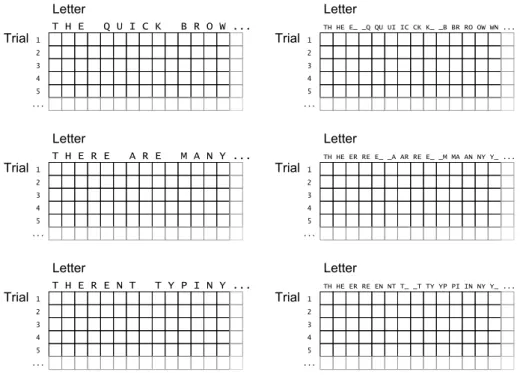
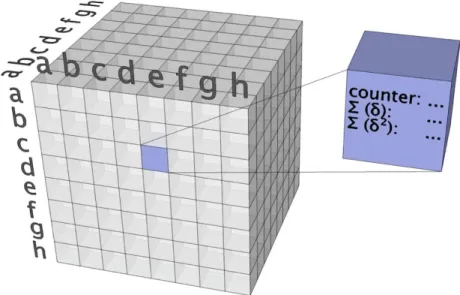
(26) Chapter 2. Fixed-text Experiments To provide practical data which would guide the development of GFT-analysis software, a set of preliminary experiments was carried out. These experiments were based on fixed text rather than free text, and they were intended to collect raw keystroke timing data from a variety of users with different levels of typing experience. To avoid unnecessary environmental bias, no constraints were placed on the users regarding the total time of execution, nor the circumstances under which the tests should take place. The software for the experiments was made freely downloadable from the world-wide web. Those invited to take part were primarily friends and colleagues of the researcher, and their friends and associates in turn. Of those who agreed to take part, a total of 14 submitted their results in a timely manner and agreed for their analysis to be included in this thesis. No particular experimental rigour was used with respect to the mix of participants involved. Nevertheless, the range of typing expertise—according to the participants’ selfassessment—covered a broad range, from hunt-and-peck keyboard users to experienced touch typists.. 2.1. Software and experimental method. The software used for the experiments was written in the C language and compiled to run on any recent Microsoft Windows platform (or mature emulator). The decision to use the Windows platform was largely motivated by its wide user base. To maximise the number of potential participants both for this experiment and also for the more in-depth analysis later in the study, it seemed natural to build the software on the OS used by the largest proportion of the target group. In tackling a high-resolution timing problem such as this, it is important to be aware that timing mechanisms on computers tend to be very much operating system specific. As a result, and due to the overwhelming 21.
(27) Keystroke Dynamics as a Biometric. 22. popularity of Windows versus other operating systems, it was decided that producing either cross-platform software or multiple versions for different systems would not be a worthwhile investment of time. In an attempt to gather accurate timing statistics, the software used a method of the Windows API (Application Programming Interface) called QueryPerformanceCounter. Several of the timing mechanisms on the platform (typically those based on system clock interrupts) fail to give accurate results as their granularity is too coarse. In contrast, this very high resolution system timer (used in combination with its sister method QueryPerformanceFrequency) gave the most reliable, accurate and hardware-portable mechanism for recording timestamps of events. For every key-down and key-up event generated by the user typing into the text box in the test window, the software was able to store a record of the key, the event type (whether up or down) and the timestamp counter, accurate to 0.1 ms. The program for collecting the experimental data was designed to be simple and selfcontained. At the end of the experiments the software saved a log file into a user-selected directory, and the participant was then invited to e-mail this results file to the researcher at their convenience. The data collected in these preliminary experiments were of a form analogous to that used for static authentication: participants were required to type fixed known phrases rather than random uncorrelated text. The simplicity of this initial approach meant that the data could be more easily analysed, comparing like with like. In addition, the constraints on the nature of each sample allowed the sizes of the data sets to be much smaller, which made for rather more willing participants: successful dynamic trials in previous literature have typically required much larger sample sets from each individual than for static analysis. Managing dynamic sets and attempting to ensure quality control on a small-scale experiment such as this one would have been prohibitively difficult. At the start of each experimental session, the software presents the participant with the opportunity to undertake a ‘dummy run’ with a phrase not present in the main tests. This allows the participant to become familiar with the interface, decreasing the chances of cognitive and procedural difficulties which might lead to problems with the first formal test run. In this ‘dummy’ phase the software presents the short phrase ‘AMBER LIGHTS’ and invites the user to type this a total of four times. Both the phrase and the number of repetitions were chosen arbitrarily, the only goal being to allow some user accommodation. In this phase, as in all the other phases, the software only accepts correctly typed phrases, with no punctuation or use of alternative keys (such as using Shift for capital letters). All typing exercises and the results of all keypresses are given directly in capitals. In common with all other published studies thus far, the software makes no attempt to handle typing errors intelligently: if an attempt is made to correct an entry, the whole.
(28) Keystroke Dynamics as a Biometric. 23. phrase is cleared and the user is invited to make a fresh attempt. It is acknowledged that for users making a disproportionate amount of mistakes this may provide them with a slightly increased chance of learning a pattern to the phrase, through carrying out a greater number of total attempts. After consideration, this effect was ignored, on the assumption that its impact should not be significant, and it should not affect the ability to distinguish between participants. Indeed, were there to be any measurable effect it should act to compact the field very slightly, bringing the ‘worse’ typists’ data slightly closer to that recovered from the ‘better’ typists—the final analysis would then be slightly more cautious rather than slightly overstated. After the dummy run, the main part of the trial begins, in three distinct sections. In each section, the user is invited to type a set phrase correctly a given number of times. The user is given the phrase before the test begins, and they are reminded that it is not a competition and that they should not try to rush and end up making mistakes. The user may view the test phrase for as long as they wish before beginning the typing trial. The phrase is displayed on the screen at all times during the trial, along with a counter showing the number of remaining times that they should enter it. Characters entered are displayed a text box as with any standard text entry interface. All attempts, both valid and abortive, are logged, but only valid attempts used in the analysis. The three phrases selected for use in the experiments were as follows: • THE QUICK BROWN FOX JUMPS OVER THE LAZY DOG, collected 6 times • THERE ARE MANY DIFFERENT TYPING PATTERNS, collected 6 times • THERENT TYPINY DIFFERNG PARERE MATTE ANS, collected 10 times The first of these is well-known stock text which covers all of the letters of the alphabet in a reasonably compact phrase. The second and third phrases form a pair chosen to investigate the effect of context and cognitive delays. Prior literature has suggested that digraphs alone provide sufficient information to profile users for dynamic monitoring. For this reason, phrase 3, clearly less natural in its composition, was deliberately crafted to include an identical set of digraphs to phrase 2 so that a direct comparison could be made between the two. Once the data had been gathered and converted into a suitable format, they were then analysed using the MATLAB software toolkit.. 2.2. Data analysis and discussion. To analyse the data gathered from each of the 14 participants, the data were first assembled into six distinct matrices per user, a pair for each of the three test phrases..
(29) 24. Keystroke Dynamics as a Biometric. Figure 2.1: The set of input data was assembled into six matrices for each user, two per phrase, representing hold times (left) and inter-key times (right). Of the pair, one corresponded to the hold times for each key, the other to the inter-key delay between consecutive keystrokes (Figure 2.1). In this way similar tests could be performed using both hold time and inter-key metrics. With each row in the matrix representing one trial by one individual, the columns corresponding to the position in the string, we derive feature vectors from each trial. For a test phrase of length N , let n represent the location of a letter (or letter pair) in the phrase, defined over the range 1..N . Let the up-time and down-time vectors be:. U = [u1 , u2 , . . . , uN ] D = [d1 , d2 , . . . , dN ] Then:. φn = un − dn ;. ∀n = 1, 2, . . . , N. H = [φ1 , φ2 , . . . , φN ] for the hold time analysis, and correspondingly:.
(30) 25. Keystroke Dynamics as a Biometric. ψn = dn+1 − un ;. ∀n = 1, 2, . . . , N − 1. L = [ψ1 , ψ2 , . . . , ψN −1 ] for the inter-key metrics. It may be noted that in the inter-key case, overlapping of typed characters can result in negative delays being recorded. To perform some simple matching tests on the results obtained in this way, a simple Euclidean distance classifier was constructed to operate on arrays of these feature vectors. The same procedure was followed for both styles of metric; the notation in the discussion below refers to the hold time features, but the method applies equally to the inter-key tests. To perform the testing, we selected a representative subset of the data for training: in this case, all test runs except the last. The last test run from each participant was used exclusively for testing, with the assumption that the typing was likely to become more stable during the test rather than less. For each phrase, we defined a gallery of vectors, G, representing each performance of the phrase for each of the participants. The training cases were all included separately, rather than using means per-user, as this meant outlying cases (where, for example, a participant may have been interrupted during the test) did not skew the other results from that participant. Then for each test case for matching, we compared it to the set of gallery vectors applying the Euclidean distance classifier as follows: we define the distance εk between the test vector T and each gallery member Gk as:. εk = kT − Gk k2. ∀k = 1, 2, ..., |G|. given the definition of the Euclidean Distance: v u n uX kx − yk = t (xi − yi )2 i=1. We then match the test case to the best fit vector in the gallery Gj , where: εj = min εk k. and declare the classified user for the test case to be the same user responsible for the Gj training data..
Figure

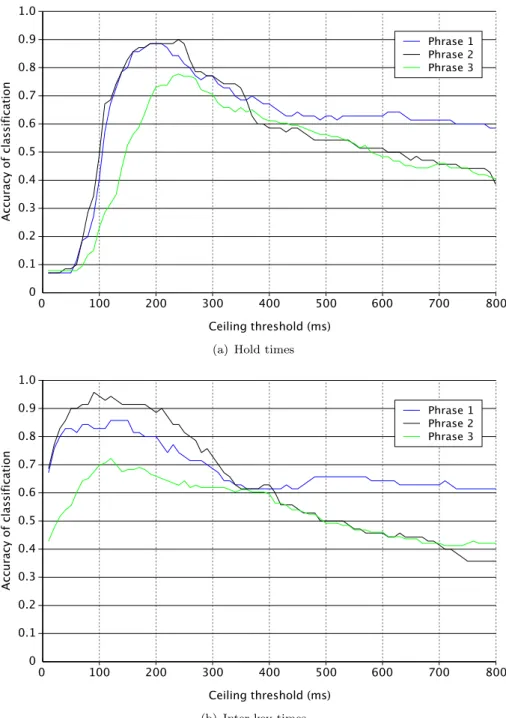

+7
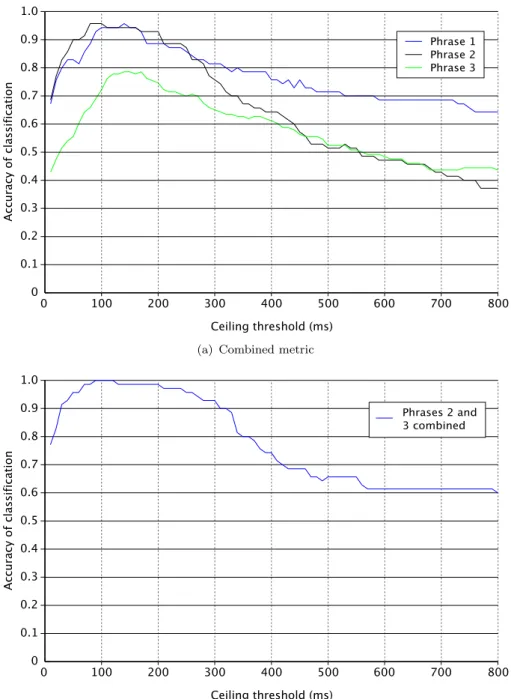
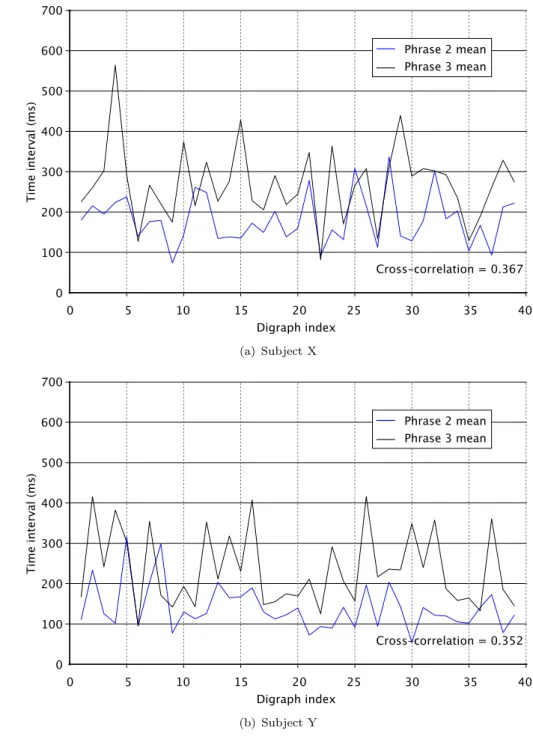
Related documents