The Influences of Workplace Environment,
Job Satisfaction and Organization
Commitment on Job Performance in
Manufacturing Industry
Ahmad Nur Aizat Ahmad1, Md Fauzi Ahmad2, Norhadilah Abdul Hamid3, Nor Aziati Abdul Hamid4,
Norziah Ismail5, Guzman Nawanir6, Adnan Bakri7, MustaqqimAbdul Rahim8
1,2,3,4,5Department of Production and Operation,Faculty of Technology Management and Business, Universiti Tun Hussein Onn Malaysia (UTHM), Parit Raja,Batu Pahat, Johor, Malaysia
6Faculty of Industrial Management,Universiti Malaysia Pahang, Malaysia
7Facilities Maintenance Engineering Department, Universiti Kuala Lumpur –Malaysian Institute of Industrial Technology, Malaysia
8Department of Civil Engineering, School of Environmental Engineering, Universiti Malaysia Perlis (UniMAP), Malaysia
1[email protected], 2[email protected],3[email protected],
4[email protected], 5[email protected], 6[email protected], 7[email protected], 8[email protected]
Abstract— This study was conducted to examine the influence of worker environment, organizational commitment and job satisfaction on work performance among the workers in manufacturing industry in Batu Pahat, Johor. The objective of this study is to identify the dominant influence of workplace environment, organizational commitment, and job satisfaction that effects the job performance in manufacturing industry and to determine the relationship of workplace environment, organizational commitment, and job satisfaction towards job performance. To achieve the objectives, the data were collected through a questionnaire that investigated various performance aspects. Quantitative methods used to achieve the objectives of the study. The Statistical Package for Social Science (SPSS) will be used to calculate the data obtain from the soiled questions that were presented to the respondents. The aim of this study is to train researching developers from universities in view of the transfer, interpretation and scientific knowledge. This study contributes to educate and raise awareness of management, employers, and employees. The result of this study shows there are relationship of workplace environment, organizational commitment, and job satisfaction towards job performance.
Keywords: worker environment, organization commitment, job satisfaction, SPSS, Questionnaire.
1.
Introduction
Employees are the most important asset of an organization and the workable of any organization depends on the skills, competencies and initiative of employees. Every organization need to understand whether workplace environment, job satisfaction and organizational commitment is a very important aspect to be considered in manufacturing industry towards
job performance. Employees with competence are demanded nowadays in accordance with the needs of their organization and committed to organization with lead of work performance skills as mentioned by [1].
Companies need to attract potential employee and make them remain at their organization by prepare pleasant working environment and involve of all the aspects which react on the body and mind of an employee. This indicates that fatigue, congenial, monotony and boredom can reduce the performance level of worker and if this following characteristic of organizational are developed than, the work performance at organization can be increased.
Human beings must be met by needs, and requirements to fulfil their expectation to increase their performance at workplace. In general, basic needs and psychological needs explained that the needs of the individual and the elements are very important factors towards job performance. [2], mentioned commitment of workers in organization are basis issue because it directly related with satisfaction which influence the competiveness of position and profitability. Organizational commitment can influence the employee performance because it’s a notion which attracted the various practitioners because it influences the job performance. Bond among employee and employer can be mentioned as kind of commitment. Absenteeism, turnover rate can be minimized because the willingness of employee’s positive work at organization with remain good performance.
One of the problems that stated nowadays is lack of organization commitment. The worker is not ______________________________________________________________
International Journal of Supply Chain Management IJSCM, ISSN: 2050-7399 (Online), 2051-3771 (Print)
giving their full commitment or incentives in certain company as mentioned by [3]. Commitment have defined as relative strength of individual identification with involvement in a specific organization. Interest of worker is the belief that they are highly committed and engage in more citizenship activities, display higher job performance. Irregular disposition can also be a big problem which cause dissatisfaction among employee and employers. In this case, its shows us there are no job satisfaction among employees. Conflicts with his or her employer and their team who are not in good terms may be subject to anger and dissatisfaction and can affect the attendance of worker. Safety is one of an important element of management. Security goods need to be distributed and made available during work as mentioned by [4]. Therefore, to investigate the relationship among workplace environment, job satisfaction and organization commitment towards job performance, there are two objectives been accomplished, (i)To identify the dominant influence of workplace environment, job satisfaction and organizational commitment that effects the job performance in manufacturing industry and (ii) To determine the relationship of workplace environment, job satisfaction, and organizational commitment on job performance in manufacturing industry. Research question been developed reflected to the objectives of this research. The purpose of this study was to identify dominant influence of worker environment, job satisfaction and organization commitment that effected job performance. Besides that, this study intended to determine the relationship on worker environment, job satisfaction and organization commitment of job performance.
2.
Literature Review
Performance is linked with behavior of worker and it is not about productivity or employee generates but it known as belief about contribution and behavior at organizational success as explained by [5]. An accomplishment of task based on set criteria by organization or supervisor follow the standard of task. Job contribution, quality, and quantity of production knows as high productivity level influence performance. Outcome of work in term of effectiveness, efficiency and efficacy reveals as job performance.
2.1 Job Performance (JP)
Accomplished work related task or skill by workers and actions that contributed to achieve objective of organizational was defined as JP been said by [6]. It can be said as willingness and openness to try to reach new ideas related to work will improve the productivity of organization as mentioned by [7]. A
characteristic that include competiveness and ability of someone to face with risk and challenges that consider as the most important thing in extent the profit level of organization. Work performance, academically studied as part of industrial psychology and part of human resource management. Performance depends on job setting, office atmosphere and social interaction [8].
As mentioned by [2], JP is a completion of task that given by organization with a set of criteria to use available resources with effectively and efficiency. Moreover, performance can consider as outcomes which means workers contribution, quality, and quantity. He said that, High productivity level can influence the performance of organization positively.
2.2 Workplace Environment (WE)
As said by [10], organization are nowadays pay attention with employee needs because most of the organization are aware and protect employee with provide a positive work environment so that the employee feel that they are being protected cared my employee. [10] argue that, space and facilities, relationship between co-workers, equality of treatment, communication system, environmental actors and procedure to control hazard are element of WE that can explain in wide category.
Environment with incompatible facilities such as poor workstations, not following ergonomic standards furniture, lack of safety are contribution of occupational diseases. WE can describe as surroundings environment that place of doing work Include inside, outside or at the desk. Supportive WE has the ability to enhance employee performance. Employer and management started to realize the importance of this factor as mentioned by [10]. Productive worker and satisfied worker are the person who fisher believes happy worker. Safety rules are an important element in dealing with workplace issues.
2.3 Job Satisfaction (JS)
[11] said that organization reactions and responses to JS will come out with positive or negative attitude between personal and job because its more to expectation of human towards and advantage gaining from workplace because JS is an emotional reaction of person whether the satisfied with their work needs and rights. Most probably, JS lead the productivity level of organization, responsibility, physical and mental health, because this will make the employee work with good mood and can gaining new skills as mentioned by [12]. [12] argued that level of responsibility and independency in the work involved show the satisfaction level of the workers on their job.
[12] mentioned that, when employees are committed with their job then turnover ratio will be automatically decreased. Meanwhile, if the employer not provide employees right than the workers wont contented with their work so that turnover will arise in their organization because there is dissatisfaction among employees regard their rights are not protected and implied.
According to [4] which mean JS can be perceived as feelings of achievement and how successful a worker on their job which can contribute to organization with well-being character and attitude. [3] recommended that JS is composed to trust and feelings that employee perceive about their work. JS determined by few elements at the work place for instance Salaries, opportunities, advancement, work conditions, and work team member, further the resultant effect of the determinant serves for satisfaction and dissatisfaction that depend on outcome [6]. Employee who not satisfied with their job might resign their job or may not but there will be such a feeling of dissatisfaction that can impact on their quality of performance.
2.4 Organization Commitment (OC)
[2] mentioned that organizational commitment (OC) is a basic issue between owners and management. Committed employee will care about organization with minimize the turnover chances, absenteeism, and will maximize their willingness of employee to positive work. It also an essential behaviour for intention of worker to leave or contribute more. Worker and company have mutual responsibilities and equal commitments. OC has been defined in multidimensional in nature that involve worker the loyalty, sincere and honesty. Its neither person committed to their work hold a strong sense of work, and place the intrinsic value on work with central life interest.
Hence, [14] said the person who has feelings of belongingness with their organization and perform in work means they are highly committed compared to those who not perform well are recognize as less committed to organization. Commitment of someone know as a loyalty toward the organization and by identifies particular organization goals and objective will maintain the membership in organization. [15] argued that OC refer to individual focus feel of employees on their working place and defined OC also defined by behaviors and performance of worker at working place. Individual’s relative ability and involvement in certain organization with consideration of their organization goals and value to be achieved is also defined as OC.
3. Research Methodology
Research methodology gives better comprehension of fitting exploration approach that implemented. Quantitative research is used to collect empirical and numerical data to accomplish the objectives of study.
3.1 Research Design
Descriptive analysis is applied to identify the dominant influences by calculating mean. Meanwhile Correlation analyses were used to determine the relationship between independent and dependent variables. This study conducted using quantitative method. Implemented using survey question. This analysis involved questionnaire checking, data entry, data clearing, check missing value and outlier. Statistical analysis in order to address research question and to test hypothesis. Quantitative research was embraced as the best method in this review to identify the dominant factor influence job performance. By utilizing the survey question, the information was being analyzed using statistical package for social science) SPSS version 25 software.
3.2 Population and sampling
The total population of the studied company specifically to molding department worker are 300. The targeted sample are 169 workers as respondent following theory of DE Morgan sample. Respondent consist of three level of management (higher level, middle level and lower level). The survey was distributed to production manager. The production manager helps to distribute the questionnaire to the workers. Questionnaires, survey, observation and interview are few type of data collection tools that used to complete this research. In this study, questionnaire are distributed among target sample.
3.3 Descriptive Analysis
Descriptive statistics are brief descriptive coefficients that summarize a given data set, which can be either a representation of the entire population or a sample. Used to simplify the data obtained through the questionnaire and present it in systematic outcomes using software program. Collected data are enter manually into SPSS software. Calculation of mean, average, percentage and frequency are show by software SPSS.
4.
Data
AnalysisTo complete this research, there are data gathered from questionnaire need to be analyse. The data consist of information to be used to be analyse using SPSS.
4.1 Survey
Population for these study are workers in molding department of studied company which consist of three level such as top level management, middle level management and lower level management. 170 questionnaires being distributed via on hand in form of survey paper by production manager. The population in molding department are 300 workers. The targeted sample for these study is 169 and get return 132 sample. (78%)
Table 4.1: Survey Return Rate Population Sample size Questionnaire
distribution Questionna ire return Return rate (%) 210 136 145 132 97 4.2 Reliability Analysis
Cronbach’s Alpha is a tool that used to measure the internal reliability. The higher or equal value of Cronbach’s Alpha to 0.7 is acceptable. Besides that, if the result of Cronbach’s Alpha lower than 0.7, researcher is required to improve their Cronbach alpha to 0.70 0r above. The result Cronbach’s Alpha can be improved by removing the problematic question which is not get a proper respond from respondent.
4.3 Actual Study Reliability
Reliability analysis for actual study was conducted after the researcher has obtain an appropriate value of Cronbach alpha for actual study. The number of respondents are 132.
Table 4.3: Reliability test for Actual study Independent Variable Alph a Number of Number of Resu lt Worker 0.70 6 130 Goo
Job Satisfaction 0.79 5 130 Goo Organization 0.71 5 130 Goo Job 0.71 6 130 Goo 4.4 Analysis Normality
If the number of respondent exceed than 50, Kolmogorov- Smirnov (K-S) test are most commonly used to check the normality of data. The significant value (p > 0.05) means that the data are normally distributed and (p < 0.05) not normally distributed. Therefore, this research is not normally distributed. To achieve the objective of the study, Spearman rho correlation test is used (non-parametric test).
Table 4.4 Normality test
Kolmogorov-Smirnov Statistic df Sig. Worker Environment .177 132 .000 Job Satisfaction .143 132 .000 Organization .133 132 .000 Job Performance .110 132 .001 4.5 Analysis of Research Question 1
“What are the dominant influence among worker environment, job satisfaction and organization commitment that effect job performance in manufacturing industry?”
To answer this research question, the researcher analyse data using mean Score to determine the dominant factor that influence performance of
workers. Every factor got their average mean score that measured by extent level of mean. The mean value can be grouped into low, moderate and high [5].
Table 4.5 Extent Level of Mean (Tasmin & woods, 2008)
4.5.1 Descriptive analysis for Independent Variable 1
Table 4.5.1 shows the mean of worker environment. Based on the observations, there are all four items shows high score mean, which are 3.90, 4.07 and 3.98 out of 6. Meanwhile, the mean score for other shows moderate level with a mean value 2.80, 3.73, and 3.76. The average mean score explains that most of the respondent agree with all item. The overall results for worker environment achieve Moderate score.
Table 4.5.1 Descriptive analysis for independent variable 1 (Worker Environment)
4.5.2 Descriptive analysis for Independent Variable 2
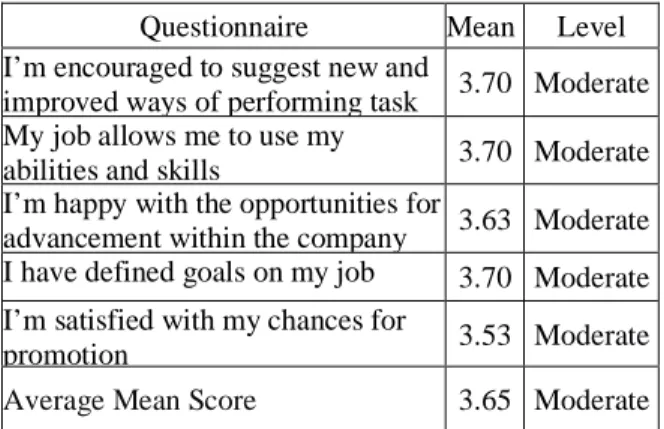
Table 4.5.2 shows the mean of job performance. Based on the observations, there are all five items score mean, which are 3.70, 3.70, 3.63, 3.70, and 3.53 out of 5. Meanwhile, the mean score for all questions shows moderate level. The average mean score explains that most of the respondent agree with all item. The overall results for job satisfaction achieve Moderate score level.
Extent Range
Low 1.0-2.3
Moderate 2.4-3.7
High 3.8-5.0
Mean Level
My duties are equally divided between co- 3.90 High Women and men have the same 3.76 Moderat
We have a good working environment 4.07 High I feel safe and comfortable at my working 3.98 High I feel stress at my work place 2.80 Moderat The relationship between worker and
3.73 Moderat
Table 4.5.2 Descriptive analysis for independent variable 2 Job Satisfaction
4.5.3 Descriptive analysis for Independent Variable 3
Table 4.5.3 shows the mean of worker’s organization commitment. Based on the observations, there are all four item shows high score mean, which are 4.17, 4.15, 3.89 and 3.84 out of 5. Meanwhile, the mean score for one of item is moderate level with a mean value 3.73. The average mean score explains that most of the respondent agree with all items. The overall results for worker commitment in organization achieved high score.
Table 4.5.3 Descriptive analysis for independent variable 3 (Organization Commitment)
Mean Level I feel company taking good care of the 4.17 High I feel company provide needs and
4.15 High I really care about the fate of this 3.73 Moderate I feel commitment of the organization
3.89 High I have defined goals on my job 3.84 High Average Mean Score 3.97 High 4.6. Summary of main dominant factor that influence job performance
The major factor that influence job performance in the studied company is organization commitment with high average score (3.97). This result reflected the commitment of worker in organization to improve their performance at work place.
Table 4.6 Summary of Average Mean for all Variables
Independent variable Average Level Worker Environment 3.71 Moderate Job Satisfaction 3.65 Moderate Organization 3.97 High
Descriptive mean analysis was carried out to determine the mean range of these three variables (worker environment, job satisfaction and
organization commitment) on job performance and obtain the high level mean range to accomplish the objective of the research.
The findings show that Factor that influence job performance from view of worker environment, job satisfaction and organization commitment are in between mean rage of moderate to high (3.65 to 3.97). Specifically, Organization commitment are the main dominant factor that influence job performance (3.97) and followed by worker environment factor that states the average mean level at 3.71. Job satisfaction recorded average level of mean with 3.67 and describes that this factor influence of this variable are in moderate level. In a nutshell, the dominant factor that influence job performance in manufacturing industry is organization commitment.
The Findings was parallel with previous study of [2] that stated commitment of worker in organizational improves the competitiveness and employee performance that being mutual perception, ability and effort for complete task at manufacturing industry. [17] explained that organizational commitment were independently and jointly predicts with positive relation with job performance.
4.7 Discussion of the relationship of worker environment, job satisfaction and organization commitment on job performance
manufacturing industry.
There is a significant relationship between two factors on job performance. Which are job satisfaction and organization commitment. That states the significant value achieved. Meanwhile there is no significant relationship between worker environment factors towards job performance.
4.8 Relationship between worker environment and job performance.
From the findings of analysis, the significant value between worker environment and job performance states was p value 0.395 > 0.01 it means that, there is no significant relationship between two variables. The value of Spearman’s rho correlation coefficient is r = 0.075 (7.5%). The correlation coefficient describes there no relation relationship between worker environment and job performance.
Furthermore, the element of “We have a good working environment” scored the highest mean at 4.07. The result is contra to past study that for the statement of worker environment influence job performance at working place. This is because a better and comfortable worker environment can reduce the stress and done work more wisely [16].
Questionnaire Mean Level I’m encouraged to suggest new and
improved ways of performing task 3.70 Moderate My job allows me to use my
abilities and skills 3.70 Moderate I’m happy with the opportunities for
advancement within the company 3.63 Moderate I have defined goals on my job 3.70 Moderate I’m satisfied with my chances for
promotion 3.53 Moderate
4.9 Relationship between Job Satisfaction and job performance
The significant value of job satisfaction towards job performance recorded was p value 0.003 < 0.01. This indicates that there is a positive relation between job satisfaction commitment and job performance but the Spearman’s rho correlation coefficient is very weak value with coefficient of 0.253 (25.3%). The mean score for three elements for measure job satisfaction reached 3.70 at moderate level. Which is “I’m encouraged to suggest new and improved ways of performing task” and “My job allows me to use my abilities and skills" and “I have defined goals on my job”. Hence, this finding has a positive relationship but weak strength of correlation coefficient because [3] determines not necessary the employee with job satisfaction may not have a high performance level.
4.10 Relationship between Organization
commitment and job performance.
Both of this two variables of Organization commitment and job performance shows there is a significant relationship with p value 0.000 < 0.01. The finding determines there is a positive relation between these two variables with The Spearman’s rho correlation coefficient value is weak and stated at 0.357 (35.7 %).
The highest element in organization commitment “I feel company taking good care of the workers” (4.17). This is because organization commitment is a basic issue of owners of companies and management [18]. This finding are aligned with [17] that stated there is a positive relationship between organization commitment and performance at workplace.
5.
Conclusion
This study proved that organization commitment was the dominant factor that influence job performance. The finding of this research is to answer the research question and to accomplish the objectives that exist in earlier of research. Analysis that be carried out in research data involved 132 respondents was a positive relationship between organizational commitment and job performance. Furthermore, the objective to identify the relationship, there are three hypotheses were tested and two accepted. This indicates that there is a significant relationship of job satisfaction and organization commitment on job performance. Hence, the finding determines these two factors are influence job performance. Meanwhile, the relationship of worker environment on job performance show there is no relationship that states p value less than 0.01.
Acknowledgement
The authors gratefully acknowledge Universiti Tun Hussein Onn, Malaysia and Ministry of Higher Education for the financial support provided for this research through Research Grant Scheme, TIER 1 Vot U879.
References
[1] Sofia, I. P. (2014). The Effect Of Work Environment, Job Satisfaction, Organization Commitment On Ocb Of Internal Auditors, 5(2), 10–18.
[2] Az, H. (2017). Arabian Journal of Business and Relationship between Organizational Commitment and Employee’s Performance Evidence from Banking Sector of Lahore, 7(2). https://doi.org/10.4172/2223-5833.1000304. [3] Aziri, B. (2011). Job Satisfaction: A Literature
Review, 3(4), 77–86.
[4] Kaliski, B.S. (2007). Encyclopedia of Business and Finance, Second edition. Thompson Gale, Detroit.
[5] Hueryeren Y, Dachuan H (2012) the Mediating Effect of Organizational Commitment on Leadership Type and Job Performance. Journal of human Resources and adult learning. 8: 50-59.
[6] Christen, M., Iyer, G., & Soberman, D. (2006). Job Satisfaction, Job Performance, and Effort: A Reexamination Using Agency Theory. Journal of Marketing, 70(1), 137–150.
[7] Fu, W., & Deshpande, S. P. (2014). The Impact of Caring Climate, Job Satisfaction, and Organizational Commitment on Job Performance of Employees in a China’s Insurance Company. Journal of Business Ethics, 124(2), 339–349. https://doi.org/10.1007/s10551-013-1876-y. [8] Balouch, R., & Hassan, F. (2014). Determinants
of Job Satisfaction and its Impact on Employee Performance and Turnover Intentions, 4(2), 120–140.
[9] Mehboob, F., & Bhutto, N. A. (2012). I Interdisciplinary Journal of Contemporary Research In Business A Study of Faculty Members at Business Institutes Job Satisfaction as a Predictor of Organizational Citizenship Behavior, 1447–1455.
[10] Chandrasekar, K. (2011). Workplace Environment And Its Impact On Organizational Performance In Public Sector, 1(1)..
[11] Munisamy, S. (2013). Identifying Factors That Influences Job Performance Amongst Employees In Oil Palm Plantation.
[12] Raziq, A., & Maulabakhsh, R. (2015). Impact of Working Environment on Job Satisfaction.
Procedia Economics and Finance, 23(October 2014), 717–725.
[13] Inuwa, M. (2016). Job Satisfaction and Employee Performance: An Empirical Approach, 1(1), 90–103.
[14] Metin, K., & Asli, K. (2018). The Relationship between Organizational Commitment and Work Performance: A Case of Industrial Enterprises, 5(1), 46–50.
[15] Studies, M., Polytechnic, T., State, O., Iree, P., Studies, M., & Polytechnic, T. (2014). Exploring the Effect of Organizational Commitment Dimensions on Employees Performance: An Empirical Evidence from Academic Staff of Oyo State Owned Tertiary Institutions, Nigeria, 4(8), 275–286. https://doi.org/10.6007/IJARBSS/v4-i8/1096 [16] Suma, S., & Lesha, J. (2013). Job Satisfaction
and Organizational Commitment: the Case of Shkodra Municipality. European Scientific Journal, 9(17), 1857–7881.
[17] Negin M, Omid M, Ahmad BM (2013). The impact Organization Commitment on Employees Job Performance. A study of Mell Bank. International Journal of Contemporary Research in Business, 5 164-171.
[18] Ulndag, O. (2011). The Effects of Job Satisfaction, Organizational Commitment, Organizational Citizenship Behavior on Turnover Intentions the Effects of Job Satisfaction, Organizational Commitment, 29(2).