http://dx.doi.org/10.17576/pengurusan-2016-47-09
Organisational Context and Citizenship Behaviour: Exploring the Moderating
Effects of Role Ambiguity
(Konteks Organisasi dan Kelakuan Kewargaaan Organisasi: Kajiselidik Kesan Moderasi Kekaburan Peranan)
Kim Lian Lee
(Taylor’s Business School, Taylor’s University) Low Guan Tui
(Vesseltech Engineering Sdn. Bhd.) Saeed Pahlevan Sharif
(Taylor’s Business School, Taylor’s University) ABSTRACT
The purpose of this paper is to examine the effect of organisational context on the organisational citizenship behaviour. The study also aimed at finding out the moderating effect of the role ambiguity on the relationship between organisational context (i.e. structure) and the organisational citizenship behaviour. Data from 280 respondents were used in the statistical analysis. Covariance-Based Structural Equation Modelling was used to test the hypotheses. The study revealed that structure has a significant positive effect on organisational citizenship behaviour. The interaction of organisational structure and role ambiguity has a significant positive effect on organisational citizenship behaviour. Statistical analysis confirmed that role ambiguity is a significant moderator of the relationship between organisational structure and organisational citizenship behaviour.
Keyword: Organisational context; role ambiguity; organisational citizenship behaviour ABSTRAK
Tujuan kajian ini dilaksanakan adalah untuk menyelidik kesan konteks organisasi ke atas kelakuan kewargaan organisasi. Kajian ini juga menyelidik kesan moderasi kekaburan peranan (role ambiguity) ke atas hubungan di antara konteks organisasi (contohnya struktur) dan kelakuan kewargaan organisasi. Data dari 280 orang responden telah digunakan dalam analisa statistik. Kaedah Structural Equation Modelling berasaskan kovarian telah digunakan untuk menguji hipotesis kajian. Hasil analisis data menunjukkan bahawa struktur organisasi mempunyai kesan positif ke atas kelakuan kewargaan organisasi. Perkaitan di antara struktur organisasi dan kekaburan peranan mempunyai kesan positif ke atas kelakuan kewargaan organisasi. Keputusan analisis statistik juga menunjukkan bahawa kekaburan peranan merupakan moderasi dalam hubungan di antara struktur organisasi dan kelakuan kewargaan organisasi. Kata kunci: Kontek organisasi; kekaburan peranan; kelakuan kewargaan organisasi
of performance. In turn, organisational citizenship behaviour could also be affected by the organisational context, the presence of role ambiguity, organisational support etc. (Chiang & Hsieh 2012). The understanding of how these variables affect OCB will help manager
provide conducive condition for OCB.
The structure of an organisation is typically defined
as “the total sum of the ways in which it divides its labour into distinct tasks and then achieves coordination among them” (Mintzberg 1979: 2). Structure is also termed as ‘anatomy of the organisation’ within which it lays the foundation and framework for the organisation to function. The structure of an organisation can vary and affect both the behaviour and attitudes of the organisational members as highlighted by Hall (1977: 109) in his statement that “organisational structure
served to minimise or at least regulate the influence
of individual variations in the organisation. Structure is imposed to ensure that individuals conform to the
INTRODUCTION
Studies found that organisational citizenship behaviour (OCB) produces various tangible benefits for employees,
co-workers, supervisors and organisations in a variety of industries (MacKenzie, Podsakoff & Fetter 1991; Nelson & Quick 1999; Podsakoff et al. 2000; Barksdale & Werner 2001; Koys 2001; Bolino, Turnley & Bloodgood 2002; Ackfeldt & Leonard 2005). It is a behaviour that the organisation would want to promote and encourage. Podsakoff and MacKenzie (1997: 135) argue that in general, OCB enhances organisational performance by
“lubricating the social machinery of the organisation,
reducing friction, and or increasing efficiency”. OCB may
also contribute to organisational success by enhancing co-worker and managerial productivity, promoting better use of scarce resources, improving co-ordination, strengthening the organisation’s ability to attract and retain better employees, and reducing variability
requirements of the organisation and not vice versa”. Organisational structure is a form of contextual factor that symbolises the type of expected behaviour and leadership in an organisation (Dust, Resick & Mawritz
2014). Central to this definition is the division of labour,
which creates task positions and the inter-relationships or interdependencies among positions. Hence, job differentiation, the formulation of rules, and formal relationships among employees of the organisation are the essence of organisational structure.
Role ambiguity happens when employees are unclear of their role parameters (Sayers, Salamonson, DiGiacomo & Davidson 2015). According to role theory, role ambiguity results in employees adopting coping behaviour in an attempt to solve the problems and thus avoid stress, or to use defence mechanisms for changing the real situation. Therefore, causing employee to be
dissatisfied with his or her role in the organisation (Rizzo
et al. 1970; Cicero, Pierro & Van Knippenberg 2010). It can be seen that the consequences of role ambiguity thus have potential cost implications to organisations. The costs of turnover and poor performance are obvious, however the true cost of attitudinal variables is also now understood (Cascio 1982; Mirvis & Lawler 1977).
This view has been reinforced by empirical findings
where research has been centred on examining the effects
of role ambiguity, and findings have started to reveal
the consequences of role ambiguity. Kahn et al. (1964) and other theorists (Miles 1976; Rizzo at al. 1970) have proposed that high levels of role ambiguity result in several unfavourable psychological effects. Such
effects are likely to adversely influence the effectiveness
of any organisation as role ambiguity occurs when employees are not certain of how to perform given roles or tasks. Among these effects are tension, stress, hostility, dissatisfaction, low productivity, performance and turnover (Seeman 1953; Merton 1957; Cohen 1959; Kahn et al. 1964; Katz & Kahn 1978; Rizzo et al. 1970). However, it is possible that role ambiguity can cause employee to give more if the organisational structure
is organic since organic structure gives flexibility for
employees to explore and experience the uncertainty about what is unexpected of a task performed.
Exploration of issues regarding structure and OCB
is important. Most research on OCB up to the early
1990s focused on individual phenomena (Folger 1993; Moorman et al. 1993), but seems not to fully capture the OCB construct. Individuals performing OCB do not
do so in vacuum and organisational context may serve to encourage or discourage individuals to engage in OCB
(George & Jones 1997). According to Podsakoff and MacKenzie (1995), organisational structure which is less formalised can create a working environment that encourage employees to engage in OCB. Conversely,
Somech and Drach-Zahavy (2004) revealed an interesting insight that formalisation (mechanistic structure) can affect the organisational members’ OCB. Additionally,
another area in which research has been lacking concerns
the understanding of how the organisation structure affects role ambiguity. The characteristics of organisational structure can contribute to inconsistent expectations and uncertainty.
Thus, this study seeks to identify the direct
and indirect influence of organisational context, the
perception of role ambiguity on the organisational citizenship behaviour. It also seeks to clarify the condition under which OCB can be further enhanced within certain
organisational context. The delineation of the research question is to examine the relationship of organisational context, role ambiguity and organisational citizenship behaviour in Malaysian companies. This study seeks to
answer the two specific questions, namely: 1) What is the
effect of organisational structure and role ambiguity on organisational citizenship behaviour? 2) To what extent does role ambiguity moderate the relationship between the organisational context and employee citizenship behaviour?
LITERATURE REVIEW
This section reviews the relevant constructs and variables as well as their interactions involving: (1) Organisational Context; (2) Role Ambiguity; and (3) the key dependent variable i.e. Organisational Citizenship Behaviour.
ORGANISATIONAL CONTEXTUAL VARIABLE
Organisational context is an important determinant of attitudes and behaviour. Rousseau (1978: 522) noted that “recognition is growing that both individual differences and characteristics of organisational settings are germane to all phases of organisation research”. Rousseau (1978: 522) further defined organisational context as “characteristics of the organisational setting, the individual, individual role in the organisation and other environment factors that may shape the responses”. In the past, researchers have used many different contextual variables including tasks characteristics such as task
identity, task significant, autonomy (Rousseau 1978),
structure and technology (Sutton & Rousseau 1979), structure and size (Ashforth, Saks & Lee 1998). In this
study, the researcher has specifically explored structure
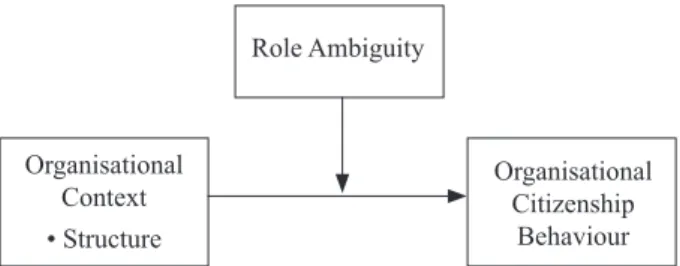
as organisational context in the proposed model in Figure 1.
FIGURE 1. Proposed model of the moderating influence of role ambiguity and its interactions
Organisational Citizenship Behaviour Role Ambiguity Organisational Context • Structure
ORGANISATIONAL STRUCTURE
In this study, structure is conceptualised on a mechanistic-organic continuum based on the theory of Burns and Stalker (1961) of mechanistic and organic structure which has proven its reliability in terms of measuring organisational properties. Although this mechanistic-organic view of organisational structure differs from the traditional view that emphasises such variables as centralisation and formalisation, it is consistent with the Burns and Stalker (1961) suggestion that some successful organisations tend to favour vertical specialisation (control) or horizontal specialisation (co-ordination). When an organisation clearly spells out rules, policies,
regulations and procedures, rigidity and inflexibility
result, and when organisations centralise their decision-making and develop elaborate control systems backed by a centralised staff, the term ‘mechanistic’ or ‘bureaucratic” is used to describe them (Burns & Stalker 1966). This type of organisation tends to have a vertical emphasis as the staff units will always be placed at the top of the system. In mechanistic organisations, departmentalisation serves as a specialised functional and hierarchical division of labour. The mechanistic structure can be seen in the stable and predictable environments where organisations tend to be strictly controlled and highly formalised, standardised and mechanised.
Intuitively, the opposite of mechanistic structure is labelled ‘organic’ (Burns & Stalker 1961). This structure tends to emphasise horizontal specialisation and co-ordination and there are comparatively few rules enforced in the organisation. Although there may be numerous policies and procedures and an extensive information system in place, staff units are usually placed toward the middle of a whole in this type of organisation. Typical forms of departmentalisation are the divisional and the matrix. This type of structure is most likely to be seen when the organisation is in its early stages of existence and in late maturity facing uncertain and turbulent environments (Burns & Stalker 1966). Such
organisations are more loosely structured, more flexible
and innovative and less specialised. They have open, lateral communication, decentralised decision-making processes, less formalisation and standardisation, fewer hierarchical distinctions and a less strict division of labour.
ROLE AMBIGUITY
Role ambiguity has been in the spotlight of human performance researches. Kalbers and Cenker (2008)
defined roles ambiguity as the lack of confidence of an
employee’s perception of responsibility. Jones (2007)
defined as lack of clear direction in the roles an employee
is expected to perform. The study of role ambiguity is still crucial for organisations, especially in light of issues such as diversity, globalisation and competitive pressure. It is vital for an individual to understand one’s role from a personal perspective as such understanding can have
an influence on the individual’s motivation, satisfaction
and performance (Beris, Sethela & Mahmood 2011). Ultimately, managers and employees need role clarity to ensure that they are working on the things that will
make the firm successful. Role incumbents who are
experiencing role ambiguity may be working on the wrong things (based on the organisation’s mission and objectives) and are probably unaware that they are doing so (Onyemah 2008). Singh and Bhandarker (1983: 50) once stated that “managerial role clarity is viewed as one of the basic requirements for organisational effectiveness”. They further stated that “managers suffering from role ambiguity are invariably observed to be pre-occupied with trivial organisational chores” (p. 35). Thus, based on the underlying role theory, high levels of ambiguity are unlikely to reduce the role incumbent satisfaction levels. In a worse scenario, it increases work anxiety, distorts reality and produces less effective work outcomes (Rizzo et al. 1970). Employees are often associated with higher tension levels and less job satisfaction when they are not clear with their required roles (Dasgupta 2012).
From a different standpoint, uncertainty regarding one’s job responsibilities creates an environment
that fosters influence attempts because of the unclear
connections among effort, performance and desired outcomes (Cicero, Pierro & Van Knippenberg 2010; Luthans 2006; Jones 2007; Onyemah 2008; Slattery, Selvarajan & Anderson 2008; Madison, Allen, Porter, Renwick & Mayes 1980; Parker, Dipboye & Jackson 1995). When role ambiguity is high, there is a greater dependence on information and feedback which can clarify the appropriateness of one’s action (Dobbins, Cardy & Platz-Vieno 1990). Therefore, as role ambiguity increases, the leader becomes more instrumental because the role clarifying information and feedback available from the leader becomes more relevant (Abdullah & Kassim 2011; Howell, Dorfman & Kerr 1986). Conversely, as role ambiguity decreases, role clarifying information from the leader becomes less instrumental. Thus, one could argue that the link between leadership and OCB would be stronger when role ambiguity is high
and weaker when role ambiguity is low. This is one of the premises of the current study.
The researcher’s study is specifically exploring
role ambiguity rather than role conflict to establish the
relationship between the variables and its antecedents and consequences. There are several reasons that dictate
the choice of role ambiguity over role conflict in this
instance, these being: (i) role ambiguity is an important concept in role theory as well as in path-goal theory of leadership; (ii) of all role concepts, role ambiguity has received the most attention; (iii) in comparison with role
conflict, role ambiguity is more amenable to managerial
intervention and thus the implementation of programmes aimed at diminishing role ambiguity is relatively less
difficult, and (iv) studies involving role ambiguity have
yielded inconsistent results, prompting greater research incentive.
ORGANISATIONAL CITIZENSHIP BEHAVIOUR
The construct of OCB was introduced by Bateman and
Organ (1983) by drawing upon the concept of super role behaviours as presented by Katz and Kahn (1966). Examples of employees OCB include: accepting extra
duties and responsibilities at work, working overtime when needed, and helping subordinates with their work (Organ 1988; Masterson, Lewis, Goldman & Taylor 1996). Organisations need their employees to participate beyond formal job requirements, such as participating and cooperating with helpful behaviours (Dierdorff, Rubin & Bachrach 2012). The behaviour of cooperating among colleagues, helping each other, job dedication, while consciously complying with organisational objectives is known as “citizenship” Borman and Penner (2001). Researches have generally shown that OCB can be linked
with a wide variety of desirable employees and employers’ outcomes, for example, better employee performance, as well as better quality and increased quantity of unit-level production (Organ, Podsakoff & MacKenzie 2006).
For this study, the researcher has chosen the OCB
construct developed by Smith et al. (1983). The authors
have identified two dimensions of OCB: altruism and
compliance. Altruism refers to behaviours aimed at helping another person such as assisting the supervisor with his or her work, orienting new people and helping others who have been absent, accepting extra duties and responsibilities at work, and working overtime when needed (Masterson, Lewis, Goldman & Taylor 2000). Smith et al. (1983) contrasted altruism with generalised
compliance, which they identified as behaviours that were not directed at specific individuals but rather at the system
itself. Compliance refers to impersonal behaviours such as not taking undeserved breaks or time off, being punctual and giving advance notice if unable to come to
work. In fact, compliance behaviours are typified by an
impersonal conscientiousness on the part of employee whereby he or she seeks to do what is ‘right and proper’
for the benefit of the organisation rather than specific
individuals. Not only have these two categories of OCB
been identified as the primary examples of OCB-I and OCB-O respectively (Organ 1997), but they are also
two of the most commonly studied dimensions of OCB,
dating back to the early findings of Smith et al. (1983)
on altruism and compliance.
Determining why individuals engage in OCB has
occupied a substantial amount of research attention in both organisational behaviour and social psychology (Brief & Motowidlo 1986; McNeely & Meglino 1994). Most research on OCB has focused on the effects of OCB
on individuals, leadership behaviour and organisational performance (Podsakoff, MacKenzie, Pain & Bachrach 2000; Bolino et al. 2002). A number of predictors of OCBs
have been identified including job attitudes (Organ 1988;
Shore & Wayne 1993), interpersonal trust or loyalty to the leader (Podsakoff et al. 1990; Johnson, Lanaj, Tan & Chang 2012), transformational leadership behaviour (Greenberg
1988), task characteristics (Farh, Podsakoff & Organ 1990), organisational justice (Moorman 1991), cultural
influences (Farh, Earley & Lin 1997), civic citizenship and
covenantal relationship (Van Dyne, Graham & Dienesch
1994), dispositional influences (Van Dyne et al. 1994; Moorman & Blakely 1995) and contextual influences
(Netemeyer, Boles, McKee & McMurrian 1997). The outcomes of OCB studied are satisfaction (Bateman &
Organ 1983), commitment (O’Reilly & Chatman 1986), perceptions of fairness (Martin & Bies 1991; Moorman, Niehoff & Organ 1993; Tepper & Taylor 2003) and perceptions of pay equity (Organ 1988).
It would seem that an employee who engages in OCB
would be contributing to the department’s efficiency and
effectiveness and thus helping the supervisor. Moreover, empirical and conceptual work in OCB suggests these
to be indicative of an employee’s performance in the work place and significantly related to supervisory performance ratings (MacKenzie et al. 1991; Werner 1994). Thus, OCB may be used as a way of reciprocating
support from the supervisor.
THEORETICAL FRAMEWORK
STRUCTURE AND OCB
Based on the assumption by Eisenberg and Fabes (1988),
OCB can be influenced by organisational patterns.
George and Bettenhausen (1990) and Podsakoff and MacKenzie (1995) seem to agree with this assumption,
finding that less highly formalised organisations created
an atmosphere of group cohesiveness that encouraged employees to engage in OCB, whereas bureaucratically
structured organisations created an environment of employees alienation that inhibited OCBs. For example,
when an organisational culture is less formalized and is being supportive, employees are more likely to exhibit greater commitment as compared to bureaucratic and less supportive organisations (Organ et al. 2006). Hence, individuals who perform or fail to perform OCB do not
do so in a vacuum; the organisational context in which these behaviours are performed serves to encourage or discourage them.
DeGroot and Brownlee (2006) explored the variable of organisational structure on OCB and organisational
effectiveness at the departmental level of 101 organisations; they found that the relationship between structure (organic-mechanistic) and organisational effectiveness
is partly influenced by OCB. Similarly, a study conducted
by Armenakis, Harris, and Mossholder (1993) on the
organisational decentralised and flexible structure found
such a structure to provide opportunities for organisational members to actively participate and enhance involvement and commitment (Durham, Knight & Locke 1997). This in turn might lead individuals to engage in behaviours that will help the organisation to achieve its goals, whether or not these are part of the employee’s role (OCB). Similarly,
interdependence in tasks and processes will lead to a reduction in formalised rules and procedures and a rise in group cohesion (Senge 1993). In turn, this situation will influence task and organisational characteristics which may be the key to promoting OCB (Organ 1990;
Podsakoff et al. 1996b) by encouraging individuals to co-operate, share and help co-workers in order to attain the organisational goals (Erez & Somech 1996; Knutson & Miranda 2000; Mitchel & Silver 1991). Accordingly, the following hypothesis is proposed.
H1 Organic structure has a significant positive effect on
subordinates’ organisational citizenship behaviour.
ROLE AMBIGUITY AND OCB
Theoretically, a high level of role ambiguity impedes the opportunity of a person to perform effectively and
efficiently (Kahn et al. 1964). When role ambiguity is
low, employees have higher organisational commitment and will perform better at work; employees are willing to commit more, thus leading to better OCB (Chun,
Shin, Choi & Kim 2011). Unfortunately, researches are polarized and the relationship between role ambiguity and job performance is unclear. Although some studies have demonstrated a negative relationship between role ambiguity and job performance (Bagozzi 1978; Behrman et al. 1981; Behrman & Perreault 1984; Fried et al. 1998; Lysonski 1985; Schuler 1975; Szilagyi, Sim & Keller 1976; Walker, Churchull & Ford 1977), other studies indicate weak or no relationship (Brief & Aldag 1976; Jackson & Schuler 1985; Schriesheim & Murphy 1976; Schuler 1977; Schuler, Aldag & Brief 1977). Although
no definite conclusions can be drawn, the inconsistencies
in previous results indicate that the “literature clearly lacks theoretical and empirical integration” (Fry, Futrell, Parasuraman & Chmielewski 1986: 153), and perhaps due
to the underspecified model studied in the past.
In addition, role ambiguity has been found to
negatively influence in-role performance in a number
of studies (Brown & Peterson 1993; Jaworski & Kohli 1991). In fact, Churchill et al. (1985) reported that role perceptions were more strongly associated with salesperson performance. The reasoning is simply that salespeople can better focus on appropriate objectives and thus achieve higher performance when they are clear about what are expected to accomplish. Higher performance can be inferred to perform extra-role behaviour. Majority of literatures still support that unclear expectations due to role ambiguity may cause lower performance. Lower performance may not lead to extra-role behaviour. Thus, the next hypothesis is formulated as:
H2 Subordinates’ organisational citizenship behaviour will be reduced as role ambiguity increases.
MODERATING EFFECT OF ROLE AMBIGUITY
As studies so far (Behrman et al. 1981; Behrman & Perreault 1984; Jackson & Schuler 1985; Fry et al. 1986;
Fried et al. 1998; Jaworski & Kohli 1991; Onyemah 2008) implicates that the effect of role ambiguity on performance is not conclusive, it is necessary to investigate the role ambiguity as the moderating variable. Role ambiguity is often observed in the organic structure where the
organisational environment promotes flexibility, innovation
and freedom of action. As this structure is expectedly more favourable in turbulent environment or early stage of organisational development, thus it is not expected that role ambiguity will have direct impact on the organisational performance or organisational citizenship behaviour. The effect is expected to be indirect, in the sense that it moderates the relationship between the organisational context and OCB. In a way, certain organisational context
may affect the OCB but the presence of the role ambiguity
will exacerbate or diffuse its effect. Thus, the following hypothesis is put forward as:
H3 Role ambiguity will moderate the relationship
between organic structure and organisational
citizenship behaviour. Specifically the role ambiguity
will increase the positive effect of organic structure on the organisational citizenship behaviour.
DATA AND METHODOLOGY
The sample selection for this study comprises executives, managers and professional people in services, manufacturing, mining and construction companies located mainly in the Klang Valley, Malaysia. This sample was selected for two reasons. Firstly, major industries were selected in order to represent the major sphere of activities in Malaysia. These industries are among the more dominant industries in Malaysia that contribute
significantly to the Gross Domestic Product (GDP) and
employment. It is also believed that the power of the theoretical framework would be increased substantially if the predicted relationships between leadership styles,
downward influence tactics, and OCB were observed in a
more diverse industrial setting. Secondly, samples were drawn only from companies who employed more than 35 employees, in order to include only organisations where a more formalised structure and system of supervision and interactions were more likely to exist and function (Hall 1977).
The companies that met the above criteria were selected from the list of companies compiled from the Federation of Manufacturers, Malaysia, Service Directory, Construction Industry Development Board Directory, and Malaysian Trade and Commerce Directory published in
2015. Stratified random sampling was used in selecting
the samples from the large databases, for example, setting certain selection criteria such as the size of the company, number of respondents per company and numbers of samples that is based on the proportion of industry size. Effort was made to sample respondent from the three (3) major industries that are service, manufacturing and
mining and construction which play a significant role
in providing employment in Malaysian economy. The number of sample to be surveyed is stratified based on the objective to secure adequate or proportionate representation of these industries. The proportion of industry size was based on the data published in the Malaysia Economic Report (2014/2015). Data from respondents were obtained through a survey questionnaire. The cover letter also requested that the questionnaires be distributed to the executive, managerial or professional staff within the company. This indicates that the unit of analysis is individual and not organisation.
In terms of construct and measurement scales for organisational structure, the seven-item scale was developed by Khandwalla (1977) and later used by Covin and Slevin (1989) and Low (2005). Covin and Slevin (1989) demonstrated that the scale has an inter-item
reliability coefficient of 0.80, while Low (2005) reported a coefficient of 0.79.
For role ambiguity, this study employed a six-item scale developed by Rizzo et al. (1970) to measure role ambiguity. This is one of most frequently used scale in organisational studies. In fact, 85% of previous studies have applied the role ambiguity tool developed by Rizzo et al. (1970) according to Jackson and Schuler (1985) and Tubre and Collins (2000). The reported Cronbach
coefficient alpha levels of the Rizzo, House, and Lirtzman
(RHL) scale range from 0.65 to 0.82.
With respect to organisational citizenship behaviour, the study has decided to adopt the OCB instrument
developed by Smith et al. (1983) and measure it as a global construct. This instrument consisted of seven items on the altruism and compliance dimension. The two-dimensional view of OCB was chosen over the broad
categories of OCB due to its popularity in earlier studies
conducted by Smith et al. (1983). Jones and Schaubroeck (2004) reported the reliabilities of the two measures as being 0.79 (altruism) and 0.80 (compliance) for the employee-rated measures.
RESULTS AND DISCUSSIONS
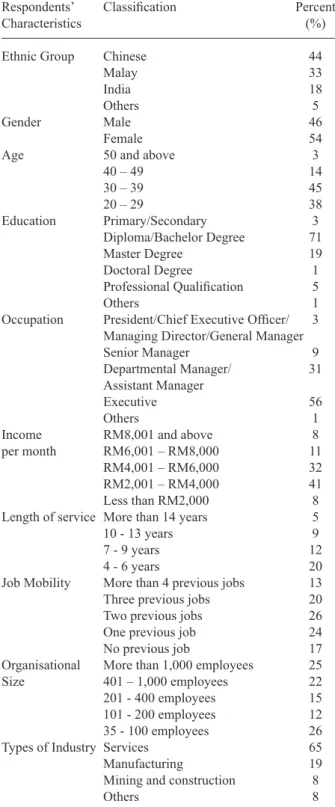
From the total of 1,500 questionnaires sent, a total of 293 responses were received, with data from 280 of those completed questionnaire being usable. The response rate was 18.7%.
RESPONDENTS’ CHARACTERISTICS
The detail of respondents’ characteristics is shown in Table 1. By ethnic group, 44% of the respondents were Chinese, 33% were Malay, and 18% were Indian, while other races made up the rest. By gender, 46% were male and 54% were female. In terms of age, the highest proportion of respondents fell into the 30-39 years age group. They accounted for 45% of the total number of respondents. This was followed by the 20-29 years age
group (38%), while those above 40 years old accounted for the remaining respondents.
On the whole, the education level of the respondents was high. Nearly 71% of the respondents had education up to tertiary level. Only 3% of the respondents had no tertiary education. The high educational level was reflected in the position or the type of occupation held by the majority of the respondents: 8 Presidents/
Chief Executive Officers/Managing Directors/General
Managers, 25 Senior Managers, 87 Departmental Managers/Assistant Managers and 157 Executives, and others made up of only three people.
The survey data showed that 8% earned more than
RM8,001 per month, 11% of the respondents earned more
than RM6,001 per month, 32% earned between RM4,001
to RM6,000 per month, 41% earned between RM2,001 to RM4,000 per month and 8% earned less than RM2,000 per
month. The average salary of the respondents was higher than the population’s average. The population’s average salary was RM2,215.50/month (Source: Malaysian
Economic Report 2014/2015).
On average, the respondents had worked in the present company for three years with a standard deviation of 4.3 years. In detail, 54% of the total respondents had worked for 1 to 3 years in the present company, 11% had worked between 4 to 6 years, 7% had worked between 7 to 9 years and 5% had worked between 10 and 13 years, while only 1% of the respondents had worked longer than 20 years in the present company. The degree of job
mobility among respondents was reflected in the average
number of previous jobs held by respondents, that being two jobs. For the present sample, 17% respondents reported they had had no previous job, 24% had one, 26% had two, 20% had three and the rest reported that they had had more than four previous jobs.
In terms of the organisational size, the sample was of medium to large size Malaysian companies. It was found that 26% of the companies had less than 100 employees, 12% had 101 to 200 employees, 15% had 201 to 400 employees, 22% had 401 to 1,000 employees and 25% had more than 1,000 employees. Classifying the business according to the type of industry revealed that a greater portion of the companies are in services industries (65%), while 19% were in manufacturing industries and 16% were in mining and construction, and others.
The survey revealed the following information about the respondent’s superior. It was reported in the survey that 62% of the superiors were males and 38% were female. The racial composition of the superiors was: 34% Chinese, 48% Malay, 10% Indian and 8% from other races. On average, the superiors had worked in the organisation for 8 years with a standard deviation of 7.2 years - longer than the subordinates’ average. 41% had worked between 1 and 5 years, 26% had worked between 6 and 10 years, 19% had worked between 11 to 15 years, 9% had worked between 16 to 20 years and 5% had worked more than 20 years in the present company. The superiors held various
hierarchical level, 34% in the second level, and 29% in the third level, while only a fraction of them were in the lower management positions. Their educational level was also predictably high, with 97% of them having had tertiary education. Only 2% had up to either primary or secondary education. By designation, 82 of the superiors
were the Presidents/Chief Executive Officers/Managing
Directors/General Managers of the companies, 61 were the Senior Managers, 81 were the Departmental Managers/ Assistant Managers and 2 were Executives.
TABLE 1. Respondents’ sample characteristics
Respondents’ Classification Percent
Characteristics (%)
Ethnic Group Chinese 44
Malay 33
India 18
Others 5
Gender Male 46
Female 54
Age 50 and above 3
40 – 49 14 30 – 39 45 20 – 29 38 Education Primary/Secondary 3 Diploma/Bachelor Degree 71 Master Degree 19 Doctoral Degree 1 Professional Qualification 5 Others 1
Occupation President/Chief Executive Officer/ 3 Managing Director/General Manager
Senior Manager 9
Departmental Manager/ 31
Assistant Manager
Executive 56
Others 1
Income RM8,001 and above 8
per month RM6,001 – RM8,000 11
RM4,001 – RM6,000 32
RM2,001 – RM4,000 41
Less than RM2,000 8
Length of service More than 14 years 5
10 - 13 years 9
7 - 9 years 12
4 - 6 years 20
Job Mobility More than 4 previous jobs 13
Three previous jobs 20
Two previous jobs 26
One previous job 24
No previous job 17
Organisational More than 1,000 employees 25
Size 401 – 1,000 employees 22
201 - 400 employees 15
101 - 200 employees 12
35 - 100 employees 26
Types of Industry Services 65
Manufacturing 19
Mining and construction 8
Others 8
Respondents’ Superior
Ethnic Group Chinese 34
Malay 48
India 10
Others 8
Gender Male 62
Female 38
Age 50 and above 18
40 – 49 34 30 – 39 44 20 – 29 4 Education Primary/Secondary 2 Diploma/Bachelor Degree 51 Master Degree 32 Doctoral Degree 5 Professional Qualification 9 Others 1
Occupation President/Chief Executive Officer/ 36 Managing Director/General Manager
Senior Manager 27
Departmental Manager/ 36
Assistant Manager
Executive 1
Length of service More than 21 years 5
16 – 20 years 9
11 – 15 years 19
6 – 10 years 26
1 – 5 years 41
Hierarchy level First Level 23
Second Level 34
Third Level 29
Fourth Level 9
Fifth Level 5
ANALYSIS APPROACH, SCALES VALIDATION AND TESTING RESULTS
This research uses Covariance-Based Structural Equation Modeling (CB-SEM) two-stage approach and AMOS
21.0 software to test the research hypotheses. Firstly,
confirmatory factor analysis (CFA) was conducted to
confirm how well the observed variables represent the latent constructs. Model fit, reliability and construct
validity of the constructs were assessed. Secondly, the structural model was developed to test the research hypotheses. The internal consistency reliability
coefficients for all the scales were satisfactory (Nunnally 1978). All the scales had coefficient Cronbach Alpha
greater than .87.
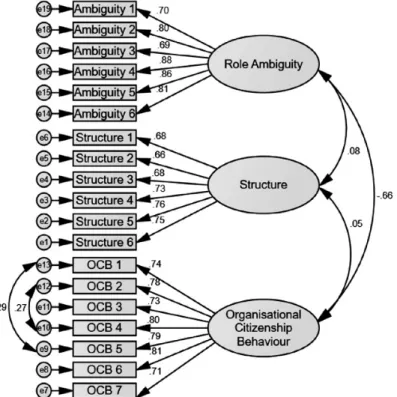
Table 2 shows the CFA results. Factor loadings
of all items were greater than 0.5 and significant at 95% confidence level (varies from 0.660 to 0.882).
Moreover, the model fit indices (χ2 (df) = 294.228
(147), χ2/df = 2.002, GFI = 0.905, CFI = .952, IFI = 0.952,
TLI = 0.944, NFI = 0.909, RMSEA (90% C.I.) = .060
(.050-.070)) indicated a good fit. The significant χ2 is
owing to a relatively large sample size being used (Hair et al. 2009; Pahlevan Sharif, Mahdavian 2015).
TABLE 2. Measurement model assessment
Construct / Measure Factor
Loading Organisation Structure (CR = 0.858, AVE = 0.503, MSV = 0.006, ASV = 0.004) Organisational Structure 1 0.675 Organisational Structure 2 0.660 Organisational Structure 3 0.676 Organisational Structure 4 0.734 Organisational Structure 5 0.759 Organisational Structure 6 0.745
Organisational Citizenship Behaviour (CR = 0.909, AVE = 0.589, MSV = 0.434, ASV = 0.218)
Organisational Citizenship Behaviour 1 0.744 Organisational Citizenship Behaviour 2 0.780 Organisational Citizenship Behaviour 3 0.732 Organisational Citizenship Behaviour 4 0.800 Organisational Citizenship Behaviour 5 0.786 Organisational Citizenship Behaviour 6 0.814 Organisational Citizenship Behaviour 7
0.710
Role Ambiguity (CR = 0.910, AVE = 0.629, MSV = 0.434, ASV = 0.220) Role Ambiguity 1 0.702 Role Ambiguity 2 0.801 Role Ambiguity 3 0.686 Role Ambiguity 4 0.882 Role Ambiguity 5 0.858 Role Ambiguity 6 0.809
Model Fit: χ2 (df) = 294.228 (147), χ2/df = 2.002, GFI = 0.905, CFI = .952, IFI
= 0.952, TLI = 0.944, NFI = 0.909, RMSEA (90% C.I.) = .060 (.050-.070). All factor loadings are greater than 0.5 and they are significant at 95% confidence level. Construct Reliability (CR), Average Variance Extracted (AVE), Maximum Shared Squared Variance (MSV), Average Shared Square Variance (ASV))
Figure 2 shows the final model after reviewing model modification indices for sources of model misfit. Measurement errors between observed items of organisational citizenship behaviour were allowed
to freely covary to improve the model fit (∆χ2 (∆df) =
35.193 (2)).
Construct reliability of role ambiguity (0.910), organisational structure (0.858), and organisational citizenship behaviour (0.909) was greater than 0.7, which indicated good reliability of constructs. In addition, while average variance extracted (AVE) of role
ambiguity (0.629), organisational structure (0.503), and organisational citizenship behaviour (0.589) was greater than 0.5, they were less than their respective construct reliability. Hence, all constructs had convergent validity (Hair et al. 2010). Moreover, maximum shared squared variance (MSV) and average shared square variance
(ASV) of role ambiguity (0.434, 0.220), organisational
structure (0.006, 0.004), and organisational citizenship behaviour (0.434, 0.218) were less than their respective
AVE. This demonstrated that discriminant validity of all
constructs was established (Pahlevan Sharif, Mahdavian 2015; Hair et al. 2010).
In order to test the moderation effect of role ambiguity, this study followed the approach discussed in Field’s
(2013) step by step. The first step is grand mean centring
to make the results interpretable. To do so, the independent variable (organisation structure) and the moderator (role ambiguity) were standardized. In the second step, the independent variable, moderator, and their interaction were included in the model. Finally, the structural model
analysis was run and path coefficients were interpreted.
The results of the structural model assessment and hypotheses testing are reported in Table 3.
TABLE 3. Structural model assessment for predicting organisational citizenship behaviour
Exogenous Variables Path P-value Coefficient
Organisation Structure 0.117** .007
Role Ambiguity -0.724*** .000
Organisation Structure * Role Ambiguity 0.074* .049
(R2 = 52.27%)
Note: * p < .05. **p < .01. ***p < .001
RESULTS DISCUSSION
Hypothesis 1 predicts that organic structure has a
significant positive effect on subordinates’ organisational
citizenship behaviour. As it is shown in Table 3, organic
structure has a significant positive effect on organisational
citizenship behaviour (β=0.117, p-value < .01), thus providing support for hypothesis 1. This suggests that the
organic structure plays a role in influencing subordinates’
responses. It must also be realised that subordinates tend to favour an organic structure and there may be some who can adapt to or actually prefer an organic structure. It is important to note the assertion of the natural system theorists who stress the advantage of informal structure
particularly to achieve certain task under specific situation.
The present result seems to be in line with the work of Kohli and Jaworski (1990) which highlighted the contracting advantage of structural characteristics that is
a more flexible structure is necessary for the initiation of
innovative or extraordinary behaviour.
Hypothesis 2 posits that subordinates’ organisational citizenship behaviour will be reduced as role ambiguity increases. The result in Table 3 (β= -0.724, p-value <.001) lend support for hypothesis 2. Thus, the result seems to agree with the conventional reasoning that role ambiguity impedes the opportunity of a person to perform effectively
and efficiently (Kahn et al. 1964). Other research findings
(Walker, Churchill & Ford 1975; Bagozzi 1978; Behrman et al. 1981; Behrman & Perreault 1984; Lysonski 1985; Onyemah 2008; Bryman 2013) have also demonstrated a negative relationship between role ambiguity and performance. Although the conclusion here is not entirely equivocal (as in the contradicting result of Brief and Aldag (1976), and Jackson and Schuler (1985), there is clearly more empirical evidence to suggest the simple conclusion that the reduction of role ambiguity ensures better performance (including extra-role) as one is more certain about what is expected to be accomplished. Hopefully, the decrease in role ambiguity will lead to an increase in organisational commitment and task performance and ultimately, increase the employees’ OCB level (MacKenzie,
Podsakoff & Ahearne 1998; Tubre & Collins 2000; MacKenzie et al. 2001).
Hypothesis 3 states that role ambiguity will moderate the relationship between organic structure and
organisational citizenship behaviour. The interaction of
organic structure and role ambiguity has a significant
positive effect on organisational citizenship behaviour
at 95% confidence level (β = 0.074, p-value < .05) to
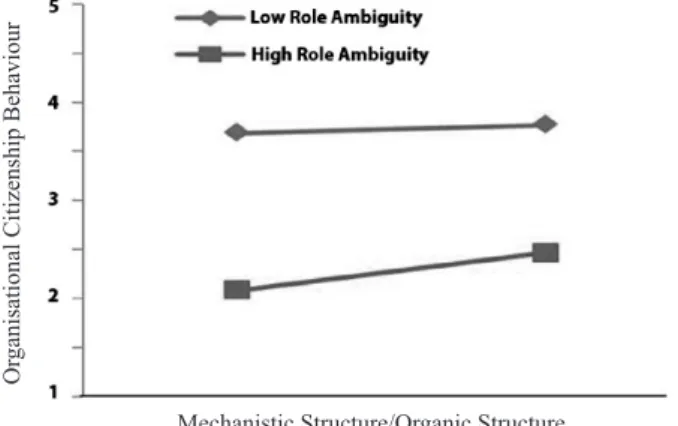
lend support for hypothesis 3. The findings indicate that
the positive effect of organic structure on organisational citizenship behaviour is made stronger when there is high role ambiguity in the organisation (Figure 3). Squared multiple correlations indicates 52.27% of variance of organisational citizenship behaviour is explained by this model. This result is in line with research done by Morrison (1994) that concluded employees’ perceptions of their role can affect the amount of OCB that they displayed.
When role ambiguity is high, it creates situational freedom of employees roles and thus, allowing a high degree of
flexibility or discretion on how they should do or perform
the task. In such situation, it can be implied that the
presence of role ambiguity can affect the flexibility of
the organisational structure which affect employees OCB.
Implicitly OCB is created when employee acts beyond of
what is expected; and what is expected can be made hazy or unbounded with a right dosage of role ambiguity.
The findings of the present study revealed several specific implications. First, the findings suggest that
organic structure has a positive influence on role ambiguity and organisational citizenship behaviour. The moderation of role ambiguity was investigated and shed light on how the variable has direct and indirect effects on structure and organisational citizenship behaviour. In an attempt to solicit subordinate super-ordinate effort in the organisation, organisational citizenship behaviour was included as the outcome variable of the study. The relationships exist to highlight the way role ambiguity influence by its own or jointly on such behaviours in the organisation; and this will have great practical
significance. The advantage of having high OCB is well
researched and its positive relationship with employee’s performance is well studied (Nielsen, Hrivnak & Shaw 2009: Podsakoff, Whiting, Podsakoff & Blume 2009). It has been shown that OCB is positively linked to
FIGURE 3. The influence organisation structure on organisational citizenship behaviour at two different
levels of role ambiguity
Mechanistic Structure/Organic Structure
Or
multiple unit performance measures, for example sales performance, quantity and quality of output, as well as attaining higher customer satisfaction (Chun et al. 2011). The collaboration efforts and sense of loyalty towards the organisation will help enhance organisational productivity. Furthermore, while OCB improves, the
supportive behaviour among employees is more likely to be linked with the reputation of the organisation, thereby attracting and retaining talented individuals (Gong, Chang & Cheung 2010; Chun et al. 2011). It is
crucial for organisations to remain flexible and dynamic
to thrive in the ever-changing business landscape. Higher OCB may mean that employees have higher
readiness to help the organisation in adapting smoothly to the environmental changes (Chun et al. 2011).
From a managerial standpoint, the research findings
suggest that when the superior has a choice in the leadership styles, he/she should place greater emphasis on the use of appropriate structure and organisational features to achieve greater OCB. While organic structure
promotes OCB, the degree of OCB can be heightened if
there is certain level of role ambiguity while implementing organic structure. Although seems counterintuitive, the result suggest that situational freedom of action can promote extra-role results.
CONCLUSION
This study highlights the need for the manager to consider an appropriate structural form to encourage
OCB. In this case, organic structure is found to be better
suited than mechanistic structure to encourage extra-role behaviour. The study also supports the contention that subordinates’ role ambiguity has a direct and indirect effect on the outcome, serving to increase the strength of
OCB when organic structure is present. This result seems
to support a widely held assertion that the effectiveness of organisation depends very much on the situation (Fiedler 1967; House & Dessler 1974; Weed et al. 1976).
This study contributes to the domain of organisational study and OCB research that structural forms and
administrative features influence behavioural outcome.
The present scope is nevertheless not exhaustive. Future studies should also attempt to incorporate additional endogenous variables such as motivation, compliance and performance of subordinates that are more indicative of organisational outcomes. Besides, studies can focus on identifying more antecedents of organisational contexts and more importantly, on understanding the processes by which such variables impact subordinates’ performance.
REFERENCES
Abdullah, J.B, & Kassim, J.M. 2011. Instructional leadership and attitude towards organizational change among secondary schools principal in Pahang, Malaysia. Procedia-Social and Behavioral Sciences 15: 3304-3309.
Ackfeldt, A.L. & Leonard, V.C. 2005. A study of organisational citizenship behaviours in a retail setting. Journal of Business Research 58: 151-159.
Armenakis, A.A., Harris, S.G. & Mossholder, K.W. 1993. Creating readiness for organisational change. Human Relations 46: 681-703.
Ashforth, B.E., Saks, A.M. & Lee, R.T. 1998. Socialization and newcomer adjustment: The role of organisational context.
Human Relations 51: 897-927.
Bagozzi, R.P. 1978. Sales force performance and satisfaction as a function of individual difference, interpersonal and situational factors. Journal of Marketing Research 15: 517-531.
Barksdale, K. & Werner, J.M. 2001. Managerial ratings of in-role behaviours, organisational citizenship and overall performance: Testing different models of their relationship. Journal of Business Research 51: 145-155.
Bateman, T.S. & Organ, D.W. 1983. Job satisfaction and the good soldier: The relationship between affect and employee “citizenship”. Academy of management Journal 26(4): 587-595.
Behrman, D.N. & Perreault, W.D. 1984. A role stress model of the performance and satisfaction of industrial salespersons.
Journal of Marketing 48: 9-12.
Behrman, D.N., Bigoness, W. & Perreault, W.D. Jr. 1981. Sources of job related ambiguity and their consequences upon sale persons’ job satisfaction and performance. Management Science 27: 1246-1260.
Beris, J.H., Sethela, L.A. & Mahmood, R. 2011. Role ambiguity and job performance of employees in the service sector SMEs in Malaysia. Malaysian Management Journal 15: 1-20.
Bolino, M.C., Turnley, W.H. & Bloodgood, J.M. 2002. Citizenship behaviour and the creation of social capital in organisations. Academy of Management Review 27: 505-523.
Borman, W.C. & Penner, L.A. 2001. Citizenship performance: Its nature, antecedents, and motives. In Personality Psychology in the Workplace, edited by B.W. Roberts & R. Hogan, 45-61. Washington, DC: APA.
Brief, A.P. & Aldag, R.J. 1976. Correlates of role indices. Journal of Applied Psychology 61: 468-472.
Brief, A.P. & Motowidlo, S.J. 1986. Prosocial organisational behaviors. Academy of Management Review 11(4): 710-725.
Brown, S. & Peterson, R. 1993. Antecedents and consequences of salesperson job satisfaction: Meta-analysis and assessment of causal effects. Journal of Marketing Research 30: 63-77.
Bryman, A. 2013. Leadership and Organisations. London: Routledge.
Burns, T. & Stalker, G.M. 1961. The Management of Innovation.
London: Tavistock.
Burns. T. & Stalker, G.M. 1966. The Management of Innovation, 2nd Edition, London: Tavistock Publications.
Cascio, W.F. 1982. Costing Human Resources. The Financial Impact of Behaviour in Organisations. Boston: Ken Publishing.
Chiang, C.F. & Hsieh, T.S. 2012. The impacts of perceived organisational support and psychological empowerment on job performance: The mediating effects of organisational citizenship behavior. International Journal of Hospitality Management 31(1): 180-190.
Chun, J.S., Shin, Y., Choi, J.N. & Kim, M.S. 2013. How does corporate ethics contribute to firm financial performance? The mediating role of collective organisational commitment and organisational citizenship behaviour. Journal of Management 39(4): 853-877.
Churchill, G.A.Jr., Ford, N.M., Hartley, S.W. & Walker, O.C.Jr. 1985. The determinants of salesperson performance: A Meta-Analysis. Journal of Marketing Research 22: 103-118.
Cicero, L., Pierro, A. & Van Knippenberg, D. 2010. Leadership and uncertainty: How role ambiguity affects the relationship between leader group prototypicality and leadership effectiveness. British Journal of Management 21(2): 411-421.
Cohen, R.A. 1959. Situational structure, self esteem and threat-oriented reactions to power. In Studies in social power, edited by D. Cartwright. Institute for Social Research. University of Michigan.
Covin, J.G. & Slevin, D.P. 1989. Strategic management of small firms in hostile and benign environments. Strategic Management Journal 10: 75-87
Dasgupta, P. 2012. Effect of role ambiguity, conflict and overload in private hospitals’ nurses’ burnout and mediation through self Efficacy. Journal of Health Management 14(4): 513-534.
DeGroot, T. & Brownlee, A.L. 2006. Effect of department structure on the organisational citizenship behaviour-department effectiveness relationship. Journal of Business Research 59(10/11): 1116-1123.
Dierdorff, E.C., Rubin, R.S. & Bachrach, D.G. 2012. Role expectations as antecedents of citizenship and the moderating effects of work context. Journal of Management
38(2): 573-598.
Dobbins, G.H., Cardy, R.L. & Platz-Vieno, S.J. 1990. A contingency approach to appraisal satisfaction: An initial investigation of the joint effects of organisational variables and appraisal characteristics. Journal of Management
16(3): 619-632.
Durham, C.C., Knight, D. & Locke, E.F. 1997. Effects of leader role, team set goal difficulty, efficacy and tactics on team effectiveness. Organisational Behaviour and Human Decision Processes 72: 202-231.
Dust, S.B., Resick, C.J. & Mawritz, M.B. 2014. Transformational leadership, psychological empowerment, and the moderating role of mechanistic-organic contexts. Journal of Organisational Behavior 35(3): 413-433.
Eisenberg, N. & Fabes, R.A. 1988. The development of prosocial behaviour from a life span perspective. In Life-span development and behaviour, edited by P.B. Baltes, D.L. Featherman & R.M. Learner, 173-202. Hillsdale, NJ: Erlbaum.
Erez, M. & Somech, A. 1996. Group productivity loss – the role or the exception: The effects of culture and group based motivation. Academy of Management Journal 39: 1513-1537.
Farh, J.L., Earley, P.C. & Lin, S.C. 1997. Impetus for action: A cultural analysis of justice and organisational citizenship behavior in Chinese society. Administrative Science Quarterly 421-444.
Farh, J.L., Podsakoff, P.M. & Organ, D.W. 1990. Accounting for organisational citizenship behavior: Leader fairness and task scope versus satisfaction. Journal of Management
16(4): 705-721.
Fiedler, F.E. 1967. A Theory of Leadership Effectiveness. New York: McGraw-Hill.
Field, A. 2013. Discovering Statistics Using IBM SPSS Statistics. London: Sage.
Folger, R. 1993. Justice, motivation, and performance beyond role requirements. Employee Responsibility and Rights Journal 6: 239-248..
Fried, Y., Ben-David, H.A., Tiegs, R.B., Avital, N. & Yeverechyahu, U. 1998. The interactive effect of role conflict and role ambiguity on job performance. Journal of Occupational and Organisational Psychology 71: 19-27. Fry, L. Futrell, C., Parasuraman, A. & Chmielewski, M. 1986.
An analysis of alternative causal models of salesperson role perceptions and work-related attitudes. Journal of Marketing Research 23: 153-163.
George, J.M. & Bettenhausen, K. 1990. Understanding prosocial behaviour, sales performance and turnover: A group level analysis in a service context. Journal of Applied Psychology
75(6): 698-709.
George, J.M. & Jones, G.R. 1997. Organizational spontaneity in context. Human Performance 10: 153-170
Gong, Y., Chang, S. & Cheung, S. 2010. High performance work system and collective OCB: A collective social exchange perspective. Human Resource Management Journal 20: 119-137.
Greenberg, J. 1988. Cultivating an image of justice: Looking fair on the job. The Academy of Management Executive
2(2): 155-157.
Hair, J.F., Black, W.C., Babin, B.J. & Anderson, R.E. 2009.
Multivariate Data Analysis. Upper Saddle River, NJ: Prentice Hall.
Hair, J., Black, W.C., Babin, B.J. & Anderson, R.E. 2010.
Multivariate Data Analysis. 7th ed. Upper saddle River, New Jersey: Pearson Education International.
Hall, R.H. 1977. Organisations: Structuring and process. Englewood Cliffs, N.J.: Prentice Hall.
House, R.J. & Dessler, G. 1974. The path-goal theory of leadership: Some post hoc and a priori tests. In Contingency Approaches in Leadership, edited by J.G. Hunt & L.L. Larson, 29-55. Carbondale, ILL: Southern Illinois University Press.
Howell, J.P., Dorfman, P.W. & Kerr, S. 1986. Moderator variables in leadership research. The Academy of Management Review 11: 88-102
Jackson, S.E. & Schuler, R.S. 1985. A meta-analysis and conceptual critique of research on role ambiguity and role conflict in work settings. Organisational Behaviour and Human Decision Processes 36(1): 16-78.
Jaworski, B.J. & Kohli, A.K. 1991. Supervisory feedback: Alternative types and their impact on salespeople’s performance and satisfaction. Journal of Marketing Research 28: 190-201.
Jones, G.R. 2007. Organizational Theory, Design, and Change. 5th edition. Upper Saddle River, New Jersey: Pearson
Education, Inc.
Jones, J.R. & Schaubroeck, J. 2004. Mediators of the relationship between race and organizational citizenship behavior.
Journal of Managerial Issues 16(4): 505-527.
Johnson, R.E., Lanaj, K., Tan, J.A. & Chang, C.-H. 2012. Putting our trust in fairness: Justice and regulatory focus as triggers of trust and cooperation. In Research in Management, edited by L.L. Neider & C.A. Schriesheim, 1-28. Hartford, CT: Information Age Publishing.
Kahn, R.L., Wolfe, D.M., Quinn, R.P., Snoeck, J.D. & Rosenthal, R.A. 1964. Organisational Stress: Studies in Role Conflict
and Ambiguity, New York: Wiley.
Kalbers, L.P. & Cenker, W.J. 2008. The impact of exercised responsibility, experience, autonomy, and role ambiguity on job performance in public accounting. Journal of Managerial Issues 20(3): 327-347.
Katz, D. & Kahn, R.L. 1978. The Social Psychology of Organisations. New York: Wiley.
Khandwalla, P.N. 1977. The Design of Organisations. New York: Harcourt-Brace-Jovanovich.
Knutson, K.A. & Miranda, A.O. 2000. Leadership characteristics, social interest and learning organisations. Journal of Individual Psychology 56: 205-213.
Kohli, A.K. & Jaworski, B.J. 1990. Market orientation: The construct, research propositions, and managerial implications. The Journal of Marketing 54(2): 1-18. Koys, D.J. 2001. The effects of employee satisfaction,
organisational citizenship behaviour, and turnover on organisational effectiveness: A unit level longitudinal study.
Personnel Psychology 54: 101-114.
Low, G.T. 2005. Strategic persistence and reorientation of the
firms following an environmental shift: An empirical study
of Malaysian manufacturing companies. Unpublished PhD Thesis, University Malaya.
Lysonski, S. 1985. A boundary theory investigation of the product manger’s role. Journal of Marketing 49: 26-40.
Mackenzie, D.L., Wilson, D.B. & Kider, S.B. 2001. Effects of correctional boot camps on offending. The ANNALS of the American Academy of Political and Social Science
578(1): 126-143.
MacKenzie, S.B., Podsakoff, P.M. & Ahearne, M. 1998. Some possible antecedents and onsequences of In-Role and Extra-Role Performance. Journal of Marketing 62: 87-98. MacKenzie, S.B., Podsakoff, P.M. & Fetter, R. 1991.
Organisational citizenship behaviour and objective productivity as determinants of managerial evaluations of salesperson’s performance. Organisational Behaviour and Human Decision Processes 50: 123-150.
Madison, D.L., Allen, R.W., Porter, L.W., Renwick, P.A. & Mayes, B.T. 1980. Organizational politics: An exploration of managers’ perception. Human Relations 33: 79-100. Martin, C.L. & Bies, R.J. 1991. Just laid off, but still a
good citizen. In The Role of Organisational Justice in Organisational Citizenship Behavior, edited by D.E. Eskew. Symposium conducted at the National Academy of Management Meetings, Miami, FL.
Masterson, S.S., Lewis, K., Goldman, B.M. & Taylor, S.M. 2000. Integrating justice and social exchange: The differing effects of fair procedures and treatment on work relationships. Academy of Management Journal 43(4): 738-748. McNeely, B.L. & Meglino, B.M. 1994. The role of dispositional
and situational antecedents in prosocial organisational behavior: An examination of the intended beneficiaries of prosocial behavior. Journal of Applied Psychology 79(6): 836-844.
Merton, R.K. 1957. Social Theory and Social Structure. New York: Free Press.
Miles, R.H. 1976. A comparison of the relative impacts of role perceptions of ambiguity and conflict by role. Academy of Management Journal 18: 25-35.
Mintzberg, H. 1979. The Structuring of Organisations. Englewood Cliffs, NJ: Prentice-Hall.
Mirvis, P.H. & Lawler, E.E. 1977. Measuring the financial impact of employee attitudes. Journal of Applied Psychology 62: 1-8.
Mitchel, T.R. & Silver, W.S. 1991. Individual and group goals, when workers are independent: Effects on task strategies and performance. Journal of Applied Psychology 75: 185-193.
Moorman, R.H. 1991. Relationship between organisational justice and organisational citizenship behaviors: Do fairness perceptions influence employee citizenship?. Journal of Applied Psychology 76(6): 845-855.
Moorman, R.H. & Blakely, G.L. 1995. Individualismcollectivism as an individual difference predictor of organisational citizenship behavior. Journal of Organisational Behavior
16(2): 127-142.
Moorman, R.H., Niehoff, B.P. & Organ, D.W. 1993. Treating employees fairly and organisational citizenship behavior: Sorting the effects of job satisfaction, organisational commitment, and procedural justice. Employee Responsibilities and Rights Journal 6(3): 209-225. Morrison, E.W. 1994. Role definitions and organizational
citizenship behavior: The importance of the employee’s perspective. Academy of Management Journal 37: 1543–1567
Nelson, D.L. & Quick, J.C. 1999. Organisational Behaviour: Foundations, Realities and Challenges. London: South-Western College Publishing.
Netemeyer, R.G., Boles, J.S., McKee, D.O. & McMurrian, R. 1997. An investigation into the antecedents of organisational citizenship behaviors in a personal selling context. The Journal of Marketing 61(3): 85-98.
Nielsen, T.M., Hrivnak, G.A. & Shaw, M. 2009. Organisational citizenship behaviour and performance: A meta-analysis of group-level research. Small Group Research 40: 555-577. Nunnally, J.C. 1978. Psychometric Theory. 2nd edition. New
York: McGraw-Hill.
Onyemah,V. 2008. Role ambiguity, role conflict and performance: Empirical evidence of an Inverted-U Relationship. Journal of Personal Selling and Sales Management 28(3): 299-313.
O’Reilly, C.A. & Chatman, J. 1986. Organisational commitment and psychological attachment: The effects of compliance, identification, and internalization on prosocial behavior.
Journal of Applied Psychology 71(3): 492-499.
Organ, D.W. 1988. A restatement of the satisfaction-performance hypothesis. Journal of Management 14(4): 547-557. Organ, D.W., Podsakoff, P.M. & MacKenzie, S.B. 2006.
Organisational Citizenship Behaviour: Its Nature, Antecedents, and Consequences. London: Sage.
Organ, D.W. 1990. The motivational basis of organisational citizenship behaviour. In Research in Organisation Behaviour Vol 12, edited by B.B. Staw & L.L. Cummings, 43-72. Greenwich CT: JAI Press.
Organ, D.W. 1997. Organisational citizenship behaviour: It’s construct clean-up time. Human Performance 10: 85-97. Pahlevan Sharif, S. & Mahdavian, V. 2015. Structural Equation
Modeling by the Use of AMOS
Parker, C.P., Dipboye, R.L. & Jackson, S.L. 1995.Perceptions of Organizational Politics: An Antecedents and Consequences. Journal of Management 21(5): 891-912.
Podsakoff, P.M., MacKenzie, S.B., Moorman, R.H. & Fetter, R. 1990. Transformational leader behaviors and their effects on followers’ trust in leader, satisfaction, and organizational
citizenship behaviors. The Leadership Quarterly 1(2): 107-142.
Podsakoff, N.P., Whiting, S.W., Podsakoff, P.M. & Blume, B.D. 2009. Individual- and organisational-level consequences of organisational citizenship behaviours: A meta-analysis.
Journal of Applied Psychology 94: 122-141.
Podsakoff, P.M. & MacKenzie, S.B. 1995. An examination of substitutes for leadership within a level of analysis framework. Leadership Quarterly 6: 289-328.
Podsakoff, P.M. & MacKenzie, S.B. 1997. Impact of organisational citizenship behaviour on organisational performance: A review and suggestions for future research.
Human Performance 10: 133-151.
Podsakoff, P.M., MacKenzie, S.B. & Bommer, W.H. 1996b. Transformational leader behaviours and substitutes for leadership as determinants of employee satisfaction, commitment, trust and organisational citizenship behaviours.
Journal of Management 22(2): 259-298.
Podsakoff, P.M., MacKenzie, S.B., Pain, J.B. & Bachrach, D.G. 2000. Organisational citizenship behaviours: A critical review of the theoretical and empirical literature and suggestions for future research. Journal of Management
26(3): 513-565.
Rizzo, J.R., House, R.J. & Lirtzman, S.I. 1970. Role conflict and ambiguity in complex organisations. Administrative Science Quarterly 15(2): 150-163.
Rousseau, D.M. 1978. Characteristics of departments, positions, and individuals: Contexts for attitudes and behaviour.
Administrative Science Quarterly 23: 521-540.
Sayers, J.M., Salamonson, Y., DiGiacomo, M. & Davidson, P. 2015. Nurse educators in Australia: High job satisfaction despite role ambiguity. Journal of Nursing Education and Practice 5(4): 41-51.
Schriesheim, C.A. & Murphy, C.J. 1976. Relationships between leader behavior and subordinate satisfaction and performance: A test of some situational moderators. Journal of Applied Psychology 61: 634-641.
Schuler, R.A., Aldag, R.J. & Brief, A.P. 1977. Role conflict and ambiguity: A scale analysis. Organisational Behaviour and Human Performance 21: 118-128.
Schuler, R.S. 1975. Role perceptions, satisfaction and performance: A partial reconciliation. Journal of Applied Psychology 60: 683-687.
Schuler, R.S. 1977. Role perceptions, satisfaction and performance moderated by organisational level and participation in decision making. Academy of Management Journal 20: 159-165.
Seeman, M. 1953. Role conflict and ambivalence in leadership.
American Sociological Review 18: 373-380.
Senge, P.M. 1993. Transforming the practice of management.
Human Resource DevelopmentQuarterly 4: 5-32. Shore, L.M. & Wayne, S.J. 1993. Commitment and employee
behavior: comparison of affective commitment and continuance commitment with perceived organisational support. Journal of Applied Psychology 78(5): 774-780. Singh, P. & Bhandarker, A. 1983. Managerial role: The need for
clarity. ASCI Journal of Management 13: 35-56.
Slattery, J.P., Selvarajan, T.T. & Anderson, J.E. 2008. The influences of new employee development practices upon role stressors and work-related attitudes of temporary employees. The International Journal of Human Resource Management 19(12): 2268-2293.
Smith, C.A., Organ, D.W. & Near, J.P. 1983. Organisational citizenship behaviour: Its nature and antecedents. Journal of Applied Psychology 68: 653-663.
Somech,A. & Drach-Zahavy, A. 2004. Exploring organizational citizenship behavior froman organizational perspective: The relationship between organizational learning and organizational citizenship behavior. Journal of Occupational and Organizational Psychology 77: 281-298.
Sutton, R.A. & Rousseau, D.M. 1979. Structure, technology and dependence on a parent organisation: Organisational and environmental correlates of individual responses. Journal of Applied Psychology 64: 675-687.
Szilagyi, A.D., Sims, H.P. & Keller, R.T. 1976. Role dynamics, locus of control and employee attitudes and behaviour.
Academy of Management Journal 19: 259-276.
Tepper, B.J. & Taylor, E.C. 2003. Relationships among supervisors’ and subordinates’ procedural justice perceptions and organisational citizenship behaviors. Academy of Management Journal 46(1): 97-105.
Tubre, T.C. & Collins, J.M. 2000. Jackson and Schuler (1985) revisited: A meta-analysis of the relationships between role ambiguity, role conflict and job performance. Journal of Management 26: 155-169.
Van Dyne, L., Graham, J.W. & Dienesch, R.M. 1994. Organisational citizenship behavior: Construct redefinition, measurement, and validation. Academy of Management Journal 37(4): 765-802.
Walker, O., Churchill, G. & Ford, N. 1975. Organisational determinants of the industrial salesman’s role conflict and ambiguity. Journal of Marketing 39: 32-39.
Walker, O.C., Jr., Churchill, G.A.Jr. & Ford, N.M. 1977. Motivation and performance in industrial selling: Present knowledge and needed research. Journal of Marketing 14: 156-168.
Weed, S.E., Mitchell, T.R. & Moffitt, W. 1976. Leadership style, subordinate personality and task type as predictors of performance and satisfaction with supervision. Journal of Applied Psychology 61: 58-66.
Werner, J.M. 1994. Dimensions that make a difference: Examining the impact of in-ole and extra-role behaviours in supervisory ratings. Journal of Applied Psychology 79: 98-107.
Kim Lian Lee (corresponding author) Taylor’s Business School
Taylor’s University
Lakeside Campus, No 1. Jalan Taylor’s 47500 Subang Jaya, MALAYSIA. E-Mail: [email protected] Low Guan Tui
Vesseltech Engineering Sdn Bhd
102, Jalan Allamanda, Bukit Belimbing, Balakong 43300 Seri Kembangan, Selangor, MALAYSIA. E-Mail: [email protected]
Saeed Pahlevan Sharif Taylor’s Business School Taylor’s University
Lakeside Campus, No 1. Jalan Taylor’s 47500 Subang Jaya, MALAYSIA. E-Mail: [email protected]