General rights
Copyright and moral rights for the publications made accessible in the public portal are retained by the authors and/or other copyright owners and it is a condition of accessing publications that users recognise and abide by the legal requirements associated with these rights.
Users may download and print one copy of any publication from the public portal for the purpose of private study or research.
You may not further distribute the material or use it for any profit-making activity or commercial gain
You may freely distribute the URL identifying the publication in the public portal
If you believe that this document breaches copyright please contact us providing details, and we will remove access to the work immediately and investigate your claim.
Peptides: Production, bioactivity, functionality, and applications
Hajfathalian, Mona; Ghelichi, Sakhi; García Moreno, Pedro Jesús; Sørensen, Ann-Dorit Moltke;
Jacobsen, Charlotte
Published in:
Critical Reviews in Food Science and Nutrition
Link to article, DOI:
10.1080/10408398.2017.1352564
Publication date:
2018
Document Version
Publisher's PDF, also known as Version of record
Link back to DTU Orbit
Citation (APA):
Hajfathalian, M., Ghelichi, S., García Moreno, P. J., Sørensen, A-D. M., & Jacobsen, C. (2018). Peptides:
Production, bioactivity, functionality, and applications. Critical Reviews in Food Science and Nutrition, 58(18),
3097-3129. https://doi.org/10.1080/10408398.2017.1352564
Full Terms & Conditions of access and use can be found at
https://www.tandfonline.com/action/journalInformation?journalCode=bfsn20
Critical Reviews in Food Science and Nutrition
ISSN: 1040-8398 (Print) 1549-7852 (Online) Journal homepage: https://www.tandfonline.com/loi/bfsn20
Peptides: Production, bioactivity, functionality, and
applications
Mona Hajfathalian, Sakhi Ghelichi, Pedro J. García-Moreno, Ann-Dorit Moltke
Sørensen & Charlotte Jacobsen
To cite this article:
Mona Hajfathalian, Sakhi Ghelichi, Pedro J. García-Moreno, Ann-Dorit
Moltke Sørensen & Charlotte Jacobsen (2018) Peptides: Production, bioactivity, functionality,
and applications, Critical Reviews in Food Science and Nutrition, 58:18, 3097-3129, DOI:
10.1080/10408398.2017.1352564
To link to this article:
https://doi.org/10.1080/10408398.2017.1352564
Published online: 11 Oct 2017.
Submit your article to this journal
Article views: 408
View Crossmark data
Peptides: Production, bioactivity, functionality, and applications
Mona Hajfathalian
a, Sakhi Ghelichi
a,b, Pedro J. Garc
ı
a-Moreno
a, Ann-Dorit Moltke Sørensen
a, and Charlotte Jacobsen
a aDivision of Food Technology, National Food Institute, Technical University of Denmark, 2800 Kgs. Lyngby, Denmark;bDepartment of Seafood Science and Technology, Faculty of Fisheries and Environmental Science, Gorgan University of Agricultural Sciences and Natural Resources, Gorgan, Iran
ABSTRACT
Production of peptides with various effects from proteins of different sources continues to receive academic attention. Researchers of different disciplines are putting increasing efforts to produce bioactive and functional peptides from different sources such as plants, animals, and food industry by-products. The aim of this review is to introduce production methods of hydrolysates and peptides and provide a comprehensive overview of their bioactivity in terms of their effects on immune, cardiovascular, nervous, and gastrointestinal systems. Moreover, functional and antioxidant properties of hydrolysates and isolated peptides are reviewed. Finally, industrial and commercial applications of bioactive peptides including their use in nutrition and production of pharmaceuticals and nutraceuticals are discussed.
KEYWORDS Peptides; hydrolysate; bioactivity; functional properties; antioxidant properties; application
Introduction
Dietary protein is an important source of energy (4 kcal/g
pro-tein) and essential amino acids, which are needed for growth
and maintenance of physiological functions such as repair of
tissues and cell signaling. In the body, proteins are broken
down to peptides upon digestion by endogenous enzymes in
the gastrointestinal system. These peptides are inactive within
the sequence of the parent protein, but after they are released
by enzymatic hydrolysis, they exert various physiological
func-tions. Recent research has shown that peptides from different
sources such as dairy products, plants, animals and seafood
have a wide range of bioactivities, e.g., antimicrobial (Tang
et al.,
2015
), immunomodulatory (Mechkarska et al.,
2014
),
antihypertensive (Capriotti et al.,
2015
), and antioxidant
(Babini et al.,
2017
) activities, among others.
Bioactive peptides can also be produced by commercial
exogenous enzymes, which hydrolyze proteins into peptides.
The greatest number of bioactive peptides isolated to date is
from milk proteins. Other sources include meat,
fi
sh, eggs,
plant sources such as soy and wheat (Hartmann and Meisel,
2007
). The most commonly used enzymes for the production
of bioactive peptides, for instance, from
fi
sh proteins include
Alcalase 2.4 L FG, Papain, Pepsin, Trypsin,
a
-chymotrypsin,
Pancreatin, Flavourzyme, Pronase, Neutrase, Protamex,
Bro-melain, Cryotin F, Protease N, Protease A, Orientase,
Thermo-lysin, and Validase (Raghavan and Kristinsson,
2008
; Ren et al.,
2008
; Samaranayaka and Li-chan,
2008
; Je et al.,
2009
; Hsu,
2010
; Ngo et al.,
2010
). Some of these enzymes are also used for
production of bioactive peptides from other sources.
A large proportion of the global production of dietary
pro-teins is being discarded as waste or sold at a low price for
ani-mal feed after the main products have been produced from the
original raw material. For example, rapeseed meal with a low
solubility is produced as a by-product from the production of
rapeseed oil (Tan et al.,
2011
). Likewise, head, bones, tails and
intestines are by-products from the seafood production, which
currently provide the manufacturer with low or no revenue.
Therefore, it seems crucial to
fi
nd avenues toward making the
best use of such protein sources, for example by using them for
the production of protein hydrolysates containing bioactive
peptides for human consumption (Sila and Bougatef,
2016
).
One of the challenges associated with this strategy is the
removal of bitterness from such peptide formulations because
the bitterness negatively affects consumer perception (Zhao
et al.,
2015
).
Protein hydrolysates and peptides from natural resources
can be used as
“
functional foods
”
and
“
nutraceuticals
”
on the
basis of their bioactivity, or as technological components
thanks to their functional properties. The functional products
and nutraceuticals may contain the whole hydrolysate and/or
isolated and puri
fi
ed peptides (Lafarga et al.,
2016
). Since the
bioactivity and functionality of peptides depend on their amino
acid composition, sequence, and molecular mass (Lassoued
et al.,
2015a
), peptides with varying effects might be derived
from a single hydrolysate. Therefore, sometimes additional
stages of isolation and puri
fi
cation are required in order to
incorporate peptide(s) with intended effect(s) in the
fi
nal
prod-uct. This isolation process is predominantly carried out by
con-trolling the process of enzymolysis (Zou et al.,
2016
).
This review aims to provide an overview of state-of-the-art
technologies for the production and puri
fi
cation of protein
hydrolysates including technologies for the removal of
bitter-ness. A second aim is to provide a comprehensive overview of
the activities that have been reported for protein hydrolysates
from various protein sources such as dairy, egg, animal,
fi
sh,
and plants. The review will cover bioactivities with a potential
CONTACT Charlotte Jacobsen [email protected]; www.food.dtu.dk Professor mso and group leader Research group for Bioactives - Analysis and Application Division of Food Technology DTU Food Technical University of Denmark National Food Institute Kemitorvet Building 204, room 112 2800 Kgs, Lyngby, Denmark.
© 2017 Taylor & Francis Group, LLC
https://doi.org/10.1080/10408398.2017.1352564
impact on human health including effects on the immune,
car-diovascular, nervous and gastrointestinal systems. Functional
properties of protein hydrolysates such as emulsifying, water
binding, and antioxidant properties in foods will also be
dis-cussed. A
fi
nal aim of the review is to critically assess potential
applications of protein hydrolysates/bioactive peptides in
phar-maceutical, sports nutrition, food and feed applications on the
basis of the current knowledge and documentation of their
bioactivity.
Production of bioactive and functional peptides
In order to exhibit their bene
fi
cial effects on health, bioactive
peptides must be released from the primary structure of food
proteins, where they remain bonded to other amino acids.
Moreover, protein hydrolysis can also lead to hydrolysates with
improved techno-functional properties (e.g., solubility,
emulsi-fying, foaming, oil and water binding, and gelling) (Wouters
et al.,
2016
). The release of bioactive peptides is achieved by
degrading the original proteins by using chemicals (e.g., acids
and alkalis) or enzymes. Proteolysis caused by enzymes is
pre-ferred to chemical hydrolysis since: (i) the reaction is carried
out at mild conditions of pH (e.g., 4
–
8) and temperature (e.g.,
40
–
60
C), (ii) side reactions are avoided because of the high
speci
fi
city of the enzymes, and (iii) the peptides obtained
main-tain their nutritional value (Guerard,
2006
). Therefore, this
review focuses on the production of bioactive peptides by
enzy-matic hydrolysis, including fermentation where enzymes are
secreted by the microorganism(s) taking part in the process.
Technologies for removal of bitterness are also discussed. In
addition, the fractionation, puri
fi
cation and identi
fi
cation of
bioactive peptides, including bioinformatics-driven approaches,
are covered in this section.
Enzymatic protein hydrolysis
Enzymatic hydrolysis of proteins is catalyzed by proteases,
which cleave peptide bonds between two amino acids
consum-ing a molecule of water per bond cleaved (Eq. 1). Hence, the
continuous cleavage of peptide bonds breaks down proteins
into products of lower molecular weight such as peptones,
pep-tides, and amino acids (Adler-Nissen,
1986
).
P
1
¡
CO
¡
NH
¡
P
2
!
P
1
¡
COOH
C
P
2
¡
NH
2(1)
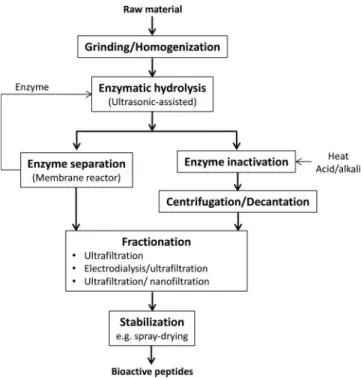
Independently of the type of food protein, the enzymatic
hydrolysis process commonly comprises the following stages
(
Fig. 1
): grinding the raw material and homogenization in water
(or buffer), temperature equilibration and pH adjustment to the
optimum values of the enzyme employed, followed by enzyme
addition (Garc
ı
a-Moreno et al.,
2010
). Recently,
ultrasonic-assisted hydrolysis was evaluated with the purpose of
facilitat-ing the production of low molecular weight peptides (Kadam
et al.,
2015
). Upon completion of the reaction, the enzyme
needs to be inactivated by heating or pH adjustment.
Alterna-tively, continuous membrane reactor, where the enzyme is
con-tinuously recycled to the reaction tank, might also be used in
order to stop the reaction and save enzyme costs (Prieto et al.,
2010a
). Subsequently, the digested material, which contains the
bioactive peptides, is separated from the precipitate and lipids
(e.g., centrifugation/decantation), fractionated, and further
sta-bilized (e.g., by spray-drying) (Abdul-Hamid et al.,
2002
;
Espejo-Carpio et al.,
2014a
).
Employing a proper enzyme and having good control over
processing conditions (e.g., pH, temperature, enzyme/protein
ratio, and time) are critical aspects for the production of
pro-tein hydrolysates with the required properties (Kristinsson,
2006
). Indeed, these process variables determine the extent of
the hydrolysis reaction for a protein
–
enzyme system. This is
normally indicated by the degree of hydrolysis (DH), which is
de
fi
ned as the percentage of peptide bonds cleaved. There are
several methods to determine the DH such as pH-stat,
trinitro-benzenesulfonic acid (TNBS), o-phthaldialdehyde (OPA),
tri-chloroacetic acid soluble nitrogen (SN-TCA), and formol
titration methods. Among them, the pH-stat method is the
most commonly employed since it allows maintaining the pH
constant at the optimum of the enzyme and measuring the DH
in real time (Rutherfurd,
2010
). However, because this method
is based on the titration of the proton released or consumed
after the cleavage of the peptide bond, it is only suitable when
the reaction is carried out under alkaline (
>
7.5
–
7.8) or acidic
(
<
3.1
–
3.6) pH, respectively (Adler-Nissen,
1986
). Another
drawback of this method is the high salt content of the
fi
nal
hydrolysate as a consequence of the alkali or acid addition,
which is required to maintain the pH constant and monitor the
DH (Whitehurst and van Oort,
2009
). As suggested by a recent
study on whey protein, an interesting alternative could be to
carry out the hydrolysis reaction without controlling pH (Le
Maux et al.,
2016
). This work indicated that the bioactive
prop-erties of the hydrolysates (e.g., antioxidant and antidiabetic)
might or might not be in
fl
uenced by the control of the pH,
depending on the enzyme employed (e.g., papain or a
micro-bial-derived alternative).
In the enzymatic hydrolysis process, the speci
fi
city of the
enzyme used is particularly important. This is because it affects
size, amount, amino acid composition and amino acid
sequence of the peptides produced, which in turn in
fl
uences
the bioactive and functional properties of the hydrolysates
(Sar-madi and Ismail,
2010
). Although crude proteases extracts (e.g.,
from
fi
sh) have been successfully used as catalysts in enzymatic
hydrolysis (Bougatef et al.,
2010
; Lassoued et al.,
2015b
),
com-mercially puri
fi
ed enzymes are preferably employed since they
allow a better control over the hydrolysis process (e.g., shorter
reaction time for a desired DH, more consistent peptides size
and composition) (Samaranayaka and Li-Chan,
2011
).
Conse-quently, industrial proteases derived from different sources
such as microorganisms (e.g., Alcalase, Neutrase, Protease P
“
Amano
”
6, Flavourzyme, Protamex) (Halldorsdottir et al.,
2013
; Venuste et al.,
2013
), animals (e.g., PTN, pepsin, trypsin,
a
-chymotrypsin, pancreatin) (Wu et al.,
2015a
,
b
; Garc
ı
a-Mor-eno et al., 2017) and plants (e.g., papain, bromelain)
(Salam-pessy et al.,
2015
; Elavarasan et al.,
2016
) have been widely
employed for the production of protein hydrolysates exhibiting
bioactive and/or functional properties. These marketable
pro-teases may mainly contain endopeptidases (e.g., trypsin,
subtili-sin, papain), or a combination of endopeptidases and
exopeptidases
(e.g.,
carboxypeptidases,
aminopeptidases).
Additionally, several enzymes can be utilized in the production
of only one protein hydrolysate. Although they may be added
simultaneously (Yamada et al.,
2013
; Garc
ı
a-Moreno et al.,
2017), sequential addition (e.g., after progressive decrease in
the reaction rate) is normally carried out in order to achieve
hydrolysates with a higher DH (Va
stag et al.,
2011
; Garc
ı
a-Moreno et al.,
2014
,
2015
).
Fermentation
In addition to proteolysis through chemical digestion and/or
addition of commercial enzymes to substrate, certain microbial
strains secreting proteases can also be used to hydrolyze
pro-tein-rich substrates. The released peptides can have a high level
of bioactivity with health-related bene
fi
ts and better functional
properties (Elfahri et al.,
2016
; Sanjukta and Rai,
2016
; Rai
et al.,
2016
).
The higher bioactivity of peptides from fermented products
compared to the raw materials could be attributed to the
change in amino acid composition in addition to size and
sequence of the peptides. Xu et al. (
2015
) reported that the
amounts of essential amino acids increased greatly following
fermentation of soybean. Kleekayai et al. (
2015
) identi
fi
ed two
ACE-inhibitory peptides (SV and IF) and one antioxidant
pep-tide (WP) from fermented shrimp pastes. Pan et al. (
2005
)
obtained two antihypertensive peptides with amino acid
sequences of VPP and IPP from skimmed milk hydrolysate
digested by cell-free extract of
Lactobacillus helveticus
. They
proposed that the amino acid composition of the peptides
accounts for bioactive effects of the fermented products.
Lactobacillus spp
. is one of the most widely used genera for
fermentation of protein-rich resources to release bioactive
pep-tides. Upon the use of
Lactobacillus
, the foodstuff rapidly
becomes acidi
fi
ed due to the production of lactic acid (Vallabha
and Tiku,
2014
). Production of lactic acid, which is an organic
acid, may elongate the shelf life and render microbial safety
and sensory quality to the
fi
nal product (De Vuyst and Leroy,
2007
). Besides,
Lactobacillus
can in
fl
uence polypeptide quality
by controlling cellular proteolysis. This is presumably done by
degradation of protein into oligopeptides through their
cell-envelope proteinase; cells absorb the oligopeptides via their
peptide transport systems and transform them into shorter
peptides and/or amino acids by intracellular peptidases
(Savi-joki et al.,
2006
). Lactic fermentation is useful not merely to
attain bioactive peptides, but also to recover other components
such as chitins, lipids, and minerals (L
opez-Cervantes et al.,
2006
). Fermentation by lactic acid bacteria may also enhance
organoleptic properties of
fi
nal products (Aguirre et al.,
2014
).
The ef
fi
ciency of lactic acid bacteria in production of bioactive
peptides can be related to their elaborate proteolytic system. It
consists of a cell envelope proteinase, which initializes protein
degradation, a transport system, and many intracellular
pepti-dases (Pescuma et al.,
2015
).
Lactic fermentation has been adopted to attain bioactive
peptides from milk resources such as antioxidant peptides from
camel milk (El Hatmi et al.,
2016
), antioxidant, ACE inhibitory,
antimicrobial, and immunomodulating peptides from whey
b
-lactoglobulin (Pescuma et al.,
2015
), and antimutagenic and
anti-in
fl
ammatory peptides from
b
-casein (Espeche Turbay
et al.,
2012
). In addition, Amadou et al. (
2011
) performed
frac-tionation on the fermented soy protein meal hydrolysate by
Lactobacillus plantarum
and found that some fractions had
great antioxidant activities. Jain and Kumar Anal (
2017
)
pro-duced functional and bioactive protein hydrolysates through
fermentation of chicken eggshell membrane by using
Lactoba-cillus plantarum
. The resulting hydrolysates exhibited favorable
functional properties with respect to solubility, foaming
capac-ity, and emulsi
fi
cation activity as well as bioactivity in terms of
DPPH-radical scavenging, reducing power, angiotensin-I
con-verting enzyme inhibition, and protection against foodborne
pathogens. Furthermore, Mechmeche et al. (
2017
) reported the
production of bioactive peptides with antioxidant activity by
using the fermentative strain
Lactobacillus plantarum
and
tomato seed meal extract as the substrate.
Fermentation of protein resources have also been performed
by using other genera of fermenting bacteria. Meinlschmidt
et al. (
2016
) studied fermentation of soy protein isolate by
Bacillus
spp.,
Rhizopus
spp., and
Saccharomyces
spp. in
addi-tion to
Lactobacillus
spp. and found that all fermented products
were more soluble and had less off-
fl
avor than nonfermented
protein isolate. Moreover, Jemil et al. (
2016
) obtained
antioxi-dant and ACE-inhibitory peptides (NVPVYEGY,
ITA-LAPSTM, SLEAQAEKY, and GTEDELDKY) from sardinelle
protein hydrolysates fermented by two species of
Bacillus
spp.
namely
B. subtilis
and
B. amyloliquefaciens
. Furthermore, Jemil
et al. (
2014
) prepared protein hydrolysate from sardinelle, zebra
blenny, goby, and ray via fermentation by
Bacillus subtilis
and
found that the hydrolysate had antioxidant and antimicrobial
effects. Zhao et al. (
2016a
,
b
) produced protein hydrolysate
from surimi through fermentation by
Actinomucor elegans
;
they stated that the end product had a higher sensory
accept-ability compared to surimi before fermentation. Kumar Rai
et al. (
2017
) produced protein hydrolysates rich in bioactive
polyphenols by using three fermentative strains from Bacillus
spp. namely
B. subtilis
KN12C,
B. amyloliquefaciens
KN2G, and
B. licheniformis
KN13C. They claimed that these strains
pos-sessed high protease,
a
-amylase and
b
-glucosidase activities.
On the whole, fermentation is a promising method in order
to prepare bioactive peptides from protein resources, especially
those with limited consumption and/or from discarded sources.
Lactobacillus
spp. is the most prevalent genus to obtain
bioac-tive peptides via fermentation although other genera such as
Bacillus
spp. are also used. Fermentation is prioritized over
acid/base digestion since it does not cause the loss of essential
amino acid and environmental pollution. It can also be an
eco-nomical substitute for the use of ef
fi
cient but expensive
com-mercial enzymes.
Removing bitterness
Bitter taste is considered the most important barrier in
commercial use of protein hydrolysates in food industry.
Low molecular weight peptides account for the bitter taste
of hydrolysates. These peptides are known to contain
hydrophobic amino acids such as leucine, proline,
phenylal-anine, and tyrosine (Ishibashi et al.,
1988
; Meinlschmidt
et al.,
2016
). In this regard, Aubes-Dufau et al. (
1995
)
men-tioned that the peptides with molecular weights up to
roughly 6 kDa and Q values exceeding 1400 cal
¢
mol
¡1can
be considered bitter; Q value is a predictive index for
bitter-ness of a given peptide and is de
fi
ned as the hydrophobicity
of the side chain of amino acids in the peptide (Ney,
1971
).
Bitterness of hydrolysates is not only caused by
hydropho-bic amino acid themselves but by their locations in peptide
sequence, as well (Spellman et al.,
2009
). Hydrophobic
amino acids caused more bitterness when they were inside
the peptide chain rather than the N- or C-terminus of
pep-tides (Matoba and Hata,
1972
).
FitzGerald and O
’
Cuinn (
2006
) listed different methods of
removing bitterness from protein hydrolysates: (i) absorption
of bitter peptides on activated carbon; (ii) chromatographic
removal using different matrices; (iii) selective extraction with
alcohols; (iv) masking hydrolysates by addition of
polyphos-phates, speci
fi
c amino acids such as Asp and Glu, and
a
-cyclo-dextrins; (v) mixing hydrolysates with intact protein samples;
(vi) formation of plasteins; and (vii) cross-linking using
trans-glutaminase. However, they also pointed to drawbacks of these
methods such as loss of some amino acid residues and decrease
in solubility.
Recently, the formation of plasteins, which are less soluble
aggregated macromolecular structures formed by incubation of
higher concentrations of the hydrolyzed proteins or peptides
with suitable proteases, has gained an increasing attention
(Udenigwe and Rajendran,
2016
). Plasteins were found to have
lower bitterness than the peptides in hydrolysates (Liu et al.,
2014
). Proposed mechanisms of plastein formation include
peptide condensation, transpeptidation, and physical forces in
peptide aggregation (for more elaboration on the mechanisms,
readers are referred to Gong et al.,
2015
). Plastein reaction was
successfully adopted to reduce bitterness in the hydrolysates
prepared from bovine red blood cells (Synowiecki et al.,
1996
)
and yellow
fi
n tuna (Zhao et al.,
2015
) as well as in synthetic
dipeptides (Stevenson et al.,
1998
).
One of the most important factors in
fl
uencing the taste
of hydrolyzed protein is the sequence and nonpolarity of
amino acids like F, W, Y, I, P, and H. Bitter taste
percep-tion of these amino acids can be changed by addipercep-tion of
a
-cyclodextrin to protein hydrolysate resulting in reduction
of its bitterness (Linde et al.,
2009
). In addition,
microen-capsulation of hydrolysates plus incorporation of masking
agents are effective alternatives for attenuation of bitterness
in hydrolysates. Daskaya-Dikmen et al. (
2017
) claimed that
encapsulation of peptides in hydrolysates is the most
favor-able technique in order to reduce bitterness.
Favaro-Trin-dade et al. (
2010
) reported that bitter taste decreased when
casein hydrolysates were spray-dried and mixed with gelatin
and soy protein isolate as carriers. It is noteworthy that the
debittering ability of gelatin might be attributed to its
endogenous amino acid glycine to mask bitterness in
hydro-lysates (Stanley,
1981
). Furthermore, Ma et al. (
2013
)
com-pared freeze- and spray-drying of whey protein hydrolysates
and found that the latter had higher ef
fi
ciency of
microen-capsulation
and
therefore,
resulted
in
less
bitter
hydrolysates.
The protease used to hydrolyze protein can also affect
the taste of
fi
nal product. Recently, Cheung et al. (
2015
)
found that exopeptidase-treated hydrolysates are less bitter
and have higher levels of umami and salty tastes as well as
increased overall acceptability compared to those produced
by endopeptidases. Moreover, when determing the in
fl
uence
of sequential hydrolysis using endo- and exo-peptidase on
bitter taste of protein hydrolysates from wheat gluten, Liu
et al. (
2016
) found that the hydrolysate produced within a
300-min reaction with Proteax had the lowest bitterness.
Raksakulthai and Haard (
2003
) also indicated application of
exopeptidases to reduce bitter taste of protein hydrolysate.
Moreover, Nishiwaki et al. (
2002
) reported that an
amino-peptidase from the edible basidiomycete
Grifola frondosa
can yield less bitter protein hydrolysates. However, Hou
et al. (
2011
) claimed that all these procedures lead to a
seri-ous loss of essential amino acids. They suggested that using
a combination of exo- and endopeptidases along with
high-pressure cooking can prevent the loss.
Besides, Newman et al. (
2015
) recommended the use of
sweeteners and
fl
avoring agents to reduce bitterness of protein
hydrolysates. They added sucralose as a sweetener and vanilla
as a
fl
avoring agent to a model beverage containing sodium
caseinate hydrolysate and concluded that this method was very
effective in reducing the bitter taste of the beverage caused by
the hydrolysate.
Although several methods have been proposed to reduce or
remove bitterness from protein hydrolysates, the majority of
them seemingly suffer from side effects like loss of amino acids
and alteration of functional properties of the bioactive peptides
obtained by the hydrolysis process. Besides, to the best of our
knowledge, no study has been done to assess economic
feasibil-ity of the hitherto-proposed debittering solutions in industrial
scale. Therefore, future studies should be directed towards
fi
nd-ing the most effective and economical debitternd-ing methods
with the least side effects in order to operationalize the
adop-tion of bioactive peptides from hydrolyzed proteins in
foodstuffs.
Fractionation, purification and identification of bioactive
peptides including bioinformatics-driven approaches
Fish protein hydrolysates are generally complex mixtures of
peptides with different chain lengths and amino acids
composi-tion, as well as other nondesired compounds such as enzymes,
nondegraded proteins and free amino acids. Hence,
fraction-ation technologies are required to separate peptides from
resid-ual enzymes, and remaining nonreacted native proteins and
free amino acids, which can induce allergenic responses and
lead to osmotically-unbalanced products, respectively. Besides,
the fractionation process makes it possible to control the
molecular-weight distribution of the hydrolysates and to
con-centrate the desired bioactive or functional peptides (Akin
et al.,
2012
). For that purpose, pressure-driven membrane
tech-niques (e.g., ultra
fi
ltration) are commonly used since they can
easily be scaled-up (Langevin et al.,
2012
). Although most of
the studies reported in the literature utilize polymeric
mem-branes (Chabeaud et al.,
2009
; Jiang et al.,
2010
; Hwang et al.,
2016
), ceramic membranes are preferred at industrial scale due
to their high chemical resistance, wider operational limits of
pH and temperature, as well as extended operational lifetime
(Lin et al.,
2011
; Espejo-Carpio et al.,
2014b
). In addition,
tan-gential-
fl
ow
fi
ltration is recommended instead of cross-
fl
ow
fi
l-tration membranes in order to limit membrane fouling (Prieto
et al.,
2010b
).
Over the past few decades, due to the increasing interest in
the production of natural biomolecules, there has been a boom
in the number of publications dealing with the concentration
of bioactive peptides by ultra
fi
ltration. Generally, fractions
con-taining low-molecular weight peptides have been reported to
exhibit higher bioactivities in vitro. For instance, numerous
studies indicate that peptide fractions
<
1 kDa showed the
strongest Angiotensin-I converting enzyme (ACE)-inhibitory
activity, independently of the type of raw protein (e.g.,
terres-trial plants or
fi
sh) (Zhao et al.,
2007
; Zou et al.,
2014
; Wu
et al.,
2016a
,
b
). Nevertheless, these differences on
ACE-inhibi-tory activity depending on the molecular weight of the peptides
might not be observed in vivo as reported for salmon protein
hydrolysate fractions (Ewart et al.,
2009
). As another example,
low molecular weight peptides (
<
1 kDa), obtained from the
hydrolysis of whey protein isolate, have also been reported to
exhibit a signi
fi
cant increase in the Fe
2Cchelating activity when
compared to larger peptide fractions (O
’
Loughlin et al.,
2014
).
On the other hand, higher molecular weight peptides (1
–
3 kDa), obtained from hydrolysis of
fi
sh protein, were found to
show the highest radical scavenging activity when compared to
other peptide fractions (
<
1, 3
–
5 and 5
–
10 kDa) (Kim et al.,
2007
).
Recently, more complex fractionation processes have been
studied for the concentration of bioactive peptides. As an
example, target bioactive peptides with similar molecular
weight, which cannot be separated by pressure-driven
mem-branes, have been concentrated by electrodialysis with ultra
fi
l-tration membranes (Doyen et al.,
2014
; He et al.,
2016
).
Furthermore, sequential ultra
fi
ltration and nano
fi
ltration stages
have also been tested in order to obtain even more concentrated
peptide fractions with a reduced salt content (Langevin et al.,
2012
;
Ranamukhaarachchi
et
al.,
2013
).
In
contrast,
fractionation techniques are seldom applied to improve
func-tional properties of protein hydrolysates. Among the few
stud-ies found in the literature, Jeon et al. (
1999
) reported that
fractions from cod frames hydrolysates containing large
pepti-des (
>
30 and
>
10 kDa) showed excellent emulsifying
proper-ties and whippability. Likewise, Taheri et al. (
2014
) indicated
that polypeptides (
>
50 kDa) obtained from proteins contained
in herring brine presented higher emulsion activity index,
when compared to fractions having peptides with lower
molec-ular weight. This indicates that only a limited hydrolysis of
native proteins is required to improve these technological
prop-erties (e.g., emulsifying and foaming).
Further puri
fi
cation and identi
fi
cation of bioactive peptides
are required in order to determine their structure-activity
rela-tionship. Initial peptide separation is normally performed by
using fast protein liquid chromatography (FPLC), employing
gel permeation or ion-exchange columns (Sampath Kumar
et al.,
2011
; Vavrusova et al.,
2015
). The fraction containing the
most active peptides is then subjected to high pressure liquid
chromatography (HPLC) separation using a reverse-phase
col-umn (RP-HPLC). This allows obtaining peptides subfractions
with different hydrophobic behavior, but more than one
RP-HPLC round will be required in order to obtain highly pure
peptides in a suf
fi
cient amount (de Gobba et al.,
2014a
; Chi
et al.,
2015
; Ruiz-Gim
enez et al.,
2012
). Furthermore,
hydro-philic interaction liquid chromatography (HILIC) has recently
been suggested for an improved separation of homologous
short peptides (Le Maux et al.,
2015
). Finally, these
chro-matographic techniques are coupled to mass spectrometry
(MS), in particular to tandem MS (MS/MS), for peptide
sequence determination. Traditional identi
fi
cation approaches,
which require the knowledge of the parent protein sequences,
match tandem spectra with theoretical spectra derived from
predicted peptides in a protein library (Espejo-Carpio et al.,
2013
; Gu and Wu,
2013
; de Gobba et al.,
2014b
). Primary
struc-ture of proteins can be accessed from online databases such as
UniProtKB/Swiss-Prot or NCBI and the identi
fi
cation process
can be carried out by using database search engines (e.g.,
Mas-cot) (Dallas et al.,
2015
; Le-Maux et al.,
2015
). On the other
hand,
de novo
sequencing approach does not require a protein
library and deduces peptide amino acid sequence by calculating
mass differences between fragments from the tandem mass
spectra (Girgih et al.,
2014
; Garc
ı
a-Moreno et al.,
2015
). For
that purpose, generally employed programs are Peaks (Marques
et al.,
2015
) and PepSeq (Liu et al.,
2015
). Alternatively to MS
techniques, automated Edman degradation has been also
widely employed for sequencing amino acids in a highly
puri-fi
ed peptide (Je et al.,
2005a
; Sheih et al.,
2009a
,
b
; Chi et al.,
2015
).
Other advances in bioinformatics, also known as
in silico
analysis or software-based methods, allow predicting and
iden-tifying cryptic peptides likely to exhibit bioactivities, elucidate
structure-function relationships and propose mechanisms of
action (Li-Chan,
2015
). BIOPEP, a database mainly focused on
peptides from food, is generally employed to determine the
occurrence frequency of embedded bioactive peptides in the
primary structure of the food proteins of interest (Udenigwe,
2014
; Lacroix and Li-Chan,
2012
). Peptide cutter programs
(e.g., ExPASy) are used to generate peptide pro
fi
les
in silico
from speci
fi
c primary protein structures using enzymes of
known speci
fi
city (Udenigwe et al.,
2013
; Nongonierma and
FitzGerald,
2016a
). Peptide cutters have been also employed to
assay the potential cleavage by gastrointestinal tract enzymes of
bioactive peptides obtained experimentally (Fitzgerald et al.,
2012
). Quantitative structure activity relationship models
(QSAR) have been successfully used to predict biological
activ-ity of peptide sequences based on physicochemical descriptors
(e.g., size, charge, polarity, sequence, etc.) (S
anchez-Rivera
et al.,
2014
). For instance, QSAR approaches have been applied
to study ACE-inhibitory, antioxidant and antimicrobial
pepti-des (see Jahangiri et al.,
2014
; Nongonierma and Fitzgerald,
2016b
). Finally, molecular docking simulations have also been
developed to predict possible interactions of peptides with
pro-teins (e.g., active sites of enzymes), which are the target of the
biological activity (Li-Chan,
2015
). Examples in the literature
include studies on ACE as well as DPP-IV inhibitory peptides
(Lin et al.,
2017
; Nongonierma et al.
2014
). Thus,
in silico
tools
may expedite the discovery and production of bioactive
pepti-des from food proteins, although they still have some
limita-tions (e.g., do not consider secondary, tertiary and quaternary
structures of proteins to predict cleavage sites; and assume
enzymes with stringent substrate speci
fi
city, which is not
always the case in food applications where complex
protease-proteins interactions occur) (Li-Chan,
2015
; Nongonierma and
FitzGerald,
2016a
; Udenigwe,
2014
).
Bioactivity of peptides
Effects on immune system
An overview of reported effects on immune system is given in
Table 1
, which also shows the suggested peptides responsible
for the effects.
Antifungal effect
Past few decades have witnessed a dramatic increase in fungal
infections, especially the invasive ones with a high potential of
claiming lives (Wang et al.,
2016
). Not only are they perilous
for humans, they might have notorious in
fl
uence on plants and
may even kill them (Luna-Vital et al.,
2015
). Therapeutic
options to
fi
ght against pathogen fungi seem to be very
restricted since there are only few antifungals specialized for
the pathogens (Wang et al.,
2016
). In addition, a global concern
on the use of synthetic antifungals has directed academic efforts
toward
fi
nding natural alternatives to combat against
trouble-making fungi.
In nature, antifungal peptides are considered the
fi
rst
defense barrier between the organism and its surroundings.
These peptides are small cationic and amphipathic molecules
with not more than 50 amino acids (Shekh and Roy,
2012
).
Antifungal proteins and peptides have been isolated from
dif-ferent sources (
Table 1
).
Antimicrobial effect
Drug resistance in bacteria has turned out to be a major
prob-lem in using antibiotics in recent years. Add to this the current
concern on using chemical preservatives in foods in order to
avoid different kinds of spoilage including microbial decay. In
this regard, one of the most interesting research breakthroughs
is the discovery of the so-called antimicrobial peptides (AMPs)
with a potential effect on even drug-resistant species (Tang
et al.,
2015
). Production of AMPs can guarantee the innate
immunity resistance against different pathogens. AMPs are
majorly small cationic molecules and they are very favorable
since their synthesis can be done with low metabolic cost and
they have the capability to diffuse rapidly to the point of
infec-tion (Pisuttharachai et al.,
2009
). AMPs have a very wide scope
in terms of their physiological roles, many of which are still to
be determined. These roles range from killing microbes to
modulating the immune system through increase in
phagocyto-sis (Battison et al.,
2008
). It seems very important to
fi
nd new
resources from which the very promising alternatives for
cur-rent antibiotics, i.e., AMPs, can be obtained.
Antimicrobial proteins and peptides have been obtained
from a variety of sources such as aquatic organisms like shrimp
(Cuthbertson et al.,
2002
), sole (Oren and Shai,
1996
),
fl
ounder
(Cole et al.,
1997
), and anchovy (Tang et al.,
2015
), plants
(Cap-riotti et al.,
2015
), blood (Fogaca et al.,
1999
), milk (McCann
et al.,
2006
), and egg (Mine et al.,
2004
), to name a few. One of
the latest investigations to derive antimicrobial peptides from
natural sources was the work performed by Capriotti et al.
(
2015
). They identi
fi
ed antimicrobial peptides from soybean
seeds and milk protein generated by simulated gastrointestinal
digestion (Capriotti et al.,
2015
).
Antiviral effect
Bioactive peptides and hydrolysates were found to have
antivi-ral activities against different species of viruses such as HSV-1
and HSV-2 (Conlon et al.,
2014a
). These peptides and
hydroly-sates were produced from different sources, e.g., oyster (Lee
and Maruyama,
1998
; Shimizu et al.,
2009
), crab (Miyata et al.,
1989
; Murakami et al.,
1991
; Masuda et al.,
1992
), mussel
(Mitta et al.,
2000
), and even, different frog species skins
(Con-lon et al.,
2014b
). Antiviral effect of these peptides has been
claimed to be in two ways: one through direct inactivation of
virus particles and the other via interference in reproductive
cycle of virus (Conlon et al.,
2014a
,
b
). Antiviral peptides from
natural sources are especially appealing because they require a
rather short contact time to induce their effect (Conlon et al.,
2014a
,
b
).
Immunomodulatory effect
Proteins and peptides obtained from plant and animal sources
(
Table 1
) have been found to improve lymphocyte
prolifera-tion, natural killer (NK), cell activity, antibody synthesis and
cytokine regulation (Singh et al.,
2014
). Recently, milk bioactive
peptides released by selected
Lactobacillus helveticus
strains
(Elfahri et al.,
2014
) and the frog skin host-defense peptides
(Mechkarska et al.,
2014
) were shown to induce stimulatory
in
fl
uence on the production of cytokines with pro- and
anti-in
fl
ammatory effects. In addition, an immunomodulatory
pep-tide derived from zebra
fi
sh phosvitin has been suggested to
up-regulate the expression of the anti-in
fl
ammatory and
down-regulate the expression of the pro-in
fl
ammatory cytokine genes
(Ding et al.,
2012
).
Parker et al. (
1984
) detected a hexapeptide with amino acid
sequence of VEPIPY with immunostimulatory effect. The
Table 1.Effects of bioactive peptides on immune system.
Effects Origin Amino acid sequence (in single-letter code) Reference
Antifungal peptides
AS Crab RRWCFRVCYRGFCYRKCR, RRWCFRVCYKGFCYRKCR,
RWCFRVCYRGICYRKCR, KWCFRVCYRGICYRRCR, YLAFRCGRYSPCLDDGPNVNLYSCCSFY, DYDWSLRGPPKCATYGQKCRTW SPPNCCWNLRCKAFRCRPR
Miyata et al.,1989; Murakami
et al.,1991; Ohta et al.,
1992; Kawabata et al.,1996;
Osaki et al.,1999
Blood of immune-challenged and untreated mussels (Mytilus edulis)
DCCRKPFRKHCWDCTAGTPYYGYSTRNIFGCTC Charlet et al.,1996
Bass FFHHIFRGIVHVGKTIHKLVTG Lauth et al.,2002
Salmon — Kamal and Motohiro,1986
Sea hare — Woyke et al.,2001; Pettit et al.,
1998 Shrimp YRGGYTGPIPRPPPIGRPPFRPVCNACYRLSVSD ARNCCIKFGSCCHLVKG, QVYKGGYTRPIPRPPPFV RPLPGGPIGPYNGCPVSCRGISFSQARSCCSRLGRCCHVGKGYSG, LVVAVTDGDADSAVPNLHENTEYNHYGSHGVY, VTDGDADSAVPNLHENTEYNH YGSHGVYPDK, FEDLPNFGH IQVKVFNHGEHIHH, PEVYKGGYTRPIPRPPPFVRPLPGGPIGPYNG CPVSCRGISFSQARSCCSRLGRCCHVGKGYS, VYKGGYTRPVPRPPPF VRPLPGGPIGPYNGCP VSCRGISFSQARSCCSRLGRCCHVGKGYS, VYKGGYTRPIPRPPFVRPVPG GPIGPYNGCPVS CRGISFSQARSCCSRLGRCCHVGKGYS Destoumieux et al.,1991, 2000; Destoumieux-Garzon et al.,2001
Oyster(Muscle) CLEDFYIG Liu et al.,2008
TP Mushroom AGTEIVTCYNAGTKVPRGPSAXGGAIDFFN, ATRVVYCNRRSGSV
VGGDDTVYYEG, AGTEIVTCYNAGTKVPRGPSAXGGAIDFFN
Wang and Ng,2004; Lam and
Ng,2001
Traditional Chinese medicinal
herbs —
Zhang et al.,2013
Bean KTCENLADTFRGPCFATSNC,KTCENLADTYKGPCFTTGSCDDHCK,
KTCENLADTYKGPCFTTG, TENLADTYWGPPFTRGS, KTCENLADTY, KTCGNLANQYYPCFTTSNCDDHCKNKEHLRSGRCRDDFRCWCTK, KTYENLADTYKGPYFTTGSHDDHYKNKEHLRSGRMRDDFF, KTYENLADTYKGPYFTTGSHDDHYKNKEHLRSGRYRDDFF
Wong et al.,2012; Chan et al.,
2012; Chan and Ng,2013;
Lam and Ng,2013; Leung
et al.,2008; Lin et al.,2010;
Wang and Ng,2007; Wu
et al.,2011
TA Venom of the social wasp
(Polybia paulista)
ILGTILGLLKSL Wang et al.,2016
Antimicrobial peptides
AS Oyster(Muscle) CLEDFYIG Liu et al.,2008
Bass FFHHIFRGIVHVGKTIHKLVTG Lauth et al.,2002
Crab RRWCFRVCYRGFCYRKCR,RRWCFRVCYKGFCYRKCR,RWCFRVCYRGI
CYRKCR, KWCFRVCYRGICYRRCR, YLAFRCGRYSPCLDDGPNVNLYSCCSFY,
DYDWSLRGPPKCATYGQKCRTWSPPNCCWNLRCKAFRCRPR
Miyata et al.,1989; Murakami
et al.,1991; Osaki et al.,
1999; Kawabata et al.,1996
Crayfish FKVQNQHGQVVKIFHH Lee et al.,2002
Flounder GWGSFFKKAAHVGKHVGKAALTHYL Cole et al.,1997
Loach RQRVEELSKFSKKGAAARRRK Park et al.,1997
Lobster IVENTSLEPHAGRCLLHTMCVKGDFTPPSPIR, QYGNLLSLLNGYR
MMKLVLLCVLGLAV,MLKLVLLCVLGLALG, MLKLVLLCVLGLALG, MLRLVLLCVLGLAVG
Pisuttharachai et al.,2009;
Battison et al.,2008
Salmon — Uyttendaele and Debevere,
1994
Atlantic salmon rest raw
material —
Opheim et al.,2015
Shrimp MRLVVCLVFLASFALVCQG, YRGGYTGPIPRPPPIGRPPFRPVCNA
CYRLSVSDARNCCIKFGSCCHLVKG, QVYKGGYTRPIPRPPPFVRPLPGGPIGPYNGCPV SCRGISFSQARSCCSRLGRCCHVGKGYSG, PEVYKGGYTRPIPRPPPFVRPLPGGPIGPYNGCP VSCRGISFSQARSCCSRLGRCCHVGKGYS, VYKGGYTRPVPRPPPF VRPLPGGPIGPYNGCP VSCRGISFSQARSCCSRLGRCCHVGKGYS,VYK GGYTRPIPRPPFVRPVPGGPIGPYNGCPVSCR GISFSQARSCCSRLGRCCHVGKGYS Cuthbertson et al.,2002; Destoumieux et al.,1991, 2000
Sole GFFALIPKIISSPLFKTLLSAVGSALSSSGGQE Oren and Shai,1996
Table 1.(Continued)
Effects Origin Amino acid sequence (in single-letter code) Reference
Marine mussels HPHVCTSYYCSKFCGTAGCTRYGCRNLHRGKLCFCLHCSR,
HSHACTSYWCGKFCGTASCTHYLCRVLHPGKMCACVHCSR, QSVACRSYYCSKFCGSAGCSLYGCYLLHPGKICYCLHCSR, SCASRCKGHCRARRCGYYVSVLYRGRCYCKCLRC, GFGCPNNYACHQHCKSIRGYCGGYCASWFRLRCTCYRCG, GFGCPNDYPCHRHCKSIPGRYGGYCGGXHRLRCTC, GFGCPNDYCHRHCKSIPGRXGGYCGGXHRLRCTCYR, GCASRCKAKCAGRRCKGWASASFRGRCYCKCFRC
Padhi and Verghese,2008;
Balseiro et al.,2011; Mitta
et al.,2000; Charlet et al.,
1996
Anchovy cooking wastewater GLSRLFTALK Tang et al.,2015
Penaeid shrimp FEDLPNFGHIQVKVFNHGEHIHH Petit et al.,2016
Zebrafish phosvitin — Ding et al.,2012
Tegillarca granosahemoglobin PSVQDAAAQISADVKK, VLASLNFGDR,ISAAEFGK, ISAEAFGAINEPMK, GHAITLTYALNNFVDSLDDPSR, MGSYYSDECAAAWAALVAVVQAAL, LNGHGLTLWYGIQNFVDQLDNADDLEDVARK
Bao et al.,2016
TP Traditional Chinese medicinal
herbs —
Zhang et al.,2013
Soybean FVLPVIRGNGGGIQVA, IIVVQGKGAIGF, WAISKDISEGPPAIKL,
ITLAIPVNKPG, LAFPGSAKDIENLIKSQ,
ASRGIRVNGVAPGPVWTPIQPA, IVTVKGGLRVTAPA, KIGGIGTVPVGRVETGVLKPGMVV, LFVLSGRAIL, GIRVNGVAPGPVWTPIQPA, LAGSKDNVIRQIQKQVKEL
NVLKVIPAGSSSGAKKA, IIIAQGKGALGV, SGGIKLPTDIISKISPLPVLKEI, SGGIKLPTDIISKISPLPV, MIIIAQGKGALGV, IIVVQGKGAIG, VLDFNSVADLTKGNVGGLIGTGL, ASLGGLQNVSGINFLIK, AIVILVINEGDANIELVGIK, VDINEGALLLPHFNSKAIV, VLSGRAILTLV, GKVKIGINGFGRIGRLV, IIYALNGRALVQV,IYALNGRALIQV
Capriotti et al.,2015
TA Bovine blood FLSFPTTKTYFPHFDLSHGSAQVKGHGAK,
VLSAADKGNVKAAWGKVGGHAAE,
VTLASHLPSDFTPAVHASLDKFLANVSTVL QADFQKVVAGVANALA HRYH, STVLTSKYR,TSKYR,VTLASHLPSDFTPAVHASLDKFLAN VSTVLTSKYR, VNFKLLSHSLLVTLASHL
Fogaca et al.,1999; Froidevaux
et al.,2001; Daoud et al.,
2005; Nedjar-Arroume
et al.,2006; Jang et al.,
2008
Beef muscle GFHI, DFHING, FHG, GLSDGEWQ Jang et al.,2008
Bovine hemoglobin VNFKLLSHSLLVTLASHL,
TKAVEHLDDLPGALSELSDLHAHKLRVDPVNFKLLSHSLL, LDDLPGALSELSDLHAHKLRVDPVNFKLLSHSL,KLLSHSL,LLSHSL
Hu et al.,2011; Adje et al.,
2011
Deer, sheep, pig, and cattle blood — Bah et al.,2016 Frogs IKIPAVVKDTLKKVAKGVLSAVAGALTQ, IKLSPETKDNLKKVLKGAIKGAIAVAKMV, LKIPGFVKDTLKKVAKGIFSAVAGAMTPS, IKIPAFVKDTLKKVAKGVISAVAGALTQ, IKIPPIVKDTLKKVAKGVLSTIAGALST, IKLSPETKDNLKKVLKGAIKGAIAVAKMV, GLVGTLLGHIGKAILG, GLVGTLLGHIGKAILS Mechkarska et al.,2012; Mechkarska et al.,2013; Mechkarska et al.,2014; Conlon et al.,2014
Bovine mammary epithelial cell line
— Malvisi et al.,2015)
Venom of the social wasp Polybia paulista
ILGTILGLLKSL,IDWKKLLDAAKQIL Souza et al.,2005
DE Milk LRLKKYKVPQL, VYQHQKAMKPWIQPKTKVIPYVRYL, IKHQGLPQE,
VLNENLLR, SDIPNPIGSENSEK
Mohanty et al.,2015; McCann
et al.,2006; Hayes et al.,
2006
Human milk EQLTK, GYGGVSLPEWVCTTFALCSEK, CKDDQNPHISCDKF,
GRRRRSVQWCAVSQPEATKCFQWQR NMRKVRGPPVSCIKRDSPIQCIQA
Pellegrini et al.,1999; Hunter
et al.,2005
Egg IVSDGDGMNAW, HGLDNYR Mine et al.,2004; Mine and
Kovacs-Nolan,2006
Bovine milk YQEPVLGPVRGPFPI,YQEPVLGPVRGPFPIIV,EVFGKEKVN,
SDIPNPIGSENSEK,RPKHPIKHQGLPQEVLNENLLRF,VLNENLLR
Dallas et al.,2016
Antiviral peptides AS Oyster(Muscle) LLEYSI,LLEYSL Lee et al.,1998
Crab KWCFRVCYRGICYRRCR, RRWCYRKCYKGYCYRKCR Murakami et al.,1991; Masuda
et al.,1992
Sponge — Plaza et al.,2007; Plaza et al.,
2009; Andjelic et al.,2008
TP Mushroom AGTEIVTCYNAGTKVPRGPSAXGGAIDFFN Lam and Ng,2001
Bean KTCGNLANQYYPCFTTSNCDDHCKNKEHLRSGRCRDDFRCWCTK Lin et al.,2010
TA Frog skin ALWMTLLKKVLKAAAKAALNAVLVGANA Bergaoui et al.,2013
Immunomodulatory peptides
AS Atlantic salmon (Salmo salar) — Opheim et al.,2015
Musca domesticalarvae — Sun et al.,2014
Chlorella vulgarian — Morris et al.,2009
Zebrafish phosvitin — Ding et al.,2012
Table 1.(Continued)
Effects Origin Amino acid sequence (in single-letter code) Reference
TP Soybean MITLAIPVNKPGR, MITLAIPVN, MITL, HCQRPR,
QRPR, MITLAIPVNKPGR
Yoshikawa et al.,2000; Singh
et al.,2014; Capriotti et al.,
2015
Rice GYPMYPLPR Takahashi et al.,1994
Mushroom — Sheu et al.,2004; Lin et al.,
2013
Wheat — Horiguchi et al.,2005
Buckwheat pollen RKYVD Liu et al.,1998
Turmeric (Curcuma longa) — Aravind and Krishnan,2016
Chickpea — Clemente et al.,1999
TA Frog skin GLVGTLLGHIGKAILG, GLVGTLLGHIGKAILS, IKLSPE
TKDNLKKVLKGAIKGAIAVAKMV
Mechkarska et al.,2014;
Conlon et al.,2014;
Mechkarska et al.,2013
Bovine mammary epithelial cell line
— Malvisi et al.,2015
DE Egg — Xie et al.,2002; Fan et al.,2003
Milk TTMPLW, YPFPAVPYPQRTTMPLW, YQEPVLGPVR, LLY Meisel,2005; Mohanty et al.,
2015; Elfahri et al.,2014;
Hernandez-Ledesma et al.,
2004; Berthou et al.,1987
Camel milk QEPVPDPVRGLHP El Hatmi et al.,2016
Whey — Mercier et al.,2004
Bovine milk PGPIPN, YQEPVLGPVRGPFPIIV, PGPIPN, LYQEPVLGPVRGPFPIIV Boutrou et al.,2013; Dallas
et al.,2016
Bursa of Fabricius (BF) in chicken YEYAY, RMYEE, GPPAT, AGCCNG, RRL Feng et al.,2012
Human milk VEPIPY Parker et al.,1984
Egg SVNVHSSL,YRGGLEPIN Goldberg et al.,2003
Cytomodulatory peptides
DE Bovine milk KAVPYPQ,PYPQ, RTLGYLE,RTLGYL, YPFPGPI YVPFPYPFPG, AVP
YPQR,RETIESLSSSEESIPEYK, QPTIPFFDPQIPK
Kampa et al.,1997; Nagaune
et al.,1989;
Hernandez-Ledesma et al.,2004
Camel milk KRKEMPLLQSPV El Hatmi et al.,2016
Casein EPVLGPVRGP Zhao et al.,2014
Antiproliferative, anti-tumor, and anti-cancer peptides
TP Bean (Phaseolus vulgarisL.) KTYENLADTYKGPYF
TTGSHDDHYKNKEHLRSGRMRDDFF,
KTCGNLANQYYTPCFTTSNCDDHCKNKEHLRSGRCRDDFRCWCT K, KTYENLADTYKGPYFTTGSHDDHYKNKEHLRSGRYRDDFF
Wang and Ng,2007; Lin et al.,
2010; Wu et al.,2011
Mushroom Flammulina velutipes — Lin et al.,2013
Soybean XMLPSYSPY, SKWQHQQDSCRKQKQGV
NLTPCEKHIMEKIQGRGDDDDDDDDD
Kim et al.,2000; Valjakka et al.,
1997
Turmeric (Curcuma longa) — Aravind and Krishnan,2016
Bean KTCGNLANQYYPCFTTSNCDDHCKNKEHLRSGRCRDDFRCWCTK Lin et al.,2010
TA Frog skin IKLSPETKDNLKKVLKGAIKGAIVAKMV,
GLWSKIKEAAKAAGKAALNAVTGLVNQGDQPS, GLVG TLLGHIGKAILG,GLVGTLLGHIGKAILS
Attoub et al.,2013; Conlon
et al., 2007; Mechkarska
et al.,2014; Conlon et al.,
2014
AS Sea hare (Dolabella auricularia) XVXXX Madden et al.,2000; Pettit
et al.,1998; Turner et al.,
1998; Vaishampayan et al.,
2000
Musca domesticalarvae — Sun et al.,2014
Fish sauce — Lee et al.,2003,2004
Sea hare (Dolabella auricularia) XVXXX Madden et al.,2000
Cod, plaice, salmon — Xhindoli et al.,2016; Ngo et al.,
2012
Tuna muscle LPHVLTPEAGAT, PTAEGGVYMVT Hsu et al.,2011
Fish backbone — Zhang et al.,2013; Ngo et al.,
2012
Sardine muscle VY Matsui et al.,2005
Shrimp shell — Kannan et al.,2011
Sea slug (Pleurobranchus
forskalii)
— Wesson and Hamann,1996
DE Bovine Milk VENLHLPLPLL,NLHLPLPLL, ENLHLPLPLL, ALNENLLRFFVAPFP
EVFG, LNENLLRFFVAPFPEVFG, NENLLRFFVAPFPEVFG, ENLLRFFVAPFPEVFG, FVAPFPEVFG
Juillerat-Jeanneret et al.,2011
Antimutagenic and antigenotoxic
DE Kefir — Guzel-Seydim et al.,2011
TA Bovine plasma, globulin and
albumin
— Park and Hyun,2002
Silkfibroin — Park et al.,2002
AS, TP, TA, and DE stand for aquatic sources, terrestrial plants, terrestrial animals, and dairy & eggs, respectively.
peptide was claimed to stimulate in vitro phagocytosis of sheep
red blood cells by murine macrophages and to have in vivo
pro-tective effect in mice against lethal infection caused by
Klebsi-ella pneumonia
(Parker et al.,
1984
).
On the other hand, application of bioactive peptides from
different resources has been limited due to their potential
anti-genicity and immunoreactivity in the body. In this regard,
pro-tein hydrolysates with hypoimmunoreactive effect are more
favorable to be used in industrial products. Clemente et al.
(
1999
) obtained extremely hypoimmunoreactive protein
hydrolysates from chickpea by sequential treatment using
endo- and exopeptidases. They de
fi
ned hypoimmunoreactivity
by the loss of antigenicity through reduction in the interaction
capacity of antigenic determinants with speci
fi
c antibodies
(Clemente et al.,
1999
).
Cytomodulatory effect
Bioactive peptides obtained from different sources (
Table 1
)
have been shown to have cytomodulatory effect. Zhao et al.
(
2014
) identi
fi
ed peptides from casein with cytomodulatory
effect (Zhao et al.,
2014
). Cytomodulation can be of a great
health importance since it is related to cell proliferation and
apoptosis as two attributes of cell viability (Zhao et al.,
2014
).
These peptides can also regulate immune cells and therefore,
they can play an important role in regulation of immune
sys-tem (Elfahri et al.,
2014
). However, the term cytomodulation
seems to include a wide spectrum of applications with key roles
in controlling cancer, tumor, and other cell-related disorders.
In other words, there is seemingly some conceptual overlap
between immunomodulation, cytomodulation, anticancer,
antitumor, etc. Nonetheless, we present a separate part as
fol-lows to give a better overview of peptide bioactivity.
Antiproliferative/antitumor/anticancer effects
Cancer is one of the most important diseases in the world and
millions of people die annually as a consequence of this
danger-ous disorder. It is generally characterized by the presence of
transformed cells in different tissues. In other words, the
carci-nogenic cells start out-of-control multiplication in the site they
belong to without rendering the role they are originally
sup-posed to. The transformed invasive cells can even cross through
their own sites and enter, say, blood vein to cause more severe
problems (Luna-Vital et al.,
2015
). There are several
chemo-therapeutics and targeted antineoplastic agents commercially
available; however, although they prove to be very ef
fi
cient
against tumor and cancer, there have also been serious
com-plaints regarding their adverse side-effects. In addition,
resis-tance to chemotherapy-based treatments has also increased
concerns regarding cancer cure since some patients experience
tumor relapse with the new tumor being resistant to
already-adopted treatments (Sun et al.,
2014
). Taken together, academic
interest has shifted toward
fi
nding dietary agents in order to
block or at least alleviate the effects of tumor or even to prevent
outbreak of cancer. Bioactive peptides from different sources
have been found to have antitumor effects (Attoub et al.,
2013
;
Lin et al.,
2013
; Sun et al.,
2014
; Luna-Vital et al.,
2015
)
(
Table 1
). Yet, no single mechanism has been detected for the
peptides to cause tumor cell death, but their action mechanism
includes nonspeci
fi
c perturbation of the cell membrane and
subsequent insertion into the lipid bilayer so as to disrupt cell
membrane (Attoub et al.,
2013
).
Bioactive peptides from natural resources have also been
found to
fi
ght against proliferation of trouble-making cells.
Sev-eral studies have shown that peptides from different sources
such as sea hare (Pettit et al.,
1998
; Turner et al.,
1998
; Madden
et al.,
2000
; Vaishampayan et al.,
2000
; Woyke et al.,
2001
),
fi
sh
sauce (Thang and Zhao,
2015
; Bah et al.,
2016
), and cod
(Xhin-doli et al.,
2016
) were able to block proliferation of carcinogenic
cells. However, it seems there is still a long way in order to
make commercial use of these potentially potent anticancer
peptides to treat different kinds of cancer. For example, clinical
intervention trials are needed to fully document the effects.
Antigenotoxic and antimutagenic effects
There might be confusion in de
fi
ning genotoxicity and
mutage-nicity. In general, genotoxicity is de
fi
ned as the potential of a
chemical agent to impair genetic information within a cell;
such impairment might cause mutation (mutagenicity) and
cancer. In other words, genotoxics include a broader spectrum
of harmful agents than mutagens; simply put, although all
mutagens can be considered genotoxic agents, not all
geno-toxics are mutagens. Therefore, it is important to
fi
nd
substan-ces in order to shield DNA from possible damage. Park et al.
(
2002
) compared antigenotoxic properties of acidic and
enzy-matic hydrolysates produced from silk
fi
broin. They analyzed
antigenotoxicity of the isolates in mouse embryo 3T3 cells via
Comet assay and concluded that acidic-derived isolates showed
higher antigenotoxic activity than those synthetized by the
commercial enzyme. Furthermore, they claimed that the
treat-ment containing 10 mg/ml acidic isolates would provide 87
percent protection from DNA damage. They proposed two
possible circumstances for antigenotoxicity of the isolates:
fi
rst,
protective interactions between cells and peptide molecules and
second, the direct role of peptides to inactivate the mutagen
(Park et al.,
2002
).
Effects on cardiovascular system
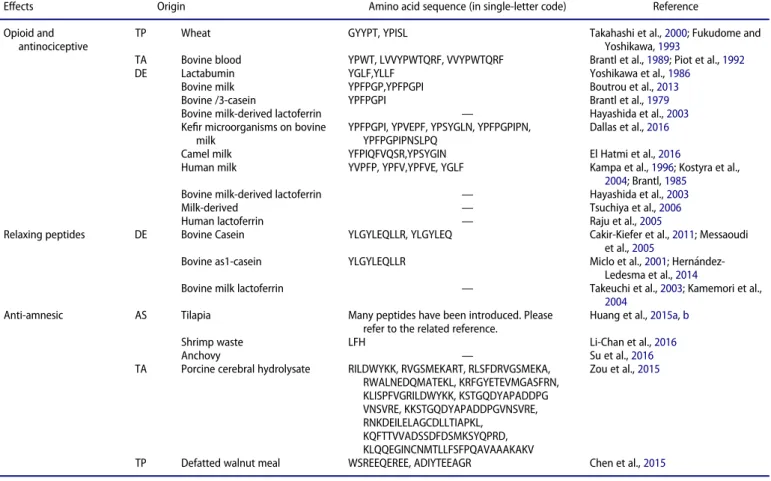
Table 2
provides an overview of reported effects of peptides on
the cardiovascular system.
Antithrombotic activities
Blood coagulation is a natural and important process required
to survive. The process is carried out in abnormal vascular
con-ditions or absence of endothelial surface in the case of vascular
injury (Jung and Kim,
2009
). However, blood coagulation and
clot formation are considered undesirable circumstances in
some medical conditions and therefore, antithrombotic agents,
especially natural ones, are favored. In this regard, bioactive
peptides have been found to have antithrombotic effect (Jolles
et al.,
1986
; Raha et al.,
1988
; Mazoyer et al.,
1990
; Chabance
et al.,
1995
; Morimatsu et al.,
1996
; Shimizu et al.,
2009
). There
are two types of antithrombotic agents: anticoagulants and
antiplatelets. The former prevent the formation and growth of
clots while the latter inhibit platelet clumping (Li-Chan et al.,
2016
).
Exogenous anticoagulants from natural sources can be
adopted to prolong or stop blood clotting (Jo et al.,
2008
). This
Table 2. Effects of bio active pe ptides on ca rdiovasc ular syst em. Effects Origi n Amino acid sequ ence (in singl e-letter code) Refere nce Antithr ombotic TP Bean LL SL, LSLL, NEGEAH,DNPIFSDHQ, NVLI SSMEMKEGA Os eguera-To ledo et al. , 2011 TA Porcine muscl e — Sh imizu et al. , 2009 DE Milk MAI PPKKNQ DK, MAIP PKKNQDK, IAIPPKKIQDK Joll es et al., 1986 ;Ch abance et al., 1995 Bovine milk VPQL EIVP NSA, VPNSA Bo utrou et al., 2013 Huma n milk KRD S, RGDS Mazo yer et al. , 1990 ;Raha et al., 1988 Ke fi r microo rganisms on bov ine milk YQ EPVLGPVRGPFPI IV, MAIP PKKNQDK Dall as et al., 2016 Huma n lactotr ansferr in KRD S Mazo yer et al. , 1990 Egg IR W, IQW Hua ng et al., 2010 ;Majumd er et al., 2013 ; Majumd er et al., 2015 ;Majumd er et al., 2013 AS Blue musse l EAD IDGDGQVNY EE FVAMM TSK Ju ng and Kim, 2009 Echiuro id worm GELT PESGPDLFVHFLD GNPSYSLY ADAVP R Jo et al., 2008 Star fi sh — Ko yama et al., 1998 Yellow fi n sole TDGSEDYGI LEIDSR Raja paks e et al. , 2005 Granu lated ark HTHLQ RAPH PNALGY HGK Ju ng et al., 2007 Spirulina LDA VNR, MMLD F Vo and Kim, 2013 Salm on — Ahn et al., 2012 Anti-diabetic AS Dog fi sh GIV DHCCRN TCSLYDLEGYC NQ,LPS QHL CGSHLVE TLYFVCGQKGF YYVPKV Ande rso n et al. , 2002 Shark GIV DHCCHN TCSLYDLEGYC NQ,LPSQHLCGSHLV ETLY FVCGQK GFYYVP KI Ande rso n et al. , 2002 TA Frog skin GF GSFLGKA LKAALKIG ANALG GAPQQ,GFLG PLLKLGLK GVAK VIPHLIPS RQQ Sri nivasan et al., 2013 DE Egg yolk LAPS LPGKPKPD Za mbrowicz et al., 2015 Album in KLP GF Yu et al., 2012 TP Cana ry seed — Est rada-Salas et al. , 2014 Momordica chara ntia RV RVWVTERG IVARP PTIG Lo et al., 2016 Bean ALV LL,LLSL,DKGGLL,L LLLEDRR R,LSLL ,WVVL,LLY,LVLL, FFAAAFT ,FFL,DFFL,DFFLS ,YAAHEV Os eguera-To ledo et al. , 2015 Soy IAV PGEVA,IAVPTGVA,LPYP Lammi et al. , 2015 Hypo cholest erolemic and hyp otriglycerid emic AS Salm on bone frames — We rgedah l et al., 2004 TP Soy LPYP RI, AVP GEVA, IAV PTGVA, LPYP Lammi et al. , 2015 ;Yoshikawa et al., 2000 DE b -lacto globul in HIRL Yos hikawa et al. , 2000 TA Blood (globin) VVY P, VYP ,VTL Kaga wa et al., 1998 Porcine muscl e DTS EPGACVM ILYFHKR Mor imatsu et al., 1996 Anti-anemic AS Hairta il — Lin et al., 2015 Fish scale — Hua ng et al., 2015a , b TP Extracts of suga r-cane yeast GH KR, HKR De la Hoz et al., 2014 ACE in hibitory & anti hyperten sive AS Sole (frame) MIF PGAGGPEL Ju ng et al., 2006 Tuna (frame) GD LGKTTTV SNWSPPKYKDTP Lee et al., 2010 Shrimp VWY HT,VW Ni i et al., 2008 Mus cle of cuttle fi sh VELYP Balt iet al. , 2015 Sardine VY Matsu iet al., 2003 ;Vercru ysse et al., 2008 ; Tokunaga et al., 2004 Fish w aste — Ohb a et al. , 2003 ;Morimu ra et al., 2002 Sea Bream (scale) GY, VY, GF ,VIY Fa hmi et al. , 2004 Pollac k (skin) GPL ,GPM By un and Kim, 2001 Cod (f rame) — Jeo n et al., 1999 ( Continued on next pag e )