THE EFFECT OF DOLLARIZATION ON
THE PERFORMANCE OF THE
ZIMBABWE STOCK EXCHANGE
by
MABEL BEN
Thesis submitted in fulfillment of the requirements for the degree of Master of Management in Finance & Investment
in the
FACULTY OF COMMERCE LAW AND MANAGEMENT WITS BUSINESS SCHOOL
at the
UNIVERSITY OF THE WITWATERSRAND
ii
DECLARATION
I, Mabel Ben, declare that the research work reported in this dissertation is my own, except where otherwise indicated and acknowledged. It is submitted for the degree of Master of Management in Finance and Investment in the University of the Witwatersrand, Johannesburg. This thesis has not, either in whole or in part, been submitted for a degree or diploma to any other universities.
--- Mabel Ben
Signed at---
iii
ABSTRACT
Zimbabwe as a country went through severe economic crisis between the years 2000 and 2008. Hyperinflation, ill conception of policies by a desperate government that was in panic because of the shock that the crisis had on the economy, a declining exchange rate were among the serious challenges that were facing the economy. As investors and ordinary citizens scrambled for ways to store the value of their wealth, they all trooped to the Zimbabwe Stock Exchange (ZSE) to buy shares. As the demand of shares increased, so did share prices. Share prices had stopped to reflect economic fundamentals as the stock exchange became a mere market place of raising money.
Stock markets have several functions which are crucial to an economy among them giving support to and facilitation of the growth of key sectors as well as provide accurate signals for resource allocation (Aurangzeb, 2012). Darskuviene (2010) says stock markets act as barometers of economies; in particular stock market movements tend to be leading indicators which means that they provide indications of likely future changes in the level of activity in the economy as a whole. Contrary to these crucial functions, the Zimbabwe Sock Exchange had become a repository of trapped local savings as Zimbabwean citizens scrambled for shares. The scrambling for shares was either for speculative purposes, store of wealth or just a place of raising fast cash as hyperinflation became a daily phenomenon. The prices of shares are supposed to reflect economic fundamentals, all things being equal but for the case of Zimbabwe, the stock prices were now reflecting activities of the ‘black market”.
Money has several characteristics that it carries among them durability, hard to counterfeit, and stability in value and one of its major function is to act as a store of value. The Zimbabwean dollar had seized to serve any of the above mentioned functions as hyperinflation corroded the value of the currency.
In 2009 Zimbabwean government adopted full dollarization as the Zimbabwean dollar had become useless as a medium of exchange. This saw the Zimbabwe Stock Exchange start to quote prices of shares in the United States Dollar (USD). This research examined the effect of dollarization on the performance of the Zimbabwe Stock Exchange. It attempts to measure and
iv assess using empirical models the extent to which the adoption of dollarization enhanced the performance of the bourse. The study uses two sample periods namely the pre-dollarization era and the post dollarization era representing the years 2003 to 2008 and 2009 to 2014 respectively. The sample is made up of sixty two listed companies that make up the Zimbabwe stock Exchange industrial index, which is used as the benchmark index. Two soft wares have been used in carry out this research namely Eviews 8 and SPSS. These were used to in trend analysis, mean difference analysis and regression or correlation analysis. The analysis was carried out using these three techniques in order to assess the effect of dollarization on the performance of the ZSE.
The results gathered from this research shows that dollarization has enhanced the performance of the ZSE. Shares prices have stabilized as compared to the pre-dollarization era where they would change a number of times in one day. This stability in share prices was brought about by the use of the US dollar to quote shares because the dollar is a more stable currency. It was found that market capitalization has significantly improved in the dollarization era. There is also strong evidence showing that Price Earnings ratio has decreased significantly which is a good for the Zimbabwean stock market. Turnover ratio did not show any statistical significance in terms of performance. Its correlation with dollarization was negative. This is due to the liquidity challenges that the country is experiencing as well as political uncertainty which is making the stock market unattractive to foreign investors. Therefore, I recommend further research on alternative ways of solving the problems that the country is facing for example de-dollarization and strategies that bring about monetary policy freedom.
v
DEDICATIONS
This research report is dedicated to
Dr Musavengana W. T Chibwana, my one and only…Tapedza Masters
honey!!
My babies: Mummy is ready to play with all of you
vi
ACKNOWLEDGEMENTS
I would like to thank God for his Faithfulness to me. It can only be God when I look back from where I am coming from. Thank you Lord Jesus, we have done it again!! Particularly, I would like to thank the following people
Prof. Kalu Ojah: My supervisor, whose extreme support and unwavering support provided
me with the inspiration to complete the research. Your professionalism and expertise made it easy in making this research a success.
My Family: Thanks to the love of my life, my hubby; Dr. Musavengana W.T
Chibwana. I wouldn’t have made it without you. You are my very sacred and special person. I love you and thank you for all the sacrifices to ensure the program was a success, may God reward you with a thousand times more. To my brothers and sisters, you guys are the best family anyone could ask for.
My friends: Thanks to all my friends, Zonke, Tarie and Justice who helped me in one
way or the other; assistance, advice, encouragement, for the success of this program and the MMFI Class of 2015. You guys are amazing!
vii
TABLE OF CONTENTS
TITLE PAGE………i
DECLARATION ...ii
ABSTRACT ...iii
DEDICATION...v
ACKNOWLEDGEMENTS ...vi
TABLE OF CONTENTS ...vii
LIST OF TABLES... xii
LIST OF FIGURES ………...….xiii
CHAPTER
1
………..1
INTRODUCTION……….1
1. CONTEXTOFSTUDY……….1
1.1 BACKGROUNDTOTHESTUDY………...2
1.2 PROBLEMSTATEMENT………...5
1.3 RESEARCH OBJECTIVES……….6
1.4 RESEARCH QUESTIONS………...6
1.5 DEFINITION OF TERMS AND ABBREVIATIONS………...7
1.6 LIMITATIONS……….7
1.6.1 ASSUMPTIONS……….8
1.7OVERVIEWOFMETHODOLOGY……….8
1.8SIGNIFICANCEOFTHERESEARCH………...………...…...10
viii
CHAPTER2………..……...12
LITERATURE REVIEW………...………...12
2.1REVIEWOFTHEDEVELOPMENTSOFTHEZIMBABWESTOCKEXCHANGE....12
2.2FINANCIALSYSTEMSTRUCTUREANDFUNCTIONS………..…...13
2.2.1 WHAT IS A STOCK MARKET? ………...14
2.2.2 WHAT IS A STOCK EXCHANGE………....….15
2.3KEYFEATURESOFASTOCKMARKET………...16
2.3.1 Stock indicators………16
2.3.2 Stock market indexes………..17
2.4PERFORMANCEINDICATORSOFASTOCKMARKET……….17
2.4.1 Market size………...17
2.4.2 Turnover ratio……….17
2.4.3 Price volatility………....18
2.4.4 Price Earnings (P/E) Ratio………..………18
2.5IMPORTANCEOFSTOCKMARKETS………19
2.5.1 Raising Capital for businesses………19
2.5.2 Mobilizing Savings for Investment………20
2.5.3 Facilitation of company growth……….20
2.5.4 Promotes Small Entrepreneurs………..…....21
2.5.5 Allows government bodies the opportunity to get funds for small programs….. 21
ix
2.6 KEY FEATURES AND BENEFITS OF A WELL-FUNCTIONING STOCK
MARKET………...21
2.7MARKETANDECONOMIC FACTORSTHATAFFECTTHEPERFOMAMNCEOFA STOCKMARKET……….22
2.7.1 Inflation………...23
2.7.2 Money supply……….………..25
2.7.3 Efficiency………26
2.7.4 Supply and Demand………26
2.7.5 Interest Rate and Exchange Rate………...……….27
2.8WHATISDOLLARISATION?...27
2.8.1 Measurement of Dollarization..……….28
2.8.2 Characteristics of money……….……….29
2.8.3 Why did Zimbabwe Dollarize the Stock Exchange?... ...29
2.8.4 Benefits of Dollarization………..………32
2.8.5 Costs of dollarization………...33
2.8.6 Economic costs………33
2.9CONCLUSIONOFLITERATUREREVIEW………34
CHAPTER 3………...35
RESEARCH METHODOLOGY………...35
3.1 INTRODUCTION………...35
x
3.2.1 Event Study ………..………35
3.2.2 Time Trend Analysis……….………...37
3.2.3 Mean Difference Test Analysis………..…………..39
3.2.4 Regression Analysis………..……...……39
3.3POPULATIONANDSAMPLE……...………41
3.3.1 Population………..………..41
3.3.2 Sample Size and Selection ……….……….41
3.4DATACOLLECTION……….43
3.5THERESEARCHINSTRUMENT……….43
3.5.1 Stationarity Test………44
3.5.2 Correlation Analysis………..…………...44
3.6DATAANALYSIS………..…44
3.6.1 Hypothesis Testing………..……….….45
3.6.2 Trend Analysis……….………46
3.6.3 Mean Difference Test Analysis..……….…....46
3.6.4 Regression Analysis….……….…47
CHAPTER4……….……48
RESULTSANDDISCUSION……….48
4.1PRESENTATIONOFRESULT………..48
4.1.1 Descriptive Analysis ………..……….48
4.2TRENDANALYSIS………50
xi
4.4 CORRELATION MATRIX ANALYSIS………57
4.5REGRESSIONANALYSIS………58
4.5.1 Results from Hypothesis Testing………59
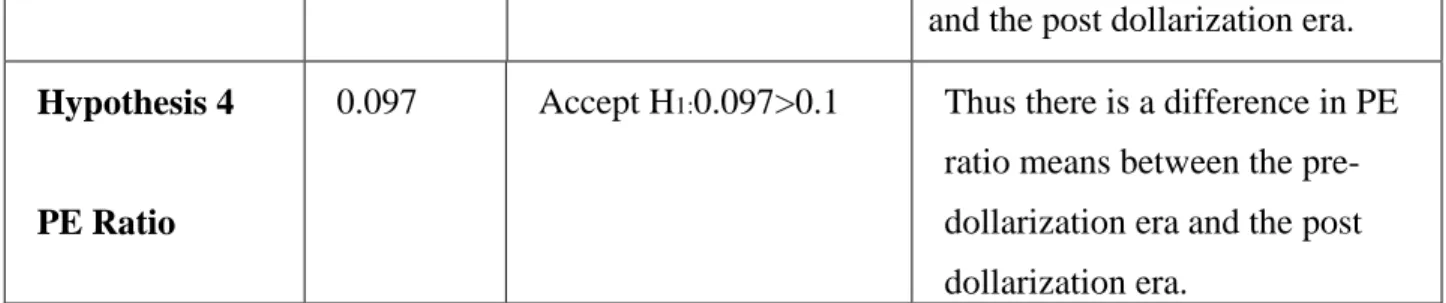
4.5.2 Summary of Result………..61
4.5.3 Changes in Market Capitalization with Macroeconomic Factors……….64
4.5.4 Changes in Turnover with Macroeconomic Factors………....64
4.5.5 Changes in Price Earnings Ratio with Macroeconomic Factors………...65
4.6DISCUSSIONOFRESULTS………..………65
4.6.1Market Capitalization with Dollarization and Inflation………...65
4.6.2 Turnover Ration with Dollarization and Inflation………66
4.6.3 Price Earnings Ratio with Dollarization and Inflation………..66
CHAPTER 5 ...68
CONCLUSION AND RECOMMENDATIONS ...68
5.1 SUMMARY OF FINDINGS ... …..68
5.2 CONCLUSION OF THE STUDY ...70
5.3 RECOMMENDATIONS FOR FURTHER RESEARCH ...71
xii
LIST OF TABLES
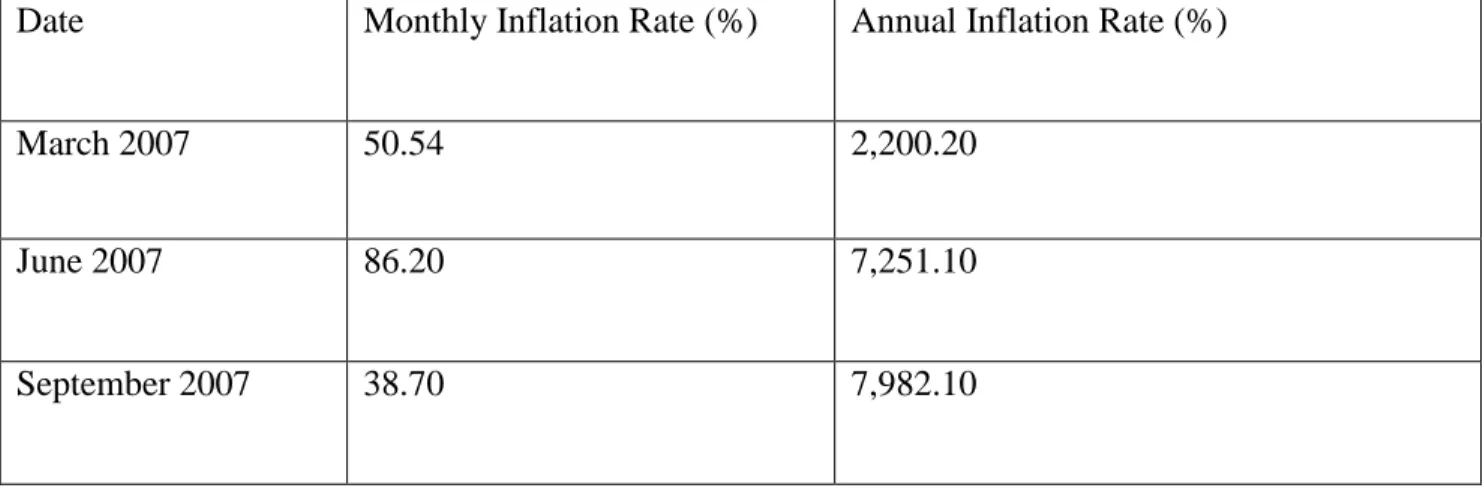
Table 2.1 Hyperinflation estimated figures in Zimbabwe, 2007-2008……….29
Table 3.1 Theoretical intuitions and their expected sign after Dollarization………37
Table 3.2 Sampled Industrial index sectors of listed firms, number of firms in each sector, market capitalization and ranking according to market capitalization ………41
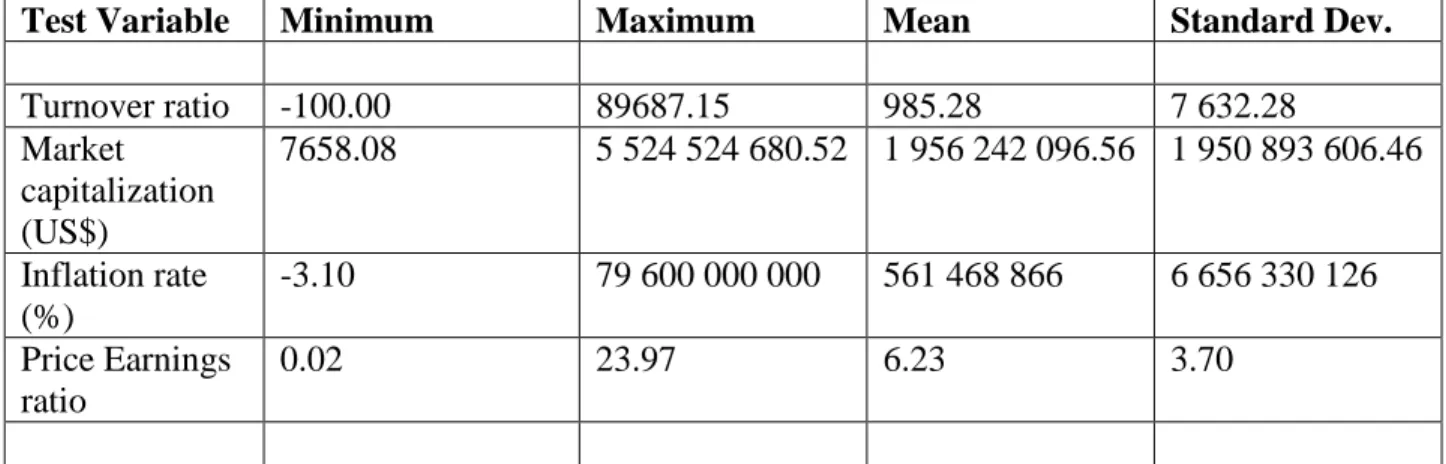
Table 4.1 Summary of Descriptive Statistics……….………49
Table 4.2 Descriptive Statistics (Pre-dollarization Era)………...49
Table 4.6 Correlations matrix amongst the Test Variables………...………...57
Table 4.7 Summary of Regression Hypothesis testing with Market Capitalization as the Dependent Variable………...…59
Table 4.8 Summary of Regression Hypothesis testing with Turnover ratio as the Dependent Variable……….60
Table 4.9 Summary of Regression Hypothesis with Price Earnings ratio as the dependent Variable………...………...60
Table 4.10 Summary of Results for Hypothesis Testing – Market Capitalization ………..………..61
Table 4.11 Summary of Result for Hypothesis Testing- Turnover Ratio………62
Table 4.12 Summary of Results for Hypothesis Testing- Price Earnings Ratio………...62
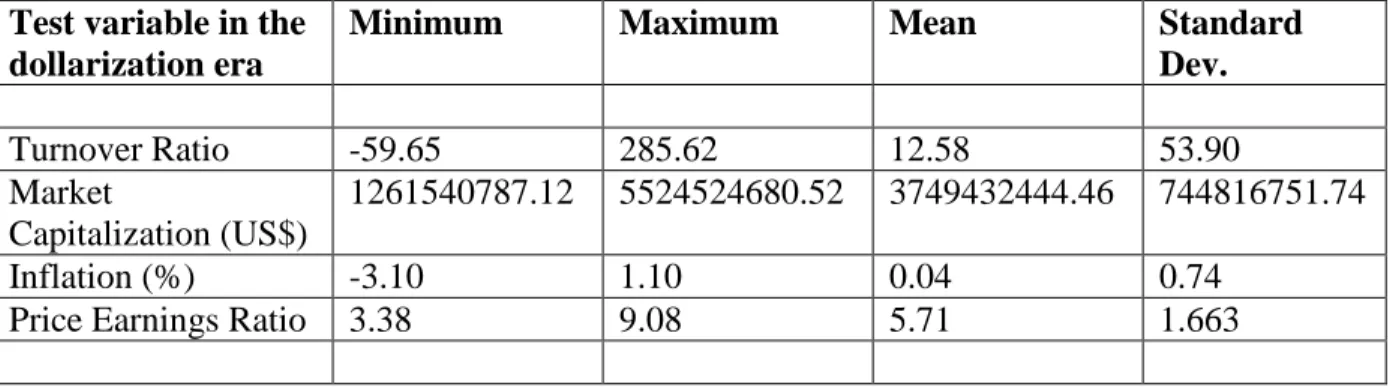
Table 4.3 Descriptive Statistics (Dollarization Era)……….50
Table 4.4 Paired Sample Test Descriptive Statistics……….55
xiii
LIST OF FIGURES
Figure 1.1 Composition of the Zimbabwe stock exchange indices according to the number
of listed firms………..…….…9
Figure 2.1 Benefits of a well-functioning stock market……….……22
Figure 2.2 Functions of Money………..31
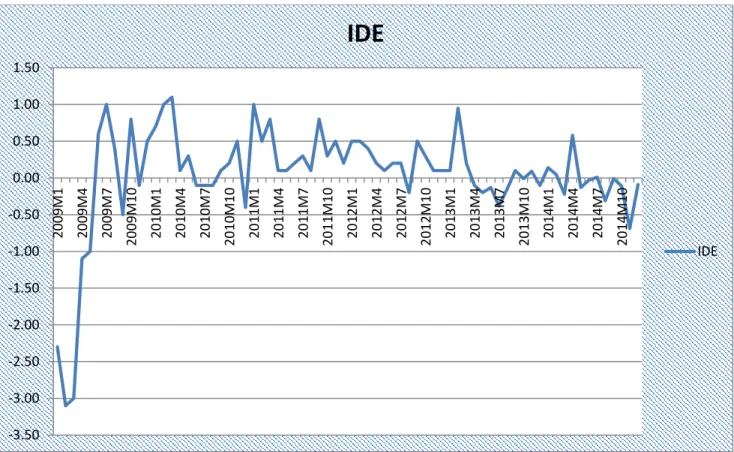
Figure 4.1 Monthly Inflation Trend from 2003 to 2014……….50
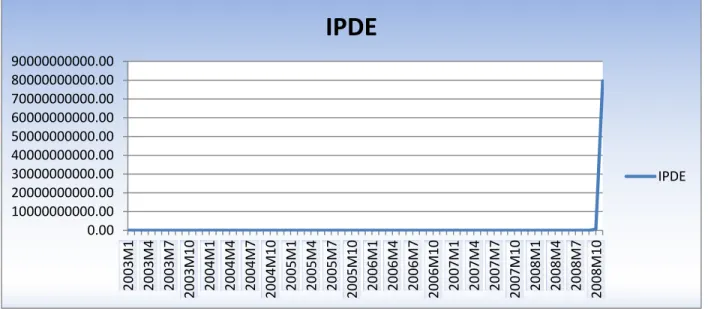
Figure 4.2 Inflation trend in the Pre- dollarization Era (IPDE)………..51
Figure 4.3 Inflation trend in the Dollarization Era……….52
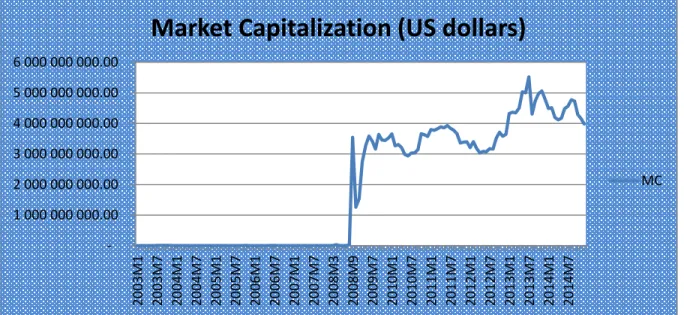
Figure 4.4 Monthly Market capitalization between 2003 and 2014………..………..53
Figure 4.5 Monthly Turnover Ratios from 2003 and 2014………54
1
CHAPTER 1
INTRODUCTION
1.CONTEXTOFSTUDY
Stock markets as well as securities exchanges have been regarded by many as the support system for the majority of modern economies as they provide the crucial means by which firms get sizeable capital for investment purposes.
The Zimbabwean economy operated virtually under uncertain, highly volatile and harsh environment in the last quarter of 2008. Prices of goods and services would increase in a blink of an eye. In fact, prices became extremely elastic in the hyperinflationary environment. Thus there were a lot of pricing disparities and inefficiencies on the country’s stock exchange, the
Zimbabwean Stock Exchange (ZSE)1, which rendered the pricing mechanism ineffective, useless
and of no purpose, including the pricing of stocks.
The country’s exchange became a place full of stored savings. The scramble after all forms of securities, including stocks, led to the continuous rising of share prices by quiet huge percentages daily (Games, 2010). Hyperinflation amongst other economic and political challenges saw the formation of the Government of National Unity and official dollarization2 of the Zimbabwean economy early 2009. In the month of February, the same year the local bourse became fully dollarized; it meant that trading could be done in United Sates dollars (USD).
Therefore, this research report is designed to find out the extent to which the adoption of dollarization affected the ZSE performance. This research report begins by giving a snapshot of the circumstances that took place before the policy took place, the area of focus that needs to be explored, the goals of the study, research questions, an overview of the methodology, the significance of the study, list of definition of terms, and a round-up with an outline of what chapters follow this introduction chapter.
1ZSE is the country’s local bourse.
2 Official dollarization takes place when the citizens of a country get to use another country’s
2
1.1BACKGROUNDTOTHESTUDY
According to the ZSE’s website, around 1998, the Zimbabwe equities market which was once a market that was doing very well in Southern Africa, recorded a sharp decrease in the amount of funds it normally receives from trades, and stock sells rose significantly. This was caused by the rise in yields in the primary market which had become more attractive to investors than the secondary market yields and rumours that the government of the country was planning to implement a fast track land reform programme.
Between the years 2000 and 2008, the Zimbabwean economy went through a period of economic chaos and declining performance as well as deep and fundamental changes. Regardless of the non-performance of the economy, equities responded spectacularly towards the chaos that was negatively affecting Zimbabwe as a country. Speculation became a major driving force behind the local bourse’s performance as investors desperately looked for ways to hedge (protect) their wealth against hyperinflation. Inflation was 231 million percent around 2008 mid-year as demand for shares rose as citizens and the corporates looked for ways to preserve their wealth (Njanike, Katsuro & Mudzura, 2009).
Games (2010) reported that on one particular day in the year 2007, the exchange rate between the Zimbabwean dollar and the United State dollar plummeted and there was panic in the business fraternity and the country as whole. The sudden depreciation of the exchange rate was caused by the government’s huge payout to freedom fighters who were striking demanding more money. These strikes came at a time when several other challenges were facing the country. Since that time, the economic situation of Zimbabwe has been downward.
Former Finance Minister, Mr. T. Biti, alluded that the rise in prices of goods and service was being caused by an increase in money supply. The increase in money supply left citizens with more disposable income and ultimately demand for more of these goods and services while there was no increase in the production capacity of the country. The macro-economic policies that were in place before the inflationary period lead to the severe strain that was now on the economy (Biti, 2009).
3 As noted by Chengu (2009), the government of Zimbabwe undertook the Fast-track Land Reform Programme (FLRP) in the year 2000. Immediately the seizing of land from white farmers was implemented and followed by the country being placed under sanctions by the west, this chain of events left Zimbabwe isolated and vulnerable.
Economically the country faced a number of serious challenges during this period, among them, the lack of planning, ill-conceived government policies, and lack of commitment on the part of new farmers, drought and increased international isolation of the economy. This led to many sectors of the economy struggling and the Zimbabwe Stock Exchange was among the victims. As the prices of goods and services rose persistently, people and companies looked for appropriate securities that would provide them with a hedge on the local currency denominated assets. There weren’t a lot of hedging alternatives and everyone was demanding and buying shares.
Although pricing regulation and policies were in place, they were rendered ineffective by a hive of fraudulent activities within the stock exchange. A lot of indiscipline was taking place on the stock exchange where the shares were being fraudulently purchased as well as other speculative assets. The stock market is a great place to raise fresh money for development and innovative production. Unfortunately the money that was going into the local bourse was not really creating new capacity but chasing after the few assets that had been created by yester years’ efforts. For example, a number of companies were then reporting earnings from reprising their ZSE portfolios and not from production (Kwesu, 2009).
The ineffectiveness of pricing regulation and policies worsened the confusion in the capital market and also contributed a lot to the failure of the stock exchange to efficiently price its
shares. The Reserve Bank of Zimbabwe (RBZ)3 Governor publicly stated in November 2008 that
without doubt, the trading mechanisms of the ZSE that were reflecting in the market demonstrated significant deterioration in the pricing systems in the capital markets (Games, 2010).
4 Hyperinflation became the order of the day in Zimbabwe. It masked a lot of mistakes and investors were able to paper over inefficiencies and poor performance, until it led to the total breakdown of the local currency. A thriving parallel market became the main driver of pricing mechanisms in the economy including share prices. Share prices instead of reflecting the economic fundamentals underlying the listed firms and the economy, specific industries and companies were now reflecting the activities on the parallel market. The economy also faced a spate of company closures and many companies were now operating below their full capacity. The Reserve Bank of Zimbabwe likened the activities on the capital market in Zimbabwe to an economic suicide. The activities on the bourse disabled the government form raising money for economic growth which would counter the rise of inflation. The ZSE was not an exception among those affected by the harsh conditions prevailing in the country at the time. Ndlela (2015) said that towards the end of the year 2008, the bourse was shut down and it seized operating for a number of months.
In February 2009, the ZSE re-opened and resumed trading but not in Zimbabwean dollars but in United States dollars. Thus, the Zimbabwe Stock Exchange became fully dollarized and shares were now quoted in US Dollars and all the transactions on the bourse could trade in the newly adopted currency, which saw the exchange get back, at least, on one foot. Full dollarization was adopted by the government in a bid to turn around the economy from a decade of instability. The adoption of dollarization in Zimbabwe brought about some degree of sanity to the economy and the bourse. Inflation dropped to single digit figures and retail shops became fully stocked once more. The manufacturing sector as well experienced an improvement in capacity utilization. According to the Zimbabwe Stock Exchange website, an exchange that has obtained both operational and pricing efficiency improves the welfare of people in the society. For investors on the stock exchange, it had been a long winding road. Thus, there is the need to examine the effect of dollarization on the performance of the ZSE.
5
1.2PROBLEMSTATEMENT
The ZSE, ranked as the second largest sophisticated stock market in Southern Africa, had become a place of mere growing of cash rather than for long term investment purposes. The public statement presented by the RBZ Governor blamed the ZSE for fuelling inflation to unprecedented levels. The function of the stock exchange during the year 2008 gave birth to a number of unscrupulous behaviors which can be traced to the poor pricing regulations put in place by the Central Bank.
In fact, there was a time when share prices were being manipulated by major players on the exchange. For example, Old Mutual implied rates were being used as the benchmark for all the stocks on the exchange and stock price volatility was unprecedented. The multiple changes in the prices of stocks were no longer reflecting economic fundamentals. Speculation drove the prices of stocks and ultimately, the performance of the exchange as investors hedged against hyperinflation and this left the ZSE virtually with both no operational and pricing effectiveness. The year 2009 saw the adoption of full dollarization of the bourse in an effort by the government to bring sanity to the stock exchange. The scenario that unfolded in the ZSE during the hyperinflationary period, was one of those that makes one unclear about how the change of currency helped to bring stability to the Zimbabwean economy and to what extent did the adoption dollarization bring about some stability (sanity) to the activities of the bourse. Karas (2002), Cohen (2000) and Agnoli (2002) are among writers who have found that the adoption of dollarization yielded both good news and bad news. Therefore, it cannot be overemphasized that there is a need to carry out this research in order to assess if dollarization of the stock exchange yielded the intended results or otherwise. In the absence of such a study, policy makers and students of stock exchange would not be clear on how and when to use dollarization in the future should things go wrong. Therefore, this research report intends to examine the effect of dollarization on the performance of the Zimbabwean Stock Exchange.
6
1.3RESEARCHOBJECTIVES
The major goal of this research report is to assess whether efficiency was enhanced on this particular bourse due to this dollarization policy. The research carried out in this study should provide a more comprehensive evaluation of the functions of stock markets, dollarization, its pros and cons and its impact on the Zimbabwe stock exchange and the Zimbabwean financial system.
The research report will assist all interested stakeholders of stock exchanges understand the key forces that drive the performance of the ZSE and particularly undertake a clear assessment of the extent to which dollarization enhanced the performance of the bourse. If investors should have a clear understanding, assessment and evaluation of the performance of the bourse in the dollarization era, they would be in a position to make sound and informed investment decisions that will enhance their profitability, bring about a productive use of the equities market and the country. Therefore the study seeks to:
Assess the change in stock market performance indicators and economic factors before and after dollarization.
Establish whether dollarization enhanced the performance of the ZSE as compared to the
Zimbabwean dollar era.
Identify the sources of efficiency on the ZSE in the dollarization era.
Determine whether the necessary preconditions required for market efficiency do exist in
the ZSE.
Identify the advantages of a healthy stock market.
1.4RESEARCHQUESTIONS
The study seeks answers to the following specific research questions which reflect the research objectives:
7
What are the benefits of a well function stock market?
What is dollarization and why did the ZSE adopt dollarization?
What are the performance drivers of the ZSE?
Did dollarization enhance the performance of the ZSE?
What anomalies of market efficiency are evident in the ZSE in the dollarization era?
1.5DEFINITIONOFTERMSANDABBREVIATIONS
ZSE : Zimbabwe Stock Exchange
Performance: The act of fulfilling a measurable task that can be compared to other already existing set standard of efficiency.
Institutional Investor : An organization that fulfills the role of investment intermediation for its clients.
Portfolio: A collection of two or more shares.
Pricing Efficiency: A characteristic of a stock market where the trading prices are a reflection of all that clients need to know about the security being traded
Stock Exchange: A structured market platform that provide trading of shares.
Dollarization: When the residents of a country hold assets and liabilities in the form of United States dollars and/or a currency other than their country’s currency.
Listed company: A company whose shares have been admitted to the ZSE official trading
list.
RBZ: The Reserve Bank of Zimbabwe, which is the country’s Central Bank.
1.6LIMITATIONS
The main aim of the research is to assess whether dollarization enhanced the activities of the bourse. The sample for the research is sixty two listed firms on the Zimbabwe stock exchange industrial index which depends largely on the availability of firm-specific performance data. The
8 result from the analysis will be considered as a reflection of the effects of the adoption of full dollarization on the performance of the ZSE.
1.6.1ASSUMPTIONS
This research uses time series data and assumes data points are made over a continuous
time interval.
Given that the sampled sixty two industrial firms compose 94% of the ZSE listed firms, it is a good sample to represent the stock exchange and the stock market as a whole.
The data collected from the various sources is reliable and accurate.
1.7OVERVIEWOFMETHODOLOGY
The research methodology lends itself to a quantitative analysis where I will use secondary data obtained from mainly the Zimbabwean Stock Exchange (ZSE) website, Reserve bank of Zimbabwe reports, Central Statistical Office (CSO), Zimbabwe Statistics website, World Development Indicators database (2006) and published financial statements in Zimbabwe. The ZSE has two indices, the mining and the industrial indices. For the purposes of this research, the industrial index monthly data will be used for the period of 2003 to 2008 and 2009 to 2014 as the sample periods representing the period before and after dollarization, respectively. The Zimbabwean industrial index will be used for this research because it is regarded as the benchmark index.
9
Figure 1.1: Composition of the Zimbabwe stock exchange indices according to the number of listed firms
Firstly, a trend analysis of important market and economic factors like inflation that affect the performance of the stock exchange will be carried out. Trend graphs of stock market performance indicators which are market capitalization, turnover ratio and price earnings ratio will be plotted and the trend behavior analyzed as well. The research will focus on two sample periods that is the pre-dollarization and the post dollarization periods.
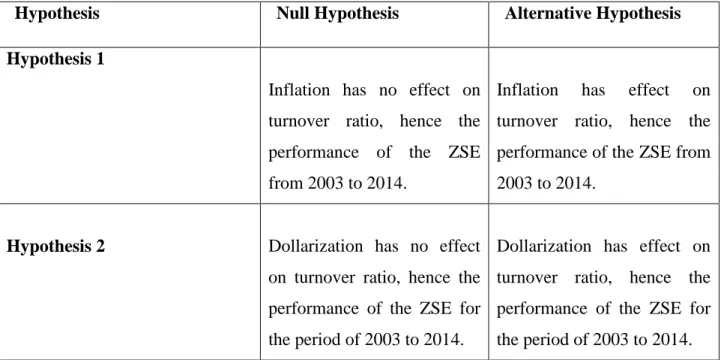
Secondly, Market capitalization, share turnover velocity and price earnings ratio are the measures that will be used as important indicators together with inflation to assess the performance of the bourse using mean difference test. A paired samples test will be carried out on each performance indicator for the pre-dollarization and the dollarization eras. The mean difference test will be employed to assess if there is a significant difference in each variable over the two specified sample periods. A two tailed t-test will be carried out to see if the means obtained before and after dollarization are different from zero. This will help in determining whether the performance of the bourse has changed significantly in the dollarization era or not.
Thirdly, I will run three regressions to investigate the degree of association between performance indicators of a stock market and dollarization (which is the target variable) as well inflation as our independent variable.
94% 6%
Industrial index Mining Index
10
1.8SIGNIFICANCEOFTHERESEARCH
i) To our knowledge, there is scarce literature on dollarization in Africa and yet several countries in the region at some point or another have dollarized. This is the reason why I have chosen to study on the effect of dollarization on the performance of the ZSE. The study seeks to add knowledge to value to several researches on Zimbabwe and the country’s exchange performance especially after the adoption of dollarization. Hence this research will be invaluable to academics in the country and Southern African region as most African countries have challenges of high inflation and might be considering dollarization.
ii) The research will also be of great use to investors, more so in dealing with complex issues in a developing economy like Zimbabwe, where the economics are linked to politics and global influences.
iii) Finally the government as the regulator of the ZSE will find this study valuable in respect of coming up with regulations that can ensure that the ZSE enhances its level of market efficiency and improve the performance of the bourse itself and the whole country at large. An assessment on the performance of the stock market through the stock exchange will also enable policy makers to evaluate the effectiveness of the transmission of policy through the stock exchange market.
1.9RESEARCHOUTLINE
This was the introductory chapter, which clearly highlighted the subject matter in this research, as well a point out the major focus of this study. This section of the paper shows the background checks that led to the writer to engage the research. The statement of the problem defines the problem to be tackled and this is followed by research objectives that will provide solutions to the problem when they are realized. Thereafter, the chapter points out the overview of the methodology to be used in the research and importance of carrying out the research.
The second chapter contextualizes the study in line with main areas of focus of this study. This chapter reviews literature designed to put the current study into context. Chapter three will
11 explain the methodology to be used in writing of the research report. It entails the research design, the sample population and the techniques employed in the research analysis.
The forth chapter is an important section of the report, which deals with the critical analysis of data in line with the subject matter, research goals as well as research questions. Finally, the research project is concluded in chapter five, by summarizing all the findings, and flagging conclusions and recommendations for further research.
12
CHAPTER 2
LITERATURE
REVIEW
2.1REVIEWOFTHEDEVELOPMENTSOFTHEZIMBABWESTOCKEXCHANGE
The ZSE website records that trading of stocks in Zimbabwe started in the 19th century around the year 1891, which was the year in which the first brokerage firm was established. After a few years, the Rhodesian Stock Exchange (RSE) 4was formed; the first stock exchanges were established in Harare, Bulawayo (the second largest city) in 1894, Gweru and Mutare with the latter two exchanges being the last two to be formed in the year 1898.
By the year 1980, then the Rhodesian Stock Exchange had become a sophisticated stock market which had become of great use to the economy of Rhodesia then. Trading was being done in the local currency, the Zimbabwean dollar. Upon the attainment of independence in 1980, RSE was renamed to the Zimbabwe Stock Exchange. In the twentieth century the bourse regarded as the second biggest stock exchange in the Southern African region, after the South African bourse registered high levels of growth from the years 1994 to 1996, with high average market capitalization figures soaring close to thirty six percent annually.
In the year 1998 the Zimbabwean stock market, which was recorded as the one of the best African market which exhibited a lot of potential started to decline in performance. Turnover plummeted compared to the yester years and a huge chunk of shares getting sold. The decline was traced to the high yields in the money market which was attracting investors to higher yields. Investors were starting to lose confidence in the stock market due to political and social unrest that had started ravishing the economy for example the government’s stated intension to embark on a Fast Track Land Reform Programme in which land was to be seized by force from white farmers and redistributed to black farmers.
As the Zimbabwean economies continued to decline and face a number of serious challenges like hyperinflation, the Zimbabwean dollar was replaced by the US dollar officially in February 2009 and the ZSE became officially fully dollarized. In the first quarter of 2009, little trade was taking
13 place on the bourse with a small number of foreign investors who seemed to be risk lovers, take upon the risk of trading on the market.
According to the ZSE website as of the last quarter of the year 2014, there were sixty six firms on the trading list of the bourse with a market capitalization of close to 4 billion United States dollars participating in more than fifteen economic sectors. Trade on the ZSE is conducted using the open cry method which is carried out on a daily basis starting from mid-morning to mid-day. Settlement is executed on a T+7 day basis. The Zimbabwe’s capital market is made up local, regional and international investors supported by thirteen registered stock brokers and five custodians.
The main goal of this research report is to analyze the extent of influence that dollarization has on the deliverables of the exchange. This particular research intends to analyze and understand whether the adoption of dollarization enhanced the performance of the bourse. This section of the research summarizes the key features and performance indicators of a stock market. The subject matter is explained and sets the context for a more detailed description of the research.
2.2FINANCIALSYSTEMSTRUCTUREANDFUNCTIONS
According to Darskuviene (2010), the financial systems are responsible for a crucial part in any economy by influencing economic growth and the performance of economic factors as well as affecting economic welfare. Financial infrastructure is the vehicle that is used to achieve the above mentioned roles, in which firms with excess funds avail their funds to the firms in deficit who have potential to use the funds in more productive ways. A financial arm of any government facilitates the feasibility of a smooth allocation and transfer of funds among the different economic sectors. There are instances where one side of a deal holds more information than another which leads to information not being effectively disseminated which lead to inefficiencies in the allocation of financial resources which may deter the growth of an economy.
Darskuviene (2010) highlighted the structural approach which gives a more detailed role of the financial system which consists of three specified components:
14 i. Financial Intermediaries.
ii. Financial Regulators.
iii. Financial Markets (of which stock market are a part).
2.2.1 WHAT IS A STOCK MARKET?
Jordan and Miller (2009) defined a stock market as a place where the trade of listed companies stocks and long term debt securities takes place at an agreed price and that the financial securities
must be listed on a stock exchange. According to Darskuviene (2010), a stock market is among
the most important sectors of financial markets with instruments with a long life are transacted with the goal of raising funds for firms. The investor from excess savings unit is given a payment from the income that the firm raises and is made a part owner of the business and the wealth that they own is regarded as a compensation for the risk they would have assumed. This market is important for the mobilization of both local and international savings and the enhancement of the investment process in a free economy. Stock markets organize national and international trading in several financial instruments including stocks.
Aurangzeb (2012) acknowledged that when we refer to stock markets, we notably think of an integral arm an economy which performs an essential part of growing other key arms that builds a nation as a whole. Stock markets play the important role in supporting productive industries that result in growth economically.
Ross, Westfield and Jaffe (2003), writes that equities market essentially is made up of the primary as well as the secondary market. It is through the primary market that securities are first brought to the market, it is also known as the market for initial public offerings (IPOs)5 and through the secondary market, shares that are not being issued for the first time are traded amongst stakeholders, as investors constantly seeks to increase the values of their firms through seasoned offerings. When the shares of a company are already owned by the public, it can raise equity with a seasoned equity offering (SEO) which is also called a follow-on offering.The bid
5An IPO refers to the sale of a company shares to the public for the first time, typically, the company will be small and growing, and needs to raise capital for further expansion (Jaffe, 2003). This process takes place in the primary market.
15 and ask prices of security transactions are determined by demand and supply of the each particular stock (Jordan and Miller, 2009).
Beechey, Gruen and Vickery (2000), reports that the paramount role of the stock market includes rationing of capital resources of a country. An efficient market is one where there are no friction costs and no information asymmetry and one which execute its mandate of allocating resources with precision. This type of a financial system allows companies to make high yielding investment decisions and investors are free to select financial commodities that stand for their ownership in the business. The presumption that underlies this concept is that securities prices at any time ‘fully reflect’ all available information.
2.2.2 WHAT IS A STOCK EXCHANGE
A stock exchangeis a place where the buying and selling of financial instruments is done. These financial instruments are of a debt or equity in nature as well instruments that derive their value from other underlying securities. Short term instruments which are highly liquid in nature are also traded as long as they are officially listed. The official trading list is composed of securities that meet the essentials of the bourse, including capital specifications that listed companies are required to meet. Different stock exchanges have different sets of rules and regulations that each player is to adhere to (Darskuviene, 2010). Bourses guarantee the elimination of imperfect information and ensure efficiency.
According to Brealey, Myers and Marcus (2001), majority of financial tradable instruments are traded on a bourse which is a place of convergence of willing buyers and willing sellers who then deliberate on each security’s final price. There are different types of exchanges bourses where trade can take place: physical places on which deals are executed through open cry system. Another category of an exchange is called over –the –counter (OTC)6. The financial instruments that are tradable on an exchange include stocks, low risk instruments like unit trust,
6 OTC is the virtual kind for example NASDAQ which is composed of a network of security dealers who uses
computers where trades are made electronically via traders at computer terminals.
16 high risk –high return type of instruments and long term securities like mortgage bonds. Thus, an exchange is a crucial part of a financial system of an economy and the determining factors of the stock prices are the supply and demand of the stocks.
2.3KEYFEATURES THAT MAKE UP A STOCKMARKET
Markets for stocks have some special features that facilitate smooth functioning of the market and most investors use these as a basis on investment decisions. Thus, the market for stocks is regarded as the initial indicator of an economy’s economic wealth being. Listed below are some of the features:-
2.3.1 Stock indicators
Stock prices changes are a major influence in the trading that takes place in the secondary market and investors look for these prices quotes on exchanges and use them for making investment related decisions. Some of the information provided on bourses include:-
Market capitalization is a profitability measure of the size of a stock market. The bigger the size means that market capitalization could be higher which a good sign is for interested stakeholders’.
Annual dividendis a part of retained earnings that is distributable to shareholders over the last year on a per share basis.
Dividend yield measures how much shareholders are realizing form each dollar investment in stocks.
Price/earnings ratio (P/E ratio)is the ratio measure the share price of a company to its earnings per share. A high P/E ratio reflects that the security market price is overvalued. The common presupposition underlying this is a good new case and vice versa.
17 Volumeof shares refers to the number traded at the close of each previous trading day.
2.3.2 Stock market indexes
According to Aurangzeb (2010), these are regarded as the efficiency of the price discovery process on different positions taken on the market, which are established as a representation of the whole financial system. There are variations on the portfolio makeup, ranging from little but high liquidity securities to numerous illiquid securities being traded on one market. The indices that are founded upon little numbers in terms of stocks are simple calculate but they barely are a representation of the whole stock market.
Stock markets’ one of the many responsibilities is that of supporting industries to grow and ultimately enhances the growth of the economy. It is commonly regarded as the tool of measuring a sense of the direction of the economy and they stabilize the economy with their performances. The consistent growth of an index is a good indicator of the growth of an economy and if the index and stock prices are on the downside or their fluctuations are on the rising side it portrays a picture of non-stability in the economy (Aurangzeb, 2012).
2.4PERFORMANCEINDICATORSOFASTOCKMARKET
2.4.1 Market Capitalization
The market capitalization’s size is a sign of the importance of each country to international investors. Market capitalizations are the basis for the attractiveness of an exchange to national, regional and international investors, the bigger the size, the more preferred the market. When the market capitalization is big, there is the assumption that in the long run investors will be rewarded with a consistent increase in share value and dividend payments (Darskuviene, 2010).
2.4.2 Turnover ratio
Turnover ratio is a liquidity measure. Pryymancheko (2003) established that the efficiency of a bourse can be measured in terms of its liquidity and price discovery. Liquidity is the environment that is created by the bourse where trading can be done with little or no friction which normally
18 results in an increase in trading volumes as well as boost interest by traders to take part in the market. Investors can take part and come up with hedging strategies when there is high liquidity in the market. Investors who trade in markets with high levels of illiquidity face higher transaction costs than in liquid markets. Thus investors, who measure performance on the basis of global benchmarks, seem to be resistant in investing in markets with liquidity problems. Highly illiquid stock markets are measured by the number of times a share changes hand also known as share turnover velocity. The high the turnover ratio, the more attractive the market is.
Prompt price discovery process is a common phenomenon in efficient markets, stock price in these markets always reflect all new information released in order to reflect the change that would have occurred to the intrinsic value of the stock (Fama, 1991).
2.4.3 Price volatility
Stability in share shares prices is crucial to investors, sharp rises and falls are considered a sign of instability of a stock market. Extreme rise and falling exposes the market to risk either by losing money or socks can become too cheap that no one will be interested in investing on the bourse. Depth and breadth have effect on the volatilityof stocks of a market. Aurangzeb (2012) identifies the effect of volatility in Korean foreign exchange market on Korean stock market and he found out that the Korean foreign currency market impact depreciation volatility positively and stock market return volatility responds to exchange rate depreciation volatility.
2.4.4 Price- Earnings (P/E) Ratio
This ratio measures of the average share prices of shares for a firm in an index to the average earnings per share of these firms. The ratio is important to stock analysts and investors who use the ratio to assess if individual stocks are correctly quoted. A long run fastest growth in prices of stocks normally happens after a low value of this ratio and the reverse is true (Shen, 2000).
19
2.5IMPORTANCEOFSTOCKMARKETS
It is of extreme importance that an economy has an efficient network among its sectors for example the way payments are executed; savings harnessed and directed towards profitable investments schemes. Stock market performance indicators are regarded as measurement instruments used when analysts need to have an informed idea about the industrial growth and the stability of the economy. The continuous and steady growth of an index is a good sign which shows that the economy is growing and if the index and stock prices are plummeting or their fluctuations are on the higher side it gives the impression of instability in the economy (Aurangzeb, 2012).
2.5.1 A means of availing funds for businesses
A bourse allows firms with the ability to get funds for growth through the trade of its shares in exchange for funds from the investing public. Brealey et al (2001) found that as firms grow, so does their capital requirements and there comes a stage when the firm will have the need to raise funds directly from investors. By selling financial securities such as shares of stock to the public these firms in deficit get funds without having to engage external borrowing. The selling of stocks is one way which is of crucial to firms that need to raise long term capital. The shares that are publicly held are known to be liquid and can be converted to cash with ease.
Shubiri (2010) acknowledged that the shares of a firm represent long term borrowings that do not demand repayments. He also noted that where there are no bourses to facilitate the trade of financial securities, these securities will be highly illiquid and it will be a hard task to locate buyers willing to purchase them. Thus, he reinforces the extreme value of stock markets. Sigh (2010) shows evidence of a huge contribution of stock markets to investment expenditures of the corporate sector in developing economies. The efficiency of service allocation is ensured through correct share pricing.
20
2.5.2 Mobilizing Savings for Investment
Shubiri (2010) said that stock markets accelerate economic growth by enhancing domestic savings, thereby increasing investment quality. Stock markets in particular increase economic growth by ensuring a way for growth for entities to generate capital at low cost compared to other sources of funds like debt. Pryymancheko (2003) also supported this finding in his paper when he agreed that a stock market allows investors to use a number of financial securities to provide their liquidity and risk needs, thereby encouraging savings and providing the non-financial corporations with equity finance possibilities.
When people put to use their savings by investing in stocks, it results in a more reasonable allocation of financial resources because savings are the put to good use to provide the much needed funds to the deficit savings unit. When these funds are pooled together and channeled towards more productive sectors of the economy, they yield good economic results for example, industry growth.
2.5.3 Facilitation of company growth
Ross, Whitfield and Jaffe (2003) acknowledged that it is with ease for enterprises to dispose of their stocks on an exchange in order to finance potential business ventures. Mergers and acquisitions are perceived by firms as an alternative business avenue for expansion and a form of wealth preservation strategy. They also testified that these forms of business expansion have a minimum tax base which increases the yields realized from them. The main issue is for the organization to decide on whether to dispose of the shares or make an exchange for them.
Savings mobilization tends to enhance the savings base of an economy. Well-functioning markets allow savings to be channeled to investment programmes that have high yields and the high yields attract more savings and there is a development of a savings culture in a country which is commendable (Shubiri, 2010).
21
2.5.4. Promotes small Entrepreneurs
Contrary to other forms of investments that require huge capital injections, stock markets do not need huge capital to start trading. Stock markets level the playing field for both small and large corporations according to their capacity. Therefore, bourses provide small saver with an opportunity to also access funding.
2.5.5 Allows governments body the opportunity to get funds for smaller programmes.
The government bodies like municipalities can trade on an exchange in order to raise funds for social welfare and the betterment of the community and enhance the lives of its citizens. For example a municipality can raise funds for water treatment and provide clean water to its people. This can only take place on an exchange where these governments departments can sell bonds to the public to raise funds for such noble purposes. This in turn will reduce the taxes that have to be paid by citizens for the provision of these municipal services.
2.5.6 Composite economic indicator.
Stable companies that are listed on bourses tend to bring stability on the market and across the whole economy amid economic challenges. Darskuviene (2010), purports that indexes have a number of uses, among them is to represent a composite indicator. Therefore, share prices are used to track economic trends and to forecast the direction of the economy. Shrestha and Subedi (2014), reports that indexes are of great importance as macro- economic indicators of many economies. The expansion of these indexes is used as an indicator of the confidence that investors have about the future of the economy.
2.6KEYFEATURESANDADVANTAGESOFAHEALTHYSTOCKMARKET
Theprimary benefits of a well-functioning stock market are:
Pooling together of funds from surplus savings units of an economy.
Provide an opportunity for the matching of willing seller, willing buyer to engage in development programmes that enhance the lives of people.
22 According to Pryymancheko (2003) provide a list of some of the major advantages of an efficient market.
Figure 2.1: Benefits of a well-functioning Stock Market
Levine and Zervos (1998) found that there is a positive relationship between the growth of an economy and the development of its capital market. The close link eliminates business failures of capital nature which then enhances the proactive sectors of the economy and the risk that is associated with liquidity problems is done away with.
2.7MARKETANDECONOMICFACTORSTHATAFFECTTHEPERFOMAMNCE
OFASTOCKMARKET
The performance of a stock market can be affected by influence. Influence can be defined as the power that affect persons or events based on prestige thus causing something without any direct or apparent effort (Ibrahim and Aziz, 2003). Influence is basically a causative factor that exerts pressure on a person or events to drive them to perform in a certain way (Seyhun, 1998).
Features of a
Well-functioning
Stock Market
External Efficiency-Pricesquickly reflect new information. Internal Efficiency-Lower transaction cost Liquidity -Marketability -Price Continuity Transparency -Availability of timely and accurateinformation about past transactions
23 The development of any economy is closed linked to the factors that foster economic development. Factors like Gross Domestic Product (GDP), consumer price index, repo rate and the growth rate of broad money are considered highly indicative of growth prospects of an economy. Changes in any of these fundamentals have high impact on the prices of stocks which clearly shows their severe influence on the economic performance of a country.
Indexes measure equities market through a time factor. They are benchmarks that investors use for comparison purposes when choosing between markets. Several researches have been carried out in a number of countries including the United States of America to establish the degree of association that exists between the changes in economic fundamentals and their influence on stock prices. The intension of the researches was to know if the results would help investors to better predict and carry out forecasting of these fundamentals changes and take precautionary measures before crises break out. The results gathered showed shares prices are highly elastic to slight changes in economic fundamentals.
2.7.1 Inflation
Consumer price index is a reflection of inflation in the economy and its high level may threaten the macroeconomic stability of a country and stock market becomes more volatile during periods of high inflation. According to White (2007), inflation is a situation where the prices of goods and services tend to rise consistently. Inflation corrodes the purchasing power of money and consumers end up purchasing fewer and fewer goods with the same value. This occurs due to the circulation of too much money in an economy. As inflation rises, purchasing power decreases, fixed asset values are affected, companies adjust their pricing of goods and services, financial markets react and there is an impact on the composition of investment portfolios.
All forms of investment need to increase at par to inflation increases, if not the value of the investments are depleted. Consumers, businesses and investors of stock markets are affected by an upward trend in prices. Changes in prices of stocks due to inflation can affect market environments as well as investment returns. Hyperinflation most directly affects fixed income
24 securities because the fixed payments become worthless and it depletes yields and hence this affects the activities of a stock market negatively.
The Consumer Price Index (CPI), which is the principle gauge of the prices of goods and services. CPI reported figures tend to move stock markets in two different directions because it plays a role in many key financial decisions. Persistent low to moderate inflation figures tend not to cause much reaction with investors but investors get worried when there is a persistent acceleration of inflation. When prices of stocks changes too much and too quickly, the effects can shock a stock market as well as the economy as a whole. Companies end up paying more for the purchase of inputs, at the same time government policies will not permit them to increases the price of its finished goods sufficiently to cover for the loss in value of the finished product. This result in a reduction of players on the stock market or no new players will enter the stock market and performance of the whole market is affected.
Lee (1992) established that inflation is not the decrease in the purchasing power of a currency but a persistent rise in broad money which then leaves people with more disposable income and the demand for goods and services is increased and ultimately the prices of goods do as well. Several authors documented the association between the increase in money supply which causes the prices of good to rise and yields on stock markets. When there is a rise in the yields on stock markets, stocks become a lucrative form of investment and there comes with it a rise in demand for the stocks. This scenario becomes a problem when there is not a corresponding increase in the supply of the same stocks. This causes a mismatch between demand and supply of stocks which destabilizes the efficiency of a stock market.
Choudhry (2001) wrote a paper where he was studying the causal relationship of recent inflation and recent yields on stocks in developing countries and he found out that it is positive but only short periods of hyperinflation. This supports the theory that hyperinflation breeds a lot of uncertainty which negatively affects investors’ confidence and thus stock prices falls (Fama, 1981).
Caporale and Jung (1997) are some of the great economist’s that state that equity markets provide a safe haven against inflation. When there is hyperinflation the value of investments is
25 corroded. Fisher and Statman (1997) supported this theory by suggesting that macro- economic variables that influence yields from equities are indicative of alternative hedging strategies for investors. Taylor and Allen (1992) refutes that the perpetual rise in inflation can cause permanent damage to the market for stocks.
Factors that caused hyperinflation in Zimbabwe includes continuous money printing and supply into the economy, a depleted foreign currency reserve, and the closing down of numerous production companies which resulted in reduced supply of goods and services and their demand rising profusely (Makochekanwa, 2009). The demand for stocks outpaced the supply for them and this caused a major challenge in the pricing of the stocks and this affected the performance of the ZSE.
2.7.2 Money supply
Money supply represented by broad money supply measure (M3) in any economy has considerable effect on the other macroeconomic variables depending on the strength of money multiplier. Serletis (1993) identified two hypotheses on the influence of an increase in broad money supply the prices of stocks;
Monetary approach which deals with changes in money supply and the efficient market hypothesis which states according to the quantity theory of money, that a rise in disposable income excessively increases the demand for shares and according to the law of demand and supply, the prices of shares increases. A scenario where the rise in the demand for shares is not matched by an increase in the supply of shares, there will be share mispricing which then affects the activities of the stock market. Dhakal, Kandil and Sharma, (1993) and Reisman (1999) also agree that the rise in stock demands mostly is influenced by investor having more money in their hands. Fama (1981) also agreed and said that the increase in money balances in the hands of investors leads to changes in the prices of shares when there is the absence of information asymmetry.
26
2.7.3 Efficiency
Fama (1981) the famous economist who developed the efficient market hypothesis in which he highlights that there are three levels of stock market efficiency namely the weak, the semi-strong and the strong level. All these forms explain the degree of information asymmetry with the weak being highly asymmetrical, and the strong form represents the perfect information level. Seyhun (1998) found significant results to support information asymmetry in the weak and semi- strong level of efficiency that results in arbitrage opportunities.
Speculators and noise traders are the two main investors who participate on an exchange. The first one manipulates information in order to attain supernormal profits and the later looks for information asymmetry opportunities where they hold superior information than anyone else in the market (Shleifer and Summers, 1990). One of the causes of information asymmetry is the presence of insider trading dealings which results in the abuse of information resources which affect the efficiency of pricing of stocks in the stock market. This negatively affects the performance of any stock market. Edwards (1993) in his research report writes that behavior finance is a reality where investors trade due to speculation purposes and not fundamentals.
2.7.4 Supply and Demand
Technical factors are a combination of circumstances that change the determination of stock prices by market forces (Coperale and Jung, 1997). These play an important part in determining the effectiveness of stock markets. Titman and Warga (1989) state that interest rate variations affect company earnings. They argued that if interest rates are on the high side it leads to a reduction in borrowings and thus consumer spending is reduced. A reduction in consumer spending by firms leads to reduced prices and demand will plummet. The reductions in spending by firms affect the stock market activities negatively as players are reduced. Carter and Van Auken (1990) in their research found that there is a decrease in interest rates when stock returns become more charming.
27 Wong and Cheung (1999) reported that investors are essentially worried about long term forecasting, looking at historical data and how their investment yields will be affected in the long run. Many researchers demonstrated that the influences of economic fundamentals are of crucial importance when investigating the performances stock markets.
2.7.5 Interest Rate and Exchange Rate
Many factors, such exchange rates and interest rates, their information have an impact on daily stock prices because they both play important roles in influencing the development of a country’s economy (Kurihara, 2006). In addition, the relationship between stock returns and foreign exchange rates has frequently been utilized in predicting the future trends for each other by investors. Several researchers for example, Aggarwal (2003) have investigated the causal association between markets for stocks and macroeconomic elements for example repo rate and exchange rate. They found that these two elements seriously influence the activities of stock markets. In trading economies, exchange rates have great influence on the stock market behavior.
According to Moya, Lapena and Sotos (2013), interest rate rises increase the interest expense of highly leveraged companies, thus reducing cash flows available for future dividends which results in a negative impact on share prices. Movements in interest rates affect the opportunity cost of equity investments. Higher interest rates make bonds more attractive given their risk-return characteristics, which motivates investors to adjust their portfolios by buying bonds and selling stocks, thus depressing stock prices. Changes in interest rates may impact upon the level of real activity in the economy in the short to medium term, and this affects equity prices by altering the expectations of future cash flows.
2.8WHATISDOLLARISATION?
Dollarization is a range of investment that a company holds in another country’s currency instead of its own home currency, to satisfy the major purposes of money. Normally the adoption of dollarization is as a result of the instability of prevailing macro-economic state including high currency risk (Bogetic, 2000). Dollarization of the Zimbabwean economy is not phenomenal;
28 several Latin American countries have already adopted the US dollar as their legal tender for example Panama dollarized in 1904, Argentina in 1991, Ecuador September 2000 and El Salvador followed and dollarized in the year 2001 (Agnoli, 2002).
2.8.1 Measurement of Dollarization
The currency that normally gets adopted will be of a major super power economy with incredible and predictable monetary policies. Agnoli and Whistler (2006) distinguish three types of dollarization:
Official dollarization is an ultimate substitution of the domestic currency of a country by a foreign currency. In this case one country takes the currency of another country as legal tender to satisfy all the major functions of money. In general terms, under such an agreement, there will be a total doing away with local currency risk (Bogetic, 2000). The utmost characteristic of full dollarization is that, once it is legally assumed, it will be equivocal (Borensztein and Berg, 2000).
Partial dollarization refers to a condition where the local currency of the adoptee country will still be recognized and accepted as money but undertakings can also be carried out in another country’s legal tender. Explicitly, this gives the country an advantage of the use of two currencies in their economy. In this system the local and adopted legal tenders are freely used in the domestic economy. Lesotho and Swaziland as well as Zimbabwe in the last quarter of 2008 used the rand officially together with their home currencies (Borensztein & Berg, 2000).
Most of the countries that take on full dollarization are either small economies that by enlarge depend on other countries for the majority of their income or on trade for example Lesotho relies on South Africa. In some cases the adoptee economy will be going through economic distress leading to extremely high levels if inflation; the case of Zimbabwe. There is unison among writers of the subject of dollarization that adoption triumphs in reversing the consequences of high levels of inflation and usher in economic stability.
29 A study on hyperinflation in Zimbabwe by Hanke & Kwok (2009) showed that inflation had adverse effects on the country as well as its exchange rate and they also found that dollarization tamed the excessively rising inflation. In the case of Zimbabwe, month on month rates of inflation from the official inception of dollarization to date have been averagely ranging between zero percent and one percent (Makochekanwa, 2009).
2.8.2 Characteristics of Money
Brooks (2010) outlines special characteristics of money, for it to be accepted as a legal tender. The Zimbabwean dollar prior to its exclusion from the country’s monetary system had some of the major features of money; however it failed to fulfill all of the features. Upon realizing that the country’s currency did not have the major characteristics of money the citizens of Z