Agreements with overlapping coalitions
par
Messan Hova Agbaglah
Département de sciences économiques
Faculté des arts et des sciences
Thèse présentée à la Faculté des arts et des sciences
en vue de l’obtention du grade de Philosophiæ Doctor (Ph.D.)
en sciences économiques
Août, 2012
c
Faculté des arts et des sciences
Cette thèse intitulée :
Agreements with overlapping coalitions
présentée par :
Messan Hova Agbaglah
a été évaluée par un jury composé des personnes suivantes :
Yves Sprumont
président-rapporteur
Lars Ehlers
directeur de recherche
Massimiliano Amarante codirecteur de recherche
Vikram Manjunath
membre du jury
Justin Leroux
examinateur externe
« Tout ce que tu désires ardemment, la nature conspire à te l’accorder » PAULO COELHO
Remerciements
Je tiens à remercier ici toutes les personnes qui, de près ou de loin, ont œuvré à l’accomplissement de ce travail. Bien des pages ne suffiraient pas pour marquer ma gratitude à toutes ces personnes de bonne foi. Je me limite ici à quelques unes mais mon cœur sera toujours reconnaissant à tous.
Je voudrais d’abord et avant tout remercier mon directeur de thèse Lars Ehlers pour sa présence continue et ses apports de tous ordres. Il est sans doute la personne clé sans qui rien de ceci n’aura été possible. Je remercie mon co-directeur Massimiliano Amarante pour son soutien inébranlable, sa présence et son écoute durant ce parcours. Mes remerciements vont également à Yves Sprumont, Walter Bossert et Onur Ozgür qui m’ont suivi depuis la première présentation orale. Je n’oublie pas Vikram Manjunath pour tout l’appui qu’il m’a apporté dans l’édition de mes papiers.
Je remercie tout particulièrement mes amis Folly, Modeste, Firmin et Blache avec qui j’ai tout partagé et qui ont été d’un soutien incommensurable.
Je remercie également : Dalibor pour nos discussions sans fin sur les ensembles de choix ; Bertrand pour l’initiation au dynamic game; Bruno pour nos discussions et nos stratégies. Je n’oublie pas mes collègues Hyacinthe, Shirley, Cédric, Michel, Calvin, Évariste, Ernest, Maxime, Nérée, Ulrich, Romuald, Dominique, Vincent, ni mes ainés Constant et Rachidi. Toute ma gratitude va à Ismaël pour sa bonté et sa grande générosité qui n’ont pas cessé de m’inspirer.
Ce parcours a été physique mais aussi moral. Si on me reconnaît toujours une attitude zen, le mérite revient à ma maman Lydia, à mes frères Cheritus, Maurice,
Émile, Gilou, à ma sœur Mimi et à mes cousines Danny et Sévérine. Merci à Linda pour m’avoir toujours soutenu et porté bonheur.
Je remercie le Département de sciences économiques de l’Université de Montréal et le Centre Interuniversitaire de Recherche en Économie Quantitative (CIREQ) pour le soutien financier. Mes remerciements vont également à tout le corps professoral, au personnel administratif et particulièrement à Mélanie dont les sourires gracieusement et gratuitement offerts m’ont apporté plus qu’un rayon de soleil, surtout dans les moments sombres de ce parcours.
Je remercie enfin ma fiancée Isabelle Aimée pour m’avoir tenu la main durant ce parcours surtout dans mes périodes troubles et ma fille Nayla dont l’attente m’a poussé au Sprint Final.
Résumé
Dans certaines circonstances, des actions de groupes sont plus performantes que des actions individuelles. Dans ces situations, il est préférable de former des coalitions. Ces coalitions peuvent être disjointes ou imbriquées. La littérature économique met un fort accent sur la modélisation des accords où les coalitions d’agents économiques sont des ensembles disjoints. Cependant on observe dans la vie de tous les jours que les coalitions politiques, environnementales, de libre-échange et d’assurance informelles sont la plupart du temps imbriquées. Aussi, devient-il impératif de comprendre le fonctionnement économique des coalitions imbriquées. Ma thèse développe un cadre d’analyse qui permet de comprendre la formation et la performance des coalitions même si elles sont imbriquées.
Dans le premier chapitre je développe un jeu de négociation qui permet la forma-tion de coaliforma-tions imbriquées. Je montre que ce jeu admet un équilibre et je développe un algorithme pour calculer les allocations d’équilibre pour les jeux symétriques. Je montre que toute structure de réseau peut se décomposer de manière unique en une structure de coalitions imbriquées. Sous certaines conditions, je montre que cette structure correspond à une structure d’équilibre d’un jeu sous-jacent.
Dans le deuxième chapitre j’introduis une nouvelle notion de noyau dans le cas où les coalitions imbriquées sont permises. Je montre que cette notion de noyau est une généralisation naturelle de la notion de noyau de structure de coalitions. Je vais plus loin en introduisant des agents plus raffinés. J’obtiens alors le noyau de structure de coalitions imbriquées que je montre être un affinement de la première notion.
Dans la suite de la thèse, j’applique les théories développées dans les deux premiers chapitres à des cas concrets.
Le troisième chapitre est une application de la relation biunivoque établie dans le premier chapitre entre la formation des coalitions et la formation de réseaux. Je propose une modélisation réaliste et effective des assurances informelles. J’introduis ainsi dans la littérature économique sur les assurances informelles, quatre innovations majeures : une fusion entre l’approche par les groupes et l’approche par les réseaux sociaux, la possibilité d’avoir des organisations imbriquées d’assurance informelle, un schéma de punition endogène et enfin les externalités. Je caractérise les accords d’assurances informelles stables et j’isole les conditions qui poussent les agents à dévier. Il est admis dans la littérature que seuls les individus ayant un revenu élevé peuvent se permettre de violer les accords d’assurances informelles. Je donne ici les conditions dans lesquelles cette hypothèse tient. Cependant, je montre aussi qu’il est possible de violer cette hypothèse sous d’autres conditions réalistes. Finalement je dérive des résultats de statiques comparées sous deux normes de partage différents.
Dans le quatrième et dernier chapitre, je propose un modèle d’assurance informelle où les groupes homogènes sont construits sur la base de relations de confiance pré-existantes. Ces groupes sont imbriqués et représentent des ensembles de partage de risque. Cette approche est plus générale que les approches traditionnelles de groupe ou de réseau. Je caractérise les accords stables sans faire d’hypothèses sur le taux d’escompte. J’identifie les caractéristiques des réseaux stables qui correspondent aux taux d’escomptes les plus faibles. Bien que l’objectif des assurances informelles soit de lisser la consommation, je montre que des effets externes liés notamment à la va-lorisation des liens interpersonnels renforcent la stabilité. Je développe un algorithme à pas finis qui égalise la consommation pour tous les individus liés. Le fait que le nombre de pas soit fini (contrairement aux algorithmes à pas infinis existants) fait que mon algorithme peut inspirer de manière réaliste des politiques économiques. En-fin, je donne des résultats de statique comparée pour certaines valeurs exogènes du
modèle.
Mots-clés : coalitions imbriquées, réseaux, jeux de fonctions de couverture, négo-ciation, noyau, stabilité assurance informelle, normes de partage.
Abstract
When groups can perform a task more efficiently than single individuals, a desi-rable behavior is to form coalitions. Coalitions can be disjoint or overlapping. But, almost all the economics literature on coalition formation is mostly restricted to mo-dels where coalitions are disjoint. However, in politics, environmental issues, customs unions, informal insurance, and many other economic, social, and political interac-tions, we observe overlapping coalitions. How can we understand agreements involving overlapping coalitions ? How can we study their efficiency if there is no theory to mo-del them ? My thesis solves these questions by developing a framework on coalition formation that accommodates overlapping coalitions.
In the first chapter, following a non-cooperative approach, I develop a bargaining game to model the formation of overlapping coalitions. I show the existence of a subgame perfect equilibrium and I provide an algorithm that generates equilibrium outcomes for symmetric games. I establish an overlapping coalition’s representation for each network and I show that, under some conditions, they are equilibrium out-comes.
The core is the most popular solution concept in cooperative game. In the second chapter, following a cooperative approach, I develop a new concept of core that accom-modates overlapping coalitions, and coincides with the recursive core when coalitions do not intersect. First, I extend naively the residual game to only embody overlap-ping coalitions, and I obtain a range of allocations between the optimistic and the pessimistic core. Secondly, I provide a consistent notion of residual game and I show
that the overlapping coalition structure core not only stands as a generalization of the coalition structure core, but also induces a refinement of the extended recursive core.
As I build a theoretical framework for overlapping coalition formation, I provide applications in the remainder of the thesis.
In the third chapter, I model informal insurance arrangements as a collection of overlapping trust coalitions. The model is based on empirical facts. I enrich the theoretical modeling of informal insurance arrangements by introducing four key fea-tures : the merging of the group approach and the network approach, the possibility for informal insurance organizations to overlap, the endogenous punishment scheme, and externalities. I characterize self enforcing stable informal insurance arrangements and I derive conditions under which deviation occurs. While it is always assumed in the literature that only wealthy individuals may deviate. I formally isolate conditions under which this assumption holds. Furthermore, I show that if these conditions does not hold, this assumption is violated. Finally, I provide static comparative results for consumption under two distinct sharing norms.
Finally in the fourth chapter, I investigate multilateral informal insurance orga-nizations built on networks of trust relationships. The model is based on empirical findings and nests the traditional approaches which use bilateral links or groups. I characterize self enforcing stable informal insurance organizations without imposing extreme discounting. I show that density and clustering characterize networks that match the lowest discounting for stability. While insurance is formally arranged to smooth consumption, I show that external effects such as social privileges tend to reinforce the stability of such arrangement. I use my stability results to derive com-parative statics for exogenous parameters of the model. Finally, I develop a procedure in finite steps that equates consumption for all linked individuals. Contrary to the existing procedures in infinite steps, my procedure is more realistic and useful to po-licy makers.
Keywords : overlapping coalitions, networks, cover function games, bargaining, core, stability, informal insurance, sharing norms
Dédicace iii
Remerciements iv
Résumé vi
Abstract ix
Table des matières xiv
Liste des figures xv
Liste des tableaux xvi
Introduction générale 1
1 Overlapping coalitions, bargaining and networks 5
1.1 Introduction . . . 5
1.2 Related literature . . . 8
1.3 The Model . . . 9
1.3.1 Cover functions . . . 10
1.3.2 The cover function bargaining game . . . 11
1.3.3 Timing of the game . . . 13
1.3.4 Existence of equilibrium . . . 16
1.4 Symmetric cover function games . . . 24
1.4.1 Symmetric cover function . . . 25
1.4.2 The algorithm . . . 27
1.5 Overlapping coalition structures and networks . . . 34
1.5.1 Networks . . . 35
1.5.2 Link with covers . . . 35
1.6 Conclusion . . . 42
2 Games with overlapping coalitions and their cores 43 2.1 Introduction . . . 43
2.2 Some definitions . . . 45
2.2.1 Deviation . . . 47
2.2.2 Residual game . . . 49
2.2.3 Dominance . . . 50
2.3 Extended recursive core . . . 51
2.3.1 Optimistic, pessimistic core . . . 51
2.3.2 Properties . . . 54
2.4 The overlapping coalition structure core . . . 55
2.4.1 Dominance . . . 57
2.4.2 Optimistic, pessimistic core . . . 57
2.4.3 Properties . . . 58
2.5 Conclusion . . . 61
3 Informal insurance : an approach by overlapping coalitions 62 3.1 Introduction . . . 62
3.2 Networks and transfer norms . . . 66
3.2.1 Endowment . . . 66
3.2.2 Network based group formation . . . 66
3.2.4 Transfers . . . 69
3.2.5 Externalities . . . 70
3.2.6 Enforcement constraints . . . 72
3.3 Endogenous stability . . . 78
3.3.1 Characterization of endogenous stability . . . 79
3.3.2 Endogenous stability and sharing norms . . . 83
3.4 Conclusion . . . 87
4 Informal insurance organizations 88 4.1 Introduction . . . 88
4.2 The model . . . 92
4.2.1 Endowment . . . 92
4.2.2 Risk sharing groups based on networks . . . 92
4.2.3 Multilateral sharing rules . . . 94
4.2.4 Preferences . . . 97
4.2.5 Enforcement constraints . . . 99
4.3 Stability . . . 100
4.3.1 Characteristics of stable IIOs . . . 101
4.3.2 Non-extreme values of the discount factor . . . 105
4.4 Application . . . 115
4.4.1 Comparative static properties . . . 116
4.4.2 Numerical simulations . . . 121
4.5 Example of full risk sharing . . . 123
4.6 Discussion and conclusion . . . 128
Conclusion générale 131
Table des figures
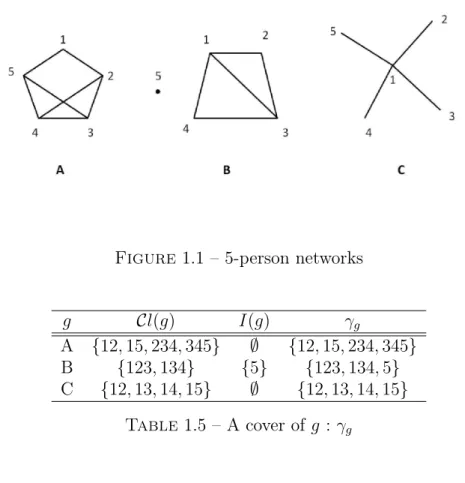
1.1 5-person networks . . . 36
3.1 An example of a 7-person trust relationship network . . . 65
3.2 An example of a 3-person network with realized incomes . . . 70
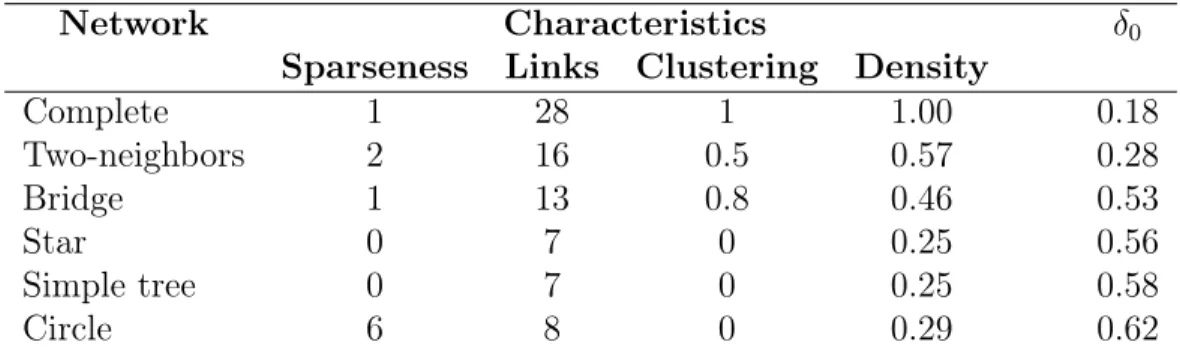
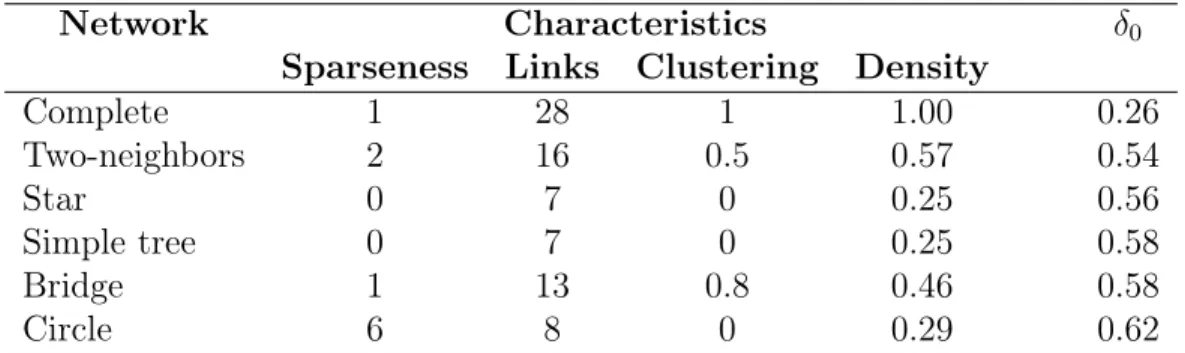
4.1 Examples of 8-person networks : (1) Simple tree, (2) Circle, (3) Two-neighbors, (4) Complete, (5) Bridge, (6) Star . . . 109
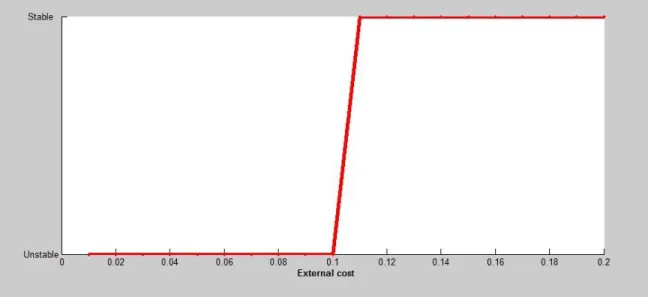
4.2 Stability and external effects . . . 114
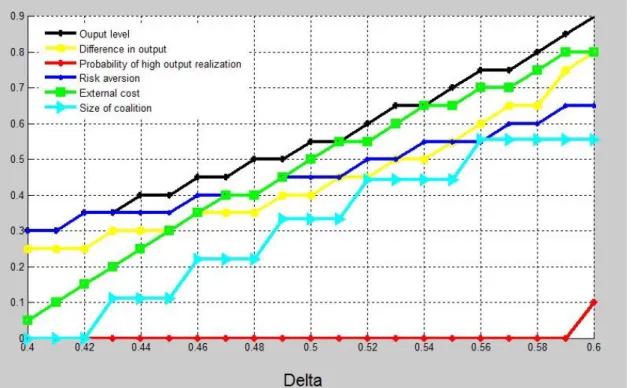
4.3 Weak-stability and exogenous parameters . . . 122
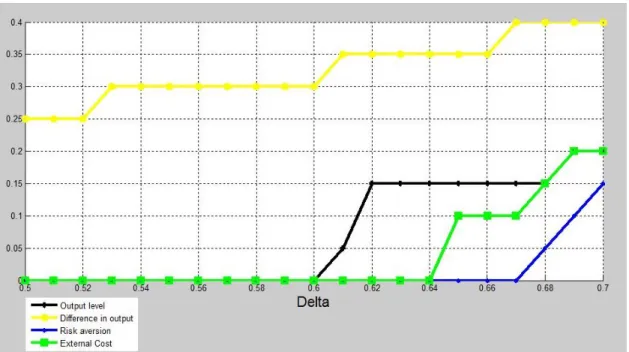
4.4 Strong-stability and exogenous parameters . . . 123
Liste des tableaux
1.1 3-person cover function game . . . 15
1.2 Number of distinct players in a cover . . . 26
1.3 A symmetric cover function . . . 29
1.4 The algorithm . . . 29
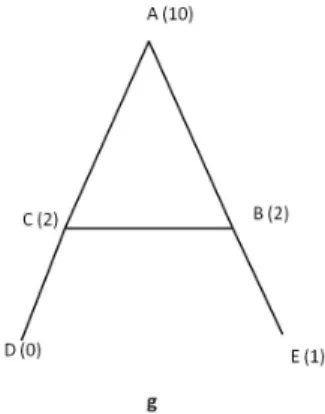
1.5 A cover ofg : γg . . . 36
4.1 Weak stability, network characteristics, and discount factor . . . 109
Introduction générale
Depuis les années 90, on observe une prolifération des zones de libre-échange à travers les cinq continents. L’Organisation Mondiale du Commence en a recensé 150 en 2012. Il s’agit de groupements de pays qui s’entendent pour éliminer les droits de douane et autres restrictions à l’importation. Vu d’un point de vue économique, il s’agit de coalitions formées par des pays qui s’entendent pour améliorer leurs ren-dements commerciaux. On observe également des coalitions dans diverses situations économiques : accords environnementaux, groupes d’assurances informelles, groupes de recherche, groupes humanitaires, groupes de fourniture de biens publics etc. Ces coalitions peuvent être des ensembles disjoints ou bien souvent des ensembles imbri-qués.
La majeure partie de la littérature économique consacrée à la formation des coali-tions, se focalise sur les coalitions disjointes. Cependant, force est de constater que les théories développées dans ce cas ne s’appliquent généralement pas aux coalitions imbriquées. De surcroît, la présence accrue de coalitions imbriquées dans les regrou-pements économiques poussent des chercheurs (Ray, 2007) à plaider pour l’urgence de leur prise en compte dans la théorie économique. Ma thèse se propose donc d’éta-blir un cadre d’analyse qui s’applique à toutes les formes de coalitions, aussi bien disjointes qu’imbriquées. Pour ce faire, la thèse se subdivise en quatre chapitres. Les deux premiers chapitres proposent des éléments de réponse aux questions liées à la formation même des coalitions imbriquées. Il s’agit de comprendre par quels proces-sus ces genres de coalitions voient le jour. Forts de ces éléments de réponses, les deux
derniers chapitres s’attaquent aux assurances informelles (qui sont souvent des coali-tions imbriquées) en tentant de les analyser à la lumière des réponses préalablement apportées.
Dans le premier chapitre, je me pose la question suivante : peut-on par un jeu dy-namique de formation de coalitions aboutir à un équilibre où les coalitions qui se forment sont imbriquées ? Pour y répondre, je propose un jeu de négociation où des propositions de formation de coalitions et de partage de surplus réalisés sont faites par étapes. Je montre que ce jeu admet un équilibre parfait en sous-jeux. Une fois cette étape franchie, la question la plus important est de savoir s’il est possible de calcu-ler concrètement cet équilibre et sous quelles conditions cela est possible. Je propose donc une procédure qui permet, sous certaines conditions de régularité, de calculer cet équilibre. Cette procédure se limite toutefois aux jeux symétriques : cas où le nom des individus n’est pas important mais seul la structure des groupes auxquels ils appartiennent compte. Dans la suite j’établis un lien biunivoque entre les coalitions imbriquées et les réseaux interrelationnels. Ce lien me permet de caractériser tous les réseaux interrelationnels par des coalitions imbriquées et inversement de dégager les formes de coalitions imbriquées qui peuvent être caractérisés par des réseaux. Partant de là, je montre que pour la plupart des réseaux (excepté les cercles où chaque agent a deux liens et tous les agents sont liés), il existe un jeu dynamique qui admet ce réseau comme émanant d’un équilibre parfait en sous-jeux (du jeu que je propose). Dans le second chapitre, toujours dans le souci de proposer un processus rationnel aboutissant à la formation de coalitions imbriquées, je propose une approche alterna-tive. Il s’agit d’une approche qui s’inscrit dans la tradition des jeux de coopération, où des agents peuvent refuser la coopération proposée et former leur propre coopé-ration, tant que cette déviation leur permet d’améliorer leurs gains. Je m’intéresse notamment à une structure particulière de distribution de gains : le noyau. Il s’agit des distributions qui ne peuvent être dominées : on ne peut pas faire strictement mieux pour les agents. Il s’agit donc de regarder comment cette notion de noyau
peut être étendue à un cas où la formation de coalitions imbriquées est possible. Je propose des extensions du noyau récursif préalablement proposé dans la littérature mais qui ne s’applique qu’aux coalitions disjoints. Je montre qu’une extension naïve (qui s’ouvre aux coalitions imbriquées tout en conservant la modélisation existante de la réaction suite à une déviation) peut aboutir à une structure de noyau pour les coalitions imbriquées. Cette structure présente cependant beaucoup de limites et ne modélise pas toutes les formes possibles de coalitions imbriquées. Dans la suite du chapitre, je propose une approche beaucoup plus adaptée aux coalitions imbriquées en insistant sur le rôle des agents qui sont membres de plusieurs coalitions. La notion de noyau ainsi obtenue présente une structure beaucoup plus fine que la première et semble mieux adaptée aux coalitions imbriquées.
Dans le troisième chapitre, j’utilise le lien établi entre les réseaux interrelationnels et les coalitions imbriquées pour expliquer dans un premier temps la structure im-briquées des assurances informelles. Il s’agit d’une structure organisationnelle où des groupes d’agents économiques, face à l’indisponibilité de crédit ou d’assurance, s’as-socient de manière non formellement réglementée pour se faire réciproquement des transferts dans le souci de lisser leur consommation. Ce chapitre vise essentiellement à caractériser les déterminants de la stabilité de ces groupes de transfert. Par stabilité j’entends la possibilité de défection par certains agents. Pour soutenir cette non-défection, souvent dans le secteur formel, il y a le système judicaire ou les agences de recouvrement. Mais dans les économies agraires où ces structures formelles font défaut, les groupes d’assurances développent des techniques d’autodiscipline. Souvent ces techniques sont supposées exogènes dans la littérature. Je propose une procédure d’autodiscipline endogène où les agents n’obéissent pas à une règle préétablie pour sanctionner ceux qui font défection, mais agissent plutôt de manière à maximiser leur bien-être. En outre, j’introduis des externalités (les actions au sein d’un groupe in-fluencent les gains des autres agents, incluant même les non-membres de ce groupe), largement documentées dans la littérature empirique, dans la construction du modèle.
En explorant deux règles de partage, je caractérise les groupes de transfert stables. J’isole ensuite les conditions qui favorisent les défections et j’identifie le rôle des ex-ternalités dans la stabilité. Enfin, je dérive des résultats de statique comparative pour les paramètres qui influencent les défections.
Le dernier chapitre est également consacré aux groupes d’assurance informelle. Je reviens sur les deux procédures d’autodiscipline exogènes les plus répandues dans la littérature. L’intérêt est que toute procédure d’autodiscipline qui se manifeste par la rupture des liens, peut se placer entre ces deux extrêmes. Je propose une structure or-ganisationnelle des assurances informelles, construite à la lumière des faits empiriques et je m’intéresse à leur stabilité. Dans un premier temps, je caractérise les groupes de transfert stables en n’imposant aucune restriction sur le facteur d’escompte (il faut noter que souvent dans la littérature on impose des facteurs d’escompte extrêmes, ce qui facilite les calculs). Je donne les bornes inférieure et supérieure des groupes de transfert stables émanant de réseaux interrelationnels. Je dégage ensuite les struc-tures de réseaux qui sont le plus susceptibles d’aboutir à des groupes de transfert stables. J’identifie une série de paramètres qui contribuent à la stabilité et je produis des résultats de statique comparative sur ces paramètres. Je fais des simulations pour tenter de comparer les contributions de ces paramètres à la stabilité. A la fin je pro-pose une procédure à pas finis (il existe une procédure dans la littérature mais à pas infinis), qui permet d’obtenir le meilleur lissage de consommation, qui est adaptée aux coalitions imbriquées.
Overlapping coalitions, bargaining
and networks
1.1
Introduction
There are many situations where a group of agents can perform a task more ef-ficiently than a single agent. A desirable behavior in this case is the formation of coalitions : “alliances among individuals or groups which differ in goals” (Gamson, 1961). When a coalition is formed, its members define rules to follow together. The-refore, forming a coalition can be viewed as writing an agreement together in order to reach some common objectives.
In politics, environmental issues, provision of public goods, customs unions, and many other situations, people write agreements. The literature on coalition formation, both applied and theoretical, is very rich. However, this literature is mostly restricted to models where each agent can be a member of no more than one coalition. That is, coalitions cannot overlap. Yet real life shows us the contrary. There are several situations where an agent can be signatory to an agreement to form a coalition S and at the same time, also be signatory to another agreement to form a coalition S0 which differs fromS. We observe such behavior in many economic, social and political
situations.
In international trade, Free Trade Agreements (FTAs) involve overlapping coa-litions of countries. The number of Regional Trade Agreements (RTAs) is growing rapidly all over the world. According to the World Trade Organization (WTO), it is estimated that more than half of world trade is now conducted under such agree-ments. Among the best known RTAs are the European Union (EU), the European Free Trade Association (EFTA), the North American Free Trade Agreement (NAFTA), the Association of Southeast Asian Nations (ASEAN) and so on. Many countries are signatories to more than one of these RTAs. Israel, for example, has an FTA with both the United States and the EU. Norway is signatory to the EFTA and has an FTA with the EU and the Baltic states.
Credit markets in developing countries are not perfect. A person with low income has limited access to credit. Rotating Saving and Credit Associations (ROSCAs) are an alternative to formal credit. A ROSCA is “an association of men and women who meet at regular intervals, for instance, once a month, and distribute a lump sum of money to one of its members" (van den Brink and Chavas, 1997). Such credit institutions are a widespread phenomenon in developing economies around the world1. In these economies, most people are members of multiple ROSCAs at the time (van den Brink and Chavas, 1997) : one at work, one at the family level, one at the village level and so on.
Environmental agreements also involve overlapping coalitions of countries. For example, the Asia-Pacific Partnership (APP) on clean development and climate, is an international agreement on development and transfer of technology in order to re-duce greenhouse gas emissions. The signatories to APP are Australia, Canada, China, India, Japan, South Korea and the United States of America (USA). Though, unlike
1. The ROSCA is known as “tontine" in Francophone West Africa, “Dashi" among the Nupe in Nigeria, “Isusu" among the Ibo and Yoruba, and as “Susu" in Ghana. It is called “Ekub" in Ethiopia. In Tanzania, it is called “Upatu," and it is known as “Chilemba" in many other parts of East Africa. In other parts of the world, the ROSCA is called “Arisan" (Indonesia), “Pia Huey" (Thailand), “Ko" (Japan), “Ho" (Vietnam), “Kye" (Korea), and “Hui" (central China). See van den Brink and Chavas (1997) for more details.
other APP signatory countries, the USA has not ratified the Kyoto Protocol : imposi-tion of mandatory limits on greenhouse gas emissions. But, the USA and Canada are signatories of the Convention on Long-Range Transboundary Air Pollution (LRTAP) : cutting of emissions of four pollutants (sulphur dioxide, nitrogen oxides, volatile or-ganic compounds and ammonia) by setting country-by-country emission ceilings to be achieved by the year 2010.
Many other examples can be found in everyday economic behavior. This empha-sizes the fact that agreements involving overlapping coalitions are present in a wide variety of economic and social interactions. Yet, the existing literature on coalition formation pays a little attention to overlapping coalitions. The aim of this chapter is to develop a theoretical model that will be useful for the analysis of overlapping coalitions.
As suggested Ray (2007) :
[If the formation of coalitionS leaves the worth of all other coalitions unchanged, in-cluding the worth of those groups that intersect withS, one can go ahead and simply treat each of these as separate bargaining problems. That would be the end of the story. But of course, matters are generally more complicated. The worth of a formed coalition do affect those of another, and they do so in two fundamental ways.
First (law, custom, information) the formation of one coalition may negate the for-mation of some other coalitions [...]
Second the formation of S can affect what a coalition T can achieve. Example free trade agreements withinSdoes not preclude another for T; but payoffs will surely be affected.]
This reflection raises some questions :
– How can we extend existing models of coalition formation to accommodate overlapping coalitions ?
– What procedure should a group of agents use to coordinate their actions ? – What is the process that leads to the formation of overlapping coalitions ?
– How should the worth of a coalition be divided among its members ? We provide answers to some of these questions, but more remains to be done.
The chapter is organized as follows. In Section 1.2, we mention the different steps that have been taken so far in the game-theoretic perspective on coalition formation. In Section 1.3, we build a “bargaining cover function game” that allows the formation of overlapping coalitions and we show existence of equilibria. In Section 1.4, we focus on symmetric cover function games and we provide an algorithm to compute equilibrium outcomes in this case. Finally, in Section 1.5 we establish a one-to-one link between social network structures and overlapping coalition structures.
1.2
Related literature
Myerson (1980) introduced the idea of overlapping coalitions in the economics literature. He used the terminology of “conference structure.” He was interested in allocation rules as mappings from conference structures to payoff vectors. The ex-pressionoverlapping coalition has been well known in other disciplines like computer science and robotics2. The problems addressed there, however, are different from those of economic interest. Ray (2007) pointed out the lack of attention paid to overlapping coalitions in game theory. He concluded by stating the necessity of a way to model overlapping coalitions in game theory.
In the game theoretical approach to modeling coalition formation, if a coalition forms, it generally means that its members agree to behave cooperatively. But if there is more than one coalition, agents across coalitions behave non-cooperatively. This mix of cooperation and non-cooperation leads to two approaches in the literature : the blocking approach and the bargaining approach. If attention is focused on cooperation, then coalitions are treated as the fundamental behavioral units and the blocking approach is taken. On the other hand, if attention is focused on non-cooperation,
then individuals are treated as the fundamental behavioral units and the bargaining approach is taken. Following the blocking approach, some papers have provided game theoretical models that take overlapping coalitions into account (Albizuri et al. 2006, Chalkiadakis et al. 2008, 2010). This chapter differs from these in that we follow the bargaining approach. To our knowledge, it is the first to provide a bargaining game that accommodates overlapping coalitions. In that sense, this chapter is a contribution to the literature on coalition formation and more generally on bargaining theory3.
As this chapter follows the bargaining approach, we expose a quick overview of some models of bargaining with discounting. Rubinstein (1982) is one of the first to use the extensive-form model of bargaining. The model is of a bilateral bargaining process. But, when Binmore et al. (1985) tested bilateral bargaining of this kind on subjects, they concluded that subjects behave fairer in real life than the theory predicts. Subjects chose equal division as an obvious and acceptable compromise. Chatterjee et al. (1993) and Okada (1996) generalized the bilateral bargaining by Rubinstein (1982) to multilateral bargaining. These two papers differ in the way the proposer is selected in the bargaining process. Based on Chatterjee et al. (1993), Ray and Vohra (1999) take into account externalities across coalitions. When a coalition forms, the actions of other coalitions can affect the worth of the formed coalition. In most of these papers, once the bargaining game is introduced, an equilibrium notion is explored and the equilibrium coalition structures are characterized.
In all of these papers, however, coalitions are not allowed to overlap. Therefore, it is interesting to take a step forward by exploring the area of overlapping coalitions as suggested Ray (2007).
1.3
The Model
The model here is an extension of the one developed by Ray and Vohra (1999) to a setting where coalitions are not necessarily disjoint sets. For this purpose, we
introduce thecover function (bargaining) game. We adopt, to the extent possible, the same notations as in Ray and Vohra (1999).
1.3.1
Cover functions
Let N ≡ {1,2, . . . , n} denote the set of all players. A coalition S is a non-empty subset of N. Two distinct coalitionsS and S0 are said to beoverlapping ifS∩S0 6=∅. A cover γ of N is a collection of coalitions such that
γ ≡ {S1, S2, . . . , Sm} and m [
k=1
Sk =N.
Let Γ denote the set of all covers of N. An embedded coalition4 is a pair (S, γ) such that S ∈ γ and γ ∈ Γ. The set of embedded coalitions is denoted by Σ and defined byΣ = {(S, γ)|S ∈γ, γ ∈Γ}.
A partition π ofN is either {N} or a cover withSj∩Sk =∅for j 6=k. Let Πdenote
the set of all partitions of N. One can easily see that Π ⊂ Γ. In the remainder, we will use the expression overlapping coalition structure to address an element of Γ whenever we want to emphasize on its structure. We denote for simplicity a coalition S ≡ {i, j, k, ...} byS =ijk....
Definition 1. A cover functionv : Σ→ <is such that for all (S, γ)∈Σ, v(S, γ)≥0 .
From this definition, existing notions of partition function and characteristic func-tion can be obtained.
Definition 2.
(a) If Γ is restricted to Π, then v is a partition function.
(b) If in addition to (a), v is such that for all distinct pairs γ, γ0 ∈Π and for all S ∈γ∩γ0, v(S, γ) = v(S, γ0), thenv is a characteristic function.
Hence, partition functions and characteristic functions are special cases of cover func-tions.
1.3.2
The cover function bargaining game
For each coalition S, there is an initial proposer ρp(S) in S and an order of
respondents ρr(S) which is a permutation of S\ρp(S). A protocol on N is given by the set ρ≡ {(ρp(S), ρr(S))}
∅6=S⊆N. A cover function (bargaining) game is given by a
triple (N, v, ρ) where N is a set of players, v is a cover function, and ρ is a protocol onN.
The game proceeds in stages. At each stage, a proposer is selected. She proposes a coalition including her and a distribution of the conditional coalitional worth to the other members of that coalition. Due to externalities, the actual coalitional worth is not known until the end of the game. Therefore, a proposer proposes a distribution that is conditional on the remaining coalitions that form. The respondents, the other members of the coalition to whom aproposal is made, either accept or reject this pro-posal in the order specified by the protocol. If all the respondents accept the propro-posal, the coalition forms. The bargaining process consists of a succession of proposals and responses. The current state of the game consists of the proposals that have already been made, the corresponding responses, the coalitions that have already formed, and the ones that can form. We provide below a formal definition of a proposal.
At each stage of the game, the set of proposers consists of the players who do not belong to any formed coalition. The set of respondents, however, is the whole set of playersN. In order to permit overlapping coalitions, we allow a member of a coalition that has already formed (during the bargaining process) to continue participating in the game, but only as respondent. For example, consider a set of countries. Suppose one country takes the first step to form an RTA with some of the others. Once this RTA is formed, another country (which does not belong to the RTA that has already
formed) may initiate the formation of another RTA. He can decide to extend the new proposal to some countries that belong to the already formed RTA. If the new RTA is formed, then we see overlapping RTAs.
At any stage of the game where a coalitionSis proposed, letΓ(S)≡ {γ ∈Γ|S∈γ}
be the set of coalition structurescompatible withS. Consider a stage of the game such that a collection of coalitionsλ≡(S1, . . . , SL)has already formed and a coalitionSis
proposed. Let Γ(λ, S) denote the set of coalition structures that arecompatible with λ and S.
Formally, Γ(λ, S)≡ {γ ∈Γ(S)|γ ∈Γ(Sl) for all l = 1, . . . , L}.
Definition 3. A proposal is a pair (S, y), where y≡(y(γ))γ∈Γ(λ,S) such that for all
γ ∈Γ(λ, S), y(γ) is a vector of size |S| and P
i∈Syi(γ) =v(S, γ).
Remark 1.
A proposal(S, y)is such thatSis a non-empty subset ofN and eachy(γ) = (yi(γ))i∈S
is a distribution of v(S, γ) among the members of coalition S conditional on the formation ofγ.
In the above definition, yi(γ)is the payoff proposed to i contingent on the formation
of the cover γ ∈Γ(λ, S).
Anoutcome of the game consists of the collection of all coalitions that form during the bargaining process if the game ends. A strategy of a player is a complete plan of action that specifies the choices to be made at each time she makes a decision. This plan of action is contingent on the history of the game. A stationary strategy of a player is to either make a proposal (possibly probabilistic) or to respond to a proposal (possibly probabilistic), conditional only on the current state of the game. Asubgame stationary perfect equilibrium is a collection of stationary strategies such that there is no history at which a player benefits by deviating from her prescribed strategy. We make the behavioral assumption thatif a player is indifferent between making non-acceptable proposals such that the game continues forever and making an non-acceptable proposal such that the game ends, she chooses to make the acceptable proposal. The
idea behind this assumption is that no individual is ill-intentioned to act as to reduce others worth without gaining any.
1.3.3
Timing of the game
At each stage k = 1,2,· · · of the game, let Pk be the set of possible proposers.
The game starts with P1 ≡N. The timing of the game is as follows.
At stage k :
(i) The protocol ρ designates i=ρp(P
k) as the initial proposer. Player i chooses
a coalition S ⊆ N to which she belongs and makes a proposal to the other members of S.
(ii) The players in S\ {i} respond sequentially according to the protocol ρr(S). If all of them accept the proposal, then coalition S forms. The game moves to stage k+ 1 with Pk+1 ≡ Pk\S. In this case, the game continues with a new
proposal made by player ρp(P k+1).
(iii) In case of rejection at stage k, the game moves to stage k+ 1 but the next proposer is not designated by the protocol. Instead, she is the first rejector that belongs to Pk.5 After a rejection, a lapse of one unit of time occurs.6 This
imposes a geometric cost on all players, and is captured by a common discount factor δ ∈ (0,1). After the next proposal is made, the game continues exactly as described in (ii).
(iv) If, during the bargaining process, a playerj makes a proposal that is rejected only by players inN \Pk, then j remains the next proposer.7
5. It can be the case that the first rejector, according to the protocol, is a player who already belongs to a formed coalition. In this case, the next proposer is the following rejector according to the protocol. If this player also belongs to a formed coalition, then the next proposer shifts to the following player and so forth.
6. The bargaining process can occur during a meeting. So in case of rejection, the lapse of time captures the additional renegotiation costs. The literature on discounting often explain this lapse of time as a cost of reorganizing another meeting or another discussion panel. But if the proposal is accepted, there is no additional cost and therefore there is no lapse of time.
7. Step (iv) in the timing of the game captures the fact that making an unacceptable proposal to an individual who belongs to an already formed coalition is strategically unnecessary. On an equilibrium path an unacceptable proposal is made strategically to force the rejector (who belongs
(v) The game ends if Pk+1 = ∅. At this time an overlapping coalition structure
forms. Each coalition is now required to allocate its worth among its members according to the proposal they have accepted.
Remark 2.
– If the bargaining process continues forever, all players receive zero due to dis-counting.
– At each stage of the game, while only members ofPkmay propose, any member
of N may be a respondent.
– Step (iv) is useful for the description of all possible situations. But, due to discounting, this never happens on an equilibrium path when the game ends.
Proposition 1. An outcome of a cover function (bargaining) game is in Γ. Proof.
The proof is straightforward because the game ends if and only if it reaches a stage
k such thatPk+1 =∅.
Notice that at any stage of the game, a proposal can be made to the whole set of players, including those players who have already formed a coalition. Therefore, coalitions may overlap in an outcome.
Example 1.
Consider a small village of three households1, 2, and 3. Suppose that in this village, 1 and 3 are enemies and 2 is a household of very skilled (or wealthy) persons. So everybody wants to sign an agreement with 2. If 1 and 3 are in the same group, their relationship will negatively affect the performance of the group. If households are allowed to bargain and form groups strategically in order to perform some tasks, what is the structure that will arise ?
To model this situation, let N ={1,2,3} be the set of players. The game is given by
to Pk) to make the next proposal. It worth noting that Ray and Vohra (1999) provide an example
Table 1.1.
Protocol Covers Cover function
ρp(N) = 1 γ1 ={N} v(N, γ1) = 4 ρp(12) = 1 γ 2 ={1,2,3} v(i, γ2) = 1 for i= 1,2,3 ρp(13) = 1 γ 3 ={12,23} v(12, γ3) =v(23, γ3) = 3 ρp(23) = 2 γ4k ={ij, k} v(ij, γ4k) = v(k, γ4k) = 1 (*) ρr(N) = 2→3 v(S, γ) = 0 for any other (S, γ)∈Σ
(*) i, j, k are such that {i, j, k}=N v(S, γ) = 0 for any other (S, γ)∈Σ.
Table 1.1 – 3-person cover function game
Suppose that the distribution of coalitional worth is fixed exogenously to be equal division.8 One possible equilibrium action sequence in the cover function bargaining game is :
(i) Player 1 makes the proposal (12, y) to player 2 , withy= (y(γ))γ∈Γ(12), where
y({12,3}) = (1/2,1/2) y({12,13}) = (0,0) y({12,23}) = (3/2,3/2).
(ii) Player 2 accepts the proposal and then the coalition 12 forms.
(iii) Player 3 makes a proposal (23, y0) to player 2 , with y0 = y({12,23}) = (3/2,3/2).
(iv) Player 2 accepts the proposal and the game ends.
It turns out that the coverγ3forms in equilibrium. This equilibrium coalition structure
is an overlapping coalition structure. This is not possible in the partition function framework.
If we were to restrict ourselves to the partition framework, since v(S, γ)≥ 0, we would have v(12, γ3) = v(23, γ3) = 0. Obviously, the grand coalition would form in
8. Equal division is a mild requirement imposed here for simplicity as by Ray and Vohra, 1999. In real life people chose equal division (Binmore et al., 1985) as an obvious compromise. Equal division is also obtained whenδ tends to unity (Ray and Vohra, 1999).
equilibrium. It is interesting that with γ3, one can easily construct a division of the
equilibrium coalitional worths, such that all the players are better off compared to all possible payoffs that they get in the partition function case. Thus,allowing the forma-tion of overlapping coaliforma-tions can lead to Pareto improvements. This example shows that, apart from the descriptive aspect, a framework that accommodates overlapping coalitions is normatively interesting.
1.3.4
Existence of equilibrium
As in Ray and Vohra (1999), our notion of equilibrium allows for three kinds of mixing : the choices of a coalition to propose, a distribution of the coalitional worth, and a response. Ray and Vohra (1999) prove the theorem below for the partition function case. We show that it remains true for the cover function case. The steps of the proof remain the same. However, the generalization is far from being obvious. Furthermore, unlike the partition case, our proof is by induction on the size of the set of proposers.
Theorem 1. There exists a stationary subgame perfect equilibrium where the only source of mixing is the choice of a coalition by each proposer.
Proof.
Notice that for a new coalition to form during the bargaining process, it needs a new proposal to be made. This requires at least one player to be a proposer. Furthermore, there can not be a new coalition formed only by players belonging to already formed coalitions. Thus for the existence of an equilibrium, it is sufficient to focus on the set of proposers.
Without loss of generality, the proof is by induction on only the size of the set of proposers. We proceed with a sequence of four lemmas. Before that, we need some additional notation.
If a coalitionS forms, let{−S, v|−S, ρ|−S}denote the new game, where proposals can
v|−S ≡ v(T, γ)T∈γ\{S} γ∈Γ(S) , and ρ|−S ≡ (ρp(T0), ρr(T)) ∅6=T0⊆N\S;T∈γ\{S},γ∈Γ(S).
Similarly define {−λ, v|−λ, ρ|−λ} as the new game obtained after a collection of
coa-litions
λ ≡ (S1, . . . , SL) has formed. Let M ≡ M ax(S,γ)∈Σ
v(S, γ) . Obviously, M exists becauseN is a finite set. For allγ ∈Γ, the number of coalitions in γ is at mostn (the total number of players).9 At the beginning of the game, the number of proposers is n. However, this number decreases during the bargaining process. Thus, an indi-vidual’s payoff can not exceed nM. In addition to that, due to the assumption that v({i}, γ)≥0for alli∈N, the equilibrium payoff for each player lies inX ≡[0, nM]. If at stage k of the game Pk ={i}, i ∈ N will propose a coalition T. If T 6={i}
and she knows that at least one player will reject the proposal, i can not do better than staying alone and proposing T = {i}.10 Otherwise, she proposes a coalition T 6={i} such that no player will reject this proposal and she gains at least the same as her payoff if she proposes{i}. And the game ends. Thus her best strategy is either making an acceptable proposal (if she can get more than what she gains by staying alone), or staying alone (if not).
Assume that an equilibrium exists for each cover function bargaining game with less than n proposers.
Now consider the overall game with n proposers at the beginning. Suppose that a coalition S has formed.11 The resulting game is {−S, v|−S, ρ|−S} withn− |S|
propo-sers. By assumption, an equilibrium exists for this game. Fix one equilibrium strategy for any player in this subgame. Now we are going to describe equilibrium strategies
9. The number of coalitions inγ lies between1 (ifγ={N}) andn(if all the coalitions inγ are singleton sets). This is due to the fact that for a coalition to be formed, we need at least one player from the set of proposersPk
10. Notice that according to Step (iv) in the timing of the game, if i’s proposal T is such that
T 6={i} and it is rejected, thenimakes the next proposal. SincePk ={i}, all the players inT\ {i}
are already members of a formed coalition. Because of the discounting following a rejection and the behavioral assumption that we made,ican not make an unacceptable proposal.
11. As far as the game is not degenerated, ie. there exists(S, γ)∈Σsuch thatv(S, γ)>0, at least the coalitionS will form at equilibrium.
afterS had formed.12
For this purpose, we have to generate :
(i) A probability distribution βS over the set Λ(S) ≡
λ = γ\ {S}, γ ∈ Γ(S) . Each λ∈Λ(S)is a collection of coalitions such that {S} ∪λ∈Γ(S).
(ii) A set U ≡ ul(T) l∈T, T ∈ λ
of equilibrium payoff vectors (in X) for all the players in the coalitions to be formed after S has formed.
At the beginning of the game, let i ≡ ρp(N).13 Let Ni ≡ {S ⊆ N, i ∈ S}
de-note the set of all coalitions containing i. Let Ai ≡
Ni × {j}, j ∈ N \ {i} ,
∆i ≡ {Probability distribution over Ai}, and∆≡ Q
k∈N∆k. Playeri∈N can make
acceptable proposals to players inS ∈ Niand unacceptable proposals toj ∈N\{i}.14
A typical elementαi ∈∆istands fori’s probabilistic choice concerning the coalition to
form or the other player to whom an unacceptable proposal is made. Thus,αi(S)
de-notes the probability with which ichooses to make an acceptable proposal toS ∈ Ni
, and αi {j}
denotes the probability with which i chooses to make an unacceptable proposal to j ∈ N \ {i}. Let xSk denote the expected equilibrium payoff that k ∈ N receives in the game, coming from the formation of a coalition S that she belongs to, if i is the first proposer. Notice that ex-post, ifS is not in the equilibrium cover, then xS
k = 0. Thus, the expected equilibrium payoffsxk that k receives in the game,
if i is the first proposer, is the sum of what she receives from each coalition that she belongs to. Formally, xk=
P S∈Nkx
S k.
Fix α ∈ ∆ and x ≡ (xk)k∈N ∈ Xn. Player i ∈ N has two options : making an
acceptable proposal to a coalition S ∈ Ni or making an unacceptable proposal to
j 6=i.
Lemma 1. If i makes an acceptable proposal to S, then her optimal expected payoff is
12. Notice that the protocol was suppose not to depend on the process that leads to the formation of a coalitionS.
13. Playeriis the first proposer of the game.
14. We can assume without loss of generally that i ∈ N make unacceptable proposals only to singleton sets of players. The point is that for a proposal to be rejected, it needs only one player to reject it.
gi(S, x)≡ P λ∈Λ(S)β S(λ)v(S, γ)−δP j∈S;j6=ixj, where γ ={S} ∪λ. Proof.
To alleviate the notation in the proof, we write (S, λ) instead of{S} ∪λ.
Player i names a coalition S ∈ Ni and makes an acceptable proposal y(S, γ)
condi-tional on γ ∈Γ(S). To do so, she solves the following program : M axyE yi S,(S, λ) ≡ X λ∈Λ(S) βS(λ)yi S,(S, λ) (1.1) Subject to : X λ∈Λ(S) βS(λ)yj S,(S, λ) ≥δxj for all j ∈S, j 6=i (1.2) X k∈S yk S,(S, λ) ≤v S,(S, λ) (1.3) (1) : i∈ N maximizes her payoff expecting that the coverγ = (S, λ) will form with probability βS(λ).
(2) :j ∈S\ {i} accepts the offer.15
(3) : The aggregate payoff of all players inS can not be greater than the coalitional worth.
It is straightforward to see that (1.2) and (1.3) will bind at equilibrium. Thus, at equilibrium : X λ∈Λ(S) βS(λ)yj S,(S, λ) =δxj for all j ∈S, j 6=i (1.4) X j∈S yj S,(S, λ) =v S,(S, λ) (1.5)
Sum (1.4) over j and add P
λ∈Λ(S)β
S(λ)y
i S,(S, λ)
. Letgi(S, x)denote the
maxi-mum value of the program. From (1.5),gi(S, x) = Pλ∈Λ(S)β
S(λ)v S,(S, λ)
−δP
j∈S;j6=ixj.
15. Because she is better off than what she could gain if she rejects the proposal and becomes the next proposer.
In the previous lemma,gi is a continuous function ofx(projections and sum) and
is independent of λ.
The playeri=ρp(N)will choose a coalitionSinN
i and make an acceptable proposal
to players in S if this coalition induces the highest gi(S, x)to her.
We have fixed (x, α)∈ Xn×∆. For each k ∈N, let vk
i(x, α) denote i’s expected
payoff received if k proposes at this stage. If k’s proposal is accepted, let Bik denote i’s expected payoff. Otherwise, ifk’s proposal is rejected byj16, then a new proposal is made by j. Notice that j ≡j if at this stagej is in the set of proposers, otherwise, j ≡k.17 Thus, vki(x, α) =Bki +δX j6=k αk {j} vij(x, α). (1.6)
Lemma 2. For each k ∈N, vk
i(x, α) is a continuous function of (x, α). Proof. For each k ∈N,vk i(x, α) is defined by vik(x, α) = Bik+δX j6=k αk {j} vji(x, α) (1.7)
Remind that iis the first proposer. Thus,
Bii ≡ X S∈Ni αi(S)gi(S, x) , and forj 6=i , Bij ≡δ X T∈Nj, i∈T xTi αj(T)+ X T∈Nj, i6∈T αj(T)ui(T) (1.8) (1.7) : With probability αi(S), i chooses a coalition S and makes an acceptable
proposal to its members.
(1.8) : Player i’s proposal is rejected by j 6= i who becomes the next proposer and makes an acceptable proposal toT. For the first expression, ibelongs to the coalition T proposed by j. For the second expression, i does not belong to the coalition T
16. Playerk makes an unacceptable proposal toj with probability αk {j}
. 17. This situation occurs according to Step (iv) in the timing of the game.
proposed by j.
For each k ∈ N, the value vk
i(x, α) depends on i’s best payoff gi , and on the vector
α.
The set of equations defining the value can be defined as
Vi ≡(vik)k∈N , and Bi ≡(Bik)k∈N
LetC denote then×n matrix with 1’s on the diagonals and −δαk {j}
as thekjth off-diagonal element. Thus, Bi =CVi.
In each row, the sum of the off-diagonal elements lies in(−1; 0] andC is nonsingular. Thus, Vi =C−1Bi by (1.6). We conclude that for each k ∈N, vik is continuous in x
and α. Player i’s expected payoff is a continuous function of x and α, whether her
proposal is accepted or not.
For each (x, α)∈Xn×∆ and a fixed i∈N, definevi(x, α,·)on ∆i by
vi(x, α, αi0)≡ X S∈Ni α0i(S)gi(S, x) +δ X j6=i α0i {j} vij(x, α)
and maximize this function with respect toα0i ∈∆i. Letφi1(x, α)≡M axα0i∈∆i vi(x, α, α0i) , φ2 i(x, α)≡Argmaxα0 i∈∆i vi(x, α, α0i) , and Φ≡Q iφ1i Q iφ2i.
Lemma 3. Φ is a mapping on Xn×∆ and it admits a fixed point (x, α). Proof.
According to the maximum theorem and the facts thatvi(x, α, α0i)is continuous, and
φ1
i(x, α) is a continuous function, φ2i(x, α) is a convex-valued upper hemicontinuous
correspondence. This result holds for all i inN and (x, α) in Xn×∆ because i and
(x, α) where chosen arbitrarily. Thus, Q iφ
1
i maps Xn× ∆ on Xn. Therefore, the
correspondence Φ: Xn×∆→Xn×∆ admits a fixed point (x, α) according to
Lemma 4. The fixed point of Φ induces an equilibrium. Proof.
Letσ denote the strategy profile such that at the stage k of the game :
(i) When Pk =N, an arbitrary i∈N, as a proposer, makes proposals according
toα :
- To every coalition S ∈ Ni such that αi(S) > 0, she proposes y(S, γ) which
solves the maximization problem addressed in the equations (1) – (3). - To every j 6= i such that αi {j}
> 0, she offers, for every possible cover containing the coalition {i, j} , less than δx{i,j}j .
(ii) Suppose that Pk =N,i∈N is a respondent to a proposaly(S, γ), and every
respondent j to follow i is offered an expected payoff of at leastδxj, i.e. P
λ∈Λ(S)β
S(λ)y
j S,(S, λ)
≥ δxj for all respondents j that follow i. Then i
accepts the proposal if and only ifP
λ∈Λ(S)βS(λ)yi S,(S, λ)
≥δxi.
(iii) Suppose thatPk=N, and i∈N is the first respondent. From (ii), if there is
exactly one respondent to followi, sayj ∈N, such thatj is offered an expected value less than δxj, thenj will reject the proposal. Player i’s decision will now
depend on the present value of the payoff resulting from j rejecting the offer and this will lead to a new proposal as in (i). This value is precisely δvij(x, α). Player i accepts the proposal if and only if δvij(x, α) ≥ δxi. Notice that this
inequality might hold even though we know from the construction ofvij and the fact that (x, α)is a fixed point, that δvji(x, α)≤xi.
Now consider a proposal made to respondents {1, ..., r} in that order. Suppose we have computed the decisions of all respondentsi+ 1, ..., r. Player i’s decision is then obtained by considering the decision of the next responder to reject the proposal, say j. Player i accepts the proposal if and only ifδvij(x, α)≥δxi . In
this way we obtain a complete description of the actions of all respondents of a proposal.
(iv) Suppose that Pk ⊂ N. It must be the case that some collection of coalitions
λ= (S1, . . . , SL)has already formed. The strategies of the remaining players are
defined according to the preselected equilibrium of the game {−λ, v|−λ, ρ|−λ}.
We show that a strategy profile σ satisfying (i)-(iv) is a stationary equilibrium. Consider σ and deviations that a single i∈N can contemplate.
By construction xi = vi(x, α, αi) = M ax
vi(x, α,·)
. Thus, it is not possible for i, as a proposer, to receive a higher payoff thanxi by making a one-shot deviation from
αi.
This implies that no other strategy can yield i a higher payoff than xi. The action
prescribed in (i) achieves xi and therefore cannot be improved upon. Suppose that
i is a respondent and all respondents to follow i are offered at least δxj, which, by
hypothesis, they will accept. By deviating,igets a present value of δxi. Clearly then,
the action prescribed in (ii) cannot be improved upon. Supposeiis a respondent who is followed by a respondent j who, based on σ, will reject the proposal. Accepting the proposal yields δvij(x, α) to i ∈ N while rejecting it yields at most δxi. Thus,
the action described in (iii) cannot be improved upon. A similar argument applies to the description in (iii) of i’s actions in the other cases wheni is a responder. Finally, notice that when some players have left the game,ican not do better than the actions
in (iv). Thus,σ is a stationary equilibrium.
This Lemma ends the induction. The strategy profile σ is then a stationary sub-game perfect equilibrium where the only source of mixing is in the choice of a coalition
by each proposer.
Remark 3.
The steps of this proof are exactly the same as in the partition function case (Ray and Vohra 1999). Nevertheless, there are two fundamental differences. First, unlike the partition case, the induction is on the number of potential proposers during the bargaining process. In the cover case, at every stage of the game, the number of possible responders is fixed at n. This is quite different from what happens in the
partition case. Secondly, unlike the partition case, a player can be a responder to acceptable proposals more than once. These features have been taken into account in this proof through the new element xSj denoting the maximum payoff that j ∈N can obtain from the formation of the coalition S if i∈N is the first proposer in the game.
1.4
Symmetric cover function games
In this section, we provide an algorithm to compute an equilibrium coalition struc-ture for symmetric cover function games.
Symmetric partition function (Ray and Vohra, 1999)
Let N be a set of n players, and π a partition of N. If π = {S1, S2, . . . , Sm} with
|Si|=si, then thenumerical coalition structure ofπ isn(π)≡(s1, s2, . . . , sm). Notice
that Pmi=1si =n. A partition function v issymmetric if for a given partition π and a
coalition Si ∈π,v(Si, π) = v(si,n(π)). Thus, the numerical coalition structure
repre-sents the equivalence class of symmetric coalitions (in consideration of the symmetric partition function).
As the coalition formation game has both cooperation (within coalitions) and non-cooperation (across coalition) aspects, the definition of a symmetric cover function game is not straightforward. A player may belong to more than one coalitions. How will this player behave ? Will she behave non-cooperatively against the other members of a coalition that she belongs to ? The answer is not trivial. That is one of the reasons why we favor the bargaining approach. As side payments are allowed, one can think that being a member of multiple coalitions will have an effect on the bargaining power of these coalitions and that will affect in either direction (reduce or increase) the worth of the concerned coalitions. This can induce a specific effect on the division of the worth in those particular coalitions. We do not address this problem here but one
should keep it in mind.
1.4.1
Symmetric cover function
Let γ ≡ {S1, . . . , Sm} ∈Γ. Let n(γ) ≡(s1, ..., sm) denote the numerical coalition
structure ofγ. Contrary to the partition case, Pmi=1si ≥n and if there exists at least
one overlapping player,18 Pmi=1si > n. Thus, the numerical structure used in the
partition case is not sufficient to characterize an overlapping coalition structure. For each Si ∈γ, count the number of overlapping players and identify the number
of distinct coalitions that these players belong to. Formally, leto(Si)≡
(o1, c1), . . . ,(ol, cl)
denote a set of pairs of integers. For each pair, the first integer accounts for the num-ber of overlapping players, and the second one for the numnum-ber of distinct coalitions that these overlapping players belong to. The set o(Si) stands for, o1 players belong
toc1 coalitions,o2 players belong toc2 coalitions,...,ol players belong tocl coalitions.
For further simplicity, we will rank these pairs by using the lexicographical order. This collection of pairs is denoted the overlapping status of Si. Similarly, define the
overlapping status of any collection of coalitions λ that we will denote by abuse of notation o(λ).
Once n(λ)≡(s1, ..., sm)and o(λ)≡
(o1, c1), . . . ,(ol, cl) are defined, let
K(λ)≡Pmi=1si−Plj=1(cj−1)oj.
Proposition 2.
For all γ ∈Γ, K(γ) =n. Proof.
The proof is straightforward. Notice that we may have multiple counts of players in the sum of the sizes of coalitions inγ (because some players may belong to more than one coalition). Therefore, to obtain the exact number of players, we need to subtract this multiple counts so that each player is counted only once.
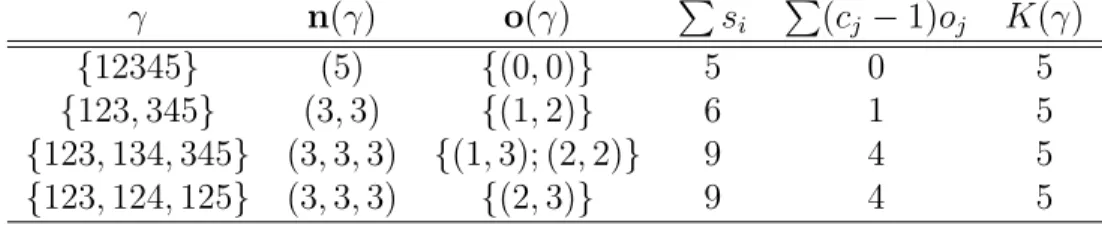
Example 2. Let N = {1,2,3,4,5}. In Table 1.2 we verify Proposition 2 for some covers. γ n(γ) o(γ) P si P(cj−1)oj K(γ) {12345} (5) {(0,0)} 5 0 5 {123,345} (3,3) {(1,2)} 6 1 5 {123,134,345} (3,3,3) {(1,3); (2,2)} 9 4 5 {123,124,125} (3,3,3) {(2,3)} 9 4 5
Table 1.2 – Number of distinct players in a cover
Definition 4. Let γ ≡ {S1, . . . , Sm} ∈Γ and si =|Si| for all Si ∈γ. The
represen-tative coalition structure of γ is denoted r(γ) and defined by r(γ)≡
{si;o(Si)}, i=
1,2, . . . , m .
A cover function is symmetric if the worth of a coalition in a given cover depends only on the size and the overlapping status of each coalition in that cover.
Definition 5. A cover functionv is symmetric if for each embedded coalitions(S, γ)∈
Σ, v(Si, γ) = v si;o(Si) ,r(γ) . Remark 4.
– By definition, the representative coalition structure represents the equivalence class of symmetric coalitions (in consideration of the symmetric cover function). Therefore, for allSi ∈γ, v(Si, γ) can be written as v
si;o(Si) ,r(γ)
.19 – If γ is a partition, then for all Si ∈ γ, o(Si) =
(0; 0) . In this case the re-presentative coalition structure is isomorphic to the numerical structure. Thus, the numerical coalition structure is a particular case of representative coalition structures.
To illustrate the symmetric cover function, let γ = {12,34,45} ∈ Γ. Let v be a symmetric cover function on γ. Thus, v(34, γ) = v(45, γ). The equality does not necessary hold for the coalition 12even if it is also of size 2, because o(12)6=o(34). A symmetric cover function (bargaining) game is a cover function (bargaining) game such that the value function is a symmetric cover function.
1.4.2
The algorithm
In this section we extend the algorithm by Ray and Vohra (1999) to symmetric cover functions. Even if the steps are alike, there are three fundamental differences. First, the representation of the equivalence class of symmetric coalitions is completely different. Secondly, the induction is made on the number ofdistinct players. Thirdly, there is a difference between the optimal size “t" of a new coalition to form, and the number “t0" of “new" players in this coalition. A new player is one who does not belong to an already formed coalition. The algorithm is based on the backward induction and computes at each stage the optimal size and overlapping status of the next coalition to form.
Consider ann-person symmetric cover function (bargaining) game. Letγ ∈Γand let λ⊆ γ denote a collection of coalitions. The sets o(·), r(λ), and the integer K(λ) are defined as in the previous section. Notice that K(∅) = 0. By abuse of notation, we will use the previous notations without their arguments (in case of no confusion) . LetF ≡ {r| K(r)< n}. In the algorithm we construct a mapping t:F →N∗. This
t(·) will characterize the optimal size of the next coalition to form and it will induce an integer t0 ≤ t that will characterize the number of new players in this coalition. Remember that at the stage k of the game, only a player in Pk can make a new
proposal. Starting from∅, we apply t(·) repeatedly and we can generate a particular setr∗.
Step 1 Let r ∈ F such that K(r) =n−1. Let t(r) denote the largest20 integer
20. In the case where we have more than one coalition, choose the largest coalition that achieves the desired outcome. One can also choose the one in which there is no overlapping player or in
in {1, . . . , n} that maximizes the expression v {t;o},r•{t;o}
t where r • {t;o} is
the representative coalition structure obtained by concatenating r with {t;o}. Obviously, we have t0(r)≡1.21 Let c(r)≡r• {t;o}. Obviously, K c(r)
=n. Step 2 Recursively, suppose that we have definedt(r)and t0(r)for allr∈ F such
that
K(r) = j+ 1, . . . , n−1, for some j ≥0. Suppose moreover that K(r) +t0(r)≤
n for any such r. Suppose that we have defined recursively the sets c(r) by successive concatenations such that K c(r)=n.
Step 3 For any r such that K(r) = j, let t(r) denote the largest22 integer in
{1, . . . , n} that maximizes the expression v {t;o},c r•{t;o}
t .
Step 4 For any such r, let t0(r)≡K c(r• {t;o})−K c(r).
Step 5 Complete this recursive definition so that t and t0 are now defined on all r∈ F . Define a representative coalition structure of the entire set of playersN byr∗, such thatr∗ ≡c(∅).
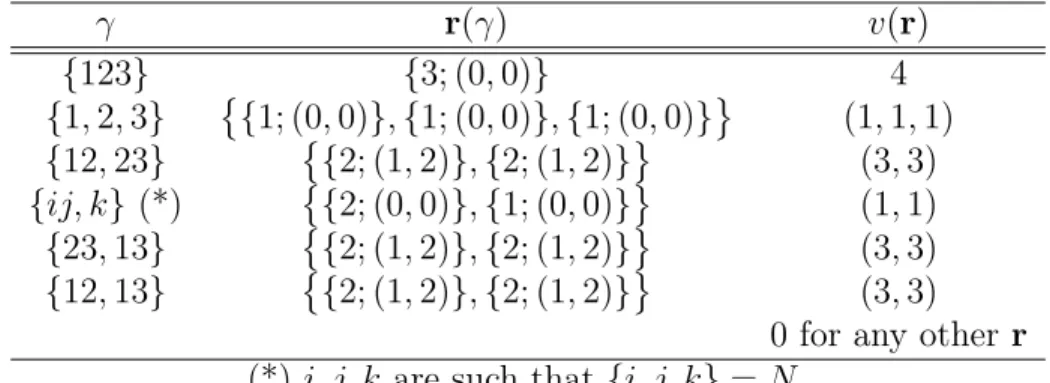
Example 3. Let N = {1,2,3}. The following table, Table 1.3, summarizes a sym-metric cover function wherev(r)denotes the collection of the values v {t;o},r.
Similarly to the previous example, one can easily see thatr∗(γ)≡
{2; (1,2)},{2; (1,2)}
is the equilibrium representative coalition structure. The first person to propose will chose one player and make an acceptable proposal to this player. The remaining player will make an acceptable proposal to one player in the previously formed coalition. For simplicity, we use Table 1.4 to compute the predictions of the algorithm for this symmetric cover function game.
contrary the one in which there are more overlapping players. It depends on the context. What is important here is to have a rule to choose onet in order to compute a unique equilibrium.
21. With K(r)=n-1,Pk=1.
γ r(γ) v(r) {123} {3; (0,0)} 4 {1,2,3} {1; (0,0)},{1; (0,0)},{1; (0,0)} (1,1,1) {12,23} {2; (1,2)},{2; (1,2)} (3,3) {ij, k} (*) {2; (0,0)},{1; (0,0)} (1,1) {23,13} {2; (1,2)},{2; (1,2)} (3,3) {12,13} {2; (1,2)},{2; (1,2)} (3,3) 0 for any otherr (*) i, j, k are such that {i, j, k}=N.
Table 1.3 – A symmetric cover function
K(r) r c r• {t;o} v {t;o},r t t t 0 2 {1; (0,0)},{1; (0,0)} {1; (0,0)},{1; (0,0)} • {1; (0,0)} 1 2 {1; (0,0)},{1; (0,0)} {1; (0,0)},{1; (0,0)} • {2; (1,2)} 0 2 {2; (0,0)} {2; (0,0)} • {1; (0,0)} 1 2 {2; (0,0)} {2; (0,0)} • {2; (1,2)} 1.5 2 1 1 {1; (0,0)} {1; (0,0)} • {2; (0,0)} 0.5 2 2 0 ∅ {1; (0,0)} • {2; (0,0)} 1 0 ∅ {2; (0,0)} • {2; (1,2)} 1.5 2 2 0 ∅ {3; (0,0)} 1.33 r∗ ={2; (1,2)},{2; (1,2)}
Table 1.4 – The algorithm
In Table 1.4, we implement the algorithm (backward induction) for Example 3 below. According to the first series of rows, if |Pk|= 1, then the optimal coalition structure
is formed by one coalition of size 2 and the following optimal coalition to form is of size 2 and contains 1 overlapping player.
According to the second series of rows, if|Pk|= 1, then the optimal coalition structure
is formed by one coalition of size 1 and the following optimal coalition to form is of size 2 and contains no overlapping player.
coalition to form is of size 2 and contains no overlapping player. Furthermore, from the first series of row we obtain that the following optimal coalition to form is of size 2 and contains 1overlapping player.
Thus, the algorithm yields the optimal representative coalition structure which is r∗ ={2; (1,2)},{2; (1,2)} as predicted.
At this point, one can ask if the prediction of the algorithm is specific to the example. Does the algorithm apply for every symmetric cover function game ? The justification to this algorithm comes from Theorem 3.1 in Ray and Vohra (1999). This theorem can also be extended to the cover case.
In the bargaining process, if a collection of coalitions λ have formed, denote r(λ) the corresponding representative coalition structure and define a(r(λ)) as
a(r(λ))≡ v
t r(λ);o ,r(γ)
t , with γ ≡c(r• {t(r(λ));o}). Regularity condition :
For all r such that K(r)< n−1, there exists a couple {s;o} (wheres is an integer, and o a collection of couples of integers) such that K r• {s;o}
= n−K(r) and v {s;o},r r• {s;o} •r’>0 for all r0 such that K r r• {s;o} •r’=n.
This condition implies that for all r such that K(r)< n−1,a(r)>0.
Theorem 2. Under the regularity condition, there exists δ∗ ∈ (0,1) such that for all δ ∈ (δ∗,1), any equilibrium i