28
Indirect Field Oriented Control of Induction Motor Drive Using Fuzzy
Controller
Abuobeida E. Babikr1, Mergani F.E/Rahman2, Awadalla T. Ali1, Abdelaziz Y. M. Abbas1
1Sudan University of Science and Technology, School of Electrical and Nuclear Engineering, Khartoum, Sudan 2Khartoum University, Dept. of Electrical and Electronics Engineering, Khartoum, Sudan
[email protected], [email protected], [email protected], [email protected]
Received:21.07.2014 Accepted:04.09.2014
ABSTRACT - This paper presents the theory, design and simulation of a fuzzy logic based
controller used for an indirect field oriented controlled three phase induction motor (IM). Field Oriented Control (FOC) theory is the base of special control method for induction motor drives. With this theory induction motors can be controlled like a separately excited dc motor. This method enables the control of field and torque of induction machine independently by manipulating the corresponding oriented quantities. Induction motor is modeled in synchronous reference frame in term of dq form. Three speed control techniques, Direct, Scalar and conventional PD are used to compare the performance of the control system with fuzzy logic controller. The models are carried out using MATLAB/SIMULINK. The simulation results demonstrate that the performance of the Indirect Field Oriented Control (IFOC) technique with fuzzy logic controller is better, especially with dynamic disturbances than that for other three types of control.
Keywords: Field Oriented Control, Induction Motor Drive, Fuzzy Logic Controller, MATLAB/SIMULINK
صلختسملا يرظنلا مدقت ةقرولا هذه , ل ةاكاحملاو ميمصتلا قطنملا ةمكاح ضماغلا كحت مدختست يتلا لاجملا هيجوت م رشابملا ريغ , لل يثحلا كرحملا يف مكحت راوطلاا يثلاث . لا هيجوت مكحت ةيرظن رشابملا لاجم , مكحتلا قرطل ساسلأا لثمت ةيثحلا تاكرحملا يف ةصاخلا . ةيرظنلا هذهب تاكرحم لثم يثحلا كرحملا يف مكحتلا نكمي لاا لصفنم رمتسملا رايتلا ةراث . ادح ىلع ًلاك يثحلا كرحملل مزعلاو لاجملا يف مكحتلا نم نكمي بولسلاا اذه , ةجلاعمب كلذو لكل ةلباقملا تايمكلا . تمت جذمن ا ة دماعتملاو رشابملا ةغيص يف ينمازتلا يعجرملا راطلاا يف يثحلا كرحمل dq . يف مكحتلل تاينقت ثلاث ةعرسلا , رشابملا يه و , وذ مكحتلا ماظن عم ءادلآا ةنراقمل تمدختسا يلضافتلا يبسانتلا يديلقتلا مكحتملاو يسايقلا ضماغلا قطنملا ةمكاح . اهداجيا ّمت جذامنلا بلاتام ةاكاحملل ةيجمربلا ةمزحلا مادختساب . ةينقت ّنأ حضوت ةاكاحملا جئاتن مادختساب رشابملا ريغ لاجملا هيجوت مكحت ضماغلا قطنملا ةمكاح , مكحتلا عاونأ نم لضفأ يكيماندلا للخلا دنع ًاصوصخ ىرخلأا ثلاثلا . INTRODUCTION
Three phase induction motors are used in industry for converting electrical power into mechanical power. They are considered to be simple, rugged, robust, effcient, and suiTable for applications in hursh environments. However, despite their popularity, their controllability remains a difficult task using conventional control methods. The control difficulty is associated with high nonlinearity of the motor’s behaviour, complexity of its analytical model and presence of interactive multivariable structures. Therefore, designing a conventional controller takes
significant time and effort and requires the presence of an accurate model of the motor. In recent years, the advances in power electronics and computing fields have made it possible to use three phase induction machines in high performance applications [1]. Also, more robust and intellignt controllers have been employed for induction motor control. One of those intelligent controller is the Fuzzy Controller. Fuzzy controllers allow the human experience to be incorporated in the control process [2].
Fuzzy controller, unlike conventional ones, can be designed without the need for an accurate model or with less information
29 about the controller system, which applies in the induction motor’s case. FLC offers a linguistic approach to develop control algorithms for any system. It maps the input-output relationship based on human expertise and hence, does not require an accurate mathematical model of the system and can handle the nonlinearities that are generally difficult to model. This consequently makes the FLC tolerant to parameter variation and more accurate and robust[3]. The vector control or field oriented control (FOC) theory is the base of a special control method for induction motor drives. With this theory induction motors can be controlled like a separately excited dc motor [4]. This method enables the control of field and torque of the induction machine independently (decoupling) by manipulating the corresponding field oriented quantities. Depending on previous research, Fuzzy logic has variety of applications applied to induction motors. For instance, it is used for motor control, control enhancement, Fault detection and diagnoses. The applications of fuzzy control in motor control performance enhancement include rotor resistance (Rr) and stator resistance (Rs) compensation in addition to torque ripple minimization . The objective of this paper is to test drive system performance (Rising time, overshoot, time to the peak, and settling time ) using FLC and compare it with Direct, Scalar, and conventional controller, and also to study the effect of load disturbance.
INDUCTION MOTOR MODEL
The motor equation in the d-q reference frame can be obtained by linking Park’s and Clark’s transformation [4, 5] in the form of :
= (1)
= (2)
= (3)
The substitution of equations (1) – (3) into the below voltage equation of induction motor : = (4)
Results in the following equations : = (5)
= (6)
The same method can be applied to obtain the rotor voltage equations: = (7) = (8) Hence, (9) (10) (11) (12)
The mathematical model of the induction motor in term of d-q reference can be obtained by substituting equations (9)-(12) into (5)-(8) [6]: (13)
FIELD ORIENTED CONTROL Direct field orientation was introduced by Blaschke. Two Hall Effect sensors mounted in the air gap are used to estimate the rotor flux based on the air gap measurement. Since it was not desirable to install flux sensors in the motor air gap, the Indirect Field Orientation Control (IFOC) approach is introduced. This approach estimates the rotor flux from the measured currents and speed without the need for flux measuring sensors. In the indirect field orientation (IFO), the angular position, θr, of the rotor flux vector is determined indirectly as [4,7,8]: (14) where denotes the rotor frequency
required for field orientation and θM is the angular displacement of the rotor, measured by a shaft position sensor, typically a digital encoder. The required rotor frequency can be computed directly from motor equations
30 under the field orientation condition. With
= λDR,
(15) The rotor voltage equation
(16) which, when substituted (15) in (16) yields
(17) where τr denotes the rotor time constant, Lr/Rr. and , Splitting (17) into the real and imaginary parts gives
(18) and
τ (19) Replacing with , DR with , and iQS with in the last equation, and solving for
, yields
(20) in the steady state of the motor (p = 0),
(21) which, when substituted in (20), gives
(22)
Variables and represent the required flux-producing and torque-producing components of the stator current vector, The reference current corresponding to a given reference flux, , can be found from (18) as
(23) while the other reference current, , for a given reference torque, ,can be obtained
(24)
Then
(25) A drive system with indirect rotor flux orientation is shown in Figure (1) [4]. In accordance with (14), the angle, θr, of the
rotor flux vector used in the DQ → dq transformation is determined as
θr = θ* + θo, (26)
where θ* denotes the time integral of the reference rotor frequency, and θo = ppθM is the angular displacement of the rotor in an equivalent two-pole motor [4].
Figure 1: Block diagram of the ASD with indirect rotor flux orientation
FUZZY CONTROLLER ARCHITECTRE
The fuzzy controller has four main components [9,10]:
The fuzzification interface simply modifies the inputs so that they can be interpreted and compared to the rules in the rule-base.converts the crisp input into fuzzy variables.
The Rule-base holds the knowledge, in the form of a set of rules, of how best to control the system.
The inference mechanism evaluates which control rules are relevant at the current time and then decides what the input to the plant should be.
The defuzzification interface converts the conclusions reached by the inference mechanism into the inputs (crisp) to the plant. In this work, Center Of Area (COA) is used as a defuzzification method.
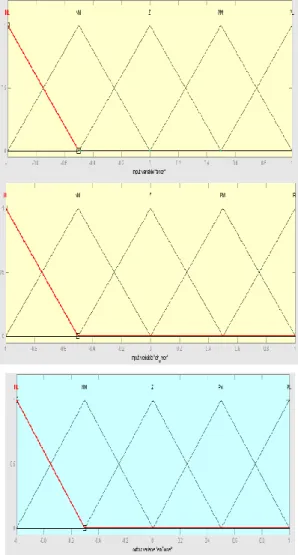
31 In this paper the fuzzy controller uses both the speed error (e) and its rate of change (ce) as inputs, and the change in electromagnetic torque (∆Te) as output. In motor control system, the function of fuzzy controller is to convert linguistic control rules into control strategy based on heuristic information or expert knowledge.
Figure 3. shows the fuzzy sets and corresponding triangular MF description of each signal, the membership function of the associated input and output linguistic variables is generally predefined on a common universe of discourse : NL (Negative Large), NM (Negative Medium), Z (Zero), PM (Positive Medium), PL (Positive Large)[11].
Figure 3: Triangular membership functions for fuzzy controller input (e and ce) and output (∆Te)
The rules are drived by help of fuzzy inference systems in the Matlab/Fuzzy Logic Toolbox as in Figure 4., then rules represented in rule Tables [11].
Figure 4: Constructor of rules
Figure 5: Surface viewer fuzzy rules Table 1: Fuzzy rules Table of FC e ce NL NM Z PM PL NL NL NL NM NM Z NM NL NM NM Z PM Z NM NM Z PM PM PM NM Z PM PM PL PL Z PM PM PL PL
32
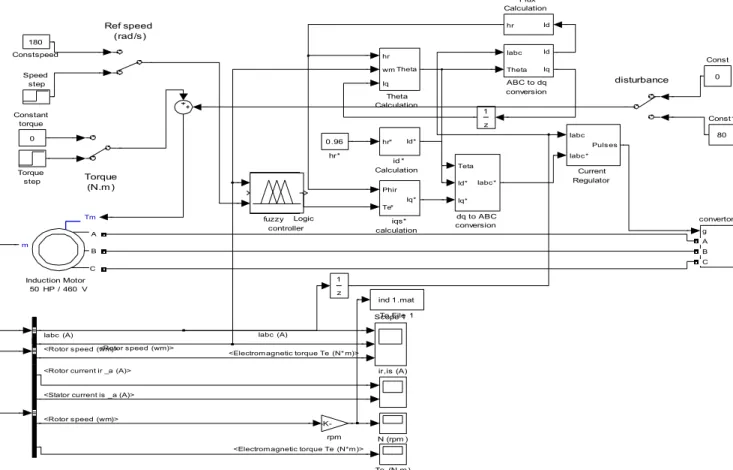
Figure 6: Indirect Field Oriented Control of Induction Motor Drive Using PD Fuzzy Controller in Matlab/Simulink
Figure 7: Scalar Control of Induction Motor Drive in Matlab/Simulnk rpm -K-ir,is (A) iqs* calculation Phir Te* Iq* id * Calculation hr* Id* hr* 0.96 fuzzy controller w w* Te* dq to ABC conversion Teta Id* Iq* Iabc * disturbance convertor g A B C z 1 z 1 Torque step Torque (N.m ) To File 1 ind 1.mat Theta Calculation hr wm Iq Theta Te (N.m ) Speed step Scope 1 Ref speed (rad/s) N (rpm ) Induction Motor 50 HP / 460 V Tm m A B C Flux Calculation Id hr Current Regulator Iabc Iabc * Pulses Constspeed 180 Constant torque 0 Const1 80 Const 0 ABC to dq conversion Iabc Theta Id Iq Logic
<Rotor speed (wm)><Rotor speed (wm)>
Iabc (A) Iabc (A)
<Electromagnetic torque Te (N* m)>
<Electromagnetic torque Te (N*m)> <Rotor current ir _a (A)>
<Stator current is _a (A)>
<Rotor speed (wm)> wm* Step (p.u.) vab (V) vab v + -rpm -K-pu 2radpersec -K-powergui Continuous peak 2rms -K-ir,is (A) disturbance Vbc s -+ Vab s -+ sin Torque step To File 1 scal1.mat Te (N.m) RelayC RelayB RelayA RMS 3 RMS RMS 2 RMS RMS Vab voltage N (rpm ) Math Function rem Look -Up Table Induction Motor 50 HP / 460 V Tm m A B C Fourier signal magnitude angle Display 3 Display 2 Demux Demux Current Measurement 2 i + -Current Measurement i + -Constant 3 80 Constant 2 0 1/1980 2*pi /3*[ 0,-1,1 ] Clock <Electromagnetic torque Te (N* m)> <Rotor current ir _a (A)> <Stator current is _a (A)> <Rotor speed (wm)>
33
Figure 8. direct operation of Induction Motor Drive in Matlab/Simulink
DESIGN OF SYSTEM CONTROL SIMULINK
Figure 6 shows the Indirect Field Oriented Control of Induction Motor Drive Using PD Fuzzy Controller, and the same Figure represents Indirect Field Oriented Control of Induction Mo-tor Drive Using conventional PD Controller, when replace the fuzzy controller by conventional controller. Figures 7 and 8, show the Scalar Control of Induction Motor Drive and direct operation of Induction Motor Drive respectively.
SIMULATION RESULTS AND DISCUSSIONS
Many simulation tests were carried out on the four types of control, and their results were compared. Figure 9, and Table 2 show the speed response of induction motor on full load.
Figure 9: Speed response comparison at full load
Table 2 summarizes numerical values of rising time, peak overshoot, time to the peak and settling time.
Table 2 : Speed response comparison at full load Type of control Property Rising time (10%-90%) (sec) Settling time ±2(sec) Overshoot (%) Time to the peak (sec) Direct on line 1.020 2.20 4.272 1.65 Scalar control 0.985 2.2O 4.285 1.74 PD conv. IFOC 0.825 2.35 - 1.37 PD fuz. IFOC 0.820 1.90 - 1.10 Figure 10-12 and Table 3 show the speed response copmarison and stator current and rotor current changes with load disturbance.
Figure 10: Speed response comparison with load disturbance Table 3: the effect of disturbance
Type of control Property Drop in speed (eds%) Increase in stator current % Increase in rotor current % Direct on line 2.94 39.77 45.00 Scalar control 2.88 36.56 43.02 PD conv. control 1.43 35.63 38.27 PD fuzzy cont. 0.47 34.83 36.14 vab (V) vab v + -rpm -K-powergui Continuous peak2rms -K-ir,is (A) disturbance Torque step To File 1 direct 1.mat Three-Phase Source A B C Three-Phase Parallel RLC Load A B C Te (N.m) RMS Vab voltage N (rpm ) Induction Motor 50 HP / 460 V Tm m A B C Fourier signal magnitude angle Constant 1 80 Const 0 <Electromagnetic torque Te (N*m)> <Rotor current ir _a (A)> <Stator current is _a (A)> <Rotor speed (wm)> 0 1 2 3 4 5 0 500 1000 1500 2000 Time(sec) S pe ed (r pm ) compatision Fuzzy Conv. Scal. Direc. Ref. 2 2.5 3 3.5 4 4.5 5 1500 1600 1700 1800 Time(sec) Speed(rpm ) disturbance Fuzzy Conv. Scal. Direc. Ref.
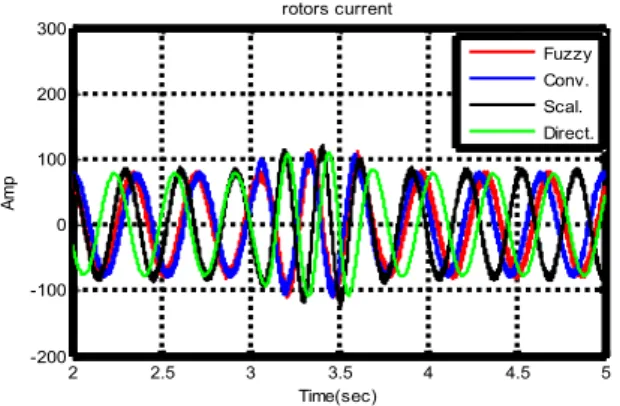
34 Figure 11 and Figure 12 show the changes in stator current(Amp) and rotor current with load disturbance.
Figure 11: Change in rotor currents at disturbance FLC performed better with respect to rise time, setting time, overshoot and time to peak compared to conventional, scalar, and direct operation as shown in Figure 9. On the same way, the load disturbance response shown in Figure 10 demonstrates that the FLC produces a better response than the other three systems. Table 2 summarizes the numerical values of rising time, settling time, overshoot and time to peak, the overshoot is the same in FLC and conventional control system, but better than scalar and direct operation systems. FLC shows a shorter rise time, settling time and time to peak. It is found that the FLC is more robust and did not show significant changes in its response due to load disturbance as shown on Table 3.
Figure 12: Change in stator currents at disturbance.
CONCLUSION
Indirect Field Oriented Controlled induction motor system has been introduced. The drive system was simulated using fuzzy logic controller, and its performance are compared with conventional PD, scalar, and direct operation. Simulation results
showed that the performance of FLC is better than that for other types of controllers. beside that, simulation results showed that the fuzzy logic controller is more robust during load disturbances.
Appendix : Motor specification
Motor type, 3-phase Induction Motor, : Rotor type, Squirrel Cage, 50 hp, 1720 rpm, 460V, 60HZ, 4poles, Rs = 0.087Ω
Rr = 0.228Ω Ls = 0.8mH Lr = 0.8mH Lm = 34.7mH, Jn = 1.66Kg.m2 f = 0.1N.m.s
REFERENCES
[1]B. Karanayil, M. F. Rahman and C. Grantham, (2001), “ A complete Dynamic Model for a PWM VSI fed rotor flux oriented vector controlled Induction Motor Drives using Simulink” Universry of New South Wales, Sydney, NSW.
[2]R.Toufouti, S.Meziane, H. Benalla, (2007), “Direct Torque Control For Induction Motor using Intelligent Techniques”, Laporatory Of Electrical Engineering University ConstantineAlgeria, Jatit. [3]Ali M. Eltamaly, A. I. Alolah, and Basem M. Badr, (2010) “Fuzzy Controller for Three Phases Induction Motor Drives” International Conference on Autonomous and Intelligent Systems (AIS), PP. 1 – 6. [4]Bose, B. K., (2001), ”Modern Power Electronics and AC Drives”,Prentice-Hall, Englewood Cliffs, N.J. [5]Martino O Ajangnay, Amir H. O. Ahmed, M. Matthew, (2010), “Methods of Computation of Optimal PID Controller Para- meters for Vector Control of Induction Motors” IEEE International Symposium on Power Electronics Electrical Drives Automation and Motion (SPEEDAM).
[6]P. Pillary, and V. Levin, (1995), “Mathematical Models For Induction Machines”, IEEE Industry Applications Conference, Thirtieth IAS Annual Meeting.
[7]Paul C.Krause, Oleg Wasynczuk and Scott D. Sudhoff, (2002), Analysis of Electrical Manhinery and Drive System, Wiley InterScience.
[8]Popescu M., (2000), “Induction Motor Modelling for Vector Control Purposes”, Helsinki University of Technology, Laboratory of Electromechanics, Report, Espoo, 144 p.
[9]Kevin M. Passino, Stephen Yurkovich ,Fuzzy Control, Addison Wesley Longman,Inc., 1998 [10]Mouloud Azzedine Denai, Sid Ahmed Attia, (2002), Fuzzy and Neural Control Of an Induction Motor, Int. J. Appl. Math. Comput. Sci., Vol. 12, No.2, 221–233. [11]Web, (2014), http://www.mathwork.com Accessed on: 17–02–2014, 20:33:17. 2 2.5 3 3.5 4 4.5 5 -200 -100 0 100 200 300 Time(sec) A m p rotors current Fuzzy Conv. Scal. Direct. 3 3.5 4 4.5 -200 -150 -100 -50 0 50 100 150 200 250 Time(sec) Am p stators current Fuzzy conv. Scal. Direc.