Orientations to studying in engineering education and their
relations to study engagement and well-being
H. Heiskanen1 Researcher
University of Helsinki, Faculty of Behavioural Sciences Helsinki, Finland
[email protected] K. Lonka
Professor, Vice Dean
University of Helsinki, Faculty of Behavioural Sciences Helsinki, Finland
[email protected] K. Keltikangas
Researcher
Aalto University School of Electrical Engineering Espoo, Finland
[email protected] J. Korhonen
Researcher
Aalto University School of Science Espoo, Finland
[email protected] H. Kettunen
Researcher
Aalto University School of Electrical Engineering Espoo, Finland
Conference Topic: Engineering Education Research
Keywords: Electrical engineering, study engagement, epistemological beliefs, motivational strategies
1 Corresponding Author
INTRODUCTION
When students enter the lecture halls and laboratories, they entertain various kinds of conceptions in their minds. For instance, they may differ in terms of how they think about learning and knowledge. We investigated what kind of student groups can be identified on the basis of electrical engineering students’ motivational strategies and conceptions of learning and knowledge (epistemologies). These variables, when clustered into orientations, have been shown to relate to students’ well-being and study success [1,18]. Their relation to study engagement is less clear. Our first research question studies, what kinds of orientations could be identified in electrical engineering students by using cluster analysis. Further, it was of interest, whether such clusters of students would differ in terms of study engagement and well-being.
1 THE EXPERIENCE OF UNDERGRADUATE STUDYING 1.1 The state and challenges of electrical engineering education
The context of this study is electrical engineering. The participants were Bachelor level students at Aalto University of Electrical Engineering (Aalto ELEC). Education of engineering students in Finland doesn’t drastically differ from the majority of foreign universities. At Aalto ELEC, all the students in the Degree Programme of Electronics and Electrical Engineering take the mandatory basic courses in e.g. circuit theory, electromagnetics, electronics, programming and signal processing. In addition, their studies include extensive basic courses in mathematics and physics. The teaching is based, rather traditionally, on mass lectures and separate small-group tutorials. Some of the courses also have computer and laboratory exercises.
Electrical engineers are supposed to be proficient problem-solvers. Therefore, engineering students need to learn to routinely master the required mathematical procedures but, on the other hand, they also have to develop a profound understanding of the underlying physical concepts. It is thus no surprise that many students consider the beginning of their studies demanding. It is seen that the success in the very first introductory courses is a predictor of success in the forthcoming studies [2]. Such courses are even viewed as ‘gatekeepers’, whose intention is to, rather heartlessly, eliminate all but the best students who are believed to have to required skills to eventually graduate. However, it has recently been realized that, instead elimination, the students should be made more engaged to their studies [3].
The same student engagement process is going on at Aalto ELEC as well. A lot of effort is put in the development of teaching. However, Electrical Engineering students’ epistemological beliefs, motivational strategies, engagement or well-being have been studied very little so far. An internal report [4] of former TKK shows that a lot of students show only surface-approached orientation to studying. Also, the study times of Bachelor level students in general have notably delayed. Leppävirta [5] has studied the correlation between students’ procedural and conceptual knowledge on an electromagnetics course. Furthermore, she found that some students are even suffering from anxiety towards mathematics, which appears detrimental to their study success. Another dissertation [6] studies why students are dropping out from an introductory programming course.
1.2 Students’ epistemological beliefs
Students differ in terms of how they think about learning and knowledge (epistemologies). These epistemological beliefs are shown to be essential in relation to students learning outcomes and academic achievements [7,8]. In the beginning of studies, students often hold
epistemological beliefs that strongly contrast theory and practice. Novice students would like to have clear facts and certain answers, whereas more advanced students hold more relativist conceptions, where knowledge is created and evaluated in a specific context [9,10]. This has found to be true also among vocational engineering students [11], who appreciated practical knowledge and emphasized “all-knowing authorities”. This can lead to accepting and acquiring the knowledge per se, without reflection or any independent evaluation [11]. This can be problematic, because lack of opportunities to reflect the learning material and developing solid understanding can lead to experience of falling out of phase with ones’ studies [12].
Originally, it was assumed that epistemological beliefs are domain independent [10]. However, shift towards more domain dependent view has been verified in recent research. Dualism has been found to be higher among medical students than in psychology students, which indicates that epistemologies are in fact domain specific [9]. This finding supports theoretical view that students on natural sciences, dealing with well-defined problems, tend to hold somewhat more dualistic views of knowledge [9]. Likewise, students seem to choose fields that correspond to their existing epistemological beliefs [13]. Some studies reported that in sciences, believing the certainty of knowledge can become stronger in the beginning of studies, as students study topics on which there exists a wide scientific agreement. This effect may be reversed as students become familiar with issues on which there does not exist strong consensus [14].
1.3 Optimism or task avoidance?
Engineering students face many challenges in their studies. For example they have to internalize large amount of knowledge in short period of time and know how to organize their study practices. Students apply different kind of motivational strategies to face these challenges and to achieve their goals [15]. In this study we are interested on two motivational strategies: optimism and task-avoidance [16]. Optimistic students apply active, task focused strategies to meet their goals, and attribute their successes positively. Optimistic strategy has been shown to relate to academic achievement, satisfaction [16,17] and good self-regulation [18].
On the contrary, task-avoidant students deliberately seek to avoid challenging situations rather than make an active effort to deal with them [16]. In engineering studies anxiety towards mathematics has been found to be common [5]. Task-avoidance is related to this kind of anxiety-provoking situations and in general to situations where students are faced by the prospect of failure [16]. Task-avoidance has been shown to relate to low academic achievement, dissatisfaction [16, 17] and low self-regulation [18].
1.4 Study engagement and well-being
In engineering and STEM education in general, engaging students and fostering their involvement is a topical challenge [3]. One obvious factor is the role of mass lectures as a teaching method [19]. There is a clear need for development of engineering education by shifting the teaching towards more student-centred methods [20].
There are strong reasons why students’ involvement and engagement should be fostered in educational context. Study engagement has been shown to enhance study success and satisfaction [21,22]. In this study we use definition which defines study engagement as a positive, fulfilling, and work-related state of mind, and is characterized by vigour, dedication, and absorption [22]. Rather than a momentary and specific state engagement refers to more persistent and pervasive affective-cognitive state, which it is not focused on any specific object, event or behaviour [22]. Study engagement can be seen as one indicator of student well-being. However, student well-being is much wider concept. In this study we
conceptualize well-being as ‘something positive’ rather than merely the absence of mental illness. From this perspective, well-being is divided in to three dimensions: emotional, social and psychological well-being [23].
1.5 What forms a favourable study orientation in relation to study engagement and well-being?
There is relatively little prior knowledge about how university students’ motivational strategies, epistemologies, study engagement and well-being are related to each other. However, it has been shown that motivational strategies and epistemological beliefs foster well-being and study success [1,18]. Deep understanding, critical evaluation of knowledge, self-regulation and optimism, have been found to form a favourable cognitive-motivational predisposition. In turn, maladaptive position seems to combine superficial learning, problems of regulation and task avoidance [1,18]. Lonka et al. [1] called this kind of position as dysfunctional orientation. In their study this orientation was a combination of various problematic symptoms and attitudes, such as exhaustion, anxiety and stress [1]. These emotional problems were related to problems in regulating one’s own learning and avoiding tasks as well as not being very optimistic. The present study explores the orientations of electrical engineering students and how these orientations are related to study engagement and well-being.
2 METHOD 2.1 Participants
The context was electrical engineering, and the participants were Bachelor students (n = 224) at Aalto University School of Electrical Engineering (ELEC). They were from five different courses in the Degree Programme of Electronics and Electrical Engineering. Most students (93 %) were between 19 and 26 years old (M = 22). They were all novice students, mainly first – third year students. Men (90 %) were over-represented in this study compared to women (10 %). However, the majority of the engineering students at ELEC are in general men. The data were collected in the spring semester 2012, when participants filled in a questionnaire in the beginning of the first lecture of each course.
2.2 Materials
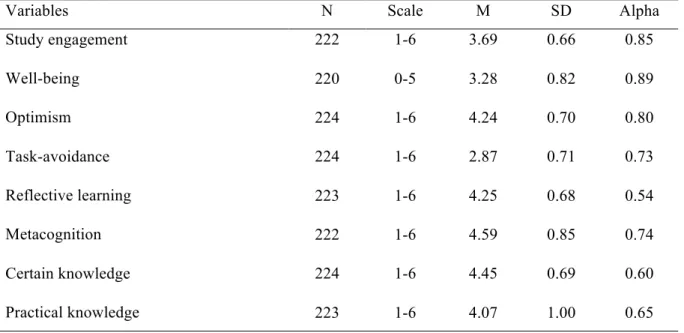
The self-report questionnaire consisted of Likert-type questions to assess students’ epistemologies, motivational strategies, study engagement, and well-being. Table 1 shows number of cases, scales, means, standard deviations and alphas. Students’ epistemologies were measured by the MED NORD questionnaire [1]. MED NORD identifies seven epistemology dimensions, of which this study included four: reflective thinking, metacognition, certain knowledge and practical knowledge. Students’ motivational strategies were measured by Strategy and Attribution Questionnaire (SAQ) [24]. SAQ comprises nine items that forms the scales Optimism and Task avoidance. Study engagement was measured by OpInto-scale [21] which is based on the student version of the Utrecht work engagement scale (UWES-S) developed originally by Schaufeli et al. [22]. Scale consists of nine items measuring three dimensions of study engagement. In this study, a sum score was calculated from all nine items to indicate the level of study engagement. Well-being was measured by MHC-SF (Mental Health Continuum – Short Form) [23]. Scale consists of 14 items measuring three dimensions of well-being: emotional, psychological and social. In this study, a sum score was calculated from all 14 items to indicate the level of general well-being.
Table 1. Number of cases, scales, means, standard deviations and alphas
Variables N Scale M SD Alpha
Study engagement 222 1-6 3.69 0.66 0.85 Well-being 220 0-5 3.28 0.82 0.89 Optimism 224 1-6 4.24 0.70 0.80 Task-avoidance 224 1-6 2.87 0.71 0.73 Reflective learning 223 1-6 4.25 0.68 0.54 Metacognition 222 1-6 4.59 0.85 0.74 Certain knowledge 224 1-6 4.45 0.69 0.60 Practical knowledge 223 1-6 4.07 1.00 0.65 2.3 Statistical analysis
The statistical analysis began with a descriptive analysis. Bivariate correlations were computed to examine the relations between students’ epistemologies, motivational strategies, study engagement and well-being. Correlational method was found to be useful for looking at relationships among the scales. This variable-oriented approach did not, however, reveal what kind of groups of individuals existed in the study population. Therefore, we wanted to apply person–oriented approach in order to examine what kinds of subgroups of students can be found. A hierarchical cluster analysis was carried out in order to determine the number of clusters. Ward’s method was used to form the initial clusters without restricting their number. On the basis of the dendrogram, a three-cluster solution was selected. After deciding the number of clusters, a Quick Cluster Analysis using a K-means algorithm was used to form the final groups. Finally, two ANOVAs were conducted to examine between-group differences across the criterion variables study engagement and well-being.
3 RESULTS
First bivariate correlations were calculated to explore the relations between students’ epistemologies, motivational strategies, study engagement, and well-being. Study engagement and well-being correlated significantly (r = .386, p <.01). Optimism was positively related to both study engagement (r =.409, p <.01) and well-being (r =.359, p <.01). In turn, task-avoidance was found to correlate negatively with both study engagement (r = -.372, p <.01) and well-being (r = -.285 p <.01). Reflective learning (r =.210, p <.01) and metacognition (r =.205, p <.01) correlated positively with study engagement.
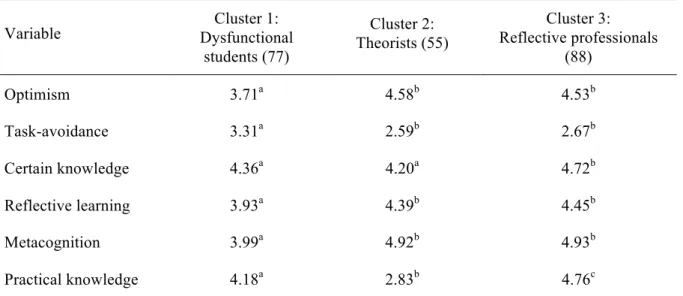
In order to reveal subgroups of students, we used a cluster analysis by cases to classify the participants according to their responses to questions on epistemologies and motivational strategies. The results from ANOVA test on clustering variables show the extent to which each variable differentiated the groups. We identified three clusters of students (Table 2.), labelled as “dysfunctional students”, “theorists” and “reflective professionals”. “Dysfunctional students” (35 %) were the least optimistic and most task-avoidant. They appreciated certain and practical knowledge and were not interested in reflection. “Theorists”
(25 %) scored high on optimism, low on task-avoidance and they emphasized the value of reflection. Compared to other groups they valued practical knowledge the least. “Reflective professionals” (40 %) were optimistic, appreciated certain and practical knowledge but were also interested in reflection.
Finally, we examined whether there were differences between the groups in study engagement and well-being. The main effect was significant for both study engagement (F(2, 217) = 23.45, p < .001) and well-being (F(2, 214) = 15.26, p < .001). Pairwise comparison with Bonferroni’s correction revealed that “dysfunctional students” expressed lower level of study engagement and well-being than the other groups (Table 3.).
Table 2. Student groups
Variable Dysfunctional Cluster 1: students (77) Cluster 2: Theorists (55) Cluster 3: Reflective professionals (88) Optimism 3.71a 4.58b 4.53b Task-avoidance 3.31a 2.59b 2.67b Certain knowledge 4.36a 4.20a 4.72b Reflective learning 3.93a 4.39b 4.45b Metacognition 3.99a 4.92b 4.93b Practical knowledge 4.18a 2.83b 4.76c
Means with different superscripts (a,b,c) differ significantly (p < .05).
Table 3. Group differences in study engagement and well-being
Variable Cluster 1: Dysfunctional students Cluster 2: Theorists Cluster 3: Reflective professionals Study engagement 3.32a 3.94b 3.88b Well-being 2.90a 3.39b 3.55b
Means with different superscripts differ significantly (p < .05). 4 DISCUSSION
In line with previous research, we also found that many novice students had troubles in their learning: they expressed task avoidance and novice-like epistemological beliefs. This study identified three student groups by their epistemologies and motivational strategies: dysfunctional students, theorists and reflective professionals. Theorists and reflective professionals were more optimistic and less task avoidant than dysfunctional students. They also appreciated reflective learning and metacognition more than dysfunctional students. Theorists didn’t appreciate practical knowledge and vice versa reflective professionals scored it high. Reflective professionals resemble those advanced medical students who wanted to have applicable knowledge, but also had sophisticated epistemological beliefs [9]. Theorists and reflective professionals scored higher on study engagement and well-being than dysfunctional students.
The term “dysfunctional” may be questioned, but the low scores of this group in terms of well-being and study engagement indicates that the students in this group were doing less well than the two others. Previous research on medical education indicates that task avoidance and low optimism are related to stress, anxiety and problems in self-regulation [1].
Our further inquiries shall reveal, whether different student groups vary in terms of learning outcomes in the context of electrical engineering. Likewise, our aim is to study how different student groups experience their learning environment. They may react differently in new educational innovations in engineering. We are going to follow these students and it will be interesting to see, whether their epistemological beliefs and motivational strategies shall change during studying. Maybe the so called dysfunctional students shall increasingly acquire self-regulatory skills and become less dualistic in the future. It is possible that they are just beginning to adapt and developing ways of learning.
REFERENCES
[1] Lonka, K., Sharafi, P., Karlgren, K., Masiello, I., Nieminen, J., Birgegård, G. and Josephson, A. (2008), MED NORD – A tool for measuring medical students’ well-being and study orientations, Medical Teacher, Vol. 30, pp. 72–79.
[2] Honkanen, S. (2011), Modelling of study paths leading to graduation of engineering students— based on study success in secondary school and early phases of studies (in Finnish), PhD Thesis, University of Oulu. herkules.oulu.fi/isbn9789514293320/isbn9789514293320.pdf
[3] Gasiewski, J. A., Eagan, M. K., Garcia, G. A., Hurtado, S. and Chang, M. J. (2012), Gatekeeping to Engagement: A Multicontextual Mixed Method Study of Student Academic Engagement in Introductory STEM Courses, Research in Higher Education, Vol. 53, pp. 229– 261.
[4] Erkkilä, M. (2010), Teknillisen korkeakoulun kandidaattivaiheen opiskelijoiden opintojen eteneminen lukuvuosina 2005–2009 (in Finnish), TKK Opetuksen ja opiskelun tuki.
http://opetuki2.tkk.fi/p/opintojenseuranta/documents/TKK-opintojen-eteneminen-2005-2009-FINAL.pdf
[5] Leppävirta, J. (2011), Engineering Students’ Proficiency in Electromagnetics. PhD Thesis. Aalto University School of Electrical Engineering.
http://lib.tkk.fi/Diss/2011/isbn9789526041919/isbn9789526041919.pdf
[6] Kinnunen, P. (2009), Challenges of Teaching and Studying Programming at a University of Technology – Viewpoints of Students, Teachers and the University, PhD Thesis, Helsinki University of Technology. lib.tkk.fi/Diss/2009/isbn9789522481955/isbn9789522481955.pdf
[7] Hofer, B. K. (2000), Dimensionality and disciplinary differences in personal epistemology.
Contemporary Educational Psychology, Vol. 25, pp. 378–405.
[8] Schommer, M. (1993), Epistemological development and academic performance among secondary students. Journal of Educational Psychology, Vol. 85, pp. 406–411.
[9] Lonka, K. and Lindblom-Ylänne, S. (1996), Epistemologies, conceptions of learning, and study practices in medicine and psychology, Higher Education, Vol. 31, pp. 5–24.
[10] Perry, W.G. (1970), Forms of Intellectual and Ethical Development in the College Years: A Scheme, New York, Holt: Rinehart & Winston.
[11] Zinn, B. (2011), A pilot study of the epistemological beliefs of students in industrial-technical fields. International Journal of Technology and Design Education, pp. 1–15.
http://dx.doi.org/10.1007/s10798-011-9153-9
[12] Scheja, M. (2006), Delayed understanding and staying in phase: Students’ perceptions of their study situation, Higher Education, Vol. 52, pp. 421–445
[13] Trautwein, U. and Ludtke, O. (2007), Epistemological beliefs, school achievement, and college major: A large-scale longitudinal study on the impact of certainty beliefs, Contemporary Educational Psychology, Vol. 32, No. 3, pp.348-366.
[14] Jehng, J., Johanson, S.D. and Anderson, R.C. (1993), Schooling and students’ epistemological beliefs about learning, Contemporary Educational Psychology, Vol. 18, pp. 23-35.
[15] Cantor, N. (1990), From thought to behavior: having and doing in the study of personality and cognition, American Psychologist, Vol. 45, pp. 735–750.
[16] Nurmi, J.-E., Aunola, K., Salmela-Aro, K. and Lindroos, M. (2003), The role of success expectation and task-avoidance in academic performance and satisfaction: three studies on antecedents, consequences and correlates, Contemporary Educational Psychology, Vol. 28, pp. 59–91.
[17] Eronen, S., Nurmi, J-E. and Salmela-Aro, K. (1998), Optimistic, defensive-pessimistic, impulsive and self-handicapping strategies in university environments, Learning and Instruction, Vol. 8, pp. 159–177.
[18] Heikkilä, A. and Lonka, K. (2006), Studying in higher education: students’ approaches to learning, self-regulation, and cognitive strategies, Studies in Higher Education, Vol. 31, pp. 99– 117.
[19] Lonka, K. and Ketonen, E. (2012), How to Make a Lecture Course an Engaging Learning Experience?, Studies for the Learning Society (in press).
[20] Felder, R. M., Woods, D. R., Stice, J. E. and Rugarcia. A. (2000), The Future of Engineering Education II. Teaching Methods that Work, Chemical Engineering Education, Vol. 34, pp. 26– 39.
[21] Salmela-Aro, K., Kiuru, N., Leskinen, E. and Nurmi, J.-E. (2009), School Burnout Inventory (SBI) – Reliability and Validity, European Journal of Psychological Assessment, Vol. 25, pp. 48–57.
[22] Schaufeli, W. B., Martinez, I., Pinto, A. M., Salanova, M. and Bakker, A. (2002), Burnout and engagement in university students: A cross-national study. Journal of Cross-Cultural Psychology, Vol. 33, pp. 464–481.
[23] Keyes, C., Wissing, M., Potgieter, J., Temane, M., Kruger, A. and van Rooy, S. (2008), Evaluation of the Mental Health Continuum–Short Form (MHC-SF) in Setswana-Speaking South Africans, Clinical Psychology and Psychotherapy, Vol. 15, pp. 181–192.
[24] Nurmi, J-E., Salmela-Aro, K. and Haavisto, T. (1995), The strategy and attribution questionnaire: psychometric properties, European Journal of Psychological Assessment, Vol. 11, pp. 108–121.