1
Introduction
In November 2012, the Healthcare Inspectorate of the Netherlands closed down the cardiology department of a general hospital. The high mortality rate of the cardiology department in particular led to this decision. The mortality rate for 2010 was calculated at the end of 2011 and turned out to be the highest of all Dutch hospitals. It indicated that the hospital had more deaths than could be expected based on its patient population. In response, the hospital started an independent investigation into possible explanations by means of record review. An interim report became available in June 2012 and highlighted severe shortcomings in the organization of the hospital. Despite these shortcomings, no improvement measures were undertaken in reaction to the interim report. The final report was completed in October 2012. Serious and persistent shortcomings were noted in the cardiology department, especially in the diagnosis and treatment of patients, resulting in a multitude of avoidable incidents. Furthermore, researchers found carelessness in the prognoses of disease progression and procedures at end-of-life decisions. When the Healthcare Inspectorate received the final report, it immediately closed down the cardiology department. Several days later, all four cardiologists were suspended and prohibited from working in the hospital until further notice. More in-depth investigations into the problems at the hospital revealed that: (1) there were long-lasting conflicts between the Hospital Board and Medical Staff Association, up to the point that both parties were unwilling to communicate with each other for months; (2) there was a high turnover of members of the Hospital Board, Board of Trustees and Medical Staff Association; (3) a greater emphasis was placed on financial challenges than on quality and safety issues; (4) there was poor collaboration between the different medical disciplines and the culture encouraging healthcare professionals to speak out was inadequate.1,2
The case described above is an example of a hospital that ‘on paper’ had quality and safety under control. The hospital had met all requirements set by law, inspection and accreditation bodies. The Dutch hospital accreditation body NIAZ granted the hospital accreditation in 2008.3
Nonetheless the hospital experienced a dramatic system failure leading to potentially avoidable deaths of patients. Unfortunately, similar examples surface every now and then in hospitals in the Netherlands, but also in other countries. Although the aforementioned Dutch hospital in fact had implemented a quality system and received accreditation status, which is generally seen as a guarantee for quality and safety, incidents happened nonetheless. The question arises of whether something structural was underlying these incidents and how it can be explained.
This research is set out to gain thorough insights into the working mechanisms underlying the structure-process-outcome relationships of quality improvement within hospital quality systems. These insights can lead to a better understanding of the conditions under which a quality system can result in higher quality of care. Furthermore, this research aims to gain insights into the determinants of effective quality systems and the long-term added value of quality systems for hospitals. The main research questions of this thesis are:
(1)Does having a hospital quality system lead to higher quality of care?
(2)What are the working mechanisms of hospital quality systems that lead to higher quality of care?
Quality of care
The Institute of Medicine (IOM) has defined quality of healthcare as: ‘The
degree to which health services for individuals and populations increase the likelihood of desired health outcomes and are consistent with current professional knowledge’.4 In addition, the WHO describes quality of healthcare as follows:
‘quality of care means that a health system should seek to make improvements in six areas or dimensions of quality’.5 These quality dimensions are (1) effective care,
(2) efficient care, (3) accessible care, (4) acceptable care, (5) equitable care, (6) safe
care.5 Effective care means that healthcare should be delivered in a way that
is evidence-based that it improves health outcomes for individuals and communities and that this care is based on need. Efficient healthcare means that care is delivered in a way that maximizes efficient use of resources (avoidance of waste). Accessible healthcare means that the delivery of care should be on time, geographically reasonable, and provided in a setting where skills and resources are appropriate to medical needs. Acceptable healthcare means that the design and delivery of healthcare should respond to and meet the needs, preferences and aspirations of individual service users and the cultures of their communities, encompassing the concept of patient involvement and promoting a culture of kindness, consideration and respect for those using the service. Equitable healthcare implies delivering healthcare that does not vary in quality because of personal characteristics of patients such as gender, race, ethnicity, geographical location, or socioeconomic status. And lastly, safe healthcare refers to delivery of healthcare that minimizes risks and harm to service users.5
Quality systems in healthcare
The implementation of quality systems in healthcare organizations is a strategy for quality assurance and quality improvement. The underlying assumption is that a quality system will improve the performance of an organization by facilitating and improving the processes within the organization. There are many different definitions for quality systems. Some are more general, such as the definition from ISO : “A quality system is defined
as the organizational structure, responsibilities, procedures, processes and resources needed to assure and improve the quality of care”.6 Others are more specifically
applicable to the healthcare setting. In this thesis, we have adopted one such more specific definition of healthcare from the European research project ‘Deepening our understanding of quality improvement in Europe (DUQuE)’7:“A quality system is a set of interacting activities, methods and
procedures used to direct, control and improve the quality of care”.7 There are
various types of quality systems, each with their own interpretation, but one feature that quality systems have in common is that they almost always cover the following five domains in some form: policy and strategy, personnel, protocols and procedures, cyclical quality activity, and clients (i.e. patients, in the case of a hospital).8 The key aspects of a quality system
are therefore: (1) addressing the responsibilities of stakeholders; (2) procedures for process management; (3) human resource management; (4) continuous education, training and development of professionals targeted at both technical and non-technical skills; (5) leadership commitment; (6) analysis and monitoring of performance and continuous improvement and patients involvement.8
The effectiveness of quality systems in healthcare
Various studies have examined the relationship between quality systems or derivatives (such as hospital-level accreditation) and outcomes in terms of quality of care. See also Chapter 4 of this thesis. Shaw et al. studied the effectiveness of different forms of external quality assessment of hospitals and found that accredited hospitals performed better on patient safety outcomes.9,10 Weiner et al. linked quality improvement with a set of patient
safety indicators at the organizational level and found that higher percentages of physicians participating in quality improvement teams led to fewer postoperative complications and lower rates of technical difficulties with procedures.11,12 Kunkel et al. found higher scores for structure and
outcomes when the implementation of a quality system was initiated by managers and when staff provided input to the quality system design.
Subsequently, this was found to result in more advanced quality systems.13,14
Groene et al. found that better-developed quality systems were associated with lower rates of hospital complications and to some extent with fewer hospital readmissions in Spanish hospitals.15 However, the same study
found no association between the maturity of the quality system and hospital mortality and length of admission.15 The European research project
DUQuE assessed the association between quality management and patient outcomes in a wider setting: the European Union.7,16 Results from this
project showed some associations between quality management measures at the hospital level and quality measures at the department level.17 However,
these associations were weak and the variability between countries was high.17 Despite these examples from the literature, research into the
relationship between quality systems and measures of quality and safety is limited and often restricted by small sample sizes and lack of availability of sufficient outcome measures.12,14 Although implementing quality systems in
healthcare aims to improve the quality of care and patient safety by improving the processes, no clear evidence can be found in the literature that this is actually the case. Furthermore, little is known about the mechanisms through which a quality system can lead to high quality of care.
Social context of the Dutch healthcare system
This thesis is based on research that was carried out in the Dutch hospital sector. In 2012, the hospital sector in the Netherlands consisted of 8 academic medical centres, 75 general hospitals and 23 teaching hospitals. Academic medical centres conduct scientific research and education for medical faculties and develop new medical technologies. General hospitals concentrate on treatment, nursing and the education of doctors and nurses. In the Netherlands, teaching hospitals provide specialized medical care and are committed to training and education. The level of care is generally complex and lies between that of general hospitals and academic centres. The number of hospitals has decreased over the years due to mergers. In 2012, 132,000 full time equivalents and 188,000 people worked at general hospitals. The number of medical specialists is 20,863.18 In the Netherlands,
most medical specialists are self-employed and work in just one hospital. These self-employed medical specialists work together with other medical specialists of the same specialty in so-called partnerships.
Various Dutch policies and national quality improvement activities that were aimed at improving the quality of healthcare shaped the way quality
and safety are embedded to date in healthcare organizations in the Netherlands. The three most important ones are:
1996: Quality Act
The Care Institutions Quality Act came into effect in the Netherlands in 1996. This act requires all care institutions to monitor, control and improve their own quality. The act imposes four requirements on care institutions: they must be responsible in their provision of care, their policy must be oriented towards quality, they must implement a quality system and must draw up an annual quality report. In response to these requirements, care institutions started setting up and implementing quality systems. These quality systems focused on monitoring care processes and preventing unintentional harm as the result of medical actions by putting the right preconditions in place for improving the quality of care.8,19-21
2003- 2005: Sneller Beter (Better Faster)
The national action programme Sneller Beter (Better Faster) was launched on 20 November 2003 as an initiative by the Ministry of Public Health, the Order of Medical Specialists, NVZ (Dutch Hospitals’ Association) and V&VN (Dutch Nurses’ Association). The programme was initiated since the improvement of quality in healthcare institutions was seen as unsatisfactory. The aim of Sneller Beter was to use three pillars to further encourage improvements in transparency, efficiency and quality: (1) creating quality awareness; (2) developing a national set of indicators for safer and better care, and (3) setting up a Quality, Innovation and Efficiency programme. A total of 24 hospitals took part in this third pillar of Sneller Beter. They were split up into three groups of 8 hospitals. Each group received support in implementing the programme for two years from a consortium.22-25
2008- 2013: Dutch Hospital Patient Safety Programme (Safety Programme) The Safety Programme was set up in 2008 to reduce preventable unintentional adverse events in Dutch hospitals by 50% by the end of 2013. The Safety Programme consisted of a safety management system and ten evidence-based patient safety themes; clinical guidelines were developed for each theme. Hospitals were given five years to implement these guidelines. In the spring of 2013, the final report was issued on the evaluation of the Safety Programme. The report showed that hospitals had improved in some of the patient safety themes, however for most of the themes there was no visible improvement.26
The development of quality systems in Dutch hospitals
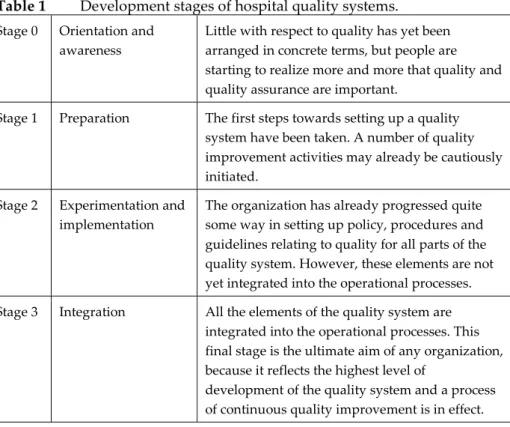
The literature distinguishes several development phases in the implementation of a hospital quality system. These phases are described in Table 1. The higher the development stage, the further the quality system is implemented.
Table 1 Development stages of hospital quality systems.
Stage 0 Orientation and awareness
Little with respect to quality has yet been arranged in concrete terms, but people are starting to realize more and more that quality and quality assurance are important.
Stage 1 Preparation The first steps towards setting up a quality system have been taken. A number of quality improvement activities may already be cautiously initiated.
Stage 2 Experimentation and implementation
The organization has already progressed quite some way in setting up policy, procedures and guidelines relating to quality for all parts of the quality system. However, these elements are not yet integrated into the operational processes. Stage 3 Integration All the elements of the quality system are
integrated into the operational processes. This final stage is the ultimate aim of any organization, because it reflects the highest level of
development of the quality system and a process of continuous quality improvement is in effect.
Adapted from: Wagner et al., 1999.8
Since the Care Institutions Quality Act came into effect in the Netherlands in 1996, hospitals have started to implement quality systems within their organizations. Several studies have shown that quality systems of Dutch hospitals became more developed over the years.19-22,27 However, the
implementation took quite some time and at the last measurement in 2007, 35 per cent of hospitals had reached the highest stage of development (‘Integration’).22 Attention to quality in the form of national quality
improvement programmes and national quality policy such as Sneller Beter and the Dutch Patient Safety Programme stimulate structural quality and safety activities in healthcare organizations. These activities contribute to the
implementation of quality systems in healthcare organizations by providing a solid and structural basis for quality improvement at the system level. It is therefore expected that hospitals will have continued their efforts from 2007 onwards to develop their quality systems further. This is expected to result in a higher percentage of hospitals that have reached the ‘Integration’ stage of development compared to the last measurement in 2007.
Chapter 2 describes the development (sometimes also referred to in the literature as the ‘maturity’) of quality systems in the Netherlands and the current state of implementation of hospital quality systems in Dutch hospital organizations. This chapter can be seen as defining the baseline to make it possible to answer the research questions in this thesis.
Theory and hypotheses
This section describes the main theory and hypotheses underlying this thesis. Five hypotheses were derived from the literature in order to answer the main research questions and the sub-questions of this thesis.
According to Donabedian’s model of quality improvement (see Figure 1), quality can be achieved by means of a structure-process-outcome relationship in which the quality system –the structure– is thought of as improving the organizational processes that in their turn should positively influence quality of care –the outcomes.28-30 The quality system is the
structure within which quality improvement policies and quality improvement activities can be embedded and this quality system is hypothesized to have an influence on quality improvement activities at the process level. The improved processes in their turn influence the outcomes of the organization.5,28-30
Figure 1 Donabedian's model of quality improvement
Based on Donabedian’s model, it can be assumed that the implementation of a quality system is positively related to outcomes of the organization. In organizations with a fully implemented quality system, the outcomes of the organization will be better than in organizations where the quality system is
less than optimally implemented. In a well-developed quality system the quality activities are integrated into the daily working processes throughout the healthcare organization. This leads to broad and systematic quality improvement. This is visible through a reduction of variation in results of the healthcare organization and improvement of these results over time.
Hypothesis 1: A higher degree of implementation of the hospital quality system leads to improved outcomes of the organization.
Furthermore, it can be assumed that this positive relationship between the quality system and outcomes of the organization results from a positive relationship between the implementation of the quality system and the improvement of organizational processes. In organizations with a fully implemented quality system, the processes will be better designed compared to organizations where the quality system is implemented to a lesser extent. In a developed quality system the quality activities are integrated into daily working processes throughout the healthcare organization. The policies and management of the healthcare organization ensure that this is done at the process level of organizations as well and this becomes visible in a reduction of variation in processes of the healthcare organization and improvement of these processes over time.
Hypothesis 2: A higher degree of implementation of the hospital quality system leads to improved processes in the organization.
In turn, these improved processes in the organization are thought to have a positive effect on the outcomes of the organization. Well-designed processes standardize working methods and the behaviour of healthcare professionals working according these methods and this leads to a reduction of the variation in outcomes of the organization.
Hypothesis 3: Improved processes of the organization lead to improved outcomes of the organization.
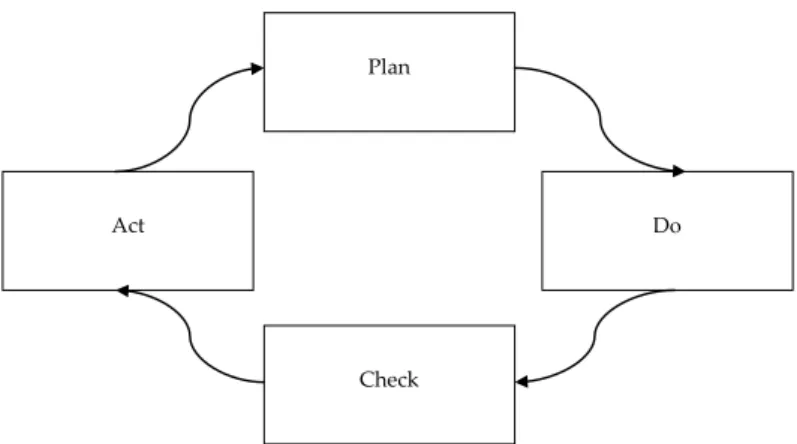
One important aspect of quality improvement is the continuous nature of the improvements, which can lead to improvement of results over time: hospitals use the results of their organization to learn from, and adjust the structure of their organization. According to Deming, all improvement activities should follow four steps (see Figure 2). First, an organization plans which organizational areas they would like to improve and how they want to improve these areas: ‘Plan’. Second, this plan is carried out in practice: ‘Do’.
Third, the results of the improvement effort are checked. It is important to evaluate whether the activities have led to the desired outcomes: ‘Check’. And last, this information is used to take action and adjust the original plan where necessary: ‘Act’. These four steps are necessary to achieve a cycle of continuous improvement in the outcomes of an organization.31,32
Figure 2 The Deming cycle of Plan-Do-Check-Act
In hospitals with more developed quality systems, it can be assumed that the four steps of the plan-do-check-act model are being followed in quality improvement efforts and a cycle of continuous quality improvement is visible in these organizations. In other words, the hospital is systematically using the results of the organization to adjust its quality policy and strategy at the system level. This creates a cycle of continuous improvement which becomes visible not only in an improvement of results but also in improvement of the system itself over time.
Hypothesis 4: In a more developed quality system, the outcomes of an organization feed back into the structure of the organization and this forms a cycle of continuous quality improvement.
Surrounding the structure-process-outcome relationship is another key aspect of a quality system: the people who have to work in this system and have to interact with the system. In hospitals, the main actors in the system are management (top management and middle management), healthcare professionals and patients. Patients have to interact with the quality system but are also part of the outcome of the system. The degree to which a quality
Plan
Do
Check Act
system can attain its desired effects (higher quality of care) is modified by the attitudes and behaviour of these actors. In this thesis, we focus mainly on healthcare professionals as actors affecting the quality system. In hospitals where the awareness of the importance of quality improvement is high amongst healthcare professionals, it is more likely that healthcare professionals act according to the standards and rules set by the quality system. Compliance with these standards and procedures is thought to be positively related to positive organizational outcomes at the process and patient levels. Non-compliance by healthcare professionals could hamper the degree to which the mechanism of a quality system can function optimally. One important precondition for a quality system is therefore awareness among healthcare professionals of the importance of quality of care (attitudes of healthcare professionals) and their compliance with standards and procedures aimed to improve the quality of care (behaviour of healthcare professionals). Awareness of the importance of quality and safety creates an environment where it becomes natural to act according to standards and procedures set by the quality system. This is a prerequisite for quality policy and strategy at the system level to seep through to the organizational results, thereby optimizing the functioning of the quality system.
Hypothesis 5: The relationship between the level of development of a quality system and the processes, and the relationship between the processes and outcomes of a hospital are modified by the degree to which healthcare professionals are aware of the importance of standards and procedures set by the quality system and act accordingly.
Research questions in this thesis
In order to answer the main research questions, the sub-questions and to test the hypotheses, the following research questions were addressed in the following six chapters of this thesis.
1. How did quality systems in Dutch hospitals develop between 1995 and 2011? (Chapter 2)
2. What is the relationship between the implementation of a hospital quality system and perceived outcomes of the hospital? (Chapter 3)
3. What is the relationship between the implementation of a hospital quality system and measures at process level? (Chapter 4)
4. What are the ecometric properties of a measurement instrument for controlling operational processes in hospital departments? (Chapter 5)
5. To what extent do healthcare professionals comply with a procedure intended to prevent wrong surgery in hospitals and what factors are associated with compliance? (Chapter 6)
6. How do healthcare professionals assess risks in operational processes related to procedures in their daily work and how do hospital departments differ in their risk assessments? (Chapter 7)
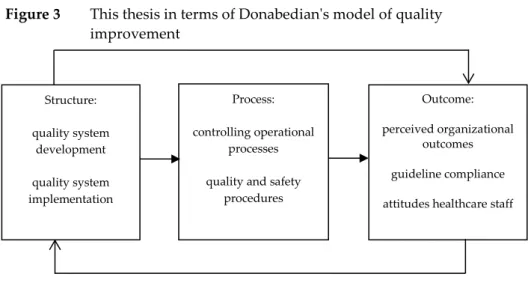
The various elements from the research questions can be translated into Donabedian’s model of quality improvement. Figure 3 shows the place of the different elements of this thesis in the model of quality improvement. Figure 3 This thesis in terms of Donabedian's model of quality
improvement
Methods
This results of this thesis are based on a combination of several research methods. Quantitative as well as qualitative data were used to address the main research questions and sub-questions. To answer the research questions, we have used triangulation of data sources. Each of the different methods will be described briefly in the following section; a more detailed description of the methods that were used in this thesis can be found in chapters 2 to 7.
Chapter 2 relies on longitudinal questionnaire survey data about quality systems in hospitals, with measurements made in 1995, 2000, 2005, 2007 and 2011. The chief executive officers of all Dutch hospitals were approached
Structure: quality system development quality system implementation Process: controlling operational processes quality and safety
procedures
Outcome: perceived organizational
outcomes guideline compliance attitudes healthcare staff
with a request to complete a written questionnaire about the quality management and safety management in the hospital in which they worked. Questions were asked within five different domains about quality improvement activities that the hospital had undertaken. The results of the questionnaires were used to describe how the development of hospital quality systems has progressed in the period between 1995 and 2011 in the Netherlands.
In Chapter 3, the same longitudinal questionnaire survey data was used in a different manner. The questions from the questionnaire were regrouped in order to reflect the five enabler and the four results criteria of the European Foundation for Quality Management model (EFQM Excellence Model). This data was then used to measure the performance of hospitals on enabler and results criteria over time (1995-2011), to see whether high scores on enabler criteria would lead to higher scores on results criteria, and to test a feedback loop of the results criteria into the enabler criteria.
Chapter 4 uses the data from the final measurement of the questionnaire on quality systems, the measurement in 2011. This data is linked to five process indicators that were measured in the Safety Programme. The Safety Programme was a national programme aimed at improving ten patient safety themes in hospitals. The Safety Programme was carried out between November 2011 and December 2012 in 20% of all Dutch hospitals (18 hospitals participated). Two academic hospitals, four teaching hospitals and twelve general hospitals were included in this evaluation study, which assessed the implementation of patient safety themes. The process indicators from the Safety Programme that were used in Chapter 4 were: (1) wrong surgery, which reflected the percentage of operations in which all the three steps of a Time-Out Procedure (TOP) were performed correctly before the start of an operation; (2) early recognition and treatment of pain, which reflected the percentage of postoperative patients who were in pain as measured in a standardized way three times a day during the first three days after surgery; (3) contrast-induced nephropathy, this was an indicator for the percentage of high-risk patients who received an intervention (hydration) to prevent contrast-induced renal failure as a result of contrast administration; (4) medication reconciliation, which is the percentage of patients for whom the bundle of medication reconciliation on admission and discharge had been implemented completely; (5) high-risk medication, reflects the percentage of administration processes in which all recommended steps have been followed by the person administering the drug. The data for ‘Early recognition and treatment of pain’,
‘Contrast-induced nephropathy’ and ‘Medication reconciliation’ was extracted from patients’ records. The data for ‘Wrong surgery’ and ‘High-risk medication’ was obtained through observations.26
Chapter 5 describes the development and validation of an instrument for prospective risk analysis at the department level in hospitals. The questionnaire that was used is called Tripod Delta and was originally developed for the petrochemical industry. The questionnaire asks the healthcare professional questions about perceived risks in five organizational domains: (1) Procedures, (2) Training, (3) Communication, (4) Incompatible Goals and (5) Organization. In our study we modified the questions slightly so that they were applicable in the healthcare sector. This altered version was named Tripod Delta Health Care and was administered in thirteen departments of two Dutch hospitals. A multilevel method called ecometrics was used to evaluate the validity and reliability of the questionnaire. An ecometrics approach allows differences between departments and individual perceptions to be distinguished so as to ensure that differences in risk analysis between departments are really reflecting differences between departments and not between individuals.
Chapter 6 uses data from a larger evaluation study of the Safety Programme, focusing on one of these patient safety themes: the prevention of wrong surgery. The goal was to have ten observation days per hospital at intervals of four to six weeks, and to observe six to ten surgical procedures per day, preferably involving different surgeons and different surgical procedures. One observer per surgical procedure evaluated whether the TOP was carried out before anesthesia, using a standardized recording form that covered the various aspects of doing the TOP: checking the patient, procedure and side/site, attention of the team (focus), completeness of the team and interruptions, plus several background variables such as the type of surgical procedure, the patient’s age and sex.
Chapter 7 uses a mixed method approach: the validated Tripod Delta Health Care was measured in ten departments of one general Dutch hospital and this was complemented by interviews about the attitudes of healthcare professionals towards the use of procedures in their work. These two data sources were combined to give a broad overview of risk perceptions and attitudes concerning procedures in the daily work of healthcare professionals.
Outline of this thesis
This thesis comprises eight chapters, including this introductory chapter. Chapter 2 describes the development of hospital quality systems in Dutch hospitals between 1995 and 2011. Chapter 3 describes the degree to which the EFQM Excellence Model in hospitals can be used as a framework for Total Quality Management within organizations. Chapter 4 takes a closer look at the association between quality system development in hospitals and quality indicators at the process level. In Chapter 5, a measurement instrument for prospective risk analysis at the department (process) level was validated by describing the ecometric properties of a questionnaire that was originally developed for the petrochemical industry and modified for a healthcare setting for the purposes of this thesis. In Chapter 6, the compliance of healthcare professionals with a safety procedure to prevent wrong surgery in hospitals is described and possible explanations for low compliance are discussed. Chapter 7 describes the attitudes of healthcare professionals towards the use of procedures in their daily work and highlights barriers and facilitators in the use of procedures. Chapter 8 provides a summary and general discussion of the results that were presented in this thesis. Furthermore, the methodological considerations, implications for practice and future research are formulated.
This thesis is based on six papers, each written to be read as a stand-alone paper in its own right. Some degree of overlap across chapters is therefore inevitable.
References
1. Netherlands HCI. Inspectierapport over verscherpt toezicht op het Ruwaard van Putten Ziekenhuis Publieksversie december 2013, 2013.
2. Veiligheid O. Inspectierapport over verscherpt toezicht op het Ruwaard van Putten Ziekenhuis Publieksversie december 2013. 2013
3. NIAZ. NIAZ. Secondary NIAZ 2014. http://www.niaz.nl.
4. Lohr KN. Medicare: a strategy for quality assurance: National Academies Press, 1990.
5. World Health O. Quality of care: a process for making strategic choices in health systems. 2006
6. Hoyle D. ISO 9000: quality systems handbook. 2001
7. Groene O, Klazinga N, Wagner C, et al. Investigating organizational quality improvement systems, patient empowerment, organizational culture, professional involvement and the quality of care in European hospitals: the'Deepening our Understanding of Quality Improvement in Europe (DUQuE)'project. BMC health services research 2010;10(1):281
8. Wagner C, De Bakker DH, Groenewegen PP. A measuring instrument for evaluation of quality systems. International Journal for Quality in Health Care 1999;11(2):119-30
9. Shaw C, Groene O, Mora N, et al. Accreditation and ISO certification: do they explain differences in quality management in European hospitals? International Journal for Quality in Health Care 2010:mzq054
10. Shaw CD, Groene O, Botje D, et al. The effect of certification and accreditation on quality management in 4 clinical services in 73 European hospitals. International Journal for Quality in Health Care 2014:mzu023 11. Weiner BJ, Alexander JA, Baker LC, et al. Quality improvement
implementation and hospital performance on patient safety indicators. Medical Care Research and Review 2006;63(1):29-57
12. Weiner BJ, Alexander JA, Shortell SM, et al. Quality improvement implementation and hospital performance on quality indicators. Health services research 2006;41(2):307-34
13. Kunkel S, Rosenqvist U, Westerling R. The structure of quality systems is important to the process and outcome, an empirical study of 386 hospital departments in Sweden. BMC health services research 2007;7(1):104
14. Kunkel S, Rosenqvist U, Westerling R. Implementation strategies influence the structure, process and outcome of quality systems: an empirical study of hospital departments in Sweden. Quality and Safety in Health Care 2009;18(1):49-54
15. Groene O, Mora N, Thompson A, et al. Is the maturity of hospitals' quality improvement systems associated with measures of quality and patient safety? BMC health services research 2011;11(1):344
16. Secanell M, Groene O, Arah OA, et al. Deepening our understanding of quality improvement in Europe (DUQuE): overview of a study of hospital quality management in seven countries. International Journal for Quality in Health Care 2014:mzu025
17. Wagner C, Groene O, Thompson CA, et al. DUQuE quality management measures: associations between quality management at hospital and pathway levels. International Journal for Quality in Health Care 2014;26(suppl 1):66-73
18. Capaciteitsorgaan. Capaciteitsplan 2013 Deelraport 1 Medisch specialisten, Klinisch technologische specialisten, spoedeisende hulpartsen. Utrecht, 2013.
19. Sluijs EM, Wagner C. Kwaliteitssystemen in de zorg: de stand van zaken in 2000. 2000
20. Sluijs EM, Wagner C. Progress in the implementation of Quality Management in Dutch health care: 1995–2000. International Journal for Quality in Health Care 2003;15(3):223-34
21. van Schoten SM, Groenewegen PP, Wagner C. De ontwikkeling van kwaliteitssystemen in Nederlandse ziekenhuizen tussen 1995 en 2011. Tijds gezondheidswetenschappen 2013;91(8):489-96 doi: 10.1007/s12508-013-0160-y[published Online First: Epub Date]|.
22. Dückers M, Makai P, Vos L, et al. Longitudinal analysis on the development of hospital quality management systems in the Netherlands. International Journal for Quality in Health Care 2009;21(5):330-40
23. Dückers M, Wagner C. Ex ante evaluatie Sneller Beter pijler 3: inventarisatie van de mate waarin de opzet van het programma Sneller Beter pijler 3 voldoet aan eisen ontleend aan literatuur. 2005
24. Dückers M, Wagner C. Evaluatie Sneller Beter pijler 3: het interne vliegwiel. Utrecht: NIVEL 2007
25. Dückers MLA. Changing hospital care: evaluation of a multi-layered organisational development and quality improvement programme: Utrecht University, 2009.
26. Blok Cd, Koster E, Schilp J, et al. Implementatie VMS
Veiligheidsprogramma: evaluatieonderzoek in Nederlandse ziekenhuizen. 2013
27. Wagner C, Gulácsi L, Takacs E, et al. The implementation of quality management systems in hospitals: a comparison between three countries. BMC Health Services Research 2006;6(1):50
28. Donabedian A. The quality of care: How can it be assessed? Jama 1988;260(12):1743-48
29. Donabedian A. The effectiveness of quality assurance. Int J Qual Health Care 1996;8(4):401-7
30. Donabedian A. Evaluating the quality of medical care (Reprinted from The Milbank Memorial Fund Quarterly, vol 44, pg 166-203, 1966). Milbank Quarterly 2005;83(4):691-729 doi: 10.1111/j.1468-0009.2005.00397.x[published Online First: Epub Date]|.
31. Deming WE. Out of the crisis, Massachusetts Institute of Technology. Center for advanced engineering study, Cambridge, MA 1986;510
32. Taylor MJ, McNicholas C, Nicolay C, et al. Systematic review of the application of the plan–do–study–act method to improve quality in healthcare. BMJ quality & safety 2013:bmjqs-2013