ASSET MANAGEMENT IMPLEMENTATION
PLAN AND TIERED SYSTEM PROCESS
Michael J. Markow, PE
Joe Racosky, PE
September 2001
COLORADO DEPARTMENT OF TRANSPORTATION
RESEARCH BRANCH
accuracy of the data presented herein. The contents do not necessarily reflect the official views of the Colorado Department of Transportation or the Federal Highway Administration. This report does not constitute a standard, specification, or regulation.
i
5. Report Date
September 2001
4. Title and Subtitle
ASSET MANAGEMENT IMPLEMENTATION PLAN AND TIERED SYSTEM PROCESS
6. Performing Organization Code
CS 6955-002 BRW 33753-051
7. Author(s)
Michael J. Markow, PE (CS); Joe Racosky, PE (BRW)
8. Performing Organization Report No.
9. Performing Organization Name and Address 10. Work Unit No. (TRAIS)
Cambridge Systematics 150 CambridgePark Drive, Suite 4000 Cambridge, MA 02140 BRW, Inc 1225 17th Street, Suite 200
Denver, CO 80303 11. Contract or Grant No. PG HAA 2000HQ00382
13. Type of Report and Period Covered
Final
12. Sponsoring Agency Name and Address
Colorado Department of Transportation – Research 4201 East Arkansas Avenue
Denver, CO 80222
14. Sponsoring Agency Code
65.10
15. Supplementary Notes
Prepared in cooperation with the US Department of Transportation, Federal Highway Administration
16. Abstract
This study has developed a five-year transportation asset management plan for the Colorado Department of Transportation (CDOT). This study has also developed a proposed tiering structure of the state highway system to support asset management. Asset management represents a strategic approach to managing transportation infrastructure. It embodies a set of principles to improve how an agency conducts business, how it reaches decisions, and how it processes, uses, and communicates information. CDOT, in consultation with the Colorado Transportation Commission, has already taken a number of steps toward improved asset management. A unique Investment Category approach organizes program investments within a policy-oriented framework incorporating explicit measures of performance. Other steps taken by CDOT include updates of the statewide planning process and the program prioritization process, establishment of maintenance program levels of service, institution of customer surveys, and updates of relevant information technology applications. The recommended transportation asset management plan builds upon these established concepts, methods, information, and tools to propose specific actions over the next five years in the following areas: (1) completion of all elements of the Investment Category structure; (2) incorporation of asset management principles in CDOT’s planning and programming processes, building on a tiered structuring of CDOT assets that has also been recommended in this study; (3) integration of asset management information on a GIS platform, and renewal of Information Technology strategic planning to support asset management department-wide; and (4) strengthening of program delivery mechanisms and measures. The recommended tiering of the state highway system is built around the concept of interregional corridors, because CDOT is the sole provider of significant interregional highway transportation.
17. Key Word
infrastructure, highways, transit, transportation planning, capital programming, maintenance management, program delivery, investment categories, management systems, information technology, tiering, highway classification
18. Distribution Statement
This document is available to the public through: National Technical Information Service
5825 Port Royal Road Springfield, VA 22161
19. Security Classif. (of this report)
None
20. Security Classif. (of this page)
None
21. No. of Pages
133
22. Price
iii by
Michael J. Markow, PE Joe Racosky, PE
Report No. CDOT-DTD-R-2001-13
Prepared by
Cambridge Systematics BRW
150 CambridgePark Drive, Suite 4000 1225 17th Street, Suite 200
Cambridge, MA 02140 Denver, CO 80202
Sponsored by the
Colorado Department of Transportation In Cooperation with the
U.S. Department of Transportation Federal Highway Administration
September 2001
Colorado Department of Transportation Research Branch
4201 E. Arkansas Ave. Denver, CO 80222
v
The authors would like to thank the following staff of the Colorado Department of Transportation (CDOT) for their valuable active participation in the study effort: Jennifer Finch, Director, Division of Transportation Development
Rich Griffin, Research Coordination Engineer and Study Manager
Original Study Panel Members
Marilyn Beem, Statewide and Regional Planning Manager Heather Dugan, Budget Director
Ed Fink, Staff Maintenance Director
Steve Horton, Staff Design and Construction Director Don Kirkpatrick, Information Systems Director George McCullar, CDOT Controller
Additional Participants in Study Panel Process
Tim Aschenbrener, Materials / Geotechnical Engineer Dave Busby, Performance Measures Specialist
Mark Leonard, Staff Bridge Engineer Scott Young, Business Office Manager
State Transportation Commission and Senior CDOT Executives
The authors would also like to thank the State Transportation Commission and Doug Aden, Chairman and Don Morrison, Vice-Chairman; Tom Norton, Executive Director, Peggy Catlin, Deputy Director, and John Unbewust, Chief Engineer; and the Executive Management Team (EMT) for their contributions
vii
Executive Summary
ES.1 Asset Management Overview
Asset management represents a strategic approach to managing transportation infrastructure. It embodies a philosophy that is comprehensive, proactive, and long-term, with the following goals:
• To build, preserve, operate, and reinvest in facilities more cost-effectively with improved performance;
• To deliver to an agency’s customers the best value for the dollar spent; and
• To enhance CDOT’s credibility and accountability in its stewardship of transportation assets.
Asset management provides a set of principles that guide an agency in improving how it conducts business, how it reaches decisions, and how it processes, uses, and communicates information related to the management of its infrastructure. At its core, asset management focuses on an agency’s allocation and utilization of resources – funding, people and skills, and information. It provides an integrated framework that establishes common approaches across asset classes in planning, program development, and program delivery. It encourages a number of best practices in these processes: e.g., consideration of the full range of alternatives at each stage of decision, adoption of a long-term view in economic analysis of projects, evaluation of tradeoffs across programs, monitoring of program delivery and system performance, and effective use of management and information systems throughout the infrastructure management cycle. Asset management is results-oriented, driven by policy goals and objectives with clear measures of system performance and accountability.
viii
ES.2 CDOT Accomplishments to Date
CDOT, in consultation with the Colorado Transportation Commission, has already taken a number of steps toward improved asset management. A major development has been the establishment of its Investment Category structure, which organizes program investments within a policy-oriented framework identifying explicit measures of performance. CDOT’s Investment Category structure is unique among state DOT practice nationwide:
• The Investment Category structure integrates several elements critical to asset management within a coherent, overarching framework;
• It structures investments based upon policy objective and impact on performance rather than funding source; and
• It facilitates the analysis of tradeoffs among capital, maintenance, and operations program categories.
The Investment Category structure establishes the unifying framework for communicating a vision of asset management at CDOT, and provides a foundation for the Asset Management Plan recommended in this study. The Investment Category structure is not the only advance that has been undertaken by CDOT, however. Other CDOT accomplishments complement the Investment Category approach, including updates of the statewide planning process and the program prioritization process, establishment of maintenance program levels of service, institution of customer surveys, and updates of relevant information technology applications.
ES.3 Asset Management Plan for CDOT
This Asset Management Plan builds upon these established concepts, methods, information, and tools to propose specific actions over the next five years to build upon and expand these accomplishments. Hallmarks of this vision include the following:
ix
1. Completion of all elements of the Investment Category structure;
2. Incorporation of asset management principles in CDOT’s planning and programming processes, building on the tiered structuring of CDOT assets recommended in this study;
3. Integration of asset management information on a GIS platform, and renewal of Information Technology strategic planning to support asset management department-wide; and
4. Strengthening of program delivery mechanisms and measures.
Each of these four areas entails multiple tasks that will need to be accomplished. An outline of these tasks follows, with recommended organizational responsibility, timeframe, and estimated budget amount. Timeframes are identified as near-term (accomplish in one to two years), mid-term (accomplish in three to four years), and long-term (accomplish in five years or longer). Budget figures identify total estimated cost, if applicable, to fund one or more projects associated with an objective or task. These costs are additional to those that may already be planned by CDOT. The objectives and tasks below constitute the key elements of CDOT’s Transportation Asset Management Plan.
While the tasks are organized by area for clarity, in fact they will interact with each other across areas. For example, performance measures defined in the Policy area need to be incorporated in the systems and tools discussed in the Information and Analytic area, so that they can be applied to tradeoff analyses and decisions in the Planning and Programming area.
x Policy and Institutional Recommendations
Asset Management Objective
CDOT Unit Responsible Task
Timing and Cost
A. Designate a departmental task force under the Deputy Director to guide implementation of the asset management plan.
Director
1. Designate the task force, building upon the experience of the Project Panel for Asset Management Plan development.
Near-term
B. Complete and refine Investment Category goals, targets, and performance measures
DTD
1. Complete definition of statewide goals, targets, and performance measures for all programs.
2. Discuss the completed approach with local and regional planning agencies.
Near-term
Near-term
C. Fold the performance measurement of all programs, including future strategic (“7th pot”) projects, within the Mobility, Safety, and System Quality Categories
DTD
1. Apply established performance measures to identify impacts of all projects, including strategic projects.
2. Implement procedures on a trial basis, assess results, discuss with Transportation
Commission, and finalize.
Near-term
Near-term
D. Define state interest in non-state-owned infrastructure.
EMT
1. Identify and categorize non-state-owned assets in which CDOT has an interest. 2. Review potential investment policies with Transportation Commission
Mid-term
Mid-term
E. Improve public and internal understanding and support of asset management techniques.
Deputy Director
1. Hold periodic departmental workshops to discuss asset management and its implications for department activities.
2. Develop and distribute public information describing asset management and its importance. 3. Track public perceptions of, and satisfaction with, asset management performance through customer surveys.
Near-term
Near-term $75,000
xi Planning and Programming Recommendations
Asset Management Objective
CDOT Unit Responsible Task
Timing and Cost A. Implement tiered classification of transportation assets. DTD
1. Implement recommended tiered system on a trial basis in cooperation with local and regional agencies.
2. Implement final set within planning and programming procedures and management and information systems.
Mid-term
Long-term $500,000
B. Develop more complete scope and cost information for STIP projects (coordinate with Program Delivery)
OFMB
1. Work with Regions to define a process and information needs. 2. Implement by 2004. Mid-term, $250,000 Mid-term C. Strengthen application of performance measures.
Deputy Director, Chief Engineer, DTD, Asset Managers,
Maintenance & Operations
1. Develop consistent measures across Investment Categories and programs serving common goals (e.g., safety, pavement/ maintenance, bridge/maintenance) 2. Develop specialized tools for tradeoff analyses and promote greater integration among management system and data
3. Develop or adapt applications to predict customer impacts in terms of user costs.
Near-term Near- to Mid-term, $1,000,000 Long-term, $250,000 D. Review over time those
program allocations based on formulas to ensure consistency with performance-based asset management
Deputy Director
1. Perform the following:
• Identify program components subject to “fixed” or “formula” distributions. • Analyze implications across Regions and
TPRs, comparing formula distributions versus implied distributions based upon performance measures.
• Discuss comparison with Transportation Commission, CDOT managers, local and regional agencies.
• Implement recommended changes.
Long-term, $250,000
xii Program Delivery Recommendations
Asset Management Objective
CDOT Unit Responsible Task
Timing and Cost
A. Strengthen tracking of program delivery and major project changes (coordinate with Planning and Programming).
Deputy Director
1. Develop program tracking methodology and system based upon more complete initial cost and scope estimates.
2. Establish a program review team to meet periodically to review and approve major changes in scope, time, and cost.
Mid-term, $350,000
Mid-term
B. Ensure consistency of accomplishments with program estimates of PMS, BMS, and MMS
Chief Engineer
1. Reinforce procedures to define projects by employing information from management systems.
2. Expand project delivery reports to confirm specific project treatments applied, or reasons for deviation
Mid-term
xiii Information and Analytic Recommendations
Asset Management Objective
CDOT Unit Responsible Task
Timing and Cost
A. Meet end-user needs for complete, accurate, timely information.
Chief Engineer
1. Conduct QA/QC checks to achieve reliable, credible management system operation and predictions
2. Schedule training of asset management staff to become more familiar with full range of PMS, BMS, MMS capabilities and to make better use of existing system capabilities 3. Fill analytic gaps with simple, quick, economical tools. Near-term Near-term, $50,000 Near- to Mid-term, $200,000 B. Enhance Information
Technology (IT) support for asset management in CDOT.
Deputy Director
1. Reconstitute the ITRT to provide high-level guidance for asset management.
2. Charge the ITRT to develop and implement an IT plan for asset management (e.g., to guide system integration and new system
development)
Near-term
Near-term
C. Integrate asset management system data on CDOT’s GIS.
ITRT
1. Details to be developed in IT plan, including:
• Classification of assets in a tiered structure; • Integrated condition and performance
measures, referencing systems, data sources;
• Program and project information to be displayed on GIS; and
• System capabilities: displays, queries, reports.
Mid- to Long-term; must be coordinated with other GIS objectives; potential cost is at least several million dollars, not exclusively for asset mgmt.
xiv
ES.4 Near-Term Implementation
The near-term tasks identified above present opportunities for immediate accomplishment as CDOT begins implementation of the Asset Management Plan. Many of these items are organizational and procedural in nature, and build upon the considerable work that CDOT has already done to promote better asset management. These near-term tasks will enable CDOT to engage all organizational units and levels of the Department in the asset management philosophy, and to lay the groundwork for the more strategic management processes, perspectives, and tools that will be needed in the future. Key near-term task objectives for CDOT include the following:
• To organize a task force chaired by the CDOT Deputy Director to provide leadership, demonstrate executive buy-in, guide and coordinate actions department-wide, and provide a focal point for strategic direction and communication of objectives and accomplishments.
• To complete the Investment Category structure to provide the goals, targets, performance measures, and analytic tools needed to use it to full advantage in planning, program development, and system monitoring.
• To communicate “what is asset management” and related CDOT actions to CDOT employees and to the Transportation Commission, stakeholders, and the public.
• To make better use of existing information technology (IT) where possible, and to develop new IT applications and tools where needed to support asset management. This objective is critical to the long-term success of asset management and comprises a number of tasks that could entail significant cost for development of IT applications and tools. A blend of organizational, planning, and developmental tasks is therefore proposed with respect to this objective:
− To reconstitute the Information Technology Resource Team (ITRT) to provide high-level IT expertise to the Asset Management Task Force and to represent CDOT “customers” of IT applications and information.
xv
− To charge the ITRT with developing an Information Technology Plan that specifically addresses IT support of asset management. A key aspect of this plan would include proposed steps for renewal or redevelopment of legacy systems, and integration of systems in a geographic information system (GIS) platform.
− To make “better and smarter use” of existing CDOT systems and data. This recommendation includes training to familiarize CDOT staff with existing system capabilities that are now underutilized but that are very relevant and helpful to asset management. It also encompasses a testing and validation phase for new or redeveloped systems to ensure that they provide credible information and can be used reliably in asset management business processes.
− To complement existing or proposed management systems with specialized analytic tools that provide needed functionality for asset management and that are quick and economical to develop and apply.
ES.5 Tiering of Assets
As an initial step toward asset management implementation, this study has also recommended an approach to create tiers of assets. Asset tiering recognizes that transportation assets serve different local, regional, and national needs that justify different levels of service. Stratifying these assets helps to organize resource allocation priorities and tradeoffs, propose meaningful target values of level of service, and provide a context for tracking expenditures, benefits, and other consequences of investments.
A major class of infrastructure assets in terms of public visibility and share of program budget is the state highway system. An existing basis of tiering of these assets is provided by Federal-Aid functional classes: Interstate highways, non-Interstate National Highway System (NHS) highways, and Other highways. This study proposes the following additional tiers to build on existing functional class:
xvi
• Level of use in terms of intervals of traffic volume;
• Role in freight carriage: classification or level of truck usage; and • Role in transit use.
Classification tiers have already been proposed for other modal assets. It is proposed that these proposals be retained at this time without change until discussed further or formally adopted by the Transportation Commission.
xvii Table of Contents
1.0 Introduction... 1
1.1 Study Objectives, Tasks, and Scope ... 1
1.2 Report Organization... 3
1.3 Transportation Asset Management ... 4
2.0 State-of-Practice at CDOT ... 15
2.1 Departmental Overview ... 15
2.2 Transportation Policies and Program Structure ... 22
2.3 Planning and Program Development ... 40
2.4 Program Delivery... 46
2.5 Management Systems and Information... 48
2.6 GASB Standards ... 57
3.0 Other States’ Experience... 59
3.1 Nature of Review ... 59
3.2 Practices Applicable to Asset Management... 61
3.3 Challenges to Asset Management Implementation... 70
4.0 Asset Management Plan ... 73
4.1 Vision... 73
4.2 Translating Vision Into Specific Recommendations... 76
4.3 Development of the Asset Management Plan ... 96
4.4 Implementation Plan for Near-Term Items ... 104
4.5 Implementation Roles of the EMT and the Transportation Commission ... 116
5.0 Tiering of the Transportation Assets ... 119
5.1 Introduction to Tiering ... 120
5.2 Other Examples of Tiering Used within CDOT ... 121
xix List of Figures
Figure 1. Framework of Transportation Asset Management ... 11
Figure 2. Implications of Asset Management for Agency Processes and Information Flows ... 12
Figure 3. CDOT Organizational Structure ... 16
Figure 4. CDOT Transportation Regions... 18
Figure 5. CDOT Maintenance Sections ... 19
Figure 6. Transportation Commission Districts ... 20
Figure 7. Colorado Transportation Planning Regions... 27
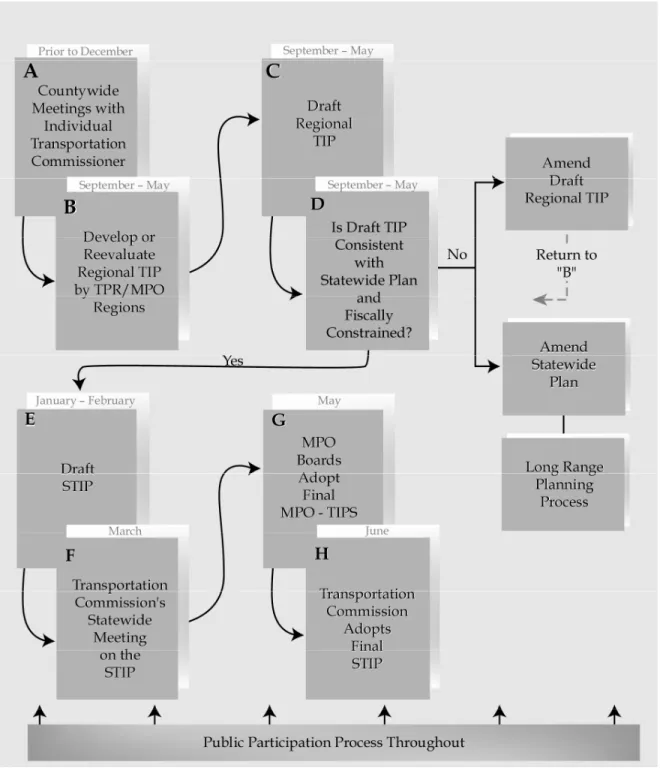
Figure 8. CDOT Project Priority Programming Process (“4P”) ... 45
Figure 9. Pontis® Modeling Framework ... 52
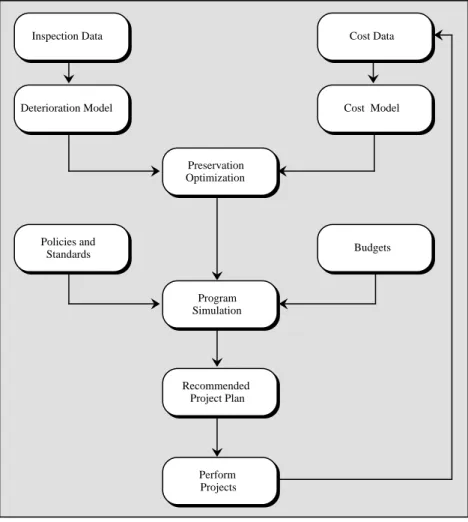
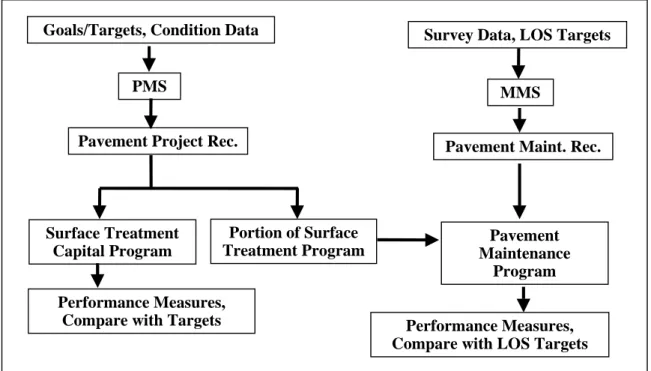
Figure 10. Current Approach to Pavement Program Development and Implementation ... 78
Figure 11. Improved Approach to Pavement Program Development and Implementation ... 81
Figure 12. Current Approach to Bridge Program Development and Implementation ... 93
Figure 13. Improved Approach to Bridge Program Development and Implementation... 93
Figure 14. Overall Safety Investment Category... 94
Figure 15. Roadway Component of Safety ... 94
Figure 16. Example of Budget Scenarios and Effects on Network Condition... 113
Figure 17. Identification of Points to be Plotted to Relate Condition and Needed Expenditure... 114
Figure 18. Resulting Relationship Between Network Condition and Needed Expenditure ... 115
Figure 19. Resulting Relationship Between Annual Expenditure and Network Condition... 115
Figure 20. Colorado State Highway System ... 121
Figure 21. Statewide Significant Corridors (SSC)... 123
Figure 22. Strategic Projects ... 125
Figure 23. Colorado Airports by Functional Level... 126
Figure 24. Significant Rail Corridors... 127
Figure 25. Proposed Interregional Corridors ... 132
List of Tables Table A. Funded Statewide Programs... 25
Table B. Asset Management Plan – Policy and Institutional Factors ... 98
Table C. Asset Management Plan – Planning and Programming Factors ... 100
Table D. Asset Management Plan – Program Delivery Factors ... 102
1
1.0 Introduction
1.1 Study Objectives, Tasks, and Scope
In April 2000, the Colorado Department of Transportation (CDOT) engaged the team of BRW, Inc., and Cambridge Systematics, Inc., to conduct a study entitled, Development of an Asset Management Implementation Plan and a Tiered System Process for CDOT. The objectives of this study are to review current practices in transportation asset management at CDOT and among other DOTs that are “leaders” in the field, and to develop from this information a CDOT Asset Management Plan and a Tiered System Process. This Final Report documents the results of this study.
The study comprises five major tasks:
• Task A – Review Asset Management as Now Practiced at CDOT. This review encompasses CDOT’s organizational responsibilities, procedures, and systems for planning, program development, allocation of resources, program delivery, facility monitoring, and reporting internally and to the Transportation Commission and the public.
• Task B – Review Asset Management as Practiced in Five Leadership States. Leadership states selected for interviews include Arizona, California, New York, Pennsylvania, and Washington State. These states have significant transportation infrastructure serving a range of customer needs in diverse conditions of climate and terrain, and are actively pursuing improved asset management techniques.
• Task C – Develop a Tiered Structure of CDOT Transportation Assets. Transportation assets serve different needs and justify different levels of service in a state with as diverse a terrain, climate, demography, and degree of urbanization as Colorado. Stratifying these assets within tiers helps to organize investment choices, priorities, and tradeoffs, establish target levels of service, and track expenditures, benefits, and other consequences of investments.
2
• Task D – Develop an Asset Management Plan for CDOT. The Plan has three components:
− Vision Statement – A Vision of CDOT asset management, including its objectives, functions, and procedures, supporting management systems and data sources, and current CDOT accomplishments that provide a foundation for future development;
− Examples – Examples of how asset management is applied in programming and budgeting decisions that illustrate its operation and its advantages, and provide insights into how to tailor and implement the Plan; and
− Implementation Program – The implementation program encompasses a projected schedule, phasing of tasks, suggested performing unit, targets and milestones, projected benefits, and estimated budget costs.
• Task E – Prepare Final Report and Briefing Presentation. The final report and PowerPoint briefing presentation communicate the results of the tasks above.
The scope of the study encompasses primarily state-owned transportation infrastructure, representing transportation networks, structures, and associated features for which CDOT has direct ownership and operating responsibility. These facilities include state roadways, bridges, pedestrian ways, bicycle lanes, and a rail line that are on the state system.
There is also a category of state-interest transportation infrastructure, representing other transportation facilities in which CDOT maintains an interest due to legal or funding arrangements or the direct relevance of these facilities to statewide transportation (evaluated on a case-by-case basis). Examples of these facilities include off-system bridges, which are inspected by CDOT personnel; intermodal facilities that are judged to benefit the CDOT system; and aviation facilities that are funded through CDOT’s Aeronautics Division. These infrastructure elements will be discussed when appropriate to asset management. However, since most critical decisions and tradeoffs by CDOT relate to the state-owned infrastructure component, it is the state-owned facilities that will receive most attention in this report.
3
While CDOT exercises management responsibility for the state-owned facilities, the scope and direction of its asset management role are circumscribed and influenced by several political, legal, and institutional relationships. Policy guidance and decisions affecting funding, options, and priorities in asset management are promulgated by a number of governing authorities, including the Colorado Transportation Commission, the Governor and State Legislature, and applicable state and federal administrative and regulatory bodies. Transportation plans and programs regarding state-owned facilities must be developed in cooperation with Colorado’s metropolitan planning organizations (MPOs) and transportation planning regions (TPR), and be informed by public opinion. A number of public and private users depend upon the statewide transportation system for social, commercial, and recreational purposes, including local motorists and transit riders, freight carriers, service industries, public service organizations, and tourists. CDOT must be responsive to its customers, and regularly engages in outreach efforts to gauge public perceptions and degree of satisfaction with its services. Thus, while this study focuses on CDOT roles and responsibilities in asset management, it recognizes the broader institutional environment and set of interests that CDOT must respond to.
Within this institutional context, the Colorado Transportation Commission has expressed significant support for asset management. This support has been evident in both the encouragement to CDOT to undertake this study and in the comments received at the briefing to the Commission on study findings and recommendations. The CDOT Executive Management Team has likewise offered helpful comments and support during briefings and workshops on asset management, as well as in interviews with individual members of the EMT. The potential roles that can be played by the Transportation Commission and the EMT in advancing better asset management practice are outlined in Section 4.0.
1.2 Report
Organization
The report organization responds to and builds upon the project tasks above.
• The remaining parts of Section 1.0 introduce the topic of transportation asset management. They summarize principles and characteristics of asset management,
4
summarize related work to date in the U.S. and internationally, and outline current accomplishments and challenges of implementing asset management within a U.S. public sector transportation agency.
• Section 2.0 summarizes current asset management practice at CDOT. It describes the characteristics of the statewide transportation system, CDOT’s organizational and program structure, and the policies, processes, and decision-support tools relating to asset management.
• Section 3.0 reviews transportation asset management practices in peer agencies. This review encompasses State DOTs that are taking the lead in this formative era of transportation asset management in the U.S., and establishes useful examples and points of comparison for developing the CDOT Transportation Asset Management Plan.
• Section 4.0 recommends the CDOT Transportation Asset Management Plan. This section comprises a Vision Statement, Examples of Specific Asset Management Improvements, the overall CDOT Asset Management Plan, and an Implementation Plan for near-term items.
• Section 5.0 presents a Tiered System for CDOT transportation infrastructure assets. Applying the results of peer state comparisons and input from a focus group conducted by the Project Team, it develops an approach to organizing and classifying CDOT’s transportation infrastructure assets.
1.3
Transportation Asset Management
Related Work to Date
. Asset management has been studied by overseas transportation and public works agencies for several years. Detailed methodological handbooks and reports have been produced, for example, in Australia and New Zealand. The subject is currently receiving considerable attention throughout the developed world, as evidenced by a recently completed compendium by the Organization for Economic Cooperation and5
Development (OECD) of activities of its member nations in North America, Europe, and Asia.
Within the United States, the American Association of State Highway and Transportation Officials (AASHTO) and the Federal Highway Administration (FHWA) began sponsoring a series of workshops on asset management beginning in 1996. Subsequently, AASHTO appointed a Task Force on Transportation Asset Management, which has prepared a Strategic Plan of activities proposed over a 10-year period.
Recently the National Cooperative Highway Research Program (NCHRP) initiated Project 20-24(11), Asset Management Guidance for Transportation Agencies. This project, scheduled to be performed in 1999-2002, will develop products that respond to several tasks in the AASHTO Strategic Plan, including a Synthesis of current practice, a Framework of Transportation Asset Management, a recommended program of prioritized research proposals, and an Asset Management Guide. The following discussion of transportation asset management is based upon concurrent work now being conducted for Project 20-24(11).
What Is Asset Management?
Transportation Asset Management represents a strategic approach to managing transportation infrastructure. Transportation agencies worldwide have historically exercised significant responsibilities in conceiving, building, operating, and maintaining networks of facilities. Asset management represents more than these combined responsibilities. It entails more than the revision of an internal procedure, preparation of an additional report, or introduction of a new computer application. It embodies an overarching set of principles, best practices, and applications of information to perform management functions better, with the following strategic goals:
• To build, preserve, operate, and reinvest in facilities more cost-effectively with improved performance;
6
• To enhance the credibility and accountability of the transportation agency to its authorizing body.
Asset management goes to the core of how an agency does business. The specific nature of the change implied by asset management will vary by agency to conform to local organizational, institutional, financial, managerial, and technological factors. Nonetheless, a set of principles characterizes asset management generally. These principles reflect the concept that transportation asset management is, simultaneously, a philosophy, a process, and a set of technical tools.
Asset Management Is a Philosophy
. Asset management represents an approach to managing infrastructure that is strategic and proactive, and places a premium on good information in all aspects and in all departmental units. Relevant principles include the following:• Asset management is holistic. It entails a comprehensive view across a range of assets. It encourages consideration of a full range of options to meet problems or needs. Tradeoffs are explicitly considered among programs, modes, or strategies.
• Asset management is driven by policy goals and objectives based upon performance. Strategies are analyzed in terms of objective assessments of costs, benefits, and other impacts on the transportation system and levels of service provided to transportation users.
• Asset management takes a long-term view of infrastructure performance and cost. The benefits of different actions are assessed throughout the infrastructure service life, applying economic as well as technical criteria.
• Asset management is proactive. An agency has the latitude to make decisions based on merit. Preventive strategies are encouraged where they are cost-effective.
• Asset management policy is influenced and informed by good information. This information describes current and projected system condition and performance that
7
would result from different policies or strategies. It also encompasses user perceptions of system condition and performance, as obtained through surveys or focus groups.
Asset Management Is a Process
. Principles of good asset management can suggest ways in which an agency’s business processes and its organizational roles and responsibilities can be strengthened. These process improvements can occur in those activities prior to budget approval – i.e., planning and program development – and in the program delivery phase subsequent to budget approval. Major principles governing process improvements are listed below.• Investment choices and decisions on allocating and applying resources are policy- and performance-driven. Procedures to reach these decisions are consistent with objective information and criteria based on merit. Performance measures consistent with policy goals and objectives are established for management review of both system performance and program delivery.
• Investment choices and decisions on allocating resources are based upon explicit tradeoffs among modes, programs, or strategies. Tradeoffs assess the impacts of more or less investment in a mode, program, or strategy, and help to craft final recommendations on how resources will be allocated across competing needs. Managers also understand the implicit tradeoffs in their programs and budgets, and the consequences thereof.
• Organizational roles and responsibilities regarding asset management are developed to overcome silo-based thinking. While strong vertical organizational units may exist to maintain core expertise, communications and decisions involve wider participation, as noted below.
• Asset management is interdisciplinary. Decisions on investment choices and resource allocation are based upon expertise and judgment from several quarters of an agency. • Asset management requires effective communication within and outside the agency.
8
horizontally. External communications need to inform policy makers and other stakeholders of the status of transportation assets and recommended policies and their benefits.
• The agency strives for more effective program delivery. The agency explores innovative methods to deliver the range of projects and services required. All available methods are considered, including use of departmental employees, intergovernmental agreements, outsourcing or managed competition, and privatization.
Asset Management Is a Set of Technical Tools
. Effective management systems and complete, current, and accurate information on transportation infrastructure are practical necessities in meeting the policy and process requirements of asset management. Good asset management implies a systematic, integrated approach to project selection, analysis of tradeoffs, and program and budget decisions. It also implies that the right information be available to the right levels of management at the right times. The principles below support the availability and application of better information to make better decisions in asset management.• Complete, current, and accurate information on transportation infrastructure assets, including descriptions, location, usage, unique or specialized characteristics, functional and other classification, and data needed for management systems as discussed below. • An appropriate suite of management systems and databases informs the agency of
the status, trends, and needs regarding its infrastructure assets. Typical capabilities of these systems include the following:
− Organization of information within databases describing infrastructure inventory, condition, and performance;
− Analytic models that predict the rate of future change in condition or performance, enabling the agency to forecast future infrastructure needs;
9
− Decision rules or procedures for applying treatments or actions to maintain, rehabilitate, replace, or expand transportation infrastructure, with analytic models of resulting costs, benefits, and other impacts; and
− Reports tailored to different organizational levels of management, including senior and executive levels, as well as for public distribution.
• Information on system performance in terms of both proposed targets and values actually achieved in the field. These data may be obtained in a number of ways:
− Periodic surveys and assessments of system condition or levels of service;
− Customer surveys of satisfaction with system condition and agency performance; and
− Incorporation of performance measures and associated backup information within management systems.
• Specialized technical applications that support an agency’s asset management procedures. These will vary by agency, but may include advances such as use of geographic information systems (GIS) as a system/data integration platform, economic analysis applications (e.g., generalized life-cycle benefit-cost procedure), and decision-support tools.
• Applications that assist in program and service delivery, including financial applications (e.g., to compute “total” or “true” cost of agency and contracted services), and management systems for construction project pipeline and construction delivery.
Asset Management Framework – Overall Approach
. These principles of good practice are embodied in an approach to asset management that is illustrated in Figure 1. Figure 1 shows a strategic, integrated, systematic, and interdisciplinary approach to asset management, from policy formulation through delivery and monitoring of results. Key points to note are as follows:10
• The approach is policy-driven. Applicable policies include those embodying system performance goals, and broader policies with important transportation implications, such as those specifying economic development or social or environmental initiatives.
• The analysis of options and tradeoffs is strategic, interdisciplinary, and integrated. It encompasses a number of modes and their asset classes, rather than a singular view of any one type of infrastructure. Policy goals and objectives are explicitly considered, with examples in Figure 1 drawn from CDOT’s Investment Categories. Different types of investment or expenditure are considered, cutting across programs, to identify the strategy that provides the best performance at the lowest life-cycle cost. Quality information is applied throughout these processes.
• Decisions on allocating departmental labor, dollar, and information resources among programs are made by managers based upon objective analyses of merit. These decisions respond to policy goals and objectives, are founded in objective analyses of costs, benefits, and other impacts, and are informed by tradeoff analyses that illustrate the consequences of allocating these resources in different ways.
• Program projects and services are delivered in the most effective way available. Options for delivery are continually evaluated in terms of the agency’s own capabilities and those of other providers in the public or private sectors.
• The information base for asset management is continually renewed, with feedback for updates and improvement. Working upward from the bottom in Figure 1 to consider the several feedback loops possible:
− Program delivery monitoring documents whether projects and services have been delivered on time and budget, and identifies causes of problems that may require remedy;
− System performance monitoring quantifies the results of past investment decisions, establishes baselines for future decisions, and identifies updates needed in project selection criteria;
11
− System and customer surveys update information on current asset inventory, condition, and performance, and the cost and effectiveness of project treatments and service delivery methods for use in future analyses; and
− System performance monitoring provides the information basis for future policy formulation and needed updates to goals and objectives.
Integrated Analysis of Options and Tradeoffs Integrated Analysis of Options and Tradeoffs
Asset Classes Highway Bridge Transit Aviation Rail Bike & Ped
Goals Safety Preservation Availability Mobility/Reliability Accelerate Projects Types of Investments Capital Operating Maintenance
Decisions on Applying Resources, Investment Choices
Decisions on Applying Resources, Investment Choices on Applying Resources, Investment Choices
Financial Human Information
Financial Human Information
Implementation Implementation
Agency, Intergovernmental Public / Private Partnership
Outsource - Privatize
Agency, Intergovernmental Public / Private Partnership
Outsource - Privatize
Systems Monitoring and Performance Results Systems Monitoring and Performance Results
Policy Goals and Objectives Policy Goals and Objectives
System Performance Economic Social & Environmental
System Performance Economic Social & Environmental
Figure 1. Framework of Transportation Asset Management
Implications for This Study
. Asset management is a comprehensive undertaking within an agency, since it goes to several business processes and decision points regarding a significant component of a transportation department’s program budget. Moreover,12
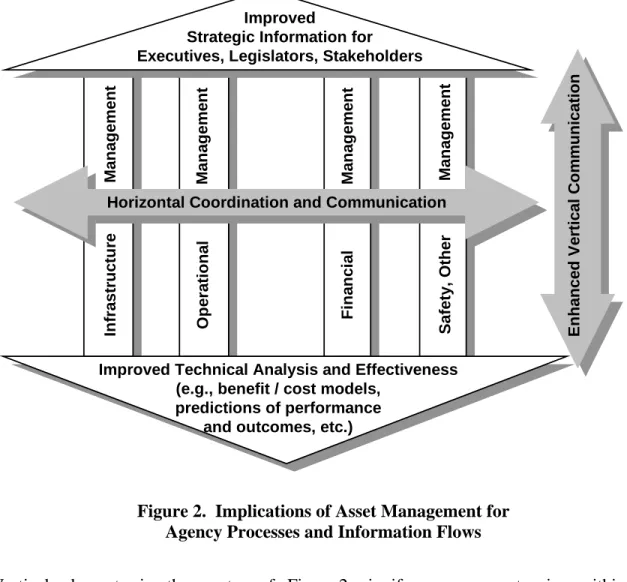
proposals for asset management improvement must be tailored to the particular policies, management philosophies, transportation network characteristics, and organizational, financial, institutional, and technological constraints that affect an agency’s decisions and actions. An illustration of key areas in which asset management can affect an agency’s activities organizationally is shown schematically in Figure 2.
Improved
Strategic Information for
Executives, Legislators, Stakeholders
Improved Technical Analysis and Effectiveness (e.g., benefit / cost models,
predictions of performance and outcomes, etc.)
Man agement Man a g eme n t
Horizontal Coordination and Communication
Enh a nc e d Ve rt ic a l C o m m uni c a tio n Man a g eme n t Man agement In frastru c tu re O p er at io n al Fina nc ia l Safety , Other
Figure 2. Implications of Asset Management for Agency Processes and Information Flows
Vertical elements in the center of Figure 2 signify core competencies within an organization. For simplicity, only four such groupings of expertise are shown, corresponding to infrastructure management, operations management, financial management, and safety and other areas of management. In fact, each of these may encompass several distinct subareas: e.g., infrastructure management may include skills in design, construction, pavement management, bridge management, traffic management,
13
track engineering and management, as well as modal specialties. From a practical perspective, core competencies such as these will likely continue within an agency, whether located in central offices, district or regional offices, or in some partnership arrangement with the private sector. The goal of asset management, however, is to ensure that these competencies are applied within an integrated, interdisciplinary environment, and that they not be isolated “with blinders on” in a “silo” or “stovepipe” approach to problems.
Asset management seeks to strengthen organizational processes and decisions across these core competencies. Improved processes, management systems, and analytic tools are a key element of asset management, as discussed earlier. Within middle management and at technical departmental levels these improvements may be visualized as new procedures, techniques, and skills that improve effectiveness, complemented by improved analytic tools and applications (whether stand-alone or within existing management systems), as shown at the bottom of Figure 2. At executive levels of the organization the focus is on the availability of improved information for decision-making and for communicating to governing bodies, customers, and other stakeholders, as shown at the top of Figure 2. Achieving a department-wide understanding of asset management and enabling the interdisciplinary approaches needed requires strengthened communication – vertically within core competencies and to executive levels, and horizontally across the department’s organizational units and disciplines, as depicted prominently in Figure 2. Collectively, this set of improvements enables the agency to establish and sustain a philosophy of asset management in a practical and meaningful way.
The remainder of this report illustrates how these concepts of asset management can be applied within Colorado DOT to develop a plan for asset management improvement.
15
2.0 State-of-Practice at CDOT
2.1 Departmental
Overview
Transportation in Colorado
. Colorado’s transportation needs are shaped by many factors of geography, economy, and society. Colorado occupies a strategic location in the Western United States, astride major east-west and north-south continental land and air routes. Variations in terrain, climate, and demographic characteristics contribute to a diverse economic base encompassing the agricultural and growing service sector in the Eastern Plains, rapidly growing suburban areas and economic transformations in the Front Range, and the Western Slope with its ranchlands and tourist attractions superimposed upon largely rural areas.These characteristics, which contribute to the economic vitality and appeal of living in or visiting Colorado, also create challenges in meeting the state’s transportation needs. In providing statewide transportation services, CDOT must strike a balance in meeting local, interregional, interstate, and international-bound demands for moving passengers, freight, and information, while addressing both urban and rural interests among its citizenry. Statewide goals to which transportation contributes in a critical way – e.g., to accommodate rapid growth, sustain a healthy economy, preserve the natural, scenic beauty and environmentally sensitive areas of the state, respond to transportation needs among different population groups, and deliver transportation services cost-effectively even under conditions of high altitude and difficult weather – must be accounted for in CDOT’s decisions on the allocation of resources among competing transportation investments and services.
The remaining parts of this section will describe CDOT’s organizational structure and policy framework, processes for planning and program development, and information resources that define the procedural approach and culture for these decisions, and the implications for transportation asset management.
16
CDOT Organization
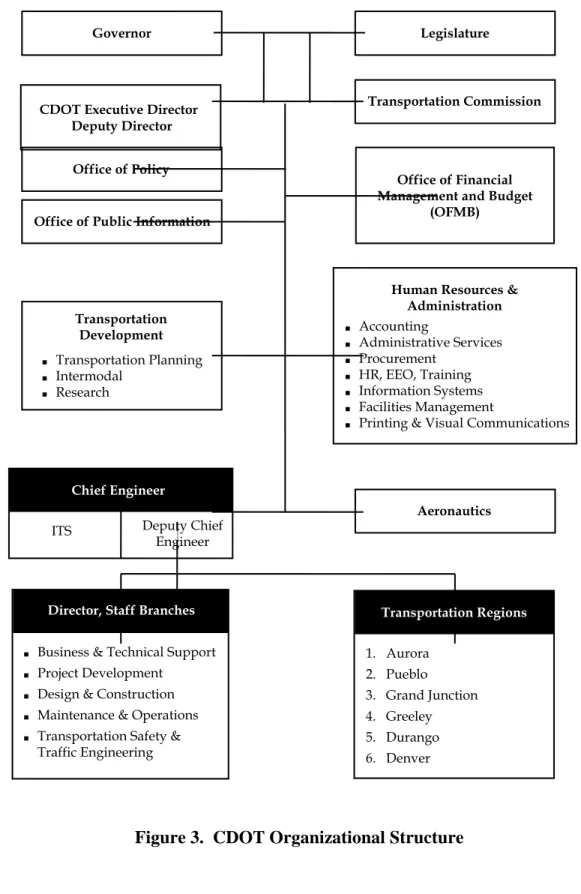
. The organizational structure of CDOT is depicted in Figure 3.Figure 3. CDOT Organizational Structure
Transportation Commission
Director, Staff Branches
■ Business & Technical Support ■ Project Development
■ Design & Construction ■ Maintenance & Operations ■ Transportation Safety &
Traffic Engineering Transportation Regions 1. Aurora 2. Pueblo 3. Grand Junction 4. Greeley 5. Durango 6. Denver
CDOT Executive Director Deputy Director
Governor Legislature
Chief Engineer ITS
Office of Policy Office of Public Information
Transportation Development ■ Transportation Planning ■ Intermodal ■ Research Office of Financial Management and Budget
(OFMB)
Human Resources & Administration ■ Accounting ■ Administrative Services ■ Procurement ■ HR, EEO, Training ■ Information Systems ■ Facilities Management
■ Printing & Visual Communications
Aeronautics
Deputy Chief Engineer
17
• The Executive Director provides overall direction and management of the Department. He or she is assisted by the Deputy Director.
• Assisting and reporting to the Executive Director and the Deputy Director are the Directors of the following offices: Policy (responsible for political liaison and policy analysis support), Financial Management and Budget (OFMB), and Public Information.
• Also reporting to the Executive Director and the Deputy Director are the heads of four CDOT divisions:
− Division of Engineering & Maintenance, headed by the Chief Engineer. This division is responsible for engineering services provided by the central and the Regional offices, as explained further below.
− Division of Transportation Development (DTD), headed by a Director responsible for transportation planning, promotion of intermodal transportation, Departmental conformity with the Clean Air Act, collection of federally required traffic and road inventory data, and research.
− Division of Aeronautics, headed by a Director responsible for administering Aviation Fund revenue, assisting with Federal Aviation grants, providing technical and administrative assistance to Colorado’s Aeronautical Board, and facilitating refunds of taxes to governmental units operating public-use airports.
− Division of Human Resources and Administration, headed by a Director responsible for employee services, equal opportunity, procurement, information systems, accounting, facilities management, training, and printing and visual communications.
• The Division of Engineering & Maintenance encompasses a number of functions and services:
− The Director, Staff Branches, oversees CDOT central office branches that provide technical expertise and program guidance in roadway and bridge design, construction,
18
maintenance and operations, safety, right-of-way, environmental services, and materials testing.
− The Chief Engineer and his/her deputy oversee the activities of the Staff Branches and the construction and maintenance activities in Colorado’s six transportation Regions (discussed below).
− The Intelligent Transportation Systems (ITS) Program oversees departmental implementation of ITS technology.
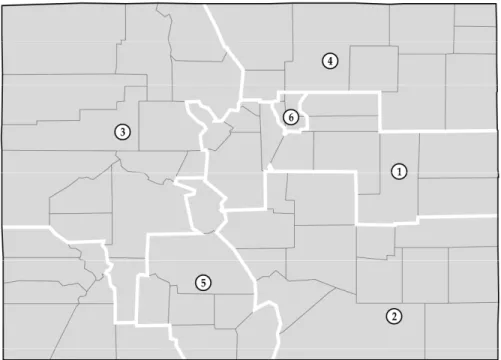
• CDOT delivery of projects and services and liaison with regional planning bodies and other local constituencies is handled organizationally through six CDOT
Transportation Regions, as shown in Figure 4. Each Region is headed by a Regional Transportation Director (RTD), who oversees assigned engineering and maintenance/operations staffs.
Figure 4. CDOT Transportation Regions
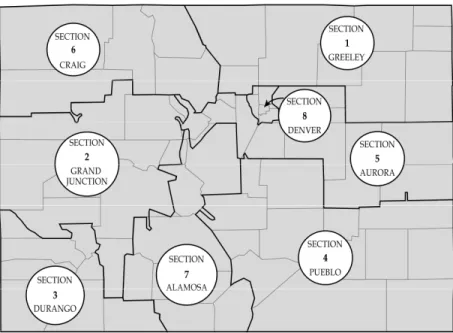
• CDOT maintenance forces within each Region are organized within maintenance sections that are part of the Regional organization, as shown in Figure 5.
19
Figure 5. CDOT Maintenance Sections
Transportation Commission
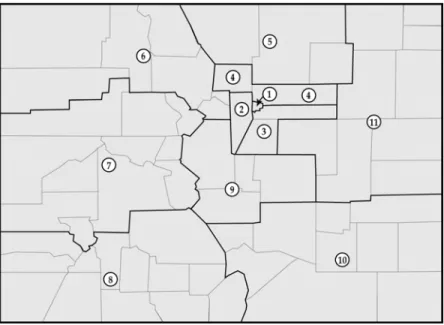
. The Transportation Commission formulates policy and provides guidance to CDOT regarding the construction, maintenance, and management of state highways and transportation systems. The Transportation Commission comprises 11 members who are appointed by the Governor and confirmed by the Senate for staggered four-year terms. Each commissioner represents one of the 11 districts shown in Figure 6. The role of the Transportation Commission in establishing transportation policy and providing overall guidance is exercised in a number of ways. The Transportation Commission meets monthly with CDOT executives and managers to review program status, provide overall program direction and priorities, and adopt CDOT programs and budgets. Policy directives and guidance are issued from time to time, and examples will be given shortly. The Transportation Commission also advises the Governor and the General Assembly on transportation policy.At a strategic level, the Commission meets with CDOT executives at two- to three-year intervals to review systematically the 20-year planned allocation of resources among programs, to re-examine and update policies and program priorities, and to explore tradeoffs in proposed funding among programs. Descriptions of the structure and
20
Figure 6. Transportation Commission Districts
composition of CDOT transportation programs that define the potential options that can be considered in these tradeoffs are given in later sections.
Statewide Transportation Assets
. CDOT now manages programs and pass-through funding that encompass a number of transportation assets: roads and bridges, transit and rail track and facilities, airports, and bicycle and pedestrian ways. These assets are reviewed below in terms of Transportation Commission policies and CDOT responsibilities to identify the scope and focus of the transportation assets that are addressed in this report. • State highways constitute the primary state-owned transportation assets under thejurisdiction of CDOT, as discussed in Section 1.0.
• The Transportation Commission has identified criteria for determining State Significant Rail Corridors. It has also formulated a Rail Corridor Preservation Policy that could result in CDOT “ownership” of either abandoned rail lines or rights-of-way for proposed new rail lines to mitigate abandonment of existing service or to preserve future transportation options in an existing corridor. This policy currently results in CDOT ownership of one rail line, which is now leased to an operating company.
21
• Transit services in Colorado are provided by local or regional operators to meet the needs of the general public in urban, rural, intercity, and resort areas/routes, and to provide specialized services for elderly and disabled riders. CDOT does not provide any state funds for transit, but administers federal funds to transit operators serving rural areas and elderly and disadvantaged populations. In the context of Section 1.0, transit overall is a mode of “state interest” to CDOT.
• The Transportation Commission and CDOT view bicycle and pedestrian ways as integral components of the state’s multimodal transportation system. Routes designated by the Transportation Commission as High-Priority Bicycle Corridors provide a focus for CDOT funding of shoulder improvements or resurfacing when highway/bridge construction, rehabilitation, or widening projects are scoped. Bicycle and pedestrian projects may also be included in Regional Priorities funded by CDOT.
• Colorado’s commercial and general aviation airports are owned and operated by local governments, with funding assistance from both federal (Federal Aviation Administration, or FAA) and state (Colorado Aeronautical Board) grants. Airports are of state-interest to CDOT given the importance of air transportation to the local economy, mobility, and accessibility of locations throughout the state. CDOT provides technical and planning assistance to the Aeronautical Board and local and regional agencies regarding airport needs.
• Movement of information within a multimodal context is interpreted by the Transportation Commission to apply specifically to Intelligent Transportation Systems (ITS) technology and to modern communications and information linkages among CDOT buildings and operations centers.
The focus of this report is primarily on the state highway assets for which CDOT has ownership and operating responsibility and which represent significant shares of CDOT programs and budgets. Investments and service improvements in the highway network are assumed to include associated improvements in pedestrian and bicycle facilities or ITS devices where appropriate, as well as rail corridor preservation actions that may relate to a
22
highway corridor. Asset management decisions affecting highways will also affect the quality of transit service that can be provided by transit operators, and the accessibility of aviation facilities to passenger and freight motorists.
2.2
Transportation Policies and Program Structure
CDOT Mission and Statewide Transportation Policies
. The Colorado Transportation Commission from time to time issues policy directives to guide CDOT program decisions and priorities and to articulate the underlying values that CDOT stands for and pursues in its daily work. Policy Directive 14, adopted in 1996, defines CDOT’s mission “to provide the best multimodal transportation system for Colorado that most effectively moves people, goods, and information.” Policy directive 14 also enumerates a set of values to guide CDOT in fulfilling its mission: e.g., to provide leadership in transportation while working in partnership with others, to strive for quality while taking pride in self and in work and seeking to improve personal skills and talents, to use resources wisely, and to make decisions that are compatible with Colorado’s quality-of-life, environmental, and economic goals.These value statements reiterate many key precepts of the comprehensive Statewide Transportation Policies that were adopted by the Transportation Commission in Policy Directive 13 (1994). The essential principles of these statewide policies are summarized below:
• Customer Focus – Strengthen outreach and communication to the public, and solicit and respond to views of those affected by transportation performance, improvements, and financing;
• Leadership – Bring together varied interests, and apply CDOT’s statewide perspective and expertise to reach optimal transportation solutions together;
23
• Management of the Transportation System – Facilitate the efficient movement of people, goods, information, and services through a unified transportation system, considering the full range of alternatives to meeting customer needs;
• Intermodalism – Develop a balanced transportation system that meets the needs of diverse sets of customers by taking advantage of the efficiencies of appropriate modes, and by ensuring connectivity and interaction among these modes;
• Partnership – Form partnerships (both formal and informal) to leverage CDOT’s limited resources and to tap new sources of support for transportation development; • Integrate Regional and Statewide Priorities – Collaborate with partners to integrate
local, regional, and statewide transportation priorities;
• Finance – Pursue diverse, cooperative funding mechanisms that are reliable, equitable, flexible, adequate, and acceptable; enhance financial management to provide cost accountability for achieving target benchmarks;
• Safety – Promote transportation safety to road users and workers through education, engineering, and enforcement;
• Balance Quality of Life Factors – Work with local, regional, and state interests to balance the long-range transportation, land use, and quality of life needs in meeting objectives of mobility, economic vitality, and environmental preservation;
• Environment – Promote a transportation system that is environmentally responsible in its planning, design, construction, maintenance, and operation; consider all reasonable alternatives to avoid or minimize adverse effects;
• Accessibility – Promote a transportation system that is accessible to users, including the transportation disadvantaged; accessibility encompasses choice of modes, good connections, ease of use, relative cost, and proximity and frequency of service; and
24
• Social Responsibility – Provide a safe, healthy, nondiscriminatory work environment for employees; follow fair business practices; keep the public welfare continually in mind in making decisions.
Many of these policy statements echo themes that are also identified with principles of good asset management. The issue in outlining an asset management plan then becomes one of how these policies are translated into specific program elements and procedures used by CDOT.
To develop this information, we first summarize below the categories of existing transportation programs managed by CDOT, their objectives, and relative priority. Commission policies and guidelines regarding these programs will also be discussed, since collectively these define key elements of CDOT’s existing decision-making culture regarding transportation asset management.
A unique approach pioneered by CDOT has been to define “Investment Categories” that impose a policy- and performance-oriented view of transportation programs, and that enable the Department to analyze cross-program tradeoffs serving a particular objective. Discussion of these program elements is followed by overviews of the CDOT planning and program development processes, mechanisms and management of program delivery, and decision support provided by management systems and related databases.
Statewide Programs
. State and federal funds are distributed among several programs managed by CDOT that address statewide transportation needs. These funded statewide programs are listed in Table A, identifying for each program the scope of work, applicable program goals or targets, and remarks on sunset provisions or plans for further development of program elements such as analytic models. The nature of program goals or targets is identified where applicable as performance-based (i.e., reflected in a measurable characteristic of the transportation system), financial (i.e., based upon an annual expenditure level approved by the Transportation Commission and reflected in Colorado’s Statewide Transportation Plan), or both. Certain programs respond to specific requirements of the federal Intermodal Surface Transportation Efficiency Act (ISTEA) of 1991 or the25
Transportation Equity Act for the 21st Century (TEA-21) of 1998, as noted. Management system support of program performance measures and project selection decisions are identified regarding CDOT’s pavement management system (PMS) and Pontis® bridge management system (BMS).
Table A. Funded Statewide Programs
Program Title and Scope Goals or Targets, Other Remarks
Strategic Transportation Investment Program (“7th Pot”)
28 long-term, high-priority transportation projects
Strategic projects selected by Transportation Commission for accelerated funding and completion
Surface Treatment Program
Resurfacing and rehabilitation of state highway pavements
Performance-based goal of at least 60 percent of pavements statewide in good or fair condition; individual condition targets defined by highway system; performance-based project selection performance-based on PMS estimates of remaining service life Bridge Program
Bridge rehabilitation or replacement to address structural and functional deficiencies
Financial targets established for
rehabilitation and replacement of on-system bridges and inspection of on- and off-system bridges; future enhancements to Pontis® BMS models/usage will allow performance-based goals in terms of structural and functional sufficiency related to funding needs; performance-based project selection assisted by Pontis® BMS
Rest Area Program
Rehabilitation, reconstruction, or relocation of existing rest areas
Financial targets established for work on priority rest areas; program to sunset in FY 2004 when completed
Noise Barrier Program
Installation of noise barriers to address significant noise impacts on federal highways
Financial targets established for identified locations; due to sunset in FY 2002 when completed
26
Table A. Funded Statewide Programs (continued)
Program Title and Scope Goals or Targets, Other Remarks
Small Urban Program
Funding for Small Urban Areas to fulfill Transportation Improvement Program (TIP) commitments
Transition program to cushion impact of ISTEA’s elimination of Federal Aid Urban System (FAUS) funding; financial targets established and distributed by population-based formula; program to sunset in 2004 Safety Program
Highway feature improvements and driver behavior and enforcement programs to reduce accident rates and increase seat belt use
Performance-based reduction in motor vehicle crashes, injuries, and fatalities on the state highway system tied to financial targets
Maintenance Program
Maintenance services for roadways, bridges, roadsides, tunnels, snow and ice control, traffic appurtenances, rest areas
Performance-based target levels of service set by Transportation Commission
corresponding to projected facility condition and degree of response to storms or
incidents Operations Program
CDOT administrative and engineering operations: e.g., administration, aeronautics, program support, transit support, workers compensation insurance, gaming funds, CDOT equipment and property, engineering program, etc.
Funding levels set by Transportation Commission to deliver programs, maintain CDOT facilities, etc.
Intelligent Transportation Systems (ITS) Installation, integration, and maintenance of ITS technology, including the Traffic Operations Center and the Colorado Transportation Management System
Financial targets established and tied to priority projects/locations.
The Strategic Transportation Investment Program is listed first in Table A. This program addresses projects of significant, long-term importance in which major mobility, safety, or