OATAO is an open access repository that collects the work of Toulouse
researchers and makes it freely available over the web where possible
Any correspondence concerning this service should be sent
to the repository administrator:
[email protected]
This is an author’s version published in:
http://oatao.univ-toulouse.fr/26624
To cite this version:
Denand, B. and Esin, V.A. and Dehmas, M.
and Geandier, G. and Denis, S. and Sourmail, T. and Aeby-Gautier,
E.
Carbon content evolution in austenite during austenitization
studied by in situ synchrotron X-ray diffraction of a hypoeutectoid
steel.
(2020) Materialia, 10. 100664. ISSN 25891529
Full Length Article
Carbon
content
evolution
in
austenite
during
austenitization
studied
by
in
situ
synchrotron
X-ray
diffraction
of
a
hypoeutectoid
steel
B. Denand
a,c,∗, V.A. Esin
b, M. Dehmas
d, G. Geandier
a,c, S. Denis
a,c, T. Sourmail
e,
E. Aeby-Gautier
a,caInstitutJeanLamour,UMR7198CNRS,Université deLorraine,Nancy,France
bMINESParisTech,PSLUniversity,CentredesMatériaux(CMAT),UMR7633CNRS,Evry,France
cLaboratoryofExcellenceforDesignofAlloyMetalsforLow-massStructures(‘DAMAS’Labex),Université deLorraine,France dCIRIMAT,Université deToulouse,CNRS,Toulouse,France
eAscometal-CREAS(ResearchCentre),Hagondange,France
a
r
t
i
c
l
e
i
n
f
o
Keywords:Austenitization
InsitusynchrotronX-raydiffraction Latticeparameter
Carboncontent Thermo-Calc
a
b
s
t
r
a
c
t
UsinginsituhighenergyX-raydiffractionstudyofausteniteformationinhypoeutectoidsteelwiththree differ-entinitialmicrostructures(ferrite-pearlite,temperedmartensiteandbainite),thelatticeparametersofferrite, cementiteandausteniteareexaminedonheatingat0.25,10and100°C/s.
Thelatticeparametersofferrite,cementiteandaustenitedonotvarylinearlywiththetemperature,especially, inthetemperaturerangewheretheaustenitizationtakesplace.Fortheaustenite,itissuggestedthatthedeviation fromthelinearityismainlyassociatedtothecarboncontentvariation.UsingDysonandHolmesequation,the carboncontentinausteniteisevaluatedforanymomentoftheausteniteformationforeachinitialmicrostructure andallheatingrates.
Fortheferrite-pearlitemicrostructureheatedat0.25°C/s,thecarboncontentinausteniteaftercomplete cementitedissolutioncorrespondstothatofpearlite.Moreover,arapiddecreaseincarboncontentintheaustenite isobservedduringthefirststageoftheaustenitization(simultaneousdissolutionofferriteandcementite)followed byaslowfurtherdecreaseduringthetransformationoftheremainingferrite.Theobtainedresultsarediscussed usingthermodynamiccalculations.
1. Introduction
Theservicelifeofcrankshaftsforautomotive industrycan be in-creasedbysurfacehardeningvia aninduction heattreatment [1,2]. Suchalocalheattreatmentleadstoaformationofaustenitecloseto thesurfacewhichfurthertransformsintomartensiteuponsubsequent quenching.Therefore,theresultingsurfacelayerhasahigherhardness incomparisonwiththatofthebulk.Inaddition,retainedcompressive stressesaregeneratedinthesurfacelayer(mainlyduetothemartensitic transformationinthatarea),optimalforthepropertiesofcrankshafts use[3].
Therequiredheattreatmentshouldbefastenoughtolimitthe vol-umeofthematerialtransformedintoaustenite(closetothesurface)on heating.Typicalheatingratesvaryfrom30toover100°C/s.Inthese conditions,theinitialmicrostructureofthesteelmayaffectthe austeni-tizationkineticsduetodifferencesininterfacemigrationandinterstitial andsubstitutionalelementsredistributionindifferentmicrostructures. Evenforafullyausteniticlayer,thechemicalcompositionmaypresent localheterogeneitiesduetoinitialmicrostructurefeaturesleadingthus
tolocaldifferencesinfinalmicrostructurewithdifferentlocal mechani-calproperties.Itisworthnoting,thatmostofinvestigationsreportedin literaturehavebeencarriedoutontheaustenitizationofsteelswith ini-tialferrite-pearlitemicrostructure[4–14].Theanalysisofaustenite for-mationforthesamesteelhavingdifferentinitialmicrostructuresandfor differentheatingratesisoftechnologicalandfundamentalimportance. Inthis scope,ourprevious studyreportedon thekineticsof austen-iteformationconsideringthreeinitialmicrostructures(ferrite-pearlite, temperedmartensiteandbainite)ofthesamehypoeutectoidsteeland fiveheatingrates(0.25,1,10,60and100°C/s)[15].TheuseofHigh EnergysynchrotronX-RayDiffraction(HE-XRD)[16]allowedto char-acterizethephasefractionevolutionofallphasesandhighlightedtwo stepsintheausteniteformation[15]:(i)thesimultaneous transforma-tionofferriteandcementiteintoaustenite,and(ii)thetransformationof theremainingferriteintoaustenite.Foragivenheatingrate,thekinetics ofeachstepwasshowntobedependentontheinitialmicrostructure.
Inadditiontothenatureandamountofphasesformed,theRietveld refinementofdiffractionpatternsgivesalsoinformationaboutthe lat-ticeparametersandwidthsofdiffractionspeaksfordifferentphasesfor
∗Correspondingauthorat:InstitutJeanLamour,UniversitédeLorraine,CNRS,UMR7198,54011NancyCedex,France.
Table 1
Chemicalcomposition(wt.%)ofthe37MnCr4-3steelused.
Fe C Si Mn S Ni Cr V Mo Cu Al
Bal. 0.356 0.253 1.285 0.024 0.208 0.652 0.005 0.065 0.172 0.018
anymomentduringheatingandtheausteniteformation.Togetinsight intothetransformationfeatures,thepresentpaperfocusesonthe evo-lutionoflatticeparametersofaustenite,ferriteandcementitetobeable toestimatethecarboncontentevolutionsinthephases.
It is worth noting that a recent studyattempted to analyze the evolutionof austenitelatticeparameterduringaustenitizationof the same50CrMo4steelhavingferrite-pearliteandsoftannealedinitial mi-crostructuresclosetoequilibriumstate[14].InsituHE-XRDwasused onheatingwiththeratesof1,10and100°C/s.Adecreaseinaustenite latticeparameterwasobservedatthebeginningof theaustenite for-mationuntilaminimumvaluefollowedbyfurtherlinearincreasewith temperature.Suchachange inaustenitelatticeparameterwas quali-tativelyattributedtotheevolutionofaustenitechemicalcomposition. However,anyattemptwasnotdonetoquantifyaustenitecarbon con-tentorlatticeparameterevolutionofferritecementiteandaustenite, andonlypossibleexplanationsweregiven.
InthepresentworkanaccurateanalysisofX-raydataiscarriedout usingRietveldrefinement.Differentassumptionsconcerningthe evolu-tionoflatticeparametersofferrite,cementiteandausteniteare care-fullyanalyzedtobeabletoobtaintheaustenitecarboncontentatany momentofthetransformationfordifferentheatingrates.Besides, non-equilibriumtemperedmartensiteandbainitemicrostructuresare inves-tigatedtogetherwithferrite-pearliteinitialmicrostructure.
2. Material
Thesteelusedinthepresentworkisa37MnCr4-3,whichwas man-ufacturedbyAscometalCREAS.Thechemicalcompositionwas charac-terizedonforgedbarsusingopticalemissionspectrometryand combus-tion(LECO)analysisforaccuratemeasurementsofcarbonandsulphur contents(Table1).Thesteelwasmadeavailableashotforgedbarsof approximatediameter40mm.Detailsofthefabricationprocesshave alreadybeenreportedin[15].
Toproducedifferentinitial microstructures,theforgedbarswere austenitizedat850 °Cfor1handfurthersubjectedtodifferentheat treatments.These thermal treatments have already been detailedin [15],butwillneverthelessbesummarizedforeaseoflegibility.To ob-tainferrite-pearliteinitialmicrostructure,thesteelwasaircooledfrom austenitizingtemperaturedownto625°Candheldatthistemperature for1h.Thetemperedmartensiterequiredoilquenchingatroom tem-peraturefromaustenitedomainfollowedbyatemperingat500°C dur-ing1h.Thebainitemicrostructurewasobtainedduringanisothermal soakinginasaltbathat450°Cduring30minafteraustenitizing.
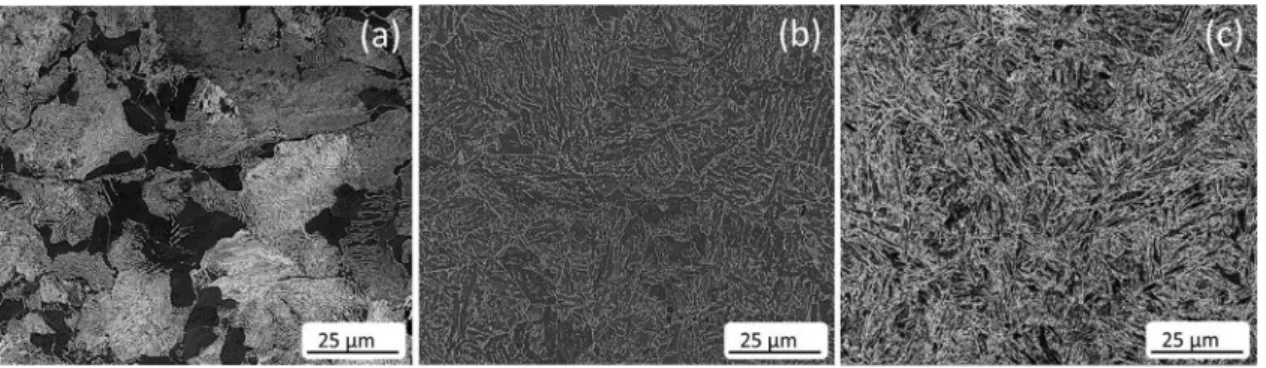
Thesamplesusedinthisstudyweretakenatthemidradiusofthe barsforeachinitial microstructurein ordertoavoid decarburization phenomenonatthesurfaceofthesebars.Theseinitialmicrostructures obtainedbyScanningElectronMicroscopy(SEM)arepresentedinFig.1. Fig.1(a)showstheinitialferrite-pearlitemicrostructurewhereblack regionsarethefreeferriteandgreyregionsarethepearlite.Volume frac-tionofferriteandpearlitecanbedeterminedbyimageanalysisbased oncontrast threshold.Themeanphase fractionobtainedforthefree ferriteis20%andthatforthepearliteis80%.Theinterceptsmethod allowedustoestimatethesizeofmeanpro-eutectoidferritegrainsto beof10μm.Fortheinitialtemperedmartensiteandbainite microstruc-tures(Fig.1(b)and(c)),itwasnotpossibletodistinguishthedifferent phasesbySEM.
HE-XRDanalysisrevealedthepresenceofabout2–3wt.%of cemen-titeforthethreeinitialmicrostructuresand3wt.%ofretainedaustenite inthebainiticmicrostructure.
3. Experimentaltechniques
Experiments were carried out at the Deutsches Elektronen-Synchrotron(DESY,Hamburg,Germany)onthebeamlineP07 of PE-TRAIII.ADIL805A/DdilatometerfromTAInstrumentwasusedto ap-plythethermal treatments.Threelinearheatingrates (0.25,10 and 100°C/s)wereimposeduntil900°Cfollowedbygasquenching.
Thesampleswerehollowcylindersof10mmlengthwhosethe ex-ternaldiameterwas4mmandthethicknesswas0.5mminorderto reduceradialthermalgradient.
Induction heatingwasemployed duringtheexperiments and the temperaturewascontrolledusingS-typethermocouplecentrallywelded atthesurfaceofthehollowcylinder.Inordertohaveagood correla-tionbetweenthetemperatureacquisitionandtheDebye-Sherrerrings recordedduringthethermaltreatment,theX-raybeamcrossedthe sam-pleintheareaclosetothermocouple.TheDebye-Scherrerringswere ob-tainedbyusingamonochromaticbeamof100keVand2Dimageplate detectorsituatedatabout1.5mawayfromthesample.Apreliminary calibrationwithCeO2powderwascarriedouttodeterminethevalues
requiredforfurtherX-raydataanalysissuchasthedistancebetweenthe sampleandthedetectororthewavelengthwhichwas0.123984Å inthis case.Thebeamsizeof1.0×1.0mm2allowedgettingareasonablygood resolutionandfastacquisitiontimeforthehighheatingrates.Indeed, twomodeswereemployedtothediffractionpatternrecording:aslow modewithanacquisitiontimeof3.5sfortheheatingrateof0.25°C/s andafastmodewithanacquisitiontimeof0.1sfortheheatingratesof 10and100°C/s.Fortheslowmode,theacquisitiontimeincludedthe shutteropeningandclosing,theacquisitionofexternalparameterasthe temperature,andthedataerasingfromthedetector.Inthefastmode, theshutteropenedatthebeginningoftheexperimentandclosedatthe end;anyexternalparameterwasnotrecordedduringtheacquisition.
Thefastmodeledthustoanuncertaintyintemperaturevaluewhich canbecalculatedasΔ𝑇=±0.1 × 𝑉ℎ,whereVh(°C/s)istheheating rateand0.1(s)istheacquisitiontimeinfastmode.
Itisworthnotingthatforthepresentstudythreeheatingrateswere selected:0.25,10and100°C/swhile1and60°C/sheatingrateswere usedaswellinthestudyonaustenitizationkineticsinthesamesteelin [15].
TheDebye-Scherrer ringsgiveinformationonthesample crystal-lographyatanymomentduringthethermalpath.Thecomplete inte-grationoftheseringsleadingtoconventional1-Ddiffractogramswere madeusingtheFit2Dsoftware.Then,thediffractogramswereanalyzed byRietveldrefinement[17,18]withtheFullProfsoftware[19].
ThestartingstructuresfortheRietveldanalysisconsistedofferrite andcementitefortheinitialferrite-pearliteandtemperedmartensite microstructures,andofferrite,cementiteandaustenitefortheanalysis ofthebainiticmicrostructure.Moredetailsconcerningtheprocedureof Retvieldrefinementcanbefoundin[15]
ForeachXRDpattern,thefollowingparameterswererefined:scale factors,massfractions,FWHM(fullwidthathalfmaximum)andlattice parameters.
4. Results
Thekineticsofausteniteformationasfunctionofinitial microstruc-ture andheatingratewasreportedin detailsin[15].Werecallhere themainresultsandconclusionsrequiredforthefurtheranalysisofthe latticeparametersevolutions.
B.Denand,V.A.EsinandM.Dehmasetal.
Fig. 1. Initial(a)ferrite-pearlite,(b)bainiteand(c)temperedmartensitemicrostructuresoftheinvestigatedsteelasobservedbySEM(standardmetallography preparationand2%Nitaletching).
Table 2
Thetemperaturesofthestart(AC1)andend(AC3)ofausteniteformationonheatingaswellasthetemperatureoftheendofthefirststageofausteniteformation (T1)accordingtothedataobtainedfromHE-XRDexperimentsin[15]fordifferentinitialmicrostructuresandheatingrates.
Heatingrate(°C/s) Ferrite-pearlite Temperedmartensite Bainite
AC1(°C) T1(°C) AC3(°C) AC1(°C) T1(°C) AC3(°C) AC1(°C) T1(°C) AC3(°C)
0.25 740 753 790 736 758 774 736 763 770
10 761 792 822 743 763 779 741 769 790
100 781 843 854 753 788 810 743 789 810
Table 3
Volumecoefficientofthermalexpansionofcementiteinthetemperaturerangefrom450to600°C,andlinearcoefficientofthermalexpansionofferriteandaustenite inthetemperaturerangewherenotransformationoccurs.
Coefficientofthermalexpansion(10−6K−1) Initialmicrostructure Literaturedata
Ferrite– pearlite Bainite Temperedmartensite
Volume,cementite 54 56 54 46[25],58[26]
Linear,ferrite 16.4 16.2 16.1 14–16[20,21],16.3[23],16.8pureiron[23],16[25]
Linear,austenite 24.7 24.9 24.4 20–23[20],24[21]
Thetemperaturerangeofausteniteformationonheatingfor differ-entconditionsisgiveninTable2.Inordertoobtainagoodconfidence onthesetemperatures,thestartofaustenitization(AC1)istakenfora
massfractionof3%ofaustenitecreatedandtheferritedissolutionis consideredascompleted(AC3)for95%ofausteniteformation.
ThedatareportedinTable2clearlyevidencethatthe transforma-tionkineticsisdependingontheinitialmicrostructure,mainlythesize ofthedifferentmicrostructureconstituents[15].Thephasefraction evo-lutionsshowtwostagesinthekineticsofausteniteformation.Thefirst onecorrespondstothesimultaneousdissolutionofferriteand cemen-tite;thesecondonetothedissolutionoftheremainingferrite.The tem-peratureoftheendofthefirststage(T1)isrecalledinTable2.This
temperatureisdependentontheinitialmicrostructureandheatingrate anditsvariationwasattributedtodifferentsizeofcementiteparticles indifferentinitialmicrostructures[15].
Togetherwithphasefractions,theresultsofRietveldrefinement in-formaboutevolutionofthemeanlatticeparametersofferrite,cementite andaustenite.Thosearefurtheranalyzedanddiscussedconsideringthe differentoriginsoflatticeparameterevolution:thetemperature varia-tion,theelasticstrainsand/orthevariationofchemicalcompositionof differentphasesduringaustenitization.
4.1. Meanlatticeparametersonheating
Thevariationofmeanlatticeparametersofferriteandaustenite dur-ingheatingwitharateof0.25°C/sisgiveninFig.2forthethreeinitial microstructures.Forcementite,thechangeinunitcellvolumeon heat-ingisreportedinFig.3forthesameconditions.Thevaluesofapparent coefficientsofthermalexpansion,obtainedinthetemperatureranges
wherenotransformationoccurred,aresummarizedinTable3forall phases.1
Fortheferrite-pearliteandtemperedmartensiteinitial microstruc-turesthatcontainamixtureofferriteandcementite,themeanlattice parameterofferriteincreaseslinearlywithtemperatureupto735°C. Between735°Candaround760°C,inthefirststageoftheaustenite formation,themeanlatticeparameterofferriteslightlydeviatesfrom thelinearbehavior,withadecreaseintheapparentCoefficientof Ther-malExpansion(CTE).Above760°C(Fig.2(b)),inthesecondstageof thetransformation,thelatticeparameterofferritedecreaseswitha neg-ativeapparentCTE.Forbothferrite-pearliteandtemperedmartensite microstructures,theunit cellvolumeof cementiteincreaseswith in-creasingtemperature:alinearbehaviorisonlyobservedbetween450 and735°C(Fig.3).Above735°Cwherecementitedissolutionoccurs, adecreaseintheunitcellvolumeofcementiteisobserved.Forthe bai-nitemicrostructure,theinitialstatecontainsamixtureofthreephases (ferrite,cementiteandretainedaustenite).Duringtheheatingbetween 240and410°C,thetransformationofretainedausteniteintoferriteand cementiteoccurs.Between410and735°C,theamountofferriteand cementiteremainsconstant.Nevertheless,themeanlatticeparameters offerriteandcementitehavealmostasimilarevolutionthantheone obtainedforferrite-pearliteandtemperedmartensitemicrostructures.
1Thevolumethermalexpansioncoefficientsofcementiteweremeasuredin thetemperaturerange450–600°Cfortworeasons:(i)thesestemperaturesare higherthancementiteCurietemperature(Tc≈227°C)[20](magnetictransition hasasignificanteffectonthethermalexpansioncoefficientinatemperature rangeofabout200°CaroundTc);(ii)fortheinitialbainitemicrostructuresome transformationoftheretainedausteniteoccurredfortemperatureslowerthan 450°Candmayaffecttheapparentthermalcoefficientofcementite.
Fig. 2. Meanlatticeparametersofferriteandausteniteonheatingwithaheatingrateof0.25°C/sforinitialmicrostructuresofferrite-perlite(solid),bainite(dashed) andtemperedmartensite(dotted):(a)before,duringandafteraustenitizationand(b)zoomtothetemperaturerangewheretheausteniteformationoccurs.
Fig. 3. Unitcellvolumeofcementitebeforeandduringaustenitizationwitha heatingrateof0.25°C/sforinitialmicrostructuresofferrite-pearlite(blue), bai-nite(red)andtemperedmartensite(black).(Forinterpretationofthereferences tocolorinthisfigurelegend,thereaderisreferredtothewebversionofthis article.)
Fortheevolutionofaustenitelatticeparameter, twotemperature rangesshould bedistinguished:(i)above730°C whereamixture of ferriteandcementite transforms intoaustenite (ferrite-pearlite, tem-peredmartensiteandbainitemicrostructures),and(ii)between240and 410°Cwhereretainedaustenitetransformsintoferriteandcementite (bainitemicrostructureonly).
Acomplexnon-linearevolutionofaustenitelatticeparameterwith temperatureisobservedduringtheferrite+cementite→austenite trans-formationwhatevertheinitialmicrostructure(Fig.2(b)).Asignificant decreasein austenitelatticeparameteris observedbetween 735and 760°C,duringthefirststageofthetransformation.Above760°C, dur-ingthesecondstageofthetransformation,theaustenitelattice param-eterincreases.TheCTEofausteniteincreasesuntilreachingaconstant valueof25×10−6K−1oncethetransformationiscompleted.
Forinitialbainiticmicrostructure,theCTEofretainedaustenite ob-tainedbetweenroomtemperatureand240°Cisequalto21×10−6K−1
whichislowerthantheCTEmeasuredaftercompleteaustenitization, couldindicatethattheretainedausteniteisunderacompressivestress
state[27].Above240°C,theapparentCTEincreasesupto41×10−6K−1
wheretheretainedaustenitetransformsintoferriteandcementite. Inthetemperatureranges whereno transformationoccurred,the coefficientsofthermalexpansionobtainedfortheferrite,cementiteand austeniteareingoodagreementwiththosefoundinliterature(Table3, [20–26]).
Asimilarevolutionofferrite,cementiteandaustenitelattice parame-terswithtemperaturewasobservedforheatingratesof10and100°C/s forthedifferentinitialmicrostructuresasillustratedforferrite-pearlite microstructureinFig.4.
Thecomplexvariationsofmeanlatticeparametersofeachphasecan beduetoseveralfactors:changeintemperature(thermalexpansion), elasticstrainandchangeinchemicalcomposition.Asthetemperature wasmeasuredallalongtheexperimentandthermalgradientswere neg-ligible,thosevariationscanbefurtheranalyzedsubtractingthethermal contributionusingthedatareportedinTable3.
4.2. Ferriteandcementitelatticeparametersbeforethe ferrite+cementite→austenitetransformation
First,themeanlatticeparameterofferriteobtainedonheatingfor the threeinitial microstructuresis comparedwith thatof pureiron, heated on the same apparatusand in the same conditions (Fig. 5). Theabsolutevaluesofferritelatticeparameterforthethreeinitial mi-crostructuresareslightlydifferentandareslightlylowerascompared tothelatticeparameterofferriteinpureiron.Thosedifferencescanbe attributedtodifferencesinchemicalcompositionoftheferriteaswell astointernalstresses.
The differences in CTE of ferrite in comparison with pure iron are within 3.6% above 450 °C (16.4 × 10⁻⁶ K−1 in ferrite-pearlite
microstructure, 16.2 × 10⁻⁶ K−1 in the tempered martensite and
16.1×10⁻⁶K−1inthebainite,Fig.5).
Comparing cementite at room temperature in three initial mi-crostructuresandapurecementitepowder[28,29],themeanlattice parametersarequitesimilar(thedifferencesarewithin1%,Table4). Moreover,inthetemperaturerangebetween200and327°C,the vol-umeCTEofcementitereportedin[28]iscloseto42×10−6K−1,which
isingoodagreementwiththeCTEofcementiteobtainedforthethree initialmicrostructuresinthesametemperaturerange:42×10−6K−1for
temperedmartensiteandlowerthan48×10−6K−1forferrite-pearlite
microstructure.Forthetemperaturerangefrom450to600°C,the ob-tainedvolumeCTEofcementite(Table3)isingoodagreementwith literaturedata.
B.Denand,V.A.EsinandM.Dehmasetal.
Fig. 4. Ferrite(black)andaustenite(blue)latticeparametersand cementiteunitcellvolume(green)asfunctionoftemperaturein ini-tialferrite-pearlitemicrostructureonheatingwithdifferentheating rates.(Forinterpretationofthereferencestocolorinthisfigure leg-end,thereaderisreferredtothewebversionofthisarticle.)
Fig. 5. Comparisonofferritemeanlatticeparameterbeforeausteniteformation forthethreeinitialmicrostructuresandforthepureironobtainedonheating witharateof0.25°C/s.InsettablegivesCTEobtainedfromtheexperimental curvesforthetemperaturesbetween450°CandAC1.
Table 4
Meanlatticeparametersofcementiteatroomtemperaturefordifferentinitial microstructuresofa37MnCr4-3steelincomparisonwiththoseforpure cemen-titepowder[28,29]. Microstructure a(Å) b(Å) c(Å) Ferrite-pearlite 5.0858 6.7374 4.5292 Bainite 5.0860 6.7420 4.5301 Temperedmartensite 5.0709 6.7295 4.5484 Cementitepowder[28] 5.0809 6.7530 4.5150 Cementitepowder[29] 5.0901 6.7456 4.5262
4.3. Meanlatticeparametersduringtheferrite+cementite→austenite transformation
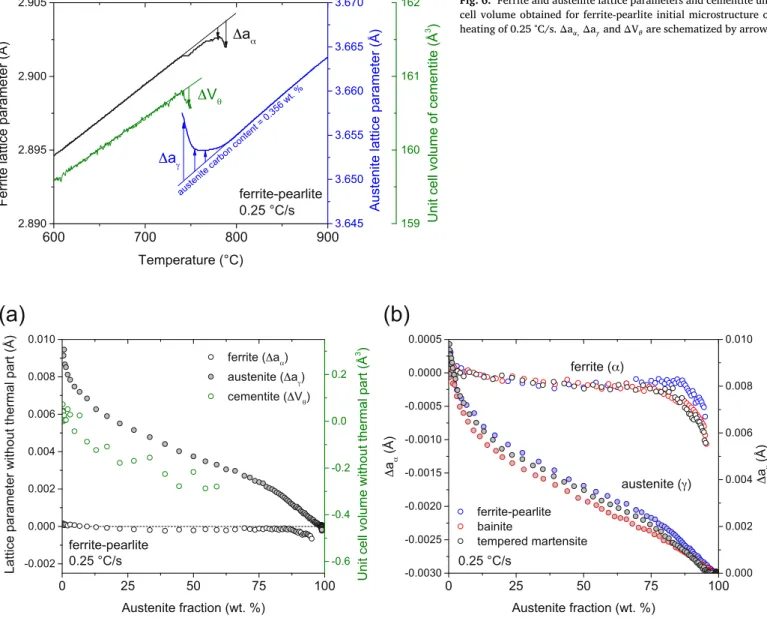
Inordertoanalyzethelatticeparameterevolutionsinthe transfor-mationtemperaturerangewithoutthethermalcontribution,the param-etersΔa𝛼,Δa𝛾andΔV𝜃 weredefinedasfollows:foreachphase,the
con-tributionduetothermalexpansionalonewasextrapolatedfrom temper-atureregionswherethisphenomenonwassoleactiveorpredominant, thedifferencewas thencalculated betweenactual measurementand thermalcontributionalone.ThisisschematicallyillustratedinFig.6.
ThiswasdoneassumingaconstantlinearCTEforferriteandconstant volumeCTEforcementitegiveninTable3.
Foraustenite,thevariationsoflatticeparameterwerecalculated tak-ingausteniteinthesingleaustenitedomainasareference.Thisisalso illustratedin Fig.6,wheretheextrapolatedchangesin austenite pa-rametersareshownasatangentlinetothemeasurementsforthehigh temperature,austenitedomain.
The resulting variationsof Δa𝛾, Δa𝛼 andΔV𝜃 areplotted versus austeniteweightfractioninFig.7(a)forferrite-pearlitemicrostructure andinFig.7(b)forallthreeinitialmicrostructures(Δa𝛾andΔa𝛼only).
Δa𝛼slightlydecreasesatthebeginningoftheausteniteformation andremainsnearlyconstantandequalto−1.5×10⁻⁴Å between20
and85wt.%ofaustenite.Adropto-1×10⁻³Å isobservedbetween85
and100wt.%ofaustenite,whatevertheinitialmicrostructure. TheΔa𝛾 variationsareoppositeinsigntothoseofferrite,andten timeslarger.Δa𝛾presentsthehighestvalueatthebeginningofthe trans-formation(0.01Å)andthendecreasesasausteniteamountincreasesto reach 0Å oncethetransformationiscompleted whatevertheinitial microstructure. Thedecrease is largerat thebeginningof the trans-formation.ΔV𝜃 decreases continuouslywithtransformationprogress. Themaximalvalueisnear−0.28Å3correspondingtoarelativevolume
changeof5.210−3.
Thedecreaseinthemeanlatticeparameterofferriteandcementite duringthetransformation,whichissmallbutsignificantcanbe associ-atedwiththedevelopmentofcompressivestresses[30]orwithachange initschemicalcomposition.
Sincetheaustenitehasalowyieldstressinthetemperaturerange wherethetransformationoccurs,thechangesinitslatticeparameters shouldbemainlyassociatedwithchemicalcompositionvariation.
4.4. Austenitechemicalcompositionduringaustenitization
Consideringonlythesoluteelementsinthestudiedsteel,weusedthe relationproposedbyDysonandHolmes[31],asdonein[32–34],forthe latticeparameteroftheausteniteasafunctionofchemicalcomposition (inwt.%)atroomtemperature:
𝑎𝛾 =3.5847+0.0330 × [C]+0.00095 × [Mn]−0.0002 × [Ni]
+ 0.0006 × [Cr]+0.0015 × [Cu] (1)
where3.5847Å correspondstotheaustenitelatticeparameterinthe pureironatroomtemperature.
UsingthecompositionprovidedinTable1,theaustenitelattice pa-rametercanbecalculatedto3.59789Å.Thisis0.01319Å greaterthan forpureiron,withacontributionof0.01175 ˚Aduetocarbonalone,and of0.00144 ˚Aduetothesubstitutionalelements.Giventhatthecarbon
Fig. 6. Ferriteandaustenitelatticeparametersandcementiteunit cellvolumeobtainedforferrite-pearliteinitialmicrostructureon heatingof0.25°C/s.Δa𝛼,Δa𝛾andΔV𝜃areschematizedbyarrows.
Fig. 7. Variationsofmeanlatticeparametersofferriteandaustenitewithoutthermalcontribution(Δa 𝜶andΔa 𝜸,respectively)andunitcellvolumeofcementite (ΔV 𝜽)asafunctionofausteniteweightfractiononheatingof0.25°C/sfor(a)ferrite-pearliteand(b)threeinitialmicrostructures.
influenceistherefore10timeslargerthanthatofthesubstitutional el-ements,thevariationsofΔa𝛾,maybeassumedtobemainlyrelatedto changesincarbonconcentrationinaustenite(Δwc𝛾).Thisisexplicited
inEq.(2):
Δ𝑎𝛾=𝐴× Δ𝑤𝑐𝛾 (2)
with𝐴=0.033∀∕wt.%[31].
UsingEq.(2)andconsideringthattheaustenite hasthenominal carboncontentofthesteel,wc0𝛾(Table1),oncetheaustenitizationis
completed,themeancarboncontentintheaustenite(wc𝛾)canbe esti-matedatanymomentofthetransformationusingthevariationoflattice parameteraftersubtractionofthermalcontributionΔa𝛾:
𝑤𝛾 𝑐=
Δ𝑎𝛾
𝐴 +𝑤𝑐0𝛾 (3)
TheresultofsuchestimationisgiveninFig.8forferrite-pearlite andtemperedmartensiteinitialmicrostructuresandfordifferent heat-ingrates.
Whatevertheconsideredinitialmicrostructureandheatingrate,a continuousdecreaseinthemeancarboncontentinausteniteisobserved untiltheendoftheaustenitization,whenthecarboncontentstabilizes andremainsconstantduringfurtherheating.Thecarboncontentinthe
first 3wt.% ofaustenite(“initial” austenitemeancarbon content)is equalto0.59wt.%fortheinitialferrite-pearlitemicrostructureandthe lowestheatingrateof0.25°C/s.Anincreaseintheheatingrateleads toanincreaseinAC1temperatureandtoadecreasein“initial” mean carboncontentinfreshaustenite(0.54wt.%for10°C/sand0.44wt.% for100°C/s).Asimilarbehaviorisobservedfortheinitial microstruc-ture of temperedmartensite(Fig.8(b))with lessdifferencebetween the“initial” meancarboncontentinausteniteforthedifferentheating rates.
Marking theend ofcementitedissolution, differentstagescan be outlined(Fig.8):afirstonewithasharpdecreaseincarboncontentin austenitebetweenthebeginningofthetransformationandthecomplete dissolutionofcementiteandasecondonewithasmootherdecrease cor-respondingtotheremainingferritedissolution.Oncetheaustenitization iscompleted,thecarboncontentinausteniteremainsconstantandequal tothemeancarboncontentofthestudiedsteel.
Whentheheatingrateincreases,thecementitedissolutionfinishes athighertemperaturesandthecorrespondingmeancarboncontentin austenitedecreasessinceahigherferriteamounttransformsinaustenite beforecompletecementitedissolution[15].
The mean carbon contentevolution in austenite during thetwo stagesoftheaustenitizationintheferrite-pearliteinitialmicrostructure
B.Denand,V.A.EsinandM.Dehmasetal.
Fig. 8. Meancarboncontentinausteniteandaustenitefractionversustemperatureduringaustenitizationfordifferentheatingratesandtwoinitialmicrostructures: (a) ferrite-pearliteand(b)temperedmartensite.
Fig. 9. Meancarboncontentinausteniteandaustenitefractiononheating dur-ingaustenitizationofinitialbainiticmicrostructurefordifferentheatingrates.
heatedat0.25°C/scanbefurtheranalyzed.FromresultsshowninFig.8, thecarboncontentinausteniteattheendofpearlite(i.e.,cementite) dis-solutionisabout0.45wt.%correspondingtothemeancarboncontent intheinitialpearlite.Indeed,thepearlitefractionestimatedbyimage analysisfromimagesacquiredonScanningElectronMicroscope(SEM, Fig.1(a))wasfoundtobe80%.Consideringthatthereisnocarbonin ferrite,themeancarboncontentinpearlitecanberoughlyestimatedas
0.356
0.8 =0.445wt.%,whichagreeswellwith0.45wt.%estimatedfromin situexperimentasdiscussedabove.
FromFig.8,weconcludethatforthelowestheatingrateof0.25°C/s, thefirstformedaustenitehasahighercarboncontent(0.59wt.%)than themeancarboncontentin theinitialpearlite (0.44wt.%).As tem-peratureandaustenitefractionincrease,themeancarboncontentin austenitedecreasesuntilreachingthemeancarboncontentofthe ini-tialpearliteattheendofthefirststageofthetransformation.During thesecondstageofthetransformation,thedissolutionoftheremaining 20%offreeferritewithnegligiblecarboncontentoccursandthemean carboncontentinaustenitedecreasesmoresmoothly.
Inthecase ofbainiticmicrostructure, adecreasein meancarbon contentinausteniteisalsoobservedduringthetransformation. How-ever,theinitialcarboncontentinausteniteincreaseswiththeheating rate(Fig.9).Such aresult,differentfromthoseobtainedforthetwo
otherinitialmicrostructuresshouldbeexplainedusingthe microstruc-turaldifferencesindifferentinitialstatesofthestudiedsteel.Indeed, asmallamountofretainedaustenitewasfoundintheinitialbainitic microstructureunliketheferrite-pearliteandthetemperedmartensite microstrutures.Fortheheatingrateof0.25°C/s,theretained austen-itecompletelytransformsintoferriteandcementitebetween240and 410°C.Fortheheatingratesof10°C/sand100°C/s,theretained austen-ite(initialfractionof3wt.%)isnotcompletelytransformedwhen reach-ingAC1temperatureandthetransformedaustenitefractiondecreases
with increasein heatingrate(about0.7 wt.%at745 °Cfor 10 °C/s and2wt.% for100 °C/s).Keepingthe assumptionthat theinternal stressesarerelaxedinausteniteatthosetemperatures,thehighercarbon contentintheaustenitewhenreachingAC1temperatureforincreased heatingratemayberelatedtothecarbonenrichmentoftheretained austeniteduringthebainitictransformation[35].Apartial transforma-tionoftheretainedausteniteinferriteandcementite(heatingrateof 10°C/s)couldthusleadtoaglobalincreaseinthecarboncontentin austeniteatthefirstmomentofaustenitization(for3wt.%ofaustenite) (Fig.9).OncetheAC1temperatureisreachedandaustenitefraction
in-creases,themeancarboncontentinaustenitestartstodecreasedueto ferrite+cementite→austenitetransformationasfortheother microstruc-tures.
Inadditiontothemeancarboncontentinaustenite,itschemical ho-mogeneitycanbeestimatedusingtheFWHM(full-widthheightmiddle) ofdiffractionpeaksrecordedduringinsituexperiments.Accordingto Caglioti’sequation,FWHMvarieswiththediffractionangle𝜃[36]:
FWHM=
√(
𝑈× tan2(𝜃)+𝑉× tan(𝜃)+𝑊) (5) whereU,V,Warethehalf-widthparametersthatcanbeobtainedby Rietveldrefinement.
First,thediffractiondiagramswiththe(111)𝛾and(200)𝛾peaksare giveninFig.10forthreeaustenitefractionsandferrite-pearliteinitial microstructureheatedat0.25°C/s.TheyillustratethelargerFWHMat thebeginningofthetransformation(6wt.%ofaustenite).
TheFWHMevolutionfor(111)𝛾and(200)𝛾peakscalculatedusing theCaglioti’sEq.(5)areplottedversus temperatureinFig.11.2 For
easeofcomparison,themeancarboncontentinaustenitepreviously discussedisalsoreported.AstrongcontinuousdecreaseintheFWHMof
2 AsthesameevolutionsofFWHMfordifferentmicrostructureswithincrease inheatingrateswereobserved,Fig.11reportsthedataforthreemicrostructures andthreedifferentheatingrates.
Fig. 10. Austenitediffractionpeaks(111)and(200)correspondingto differ-entstagesofausteniteformationonheatingwiththeheatingrateof0.25°C/s ininitialferrite-pearlitemicrostructure:6wt.%(beginning),66wt.%(endof cementitedissolution)andfullyaustenitic(endoftheaustenitization). (111)𝛾and(200)𝛾peaksisobservedduringthefirststageofthe austen-iteformationfollowedbyaplateauduringthesecondstage(remaining freeferritedissolution)andlateronceausteniteformationiscompleted. Anenlargementindiffractionpeaksmaybeduetoseveralfactors: smallsize of diffractingdomains, heterogeneities(chemical,internal
stresses,localtemperature).ThedecreaseinFWHMcanbemainly as-sociatedwithahomogenizationofcarboncompositionoftheaustenite becausestressandthermalgradientduringausteniteformationas dis-cussedearliercanbeconsiderednegligible.Indeed,gradientsincarbon contentarepresentduringthetransformation.Thechemical homoge-nizationbeingcontrolledbydiffusion,isacceleratedwithtemperature. TheFWHMofaustenitediffractionpeaksisthusmaximalatthe begin-ningofthetransformationduetoamaximumchemicalheterogeneity. Moreover,itisworthnotingthatthemaximumFWHMincreasesasthe heatingratesincreasesuggestingincreaseinchemicalheterogeneities inaustenite.
5. Discussion
Sinceanydataforthechemicalcompositionofdifferentphasesin differentinitialmicrostructureswerenotavailable,severalassumptions arerequiredforfurtherdiscussion.Threeinitialmicrostructureswere obtainedatdifferenttemperaturesandfordifferentdurations:625°C - 1hforferrite-pearlite,425°C-30minforbainiteand500°C-1h fortemperedmartensite.Thesethreetemperaturesandcorresponding durationsseemtobedisadvantageousforasignificantdiffusiondistance ofthesubstitutionalelements(Si,Mn,Ni,Cr,MoandCu).Indeed,the estimationofthebulkdiffusionlengthsinaustenitefortheseelementsat thehighesttemperatureof625°Cfor1hannealing,indicatethatitdoes notexceed10nmforthefastdiffusingelementslikeCrandMn[37]. However,thecementiteinpearlitecanbesignificantlyenrichedinMn eventhoughthepearliteformationtakesplaceatlowtemperaturesdue toacceleratedMndiffusionalongtheinterfaces[38,39].Nevertheless,
Fig. 11. FWHMof(111)𝛾and(200)𝛾diffractionpeaksofaustenitecomparedtothemeancarboncontentevolutionduringausteniteformationfordifferentinitial microstructuresandheatingrates:(a)ferrite-pearliteat0.25°C/s,(b)bainiteat10°C/s,(c)temperedmartensiteat100°C/s.
B.Denand,V.A.EsinandM.Dehmasetal.
Table 5
Austenitestarttemperature(AC1)andmeancarboncontentinausteniteatthebeginningofaustenitization(C0𝛾)(3wt.%offormedaustenite)fordifferentheating
ratesandinitialmicrostructures.
Heatingrate(°C/s) Ferrite-pearlite Temperedmartensite Bainite
AC1(°C) C0𝛾(wt.%) AC1(°C) C0𝛾(wt.%) AC1(°C) C0𝛾(wt.%)
0.25 740 0.594 736 0.593 736 0.585
10 761 0.543 742 0.586 – –
100 781 0.442 753 0.554 – –
Fig. 12. Isoplethphasediagramforthe37MnCr4-3steelforfixedcontentof substitutionalelementsandvaryingcarboncontent(attheexpenseofiron) ob-tainedusingThermo-CalcsoftwareandTCFE9database.Mncontentwastaken 1.285wt.%(blacklines)andcorrespondingto5,10and20wt.%(dashed col-oredlines)ofMnincementiteinequilibriumwithaustenitetotakeintoaccount eventualMnenrichmentincementiteduringpearliteformation.Initialcarbon contentinausteniteobtainedexperimentally(points)iscomparedwiththemean carboncontentinaustenite,whichisinthermodynamicequilibriumwith fer-riteandcementitehavingthesamecontentofsubstitutionalelements(dotted greenline).(Forinterpretationofthereferencestocolorinthisfigurelegend, thereaderisreferredtothewebversionofthisarticle.)
diffusionofsubstitutionalelementsduringtheformationoftempered martensiteandbainiteshouldbesufficientlylimitedtobeneglected.
Therefore,onecan expectthesame contentofsubstitutional ele-ments(thesameu-fraction)inferriteinbainiteandtempered marten-sitemicrostructureswhilesomeMnpartitioningcouldtakeplaceduring thepearliteformationleadingtocementiteenrichedbyMn.Duringthe austenitization,Mn partitioningcanoccuraswell whichdepends on initialMncontentinferriteandcementite[40,41].
Wenowcananalyzetheformationoffreshausteniteusingan iso-plethphasediagramobtainedforthefixedcontentofthesubstitutional elements(accordingtoTable1),exceptthatofMn,andvaryingcarbon content(attheexpenseofiron)usingThermo-CalcsoftwareandTCFE9 database(Fig.12).Inordertotakeintoaccountpossiblecementite en-richmentbyMnduringpearliteformationorduringslowheatingrate ofthethreeinitial microstructures,Mncontentincementitein ther-modynamicequilibriumwithaustenitewasbeingvariedwhenplotting isoplethdiagram.However,onecanobservethatdifferentMncontent incementite(from5to20wt.%)inequilibriumwithaustenitedoes notchangesignificantlyaustenite/cementiteequilibriumascompared toglobalcontentofMnof1.285wt.%(Fig.12).Therefore,the discus-sioncanbelimitedtothenominalMncontentinthestudiedsteelof 1.285wt.%.
Theisoplethphasediagramfor1.285wt.%ofMn(blacklines)gives carboncontentintheausteniteinequilibriumwithcementitec𝛾/𝜃and
ferritec𝛾/𝛼havingthesamecontentofsubstitutionalelementsasthatin
austenite.
Plottingtheinitialmeancarboncontentinausteniteobtainedfrom theinsituexperiments(pointsinFig.12),weobservethatforthe heat-ingrateof0.25°C/s(thelowestaustenitestarttemperature),the austen-itemeancarboncontent,atthestartofaustenitization,isclosetothe eutectoidcomposition,butnearertothecompositionoftheausteniteat equilibriumwithcementite.Thecarboncontentoffreshausteniteclose tothatofeutectoidcompositionwerereportedin[4,40,42]and sug-gestedrecentlyin[15]whereausteniteformationisstartingcontrolled bycarbondiffusion[40,41,43–47].
Fordifferentheatingratesandferrite-pearliteandtempered marten-sitemicrostructures,adecreaseofthemeaninitial carboncontentin austeniteisobservedwhenheatingrate(andthus theaustenitization starttemperature(AC1))increases(Table5).
Whenwereportallexperimentalvaluesofinitialcarboncontentin austeniteontheisoplethphasediagram,weobservethatincreasingthe heatingrate,theinitialmeancarboncontentinaustenitevaries accord-ingtotheaveragevalue(c𝛾/𝛼+c𝛾/𝜃)/2(Fig.12).Sucharesultsuggestsa
lineargradientforcarboncontentinthefirstausteniteformedbetween ferriteandcementite[48].
Inthecaseoftheferrite-pearliteinitialmicrostructureandtherate of100°C/s,adeviationfromtheaveragevalue(c𝛾/𝛼+c𝛾/𝜃)/2is ob-served.Eventual partitioningof Mnduringaustenitization andwhen forminginitialferrite-pearlitemicrostructureshouldbecarefully exam-inedforfastheatingrate.Theassumptionofnon-linearcarbonprofilein austenitecanbesupposed.Experimentally,itrequiresadditional anal-ysisofchemicalcompositionofphasesininitialmicrostructuresbefore austenitization.
6. Conclusion
Theinfluenceofheatingrateandinitialmicrostructureonthemean latticeparametersofferrite,cementiteand,especially,thatofaustenite duringaustenitizationwasinvestigatedbyinsituHE-XRDina 0.36C-1.3Mn-0.7Cr-0.07Mowt.%steel.Themainresultsaresummarized be-low:
(1) Ferriteandcementiteareundercompressionattheendoftheir transformationintoaustenite;
(2) Duringtheaustenitization,themeanlatticeparameterof austen-itedecreases;thisdecreaseismainlyassociatedtoachangein themeancarboncontent;
(3) Assumingthattheelasticstrainsinaustenitearenegligible,the variationsinmeancarboncontentinaustenitearecalculated us-ingmeanaustenitelatticeparameterforeachtransformation con-dition.Thefirstformedaustenitehasthehighestmeancarbon content;itdecreasesrapidlydue tothesimultaneous transfor-mationofferriteandcementiteintoaustenite.Oncecementite isdissolved,duringtheferritetransformation,themeancarbon contentinaustenitedecreasesmoreslowly;
(4) Theinitial meancarbon contentin austeniteat thebeginning oftheausteniteformationisdependent ontheheatingrate:it decreasesasheatingrateincreases(asclearlyshownfor ferrite-pearliteandtemperedmartensiteinitialmicrostructures).Forthe lowestheatingrate,thecarboncontentinthefirst3wt.%formed austeniteisnearthecalculatedeutectoidcompositionobtained byThermo-CalcandTCFE9database;
(5) Valuesofinitialcarboncontentinthefirstausteniteformedarein goodagreementwiththermodynamiccalculationswithor with-outpartitioningofMnininitialcementite.
DeclarationofCompetingInterest
Theauthorsdeclarethattheyhavenoknowncompetingfinancial interestsorpersonalrelationshipsthatcouldhaveappearedtoinfluence theworkreportedinthispaper.
Acknowledgements
Authors gratefully acknowledge the Deutsches Elektronen-Synchrotron (DESY, Hamburg, Germany) and staff of the P07 line atPETRAIII, especially,Andreas Starkfor theassistancewithX-ray diffraction experiments. Financial support of the National Research Agency (ANR) (research grant No. ANR-2010-RMNP-011-06) is gratefullyacknowledged.
References
[1] Y.Desalos,F.LeStrat,Traitementsthermiquessuperficielsdesaciers,Tech.Ing. M1205(1996)1–25.
[2] J.Barglik,A.Smalcerz,Influenceofthemagneticpermeabilityonmodelingof in-ductionsurfacehardening,Int.J.Comput.Math.Electr.Electron.Eng.36(Issue:2) (2017)555–564,doi:10.1108/COMPEL-05-2016-0240.
[3] U.Kabasakaloglu,H.Saruhan,Effectsofinductionhardenedsurfacedepthonthe dynamicbehaviorofrotatingshaftsystems,Mater.Test.61(Issue:3)(2019)277– 281,doi:10.3139/120.111316.
[4] G.R.Speich,V.A.Demarest,R.L.Miller,FormationofAusteniteDuringIntercritical AnnealingofDual-PhaseSteels,Metall.Trans.A12(1981)1419.
[5] A.Roósz,Z.Gácsi,E.G.Fuchs,Isothermalformationofausteniteineutectoidplain carbonsteel,ActaMetall.31(1983)509–517.
[6] A.P.Surovtsev,V.V.Yarovoi,Featuresofpolymorphictransformationkinectics dur-ingheatingforlow-carbonsteels,Metalloved.Term.Obrab.Met.9(1984)2–5.
[7] S.Denis,D.Farias,A.Simon,Mathematicalmodelcouplingphasetransformations andtemperatureevolutionsinsteels,ISIJInt.32(1992)316–325.
[8] F.G.Caballero,C.Capdevila,C.G.DeAndrés,Modellingofkineticsofaustenite for-mationinsteelswithdifferentinitialmicrostructures,ISIJInt.41(2001)1093–1102.
[9] V.I.Savran,S.E.Offerman,J.Sietsma,Austenitenucleationandgrowthobserved onthelevelofindividualgrainsbythree-fimensionalX-raydiffractionmicroscopy, Metall.Mater.Trans.A41(2010)583–591,doi:10.1007/s11661-009-0142-5. [10] F.L.G.Oliveira,M.S.Andrade,A.B.Cota,Kineticsofausteniteformationduring
continuousheatinginalowcarbonsteel,Mater.Character.58(2007)256–261, doi:10.1016/j.matchar.2006.04.027.
[11] V.I.Savran,Y.VanLeeuwen,D.N.Hanlon,C.Kwakernaak,W.G.Sloof,J.Sietsma, MicrostructuralfeaturesofausteniteformationinC35andC45alloys,Metall.Mater. Trans.A38(2007)946–955,doi:10.1007/s11661-007-9128-3.
[12]E.Schmidt,Y.Wang,S.Sridhar,Astudyofnonisothermalausteniteformationand decompositioninFe-C-Mnalloys,Metall.Mater.Trans.A37(2006)1799–1810.
[13] E.D. Schmidt, E.B. Damm, S. Sridhar, A study of diffusion- and interface-controlled migration of the austenite/ferrite front during austenitization of a case-hardenable alloy steel, Metall. Mater. Trans. A 38 (2007) 244–260, doi:10.1007/s11661-007-9208-4.
[14] A.Eggbauer,M.Lukas,G.Ressel,P.Prevedel,F.Mendez-Martin,J.Keckes,A.Stark, R.Ebner,Insituanalysisoftheeffectofhighheatingratesandinitialmicrostructure ontheformationandhomogeneityofaustenite,J.Mater.Sci.54(2019)9197–9212, doi:10.1007/s10853-019-03527-3.
[15] V.A.Esin,B.Denand,Q.LeBihan,M.Dehmas,J.Teixeira,G.Geandier,S. De-nis, T. Sourmail, E. Aeby-Gautier, In situ synchrotron X-ray diffraction and dilatometricstudyofausteniteformationinamulti-componentsteel:Influence of initial microstructure and heating rate, Acta Mater. 80 (2014) 118–131, doi:10.1016/j.actamat.2014.07.042.
[16] G.Geandier,E.Aeby-Gautier,A.Settefrati,M.Dehmas,B. Appolaire,Studyof dif-fusivetransformationsbyhighenergyX-raydiffraction,C.R.Phys.13(2012)257– 267,doi:10.1016/j.crhy.2011.12.001.
[17]H.M.Rietveld,Aprofilerefinementmethodfornuclearandmagneticstructures,J. Appl.Cryst.2(1969)65–71.
[18] H.TobyBrian,RfactorsinRietveldanalysis:Howgoodisgoodenough?Powder Diffr.21(2006)67–70,doi:10.1154/1.2179804.
[19]J.Rodriguez-Carvajal,Recentadvancesinmagneticstructuredeterminationby neu-tronpowderdiffraction,PhysicaB192(1993)55–69.
[20] S.M.C. Van Bohemen, Austenite in multiphase microstructures quanti-fied by analysis of thermal expansion, Scr. Mater. 75 (2014) 22–25, doi:10.1016/j.scriptamat.2013.11.005.
[21] G. Mohapatra, F. Sommer, E. Mittemeijer, Calibration of a quenching and deformation differential dilatometer upon heating and cooling: Thermal ex-pansion of Fe and Fe–Ni alloys, J. Thermochim. Acta 453 (2007) 31–41, doi:10.1016/j.tca.2006.11.007.
[22]Y.C.Liu,F.Sommer,E.J.Mittemeijer,Latticeparametersofiron-carbonand iron-ni-trogenmartensitesandaustenites,Phil.Mag.84(2004)1853–1876.
[23]A.Kagawa,T.Okamoto,H.Matsumoto,Young’smodulusandthermalexpansionof pureiron-cementitealloycastings,ActaMetall.35(4)(1987)797–803.
[24]S.Hartmann,H.Ruppersberg,Thermalexpansionofcementiteandthermoelastic stressesinwhitecastiron,Mater.Sci.Eng.A190(1995)231–239.
[25] K.D. Litasov, S.V. Rashchenko, A.N. Shmakov, Y.N. Palyanov, A.G. Sokol, Thermal expansion of iron carbides, Fe7C3 and Fe3C, at 297–911 K deter-mined by in situ X-ray diffraction, J Alloy. Compd. 628 (2015) 102–106, doi:10.1016/j.jallcom.2014.12.138.
[26]R.C.Reed,J.H.Root,Determinationofthetemperaturedependenceofthelattice parametersofcementitebyneutrondiffraction,Scr.Mater.38(1)(1998)95–99.
[27] S.Y.P.Allain,S.Gaudez,G.Geandier,J.-.C.Hell,M.Gouné,F.Danoix,M.Soler, S. Aoued,A.Poulon-Quintin,Internalstressesandcarbonenrichmentinaustenite ofQuenchingandPartitioningsteelsfromhighenergyX-raydiffractionexperiments, Mater.Sci.Eng.A710(2018)245–250,doi:10.1016/j.msea.2017.10.105. [28] I.G.Wood,L.Vocadlo,K.S.Knight,D.P.Dobson,W.G.Marshall,G.D.Price,J.
Brod-holt,Thermalexpansionandcrystalstructureofcementite,Fe3C,between4and 600Kdeterminedbytime-of-flightneutronpowderdiffraction,J.Appl.Crystallogr. 37(2004)82–90,doi:10.1107/S0021889803024695.
[29] A.J. Leinewber, Anisotropic microstrain broadening in cementite, Fe3C, caused by thermal microstress: comparison between prediction and re-sults from diffraction-line profile analysis, Appl. Cryst. 45 (2012) 944–949, doi:10.1107/S0021889812036862.
[30] G.Geandier,L.Vautrot,B.Denand,D.Sabine,Insitustresstensordetermination dur-ingphasetransformationofametalmatrixcompositebyhigh-energyX-ray diffrac-tion,Materials11(2018)1415,doi:10.3390/ma11081415.
[31]D.J.Dyson,B.J.Holmes,Effectofalloyingadditionsonthelatticeparameterof austenite,IronSteelInst.208(1970)469.
[32] N.H.VanDijk,A.M.Butt,L.Zhao,J.Sietsma,S.E.Offerman,J.P.Wright,S.van derZwaag,ThermalstabilityofretainedausteniteinTRIPsteelsstudiedby syn-chrotron X-raydiffraction during cooling,Acta Mater.53(2005) 5439–5447, doi:10.1016/j.actamat.2005.08.017.
[33] R.Blondé,E.Jimenez-Melero,L.Zhao,J.P.Wright,E.Brück,S.vanderZwaag, N.H.vanDijk,MechanicalstabilityofindividualaustenitegrainsinTRIPsteel stud-iedbysynchrotronX-raydiffractionduringtensileloading,Mater.Sci.Eng.A618 (2014)280–287,doi:10.1016/j.msea.2014.09.008.
[34] L.Guo,H.K.D.H.Bhadeshia,H.Roelofs,M.I.Lembke,InsitusynchrotronX-raystudy ofbainitetransformationkineticsinalow-carbonSi-containingsteel,Mater.Sci. Technol.33(17)(2017)2147–2156,doi:10.1080/02670836.2017.1353669. [35] P.Huyghe,M.Caruso,J.-.L.Collet,S.Dépinoy,S.Godet,Intothequenching&
par-titioningofa0.2Csteel:Anin-situsynchrotronstudy,Mater.Sci.Eng.A743(2019) 175–184,doi:10.1016/j.msea.2018.11.065.
[36]G.Caglioti,D.Toccheti,Resolutionandluminosityofatripleaxiscrystal spectrome-terinexperimentsofelasticneutrondiffraction,NuclearInstrum.Methods32(1965) 181–189.
[37]Mehrer, Diffusioninsolid metalsandalloys, Landolt-BörnsteinHandbook, 26, Springer,Berlin,1990.
[38] C.R. Hutchinson, R.E. Hackenberg, G.J. Shiflet, The growth of parti-tioned pearlite in Fe–C–Mn steels, Acta Mater. 52 (2004) 3565–3585, doi:10.1016/j.actamat.2004.04.010.
[39] W.W.Sun,Y.X.Wu,S.C.Yang,C.R.Hutchinson,Advancedhighstrengthsteel (AHSS)developmentthroughchemicalpatterningofaustenite,Scr.Mater.146 (2018)60–63,doi:10.1016/j.scriptamat.2017.11.007.
[40] M. Enomoto, S. Li, Z.N. Yang, C. Zhang, Z.G. Yang, Partition and non-partition transition of austenite growth from a ferrite and cementite mix-tureinhypo-andhypereutectoidFe-C-Mnalloys,Calphad61(2018)116–125, doi:10.1016/j.calphad.2018.03.002.
[41] Y.Xia,M.Enomoto,Z.Yang,Z.Lic,C.Zhang,Effectsofalloyingelementsonthe kineticsofaustenitizationfrompearliteinFe–C–Malloys,Philos.Mag.93(9)(2013) 1095–1109,doi:10.1080/14786435.2012.744484.
[42]A.Jacot,M.Rappaz,Acombinedmodelforthedescriptionofaustenitization, ho-mogenizationandgraingrowthinhypoeutectoidFe-Csteelsduringheating,Acta Mater.47(5)(1999)1645–1651.
[43] Q. Lai,M. Gouné,A. Perlad,T.Pardoen,P. Jacques,O.Bouaziz,Y.Bréchet, Mechanismof austeniteformationfrom spheroidizedmicrostructurein a inter-mediate Fe-0.1C-3.5Mnsteel,Metall.Mater.Trans.A 47A (2016)3375–3386, doi:10.1007/s11661-016-3547-y.
[44] G. Miyamoto, H. Usuki, Z.D. Li, T. Furuhara, Effects of Mn, Si and Cr addition on reverse transformation at 1073 K from spheroidized cemen-tite structure in Fe–0.6 mass% C alloy, Acta Mater. 58 (2010) 4492–4502, doi:10.1016/j.actamat.2010.04.045.
[45] Z.D.Li,G.Miyamoto,Z.G.Yang,T.Furuhara,Kineticsofreversetransformationfrom pearlitetoausteniteinanFe-0.6masspctCalloyandtheeffectsofalloyingelements, Metall.Mater.Trans.A42A(2011)1586–1596,doi:10.1007/s11661-010-0560-4. [46] D. Shtansky,K.Nakai,Y. Ohmori,Pearlite to austenite transformationin an
Fe-2.6Cr-1Calloy,ActaMater.47(9)(1999)2619–2632.
[47] H.Kamoutsi,E.Gioti,G.N.Haidemenopoulos,Z.Cai,H.Ding,Kineticsofsolute partinioningduringintercriticalannealingofamedium-Mnsteel,Metall.Mater. Trans.A46A(2015)4841–4846,doi:10.1007/s11661-015-3118-7.
[48] D.Gaude-Fugarolase,H.K.D.H.Bhadeshia,Amodelforaustenitisationof hypoeu-tectoidsteels,J.Mater.Sci.38(2003)1195–1201,doi:10.1023/A:1022805719924.