Banking Competition in Developing Countries:
Does Foreign Bank Entry Improve Credit Access?
Todd A. Gormley
*First Version:
July 1, 2005
This Version:
May 26, 2006
Abstract
This paper estimates the impact of foreign bank entry using variation in the location of banks established in India following a policy change. The estimates indicate that the 10 percent most profitable firms received larger bank loans, but that on average, firms were 7.6 percentage points less likely to have a loan after entry. The decline in loans was uncorrelated with firms’ profitability and larger among group-affiliated firms. The reallocation is consistent with the presence of asymmetric information, and similar estimates are obtained using the location of pre-existing foreign firms as an instrument for the location choice of new banks.
Keywords: Foreign Banks, Economic Development, Asymmetric Information, India.
JEL Classification: D82, G14, G21, O16, O20.
* MIT Department of Economics: [email protected]. I thank Daron Acemoglu, Abhijit Banerjee, Esther Duflo and
Simon Johnson for their guidance and encouragement. I am also grateful to Shawn Cole, Abhiman Das, David Matsa, Guy Michaels, Gerard Padro-i-Miquel, Bilal H. Zia and seminar participants at the Olin School of Business -- Washington University, New York Federal Reserve Bank, Federal Reserve Board of Governors, Kelley School of Business -- Indiana University, and Fuqua School of Business -- Duke University for their many useful comments throughout the course of this project. The Prowess data used in this paper was provided by the IMF through their visiting scholars program. The analysis and conclusions in this paper, however, are my own and do not necessarily represent those of the IMF or IMF Policy. All errors and omissions are also my own.
In recent years, the liberalization of financial markets in less developed countries (LDCs) has accelerated. The motivations are many. A shortage of savings, inefficient banking systems, and poor protections for lenders result in high borrowing costs for firms in LDCs, and worse, many firms are completely rationed out of the credit market despite lucrative projects. One policy often used by LDCs to address the shortcomings of their financial system is to allow foreign banks greater access to domestic borrowers under the presumption foreign banks increase the supply of credit, improve efficiency, and provide access to new financial services. The opening of financial markets in LDCs has also become standard policy associated with the World Trade Organization (WTO) and developed nations1, and the effect of liberalization can be large and sudden. After liberalizing,
roughly 50 percent of Poland and Chile’s banking assets were controlled by foreigners in 1999, up from just 2.1 and 16.3 percent respectively five years earlier.2
The theoretical case for allowing foreign bank entry, however, is not clear because greater banking competition has theoretically ambiguous effects on aggregate credit. The standard
competitive model implies that in the absence of competition, banks charge higher lending rates and pay lower deposit rates. Thus, assuming an upward sloping supply curve for deposits and downward sloping demand curve for loans, the quantity of loans should increase with greater competition from foreign banks. This may be particularly beneficial in LDCs, where banking systems are often highly concentrated.3 Banking theories that incorporate information asymmetries, however, demonstrate
that credit may be rationed in equilibrium (Stiglitz and Weiss 1981), and that greater competition among banks may increase credit rationing (Petersen and Rajan 1995). These models imply foreign
1 The first multilateral rules pertaining to trade in financial services were made in the General Agreement on Trades
in Services (GATS) in 1993. WTO negotiations to liberalize further are ongoing, and as recently as June 6, 2005, delegations from Japan, the U.S., and other nations argued further liberalization was necessary since “Policies that impede competition, such as entry restrictions and restrictions on foreign banks, have been shown to raise the cost of financial services and hurt economic performance.” WTO Document #05-2335, Council for Trade in Services.
2 See Agénor (2003), pp. 1108.
3 Characteristics unique to foreign banks may also directly increase credit access in LDCs. Foreign banks may be less
susceptible to politically connected loans (Agénor 2003); domestic banks may benefit directly by adopting the technologies of foreign banks (Lensink and Hermes 2004); and foreign banks may be more efficient, have access to international capital markets, and encourage the development of better auditing agencies (Levine 1996).
bank entry may reduce aggregate credit in LDCs, where the lack of information about many borrowers makes information asymmetries particularly acute.
Moreover, asymmetric information may have unique implications regarding which firms benefit or are adversely affected by foreign bank entry. Gormley (2006) demonstrates that foreign banks’ greater access to cheap international capital markets but higher costs of acquiring information about borrowers may limit their entry to ‘cream-skimming’ the largest, most profitable firms. By reducing the quality of domestic bank loan portfolio, this ‘cream-skimming’ improves domestic lenders’ incentives to identify and discontinue financing unprofitable firms. However, if domestic banks are ineffective at identifying firms’ quality, informationally opaque firms with profitable projects may also lose access to domestic credit following foreign entry.
Existing empirical studies also do not support the presumption that greater banking
competition necessarily improves credit access in developing economies. Evidence that foreign bank entry is associated with lower profit margins among domestic banks (Claessens, Demirguc-Kunt, and Huizinga 2001) does not directly address the issue. While suggestive that competition from foreign banks affects domestic banks, it does not answer the broader theoretical question of whether the increased banking competition improves credit access. Evidence that foreign banks tend to finance only larger, more established firms (Berger, Klapper and Udell 2001, Haber and Musacchio 2004, Mian 2006) also fails to identify the overall impact on the allocation of credit in the economy. Lastly, country-level studies of foreign bank entry and domestic credit (Clarke, Culle and Peria 2001,
Giannetti and Ongena 2005, and Detragiache, Gupta and Tressel 2005) vary in their findings and could suffer from biases if the ease with which foreign banks enter a country is correlated with other reforms, institutional change, or future growth opportunities.
Unlike previous empirical studies, this paper uses within-country variation to identify the effect of foreign bank entry using variation in the location of foreign banks established in India following a policy change in 1994. The use of within-country variation mitigates the potential biases
from differences in institutions and economic reforms that are present in country-level studies, and to my knowledge, this is the first such study of its kind. Specifically, a panel of firms is matched to the location of newly established foreign bank branches in India from the mid- to late 1990s. I compare changes in the borrowing patterns of firms located near new foreign banks to changes in borrowing patterns of other firms. Variation in how firms’ report long-term loans from domestic and foreign banks in India also allows me to test which firms foreign banks target and how their entry affects firms’ long-term lending relationships with domestic banks. The use of firm-level data also allows me to test for any distributional changes in credit access following foreign bank entry.
Since new foreign banks in India chose where to establish new branches, I conduct a number of falsification tests to ensure their location choices are not correlated with pre-existing trends in local lending relationships. Additionally, the presence of foreign firms before the policy change is used as an instrument for the location of new foreign banks. I assume banks chose to enter markets with a greater presence of firms from their home country, and foreign firms’ presence is not otherwise related to domestic lending relationships. Various tests indicate this identification assumption holds, and the instrumental variable (IV) estimates, while not all significant at conventional levels, are similar in sign and magnitude to the ordinary least squares (OLS) estimates.
Overall, the estimates suggest that competition from foreign banks is associated with a reallocation of loans that is not necessarily a boon to most domestic firms. The 10 percent most profitable firms located in districts with a new foreign bank receive larger loans after entry, and these loans appear to originate from foreign banks. But on average, firms were 7.6 percentage points less likely to have a long-term loan of any size. The extent and nature of the decline suggests there is a systematic drop in the supply of loans from domestic banks in response to increased competition from foreign banks. All estimates are robust to a number of specification checks, and the timing of this loan reallocation coincides with foreign bank entry.
information asymmetries are likely more acute, and foreign banks appear to target non-group firms. Both of these findings are consistent with banking and competition theories that incorporate
information asymmetries. Despite the overall drop in credit, however, there is little evidence that the reduction in long-term financing significantly increases bankruptcy rates or reduces sales growth. The negative impact on bank credit appears to be mitigated by substitution to other forms of borrowing, such as financial loans from other group-affiliated firms.
This paper is related to a number of other recent studies on the impact of financial liberalization in emerging economies. The focus on a specific type of liberalization, foreign bank entry, is similar to recent work on the impact of foreign participation in domestic equity markets (Bekaert and Harvey 2000, Bekaert, Harvey, and Lundblad 2005, Chari and Henry 2004, Henry 2000a and 2000b). This paper also builds upon existing empirical work that makes use of firm-level and within-country geographical variation to identify the impact of greater bank competition (Cetorelli and Strahan 2006, Zarutskie 2006). Lastly, this paper’s focus on financial reforms in India is also related to recent research on foreign direct investment liberalization in India (Chari and Gupta 2005).
The remainder of the paper proceeds as follows. Section 1 provides a review of India’s policy change regarding foreign banks, and Section 2 describes the data. The baseline regression and
identification strategy are explained in Section 3, and Section 4 reports the OLS estimates. Section 5 contains robustness checks and IV estimates. Section 6 analyzes the differential effect of entry on group-affiliated firms along with other potential effects on finance choices, bankruptcy rates, and sales of firms. Finally, Section 7 concludes.
1 Description of Policy Change
Prior to 1991, India’s economy and financial system was heavily regulated and dominated by the public sector. A complicated regulatory regime required firms to obtain licenses for most economic activities, and many industries were reserved for the public sector, including much of the financial system. Bank nationalizations in 1969 and 1980 increased the public sector share of deposits
to over 80 percent, and further branch licensing was rigidly controlled. Primarily focused on financing government deficits and serving government priority sectors such as agriculture, India’s public banks lacked proper lending incentives and exhibited a high number of non-performing loans.4
Following a balance of payments crisis in 1991, however, a number of structural reforms were implemented that greatly deregulated many economic activities, and in November 1991, a broad financial reform agenda was established in India by the Committee on the Financial System (CFS). The CFS was appointed by the Government of India to examine the existing financial system and make recommendations for improving its efficiency so as to more effectively meet the credit needs of firms. One of the committee’s recommendations to meet this goal was to introduce greater
competition into the banking system by allowing more foreign banks to enter India.5 It was argued
that the entry of additional foreign banks would improve the competitive efficiency of the Indian banking system and induce an upgrading of banking technology.
However, no significant action was taken by the Government of India regarding the CFS recommendation on foreign banks until April 1994 when the government agreed to allow for an expansion of foreign banks under the WTO General Agreement on Trades in Services (GATS). In the initial GATS agreement, India committed to issue five additional branch licenses to both new and existing foreign banks each year. In a subsequent supplemental agreement in July 1995, India
increased the limit to eight licenses per year, and in February 1998, the limit was increased to 12. The expansion of foreign banks in India was by de novo branches only, as foreign banks were not allowed to own controlling stakes in domestic banks.6
In the years preceding the signing of the GATS agreement, very few licenses for new foreign
4 See Ghemawat and Khanna (1998), Hanson (2003) and Tarapore (1999) for more details about India’s licensing
regime and financial system before 1991.
5 Other financial reforms recommended and implemented included the partial opening of the capital account in
1992, the reduction in pre-emption of bank resources in 1992 and 1993, the deregulation of deposit rates, and the issuance of bank licenses to nine new private banks in 1994.
6 Foreign banks wishing to expand needed to seek RBI approval, as do all banks under Section 23 of the Banking
Regulation Act, 1949. Requests for new branches are evaluated on the “merits of each case and taking into consideration overall financial position of the bank, quality of its management, efficacy of the internal control system, profitability, and other relevant factors”. See “Master Circular on Branch Licensing,” DBOD.No. BL.BC. 5/22.01.001/2004, Reserve Bank of India, Mumbai, pp. 4.
bank branches were granted, and the presence of foreign banks in India was limited. On March 31, 1994 there were 24 foreign banks with 156 branches in India. Most of these banks, however, had began operations before India’s first nationalization of private banks in April 1969, and only 7 new branches had opened since 1990. Moreover, most of India’s 575 districts did not have a foreign bank, as roughly 75 percent of these foreign bank branches were concentrated in districts encompassing India’s three largest cities: Delhi, Mumbai, and Kolkata.
In eight years following the acceptance of GATS, however, 17 new foreign banks and 89 new foreign bank branches were opened in India bringing the total number foreign banks to 41 with 212 branches as of March 2002.7 The expansion of foreign banks also increased their representation
outside of India’s most populous cities, as the number of districts with a foreign bank increased from 18 to 26. Despite the opening of many new branches, foreign banks’ overall representation of bank offices in India only slightly increased after 1994. In 1994, they accounted for roughly 0.24 percent of the 63,961 bank branches, and by 2002 this had increased to 0.31 percent.
Foreign banks’ small representation of bank offices, however, understates their increased presence in India’s long-term loan market during the 1990s, as foreign banks tend to be much larger than the average Indian bank. In March 1994, foreign banks accounted for 5 percent of all
outstanding long-term loans. With their expansion of branches, their share of long-term loans increased and averaged roughly 8 percent from 1996-1998, and 10 percent from 1999-2001. More importantly, some back of the envelope calculations suggest foreign bank entry was sizeable in the 8 districts receiving their first foreign bank. By 2003, foreign banks accounted for roughly 5.5 percent of long-term loans in these districts.8
7 33 foreign bank branches closed during this time period, so the net change was only 56. 17 of these closures were
from ANZ Grindlays Bank Ltd. and 5 from Standard Chartered Bank in 1998 and 1999. Standard Chartered subsequently bought the remaining Indian operations of ANZ Grindlays Bank Ltd. in 2000.
8 District level data on total credit by bank-type is available beginning in 2003 in the Quarterly Handout, Reserve Bank
of India, Mumbai. As of September 2003, foreign banks account for roughly 2.81 percent of total credit in the 8 districts receiving their first foreign bank between 1991-2002. From the Annual Accounts Data for Commercial Banks, RBI, Mumbai, I calculate that domestic banks lend roughly 1/3 of their total credit as long-term loans between 1994-2001, while foreign banks entering the 8 districts lend 2/3 of their total credit as long-term loans. This implies that foreign banks account for approximately 5.5 percent of long-term loans in these 8 districts.
2 Data Description
The data used to identify the location and date of opening for each foreign bank in India is the Directory of Bank Offices published by the Reserve Bank of India (RBI). Providing the location, name, opening date, and closing date for every bank office in India, the dataset is used to construct a complete annual directory of all banks in India from 1988-2004.
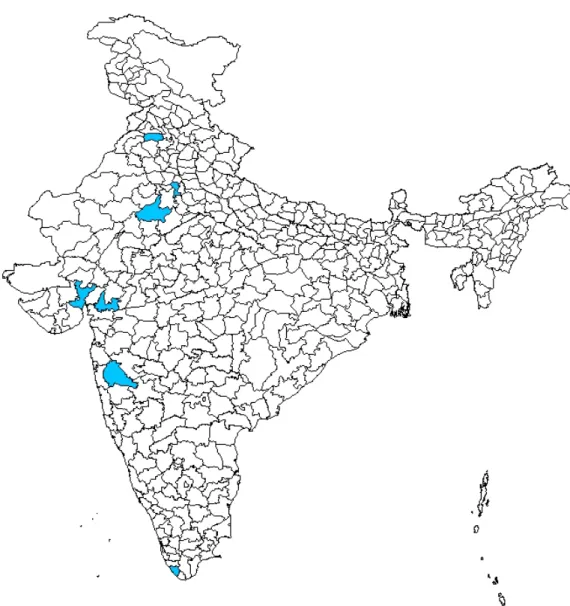
Using this data, it is possible to map out the timing and location of arrival for the new foreign banks. Table I shows the number of foreign banks by district and year from 1990-2002. In the top half of the table are the 18 districts that already had a foreign bank before 1991. These include the three districts with very large metropolitan centers: Delhi, Greater Mumbai, and Kolkata. In the bottom half are the eight districts that received their first foreign bank during India’s financial liberalization. As can be quickly seen, the overall increase in foreign bank branches largely coincides with the signing of the GATS in 1994, but the actual timing of entry across these 8 districts is staggered across years. The district location of new foreign banks is mapped in Figure 1 which highlights the 8 districts that receive their first foreign bank between 1991 and 2002. The 8 districts are relatively dispersed across India, spanning 7 of India’s 35 states.9
The bank location data is matched up to the Prowess dataset compiled by the Centre for Monitoring Indian Economy (CMIE).10 Prowess is a panel dataset of firms from 1988-2002 where Indian and foreign firms with assets plus sales greater than 40 million Rupees (approx. $900,000) are included in the dataset. The dataset provides the annual financial and accounting data of each firm along with descriptive variables including the ownership, year of incorporation, and registered address. Using each firm’s address, it is possible to track their financial status at the district level and to merge this data to the district location of the new foreign banks in India.11
9 Citibank and Hong Kong & Shanghai Banking (HSBC) were responsible for half of the new foreign bank branches
in the 8 districts. Other banks opening branches in these districts were ABN AMRO, American Express Bank Ltd., ANZ Grindlays, BNP Paribas, Crédit Lyonnais, Deutsche Bank (Asia), Société Générale, and Standard Chartered. Each had pre-existing branches elsewhere in India at the time of entry in the 8 districts.
10 The Prowess data used in this paper was provided by the IMF through their visiting scholars program. The
analysis and conclusions in this paper, however, are my own and do not necessarily represent those of the IMF.
11 CMIE compiles the financial data using the audited annual accounts that all registered companies in India must
submit to the Registrar of Companies. The cutoff level of firm size in the Prowess dataset seems to be an arbitrary point chosen to limit the size of the database. Firms’ locations are determined primarily using their registered office address -- see the appendix for more details.
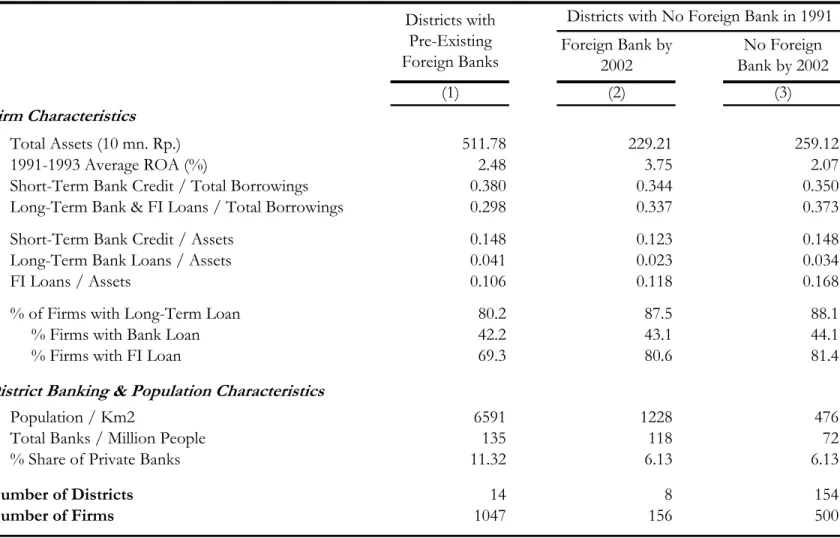
Table II provides pre-reform summary statistics of the firms included in Prowess.12 The
summary statistics reported in Table II are restricted to only non-financial, domestic firms included in the Prowess data by 1991. This is done to represent accurately the unbalanced sample of firms used in later regressions.13 Since the Prowess data is limited to relatively large firms, the sample only
contains firms from 176 of India’s 575 districts. In the table, these firms are broken down into three categories based on district location. The first column reports summary statistics for firms found in the 18 districts with a foreign bank presence by 1991. These districts are more densely populated and heavily banked than all other districts. Firms in these districts are also twice as large on average, in terms of total assets, than all other firms in India which are reported in the other two columns. The second column provides statistics for firms in the 8 districts that receive their first foreign bank from 1991-2002, and column three provides the summary statistics for firms found in districts still without a foreign bank by the end of 2002. The 8 districts with a new foreign bank are also more densely populated and heavily banked than the remaining 154 districts that do not receive a foreign bank by 2002, but not nearly to the extent as districts already having a foreign bank.
The main comparison of interest in this paper is between firms located in the 8 districts receiving their first foreign bank in the 1990s to those located in districts without a foreign bank. Among firms in these districts, bank credit accounts for roughly 2/3 of total borrowings. Short-term bank credit, which is defined as all cash credits, bank overdrafts, and working capital loans from banks with maturity less than a year, accounts for roughly 1/2 of their bank borrowings, while long-term loans with maturity of one year or more from banks and financial institutions (FIs) account for the other half of bank borrowings in each type of district.14
The distinction between ‘bank’ and ‘FI’ loans is important as it allows for a partial separation
12 In Table II and for the remainder of this paper, all financial variables from Prowess are adjusted for inflation using
India’s consumer price index, base year = 2000. The CPI data was obtained from the IMF-IFS database.
13 See Appendix Table I for an exact description of which observations are dropped from later regressions.
14 The remainder of total borrowings consists of bonds (9%), fixed deposits (3%), corporate & promoter loans (5%),
of long-term loans provided by domestic and foreign banks. While the Prowess data does not provide a direct measure of loans from foreign banks, these loans will be included, along with loans from domestic commercial banks, in a firm’s stock of ‘bank’ loans. Only about 44 percent of firms in districts without a foreign bank had such loans in 1993 as India’s commercial banks typically do not provide many long-term loans. The direct effect of new foreign bank loans will be picked up by changes in the ‘bank’ loan variable, though the variable will also capture lending changes from India’s domestic commercial banks.15 ‘FI’ loans, however, report firms’ loans from India’s development banks
and will capture the indirect effects of foreign entry on domestic lending patterns. These development banks are domestic entities and the primary providers of long-term loans in India.16 81 percent of
firms in districts without a foreign bank in 1993 had an ‘FI’ loan in 1993, and because they specialize in long-term loans, the FIs are particularly likely to be affected by the entry of foreign banks. According to the Annual Accounts Data for Commercial Banks published by the RBI, long-term loans accounted for 70 percent of total loans for Citibank and HSBC from 1996-2001. Lastly, the sum of ‘FI’ and ‘bank’ loans captures firms’ total long-term borrowings from banks in India.
3 Empirical Strategy and Identification Assumptions
The basic OLS specification used in this paper is the following:
, , 0 1 , , ,
i d t d t i t i d t
y =
β
+β
Foreign Bank +α δ
+ +ε
(1) The dependent variable is a firm-level outcome variable y for firm i, located in district d , inyear t. The variable y will entail measures of firms’ outstanding stock of loans from banks and FIs, and the different financial measures used are discussed below. The Foreign Bank variable is an
15 It is also possible that some foreign bank loans may be classified elsewhere as ‘FI’ loans. When a loan is provided
through a consortium and a breakdown of the loan by bank is not available, Prowess classifies the loan as a ‘FI’ loan.
16 The development banks include the Industrial Development Bank of India (IDBI), Industrial Finance Corporation
of India (IFCI), and Industrial Credit and Investment Corporation of India Limited (ICICI). FIs were established in the 1950’s and 1960’s with the express purpose of providing long-term financing to firms and were subsidized by the Indian government through the Long-Term Operations Funds, which was funded by RBI profits. The special status of FIs, however, was curtailed in the early 1990s and regulations inhibiting the provision of long-term loans by other banks were removed as part of a general reform to put FIs and banks on equal footing in terms of regulations, supervision, and operations. Many of the FIs officially became private banks in 1993 and 1994, though the Prowess dataset still reports loans from these institutions separately. See Tarapore (1999), pp. 67, 77-78 for more details.
indicator for the presence of a foreign bank in district in year that is turned on for all firms in the district if a foreign bank was present in that year.
d t
17 A full set of firm dummies, i
α , absorb any fixed differences in firms’ use of loans such that the coefficient of interest, β1, is estimated only using
within firm changes. The time dummies, δt, control for any country-level trends. Finally, because the
variation of foreign entry occurs at the district level, the standard errors are clustered at the district. In this base specification, the effect of foreign bank entry is captured by the coefficient β1 which is estimated using the changes in the indicator for firms located in the eight districts that receive their first foreign bank from 1991-2002 relative to firms in districts that never receive a foreign bank. The primary control group used is all firms found in districts that did not have a foreign bank at any point from 1991-2002. Firms headquartered in the 18 districts with a pre-existing foreign bank are dropped from the regression. As shown in Table II, these districts are likely to be a poor control group since they are significantly more urban and contained firms that were much larger on average.
Foreign Bank
18 As a robustness check, the regressions are also run using a smaller control
group consisting only of firms found in the 9 districts that receive their first foreign bank in 2003 and 2004.19 These 9 districts potentially provide a better control group in that one might consider them
“next in line” for foreign bank entry and hence, very similar to the 8 districts that receive their foreign bank earlier. The effect of foreign bank entry will be properly identified under the assumption that the trend in use and size of firms’ loans in these eight districts would have been the same as those in the control group in the absence of the foreign bank.
The basic specification in equation (1), however, does not allow us to test whether foreign bank entry differentially affects firms. This is done using a second specification, equation (2), that includes the interaction, Foreign Bank ROA× , where is the demeaned average percent return over total assets of firm from 1991-1993. Profits are measured using profit after taxes net of
non-ROA i
17 All subsequent findings are similar when the district-level share of foreign banks is used instead of an indicator. 18 Including these 18 districts does not significantly alter the main findings. See Section 5 for more details. 19 The 9 districts are Aurangabad, Bhopal, Faridabad, Lucknow, Nagpur, Patna, Rajkot, Surat, and Thane.
recurring transactions. A full set of year and profit interactions,δ ×ROA, are also included to allow firms across India to trend differently as a function of their past profitability.
yi d t, , =
β β
0+ 1Foreign Bankd t, +β
2(
Foreign Bankd t, ×ROAi)
+ + +α δ
i t(
δ
t×ROAi)
+ε
i d t, , (2) In this second specification, β1 still describes the main effect of foreign bank entry since is demeaned, whereas,ROA β2 describes the marginal effect of having a higher beforehand.
Inclusion of the interaction of
ROA
Foreign Bank ROA× tests whether a firm’s profitability matters more for credit access after foreign banks enter the district, under the assumption that a firm’s past ROA is a positive predictor of future potential.20 This allows us to assess whether foreign bank entry is
associated with a reallocation of credit from less profitable to more profitable firms, as would be indicated by β2>0. Moreover, if there is a drop in credit driven predominately by fewer loans allocated to politically connected, unprofitable firms, this would also be indicated by β2>0.
Finally, it is implicitly assumed that the effect of foreign bank entry is localized and realized predominately by firms headquartered in the district with a foreign bank. Both specifications presume that firms in India borrow from banks located near their registered address, and that these banks are located in the same district. In general we expect this to hold as empirical work regarding lending relationships in other countries has demonstrated the average distance between firms and their bank is usually quite small.21 However, even if this assumption is not fully true, this would only
bias the results against finding an effect of foreign bank entry. If firms borrow from outside their district, then firms located outside the eight treated districts may in fact be ‘treated’ causing the estimates to understate the true effect. Moreover, the ability to borrow from banks outside the district will only mitigate the local impact of foreign bank entry thus making it more difficult to
20 Firms’ average ROA from 1991-1993 is in fact positively correlated to ROA levels from 1994-2002. Pre-entry
ROA is used rather than actual ROA since profits after 1993 are an endogenous outcome of foreign bank entry.
21 Analyzing small firms in the U.S., Petersen and Rajan (2002) finds that the average distance between a firm and its
main bank was 67.8 miles in 1993, and the median distance was 5 miles. The Indian districts included in this sample had an average size of 2,457 square miles. While the U.S. firms sampled were on average 6 times smaller than the firms found in the Prowess data, it is likely the Indian firms also borrow locally as the positive relation between distance and borrowing costs are greater in a developing country such as India.
discern an impact of foreign bank entry at the district level.
To measure firms’ access to loans, a number of dependent variables, y, will be used. First, to test the effect on the amount of loans a firm reports, three different variables will be used: the stock of long-term commercial bank loans (Bank Loans), the stock of loans from domestic development banks (FI Loans), and the stock of loans from both commercial and development banks (Total Long-Term Loans). All three measures are normalized by firms’ total assets as they stood in the beginning of the sample in 1991. Second, a set of indicators that equal 1 for firms with a loan from the given source are used to test for changes in the likelihood of a firm having a loan. While the two sets of financial measures are similar in nature, their distinction is important. The first set will capture whether firms in districts receiving a foreign bank experience a relative change in the amount of financing they receive, while the second set of indicators will test for whether a firm’s likelihood of having a loan is affected by foreign bank entry.
4 OLS Estimates
4.1 Impact on Total Long-Term Loans
The OLS estimates of the relation between long-term loans and the presence of a foreign bank are reported in Table III. Columns (1)-(4) report the coefficients using an indicator for having a long-term loan as the dependent variable, while columns (5)-(8) report the coefficients when the dependent variable is the stock of total long-term loans normalized by assets.
Rather then being a boon for domestic firms, foreign bank entry is associated with a
reduction in domestic firms’ likelihood of having long-term loan that is unrelated to firms’ profits. In the basic regression with all firms and no additional controls or interactions [column (1)], foreign bank entry coincides with a 7.6 percentage point drop in firms’ likelihood of having a long-term loan relative to firms located in districts without a foreign bank. Inclusion of the ROA interactions in column (2) demonstrate that the decrease is largely unrelated to firms’ ROA, and if anything, there is
weak evidence a firms’ ROA is marginally less important following foreign bank entry. The decline in long-term loans is robust to the inclusion of industry-year interactions [column (3)] and restriction to the eventually “treated” control group [column (4)].22
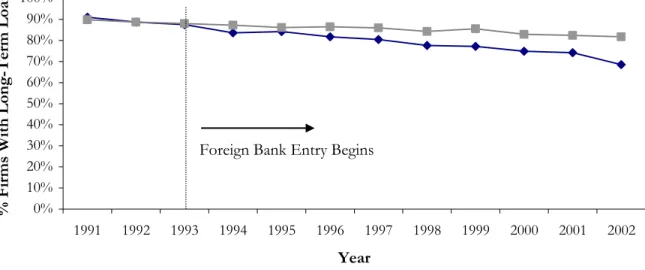
The drop in the number of firms with a long-term loan is relatively large. As noted in Table II, roughly 88 percent of all firms had a long-term loan in 1993. By 2002, however, this dropped to around 78 percent as there was a general decline in the long-term loans provided by India’s
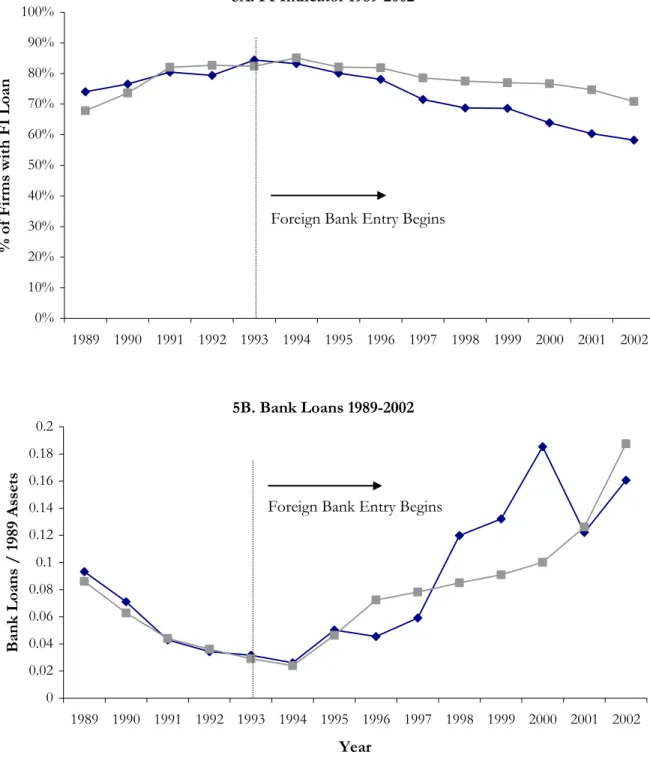
development banks. The drop, however, was larger in districts with a new foreign bank as shown in Figure 2, and the timing coincides with the general expansion of foreign banks from 1994-2002.
The timing of this drop also seems to coincide with foreign bank entry within each district. Of the 8 districts receiving their first foreign bank between 1991-2002, Pune experienced the largest entry in that foreign banks accounted for roughly 15.3 percent of long-term loans in Pune by 2003. As shown in Figure 2, the drop in loans in Pune was particularly large, and begins in 1996 about one year after foreign bank entry. In 1995 when foreign banks first began entering Pune, 92 percent of firms had a long-term loan. By 2002, only 74 percent had a long-term loan. More robustness checks on the timing of this decrease within each district are provided in Section 5.23
There is evidence, however, that foreign bank entry is associated with an increase in the relative importance of firms’ ROA in the amount of long-term financing allocated, suggesting a distributional effect of entry. In the regression with no interactions [Table III, column (5)], there is no significant evidence of a change in loan sizes, though the estimate is negative suggesting overall loan amounts decreased.24 However, inclusion of the ROA interactions in column (6) indicates that a
22 While not shown, the negative relation between foreign bank entry and firms’ likelihood of a loan is also robust to
the use of a fixed effects probit estimation. For this paper, however, the linear probability model is preferred as the probit model suffers from large small-sample biases when estimated with fixed effects (Greene 2004) in what is known as the ‘incidental parameters problem’.
23 Figure 2, Panel B also indicates foreign bank entry is associated with a level change in loans rather than a change in
trend as the largest drop occurs in the first year following foreign bank entry. OLS specifications that allow for both a change in level and trend find the downward drop in levels remains negative and significant (though slightly smaller in magnitude) while the estimated change in trend is negative but not significant at conventional levels.
24 The loan-asset ratio being a noisier measure of credit relative to the indicator may explain the lack of a significant
one percentage point higher ROA corresponds to a 0.011 increase in the loan to asset ratio for firms in districts with a foreign bank relative to firms in districts without a foreign bank. The average loan to asset ratio of firms from 1994-2002 was about 0.48. The magnitude of the coefficient implies that a one standard deviation increase in firms’ ROA is associated with an increase in their loan to asset ratio that is approximately 1/10 standard deviations larger when a foreign bank is present in their district. The estimates are robust to the inclusion of industry-year interactions [column (7)] and the restriction to the eventually “treated” control group [column (8)].
Overall, the estimates of Table III are consistent with the theoretical framework of Gormley (2006) where foreign entry is associated with a reallocation of credit that does not necessarily benefit all borrowers. The more profitable firms see an increase in their relative amount of loans, while other firms see a drop in their likelihood of having a long-term loan of any sort. The question remains, however, as to whether this reallocation is efficient. In this regard, the drop in loans does not appear to be driven by a decline in loans allocated to only the most unviable, politically-connected firms. This would yield a positive coefficient for the marginal effect of a firm’s ROA, not a negative coefficient as seen in columns (1)-(4) of Table III. Instead, the decrease in credit seems to be unrelated to firms’ potential, and if anything, the relation is the opposite of what one might expect. This is suggestive that some positive NPV projects were unable to obtain financing after foreign bank entry because of interaction between information asymmetries and greater financial competition.
If some firms do receive better financial services after entry, part of the decline in loans could also be demand driven if local domestic firms within the same industries face greater competition in their output market. Given that these are relatively large firms, however, such local changes are unlikely to affect the aggregate demand for their output, and a robustness check in Section 5.3 also suggests the decline in loans is not demand driven.
4.2 “Direct” versus “Indirect” Effects
are now conducted separately for loans from banks and FIs. Again, the regressions pertaining to bank loans will proxy for the “direct” effect of foreign bank entry, while the FI loan regressions will capture the “indirect” effect of foreign bank entry on the domestic development banks. The regressions for bank and FI loans are reported in Tables IV & V.
In Table IV, we see that the decrease in the likelihood of having a long-term loan is driven entirely by a fall in FI loans [columns (5)-(8)] rather than loans from banks [columns (1)-(4)]. This implies that competition from foreign banks indirectly affects the allocation of credit by India’s domestic development banks. Again, a firm’s ROA does not appear to have any effect on whether it is less likely to receive an FI loan. Therefore, there does not appear to be any evidence to support the hypothesis that domestic lenders respond positively to competition by adopting new screening technologies and improving their credit allocation. Instead, domestic development banks respond to the competition from foreign banks by systematically reducing the number of domestic firms they extend long-term loans to, regardless of their potential, and this decrease in loans from the domestic banks is not offset by an increase in loans from foreign banks.25
In Table V, we see that the relative increase in importance of firms’ ROA for the amount of loans is driven primarily by an increase in slope for bank loans [columns (1)-(4)] rather than FI loans [columns (5)-(8)]. This suggests the increase in loans to more profitable firms is driven by new loans from the foreign banks rather than domestic banks. If the specification is modified to allow for both a level and trend changes after foreign bank entry (not shown), I find evidence of positive effect in the interaction term in both levels and trend for the amount of bank loans. This is consistent with the hypothesis that foreign banks’ lending increases with time after their initial entry.
25 It is difficult to discern exactly where the domestic capital went. One possible explanation is that FIs raised less
capital on external markets via the issuance of bonds, commercial paper, etc.. While data is only available beginning in 1996, the real value of external capital raised by development banks was constant from 1996-1998 and declining thereafter. Another is that bank capital was redirected elsewhere. From 1992-1993, 24 percent of bank deposits were held as government securities, but from 1994-1998, it increased to 29 percent, exceeding the statutory requirement of 25 percent. Data limitations, however, do not allow us test whether either of these changes were driven by development banks with branches located in districts with new foreign banks.
4.3 Evidence of ‘Cream-Skimming’
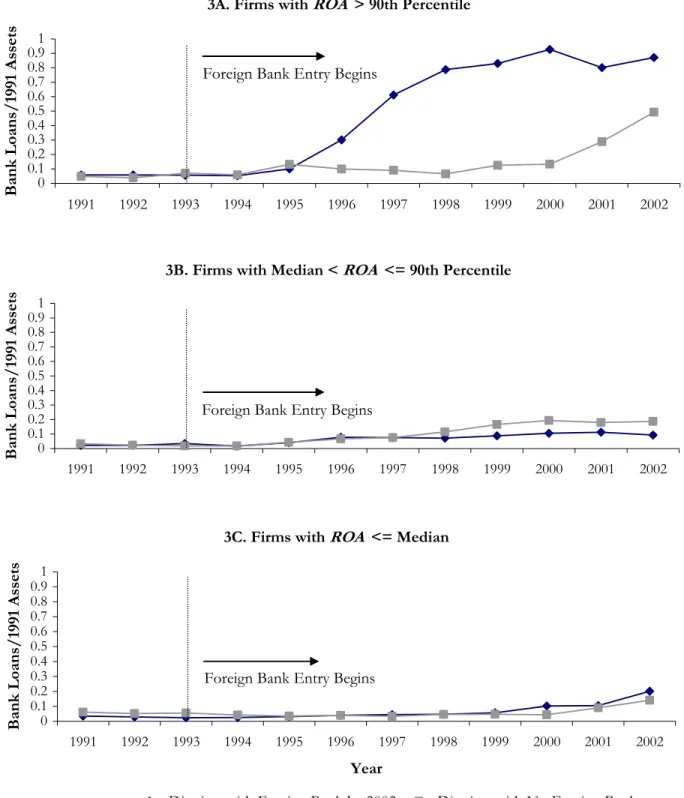
Contrary to a general reallocation of credit from less to more profitable firms, however, the positive interaction in Table V appears driven by an increase in bank loans to only the top 10 percent of firms in terms of ROA. It is easy to see this in Figure 3, which breaks down the trend in bank loans/assets of firms from 1991-2002 based on their ROA from 1991-1993. As seen in Figure 3, the trend in loans to the most profitable 10 percent of firms was relatively flat from 1991-1995.
Beginning in 1996, however, there is a very large growth in loans for the top 10 percent in districts with a foreign bank, while the top 10 percent in other districts do not show any increase in loans. The increase in loans to more profitable firms is restricted to the top 10 percent, however, as there is no evidence that foreign bank entry is associated with an increase in loan amounts for firms with an
ROA above the median but not in the top 10 percent or for firms with an ROA below the median. The estimates in Table VI confirm that the positive interaction on loan sizes is caused predominately by the top 10 percent of firms. In columns (1)-(3), the top 10 percent of firms in terms of ROA are dropped from the regressions. The positive effect on the size of loans to more profitable firms seen in Table V is now completely gone, supporting the finding that the earlier results were primarily driven by an increase in bank loans to very profitable firms. The increase in loans also seems to be primarily caused by only the largest firms. Dropping firms with assets in 1991 exceeding the median, as done in columns (4)-(6) also eliminates the increase in loans. These findings support the theory that information asymmetries are particularly difficult for foreign banks to overcome leading them to only finance the most profitable and largest firms in the economy.
Overall, the figures and OLS estimates are supportive of models incorporating asymmetric information. The increase in loans to the most profitable 10 percent of firms is suggestive that these firms were under-financed in the closed economy, and that foreign bank entry improves the
allocation of credit by targeting more loans to these firms. However, competition from foreign banks also seems to lead to a systematic reduction in long-term lending by the domestic development banks
that is not offset by a corresponding increase in loans from foreign banks. While part of this decline in credit may be the consequence of an efficient reduction in loans to very unprofitable or politically connected firms, the extent of the drop and its non-relation to a firm’s past profits is suggestive that some viable domestic firms were also less likely to receive a loan after entry. 26
5 Robustness Checks & IV Estimates
While the initial regressions are supportive of predictions that additional competition from foreign banks will induce a reallocation of credit when information asymmetries are large, one might be concerned about a potential selection bias in the OLS estimates. Since foreign banks
endogenously chose where to locate new branches in India, it is possible the foreign banks selected into districts that were either already trending differently in bank or FI loans or were going to trend differently in the future for reasons other than the entrance of the foreign bank.
5.1 Testing for Pre-Trends
To test for a pre-existing trend in bank and FI loans, two variables are added to the basic regressions of Tables III-V. The first variable is an indicator, fake, that turns positive in the three years prior to the entrance of a foreign bank. For example, in Ludhiana where the first foreign bank shows up in 2001, this variable is equal to 1 in years 1998-2000, and zero all other years. The second variable added is the interaction fake ROA× . Results of this specification are shown in Table VII.
If the most profitable firms were already seeing an increase in their bank loans in the three years prior to the foreign bank’s arrival, then we would find a positive coefficient for the interaction term, fake ROA× . Additionally, if domestic firms in the foreign bank districts were already
exhibiting a reduction in their access to development bank loans before the foreign bank’s arrival, we should find a negative coefficient for fake in the regressions using an indicator for FI loans as the
26 It is possible, however, that the capital was efficiently reallocated to smaller, younger firms not captured in the
Prowess data. The reduction in FI loans may also be offset by increases in credit from other, more efficient non-bank
dependent variable. However, as shown in Table VII, the increase in bank loan amounts to the most profitable firms [columns (1)-(4)] and the reduction in FI loans to all firms [columns (5)-(8)] are not present in the three years before foreign bank entry. In neither case can we reject the null hypothesis that the point estimate for fakeor fake ROA× is zero. There is no evidence that foreign banks selected into districts with pre-existing differential trends in bank or FI loans.
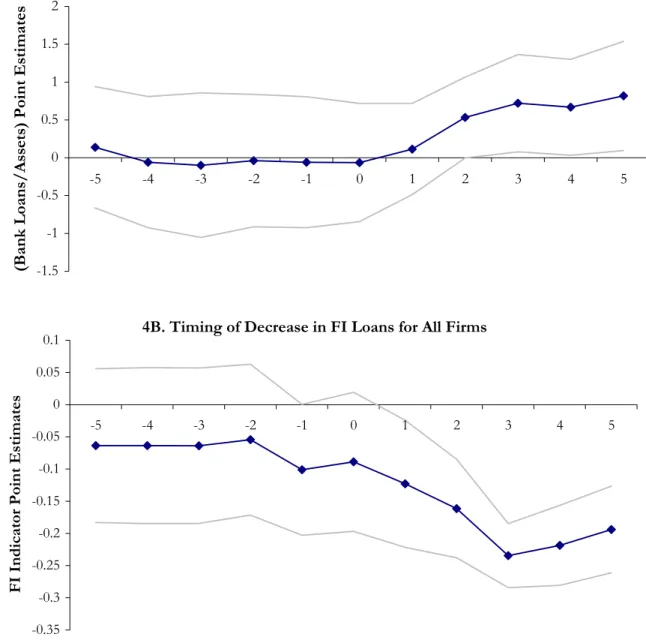
Moreover, both the increase in bank loans to the most profitable firms and the drop in FI loans to the average firm appear to occur one to two years following foreign bank entry within each district. Figure 4, Panel A plots the point estimates from an OLS regression of bank loans/assets onto indicators for years pertaining to foreign bank entry for firms with an ROA in the top 10 percent. As shown in Figure 4, there is no evidence of an increase in bank loans/assets in the years preceding foreign bank entry or in the year of actual entry. However, one year following entry, bank loans/assets increase, and the increase becomes and stays significant at the 5 percent level beginning two years after foreign bank entry. Figure 4, Panel B plots the point estimates from a similar
regression using all firms and an indicator for FI loans as the dependent variable. Again, the point estimates indicate the decline in FI loans begins approximately one to two years after initial entry.
5.2 IV Estimates
However, there is still the concern that foreign banks could have selected into districts that were going to trend differently in the future for reasons unrelated to the actual entry.
A review of press releases of the foreign banks establishing new branches in India during the late 1990s suggests new branch locations in India were chosen to decrease the distance to existing borrowers and to establish a presence in high-growth cities. Inaugurating the opening of a new branch in Surat in 2004, Sanjay Nayar, Citigroup Country Officer for India, stated “We’re very happy to move closer to our clients...” Regarding the opening of a new branch in Vadodara in 2005, Naill Booker, CEO of HSBC -- India, stated, “The markets in western India hold enormous potential for
growth and there are huge opportunities for us…” While the location choice based on existing clients is unlikely to pose an identification problem, the selection into high-growth districts could cause a positive bias in the OLS estimates if these districts would have seen a growth in loans even in the absence of foreign banks. Or, this selection into high-growth districts could also cause a negative bias if the rapid growth by new industries (e.g. software) in these districts coincides with slower growth rates for firms in older, more established industries.
To address this potential identification problem, the pre-1994 presence of foreign firms is used as an instrument for the location of new foreign banks. I assume that foreign banks are more likely to enter districts with firms from their home country in order to preserve pre-existing
relationships or take advantage of their competitive advantage in obtaining information about the firms in their home country. This tendency for foreign banks to follow their customers abroad has been noted in a number of countries,27 and seems to occur in India also. Within the sample of data,
there are 52 foreign-owned firms spread across 26 of the 162 districts. 5 of the 8 districts that receive their first foreign bank during the 1990s have a foreign-owned firm present in 1993.
To test the relation between the location of foreign banks and foreign-owned firms, the following first stage regression is used:
, . ,1993 -1993 , ,
d t d t i t i d t
Foreign Bank =const +Foreign Firm ×Post +α δ ε+ + (3)
The instrument for is the interaction between a district level indicator variable for having a foreign-owned firm present in 1993, , and a post-1993 year indicator. This is a firm-level regression with firm and time dummies, and the standard errors are clustered at the district level. The results of the first stage are reported in Table VIII. As can be seen, the presence of a foreign-owned firm in 1993 is a positive and significant predictor of a foreign bank being present in the years 1994-2002. The estimates imply that the presence of foreign-owned firm in 1993 increased
Foreign Bank
Foreign Firm
27 Sabi (1988) finds a positive correlation between the amount of U.S. FDI and banking assets in 23 less-developed
countries from 1975-1982. Yamori (1998) finds that Japanese financial companies tend to invest in countries with greater amounts of Japanese FDI. Brealey and Kaplanis (1996) find a positive correlation between the number of foreign banks present in a country and the amount of FDI from the parent country of the foreign banks.
a districts’ likelihood of receiving a foreign bank after 1994 by about 34 percentage points relative to districts that did not have a foreign-owned firm.
In order for the instrument to be valid, however, the location of foreign firms, in itself, should be uncorrelated with the borrowing trends of domestic firms. While the original location choice of foreign firms was also probably strategic,28 this assumption seems plausible in that the
median year of incorporation for foreign firms used in the sample is 1974, nearly 20 years prior to the liberalization of the mid-1990s. Therefore, the location of foreign-owned firms is less likely to be directly correlated to domestic lending patterns in the mid- to late 1990s than the location choice of the new foreign banks. The IV estimates reported below are also very similar when the sample is restricted to foreign firms established at least 10 years prior to India’s liberalization in 1994.29
Moreover, there is no evidence that domestic firms in districts with a foreign bank were trending differently in their use of long-term loans in the 5 years prior to the signing of the GATS in 1994. This is seen in Figure 5, which plots the percentage of firms with an FI loan and the average bank loan to asset ratio of firms from 1989-2002. Bank loans show a similar downward trend in the five years prior to foreign bank entry in both districts with and without a foreign firm in 1993, and the number of firms with FI loans was trending up in both types of districts from 1989-1993.
With the instrument seeming to satisfy the identification assumptions, I now proceed to the IV estimates of equation (2). The interaction Foreign Firm Post× -1993 is used to instrument for the location of foreign banks,Foreign Bank, and the interaction Foreign Firm Post -1993× ×ROA is used to instrument for Foreign Bank ROA× . The IV estimates are reported in Table IX.
The IV estimates appear to confirm the OLS estimates. While the estimates are less precise, the arrival of a foreign bank is still associated with a drop in the average firm’s likelihood of receiving
28 The location of foreign direct investment (FDI) within the U.S. suggests foreign firms tend to locate in areas with
lower taxes, higher per-capita incomes, lower wages, and more extensive transportation infrastructures (Coughliin, Terza and Arromdee 1991, Hines 1996). Cheng and Kwan (2000) find similar results for China.
29 Using only these older foreign firms further limits endogeneity concerns regarding the location choice of recently
a long-term loan [Table IX, column (3)]. The IV estimates suggest foreign bank entry is associated with a 12.4 percentage point reduction in firms’ likelihood of having either a bank or FI loan, which is larger than OLS estimate of 7.5 percentage points. Moreover, foreign bank entry is still associated with a positive and significant increase in the marginal importance of ROA for bank loan sizes [column (5)], and the magnitude of the effect is similar to the OLS estimate.
5.3 Additional Robustness Checks
Overall, both the drop in firms’ likelihood of having a long-term loan and the increase in the relative importance of firms’ past ROA in determining the size of bank loans after foreign bank entry are robust to using a number of different specifications and control variables. The inclusion of additional controls, including urban-year interactions,30 state-year interactions, firm-size year
interactions, log of total non-foreign banks, and the log of private banks does not alter the findings. Dropping firms that permanently exit the dataset before 2002 or further restricting the data to balanced panel of firms also does not impact the basic findings.
Including firms located in the 18 districts with pre-existing foreign banks also does not change the OLS or IV results, though a number of the estimates are no longer significant at
conventional levels. However, the inclusion of these districts confounds the effect estimated by the indicator as some of the districts exhibit a complete exit by foreign banks between 1991 and 2002.
Foreign Bank
31 With their inclusion, the basic specification no longer just estimates the effect of foreign
bank entry but the average effect of entry and exit. There is no reason to believe the two events should induce equal effects as the foreign banks that exit are likely to be much different than the new foreign banks. Excluding the districts exhibiting a complete exit by foreign banks between 1991 and 2002, I again find a significant negative effect of foreign bank entry on FI loans and a significant positive effect on the importance of past ROA for bank loans.
30 Districts with a metropolitan center exceeding 1 million persons in the 2001 were designated as ‘urban’. 31 Foreign banks exit Kozhikode and South Goa in 1999; Amritsar, Kamrup, Simla and Srinagar in late 2002.
Another concern might be that the drop in long-term credit is caused by the growth of industries concentrated in the treated districts. While industry-year interactions would pick up any differential trends for these industries, one might still be concerned that their growth could have an indirect effect on borrowing by other local firms. One such example could be the software industry, which is typically less dependent on long-term capital and experienced significant growth in the late 1990s. Five of the eight treated districts had software-related firms by 2002 compared to only 14 of the 154 non-treated districts. However, the estimates are robust to restricting the control group to only districts with software industries by 2002.
Lastly, if foreign firms or the most profitable domestic firms receive better financial services after entry, local domestic firms within the same industries as these firms are likely to face greater competition. In this case, the decline in loans could be demand-driven as domestic firms respond negatively to increased competition from other firms. However, this does not seem to be the case. Excluding domestic firms identified in the same industry and district as foreign firms does not change the estimates. Excluding firms found in the same industry as treatment firms with an ROA in the top 10 percent also does not affect the estimates. Therefore, the observed decline in domestic loans appears to reflect a decrease in the supply of credit rather than a change in demand.
6 Alternative Specifications
6.1 Group versus Non-Group FirmsIf information asymmetries play an important role in explaining the reallocation of credit following foreign bank entry, then we would expect foreign bank competition to affect firms with opaque informational structures more than other firms. To test this hypothesis, the sample is divided into firms associated with a business group and all other non-group firms.32 The information hurdle
32 Groups in India are typically controlled via a complicated network of company shareholdings, and their existence
pre-dates liberalization in 1947. See Dutta (1997) and Ghemawat and Khanna (1998) for more details. CMIE tracks group affiliation in Prowess through “continuous monitoring of company announcements and a qualitative
understanding of the group-wise behavior of individual companies” (Prowess Help Files, Data Dictionary). Khanna and Palepu (1999) find the CMIE classification to be consistent with other available lists of Indian groups.
faced by lenders is likely higher for firms associated with a business group because of their
complicated networks and the relative ease of diverting funds within the group. The moral hazard problem faced by banks, another form of information asymmetry, are also particularly acute within business groups as the gap between the control and ownership rights of the controlling shareholder or family creates incentives for the owners to expropriate resources of the firm.33
Given that information asymmetries are greater for group-affiliated firms, we should expect to see foreign bank competition have a stronger negative effect on the amount of credit allocated to these firms. If foreign banks face greater difficulties in screening group-affiliated firms, then we should also expect to find foreign banks more likely to target non-group firms. Both of these predictions in fact seem to be true in the example of India.
In Table X, estimates pertaining to a firm’s likelihood of having an FI loan are presented separately for group and non-group firms. It is immediately clear that the systematic decrease in firms’ likelihood of having an FI loan is caused predominantly by a reduction in credit to the group-affiliated firms [columns (1)-(5)] rather than non-group firms [columns (6)-(10)]. The decrease in credit is significant in all specifications, and again unrelated to firms’ profitability.34 In separate
regressions (not shown), the decline in loans to group-affiliated firms is equally strong for firms with group members located in districts containing India’s largest cities versus those without. Therefore, the decline in domestic loans to these group-affiliated firms does not appear driven by a substitution away from local credit markets towards credit obtained by group members located in large cities.
The non-group firms, however, see a relative drop in the marginal importance of ROA for the likelihood of having an FI loan [columns (6)-(10), Table X], but in Table XI, we see that the marginal importance of past profits in obtaining a bank loan is greater after foreign bank entry for the
33 Bertrand, Mehta and Mullainathan (2002) find that such ‘tunneling’ is in fact a present in India business groups. 34 Because tunneling likely makes past profits a noisier predictor of future potential for group-affiliated firms, this
finding is difficult to interpret. While the systematic drop in credit among these firms is suggestive that foreign bank competition adversely affects the ability of domestic banks to finance informationally opaque firms, it is possible past profits do not adequately proxy for group-firms’ future potential. If so, the drop in loans could be occurring for unviable group-firms previously protected by their group’s ability to lobby politicians for preferential credit access prior to 1991. In this scenario, the drop in credit could be an efficient outcome of foreign bank entry.
non-group firms [columns (6)-(10)]. While the estimates are only marginally significant, they suggest that profitable, non-group firms dropped their relationships with domestic development banks and became clients of the new foreign banks. This is not true, however, of the group-affiliated firms [columns (1)-(5)]. Not only are group-affiliated firms less likely to receive an FI loan following foreign bank entry, the relative importance of their past ROA is less with regards to their ability to obtain bank loans. This finding suggests that foreign banks were less inclined to lend to group-affiliated firms, irrespective of their past profitability.
We might expect to find similar results for other standard measures of informational ‘opaqueness’, such as the size and age of the firm. However, no evidence was found that smaller or younger firms in India experienced a greater drop in domestic credit after entry. One explanation may be that the Prowess dataset contains only relatively large firms such that size and age do not provide a meaningful measure of information asymmetries among these firms.
6.2 Total Sales and Bankruptcy
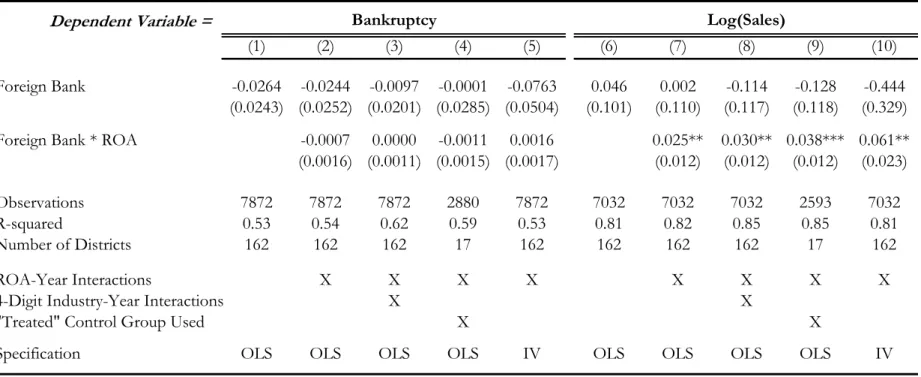
If competition from foreign banks induces a reallocation of loans, it is also possible the entry of a foreign bank could affect firm sales and bankruptcy rates.35 While there is no significant relation
between foreign bank entry and the likelihood of bankruptcy [Table XII, columns (1)-(5)], there is evidence that a firm’s ROA was relatively more important for sales after foreign bank entry [Table XII, columns (6)-(10)]. The IV estimate [column (10)] indicates that an increase in the ROA by 1 percent was associated with a 6.1 percent higher growth rate after foreign bank entry. However, the main effect on total sales is actually negative in the IV, such that the average firm, in terms of ROA, exhibits a decline in sales after entry. However, the decline in sales is not significant, and it is not
35Bankruptcy is measured by when a firm registers with the Board for Industrial and Financial Reconstruction (BIFR),
which is designated under the 1985 Sick Industrial Companies Act (SICA) to determine sickness and expedite the revival of viable firms or closure of unviable firms. Registration is available to companies with accumulated losses exceeding net worth, and companies approved for reorganization receive protection from creditors until completion. See the BIFR website (bifr.nic.in) for more details. The names of registered companies and date of registration are publicly available on the BIFR website and are matched to the Prowess data using company names. 15 percent of the sample observations declare bankruptcy by 2002
possible to make a strong inference given the imprecise estimates. The lack of large main effects on either bankruptcy rates or sales growth may also suggest that some of the firms receiving fewer bank loans were productive and had access to positive NPV projects.36
6.3 Borrowing from Other Firms
The inability to find large effects on sales growth may also result from firms’ ability to substitute into other forms of finance to mitigate the reduction in bank loans and diminish the real effect on sales and bankruptcy rates. If the entrance of the foreign banks is systematically inducing a contraction of FI and bank loans, then we might expect to find firms increase their use of borrowings from other sources. Additionally, the more profitable firms that benefit from foreign bank entry should substitute away from other more expensive sources of external finance. One such potential source would be financial loans from other firms. In general, such loans are considered less desirable and more costly than loans from specialized intermediaries like banks. Table XIII reports the OLS and IV regressions pertaining to a firm’s loans from other firms.
Foreign bank entry does in fact appear to be weakly associated an increase in corporate loans by less profitable firms and a drop in loans by more profitable firms. The negative coefficient for the interaction term, , suggests that more profitable firms were less likely to borrow from other firms after foreign bank entry, and the positive main effect, though not significant at conventional levels, suggests other firms saw an increase in their use of corporate loans. The estimates are robust to the inclusion of industry-year interactions [column (3)] and the restriction to the smaller control group [column (4)]. The IV estimates [column (5)] also suggest a reallocation of corporate loans. Columns (6)-(10) of Table XIII demonstrate that the change in total corporate borrowing [columns (1)-(5)] is predominately caused by a reallocation of loans from group-affiliated firms. The increase in loans within groups coincides with earlier evidence that group-affiliated firms
Foreign Bank ROA×
36 There is also little evidence that foreign bank entry affects the combined sales or output of the sample firms within
are more likely to see a decrease in loans after foreign bank entry than non-group firms.
Two other alternative forms of long-term financing available to Indian firms are debentures and fixed deposits. Both are likely only available to the most creditworthy firms since they are obtained directly from individuals rather than through an intermediary. To test whether foreign bank entry affected such direct borrowings, separate regressions were run using debentures and fixed deposits, but there was no evidence of a change in firms’ usage of either. There is also no significant evidence of a change in various measures of trade credit, a form of short-term borrowing between firms, or in the amount of capital raised via the issuance of shares.
7 Conclusion
The entrance of new foreign banks to India is associated with a reallocation of loans. The most profitable 10 percent of firms receive larger loans, but on average, firms are 7.6 percentage points less likely to have a long-term loan of any size. The findings suggest that foreign banks finance only the most credit-worthy firms, and that the decline in loans, which is most pronounced among group-affiliated firms, is caused by a systematic fall in domestic bank loans.
This reallocation of loans following foreign bank entry in India suggests that information asymmetries in the market for loans are a significant factor in LDCs. While credit access is improved for many credit-worthy firms, the extent and nature of the drop in loans to informationally opaque firms, as captured by a firms’ group affiliation, suggests that some firms with positive net present value projects may have found it difficult to obtain loans after entry. Theory indicates this may occur when information asymmetries are large and domestic banks are ill-equipped to effectively screen potential clients. Moreover, the reallocation in bank loans does not seem to translate into large effects on either bankruptcy rates or sales growth, suggesting some of the firms receiving less credit had access to positive NPV projects. Firms’ ability to substitute into financial loans from other firms, particularly group-affiliated firms, appears to mitigate the effects of fewer domestic bank loans.
The findings are robust to using a number of different specifications and control variables, and the timing of the loan reallocation coincides with foreign bank entry within each district. Moreover, the decline in domestic credit appears to be driven by shifts in the supply of loans rather than the demand for loans. The OLS estimates are also robust to using the presence of pre-existing foreign-owned firms as an instrument for the location choice of new foreign banks in India.
Overall, the empirical findings presented in this paper suggest that reducing the information barriers endemic to LDC credit markets may further improve the allocation of credit following liberalization and increase the range of firms foreign banks are willing to finance upon entry. For example, policymakers may consider strengthening accounting standards disclosure rules and credit evaluating agencies. By reducing banks’ costs of obtaining information about firms, such policies may increase the range of firms foreign banks finance and reduce the scope for a systematic drop in loans from domestic banks in response to increased competition.
8 Data Appendix – Determining Firm Location within Prowess
The Prowess dataset reports the district location of each firm’s registered office, head office and registrar office. Nearly all firms (about 95 percent) report the district location of their registered office, while only 25 percent report district location of their head office or registrar office. To
determine a firm’s location, the district of the registered office is used primarily. The registered office is the address each firm of more than 20 persons in India must submit to the Registrars of
Companies (RoC) as dictated by the Companies Act, 1956. All communications and notices to the company are addressed to the registered office and is the official address of the company where statutory books and records must be kept. Every company must affix this address outside of every office or place at which activities of the company are carried out, and firms are required to file their balance sheet and annual return each year with the RoC. If the district location of the registered office is missing, however, the district location of the head office is used next, and the district location of the registrar address is used last. Only about 2 percent of firms are missing the district location of all three offices.