AMCIS 2003 Proceedings
Americas Conference on Information Systems
(AMCIS)
12-31-2003
Prospective Tracks in the MSIS 2000 Model
Curriculum Framework
John Gorgone
Bentley College
Vijay Kanabar
Boston University
Follow this and additional works at:
http://aisel.aisnet.org/amcis2003
This material is brought to you by the Americas Conference on Information Systems (AMCIS) at AIS Electronic Library (AISeL). It has been accepted for inclusion in AMCIS 2003 Proceedings by an authorized administrator of AIS Electronic Library (AISeL). For more information, please contact [email protected].
Recommended Citation
Gorgone, John and Kanabar, Vijay, "Prospective Tracks in the MSIS 2000 Model Curriculum Framework" (2003).AMCIS 2003 Proceedings.Paper 401.
C
URRICULUM
F
RAMEWORK
John T. Gorgone
Bentley College
[email protected]
Vijay Kanabar
Boston University
[email protected]
Abstract
The latest report on MSIS 2000: Model Curriculum and Guidelines for Graduate Degree Programs in Information Systems introduced Career Tracks as one of the curriculum building blocks. A career track consists of four or more related electives that provides students an opportunity for specialization within information systems. This paper elaborates on the implementation and advantages of career tracks in areas ranging from information security to project management and provides comprehensive details on constituent courses and structure. We hope this paper will stimulate thinking about how one might introduce career/specialty tracks in a traditional MSIS program.
Keywords: Curriculum, Master’s IS, career tracks, specialized programs, graduate certificates, MSIS, MSCIS
Introduction
The latest AIS/ACM report by Gorgone and Gray (2000) on model graduate curriculum programs in Information Systems introduced Career Tracks as one of the innovative curriculum building blocks. A career track can be designed to support traditional and/or emerging career opportunities and can be used by IS professionals to exploit the significant increase in career path opportunities. A career track consists of four or more related electives that provide students an opportunity for specialization. Examples of career tracks suggested in the report include Data Management and Electronic Commerce. Well-designed career tracks can provide students an opportunity to prepare for certification exams from vendors such as Oracle, Microsoft, Cisco and Novell. This paper presents sample career tracks, their course descriptions, and implementation details regarding our experiences.
MSIS 2000 Curriculum Model Overview
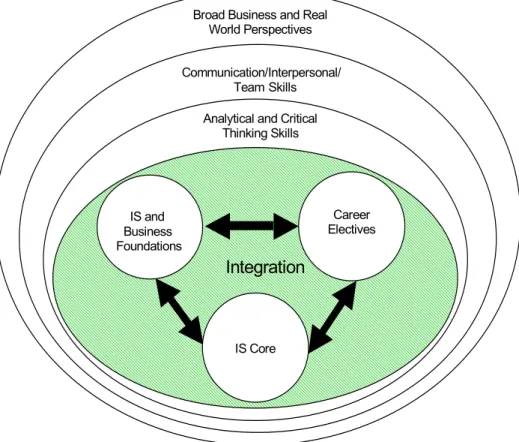
Model 2000: Model Curriculum and Guidelines for MS Degree Programs in Information Systems was sponsored, approved and published by the Association for Computing Machinery (ACM) and the Association for Information Systems (AIS). The report is endorsed by seven leading academic and practitioner information systems organizations. Figures 1 and 2 from Gorgone, J., and Gray, P. (2000) illustrates the skills, knowledge, and values expected of graduates from the degree program and curriculum architecture respectively.
A graduate from the program is expected to have broad business and real world perspective, communication, interpersonal and team skills, and analytical and critical thinking skills. Skills are integrated throughout the curriculum and its individual courses. Figure 1 displays the equal importance and relationship of career track electives with foundations and core requirements of the degree program (Gorgone, J., and Gray, P. 2000).
I
Broad Business and Real World Perspectives Communication/Interpersonal/
TeamSkills Analytical and Critical
Thinking Skills
Integration
IS and Business Foundations IS Core Career Electives IS Foundations BusinessFoundations IS Core Career Electives
Fundamentals of IS
IT Hardware and Software
Programming, Data and Object
Structures Financial Accounting Marketing (Customer Focus) Organizational Behavior Data Management Analysis, Modeling and Design Data Communications and Networking Project and Change Management IT Policy and Strategy Required Tracks (representative) • Consulting • Decision Making • Electronic Commerce
• Enterprise Resource Planning
• Globalization
• Human Factors
• Knowledge Management
• Managing the IS Function
• Project Management
• Systems Analysis and Design
• Technology Management • Telecommunications
In
te
g
ra
tio
n
Elective Pre-/Corequisite 9-12 units units9 15 units 3 units 12 units Figure 1. Skills, Knowledge, and Values of MSIS GraduatesObjectives of the MSIS Program
The graduate curriculum architecture is designed as a set of interrelated building blocks that included foundations, core, integration component and career track electives. At the business and IS foundations level, the curriculum is designed to provide prerequisite skills to students from a wide variety of backgrounds. The next building block is the IS core that includes a set of courses required of all graduates, as follows:
• Data management
• Analysis, modeling, and design • Data communications and networking • Project and change management • IS policy and strategy
The integration component provides “students the opportunity to synthesize ideas presented earlier” (Gorgone, J., and Gray, P. 2000). The Career Track is explained next.
Career Tracks in the MSIS 2000 Model Curriculum
IS professional career paths are more diverse than in the past. The purpose of career tracks is to help fulfill this broader need. The Career Tracks block in MSIS 2000 consists of elective courses organized around current or future careers areas such as database management or Internet security. A career track consists of four or more associated electives that prepare a student for a specialization within information systems. Schools may have one or more tracks depending on faculty expertise, demands of local industry and interest of students. MSIS 2000 recommends experimenting with tracks as a way to meeting local industry needs. Multidisciplinary career tracks are recommended as they can provide robust synergy between diverse faculty expertise (Gorgone, J., and Gray, P., 2000).
Career Tracks and Inter-Disciplinary Communication
Note that career tracks may be multidisciplinary and involve courses from two or more departments. Before embarking on development of career tracks it is important to even out issues and communicate frankly with the impacted departments. For example, the telecommunications track may involve integrating three or more courses from a telecommunications or computer science department. Implementation of the electronic commerce career track may require rigorous communication amongst the management and computer science departments. Many dreadful stories abound in academia of wasted resources and enthusiasm simply because of lack of or very poor communication among affected parties. Any such risks should be mitigated well in advance.
Career Tracks and Units of Work
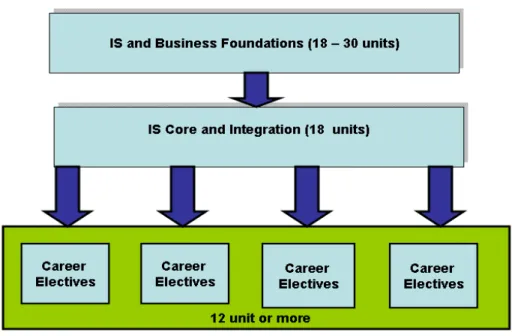
The number of units relative to the other components is illustrated in the MSIS Curriculum workflow below. Depending on the type of career track the number of units may range from 12 to 20 or more. Note that some institutes use credit hours or credits per courses.
Career Track Implementation
This section presents several career tracks that have been successfully implemented at colleges and universities in the US. The proposed career tracks are primarily inspired by existing and recently introduced Graduate Certificate programs at Boston University as well as career electives at Bentley. For example, Boston University provides the following graduate certificate programs: Computer Networks, Database and Multi-Tiered Computing, Electronic Commerce, Information Security, Project Management, Internet Technologies & Languages, Software Engineering, and Telecommunication. Comprehensive details pertaining to Boston University’s new Information Security career track has also been recently published (Zlateva, Kanabar, et al 2003).
Figure 3. Career Track Units
We would also like to note that career tracks are prominently “in-action” at Stevens Institute of Technology (http://
attila.stevens-tech.edu/stmm/msis/). The career tracks presented at this Web site reveal: a) Management Tracks--for example,
Information Management, Project Management; and b) Technical Track--for example, E-Commerce Technical, Information Security, Software Engineering and Telecommunications Management.
The authors also conducted research of program offerings at other universities and colleges to see if they provided career tracks, specialty tracks, or graduate certificates at a Masters level. The Masters Programs in IS Web page, which contains a list of graduate programs in IS, sorted alphabetically proved to be a useful starting point. http://www.isworld.org/isprograms/
graduate/graduatealphabetic.asp.
Search engines such as Google were also used. Our Web page finding of concentrations are documented in http://
metcswebserver.bu.edu/faculty/vkanabar/msis/careertracks.htm.
Finally, a substantial amount of the detail for the following concentrations and preliminary course descriptions came from faculty and adjunct faculty at our universities. The adjunct faculty, working in the industry as practitioners, proved to be a good source for ideas and details for the career tracks.
The following career tracks are presented next as case studies and a macro-level course description is provided. Case Study A: Database and Multi-Tiered Systems
Case Study B: Electronic Commerce Case Study C: Project Management Case Study D: Telecommunications Case Study E: Information Security
Case Study F: Internet Technology and Languages
Case Study A: Database and Multi-Tiered Systems
Database and Multi-Tiered Systems have witnessed substantial growth over the past decade and remains a major source of employment for IS graduates. At least two related tracks can be implemented within the database area. They are briefly introduced below:
(1) Data Warehouse and Data Mining Track (2) Database and Multi-tiered Systems Track
The above tracks are listed as possible career tracks in MSIS 2000 and are listed here as examples of different approaches that can be implemented with the database area as career tracks.
(3) Data Warehouse and Data Mining Track
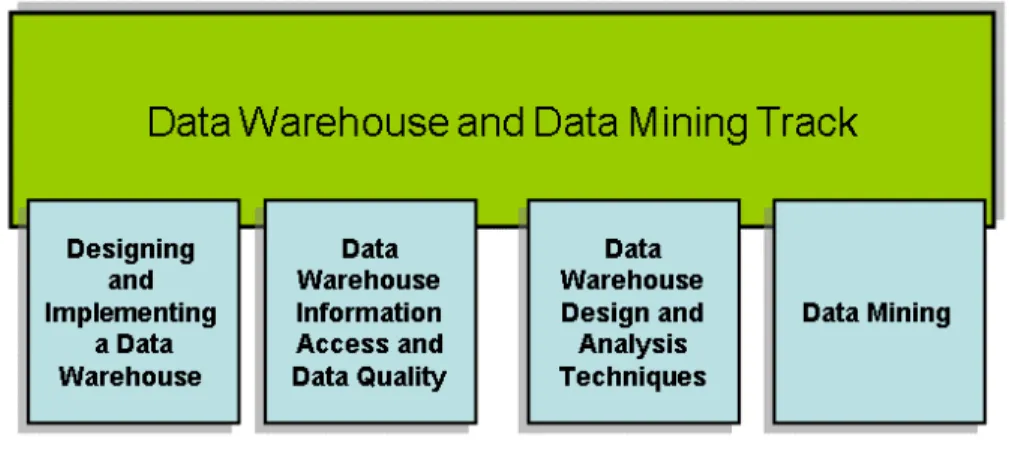
From the job market perspective this new career track is bound to be the very popular across industries. Banks and related financial institutions have designed and implemented data warehouse solutions for almost a decade. The major growth area for data warehouses will be in homeland security. Comprehensive targeted collection of all kinds of data, such as travel and money trail, will be stored in data warehouses. We recommend the following courses for this specialization: Designing and Implementing a Data Warehouse, Data Warehouse Information Access and Data Quality, Data Warehouse Design and Analysis Techniques, and Data Mining. See diagram below followed by course descriptions.
Figure 4. Data Warehouse and Data Mining Track Designing and Implementing a Data Warehouse (Course Description):
This course provides students with the technical skills required to plan, implement, and maintain a data warehouse using a DBMS such as SQL Server or Oracle Warehouse Builder. It describes basic data warehousing concepts. Key topics: Design a data warehousing system; implement a database designed with a star schema, gather data from primary data sources, transform data, and load data in to a DBMS. To conclude the students will create a cube using OLAP and analyze cube data using client applications. Upon successful completion, students will be familiar with the typical data warehouse components and architecture, and have an understanding of the practical uses of data warehousing.
Data Warehouse Information Access and Data Quality (Course Description):
The objective of this course is to provide students with comprehensive knowledge of two related areas--information access strategies and data quality. To access information from a data warehouse one has to develop business intelligence solutions with SQL, DSS and OLAP tools. Students will execute drill-down features for data analysis. Data quality topics covered are: defect detection, correction, and prevention; comparing source data cleansing and target data cleansing, and understanding the evolutionary nature of data in a data warehouse.
Data Warehouse Design and Analysis Techniques (Course Description):
This course introduces students to best practices in designing warehouse data structures and databases. It describes useful data modeling techniques and defines metadata. Different roles and uses of data, changing uses of normalization, and new modeling constructs that focus on time, location, and dimensional aspects of data are introduced. Other topics in this course include:
modeling the persistent staging area, data mart modeling, comparison between entity-relationship and dimensional modeling techniques, and optimizing warehousing data structures.
Data Mining (Course Description):
Data that users and managers can mine and investigate is a key goal behind any data warehouse effort. This course provides an introduction to basic concepts behind data mining and web mining. It surveys various data mining applications, data mining methodologies, techniques and models. Topics include decision tables, neural networks, decision trees, classification rules, association rules, clustering, statistical modeling, and linear models. The course wraps up with data mining case studies using large data sets taken from real-world projects.
Database and Multi-Tiered Systems Track
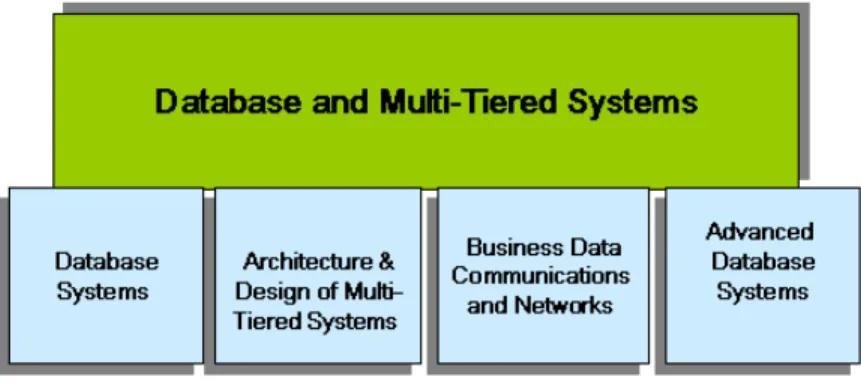
The second career track example focuses on classical database and multi-tiered systems. It consists of courses such as: Database Systems, Architecture and Design of Multi-tiered Systems, Business Data Communications and Networks, and Advanced Database Management. The diagram below illustrates the components of this specialization. It is followed by course descriptions.
Figure 5. Database and Multi-Tiered Systems Database Systems (Course Description)
The objective of this course is to provide solid practice in SQL and modeling and design of objects/data. This course provides an introduction to DBMS, relational model, data architecture, relational theory, SQL, modeling objects and modeling persistent data, and basic introduction to database recovery, concurrency, and security. Oracle DBMS, Microsoft SQL Server or MySQL are used in this course. Students complete a DBMS project.
Architecture and Design of Multi-Tiered Systems (Course Description)
This course provides an introduction to client/server architecture, thin clients are compared with fat clients and 2-tiered architectures are compared with n-tiered architectures. Other topics in this course include: Internet-based open distributed systems, front-end client technologies for the presentations layer, server technologies, database access, and business logic procedures. Finally, the role of XML as the perfect middleware is introduced. Students learn other XML related topics such as XSL, Schema, and Web services. Students complete a client/server design and implementation project using Oracle, SQL Server, MySQL and tools such as Visual Studio.Net.
Business Data Communications and Networks (Course Description)
This course provides basic concepts of data communications and computer networks, hardware, software, and reference models. The TCP/IP protocol suit and OSI model are introduced. Other topics in this course: voice communication, LAN, network development life cycle, security, and data communications economics.
Advanced Database Management (Course Description)
This advanced course covers the following topics: ERM versus semantic modeling, object-oriented databases, data warehouse, data mining, DDBMS; recovery, integrity, concurrency, transaction management, security, and heterogeneous database. Students complete projects involving: Web-based database applications using JDBC or ODBC, XML/Web Services, Schemas and XSL.
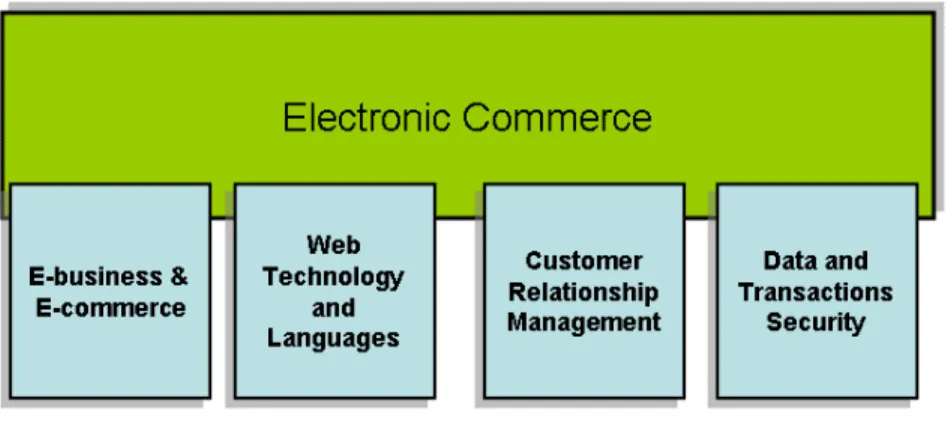
Case Study B: Electronic Commerce
Successful companies have integrated electronic e-commerce and related business strategies to build cutting edge enterprises. This career track provides specialized skills in the field of e-commerce and e-business. State of the art topics such as Customer Relationship Management that serve and treat customers effectively, e-privacy and supply chains are covered in this track. Students receive a sound foundation in web languages and programming (HTML, ASP & XML) and electronic commerce security.
Despite the gloom and doom surrounding dot-com woes, Internet technology and electronic commerce is here to stay. All current and future IS systems development will be web-enabled. The electronic commerce concentration will continue to be a key MSIS career track. It is very important to continuously fine-tune this concentration by introducing new courses such as customer relationship management and integrating topics such as supply chain management.
Figure 6. Electronic Commerce E-Business and Electronic Commerce (Course Description)
This course provides a detailed examination of how businesses can successfully use Internet and Web technology. Students are introduced to concepts and issues of electronic commerce. Topics include comparison of e-commerce procedures, payment mechanisms, supply chain management, applications in different industry sectors, security, challenges of starting and maintaining an electronic business site, as well as a comparison with traditional business practices. Students create an e-commerce Web site using such tools as FrontPage or Dreamweaver MX.
Web Technology and Languages (Course Description)
This course presents a complete immersion into Web technology, Internet, World Wide Web architecture. Students start with Web page creation using the standard HTML language. Other topics include client-side scripting using DHTML, JavaScript, VBScript, and XML. The course concludes with server-side scripting using ASP or PERL.
Customer Relationship Management (Course Description)
This course introduces the Internet, World Wide Web, and related technologies as they have come to be used for the marketing, selling, and distribution of goods and services and technologies pertaining to Customer Relationship Management (CRM). Much
has happened in this arena and new developments continue at a high rate. Topics covered include: CRM fundamentals, CRM architecture, ethical uses of information and privacy considerations, next generation CRM trends, and roadmap for managers. Data and Transactions Security (Course Description)
This course develops knowledge and skills for both Electronic Commerce Payment Mechanisms and Data Transactions Security of information and information systems within organizations. Payment options for electronic commerce such as E-Cash, SET, credit cards, systems design, and methods of dealing with risks are covered. The core topics in this course are: designing, implementing, managing, and auditing security at all levels; techniques for assessing risk associated with accidental and international breaches of security; digital certificates, digital signatures, firewalls, and cryptography.
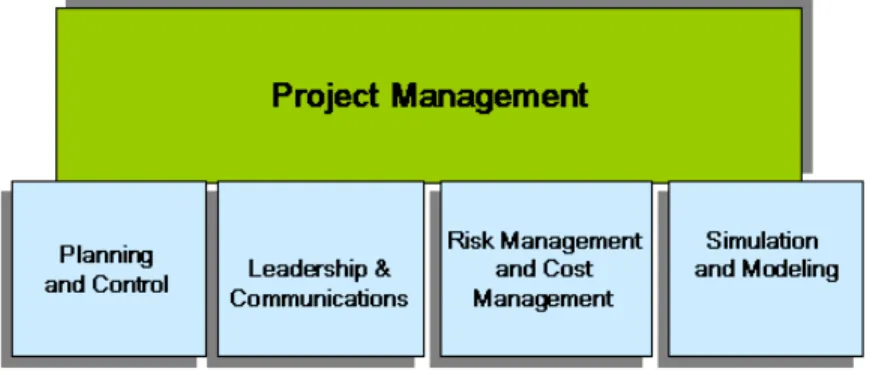
Case Study C Project Management
The focus of IT project management concentration is to teach students how to deliver quality products and solutions, on time, within budget, ahead of the competition. Top organizations are moving toward a project-oriented approach to manage their businesses. Graduates of this track will understand and appreciate the latest tools and techniques of project management. Students in this concentration learn to master IT cost estimation, cost and schedule control systems, and risk management.
Figure 7. Project Management Planning and Control (Course Description)
This course provides a foundation to project management principles. It introduces project methodology and describes project planning, scheduling and control techniques. It examines common pitfalls while offering students a practical introduction to project management. A project management tool such as MS Project will be used in an innovative way to combine technology with theory and to provide practical skills to effect project management.
Project Leadership and Communications (Course Description)
To be a successful project manager you must be a skillful leader and a good communicator. This course explains current leadership philosophies as applied to project management. It identifies styles of communication and conflict resolution. This course focuses on both technical communications and non-technical communication. The complexities of communication in the project environment (especially matrix structure) are presented in detail. Case studies and exercises will provide leadership skills, communication skills, conflict management skills and negotiation skills.
Risk Management and Cost Management (Course Description)
This course introduces the art and science of project risk and IT cost estimation and cost management. Project risk management is introduced as a systematic process of identifying, analyzing and responding to project risk. Case studies include risks pertaining to security. Both early and detailed cost estimation, and cost control using earned value method is covered
Simulation and Modeling (Course Description)
This capstone course provides an opportunity to integrate skills and knowledge acquired in this career track and produces the deliverables required for successful project management. This course includes use of an interactive computer-based simulation involving student teams performing project planning, analysis and decision-making. Additional topics covered include procurement management, quality management and project closeout and turnover activities.
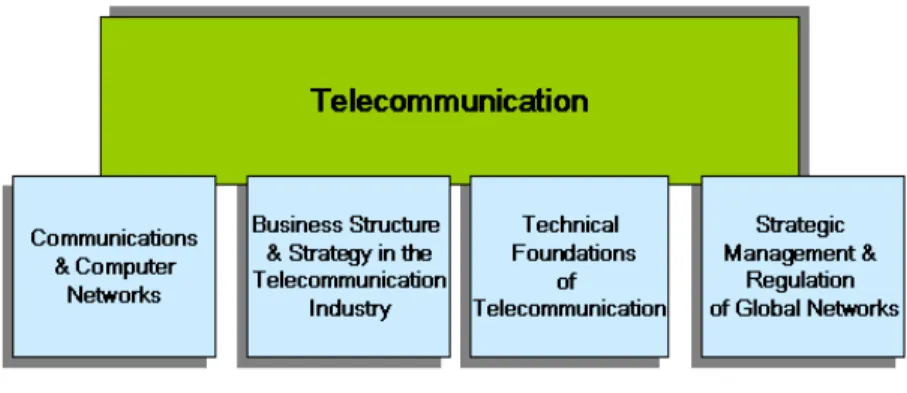
Case Study D: Telecommunication
Graduates of this concentration acquire the knowledge and skills in IT and network management for a career in the telecommunication industry.
Figure 8. Telecommunication Communications and Computer Networks (Course Description)
Basic concepts of data communications and computer networks; hardware, software and reference models; example data com-munication services, standardization, TCP/IP, and emerging protocols, such as Bluetooth, WAP, and 802.11; network develop-ment life cycle, security; LANs, MANs, WANs, encoding digital and analog signals, transmission media, asynchronous/ synchronous protocols; circuit, packet and message switching, internetworking technologies, topologies and wireless communications.
Business Structure and Strategy in the Telecommunications Industry (Course Description)
Market structure, market rivalry, regulations, and public policy will be discussed. Merger/acquisition and strategic partnerships, as well as the cable, wireless, and satellite industries/technologies are covered. E-commerce and Web-related issues will be examined.
Technical Foundations of Telecommunications (Course Description)
Introduces the theoretical foundations of telecommunications, including pulse code modulation, line coding, information rate, equalization, amplitude modulation, angle modulation, frequency modulation, phase modulation and noise in communication systems. Detailed overview of analog and digital transmissions systems and techniques are covered. Topics include telephony, analog and digital radio, transmission efficiency, wireless communications systems, personal communications systems technologies, cellular radio, digital cellular, wireless LANs, Mobile IP, GSM and 3G.
Strategic Management & Regulation of Global Networks (Course Description)
Strategic management and regulation of national and global networks are covered. Topics include: ISDN, BISDN, GIGANET, ATM, SONET, international standards, international organizations, global network security, and global management. IT Economic: Total Cost Ownership, Return on investment and IT Project Portfolio Management.
Case Study E: Information Security
Information Systems professionals need an in-depth knowledge of emerging security risks and solutions to ensure that IT infrastructure including facilities, networks, and computer systems are secure. IS professionals are responsible for developing information security and disaster recovery plans that proactively protect IT systems. This career track is designed for IS professionals interested in the information Security field. It is intended to provide essential knowledge and skills in the area of Internet and electronic commerce security.
Figure 9. Information Security Data Communications, Operating systems and Web Servers (Course Description)
This course provides an overview of computer networks: hardware, software, reference models, TCP/IP, and emerging protocols. The course also provides and overview of UNIX and Windows operating systems with particular emphasis on security. Finally, both Apache and IIS web servers are introduced in great detail. HTTP, FTP and SMTP are all introduced from a practical perspective.
Network Management and Computer Security (Course Description)
In-depth study of LAN and WAN network management. Topics include fault, configuration, security, performance and accounting management. Strong focus on problem-solving techniques and network management tools based on SNMP. Discussion of techniques for achieving security in multi-user computer systems. Other topics covered in this course include: cryptography, secret-key, public-key, digital signatures, electronic mail, and firewalls.
Information System Security (Course Description)
This course will enable IT leaders to identify and implement highly secure networks that support organizational goals and provide students with a methodology to identify, quantify, mitigate and control risks. Students will implement comprehensive IT risk management plan (RMP). The plan will identify alternate sites for processing mission-critical applications, and techniques to recover infrastructure, systems, networks, data and user access. The course focuses on topics such as: disaster recovery, handling information security; protection of property, personnel and facilities; protection of sensitive and classified information, privacy issues, and criminal terrorist and hostile activities.
Databases and Security (Course Description)
The course provides a strong foundation to database and computer security. It provides database related IT security concepts and suggests strategies to guard against crackers, viruses and other intrusions. The following topics are covered from a database centric perspective –data communication, security models, firewalls and gateways; authentication and encryption techniques and public key protocols. This course deals with database management security—issues such as securing the DBMS, enforcing access controls, backup and recovery, XML security standards, cryptography, network security, web server security, UNIX and Windows security.
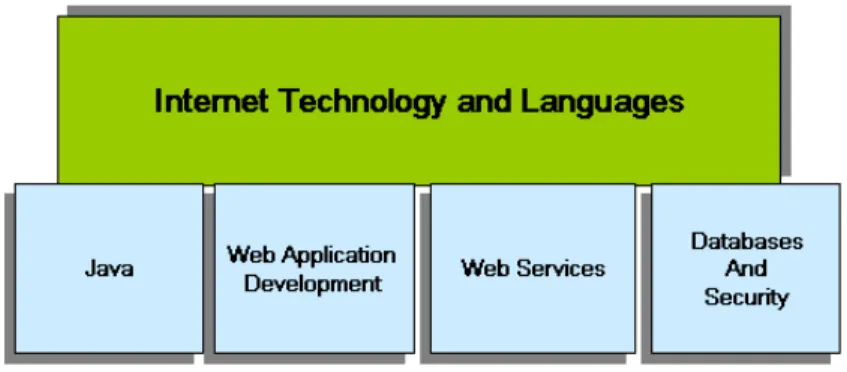
Case Study F: Internet Technology and Languages
The Internet is an important platform for delivery of e-commerce and other applications. Languages, methods, tools, standards, and technology for developing applications on this platform are proliferating rapidly. This career track prepares students with the background needed to plan and design Internet applications.
Figure 10. Internet Technology and Languages Java (Course Description)
This course introduces the Java programming language and provides comprehensive coverage of flow of control, classes and methods, class composition and extension, interfaces, exceptions, and packages in Java. Other topics covered include: utilities, applets, and Abstract Window Toolkit (AWT), Swing Library, networking, and Java database connectivity.
Web Application Development (Course Description)
This course presents a complete immersion into Web technology and languages other than Java. For course description see Case Study B, Web Technology and Languages course.
Web Services (Course Description)
Topics covered in this course include: Architecture and advantages of Web Services, XML, DTD, Schemas and XSL. XML applications such as SOAP, WSDL, and UDDI are introduced. Students complete application development projects using Visual Studio.NET, or Sun One Architecture tools.
Databases and Security (Course Description)
The course provides a strong foundation to database and computer security. See Case Study E for course description.
Other Possibilities
It is possible to support information system concentrations by industries. For example, specialized concentrations might be of interest to the following industries: bio-tech (bioinformatics), health care, and financial services. You can local additional information at: http://metcswebserver.bu.edu/faculty/vkanabar/msis/ITinIndustry.htm.
A few schools embrace certification and align their courses with vendor certification tracks (Montante and Khan 2001). This is readily possible for database, computer networking, project management, and information security tracks and might be of interest to certain colleges or universities.
Conclusion
Career tracks are a key component of MSIS 2000 curriculum model. It provides academic institutions an opportunity to implement specializations and produces graduates who are focused and better prepared for the job-market. The paper demonstrated that career tracks could be interdisciplinary and involve courses from two or more departments. Before creating career tracks it is important to even out issues and communicate frankly with the impacted departments. For example, the telecommunications track would involve integrating three or more courses from a telecommunications, electronical engineering or computer science department. Taking a MSIS degree on a part time basis is challenging and if the curriculum is aligned with their “working career” it becomes an attractive attribute in both retaining and motivating the working adult. Universities can package several MSIS “career track” courses as “graduate certificates”. Students who complete such related courses can obtain a graduate certificate or diploma. Such certificates act as milestones for part time students and propel them towards their MSIS degree. Finally, this paper provided templates for faculty to use to introduce technical or managerial career tracks in their institutions.
References
Davis, G.B., Gorgone, J., Couger, J.D, Feinstein, D.L., and Longenecker, Jr., H.E. “Model Curriculum and Guidelines for Undergraduate Degree Programs in Information Systems,” The DATA BASE for Advances in Information Systems, (28:1), 1997, pp.1-94.
Gorgone, J., and Kanabar, V. “Status of Master’s Degree Programs in Information Systems,” Proceedings of the 12th Annual Conference of International Academy for Information Management, December 1997.
Gorgone, J., and Gray, P. “MSIS 2000 Model Curriculum and Guidelines for Graduate Degree Programs in Information Systems,” The DATA BASE for Advances in Information Systems, (31:1), 2000, pp.1-48.
Montante, R., and Khan, Z. “Specialized Certification Programs in Computer Science,” Proceedings of the SIGCSE 2001, 2001, pp. 371-375
Zlateva, T., Kanabar, V., Temkin, A., Citkusev, L. and Kalathur, S., “Integrated Curricula for Computer and Network Security Education,” Proceedings of the Colloquium for Information Systems Security Education, 2003, pp.1-12.