Supported
internships
Advice for:
•
further education colleges
•
sixth forms in academies
•
maintained and non-maintained schools
independent specialist providers
•
other providers of study programmes, and
•
local authorities
June 2014
Contents
1. Summary 4
About this departmental advice 4
Expiry or review date 4
Who is this advice for? 4
Main points 4
2. Introduction 6
2.1 What is a supported internship? 6
2.2 The government’s ambition for children and young people with learning difficulties
and/or disabilities 9
2.3 Why might a learning provider offer supported internships? 10
3. Planning and designing supported internships 12
3.1 Delivery models 12
3.2 Staffing 211
4. Job coaching 25
4.1 Roles and responsibilities 25
4.2 Skills, attitudes and behaviours 28
4.3 The job coach contract 29
5. Recruiting and engaging Interns 30
5.1 Eligibility 32
5.2 Suitability 32
5.3 Recruitment and engagement practices 33
5.4 Providing support to interns 34
5.5 Reviewing progress and support needs 36
6. Working with parents and carers 388
6.2 During the programme 399
6.3 Towards the end of the programme 39
7. Working with employers 41
7.1 Engagement and recruitment of employers 41
7.2 Job matching 46
7.3 Induction and settling in 48
7.4 The duration of the internship 49
7.5 Securing employment for the intern 50
8. Achieving positive progression 51
8.1 Planning for progression: examples of positive actions 51
9. Funding 54
9.1 Education Funding Agency funding 54
9.2 Further sources of funding for supported internships 56 9.3 Funding for interns requiring on-going support after completing their internship 58
10. Further information 60
For information about supported internships and similar schemes 60
Further sources of information 60
Other departmental advice and guidance you may be interested in 61
1. Summary
About this departmental advice
The advice explains what supported internships are and why they have been introduced. It also provides practical advice on developing, implementing and delivering supported internships, including information on funding, programme design, staffing, and the various partnerships on which supported internships are founded.
Expiry or review date
This advice will next be reviewed before May 2016.
Who is this advice for?
This advice is primarily for the use of learning providers including:
further education colleges;
sixth form colleges;
sixth forms in academies, free schools and maintained schools, including special schools;
independent specialist providers; and
any other providers of study programmes interested in delivering supported internships.
It will also be of interest to local authorities as they determine their Local Offer, as required by the Children and Families Act, and to other bodies, such as supported employment agencies, who may be working with a learning provider as a key partner in their supported internship provision.
Main points
The advice draws heavily on the experiences of the 15 colleges who took part in the 2012/13 supported internship trial set up by the Department for Education1. The colleges shared key success factors and lessons learned as part of their involvement in the
1 Find out about supported internships at
https://www.gov.uk/government/policies/increasing-options-and- improving-provision-for-children-with-special-educational-needs-sen/supporting-pages/supported-internships-for-young-people-with-sen. For a concise supported internship factsheet, visit
http://www.preparingforadulthood.org.uk/resources/pfa-resources/factsheet-supported-internships See the evaluation report of the supported internship trial at https://www.gov.uk/government/publications/learning-difficultiesdisabilities-supported-internship-evaluation
evaluation of the pilot.2 The advice also draws on the experiences of other providers who
have been running programmes to support young people with learning difficulties and/or disabilities into employment, including some who have been running for a considerable period of time, where their provision is consistent with the principles of supported internships.
The advice has been designed to provide a comprehensive introduction to supported internships and to allow users to dip into individual sections of particular interest. It is divided into nine broad sections. Details of the specific content covered in each of these sections can be found on the Contents pages.
Introductory information
Planning and designing supported internships
Job coaching
Recruiting and engaging interns
Working with parents and carers
Working with employers
Achieving positive progression
Funding
Further reading
Readers who want to gain a quick overview of the content are advised to focus on the summary boxes at the start of each relevant section.
2 The majority of the case studies, quotations and images included in the advice have been contributed by the 15 trial colleges. A more detailed account of the trial can be found in the supported internship trial evaluation report.
2. Introduction
2.1 What is a supported internship?
From August 2013, all young people in full or part-time education aged 16 to 19 (16 to 24 where the student has a Learning Difficulty Assessment or Education, Health and Care (EHC) plan) have been expected to follow a study programme3 - a coherent,
personalised learning programme that offers breadth, depth and progression. A
supported internship is one type of study programme specifically aimed at young people aged 16 to 24 who have a statement of special educational4 needs, a Learning Difficulty Assessment, or an EHC plan, who want to move into employment and need extra support to do so.
All young people should be helped to develop the skills and experience, and achieve the qualifications they need to succeed in their careers. The overwhelming majority of young people with SEN are capable of sustainable paid employment with the right preparation and support. All professionals working with them should share that presumption. Colleges that offer courses which are designed to provide pathways to employment should have a clear focus on preparing students with SEN for work. This includes identifying the skills that employers value, and helping young people to develop them. Supported internships are structured study programmes based primarily at an employer. They are intended to enable young people with learning difficulties and/or disabilities to achieve sustainable, paid employment by equipping them with the skills they need for work through learning in the workplace. Internships normally last for a year and include unpaid work placements of at least six months. Wherever possible, they support the young person to move into paid employment at the end of the programme. Students complete a personalised study programme which includes the chance to study for relevant substantial qualifications, if suitable, and English and maths to an appropriate level.
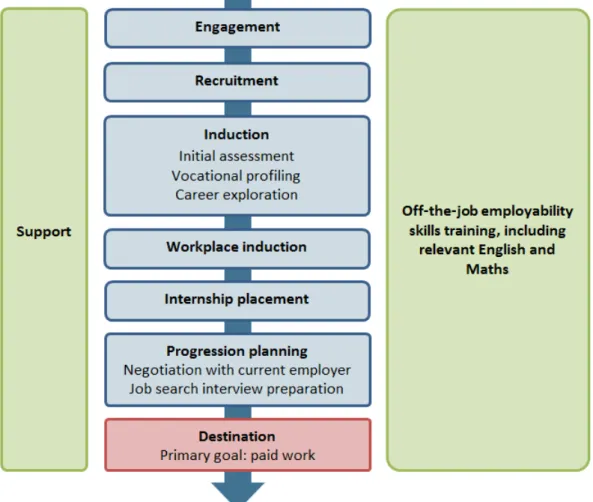
2.1.1 Learner journey on a supported internship
The diagram below sets out an example of a supported internship as it might be experienced by the young person during the period of the internship itself. The young person and their parents and carers will have access, in line with the SEN Code of Practice, to information, advice and guidance about their post-16 options, including supported internships, well in advance of the start of their programme, beginning with 3 For general guidance on study programmes, see
http://www.education.gov.uk/childrenandyoungpeople/youngpeople/qandlearning/programmes. For specific guidance on study programmes for learners with learning difficulties and/or disabilities, see
http://www.preparingforadulthood.org.uk/media/309641/factsheet_study_programmes.pdf
4 A young person turning 25 whilst on a supported internship is able to continue on it until the end of that academic year.
their Year 9 review. Equally, for many learners, a programme of continuing support after
the end of their internship may need to be in place (see section 9.3).
Figure 1 - An example of a supported internship
2.1.2 How does a supported internship differ from a traineeship or
Apprenticeship?
Although similar in aims to a traineeship or Apprenticeship, supported internships differ in key ways. Young people on supported internships are expected to require a higher level of support than a trainee or apprentice, and to be offered workplace support in the form of a job coach, as well as support for their non-workplace learning.
A key difference to traineeships is that interns are expected to need a longer programme
than a trainee, for whom the maximum programme length is six months, before they are ready to progress to an Apprenticeship or other sustainable employment. For more information about traineeships, see the framework for delivery of traineeships5.
5 Department for Education (2014), Traineeships: Framework for delivery 2015/15
https://www.gov.uk/government/publications/supporting-young-people-to-develop-the-skills-for-apprenticeships-and-sustainable-employment-framework-for-delivery
Apprentices, like interns, gain practical skills in the workplace. A key difference is that Apprentices have to pass various qualifications or assessments, for example English and maths qualifications, to complete successfully their Apprenticeship. There are no entry or completion requirements for supported internships, and each learning provider will work with their interns to develop a personalised programme that meets their needs and provides progression and stretch. Like supported internships and traineeships, young people who undertake Apprenticeships can retain their EHC plans while they are participating. For more information about Apprenticeships, see the Apprenticeship website.6
2.1.3 What is a successful outcome from a supported internship?
The aim of supported internships is to prepare young people with complex needs for paid employment by:
• supporting them to develop the skills valued by employers;
• enabling them to demonstrate their value in the workplace; and
• developing confidence in their own abilities to perform successfully at work. Whilst the ideal outcome from a supported internship will be the offer of a paid job from an employer, possibly the employer who hosted the intern’s work placement, other outcomes include:
• building up experience for a CV, demonstrating that the young person has the skills and willingness to work;
• changing the perception of employers about employing people with learning difficulties and/or disabilities;
• changing the perception of the young person’s family that they can work;
• improving skills in English and maths that enable the young person to be better prepared for work, including handling money, interacting with the public, and practising interview skills; and
• becoming independent travellers.
Supported Internships are recorded as part of the Individualised Learning Record (ILR). We will look at how this information can be used to inform young people, their parents and local authorities.
6http://www.apprenticeships.org.uk/
2.2 The government’s ambition for children and young people
with learning difficulties and/or disabilities
Government policy is that young people with learning difficulties and/or disabilities, including those with more complex needs, should be supported to develop the skills and gain the qualifications and experience they need to succeed in their careers. Supported internships are one means by which young people with learning difficulties and/or
disabilities can be supported to achieve paid employment. 7
This is consistent with the Government’s vision for disability and employment set out in
Fulfilling Potential: Making it Happen (DWP, 2013)8, and the wider reforms to the SEN and disability (SEND) system which is set out in the Children and Families Act.9
The Act was introduced because the former system of support was complicated,
expensive and delivered poor outcomes, and children and young people struggled to get the help they needed. Local authorities spend over £5 billion a year on SEND provision, and yet:
• in 2012 at Key Stage 2, pupils with SEND achieved roughly half as well as those with no identified SEND at English and Maths (43% achieved level 4 in
comparison with 91%);
• the percentage of pupils with SEND achieving 5 or more GCSEs at grade A* to C was 22% in comparison with 69% with no identified SEND at Key Stage 4/5; and
• around 30% of all young people with statements of SEN at 16 are not in education, employment or training at 18 compared to 13% of their peers.
From September 2014, the special needs reforms implemented a new approach which seeks to join up help across education, health and care, from birth to 25. Help will be offered at the earliest possible point, with children and young people with SEND and their parents or carers fully involved in decisions about their support and what they want to achieve. This will help lead to better outcomes and more efficient ways of working This includes a 0-25 Education, Health and Care Plan to replace statements and
Learning Difficulty Assessments, which reflect the child or young person’s aspirations for the future, as well as more immediate outcomes they need support to achieve.
7 For an understanding of supported internships in the wider reform context see
http://www.preparingforadulthood.org.uk/media/312574/pfa_delivering_oct_2013.pdf, a guide to implementing the reforms, based on the experience of the 20 pathfinders
8 Department of Work and Pensions (2013) Fulfilling potential: Making it Happen
http://odi.dwp.gov.uk/fulfilling-potential
9http://www.legislation.gov.uk/ukpga/2014/6/contents/enacted, which builds on the proposals originally set out in the SEN Green Paper, Support and Aspiration (DfE, 2011)
https://www.gov.uk/government/publications/support-and-aspiration-a-new-approach-to-special-educational-needs-and-disability-consultation
Local authorities are required to produce a ‘Local Offer’ of services developed with parents and young people, so that they can understand what is available, and how to complain if they need to. They must consult publicly on this Local Offer, and publish the results.
2.2.1 The rationale for supporting young people with learning
difficulties and/or disabilities into employment
The National Audit Office report Oversight of special education for young people aged 16-25 published in November 2011, estimates that supporting one person with a learning disability into employment could, in addition to improving their independence and self-esteem, increase that person’s income by between 55 and 95 per cent. The National Audit Office also estimates that equipping a young person with the skills to live in semi-independent rather than fully supported housing could, in addition to quality-of-life improvements, reduce lifetime support costs to the public purse by around £1 million. These results illustrate the potential for improving the life chances of young people with SEN through employability and independence skills. Most people with a learning difficulty or disability want to work10. However, only a small percentage (7% of adults known to social services with moderate to severe learning difficulties11) is currently in paid employment. A 2007 Ofsted survey of college-based provision12 for 16-18 year olds
with learning difficulties and/or disabilitiesfound that learners’ progression to employment was ‘under-developed’ and a more recent report from Ofsted suggests that this issue remains:13hence the need for a new approach. Achieving paid employment not only
brings young people financial independence, but it can be key to building confidence and self-esteem, increasing health and well-being, and to gaining friendships and a social life. There are also benefits for the economy, employers, families, the local community and wider society.
2.3 Why might a learning provider offer supported
internships?
The SEN Code of Practice states that FE colleges, sixth form colleges and 16-19 Academies must use their best endeavours to secure the special educational provision 10 65% say they want to work. Referenced in Emerson, E., Malam, S., Davis, I. and Spencer, K. (2005),
Adults with Learning Difficulties in England, 2003/4
11 NHS Social Care and Mental Health Indicators from the National Indicator Set: 2010-11 provisional release at www.data.gov.uk
12 Ofsted (2007) Current provision and outcomes for 16- to 18-year-old learners with learning difficulties
and/or disabilities in colleges http://www.ofsted.gov.uk/resources/current-provision-and-outcomes-for-16-18-year-old-learners-learning-difficulties-andor-disabilities
13 Ofsted (2011) Progression post-16 for learners with learning difficulties and/or disabilities
http://www.ofsted.gov.uk/resources/progression-post-16-for-learners-learning-difficulties-andor-disabilities
which young people need. Offering supported internships can help all learning providers who educate young people with statements of SEN, Learning Difficulty Assessments and EHC plans to:
provide evidence that their provision is personalised and outcome-focused, in line with Ofsted expectations;
support more young people with learning difficulties and/or disabilities in their local area into paid work, in line with government policy;
offer a positive progression route to employment from their existing provision ;
solve the issue of ‘learner churn’ or ‘revolving door syndrome’, where learners complete one programme and re-enrol on something very similar, rather than achieving a positive progression;
show their commitment to equality and diversity; and
demonstrate their responsiveness to the full range of learners in the local community.
The SEN Code of Practice states that local authorities and their partner bodies and agencies must co-operate with each other in the development and review of the Local Offer. This is essential so that the Local Offer provides a comprehensive, transparent and accessible picture of the range of services available.
Learning providers will therefore need to work with their local authority to contribute to a Local Offer which meets the needs of the full range of young people with SEN or
disabilities in their local area. Supported internships are expected to be a key part of this Local Offer.
New Bridge School’s rationale for setting up a supported internship programme We wanted to provide extended training for young people in real work placements. We had identified significant limitations in possible pathways for young people with a learning disability on transition into adulthood. Previous work experience had proved time-limited, at times tokenistic and generally ineffective in terms of securing pathways into
3. Planning and designing supported internships
Summary
The evaluation of the trial told us that key factors in effective first-stage planning for the shaping of supported internship delivery models are:
• flexibility to meet (changing) needs of individual interns - and employers;
• induction that makes clear that the end goal is work and includes detailed assessment and profiling in relation to work;
• substantial time in the workplace;
• personalised learning provider-based learning;
• clear links between workplace and non-workplace learning
• planned progression strategies ;
• based on partnerships with specific roles and responsibilities; and
• distinction from other courses offered by the learning provider.
3.1 Delivery models
Providers are free to design their supported internship programme to fit their local circumstances and to meet the needs of their learners. However, the Department for Education has set out the following principles which should be followed:
• Principle 1 - A significant majority of the intern’s time must be spent at the
employer’s premises. Whilst at the employer, the young person will be expected to comply with real job conditions, such as time keeping or dress code. Where appropriate, learning at the employer should use systematic instruction, a method specifically designed to help people with complex learning difficulties learn new tasks.
• Principle 2 - Interns must do some form of learning alongside their time at the
employer, including relevant aspects of English and maths.
• Principle 3 - Jobs must work for both the young person and the employer. For the
young person, the job must fit with their vocational profile, contribute to their long term career goal and be flexible enough to address barriers where necessary. For the employer, they must meet a real business need. As the goal of the
the employers taking on interns should have a job available to offer at the end of it – should the intern meet the required standard.
• Principle 4 - Central to the study programme is the provision of support to the
young person and to the employer, including job coaching support. On-going support should continue to be available (including Access to Work14) should the
employer offer the young person a job at the end of the internship or to support young people who do not achieve paid work to continue to work towards this end.
3.1.1 Key planning considerations
When exploring possible models consistent with these principles, providers will need to think through the following questions:
• What will be the overall shape of the programme and how much flexibility will we need to build in? See section 3.
• How long will our supported internship programme be? See section 3.1.
• What partners might we need to work with? See section 3.1.
• How much time, on average, will interns spend in the workplace? See section 3.1.1.
• How much time, on average, will learners spend in school/college and what learning will they do while they are there? See section 3.1.1.
• How will we staff our model? See section 3.2.
• How will we get the buy-in we need from employers, parents, young people, senior leaders, governors and others? See sections 3.1, 5, 6 and 7
• What forms of support might interns need and how will we meet those needs? See
sections 4 and 5.4.
• How many and what sort of employers might we need to work with? See section
7.
• How much funding can we source to run our supported internships? See section
9.
14 Access to Work is a specialist disability service from Jobcentre Plus that gives practical advice and support to disabled people, whether they are working, self-employed or looking for employment. Access to Work is provided where someone needs support or adaptations beyond the reasonable adjustments which an employer is legally obliged to provide under the Equality Act. Access to Work has been extended to the in-work element of supported internships and traineeships and can fund job coaches, specialist equipment for days that a young person is at the employer's premises, as well as the extra fares to work if the person is unable to use public transport See https://www.gov.uk/access-to-work and
http://www.preparingforadulthood.org.uk/what-we-do/supported-internships/access-to-work-fund
Each of these issues is explored within the advice. The section below focuses on the shape of the programme itself.
Length of programme
The duration of a supported internship is normally a year. It should last at least six months, depending on the needs of the interns, the needs of the employer and the point at which the opportunity for paid employment arises. Providers will not be penalised if interns complete a supported internship earlier than originally planned in order to take up employment. Providers can run supported internships as roll-on, roll-off programmes in order to maximise flexibility and meet the needs of a larger number of interns.
Balance of learning time in and out of the workplace
The first supported internship principle requires interns to spend a substantial majority of their time in the workplace. The actual amount of time will vary according to intern and employer need, and may increase during the course of the internship. Variations in time spent in the workplace may arise for a number of reasons: for example, some interns may have health issues which mean that they are unable to spend extended periods of time in the workplace, while some employers may have a business need which requires the intern to work four days a week.
Providers may choose to ‘front-load’ their programme with an intensive period of
preparation before the interns go out into the work-place, while they prepare interns for their internship. They may also decide to introduce an intern to the workplace
incrementally, stepping up the time in the workplace over a period or weeks. However the internship is designed, the overall balance of time should be weighted in favour of the workplace, and after an initial period, interns should be spending more of their time at work than on learning outside of the workplace.
Pre-placement training
Providers might run an intensive period of pre-placement training alongside the
vocational profiling and initial assessment that will be included in the early stages of all internship programmes. However, if interns require considerable and extended input before moving into the workplace, it may be that they are not yet ready for a supported internship and their needs would be better met by a preparation for employment course, with a planned progression to an internship once that has been completed.
Pre-placement learning can be used to build confidence, raise aspirations and extend interns’ employability skills and knowledge of the world of work. This can support better job matching (placing the right intern in the right job role), and greater confidence and awareness of work, including different career options, leading to a greater chance of a successful internship and an offer of employment at the end. Learning activities might include:
research about different employment sectors, employers and job roles
visits from employers;
visits from inspirational speakers including role models (e.g. young people with learning difficulties and/or disabilities in employment);
a variety of short work experience opportunities;
taster sessions in different vocational areas offered by the provider; and
practical activities (on and off-site) to develop team-work, problem-solving, confidence and communication skills
Off the job learning
The second supported internship principle requires providers to offer interns some form of learning off the job. This learning is most valuable and best engages interns when it clearly complements their learning in the workplace and is personalised to their specific needs and aspirations. Off-the-job learning also enables interns to build up a group identity and self-help network preventing them from feeling isolated in their separate workplaces.
Off-the-job learning, once the intern has been successfully placed in an internship, can vary considerably. It will typically include employability skills and, following study
programme principles, those students who haven’t already achieved GCSEs at grade C in English and maths should be working towards achieving them. Interim qualifications, such as Functional Skills, free standing maths and/or ESOL can be a useful stepping stone towards achieving GCSEs. Students who have profound or complex learning difficulties can be excluded from this requirement where appropriate. However, given the importance of English and maths to all young people, we strongly encourage those students who are capable of taking and achieving these qualifications, although they may be stretching, to do so.
It may also include specific areas of vocational learning, including small awards in areas such as food hygiene, health and safety, lifting and handling and pesticide handling which employers identified as increasing the intern’s employability in a specific sector. Some colleges on the trial offered interns larger vocational certificates, delivered over the two days a week when they were not in the workplace.
Learning outside the workplace does not mean working inside a classroom. It could include, for example:
visits to workplaces, other than the internship employer;
visits to job centres and (supported) employment agencies;
travel training;
community-based activity (e.g. a shopping trip to identify and price up suitable interview-wear);
residential activity (e.g. to improve independence skills or build up teamwork skills); and
use of other college facilities – e.g. learning resource centre, workshops, kitchens). Effective ways of ensuring that learning outside the workplace complements workplace learning include:
involving the job coach in some of the planning and delivery of the non-workplace learning
running workshops based on issues and challenges that have arisen at work
responding to employer requests for specific skills to be addressed
offering tutorial sessions in which learners can reflect on progress in the workplace and help identify learning needs
Effective ways of ensuring that learning outside the workplace is personalised include:
working with the learner, job coach and employer to identify specific learning needs
use of qualifications which allow for achievement at different levels
learner-led sessions
individualised timetables
inclusion of specific awards for individuals identified as supporting employability by employers (e.g. brush-cutting for a council parks and gardens assistant)
Interns often find that practical activities are the most enjoyable. These can be used, for example, to develop problem-solving skills, identify interns’ strengths and abilities, build up a team ethic or help interns to follow instructions.
Planning employer involvement
There are two main models of employer involvement that have so far been explored. Providers can operate either model or a blend of the two. They are also free to develop other models if these fit their local circumstances better, as long as the model meets with the four principles outlined earlier.
Supported internship extended work placements, unlike other forms of work experience, can be offered on-site in a school or college, provided the placement meets the four principles of the supported internship, i.e. the extended placement must be a real job, meeting a real business need, and complying with job conditions.
A supported internship is only an option for a young person with an SEN statement, an EHC plan or an LDA. Therefore if a young person is undertaking a work placement within the school or college, it will be recorded as part of a supported internship study
programme and the young person will have a statement, LDA or EHC plan. Unless both these conditions apply, an internal placement would not meet the EFA criteria for funding. Model 1: working with a single employer
A provider sources a single large employer who can offer multiple internships, sometimes including the opportunity for interns to rotate between different job roles. The employer
may be able to provide an on-site classroom so that all the learning takes place in the work setting, including that offered by the learning provider. This is based on the Project SEARCH model15, an approach originally developed in America, which has been
successfully trialled and implemented in the UK. Model 2: working with multiple employers
Providers source multiple employers, large or small, who can offer one or possibly two internships. Interns normally stay in a single job role which may be developed and extended over the period of the internship. Occasionally, interns may combine two internships at different employers or move from one internship to a second (e.g. where their aspirations change during the programme or where an internship placement simply does not work out for either the intern or the employer).
Combining models
Providers can also choose to combine these two models, with one group of interns placed with a single large employer (Model 1) and other individual interns placed with different employers (Model 2), where their needs cannot be met by the Model 1 employer.
Experiences from colleges involved in the trial
Whatever your model, you need to differentiate the supported internship from other college programmes. It’s not a college course, it’s an employment programme designed to get the learners into work. The learners have to be able to see the difference.
Examples of ways in which colleges in the trial achieved this distinctiveness include:
• holding their off-the-job learning sessions at a Connexions office, rather than at the college
• requiring interns to use annual leave cards to apply for time off and have different leave entitlement to college holidays
• and holding competitive interviews for specific internships to mirror what happens in real employment situations
15http://www.projectsearch.us
Example of a variant of Model 1, where a special school is working in partnership with two large employers
Bridging the Gap is an innovative joint partnership between New Bridge School, The Royal Oldham Hospital and Manchester Metropolitan University. Interns have the chance to try three different full time work placements over an academic year, in either the Royal Oldham Hospital or Manchester Metropolitan University. At the hospital they can choose, for example, roles in catering, in the laundry, in the pharmacy, in housekeeping or the pathology stores. Roles available in the university include opportunities in the library, in offices, in reception, and in property services. Each placement lasts for approximately 12 weeks, although length in placement can vary according to individual need.
Planning supported internship partnerships
Successful internships depend on successful partnership working. The core partners will include:
employers (and their staff, some of whom may act as ‘work buddies’);
learning provider staff (e.g. vocational tutors, employer liaison officers, learning support staff);
job coaches (whether employed by the learning provider or contracted from an
external agency, such as a supported employer); and
interns and their families.
One of the key planning decisions for learning providers will be the extent to which they involve external agencies within this core partnership. The most common external partner is a supported employment agency (SEA). SEAs can provide both employer engagement and liaison and job coaching services. Learning providers who have entered into partnership with an SEA have done so for a number of reasons including:
access to trained, experienced job coaches with established sources of support;
access to the SEA’s existing employer network;
ability to buy-in just the coaching hours needed and hence keep down costs; and
flexibility to respond to varying need for job coaching (e.g. high need at the beginning of a programme to support multiple, simultaneous starts).
Providers might also choose to involve external agencies, including partner providers, in:
helping to source employers;
providing mentoring;
delivering training to either interns or staff; and
It is also likely that providers will draw on the support of a wider circle including, for example:
parents/carers;
local authorities;
referral agencies;
Access to Work; and
progression partners such as the Disability Employment Advisor at Jobcentre Plus, local supported employment agencies, adult services.
They will need to factor in the time and resource needed to identify the right partners, to establish partnership-working arrangements and for on-going liaison.
Example of partnership-working between a college and a social enterprise Bicton College has partnered with Pluss, a social enterprise that supports thousands of people with disabilities and other disadvantages into employment each year. They do this through a range of specialist, local employment services and through direct employment within their own commercial enterprises. Pluss provided Bicton College with a full-time employment adviser who also provided 1:1 support in the workplace as required. The employment advisor’s main remit was to find internship placements and to be there to offer advice when employment contracts were being negotiated. Both organisations are committed to improving employment outcomes for people with learning disabilities and feel that working together has strengthened their positions. Bicton College says:
‘Part of our motivation to work with Pluss was the desire to get the best outcomes for our interns, and it was felt that Pluss’ established reputation would enable us to reach a much wider range of employers. It was also seen as a good opportunity to link educational and local supported employment provision because as they move on, this is the route that the young people are likely to take.’
Descriptor of their supported internship delivery model from East Kent College We currently offer 16 internships for interns:
aged 16-24;
with a Learning Difficulty Assessment;
with a keen desire to work, preferably with some work experience gained;
either already an independent traveller or willing to train to become one;
able to study at a level 1; and
not in receipt of Job Seekers Allowance.
Our programme runs for a full academic year from September to July, which spans 36 weeks of taught time. It includes the academic holidays to give our interns a real experience of work. They are encouraged to book their annual leave in advance with the employer and the college like any other employee. We work with a large number of local employers from a whole variety of different sectors. We’ve used information and awareness events, mailshots, cold-calling and visits to get employers on board. Although the programme itself has a clear structure, each individual’s experience of it is unique to them, depending on their career aspirations and the support they need. At the start of the supported internship journey, we invite the intern in for a profiling session to enable us to find out more about them and what they would like to achieve from the programme. One key element to this is to engage other key areas of support around the intern, e.g. their parent(s)/carers/guardians. The buy-in of the supporting parties is crucial to the intern staying on track and achieving a positive outcome in their study and gaining paid employment.
All interns are required to attend college one day a week which consists of 5 hours of taught time, studying towards a level 1 LASER award or certificate in ‘Working towards Employment’. The other days of the week (of a varying number depending on the individual) are spent in the designated workplace, where active job coach support is given to ensure the intern can undertake the duties that the employer wishes them to do in a keen and confident manner. Typically we would have one intern in each workplace which has been carefully selected for the individual based on their needs, interests and aspirations. We try to get the interns into the workplace as soon as possible so that they can start to learn in a real work environment.
Our whole provision is supported in-house, so we do not buy in external agencies’ support. We do, however, buy training in systematic instruction to ensure all our job coaches and support staff are completely equipped to support the intern in the best possible way. And we do work with other agencies, especially towards the end of the programme to ensure a positive progression and continued support for those who need it.
3.2 Staffing
Summary
What the evaluation of the trial told us about effective supported internship teams. They need:
• careful planning, with clear job descriptions and people specifications in place;
• staff with a ‘can-do’ attitude who believe in the concept and are confident and empowered to make decisions;
• versatile, flexible team members with a complementary set of skills;
• multi-skilled staff who are able and willing to multi-task;
• staff with varying backgrounds and experience (e.g. sales, personal or professional knowledge of disability, employment services); and
• varied opportunities for training and development.
Providers need to ensure that they have in place a team of suitable staff who can work together to fulfil the main roles and functions required in order to deliver a successful supported internship programme. The team will need to work collaboratively and to have strong leadership.
3.2.1 Functions and roles
Providers will need to ensure the following core functions are met by their supported internship team to provide effective support for young people during their internships:
• Strategic management
• Management of staff team
• Employer engagement • Employer liaison • Day-to-day • co-ordination • Job coaching • Teaching or tutoring
• Learning support
• Administration
• External liaison: parent/carer, agencies
These functions can be divided in different ways amongst team members, including those who are co-opted from partner organisations or from other teams within the learning provider. Job roles within teams may have over-lapping responsibilities. For example, some co-ordinators might also be involved in job coaching and employer liaison, while job coaches could also responsible for employer engagement and some aspects of teaching. Sharing responsibilities in this way in widens the understanding of the programme and means that staff can cover for one another when necessary. The specific and central role of the job coach is explored in more detail in the section 4 of the advice.
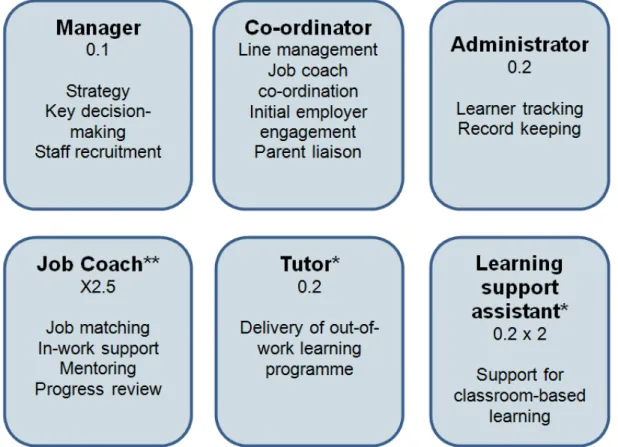
Example of a supported internship team
The team below is designed to meet the needs of a single group of 15 interns. It could be extended (e.g. by the addition of further job coaches, tutors and learning support staff) to work for larger intern groups or for multiple groups.
3.2.2 Recruiting and building a supported internship team
A supported internship team needs members with a variety of complementary skills. Members of this team can either be learning provider staff or staff from partner organisations, such as job coaches from a supported employment agency. Where a provider chooses to create a dedicated in-house team, staff can be recruited from existing roles within the provider but it can be helpful to recruit externally to ensure a different approach which differentiates the programme from existing provision for learners with learning difficulties and/or disabilities.
The skills which providers may need to look for outside of their organisations could include employer engagement and liaison skills, selling skills and coaching and mentoring. It can also be useful to recruit staff with contrasting backgrounds. These might include experiences of working with or for employers (including the private sector), for a supported employment agency, with disabled people, or on other into-work
programmes or having personal experience of disability, which might be helpful when engaging with parents and carers.
In order to make effective recruitment decisions, including how to describe job roles and compile person specifications, staff responsible for recruitment may find it useful to do some research, for example undertaking job coach training themselves, reading relevant research reports, and looking at The National Occupational Standards for Supported Employment.16 A list of useful documents is provided in the Further Reading section at the end of this advice.
While skills and experiences are important, it is also important to ensure that staff have a can-do attitude and a strong belief in the young people’s ability and right to work, which enables the team to engage with and inspire interns and their families and employers to aspire to paid work.
Providers should be aware that setting up a suitable staff team takes time. In addition, new recruits may need to apply for a Disclosure and Barring Service check or require specific training before they are able to begin to work with vulnerable young people. Managers will need to factor in these requirements as they set up their provision.
3.2.3 Training and development
Learning providers may find it beneficial to carry out a skills audit across their team, including those of partners, to help identify training and development needs. The National Occupational Standards for Supported Employment can be a helpful tool in identifying skills needs and gaps. Training might include attending external training events, for example in job coaching skills, or working towards qualifications such as the
16http://base-uk.org/knowledge/national-occupational-standards
Awards and Certificate for Supported Employment Practitioners17. Development
opportunities can also include, for example, observation of and coaching or mentoring by more experienced colleagues, visits to providers where supported internships are more established and in-house reflective practice sessions.
Specific areas of training cited as useful by colleges in the trial included:
job coaching;
systematic instruction (a specific in-work support approach based on task analysis);
working with learners with learning difficulties and/or disabilities;
employer engagement; and
management and planning.
17http://www.ocner.org.uk/qualifications/ocn_eastern_region_qualifications/supported_employment
4. Job coaching
Summary
What the trial told us about effective job coaching:
• job coaches need a diverse skill set, including the confidence to work effectively with young people, employers and parents/carers;
• job coaches need to be flexible, adaptable, creative and willing to work outside term time, sometimes including anti-social hours;
• job coaches have a wide range of responsibilities, some of which will require them to undertake specific training;
• job coaching is significantly different from providing learning support, requiring a higher level of responsibility and autonomy;
• job coaches need to be able to recognise when and how to provide support, and when to increase, decrease or remove support; and
• job coaches need high levels of energy and enthusiasm and above all a belief in the young person’s right and ability to achieve paid employment.
Job coaching is one of the main success factors and a key differentiating feature of supported internships.
4.1 Roles and responsibilities
The core role of the job coach is to provide tailored support to:
young people to enable them to gain, learn from, develop in and maintain their internship and to make a positive progression on to paid sustainable employment; and
employers to enable them to offer a meaningful internship and recruit interns where possible.
The range of responsibilities that job coaches take on within their role varies.18 Each learning provider needs to scope out the role in a way that will work for them in their setting and within the wider team and to suit the needs of the interns. Depending on the extent and range of their responsibilities, job coaches will be able to support a varying 18 For a comprehensive guide to job coaching, see best practice guidelines from Valuing People Now –
Employment:
http://base-uk.org/sites/base-uk.org/files/[user-raw]/11-06/supported_employment_and_job_coaching-_best_practice_guide....pdf
number of interns. Job coaches typically support between three and five interns, but some work with considerably more, drawing on the support of other staff where needed. It should be noted that Access to Work funding is available for job coaches (see section 9.3.1), but only where they support interns directly in their work placements. Other support provided by a job coach will need to be funded separately.
Job coaches can be involved in the following range of activities:
4.1.1 Pre-placement at work
• vocational profiling and assessment
• sourcing potential employers, identifying possible internships through cold-calling, visits, liaising with other departments
• undertaking job matches
• job analysis
• negotiating or ‘carving’ job roles19
• helping interns to prepare for and accompanying them to interviews
• supporting interns to develop CVs
• travel and mobility training
• sourcing and gathering relevant documentation for work
• helping interns to sort out travel arrangements (e.g. planning routes or getting bus passes)
• accompanying interns on visits to the workplace prior to starting a job
4.1.2 Workplace support
• attending workplace inductions and first day or first few days at work
• mentoring and confidence-building
• learning the job role in readiness for training the intern
• training the intern to master tasks
• breaking down tasks, sometimes applying systematic instruction techniques
• modelling workplace behaviours
• target-setting and monitoring and reviewing progress
19 Job carving is a term for tailoring a job so it is suitable for a particular worker and their skills. This
approach generates employment opportunities for young people with SEN, and can lead to improved productivity for the employer. See http://base-uk.org/employers-recruitment-jobcarving
• encouraging intern self-assessment/reflection
• regular workplace visits
• observation of interns
• prompting and reminding interns
• producing visual or written aids and reminders (e.g. step-by-step task list)
• re-phrasing or repeating employer instructions
• checking interns’ understanding
• negotiating an increase in responsibilities or new activities
• supporting interns to try out new ways to do things if they are not successful at first
• trouble-shooting or advocating for intern when things go wrong
• identifying skills development needs and either addressing them or referring to other staff
• determining if an intern needs to move placement and arranging for that to happen
4.1.3 Support for employers
• explaining an intern’s strengths and support needs
• advising on reasonable adjustments
• sharing successful strategies (e.g. for communication or disciplining an intern)
• being a first point of call if issues or problems arise and negotiating solutions
• providing information about a particular condition or impairment
• introducing the intern to his/her colleagues and offering advice on how to best support and include him/her
• identifying additional and/or more challenging tasks or roles that an intern could take on
• suggesting appropriate ways to explain tasks, developing supporting accessible resources of use to the wider workforce
• ensuring interns are on task and meeting workplace standards and expectations (e.g. for time-keeping/attendance)
4.1.4 Towards the end of the internship
• negotiating opportunities for paid employment with employer providing internship
• supporting interns in job search and application
• helping interns prepare for and accompanying them to job interviews
• signposting interns to other services (e.g. Access to Work) and if necessary liaising with these agencies
• introducing interns to other agencies (e.g. local supported employment services)
• identifying volunteering possibilities
4.1.5 Other roles during the internship
• mediating between parents and interns
• keeping parents informed of progress
• mentoring
• providing a link between classroom and workplace learning
• reporting on progress to co-ordinator/manager
• providing mutual support for other job coaches
• identifying relevant further learning opportunities
4.2 Skills, attitudes and behaviours
In order to fulfil these responsibilities, each job coach needs a diverse set of skills, attitudes and behaviours, and where a provider is employing several coaches, it will be important to build up a team with complementary skills and strengths.
Skills, attitudes and behaviours cited as important by job coaches interviewed as part of the evaluation of the supported internship trial:
• a positive outlook
• ability to anticipate need
• ability to drive/travel between sites
• ability to encourage and motivate others
• ability to exercise ‘tough love’
• ability to multi-task
• ability to use own initiative
• adaptability
• assertiveness (to be applied with employers and interns)
• belief in the supported internship programme and the young people’s ability and right to work
• communication skills - with interns, employers, families, colleagues including those in other agencies
• confidence to be autonomous and make your own decisions
• creativity: being able to think outside of the box
• diplomacy • empathy • flexibility • negotiation skills • open-mindedness • patience
• preparedness to ‘roll sleeves up and get stuck in’
• problem-solving skills
• resilience
• resourcefulness
• responsiveness
• sales skills
• time management skills: time-keeping and prioritising
4.3 The job coach contract
Job coaches need a contract which acknowledges that there will be a need for flexible working hours which require working outside of term times and may include evenings, weekends and bank holidays. In line with the provider’s human resources procedures, job coaches will need to be able to travel to a variety of locations, sometimes at short notice, and if using their own cars should have business insurance. Job coaches should be covered by providers’ lone working policies and procedures.
5. Recruiting and engaging Interns
Summary
The evaluation of the trial told us that effective practice in recruiting interns includes:
• recruiting young people who really want to work;
• educating, informing and partnership-working with referral agencies and other college staff;
• positioning the supported internship programme as a progression route from other college courses;
• targeting learners while they are still in education; and
• being clear about the aim of the internship, the commitment required and its distinctiveness from college courses.
Case study - Zak’s story
As a result of his successful internship, Zak was offered an apprenticeship in the college restaurant. He says it has,
given me the chance to carry out proper work… I don’t care about the cash I just like working, but it has got its uses… It has made me more independent and I am
able to help out with finances at home.
Zak, who has Asperger’s Syndrome, had completed a course in the Essential Skills Department at Seevic College the summer before the supported internship trial began. College staff knew that he was keen to work and that he was already volunteering at a local charity for people with physical disabilities. As a student he had a 100% attendance record and had demonstrated a variety of skills (such as attention to detail and commitment to a task) that they could see would be valued in the workplace if they could just help him into work. When invited to join the
supported internship programme, Zak jumped at the chance.A series of
conversations helped establish that he would like to work in catering as he enjoyed cooking at home. During this initial period, staff discussed with Zak the different sorts of opportunities in the catering sector. He thought he might like to work in a supermarket café, so the team set about looking for a willing employer. While the search was on, the internship co-ordinator decided to see if she could organise a temporary position for Zak in the college restaurant, to enable him to begin building up his catering skills straightaway. She met with the catering manager, explained what the internship programme was all about and how full support would be
provided during the short period that Zak was in the kitchen - and left with the offer of temporary placement. Zak started with basic kitchen duties like washing up and cleaning the tables before progressing onto helping with the preparation of foods. After a few weeks, the hunt for the supermarket job was called off. The catering manager at the college restaurant wanted to keep Zak on as an intern. A tailored support package, including job coaching, was arranged for him, involving college staff, the catering manager and his colleagues.
Towards the end of the internship, the manager reflected:
It is an amazing opportunity for a young person; it gives them an insight into the world of work through hands on experience. I am very pleased with the support from the staff of the supported internship, for both myself, my staff and for Zak. Zak is most helpful and happy to work with. He works to the best of his ability and he never forgets anything. His attendance is 100% and he is always willing to work extra. He is a pleasure to have around.
It’s also led to a busy social life. Zak has been paintballing with colleagues (where he won the ‘Top Gun’ Award) and regularly meets up with them out of work.
Zak’s Mum can’t speak highly enough of the supported internship:
The Supported Internship has given Zak a brilliant opportunity to start an
apprenticeship in an area that he loves. The support from the college, the catering staff and the manager has been brilliant, even now since he has started the
apprenticeship. He has become more confident and he eats more as he never used to eat. He wants to experiment with cooking. Every Sunday he helps me with the
dinner and he tells me that I am doing it wrong and tells me the correct way to cook things. I can’t put it into words what it has done for Zak, he is brilliant and I am so proud of him.
Getting the right learners onto supported internships is critical to the success of the programme. Providers need to think in terms of both eligibility and suitability.
5.1 Eligibility
In order to be eligible for a supported internship, a young person must be aged between 16 and 24 and have a statement of special educational needs, a Learning Difficulty Assessment (LDA) or Education, Health and Care (EHC) plan. Increasingly, as EHC plans are implemented and supported internships become part of the Local Offer, it is likely that a young person’s EHC plan will explicitly reference a supported internship as the most appropriate provision to support the achievement of the outcomes they have identified, where these are employment-related.
Where a provider believes that a young person with a learning difficulty or disability, but without a statement, an LDA or EHC plan, would benefit from a supported internship, they should contact the local authority to request an assessment of their education, health and care needs and to confirm the appropriateness of a supported
internship. This may be particularly pertinent during the transition period while EHC plans are being introduced, for young people who had a statement at school which has now lapsed because they have spent some time out of education, for example in work or Not in Education, Employment or Training (NEET).
From September 2014, local authorities will be under a duty to decide whether an assessment is necessary and where it is, to carry out an assessment to determine whether special educational provision needs to be provided through an EHC plan.
Providers should be aware that not all assessments will result in an EHC plan. Where an EHC plan is required, it has to be finalised within 20 weeks of the original request for an assessment. Providers will need to take these factors into account when directly
recruiting young people onto supported internships. Local authorities are also under a duty to keep local education, training and care provision under review, and consider the extent to which it is sufficient for the young people for whom they are responsible. They also have a duty to ensure that young people have access to appropriate learning programmes.
5.2 Suitability
In order to benefit from a supported internship, young people need to:
really want to work; and
be at the right stage in their learning and development to benefit from a supported internship.
The desire to work is more likely to affect the outcome of the internship than an intern’s existing employability skills, awareness of the world of work, previous experience of the workplace, confidence level, or degree of support needed. Parents and carers sharing their son’s or daughter’s aspiration for employment is also an important factor, although providers can work on raising parental aspirations during the course of the programme. A wide variety of learners can benefit from a supported internship. Interns involved in the supported internship trial had a range of different support needs including moderate to more severe learning disabilities, sensory impairments, physical disabilities and autism. There does not appear to be any direct link between a particular type of support need and success in gaining paid employment.
5.3 Recruitment and engagement practices
As with any new programme, providers need to raise awareness of their supported internship programmes amongst key partners, including:
local authorities;
referral agencies, such as Jobcentre Plus or local youth support services;
other learning providers such as neighbouring 16+ providers and feeder schools;
parent groups; and
colleagues within their own organisation.
This awareness-raising needs to begin as soon as possible, to enable recruitment to start early and the necessary time allocated for assessing young people’s suitability for an internship. Early recruitment also allows for maximum planning time to shape the individual approach needed for each young person.
Once the local authority has published its Local Offer, as required by the Children and Families Act, providers need to ensure that the supported internship programme is clearly described as one option within this offer. This will enable consideration of a supported internship to be included in transition planning, starting with the Year 9 review.
Providers can also offer open afternoons or evenings for learners and their parents and carers and other interested parties. These might involve employers, delivery partners and current or previous interns who can share their experiences. Learners can be invited in to drop-in workshops to sample the supported internship programme and get a feel for how it differs from other college courses. Providers can also develop publicity materials that present their internships from the different perspectives of previous interns,
When interviewing prospective interns and discussing the course with parents and carers, providers will need to determine the young person’s commitment to achieving employment and make it clear that they will be required to comply with workplace
conditions, for example for attendance, time-keeping, appropriate workplace behaviours and dress code. Providers can use assessment techniques such as requiring
prospective interns to undertake competitive interviews for a supported internship place or to undertake work-related tasks either individually or in small groups. Young people should also be reassured that full support will be available to them in order to help them succeed on the programme.
5.4 Providing support to interns
Summary
What the evaluation of the trial told us about effective provision of support for interns:
• the amount and type of support needs to be tailored to the individual;
• interns should be encouraged to actively participate in determining and reviewing their support package;
• job coaches benefit from having a ‘toolkit’ of different support strategies, including systematic instruction;
• support should generally be tapered to encourage increased independence;
• the need for support should be closely monitored as it is likely to fluctuate across the programme;
• there are often ‘natural’ forms of support available in the workplace (e.g. from colleagues or buddies) ;
• employers need to understand the role of the job coach in providing support so they don’t see them as ‘in the way’; and
• employers should be part of the decision-making process about how much, when and what type of support is needed.
The high level of individualised support provided to interns is a key distinguishing feature of the supported internship programme. The amount and nature of the support provided will differ from one intern to the next, depending on their needs. However, as a general principle the support provided should be that which will enable the intern to be as independent as possible, and will vary according to need during the internship, often decreasing over the length of the internship as the intern becomes more confident in the workplace.
For many interns, direct support may have been withdrawn altogether in the latter stages of the internship, although the job coach and/or other college staff will remain ‘on call’, via phone or email as needed. Often ‘natural’ forms of support provided by the employer and the intern’s colleagues replace the job coach’s support once the intern is well-established.
For other interns, some form of formal support may always be needed and it will be a case of reducing that to the minimal level required by the young person in order to do their job effectively. It will be particularly important in these cases to ensure that there is a plan for on-going support once they progress to paid employment.
As described in section 4, the job coach will normally be the key provider of support to interns, although learning support staff, personal care staff and professionals with specific expertise (such as an interpreter, a travel trainer or a counsellor) may also be providing complementary forms of support. Workplace support will almost always be provided mainly or solely by the job coach. Interns may also need support in the form of specialist equipment, including assistive technology, that may reduce their need for support from job coaches or other people. Interns may be eligible for Access to Work funding for equipment of this nature.
Key to providing support in a way that maximises interns’ chance of success is getting the amount and type of support right for each individual. These two factors will vary for each intern and at different stages of the programme. Most interns will need intensive support at the start of their internship, as described in the paragraphs above, but they may also need renewed support if there is a change in their responsibilities, if other factors in the workplace change (e.g. a new manager or colleagues or a revised rota), or if there is a change in their personal circumstances (e.g. something unsettling happening at home or as they begin to take the bus to work rather than get a lift).
Examples of some of the different kinds of support provided by job coaches are detailed in section 4.
Observation from an employer in the leisure sector involved in the trial
The job coach came in every day at some point for the first few weeks as [the intern] was very shy and had very little confidence. Now she just pops in for an hour. There is plenty of support for [the intern] here and she is confident now to ask for help if she needs it.