econ
stor
www.econstor.eu
Der Open-Access-Publikationsserver der ZBW – Leibniz-Informationszentrum Wirtschaft The Open Access Publication Server of the ZBW – Leibniz Information Centre for Economics
Nutzungsbedingungen:
Die ZBW räumt Ihnen als Nutzerin/Nutzer das unentgeltliche, räumlich unbeschränkte und zeitlich auf die Dauer des Schutzrechts beschränkte einfache Recht ein, das ausgewählte Werk im Rahmen der unter
→ http://www.econstor.eu/dspace/Nutzungsbedingungen nachzulesenden vollständigen Nutzungsbedingungen zu vervielfältigen, mit denen die Nutzerin/der Nutzer sich durch die erste Nutzung einverstanden erklärt.
Terms of use:
The ZBW grants you, the user, the non-exclusive right to use the selected work free of charge, territorially unrestricted and within the time limit of the term of the property rights according to the terms specified at
→ http://www.econstor.eu/dspace/Nutzungsbedingungen By the first use of the selected work the user agrees and declares to comply with these terms of use.
zbw
Leibniz-Informationszentrum WirtschaftLeibniz Information Centre for Economics
von Hagen, Jürgen; Dinger, Valeriya
Working Paper
Banking sector (under?) development
in Central and Eastern Europe
ZEI working paper, No. B 06-2005 Provided in cooperation with:
Rheinische Friedrich-Wilhelms-Universität Bonn
Suggested citation: von Hagen, Jürgen; Dinger, Valeriya (2005) : Banking sector (under?) development in Central and Eastern Europe, ZEI working paper, No. B 06-2005, http:// hdl.handle.net/10419/39448
Zentrum für Europäische Integrationsforschung Center for European Integration Studies
Rheinische Friedrich-Wilhelms-Universität Bonn
B 06
2005
W
orking
Paper
Zentrum für Europäische Integrationsforschung Center for European Integration Studies
Rheinische Friedrich-Wilhelms-Universität Bonn
Walter-Flex-Straße 3 D-53113 Bonn Tel.: Fax: +49-228-73-9218 +49-228-73-1809 //www.zei.de ISSN 1436-6053
Banking Sector
(Under?) Development in
Central and Eastern Europe
Jürgen von Hagen
and
Banking Sector (Under?)Development in Central and Eastern Europe
Jürgen von Hagen* and Valeriya Dinger**
This Version: February 2005
Abstract:
By introducing a new measure of the banking systems’ size, the paper challenges the existing consensus on severe underdevelopment of the CEE banking sectors. We argue that the existing studies on the size of CEE banking systems exaggerate the real degree of underdevelopment because common measures of the size of the banking system produce downward biased results when applied to transition economies. We compare various measures of the size of the CEE banking sectors with those of several “old” European Union (EU) member countries which are used as benchmarks. The comparison indicates that indeed the banking sectors in the CEE countries lag behind the most developed financial systems in the EU, but are very close to the levels in the financially less developed EU countries.
Key words: financial intermediation, transition economies, banking sectors’ size JEL: G21, P34
* Center for European Integration Studies, University of Bonn, Indiana University and CEPR. E-mail address: [email protected]
1. Introduction
The existence of developed financial institutions is an important prerequisite for an efficient allocation of capital and sustainable economic growth. Therefore, viable and well functioning banking sectors are important for the development path of transition economies where the process of financial intermediation had been profoundly reshaped in accordance with the liberalizing of the business environment. The literature on banking in transition economies argues that banking sectors in Central and Eastern European countries are much smaller than those in mature market economies (Bonin and Wachtel, 2002; Anderson and Kegels, 1998), and that this puts a limit on the growth potential of these economies.
In this paper we present an analysis of the size of the banking sectors in ten Central and Eastern European (CEE) countries1. We focus especially on the sectors’ ability to provide efficient financial intermediation between savers and investors in the economy. By introducing a new measure of the size of banking systems, we challenge the existing consensus on the severe underdevelopment of the CEE banking sectors. We argue that common measures of the size of the banking system produce downward biased results when applied to countries with a low stock of financial wealth in general and to transition economies in particular. Existing studies on the size of CEE banking systems, therefore, exaggerate the real degree of underdevelopment. We compare various measures of the size of the CEE banking sectors with those of several “old” European Union (EU) member2 countries which are used as benchmarks. The comparison indicates that indeed the banking sectors in the CEE countries lag behind the most developed financial systems in the EU, but are very close to the levels in the financially less developed EU countries.
Next, we explore various reasons for the comparatively low levels of financial intermediation as measured by traditional methods used in the literature (Bonin and Wachtel, 2002; Anderson and Kegels, 1998). We concentrate in detail on three such arguments. The first points to the low initial levels of bank activity in CEE countries as a cause of the low current
1 Bulgaria, the Czech Republic, Estonia, Hungary, Latvia, Lithuania, Poland, Romania, Slovakia and Slovenia 2 later on only referred to as EU countries
levels of the banks’ financial intermediation. The second maintains that as capital markets develop they at least partially substitute for the necessity of financial intermediation by banks. Finally, the third argument stresses the low involvement of individual CEE banks in financial intermediation as a reason for the lower financial intermediation performance of the banking sectors.
We focus this analysis on the developments in ten CEE countries: Bulgaria, the Czech Republic, Estonia, Hungary, Latvia, Lithuania, Poland, Romania, Slovakia and Slovenia during the time period from 1993 to 2001.
Regarding the size of the banking industries, we relate the level of financial intermediation to proxies for the available financial wealth in the sample countries, rather than to GDP as the literature commonly does. We do this to account for the fact that transition economies have lower stock of private financial wealth than mature market economies3. With low wealth levels the size of the banking industry (financial intermediation in general) is constrained by the low stock of intermediable resources, unless capital inflows compensate fully for the small volume of domestic financial wealth. The literature on the integration of capital markets (Bayoumi, 1990; French and Poterba, 1991; Baxter and Crucini, 1993)4 suggests that this is typically not the case.
Due to the low stock of financial wealth, banking sectors appear small relative to GDP even though their size relative to financial wealth may be comparable with the size of banking sectors in mature market economies. Indeed, the results of our analysis point to the fact that GDP-based measures of the size of CEE banking sectors underestimate the ability of the banking sector to intermediate financial wealth. When the financial intermediation ability of the banking sectors is measured relative to financial wealth, the gap between the CEE countries and the EU countries is smaller than indicated by GDP-based measures.
3 The fact that the stock of financial wealth in CEE transition economies is low has been pointed out by the World Bank and IMF (see Koch-Weser, 1996). Unfortunately there exist, to our knowledge, no systematic studies on the stock of financial wealth in CEE.
4 This literature concentrates on analyzing the ‘home-bias puzzle’ that was initially pointed out by Feldstein and Horioka (1980)
Nevertheless, the gap still exists and the banks’ financial intermediation in all CEE sample countries is underdeveloped relative to EU countries with developed financial systems.
This paper also explores alternative arguments, presented in the literature, explaining this low level of financial intermediation provided by the banks.
The first of these arguments is based on the fact that the initial level of bank intermediation at the onset of the transition was extremely low (see Anderson and Kegels, 1998). The underdevelopment of bank intermediation in planned economies is explained by the fact that the intermediation function was generally performed by the governments. We test this argument by constructing two measures of marginal intermediation that illustrate the changing importance of bank intermediation. The first measure compares the change of bank deposits to gross savings in the economy; the second ties the change of domestic credit to the sum of investments and government deficit. These two measures allow us to illustrate the degree of bank penetration into the financial intermediation chain. Generally, the results of our analysis indicate an increasing importance of both deposit accumulation and loan supply by banks in the early transition period. Later in the transition process a trend of increasing importance of bank intermediation is only observed with regard to deposit gathering. Deposit accumulation by CEE banks is therefore approaching the levels prevailing in the EU. With regard to loan supply, the trend of increasing bank importance slowed during the late 1990s. Therefore, our analysis only partly supports the argument that the low starting levels of bank intermediation can explain the low level of bank intermediation still observed in CEE countries.
Secondly, we focus on the argument that the development of capital markets has evoked changes in the financial intermediation function of banks. This view is thoroughly discussed in Danthine et. al. (1999). Danthine et. al. (1999) argue that this could either be because the capital markets substitute the banks in undertaking the main share of financial intermediation between savers and investors in the economy, or because the banks’ financial intermediation has changed in a way that the lending activity is moving towards securitization of loans and therefore is reflected off-balance sheet. As suggested by Fender and von Hagen (1998),
securitization of loans does change the behavior of banks and may modify monetary policy transmission. However, since the process of securitization does not eliminate a bank’s role in monitoring borrowers, the banks continue to play an essential role in the intermediation chain, even though it is no longer reflected in the existence of loans on the banks’ books. Nevertheless, these explanations are based on the assumption of sufficient capital market development. We present a closer look at the development of capital markets in CEE in absolute measures and relative to banking sector development in order to see whether these are the valid explanations for the low levels of bank intermediation in CEE countries. The results show that CEE capital markets are severely underdeveloped, even relative to banking sectors. Thus, the argument that the insufficient levels of classical financial intermediation by CEE banks are caused by the advanced development of capital markets lacks empirical support.
Finally, we explore the argument that the level of bank intermediation in CEE countries is low because the financial intermediation productivity of banks is low as measured by aggregate level variables, such as loans to total banking industry assets and deposits to total banking industry assets (Miller and Petranov, 2002). To test this argument, we analyze micro level balance sheet data from a large sample of CEE banks. The use of micro level data is an important innovation in our research5. It allows us to detect heterogeneity among the banks in individual banking systems and indicates that the low aggregate levels of financial intermediation productivity in some CEE countries reflect the specialization in deposit gathering by some banks and in loan supply by others.
Throughout this analysis we use the three EU countries Germany, the Netherlands and Greece as benchmarks. We prefer a comparison with these benchmark countries over average variables for the whole sample of EU members as the differences of the structure of the financial systems across the EU countries are significant6 and distort the overall comparison.
5 To our knowledge the existing literature of financial intermediation activities of banks in transition economies only focuses on aggregated data
6 For detailed discussions on the differences across European banking systems see Allen and Gale (1999), Demirguc-Kunt and Levine (2001), Danthine, et al (1999)
Choosing Germany, the Netherlands and Greece as benchmark countries, we have representatives of three different types of financial structures coexisting in the Union7. First, Germany being the largest banking system of the EU is a textbook example of highly developed bank-based financial system (similar to Italy, Austria, Belgium, etc.). A comparison of the CEE banking sectors with that of Germany will give us an idea of the extent to which the financial intermediation activities of the CEE banks are approaching those of the banking institutions in developed bank-based systems. The Netherlands (similar to UK, Denmark and Sweden) typify a developed market-based financial system8. We can expect that Dutch banks have a different intensity of involvement in classical financial intermediation relative to bank-based systems since in countries with market-based financial systems the function of channeling funds to the real economy is shared between the banking institutions and the equity and debt markets. The inclusion of the Netherlands as a benchmark case controls for the possibility that some of the CEE countries might have directed the transformation of their financial systems towards a more market-based system. Finally Greece (a country where both the banking system and the capital markets9 are considered underdeveloped) serves as an example of a relatively underdeveloped bank-based financial system.
The analysis is based on country level data provided by the International Financial Statistics (IFS) issues of the International Monetary Fund, the European Bank for Reconstruction and Development’s Transition Reports, Thomson Financial’s Datastream, International Statistics issues of the Bank for International Settlements and on bank level data provided by BankScope10,11.
7 Demirguc-Kunt and Levine (2001)
8 Demirguc-Kunt and Levine (2001) define a financial system as market-based or bank-based depending on an index consisting of the following ratios: market capitalization versus bank assets, total value traded on the security market versus bank credit and security market turnover versus overhead costs of the banking sector. 9 Demirguc-Kunt and Levine (2001)
10 BankScope is a database provided by Bureau van Dijk and FITCH. 11 Table A.1 in Appendix A presents the data sources for each variable.
The rest of the paper is organized as follows; Section 2 presents alternative measures of the size of the banking sectors and compares these measures across the CEE and the EU benchmark countries. Section 3 focuses on the changes in the importance of bank intermediation. Section 4 analyses the development of capital markets in CEE countries relative to banking systems. Section 5 presents the results of the micro-level analysis of bank financial intermediation productivity, and Section 6 gives the conclusion.
2. Are banking sectors in CEE countries smaller than those in the EU?
This section concentrates on different size measures of CEE banking sectors and their ability to provide financial intermediation. First, following the literature12 we measure the size of the
banking industry as the aggregate volume of bank assets in the country relative to GDP. Furthermore, following Demirgüc-Kunt and Levine (2001), we include two additional measures of banking sector performance with regard to financial intermediation. One is the ratio of deposits to GDP, which measures the deposit-gathering function of banks. The other is the ratio of domestic bank credit to GDP, which measures the loan supply function of the banking sectors.
Table 1: Aggregate bank assets to GDP, in %
1993 1994 1995 1996 1997 1998 1999 2000 2001 Bulgaria 150 133 93 158 43 33 33 34 39 Czech Republic 95 99 103 100 109 103 103 99 96 Estonia 27 31 31 36 55 50 56 61 67 Hungary 67 62 58 57 58 58 59 60 61 Latvia 68 44 31 36 47 42 47 58 66 Lithuania 24 27 22 20 22 24 26 28 29 Poland 47 44 42 44 45 48 50 49 52 Romania 40 31 35 39 26 29 27 25 25 Slovakia 76 65 65 78 97 90 79 86 90 Slovenia 54 59 62 64 67 69 70 71 84 Germany 153 154 160 170 180 191 218 224 226 Greece 92 89 98 99 101 102 112 116 126 Netherlands 170 162 171 181 199 206 240 246 259
Source: Own calculations based on IFS data
As presented in Table 1 banking sectors in CEE countries are significantly smaller with respect to the ratio of aggregate volume of bank assets to GDP than those of Germany and the Netherlands. Only in the Czech Republic is the size of the banking sector, as measured by this
proxy, close to the lowest ranked EU country (Greece). The rest of the sample transition countries’ banking sectors are much smaller than the one of Greece. Furthermore, this measure indicates a trend of increasing the size of the banking sectors only in Estonia and Slovenia. On the contrary, in Bulgaria a drastic decline in the ratio of bank assets to GDP is observed. In the rest of the CEE countries the levels of the variables in 2001 are very similar to the ones in 1993.
Table 2: Aggregate deposits to GDP, in %
1993 1994 1995 1996 1997 1998 1999 2000 2001 Bulgaria 68 71 58 64 24 20 21 22 27 Czech Republic 62 62 66 63 63 59 57 64 66 Estonia 19 18 17 20 25 23 27 31 35 Hungary 44 42 40 41 40 39 39 39 40 Latvia 21 24 15 14 17 17 17 20 23 Lithuania 16 18 15 11 12 13 15 17 21 Poland 29 29 28 29 31 34 37 37 40 Romania 18 17 20 23 21 22 21 20 20 Slovakia 56 55 56 58 56 54 56 59 60 Slovenia 28 31 34 37 40 42 43 45 52 Germany 61 60 60 64 64 66 99 98 101 Greece 52 56 57 59 59 55 58 57 98 Netherlands 77 73 75 76 77 86 97 100 104
Source: Own calculations based on IFS data
Table 3: Aggregate domestic bank credit to GDP, in %
1993 1994 1995 1996 1997 1998 1999 2000 2001 Bulgaria 127 104 71 112 23 18 18 17 20 Czech Republic 73 76 76 72 72 64 60 54 49 Estonia 13 13 14 22 32 33 35 39 43 Hungary 97 93 82 72 66 63 53 55 50 Latvia 18 23 15 13 15 18 20 25 31 Lithuania 16 19 15 12 13 14 17 16 16 Poland 41 37 32 33 34 35 38 34 36 Romania 21 18 24 29 19 22 18 14 12 Slovakia 72 57 48 56 66 62 59 58 62 Slovenia 34 32 37 36 36 40 43 45 48 Germany 99 102 103 109 113 119 121 125 126 Greece 110 101 96 91 88 85 94 101 100 Netherlands 106 107 112 119 127 131 147 153 154
Source: Own calculations based on IFS data
With regard to the variables measuring the financial intermediation performance of banks relative to GDP, we observe both lower deposit accumulation and loan supply of CEE banks. As shown in Table 2, concerning the deposit accumulation function, the Czech Republic and Slovakia have the most developed banking sectors among the accession countries. But even
there, banks accumulate significantly less deposits relative to GDP, than the banks in the EU benchmark countries.
Table 3 illustrates that the loan supply function of CEE banks is especially underdeveloped. Whereas in Germany and the Netherlands the value of domestic bank credit significantly exceeds the level of GDP, in the Czech Republic, Hungary, Slovakia and Slovenia domestic bank credit only equals about half of GDP. In the rest of the sample countries domestic bank credit represents less than a third of GDP. Furthermore, only in Estonia and Slovenia are the values of domestic bank credit to GDP ratio increasing.
In view of this, we confirm the notion that in CEE countries banking sectors are smaller and provide less financial intermediation relative to GDP than in mature market economies. However, the question arises, whether financial intermediation capacity should be measured in relation to GDP. Financial intermediation is the sum of activities serving the intermediation between savers and investors. It requires the existence of financial resources (wealth) to be intermediated. However this stock of financial wealth is, for historical reasons, lower in transition economies (see Koch-Weser, 1996) than in mature market economies. Thus, the size of the banking industry and its financial intermediation capacity measured in relation to the stock of financial wealth might represent a better measure for the development of the banking sector.
Unfortunately, there exist to our knowledge, no systematic data on the stock of financial wealth in the CEE countries. To close this gap we introduce a measure of the stock of financial assets in the economy as a proxy for financial wealth and then relate the size of the banking sectors to this new financial wealth proxy. To create such a measure we add together broad money (equal to the sum of currency outside the banks and the demand, time, savings and foreign currency deposits of residents), money market instruments, and bonds issued by banks and monetary authorities. In this measure we do not include equity shares in the stock of financial assets, because data is not available for all countries and years. Non-bank corporate debt securities are also not included in this and the following proxy for financial
wealth because, as we show later13, government securities held by banks, represent in CEE countries the main share of domestic securities14.
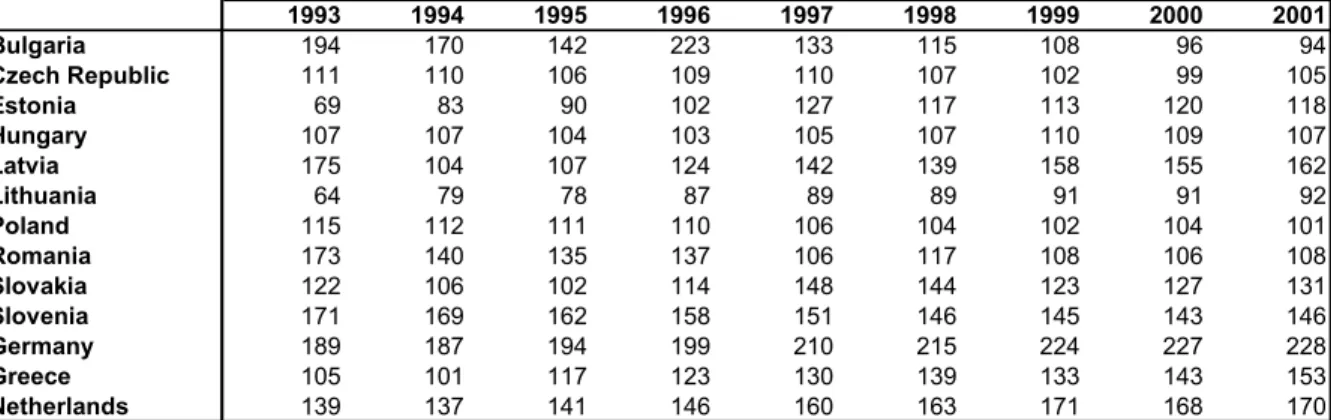
Table 4 presents the size of the banking sectors relative to this new financial wealth proxy. Moreover, for those years and countries where data on stock market capitalization is available we add the stock market capitalization to the sum of broad money, money market instruments and bonds15. Table 5 presents the size of the banking sectors relative to this broader measure. As illustrated in Table 4 banking sectors of the CEE accession countries are generally smaller than the banking sectors in the EU benchmark countries, but the gap between these two groups of countries is much smaller than indicated by the traditional measure. So, for example, Latvia and Slovenia according to this new measure have banking sectors of a similar size to that of Greece. Furthermore, the banking sectors of Bulgaria and Romania, which according to the bank assets to GDP measure were classified as severely underdeveloped, have according to this measure a size comparable to the one of the Czech or the Hungarian banking sectors.
Table 4: Aggregate bank assets to a proxy of the stock of aggregate financial assets, in %
1993 1994 1995 1996 1997 1998 1999 2000 2001 Bulgaria 194 170 142 223 133 115 108 96 94 Czech Republic 111 110 106 109 110 107 102 99 105 Estonia 69 83 90 102 127 117 113 120 118 Hungary 107 107 104 103 105 107 110 109 107 Latvia 175 104 107 124 142 139 158 155 162 Lithuania 64 79 78 87 89 89 91 91 92 Poland 115 112 111 110 106 104 102 104 101 Romania 173 140 135 137 106 117 108 106 108 Slovakia 122 106 102 114 148 144 123 127 131 Slovenia 171 169 162 158 151 146 145 143 146 Germany 189 187 194 199 210 215 224 227 228 Greece 105 101 117 123 130 139 133 143 153 Netherlands 139 137 141 146 160 163 171 168 170
Source: Own calculations based on IFS data
13 See Section 4
14 Central banks’ data indicate that in the Czech Republic in the period 1995-2001 banks held between 60 and 70% of the volume of domestic securities. In Hungary the share of domestic securities held by banks is about 55% and in Poland around 80%.
15 The assumption, based on the Feldstein-Horioka home bias puzzle, that equity traded in domestic markets is mostly held by domestic agents is made here. See Folkerts-Landau et. al. (1997) for data on the low volumes of international portfolio investments in CEE.
As shown in Table 5 if banking system assets are related to a broader proxy of domestic wealth including equity shares, then again in most CEE countries the size of the banking systems are very close to that of Greece. Furthermore, Latvian and Slovakian banking sectors have by this measure a size similar to the Dutch banking sector16. These results indicate that the ratio of bank assets to GDP presents a downward biased measure for the size of the banking industry in the accession countries. The magnitude of the bias is especially large in the poorer CEE economies, where financial wealth is small relative to officially measured economic activity.
Table 5: Aggregate bank assets to a proxy of the stock of aggregate financial assets including stock market capitalization, in % 1993 1994 1995 1996 1997 1998 1999 2000 2001 Bulgaria na na 141 222 137 91 90 84 82 Czech Republic na 95 81 81 86 89 83 80 87 Estonia na na na na 81 96 65 71 71 Hungary 103 100 94 84 64 69 66 74 77 Latvia na na 107 113 120 115 131 127 132 Lithuania na 77 71 58 52 65 66 62 62 Poland 105 103 101 95 87 81 72 74 73 Romania na 140 133 136 98 103 96 91 96 Slovakia na 95 92 98 130 134 116 120 123 Slovenia na 152 154 145 125 116 116 96 105 Germany 168 165 153 138 134 132 129 136 144 Greece 93 88 98 97 92 88 85 88 85 Netherlands 94 89 88 82 79 76 94 101 125
na – data not available
Source: Own calculations based on IFS, Datastream and Transition Report
In sum, banking sectors in CEE countries are generally smaller than those of the developed financial system in the EU countries. However, the gap is not as severe as argued in studies based on the traditional approach of measuring the size of the banking system and the level of bank intermediation in relation to GDP. When we relate the sum of aggregate banking assets to a proxy for the stock of financial assets, the banking sectors in all CEE countries, but Latvia, are indicated to be only slightly smaller than the one of Greece. The Latvian banking sector is even larger than the Greek one as measured in this relation. These results indicate that the low level of bank intermediation in CEE countries is to a large extent caused by the low level of accumulated financial wealth.
16 The measure presented in Table 5 indicates a much smaller size of the Dutch banking sector than that presented in Table 4, which is due to the market-orientation of the Dutch financial system. In the environment of highly developed capital markets banks intermediate a smaller proportion of financial wealth.
3. Is the role of bank intermediation in the CEE countries increasing?
In this section we focus on the question of whether the role that banks play in the process of channeling funds from savers to investors is gaining in importance. For this purpose we introduce two variables that we call ‘measures of marginal financial intermediation’. The first variable equals the ratio of the change in deposits between time period t and t-1 to the gross savings in period t. This ratio measures the change in the relative importance of bank deposits in the stock of financial wealth. However, comparability of these ratios across countries is conditional on the differences among the money multipliers and we should bear in mind these differences when analyzing the values of the above ratio. The second measure equals the ratio of the change of domestic bank credit between time period t and t-1 to the sum of investment and government deficit17 in period t. This measure is an illustration of the share of investments in the economy that has been financed by bank credit.
Table 6: Marginal financial intermediation: ∆ aggregate deposits with banks/gross savings, in %
1994 1995 1996 1997 1998 1999 2000 2001 Bulgaria 156 132 54 16 6 17 27 49 Czech Republic 32 43 16 16 6 0 38 30 Estonia 22 22 40 48 7 27 33 35 Hungary 33 38 41 41 27 23 25 29 Latvia 34 -38 13 32 9 6 26 21 Lithuania 41 19 -4 21 13 14 25 26 Poland 52 35 36 30 34 23 21 25 Romania 52 43 46 54 43 38 29 35 Slovakia 31 34 26 13 8 19 27 20 Slovenia 39 34 30 32 28 21 30 51 Germany 6 12 21 8 20 15 7 24 Greece 69 47 43 34 5 39 16 19 Netherlands 1 21 20 23 27 32 38 37
Source: Own calculations based on IFS data
As shown in Table 6, the change of bank deposits represents in CEE countries on average a higher share of gross saving than in the EU benchmark countries. The fact that CEE countries have lower money multipliers than the EU benchmarks18 reinforces the implication that CEE banks are accumulating a higher share of savings than banks in the EU. Especially in 1994-1996 CEE banks accumulated a very high share of savings. Later on the pace slowed down
17 Government deficit is included in the denominator since the data for the nominator does not allow us to distinguish between credit to the private sector and credit to the government.
but the values of this ratio remain higher in the accession than in the “old” member countries. This result indicates that the deposit gathering performance of CEE banking sectors is catching up to the EU levels.
With regard to the loan supply function, at least in the mid 1990s the change in bank loans represented a very large share of investment in all CEE countries except Slovakia (see Table 7). Later on, the importance of bank credit decreased in most of the countries to levels below the ones of the EU benchmarks. In times when substantial amounts of bad loans were written-off the bank books, we even observe negative change in the volume of domestic credit outstanding (i.e. Slovakia in 1994, Latvia in 1995). Only in four of the sample CEE countries (Bulgaria, Estonia, Latvia and Slovenia) the share of bank credit to investments is comparable to any of the EU benchmarks. Therefore, the data present no evidence that the level of bank loan supply in the CEE countries is catching up to the EU levels.
Table 7: Marginal financial intermediation: ∆ domestic bank credit/(investment +government deficit), in % 1994 1995 1996 1997 1998 1999 2000 2001 Bulgaria 58 61 45 16 31 42 73 61 Czech Republic 46 35 17 16 -6 -8 -9 -1 Estonia 11 19 43 47 16 12 32 30 Hungary 52 37 21 30 23 -11 33 6 Latvia 64 -34 3 25 16 8 27 28 Lithuania 31 7 1 14 8 9 -2 6 Poland 42 26 34 27 23 23 7 18 Romania 43 45 49 25 55 19 10 13 Slovakia -15 -3 37 44 5 2 14 23 Slovenia 29 46 19 17 32 27 29 30 Germany 30 21 31 29 41 39 35 33 Greece 19 37 21 27 19 66 63 54 Netherlands 31 44 52 72 70 74 84 45
Source: Own calculations based on IFS data
To summarize, at least in the early transition period, CEE banking sectors were characterized by high levels of marginal intermediation. Whereas this process is still valid with regard to the deposit gathering activities of banks, the later years are marked by no catching up concerning the loan supply by CEE banks. Thus it is not likely that the level of bank loan supply in the CEE countries will reach the level of the EU benchmarks in the future.
4. Are capital markets compensating for the low level of financial intermediation provided by banks?
In this section we explore the argument that the low levels of financial intermediation provided by the CEE banks are a result of the development of capital markets. So, for example, Danthine, et. al. (1999) argue that banks may provide lower levels of classical financial intermediation (as measured by deposit and loan volumes) because capital market development serves at least partially as a substitute. Furthermore, they point out the fact that, even if financial intermediation is mainly performed by banks, classical measures like loans to GDP may fail to reflect this since they do not account for off-balance sheet activities of banks. In this section we present an overview of capital market developments in CEE countries and analyze their relevance for the low levels of loan supply.
Table 8: Domestic debt securities to GDP, in %
Source: Bank of International Settlement
Following Demirgüc-Kunt and Levine (2001) we use the ratio of stock market capitalization to GDP as a measure for capital market development. This measure ignores both government and corporate debt markets, but is still frequently used in the literature on transition economies (Anderson and Kegels, 1998; Hencsey and Hultgren, 2001) as a proxy for capital market development. Reasons why this measure is still used in the transition literature include the following. First, systematic data about debt markets that would allow a cross-country comparison is unavailable19. Second, as shown by Pissarides (2001) and Hencsey and
Hultgren (2001) corporate debt markets are negligibly small in CEE countries. Hencsey and
19 The Bank for International Settlement provides debt market data for only three of the CEE countries (the Czech Republic, Hungary and Poland)
1993 1994 1995 1996 1997 1998 1999 2000 2001 Czech Republic all issuers 11 17 23 22 26 36 47 45 43 government 11 14 18 15 17 29 38 34 34
Hungary all issuers 23 28 23 31 27 32 32 32 38 government 23 27 23 30 25 30 30 30 35
Poland all issuers 22 20 20 16 15 18 16 19 24 government 21 20 20 16 15 18 16 19 24
Germany all issuers 69 85 85 75 74 96 86 92 81 government 22 27 26 24 24 31 29 32 32
Greece all issuers 66 74 74 81 78 82 71 77 78 government 62 70 71 80 77 82 71 77 78
Netherlands all issuers 69 78 79 78 81 88 87 94 94 government 45 48 50 49 48 51 46 44 41
Hultgren (2001) mention that among the CEE countries debt (both government and corporate) markets are most developed in the Czech Republic, Hungary and Poland.
However as we show in Table 8 even in these countries the size of non-government security markets are negligible as compared to those in Germany and the Netherlands. Furthermore, most of the government debt securities are held by banks (Bonin, 1998)20 and thus developed government securities markets cannot account for transfer of intermediation from banks to markets.
Table 9: Stock market capitalization to GDP, in %
na – data not available
Source: Datastream and Transition Report
Table 9 presents the values of the ratio of stock market capitalization to GDP in the accession and the benchmark countries. The data illustrate the gap between the size of stock markets relative to GDP in the accession countries and the EU benchmarks. Even in Greece, the country that represents an underdeveloped bank-based system, the stock market has a much larger size relative to GDP than the highest developed stock markets in the accession countries, those in Estonia and the Czech Republic.
Furthermore, in the CEE countries we do not observe a general trend of approaching the higher EU levels. In the early transition period the volume of market capitalization increased in all countries due to government efforts to enhance capital market participation through privatization schemes. Later on, in most of the countries the process of capital market
20 See also the discussion in Section 2
1993 1994 1995 1996 1997 1998 1999 2000 2001 Bulgaria na na 1 0 0 8 6 5 6 Czech Republic na 14 30 31 27 20 23 23 19 Estonia na na na na 25 9 37 35 38 Hungary 2 4 6 12 35 30 36 26 22 Latvia na na 0 3 6 6 6 8 9 Lithuania na 1 3 11 18 10 11 14 15 Poland 4 4 4 7 10 13 20 19 20 Romania na 0 0 0 2 3 3 4 3 Slovakia na 7 7 12 9 5 4 4 5 Slovenia na 4 2 4 9 12 12 24 22 Germany 24 24 24 29 40 48 72 67 58 Greece 12 14 16 21 32 43 48 51 53 Netherlands 59 64 74 96 128 145 185 170 132
development slowed down significantly. Only in Estonia and Poland is a trend of further development observed.
Table 10: Aggregate bank assets to stock market capitalization, , in %
1993 1994 1995 1996 1997 1998 1999 2000 2001 Bulgaria na na 18543 78970 21736 426 549 676 621 Czech Republic na 696 343 321 408 512 448 426 500 Estonia na na na na 224 536 152 173 175 Hungary 2931 1480 995 456 165 194 164 230 273 Latvia na na 15616 1206 766 687 789 698 730 Lithuania na 2655 849 176 125 238 245 200 190 Poland 1259 1246 1086 671 472 363 248 259 261 Romania na na 8648 19508 1302 878 860 648 813 Slovakia na 892 969 678 1044 1913 2076 2204 2008 Slovenia na 1441 3464 1782 717 563 586 294 376 Germany 649 652 657 588 450 396 301 336 391 Greece 768 647 609 459 314 256 233 227 237 Netherlands 288 254 231 188 156 142 112 122 159
na – data not available
Source: Own calculations based on IFS, Datastream and Transition Report
To judge the relative importance of capital markets in CEE financial systems and to provide evidence on the bank-based orientation of the financial systems, we compute (following the approach of Demirgüc-Kunt and Levine, 2001) the ratio between aggregate bank assets and stock market capitalization for each of the observed countries. Demirgüc-Kunt and Levine (2001) compute this ratio for a sample of 95 countries around the world and classify those countries with values above the median as bank-based and those with values below the median as market-based. The median ratio value in their sample is close to 200%. As shown in Table 10 among the CEE countries only Estonia has developed a market-based financial system according to this classification. In two other countries, Hungary and Lithuania, stock markets do play a significant role at least in the period after 1996. In contrast, in Bulgaria, Latvia and Slovakia, stock markets play only a marginal role compared to the banking sectors. In the remaining sample countries the values of bank assets to stock market capitalization are well below Germany’s.
Altogether, the data point to a severe underdevelopment of capital markets in most CEE countries, which implies that banks are still the main providers of financial intermediation. Furthermore, it is unlikely that in financial systems with such small security markets banks could shift lending activity off balance sheet through securitization. These results indicate that
the low level of financial intermediation provided by banks cannot be explained by highly developed capital markets.
5. Is the financial intermediation productivity of CEE banks low?
In this section we extend our analysis with a presentation of micro level data from bank balance sheets. We try to answer the question of whether the low levels of deposit accumulation and loan supply on the aggregate level are results of low involvement of individual banks in classical banking functions namely, deposit gathering and loan supply. To explore this question we concentrate on how banks finance their operations and on the main positions in their investment portfolio. We regard the degree to which a bank is involved in deposit gathering and in loan supply as a bank’s financial intermediation productivity. The fact that we concentrate on classical loan and deposit functions when estimating the financial intermediation productivity of banks is motivated by the discussed unavailability of more advanced intermediation channels in CEE (see Section 4).
We use two variables from bank balance sheet as proxies for bank financial intermediation productivity. On the asset side a higher involvement in classical credit activities implies that loans represent a high proportion of assets21. Therefore, we choose the ratio of loans to total assets as a measure of credit activity. Unfortunately, BankScope does not provide separate entries on bank loans to private and public institutions. We use the entry of “loans”, which includes both lending to private and public sector, keeping in mind that this measure overestimates the de facto supply of loans on commercial terms22. On the liability side, deposit gathering activity is defined in the literature as “receiving deposits from the public” or “taking deposits from individuals”23. When analyzing the deposit accumulating activities we
21 The structure of the balance sheet used by BankScope is presented on Figure A.1 in Appendix A
22 The importance of this ratio can be a doubtful indicator of banks’ involvement in channeling funds to the real sector if most of the credits are granted to government and municipalities. Unfortunately such information is not provided by BankScope for the Central and Eastern European banks. Nevertheless, we argue that the ratio presents relatively unbiased idea of the banks’ involvement in credit supply, since government debt, especially in the years of advanced transition, is securitized (see Miller and Petranov, 2002 and Anderson and Kegels, 1998). The large volumes of government bonds hold by the banks present further evidence for the securitization of government debt.
therefore concentrate on customer deposits and disregard inter-bank deposits (see Figure A.1 in the Appendix). Therefore, the ratio of customer deposits to total deposits24 can be used as a measure for the involvement of banks in deposit gathering activities. This ratio indicates to what extent a specific banking institution is engaged in gathering deposits from the public. Table 11 and Table 12 present the average values25 of these ratios for each of the CEE sample countries and the EU benchmarks.
Table 11: Loans to total assets, weighted average for the banking system, in %
1994 1995 1996 1997 1998 1999 2000 2001 Bulgaria 65 38 32 25 25 28 29 31 Czech Republic 52 48 50 49 47 39 33 33 Estonia 40 44 51 51 57 56 57 55 Hungary 36 35 35 37 37 41 49 50 Latvia 31 24 23 26 45 43 37 46 Lithuania 55 56 45 39 41 45 41 41 Poland 29 33 38 41 45 49 47 46 Romania 40 49 52 41 32 28 31 34 Slovakia 49 45 47 45 44 47 43 31 Slovenia 49 43 42 43 48 52 52 48 Germany 60 59 58 57 54 51 49 48 Greece 35 36 38 36 37 38 42 46 Netherlands 67 61 56 55 53 56 54 54
Source: Own calculations based on BankScope data
Table 12: Customer deposits to total deposits, weighted average for the banking system, in %
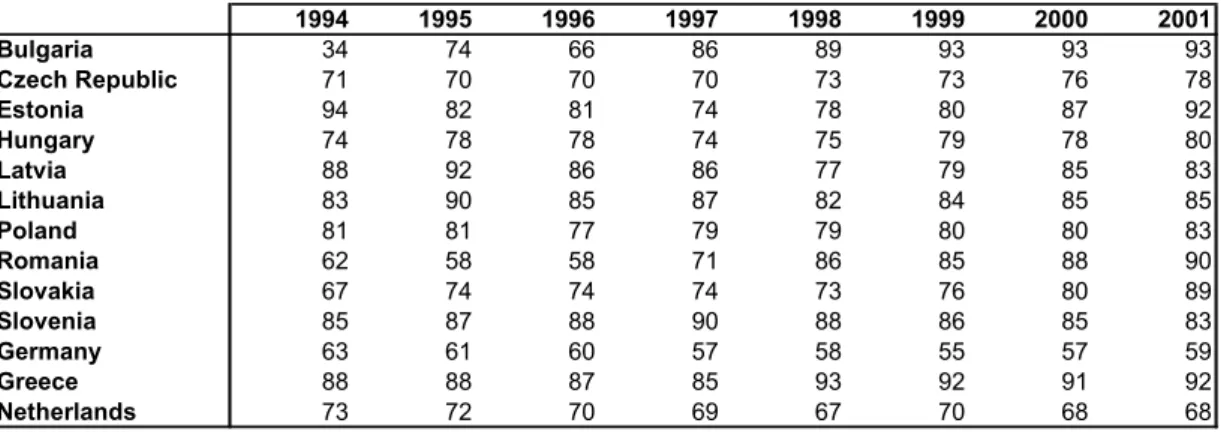
1994 1995 1996 1997 1998 1999 2000 2001 Bulgaria 34 74 66 86 89 93 93 93 Czech Republic 71 70 70 70 73 73 76 78 Estonia 94 82 81 74 78 80 87 92 Hungary 74 78 78 74 75 79 78 80 Latvia 88 92 86 86 77 79 85 83 Lithuania 83 90 85 87 82 84 85 85 Poland 81 81 77 79 79 80 80 83 Romania 62 58 58 71 86 85 88 90 Slovakia 67 74 74 74 73 76 80 89 Slovenia 85 87 88 90 88 86 85 83 Germany 63 61 60 57 58 55 57 59 Greece 88 88 87 85 93 92 91 92 Netherlands 73 72 70 69 67 70 68 68
Source: Own calculations based on BankScope data
As shown in Table 11 in most CEE countries loans represent a smaller share of bank assets than in the developed EU financial systems, Germany and the Netherlands. Exceptions are Estonia and Slovenia (for the whole period), Bulgaria in 1994, the Czech Republic in 1994 to
24 The variables “loans to total assets” and “customer deposits to total deposits” are also called in the literature indicators for banks’ business mix (De Bandt and Davis, 1999) or indicators for banks’ output mix (Kwan, 2002).
1998 and Hungary in 2000 to 2001. These results indicate that the low supply of loans on the aggregate level is a reflection of the low average involvement of the individual banks in lending activities.
The data presented in Table 12 illustrate that CEE banks’ performance with regard to deposit gathering is on average comparable to that of the EU benchmarks. Nevertheless, differences exist: the average ratios for Estonia, Latvia, Lithuania and Slovenia are generally higher than the those in the rest of the CEE countries and Germany and the Netherlands.
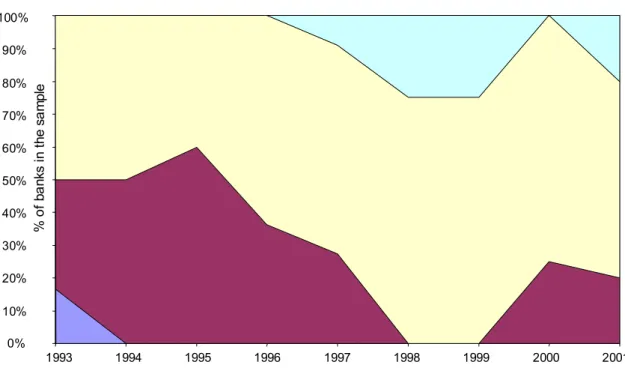
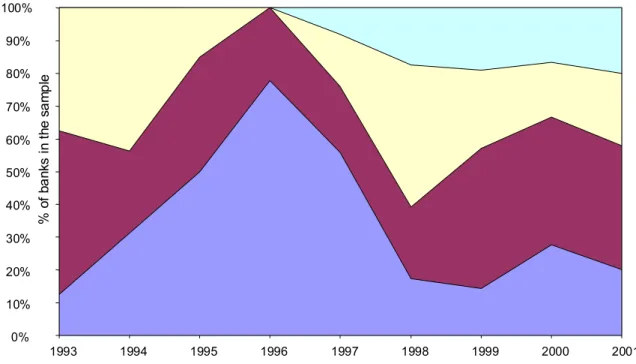
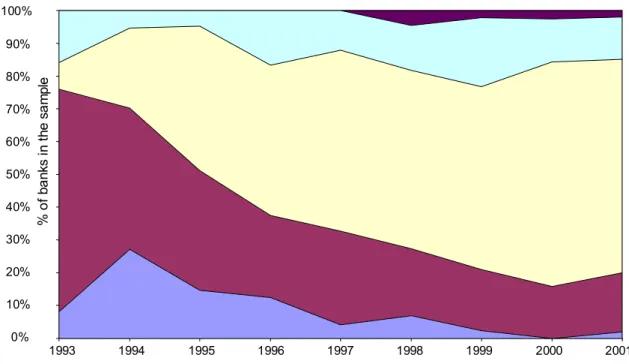
Various articles on the development of the banking sectors in transition economies have pointed out that the population of banks in many CEE countries is characterized by a high level of heterogeneity. So, for example, incumbent saving banks are said to have a different involvement in deposit gathering and loan supply activities than newly entering private banks (Bonin, 1998). Furthermore, foreign banks take on different banking activities than domestic banks (Clarke, et. al, 2003). In the presence of heterogeneity the degree of financial intermediation provided by CEE banks is better described by the distribution of the variables measuring financial intermediation productivity rather than by aggregating these variables. Figures A.2 to A.14 in the Appendix illustrate the distribution of the variable loans to total
assets for the CEE countries and the EU benchmarks in the period 1993-2001. The figures
show significant differences among the EU benchmarks. This confirms our initial prior that working with benchmark cases is superior to using an EU-wide average. Generally German banks show the highest involvement in lending; almost 75% of German banks invest more than 60% of their assets in loans. Most Greek banks, on the contrary, concentrate only a small share (below 40%) of their assets in loans. The distribution of Dutch banks indicates significant differences across banks: about 20% of banks of banks invest almost exclusively in loans, whereas another 20% hold only a minor share of loans in their assets.
The comparison between the CEE countries and the EU benchmark countries shows that in all CEE countries the share of banks that are heavily involved in lending is smaller than in the developed EU financial systems, Germany and the Netherlands. Only a minor proportion of
banks in CEE countries concentrate more than 60% of their assets in loans. All other banks have low or medium values of the ratio of loans to total assets, which indicates that they invest prevailing shares of their funds in alternative assets. Furthermore, only for Estonia and Slovenia, the CEE countries with highest involvement of banks in credit supply, the distribution of the loans to total assets variable indicates levels of lending activity that are higher than those of Greek banks. Only in these two countries do the majority of banks invest predominantly (more than 60% of their assets) in loans. In Hungary and Poland the prevailing share of banks invests between 40% and 60% of their assets as loans, a feature that resembles the Greek banking sector. For all other CEE countries (Bulgaria, the Czech Republic, Latvia, Lithuania, Romania and Slovakia) the majority of banks invest less than 40% of their assets in loans. In these countries only very few banks distribute more than 60% of their assets as loans, which signals the importance of alternative assets in bank portfolios.
The results from this section confirm the hypothesis that not only the smaller size of the banking industry, but also the fact that existing banks invest in alternative assets instead of supplying credit, explains the low levels of bank loan supply. In order to illustrate the importance of the alternative investments in the asset portfolio of banks we present the distributions of the variables assets in form of government securities to total assets and
deposits with banks to total assets.
The distribution of the variable assets in form of government securities to total assets, presented in Figures A.15. to A.23 in the Appendix, indicates that investment in government securities represents a substantial share of assets in Bulgaria (especially in the early transition period), Hungary, Lithuania, Poland and Slovakia26. In Bulgaria, Hungary, Lithuania and Slovakia almost half of the banks, and in Poland even more than 80% of the banks, invest more than 10% of their assets in government securities. In the developed EU financial systems this is done by less than 5% of the banks.
26 Data for bank investments in government securities in the Czech Republic, Estonia, Latvia and Romania is not available
All CEE countries, but Poland, have recently experienced periods of severe government deficits. These deficits have mostly been financed by government bonds which represented a profitable risk adjusted investment alternative for banks. Furthermore, all CEE countries had wide-ranging consolidation programs27 that swapped bad bank loans for government securities. The effects of these consolidation programs can be seen in the high share of government securities in bank assets. The implementation of consolidation programs is marked by an increase in the share of banks that invest more than 10% of their assets in government securities (i.e. Hungary and Poland in 1994).
The literature on transition banking points to the possibility that the high share of government bonds in bank assets can generate crowding-out effects (Anderson and Kegels, 1998). The lack of loan demand data does not allow us to prove the relevance of this hypothesis. Nevertheless, an alternative argument can be mentioned here. In CEE countries, government debt is intermediated by the banking sectors, whereas in countries with stronger investment tradition the public directly holds government securities and these are not reflected on bank balance sheets. This means that banks in CEE countries undertake functions that are performed by capital markets in mature market economies. This implies that banks increase in size due to reasons not directly associated with typical banking functions like credit assessment and monitoring.
The distribution of deposits with banks to total assets, presented in Figures A.24 to A.35 in the Appendix, show that a large proportion of banks in Bulgaria, the Czech Republic, Poland, Romania and Slovakia hold a substantial share of assets in the form of deposits with other banks.
On the liability side, significant differences among the distribution of the variable customer
deposits to total deposits across the EU benchmark countries is observed. In Germany and
Greece most of the banks rely predominantly on funds gathered in the customer deposit market. In contrast, funding through the interbank market has a much higher importance for
Dutch banks28. As reflected in Figures A.36 to A.48 in the Appendix we also observe significant differences among the CEE countries. In the Czech Republic, Hungary, Poland and Slovakia interbank deposits are an important source of refinancing for the vast majority of banks.
On the other hand, in Estonia, Latvia, Lithuania29, Romania and Slovenia the distribution of the variable customer deposits to total deposits shows that almost all banks are fully financed by customer deposits. A low ratio of customer deposits to total deposits ratio is observed only temporary in periods of instability of the financial system (e.g. Latvia in 1995-1996, Romania in 1997-98). This stems from the fact that central bank liquidity assistance is reflected in the balance sheets as interbank deposit. The distributions of the variable customer deposits to total deposits for the CEE countries are otherwise similar to the ones of German and Greek banks. They indicate a relative low importance of interbank deposits on the liability side of bank balance sheets. In these CEE countries all banks participate in the deposit market under similar conditions and the incentives for interbank borrowing are limited. Bulgarian banks showed a relatively low involvement in deposit collecting activities during the mid-1990s, but later this pattern changes and by 2001 most banks finance their assets almost exclusively by customer deposits.
The distribution of the variables measuring financial intermediation productivity of banks point to both, differences across CEE countries, and differences across banks within the respective banking systems. These results comply with the specialization argument made by some studies on banking in CEE countries. Large incumbent banks in CEE countries specialize in deposit gathering, whereas loan supply is mostly provided by new entrant banks. This phenomenon has been described by Miller and Petranov (2002) for the early transition period in Bulgaria and by Bonin et. al. (1998) for the Czech Republic and Hungary. The
28 As evidenced by De Bandt and Davis (1999) the low level of customer deposits in the Netherlands is a phenomenon of the 1990s. The reason is that bank deposits became less attractive during the 1990s due to the higher returns in investment in shares and mutual funds. This low level of customer deposits is compensated for by deposits from foreign banks.
29 After the Baltic countries’ became independent from the USSR the assets of the local Sberbank subsidiaries were never recovered from the legal successor of Sberbank in Moscow29. This is analogous to the situation in Slovenia (Bonin, et. al., 1998).
existence of such specialization explains the high share of interbank borrowing by CEE banks, because banks clear the systematic inequalities between deposits and loans through interbank trade.
Table 13: Loans to total assets, weighted average by groups of banks, in %
1994 1995 1996 1997 1998 1999 2000 2001
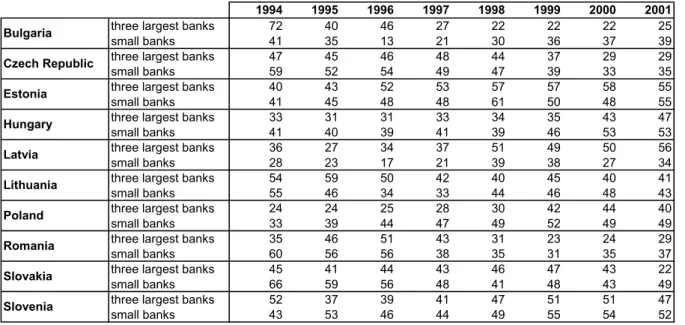
three largest banks 72 40 46 27 22 22 22 25 small banks 41 35 13 21 30 36 37 39 three largest banks 47 45 46 48 44 37 29 29 small banks 59 52 54 49 47 39 33 35 three largest banks 40 43 52 53 57 57 58 55 small banks 41 45 48 48 61 50 48 55 three largest banks 33 31 31 33 34 35 43 47 small banks 41 40 39 41 39 46 53 53 three largest banks 36 27 34 37 51 49 50 56 small banks 28 23 17 21 39 38 27 34 three largest banks 54 59 50 42 40 45 40 41 small banks 55 46 34 33 44 46 48 43 three largest banks 24 24 25 28 30 42 44 40 small banks 33 39 44 47 49 52 49 49 three largest banks 35 46 51 43 31 23 24 29 small banks 60 56 56 38 35 31 35 37 three largest banks 45 41 44 43 46 47 43 22 small banks 66 59 56 48 41 48 43 49 three largest banks 52 37 39 41 47 51 51 47 small banks 43 53 46 44 49 55 54 52 Slovakia Slovenia Latvia Lithuania Poland Romania Bulgaria Czech Republic Estonia Hungary
Source: Own calculations based on BankScope data
To present more evidence supporting this phenomenon we look at the differences among the financial intermediation performance of different groups of banks. We divide the sample of banks covered by BankScope into two groups. The first includes the three largest banking institution in terms of total assets, and the second includes the remaining “small” banks. Table A.2 and A.3 in the Appendix illustrate that in Bulgaria, the Czech Republic, Hungary, Poland, and Slovakia all large banks are incumbent institutions. In newly independent economies like Estonia, Latvia, Lithuania and Slovenia, in contrast, incumbent banks did not exist and new entrants managed to acquire a dominant position in the banking market.
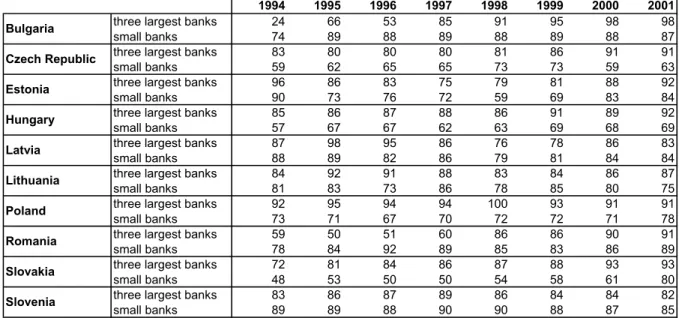
Table 13 and Table 14 illustrate that the largest incumbent banking institutions do indeed perform different activities when compared with the rest of the banking sectors in Bulgaria, the Czech Republic, Hungary, Poland and Slovakia. So for example, the ratio of loans to total assets in the Czech Republic and Hungary is on average 10% higher for small banks than for the large banks. In Poland and Slovakia small banks have a ratio of loans to total assets that is even about 20% higher than the one for the largest banks. On the liability side, large banks in
the Czech Republic, Hungary, Poland and Slovakia almost exclusively finance their activities by customer deposits, whereas customer deposits represent only 50-70% of the total deposit in small banks. Thus up to 50% of small banks’ deposits represent interbank financing.
These differences cannot be explained by the size of the banks alone, since in countries where dominant banks are new entrant institutions (Estonia, Latvia, Lithuania, and Slovenia) this phenomenon of specialization is not observed.
Table 14: Customer deposits to total deposits, weighted average by groups of banks, in %
1994 1995 1996 1997 1998 1999 2000 2001
three largest banks 24 66 53 85 91 95 98 98 small banks 74 89 88 89 88 89 88 87 three largest banks 83 80 80 80 81 86 91 91 small banks 59 62 65 65 73 73 59 63 three largest banks 96 86 83 75 79 81 88 92 small banks 90 73 76 72 59 69 83 84 three largest banks 85 86 87 88 86 91 89 92 small banks 57 67 67 62 63 69 68 69 three largest banks 87 98 95 86 76 78 86 83 small banks 88 89 82 86 79 81 84 84 three largest banks 84 92 91 88 83 84 86 87 small banks 81 83 73 86 78 85 80 75 three largest banks 92 95 94 94 100 93 91 91 small banks 73 71 67 70 72 72 71 78 three largest banks 59 50 51 60 86 86 90 91 small banks 78 84 92 89 85 83 86 89 three largest banks 72 81 84 86 87 88 93 93 small banks 48 53 50 50 54 58 61 80 three largest banks 83 86 87 89 86 84 84 82 small banks 89 89 88 90 90 88 87 85 Slovakia Slovenia Latvia Lithuania Poland Romania Bulgaria Czech Republic Estonia Hungary
Source: Own calculations based on BankScope data
In general the small banks in those CEE sample countries where incumbents still dominate the deposit market rely heavily on interbank funds. This supports the notion of specialization within the banking sector. The process of channeling funds from savers to investors in the economy contains an additional chain of transferring funds from a few banks possessing access to a wide range of customers to those banks that have not developed a customer deposit network, but have potential projects to finance.
One immediate result of the specialization phenomenon is that the average ratio measuring financial intermediation productivity of banks is relatively low, since some banks are not involved in loan supply, whereas others do not gather deposits.
To summarize, the micro level analysis on the financial intermediation productivity of CEE banks indicates that the low aggregate levels of bank intermediation are a reflection of the low financial intermediation productivity. This is especially true with regard to the loan supply function; banks in all CEE countries are less involved in loan supply than banks from the EU benchmark countries. Moreover, a phenomenon of specialization of large incumbents in deposit gathering and of new entrants in loan supply is observed in some of the CEE countries (Bulgaria, the Czech Republic, Hungary, Poland and Slovakia). As a result ratios measuring the aggregate financial intermediation productivity of banks are biased downwards, since some banks are not involved in loans supply, whereas others do not gather deposits.
6. Conclusion
This paper presents an analysis of the size of the banking sectors in Central and Eastern European (CEE) countries. We focus on the banking sectors’ ability to provide financial intermediation between savers and investors in the economy.
The existing literature on banking in transition economies argues in unison that banking sectors in CEE countries are too small and do not provide sufficient levels of financial intermediation. In this paper we detect a common drawback of the existing measures used to indicate the size of CEE banking sectors: they all relate the volume of bank intermediation to GDP. We argue that since transition economies have a low stock of financial wealth relative to economic activity, a more objective measure of the size of the banking sector is the ratio of bank assets to a proxy of the stock of financial wealth rather than to GDP. Indeed, we find evidence that the estimation of the size of the banking sectors relative to GDP produce downward biased measures for the ability of CEE banks to intermediate available financial resources. But even when the size of the banking sector is measured relative to financial wealth, a gap between the developed EU banking systems and those of the CEE countries exists. But this gap is not as severe as argued in studies based on the traditional approach of measuring the size of the banking system with respect to GDP.
This paper, moreover, focuses on three arguments proposed in the literature that help explain the low level of financial intermediation by banks in CEE countries.
First, we find that the low current level of bank intermediation can at least partly be explained by the low initial stage of development of CEE banking sectors. By comparing the levels of marginal intermediation of the CEE countries with those of the EU countries, we conclude that catching up with the EU levels is progressing, at least with regard to the CEE banks’ ability to accumulate deposits. Regarding to the lending function of the banking sectors, a trend towards approaching EU levels could be observed during the early transition years but was interrupted in the late 1990s.
Second, comparing the capital markets of CEE countries with those of the EU benchmarks, we reject the hypothesis that the development of banking sectors has been insufficient because financial systems are developing in a market-based manner. The data illustrate that capital markets in all CEE countries are even more severely underdeveloped than banking sectors. Therefore, they cannot compensate for the low level of bank financial intermediation.
Finally, when analyzing the involvement of CEE banks in classical financial intermediation activities on a micro level we find evidence for the hypothesis that the low level of financial intermediation provided by CEE banking sectors is a reflection of the low financial intermediation productivity of CEE banks on the individual bank level. Furthermore, our data indicate that significant differences across banks in some of the CEE countries exist. Whereas some banks do not perform credit, others show only minor involvement in deposit gathering. We relate this heterogeneity to a phenomenon of bank specialization in some CEE countries that has previously been described in the literature. A comparison between the financial intermediation activities of the largest banks with those of the small institutions supports the argument that in countries where incumbent banks still dominate the deposit market, there is a specialization of large incumbents in deposit gathering and of new entrant banks in credit supply.
Bibliography:
Allen, F. and D. Gale. 1999. Comparing Financial Systems, MIT
Anderson, R. and C. Kegels. 1998. Transition Banking: Financial Development of Central and Eastern Europe, Oxford University Press
Barisitz, S. 2001. The Development of the Romanian and Bulgarian Banking Sectors since 1990, Focus on Transition, Österreichische Nationalbank
Baxter, M. and M. Cruccini. 1993. Explaining Saving-Investment Correlations. American
Economic Review 83: 416-36
Bayoumi, T. 1990. Saving-Investment Correlations: Immobile Capital, Government Policy, or Endogenous Behaviour? IMF Staff Papers 37: 360-387
Bonin, J. 2001. Financial Intermediation in Southeast Europe: Banking on the Balkans,
Vienna Institute for International Economic Studies, mimeo
Bonin, J., Mizsei, K., Szekely, I., and P. Wachtel. 1998. Banking in Transition Economies: Developing Market Oriented Sectors in Eastern Europe,Institute for EastWest Studies
Bonin, J. and P. Wachtel. 2002. Financial Sector Development in Transition Economies: Lessons from the First Decade, BOFIT Discussion Paper 9/2002
Calveras, A. 2001. Bank Specialization: The Role of the Interbank Market. mimeo
Clarke, G., Cull, R., Peria, M. S., and S. M. Sanchez. 2003. Foreign Bank Entry: Experience, Implications for Developing Economies, and Agenda for Further Research. The World Bank Research Observer, vol. 18 (1)
Cole, D., and B. Slade. 1996. Building a Modern Financial System: The Indonesian Experience. Cambridge University Press
Danthine, J-P., Giavazzi, F., Vives, X., and E-L. von Thadden. 1999. The Future of European Banking, Monitoring European Integration, CEPR
De Bandt, O. and E.P. Davis. 1999. A Cross-Country Comparison of Market Structures in European Banking, ECB Working Paper
Demirgüc-Kunt, A. and R. Levine. 2001. Bank-based and Market-based Financial Systems. Financial Structure and Economic Growth, MIT Press
Dittus, P. and S. Prowse. 1995. Corporate Control in Central Europe and Russia: Should Banks Own Shares? World Bank
European Central Bank. 2002. Financial Sectors in the EU Accession Countries
Feldstein, M. And C. Horioka. 1980. Domestic Saving and Internatioanl Capital Flows. The Economic Journal 90: 314-329
Fender, I. and J. von Hagen. 1998. Central Banking in a more Perfect Financial System. Open Economies Review Vol. 9: 331-353
Folkerts-Landau, D., Mathieson, D. J. And G. J. Schinasi. 1997. International Capital Markets: Developments, Prospects and Key Policy Issues, International Monetary Fund
Freixas, X. and J. C. Rochet. 1997. Microeconomics of Banking, MIT
French, K. R. and J. M. Poterba. 1991. Investor Diversification and Internatioanal Equity Markets. NBER Working Paper 3609
Grinblatt, M. and S. Titman. 1998. Financial Markets and Corporate Strategy, McGraw-Hill
Grossman, R. S. 2001. Double Liability and Bank Risk Taking, Journal of Money, Credit and Banking 33(2): 143-159
Hencsey, N. and G. Hultgren. 2001. Securities Markets: Huge Gap, Difficult to Close Soon.
EU Enlargement Monitor Deutsche Bank Research 5/01
Ho, S. Y., and A. Saunders. 1985.A Micro Model of the Federal Funds Market. The Journal of Finance 49(3): 977-990
Hristov, K. and M. Michailov. 2002. Bank Credit Activities and Credit Market Rationing in Bulgaria, Bulgarian National Bank
Iakova, D. and N. Wagner. 2001. Financial Sector Evolution in Central European Economies: Challenges in Supporting Macroeconomic Stability and Sustainable Growth, International Monetary Fund Working Paper
Koch-Weser, C. 1996. The Transition in Central and Eastern Europe: Recent Progress and Next Steps, Address to the Fourth Annual Conference “Banking and Finance: The Experience of Central Europe”
Kwan, S. H. 2002. Operating Performance of Banks among Asian Economies: An International and Time Series Comparison, Federal Reserve Bank of San Francisco
Miller, J. and S. Petranov. 2002. The Financial System in the Bulgarian Economy, Bulgarian National Bank
Petrov, B. 2000. Bank Reserve Dynamics under Currency Board Arrangement in Bulgaria.
Bulgarian National Bank
Pissarides, F. 2001. Financial Structures to Promote Private Sector Development in South-Eastern Europe, European Bank for Development and Reconstruction Working Papers
Pyle, W. 2002. Over-banked and Credit-Starved: A Paradox of the Transition. mimeo
Schardax, F. and T. Reiniger. 2001. The Financial Sector in Five Central and Eastern European Countries: An Overview, Focus on Transition, Österreichische Nationalbank Stulz, R. 2001. Does Financial Structure Matter for Economic Growth? Financial Structure
and Economic Growth, MIT Press
Transition Report .2001. European Bank for Recunstruction and Development
Zoli, E. 2001. Cost and Effectiveness of Banking Sector Restructuring in Transition Economies, International Monetary Fund
Appendix
Table A.1: Data sources
Variable Data Source
Bank assets to GDP IFS
Bank claims to the private sector to GDP IFS
Deposits with banks to GDP IFS
Stock market capitalization to GDP Transition Report for CEE countries, Datastream for EU benchmarks Domestic debt securities to GDP Bank for International Settlements
Loans to total assets BankScope
Deposits with banks to total assets BankScope Investment in government securities to total assets BankScope Customer deposits to total deposits BankScope
Table A.2: Main deposit gathering banks in CEE: shares in deposit market
Source: Own calculations based on Bankscope and IFS
1994 1995 1996 1997 1998 1999 2000 2001
BULBANK yes 12% 12% 24% 28% 20% 27% 29% 30%
DSK yes 45% 37% 24% 30% 28% 26% 25% 25%
United Bulgarian Bank yes 14% 9% 6% 11% 10% 13% 15% 17%
Ceska Sporitelna yes 39% 32% 26% 26% 26% 28% 29% 26%
Ceskoslovenska Obchodni Banka yes 8% 9% 8% 10% 9% 11% 28% 28%
Komercni Banka yes 27% 25% 23% 24% 20% 22% 23% 22%
Estonian Savings Bank yes 35% 28% 23% 19% - - -
-Eesti Uhispank no 36% 20% 22% 21% 29% 27% 23% 24%
HansaBank no 10% 28% 32% 29% 60% 64% 68% 68%
Hungarian Foreign Trade Bank yes 6% 6% 7% 8% 8% 8% 8% 9%
K&H Bank yes 10% 9% 9% 9% 10% 14% 14% 14%
National Savings and Commercial Bank yes 55% 49% 44% 39% 40% 34% 30% 31%
Hansabanka no 5% 8% 12% 17% 20% 22% 22% 24%
Latvijas Unibanka no 23% 25% 24% 24% 34% 31% 28% 25%
Parekss Banka no 27% 22% 24% 24% 34% 37% 33% 28%
AB Bankas Hansa no - 26% 24% 30% 39% 43% 33% 33%
Agricultural Bank of Lithuania yes 22% 20% 21% 20% 17% 17% 13% 13% Commercial Bank of Lithuania yes 46% 24% 20% - - - -
-Vilniaus Bankas no 18% 7% 15% 21% 21% 29% 41% 41%
Bank Pekao yes 14% 13% 15% 15% 12% 13% 13% 15%
Bank Przemyslowo-Handlowy PBK yes 4% 6% 5% 7% 8% 10% 11% 13% Powszechna Kasa Oszczednosci BP yes 24% 32% 30% 27% 34% 25% 28% 28% Banca Comerciala Romana no 8% 12% 12% 13% 28% 34% 29% 35%
BANCOREX yes 79% 66% 71% 54% 23% - -
-Romanian Savings Bank yes 10% 8% 10% 11% 13% 14% 11% -Slovak Savings Bank yes 49% 46% 43% 41% 36% 34% 32% 31%
Tatra Banka no 3% 5% 7% 7% 7% 9% 12% 15%
Vseobecna Uverova Banka yes 33% 32% 30% 29% 26% 26% 25% 25% Nova Kreditna Banka Maribor yes 22% 18% 13% 10% 16% 16% 18% 16% Nova Ljubljanska Banka no 23% 21% 20% 21% 46% 45% 48% 47%
SKB Banka DD no 7% 10% 10% 9% 14% 13% 14% 14%
Customer deposit market share in