Pupil engagement in the questioning process during
Numeracy problem-solving sessions
by
Joanne Davenport
A thesis submitted in partial fulfilment for the requirements for the degree of M.A. (by Research) at the University of Central Lancashire
a
uclan
Student Declaration
Concurrent registration for two or more academic awards
Either
/1
declare that while registered as a candidate for the research degree, I have riot been a registeredV candidate or enrolled student for another award of the University or other academic or professional institution
or I declare that while registered for the research degree, I was with the University's specific permission, a "registered candidaterenrolled student for the following award:
Matedal submitted for another award
Either /declare that no material contained in the thesis has been used in any other submission for an
V academic award and is solely my own work
or I declare that the following material contained in the thesis formed part of a submission for the award of
(state award and awarding body and list the material below):
Collaboration
Where a candidate's research programme is part of a collaborative project, the thesis must indicate in addition clearly the candidate's individual contribution and the extent of the collaboration. Please state below
Signature of Candidate
.
fhvot.fiA Type of AwardABSTRACT
Within the context of interactive Numeracy lessons, active participation of pupils is encouraged. For example, questioning may be used to stimulate thinking skills and pupils may explain their methods of calculation to the class. Problem-solving is an area of Numeracy that offers an opportunity for pupils to discuss their methods and it has been highlighted as an area for development in Key Stage 2 mathematics. However, despite an emphasis on interactive lessons, research has shown that lessons tend to be teacher-dominated, with the teacher as questioner and evaluator, and pupils as respondents. I feel that if pupils are to be regarded as active participants in Numeracy lessons, then they must be engaged participants who willingly contribute to discussions, perhaps by asking questions, reflecting or sharing misconceptions. Indeed, I believe that, given the opportunity, pupils are capable of engaging in the questioning process, both as questioner and respondent.
Consequently, I have examined the nature of interaction and discourse in the classroom, in order to determine when pupils are explicitly engaged during whole-class problem-solving sessions. I collected data primarily in the form of audio-tapes, which were transcribed in order to facilitate analysis. I applied models of discourse analysis developed by Sinclair and Coulthard (1975) and Archer (2005) in order to categorise speech. Additionally, I utilised Bloom's Taxonomy of educational objectives (1956) to highlight the range of thinking skills being used in response to questioning.
The key findings indicated that when pupils were encouraged to pose their own questions, they readily responded to this opportunity to act as questioners. Pupils demonstrated a willingness and capability to question methods of calculation. There were instances of pupils using sustained questioning to examine alternative methods or misconceptions. The findings signalled that pupils were capable of engaging in the questioning process by considering and questioning methods of problem-solving, and responding to questioning from their peers by providing explanations and comments.
ACKNOWLEDGEMENTS
I would like to thank Kevin for his patience and support.
Thank you to my Supervisors, Anne, Gary and especially Dawn, my Director of Studies; for their expertise and guidance.
Contents Page Title Declaration ii Abstract lii Acknowledgements iv Contents v
List of figures Vii
List of tables Viii
List of appendices ix
Chapter 1: Introduction
• I Rationale 1
1.2 Why Numeracy problem-solving? 2
Chapter 2: A review of literature 8
2.1 Recommendations of DfES and QCA 8
2.2 Interpretations of terminology regarding "interactivity" and
"engagement" 9
2.3 Thinking skills 11
2.4 Developing questioning skills 12
Chapter 3: Methodology 14
3.1 Methods of data analysis 18
Chapter 4: Application of and findings from Sinclair and Coulthard's system of
discourse analysis 26
4.1 Application of Sinclair and Coulthard's system of discourse analysis 26
4.2 Findings 29
4.3 Summary 35
ChapterS: Application of and findings from Archer's systemic approach to
context identification and analysis 36
5.2 Findings: interpretation of charts 37
5.3 Summary 47
Chapter 6: Application of and findings from Bloom's Taxonomy
of Educational Objectives 48
6.1 Application of Bloom's Taxonomy 48
6.2 Findings 51
6.3 Summary 60
Chapter 7: Evaluation of the models of categorisation and a summary
of their key findings 62
7.1 Sinclair and Coulthard 62
7.2 Archer 64
7.3 Bloom 66
7.4 A summary of the key findings from the three models
of categorisation 68
Chapter 8: Discussion and future research 72
8.1 A summary of the study's approach 72
8.2 Implications 73
8.3 Future research 76
References 78
LIST OF FIGURES: PAGE
I. Percentage of teacher and pupil replies 31
2. Percentage of teacher and pupil comments 32
3. Comparison of percentages of teacher and pupil replies,
evaluations and elicitations 33
4. Percentage of teacher and pupil elicitations 34
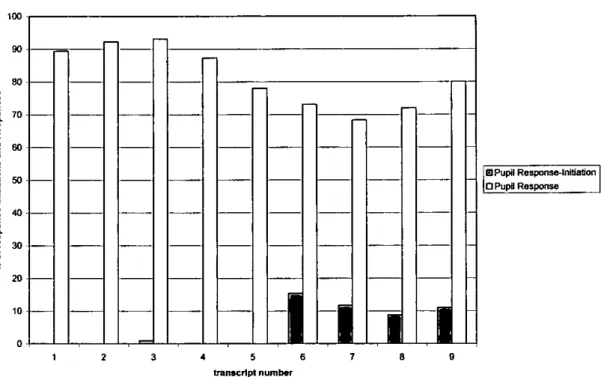
5. Percentage of teacher and pupil Response-initiation utterances 38
6. Percentage of teacher and pupil Response utterances 39
7. Comparison of percentages of pupil Response-initiations and Responses 40
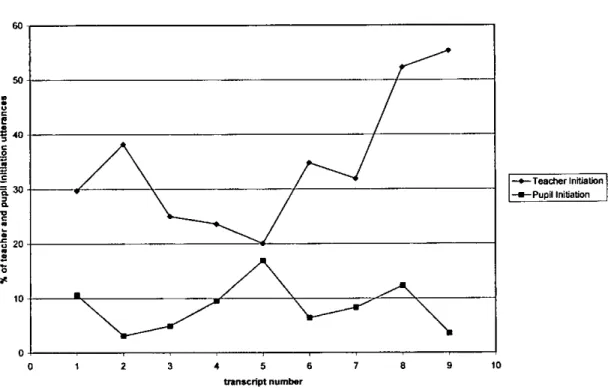
8. Percentage of teacher and pupil Initiation utterances 41
9. Percentage of teacher and pupil Follow-up initiation utterances 43 10. Comparison of percentages of teacher and pupil Initiations and
Follow-up initiations 44
11. Percentage of teacher and pupil Follow-up utterances 45
12. Percentage of higher and lower thinking: pupil responses to teacher
questions and instructions 57
13. Comparison of percentages of teacher and pupil
LIST OF TABLES: PAGE
I. Categories of Interactional Intent 21
2. Data showing teacher and pupil acts from Transcript 6 28
3. Example of categorisation of utterances based on Archer 36
4. Percentage of teacher and pupil Re-initiates 46
5. Exchanges leading to higher or lower level thinking 50
6. Percentages of higher and lower level pupil responses 51
7. Percentage of multiple types of question 59
LIST OF APPENDICES: PAGE
1. Key points arising from each session 82
2. Categorisation of utterances based on Archer 87
3. Categorisation of thinking skills based on Bloom 97
4. Descriptions of Sinclair and Coulthard acts, including symbols 100
5. Turns and acts with percentages 102
6. Charts showing percentages of teacher and pupil utterances Ill
7. Exchanges from Transcripts I to 9 leading to higher or lower level
thinking based on Bloom's Taxonomy 117
8. Initial analysis of Transcripts using levels of thinking framework
based on Bloom's Taxonomy 161
9. Categorisation of responses to multiple and fuzzy questioning 191 10. Charts showing percentages of teacher and pupil replies,
comments and elicitations. Chart showing comparison of replies,
evaluations and elicitations 192
CHAPTER 1 INTRODUCTION
This thesis seeks to examine the nature and extent of pupil involvement in classroom discourse during Numeracy lessons. I question whether effective methods are being used to engage pupils in this activity. Such methods include pupil demonstration of calculation procedures and the provision of opportunities for questioning and querying by pupils. The research aims to explore whether pupils are effectively engaged in the questioning process applied during Numeracy problem-solving lessons and examines the significance of pupil contributions to discussions. The thesis draws on prior research including interpretations of interactive whole-class teaching and pupil engagement. It explores the development of questioning by pupils in Upper Key Stage 2 (Year 5 pupils, aged 9-10). The impetus to explore these areas is outlined in the following sub-section.
1.1 Rationale
An important element of teaching is the process of asking questions as a means of gauging knowledge and also as a means of signalling the expectation of a response from pupils. Research has shown that teachers ask a variety of questions and these can be categorised in a number of ways. Andrew Trott for instance, provided examples of lower, middle and higher order questions (Trott, 2002). These ranged from questions which require the recall of a fact, e.g. "when was the Battle of Hastings?" to questions involving analysis, e.g. "why is the job of a police officer an important one?" (Trott, 2002: 9).
The Handbook for Leading Mathematics Teachers (DfES, 2002) emphasises the development of the skills of questioning. The objectives indicate that questioning has an important role in the development of children's learning in maths and that there should be consideration of,
the role of questioning within the planning, teaching and assessment of mathematics (DiES, 2002: Objectives, session 3).
It also makes clear that pupils should be involved in discussions or dialogue, regardless of ability, stimulated by the use of a variety of questioning styles. However, the Handbook does not clarify whether the questions were to be used by teachers and pupils or by one group. This is an important point because during their review of the importance of developing thinking skills in the classroom, the Qualifications, Curriculum and Assessment Authority for Wales (QCA for Wales, 2006) emphasise the importance of encouraging learners to ask questions. Unfortunately, there is insufficient time to fully examine what may be meant by "thinking skills" in detail. However, I would suggest that thinking skills could mean the ability to reason, sort, analyse or draw conclusions from information. That is to say, these skills are employed during activities such as problem-solving. The QCA for Wales concludes,
There is well-documented and substantial qualitative and quantitative evidence to show that the use of [thinking skills and assessment for learning] with learners in the classroom raises their motivation and performance (QCA for Wales, 2006: 4).
In other words, in order to raise pupil motivation and standards, pupils should develop their thinking skills through, for example, questioning, talk and explanation. In spite of this, Baumfield and Mroz, (2002) acknowledge that there is a shortage of research which focuses on pupil responses. Consequently, there appears to be a need to research the importance of pupil contributions during classroom discourse. In light of the suggestion that pupil involvement in discourse is important and under-researched, I will seek to assess the effectiveness of methods used to engage pupils in dialogue during the questioning process in this thesis. In particular, I will focus on Numeracy problem-solving lessons.
1.2 Why Numeracy problem-solving?
During my career as a primary school teacher, I was introduced to two important changes:
(i) the introduction by the Department for Education and Employment (DfEE) of the National Numeracy Strategy (NNS) Framework for Teaching Mathematics (DfEE, 1999)
and
(ii) the opportunity to undertake school-based research.
The NNS emphasises the importance of a two-way interactive process of teaching, as indicated in the following extract from the NNS Framework,
During each lesson you should aim to spend as much time as possible in direct teaching and questioning of the whole class, a group of pupils, or individuals. High-quality direct teaching is oral, interactive and lively. It is not achieved by adopting a simplistic formula of 'drill and practice' and lecturing the class, or by expecting pupils to teach themselves from books. It is a two-way process in which pupils are expected to play an active part by answering questions, contributing points to discussions, and explaining and demonstrating their methods to the class (DfEE, 1999: II).
This suggests that pupils should actively participate in the teaching process and any activity should include the opportunity for pupils to share their ideas or methods. Notice that the quotation presupposes that teachers and pupils will understand the meaning of "interactive" and that pupils will not seek to ask questions. The former change led me towards a specific interest in the processes necessary to gain mathematical skills, while the latter introduced me to the concept of practising such interactive methods of discourse. I began to explore alternative methods of tackling neglected or unpopular areas of Numeracy such as problem-solving and, having realised that my teacher-talk often dominated the lessons, I gave pupils the opportunity to question their peers' methods and to demonstrate their own methods. Put simply, lessons became more pupil-centred. That is, pupils proposed alternative methods of solving problems and aired their doubts or queries. Misconceptions and various alternative methods were aired and proposed. Pupils were active learners who tackled problem-solving with more confidence than earlier in
the school year. Contextual knowledge indicated that pupils had become engaged problem-solvers. This situation was seemingly in contrast with findings from other research,
\Vhile 'interaction' is promoted, it is found to be essentially teacher-centred; teacher-talk dominates. The whole class interaction exemplified in NNS video materials supplied to schools does not show examples of interaction that go beyond the teacher-centred Initiate-Respond-Evaluate/Feedback model (... Sinclair & Coulthard, 1975): significantly children are never seen to explore a misconception, develop their argument or engage in conflict and reflection which ... are seen to be so productive for learning (Ryan, Kassem and Sarland, 2003: 1).
The research by Ryan et al. (2003), indicated that far from being a two-way process whereby pupils are engaged in sharing their ideas, pupils are simply respondents in a teacher-dominated lesson. I will aim to explore the form of pupil discourse during Numcracy lessons focusing specifically on problem-solving sessions. There are several reasons for this particular focus,
(i) Analysis of pupil performance following Standard Assessment Tasks (SAT5) identified problem-solving as an area for development (QCA, 2005)
(ii) Problem-solving offers an opportunity for pupils to contribute and discuss their methods of thinking. This form of interaction is a requirement of the National Numeracy Strategy (NNS).
(iii) On 20 May 2003, the Secretary of State launched "Excellence and Enjoyment - A Strategy for Primary Schools" (DfES, 2003). The Department for Education and Skills (DIES, formally known as the DIEE) aimed for 85% of Key Stage 2 (KS2) pupils to reach the standard of level 4.
Pupils are developing their own strategies for solving problems and are using these strategies ... They present information and results in a clear and organised way. They search for a solution by trying out ideas of their own (DfEE, 1999: 9). These factors suggest that problem-solving is an area of Numeracy which is ripe for investigation and development, whilst at the same time offering an opportunity for encouraging pupils to develop their thinking skills during interactive engagement, including exploration and discussion of their methods of calculation. Consequently, there are valid reasons for selecting this area to research. However, it is important to consider a number of contextual factors when studying classroom discourse, for example, teaching and learning styles or curriculum pressures. They are all of significance but due to time constraints, I am unable to examine these in detail as part of this thesis. I do, however, examine them briefly here. Clearly, numerous and possibly wide-ranging mathematical and thinking skills are required in order to attain the expected level 4. Pupils need to possess the capability to express their thinking when sharing their mathematical ideas. The NNS publication "Mathematical Vocabulary" (DfEE, 2000) states that by utilising a breadth of question-types e.g. from those that recall knowledge to those that require analysis or interpretation of information, children could learn to understand mathematical ideas (DfEE, 2000: 4). The publication goes on to list examples of questions that may extend children's thinking. There is a particular point of interest however; the publication, which was circulated to schools mentions, "a higher level of thinking" (DfEE, 2000: 4), but does not explicitly define what is meant by this. Similarly, an on-line article aimed at teachers states,
Everyone uses a range of thinking skills. Benjamin Bloom's Taxonomy of educational objectives (1956) has been widely used to define a hierarchy of these skills (QCA, 2006: 8).
This seems to be a cursory mention of taxonomy of skills and presupposes that it is familiar to the audience. It is questionable whether the DIEE assumption that the term "thinking skills" is a familiar and understandable term. Perhaps it would be beneficial to provide a clear and explicit definition of what is meant by "thinking skills" prior to
emphasising methods of developing such skills? This thesis will highlight the need for a
clear definition of thinking skills, including higher levels. In fact it is my belief that there
is a need to clearly define key vocabulary or terminology such as "interactive" or
"thinking skills" so that teachers are able to consistently apply their professional
capabilities when planning. With this in mind, I am seeking to define my understanding
of "engaged" or "engagement" (based on contextual knowledge and reviews of literature
which imply the meaning of engagement) and to review definitions of "interactive" and
"interactivity". Additionally, the conditions necessary to stimulate dialogue between
pupil and teacher or pupil and pupil may not be present in all classrooms. Such conditions
may include an ethos of valuing and respecting contributions to discussions, or a
willingness to transfer responsibility for posing questions from teacher to pupil.
Regarding the latter, Skidmore (2004) concluded in his study of the Literacy Hour (i.e.
daily primary school lesson to teach literacy skills) that the teacher dominated talk, asked
questions where the answer was already known and decided the order of turn taking.
Consequently, Skidmore argued for pupils to "play a more leading role in shaping the
topic of conversation" (Skidmore: 2004, 1). If effective questioning is to take place
during Numeracy problem solving sessions, then the teacher may need to review their
control of the discussion and allow the child who is describing their methods to invite
questions and queries. Also, it is necessary to consider additional curriculum and
professional constraints to utilising interactive methods to engage pupils, for example, the
pace of Numeracy lessons, timetable pressures, trust and confidence. Although these are
considered in more detail in a later chapter, it is important to recognise that teachers are
expected to meet prescribed objectives within a given time and to a given minimum
standard. Equally pupils are expected to achieve in a potentially fraught atmosphere of
time limits and boundaries. These factors may serve to constrain effective methods of
engagement. Finally, it is important to note that there are various learning styles preferred
by pupils and some may or may not involve overt, active participation. I have focused on
active participation as an element of engagement because this can be more readily
observed and noted, but I value the importance of concealed pupil engagement whereby
To summarise, within the context of interactivity during Numeracy problem-solving lessons, 1 will examine potential methods of engagement and question whether interactive methods necessarily promote engagement. Indeed, I will suggest that given the opportunity, capability and awareness of the importance or value of asking questions and therefore using a range of thinking skills, pupils will be engaged and active participants in the Numeracy problem-solving process. However, there are likely to be implications, such as training needs or changes in expectations or values of teachers and pupils. This hypothesis is explored in the following chapters which are outlined below. The next chapter reviews literature associated with the research topic. It identifies common themes and contrasting ideas which helped to guide the direction of the research. This is followed by Chapter 3 "Methodology" which states the selected research methods.
Data is in the form of transcripts produced from ten sessions of audio-recording of whole-class problem-solving Numeracy lessons. Summaries of each lesson are provided in the appendices. The data is analysed using three systems of categorisation (including discourse analysis) in order to determine whether engagement was taking place and to determine the nature of the interactions. The application of and findings from each system are described in Chapter 4 "Application of and findings from Sinclair and Coulthard's system of discourse analysis", Chapter 5 "Application of and findings from Archer's systemic approach to context identification and analysis" and Chapter 6 "Application of and findings from Bloom's Taxonomy of Educational Objectives". Then, Chapter 7 discusses the advantages and disadvantages of each of the systems of analysis and emphasises their main findings. Finally, Chapter 8 discusses the strengths and weaknesses of the research process, clarifies the findings following interpretation and analysis of the data and suggests a proposed way forward regarding further research.
CHAPTER 2 A REVIEW OF LITERATURE
In this chapter, 1 examine literature relating to key elements of my work. In particular, I examine literature stemming from Government bodies that was circulated to teachers and Head teachers. This literature focuses on Numeracy standards and pupil achievement; I also examine literature in a bid to find a consistent description of engagement. Additionally, there is a review of literature concerning questioning and thinking skills. These reviews act as introductions to research findings. Subsequent chapters contain more detailed analyses and discussions where appropriate. The review of literature focuses on the following areas:
Recommendations of DIES and QCA
Interpretations of terminology regarding "interactivity" and "engagement"
Thinking skills
Developing questioning skills.
2.1 Recommendations of DJES and QCA
On 20 May 2003, the Secretary of State launched "Excellence and Enjoyment - A Strategy for Primary Schools". The Department for Education and Skills (DIES, formally known as the DIEE) set a target of 85% of Key Stage 2 (KS2) pupils to attain the standard of level 4. The expectation was that by this level, pupils were able to develop and use their own strategies for solving problems, as well as clearly organising their method of calculation. Supporting the DIES is the Qualifications and Curriculum Authority (QCA). The QCA has the responsibility of reviewing the National Curriculum, including pupil performance, and suggesting areas for development. For example, problem-solving was cited as an area for development during the 2005 Implications for leaching and learning from the 2005 national curriculum tests report (QCA, 2005). Additionally, a DIEE booklet Mathematical Vocabulary (DIEE, 2000: 4) stated that by
means of questions children can learn to understand mathematical ideas. Yet, in both publications, questioning by pupils was not explicitly suggested as a means to improve performance. The use of questioning was in line with the key aims of the National Numeracy Strategy Framework for Teaching Mathematics (DfEE, 1999) which emphasised interactivity, including pupils providing explanations and answers. Interestingly, this suggests that pupils are to be assigned an answering role rather than a questioning role, and so they are seemingly not expected to engage in the questioning process other than as a respondent. Similarly, the Basic Skills Agency (which works with Local Education Authorities to ensure good standards of literacy and numeracy teaching) emphasises the importance of pupil participation in the questioning process and has found that mathematical talk leads to raised achievement. That is, schools which combined thinking skills, questions and reflection with an ethos of valuing mathematical discussion, noted that pupils reinforce their ability to think and reason mathematically (Basic Skills Agency, cited in QCA, 2005: 9). However, it was unclear whether mathematical talk was to include pupils participating as questioner or respondent or both.
2.2 Interpretations of terminology regarding "interactivity" and "engagement"
The National Numeracy Strategy (DfEE, 1999) emphasises and encourages the use of interactive whole-class teaching in order to raise standards of achievement. However, teachers and pupils have sometimes interpreted the meaning of "interactive" teaching in different ways, for instance, listening is viewed as more important than talking, and this may have implications for the quality of learning (Pratt, 2003).
Indeed as a result of the implementation of the National Nutneracy Strategy, Grainger (2000) was motivated to research examples of best practice in maths teaching from the Czech Republic and to implement the processes in selected Nottinghamshire schools. Reference was made to OFSTED (Office for Standards in Education: the inspectorate for children and learners in England) who had highlighted interactive whole class teaching as being important for effective learning (OFSTED, in Grainger, 2000: 2). This primarily involved sharing misconceptions and using effective questioning. These methods were employed in the Czech Republic. Pupil thinking was made explicit and students were used to presenting their working out to the rest of the class. Additionally pupils were
expected to fully participate in lessons and challenged to attempt difficult mathematical ideas with tasks at an appropriate level. This interpretation of "interactive whole class teaching" and its related effectiveness corresponds with my understanding of this method of teaching, in that pupils are encouraged to actively participate by showing their methods of calculation to the rest of the class and by sharing any misconceptions through discussion. However, Grainger's work is seemingly a rare practical example of effective whole class interactive teaching using explicit guidelines.
There has been much research regarding the nature of interactivity. Pratt (2003) explored children's perceptions of whole-class interactive teaching (as required by the NNS) and particularly their view of the roles of speaking and listening in the classroom. Pratt learned that children perceived listening to be more important than talking and talking was not seen by pupil or teacher as a tool for learning. Similarly, Hardman, Smith, Mroz and Wall (2003) concluded that teachers were unclear as to what constituted interactive whole class teaching and had received insignificant amounts of advice in respect to the latter e.g. less than a fifth of the sample of teachers said they had seen DIES training materials. Hardman et al. (2003) based their findings on teacher responses to questionnaires regarding their understanding of interactivity and compared these findings with observations of teachers in the classroom during "interactive" lessons. It was determined that there was a disparity between the findings. For instance, teachers suggested that they encouraged or extended pupil contributions, but in practice, this was a rarity. Bums and Myhill (2004) supported this belief that there were divergent interpretations of "interactive" teaching. They concluded that teachers had been left to interpret "interactive" and dominated the discourse in order to meet objectives documented in Government teaching frameworks. As a result, pupils played a generally passive role in the proceedings with few opportunities to explore their ideas. However, Thornborrow (2002) disputes that teachers have all the power in the classroom. That is, Thornborrow learned that pupils are capable of collaborating and of regulating discussions; thereby becoming engaged as participants and the teacher then becomes a less dominant regulator of the proceedings. I would agree with this conclusion, but I would suggest that pupils are more likely to actively participate or engage if they are given the opportunity by the teacher. Yet Anderson (2000) argues that pupils may
actually become disengaged if they felt that their peers or teacher were scornful of their contributions. Anderson explores whether pupils felt anxious during whole-class questioning and whether this impacted on their school-life. It transpired that pupils became anxious and withdrew from participating during periods of whole-class questioning if they felt they had made a mistake. Therefore, Anderson's work highlights potential implications regarding whole-class interactive teaching and engagement, including the need to be aware of pupil anxiety resulting from teacher questioning.
2.3 Thinking skills
Department for Education and Skills (DfES) literature, for example, Mathematical Vocabulary (2000), recognises the importance of stimulating thinking skills. As such, guidance was circulated to teachers regarding the use of questions to promote higher thinking skills. The Qualifications and Curriculum Authority for Wales (QCA for Wales), whose role it is to maintain and develop the national curriculum and regulate tests and standards, has researched the importance of developing pupils thinking skills, such as the ability to analyse information, problem-solve, evaluate and reflect. The QCA for Wales (2006) suggest that there is substantial evidence to show that the use of thinking skills and self-assessment could lead to increased motivation and achievement. The work features specific guidelines for developing thinking skills, including giving pupils time to talk, explain and/or question. Similarly, McGuinness (DfEE, 1999) has reviewed research into the role of thinking skills and suggests that a clear definition of what is meant by "thinking" is necessary. She further suggests that the development of thinking skills should not only equip pupils for better learning, but also necessitate a change in training for teachers due to the potentially more active role of the pupil.
It is worth noting that a taxonomy of thinking skills was developed by Bloom (1956). The aim of the taxonomy was to define thinking skills for educators and to categorise them in hierarchical order. The Taxonomy was cited on the QCA web-page KS2: Mathematics optional tasks for the more able (QCA, 2006: 7) and applied to examples of questions that could be used by teachers to stimulate higher level thinking skills. These examples include the following: what is the general rule? How would you change ...? What would happen if ...? (QCA, 2006: 9) However, the responsibility for
posing questions seems to belong to teachers rather than pupils. That is, the web-page focuses on questions to be used for assessment purposes in order to stimulate higher level thinking from pupils. This implicitly suggests that the teacher will be assessing by asking questions.
The development of questioning skills is explored in the following section.
2.4 Developing questioning skills
Classroom discourse was analysed during the 1970s using a system developed by Sinclair and Coulthard. The system is described further in the Methodology chapter and is evaluated in Chapter 7.
Talk is still regarded as important for engaging pupils in the process of learning. For example, the National Numeracy Strategy Handbook for Leading Maths Teachers (DfES, 2002) was intended to be used by leading maths teachers in order to clarify key points of good practice to classroom teachers: it makes clear that all abilities of pupils should be involved in discussions and that their involvement should be stimulated by the use of a variety of questioning styles. However, it can be assumed that the questions were to be used by teachers rather than pupils because an overt distinction was not apparent. That is, the Handbook emphasises the use of a variety of question types, but goes on to highlight the importance of giving pupils time to form their responses and then listening closely to their answers. Indeed this covert distinction of the teacher as questioner and the pupil as respondent seems to be a prevailing view in Government literature. Teacher-dominance of classroom discourse is identified by Skidmore (2004) who concludes that during dialogue, the teacher dominates talk, asks questions where the answer is already known and decides the order of turn taking. Although Skidmore's area of interest is related to the teaching of Literacy, his comments are applicable to Numeracy, particularly in the sense that he summarises the artificial nature of talk in classroom when compared with everyday conversations e.g. that pupils wait their turn and raise their hand to indicate their willingness to contribute. Skidmore also concludes that government guidance regarding teacher-led discussions (in the Literacy Hour) should be changed in order to give pupils the opportunity to develop their thoughts or ideas. This change may include giving pupils an opportunity to develop their questioning skills, but this is not
explicitly proposed by Skidmore. Another potential change to classroom dynamics is also proposed by Coles (2001), who studied different forms of "listening" used by teachers. The forms of listening described by the author are: (1) evaluative, whereby contributions are judged as either right or wrong; (2) interpretive, whereby the response is likely to be a check for clarification; (3) transformative, whereby ideas are considered and incorporated into responses. Coles (2000) determined that, when the teacher's type of listening changed, pupils began to ask their own questions about complex mathematical procedures. I felt that this was an interesting point because the form of listening may possibly act as a constraint to pupils wishing to engage and pose their own questions. Coles commented upon particular transcripts in his work. In respect to one transcript (3), he highlights how:
The participatory nature of discussion is even more evident in Transcript 3 [teacher and pupils discussing lines of symmetry in a rectangle]... the listening is also transformative [whereby ideas are considered and incorporated into responses]. The teacher here is not running the discussion (e.g. posing questions for students to respond to), It is the students who are asking questions: e.g. 'What would just a straight line be?' Students are now talking directly to each other and extending each other's ideas (Coles, 2001: 5).
In other words, Coles is commenting on a change in classroom dynamics whereby pupils engaged in the questioning process (by asking their own questions), apparently as a result of the change in the form of listening undertaken by the teacher.
As indicated in the previous paragraphs, a review of literature has revealed common and sometimes complementary themes and views. It has served to extend my understanding, in that it is apparent that research has centred on the role of the teacher as the questioner and methods of interactive teaching have seemingly neglected to actively involve pupils as questioners. Also, the review has guided the direction of the thesis, in that there is an examination of the nature of interaction and discourse during Numeracy problem-solving sessions, in an effort to discern whether "interactive" teaching necessitates pupils to become questioners capable of developing their thinking skills.
CHAPTER 3 METHODOLOGY
This thesis aims to assess the most effective methods of engaging Key Stage 2 (in particular aged 9-10) pupils in the questioning process during Numeracy problem-solving lessons. I believe that, given the opportunity and recognising the value of asking questions, pupils would be engaged and active participants in the Numeracy problem-solving process. In turn, I believe that pupils would recognise that they are capable of posing questions which enable them to actively interact during the learning process.
Due to the context of the research, the strategies for data-collection have been carefully chosen. That is to say, the research focuses on the discourse and interaction between pupils and their teacher and so it was important that my presence as a researcher in the classroom caused minimal disruption and distraction. A class of 28 Year 5 pupils (aged 9-10) was chosen from a school which represented a wide range of ability and backgrounds. Parental permission for participation was sought and gained. I approached the Head teacher regarding my aims and agreed that I would collect data in the format of audio tapes and observations during the Spring Term, by which time the pupils had settled into their classroom routines. Initially, I made two visits to the class so that members would become familiar with my presence in the classroom as an observer. Similarly, I had met with the newly-qualified class teacher prior to becoming an observer, in order to allay any possible nervousness on her part and to reassure her of my motives.
During previous school-based research, I had used questionnaires as a means of gathering data effectively and time-efficiently. Macintyre (2000) identified the pros and cons of questionnaires. The "pros" included the speed of administration, anonymity of respondents, numerous replies, questions can be standardised, not necessary to interact face-to-face. The "cons" included the large amount of time required to design and redraft the questions, descriptive rather than explanatory responses, responses lacking detail, difficulty in following up note-worthy responses (Macintyre, 2000: 84). Pupil capability and willingness to respond can be problematical and I agree that some resultant responses might be deemed "superficial" (Macintyre, 2000: 84). Permission to use questionnaires as a means of collecting data was granted, but this method was not utilised during analysis
because there was sufficient applicable data collected from observation and
audio-recording methods.
Regarding audio-recording, the major benefit according to Macintyre was that this
method recorded not only what was being said, but also how it was being said. The
author determined that such information captured on tape was invaluable, e.g. the main
benefit of audio-recording was that tapes could be replayed and/or transcribed in order to
access detailed data, or to enable participants to evaluate dialogue or behaviours. But it
was necessary to be aware of procedural bias associated with the research method, e.g.
teacher or pupil behaving differently than usual due to the presence of the recorder.
However, I was also aware that clarity of recordings was critical and this point was
emphasised by Macintyre (2000: 64). Furthermore, transcription of tapes could be a
lengthy process and this would be prolonged if tapes were difficult to decipher.
In order to assess the nature of the classroom interaction, I made audio recordings
(c. 45 minutes duration) of the interactions between the pupils, their peers and their
teacher during weekly Numeracy problem-solving lessons over a period of 11 weeks. The
tape recorder remained in the same position throughout the period of the lesson when all
pupils were gathered together as a means of participating interactively during the
teaching process ("whole-class" session). I focused on recording this part of the session
because I wanted all pupils to be present in order to provide a fair basis for data
collection. The teacher was not asked to position the pupils any differently than usual in
order to maintain a sense of normality, which I felt was important for recording purposes.
In order to allow for repeated close analysis of the content of the tapes, each session was
transcribed. That is, all audible interaction taking place during the whole-class
introductory session was transcribed. This stage of the Numeracy lesson involved the
main teaching input and pupils were expected to be involved "interactively" by
questioning and by contributing to discussions, e.g. by offering their methods and
solutions to problems.
An audio device was used because the teacher preferred not to be video recorded.
Unfortunately, the device was not sensitive enough to record all discussion, e.g. lower
volume voices and voices from a certain distance away from the microphone.
volume utterances. Also the tapes used were of variable quality and consequently the recognition of individual words during the lengthy transcription process was difficult at times. Yet, overall, audio recording was beneficial because I felt it provided improved accuracy over paper-based observation records, namely, because the tapes could be repeatedly checked after the session. However, I believe that video recordings could have proven useful for recording facial expressions and gestures which may have acted as potential indicators of enthusiasm or engagement.
Observation as a means of gathering data was explored by Macintyre. The author stressed that it was a difficult skill to master but was valuable for gaining objective information, e.g. "The recordings can tell "when" and "where" as well as "how often" and so provide a valuable source for reflection and evaluation" (Macintyre, 2000: 66). And "several [observation] schedules spaced sequentially... can show the progress that is being made...(Macintyre, 2000: 66).
I agree that observation is probably necessary to "supplement" or support other forms of data-collection methods, mainly because notes taken during periods of observation can serve to highlight "small" details which may go unnoticed but may be relevant, such as facial expressions, peer responses or seating positions. In an attempt to avoid bias or false impressions during potentially subjective observations, it would be necessary to perhaps design a clear structure for recording notes or tallies. Such a framework for observation was designed and it focused on talk according to role (pupil or teacher) and form of interaction, e.g. questioning, answering, reflection. I observed the class while the audio tape was recording. I noted anything of interest that could not be audio recorded, e.g. facial expressions, seating organisation, use of easel or interactive board, general location of teacher, whether pupils took their whiteboards, pens, pencils andlor exercise books into the teaching area. I thought that these factors may have been of relevance during later analysis. (The key points arising from each session form Appendix I).
Initially I was a non-participant observer. The reasoning behind this was that I wanted to be as unobtrusive as possible in order to encourage pupils and teacher to behave as normal and therefore to provide an accurate basis for data collection. For a similar reason, I chose to sit in the same seat each week. This was positioned near the front of the
classroom and therefore I was sitting amongst the pupils during the whole-class session. As pupils became familiar with my presence, individuals would ask for support during whole-class teaching time. I opted, at this point, to become a participant observer by supporting pupils during the whole-class session and circulating during the non-recorded individual or group activities so that I could assist pupils who requested support with their work.
From the outset of the data-collection period, the class-teacher was using interactive methods to engage pupils, for example the use of questioning to stimulate pupil responses, including descriptions of their methods of calculation. The whole class could view the chosen method as the teacher repeated the pupil's steps and recorded their working-out on a whiteboard easel. The question and the answer would then be erased in preparation for the next questionlanswer. Pupils did not seek to ask questions to clarify or to extend the possible method of calculation, nor were they encouraged to do so. However, in order to extend the potential opportunities for pupils to engage in the questioning process, I proposed the introduction of additional interactive methods. The class teacher responded positively and was willing to instigate gradual changes. Applicable to the whole-class section of the lesson, I suggested the following methods:
(1) The use of the interactive whiteboard to enable pupils to write and explain their methods of calculation to the whole of the class,
(2) The display of the questions on the interactive board so that pupils were able to physically underline the key points for example,
(3) The introduction of the opportunity for pupils to ask questions to their peers, for instance regarding methods of calculation.
The first two methods enable pupils to view the questions and refer to them where applicable, and allow pupils to view the steps involved in solving a problem and to potentially offer an opportunity for highlighting areas of difficulty for instance. The latter method enables pupils to participate in the process of problem-solving by addressing any misconceptions or by investigating alternative methods of calculation for example.
The characteristics of each lesson, including the introduced changes to pedagogy, are outlined in Appendix I and include the focus of the lesson, dominant voice and utilisation of resources. Importantly, the analysis of the nature of classroom interaction,
including the use of thinking skills for example, aims to show the effects of these changes/interventions on engaging pupils in the questioning process.
3.1 Methods of data analysis
The following models of discourse analysis offer a means of explaining the content of my sets of data and they contain elements which are applicable to my area of interest, e.g. the categorisation of thinking skills and speech in order to determine the nature of interaction during Numeracy problem-solving discourse.
Sinclair and Coulthard (1975) focused on the discourse taking place in primary schools during whole-class sessions, and between pupil and teacher. They developed a framework for analysis which was considered to be suitable for teacher/pupil interaction within the classroom. The framework included acts (the label given to categories of speech such as questions or replies) which helped to describe the detail of the discourse. It was expected that questions from pupils were generally regarding administration of tasks rather than to elicit explanations or to query methods of working out. Sinclair and Coulthard were aware of difficulties associated with language, such as the constantly changing topics within a conversation or when a question acted as an instruction. They chose to focus on,
a more simple type of spoken discourse, one which has much more overt structure, where one participant has acknowledged responsibility for the direction of the discourse ...and. . .a situation where all participants were genuinely trying to communicate and where potentially ambiguous utterances were likely to have one accepted meaning (Sinclair and Coulthard, 1975: 6).
Consequently, they were interested in analysing the discourse that took place in classrooms. Whereas Sinclair and Coulthard's system of discourse analysis examined teacher/pupil discourse, I am interested in investigating both teacher/pupil and pupil/pupil discourse. Nevertheless, the system is seemingly appropriate to employ because its categorisation of talk in the classroom can serve to highlight the nature of interaction.
Furthermore, their model of discourse analysis involved the designation and annotation of acts within a turn. The categories which were immediately applicable to classroom discourse included,
lnformative= a statement that provides information Elicitation = a question that requests a response Prompt= expecting a response
Nomination= choosing someone to respond Reply= an answer appropriate to the question
Accept= indicates that the response was appropriate but not necessarily correct Evaluate =a comment on the quality of a reply that lets someone know if they are "right"
Based on the above, Sinclair and Coulthard recognised a common pattern of initiation (e.g. a question or instruction) by the teacher (I), followed by a response from a pupil (R) and evaluative follow-up or feedback from the teacher (F). For example, a typical IRF pattern was,
Teacher: A group of people used symbols to do their writing. They used pictures instead of words. Do you know who those people were? I'm sure you do. Billy?
Pupil: The Egyptians
Teacher: Yes. The Egyptians (Sinclair and Coulthard, 1975: 71).
Although this demonstrates a level of "interactivity", I do not feel that it necessarily indicates engagement, because the role of the pupil is passive. That is, the pupil participated by replying to a teacher-initiated question. However, the pupil did not go on to provide a supporting comment or to pose a question for instance. In other words, their role seemed to be that of a respondent replying to a question to which the teacher already knows the answer. The pupil's answer would enable the teacher to gauge recall of
knowledge but does not serve to develop a discussion point. This IRF pattern of interaction is nevertheless relevant in my view. Indeed, I reasoned that Sinclair and Coulthard's system would help me to highlight such patterns in my own data and therefore facilitate the interpretation of the nature of contemporary classroom discourse and interaction, including instances of pupils asking questions (to their peers) and occasionally providing feedback (to their peers). In fact, I want to determine whether Sinclair and Coulthard's system is as applicable when exploring such interaction between pupils. This necessitates an examination of each transcript and the annotation of every turn taken by a pupil or the teacher, in addition to the calculation of the total number of each act. This data is then analysed in order to determine the emphasis or under-emphasis of those acts which indicate participation or engagement during the learning process.
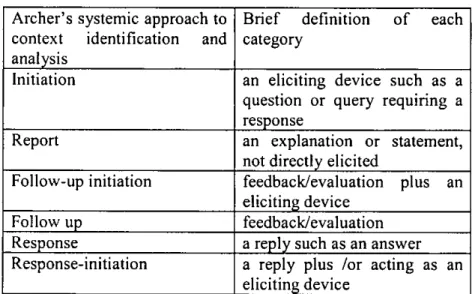
A similar system to Sinclair and Coulthard's has been devised by Archer (2005) to study discourse taking place in the courtroom. Archer's systemic approach to context identification and analysis classifies questions and answers according to their form, function and interactional intent, for instance who was the question directed towards, in what context and in what form, e.g. whether it was a request, an inquiry or a query. This level of detail potentially allows for more specific distinctions to be made, for example, were pupils engaged in the questioning process as questioners or as respondents or both? Archer's linguistic-based system contains the category of "Response-initiation" (Stenstrom, cited in Archer, 2005: 122-125) and this precisely relates to the instances when pupils respond to a question or instruction and then pose their own question or query for example. Archer's (2005) system relates to the speaker and hearer at the utterance level. As such, we can distinguish elicitations (e.g. questions, requests) and responses that are used by teachers and elicitations that are used by pupils to be categorised and counted. That is, Archer's system contains the "Interactional Intent" fields (Archer, 2005: 121) which categorise the organisation of talk. Using Archer's categories as a model (see below), I have added two categories which are compatible with classroom talk, in order to assist in the gathering of further applicable data. These categories are,
(I) "Re-initiate" categorises instances when appropriate responses were not forthcoming perhaps due to reinforcement of skills being required and so necessitated a change in the approach to questioning for example
(2) "Re-word" categorises occasions when the same intention was worded in a variety of ways in order to extend to differing ability levels.
Table I shows Archer's categories of Interactional Intent for use during analysis. Table I Categories of Interactional Intent
Archer's systemic approach to Brief definition of each context identification and category
analysis
Initiation an eliciting device such as a
question or query requiring a response
Report an explanation or statement,
not directly elicited
Follow-up initiation feedback/evaluation plus an
eliciting device
Follow up feedback/evaluation
Response a reply such as an answer
Response-initiation a reply plus br acting as an
Archer's "Interactional Intent" terminology already captures interactivity and participation e.g. "Initiation", "Response", "Follow-up", but I am particularly interested in using the system to determine engagement. I believe that the category of "Response-initiation" can provide an important indication or feature of engagement. This is because it may signal that a pupil is not only listening to their peer's method of calculation, but also considering or analysing it in order to query or question it or occasionally to advise or make a request. Such an occasion may be when a pupil is disputing the reasoning behind a method or because they require more information.
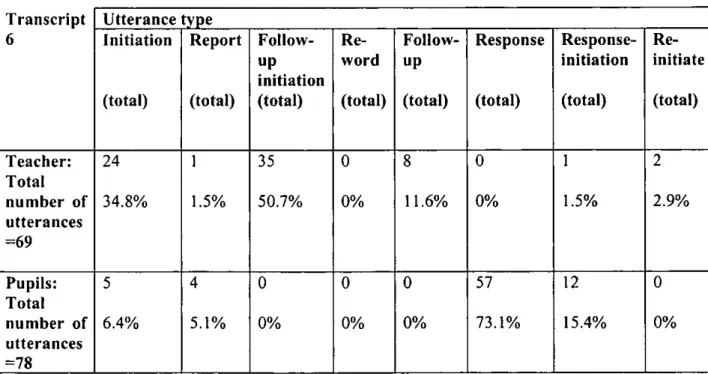
Each transcript is then examined by initially assigning each teacher and pupil utterance a categorisation symbol e.g. IN! (initiation), or RES (response). Totals for each category of teacher and pupil utterance are recorded and the data analysed (see Appendix 2).
Both of these systems highlight the nature of interaction between the teacher, pupils and their peers, and the data serves to indicate the dominance of certain forms of discourse, for example the teacher as the chief questioner or evaluator, or the pupils as active participants in the questioning process.
A third system of analysis to be utilised, is based on levels of thinking skills rather than discoursal analysis. I believe that engaged pupils demonstrate a range of thinking skills that involve explanations, interpretations and comparisons for example. When pupils respond to or ask questions, evaluate methods or query calculations, I reason that they are using a range of thinking skills which can be identified and categorised. I feel that Bloom's Taxonomy (1956) is a valuable tool for assisting my analysis because it focuses on the categorisation of thinking skills. Following categorisation, it may be apparent which level of skills are being used and to what extent. If pupils offered questions and comparisons for instance, I would suggest that they are actively engaged in the learning process. Alternatively, if they generally respond to teacher questioning with simple recall responses, then I would suggest that they are "participating" rather than "engaging".
The system is considered to be a useful tool for teachers because it enables them to identify learning goals that are disproportionately represented during a lesson; for example, asking the listener to recall facts, but rarely using question types that require interpretation of results. QCA cited Bloom's taxonomy of Educational Objectives (1956) in their web-page KS2: Mathematics optional tasks for the more able (QCA, 2006) and provided examples of questions based on Bloom's categorisation system, which could be used to develop higher thinking skills. The system is also used when planning assessments in order to encourage pupils to use the full range of thinking skills when answering questions. However, in theory, certain categories have proved difficult to understand or place in context, perhaps due to the taxonomy dating from the 1950's. Based on Bloom's Taxonomy, I have produced a simplified list of categories of thinking skills (see Appendix 3). For instance, instead of dividing the skill of knowledge into nine sub-sections as Bloom did, I have simply categorised the skill as "remembering". In this way, I feel able to analyse the data in simpler terms.
It has been observed that Bloom's taxonomy does not provide a good fit with mathematics. Analysis and synthesis are often done together and those, together with evaluation, are often used in application. So we reorganize these tasks, adding a bit of our own, for a better fit (Buxkemper and Hartfiel, 2003: 2).
I agree that it may be difficult to distinguish between thinking skills which, by necessity, may be combined in order to tackle problem-solving questions for instance. Unfortunately, Buxkemper and I-Iartfiel do not elaborate any further, but they do provide a useful summary of the Taxonomy:
(I) Knowledge—a student should be able to recall and recognise material from memory.
(2) Comprehension—a student should be able to give literal meanings of material.
(3) Application—a student should be able to apply general material to new situations.
(4) Analysis—a student should be able to break down material, identify significant pieces and their interrelationships to see how the pieces fit to form a whole.
(5) Synthesis—a student should be able to put material together in order to create new material.
(6) Evaluations—using a sense of the whole, a student should be able to make judgements about what is important and what is efficient.
The levels of thinking skills are hierarchical in nature and simpler behaviours form part of more difficult behaviours.
I use two methods of analysis utilising Bloom's Taxonomy. The initial analysis is qualitative and provides an overview of thinking skills used by the teacher and pupils during each weekly session of problem-solving. This initial method is followed by a more detailed examination of the transcripts using the major elements of Bloom's
categorisation system. From this data I make a qualitative analysis combined with a quantitative interpretation.
Each transcript of the taped Numeracy problem-solving lessons is analysed for examples or evidence of thinking skills and forms of questioning. This initial method aids recognition of forms of pupil and teacher thinking and their associated interaction. A framework based on Bloom's Taxonomy of thinking skills has been produced and is divided into two main sections: teacher as a model (e.g. providing questions that should lead to a variety of thinking skills being employed by the pupils) and pupil as an active participant (also demonstrating a variety of thinking skills). The sections are sub-divided into questioning style, skills and form of interaction (see Appendix 3). Examples of skills are matched to categories from Bloom's Taxonomy. For example:
Skill of remembering: did teacher make a summary? Did teacher show a mathematical procedure (working out)?
Skill of application: did pupil solve problems using required skills? Did pupil give reasons for their conclusion (I think this because ... )?
It is envisaged that Sinclair and Coulthard's system, together with Archer's system, may indicate the nature of interaction taking place, and Bloom's Taxonomy may demonstrate the thinking skills being used at the time.
Another analysis system familiar to educationalists is Flanders Interaction Analysis Categories (FIAC). Indeed Croll (1986) cites FIAC as the most recognised systemic observation system. This system contrasts with the former systems, mainly because it involves a method of coding which classifies interactions between teacher and pupils. Interestingly, one category encompasses, "Talk by pupils which they initiate... freedom to develop opinions and a line of thought, like asking thoughtful questions...(Croll, 1986: 40).
This is of interest because unlike Sinclair and Coulthard's system and unlike certain DIES and QCA literature, there is an assumption being made that pupils are likely to pose "thoughtful" questions rather than administrative questions. Importantly, Croll
highlighted that it was possible to note trends, for example the "two-thirds" rule which demonstrated that two-thirds of classroom-talk was dominated by the teacher. This system offers a potentially valuable method of categorisation, but due to time constraints, it is not used during this study.
I intend to analyse the data using both qualitative and quantitative methods involving observation and three data analysis models (Sinclair and Coulthard, Archer and Bloom). Observation aims to provide an initial, general and qualitative overview of each session. This includes noting potentially relevant points, such as, when are pupils enthusiastic or willing to voluntarily contribute points to the discussion, and who possesses the dominant "voice" throughout the discourse: teacher or pupils? The data resulting from the application of systems of categorisation is largely quantitative. It is hoped that one, some or a combination of categorisation systems produces findings that indicate occasions when pupils are engaged in the questioning process. In other words, data analysis aims to highlight which are the most effective methods for engaging pupils.
The following chapters explore the data using systems of analysis: Chapter 4: Sinclair and Coulthard
Chapter 5: Archer Chapter 6: Bloom
CHAPTER 4 APPLICATION OF AND FINDINGS FROM SINCLAIR AND COULTHARD'S SYSTEM OF DISCOURSE ANALYSIS
In order to determine the nature of interaction taking place between teacher and pupils during Numeracy problem-solving sessions, I chose to utilise Sinclair and Coulthard's system of discourse analysis (1975). The application of their system is discussed in this chapter, along with findings.
4.1 Application of Sinclair and Coulthard's system of discourse analysis
I used Sinclair and Coulthard's terminology regarding the categorisation of acts, as these indicate interaction between pupils and teacher. That is to say, interaction could have taken various forms, including teacher as initiator of questions and pupil as respondent or perhaps as nominator of the next participant in the discussion and as initiator of questions. I determined that certain acts or categories indicated elements of active participation or engagement. For example, if pupils were asking their own questions (elicitation) or providing feedback (evaluate) then the likelihood was that they were motivated sufficiently to actively contribute to the discussion rather than by simply answering. Also, I limited my application of Sinclair and Coulthard's analysis system to the lowest level of discourse, e.g. acts, rather than attempting to apply their whole system of analysis. This was because the system is so fine-grained, it would be difficult to quantify data in a way that suggested meaningful results.
I examined each transcript according to my understanding of Sinclair and Coulthard's categories. I have produced a simplified list of definitions to assist my categorisation decisions. (Appendix 4) I annotated each turn taken by a pupil or teacher with a set of acts. For example, the following extract from transcript 2 (see Appendix 12: 203) demonstrates the IRF form of interaction recognised by Sinclair and Coulthard,
Teacher: C. how did you work it out then? (n, el) Pupil: I did 5 times £1.50 and then 4 times 50 (rep)
It can be seen that the teacher initiated a question (nomination and elicitation), which was followed by a pupil response (reply) and ended with teacher-led feedback (evaluate). This process of categorising turns was continued for each whole-class session of each transcri pill esson.
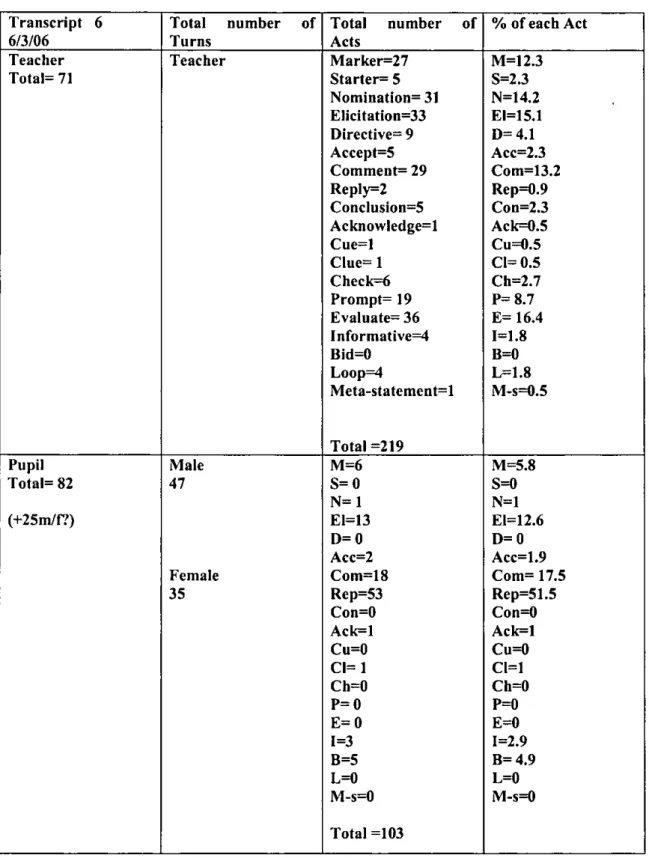
I counted the total number of each act which took place during each session. Totals of acts were calculated according to gender and role (teacher or pupil) because this served to identify an emphasis or under-emphasis of those acts which indicate participation or engagement; for instance, reply (Rep), elicitation (El), comment (Com), evaluation (E). Table 2 "Data showing teacher and pupil acts from Transcript 6" shows an example of a table of data from lesson 6. Nineteen categories of acts have been utilised for both teacher and pupils, including those which indicate participation or engagement. The table also shows the percentages of acts within each turn. Similarly, I counted acts according to gender in order to ascertain whether engaged pupils were generally male or female. (However, at this point it is important to reiterate that pupils had various preferred learning styles and, although engaged, they may not have overtly appeared to demonstrate all the elements of engaged behaviour. For the purposes of this study, the learning styles were valued but only overt engagement has been identified). Appendix 5 contains data tables for each transcribed lesson and the symbols are explained in Appendix 4.
Clustered column charts and scatter charts were created from the data because they allowed the comparison of values across different categories. The reader will encounter these forms of graph in the Findings section 4.2 (nb the form was chosen according to its visual impact). It is important to note that there are varied maximum percentage levels for each chart (y axis) and the transcripts are numbered in chronological order (x axis). Also, regarding reliability of data, it was necessary to take into account that, due to the nature of Sinclair and Coulthard's fine-grained system, there were several acts per turn, so for example there could be 38 teacher turns in one session, with 195 corresponding acts. Finally, I had aimed to indicate the total number of turns taken by pupils by gender and by the teacher. Unfortunately, due to the similarity in the nature of certain pupil voices, a number of pupil turns were unable to be assigned as being either male or female voices (md?). This ranged from an additional 0.1% to 64%.
Table 2 Data showing teacher and pupil acts from Transcript 6 Transcript 6 613/06 Total number of Turns Total number of Acts % of each Act
Teacher Teacher Marker=27 M12.3
Total= 71 Starter 5 S=2.3 Nomination 31 N14.2 Elicitation=33 E115.1 Directive 9 0=4.1 Accepts Acc=2.3 Comment= 29 Com13.2 Replr2 Rep=0.9 Conclusion5 Con2.3 Acknowledgel Acle0.5 Cuel Cu0.5 Clue= 1 Cl 0.5 Check=6 Ch=2.7 Prompt= 19 P= 8.7 Evaluate= 36 E= 16.4 tnformative=4 1=1.8 Bid=0 B=0 Loop=4 L=4.8 Meta-statementl M-s0.5 Total =219 Pupil Male M=6 M5.8 Total= 82 47 S= 0 S0 N=1 N=1 (+25m1f?) E113 E112.6 9=0 0=0 Acc2 Acc1.9
Female Com18 Com= 17.5
35 Rep53 Rep51.5 ConO ConO Ackl Ackl Cu0 Cu0 CI= I Cl=I Ch=0 Ch=0 P=0 P=0 E=0 E=0 1=3 1=2.9 B=5 B= 4.9 L=O L=0 M-s0 M-s0 Total =103
charts. Indeed, this difficulty highlighted why video recording would have been beneficial, however, the class teacher preferred the use of audio to video recording.
The charts were interpreted by searching for patterns and significant changes over time and the findings are described in the next section.
4.2 Findings
I employed elements of Sinclair and Coulthard's system of discourse analysis and scrutinised the resulting percentages of pupil and teacher acts. I focused on those acts which I felt were indicators of interaction and possibly could be interpreted as indicators of engagement. For example, I am interested in the nature of pupil participation and so I examined acts which indicated interaction e.g. elicitation, reply, evaluation and comment. As a result of counting according to act and role (i.e. teacher, pupil) using Sinclair and Coulthard's system of discourse analysis, a certain amount of "counter-evidence" was exposed. That is, during whole-class sessions, there was evidence of:
I. Pupil initiated questions 2. Pupil initiated feedback 3. Pupil:pupil interaction
To be fair, the latter forms of interaction were not intended to be highlighted by Sinclair and Coulthard, mainly because their system was designed to examine teacher/pupil interaction. However, each finding was an indication of the nature of contemporary classroom interaction and these were seemingly contrary to the pattern of discourse recognised by Sinclair and Coulthard. For example, their system of discourse analysis categorise questions requiring a reply as "elicitations" and I recorded the following examples of pupil talk as "elicitations,"
How have you got 10 minus 3 equals 6? (Appendix 17: 249). How would you check your answer? (Appendix 17: 246).
Why did you do subtraction when you could have done adding? (Appendix 17: 246).
How did you change metres into kilometres? (Appendix 16: 241).
It is apparent that these pupil "elicitations" are similar to those expected from a teacher, e.g.
OK, so how would you go about working this out? (Appendix 14: 226). So how are you going to calculate it? (Appendix 15: 234).
Similarly, I categorised the following examples of feedback as "evaluation" acts (pupil category),
Well done! (Appendix 18: 253).
You've lost meD. (Appendix 18: 253).
D! D! Look at where it says 13 and it'll tell you! (Appendix 18: 254). That's a weird method. There's a lot easier way... (Appendix 17: 250).
Again, these evaluations or offers of feedback are from pupils yet appear to be teacher-initiated, e.g.
That's a good question (Appendix 16: 241).
OK so she's got 66 take away 43. That's a good way of doing it. (Appendix 14: 227).
It was necessary to refer back to the transcripts of the lessons in order to provide these word-for-word examples of acts, and findings indicated discourse that included questions ("elicitations") posed by pupils, plus occasional instances of evaluative comments ("evaluations") from pupils.
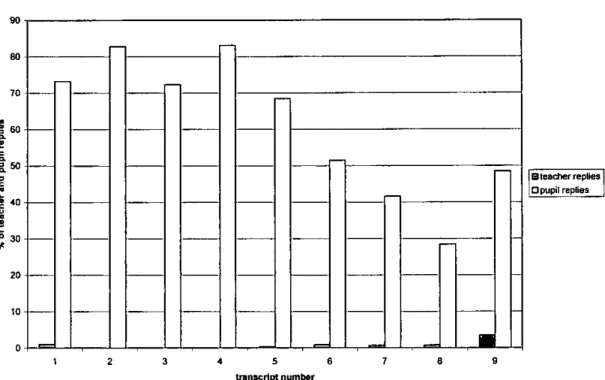
Regarding responses to "elicitations", the chart showing "Percentage of teacher and pupil replies" indicated that there were few teacher "replies" during the data-collection period. (see Figure 1)