Virtual Knowledge Communities for Distributed
Knowledge Management:
A Multi-Agent-Based Approach using JADE
@ @@ @ @@ @@ @@@@@@@@@@@@@@@@@@ @@ @@ @@ @@ @@ @@ @@ @@ @@ @@@ @ @ @ @@ Diplomarbeit von Marc Hammond
Betreuer: Prof. Dr. J. Calmet Betreuender Mitarbeiter: Dr. Pierre Maret Institut f¨ur Algorithmen und Kognitive Systeme
Universit¨at Karlsruhe (TH) SS 2004
Abstract
Virtual communities are becoming increasingly popular, particularly on the internet, as a means for like-minded individuals to meet, share and gain access to the information they are most interested in quickly and efficiently, from other individuals they can learn to trust. The concept of a commu-nity of practice or a commucommu-nity of interest can be supported in a virtual community in order to bring the appropriate parties together, to share their knowledge with each other. In this project, the most general model for modelling distributed knowledge management is investigated, that involves extending the abstraction of an agent, such that it becomes an actor within a knowledge community. In this model, agents themselves, software or human, are the members of the virtual knowledge sharing communities. Agents can choose to join, leave, create and destroy communities, and can be member of many communities simultaneously. A Jade-based prototype design and implementation are used to show how such a system can operate and be useful in practice.
Project Website
There is also a website for the project where the prototype system can be obtained, together with this report, the user guide, and some examples. This can be found here:
Contents
1 Introduction . . . 2
2 Background . . . 3
2.1 Motivation . . . 3
2.2 Related Works . . . 4
2.2.1 Centralised Knowledge Management . . . 4
2.2.2 Distributed Knowledge Management . . . 4
2.2.3 Virtual Communities . . . 6
2.2.4 Societies of Agents . . . 6
2.2.5 The Role of Agents in Knowledge Management 7 3 The approach taken to Knowledge Management using Virtual Knowledge Communities . . . 8
3.1 The ’Community of Communities’ . . . 8
3.2 Agent Modelling . . . 8
3.3 Community modelling . . . 10
3.4 Agent Policies Regarding Community Life Cycle . . . 11
4 Prototype System . . . 13
4.1 Aims the System . . . 13
4.2 JADE . . . 14
4.3 Description of System . . . 15
4.4 Design of the System . . . 17
4.4.1 JAVA Classes . . . 17
4.4.2 Agent Communications . . . 22
4.4.3 Agent Behaviours . . . 24
4.5 Implementation of the System . . . 30
4.6 Using the System . . . 31
5 Evaluation . . . 32
5.1 Example Use Case Showing Strengths of the System . 34 6 Conclusions and Future Works . . . 37
1
Introduction
The objective of this project is to investigate an agent based abstraction approach to distributed knowledge management called virtual knowledge communities, and to present a prototype implementation of the approach using JADE (Java Agent Development Framework) [4]. This paper begins by presenting the background to the project in Section 2. This explains why the research being conducted is important and useful, and introduces some of the concepts used in the project. State of the art projects, research and related work already done in the domain of distributed knowledge manage-ment have been researched and are also summarised in this section. Having studied and evaluated the existing work done in this field, the multi-agent-system based approach to virtual knowledge communities is presented. This approach was conceived, by taking the strengths of other approaches and applying them to the most appropriate abstraction for distributed knowl-edge sharing in open systems. The approach is presented in Section 4. Next, a sample implementation that demonstrates how the approach can be put in to practice is presented in detail in Section 5. The implementation is then evaluated in Section 6 with regard to other knowledge management approaches, and conclusions are presented in Section 7.
2
Background
2.1 MotivationThe inception and popularisation of the internet has taken the informa-tion age to a new level of complexity. The informainforma-tion society now has so much information at its disposal that it is more important than ever to find effective techniques for managing the optimal distribution of this information, such that individuals are not overwhelmed with meaningless data. Knowledge exchange, knowledge brokering and knowledge reuse are of critical importance within the knowledge information society [1].
The objectives of knowledge management are well known; to improve the re-use of the knowledge within the processes of a system, by reducing the distance between tasks and generalised knowledge bases, and increasing ac-cessibility to resources [1]. In recent years many organisations have adopted knowledge management techniques that focus on building large, expensive, centralized knowledge management systems based on the standardisation of the syntactical and semantic representations of all of the knowledge in the organisation. Support is then provided for tools that facilitate access and use of this knowledge by different users of the system. There is both practical and theoretical evidence to suggest that this approach to sharing knowledge is inappropriate, as the centralisation and standardisation of the knowledge removes much of the vital contextual information that inherently comes with knowledge from different sources [2].
Modern knowledge management, on the societal level, often focuses on the constitution of communities of practice and communities of interest [1]. This is particularly important in a large, heterogeneous system such as a company or the internet, where the ’global’ community is too large to be use-ful as a single entity, without the formation of such smaller sub-communities that are composed of individuals with some common agenda.
The fact that the internet is itself a dynamic, open system, that is com-posed of distributed heterogeneous entities, who can both conflict and co-operate with each other but have no necessary central locus of control, makes the multi-agent system paradigm a convenient and natural abstraction for designing internet-based systems. This is also true of almost all corporate systems, in which knowledge needs to be shared. Actors within a society such as a company are both individuals and software systems, which can be generally abstracted as agents. Agents are themselves autonomous, and can be used to model human as well as automata behaviour, a requirement for modelling and engineering complex articulated systems.
Moreover, it is increasingly hard to explicitly define the role of the human and that of the software system in areas such as e-business task processing. An increasing amount of software is concerned with task and knowledge processing, and it is becoming increasingly common for programs to
inter-act and trade knowledge with each other without the direct influence of human control. Knowledge is no longer external to an agent’s processes; it is part of the ”agent’s world”, and knowledge management can be seen as ”result sharing” between agents. Agents possess knowledge and processes within the organization tend to make agents produce and exchange knowl-edge with each other. Result sharing is generally considered as a sub-part of the ”Distributed Problem Solving” area [3]. From the perspective of corpo-rate knowledge management, agents coopecorpo-rate to resolve a unique high-level problem, namely the success of a company.
There are numerous strategies for achieving this goal, thus agents may have no common explicit goal. In the context of this project, agents are considered to have the ability to process their own tasks or solve problems, which could gain in productivity, time or quality by importing knowledge from other agents. The aim of the project is to formulate an approach that enables agents to do this effectively without being forced to make concessions with regard to their own autonomy or corrupt the knowledge they have by imposing a standard ’view of the world’ upon them.
2.2 Related Works
2.2.1 Centralised Knowledge Management
Most approaches to knowledge management - even when based on MAS - remain predominantly founded on centralization and objectivity. Exam-ples of such systems are numerous, for instance [12] and [9]. However, this approach appears incompatible with the very nature of knowledge.
Bonifacio [5] criticises most current knowledge management systems, in which ”all perspectival aspects of knowledge should be eliminated in favor of an objective and general representation of knowledge”. It is argued that many traditional knowledge management systems are deserted by their users due to the ”false epistemological and organisational assumptions made dur-ing the design of the systems”. This is unacceptable in a modern knowledge sharing environment.
2.2.2 Distributed Knowledge Management
Kornfeld [13] claimed years ago that diversity and concurrency of (scientific) communities are essential to their progress. The same argument can be applied to any community in which knowledge is the currency.
Distributed Knowledge Management is presented in [2], emphasising the value of autonomy and coordination within an approach the authors have called Distributed Knowledge Management. It is based upon two fundamen-tal principles; the Principle of Autonomy, which states that each organisa-tional unit should be granted a high degree of autonomy, and in particular semantic autonomy, to manage its local knowledge and conceptualisations,
The ’Knowledge Node’ approach
The approach taken in this paper
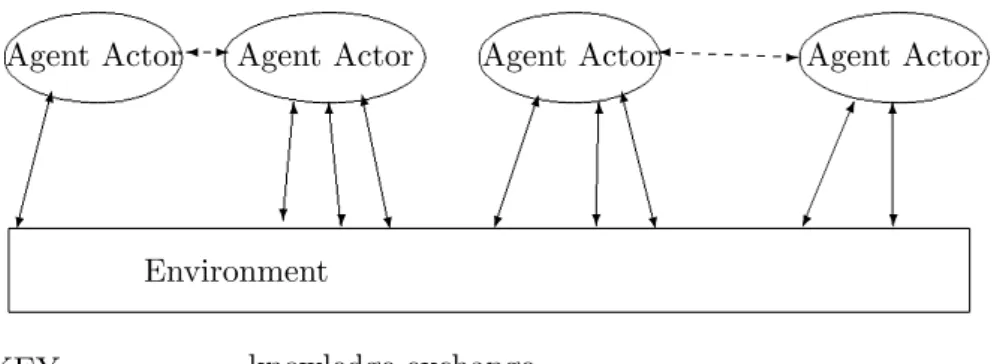
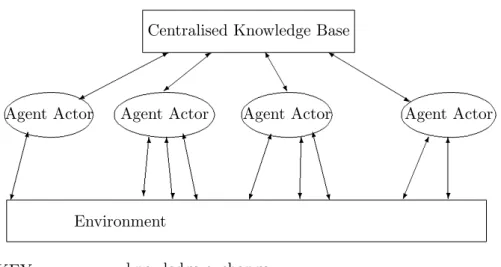
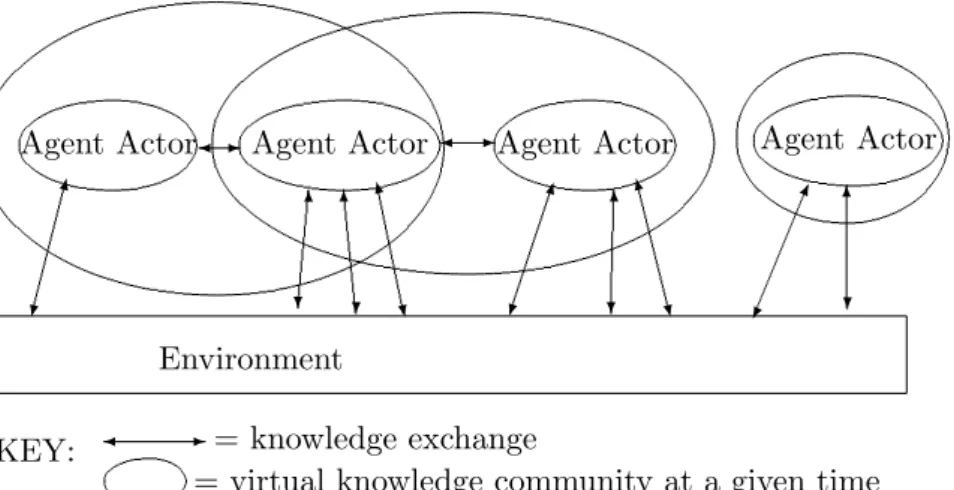
KEY: = agent = organisational unit
Figure 1: A comparison of the view of ’organisational units’ in the approach taken in this paper and the knowledge nodes approach described in [2].
and the Principle of Coordination, which states that each unit must be en-abled to exchange knowledge with other units, without imposing the adop-tion of a single, common interpretative schema, but by using a method of mapping other unit’s context onto its context from its own perspective.
AKnowledge Node (KN) is then presented as a means for obeying these principles and is defined as a reified organisational unit which exhibits some degree of semantic autonomy. Each KN has its own explicit representation of its reified perspective of a community called a context. This can be a category system, an ontology, a collection of guidelines, or a business process. Each KN also has a software agent associated to it, which knows the KN’s context. The agents act as a go-between between the KN and other KN’s, by supporting users of a KN to compose outgoing queries, and answering incoming queries from other KN’s.
The principle of autonomy is supported in this project, but it is felt that the principle is so strong that the idea of using Knowledge Nodes is not sufficient. The ’organisational unit’ mentioned in the above principle should go right the way down to the level of the agents themselves. Since every single agent, even those in the same community, needs its own autonomy in order to model an organisation and its individuals correctly, then this is the natural model for an agent based knowledge sharing system. With this model, agents can choose to join, leave, create and destroy communities, and can be member of many communities simultaneously. This is the most general model of a fully autonomous system, and the difference between this model and that proposed in [2] is portrayed in Fig1.
2.2.3 Virtual Communities
Virtual communities are becoming increasingly popular, particularly on the internet, as a means for like-minded individuals to meet, share and gain access to the information they are most interested in quickly and efficiently, from other individuals they can learn to trust. An example of a system that implements such a community can be found in [6]. The concept of a community of practice or a community of interest ([2] and [6]) can be supported in a virtual community in order to bring the appropriate parties together, to share their knowledge with each other. An advantage of this is that the members of a community centred on one specific topic or practice will only be presented with knowledge from domains they are, or at least are relatively likely to be, interested in, and this knowledge need not be something they have specifically asked/searched for. Sometimes a piece of information may be of interest to an agent, although it didn’t know that it was looking for it. While many virtual communities already exist on the internet to aid knowledge sharing, many of which use ’agents’ in various forms as part of the system, we propose a model that extends the abstraction of an agent, such that it becomes an actor within the system. In other words, in our model, agents themselves, software or human, are the members of the virtual knowledge sharing communities.
2.2.4 Societies of Agents
Within multi-agent societies a balanced articulation must be found between organizational control and autonomous social behavior of agents. Brad-shaw proposes a framework to specify, manage and enforce agent behavior using DAML-based policies [15]. Exploring security issues inside an open organisation, Omicini ([16]) claims for a systemic vision of MAS, explicitly accounting for social issues (social intelligence) as opposed to focusing on individual agent’s intelligence.
Calmet presents the Liberal Approach to openness in societies of agents in [7]. This approach is based on Max Weber’s ideas ([14]), that the be-haviour of the society is the result of the individual actions of the agents. The paper states that ”the goals of a multiagent system are the results of specific goals of the constituting agents which are closely tied to the design decision adopted when defining the architecture of the system”. The work undertaken in this project fully subscribes to this view of achieving goals within the system, because, as already argued above, the agents within any knowledge sharing corporation will not naturally subscribe to a centralized model of control and standardization. Therefore the most general model that can be applied to the problem of corporate knowledge sharing is one in which each agent has full decision making autonomy and his own perspec-tive of the world, within some sensible general laws and boundaries, which
can be imposed for reasons such as security of the overall system.
2.2.5 The Role of Agents in Knowledge Management
There are two general perspectives of the roles of agents in knowledge man-agement [8]. The first is that agents implement the functionality of the system, as, for example, in [9]. The other is that agents are used to model the organisational environment in which Knowledge management will oper-ate. The approach presented in this project is perhaps closer to this second perspective; however we opine that choosing the correct approach for mod-elling the real world is the best way of designing a system that will work well in practice. In other words, although we are modelling an organisational en-vironment with agents, the agents in this model can also be used to create a fully functional system, for example, one in which agents play the part of a personal assistant, which searches for data on behalf of its human owner.
3
The approach taken to Knowledge Management
using Virtual Knowledge Communities
Having analysed the existing body of work in the area, we propose an au-tonomous multi agent system based on the virtual knowledge community abstraction, which adheres to the liberal approach to societies of agents.
3.1 The ’Community of Communities’
A community is a place where agents can meet and share knowledge with other agents who share a similar domain of interest. We propose a ’com-munity of communities’ of which all agents are a member, and within this global community, communities can be created and destroyed dynamically by agents, as and when necessary.
As with any such open system, consisting of distributed individuals with different views of the world, we have the problem of knowledge heterogeneity. This is encapsulated by the buyer seller paradigm in [10]. There needs to be a way to overcome this problem so that agents can communicate and share ideas about topics, and understand what each other mean when they use concepts to describe these ideas. There have been some developments in solving this problem, in [11] and [10], but this problem is considered outside of the scope of this project.
In order to address this problem we assume that, even if agents are fully free to maintain and keep their own ontological view of the world, we have a set ofnormalised ontologies, which all agents agree upon and can reference when creating communities. Here, an ontology is a taxonomical specifica-tion of all the classes of objects and predicates that an agent understands. It is used to give meaning to instances of the objects and predicates de-scribed within it, that an agent may encounter. Thus, other agents can understand what the domain of a community it in the context of this nor-malised ontology. It is important to note that an agent’s personal knowledge is not constrained to solely contain concepts from the normalised ontology. If this were the case, the virtual knowledge communities approach would be conceptually no more powerful than a centralised one.
The community of communities maintains a central directory of all com-munities, which agents can use to find out about existing communities they may wish to join. All agents in the organisation have access to this directory.
3.2 Agent Modelling
In the perspective of this project, agents are active objects with the ability to perceive, to reason and to act. In addition, it is assumed that agents have explicit knowledge representation and communication ability [17].
Participation in knowledge communities does not replace the intrinsic ac-tivity of agents for which they were introduced to the agent society. Thus, agents follow two goals: their intrinsic goal, which they may operate with-out the community help, and knowledge acquisition goal, which is processed, proactively or reactively, for improving intrinsic activity. This project con-siders only the knowledge acquisition component of an agent, but respects the fact that that is not the only goal of the agent.
We have four key notions for our agent modelling approach: personal ontology, knowledge instances, knowledge cluster and mapper. These are explained hereafter.
The knowledge of an agent is represented in the vocabulary of itspersonal ontology, which describes the taxonomical relationships between classes of concepts and predicates it understands. Knowledge instances are instance of objects defined into the personal ontology. We assume that an agent’s knowledge consists of both its personal ontology and knowledge instances of objects in its personal ontology.
Under this assumption, an agent’s knowledge varies from agents to agent, which is fully compliant with individuals’ knowledge. Moreover, while pro-cessing tasks, agents use, produce and acquire knowledge. Thus, knowledge can not be uniquely considered at design time (inherent knowledge). So, we assume that agent’s knowledge evolves during the agent’s life. These as-sumptions are trivial regarding knowledge instances, but they are not trivial regarding its personal ontology.
In order to maintain an evolving personal ontology, and share its knowl-edge with other agents an agent must have a means of adding and taking concepts and predicates to and from its personal ontology. In order to do this we introduce the concept of a knowledge cluster to define a sub-part of an ontology, in other words a ’piece’ of knowledge, that can be shared between agents.
A knowledge cluster is defined by its head concept. It contains the head concept itself, all sub-concepts of the head concept, and all concepts that are the types of attributes of the head concept and its sub-concepts. It also includes all predicates that only take arguments whose types are one of the concepts in the knowledge cluster.
Basic operators on knowledge clusters can be defined. Knowledge clus-ters can be added together, compared for equality and extracted from other knowledge clusters as sub clusters defined by a head concept. The overlap between two knowledge clusters can also be found.
The personal ontology of an agent can also be represented by a knowledge cluster, without a defined head, but instead containing all concepts and predicates known to the agent. Using this fact and the basic operators on knowledge clusters, we are able to extract knowledge cluster from the personal ontology of an agent in order to share it with another agent, and add knowledge for personal use.
While accessing knowledge of a community, an agent can choose to add a knowledge cluster to its own ontology and then use it for ”private” purposes. Contributions to the community are similarly related to the community’s cluster: the agent extracts a cluster from its ontology and send it to the community.
The only barrier to this sharing of knowledge is the heterogeneity of knowledge mentioned above. Therefore, for each community that an agent is a part of, the agent must maintain a set of mappings from its own personal ontology concepts and predicates to those it encounters within the commu-nity. This includes the maintenance of mappings from its personal ontology concepts and predicates to those in the normalised ontology. In order to do this we introduce the concept of amapper.
The mapper simply contains a set of mappings from personal terms to a mapped terms, and allows an agent to add such mappings, and use the mapper to normalise or personalise a given knowledge cluster or knowledge instance using these mappings. An agent will maintain one mapper for each community it is a member of, and mappings can be added as the agent sees fit. Once a mapping is added to the mapper, this mapping will always be used when normalising or personalising a knowledge cluster or a knowledge instance. Note that mappings to normalised ontology concepts and predicates can exist outside of a community, and span more than one community. Therefore, any mappings to normalised ontologies are stored by the agent outside the context of any community. They are, if you like, the agent’s global mappings for a given normalised ontology.
3.3 Community modelling
Each virtual knowledge community has adomain of interest, which is sim-ilar to the concept of ontology for an agent. We will consider this domain of a knowledge community as a knowledge cluster, which is given by the community leader who created the community. The leader of a community is an agent who controls knowledge exchanges within the community, and has power to destroy the community. There can be more than one leader of each community. Other agents can become the leader of a community if the current agent wishes to leave the community, or if the current leader is too busy and an extra leader is needed.
The community pack is what defines the community. It consists of a community knowledge cluster, a normalised ontology which contains at least the head of the community cluster, and the identification of the leaders of the community. It is created when the community is created, and lasts for the lifetime of a community.
In order to share knowledge within a community, a blackboard based sys-tem was considered. Blackboards are repositories for storing agents’ multiple intermediate results [3]. Our goal is compatible with blackboard systems.
However, our aim is not to generate a huge central knowledge base, which would be unpractical. We prefer the use of a buffer system where messages are stored and then deleted. The oldest, lowest priority message is deleted first. In addition, blackboard architectures are generally used for agents cooperating to solve a problem. Our perspective is different because we do not consider a unique system goal: agents cooperate to solve their respective problem.
Thus, knowledge is shared by the members of a community using mes-sages that are written to thecommunity buffer. Messages are stored here and can be read by other members of the community. This ensures that agents do not need to know which other agents are members of the community, but can still access knowledge in the community, and themselves choose whether it is interesting or not. This is a fully autonomous approach, in which the individual actors in the system have the power to decide if the knowledge is interesting to them or not, as opposed to the large centralised approach where such decisions are imposed from above.
In general terms, each community must have a policy for specifying who is able to join the community, whether or not agents within the community have roles, and what these roles should be and mean, and whether or not there are any additional rules corresponding to how much, or how often an agent must contribute to a community. The leader of the community is in charge of enforcing these policies within the community.
Since the communities in our system are based on the liberal approach to a society, what actually defines a community is contained within the con-stituent agents that make up that community. Moreover, all communities are created by agents themselves, so any general policies for a given com-munity are also chosen by the individual agent who creates the comcom-munity. Every agent can be in any number of communities at any one time. An agent may be interested in a community when the intersection between the community’s cluster and its own ontology is not empty. In order to find this intersection, the agent will use the mappings it maintains between its personal ontology, and those of the normalised ontology of the community, in order to find an overlap between its own personal ontology and the domain knowledge cluster of the community.
3.4 Agent Policies Regarding Community Life Cycle
Agents create communities. Therefore agents need a policy specifying what are the circumstances in which they would choose to create a community are. Of course, this policy can be different for every agent, and can range from creating a community for every domain of interest the agent has, purely for the good of all, to creating communities purely because the agent needs to in order to get some knowledge on a given domain from other agents.
Again, each agent can have its own policy for joining communities and this can range from joining every community, whose domain of interest overlaps with the agents personal knowledge, to only joining communities in which the agent feels it can benefit, because it needs to get some knowledge from a given domain, and there already exists a community that concerns this domain of interest.
The circumstances in which an agent leaves a community also need to be defined. An agent could conceivably be forced out of a community, or choose to leave. The circumstances in which an agent would be forced out of a community are defined by the policies of the community that specify the minimum contribution of an agent, mentioned above. The circumstances in which an agent would choose to leave a community are of course down to the individual agent. Policies range from leaving as soon as the agent gets what it needs from a community or if the agent feels it is not benefiting from being in the community, to never leaving a community, unless forced to.
Finally a community can die for several reasons. Policies range from leaders killing the community once they have what they need from it, to communities being killed due to a lack of activity e.g. once everyone has left the community, or no messages being exchanged for a certain minimum time period.
All of these policies are policies of the individual agents, as both leaders and non-leaders. All of the policies mentioned range from totally selfish agents, who do everything for the good of themselves, to totally self-less agents, who do everything purely in the hope that it will help others, i.e. for the good of the group. Of course, an agent’s policy for any given action can fall in between these two extremes.
4
Prototype System
4.1 Aims the SystemThe aim of the prototype is to design and create a working system, in which agents with heterogeneous personal ontologies can create, destroy, leave and join communities in order to share knowledge clusters and instances with each other, as described in the previous section. The intention is just to get a system working, with two extreme different ’types’ of agents. The prototype system will prove that such a system can be built and how different types of agents can be implemented. It will also show how such a system can be useful, in that it will be a working system that does what it is meant to, namely allow the sharing of both heterogeneous knowledge clusters and instances in a distributed environment.
The prototype system is not intended as a final product. The user inter-face can be primitive, and not all feasible policies and agent decision making mechanisms will be implemented. Since this product forms a part of a re-search initiative, the emphasis is not on making a perfect product, rather, to create an initial version of something that shows it can work, and to put the data structures and classes in place, such that the implementation can be extended and developed further should the need and desire arise. The emphasis of the system is on the sharing of knowledge, the creation of map-pings between personal concepts and community/normalised concepts and to establish the mechanics with which agents can dynamically move between communities and update their personal knowledge.
All agent decision making processes that are not considered within the scope of the prototype will be implemented in the prototype by asking a human user to make a decision on the agent’s behalf. This is an appropriate model for decision making to take in light of the agent abstraction methods we are aiming at, as we have already stated that an agent in a system could in fact be a human anyway. The idea is that should an appropriate automated decision making process be devised for a certain type of agent in the future, the current human interaction can be replaced by the new decision making process in the implementation of the new type of agent.
So to summarise what is expected of a prototype we list the inputs to the system, the decisions we expect a human user to make on the agents behalf, and the results we can expect to observe.
We expect the prototype to allow the creation of multiple agents, po-tentially on different machines, each with a given personal ontology, given personal knowledge instances, a set of given normalised ontologies and a set of mappings for each normalised ontology as inputs. Each one of the sets of mappings details any mappings an agent already has from its personal ontol-ogy predicates and concepts to the normalised ones. The agents should be allowed to join and leave the system at any given time, in any given order.
The agents should not be hard-coded with any knowledge about existing communities to join (except for the global ’community of communities’) or other agents to communicate with. It should search for these things itself by using the community of communities.
We expect the user to be involved when an agent creates a new commu-nity. Here the user should specify which one of the normalised ontologies the agent should use to create this community. We also expect the user to be involved whenever the agent encounters a new concept that it does not already have a mapping for. Here the user is asked which concept to map it to, if any. Finally, we expect the user to be involved when adding goals to an agent (for goal driven agents) or when choosing which of its knowledge it should share (for altruistic agents). For all of these types of decisions, we could imagine an automated approach, but this is outside of the scope of the prototype implementation of the system described in this project.
The results of the system should take the form of a user readable inter-active output, showing the actions the agent is undertaking as it does them, so the user can analyse the behaviour of the agents. This is very useful, as the actions the agents take depend on other agents in the system as well as themselves, so the actions taken by an agent may be non predictable in advance.
Also, agents should update their personal ontology, personal knowl-edge instances and personal mappings when appropriate, and these changes should be output to some concrete representation of knowledge in a stan-dard format, that can be viewed and used by another human or software user.
4.2 JADE
JADE (Java Agent DEvelopment Framework), a Java based software de-velopment framework that fully conforms to FIPA standards for intelligent agents ([18]), was chosen to implement the prototype system. The fact that JADE conforms to all the appropriate FIPA standards and enables portable and easily maintainable agent development using the Java language, a lan-guage the author is very familiar with, makes it a perfect framework in which to develop a multi agent based system for knowledge management using vir-tual knowledge communities. Hereafter we detail the features of JADE that make it the ideal framework for developing the prototype system.
JADE allows the development of agents in java by simply extending, implementing using its collection of classes and interfaces, that provide a wide range of agent functionalities that are required to build a multi agent system. It also provides a FIPA compliant agent platform, upon which agents can be deployed. The platform can be split between several hosts, and provides an Agent Communication Channel (ACC) which controls all of the message exchanges within a platform, and to/from remote platforms.
This means JADE allows agents across distributed machines to be deployed into the same system and communicate with each other. This is one of the requirements of the prototype system.
Agents are created by simply extending the jade.core.Agent class. This makes the development of different kinds of agents very straightfor-ward, and all of the fundamental things that an agent needs at is disposal are available to the programmer.
Several abstract agent behaviour classes are provided, which can be extended to provide different behaviours for different types of agents as required. Basic behaviours already provided by JADE include cyclic be-haviours and one shot bebe-haviours. Composite bebe-haviours are also provided by JADE, with the scheduling of sub-behaviours handled differently depend-ing on which behaviour is used, for example the programmer can choose to implement parallel behaviours (scheduled in a round-robin fashion) or se-quential behaviours (scheduled sese-quentially), and add them to his agent class. This takes much of the complex consideration of how to handle the multi-tasking within one agent away from the programmer, and again, al-lows the programmer to focus on developing the behaviour it needs. This is ideal for the prototype system, as the different types of agents in the system need to have different types of behaviour, some of which are comprised of multiple behaviours.
Perhaps the most important aspect of JADE that makes it useful for the prototype system is its support for message passing and user defined ontologies. JADE provides the mechanisms for ACL Message passing as de-scribed by the FIPA specifications ([18]). It provides codecs and ontologies for converting java objects to and from the string representations that are sent in messages. All ACL Message performatives are provided, and the programmer can define his own ontologies, so everything is at the program-mer’s disposal to allow the filling the content of messages appropriately for sharing knowledge.
No other frameworks were seriously considered, as JADE provided ev-erything necessary in order to implement the prototype system required, and allowed the author to do the agent development in JAVA, which would always be the language of choice. Of course, the fact that JADE is an agent based platform, means it can be built and agents deployed on any platform, increasing the value of the prototype system, if it were ever to be developed further in to a finished product, particularly when one considers the em-phasis on openness and accessibility to all in the distributive system we are building.
4.3 Description of System
We have designed a prototype system that supports different ’types’ of agents and communities with different ’policies’, in order to enable us to
compare different types of policies and types of agents. We have only de-signed a system to demonstrate communities with the basic extreme policies, using two fundamental types of agents; the ’individualistic agent’ and the
’sociable agent’. However, the system could relatively easily be extended to support a larger range of policies for each agent.
We define four policies that define a community. TheMembership Policy
defines what type of agents can join the community. If a community has an individualistic approach, then only individualistic agents can join the community. If a community has a collective approach, then only sociable agents can join the community. If a community has a free policy, then any type of agent can join the community. The Regulation Policy defines whether or not we have roles within the community. If there are roles then theRole Policy defines the rules by which an agent obtains a ’better’ role.
The different roles that exists arecontributors, who can only send informs to the buffer,full members, who can send informs or requests to the buffer, and leaders, who can do the same as full members, but have additional special duties. One approach for the Role Policy is a reward approach based on quantity of knowledge submitted. In this approach an agent’s role is updated if they have sent enough contributions to the community. The alternative is a reward approach based on quality of knowledge submitted. This policy requires some form of feedback from the knowledge receiver. Finally, theContribution Policy of a community defines what the rules are for agents to be part of a community, in terms of minimum contributions. Either there is a minimum contribution per request for each agent, or a requirement for a regular contribution in terms of time.
It must be noted that agents themselves create communities, so all of these community policies are in fact community creation policies of the agent who created the community. For this reason, all agents have parameters specifying their community creation policies, as well as their individual agent policies. In our prototype implementation we say an agent can be either ’individualistic’ or ’sociable’. This defines in which situations an agent would create, destroy, join and leave a community. When an agent is created we specify the class of agent it is (either individualistic or sociable).
Anindividualistic agent instigates or joins a community because it needs knowledge from a certain domain, and will leave a community when it has got what it wants from the community or if it is not getting enough from it (e.g. it has been in the community too long with no benefit). An individu-alistic leader will kill a community once it has the knowledge it requires.
A sociable agent instigates a community purely because it has nothing else to do. The community will only die if everyone leaves the community (community must have had at least one additional member join and leave before this happens otherwise it would die as soon as it was created). So-ciable agents join every community that concern them (whose community cluster overlaps his own domain of knowledge) and never leave active
com-Jade.core.Agent
CommunityAgent
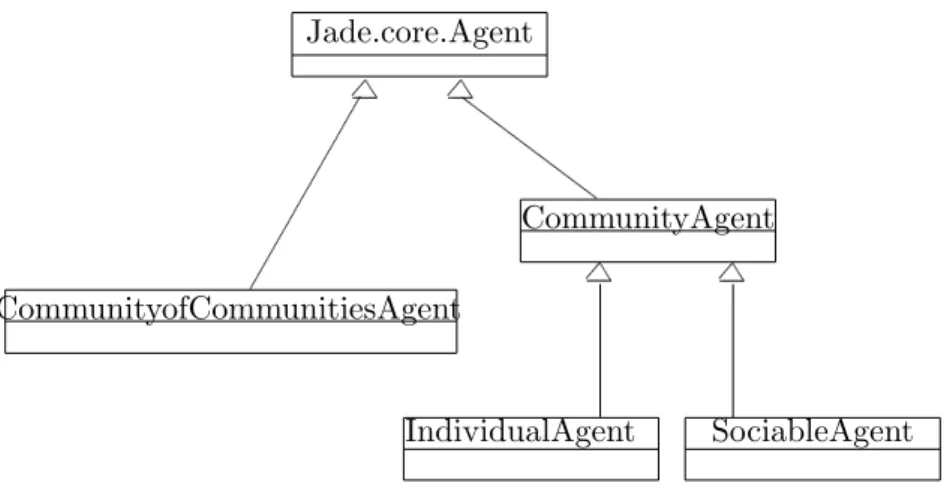
IndividualAgent SociableAgent CommunityofCommunitiesAgent
Figure 2: UML Class diagram showing the types of agent classes in the prototype multi agent virtual knowledge communities system.
munities where they may still be able to offer something.
4.4 Design of the System
4.4.1 JAVA Classes
All agents within the prototype system extend thejade.core.Agentclass. The different types of agent class in the system can be seen in Fig.2.
CommunityOfCommunitiesAgent TheCommunityOfCommunitiesAgent
class represents a special agent, that has been created for conveniance in this implementation. The motivation for this agent type is as follows. All agents within the system need to have acces to a sharedCommunityOfCommunities
class. The idea of creating of a static shared community of communities class, using the Singleton design pattern [20] immediately springs to mind. However, this approach would not work as agents are distributed objects, and each agent has its own memory space, so they would not be able to access the same static object. Therefore another approach is necessary. The approach taken here is designed to be as simple as possible, and is that we have aCommunityOfCommunitiesAgentthat simply holds a local copy of the latest version of theCommunityOfCommunitiesclass, via which other agents can access and update as and when necessary, by sending and receiving messages to it.
An alternative approach would be to use a data file accessible to all agents, but then we would have to handle issues of concurrent access, which are already taken care of by using an agent that holds the data item for us. It is not important that agents read the most up to date version of the
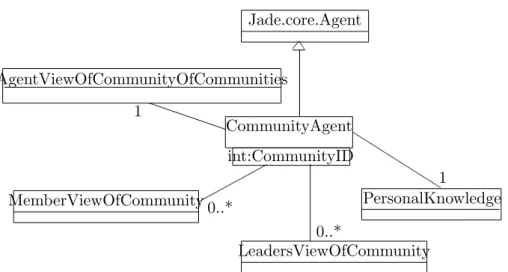
Jade.core.Agent LeadersViewOfCommunity AgentViewOfCommunityOfCommunities PersonalKnowledge MemberViewOfCommunity int:CommunityID CommunityAgent 1 0..* 0..* 1
Figure 3: UML Association diagram showing the classes that a Community Agent has access to.
CommunityOfCommunitiesobject, but it is important that any writes to this object (e.g. addition of new communities into the community of communi-ties, or the removal of communities from the community of communities), are performed independently and sequentially, ensuring that one change is not overwritten by another. Using the single CommunityOfCommunitiesAgent
to handle accesses to the object will ensure this.
CommunityAgent The CommunityAgent class is an abstract class that all different types of agents (except the specialCommunityOfCommunitiesAgent) must extend. In this design we propose two extensions of theCommunityAgent; theIndividualAgent, and the SocialAgent. These two different types of agent have different behaviours as will be detailed later.
The classes that theCommunityAgenthas access to can be seen in Fig.3.
AgentViewOfCommunityOfCommunities The
AgentViewOfCommunityOfCommunities class is an interface for the
CommunityAgent to access the CommunityOfCommunitiesobject indirectly. Every CommunityAgent has exactly one of these. All accesses and up-dates to the community of communities are done through this interface, which sends and receives messages to the CommunityOfCommunitiesAgent
on the CommunityAgent’s behalf. It is useful to encapsulate these accesses in this class, so that if, in any time in the future, it is decided to use a dif-ferent means of handling the global CommunityOfCommunities object, the
CommunityAgent class does not need to be changed. Instead, the methods in theAgentViewOfCommunityOfCommunitieswill just need to be changed.
Jade.content.onto.ontology PersonalKnowledge jade.content.abs.AbsContentElementList KnowledgeCluster absInstances 1 1 personalOntology KnowledgeClusterOntology
Figure 4: UML association diagram showing thePersonalKnowledgeclass.
PersonalKnowledge EachCommunityAgent also has exactly one
PersonalKnowledgeobject, representing it’s personal knowledge. The per-sonal knowledge of aCommunityAgentconsists of both it’s personal ontology and it’s personal knowledge instances. The PersonalKnowledge object is used by the CommunityAgent in all situations where it’s knowledge needs to be used or added to. It allows the agent to interpret new knowledge instances using the personal ontology of the agent, and provides methods to add knowledge clusters or knowledge instances to the personal knowledge of the agent, to extract knowledge clusters or knowledge instances from the personal knowledge of the agent, to check whether the agent already has a knowledge clusters or knowledge instances, and to get the overlap of the agent’s personal ontology and a given knowledge cluster. It also provides methods for importing and exporting the current personal ontology and personal instances to a data file, which was a requirement of the prototype system. The class diagram of thePersonalKnowledge class can be seen in Fig.4.
Figure 4 shows that the PersonalKnowledge class extends the
KnowledgeClusterOntologyClassclass, which is in turn extends the
jade.content.onto.Ontologyclass. This means that thePersonalKnowledge
class IS an ontology itself. The reason for this is that, in order to in-terpret knowledge instance messages, which contain content of the type
jade.content.abs.AbsContentElementList(as will be detailed later), the agent has to have an ontology that is able to comprehend such content. JADE provides a means to do this, with the use of the
jade.content.onto.Ontology class. This class, and classes that extend it, can be used, along with a codec, to convert the content of a message to/from a java object that an agent can use. Since the personal ontology of an agent is updated throughout the agent’s lifetime, and is therefore not constant or known at compile time, the agent needs an object that extends thejade.content.onto.Ontologyclass that represents his current personal ontology for understanding
jade.content.abs.AbsContentElementList knowledge instances. The
PersonalKnowledgeclass provides that object.
Moreover, as can be seen in Fig.4, thePersonalKnowledgeclass also has a reference to exactly oneKnowledgeCluster, called itspersonalOntology, and exactly oneAbsContentElementList, called itsabsInstances. It ap-pears strange that we have aKnowledgeCluster representation of the per-sonal ontology, when we have just stated that thePersonalKnowledgeIS the personal ontology. The truth is that the current personal ontology is main-tained in both formats. As already stated, the PersonalKnowledge repre-sentation is used to interpret thejade.content.abs.AbsContentElementList
knowledge instances that the agent receives in messages and to fill messages withjade.content.abs.AbsContentElementListknowledge instances. The
KnowledgeCluster representation is used for all other activities; mapping the personal ontology using a mapper, taking sub-clusters from the personal ontology, checking if a knowledge cluster overlaps the personal ontology etc.
The agent’s absInstances, of type
jade.content.abs.AbsContentElementList, are the knowledge instances of predicates and concepts that appear in the agent’s personal ontolgoy, that the agent currently holds. ThePersonalKnowledgeclass also provides methods for importing and exporting these to file.
KnowledgeClusterOntology TheKnowledgeClusterOntologyis an on-tology that describes the classes of objects that make up knowledge clusters, namely concepts and predicates. One might say that it is a meta-ontology that describes knowledge clusters. An agent’sPersonalKnowledge extends this, and in doing so can be used to fill the content of anACLMessage with a KnowledgeCluster.
MemberViewOfCommunity The MemberViewOfCommunity is the
CommunityAgent’s view of a community, and provides methods that an agent needs for a community. ACommunityAgent has exactly one
MemberViewOfCommunity for each community that it is a member of. The
MemberViewOfCommunity class diagram can be seen in Fig.5.
CommunityPack The CommunityPackcontains all the information that is needed by a CommunityAgent with regards to a community it is a mem-ber of. It has a reference to the communties’ domain cluster, which is a KnowledgeCluster that represents the knowledge domain of a commu-nity, and a NormalisedOntology The community pack is created by the
CommunityAgent that creates the community, and lasts for the life-time of the community. Upon creation of a community, the creator selects a
NormalisedOntologyfor the community, and a domain cluster is extracted from the creator’s own PersonalKnowledge, whose head concept is
con-LeadersViewOfCommunity Jade.lang.acl.ACLMessage CommunityBuffer CommunityPack Mapper KnowledgeCluster NormalisedOntology MemberViewOfCommunity 1 0..* 1 1 1 1 1 domainCluster
Figure 5: UML association diagram showing the MemberViewOfCommunity
and LeadersViewOfCommunityclasses.
tained in theNormalisedOntolgoy. Every agent who joins a community is given a reference to theCommunityPackfor the community.
NormalisedOntology ANormalisedOntologyobject is constructed us-ing it’s name and the NormalisedOntology data is imported from an .rdf file with the same name. It represents a normalised ontology that all agent’s in the system agree upon, and since all community domain clusters must have a head concept contained within a chosen NormalisedOntology for the community, it ensures that all CommunityAgents can understand the domain of a community, and decide whether or not to join it.
Mapper TheMapperclass provides an object that aCommunityAgentcan use to map its own personal concepts and predicates to those it encounters in a community. Using this mapper, agents canpersonaliseKnowledgeClusters they encounter, in order to understand them in terms of their
PersonalKnowledge, ornormalise personalKnowledgeClusters in order to share them with the community. ACommunityAgentmaintains one mapper for each community it is a member of.
TheMapperclass also provides methods to import and export mappings to/from NormalisedOntologys to file. The mappings contained in these files will thus span all communities that the agent is a member of. This is the right scope for these mappings, since they are mappings to global normalised concepts.
LeadersViewOfCommunity TheLeadersViewOfCommunity is the
the point of view of the leader. It provides methods that a leader needs for a community. ACommunityAgent has exactly one LeadersViewOfCommunity
for each community that it is a leader of, and will also still maintain a
MemberViewOfCommunity. In other words, a leader of a community is also a member of a community.
CommunityBuffer TheLeadersViewOfCommunityhas a reference to ex-actly oneCommunityBufferfor the community. This object is used to store and allow retrieval of ACLMessage’s, by the leader. All messages within a community are sent via the leader of the community, who maintains a list of jade.core.AID’s for each CommunityAgentmember of the community.
4.4.2 Agent Communications
All communication in the system is done using message passing.
CommunityAgents write knowledge clusters and knowledge instances, and re-quests for knowledge clusters and knowledge instances, by sending messages to the leader of the community, who adds them to the CommunityBuffer.
CommunityAgents read knowledge clusters and knowledge instances, and requests for knowledge clusters and knowledge instances, by sending read request messages to the leader of the community, who then extracts mes-sages from the
CommunityBuffer, and sends them to the appropriate agent.
Leaders are in charge of the CommunityBuffer, and all communication goes via the leader. This is due to the fact that it is the leader who upholds any regulation and role policies that exist, by ensuring that any agent who sends a message to the community is actually allowed to do so. If the agent is not allowed, then the message is ignored.
Since knowledge is the object of the agent communications, we pro-pose to define a high-level ontology for frame-based description of knowl-edge. We describe knowledge in terms of Concepts and Predicates, which have slots and arguments respectively, in an ontology we have called the
KnowledgeClusterOntology. Using this ontology, and using a codec, JADE allows us to convert aKnowledgeClusterjava object into an encoded String to be sent in the content of a message.
TheKnowledgeSharingOntologyextends theKnowledgeClusterOntology, and also defines the following basic actions and predicates that agents can send as the content of message. The following actions are implementa-tions of the jade.content.AgentAction class; joinCommunity, readFrom-Buffer and updateRole. The following predicates are implementations of
jade.content.Predicate class; communityDead and leavingCommunity. TheKnowledgeClusterOntologyis a static ontology that all agents can ac-cess using the staticKnowledgeClusterOntology.getInstance() method.
To summarise, all message sent are of typejade.lang.acl.ACLMessage. They are sent with performative set tojade.lang.acl.ACLMessage.INFORM
orjade.lang.acl.ACLMessage.REQUEST.
All messages have the user defined parameter
CommunityAgent.COMM ID PARAM with value of the community ID of the relevant community concerned. This is necessary, as agents can be members of several communities simultaneously, and need to know which community any message they receive concerns.
The user defined parameterCommunityAgent.BUFFER TIME STAMPis also used forinformandrequest knowledge messages, that the leader sends from the buffer. The leader adds this value as it sends it to a member, so the member knows the time of the last message it read from the buffer, and in the future can ask for later ones.
Request messages There are three types of request messages that can be sent byCommunityAgent’s.
The first is the request message containing the abstract agent action (AbsAgentAction) joinCommunity. This represents a request from a
CommunityAgent who wishes to join a community, and is always sent to a leader of a community. This action takes an integer parametercommunityID, specifying the community that the agent wishes to join. For this type of re-quest, theontologyslot is set toKnowledgeClusterOntology.getInstance().
The next is the request message containing the abstract agent action (AbsAgentAction) readFromBuffer. This represents a request from a
CommunityAgentto read from theCommunityBufferof the community, and is always sent to a leader of a community. This action takes an integer parametertime, specifying that the agent wishes to read the first message on the buffer after timetime. For this type of request, theontologyslot is set toKnowledgeClusterOntology.getInstance().
The final type ofrequest just contains a String, that represents the head of aKnowledgeClusterthat an agent wishes to increase its knowledge (both ontological knowledge, and instance knowledge) of. This type of message is sent from members to leaders of communties, and from leaders to members following areadFromBufferrequest. For this type of request, theontology
slot is set toKnowledgeClusterOntology.getInstance().
Inform messages There are five types of inform messages that can be sent by CommunityAgent’s.
The first type of inform message takes aknowledgeCluster as content. This represents ontological knowledge that is being shared by an agent. This type of message is sent from members to leaders of communties, and from leaders to members following areadFromBufferrequest. For this type of in-form, theontologyslot is set toKnowledgeClusterOntology.getInstance().
The next type of inform message takes an abstract content element list
AbsContentElementList as content. This represents knowledge instances that are being shared by an agent. This type of message is sent from mem-bers to leaders of communties, and from leaders to memmem-bers following a
readFromBuffer request. For this type of inform, theontology slot is left blank. An agent must use his personal ontology to understand the content, if indeed it is able to.
The next type of inform message takes an abstract agent action
(AbsAgentAction) updateRole as content. This agent action takes an in-teger argument namednewRole. This represents a command from a leader of a community to a member to update their own view of their role to the new role specified by newRole. This type of message is sent from leaders to members following an update of an agent’s role by the leader. It is also sent in reply to a successful joinCommunity request message. The reason for sending this type of message is so that the agent is made aware of his change of role within the community. For this type of inform, theontology
slot is set toKnowledgeClusterOntology.getInstance().
The next type of inform takes an abstract predicate (AbsPredicate)
leavingCommunity as content. This predicate takes an integer argument called CommunityID, specifying the community that the sender is leaving. The reason for sending this type of message is so that when an agent leaves a community, then the leader is made aware of the fact, and can remove the list of the members of the community. For this type of inform, theontology
slot is set toKnowledgeClusterOntology.getInstance().
The final type of inform takes an abstract predicate (AbsPredicate)
communityDeadas content. This predicate takes an integer argument called
deadCommunityID, specifying the community that is dead/dying. The rea-son for sending this type of message is so that, when a leader decides to destroy a community, it needs to let all members of the community know that this community is dead, so that they stop engaging in communica-tion with the leader about this community. For this type of request, the
ontologyslot is set toKnowledgeClusterOntology.getInstance().
4.4.3 Agent Behaviours
The behaviours of an IndividualAgent and a SociableAgent are imple-mented in theIndividualAgentBehaviour and SociableAgentBehaviour
classes respectively.
It should also be noted that in thesetup()method of anIndividualAgent, that is called when the agent is created, the user is asked to enter thegoals
of the agent, in the form of concepts that the IndividualAgent wants to increase it’s knowledge of.
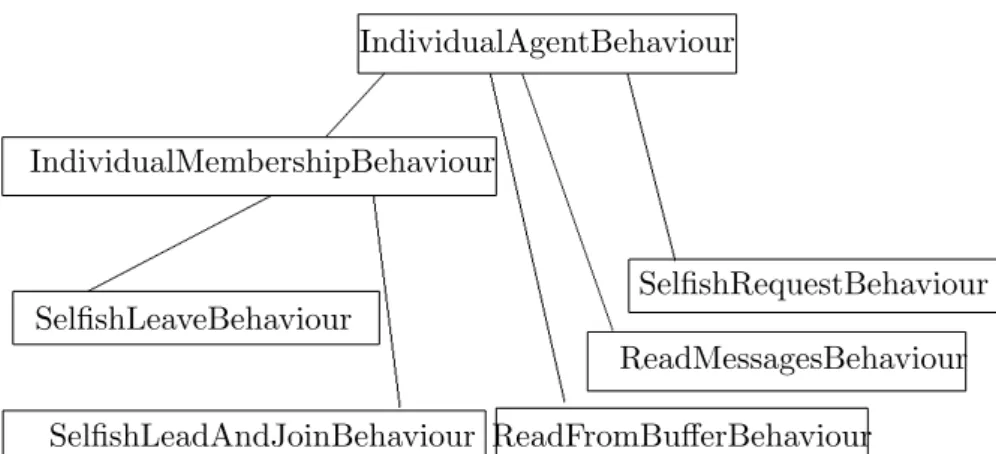
readKnowledgeBehaviour SelfishLeaveBehaviour SelfishRequestBehaviour IndividualAgentBehaviour IndividualMembershipBehaviour ReadMessagesBehaviour ReadFromBufferBehaviour SelfishLeadAndJoinBehaviour
Figure 6: The hierarchy of behaviours of an ’individualistic’ agent.
IndividualAgentBehaviour The IndividualAgentBehaviouris a par-allel composite behaviour consisting of four sub-behaviours. The structure of theIndividualAgentBehaviour can be seen in Fig.6. The details of the sub-behaviours follow.
SelfishRequestBehaviour The SelfishRequestBehaviour is a cyclic behaviour. During each cycle the agent performs the following. For each community that the agent is a member of, if there is a request it is wanting to send (in there is a request in his list of requests to send), check it is able to (check that hisrole allows him to, and that thecontribution policyallows him to). If it is, send it and update his count of messages sent and his count of requests sent since it last sent an inform. If the agent is not able to send the request, it tries to do what it is it has to do in order to be able to. This involves checking his list of outstanding requests to answer and trying to answer them. This should ultimately lead to an improvement of role, and count of requests sent since it last sent an inform to zero, so it will be able to send requests again.
To answer a request for knowledge, an agent uses his mapper for the community to check whether or not his personal knowledge overlaps that of the KnowledgeCluster in the request. If it does not, then he cannot answer the request. If it does, he sends any instances he has of concepts and predicates contained in the overlap of his personal knowledge and that of theKnowledgeClusterin the request (if there are any). He also extracts a KnowledgeCluster from his own personal ontology with the same head
as that of the overlap. If this contains any new information, that was not included in the original request cluster, then he also sends an inform with this KnowledgeCluster.
ReadMessagesBehaviour The ReadMessagesBehaviour is a cyclic be-haviour. During each cycle the agent receives a message if there is one. It extracts theCommunityAgent.COMM ID PARAM from the message to find out which community the message concerns. It then handles the message differ-ently, depending on whether or not it is the leader of the community or not, and whether the message is an inform message, or a request message.
Leaders expect to receive 3 kinds of requests; requests to join a commu-nity, a request to read from the buffer, or a requests for knowledge. If the message has any other type, then it is ignored.
If the request is a requests to join a community, the leader decides whether or not to add this agent to the community, assigns it with a role if required, and sends an inform message of type updateRole that lets the agent know he is in the community, and has role specified by the argument
newRole.
If the request is a requests to read from the community buffer, the leader first checks that the sender of the message is a member of the community. If it is, the leader extracts the time argument from the message, finds the first message in the buffer after the time specified bytime (if there is one), and forwards this message to the agent who made the request. If there is not one, then the leader does nothing.
If the request is a request containing a KnowledgeCluster, the leader just adds the message to buffer, having checked that the sender has correct rights to do so, and also handles the request as a member (see below). This is because leaders are, of course, members of a community as well.
Members only receive one type of request - a request for knowledge in the form of a KnowledgeCluster. Upon receiving such a request they simply add it to their list of requests received, to be handled later (i.e. in the
SelfishRequestBehaviouror theSelflessContributorBehaviour. Leaders expect to receive 3 kinds of informs; an inform of ontological knowledge in the form of a KnowledgeCluster, an inform of instance knowl-edge in the form of an absContentElementList, or a message from a member agent stating that they are leaving the community.
If the inform message is one of either type of knowledge inform (an inform of ontological knowledge in the form of a KnowledgeCluster, or an inform of instance knowledge in the form of an absContentElementList), then the leader simply the leader adds the message to buffer, having checked that the sender has correct rights to do so. Then the leader checks if the agent deserves a role promotion as a result, and if so, promotes the agent and sends anupdateRoleinform message to the agent, informing the agent that
its role in the community has changed. Finally, the leader also handles the inform as a member (see below), in order to try to use the knowledge for personal benefit.
If the inform message is aleavingCommunitymessage, the leader simply removes the member who sent the message from the list of members for the community.
Members expect to receive 4 kinds of informs; ontological knowledge in the form of a KnowledgeCluster, instance knowledge in the form of an absContentElementList, an update role message informing the agent new role in the community or a community dead message telling the agent to leave the community.
If the inform message has its ontology slot set to nothing, the agent knows that this is an inform of instance knowledge in the form of an ab-sContentElementList. It attempts to use its own personal ontology and mapper to comprehend and add these instances to its own personal knowl-edge. Of course, this might not be possible, in which case the knowledge is ignored.
Otherwise, if the inform message is an updateRole message, the agent extracts the integer argument namednewRole, and sets its preceived role in the community to this value.
If the inform message is an communityDeadmessage, the agent extracts the integer argument namedcommunityID, and removes it’s personal
MembersViewOfCommunityforcommunityID.
Finally, if the inform message is an ontological knowledge inform mes-sage, in the form of a KnowledgeCluster, the agent adds the cluster to his own personal ontology using his mapper for the appropriate community.
IndividualMembershipBehaviour TheIndividualMembershipBehaviour
is a composite behaviour consisting of two sub-behaviours. This behaviour implements an individual agent’s policies on creating, joining, leaving and destroying communities. The details of the sub-behaviours that implement these policies follow.
SelfishLeaveBehaviour TheSelfishLeaveBehaviouris a cyclic behaviour. In each cycle the agent loops through each community it is a member of, checking that the reason (goal) for being in the community still exists in its list of goals. If not, then the agent leaves the community and sends a leftCommunity message to the leader of the community. If the agent is the leader of the community, then he destroys the community first. He does this by removing the reference to the community from the community of communities so that no other agents can join the community, sending
communityDeadmessages to all members of the community, and then leav-ing the community itself. Of course, some agents may continue to send this
leader messages for this community until they have read and digested the
communityDeadmessage, but these messages will simply be ignored by the agent, which no longer considers itself a member of this community.
SelfishLeadAndJoinBehaviour TheSelfishLeadAndJoinBehaviouris a cyclic behaviour. In each cycle the agent loops through it’s outstanding goals and tries to find an existing community which may satisfy that goal by searching the CommunityOfCommunities. If it finds one, it joins it. If it doesn’t find one, it creates a community centered around the goal.
An existing community that may satisfy the agent’s goal is a commu-nity whose domain cluster overlaps that of the agent’s goal cluster (the
KnowledgeCluster extracted from the agent’s personal ontology, with the goal as it’s head).
In order to join a community, the agent creates anMemberViewOfCommunity
with the appropriateCommunityPackandMapper, and reason for joining set to the goal (forIndividualAgents). The initial role of the agent in the com-munity is the special AgentViewOfCommunity .NO ROLE role. This repre-sents the fact that the agent is not yet a member of the community. Next, the agent sends aJoinCommunitymessage to a leader of the community, that it finds from theCommunityPack. Later on (in theReadMessagesBehaviour), the agent will receive anUpdateRole message, stating that he is a member of the community. Then the agent can update his role, and start interacting with the community as desired.
An individual agent creates a community by extracting it’s goal cluster for a given goal (theKnowledgeClusterextracted from the agent’s personal ontology, with the goal as it’s head) and creating the community around this cluster.
In order to create a community around a given KnowledgeCluster, an agent must select a NormalisedOntology that contains the head concept of the KnowledgeCluster (for an individualistic agent this is the goal it-self). Next it creates a new CommunityPack with this goal cluster and
NormalisedOntologyand adds it to theCommunityOfCommunities. In do-ing all of this, the agent will have used aMapperto translate between its per-sonal terms and normalised ones. It therefore creates aMemberViewOfCommunity
with theCommunityPackand the Mapper, and sets its role to leader. It also creates aLeadersViewOfCommunity with itself as the initial leader.
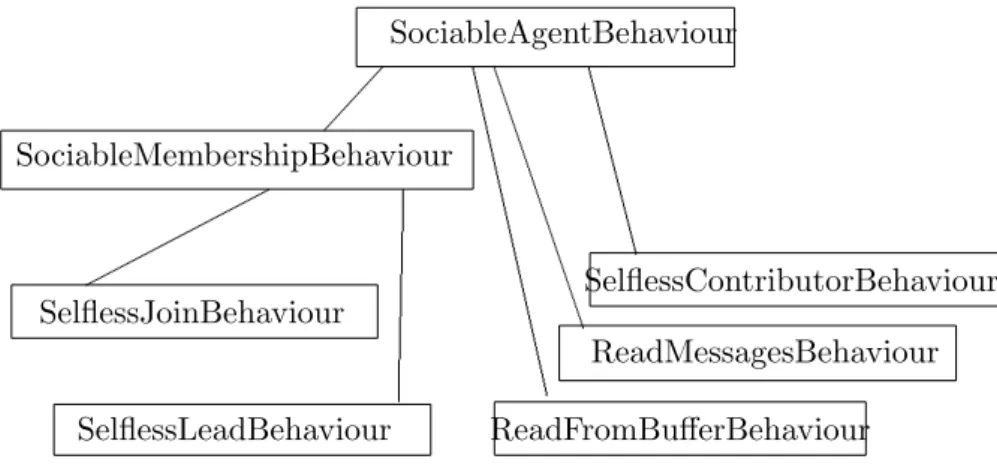
SociableAgentBehaviour The SociableAgentBehaviour is a parallel composite behaviour consisting of four sub-behaviours. The structure of the
SociableAgentBehaviourcan be seen in Fig.7. TheReadMessagesBehaviour
andReadFromBufferBehaviourare detailed above. The details of the other sub-behaviours follow. Note - aSociableAgentnever destroys any commu-nities it is the member of. It leaves them in existence for the good of all.
readKnowledgeBehaviour SociableMembershipBehaviour ReadMessagesBehaviour ReadFromBufferBehaviour SociableAgentBehaviour SelflessJoinBehaviour SelflessContributorBehaviour SelflessLeadBehaviour
Figure 7: The hierarchy of behaviours of an ’sociable’ agent.
SelflessContributorBehaviour TheSelflessContributorBehaviouris a cyclic behaviour. During each cycle the agent checks his list of outstand-ing requests to answer and tries to answer them, as detailed under the
SelfishRequestBehaviourabove.
SelflessJoinBehaviour TheSelflessLeadAndJoinBehaviouris a cyclic behaviour. In each cycle the agent cycles through all of the communities in the community of communities and attempts to join any that it can.
The details for a SociableAgent joining a community are the same as those detailed above for an IndividualAgentin the
SelfishLeadAndJoinBehaviour, except that when creating theMembersViewOfCommunity
the reason for joining the community is set toAgentViewOfCommunity.ALTRUISM, as there is no goal that consitutes its reason for joining the community. It does it purely for the good of all.
SelflessLeadBehaviour TheSelflessLeadBehaviouris a cyclic behaviour. In each cycle the agent cycles extracts aKnowledgeConcept from it’s
PersonalOntology, and creates a community around this concept. The
KnowledgeConcept is somewhat arbitrary, but it would make sense to be something the agent may feel the community would benefit from having a community centered around.
The details for a SociableAgentcreating a community around a given
KnowledgeConceptare the same as those detailed above for anIndividualAgent
4.5 Implementation of the System
Details of the Implementation The system that has been implemented has a command-line user interface where all descriptions of the agent activ-ities are written, and where any user input is collected, when decisions need to be made on an agent’s behalf.
Agents are deployed on the jade platform as either anIndividualAgent
or aSociableAgent and have some input data files.
The inputs, outputs and decisions collected from the user are exactly as detailed in Sect.4.3. The personal ontology and personal instances of an agent are in are given to the agent in .rdf files, together with any normalised ontologies an agent has. For each normalised ontology, an .xml file detailing any existing mappings between the agent’s personal predicates and concepts and those in the normalised ontology are also given. Any new knowledge that an agent obtains will be written to these files by the agent program.
Differences Between the Design and the Final Implementation
The system has been implemented as in the design, except for a few dif-ferences. Firstly, although the system supports multiple policies for com-munities, which are passed to the community upon creation, the system only currently supports one membership policy, one regulation policy, one role policy and one contribution policy. In a more general system we would add support for many different policies, but due to time constraints the policies have been chosen as detailed below. Also, in the implementation we only have one leader per community. Again, in a more general system we could add support to add more than one leader to a community, but in this first prototype this is not supported.
The policies decided upon are as follows. There is nomembership policy, so all types of agents are allowed to join any community. The regulation policy is role based, and therole policy decided upon is one in which agents must contribute a certain minimum number of informknowledge messages to the community and then they gain apromotion. Agents join a community as a contributor, which means they can only send inform messages to the
CommunityBuffer. If they earn a promotion they can become afull member, which means they are also allowed to make requests. The only other roles are the special rolesleader andno role, which is used when an agent has created aMemberViewOfCommunity, but is not yet a member of the community.
Another point that needs making about the implementation is that of the CommunityOfCommunitiesAgent. In the current implementation, the latest version of the CommunityOfCommunities object is sent to and from this agent by the AgentViewOfCommunityOfCommunities object for each agent. There is a sychronisation issue here, and the current implementa-tion contains a bug. This bug will not show itself in situaimplementa-tions where the
![Figure 1: A comparison of the view of ’organisational units’ in the approach taken in this paper and the knowledge nodes approach described in [2].](https://thumb-us.123doks.com/thumbv2/123dok_us/885080.2613464/7.892.182.707.188.465/figure-comparison-organisational-units-approach-knowledge-approach-described.webp)