Encapsulating distribution by remote objects
M. Jansen
a, E. Klaver
b, P. Verkaik
c, M. van Steen
c,*, A.S. Tanenbaum
c aOce Technologies, St Urbanusweg 43, 5914 CA Venlo, The NetherlandsbmarviQ, Kruislaan 400, 1098 SM Amsterdam, The Netherlands
cDepartment of Mathematics and Computer Science, Vrije Universiteit, De Boelelaan 1081a, 1081 HV, Amsterdam, The Netherlands Received 5 September 2000; revised 4 December 2000; accepted 8 December 2000
Abstract
Middleware for modern of®ce environments and many other application areas needs to provide support for a myriad of different, highly mobile objects. At the same time, it should be able to scale to vast numbers of objects that may possibly be dispersed over a large wide-area network. The combination of ¯exibility and scalability requires support for object-speci®c solutions that is hardly addressed by current object-based systems such as CORBA. We have developed a middleware solution that seamlessly integrates traditional remote objects with physically distributed objects that can fully encapsulate their own distribution strategy. We describe how this integration takes place, and how it can be applied to existing systems such as CORBA.q2001 Elsevier Science B.V. All rights reserved.
Keywords: Distributed objects; Middleware; Mobile objects; Distribution encapsulation
1. Introduction
People in many of®ce environments are no longer ®xed to a speci®c location. Instead, they carry their own mobile devices, such as a laptop, connect to the local infrastructure at an arbitrary point, and expect to continue their work where they left off. The traditional notion of an of®ce is thus gradually being replaced by that of a virtual, highly personalized of®ce that an individual connects to as he or she moves from location to location. Such a virtual of®ce is supported by devices such as personal digital assistants, smart cards, notebooks, and so on. The working environ-ment of an employee in such an of®ce will simply appear to travel along as that person moves.
One approach to implementing such virtual of®ces is to statically con®gure a number of servers in a network, and allow clients to access those servers from very different locations using a myriad of access devices. However, there are several drawbacks to this approach, the most important one being the lack of ¯exibility. In practice, resources and services in many of®ce systems change rapidly in number and functionality. Also, the underlying infrastructure by which those resources and services can be accessed is continuously changing.
As a simple example of the need for ¯exibility, consider
the implementation of a company's intranet Web site. Until recently, it was common practice to construct such a site by means of a server that has access to the local ®le system containing the HTML pages comprising the site. In addition, user interaction was supported through CGI-BIN scripts. At present, a shift is taking place through Content Delivery Networks (CDNs) which offer Web hosting services that can replace a company's traditional Web server. At the same time, the traditional notion of Web servers is changing as Web services become accessible on small-scale devices such as PDAs [3].
The components that comprise a user's working environ-ment are thus seen to be highly dynamic in time and space. Basic resources and services such as printers, CPUs, storage, access devices, and so on, change as the user moves. Also, components that make those resources and services available, as well as the applications that are part of the working environment, change in a similar fashion.
Any system that is to support future virtual of®ces, or similar environments, will thus need to accommodate mobility in the broadest sense of the word. Users should be able to move easily between locations implying that they should equally well be easy to locate when needed. Components that comprise a user's environment should be able to migrate, and be traceable as well. Likewise, ®nding and binding to the appropriate resources and services to accommodate a user's environment at a speci®c location should be easy to do. For example, a roaming user who 0950-5849/01/$ - see front matterq2001 Elsevier Science B.V. All rights reserved.
PII: S0950-5849(00)00174-9
www.elsevier.nl/locate/infsof
* Corresponding author. Tel.:131-20-444-7784; fax:131-20-444-7653. E-mail address:[email protected] (M. van Steen).
wants to print his e-mail should be able to do so without having to (manually) con®gure his notebook for the type of printer that happens to be locally available. What we are thus looking for is ¯exibility.
Middleware can offer the ¯exibility we are seeking in such environments. However, current solutions, be they based on a middleware approach or not, fail to adequately address scalability. At best, they allow transparent access to remote resources. However, when applying scaling tech-niques such as caching and replication, they generally support only a few policies. Such an approach is inadequate for large-scale systems. Not only are we faced with problems regarding the sheer amount of data and number of people that need to be supported, problems are also complicated by the fact that in many cases, people and resources may be dispersed across a wide geographical area. Further complications are caused by the highly dynamic nature of data, people, devices, functionality, and media, both in time and space. What is needed is support for resource-speci®c solutions; a single one-size-®ts-all approach will not do.
This paper describes the integration of two middleware solutions, CORE and Globe, that jointly address the ¯ex-ibility and scalability issues that are needed in future of®ce environments. CORE is a CORBA-like middleware layer which has been designed to support highly mobile objects, tailored to of®ce environments. Globe too is a middleware system, but instead of concentrating on mobile objects, its designers concentrated on supporting highly replicated and widely distributed shared objects. As Globe is already described extensively elsewhere (see, e.g. Ref. [26]), we restrict ourselves only to describing its most relevant properties.
The main contribution of this paper is that we show how CORBA-like systems, such as CORE, can be extended in such a way that scalability problems can be more effectively tackled. Part of our approach is to adapt the remote-object model allowing objects to be physically distributed, while at the same time fully encapsulating their own distribution strategy. The adaptation does not affect existing interfaces. We start by describing CORE, an object-based middle-ware system whose object model strongly resembles that of CORBA. The objects as used in CORE need to be enhanced to support object-speci®c distribution, as we explain in Section 3. Details on these enhancements are discussed separately in Section 4, where we concentrate on keeping enhancements transparent to existing applications. We conclude in Section 5 by re¯ecting on our work and compare it to work by others.
2. The architecture of CORE
CORE is a middleware platform aimed at mobility. To enable objects to be highly mobile, instead of only having portable code, CORE mobile objects are written in Java.
There are Java Virtual Machines (JVMs) available for most processing devices. Another key property of CORE is the small footprint. As the target environment contains many devices with limited processing power and resources, CORE should claim minimal resources.
2.1. Global architecture
A CORE system consists of a heterogeneous network of machines, which together form a distributed system. Each machine runs a number of services Ð hardware or software entities that can perform a speci®c task. To enable commu-nication between services on different machines and to provide some basic functionality, such as lookups of services, a small piece of middleware runs between the operating system and the services. This piece of middleware makes network access and location of services transparent to both the user and the programmer of services.
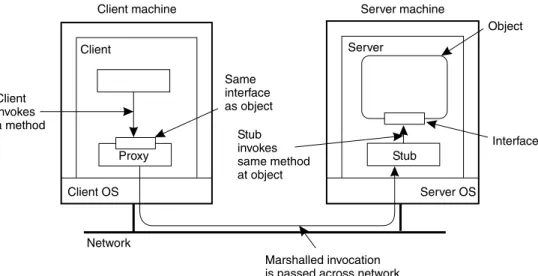
As most other object-based distributed systems such as CORBA [23] and Java RMI [24], CORE uses a remote-object model. In this model, an object is placed in the address space of a single object server. The object server exports the object's interfaces to remote clients, allowing them to invoke the object's methods. The interface imple-mentation at the client is called a proxy [22]. A proxy marshals a method invocation into a message that is sent to the object server. An incoming invocation request is then unmarshaled at the server, after which the method is invoked at the object, as shown in Fig. 1.
The object is identi®ed by a globally uniqueobject iden-ti®er, referred to as aCORE OID. A CORE OID is a true identi®er [31]. In particular, it contains no location informa-tion. In addition, each of the services offered by the object by means of its interfaces are identi®ed by a separate service ID. Given a service ID, it is possible to look up the object that provides the identi®ed service. A service ID is some-what comparable to an interface identi®er in CORBA or DCOM [5], except that it is also uniquely tied to an object. In CORE, no assumptions are made concerning the loca-tion of an object. Objects are allowed to move freely between servers on possibly different machines. When an object moves to a different server, the proxy is responsible for reconnecting to that server. Likewise, the proxy is responsible for masking failures as much as possible, although fatal errors such as crash failures or persistent communication failures may raise an exception at the client (see also [29]). When a method is invoked during the migra-tion of the object to another server, the invocamigra-tion is queued until the object is up and running again. The object itself is not aware of any of its proxies. In our current implementa-tion, strong consistency is guaranteed by forbidding the proxy to cache results of method invocations.
2.2. CORE platform
A CORE-based distributed system consists of a collection of interconnected hosts, where each host executes a number
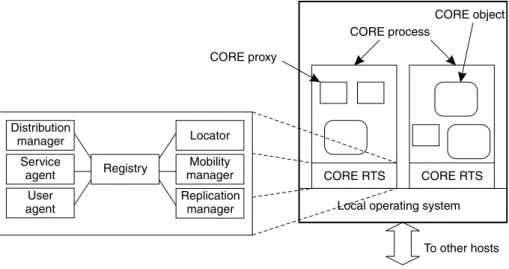
of basic CORE components. These components collectively form theCORE Runtime System(RTS). Each host can run one or more CORE processes. Each process can be accessed through its transport-level address, that is, an (IP address, port number)-pair. The CORE RTS at each process partly consists of the Voyager object broker,1 along with CORE
extensions that allow the process to, for example, commu-nicate with other CORE processes. This organization is shown in Fig. 2, and is explained next. In the following, the most important CORE components are discussed. 2.2.1. Registry
TheRegistry is used to register (and unregister) objects locally, including the basic CORE components that are part of the platform. The registry also keeps some usage infor-mation on each object, such as the number of times it has been invoked, the last time it was invoked, etc. Registration of an object proceeds by providing its interfaces to the registry. Subsequent lookups are done by means of the registry as well, possibly with the help of other CORE components that we discuss below.
2.2.2. Distribution manager
CORE objects are accessible to remote clients. To that end, a client mustbindto an object by locally installing a proxy for each object it wants to invoke. Installing a proxy is done automatically by uploading it to the client as we describe below.
As we explained, proxies are object speci®c. In CORE, objects themselves are responsible for creating and handing out proxies to their clients, but for this they can make use of a number of CORE services. The Distribution Manager (DM) is such a service. This component can be called by an object with the request to generate a proxy object imple-menting one or more of the object's interfaces. The proxy
contains the object's CORE OID, as well as a reference to where the object currently resides.
A proxy can be serialized and handed out to a client. Serialization is the process by which an object is represented as a host-independent series of bytes. Such a series can be safely transferred between different hosts. When a host receives a serialized object, it can deserialize it into a repre-sentation speci®c for that host.
2.2.3. Service and user agent
The Service Agent (SA) and User Agent (UA) are two related components. An SA is responsible for registering services at remote platforms, whereas a UA is responsible for looking up services at remote platforms. The implemen-tation of these agents is based on the Service Location Protocol (SLP) described in RFC 2165.
An SA maintains a list of descriptions of currently avail-able services at various CORE platforms. In essence, each description takes the form of an (attribute,values)-pair and is normally provided directly by the objects themselves. An SA is responsible for broadcasting removals of service descriptions, and also continually listens to requests and updates coming in over the network.
To look up a service, a UA will broadcast a system-wide lookup request by specifying a predicate formulated in terms of these (attribute, values)-pairs. Predicates are similar to LDAP queries [28]. They are formulated as Boolean expressions in which each term consists of an (attribute, values)-pair, specifying the required values for that attribute. When a lookup request comes in, the SA tests the associated predicate against all descriptions in its list and returns the IDs of each service of which the description matches the predicate. The UA collects replies from SAs (containing service IDs) for some period of time or until it has received the requested number of services.
It is thus seen that the SAs jointly maintain a distributed database of service descriptions. However, broadcasting as 1 See http://www.objectspace.com for information on Voyager.
Server machine Object Client machine Proxy Same interface as object Interface Client invokes a method Network Stub invokes same method at object Marshalled invocation is passed across network
Client OS Server OS
Server
Stub Client
is done in CORE has inherent scalability problems. To solve these problems, more sophisticated techniques are neces-sary. For example, the distributed database could easily be replicated to facilitate local lookups by UAs. This approach is feasible as the set of services is expected to be relatively stable. In other words, the mapping between (attribute, values)-pairs and service IDs of the corresponding inter-faces will not change often. In addition, it is not necessary that the SAs always share the exact same view of available services. The combination of relative stability and weak consistency allows us to use highly scalable techniques such as deployed in epidemic algorithms [4,21].
2.2.4. Locator
TheLocatorlocates an object with a speci®ed CORE OID on behalf of a client, and takes care of binding the client to the requested object. Binding is accomplished by returning a serialized proxy that implements the interface of the object. Note that this proxy contains the current address of the object. Consequently, by merely deserializing the proxy, the client can immediately invoke methods of the object. We return to the Locator when discussing the Globe loca-tion service below.
2.2.5. Mobility manager
The Mobility Manager (MM) is responsible for moving objects from one location to another. Instead of implement-ing a simplement-ingle migration scheme, different schemes are possi-ble by making use of Object Movers(OM). For example, some objects can be migrated merely by shipping their state to the target machine because the necessary classes are already available. In other cases, migration may need to take place by shipping code and state, or by letting the target ®rst load the appropriate classes. As another example, when the target machine is a notebook, it will probably be neces-sary to ensure that it has all the necesneces-sary classes available to instantiate the object, for the notebook may need to oper-ate in disconnected mode. On the other hand, for a
continu-ously online target, classes can be dynamically downloaded when they are actually needed. By providing different OMs, it becomes possible to implement different migration schemes into a single system.
In effect, an OM implements a speci®c migration policy. An MM is responsible for coordinating the migration between two locations. When an object is to be moved from one host to another, the MM at the source is given the address of the target host, and optionally a preferred OM. This MM then contacts the MM of the target host and negotiates an OM that both machines support, keeping the preferred OM in mind. The negotiated OM is returned to the caller of the MM. The OM is then used to actually move the mobile object. As soon as the object is in a transferable state, the OM marshals the object, transports it, and lets the OM at the target machine rebuild the object.
2.2.6. Replication manager
The original version of CORE supported only remote objects. However, a Replication Manager (RM) has later been added and which is responsible for replicating objects to other locations. Keeping the state of replicated objects consistent with each other is, however, the task of the repli-cated objects themselves, because they know best how to do that most ef®ciently. When an object is to be replicated to another host, the RM is contacted specifying the target host and port number, and the object to replicate. Subsequently, the RM asks the object to ®rst create a replica of itself and then moves this replica to the speci®ed target machine. Replication is discussed in more detail below.
3. Distribution of CORE objects
The original version of CORE does not support replica-tion, and has some serious limitations with respect to its scalability. The ®rst problem is that the state of a remote object always resides at a single location. Consequently, in a Registry managerMobility
Service agent User agent CORE RTS CORE RTS CORE process
Local operating system CORE object To other hosts CORE proxy Locator Distribution manager Replication manager
geographically dispersed environment, access times to such objects may be considerable. If an object is not simulta-neously shared by multiple clients, access times can be improved by migrating the state to the object's current client. However, this solution does not work when several clients require access to the object at the same time. Another problem is that if objects are allowed to migrate a lot, we need a scalable mechanism to track and locate them. The original naming service in CORE offers only a centralized solution which scales poorly to large networks.
There are basically only three solutions to tackle scalabil-ity problems: distribution (i.e. partitioning), replication, and caching [19]. In the case of replication or caching, objects are copied to several machines. In principle, service requests are simply forwarded to the nearest copy. The main draw-back of replication is that whenever a copy is updated, that copy becomes inconsistent with the others. Consequently, we need to update the other copies as well. In a worst-case scenario, propagation of updates may require global synchronization between the replicas. Unfortunately, global synchronization has itself inherent scalability problems. The only approach to alleviate such problems is to provide weaker consistency guarantees.
An important observation, however, is that the ideal repli-cation policy is dependent on the usage of the object being replicated. For example, as reported in Ref. [20], applying a single replication strategy to all documents from the same Web site will never lead to the same performance as select-ing a policy for each document separately. In other words, applying caching and replication as a means to enhance the scalability of a system, is most effective if each object is allowed to have its own replication strategy. Origin-ally, CORE, like many distributed systems based on remote objects such as CORBA and Java RMI, lacked this support.
We have improved the scalability of CORE in two ways. First, we have replaced part of the naming service by a scalable location service that allows us to track frequently migrating objects in an ef®cient way. Second, the remote-object model has been partly replaced by physically distrib-uted objects that encapsulate their own strategy regarding how their state is distributed, replicated, or migrated. These two extensions to CORE are described next.
3.1. A scalable location service
Our ®rst extension to CORE was to partly replace the naming service with a scalable location service as devel-oped in the Globe project [25]. The CORE Locator was rebuilt to act as a front end to this location service. The basic idea is that each distributed object in CORE is assigned a lifelong object identi®er. It is crucial that this identi®er never changes, and, in particular, that it is location independent. In contrast, a (location-dependent) contact addressis used to refer to the current location of an object. As we explained, a contact address in CORE is
implemented as a serialized proxy, similar to the use of proxies in Java RMI [30]. When a client wants to bind to an object it looks up the object's current location by provid-ing the object identi®er to the location service. The location service returns a contact address in the form of a serialized proxy. This proxy is subsequently deserialized by the client and automatically initialized. The proxy already has the current location of the object as part of its state, so that after deserialization, the client can immediately invoke the object's methods as made available through the proxy.
Note that when an object moves, the proxy as stored in the location service is updated with the object's new location. As we explain next, updating means removing the old proxy and inserting a new one. However, for those processes that are already bound to an object, and thus already have a proxy in their address space, it is the proxy's responsibility to keep track of the current location of the object. Currently, this has been implemented by raising an exception when a client attempts to access the object again, enforcing the client to look up the object's current address in the location service.
The location service organizes the underlying network into a hierarchical collection of domains. For example, a lowest-level domain may represent the entire network of a science park, whereas the next higher-level domain repre-sents the city where that science park is located. Each domain is represented in the location service by a directory node. The concept of a domain in the location service is thus somewhat similar to the concept of a domain in DNS.
A directory node has a contact record for every (regis-tered) object in its domain. The contact record is divided into a number of contact ®elds, one for each child node. A directory node stores either a forwarding pointer, or an object address in the contact ®eld. A forwarding pointer indicates that an address can be found at the child node. Contact records at leaf nodes are different, they contain only one contact ®eld storing the object's address in that leaf domain.
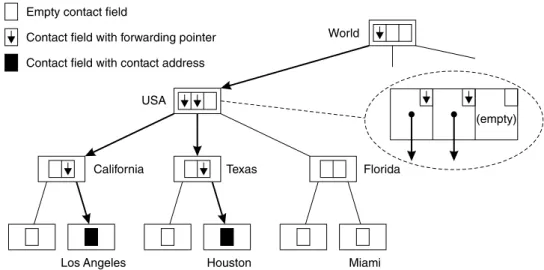
As an example, consider Fig. 3, which shows a con®g-uration for a single object that has been replicated across Los Angeles and Houston. The root node has a forwarding pointer to the USA node, which in turn points both to California and Texas. Now, consider a client in Miami who wants to contact the object. In that case, a lookup request will travel from the Miami node upwards to the ®rst node where the object is known. In our example, this is the USA node. From there on, the request is forwarded either to Texas or California, and eventually reaches a leaf node where an address is stored. The important issue is that scalability is obtained by exploiting locality: a request issued within the USA will never leave the USA domain if a replica is present in that domain.
The location service has been implemented in Java and integrated with CORE. Further details concerning its algorithms, including the partitioning of higher-level nodes, can be found in Refs. [2,27].
3.2. Physically distributed objects
Ef®ciently locating mobile objects in a geographically dispersed network is not enough for scalability. We also need support for caching and replicating objects. The ideal replication strategy for all objects is that updates are (1) immediately propagated to all copies, and (2) each copy sees all updates in the same order. Unfortunately, such a strong degree of consistency is impossible to implement ef®ciently in large-scale systems as it requires global synchronization. As we discussed, the solution to scalability is to weaken consistency requirements so that alternative and more ef®cient replication strategies can be followed. Such an approach requires that we take the usage and update patterns of individual objects into account. Consequently, it makes sense to let an object fully encapsulate its own repli-cation strategy. This is the approach followed in Globe [26], and which we adopted for CORE.
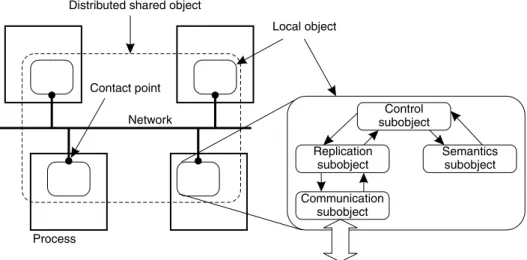
One of the key concepts of the Globe system is its model of Distributed Shared Objects (DSOs). Like other object-based models each object offers one or more interfaces, each consisting of a set of methods. Objects are passive; activity comes from processes. Multiple processes may access the same object simultaneously. A major distinction with other object-based models is that objects are physically distribu-ted, meaning that copies of an object's state can and do reside on multiple machines at the same time. However, processes are not aware of this: state and operations on that state are completely encapsulated by the object. This means that all implementation aspects, including commu-nication protocols, replication strategies, and distribution and migration of state, are part of the object but are hidden behind its interface. This model is illustrated in Fig. 4.
A DSO has the possibility to distribute (part of) its state among several machines. It is the responsibility of the object to decide what distribution or replication policy is taken and to keep its state consistent. The policy can vary from repli-cating the whole state on different machines (replication) to
dividing its state in distinct parts and locating each part on different machines (partitioning). Also, how, when, and where updates are propagated is entirely left to the object to decide. As a consequence, different objects can and do implement different replication policies.
Each distributed object is spread across multiple processes by installing a local object at each process. Each local object is composed of several subobjects, and is itself again fully self-contained as also shown in Fig. 4. A minimal composition consists of the following four subob-jects.
Semantics subobject. This is a local object that imple-ments (part of) the actual semantics of the distributed object. As such, it encapsulates the functionality of the distributed object. The semantics object consists of user-de®ned primi-tive objects written in programming languages such as Java or C11. These primitive objects can be developed independent of any distribution or scalability issues.
Communication subobject. This is generally a system-provided subobject. It is responsible for handling commu-nication between parts of the distributed object that reside in different processes. Depending on what is needed by the other components, a communication subobject may offer primitives for point-to-point communication, multicast facilities, or both.
Replication subobject.The global state of the distributed object is made up of the state of its various semantics subobjects in different processes. Semantics subobjects may be replicated for reasons of fault tolerance or perfor-mance. The replication subobject is responsible for keeping these replicas consistent according to some (per-object) coherence strategy. Different distributed objects may have different replication subobjects, using different replication algorithms.
The replication subobject has a standard interface. However, implementations of that interface will generally differ between replication subobjects. In a sense, this subobject behaves as a meta-level object comparable to
World
Los Angeles Houston Miami California Texas Florida
USA Empty contact field
Contact field with forwarding pointer Contact field with contact address
(empty)
techniques applied in re¯ective object-oriented program-ming [12].
Control subobject. The control subobject takes care of invocations from the client process, and controls the inter-action between the semantics subobject and the replication subobject. This subobject is needed to bridge the gap between the application-de®ned interfaces of the semantics subobject, and the standard interfaces of the replication subobject.
A key role is, of course, reserved for the replication subobject. An important observation is that communication and replication subobjects are unaware of the methods and state of the semantics subobject. Instead, both the commu-nication subobject and the replication subobject operate only on invocation messages in which method identi®ers and parameters have been encoded. This independence allows us to de®ne standard interfaces for all replication subobjects and communication subobjects.
As in CORE, each DSO has a location-independent, globally unique object identi®er. To distinguish such iden-ti®ers from those used in CORE, we refer to them asGlobe OIDs. Again, a client can invoke the methods of a DSO by ®rst binding to the object. Binding requires that a contact address is looked up in the location service. In contrast to CORE, a contact address for a Globe DSO consists of a transport-level address, along with a protocol identi®er, specifying exactly what subobjects the client should imple-ment in order to communicate with the object. In the current implementation, a protocol identi®er takes the form of a URL referring to an implementation of the required subobjects that the client should load into its address space. The effect of binding to a DSO is that a local object is placed in the client's address space. This local object has the same internal organization as before, in that it consists of the four subobjects described above. In this sense, there is no strict distinction between the client and other processes bound to the same DSO. In principle, the client may register a contact address for the object in the location service, thus
allowing other processes to bind to the object as well, using the freshly bound process as an intermediate. However, a security policy may possibly prohibit such registration. 4. Jackets: integrating CORE and Globe
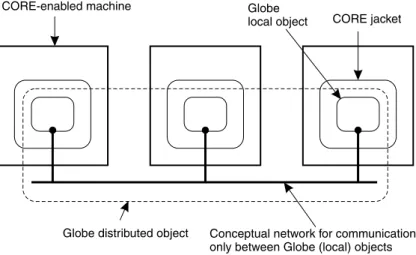
To address the scalability problems inherent to the CORE object model, we have integrated CORE and Globe into a single system. An important objective was to make the integration transparent to CORE applications. In other words, the existing CORE object model should essentially remain the same. Likewise, we did not want to affect the Globe object model. This approach has led to an integrated object model shown in Fig. 5. We refer to objects in this model asCORE Distributed Shared Objects(CORE DSOs). Conceptually, the integration is relatively simple. Each local object of a Globe distributed shared object (referred to as a Globe DSO) is fully encapsulated in a special CORE proxy, called ajacket. A jacket offers all the standard inter-faces that are normally provided by CORE proxies. In this sense, the CORE DSO cannot be distinguished from other CORE objects. This encapsulation also allows a Globe local object to treat a jacket as just a client. In other words, the local object can remain ignorant of how a process is actually bound to it.
Consequently, CORE applications and Globe DSOs are, in principle, fully independent of one another. However, there are a number of subtleties that need to be dealt with to maintain this independence, which we discuss next. 4.1. Creating a CORE DSO
Our ®rst concern is the creation of a CORE DSO. In Globe, a DSO is created by having a process ®rst create a local object with all its subobjects. In practice, this means that the process loads a ®le containing the complete imple-mentation of a speci®c local object after which it instantiates the object.
Local object Distributed shared object
Process Network Contact point Communication subobject Replication subobject Control subobject Semantics subobject
Together with instantiating a local object, a Globe object identi®er (Globe OID) is generated for it, effectively estab-lishing a Globe DSO, albeit one with only a single local object. The Globe OID is used to register a Globe contact address in the location service. This contact address allows another process to contact the process that just created the object, and bind to it.
In essence, the same procedure is followed when creating a CORE DSO. First, a CORE process creates a jacket. Because a CORE process can, in principle, support any objects written in Java, it is straightforward to embed a Globe local object that has been written in Java into a CORE process. After instantiating a jacket, initialization of the jacket continues by creating a Globe local object as just described, along with a Globe OID. Only the latter is stored in the serializable state of the jacket. The Globe local object that has just been created does not form part of this state, as shown in Fig. 6. We return to this issue below.
To make the Globe local object known to other objects, the CORE process ®rst creates a contact point, such as a
socket. It then registers the local object at the location service by handing it a (Globe OID, Globe address)-pair, with the address containing all the necessary information to enable binding. Note that such a pair is useless to CORE processes, which expect a serialized CORE proxy. There-fore, to facilitate such processes, the associated jacket is serialized and inserted into the location service under its own CORE OID. Of course, jackets for local objects that belong to the same Globe DSO will have the same CORE OID.
Binding to a CORE DSO is now straightforward. A process looks up a CORE contact address in the location service by handing it a CORE OID. The location service returns a serialized jacket, containing a Globe OID in its serialized state. After deserializing and instantiating the jacket, a second lookup takes place, but now by means of the Globe OID found in the jacket. This lookup returns a contact address for a Globe local object. The process subsequently creates a local object that connects to the associated Globe DSO through the returned contact address.
CORE jacket Globe OID
Globe local object Volatile pointer Part of serializable state Combined CORE/Globe process
Logical view of CORE local object
Network Fig. 6. The relation between a jacket and its associated Globe local object.
Globe distributed object
Globe
local object CORE jacket
Conceptual network for communication only between Globe (local) objects CORE-enabled machine
4.2. Migration and replication
Objects in Globe and CORE are highly independent in the sense that mutual adaptations are actually not necessary to allow integration. However, migration and replication as provided by CORE require some subtle changes.
As we explained, migration in CORE takes place by means of the MMs. In essence, a CORE object is moved by serializing it, transferring the serialized object to the target server, and deserializing it again. A different approach needs to be followed for a CORE DSO. Migration is done in two phases. The ®rst phase consists of migrating the jacket, whereas the second phase consists of migrating the associated Globe local object.
Migrating the jacket is straightforward. Like any other CORE object, the jacket is serialized and moved from source to destination with the help of the respective MMs and OMs as described above. Note that the volatile pointer shown in Fig. 6 isnotserialized. After this phase, there is still a Globe local object at the source, but none at the target. To Globe, unless special measures are taken, this situation appears as if the local object at the source is no longer used. In principle, it could therefore be cleaned up. However, the local object might contain state that must be safeguarded ®rst.
To avoid removing the local object, a binding to the local object is maintained at the source as long as necessary, as we explain next. In line with the approach that objects should fully encapsulate their own distribution strategy, an object-speci®c scenario is followed for completing the migration process. Let us consider two example scenarios.
In the ®rst scenario, the jacket at the destination creates a Globe local object that connects to the local object at the source. A state transfer between these two Globe local objects subsequently takes place. Then, the contact address of the source is removed from the location service, whereas a contact address at the destination is inserted. At that point, all state of the Globe DSO has been preserved, so that we can safely remove the Globe local object at the source. Removal includes informing all other local objects of the Globe DSO to disconnect from the local object at the source, if necessary, and possibly reconnect to the local object at the destination.
A completely different scenario is the following. After having migrated the jacket to the destination, the local object at the source removes its contact address from the location service. This removal prevents other processes from binding to it. The local object subsequently instructs processes to disconnect from it, possibly after having shipped its state to other local objects such that the state of the DSO as a whole is preserved. Meanwhile, the jacket at the destination simply starts binding to the Globe DSO referred to by the Globe OID that is part of its state. Binding at the destination can take place simultaneously with the unbinding of the local object at the source.
Variants of these two scenarios can easily be thought of.
However, it is up to the DSO to decide which strategy is the best one to follow. It is precisely this separation between mechanism and policy that we feel is currently lacking in many object-based distributed systems.
Replication is currently dealt with in a similar fashion. A CORE RM may be instructed to create a new replica, for which it creates a jacket as described above. The newly created jacket simply binds to the associated Globe DSO and, following an object-speci®c scenario, maintains local state consistent with other local copies. Deciding on where to create a new replica is currently left to applications. However, it should also be possible for an object to decide that more or fewer replicas are needed. In that case, an object will itself contact a RM to install or remove a replica. We are currently developing mechanisms to support such object-initiated replication (see also Ref. [11]).
5. Discussion and related work
Distributed objects in virtually all existing systems are actually implementations of a remote-object model in which the object resides at a single server. Remote clients are offered transparent access to an object by means of proxies. We argue that the remote-object model misses two important properties.
First, it can be argued whether remote objects are actually distributed. In many cases, remote objects are nothing but traditional objects contained in a single object server, but which can be transparently accessed by remote clients by means of proxies. Further distribution transparency is supported by allowing the object to migrate between servers, but hiding all location-awareness inside the proxies. Second, remote objects do not encapsulateall implemen-tation aspects. In particular, many distribution policies are implemented by special or con®gurable object servers [10,13]. We argue that distribution policies should be part of an object's implementation, similar to why an object encapsulates its state and operations.
There are only a few distributed-object models that follow this approach, notably the fragmented objects as developed by the SOR group at INRIA [15]. At best, support is given for adapting the client proxy to speci®c objects, as used in Spring's subcontract model [9] or as implemented in Java RMI [30]. To compensate for the lack of ¯exibility in the supported object model, CORBA provides interceptors as a mechanism to provide object-speci®c policies [18]. However, interceptors essentially allow only breaking into an existing ORB and modifying its invocation policy. Much more is needed to actually provide object-speci®c support for distribution.
There are other projects that use the remote-object model while addressing scalability problems. In Legion, scalability is essentially addressed by aiming at reducing communica-tion traf®c and exploiting locality [8,14]. To do so, copies of objects can be cached. However, what Legion does not
address is the synchronization problem that arises when a replicated object is updated. In contrast to the approach described in this paper, Legion provides no support for accommodating a wide variety of replication scenarios. Replication will have to be handcrafted as part of object development.
Another major distinction with Legion is its lack of support for tracking mobile objects. In essence, Legion's mechanism for locating an object relies heavily on caching the object-to-address binding. Such caching will work only if bindings are stable, which is not the case for mobile objects.
Globus is another project that addresses scalability issues [6,7]. In contrast to CORE, Globe, and Legion, Globus is not so much concerned about objects, but rather about wide-area resource management such that applications can access and use resources at remote sites. An important goal achieved by Globus, is to provide a mechanism that will let different high-performance computing services inter-operate on behalf of a large wide-area applications. Interoperability is the keyword here. In contrast, in this paper we address the problem of achieving scalability not by connecting different resources, but rather by providing mechanisms to support advanced caching and replication, using objects as our basis.
If we take a step back and concentrate on the functionality of the integrated CORE and Globe system, the work done with respect to Jini comes closest to what we have described in this paper [17]. Jini is based on Java's remote-object model, but provides many services that are also available in CORE and Globe. One of Jini's most powerful services for which CORE has no immediate counterpart, is Java-Spaces. This directory service uses an associate memory to match queries against objects [16]. Although powerful, JavaSpaces has the serious drawback of being inherently dif®cult to scale, as has been demonstrated by the various implementations of Linda [32], from which JavaSpaces has inherited its model.
6. Conclusions and future work
Our research demonstrates that it is possible to support object-speci®c policies while retaining the client's view of a remote-object model. In fact, we have shown that integra-tion of a remote-object model and that of physically distrib-uted shared objects can be done in such a way that neither model needs to be affected. Integration takes place by means of a relatively simple type of object, called a jacket. Although we have concentrated on the integrated imple-mentation of CORE and Globe, this same approach can be followed for existing systems such as CORBA.
Our approach is still lacking a number of important features. For example, we still need to include security into our system, which is currently a subject of active research in our groups. Fault tolerance, although not
addressed in this paper, is partly covered by our support for caching a replication. However, more work needs to be done in this area.
Besides our continuing work on distributed objects, we are currently focusing on building a large-scale worldwide distributed archive based on the technologies described in this paper. The archive will need to support highly mobile users and objects, and be tightly secured. An experimental system that forms the basis of such an archive is described in Ref. [1].
Acknowledgements
The original concept and the basis for the CORE archi-tecture as described in this paper, was part of the OceÂ-Tech-nologies research efforts, initiated by Teus Hagen who is now at NLnet Foundation. We also gratefully acknowledge the implementation work done by Ivo van der Wijk on the integration of CORE and Globe, and that of Sebastiaan de Jongh with respect to application development.
References
[1] A. Bakker, E. Amade, G. Ballintijn, I. Kuz, P. Verkaik, I. van der Wijk, M. van Steen, A. Tanenbaum, The Globe distribution network, Proceedings of the 2000 USENIX Annual Conference (FREENIX Track), San Diego, CA, June 2000, USENIX, pp. 141±152. [2] G. Ballintijn, M. van Steen, A.S. Tanenbaum, Exploiting location
awareness for scalable location-independent object IDs, Proceedings of the Fifth ASCI Annual Conference, Heijen, The Netherlands, June 1999, ASCI, pp. 321±328.
[3] G. Borriello, R. Want, Embedded computation meets the World Wide Web, Commun. ACM 43 (5) (2000) 59±66.
[4] A. Demers et al., Epidemic algorithms for replicated data manage-ment, Proceedings of the Sixth Symposium on Principles of Distrib-uted Computing, Vancouver, August 1987, pp. 1±12, ACM, New York. Also in Operating Syst. Rev. 22(1) (1988) 8±32.
[5] G. Eddon, H. Eddon, Inside Distributed COM, Microsoft Press, Redmond, WA, 1998.
[6] I. Foster, C. Kesselman (Eds.), Computational Grids: the Future of High Performance Distributed Computing Morgan Kaufman, San Mateo, CA, 1998.
[7] I. Foster, C. Kesselman, The Globus project: a progress report, Proceedings of the IPPS/SPDP Heterogeneous Computing Workshop, March 1998, pp. 4±18.
[8] A. Grimshaw, M. Lewis, A. Ferrari, J. Karpovich, Architectural support for extensibility and autonomy in wide-area distributed object systems, Technical Report CS-98-12, Department of Computer Science, University of Virginia, June 1998.
[9] G. Hamilton, M. Powell, J. Mitchell, Subcontract: a ¯exible base for distributed programming, Proceedings of the 14th Symposium on Operating System Principles, Asheville, NC, December 1993, ACM, New York.
[10] B. Jùrgensen, E. Truyen, F. Matthijs, W. Joosen, Customization of object request brokers by application speci®c policies, in: J. Sventek, G. Coulson (Eds.), Proceedings of Middleware 2000, Lecture Notes in Computer Science, vol. 1795, Springer, Berlin, 2000, pp. 144±163. [11] A. Kermarrec, I. Kuz, M. van Steen, A. Tanenbaum, A framework for
consistent, replicated Web objects, Proceedings of the 18th Interna-tional Conference on Distributed Computing Systems, Amsterdam, The Netherlands, May 1998, IEEE, New York, pp. 276±284.
[12] G. Kiczales, Towards a new model of abstraction in the engineering of software, Proceedings of the International Workshop on New Models for Software Architecture (IMSA): Re¯ection and Meta-Level Architecture, Tokyo, November 1992.
[13] F. Kon, M. RomaÂn, P. Liu, J. Mao, T. Yamane, L.C. MagalhaÄes, R.H. Campbell, Monitoring, security, and dynamic con®guration with the dynamicTAO re¯ective ORB, in: J. Sventek, G. Coulson (Eds.), Proceedings of Middleware 2000, Lecture Notes in Computer Science, vol. 1795, IFIP/ACM/Springer, New York/Berlin, 2000, pp. 121±143.
[14] M. Lewis, A. Grimshaw, The core Legion object model, Technical Report CS-95-35, Department of Computer Science, University of Virginia, August 1995.
[15] M. Makpangou, Y. Gourhant, J.-P. LeNarzul, M. Shapiro, Fragmen-ted objects for distribuFragmen-ted abstractions, in: T. Casavant, M. Singhal (Eds.), Readings in Distributed Computing Systems, IEEE Computer Society Press, Los Alamitos, CA, 1994, pp. 170±186.
[16] Microsystems, S. JavaSpaces Service Speci®cation, October 2000. [17] Microsystems, S. Jini Architecture Speci®cation, October 2000. [18] P. Narasimham, L. Moser, P. Mellior-Smith, Using interceptors to
enhance CORBA, Computer 32 (7) (1999) 62±68.
[19] B. Neuman, Scale in distributed systems, in: T. Casavant, M. Singhal (Eds.), Readings in Distributed Computing Systems, IEEE Computer Society Press, Los Alamitos, CA, 1994, pp. 463±489.
[20] G. Pierre, I. Kuz, M. van Steen, A. Tanenbaum, Differentiated stra-tegies for replicating Web documents, Proceedings of the Fifth Web Caching Workshop, Lisbon, May 2000.
[21] M. Rabinovich, N. Gehani, A. Kononov, Scalable update propagation in epidemic replicated databases, Proceedings of the International Conference on Extended Database Technology, 1997, pp. 207±222.
[22] M. Shapiro, Structure and encapsulation in distributed systems: the proxy principle, Proceedings of the Sixth International Conference on Distributed Computing Systems, Cambridge, MA, May 1986, IEEE, New York, pp. 198±204.
[23] J. Siegel, CORBA 3 Fundamentals and Programming, 2nd ed., Wiley, New York, 2000.
[24] R. Ste¯ik, P. Sridharan, Advanced Java Networking, 2nd ed., Prentice Hall, Upper Saddle River, NJ, 2000.
[25] M. van Steen, F. Hauck, P. Homburg, A. Tanenbaum, Locating objects in wide-area systems, IEEE Commun. Mag. 36 (1) (1998) 104±109.
[26] M. van Steen, P. Homburg, A. Tanenbaum, Globe: a wide-area distributed system, IEEE Concurrency 7 (1) (1999) 70±78. [27] M. van Steen, F.J. Hauck, G. Ballintijn, A.S. Tanenbaum,
Algorith-mic design of the Globe wide-area location service, Comput. J. 41 (5) (1998) 297±310.
[28] M. Wahl, T. Howes, S. Kille, Lightweight Directory Access Protocol (v3), RFC 2251, December 1997.
[29] J. Waldo, G. Wyant, A. Wollrath, S. Kendall, A note on distributed computing, Technical Report SMLI TR-94-29, Sun Microsystems Laboratories, Mountain View, CA, November 1994.
[30] J. Waldo, Remote procedure calls and Java remote method invoca-tion, IEEE Concurrency 6 (3) (1998) 5±7.
[31] R. Wieringa, W. de Jonge, Object identi®ers, keys, and surrogates Ð object identi®ers revisited, Theor. Practice Object Syst. 1 (2) (1995) 101±114.
[32] G. Wilson, Linda-Like Systems and their Implementation, Edinburgh Parallel Computing Centre, University of Edinburgh, Edinburgh, June 1991.