A Service Performance Insight White Paper
Service Compass:
Charting the Course to
Professional Service Excellence
Improve Your Bottom Line with
Repeatable Services
December 2011
6260 Winter Hazel Drive 25 Boroughwood Place
Liberty Township, OH 45044 USA Hillsborough, CA 94010 USA
Telephone: 513.759.5443 Telephone: 650.342.4690
Introduction
The service industry is buzzing with interest about a way to create, sell, and deliver repeatable service products. It’s called “service productizing.” Productized services present the allure of bigger sales pipelines, rapid deal closure, faster client time-to-value, and improved project delivery quality. Based on our research, no other recent business topic has generated the same level of curiosity – and confusion. Why?
Professional service organizations (PSOs) of all sizes and types are interested in embarking on this new path to greater sales differentiation and improved performance. Yet few have been successful. And for many, the reality falls short of expectations.
Historically, product manufacturers have been productizing their support and training services for decades. Tiered customer-support levels have been the standard since the 1990s. But the “service-in-a-box” concept is only now being widely applied to professional services, often with lackluster results. Productizing high-value strategic or management consulting services has proven to be far more
challenging because few client business problems are the same. And, unique consulting knowledge and its application are hard to define and replicate.
Productizing services offers pre-defined scope, pricing, duration, deliverables, and results – providing PSOs predictable outcomes that previously have been inconsistent. But why is it done? How is it done? What are its benefits? This Service Performance Insight (SPI) white paper examines the trend in productizing services. We consider a framework to help you start reaping the benefits.
Industry Dynamics Driving Service Productizing
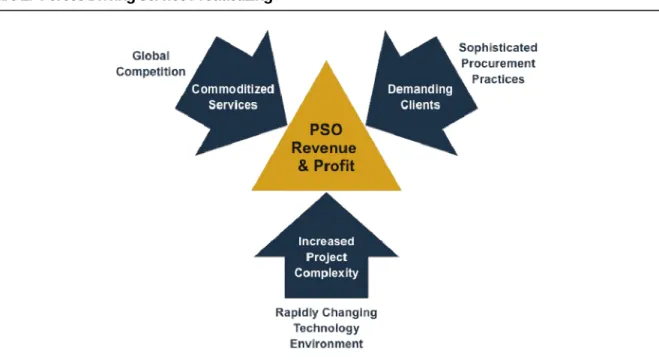
Service Performance Insight’s extensive market research and analysis of over 600 professional services organizations has identified three major forces driving PSOs toward service productizing.
1) Global competition
2) Clients’ increasing procurement sophistication 3) A rapidly changing technology environment
First, globalization and increased competition are exerting price pressure by commoditizing “cash cow” services like enterprise software implementation. Service providers are responding offensively and defensively by productizing their most frequently delivered services. Successfully productizing services not only protects revenue and margins, but can also provide the differentiation to increase them. Further, productizing services improves resource management. It provides a framework for new consultants to come up to speed quickly while freeing up experienced consultants for more complex, unique client problems.
Second, increased adoption of strategic sourcing and sophisticated procurement practices mean that clients are demanding more from all of their suppliers. Specifically, a PSO’s clients require clearly defined service descriptions, delivery process transparency, and confirmed project costs before they approve an engagement. “Open-ended” engagements – typically represented by time-and-expense priced work – are no longer palatable. The market has moved toward deliverables-based and fixed-price
engagements, shifting more accountability for successful outcomes to the service provider.
Third, the rapidly changing technology environment introduces more challenges to both PSOs and their clients. Clients have to meet both the quantitative business case of their projects and the promised qualitative improvements. And simultaneously they are required to operate with a leaner staff level. Project durations are reduced – despite increased technological complexity – to accelerate business value capture.
Shorter, faster, more iterative projects mean that professional service organizations engage in more sales cycles and win more projects to achieve targeted revenue and required margins. Successful projects today require PSOs to provide greater project governance with supporting tools to ensure quality while
remaining within budget.
Overall, PSOs are facing tremendous pressure to expedite and streamline their market approach with packaged service offers containing well-defined service delivery guidelines. Done right, productized services create lucrative new revenue and profit streams.
Figure 1: Forces Driving Service Productizing
Source: Service Performance Insight, June 2011
Service Productizing Defined
Most professional services organizations are already involved in some type of service packaging
initiative. Typically, when PSOs define service packages they limit the scope and therefore the impact of comprehensive service productizing.
For the purposes of this paper, service productizing will be “the process of delineating, building, deploying, and improving a clearly defined service process (product) to achieve operational improvements in support of an organization’s strategic objectives.”
A productized service has the following core attributes:
Defined service offering with supporting marketing material detailing value and client benefits Comprehensive sales playbook and PSO delivery guide
Clearly defined and bounded scope, assumptions, delivery process, tasks, roles and responsibilities, staffing requirements, duration, pricing structure, outcomes Standardized delivery method
Estimation and delivery tools that support the initiative Pre-defined deliverable templates
Embedded quality controls
Enforced feedback and continuous improvement
Productized services can be stand-alone, “fast start” offerings or they can be components of an overall service lifecycle methodology. An organization can offer productized service in one or hundreds of locations. Regardless of its reach, the service must possess the core attributes that make the training, sales, and delivery processes clear, consistent, and repeatable.
Further, a productized service demonstrates that the PSO has a consistent knowledge base and unique intellectual property. A productized approach shows the PSO has the skills to deliver the service within a pre-defined time and cost.
When professional services are not productized, they are less tangible and the benefits harder to define.
Taking Productizing to the Next Level: Managed Services
Professional services organizations are increasingly taking productized services to the next level by providing clients with managed service contracts. Managed service contracts are powerful tools for deepening client relationships and improving customer retention. These contracts can create a reliable, recurring revenue stream for the firm and improve its competitive position.
In the IT consulting sector, a firm can augment its project-based business with support agreements for software or hosting support, regular maintenance work, or upgrades of client systems. Management consulting firms can offer contracted services for executive coaching or a regular process audit review. At the heart of the managed service agreement is a contract specifying service terms, service level agreement, billing schedules, and any service inclusions or exclusions. Work associated with delivery of managed service contracts will incur costs, and will require resourcing, scheduling, management of escalations and delivery. Monitoring these variables to stay within the terms of the agreement ensures accurate and timely billing. This careful monitoring will also provide a clear understanding of the cost structure and risk exposure.
By developing standardized managed service offerings, the PSO develops a unique competency in the market. It generates long-term benefits by selling these repeatable services to multiple clients. To achieve the many benefits from managed services, a PSO depends on its internal systems. Without these systems in place, managed services cannot run efficiently. The reason PSOs implement an integrated business management system is to handle the entire operation from sales and project management, to service delivery, accounting, and billing.
Why Productize?
PSOs consider service productizing they face increased global competition, strategic sourcing adoption, and technological complexity.
Firms adopting a well-coordinated service productizing initiative gain a clearer understanding of how their skills support their service business strategy. By necessity, the process of service productizing drives clarity in the firms’ objectives and any existing competencies and skill gaps.
Adopting service productizing forces the firm to identify best reusable methods, tools, templates, and practices. This change helps provide consistent service execution, protecting reputation and quality. As PSOs expand internationally, this method is valuable to standardize separate country or regional processes that have developed for similar projects.
Service productizing has been proven to provide these benefits: Increased proposal to sales conversion
Increased reliability of estimates
More measurable performance from repeatable services Accelerated recruiting, hiring, and ramping
Ability to staff with less-experienced resources
Improved intellectual property value around methods, tools, and processes Superior project governance
Predictable costs, resources, time, and deliverables Reduced risk and improved consistency and quality Enhanced forecasting accuracy
Greater revenue recognition conforming to accounting standards
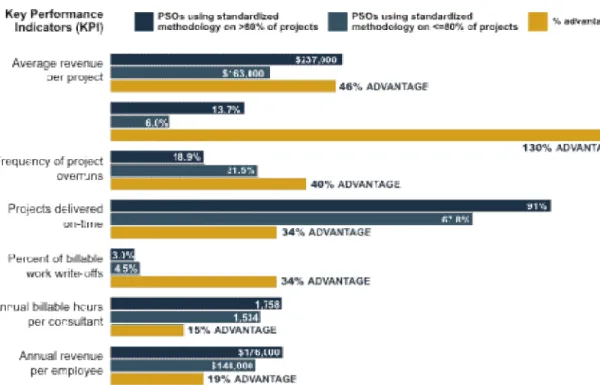
The following chart shows benefits of using a standard service delivery methodology. The data is based on SPI Research analysis of 235 independent PSOs with 10 - 700 employees.
Table 1: Benefits of Using Standard Service-Delivery Methods
Service Lifecycle Management Framework
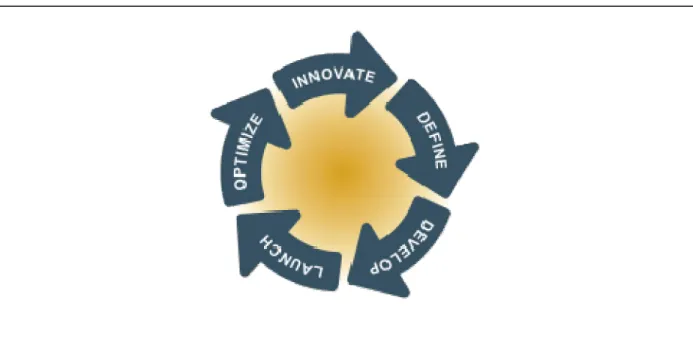
We have learned that no single method instantly creates high-quality service packages. Many service product development teams do not follow a service product development roadmap. To fill this void, Service Performance Insight has developed a five-phase, closed-loop Service Lifecycle Management framework to help manage the service productizing process.
Figure 2: SPI’s Service Lifecycle-Management Framework
Source: Service Performance Insight, June 2011
We find that service productizing is more successful when an organization uses a framework to
choreograph roles and responsibilities and define clear outcomes by phase. This approach leverages client knowledge with existing project plans. Speed and quality of service productizing improve with
experience. Each step outlines key decision points and deliverables that break the service productizing effort into its measurable and actionable components.
The five phases of service productizing are:
1. Innovate – Identify service productizing candidates; conduct research; analyze the market; fund the effort.
2. Define – Plan the overall effort; define requirements and content; design service productizing methods, tools, and processes.
3. Develop - Build service products based on best practices, consistent methodology, and tools; test assumptions.
4. Launch – Conduct beta test; assemble sales, marketing, and delivery documents; train sales and service professionals; execute sales and marketing campaigns; deliver with quality.
5. Optimize – Develop measurements and rewards; garner sales, PSO, and client feedback; identify areas for improvement. Propose significant changes and add-on services through the “Innovate” stage.
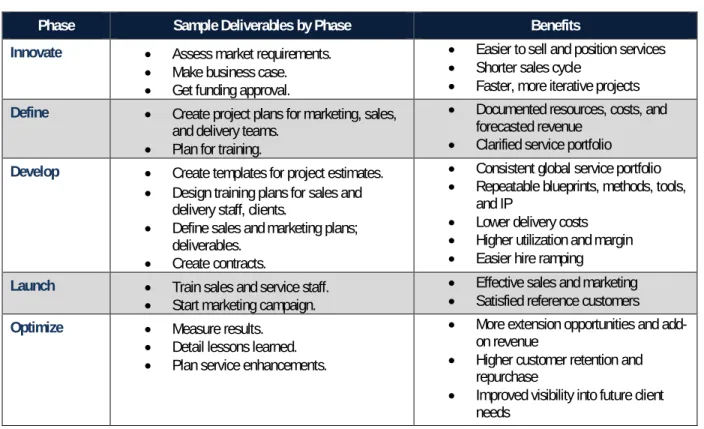
Table 2: SPI Service Lifecycle - Deliverables and Benefits
Phase Sample Deliverables by Phase Benefits
Innovate Assess market requirements.
Make business case. Get funding approval.
Easier to sell and position services Shorter sales cycle
Faster, more iterative projects
Define Create project plans for marketing, sales,
and delivery teams. Plan for training.
Documented resources, costs, and forecasted revenue
Clarified service portfolio
Develop Create templates for project estimates.
Design training plans for sales and delivery staff, clients.
Define sales and marketing plans; deliverables.
Create contracts.
Consistent global service portfolio Repeatable blueprints, methods, tools, and IP
Lower delivery costs Higher utilization and margin Easier hire ramping
Launch Train sales and service staff.
Start marketing campaign.
Effective sales and marketing Satisfied reference customers
Optimize Measure results.
Detail lessons learned. Plan service enhancements.
More extension opportunities and add-on revenue
Higher customer retention and repurchase
Improved visibility into future client needs
Source: Service Performance Insight, June 2011
Alignment is key
To succeed in productizing services, align your organization to ensure that each relevant function understands its role and obligations. When service organizations get serious about service productizing, the initiative can become the catalyst for an overall transformation. It can lead the entire organization to a better way of doing business. Service productizing creates a business model centered on delivering maximum client value in the least amount of time. The process can be supported by a system including financial and project management, knowledge management and collaboration tools.
Table 3: Service Productizing Teams and Measurements
Teams Roles Measurement
Executive and
Finance Set service vision and strategy Fund service productizing business plan Create, fund, and resource service productizing teams
Provide ongoing executive sponsorship, support, measurement, and compensation
Service strategy is well-understood and clearly communicated
Goals and measurements are in alignment Service productizing goals are achieved
Service Productizing Core
Develops the business case and business plan Defines and develops the service product portfolio
Inventories and selects IP, templates, and tools Develops pricing and contracts
Cost of service development Time-to-market
Effectiveness of service Development – speed, cost, quality
Content re-use Knowledge capture
Teams Roles Measurement
Marketing Works with executive and core teams to
develop the market requirements, business case, and business plan
Develops and executes the marketing plan
Percent of packaged services sold Better bid to win ratios
Larger pipeline
Higher customer retention and repurchase
Training Co-develops the sales and service delivery
training materials with the core team
Conducts sales, service delivery, partner, and customer training
Training effectiveness
Sales and delivery effectiveness
Field Provides field delivery experts to be part of the
core team
Selects and implements regional beta customers
Supports train-the-trainer program and ensures resource commitments
Supports launch, actively sells and delivers service products
On-time, on-budget project completion Lower project delivery costs, higher utilization, better margins
Improved project delivery quality
More extension and upgrade opportunities; add-on revenue
Source: Service Performance Insight, June 2011 Productized Service STEPS
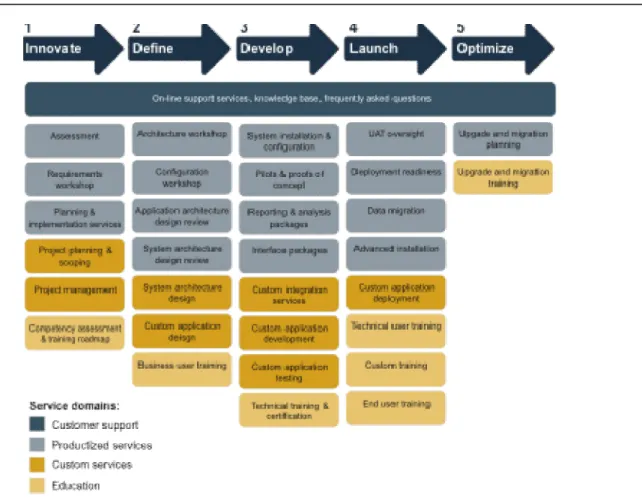
The following chart represents a five-phase service solution delivery method. The chart illustrates how components have been productized after the entire service lifecycle method was established and field-proven with many client projects.
Start with productizing training. Then package client workshops and surveys that can be effectively integrated with the sales through delivery process. This approach will enable less-experienced PSO resources to deliver services under the quality assurance guidance of senior PSO resources.
These packaged services incorporate all core attributes, including contract templates to execute a legal agreement.
A “fast start” package assumes that only “out-of-the-box” deliverables can be completed within a shorter timeframe than a typical full solution delivery.
Figure 3: Service Productizing Example
Source: Service Performance Insight, June 2011
Common Failure Points
To reap the benefits of productized services, a PSO should spend plenty of time in the “innovate” and “define” stages of the process. The risks of failure are high without critical support, tools, and cross-functional participation.
The most common pitfalls we have observed have resulted in poor results or complete failure of a service productizing initiative:
1. Inadequate executive sponsorship 2. Insufficient market analysis 3. Underdeveloped business case 4. Lack of competitive differentiation
5. No sales, marketing, training, or launch plan 6. Unrealistic scope, time, and budget
7. Insufficient resources or inadequate competencies 8. No beta or reference customers
9. No feedback or measurement systems or quality controls 10. No repeatable methods, tools, IP, or plan for re-use
11. No understanding and appreciation for required organizational change
A successful productized service initiative can deliver improved service performance, make more profitable internal investments, improve overall operations, and deliver value to its clients.
Conclusions
Global competition, a more sophisticated client base, and a rapidly changing technology environment will increase pressure on professional services revenue and margin. Aside from responding to these external forces, productized services deliver many benefits. An organization can gain sales differentiation,
repeatable quality service delivery, increased financial and operational predictability. Productized services provide tangible value to your clients and your firm. Predictable quality and results improve your
reputation and the increase the probability that your firm will be selected for future work.
By productizing services, the PSO can better prioritize the creation, management, and improvement of its services portfolio. Marketing can build the appropriate materials to do a better job of defining and selling the services offering. Contracts can be tightened and service level agreements considered. Accounting and finance can more easily and efficiently determine cash flow, revenue, and profits. The consulting
organization can better plan and schedule the workload to deliver high utilization, high quality, and repeatable business.
About Service Performance Insight
Jeanne Urich, Service Performance Insight Managing Director, provides strategic consulting, research and operational advice to improve and transform service and project-oriented organizations. She is a thought leader and recognized expert in Professional Services.
She is the co-author of the ground breaking Professional Service Maturity Model benchmark used by over 4,000 project-oriented organizations to diagnose and improve their performance. www.spiresearch.com. She is a featured speaker and author for major software solution providers and industry associations.
She has a BA in Math and Computer Science (Magna Cum Laude and Phi Beta Kappa) from Vanderbilt University and completed Executive Management programs in Marketing and Finance at Stanford and Brown University.
Contact Jeanne at [email protected] – Phone: (650) 342-4690.
Dave Hofferberth, Service Performance Insight Managing Director, has over 25 years’ experience in information technology (IT) serving as an industry analyst, product director and consultant. Hofferberth’s research is focused on the services economy, and in particular, on white-collar productivity issues and the technologies that help people perform at their highest capacity.
Hofferberth’s background is extensive in services performance beginning in the early 1980’s, where he conducted studies on white-collar productivity in the banking, technology, energy and construction sectors.
Hofferberth earned an MBA from Duke University and a BS in Industrial Engineering from the University of Tennessee. He is also a licensed Professional Engineer (PE).
Contact Dave at [email protected] – Phone: (513) 759-5443
Carey Bettencourt is a management consultant who specializes in improvement and transformation for project-driven professional service organizations. She is an experienced change management leader, expert in helping clients develop high performing teams that deliver increased utilization, profit and customer satisfaction. Carey also helps PS organizations identify, clarify, and create integrated communication, marketing, and product offerings that drive market differentiation and increased sales.
Carey has over 20 years domestic and international experience with leading software companies. She was a corporate officer and the senior vice president of the customer solutions organization at Accruent, the top-ranked professional services organization for three consecutive years according to the SPI Research Maturity benchmark. Carey was also a vice president at software firms ChannelPoint and Vroom Technologies responsible for professional services, education, support, strategic alliances, and hosting services. She previously held consulting practice, business development, and strategic alliance leadership roles at Oracle and J.D. Edwards.
Carey earned a Bachelor of Arts in Economics from UC Berkeley and an MBA from Pepperdine University.
Service Performance Insight (SPI Research) is a globally focused research and consulting firm specializing in business improvement and transformation for service-oriented companies. SPI uses its industry standard Professional Services Maturity Model™ to help service organizations assess and prioritize their service improvement and transformation plans. The firm closely follows professional services organizations (PSOs), independent software vendors (ISVs) and other technology providers, analyzing how organizations best use technology to make their people more productive and profitable. SPI Research pays particular attention to the integration of the three key assets of a PSO: its people, (business) processes and capital. SPI Research’s annual Professional Services Maturity™ Benchmark is used by more than 5,000 companies to measure and improve their operations.