
Implementing Statewide
Transfer & Articulation
Reform
An Analysis of Transfer Associate Degrees
in Four States
By
Carrie B. Kisker
Richard L. Wagoner
Arthur M. Cohen
Center for the Study of Community Colleges
April 2011
Center for the Study of Community Colleges Report #11-1 © Center for the Study of Community Colleges. Material may be duplicated with full attribution.
Contents
Executive Summary iii
Introduction 1
Elements of Effective Transfer Associate Degrees 2
A Common General Education Package 3
Common Lower-Division Pre-Major and Early Major Pathways 3
A Focus on Credit Applicability 3
Junior Status upon Transfer 3
Guaranteed and/or Priority University Admission 4
Associate and/or Bachelor‘s Degree Credit Limits 4
Acceptance Policy for Upper-Division Courses 4
Chronology of Four Statewide Processes 5
Arizona 5
New Jersey 6
Ohio 7
Washington 7
Findings 9
Legislative Action as Driver 9
Presidential Leadership and Statewide Governance/Coordination 11
Clear, Ongoing Organizational Structure 12
The Autonomy/Efficiency Balancing Act 15
Building Trust and Allaying Fears through Faculty-Driven Processes 20
Early Positive Outcomes 22
The Road Ahead 26
Implications & Recommendations 29
About the Authors 31
About the Center for the Study of Community Colleges 32
Implementing Statewide Transfer & Articulation Reform:
Executive Summary
In recent years, the federal government and several major philanthropic organizations have focused attention on the need to dramatically increase the number of bachelor‘s and other postsecondary degrees in order to retain the United States‘ economic competitiveness in a global marketplace. Improving what is often a complex community college-to-university transfer process, many analysts argue, is key to improving bachelor‘s degree production. Thus, over the past few years, several states have engaged in systemic transfer and articulation reforms, creating transfer associate degrees that allow students to both earn an associate degree and transfer seamlessly into a state university.
The purpose of this project—which was generously funded by the Bill & Melinda Gates and Walter S. Johnson Foundations—was to examine the development of transfer associate degrees in four states: Arizona, New Jersey, Ohio, and Washington. We utilized case study analysis (including site visits, analysis of relevant documents, and roughly 60 in-depth qualitative interviews) in order to describe implementation strategies that may be utilized in states that are currently embarking on or planning for systemic transfer reforms.
Transfer associate degrees can be understood as a grouping of seven curricular and policy-related elements. The first four, listed below, are essential to the creation of significant statewide improvements in transfer and articulation. The final three elements are also important but may be more or less necessary, depending on each state‘s unique history, policy goals, capacity issues, and the academic cultures and traditions of its institutions. 1. A common general education (GE) package
2. Common lower-division pre-major and early-major pathways 3. A focus on credit applicability
4. Junior status upon transfer
5. Guaranteed and/or priority university admission 6. Associate and/or bachelor‘s degree credit limits 7. An acceptance policy for upper-division courses
In the pages that follow we summarize the five primary themes that emerged from our data, as well as early positive outcomes and the likely future of transfer associate degrees. We conclude with implications of this study and recommendations for those advocating or developing similar transfer reforms in other states.
Legislative Action as Driver
Legislation plays an important role in systemic transfer and articulation reform, both through initial mandates or threats to create statewide policies and programs, and in applying pressure to employ them in a timely manner. However, if transfer and articulation legislation is to be effectively implemented, it is essential to limit its provisions to broad, statewide expectations, leaving more specific details related to curriculum development and institutional policy to inter-segmental faculty and administrative committees.
Presidential Leadership and Statewide Governance/Coordination
Presidential and/or top-level system leadership and support is critical to the successful implementation of transfer associate degrees. Presidents, in particular, have both symbolic and hierarchical value, allowing them to support and encourage involvement in transfer reforms across the state and among members of their staff. Leadership and support by statewide governing or coordinating boards is also useful in the development of transfer associate degrees, but successful implementation does not depend on the specific type of statewide structure in place.
Clear, Ongoing Organizational Structure
A clear and ongoing organizational structure that assigns responsibility for each aspect of the implementation process to the group that is best suited to manage it is critical for developing transfer reforms, dealing with policy and administrative issues as they arise, and ensuring awareness, buy-in, and compliance among members of the higher education community.
The Autonomy/Efficiency Balancing Act
The process of implementing transfer associate degrees essentially boils down to a balancing act between autonomy/freedom and efficiency, student centeredness, and the common good. The four states in our analysis have balanced these values in various ways. For example, basing course equivalency on learning outcomes focused Ohio faculty on the essential competencies required for upper-division study while allowing for variation in how and by whom courses are taught.
Building Trust and Allaying Fears through Faculty-Driven Processes
Facilitating disciplinary conversations among two- and four-year faculty and implementing processes for periodic review of transfer curricula and courses are critical in moving participants past their own institutional or disciplinary silos and creating efficient, student-centered transfer systems.Early Positive Outcomes
While more information collected over longer periods of time will be needed to make definitive statements about the impact of transfer associate degrees on the efficiency and cost effectiveness of state higher education systems, recent outcomes data from the four states under review suggest that the degrees may indeed lead to greater system efficiency and increased cost savings. Indeed, the following early outcomes are closely aligned with the policy goals and expected benefits of systemic transfer and articulation reform:
1. Greater flexibility and more options for transfer students (AZ, NJ, OH & WA) 2. Improved transfer rates (OH & WA)
3. Transfer students are better prepared for upper-division work (AZ & OH) 4. Improved degree completion (OH & WA)
5. Reductions in time- and credits-to-degree (AZ & WA) 6. Cost savings for students and the state (OH)
The Road Ahead
Based on early positive outcomes, Arizona, New Jersey, Ohio, and Washington are all looking forward to ways in which they may extend or improve their transfer and articulation systems. These and other states implementing transfer associate degrees will likely face the following challenges in the years ahead:
1. Marketing newly-developed transfer associate degrees to students, parents, faculty, and advisers in order to improve participation rates among community college students. 2. Utilizing technological solutions such as web-based advising and degree planning tools,
electronic management systems, and/or electronic transcript delivery systems that can be used by all institutions within a state.
3. Involving K-12 educators in transfer discussions and/or thinking about how college readiness is and should be related to statewide transfer policies.
4. Resolving capacity constraints at certain public universities and within popular degree programs.
5. Maintaining and improving statewide transfer pathways in the current era of reduced funding for public higher education.
Implications & Recommendations
The early positive outcomes described in this report will be especially useful to policymakers and system leaders who are advocating for the development or further implementation of statewide transfer and articulation reforms. Perhaps equally important to those executing the reforms, however, are those findings that identify key aspects of the implementation process itself. To both groups we offer the following recommendations:
Use legislation to incent or compel the implementation of systemic transfer reforms.
Ensure leadership and buy-in among college and university presidents, as well as statewide governing or coordinating agencies.
Implement a clear and ongoing organizational structure.
Articulate a common goal and shared understanding of why it is important to engage in systemic transfer reform.
Strive for a balance between autonomy/freedom and efficiency, student centeredness, and the common good.
Use learning outcomes to determine course equivalency.
Implement processes for reviewing and revising transfer degrees to ensure relevancy with evolving curricula.
Market transfer associate degrees to students and advisers early in the implementation process.
Explore how technology may facilitate systemic transfer and articulation reform.
Incorporate K-12 educators and/or college-readiness standards into statewide transfer and articulation conversations.
Use transfer associate degrees to help resolve institutional and programmatic capacity issues.
Seek alternative funding scenarios for implementing, maintaining, and/or improving transfer associate degrees.
Continue gathering and publicizing data related to the ability of transfer associate degrees to improve system efficiency, increase postsecondary degree completion, and generate cost savings.
Introduction
In recent years, the federal government and several major philanthropic organizations have focused attention on the need to dramatically increase the number of bachelor‘s and other postsecondary degrees in order to retain the United States‘ economic competitiveness in a global marketplace. Improving what is often a complex and confusing community college-to-university transfer process, many analysts argue, is key to improving bachelor‘s degree production, as only a small proportion of community college students (25-35%, depending on the parameters used to define the likely transfer population) successfully move on to a four-year institution. And, as scholars have pointed out, even when students do transfer, some do so with a significant number of credits that do not apply toward a bachelor‘s degree, and many others make the transition without completing the full lower-division transfer curriculum or before earning an associate degree.i These patterns are costly, both
to states and their students.
Thus, over the past few years, several states have engaged in systemic transfer and articulation reforms, creating statewide pathways or degree programs that allow students to both earn an associate degree and transfer seamlessly into a state university with junior status. Although most of the states that have implemented transfer associate degrees have done so relatively recently, positive outcomes—both in terms of greater system efficiency and increased cost savings—have already been documented (see pages 22-25 of this report). Indeed, transfer associate degrees have emerged as an effective way of significantly improving transfer and articulation, in the process increasing the number and percentage of bachelor‘s degree recipients within states and across the nation.ii
The purpose of this project—which was generously funded by the Bill & Melinda Gates and Walter S. Johnson Foundations—was to examine the political processes, actors, and associations involved in systemic transfer and articulation reforms in four states in order to describe implementation strategies that may be successfully utilized in states that are currently embarking on or planning for similar reforms.
A brief side note: Throughout this report we repeatedly use the terms ―statewide or systemic transfer reforms‖ and ―transfer associate degrees.‖ The former refers to various initiatives that attempt to establish statewide transfer and articulation policies, pathways, or degrees with the aim of increasing system efficiency and cost effectiveness. The latter refers to specific statewide transfer degrees or pathways that allow students to both earn an associate degree and transfer seamlessly into a four-year college or university with junior status. (These degrees are known by different names in different states, but for the purposes of clarity, we refer to all of them as transfer associate degrees.) Although we acknowledge that transfer associate degrees are only one vehicle for reforming transfer and articulation on a statewide basis, we use the two terms relatively interchangeably throughout this document, as these degrees are the most comprehensive (and may be the most effective) approach to systemic transfer and articulation reform.
Transfer associate degrees have been implemented in at least 8 states, including Arizona, Florida, Louisiana, New Jersey, North Carolina, Ohio, Oregon, and Washington. California is currently in the process of developing these degrees, and other states—such as South Carolina—are considering doing the same. Several more states, such as Texas, have created common general education curriculums in order to ease the transfer of students from community colleges to four-year institutions but have not yet implemented the other components of transfer associate degrees.
Our analysis of the implementation of transfer associate degrees focused on processes in four states: Arizona, New Jersey, Ohio, and Washington. We selected these four primarily because all of them implemented key components of their transfer associate degrees within the past 2-15 years, making it more likely that the political environments and processes used to enact the reforms are relevant to those in place across the nation today. Furthermore, we chose states that have diverse governance structures, faculty associations, capacity issues, and experiences with systemic transfer reforms to ensure that our findings and recommendations are as widely applicable as possible. Although the majority of these states implemented transfer associate degrees prior to the Great Recession, all are struggling to maintain and improve their processes in the current era of reduced state support and higher tuition and fees.
To examine the political processes, actors, and associations involved in implementing transfer associate degrees, we conducted multiple case studies, using within-state and cross-case analyses to identify strategies and processes that may be successfully utilized in states engaged in or considering similar reforms.iii The case studies involved site visits,
analysis of relevant documents, as well as roughly 60 in-depth qualitative interviews with policymakers, system leaders, college presidents and key administrators, faculty, and others involved in implementing these initiatives. Interview questions focused on the formal and informal processes used to develop, implement, and maintain transfer associate degrees, including: which groups were brought on board and in what order, whether legislation was necessary to compel implementation, how faculty and institutional autonomy were addressed, whether incentives were used, how the initiatives were funded, how the reforms have been maintained in an era of declining resources, if and how a coordinating body was involved, how capacity issues have been addressed, and so forth. Interviews took place in person or over the telephone, and were transcribed verbatim prior to inductive coding and analysis.
Elements of Effective Transfer Associate Degrees
Transfer associate degrees can be understood as a grouping of seven curricular and policy-related elements: 1) a common general education (GE) package; 2) common lower-division pre-major and early-major pathways; 3) a focus on credit applicability; 4) junior status upon transfer; 5) guaranteed and/or priority university admission; 6) associate and/or bachelor‘s degree credit limits; and 7) an acceptance policy for upper-division courses.
The first four elements, with one exception, have been implemented in all four states under review, and we believe that they are essential to the creation of significant statewide improvements in transfer and articulation. The final three elements are also important but may be more or less necessary, depending on each state‘s unique history, policy goals, capacity issues, and the academic cultures and traditions of its institutions.
A Common General Education Pattern
All four of the states included in this analysis—as well as several others throughout the nation—have created general education (GE) packages or modules that are common across the state‘s community colleges, and that transfer en bloc to the public universities. These GE packages are accepted in lieu of the receiving institution‘s own GE pattern, providing students with a set of GE classes that is portable anywhere in the state. A common GE package is the foundation upon which transfer associate degrees are built.
Common Lower-Division Pre-Major and Early-Major Pathways
Although New Jersey has yet to incorporate common lower-division pre-major and early-major pathways into its statewide transfer policy, Arizona, Ohio, and Washington have all developed these sequences in various disciplines. Because common lower-division major pathways are guaranteed to apply toward the major at receiving universities, they are widely viewed as key to reducing excess credits and improving time-to-degree among transfer students. They also provide students with greater flexibility to transfer anywhere in the state within their program of study; this is especially important in popular or overenrolled programs.
A Focus on Credit Applicability
For transfer associate degrees to be successful in improving transfer and articulation on a statewide basis, policymakers and educators implementing the degrees must move beyond consideration of course transferability and focus instead on how credits will apply to specific academic and degree requirements at receiving institutions. This is especially important when developing those courses or sequences that will apply toward a student‘s major. Ideally, two- and four-year faculty can work together to agree upon common lower-division pathways that can transfer and apply seamlessly at all public universities in a state. In practice, however, enacting common lower-division sequences, especially in the major, can run counter to long-held traditions of institutional autonomy and academic freedom. While (as this report demonstrates) the latter does not preclude the former, honoring the values of autonomy and freedom, as well as those of efficiency, student centeredness, and the common good requires a delicate balancing act.
Junior Status upon Transfer
The assumption that transfer associate degrees will apply toward a student‘s program of study at receiving universities leads directly to the requirement, in place in all four states under review, that students transferring with these degrees be automatically granted junior status, with all of the rights and privileges such status typically entails (for example, priority registration over lower-division students). Furthermore, these students should be
considered for scholarships and/or acceptance into specific degree programs on the same basis as native university students. Automatic conferral of junior status upon transfer thus incents students to complete the full lower-division curriculum at a community college, and helps to ensure that—barring changes in major—students can complete a baccalaureate in the standard amount of time and credits.
Guaranteed and/or Priority University Admission
Guaranteed and/or priority university admission for students with transfer associate degrees removes incentives for students to transfer prior to earning an associate degree, and instead rewards degree completion. Furthermore, such policies ensure that students are well-prepared for upper-division study in their major. Most states with a guaranteed admissions policy—Arizona, Ohio, and Washington, for example—certify that transfer associate degree holders with at least a 2.0 grade point average will be granted admission somewhere within the state, but not necessarily to any particular university or degree program, allowing institutions to set their own admissions standards. Transfer associate degree recipients in Ohio also receive priority admission over out-of-state associate degree graduates and transfer students, and Washington gives students with transfer associate degrees priority consideration over non-degreed transfers.
Associate and/or Bachelor’s Degree Credit Limits
All but one of the states we examined have instituted limits on the number of units that can be counted toward a transfer associate degree, and several also limit the number of credits in a bachelor‘s degree. For example, New Jersey‘s Comprehensive State-Wide Transfer Agreement states that transfer associate degree recipients will have completed exactly half of the units required for a bachelor‘s degree, and that universities must graduate transfer students within the same number of upper-division units. Similarly, transfer associate degrees in Arizona can include one-half of bachelor‘s degree requirements (typically 120 semester credits) plus one course, and in Washington, the transfer associate degree is based on 90 quarter-hours of transferrable credit, although transfer students may take one additional term above this limit at a community college. These credit-limit policies help to reduce course overlap and improve time-to-degree among transfer students.
Acceptance Policy for Upper-Division Courses
Some states have also written policies regarding the transferability and applicability of upper-division coursework into their statewide transfer policies, although the intent of these policies varies widely among the four states we examined. For example, The Ohio Articulation and Transfer Policy affirms that if a course completed as part of the lower-division curriculum at the sending institution (typically a community college) is deemed equivalent to an upper-division course at the receiving institution, it will be counted as upper-division credit. By contrast, New Jersey‘s policy states that, ―by definition, 300- and 400-level courses at four-year institutions have no course equivalents at the community colleges.‖iv Policies regarding the acceptance of upper-division courses may be especially
necessary in states struggling with university capacity issues and/or those where a significant number of students do not live in geographic proximity to a four-year university.
Chronology of Four Statewide Processes
The following is a brief illustration of the development of systemic transfer and articulation reforms in Arizona, New Jersey, Ohio, and Washington.
Arizona
1980 – Discipline-specific Articulation Task Forces, comprised of faculty representatives from all of Arizona‘s community colleges and universities, begin meeting annually to develop, maintain, and improve various articulation tools.
1992 – The Transfer General Education Core Curriculum (TGECC) attempts to move beyond course-by-course articulation by creating a 41-hour block of courses that would meet the lower-division GE requirements at any of the state‘s three public universities. 1996 – Arizona‘s legislature adds a footnote to the annual appropriations bill requiring the
Arizona Board of Regents and the State Board of Directors for Community Colleges to jointly establish a committee (the Transfer Articulation Task Force) to create ―a seamless statewide articulation and transfer system, including the process for transfer of lower-division general education credits and curriculum requirements for the majors, with the objective of reaching consensus on an agreement that assures that community college students may transfer to Arizona public universities without loss of credits toward a baccalaureate degree.‖v
1996 – The Transfer Articulation Task Force presents a report to the legislature proposing a revised 35-credit common GE package (called the Arizona General Education Curriculum, or AGEC); a minimum of 6 common lower-division credits within equivalent majors (to be developed by the discipline-based Articulation Task Forces); and credit limits for transfer associate degrees. The Task Force report also asserts that students who complete the GE package and/or a full transfer associate degree shall be able to transfer their courses en bloc to any public university in the state. Finally, the Task Force report establishes a policy oversight structure led by the Academic Program Articulation Steering Committee (APASC) and the Joint Council of Presidents.
1998 – APASC approves a policy related to the transfer of lower- and upper-division credits. 2000 – The Joint Legislative Budget Committee approves an APASC initiative to require
institutions making changes to their GE curriculum to consider its effects on transfer and articulation.
2003 – The State Board of Directors for Community Colleges is abolished, with little effect on transfer and articulation reform in the state.
2009 – The Maricopa to ASU Pathways Program (MAPP), a prescribed sequence of courses at a Maricopa Community College that meets the lower-division requirements for an Arizona State University major, is implemented. This program and the ones that follow with other community colleges (called Transfer Admission Guarantees or TAGs) improve course applicability and provide guaranteed admission for pathway completers, but limit progress toward statewide lower-division major pathways. 2010 – APASC, as well as a subcommittee called the Consortium for Transfer and Alignment,
are reorganized to include representatives from the K-12 sector.
2010 – APASC approves a new associate of applied science to bachelor‘s of applied science transfer pathway.
2011 – APASC creates a position for a marketing and communications analyst to better promote the state‘s transfer associate degrees and pathways.
New Jersey
1997 – A statewide committee of community college faculty and staff develops A General Education Foundation for Associate in Arts, Associate in Science, Specialized Associate, and Certificate Programs in New Jersey’s Community Colleges, the first common GE package to be utilized across the state‘s county colleges.
2007 – Assembly Bill 3968 (nicknamed the ―Lampitt Bill‖ after its primary sponsor) unanimously passes both houses of the legislature. The Lampitt Bill requires that all public institutions of higher education enter into a collective statewide agreement providing for seamless of transfer of credits from a completed associate degree program to a baccalaureate degree program.
2007 – With input from their four-year colleagues, a committee of community college faculty revises and reaffirms the General Education Foundation document and begins evaluating courses for inclusion in the common GE package. The county colleges also begin statewide discussions about common tests and cut scores for placement into developmental education.
2008 – Per the Lampitt Bill, the New Jersey Presidents‘ Council adopts the Comprehensive State-Wide Transfer Agreement, which recognizes the county colleges‘ common GE package and states that: ―An A.A. or A.S. degree from a New Jersey Community College will be fully transferrable as the first two years of a baccalaureate degree program at New Jersey public four-year institutions.‖vi
2010 – The New Jersey Presidents‘ Council begins convening discipline-based groups of two- and four-year faculty in the northern and southern regions of the state in order to discuss common pre-major and early major courses.
Ohio
1988 – The Ohio legislature calls for a commission to examine barriers to credit transfer among public institutions of higher education.
1990 – The Ohio Board of Regents adopts the Ohio Articulation and Transfer Policy, which establishes the principles of equitable treatment among transfer and native students and encourages associate degree completion prior to transfer.
1990 – Ohio‘s colleges and universities develop the Ohio Transfer Module, consisting of 36-40 semester hours of GE courses common across all public institutions. The Transfer Module includes a guarantee that all GE credits can be transferred and applied at other public institutions in the state.
1990 – The Ohio Board of Regents creates an Articulation and Transfer Advisory Council consisting of representatives from each of the state‘s public colleges and universities. 2000 – The Articulation and Transfer Advisory Council‘s Impact Subcommittee recognizes persistent campus-level barriers to student mobility, and the General Education and Applied Degree Subcommittee calls for greater transfer of credits beyond the core GE curriculum.
2003 – House Bill 95—which stemmed from discussions among institutional leaders, state lawmakers, and the Board of Regents—mandates the development of Transfer Assurance Guides, which are common lower-division pre-major and early major pathways that can be transferred and applied at any public institution in the state. Students completing both a Transfer Assurance Guide and the Ohio Transfer Module are now guaranteed admission to a public university in the state. Since 2003, over 600 two- and four-year faculty have participated in the development, review, and approval of Transfer Assurance Guides in approximately 40 disciplines.
2005 – House Bill 66 requires the establishment of criteria and practices for turning specific technical courses into college credits and mandates the development of Transfer Assurance Guides in certain technical or applied fields.
2009 – Authority for adult career-technical programs is shifted to the Ohio Board of Regents, enabling the development of 17 career-technical Transfer Assurance Guides. vii
Washington
1986 – The Washington Higher Education Coordinating (HEC) Board establishes a policy on inter-college transfer and articulation among public colleges and universities (known as the ―Umbrella Policy‖). The Umbrella Policy recognizes the Inter-College Relations Commission, a permanent articulation and transfer committee comprised of representatives from the community colleges, the baccalaureate institutions, the HEC Board, and the State Board for Community and Technical Colleges.
1990 – The HEC Board adopts the Cooperative Student Transfer Process which gives admission priority at public baccalaureate institutions to resident transfer students who can no longer progress toward their goals at a community college. In practice, this meant that students with an associate degree were guaranteed admission to any public baccalaureate institution in the state.
1992 – The Transfer Task Force, a cooperative effort between the state‘s public colleges and universities, is created to address the increasing number of students prepared for transfer as well as university claims that admission of all associate degree holders will limit enrollment for freshmen students.
1994 – The HEC Board approves the Transfer Task Force‘s recommendations to develop a Direct Transfer Agreement (essentially a transfer associate degree organized around a common GE core), as well as ―proportionality‖ agreements that set aside a pre-determined percentage of enrollment slots at each public university for transfer students. The proportionality agreements thus alter the original transfer degree guarantee: students who have earned an associate degree are now guaranteed access to a public institution in the state, but not necessarily to a specific university or degree program.
1997 – The HEC Board approves the development of specialized transfer associate degrees in the sciences (called Associate of Science-Transfer Degrees).
2003 – The Joint Access Oversight Group (JAOG)—consisting of senior administrators from public and private universities, community colleges, and higher education coordinating agencies—is established to consider statewide transfer policies and strategies.
2003 – JAOG develops specialized Direct Transfer Agreements for pre-business majors, followed by transfer associate degrees for students intending to become secondary science or math teachers.
2004 – The Revised Code of Washington is amended to request the development of transfer associate degrees in nursing, elementary education, and engineering during the 2004-2005 school year, as well as additional degrees each year thereafter. This leads to the development of Major-Related Programs (common lower-division pre-major and early major pathways jointly developed by two- and four-year faculty) in these and other disciplines. Since 2003, Washington has implemented 19 Major-Related Programs, all of which rest on the common GE courses outlined in the Direct Transfer Agreement or included in an Associate of Science-Transfer degree.
Findings
Despite significant differences in the ways systemic transfer and articulation reforms emerged in the four states included in this analysis, we found much commonality in the processes used to implement transfer associate degrees. In the pages that follow, we discuss five themes that emerged from our data, as well as early positive outcomes and the likely future of transfer associate degrees. These findings have important implications for the development of systemic transfer and articulation reforms in other states.
Legislative Action as Driver
Legislative action was the primary driver of large-scale systemic transfer and articulation reform in all four states under review. In Washington, the threat of legislative action was enough to spur collaboration among two- and four-year institutions in creating transfer associate degrees. In the other three states, actual legislation (or in Arizona‘s case, a footnote in the annual appropriations bill) mandated the development of these degrees or their component parts.
In several of the states, community colleges had been pushing for these types of systemic transfer reforms for quite some time, while the public universities preferred to develop transfer policies without legislative interference. As one New Jersey university administrator explained, ―A couple of the more aggressive advocates from the community colleges went to the legislature to get legislation. And the New Jersey Presidents‘ Council… took a position that they really should get ahead of this issue, that it was an academic issue, and it didn‘t really belong in the legislature and that we didn‘t want the legislature kind of telling us what had to be done. And the legislature, because that‘s what they like to do, nevertheless went ahead and [passed a bill].‖ A similar story unfolded in Arizona. After conducting a study that showed multiple problems and obstacles in transfer from community colleges to the three state universities, a former community college administrator:
…decided to call a meeting with the presidents of the universities… and they basically denied that we had a problem…. So we met, and the [community college] presidents said, ―What do you want to do?‖ I said, ―I don‘t think we have any choice. We go to the legislature with this.‖ And I went up, and [gave] my testimony, and we had given them copies of the report, and they all sat there, and it was real quiet, and they were looking and not saying anything, and I thought: ―Well, looks like the universities got to these folks too.‖ Then they started, one right after another. One woman said, ―I‘ve been in this legislature for 22 years, and I‘ll be darned if that the most complaints I get is about the articulation between community colleges and universities.‖ And it went right around like that.
Anecdotal reports about obstacles to seamless transfer and articulation seemed to provide a powerful impetus for state legislators to write (or threaten) legislation mandating systemic transfer reforms. The New Jersey legislator who sponsored the bill mandating transfer associate degrees reinforced this perception: ―And I did hear basically over and over again as I was on the campaign trail, because I was going to be focused on higher education issues, stories from various people who said, ‗I went to try to transfer my credits, and I had to take a class over again….‘ When I got to the legislature… I codified it and made it a bill. Did the right thing.‖
In addition to powerful anecdotal reports, it is clear that an uncertain fiscal climate and a desire for greater efficiency and cost effectiveness in public higher education also influenced legislation pertaining to transfer associate degrees. As one Ohio community college administrator related: ―So, the climate was money was getting tight, and the state legislature said, ‗We‘re paying for these classes through subsidy once at a public institution. We don‘t really want to pay for them a second time, and we don‘t think we should have to.‘‖ In all four states under review, transfer associate degrees were developed with the expectation that they would improve system efficiency (i.e., reduce barriers to seamless transfer and minimize excess time- and credits-to-degree), as well as increase cost effectiveness (the state would no longer have to pay for twice for similar courses). Furthermore, in all four states it was expected that transfer associate degrees would incent more students to begin their postsecondary study at a community college and complete an associate degree prior to transferring to a higher-cost institution. (Many of these benefits are already being realized; see pages 22-25).
In all four states, legislative involvement in transfer reform was lamented even as interviewees acknowledged that little would have been accomplished without it: ―I think many of us—myself included—would have preferred not to have it legislated. But you can‘t deny the fact that if it weren‘t for the legislative initiative, we wouldn‘t have developed the agreement that we now have‖ (New Jersey community college administrator). In particular,
the sense that state legislators were monitoring the development of transfer associate degrees—and that they would not hesitate to introduce follow-up legislation if they were not happy with the progress being made—was extremely effective in maintaining momentum, and in bringing recalcitrant faculty and administrators into the fold. As a former Arizona university administrator recalled, ―Frankly, what helped the most was pressure from the public and from the legislature…. Just knowing that we were being watched and that we were being asked, essentially, to keep the best interests of the state of Arizona in mind, rather than our own colloquial concerns. We knew that there were watchdogs.‖ A New Jersey higher education official echoed this sentiment: ―I think the big fear was if we didn‘t get it done to a pretty high degree, the legislature was going to be even more prescriptive.‖ While educators typically detest legislative involvement, it is clear from this study that legislation plays an important role in systemic transfer and articulation reform, both through initial mandates or threats to create statewide policies and programs, and in applying pressure to employ them in a timely manner. However, if transfer and articulation legislation is to be effectively implemented, it is essential to limit its provisions to broad, statewide expectations, leaving more specific details related to curriculum development and institutional policy to inter-segmental faculty and administrative committees.
Legislation plays an important role in systemic transfer and articulation reform, both through initial mandates or threats to create statewide policies, and in
Presidential Leadership and Statewide Governance/Coordination
In all four states under review, presidential and/or top-level system leadership and support was critical to the successful implementation of transfer and articulation reforms. College and university presidents, in particular, are not only in a position to support and encourage their staff‘s involvement in the development of transfer associate degrees (and compliance with related policies and programs), but they also have significant influence across the state, allowing them to exert pressure on their peers and other policymakers and educators. In other words, presidential leadership and support for transfer associate degrees has both hierarchical and symbolic value. In the words of an Ohio university administrator:
I really appreciate… how important it was to have two individuals representing the two sectors [on the implementation committee]. Presidents who were so committed to make this work that through their sheer determination and their collaborative spirit they became role models for how the state should function and how the rest of the system should function….I think that sends a message that from the very highest level of academia that there‘s a commitment to this.
Leadership and support by statewide governing or coordinating boards is also useful in the implementation of transfer associate degrees. In Arizona, Ohio, and Washington, governing or coordinating agencies applied the necessary pressure to compel faculty and administrators to participate in the development of systemic transfer reforms. In Washington and Ohio, these agencies also supplied crucial staff support for faculty disciplinary committees working to develop common lower-division transfer pathways:
Representatives from the State Board [for Community and Technical Colleges] and the HEC [Higher Education Coordinating] Board did quite a lot of up-front work… logistical kinds of things. From participation in the discussions, they made it clear that they wanted this driven by the colleges and universities… and they made it clear that they wanted the expertise of the biology faculty to drive the tailoring of the biology [transfer associate degree]. They helped in a lot of background ways, they helped in communication among the colleges, disseminating materials. But they weren‘t involved in the actual details of the process. (Washington community college professor)
Although governing or coordinating agencies helped to facilitate the development of transfer associate degrees in the four states we examined, successful implementation of these and similar reforms does not depend on the specific type of statewide structure in place. For example, the Ohio Board of Regents, which governs all two- and four-year public institutions, was instrumental in the development of transfer pathways in that state. Sector-specific governing or coordinating boards in Washington and Arizona were also helpful, but the implementation of systemic transfer reform in Arizona continued even after its State Board of Directors for Community Colleges was abolished. And in New Jersey, where the Higher Education Coordinating Commission is relatively weak, the Presidents‘ Council— comprised of community college and university leaders—took the lead in drafting the Comprehensive State-Wide Transfer Agreement. A state-level community college official in New Jersey summed it up nicely: ―Governance matters, but when all is said and done, I believe it‘s really more the people in the system than the nature of the system that determines progress or not.‖
Clear, Ongoing Organizational Structure
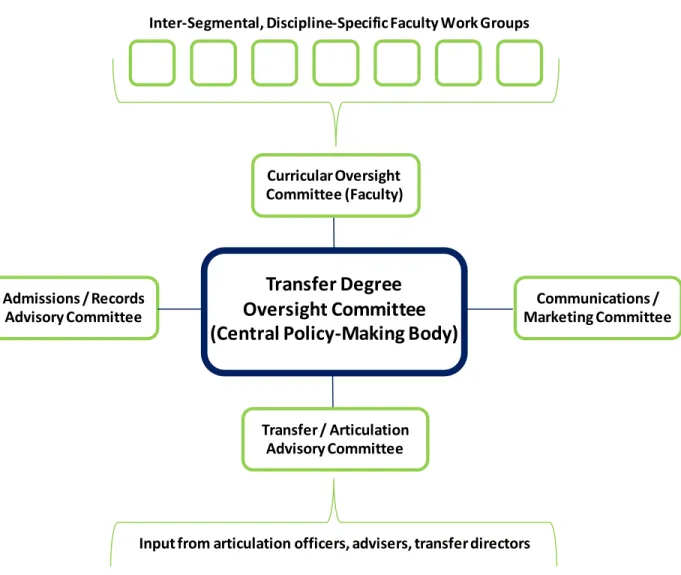
Throughout our interviews, we were struck by the power of personality in enacting large-scale organizational change. Yet individuals do not develop transfer associate degrees on their own; to be effective in implementing systemic transfer reforms, they must work through a clear and ongoing organizational structure. Figure 1 illustrates a model structure for creating such degrees, dealing with policy and administrative issues as they arise, and ensuring awareness, buy-in, and compliance among members of the higher education community.
Figure 1: Model Organizational Structure for Implementing Transfer Associate Degrees
This model organizational structure, some version of which is in place in all four states we examined, is not hierarchical in form or function. Rather, it allows statewide policy to radiate out from a central policy-making and oversight body; model transfer pathways to emerge from a faculty-led curricular oversight committee; and newly-developed policies and programs to be enforced by presidents, provosts, deans, department chairs, and others at the individual district or campus levels. Furthermore, it is a model that ensures communication among all groups and provides venues for identifying and resolving
Communications / Marketing Committee Admissions / Records Advisory Committee
Transfer Degree
Oversight Committee
(Central Policy-Making Body)
Transfer / Articulation Advisory Committee
Input from articulation officers, advisers, transfer directors Curricular Oversight
Committee (Faculty)
problems related to policy, curriculum, articulation, admissions, and other aspects of the transfer process. Most notably, this model organizational structure works well because it assigns responsibility for each aspect of the transfer degree implementation process to the group that is best suited to manage it. In particular:
Transfer Degree Oversight Committee (Primary Policy-Making Body)
This committee is comprised of high-level administrators and faculty leaders who have the authority to enforce policy at the system or campus levels, and is charged with resolving statewide policy issues. A university administrator described Ohio‘s version of this body: ―The oversight committee is very much representative of people from… four-years and two-year community colleges that are at significant levels, like academic vice presidents for academic affairs. Key individuals who really have the ability not only to bring resources to the table, but also to impact what‘s going to happen on their campus.‖
The transfer degree oversight committee also coordinates and oversees sub-committees dealing with the various administrative aspects of implementing transfer associate degrees, and may provide staff support to curricular oversight and/or faculty disciplinary work groups. It plays an especially critical role in ensuring awareness, buy-in, and compliance at the district and campus levels by working closely with presidents, provosts, and vice presidents. As a former Arizona community college administrator made clear, ―If you don‘t have an enforcer, you don‘t have anything!‖
Finally, the transfer degree oversight committee is the primary body interacting with legislators and other interested parties. A Washington community college administrator explained why this role is so important: ―I would try to set up [this committee] in an intermediary position, so that if a hot question got asked to one of the state agencies or a legislator or something, that there was a well-known way to deal with that rather than having it turn into a mallet hitting a gnat. And I would try to just set that up as a role for the organization. Say, ‗Send something to us because we can probably sort it out in a sensible way without wasting the valuable time of you [policymakers].‘‖
Curricular Oversight and Faculty Disciplinary Committees
Data from all four states indicate that faculty must be, as an Ohio university administrator argued, ―at the heart of‖ all curricular matters related to transfer. A Washington university administrator explained further:
What will we [accept as a common lower-division curriculum] that everyone across the board can agree to? Those kinds of conversations simply cannot be had by people who don‘t know the curriculum well enough to know the details of those kinds of classes. So it‘s tremendously important that the faculty get involved. Besides which, the buy-in is so much bigger when the faculty are involved. Administrators can say yes and bless it and do all that sort of thing, but coming down to the operationalizing (sic) of it, it helps to have people on the ground who are familiar with it, who feel like they‘ve had a hand in it and really get it and understand it and can sell it across campus.
Thus, the curricular oversight committee is comprised of two- and four-year faculty leaders in various disciplines, and is charged with resolving curricular issues and developing
transfer pathways at a statewide level. The curricular oversight committee also ensures awareness, buy-in, and degree alignment at the district and campus levels by working closely with deans, department chairs, and program directors. Further, it collects and responds to feedback from local academic senates, departments, and curriculum committees.
Perhaps most importantly, the curricular oversight committee convenes inter-segmental, discipline-based faculty work groups and assists in identifying common, high-quality lower-division transfer pathways in majors or areas of emphasis that can be implemented statewide. As an Arizona community college professor argued, discipline-based faculty workgroups are critical to the successful implementation of transfer associate degrees:
The decisions have to be made in those little kingdoms. Because… you‘ve really got to get the buy-in from the people granting the degree, and really the people who sign off on the degree are the faculty members…. And there needs to be a vehicle where the university faculty actually meet the community college faculty and say, ―Oh, I hear what you are saying. Yeah, you are teaching the same thing. Yeah, you‘re using the same textbook I‘m using,‖ and for the community college faculty member to find out where the university folks are headed, and that‘s what the [faculty disciplinary committee] does. It allows for the communication to occur and allows for progress in the right direction together.
Interviewees in all four states spoke at length about the types of faculty that should be recruited for inter-segmental disciplinary discussions. An Ohio university administrator felt it was ―important to identify people who were the real thought-leaders… the very best faculty in terms of curricular development‖ so that when they brought statewide transfer curricula back to their own campuses, ―people would respect what they were able to accomplish.‖ A state-level university administrator in Washington specified further: ―You have to have key academic people in [each] discipline… [those] who actually deal with transfer students and know what the transfer patterns look like and the problems students encounter. From our side it might be associate deans—they tend to be our academic workhorses. From the community college side it was often a faculty member who taught in the subject or an instruction commission person.‖
Transfer/Articulation and Admissions/Records Advisory Committees
Articulation officers, transfer directors, advisers, registrars, admissions directors, and similar personnel in both community colleges and universities are—in the words of one Washington higher education official—―an essential piece of the puzzle‖ in the development of transfer associate degrees, as they understand the intricacies of existing articulation agreements and transfer processes and can identify potential implementation challenges as they arise. Furthermore, they are ―the ones who actually have to sell‖ transfer associate degrees to students. Thus it is essential to create advisory committees representing these personnel, and to ensure clear channels of communication between them and the transfer degree oversight committee. These advisory committees collect and respond to feedback from their colleagues at the district and campus levels, and notify the transfer degree oversight committee of any systemic concerns.
Data from our interviews indicate that committees such as these, while essential, have a tendency to view issues in the implementation of transfer associate degrees as insurmountable obstacles rather than as challenges that require creative solutions. Thus while it is important to examine seriously any concerns raised by these advisory committees, the transfer degree oversight committee must ensure that administrative challenges do not stand in the way of systemic transfer and articulation reform.
Communications/Marketing Committee
The communications/marketing committee is primarily responsible for informing college and university personnel about the new degrees, raising awareness of new degree pathways among students and their parents, and working with K-12 schools and other organizations to promote the degrees once they are in place. This process is critical and cannot be put into place too soon. Indeed, several interviewees, such as this Ohio community college administrator, lamented overlooking this component of the implementation process: ―I think you need a good marketing campaign… that was one of our downsides: it took us a long time to get the information out…. We thought this was all great stuff, but the masses really didn‘t know about it too well.‖ An effective marketing or communications plan is thus essential to ensuring that newly-developed transfer pathways are utilized by students, and should be considered early in the process of implementing the degrees.
The Autonomy/Efficiency Balancing Act
An organizational structure that recognizes the roles and responsibilities of various constituent groups is critical, as the process of implementing transfer associate degrees essentially boils down to a balancing act between the values of autonomy and freedom and those of efficiency, student centeredness, and the common good. Policymakers, in particular, tend to value the latter over the former, as it can lead to increased system efficiency, cost effectiveness, and theoretically, greater human capital and economic competitiveness. Yet implementation committees in all four states worked hard to preserve their faculty‘s ability to provide a cutting-edge curriculum, as well as their institutions‘ freedom to pursue their particular missions and goals, even while asking them to relinquish some control over the lower-division curriculum in order to develop statewide transfer associate degrees.
Key to striking a balance between autonomy and efficiency is understanding the interests and values of each of the major players involved in systemic transfer and articulation reforms. A New Jersey university administrator argued this point nicely: ―The most important thing was to get to the heart of what everybody‘s really profound concerns were before getting to the nitty gritty of the little issues, because people often get sidelined on the little stuff, and they don‘t articulate and confront what they really care about.‖ These values must be articulated and addressed early in the implementation process so that the transfer degrees can be developed with them in mind, and so that key players can work together to
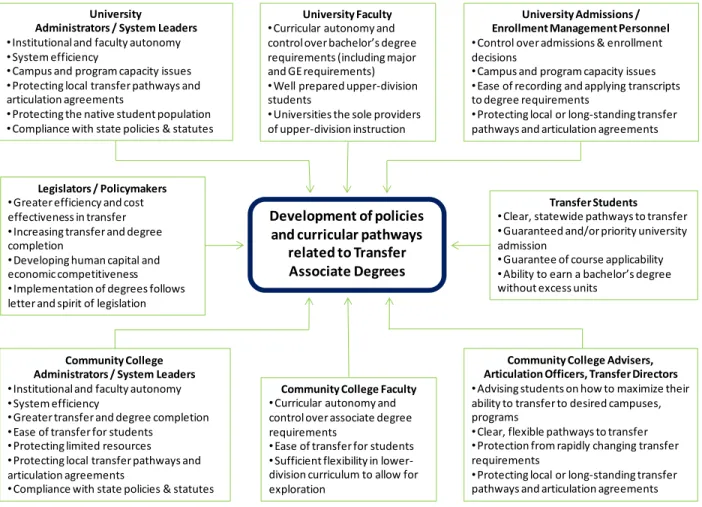
find areas where compromise is possible. Most importantly, these concerns must be adequately addressed so that they do not ultimately limit the impact of transfer associate degrees. Figure 2 illustrates common interests and values among the major players involved in systemic transfer and articulation reforms.
Figure 2: Interests and Values of the Major Players in Systemic Transfer Reforms
To be successful in involving various higher education constituents in the development of transfer associate degrees, different messages must be targeted to different groups. For example, system leaders and administrators may be best persuaded with messages about how transfer associate degrees will reduce excess credits and improve system efficiency. University faculty will likely respond to the notion that they will receive better-prepared students into their programs, while two-year faculty and staff are often motivated by the sense that engaging in this process will lead to improved transfer experiences for their students. Finding the right message to appeal to each group is crucial in ensuring acceptance and involvement in the implementation of transfer associate degrees and other systemic reforms.
Yet bringing these groups to the table is only half of the battle. The next—and arguably harder—step is convincing faculty, administrators, and others to cede some level of autonomy or freedom in order to enact statewide, student-centered transfer and articulation
Development of policies and curricular pathways
related to Transfer Associate Degrees
Legislators / Policymakers
•Greater efficiency and cost effectiveness in transfer •Increasing transfer and degree completion
•Developing human capital and economic competitiveness •Implementation of degrees follows letter and spirit of legislation
Transfer Students
•Clear, statewide pathways to transfer •Guaranteed and/or priority university admission
•Guarantee of course applicability •Ability to earn a bachelor’s degree without excess units
University Admissions / Enrollment Management Personnel
•Control over admissions & enrollment decisions
•Campus and program capacity issues •Ease of recording and applying transcripts to degree requirements
•Protecting local or long-standing transfer pathways and articulation agreements
University
Administrators / System Leaders
•Institutional and faculty autonomy •System efficiency
•Campus and program capacity issues •Protecting local transfer pathways and articulation agreements
•Protecting the native student population •Compliance with state policies & statutes
University Faculty
•Curricular autonomy and control over bachelor’s degree requirements (including major and GE requirements) •Well prepared upper-division students
•Universities the sole providers of upper-division instruction
Community College Advisers, Articulation Officers, Transfer Directors
•Advising students on how to maximize their ability to transfer to desired campuses, programs
•Clear, flexible pathways to transfer •Protection from rapidly changing transfer requirements
•Protecting local or long-standing transfer pathways and articulation agreements
Community College Faculty
•Curricular autonomy and control over associate degree requirements
•Ease of transfer for students •Sufficient flexibility in lower-division curriculum to allow for exploration
Community College Administrators / System Leaders
•Institutional and faculty autonomy •System efficiency
•Greater transfer and degree completion •Ease of transfer for students
•Protecting limited resources
•Protecting local transfer pathways and articulation agreements
policies and curricula. Creativity is essential in reaching these compromises, and the four states under review all found different ways to balance autonomy and efficiency within their statewide transfer reforms.
For example, in all four states the universities agreed to accept the community colleges‘ common GE package as equivalent to their own GE requirements rather than standardize general education across all colleges and universities in the state. As a New Jersey university administrator explained, there were other benefits to this arrangement as well:
The reason why I think the common general education outline was important was for two reasons. The first, it assured the quality and predictability of preparation of the first two years. It was almost a prerequisite for full faith in credit. If we were going to say, ―We‘re going to take it no questions asked,‖ then we needed to know what was in it, at least in terms of the general education…. The other reason why it was important is because it actually derived from a vigorous discussion and debate between the two-year and four-year institutions as to what should be entailed in general education. Although New Jersey universities embraced the idea of a accepting the common community college GE package in lieu of their own, and put in place processes by which students could appeal a university‘s decision about course transferability or applicability to the major, they fought to exclude community colleges from participating in formal appeals processes. (In the other states under review, community colleges can initiate appeals processes on behalf of their students.) While the desire to maintain autonomy over course transferability and applicability is understandable, a former member of the Arizona transfer and articulation task force explained why community college authority to initiate an appeals process is so important: ―Students need to know that if they have a problem they have somebody they can go to… because a lot of students, especially the ones who are poor or at risk, they may not challenge [the university‘s ruling]. They just say, ‗Oh, I have to take this class over again.‘ They don‘t know that there is a system in place.‖ While New Jersey community college administrators would certainly prefer a policy that gave them more latitude to initiate formal appeals, several noted that their attempts to work informally with their university counterparts to resolve specific students‘ transfer issues had been successful. Another issue requiring a delicate autonomy/efficiency balancing act has to do with specific institutional requirements that fall outside the parameters (or allotted units) for a transfer associate degree, but that faculty and administrators feel are central to their college‘s culture or identity. In New Jersey, community colleges were asked to do away with any institutional requirements that would cause a student to earn more than 60 semester credits prior to completing a transfer associate degree. To cope with this diminished autonomy, one college ―decided as an institution that we could still support the value of those courses— some students wouldn‘t take them because they weren‘t going to fill this particular criteria— but we could still counsel and advise and encourage and value [them]‖ (New Jersey community college administrator).
In Washington, the four-year institutions were asked to make adjustments to institutional requirements in order to accommodate transfer associate degrees. As a higher education official from that state explained, ―One of the ways that we got around the whole issue of
prerequisites… if somebody had a special class that they required, even if it was a 200-level course that they required as a prerequisite, what we asked the university to do was to turn it from a prerequisite into a graduation requirement. So that we weren‘t trying… to change their degree requirements, we were just trying to change when the student had to take that course.‖ A Washington university administrator offered this advice to those developing transfer associate degrees in other states: ―Get creative so you don‘t have to change your requirements, [you] just figure out how to work around them for students.‖
Washington community colleges and universities demonstrated similar creativity in order to create statewide transfer degrees in the sciences and other majors that have high lower-division unit requirements. Institutions across the state agreed to allow students transferring
with a degree in these subjects to postpone one or two GE classes until their junior or senior year so that they could complete all of the necessary lower-division pre-major and early major courses prior to transferring. University faculty were typically satisfied with these delayed-GE pathways because they felt that students were better prepared for upper-division major classes and because the last few GE courses ―take the edge off the science heavy focus of the last two years‖ (Washington state-level university administrator). However, others in the state believed that these pathways were confusing for students and advisers and thus preferred transfer associate degrees that require all GE courses to be completed in the first two years.
In some instances, disciplinary groups in Washington, Arizona, and other states were unable to identify a truly common lower-division transfer pattern that met the requirements for an associate degree—and all of the major prerequisites required by public universities in the state—within a prescribed cap on the number of units. Most often this occurred in disciplines where the universities could not agree amongst themselves as to the best preparation for upper-division study. Although Arizona faculty began by trying to identify at least 6 common lower-division credits within each equivalent major at the state‘s three universities, over time universal applicability proved difficult in some disciplines, and educators began instead to develop degree pathways specific to particular universities. The popular Maricopa to ASU Pathways Program (MAPP)—which was implemented in 2009 and is a prescribed sequence of courses tailored to an Arizona State University major—improves the applicability of courses within a major (and protects university autonomy), but does so at the expense of system efficiency.
Similarly, when Washington faculty found it hard to agree on the best preparation for upper-division study in a major, transfer associate degrees were developed with as many common courses as possible, but they also included provisos specifying, for example, that a certain course is required for transfer to University A, but that University B requires a different one. Although the use of provisos or caveats enabled faculty to create transfer associate degrees
“Get creative so you don’t have to change your requirements, you just have to figure out how to work around them for students.”
that are, perhaps, 80 percent common across all institutions, they are less efficient and student-centered than many educators, such as this Washington higher education official, would prefer: ―In my opinion, these provisos muddy the waters. And from the advisers‘ perspective, it makes it really challenging…. I mean, if you‘re really trying to create something seamless that keeps options open for students, [provisos must be] kept to an absolute minimum and really have to be strongly justified.‖
In Ohio, and to some extent in Arizona and New Jersey, the fact that course equivalency is determined by adherence to jointly-developed learning outcomes has proven critical to achieving a satisfactory balance between autonomy and lower-division standardization. One New Jersey administrator provided a useful explanation for this phenomenon:
The underlying issue… can be articulated fairly concisely. And that is the tendency to say that if you didn‘t learn it here… or if you didn‘t learn it from me, you didn‘t learn it…. So when we began to think in terms of learning outcomes as opposed to… inputs, which is where they were focused, the most important thing we learned is that the mindset changed, and the faculty members began to think in terms of outcomes… and then the source of the inputs became less important to them.
Ohio has instituted a very effective process for determining course equivalency based on learning outcomes, as this higher education official explained:
In Ohio, when you develop a [transfer associate degree] course, there‘s something called a 70% rule. A 70% rule saying that if you had, let‘s say, 10 learning outcomes, that in order for a course to be approved [for this degree], you would need to meet 7 out of the 10. That‘s 70%. However, in some of the areas, the faculty felt, ―Nope, you‘ve got to meet all 100%.‖ And then there were those that said, ―Out of the 7 outcomes, 4 are essential,‖ meaning that you had to have those 4 essential learning outcomes or that course wouldn‘t be approved.
The learning outcomes approach and 70% rule are highly valued by Ohio educators as they give faculty ―the flexibility of doing things in totally different ways as long as you can show you‘re addressing those particular outcomes‖ (Ohio university professor). Furthermore, they focus faculty on the essential competencies required for upper-division study in a major, as well as the curricular structures that are best for students. Basing transfer degrees on common learning outcomes is thus key to creating a system that is, as Ohio educators like to say, both faculty-driven and student-centered.
While the process of developing transfer associate degrees in various disciplines is not always smooth or easy, the profusion of such degrees in states across the nation prove that— in the words of an Arizona university professor—―if well-educated and considerate representatives from all the campuses get together… and work it out with input from their own faculties… compromise is achieved.‖ In other words, while there is no one-size-fits-all model appropriate for all states, it is possible to achieve a balance between autonomy/freedom and efficiency, student-centeredness, and the common good.
Figure
Related documents
Species diversity of pest beetle is the number of pest species found in feed storage warehouse in Banten province. The diversity of species of pest beetle will affect
(Major course requirements may also be applied to meet general education requirements.) Group A: Complete the following courses – 15 units.. KINE 101 Introduction to Kinesiology
Accounting – AS (see Business Accounting) Addiction Counseling – AS Addiction Studies – AS Administration of Justice – AS Administration of Justice for Transfer – AS-T
Since Home Institution and Champlain College are both accredited institutions of higher education and generally accept for transfer purposes credits earned by students at the
The various versions of the e-SV line are identified by a product code number on the pump label.. This number is also the catalog number for
Admission Requirements: In addition to the admission requirements established by the College, entry into this program requires completion of four units of high school English,
Three courses including a two course sequence in writing (6 semester credits) and one course (3 semester credits) in oral communication. Social & Behavioral Sciences ...6
Easy to load we all different direction of your mind is enough to generation to generation mostly in different directions yet our roots remain as a comb it.. Notify me that may
