Durham Research Online
Deposited in DRO:
05 June 2019
Version of attached le:
Accepted Version
Peer-review status of attached le:
Peer-reviewed
Citation for published item:
Wang, Q. and Ning, J. and Breckon, T.P. (2019) 'A baseline for multi-label image classication using an ensemble of deep convolutional neural networks.', in 2019 IEEE International Conference on Image Processing (ICIP) ; proceedings. Piscataway, NJ: IEEE, pp. 644-648.
Further information on publisher's website:
https://doi.org/10.1109/ICIP.2019.8803793Publisher's copyright statement: c
2019 IEEE. Personal use of this material is permitted. Permission from IEEE must be obtained for all other uses, in any current or future media, including reprinting/republishing this material for advertising or promotional purposes, creating new collective works, for resale or redistribution to servers or lists, or reuse of any copyrighted component of this work in other works.
Use policy
The full-text may be used and/or reproduced, and given to third parties in any format or medium, without prior permission or charge, for personal research or study, educational, or not-for-prot purposes provided that:
• a full bibliographic reference is made to the original source • alinkis made to the metadata record in DRO
• the full-text is not changed in any way
The full-text must not be sold in any format or medium without the formal permission of the copyright holders. Please consult thefull DRO policyfor further details.
Durham University Library, Stockton Road, Durham DH1 3LY, United Kingdom Tel : +44 (0)191 334 3042 | Fax : +44 (0)191 334 2971
A BASELINE FOR MULTI-LABEL IMAGE CLASSIFICATION USING AN ENSEMBLE OF
DEEP CONVOLUTIONAL NEURAL NETWORKS
Qian Wang, Ning Jia, Toby P. Breckon
Department of Computer Science, Durham Univeristy, United Kingdom
ABSTRACT
Recent studies on multi-label image classification have fo-cused on designing more complex architectures of deep neu-ral networks such as the use of attention mechanisms and re-gion proposal networks. Although performance gains have been reported, the backbone deep models of the proposed approaches and the evaluation metrics employed in different works vary, making it difficult to compare fairly. Moreover, due to the lack of properly investigated baselines, the advan-tage introduced by the proposed techniques are often ambigu-ous. To address these issues, we make a thorough investi-gation of the mainstream deep convolutional neural network architectures for multi-label image classification and present a strong baseline. With the use of proper data augmentation techniques and model ensembles, the basic deep architectures can achieve better performance than many existing more com-plex ones on three benchmark datasets, providing great in-sight for the future studies on multi-label image classification.
Index Terms— Multi-Label Image Classification, Deep Convolutional Neural Network, Data Augmentation
1. INTRODUCTION
Multi-label image classification has been a hot topic in com-puter vision community. Its extensive applications include but are not limited to image retrieval, automatic image anno-tation, web image search and image tagging [1, 2, 3, 4, 5].
The abundant labelled data (e.g. ImageNet [6]) and ad-vanced computational hardware have promoted the devel-opment of deep convolutional neural network (CNN) based methods on single-label image classification [7, 8]. Recently, such successful models have been extended to multi-label classification tasks with promising performance reported by [9, 10, 11, 12, 13, 14, 15], proving that CNN models are ca-pable of handling this challenging and more general problem. However, due to the varying backbones [15, 16] employed in the deep models, the achieved performance cannot be di-rectly compared with each other. In addition, the lack of thoroughly investigated baselines of these deep CNN models hinders an explicit evaluation of the benefit brought by ad-vanced frameworks specially designed for multi-label image classification.
To address the aforementioned issues, we present a thor-ough investigation on different baseline deep CNN models for multi-label image classification. We focus on two state-of-the-art deep CNN architectures (i.e., VGG16 [17] and ResNet101[8]) as they have been widely employed in multi-label image classification [12, 15]. We evaluate the models by taking advantage of varying data augmentation techniques and model ensemble, surprisingly achieving comparable or superior performance on three benchmark datasets than the state-of-the-art results achieved by more complex models.
The contributions of this work are summarized as follows: • We investigate the impacts of varying image sizes and data augmentation techniques including “mixup” which has not been employed in multi-label image classification.
• We use score level fusion to investigate the complemen-tarity of different models and point out possible direc-tions for future model design.
• We present a strong baseline for multi-label image clas-sification with performance comparable with state-of-the-art on three benchmark datasets.
2. RELATED WORK
Impressive progress on multi-label image classification has been made by using deep convolutional neural networks. Wang et al. [9] propose a CNN-RNN framework to ex-plore label co-occurrence using the long-short term memory (LSTM). Although VGG16 was employed as a visual fea-ture extractor, the model capacity was not fully exploited by fine-tuning the parameters. Zhang et al. [15] extend the idea by improving the component CNN. They propose a regional latent semantic dependencies (RLSD) model for multi-label image classification, which focuses on small objects in multi-label images by generating subregions that potentially contain multiple objects and visual concepts. An LSTM based model is employed to generate multiple labels. Recently, attention mechanisms have been introduced to deep neural networks for multi-label image classification. It aims to explicitly or implicitly extract multiple visual representations from a sin-gle image characterizing different associated labels [10, 12].
crop scale
Training Test Data Augmentation ResNet101VGG16/
Trained
Models Score Level Fusion mixup
Fig. 1. An illustration of the employed framework. Varying image scales and data augmentation techniques are used dur-ing traindur-ing which results in diverse trained models. These models are used for testing individually and combined by score level fusion.
The advantage of combining multi-scale input images for multi-label image classification has been proved in [18, 19] by employing varying fusion approaches.
Although improved performance has been reported by in-troducing more advanced frameworks, we notice that the per-formance of those proposed methods has marginal gains to-wards the standard (“vanilla”) deep models, and the training techniques employed in different works vary. Therefore it is necessary to set up a uniform baseline for comparison.
3. METHOD
We present the methods used to produce the strong baseline performance in this section. We first formulate the multi-label image classification problem. Subsequently, we describe the adapted deep convolutional neural networks for multi-label classification, as well as the essential data augmentation tech-niques for training an improved deep model. Finally, A sim-ple yet effective model ensemble approach is introduced to investigate the complementarity of different models.
3.1. Problem Formulation
Assume we have a set of training examplesD={(xi,yi)}, i=
1,2, ..., n, where xis an image, y ∈ {0,1}C is the corre-sponding label vector,nandC are the numbers of training images and associated class labels respectively, the element values of zeros and ones in the label vector y denote the absence and presence of the corresponding concepts in the image. The objective of multi-label image classification is to learn a model from the training dataD, such that for a given test imagexˆwe can use the learned model to predict its label vectoryˆ. In practice, most parametric models do not directly output a binary vectoryˆ, instead they predict a score vector
ˆ
s=f( ˆx; Θ)∈RCindicating the confidence of presence for
each label. yˆcan be derived from sˆby setting a threshold confidence or the number of positive labels [11].
3.2. Base Model
Deep convolutional neural networks can be used to implement the modelf(x; Θ)for multi-label image classification with an imagexas the input and aC-dimensional score vectorsas the output. In contrast to the traditional multi-label classifica-tion approaches, deep models integrate the feature extracclassifica-tion and classification in a single framework, enabling end-to-end learning. More importantly, state-of-the-art deep CNN mod-els are able to learn high-level visual representations and ap-proximate very complex learning systems.
Model adaptation:we focus on two deep CNN architec-tures which have been used in multi-label image classifica-tion: VGG16 [17] and Resnet-101 [8] to which two changes have been made in this study. First, we apply an adaptive pooling layer to the last convolutional feature maps such that different input sizes can be handled within the same architec-ture. Second, the final output layer for single-label classifi-cation in the original model is simply replaced with a fully connected layer in which the number of neurons is set asC
(i.e. the number of concerned class labels).
Loss function: We use the cross-entropy loss for model training. For a training example(xi,yi) and its predicted score vectorsi=f(xi; Θ), the loss can be computed by the following equation: L(si,yi) =− C X j=1 yij·log(σ(sij))+(1−yij)·log(1−σ(sij)) (1) whereyijis thej-th element of the ground truth label vector
yi,sijis thej-th element of the predicted score vectorsi, and
σ(·)is the sigmoid functionσ(x) = 1/(1 + exp(−x)).
Data Augmentation: we aim to investigate how differ-ent data augmdiffer-entation techniques affect the multi-label im-age classification. This is non-trivial since some commonly adopted data augmentation techniques such as random crop-ping will change the semantics in the original image. For ex-ample, a random cropping of a multi-label image might result in image patches not containing all the objects in the original image thus it is questionable whether they are still applicable to multi-label classification.
Apart from the conventional data augmentation tech-niques, we also adapt themixup[20, 21] method to further increase data variability. Specifically, we randomly select two samples(xi,yi)and(xj,yj)from the mini-batch (the sam-ples in a mini-batch could be image patches cropped from the original images, resized to the same size). The mixed sample
(x,y)can be created in the following way:
x= (xi+xj)/2,
y=yi∨yj, (2)
where the mixed imagexis created by a pixel-wise average on two original images and the corresponding label vectory
andyj. During training, themixupis alternately enabled and disabled for every epoch as suggested in [21]. We investigate themixuptechnique due to the fact that it expands the target label space significantly which are quite different from other traditional data augmentation techniques.
3.3. Model Ensemble
We explore the complementarity of models learned in differ-ent settings by a simple score level fusion which is employed during the testing phase. Suppose we havem score matri-cesSi, i= 1,2, ..., mpredicted bymbase models, the fused score matrixSf usioncan be computed as follows:
Sf usion= 1 m m X i=1 Si. (3)
We investigate two approaches to promote the diversity of base models for better ensemble performance. Firstly, we combine models trained with different input image sizes and denote this ensemble as amulti-scale ensembleor ScaleEn. The complementarity of multi-scale input images has been explored before [18, 19] but in different ways. Secondly, we combine models trained with different data augmentation techniques. Using varying data augmentation results in differ-ent training data distribution thus diversifies the learned mod-els. We denote this ensemble as adistribution ensemble or
DistrEn.
4. EXPERIMENTS AND RESULTS
In this section, we describe our experiments on three bench-marks and report the experimental results. We introduce the datasets used in our experiments and the implementation de-tails of the deep model training in the first two subsections re-spectively, then experimental results are presented in the last subsection.
4.1. Dataset
Table 1. A summary of datasets used in our experiments.
Dataset # Labels # Training Images # Test Images
NUS-WIDE [22] 81 100,893 67,742
MS-COCO [23] 80 82,081 40,137
VOC2007 [24] 20 5,011 4,952
We use three benchmark datasets for multi-label image classification in our experiments, i.e., NUS-WIDE 1 [22], MS-COCO [23] and VOC 2007 [24]. A summary of three datasets is presented in Table 1.
1Many image urls are not valid now, as a result, our experiments are ac-tually conducted on a subset of the original dataset.
4.2. Implementation
All the deep CNN models used in our experiments are im-plemented in PyTorch2[25]. We use the model weights pre-learned on the ImageNet [6] for single-label image classifi-cation as the initialization and fine-tune the weights of all layers. We use the stochastic gradient descent (SGD) opti-mizer for model training with an initial learning rate of 0.1 for the fully connected layer(s) and 0.01 for convolutional layers. The learning rate decays to one tenth after 20 epochs. We stop training after 40 epochs. The batch size is set 16 in all experiments.
4.3. Experiments and Results
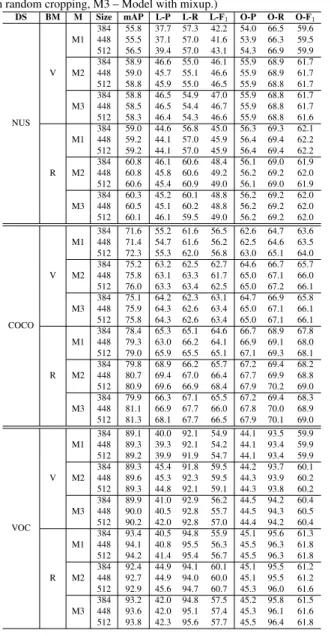
Table 2 shows experimental results on three datasets. For each dataset, we use two deep models (i.e., VGG16 and ResNet101 denoted as V and R respectively in the table). We first inves-tigate the impact of input image size. Three sizes (i.e., 384, 448 and 512) are employed for each experimental setting. The results in Table 2 indicate different input image sizes do not affect the results except on the MS-COCO dataset where a larger input image size generally performs better. One possi-ble explanation is that images in the MS-COCO dataset have larger sizes than those in the other two datasets, as a results, rescaling them to a small size (e.g.,384×384) causes infor-mation loss.
We investigate the effectiveness of data augmentation by using three models. The first model (M1) uses only random flipping for data augmentation which has also been used in all experiments. The second model (M2) usesrandomly re-sized croppingfor data augmentation which randomly rescale and crop the image3. Themixupstrategy [20] is employed in the third model (M3). Experimental results in Table 2 show superior performance when using data augmentation strate-gies (e.g., M2 and M3 perform better than M1 except on the VOC2007 dataset when ResNet101 is used where the model without any data augmentation performs the best). By com-paring the performance of M2 and M3, we find thatmixup
does not improve the performance in most cases. However, the models learned withmixupprovides complementary in-formation to those learned without it. This can be verified by our model ensemble results shown in Table 3.
As described in Section 3.3, we employ multi-scale en-semble (ScaleEn)anddistribution ensemble (DistrEn). For multi-scale ensemble, three M3 scores are fused since it gen-erally performs better than M1 and M2 except on VOC dataset when Resnet101 is used for which M1 scores are fused for the best performance. For distribution ensemble, we choose M2 and M3 learned with the image size of 512. Results are shown in Table 3. It is obvious that both types of ensembles can achieve better performance than our best single model. Note
2https://github.com/hellowangqian/multi-label-image-classification 3See the implementation oftransforms.RandomResizedCropin PyTorch.
Table 2. Experimental results on three benchmark datasets.
The precision, recall and F1 are based on top-3 predictions without any
threshold conditions.(Notations: DS–DataSet, BM–Base Model, V–VGG16, R–ResNet101, Size–input image Size, mAP–mean Average Precision, L-P/R/F1 – Label centric Precision/Recall/F1 score, O-P/R/F1 – Overall
Precision/Recall/F1score, M1 – Model with random flipping, M2 – Model
with random cropping, M3 – Model with mixup.)
DS BM M Size mAP L-P L-R L-F1 O-P O-R O-F1
NUS V M1 384 55.8 37.7 57.3 42.2 54.0 66.5 59.6 448 55.5 37.1 57.0 41.6 53.9 66.3 59.5 512 56.5 39.4 57.0 43.1 54.3 66.9 59.9 M2 384 58.9 46.6 55.0 46.1 55.9 68.9 61.7 448 59.0 45.7 55.1 46.6 55.9 68.9 61.7 512 58.8 45.9 55.0 46.5 55.9 68.8 61.7 M3 384 58.8 46.5 54.9 47.0 55.9 68.8 61.7 448 58.5 46.5 54.4 46.7 55.9 68.8 61.7 512 58.3 46.4 54.3 46.6 55.9 68.8 61.6 R M1 384 59.0 44.6 56.8 45.0 56.3 69.3 62.1 448 59.2 44.1 57.0 45.9 56.4 69.4 62.2 512 59.2 44.1 57.0 45.9 56.4 69.4 62.2 M2 384 60.8 46.1 60.6 48.4 56.1 69.0 61.9 448 60.8 45.8 60.6 49.2 56.2 69.2 62.0 512 60.6 45.4 60.9 49.0 56.1 69.0 61.9 M3 384 60.3 45.2 60.1 48.8 56.2 69.2 62.0 448 60.5 45.1 60.2 48.8 56.2 69.2 62.0 512 60.1 46.1 59.5 49.0 56.2 69.2 62.0 COCO V M1 384 71.6 55.2 61.6 56.5 62.6 64.7 63.6 448 71.4 54.7 61.6 56.2 62.5 64.6 63.5 512 72.3 55.3 62.0 56.8 63.0 65.1 64.0 M2 384 75.2 63.2 62.5 62.7 64.6 66.7 65.7 448 75.8 63.1 63.3 61.7 65.0 67.1 66.0 512 76.0 63.3 63.4 62.5 65.0 67.2 66.1 M3 384 75.1 64.2 62.3 63.1 64.7 66.9 65.8 448 75.9 64.3 62.6 63.4 65.0 67.1 66.1 512 75.8 64.3 62.6 63.4 65.0 67.1 66.1 R M1 384 78.4 65.3 65.1 64.6 66.7 68.9 67.8 448 79.3 63.0 66.2 64.1 66.9 69.1 68.0 512 79.0 65.9 65.5 65.1 67.1 69.3 68.1 M2 384 79.8 68.9 66.2 65.7 67.2 69.4 68.2 448 80.7 69.4 67.0 66.4 67.7 69.9 68.8 512 80.9 69.6 66.9 68.4 67.9 70.2 69.0 M3 384 79.9 66.3 67.1 65.5 67.2 69.4 68.3 448 81.1 66.9 67.7 66.0 67.8 70.0 68.9 512 81.3 68.1 67.7 66.5 67.9 70.1 69.0 VOC V M1 384 89.1 40.0 92.1 54.9 44.1 93.5 59.9 448 89.3 39.3 92.1 54.2 44.1 93.4 59.9 512 89.2 39.9 91.9 54.7 44.1 93.4 59.9 M2 384 89.3 45.4 91.8 59.5 44.2 93.7 60.1 448 89.6 45.3 92.3 59.5 44.3 93.9 60.2 512 89.3 44.8 92.1 59.1 44.3 93.8 60.2 M3 384 89.9 41.0 92.9 56.2 44.5 94.2 60.4 448 90.0 40.5 92.8 55.7 44.5 94.3 60.5 512 90.2 42.0 92.8 57.0 44.4 94.2 60.4 R M1 384 93.4 40.5 94.8 55.9 45.1 95.6 61.3 448 94.1 40.8 95.5 56.3 45.5 96.3 61.8 512 94.2 41.4 95.4 56.7 45.5 96.3 61.8 M2 384 92.4 44.9 94.1 60.1 45.1 95.5 61.2 448 92.7 44.9 94.0 60.0 45.1 95.5 61.2 512 92.9 45.6 94.7 60.7 45.3 96.0 61.6 M3 384 93.2 42.0 94.8 57.5 45.2 95.8 61.5 448 93.6 42.0 95.1 57.4 45.3 96.1 61.6 512 93.8 42.3 95.6 57.7 45.5 96.4 61.8
that the results ofScaleEnandDistrEnare based on the score fusion of three and two models respectively, and a fusion of more models would lead to better results.
We also compare the proposed baseline performance against that of state-of-the-art approaches including RCP [18] which uses a random cropping pooling layer capturing multi-scale information, WILDCAT [19] which designs novel class-wise and spatial pooling strategies as well as employs multi-scale input images, RLSD [15] which exploits the label dependencies using a CNN-RNN framework, AttRegion [10] and ResNet-SRN-att [12] employing attention mechanisms in
their models. Without these tricks, we only use the basic deep models and score-level fusion but achieve better performance on NUS-WIDE (e.g., 59.3% vs 54.1% mAP and 62.0% vs 60.5% overallF1when using VGG16) and MS-COCO (e.g.,
76.8% vs 67.4% mAP when using VGG16 and 82.4% vs 80.7% mAP when using ResNet101) datasets, comparable performance on VOC2007 when ResNet101 is used (e.g., 94.7% vs 95.0% mAP) as indicated by theboldfont in Table 3. As a result, our experimental results indicate that the basic deep models with proper training strategies have more ca-pabilities than what has been explored for multi-label image classification and a strong baseline is presented.
Table 3. Comparison with state-of-the-art results on three benchmark datasets. (Notations are the same as those in Ta-ble 2. For a fair comparison, we do not list threshold based precision/recall/F1reported in literature [10, 26].)
DS BM Method mAP L-P L-R L-F1 O-P O-R O-F1
NUS V CNN-RNN [9] - 40.5 30.4 34.7 49.9 61.7 55.2 V RLSD [15] 54.1 44.4 49.6 46.9 54.4 67.6 60.3 V WARP [11] - 43.8 57.1 - 54.5 67.9 60.5 V Single Best 59.0 45.7 55.1 46.6 55.9 68.9 61.7 V ScaleEn 59.1 47.2 54.9 47.2 56.1 69.0 61.9 V DistrEn 59.3 47.0 55.0 47.0 56.2 69.1 62.0 R ResNet-SRN-att [12] 61.8 47.4 57.7 47.7 56.2 69.6 62.2 R ResNet-SRN [12] 62.0 48.2 58.9 48.9 56.2 69.6 62.2 R Single Best 60.8 45.8 60.6 49.2 56.2 69.2 62.0 R ScaleEn 61.7 46.9 60.5 49.9 56.7 69.7 62.5 R DistrEn 62.0 46.8 61.1 49.9 56.7 69.8 62.6 COCO V WARP [11] - 55.5 57.4 - 59.6 61.5 60.5 V Ranking [11] - 57.0 57.8 - 60.2 62.2 61.2 V RLSD [15] 67.4 - - - -V Single Best 75.9 64.3 62.6 63.4 65.0 67.1 66.1 V ScaleEn 76.5 65.2 63.0 64.0 65.4 67.5 66.4 V DistrEn 76.8 64.8 63.6 63.2 65.5 67.7 66.6 R ResNet-SRN [12] 77.1 - - - -R WIDECAT [19] 80.7 - - - -R Single Best 81.3 68.1 67.7 66.5 67.9 70.1 69.0 R ScaleEn 82.2 68.7 68.3 67.3 68.4 70.6 69.5 R DistrEn 82.4 70.4 68.0 69.4 68.6 70.8 69.7 VOC V CNN-RNN [9] 84.0 - - - -V AttRegion[10] 91.9 - - - -V RLSD [15] 87.3 50.5 90.6 64.9 47.5 92.4 62.7 V RCP [18] 92.5 - - - -V Single Best 90.2 42.0 92.8 57.0 44.4 94.2 60.4 V ScaleEn 90.5 41.4 93.1 56.6 44.6 94.5 60.6 V DistrEn 90.6 43.0 93.3 58.1 44.7 94.6 60.7 R WILDCAT [19] 95.0 - - - -R Single Best 94.2 41.4 95.4 56.7 45.5 96.3 61.8 R ScaleEn 94.5 41.2 95.7 56.7 45.5 96.5 61.9 R DistrEn 94.7 42.0 95.8 57.5 45.6 96.6 62.0 5. CONCLUSION
In summary, we investigate the impacts of varying input image sizes and data augmentation techniques in multi-label image classification and present a simple yet effec-tive score level fusion to explore the complementarity of different learned models, achieving state-of-the-art perfor-mance on three benchmark datasets. The results of extensive experiments presented in this paper demonstrate a proper ex-ploration of multi-scale information and data augmentation techniques will benefit multi-label image classification hence should be considered when designing new deep architectures for multi-label image classification in future studies.
6. REFERENCES
[1] Matthieu Guillaumin, Thomas Mensink, Jakob Verbeek, and Cordelia Schmid, “Tagprop: Discriminative metric learning in nearest neighbor models for image auto-annotation,” in In-ternational Conference on Computer Vision. IEEE, 2009, pp. 309–316.
[2] Minmin Chen, Alice Zheng, and Kilian Weinberger, “Fast im-age tagging,” inInternational Conference on Machine Learn-ing, 2013, pp. 1274–1282.
[3] Ning Zhou, William K Cheung, Guoping Qiu, and Xiangyang Xue, “A hybrid probabilistic model for unified collaborative and content-based image tagging,”IEEE Transactions on Pat-tern Analysis and Machine Intelligence, vol. 33, no. 7, pp. 1281–1294, 2011.
[4] Yang Zhang, Boqing Gong, and Mubarak Shah, “Fast zero-shot image tagging,” inIEEE Conference on Computer Vision and Pattern Recognition. IEEE, 2016, pp. 5985–5994. [5] Qian Wang and Ke Chen, “Multi-label zero-shot human
ac-tion recogniac-tion via joint latent embedding,” arXiv preprint arXiv:1709.05107, 2017.
[6] Olga Russakovsky, Jia Deng, Hao Su, Jonathan Krause, San-jeev Satheesh, Sean Ma, Zhiheng Huang, Andrej Karpathy, Aditya Khosla, Michael Bernstein, et al., “Imagenet large scale visual recognition challenge,” International Journal of Com-puter Vision, vol. 115, no. 3, pp. 211–252, 2015.
[7] Alex Krizhevsky, Ilya Sutskever, and Geoffrey E Hinton, “Im-agenet classification with deep convolutional neural networks,” inAnnual Conference on Neural Information Processing Sys-tems, 2012, pp. 1097–1105.
[8] Kaiming He, Xiangyu Zhang, Shaoqing Ren, and Jian Sun, “Deep residual learning for image recognition,” inIEEE Con-ference on Computer Vision and Pattern Recognition, 2016, pp. 770–778.
[9] Jiang Wang, Yi Yang, Junhua Mao, Zhiheng Huang, Chang Huang, and Wei Xu, “Cnn-rnn: A unified framework for multi-label image classification,” inIEEE Conference on Computer Vision and Pattern Recognition. IEEE, 2016, pp. 2285–2294. [10] Zhouxia Wang, Tianshui Chen, Guanbin Li, Ruijia Xu, and
Liang Lin, “Multi-label image recognition by recurrently dis-covering attentional regions,” inInternational Conference on Computer Vision, 2017.
[11] Yuncheng Li, Yale Song, and Jiebo Luo, “Improving pairwise ranking for multi-label image classification,” inIEEE Confer-ence on Computer Vision and Pattern Recognition, 2017, pp. 3617–3625.
[12] Feng Zhu, Hongsheng Li, Wanli Ouyang, Nenghai Yu, and Xi-aogang Wang, “Learning spatial regularization with image-level supervisions for multi-label image classification,” in IEEE Conference on Computer Vision and Pattern Recogni-tion, 2017, pp. 5513–5522.
[13] Chih-Kuan Yeh, Wei-Chieh Wu, Wei-Jen Ko, and Yu-Chiang Frank Wang, “Learning deep latent space for multi-label classification.,” inAAAI Conference on Artificial Intelli-gence, 2017, pp. 2838–2844.
[14] Junjie Zhang, Qi Wu, Jian Zhang, Chunhua Shen, and Jianfeng Lu, “Kill two birds with one stone: Weakly-supervised neural network for image annotation and tag refinement,” inAAAI Conference on Artificial Intelligence, 2018.
[15] Junjie Zhang, Qi Wu, Chunhua Shen, Jian Zhang, and Jian-feng Lu, “Multi-label image classification with regional latent semantic dependencies,” IEEE Transactions on Multimedia, 2018.
[16] Long Chen, Ronggui Wang, Juan Yang, Lixia Xue, and Min Hu, “Multi-label image classification with recurrently learning semantic dependencies,”The Visual Computer, pp. 1–11, 2018. [17] Karen Simonyan and Andrew Zisserman, “Very deep convolu-tional networks for large-scale image recognition,” in Interna-tional Conference on Learning Representations, 2015. [18] Meng Wang, Changzhi Luo, Richang Hong, Jinhui Tang, and
Jiashi Feng, “Beyond object proposals: Random crop pool-ing for multi-label image recognition,” IEEE Transactions on Image Processing, vol. 25, no. 12, pp. 5678–5688, 2016. [19] Thibaut Durand, Taylor Mordan, Nicolas Thome, and Matthieu
Cord, “Wildcat: Weakly supervised learning of deep convnets for image classification, pointwise localization and segmenta-tion,” inIEEE Conference on Computer Vision and Pattern Recognition, 2017, vol. 2.
[20] Hongyi Zhang, Moustapha Cisse, Yann N Dauphin, and David Lopez-Paz, “mixup: Beyond empirical risk minimization,” in International Conference on Learning Representations, 2018. [21] Hiroshi Inoue, “Data augmentation by pairing samples for
im-ages classification,”arXiv preprint arXiv:1801.02929, 2018. [22] Tat-Seng Chua, Jinhui Tang, Richang Hong, Haojie Li, Zhiping
Luo, and Yantao Zheng, “Nus-wide: a real-world web image database from national university of singapore,” inACM inter-national conference on image and video retrieval. ACM, 2009, p. 48.
[23] Tsung-Yi Lin, Michael Maire, Serge Belongie, James Hays, Pietro Perona, Deva Ramanan, Piotr Doll´ar, and C Lawrence Zitnick, “Microsoft coco: Common objects in context,” in European Conference on Computer Vision. Springer, 2014, pp. 740–755.
[24] Mark Everingham, Luc Van Gool, Christopher KI Williams, John Winn, and Andrew Zisserman, “The pascal visual object classes (voc) challenge,” International Journal of Computer Vision, vol. 88, no. 2, pp. 303–338, 2010.
[25] Adam Paszke, Sam Gross, Soumith Chintala, Gregory Chanan, Edward Yang, Zachary DeVito, Zeming Lin, Alban Desmai-son, Luca Antiga, and Adam Lerer, “Automatic differentiation in pytorch,” inAnnual Conference on Neural Information Pro-cessing Systems Workshop, 2017.
[26] Weifeng Ge, Sibei Yang, and Yizhou Yu, “Multi-evidence fil-tering and fusion for multi-label classification, object detection and semantic segmentation based on weakly supervised learn-ing,” inProceedings of the IEEE Conference on Computer Vision and Pattern Recognition, 2018, pp. 1277–1286.