Efficient XML-to-SQL Query Translation: Where to Add
the Intelligence?
Rajasekar Krishnamurthy
∗Raghav Kaushik
∗Jeffrey F Naughton
IBM Almaden Research Center Microsoft Research University of Wisconsin-Madison [email protected] [email protected] [email protected]
Abstract
We consider the efficiency of queries generated by XML to SQL translation. We first show that published XML-to-SQL query translation algo-rithms are suboptimal in that they often trans-late simple path expressions into complex SQL queries even when much simpler equivalent SQL queries exist. There are two logical ways to deal with this problem. One could generate subopti-mal SQL queries using a fairly naive translation algorithm, and then attempt to optimize the re-sulting SQL; or one could use a more intelligent translation algorithm with the hopes of generat-ing efficient SQL directly. We show that optimiz-ing the SQL after it is generated is problematic, becoming intractable even in simple scenarios; by contrast, designing a translation algorithm that exploits information readily available at transla-tion time is a promising alternative. To support this claim, we present a translation algorithm that exploits translation time information to generate efficient SQL for path expression queries over tree schemas.
1
Introduction
Exporting XML views of relational data gives rise to the problem of translating XML queries into SQL. To date, the focus of most of the work in the published literature [10, 16, 21] has been on mechanisms for correctly translating complex XML queries into SQL queries, with less emphasis on evaluating the quality of the resulting SQL queries. The efficiency of the SQL queries generated by the translation process is the fo-cus in this paper.
∗Work done while the authors were students at the Univer-sity of Wisconsin-Madison
Permission to copy without fee all or part of this material is granted provided that the copies are not made or distributed for direct commercial advantage, the VLDB copyright notice and the title of the publication and its date appear, and notice is given that copying is by permission of the Very Large Data Base Endowment. To copy otherwise, or to republish, requires a fee and/or special permission from the Endowment.
Proceedings of the 30th VLDB Conference, Toronto, Canada, 2004
SQL query Relational Query Processor XML Query XML−to−Relational mapping XML Results XML−to−SQL Query Translator Relational Results
Relational Integrity Constraints
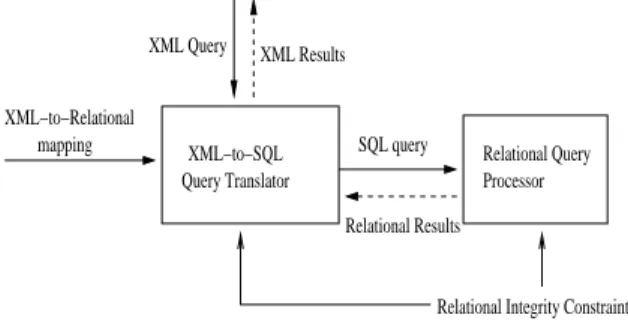
Figure 1: Stages in using an RDBMS to evaluate an XML query
Translating XML queries to SQL involves translat-ing queries over hierarchical schemas into queries over flat relational schemas. This turns out to be prob-lematic — a closer look at the queries generated by the published translation algorithms shows that the hierarchical nature of the exported XML schema is often blindly reflected in the generated SQL query, even when this is clearly not necessary. As a result, in many cases even simple path expression queries result in unnecessarily complex SQL queries. This problem is aggravated when the input XML query includes a traversal of the descendant axis (//), because it does not have a simple equivalent in SQL.
A natural question to ask next is whether the phe-nomenon of large, complex SQL queries arising from simple XML queries is avoidable, or if it is intrinsic due to the mismatch in data models. We show by example in Section 2.1 that complex SQL is not necessary in many cases — while the SQL generated by published translation algorithms is complex, usually there is a much simpler equivalent SQL query. This observation motivated us to search for techniques that make use of readily available semantic information to improve the quality of the generated SQL.
To understand the alternatives for how we can do this, consider the different stages in the transla-tion process as shown in Figure 1. Given an XML-to-Relational mapping, some relational integrity con-straints, and an XML query, the XML-to-SQL query translator generates an equivalent SQL query and hands it over to the relational query processor. The
relational query processor optimizes and executes the query, and returns the results to the query translator, which adds the appropriate XML tags to the results and returns them to the user. There are two impor-tant points to note here: (i) As the XML-to-Relational mapping and relational integrity constraints are valid across multiple query invocations, they are shown sep-arately, and (ii) We have made no assumptions about whether the XML-to-SQL query translator is inside an RDBMS or in middleware. This is the reason for using the term Relational Query Processor instead of RDBMS for the box on the right.
There are two logical extremes in approaches to-ward obtaining efficient SQL queries for XML work-loads. One could generate suboptimal SQL queries using a fairly naive translation algorithm, and then op-timize the resulting SQL queries (SQL Optimization); or one could use a more intelligent query translation al-gorithm and attempt to generate efficient SQL queries directly (Intelligent Query Translation).
In Section 4, we will show that if we take the SQL Optimization approach, then in order to obtain effi-cient SQL queries we have to solve the relational query minimization problem under bag semantics. The tech-niques for query minimization in the published litera-ture rely on algorithms for query containment or query equivalence. Unfortunately, these problems become in-tractable in even simple scenarios, making the SQL Optimization approach impractical. In view of this problem, we need to find a way to generate good SQL queries that does not require the solution of these in-tractable problems during actual query translation.
In response to this goal, we propose that Intelligent Query Translation should be used instead of SQL Opti-mization, and propose a translation approach that re-lies upon three main ideas. First, we identify a class of tree XML-to-relational mappings calledbijective map-pings. Bijective mappings cover a large class of the mappings we have encountered in print, and they have the desirable property that they can be optimized us-ing containment and equivalence algorithms under set semantics instead of multiset semantics.
Second, we observe that for a given XML schema over a given relational schema, the SQL queries gen-erated from XML queries are not arbitrary. That is, the XML-to-Relational mapping determines the class of SQL queries that are likely to be output by the XML-to-SQL query translation algorithm, which in turn fixes the class of queries that need to be mini-mized. Since the XML-to-Relational mapping and the underlying relational integrity constraints are indepen-dent of the query being optimized, we can use them to precompute some useful information, and then use this information during the runtime query translation. This way, we can move the potentially expensive task of reasoning about integrity constraints to the precom-putation phase, keeping the run time overhead small.
Third, the conjunctive queries produced by XML to SQL translation are mainlychainqueries of the form
R(xn) :−R1(x1, x2), R2(x2, x3), . . . , Rn−1(xn−1, xn)
As we will show, in the XML to SQL translation do-main, exploiting integrity constraints enables the min-imization of such queries by removing a prefix of the relational predicates. We refer to this asprefix elimi-nation. This turns out to be more tractable than gen-eral conjunctive query minimization.
We show that by exploiting the above three ideas, the XML-to-SQL query translation problem can be solved in polynomial time for path expression queries over bijective tree mappings. Our proof works by presenting a query translation algorithm that solves the problem with the required efficiency. Our algo-rithm works correctly even over non-bijective pings; it identifies the bijective portions of the map-ping and performs more efficient query translation in those parts. This translation algorithm produces SQL queries that in many cases are far more efficient than those produced by previously published translation al-gorithms.
The rest of the paper is organized as follows. In Sec-tion 2.1, we present an example scenario to illustrate the problems with published XML-to-Relational trans-lation algorithms. Next we define the query transla-tion problem in Sectransla-tion 3. Then, in Sectransla-tion 4, we present some of the known complexity results we bump into if we attempt to minimize the SQL queries after generating them. We describe our strategy for more in-telligent query translation in Section 5. A more formal description of the various components of this approach is presented in Section 6.
1.1 Related Work
Translating XML queries into SQL in an XML Pub-lishing context has been addressed in [9, 10, 12, 16, 17, 20]. Excepting MARS [9], the main focus has been on translating complex XML queries into SQL, and not on the quality of the final SQL query. A more detailed description of the existing published work on XML-to-SQL query translation is given in [15].
In MARS [9], a technique for translating XQuery queries into SQL is given, when both Global-As-View (GAV) and Local-As-View (LAV) views are present. The system achieves the combined effect of rewriting-with-views, composition-rewriting-with-views, and query mini-mization under integrity constraints. While this tech-nique has its own advantages, it does not produce ef-ficient SQL queries for simple XML queries that con-tain the descendant axis (//) (like the example in Sec-tion 2.1). The technique in MARS [9] can be viewed as a SQL Optimization technique since the main opti-mization occurs after the SQL query is generated from the XML query. In our work, we assume a simpler set-ting of only GAV-style views and show how one can obtain efficient SQL queries by placing the intelligence in the translation process.
2
Motivation
2.1 Translation example
In this section, we present an example recursive query (with the descendant axis //) over a tree XML schema to illustrate that even simple XML queries can give rise to fairly complex SQL queries if we use published translation algorithms.
Part of a sample relational schema for an auction database is shown in Figure 2. The figure also shows one way of exporting this data as XML. The exam-ple XML schema is part of the XMark benchmark [23] schema. The associated view definition is easy to con-struct and is omitted. Each node in the XML schema is annotated with a table name, to indicate the re-lational table that corresponds to the element repre-sented by the node. Each leaf node has a column name next to it, which indicates the column in which the value of corresponding element is stored.
Consider the evaluation of the following queryQ1, which finds the number of items in a given category:
count(/Site/Regions//Item/InCategory[ @Category = ‘cat1’])
Consider the following simple algorithm for han-dling queries with the descendant axis (//) [12]: Iden-tify all paths in the schema that satisfy the query. For each path, generate a relational query by joining all relations appearing in this path. The final query is the union of the queries over all satisfying paths (six paths forQ1). This algorithm will result in the follow-ing SQL querySQ1.
select count(*)
from Site S, Item I, InCat C
where S.id = I.siteid and I.id = C.itemid and C.category=‘cat1’ and I.continent=’africa’ union all ... (6 queries)
Suppose furthermore that the underlying relational schema has the following domain integrity constraint (in addition to the key and foreign key constraints shown in the figure): the column Item.continent has only six potential values {asia, africa, australia, eu-rope, namerica, samerica }.
For the above query, we have found through experi-mentation that the optimizers in current relational sys-tems will use foreign key constraints to eliminate some redundant joins. For instance, the join between Site and Item can be removed. Though the join between Item and InCat is a key-foreign key join, it cannot be removed due to the condition on Item.continent. Thus the query as rewritten by a relational optimizer becomes the new query SQ1
1:
select count(*)
from Item I, InCat C
where I.id = C.itemid and C.category=‘cat1’ and I.continent = ’africa’
union all ... (6 queries)
We have seen that existing commercial RDBMS op-timizers convert SQ1 to SQ11. A reasonable question is whether the XML to SQL translation routines pro-posed in SilkRoute [10] and Xperanto [21] do better. We find that by merging common subexpressions, they generate a better initial query than SQ1. But, inter-estingly, if you feed the queries that they generate to a relational optimizer, the resulting final query is once again SQ1
1. So, no matter whether we use a naive XML to relational translation, or these more sophisti-cated translation schemes, in the end the RDBMS will evaluate SQ1
1.
Another valid question to ask at this point is whether the algorithms for minimizing XML queries, such as in [3, 18], will help in this context. These algo-rithms remove parts of the XML query that are made redundant by other parts of the query. Notice that the XML query Q1 has no redundant parts in it, and so XML query minimization will not help in this case.
Unfortunately,SQ11 is far from optimal, since all of these queries are equivalent to the even simpler OQ1 given below:
select count(*)
from InCat
where category = ‘cat1’
The equivalence between the queriesSQ1,SQ11and OQ1holds under the key, foreign key and domain con-straints mentioned above. Notice how we are able to replace a querySQ1
1, which was the union of six queries each with a join, by a single scan queryOQ1.
2.2 Experimental Study
The previous example showed that while published algorithms translate the example XML query into a fairly complex SQL query, there is an equivalent query that looks much simpler. An important question to answer at this point is whether the associated perfor-mance gains are substantial. In order to demonstrate that this improvement can be sizable in practice, we performed an experimental study using two datasets: a synthetic ADEX dataset conforming to a standard ad-vertisement schema [1] and a dataset from the XMark Benchmark [23].
The ADEX dataset conforms to the standard DTD being developed by the Newspaper Associa-tion of America Classified Advertising Standards Task Force [1]. This standard is intended to pave the way for the aggregation of classified ads among publishers on the Internet, as well as to enhance the develop-ment of classified processing systems. We generated synthetic data conforming to the ADEX schema. This generated data consists of 100K advertisements and 200 publications, and is approximately 150 MB. The XMark Benchmark [23] schema contains information about an auction database and we used the standard 100 MB dataset defined in the benchmark. For both scenarios, we built indexes on all columns that ap-peared in a query. We ran the experiments using the
... ... ... itemid category continent
id
id
siteidid
Incat
Item
Site
e1 e2 e3 e4 e5 e6e6: Site.id = Item.siteId and Item.continent = ’samerica’ e1: Site.id = Item.siteId and Item.continent = ’africa’
...
Regions
Africa Asia Australia SiteSite Europe7 8 9 6 5 4 3 1 Item Incategory * InCat 10 12 Item Incategory * InCat 35 37 SAmerica NAmerica ... Category14 13 InCat.category Item.id Category 38 39 InCat.id 36 11 Item.id 2 Item Item id id id id id Site.id InCat.id InCat.category * * * * * *
Figure 2: Sample relational schema and corresponding XML view
Speedup Speedup
Queries (Cold buffer) (Warm buffer)
A1 Get the number of open-house ads in the campus area 1.22 1.15 A2 Get the number of real-estate ads in the campus area 2.73 3.25
A3 Get the addresses of ads in the campus area 27.05 31.1
A4 For each geographic area, get the number of ads in that area 51.34 92.96 A5 For each person, get the number of times (s)he is a reference 12.82 29.79 A6 For each job category, get the number of people interested in that category 6.11 34.13
X1 Get the number of items in a particular category 2.69 5.56
X2 For a particular person, get categories of items for which (s)he made a bid 5.35 13.20 X3 For each category, get the number of items in that category 6.40 7.63
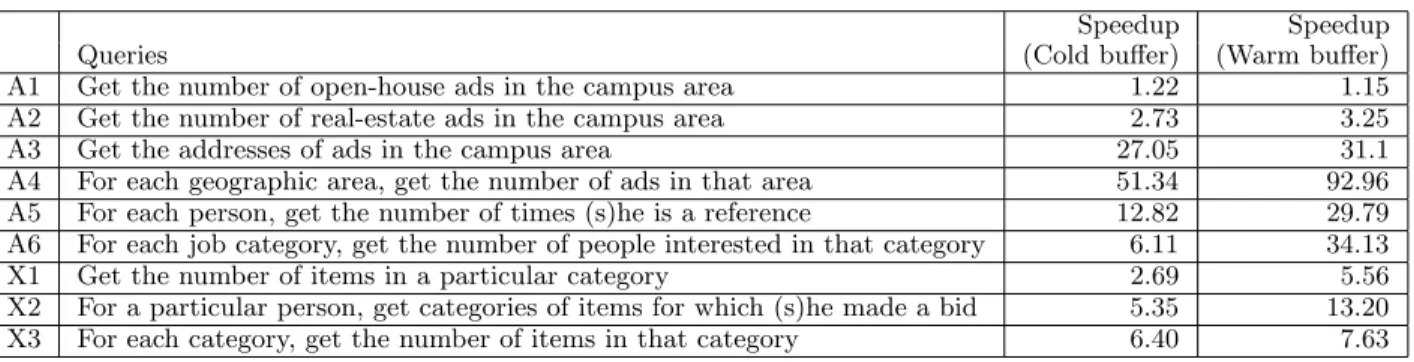
Table 1: Relative performance improvement obtained by using constraint information IBM DB2 database on a Linux workstation with an
In-tel 800 MHZ Pentium processor and 256 MB of main memory. The buffer pool was set to 32 MB. A com-plete description of the experimental setup is given in [14].
We compare the execution times we measured for the queries in Table 1. The queries labeled Ai are on the advertisement dataset, while those labeled Xi are on the XMark dataset. Note that query X1 in this table is the example query we considered in the previous section. For each XML query, we generated relational queries using several prior published algo-rithms and used the best timing for comparison with our approach, where we use the constraint information as well. The speedups obtained in execution times are given in the table.
The relative improvement in performance ranges from 1.15 to 93. In general, by using the constraint in-formation we do no worse than any of the prior strate-gies; so the relative performance is always greater than or equal to 1. We found that the actual performance improvement depends on two main factors: (i) number of satisfying paths that can be merged together due to the fact that they have the same relation sequence and (ii) the length of the prefix that can be eliminated.
For example, the wild card in query A1 had two satisfying paths, while that in A2 and A3 had seven and twenty satisfying paths respectively. The response times show that as the number of satisfying paths for a wild card increases, the benefit obtained by our ap-proach also increases considerably. The above three
queries have a selection condition on the geographic area of an advertisement. Queries A4, A5 and A6 compute information across all areas. For example, A4 gets the number of ads for each area. Even for these queries, we observed significant speedups when constraint information was used to generate optimized SQL queries.
Similarly, queries X1, X2 and X3 on the XMark dataset also had significant speedups ranging from a factor of 2.7 to a factor of 13.2. The speedup was smaller in these cases relative to the ADEX dataset as the maximum number of satisfying paths for a wild card is only six for the XMark schema.
2.3 Observations
The above experimental results show that by using constraint information it is possible to obtain signifi-cant speedups in SQL query execution times in a num-ber of cases. This improvement is markedly higher when the XML query has wild cards in it and the con-straints on the data allow several of these branches to be merged. Opportunities for such optimizations occur when we build a hierarchy in the XML view from flat relational data. For example, in the XMark schema in Figure 2 a hierarchy was created by partitioning items based on the continents to which they belong to.
In the rest of the paper, we look at two dif-ferent ways of attempting to automatically generate these better queries: SQL Optimization, and Intel-ligent Query Translation. In the former approach, SQL queries are generated in a straightforward fashion
and then optimized using the relational integrity con-straints. In the latter approach, we use the constraint information during the XML-to-SQL query translation process itself.
3
Problem Definition
In this section, we present a formal description of the XML-to-SQL query translation problem.
For concreteness, we need to provide some mecha-nism for representing how an XML schema is mapped to a relational schema. In this paper, we use the simple approach of defining an XML view with annotations on the XML schema nodes and edges. A non-leaf node is annotated with a relation name, while a leaf node is annotated with the name of a relational column. Each edge e = (u → v) is annotated with a conjunctive query, where the relations allowed in the query are the relational annotations of nodes on the path from the root of the graph to node v. A simple XML view is one in which each of the edge annotations involves at most one join condition.
We illustrate this approach to defining views with an example1. Consider the relational schema and the corresponding XML view definition in Figure 2. Con-sider a top-down traversal of this schema, which illus-trates how an XML document can be constructed from underlying relational data. The Site element is the root of the document and it has anidchild whose value is the value of Site.id attribute. A Regions child ele-ment is created within theSiteelement and six subele-ments are created within Regions, one for each conti-nent. Within each continent element, the information about the items in that continent are exported. For example, consider the elementAfrica. The annotation on the outgoing edge (4,10) indicates that for each tu-ple in theItemrelation corresponding to this continent and satisfying the join condition, anItem subelement is created. For each such item, itsidis exported as an
id child element and the categories to which the item belongs is represented as incategorysubelements. The annotation on edge (10,12) is a join conditionItem.id
= InCategory.itemId (not shown in figure). This view
definition is an example of asimple view definition as each edge annotation has at most one join condition.
In this paper we focus on a simple but useful class of queries: simple path expressions. A simple path expression can be denoted as “s1 l1 s2 l2. . . sk lk,”
where each of the li is a tag name and each of the
si is either/(denoting a parent-child traversal) or //
(denoting an ancestor-descendant traversal).
For a path expression query over a tree XML view, the equivalent relational query output by published translation algorithms can be viewed as the union of several conjunctive queries. So, we consider this class of queries with a simple extension: a disjunction of selection conditions is allowed for each conjunctive query.
1
See [14] for a formal description of the view definition
For concreteness, we need to define what is meant by a translation of an XML query to a SQL query. That is, we need to define when a SQL query is consid-ered a correct translation for a given path expression queryQunder a mappingT. Our approach to defining these semantics is to present a straightforward trans-lation algorithm that returns the query baseline(Q). Any SQL query SQthat is equivalent to baseline(Q) under the given relational integrity constraints is a cor-rect SQL translation for the XML queryQ.
For a leaf node n in the schema, we define the root-to-leaf query rtol(n) as the SQL query obtained by (conjunctively) combining the annotations on the edges of the root-to-leaf path of nand projecting the annotation of node n. For example, rtol(14) is the query
select C.category
from Site S, Item I, InCat C
where S.id = I.siteid and I.id = C.itemid and I.continent=’africa’
Given a tree XML-to-Relational mapping T and a simple path expression query Q, let S = {n1, n2, . . . , nk} denote the set of nodes in T that
match the queryQ. Then abaseline query translation algorithm is to return the SQL query Sn∈Srtol(n).
Letbaseline(Q) denote this query.
Finally, we are able to define what we mean by the to-SQL translation problem: Given an XML-to-Relational mapping T, a simple path expression query Q and integrity constraints on the underlying relational schema, find the equivalent SQL query with minimum cost.
The above definition is precise modulo the interpre-tation of the phrase “minimum cost.” Different prob-lems will result with different cost metrics. A reason-able cost metric is the traditional metric for conjunc-tive query minimization — that is, the cost of a query is the number of relational conjuncts. Let us denote this metricRelCount.
4
The SQL Optimization approach
The scenario we presented in Section 2.1 showed that query minimization is a core issue in generating effi-cient SQL queries for XML workloads. For the class of path expression queries over a tree XML-to-Relational mapping, recall that baseline (Q) is a union of con-junctive queries. Hence, we need to minimize a union of conjunctive queries under multiset semantics in the presence of relational integrity constraints. In this sec-tion, we first discuss prior work on relational query minimization and then discuss the impact on the SQL Optimization approach.4.1 Previous work on Relational Query Mini-mization
Most, if not all, techniques in the published litera-ture for minimizing relational queries are based on al-gorithms for query containment or query equivalence.
We next present some known results about the com-plexity of these problems.
• The containment, equivalence and minimization
prob-lems for conjunctive queries under set semantics are NP-complete [2, 5].
• The containment problem for conjunctive queries
un-der multiset semantics isπP2-hard [6].
• The equivalence problem for conjunctive queries
un-der multiset semantics is same as graph isomor-phism [6].
• The containment and equivalence problems for
mono-tonic relational expressions under set semantics isπP
2
-complete [19].
• The containment problem for union of conjunctive
queries is undecidable under multiset semantics [11]. There has also been a lot of work on the use of con-straints in query optimization of relational queries [7, 13, 25]. In [13], the query containment problem un-der functional dependencies and inclusion dependen-cies is studied. In [22], a scheme for utilizing seman-tic integrity constraints in query optimization, using a graph theoretic approach, is presented. In [24], a nec-essary and sufficient condition for the IC-RFT problem (does a conjunctive query always produce an empty result under a given set of implication constraints) is presented and in [25] the results are extended when referential constraints are also allowed. Polynomial equivalence to other problems like the query contain-ment problem are also proved.
More recently, the chase and backchase algorithm (c&b) was introduced in [7] motivated by logical re-dundancy and physical independence in mediator-like components. This approach brings together use of in-dexes, use of materialized views, semantic optimiza-tion and join/scan minimizaoptimiza-tion and allows non-trivial use of indexes and materialized views through the use of semantic constraints. In [8], the authors present a generalization of the classical chase algorithm for embedded dependencies [4] to a richer class of con-straints known as Disjunctive Embedded Dependen-cies (DEDs).
4.2 Impact on the SQL Optimization ap-proach
While a lot of research has been done on relational query optimization in the presence of constraints, there are some mismatches with what we need in the XML-to-SQL query translation scenario.
• Most of the prior work is on reasoning under set semantics. On the other hand, we need to op-timize relational queries under multi-set seman-tics. We are not aware of any published algorithm for minimizing union of conjunctive queries under multi-set semantics (both in the absence and pres-ence of integrity constraints).
• Even under set semantics, the running time of these algorithms are exponential in the size of the input (relational schema, constraints and query). Incurring this overhead on a per-query basis may be expensive in practice.
• The class of constraints handled by different ap-proaches vary considerably and no single tech-nique dominates the others.
By a simple reduction, we have the following result.
Proposition 1 Solving the XML-to-SQL Query Translation problem using the SQL Optimization approach for a simple tree XML view under the metric RelCountis at least as hard as minimizing a union of conjunctive queries under multiset semantics.
5
Intelligent Query Translation
In this section, we present our approach to generating SQL queries that are often more efficient than those generated by existing translation algorithms. We are able to do so by focusing on a tractable yet important subpart of the problem space. This section is some-what complex; we begin with an overview of our ap-proach and then explain the main components of our approach. A more formal description is presented in the following section (Section 6).
5.1 Outline of our approach
As we saw in the previous section, the SQL Optimiza-tion approach has three main problems: (i) lack of techniques for query minimization under multi-set se-mantics, (ii) high overhead for reasoning using con-straints even under set semantics and (iii) variety of techniques for different class of constraints. In the In-telligent Query Translation approach, we circumvent each of these problems in the following fashion.
While reasoning about query minimization under multi-set semantics can be a lot different from reason-ing under set semantics, there are scenarios where the two notions are similar. In our approach, we identify a class of views that, informally speaking, have the property that the target relational data is exported exactlyonce in the XML view. We refer to such views asbijective, and describe this concept in more detail in Section 5.2. Such mappings have the desirable prop-erty that they can be optimized using containment and equivalence algorithms under set semantics instead of multiset semantics. In our approach, we identify parts of the mapping that are bijective and apply our opti-mizations to those parts.
In order to address problems (ii) and (iii), we adopt the following strategy. By observing that the XML-to-Relational mapping and the underlying relational integrity constraints remain constant across multiple query invocations, we compute some summary infor-mation in a precomputation phase. In this precom-putation phase, we make use of an algorithm for rea-soning about conjunctive query containment under set
* * (i) (ii) (i) Book.price <= P1 (ii) Book.price > P2 * * * * cheapbook 2 Book costlybook Book books 1 section title 3 4 Book.title Author
author 7title 8 section
Book.title Author
author
Section Section
6
5 9
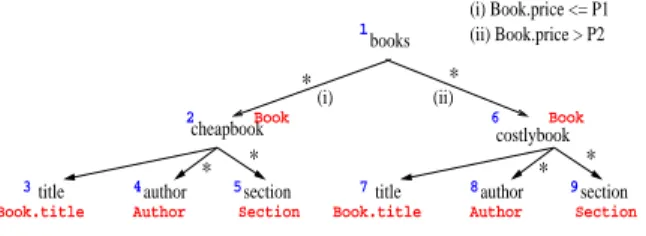
Figure 3: Sample mapping
semantics (say A). Then, when we need to translate an XML query into SQL, we use this summary infor-mation in the run-time query translation phase. This way, the potentially expensive part of reasoning using integrity constraints is moved to a (offline) phase and the run-time overhead is kept small. In addition, we can make use of different algorithms for Athat work for varying classes of relational integrity constraints. This is especially useful as we can choose algorithm Abased on the class of relational integrity constraints that are applicable for the current relational schema.
Since, we are going to use some summary informa-tion during the run-time query translainforma-tion process, we need to relax the optimality metric that we hope to achieve. As we have seen in Section 2.1, optimizing SQL generated by XML to SQL translation frequently involves eliminating unnecessary prefixes in the SQL queries. Motivated by this observation, we define a dif-ferent notion of minimality for generated SQL queries — one where we would like to maximize the length of the prefix eliminated for each matching path in the schema. We define this metric, PrefixMetric in Sec-tion 5.3.
Using the above techniques, we developed a constraint-awareapproach to efficiently translate path expression queries into SQL. We describe the main components of our approach informally in the follow-ing subsections. A more formal description of our ap-proach is presented in Section 6.
5.2 Bijective mappings
Consider the XML schema shown in Figure 3, which represents information about a collection of books. The XML view has created a simple hierarchy, par-titioning the books into cheap and costly books by the relationship of their prices to two constantsP1andP2. Let us now consider three possible scenarios: P1 = P2, P1< P2 andP1 > P2. If P1=P2, then the XML view has information about all the books exactly once, while ifP1< P2the XML view has information about only certain books. On the other hand, whenP1> P2, the XML view has information about the books in the price range{P2−P1}twice.
The scenario when P1 = P2 corresponds to an in-teresting and common class of mappings, one in which there is a one-to-one correspondence between the XML view data and the underlying relational data. We refer to this class of mappings asbijective. These mappings have the property that the query results of two root-to-leaf path queries do not have any common results, so
the corresponding SQL queries can be merged without worrying about preserving counts of duplicates.
For example, thertolqueries for nodes 3 and 7 re-turning the titles of cheapbooks and costlybooks will not have any common results when the mapping is bijective. This simple observation makes the query minimization process a lot simpler as we can use al-gorithms for query minimization under set semantics instead of multiset semantics.
Notice that whether an XML view definition is bi-jective or not is a property of the view, and that one cannot determine if an XML view definition is bijective by simply examining the relational schema without the mapping. So, while one can easily use this information during the query translation process (where we know about the XML view), in order to perform similar op-timizations after the SQL query has been generated, the appropriate module (be it the relational optimizer or some other module) needs to know about proper-ties of the XML view. This means that if existing relational optimizers are to be extended to handle op-timizations based upon bijective views, they need to be extended to understand XML views, which is not very attractive.
5.3 Prefix Elimination Optimality
We define the cost metric PrefixMetric(SQ,T) to be the number of nodes in the XML-to-Relational mapping T that correspond to the SQL query SQ. For example, consider the query SQ1 in Sec-tion 2.1. The fragment of this query identifying items in Africa corresponds to the sequence of nodes <1,3,4,10,12,14>, and so the cost is six. Since there are six such fragments in SQ1, the total cost PrefixMetric(SQ1,T) is 36. Similarly, the cost for each fragment of querySQ1
1 is four and the total cost PrefixMetric(SQ1
1,T) is 24. For queryOQ1, the total costPrefixMetric(OQ1,T) is six.
By definition, the cost of any SQL query that does not correspond to a path in the mapping is undefined. Notice that the definition of the PrefixMetric met-ric restmet-ricts the class of equivalent SQL queries consid-ered. For example, we are only interested in finding equivalent queries that are in some sense “syntacti-cally” contained in some conjunctive query fragment inbaseline(Q). While this misses opportunities to find equivalent queries that involve materialized views or cached query results or eliminating intermediate rela-tions in the conjunctive query, it is still general enough to cover a large number of interesting scenarios. 5.4 The query translation algorithm
In this section, we briefly explain the main compo-nents of our query translation algorithm using exam-ples. The algorithm has two parts: an (offline) pre-computation phase, in which summary information is computed; and a run time phase when the actual query translation occurs.
5.4.1 Precomputation Phase
Here, we make use of the fact that the XML-to-Relational mapping and the relational integrity con-straints are valid across multiple queries and use them to precompute some summary information. The in-formation that we precompute is related to properties of the root-to-leaf queries we discussed in connection with the semantics of translation in Section 3.
For a given node in the XML schema, it may be possible to eliminate a prefix of its corresponding root to leaf query. The actual prefix that can be elimi-nated for a leaf node varies depending on the subset of schema nodes selected by the query. We define the notion of Least Distinguishing Ancestors (LDAs) to capture this. For each pair of leaf nodes (u, v), we compute LDA(u, v) = w. Intuitively, w is the lowest ancestor ofusuch that if nodeumatches a given XML query, it is sufficient to issue the query fromw−u (in-stead of the root to leaf query foru) without returning any results corresponding to nodev. In order to create the query for a node u, it suffices to pick the highest ancestor among LDA(u, v) over all leaf nodes v not matching the query.
For example, for the schema in Figure 2, LDA(14,39) = 4 and LDA(39,14) = 9. In other words, if node 14 matches a query and node 39 does not, then it suffices to issue the query corresponding to the path {4,10,12,14} in order to return the results cor-responding to node 14. This query is shown below.
select IC.category from Item I, Incat IC
where I.id = IC.itemid and I.continent = ’africa’
In our precomputation phase, for every pair of non-leaf nodesu, vthat have the same annotation, we com-pute LDA(u, v). In addition, we identify the parts of the XML view definition that are bijective. In our running example, the entire XML view is bijective. 5.4.2 Run-time Query Translation
We use the following query on the mapping schema in Figure 2 to illustrate the translation algorithm.
Q: //Item/InCategory/Category
We first executeQ on the schema graph and iden-tify the satisfying nodes: S = {14,19,24,29,34,39}. For each noden∈S, issuingrtol(n) is a correct trans-lation. Our goal is to find the smallest suffix of each such query. Consider the leaf noden1= 14. We need to identify the lowest ancestora1ofn1such that it suf-fices to output the query for the path <a1, . . . , n1>. In order to find a1, we look at the other nodes with the same annotation, namely C = {19,24,29,34,39} and compute LDA(14, x),∀x∈(C−S). The highest node among these corresponds toa1. In this particular case, (C−S) is empty, so we do not have to look at the LDA values. As a result, for node 14 it suffices to is-sue the scan query corresponding to the leaf node. We
obtain a similar scan query for the other five schema nodes inS. Since the six scan queries are on the same relation, we merge them and issue a single queryOQ given below:
select C.eid from InCat C
On the other hand, using existing algorithms we would have obtained a relational querySQthat is the union of six queries, each with two joins (similar to the example querySQ1 in Section 2.1).
5.5 Analysis
The proofs of the theorems in this section are omitted due to lack of space and are presented in [14].
Theorem 1 Given a tree XML-to-Relational
map-pingT along with the integrity constraints that hold on the underlying relational schema, and a path expres-sion query P, the constraint-aware algorithm outputs a correct equivalent SQL query in polynomial time.
We would like to point out that our algorithm per-forms XML-to-SQL query translation correctly even when part of the mapping is not bijective or when the conjunctive query containment algorithm A is sound but not complete for the class of relational constraints that are applicable. Note that the running time of algorithm A does not impact the complexity of the translation algorithm, sinceAis run once as a precom-putation step, not on a per-query basis during trans-lation.
Let Q1 be a conjunctive query and Q2 be a union of conjunctive queries. Let UQC denote the problem: isQ1⊆Q2under set semantics? and DUP denote the problem: Are the results ofQ1 duplicate-free?
SupposeC is the class of integrity constraints that hold on the relational schema andAandA0
are sound and complete algorithms for the UQC and DUP prob-lems over this class of constraints. Examples of such algorithms and a description of the corresponding class of integrity constraints can be found in [7, 25]. In such cases, our algorithm actually outputs the opti-mal query under metric PrefixMetric.
Theorem 2 Given sound and complete algorithmsA
andA0
for the UQC and DUP problems over the class C, the XML-to-SQL Query Translation problem for a bijective tree XML view under metricPrefixMetriccan be solved in polynomial time.
6
The
constraint-aware
approach
In this section, we formally describe the various com-ponents of our approach. We start by describing some terminology used in the formalization followed by the actual description of the two main components: precomputation phase and run-time query translation phase.
6.1 Terminology
Most of the properties we talk about address leaf nodes in the schema that are annotated with the same rela-tional column. We define nodes(R.C) to be the set of leaf nodes annotated with R.C. We call two leaf nodes column-compatible if they are annotated with the same relational column. We refer to the annota-tion of nodenasannot(n).
Recall that we definedrtol(n) to be the root-to-leaf query for a noden. We generalize this notion to an ar-bitrary sequence of nodes as follows. Anode sequence N S=< n1, n2, . . . , nk>is a sequence of nodes in the
schema graph that corresponds to a path starting from the node n1 = N S.f irstand terminating in the leaf nodenk =N S.last. The relational query Query(N S)
is obtained by combining the conditions on the edges of the sequence and projectingannot(nk). The relational
query keyQuery(N S) is the same as Query(N S), ex-cept that the key column(s) of Rel(nk) is (are) also
projected. Query(N S) and keyQuery(N S) are always conjunctive queries. Just like Query(N S) corresponds tortol(n), we refer to keyQuery(N S) askeyrtol(n).
Let RelSeq(N S) denote the sequence of relations joined in Query(N S), in a bottom-up order. For example, for N S =<1,3,4,10,12>, RelSeq(N S) = <InCat,Item,Site>.
Two node sequences N S1 and N S2 are said to be combinableif the corresponding relation sequences RelSeq(N S1) andRelSeq(N S2) are the same, the join conditions are on the same set of columns for each pair of relations, and N S1.last andN S2.last are column-compatible. In other words, the two relation sequences are identical modulo the selection conditions.
6.2 Precomputation Phase
Recall that, in the precomputation phase we identify the parts of the XML-to-Relational mapping that are bijective and also compute LDA information. We for-mally define these two notions in the next two subsec-tions and then describe how we compute this informa-tion.
6.2.1 Bijective column mappings
For a relational column R.C, let KeyProject(R.C) denote the query “select R.key, R.C from R” and NodeKeyProject(R.C) denote the querySn∈nodes(R.C) keyrtol(n). Here, R.key denotes the key column(s) of R. We will make use of the following definitions:
Definition 1 For a relational columnR.C,
• If KeyP roject(R.C) ⊆ N odeKeyP roject(R.C), thenR.C is At-least-once mapped
• If KeyP roject(R.C) ⊇ N odeKeyP roject(R.C), thenR.C is At-most-once mapped
• If KeyP roject(R.C) = N odeKeyP roject(R.C), thenR.C is bijectively mapped
In the preceding definition, the containment opera-tions are under multi-set semantics.
Informally, if all the values in the columnR.C ap-pear in the XML view “exactly once”, then the rela-tional column is bijectively mapped. In order to check this under multi-set semantics, we use the key field(s) of the relation R.
An XML-to-Relational mapping T is bijectively mapped if each of the relational columns annotating some leaf node inT is bijectively mapped.
6.2.2 Lowest Distinguishing Ancestor
Letuandvbe two column-compatible leaf nodes in the schema. Let node sequence N S=< n1, n2, . . . , nk >,
where n1 = root(T) andnk =u, represent the
root-to-leaf path in tou.
Definition 2 The nodenj is adistinguishing
ances-tor for u with respect to v if the intersection of the results of the two queries, keyQuery(< nj, . . . , nk >)
and keyrtol(v), is empty.
Ifnj is a distinguishing ancestorforuwith respect to
v, then we write u |nj v. Thus, for the above
exam-ple, 4 is a distinguishing ancestor of 14 with respect to every other column-compatible node. In other words, issuing the query from 4 to 14, we will obtain all the results corresponding to node 14 and no result corre-sponding to any other column-compatible node (such as node 39).
Observe that the distinguishing ancestor relation is not a symmetric relation. For example, in the annotated schema graph shown in Figure 2, con-sider schema nodes 14 and 39, which are column-compatible. Now, 14|439 is true. Notice that node 4 is an ancestor of node 14 but not an ancestor of node 39. So, 39|4 14 is false.
Definition 3 The lowest distinguishing ancestorfor
uwith respect to v,u|| v, is the lowest ancestorw of usuch that u|w v.
We represent this asw=lda(u, v) orw=u||v. The lda relation is not symmetric. For example, 14||39 = 46= 39|| 14.
Using these definitions, and our previously defined notion of a a bijective column mapping, we have the following lemma that aids in the identification of low-est distinguishing anclow-estors:
Lemma 1 Letuandvbe two column-compatible nodes in the schema graphT, where annot(u) =annot(v) = R.C andR.C is bijectively mapped. Thenu|root(T)v holds.
6.2.3 Computing Summary Information from the Constraints
Given an XML-to-Relational mapping T and the in-tegrity constraints that hold on the underlying rela-tional schema, we precompute the following informa-tion
• For each relational columnR.C, isR.C bijective? • For every pair of column-compatible nodes (u, v),
u||v andv|| u.
In this computation, we use procedures for solving the following problems on conjunctive queries in the presence of constraints.
UQC: Given a conjunctive queryQ1and a union of con-junctive queriesQ2, isQ1⊆Q2under set seman-tics?
EQI: Is the intersection of two given conjunctive queries empty?
DUP: Are the results of a given conjunctive query duplicate-free?
We have developed procedures for these three prob-lems by adapting the chase and query containment gorithms proposed in [8]. We have also designed an al-ternate solution using the algorithm proposed in [25]. In general, any algorithm for conjunctive query con-tainment under set semantics can be used to develop procedures for the above three problems. The details of the above procedures and how we use them to pre-compute the required summary information are omit-ted due to lack of space. These details can be found in [14].
6.3 Run-Time Query Translation Algorithm The run-time query translation algorithm is outlined in Figure 4. Given a path expression queryQ, we first identify the parts of the schema that match the query. Let S denote the set of matching schema nodes. For purposes of exposition, we assume thatSconsists only of leaf nodes, leaving the handling of non-leaf nodes to Section 6.4.1.
We then partition the setS into two sets based on whether the corresponding relational column is bijec-tively mapped. For the set Snonbij, we construct the
root-to-leaf queries just like prior algorithms. On the other hand, for the set Sbij we utilize the summary
information to eliminate parts of the query that are redundant. This is a two stage process: first we find the longest prefix that can be eliminated for each node n ∈ Sbij (Prefix-Elimination); then we construct the
SQL query using the prefix-eliminated set of nodes (SQLGen). Finally, we union the queries correspond-ing to the bijective and non-bijective nodes.
We next describe the prefix-elimination and SQL-Genstages.
6.3.1 Eliminating Redundant Prefixes
ThePrefix-Eliminationalgorithm is given in Figure 5. We use the pre-computed information about least dis-tinguishing ancestors in this computation. Instead of taking the naive approach of issuing the full query for each of these nodes and taking their union, we wish, at the very least, to be able to issue a smaller query
procedureconstraint-aware(Q) begin
LetS←NodeId(Q)
PartitionS intoSbij andSnonbij
based on whetherannot(n) isbijective SQLnonbij =Sn∈Snonbijrtol(n)
Prefix-Elimination(Sbij)
SQLbij =SQLGen(Sbij)
ReturnSQLbijSSQLnonbij
end
Figure 4: constraint-aware query translation algo-rithm for path expression queries
procedurePrefix-Elimination(S) begin
for each noden∈S do
LetSchema(n) denote the set of schema nodes mapped to the same column asn
LetConf lict(n)←Schema(n)−S Let LDA Set(n) denote set ofn||xfor every nodexin Conflict(n)
C lda(n) = highest node in LDA Set(n) While true do
If (∃n, n1∈S), such that
RelSeq(C lda(n),n) and RelSeq(C lda(n1),n1) are not combinableand
n||n1 is a strict ancestor of C lda(n) Then
C lda(n) =n||n1 Else
Break end
Figure 5: Prefix-Elimination phase for each noden ∈S. Thus, we want to find the low-est anclow-estorasuch that Query(< a, . . . , n >) returns the correct answer, that is, where the prefix ofrtol(n) from root(T) toacan be safely eliminated. There are two conditions to check here:
• amust distinguishn from all column-compatible nodes not in S. This computation corresponds to theforloop in Figure 5.
• For each column-compatible node n1 ∈S, either the two queries are combinable oradistinguishes nfrom n1. This corresponds to the whileloop in Figure 5.
Thewhileloop is an iterative process that will ter-minate in at most (k∗d) iterations, wherek=|S|and dis the maximum depth (in the XML schema) among all nodes inS. At the end of this process we have the prefix eliminated node sequence for every node inS. 6.3.2 SQLGenStage
We next construct the optimized SQL query by taking the prefix-eliminated set of nodes and grouping multi-ple paths that involve the same sequence of relations.
LetN S ={<C lda(n),. . . ,n >:n∈NodeId(Q)}. No-tice that combinability of node sequences is an equiva-lence relation. We partitionN S based on combinabil-ity and construct a SQL query for each equivalence class created. The final SQL query is the union of the queries across all equivalence classes. Notice that all the queries in an equivalence class have the same relation sequence and differ only in the selection con-ditions. This operation is correct under multi-set se-mantics because it is only applied to columns that are bijectively mapped.
6.4 Extensions to More General Cases
In this section, we discuss how the methods discussed to up to this point extend to more general situations. Note that our optimization techniques will never gen-erate an incorrect query — they will either not apply (in which case we will generate the naive query) or they will apply and will generate a query expected to be more efficient than the naive query. Hence the dis-cussion here outlines techniques that allow us to apply optimizations to more queries.
6.4.1 Path Expression Queries Involving Non-Leaf Nodes
In our discussion in Section 6.3 on translating path ex-pression queries, we assumed that the query matches a set of leaf nodes in the schema. If the result includes non-leaf nodes as well, then there are two alternative ways of returning the resulting XML elements corre-sponding to the non-leaf nodes.
1. For each non-leaf element, we can return an iden-tifier or representative subelement. In this case, each non-leaf noden in the schema is associated with a child leaf nodenc. Ifnappears in a query
result, then the correspondingnc elements are
re-turned instead. For example, we can associate the key field(s) of the corresponding relations with each non-leaf node.
2. For each non-leaf element, we can return the en-tire subtree rooted at this element. The problem of efficiently constructing entire subtrees of XML documents has been considered in [10, 21]. We leave the interesting problem of combining our al-gorithm with one of these alal-gorithms for future work.
6.4.2 Beyond Path Expressions
Our techniques can be extended in a straightforward way to handle branching path expression queries (as we show in [14]); because that extension does not pro-vide any additional insight, and due to space con-straints, we do not discuss that extension here.
We now briefly describe how to extend constraint-aware translation to more general queries. A path expression query corresponds to a single For clause in XQuery. Consider an XQuery that has several of
these For clauses and (optional) Where clauses. A natural way of applying our techniques is to perform constraint-aware translation for each of the individ-ual path expressions, and then combine the resulting queries with appropriate join conditions. For example, consider a query XQ involving two path expressions p1 and p2 with a join condition between them. We apply our constraint-aware translation on p1 and p2 individually to obtain relational queriesQ1andQ2 re-spectively. Note that Q1 and Q2 are the union of k1 and k2 queries respectively. We generate the query Q=Q11Q2as the SQL query corresponding toXQ. Ifk1>1 ork2>1, then we could have generated the final SQL query in a number of other ways. For exam-ple, we could have distributed the unions over the join and generated the queryQ0that is the union ofk
1∗k2 queries. Choosing the best query from amongst these (possibly exponential) alternatives is also an interest-ing area for future work.
6.4.3 Beyond Bijective Mappings
Recall that our technique optimizes the SQL query cor-responding to bijective parts of the mapping. It con-structs the baseline query for the non-bijective parts of the mapping. While we expect bijectively mapped columns to be common, we have extended our algo-rithm to perform efficient XML to SQL query transla-tion when either the At-least-once or the At-most-once condition is satisfied. We outline the main ideas here with an example and omit the details due to lack of space.
Let us look at the scenario when a relational column R.C satisfies the At-most-once condition but violates the At-least-once condition. For example, consider the example in Figure 2. While the XMark XML schema contains information about items in six continents, in reality, there is actually a seventh continent (Antarc-tica). So, it is reasonable to assume that the relational schema has an integrity constraint on Item.continent allowing seven potential values. In this case, parts of the relational data are not present in the XML view, namely the items corresponding to Antarctica. Now while SQ1 and SQ11 are correct SQL queries for Q1, OQ1 is not. The best query in this scenario will be a variation ofSQ1
1that combines all the six queries into one, since they are on the same sequence of relations. This query is given below.
select count(*)
from Item I, InCat C
where I.id = C.itemid and C.category=‘cat1’ and I.continent IN {’africa’,...,’samerica’}
Notice how we were able to group together the six paths corresponding to different continents. This was possible due to the fact that InCat.category satisfied the At-most-Once condition. As a result, the rtol queries corresponding to any two column-compatible schema nodes mapped to InCat.category will not have any common results. So, we can translate the unions
to a disjunction. In other words, we can perform the SQLGenphase without any change.
On the other hand, we need to be careful in the prefix-elimination stage. We cannot eliminate any prefix below the continent nodes due to one missing continent in the XML schema. To account for this fact, we have to augment the prefix-elimination stage. We do this as follows: S =nodes(InCat.category) = {14,19,24,29,34,39}. For each schema noden ∈ S, we compute the lowest schema node below which the prefix cannot be eliminated (since the column is not completely exported). Let us call thislowest required ancestor(lra(n)). For example, lra(14) = 4 and lra(39) = 9. This ensures that the selection condition on Item.continent is always present in the query.
The lra computation is another summary informa-tion that we precompute for schema nodes correspond-ing to relational columns that violate the At-least-once condition.
7
Conclusion
We have considered the problem of generating efficient SQL queries for XML workloads and showed that pub-lished translation algorithms can generate SQL queries that are suboptimal. We consider the problem of where to add the intelligence in order to obtain opti-mized SQL queries using integrity constraint informa-tion. Our results argue that the quality of the resulting SQL should be a concern of the translation algorithm itself, rather being left in the hands of a traditional relational optimizer. This is because many “easy” op-portunities for optimization are apparent only when the XML view definition and relational integrity con-straints are considered simultaneously. These oppor-tunities vanish by the time the relational optimizer is presented with SQL.
A number of directions for future research ex-ist. Extending our approach to a more general class of XML-to-Relational mappings (including recursive mappings) is an interesting problem. Similarly, look-ing at a larger class of input XML queries gives rise to other interesting problems. In a different direc-tion, the XML-to-SQL query translation problem also arises in another context: XML Storage, where data that was originally XML is to be stored and queried in an RDBMS (as opposed to the case considered here, where data that was originally relational is to be viewed and queried as XML.) The class of XML-to-Relational mappings produced by existing techniques for XML storage are bijective and there may be al-ternative ways of computing the summary informa-tion without even resorting to relainforma-tional integrity con-straints. Exploring this variant of the problem is an-other open problem.
Acknowledgement: This work was supported in part by NSF grant ITR-0086002.
References
[1] Naa classified advertising standards task force.
http://www.naa.org/technology/clsstdtf/.
[2] A. Aho, Y. Sagiv, and J. Ullman. Equivalence among rela-tional expressions. SIAM J. Comput., 8(2), 1979. [3] S. Amer-Yahia, S. Cho, L. V. S. Lakshmanan, and D.
Sri-vastava. Minimization of tree pattern queries. InSIGMOD, 2001.
[4] C. Beeri and M. Vardi. A proof procedure for data depen-dencies. Journal of the ACM, 31(4), 1984.
[5] A. K. Chandra and P. M. Merlin. Optimal implementation of conjunctive queries in relational data bases. In ACM STOC, 1977.
[6] S. Chaudhuri and M. Y. Vardi. Optimization of real con-junctive queries. InPODS, 1993.
[7] A. Deutsch, L. Popa, and V. Tannen. Physical data in-dependence, constraints and optimization with universal plans. InVLDB, 1999.
[8] A. Deutsch and V. Tannen. Containment and Integrity Constraints for XPath Fragments. InKRDB, 2001. [9] A. Deutsch and V. Tannen. MARS: A System for
Publish-ing XML from Mixed and Redundant Storage. InVLDB, 2003.
[10] M. Fernandez, A. Morishima, and D. Suciu. Efficient Eval-uation of XML Middle-ware Queries. InSIGMOD, 2002. [11] Y. E. Ioannidis and R. Ramakrishnan. Containment of
conjunctive queries: beyond relations as sets.ACM TODS, 20(3), 1995.
[12] S. Jain, R. Mahajan, and D. Suciu. Translating XSLT Programs to Efficient SQL Queries. InWWW, 2002. [13] D. S. Johnson and A. C. Klug. Testing containment of
conjunctive queries under functional and inclusion depen-dencies. InPODS, 1982.
[14] R. Krishnamurthy, R. Kaushik, and J. F. Naughton. Efficient XML-to-SQL Query Transla-tion: Where to Add the Intelligence? (full version).
http://www.cs.wisc.edu/ sekar/publications.html. [15] R. Krishnamurthy, R. Kaushik, and J. F. Naughton.
XML-SQL Query Translation Literature: The State of the Art and Open Problems. InXML Database Symposium, 2003. [16] C. Li, P. Bohannon, H. Korth, and P.P.S. Narayan. Com-posing XSL Transformations with XML Publishing Views. InSIGMOD, 2003.
[17] I. Manolescu, D. Florescu, and D. Kossman. Answering XML queries over heterogeneous data sources. InVLDB, 2001.
[18] P. Ramanan. Efficient algorithms for minimizing tree pat-tern queries. InSIGMOD, 2002.
[19] Y. Sagiv and M. Yannakakis. Equivalences among rela-tional expressions with the union and difference operators. Journal of the ACM (JACM), 27(4), 1980.
[20] J. Shanmugasundaram, J. Kiernan, E. J. Shekita, C. Fan, and J. Funderburk. Querying XML Views of Relational Data. InVLDB, 2001.
[21] J. Shanmugasundaram, E. Shekita, R. Barr, M. Carey, B. Lindsay, H. Pirahesh, and B. Reinwald. Efficiently Pub-lishing Relational Data as XML Documents. In VLDB, 2000.
[22] S. T. Shenoy and Z. M. Ozsoyoglu. A system for semantic query optimization. InSIGMOD, 1987.
[23] Xmark: The xml benchmark project.
http://monetdb.cwi.nl/xml/index.html.
[24] X. Zhang and Z. M. Ozsoyoglu. On efficient reasoning with implication constraints. InDOOD, 1993.
[25] X. Zhang and Z. M. Ozsoyoglu. Implication and referential constraints: A new formal reasoning. TKDE, 9(6), 1997.