Abstract: The widespread use of the Internet comes accompanied with severe threats for web applications security. Intrusion Detection Systems (IDS) have been considered to deal with the diversity and complexity of web attacks. In this context, this work proposes an algorithm for web attack detection, exploring an anomaly-based technique: the wavelet transform. The proposed algorithm analyzes anomalies within variations on characters frequencies in web requests. Experimental results show high rates of detection without false positive occurrences.
Keywords: Web Attacks, Anomaly Detection, Wavelet Transform, Web Applications.
Anomaly-based Techniques for Web Attacks Detection
Bruno Augusti Mozzaquatro, Renato Preigschadt de Azevedo, Raul Ceretta Nunes, Alice de Jesus KozakeviciusUniversidade Federal de Santa Maria, Centro de Tecnologia. Av. Roraima, 1000, 97105-900, Santa Maria, RS, Brasil.
[email protected], [email protected], [email protected], [email protected] Cristian Cappo, Christian Schaerer
Polytechnic School, National University of A suncion. P.O. Box: 2111 SL, San Lorenzo, Paraguay. [email protected], [email protected]
Introduction
Internet has become an interconnection system between computer networks and web applications, that serves billions of users and mainly provides communication and informa-tion disseminainforma-tion.
A consequence of massive usage and ex-pansion of web applications is the continual identification and appearance of new vulner-abilities (OWASP, 2010), that are explored with the aim of violating the security and prejudic-ing the availability of applications (Fonseca et al., 2010).
In this context, Intrusion Detection Systems (IDS) are necessary to guarantee information security. These systems can be distinguished according to two different approaches: signa-ture- and anomaly-based.
Signature-based IDS identify attacks through a group of information containing previously defined patterns, i.e. signatures. (Kruegel et al., 2004). The advantage of this approach is to detect attacks with low rate of false positives. Nevertheless, only attacks with
respect to known patterns are identified, de-manding frequent signature updates in order to keep detection in reliable standards.
Alternatively, anomaly-based IDS identify attacks through the observation of behaviour variations in characteristics of the network (Chandola et al., 2009). The main advantage of this approach is the ability to identify new at-tacks that are not necessarily associated to pre-viously known patterns, avoiding the usage of signatures (Chandola et al., 2009).
Web attacks are performed exploring many different contexts. Among them, attacks that manipulate web requests have received wide attention (OWASP, 2010) in the last years. These attacks explore vulnerabilities of pa-rameter manipulations to change values of a web request (Álvares and Petrović, 2003). In this context, special characters are commonly inserted, resulting in serious degradation of integrity, authentication, availability and au-thorization of internet services.
Several works explore anomaly-based methodologies to determine anomalies re-strained in the web traffic (Kruegel and Vigna,
2003; Wang and Stolfo, 2004; Estevez-Tapiador
et al., 2005), to mention a few examples. The most widespread techniques are those based on n-grams (Wang and Stolfo, 2004), determin-istic finite automata (Ingham and Inoue, 2007), statistics information (Kruegel and Vigna, 2003) and Markov chains (Estevez-Tapiador et al., 2005).
Signal processing techniques have been recently applied to anomalies detection in computer networks (de Azevedo et al., 2011; Lu and Ghorbani, 2009), providing a promis-ing toolset, with big potential for anomalies recognition.
This work explores a new approach for web attacks detection also based on signal process-ing techniques, considerprocess-ing well-established wavelets methods (Stollnitz et al., 1995). In the initial study, presented in Cappo et al. (2009), the usage of the Haar wavelet transform for at-tack detection on web application was investi-gated. Now in this work the application of the same discrete wavelet transform is considered to analyze the characters frequency distribu-tion of web requests. The wavelet transform enables the extraction of information on dif-ferent resolution levels and discards the train-ing phase. This is an alternative to techniques based on machine learning (Kruegel and Vigna, 2003; Kiani et al., 2008), which are the most used approach to detect web attacks.
This paper is organized as follows: Sec-tion II briefly summarizes the most commonly techniques used to detect anomalies on web re-quests. Section III presents aspects with respect to web attacks. In Section IV the one dimen-sional Haar wavelet transform is introduced, along with the corresponding bi-dimensional version. Section V contains the approach for detecting web attacks using the Haar wavelet transform. The validation set of experiments is presented in Section VI. Finally, the conclusion of the work is presented in Section VII.
Ano maly-based Detection
Techniques for Web Traffic
In this section a brief review about anomalies detection in the context of web traffic security is presented. The most common techniques are based on machine learning approaches, which explore anomalies in web traffic by a training phase, to model the ordinary behaviour of a system (Kruegel et al., 2004). Three commonly used approaches for the learning phase from web requests: packet payload, extracted tokens
and character distribution analysis.
Wang and Stolfo (2004) observed packet payload to model byte (n-gram) frequency distributions. A clustering algorithm was then applied to merge similar distributions by port and stream directions. The detection phase consisted in comparing the cluster distances to a certain threshold.
Ingham and Inoue (2007) tokenized HTTP requests. They employed Deterministic Finite Automata (DFA) machine induction com-bined with rules and heuristics for modelling and detecting attacks on traces of tokens with benign attacks. Ingham and Inoue (2007) com-pared the DFA and n-grams performances, signalling that the first approach was more ef-ficient than the former one.
Character distribution was also explored by the usage of statistic techniques. Kruegel and Vigna (2003) modelled the relative fre-quency of the characters and arranged into six arbitrarily chosen groups. Finally the Pear-son’s chi-squared statistical test was applied to detect attacks. Kiani et al. (2008) also utilized the test. However, in their work cumulative frequency of the characters in the training phase has been considered, and the characters from Yate’s correction method were grouped. Another group clustering was proposed by Sriraghavan and Lucchese (2008), where three groups of characters were formed according to type as alphabetic, numeric, and special char-acters.
Another behaviour modelling was pro-posed by Corona et al. (2009). The authors, using Markov’s hidden models for parameter analysis of the web traffic communication (GET and POST), demonstrated good results in the detection of the SQL Injection and Cross Site-scripting (XSS) attacks. Markov’s hidden models were also employed by Airu and Gi-acinto (2010) to explore the HTTP payload byte sequence for analysing attacks between web application and the web server.
Fr om the authors’ knowledge, signal processing techniques have been applied for detecting network anomalies, but not to ex-plore HTTP requests, as proposed in this work.
Web Attacks
Within the reported attacks in the last years, a representative amount was related to web applications (OWASP, 2010). This scenar-io is a consequence from the increasing utiliza-tion of these systems on the web and also from
failures on the software development phase, since programmers commonly skip some se-curity issues on the software life cycle design (Wagner et al., 2011).
From OWASP (2010), vulnerabilities re-lated to content injections are on the top of the technical vulnerabilities list. The amount of injection based web attacks, as Code Injec-tion and Cross Site-scripting (XSS), are conse-quently increasing and causing damages for many organizations.
This work looks at web attacks that insert malicious content by changing the character frequency on web requests. Figure 1 shows an example of this type of attack, where charac-ters “.” and “/” were injected on a GET request.
Wav elet Transform
The wavelet transform decomposes a signal on many resolution levels with the goal to high-light and recognize relevant information on the signal. The wavelet decomposition is hierarchi-cal and is formed by a coarsest level of repre-sentation and many refinement levels of infor-mation (Stollnitz et al., 1995). The coarsest level is associated to the scaling coefficients, which represent the main trend of the signal. The re-finement levels are composed by the wavelet coefficients, also called details, which are com-plementary information of the coarse represen-tation and are needed to reconstruct the origi-nal data. In sigorigi-nal aorigi-nalysis applications they are manipulated in order to allow noise removal, compression (Kozakevicius et al., 2005), or other feature extractions from the analyzed data.
There is a diversity of wavelet families, and the Haar wavelet is the one adopted in this work, mainly due to the facility to preserve the loca-tion of sudden varialoca-tions within data (Mallat, 2008). Furthermore, the Haar wavelet transform dismisses special treatment for the signal bor-ders and its implementation is straightforward. These are important features when considering discrete input data (with finite dimension). One-dimensional Wavelet
The application of the Haar wavelet trans-form involves high-pass (H) and low-pass
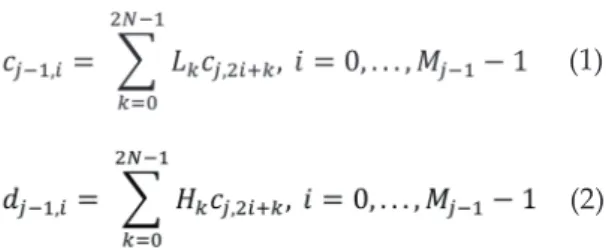
fil-ters (L), which are convolved with the signal to obtain the transformation coefficients. The application for one decomposition level of the pyramidal algorithm (Mallat, 2008), provides two groups of coefficients: a set of scaling, cj –1,i, and a set of wavelets coefficients, dj –1,i. The coefficients cj –1,i are associated to lower frequencies, keeping the mean information of the signal at each level. The wavelets coeffi-cients (or details) dj –1,i are associated to higher frequencies within the signal. Their computa-tion considered as input data a vector with values on the finest resolution level. Therefore the one scale decomposition is done as follow:
(1)
(2) Note that the difference between them is basically due to the considered filter type. One of the most important properties of the wavelet transform is its capability to identify jumps and peaks on data through the set of details (Grané and Veiga, 2009). This prop-erty allows the application of wavelet trans-form for abrupt changes identification and localization, noise removal and signal com-pression. In this paper we explore the algo-rithms presented in Stollnitz et al. (1995) for the alarm designing.
In Figure 2, an algorithm to compute the one dimensional wavelet transform (1DWT) is represented. In the input procedure the input data is processed until the coarsest de-composition level is achieved (line 8). On the level decomposition step (line 1), only data associated to mean values in each level is de-composed, generating a new set of means (de-noted by C’[i] on Figure 2) and a new set of details (denoted by C’ + h i
2 ), both with half size of the original block. One aspect to ob-serve is that only blocks associated to means (scaling coefficients) are further decomposed when the standard wavelet transform is
sidered. Another aspect is that in the proposed algorithm all decompositions are stored on the same array C, instead of using two different arrays as suggested by pyramidal algorithm equations. The level of transform corresponds to the number of interactions on decomposi-tion procedure. Each level of Haar wavelet transform is performed here in a dyadic form, i.e. the input data is always split in sets with half size. At least two values must be kept on the coarsest level to run this algorithm. Bi-dimensional Wavelet
The bi-dimensional wavelet transform (2DWT) allows data analysis and identification of variations with respect to lines and columns of two dimensional input data.
The bi-dimensional wavelet transform (2DWT) allows data analysis and their varia-tions recognition with respect to lines and col-umns of a bi-dimensional input data. In fact, when processing the decomposition with re-spect to lines and to columns, another set of variations is captured as a by-product, which here we interpret as being in the diagonal di-rection. This set is also a linear combination to lines and columns and is associated again to high frequencies of the signal. In other words the 2DWT generates three sets of wavelet co-efficients (sometimes called as sub-bands) for representing variations in the input data, dif-ferently of the 1DWT, which generates only one set of wavelet coefficients.
In practice, there are many ways to per-form this transper-formation (Stollnitz et al., 1995), since the order which the many 1DWT are
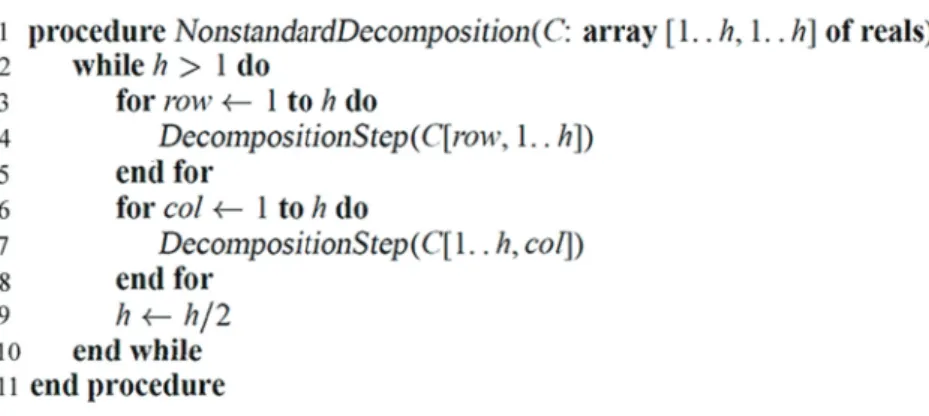
performed implies in a different system for data representation. One simple form is to compute initially the 1DWT for all lines of the input matrix and then compute the 1DWT for all columns of the resulting matrix. According to the classification presented in Stollnitz et al. (1995) this is a Non-Standard formulation, which is presented in Figure 3.
In Figure 4 the effect of applying one com-plete level of the 2DWT is presented for one sample image. First in panel (a) the interme-diate stage after the 1DWT by lines is shown, where data is decomposed in scaling and wavelet coefficients. In panel (b) the final step is shown, when all three sets of wavelet coef-ficients are finally obtained as well as the set of the scaling coefficients (one level coarser).
As done for the one dimensional transform, again in a free interpretation, the scaling coef-ficients are seen as a block formed by means, (means over means), and the three wavelet co-efficient sub-bands could be viewed as details of means (dc), means of details (cd) and details of details (dd), as a try to identify the origin of the wavelet coefficient generated during the transformation process.
In the application proposed here in this paper the lines of input matrix are associ-ated to ASCII characters and web requests to the columns. This paper explores the 2WDT to accomplish analysis of the character fre-quencies variation kept in the web requests in more than one direction, within a request and among requests.
In order to perform more levels of the 2DWT, only the set of the scaling coefficients is analyzed, being considered as the new in-Figure 2. Algorithm for 1DWT decomposition (Adapted from Stollnitz et al., 1995).
put data, which will again be decomposed in four new coefficient sets (sub-bands) accord-ing to the same algorithm. In each stage of the transform, the wavelets sub-bands remain un-altered.
Threshold
Af ter the application of the bi-dimensional wavelet transform, the signal is represented by four different sub-bands cc, cd, dc and dd. The sub-bands associated to wavelet coefficients represent the data variations captured in three different directions.
According to one of the main properties of wavelet decompositions, each time the wave-let coefficients are small, the corresponding coarse information (mean coefficients) can ac-curately represent the original data. Therefore the determination of the size (significance) of the wavelet coefficients is a tool to discard ir-relevant data from the representation or to detect relevant variations within the analyzed data. Thus, the criteria to discard wavelet coef-ficients are basically based on comparing the coefficients from sub-bands cd, dc and dd with some reference value, called threshold value. One of the most utilized values in filtering Figure 3. Nonstandard 2DWT algorithm: 1DWT applied for all lines and then applied for all columns (Adapted from Stollnitz et al., 1995).
applications is the universal threshold pro-posed by Donoho and Iain (1995) that is de-termined by λ = σ 2 log(N), where σ is the standard deviation of the coefficients, N is the number of samples at each sub-band.
When the threshold value is consistently chosen, the threshold operation does not de-stroy fundamental properties of the signal (Donoho and Iain, 1995). So, the main analysis question is how to determine the most coher-ent threshold, capable to separate relevant and irrelevant information, depending on the ap-plication properties.
Donoho and Iain (1995) proposed two ways to filter wavelet coefficients: one by applying a Hard threshold (Equation 3) and the other by applying a Soft threshold (Equation 4). The Hard threshold discards wavelet coefficients without modifying coefficients bigger than the threshold value (those judged as significant) and the Soft threshold provides smoothness the entire set of wavelet coefficients.
(3)
(4) In this work, the Hard threshold is em-ployed, since the main information necessary for modelling the proposed attack algorithm detection is the significance of the wavelet co-efficient instead of its absolute value.
For a detailed explanation about different threshold definitions, as well as different crite-ria for the threshold value choice, see (Donoho and Iain, 1995).
Wave let based Algorithm for Web
Attacks Detection
Anomalies can occur in web traffic com-munications, especially during a web attack occurrence, causing several inconveniences for clients and web servers. The web traf-fic can be analyzed on different ways, from packet amount to protocols usage or server requests, considering point-to-point streams or not. This work focuses on web attacks that generate anomalies in the web request charac-ter distribution, observed from the server side (requests from clients to server).
Attack-free web requests present two im-portant features (Kruegel and Vigna, 2003)
they have a regular structure with respect to characters frequency distribution and they commonly use readable characters. Thus, variations on the regular structure of the com-monly used characters can indicate undesir-able events, such as a possible attack. Since wavelet analysis is an efficient tool to detect variations, this capability is explored here for detecting web attacks that inject code or mali-cious content in web requests. The proposed wavelet-based algorithm analyzes the request characters frequency by using the two dimen-sional Haar wavelet transform.
The proposed algorithm has two data in-puts: the requests sent to a specific web server and a constant correction factor ρ to adjust the universal threshold value. The requests are or-ganized in a matrix defined by M[n][m], where
n is the number of ASCII characters (256). The value of m is the amount of requests that are considered in the wavelet analysis. In the ma-trix, each row represents a character and each column represents a request. Thus, the ele-ment M[i][j] contains the amount of times the ith ASCII character appears in request j.
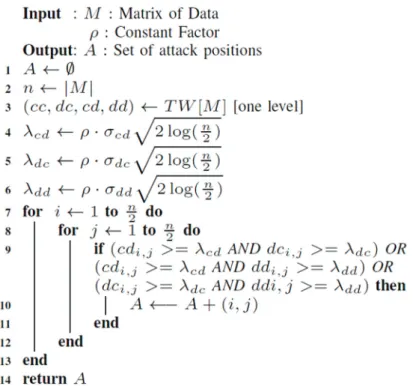
Figure 5 presents the proposed algorithm. For the anomalies detection approach in this work, only one level of the 2DWT is performed, since the significant abrupt changes are associ-ated to high frequencies wavelet coefficients. Through the transformation of M[n][m], four sub-bands of coefficients are obtained: cc, dc,
cd and dd. For each one of the wavelets sub-bands, a corresponding threshold value (λdc,
λcd and λdd) is computed as the multiplication of the constant correction factor ρ and the uni-versal threshold value for the sub-band. This correction of the universal threshold value provides more freedom in adjusting the trun-cation parameter in the filtering process since the Donoho threshold was planned consider-ing image denoisconsider-ing and this paper threshold must be applied to highlight only the values that override the higher value of a data with-out attacks. The threshold strategy is then processed (Line 4-6).
After the hard threshold application, char-acters with the most significant variations for their occurrence distribution can be identi-fied. Note that the wavelet-based algorithm enables peaks verification on the occurrence distributions among characters on the same requisition (M[n][m] rows) and among char-acters of different requests (M[n][m] columns). To decide whether the variation is an anomaly or not (Line 9 of the algorithm), the variation
detection between each two pairs of sub-bands
cd, dc and dd is analysed. A peak on a charac-ter distribution is associated to a peak on the corresponding wavelet coefficient. Therefore, anomalous events are associated to significant coefficients, classified after the hard threshold process. Moreover, according to the proposed heuristic, anomaly on a characters distribution should be captured by at least two sub-bands of details to be considered an attack (Line 6).
Finally, another point to be highlighted is that the Haar wavelet transform is character-ized as a simple and fast tool, specially because it’s algorithmic formulation (Mallat, 2008). In practice, it is due to the number of operations being linearly proportional to the quantity of data contained in the input matrix, resulting in an algorithm of complexity O(nm).
Experiments and Results
Data collected from web application on the web server of the Polytechnic of the National University of Asuncion (FPUNA), Paraguay is considered to validate the proposed methodol-ogy. The data acquisition period was from Jan-uary to March 2009, building 71 days of web traffic, captured from log files of web server. Altogether, a total amount of 59.248 web re-quests on the collecting phase was obtained.
For the validation process of any anomaly
detection procedure, the capability of detect-ing true attacks has to be proved. Therefore, a data set with attacks inserted in known posi-tions is considered for this verification.
The attacks detected on the FPUNA collect-ed data set were manually removcollect-ed by visual inspection, generating a so called “attack-free” signal, whose status was verified by using ac-tualized signature-based IDS. Eight test data sets were built by the injection of 0, 1, 2, 3, 4, 5, 10 and 20 attacks in predefined places in the “attack-free” constructed signal. The data set with 0 attacks presents regularity among requests and low variability within the same character frequency by request. According to the description given on Section 3, the injected attacks were of types: directory transversal, cross site scripting and buffer overflow (the most popular attacks against web servers).
Based on the eight benchmark examples, the detection rates were computed, since the attacks location and distributions are previ-ously known. For the experiments executed in this work, all event detections on unknown places are considered false positives. In other words, a false positive is characterized by the detection of an attack in a normal web request.
Table 1 presents the results of the detection when varying the number of attacks and the constant factor of universal threshold value. The algorithm was run considering the Hard Figure 5. Pseudocode of algorithm proposed.
threshold approach and increasing the value of the threshold by multiplying it by factor ρ equal to 1, 2, 3, 4 and 5. The results show that for all data sets the number of false positives (FP) is very high when constant factor is 1 and 2 times the universal threshold λ. Otherwise, when the threshold overrides 3λ the number of false positives is small. The number is 0 when the adopted threshold is equal to 5λ.
It is important to notice that the determi-nation of the threshold value is a key point in analysis using wavelet transforms associ-ated to the Hard or Soft threshold strategies. Here the universal threshold value given by Donoho and Iain (1995) was considered as a possible reference choice for the cutting point, since it was an efficient choice for de-noising processes when the signal is affected by White Gaussian noise. In other words, the Hard threshold with the universal thresh-old value is designed to be efficient under a big amount of variability. Thus, the experi-ment designed here shows that the universal threshold value is only one possible candidate to be considered as an alarm detector, and the correction factor plays an important role in fitting the cutting parameter according to the magnitude of the analyzed data, especially in the case of noise absence. Here five times the universal truncation value produced an efficient detector, since all the attacks were detected without occurrence of false posi-tives. However, according to the web applica-tion, an analysis for the determination of the threshold value has to be performed. In this paper the FPUNA dataset was collected from a web application server and it has low vari-ability and regularity between requests and characters frequencies.
The Table 2 compares our algorithm results with the results obtained by the Pearson chi-squared statistical χ2 test. The χ2 test is fre-quently used by detection techniques (Kruegel and Vigna, 2003; Kiani et al., 2008) with the same proposal as presented in this work.
The
χ
2 test makes use of a training phase and it was set to use a threshold of 10% higher than the maximum value obtained on the train-ing phase. In the comparison, our algorithm has utilized the threshold of 5λ. The results ob-tained comparing of the proposed algorithm with the χ2 show the wavelet-based algorithm has better results with respect to the number of false positives and correct detections.For the measure the computational cost are performed various performance tests. The algorithm was implemented with ANSI C in a sequential version (i.e. using a single proc-essor). The version of the Wavelet Transform algorithm is not in-line requiring an additional space of order of O(nm). In the experiments the total memory required for the algorithm was approximately 640 KB.
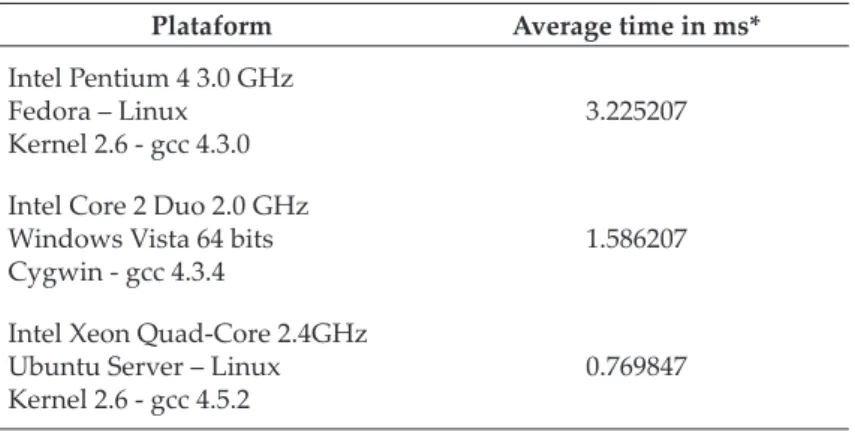
The analysed dataset contains about 232 groups of 256 requests. The processing average time of 256 requests is presented for three dif-ferent platforms in the Table 3. This processing time of complete dataset (FPUNA), with 59248 requests, considering the platforms presented was 1 second, 1.5 seconds and 2.5 seconds, respectively. Thus, the obtained performance in requests per second was approximately be-tween 59000 and 24000 requests per second.
Conclusio n
Internet became an essential component for the current society and numerous organi-Table 1. Results obtained with proposed approach.
# attacks detected with differents ρλρλ
Attacks 1λ 2λ 3λ 4λ 5λ FP TP FP TP FP TP FP TP FP TP 0 15971 0 1939 0 7 0 1 0 0 0 1 15970 1 1934 1 8 1 2 1 0 1 2 15969 2 1934 2 7 2 1 2 0 2 3 15911 3 1934 3 7 2 1 3 0 3 4 15909 4 1934 4 7 4 1 4 0 4 5 15887 5 1874 5 3 5 1 5 0 5 10 15774 10 1940 10 7 10 1 10 0 10 20 15420 20 1876 20 3 20 1 20 0 20
zations perform daily operations through web applications. However, security of the infor-mation plugged in the web, dependability and reliability of the users should be guaranteed. Attacks damaging web applications or ac-cessing restricted information can cause sev-eral problems for an organization and, conse-quently, for its users.
This paper proposed a new approach to detect web attacks by using signal-processing techniques. The performed experiments have demonstrated that the utilization of the wave-let transform associated to a threshold criteria allows web attack detection, since attacks as-sociated of characters injection cause signifi-cant variation in the characters distribution within the requests.
Moreover, the issue related to the choice of the threshold value is also addressed. The rate of false positives was null when the correction factor ρ was considered bigger than 5, gener-ating a threshold value 5 times the universal value of Donoho and Iain (1995). The Hard threshold procedure was applied for construc-tion of the proposed alarm detector.
Using the properties of the wavelet trans-form it was possible to analyze the variation in the characters distribution in different
di-Table 2. Comparison of algorithm proposed with test Person
χ
2# attacks inserted in the data set FPUNA
Algorithm 0 1 2 3 4 5 10 20
FP TP FP TP FP TP FP TP FP TP FP TP FP TP FP TP
χ
2 12 0 12 0 12 0 12 3 12 4 12 5 12 10 12 20* 0 0 0 1 0 2 0 3 0 4 0 5 0 10 0 20
* Algorithm proposed (5λ) FP = False Positive TP = True Positive
Table 3. The computational cost for processing of the algorithm proposed. Plataform Average time in ms* Intel Pentium 4 3.0 GHz
Fedora – Linux Kernel 2.6 - gcc 4.3.0
3.225207
Intel Core 2 Duo 2.0 GHz Windows Vista 64 bits Cygwin - gcc 4.3.4
1.586207
Intel Xeon Quad-Core 2.4GHz Ubuntu Server – Linux Kernel 2.6 - gcc 4.5.2
0.769847 *ms = milliseconds
rections, resulting in a high rate of correct web attacks detection. Further, as the wavelet ap-proach is based on low complexity calculus and it does not consider the training phase, an efficient and fast approach for detecting injec-tion-based web attacks is obtained.
For future works, a new set of experiments to demonstrate the use feasibility in real time applications will be designed. The proposed approach so far has demonstrated good detec-tion rates for web attacks in off-line scenarios.
References
ÁLVAREZ, G.; PETROVIĆ, S. 2003. A new taxonomy of Web attacks suitable for efficient encoding.
Computers & Security, 22(5):435-449.
http://dx.doi.org/10.1016/S0167-4048(03)00512-1 ARIU, D.; GIACINTO, G. 2010. HMMPayl: an ap-plication of HMM to the analysis of the HTTP Payload. In: WORKSHOP ON APPLICATIONS OF PATTERN ANALYSIS, Cumberland Lodge, 2010. Proceedings... Cumberland Lodge, WAPA. p. 81-87.
CAPPO, C.; NUNES, R.C.; SCHAERER, C. 2009. On using wavelets for detecting attacks to web-ba-sed applications. In: CONGRESSO NACIONAL DE MATEMÁTICA APLICADA E COMPUTA-CIONAL, XXXII, Cuiabá, 2009. Proceedings...
CHANDOLA, V.; BANERJEE, A.; KUMAR, V. 2009. Anomaly detection: A survey. ACM Computing
Surveys,41(3):15-58.
http://dx.doi.org/10.1145/1541880.1541882 CORONA, I.; ARIU, D.; GIACINTO, G. 2009.
HMM-Web: A Framework for the Detection of Attacks Against Web Applications. In: IEEE INTERNA-TIONAL CONFERENCE ON COMMUNICA-TIONS, 9, Dresden, 2009. Proceedings... Dresden, ICC. p. 1-6.
http://dx.doi.org/10.1109/ICC.2009.5199054 DE AZEVEDO, R.P.; MOZZAQUATRO, B.; CAPPO,
C.; NUNES, R.C.; SCHAERER, C.E.; KOZAKE-VICIUS, A. 2011. A Bidimensional Wavelet Transform based Algorithm for DoS Attack De-tection. In: LATIN-AMERICAN SYMPOSIUM ON DEPENDABLE COMPUTING, 5, São José dos Campos, 2011. Proceedings... São José dos Campos, LADC. 1:1-2.
DONOHO, L.D.; IAIN, M.J. 1995. Adapting to unknown smoothness via wavelet shrinkage.
Journal of the American Statistical Association.
90(432):1200-1224.
http://dx.doi.org/10.2307/2291512
ESTEVEZ-TAPIADOR, J.M.; GARCIA-TEODORO, P.; DIAZ-VERDEJO, J.E. 2005. Detection of Web-Based Attacks through Markovian Protocol Par-sing. In: IEEE SYMPOSIUM ON COMPUTERS AND COMMUNICATIONS, 10, Madrid, 2005.
Proceedings... Madrid, ISCC. p. 457-462.
http://dx.doi.org/10.1109/ISCC.2005.51
FONSECA, J.; VIEIRA, M.; MADEIRA, H. 2010. The Web Attacker Perspective - A Field Study. In: IN-TERNATIONAL SYMPOSIUM ON SOFTWA-RE SOFTWA-RELIABILITY ENGINEERING, 21, San Jose, 2010. Proceedings... San Jose, ISSRE. p. 299-308. http://dx.doi.org/10.1109/ISSRE.2010.21
GRANÉ, A.; VEIGA, H. 2009. Wavelet-based detection of outliers in volatility models. In: STATISTICS AND ECONOMETRICS WORKING PAPERS. Madrid, 2009. Proceedings... Madrid, p. 01-22. INGHAM, K.L.; INOUE, H. 2007. Comparing
Anomaly Detection Techniques for HTTP. In:
INTERNATIONAL CONFERENCE ON RE-CENT ADVANCES IN INTRUSION DETEC-TION, 10, Gold Goast, 2007. Proceedings... Gold Goast, RAID. p. 42-62.
http://dx.doi.org/10.1007/978-3-540-74320-0_3 KIANI, M.; CLARK, A.; MOHAY, G. 2008.
Evalua-tion of Anomaly Based Character DistribuEvalua-tion Models in the Detection of SQL Injection At-tacks. In: INTERNATIONAL CONFERENCE ON AVAILABILITY, RELIABILITY AND SE-CURITY, 3, Barcelona, 2008. Proceedings... Barce-lona, ARES. p. 47-55.
http://dx.doi.org/10.1109/ARES.2008.123
KOZAKEVICIUS, A.J.; RODRIGUES, C.R.; NU-NES, R.C.; GUERRA FILHO, R. 2005. Adap-tive ECG Filtering and QRS Detection using Orthogonal Wavelet Transform. In: INTERNA-TIONAL CONFERENCE ON BIOMEDICAL ENGINEERING. Innsbruck, 2005. Proceedings...
Innsbruck, IASTED. p. 109-114.
KRUEGEL, C.; VIGNA, G. 2003. Anomaly detection of web-based attacks. In: ACM CONFERENCE ON COMPUTER AND COMMUNICATIONS SECURITY, 10, Washington, 2003. Proceedings...
Washington, CCS. p. 251-261.
http://doi.acm.org/10.1145/948109.948144 KRUEGEL, C.; VALEUR, F.; VIGNA, G. 2004.
Intru-sion Detection and Correlation: Challenges and
So-lutions. Santa Clara, Springer, 136 p.
LU, W.; GHORBANI, A.A. 2009. Network anomaly detection based on wavelet analysis. EURASIP J.
Adv. Signal Process,4(1)4-16.
http://dx.doi.org/10.1155/2009/837601
MALLAT, S. 2008. A wavelet tour of signal processing, 3 ed., Amsterdam, Academic Press. 832 p. OWASP. 2010. Top 10 Web Application Security
Risks. Available at: https://www.owasp.org/in-dex.php/Category:OWASP_Top_Ten_Project. Acessed on: October 2th, 2011.
SRIRAGHAVAN, R.G.; LUCCHESE, L. 2008. Data processing and anomaly detection in web-based applications. In: IEEE WORKSHOP ON MACHI-NE LEARNING FOR SIGNAL PROCESSING. Cancun, 2008. Proceedings... Cancun, p. 187-192. http://dx.doi.org/10.1109/MLSP.2008.4685477 STOLLNITZ, E.J.; DEROSE, A.D.; SALESIN, D.H.
1995. Wavelets for computer graphics: a primer 1. IEEE COMPUTER GRAPHICS AND APPLI-CATIONS. Seattle. 1995. Proceedings... Seattle, 15(6):76-84.
http://dx.doi.org/10.1109/38.376616
WAGNER, R.; FONTOURA, L.M.; NUNES, R.C. 2011. Tailoring Rational Unified Process to Con-template the SSE-CMM. In: LATIN AMERICAL CONFERENCE ON INFORMATICS, Quito, 2011. Proceedings... Quito, CLEI. p. 128-141. WANG, K.; STOLFO, S.J. 2004. Anomalous
Payload-Based Network Intrusion Detection. New York.
Springer Berlin, Heidelberg. 3224:203-222. http://dx.doi.org/10.1007/978-3-540-30143-1_11
Submitted on October 10, 2011. Accepted on December 20, 2011.