Grand Valley State University
ScholarWorks@GVSU
Technical Library
School of Computing and Information Systems
2013
Search Engine Optimization: A Survey of Current
Best Practices
Niko Solihin
Grand Valley
Follow this and additional works at:
http://scholarworks.gvsu.edu/cistechlib
This Project is brought to you for free and open access by the School of Computing and Information Systems at ScholarWorks@GVSU. It has been accepted for inclusion in Technical Library by an authorized administrator of ScholarWorks@GVSU. For more information, please contact
Recommended Citation
Solihin, Niko, "Search Engine Optimization: A Survey of Current Best Practices" (2013).Technical Library.Paper 151. http://scholarworks.gvsu.edu/cistechlib/151
Search Engine Optimization:
A Survey of Current Best Practices
By
Niko Solihin
A project submitted in partial fulfillment of the requirements for the degree of
Master of Science in
Computer Information Systems
at
Grand Valley State University
April, 2013
_______________________________________________________________________________
Search Engine Optimization:
A Survey of Current Best Practices
Niko Solihin
Grand Valley State University Grand Rapids, MI, USA
ABSTRACT
With the rapid growth of information on the web, search engines have become the starting point of most web-related tasks. In order to reach more viewers, a website must im-prove its organic ranking in search engines. This paper intro-duces the concept of search engine optimization (SEO) and provides an architectural overview of the predominant search engine, Google. This paper presents a conceptual framework for exploring various optimization guidelines, which can be categorized under four parts: keyword research, indexing, on-page optimization, and o↵-page optimization. Some worst practices, or ”black hat” approaches, to SEO are briefly dis-cussed. The paper concludes with the future semantic web and how it can a↵ect optimization techniques, such as link building.
1. INTRODUCTION
This section begins with background information on In-ternet searches, discusses the basic tasks and primary goal of search engines, and briefly examines a research study that helps explain what this paper tries to accomplish.
1.1 Background
The web is big. In 1998, the first Google index had 26 mil-lion pages and reached the 1 bilmil-lion mark by 2000. As of July 2008, that number multiplied by a thousand, or, to be exact, 1 trillion [1]. In late 2012, Google claimed to have indexed over 30 trillion unique individual live URLs on the web [2]. Search has penetrated the very fabric of our globalized soci-ety. According to comScore, more than 158 billion searches were performed worldwide each month in 2011. This num-ber equals approximately 5.2 billion searches performed ev-ery day, and 61,000 searches performed evev-ery single second every day [3]. The way we work, play, shop, and interact have changed, and the high demand for search will continue to escalate. Profit and non-profit organizations, as well as individuals looking to have a successful presence on the web need to adapt the way they create, publish, and distribute information. Search engines are closely tied to success in the new web economy.
1.2 Search Engines
A search engine is simply a database of web pages, a method for discovering and storing information about new web pages, and a way to search that database. Therefore, in the simplest form, search engines perform three basic tasks: 1. Traverse the web and determine important words
(crawl-ing)
2. Build and maintain an index of sites’ keywords and links (indexing)
3. Present search results based on reputation and rele-vance to users’ keyword combinations (searching) The primary goal is to e↵ectively present high-quality, pre-cise search results while efficiently handling a potentially huge volume of user queries.
1.3 Search Engine Optimization
Search Engine Optimization is the process of increasing the number of visitors to a website by achieving high rank in the search results returned by a search engine. The higher a website ranks in the results pages, the greater the chance of users visiting the website. To do this, a website uses a set of optimization methods that manipulate dozens or even hundreds of its markup elements.
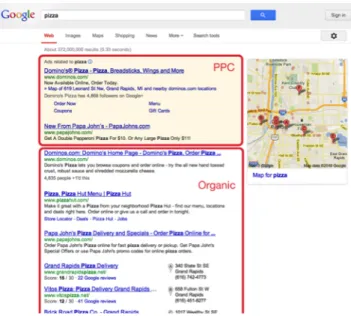
A search engine results page (SERP) is the listing of re-sults returned by a search engine in response to a keyword query, and it contains two di↵erent sections: organic and PPC (Pay-per-click). The Organic section of a SERP con-tains results that are not sponsored or paid for in any way
˜
N they rely strictly on search algorithms. The PPC sec-tion, on the other hand, contains text ads purchased from either Google AdWords or Microsoft AdCenter, using a bid-ding system to determine placements among other compet-ing text ads. Figure 1 shows an SERP from Google.
This paper focuses on optimizing the ranking outcome of the organic result in search engines through the use of important optimization techniques. These techniques will be explored based on the conceptual framework introduced in Section 3.
1.4 Motivation for Higher Ranking
A study using heat-map testing was published in 2006 by re-search firms Enquiro, Didit, and Eyetools. Using eye-tracking devices, the study analyzed what users see and fo-cus on when they are engaged in search activity [4]. At the time of the study, paid search listings were located in a col-umn to the right of organic SERPs. The study showed that little attention was given to results that appear lower on the search result page (SERP). Users’ eyes also tended to be drawn to bold keywords, titles, and descriptions in the organic SERPs, while the paid search listings to the right received little attention. ”The vast majority of eye tracking activity during a search happens in a triangle at the top of the search results page indicating that the areas of maxi-mum interest create a ’golden triangle’” the study argues,
Figure 1: Sample Search Engine Result Page in Google, 2013.
Table 1: SERP Results Visibility
Rank Visibility 1 100 % 2 100 % 3 100 % 4 85 % 5 60 % 6 50 % 7 50 % 8 30 % 9 30 % 10 20 %
as shown in Figure 2. Furthermore, the study provided the data shown in Table 1, displaying the varying levels of re-sults’ visibility when participants look only at the first page of a Google organic search listing.
Based on the Enquiro et al. study, we can conclude that traffic to businesses’ or individuals’ web pages is directly related to their position in the SERP. Obtaining a high rank in the search result is essential. The purpose of this paper is to deconstruct and demystify both search engines and search engine optimization techniques, to enable users to increase their search rank.
This paper introduces a helpful conceptual framework de-rived from surveyed literature for readers who are looking into optimizing their rankings in search engine result pages.
2. ANATOMY OF A SEARCH ENGINE
This section provides a brief architectural overview of the pre-dominant search engine, Google, and explores its vari-ous components that aid in accomplishing its major tasks: crawling, indexing, and searching. The high-level system overview is based on Sergey Brin and Lawrence Page’s orig-inal paper [5], upon which the prototype of Google was con-ceived. This section also discusses PageRank, a Google
al-Figure 2: Aggregate Heat Map from Eye Tracking Study, 2006.
gorithm for measuring the importance of a web document based on its inbound link profile.
2.1 High-Level Architecture
In order to deliver fast and relevant search results, Google must first discover the hundreds of millions of web pages that exist on the World Wide Web and organize them in an effi -cient manner. Google utilizes special application programs called web crawlers or spiders to automatically download a copy, or cache, of a web page and follow any links it may have. After downloading, a search engine will analyze the content of each page to discover lists of words and their occurrence, structural analysis, hyperlinks, and HTML val-idation.
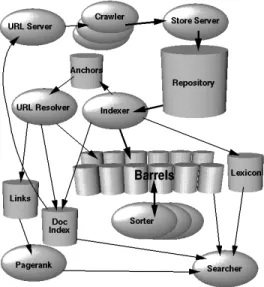
The process of crawling starts with the URL server (Fig-ure 3) sending a list of URLs to be fetched by Googlebot, Google’s web crawler, which consists of distributed networks of high-performance computers. Fetched pages are then handed to the store server, which compresses and assigns an ID number called ”docID” to each web page before storing them in a repository. Subsequently, the indexer reads the repository, decompresses the documents, and parses them. It then creates a word occurrences list called a ”hit” for ev-ery document, recording the word, position in the document, capitalization, and an approximation of font size. These hit lists are then distributed into a set of ”barrels”, creating a partially-sorted forward index as shown in Table 2.
Additionally, the indexer parses out all the hyperlinks in every web page and stores important information about them in an anchors file. For each hyperlink parsed out, this file stores the previously assigned docID, the text of the link, as well as where each link points from and to. The URL Re-solver reads the anchors file and converts relative URLs into absolute URLs and, ultimately, docIDs. It puts the anchor
Figure 3: High-Level Google Architecture.
Table 2: Forward Index
Documents Words Document 1 the, cow, says, moo Document 2 the, cat, and, the, hat Document 3 the, dish, ran, away, with, the, spoon
text into the forward index, associated with the docID to which the anchor points. It also generates a database of links which are pairs of docIDs. The links database will be used to calculate a document’s PageRank by the Searcher, a web server responsible for handling the Google search func-tionality when invoked by the user.
The partially sorted forward index is then converted to an inverted index by the Sorter. This is done by taking the barrels, which are sorted by docID, and resorting them by wordID. Next, a Lexicon program takes this list and builds a new lexicon to be used by the Searcher, together with the PageRanks, to answer user queries.
Suppose we have an array of documents which has a sen-tence each:
Documents[0] = "it is what it is" Documents[1] = "what is it" Documents[2] = "it is a banana"
The inverted index of the array above is listed below in Table 3, with document numbers identifying the location of each word. A search query of"what is it"consists of the term
"what","is", and"it"and will invoke the intersection set operator, giving the result set in Figure 4.
Since these query words appear in document 0 and 1, the ID of these documents will be returned, and in Google’s case, the docID will be returned and rendered appropriately on the SERP page, sorted by rankings that PageRank calcu-lates.
Figure 4: Result Set.
Table 3: Inverted Index
Words Doc # a {2} banana {2} is {0, 1, 2} it {0, 1, 2} what {0, 1}
Figure 5: Simple PageRank.
2.2 PageRank Algorithm
PageRank is an algorithm originally implemented by Google to measure the importance of a web document based on its inbound link profile. PageRank helps Google produce high-quality precision results. It is a purely numerical mea-surement and does not take into account the relevance of the linking page, or how trusted or authoritative that page might be. In a nutshell, each inbound or backlink to a web page is counted as a vote for that page, and the more back-links a web node receives from another web node, the higher the web page will be positioned within the organic search results. Additionally, PageRank only deals with organic SERPs. The following section provides a brief overview of the original PageRank algorithm, while section 4 discusses the factors that influence link value.
2.2.1 PageRank Calculation
Brin and Page define the original PageRank as follows [5]:
We assume page A has pages T1...Tn which point to it (i.e., are citations). The parameter d is a damping factor which can be set between 0 and 1. We usually set d to 0.85. C(A) is defined as the number of links going out of page A. The PageRank of a page A is given as follows:
PR(A) = (1-d) + d (PR(T1)/C(T1) + ... + PR(Tn)/C(Tn)) Note that the PageRanks form a probability distribution over web pages, so the sum of all web pages’ PageRanks will be one.
To help readers understand the underlying logic of PageR-ank, which is still in use today, Figure 6 provides a simple diagram of the concept.
To begin with, pages are given a small amount of natural PageRank which can then be increased by increasing the
Figure 6: Conceptual Framework.
number of backlinks pointing to the page. The amount of PageRank that a page can pass to another through its links, called passable PageRank, is predicted to be around 85% to 90% of its own PageRanks [6].
In the original formula, for pages linking to more than one other page, the passable PageRank gets divided equally among all the pages receiving those links. However, this does not hold true today, since Google has refined the original algorithm and the details of this is not widely known. In addition to outbound links, cross-linking, or the reciprocal link between two pages, requires more complex calculations. In the scenario of Figure 5, the PageRank of each page must be determined by recursive analysis, since the PageRank of Page A is dependent on f(y), the passable PageRank of Page B, which is dependent on f(x), the passable PageRank of Page A. To complicate matters more, The PageRank that Page A passes to Page C is a↵ected by the link from Page B to Page A.
Although Google’s ability to compute reputation based on links has advanced significantly over the years, famil-iarity with its initial reference architecture and PageRank algorithm will help conceptualize the complexity of search engines. Furthermore, the information presented in this sec-tion helps establish the foundasec-tion for the important tech-niques discussed in the next section of this paper.
3. CONCEPTUAL FRAMEWORK
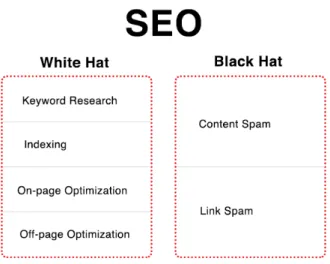
After studying primary literature on Search Engine Op-timization and observing the characteristics of opOp-timization techniques, we established a conceptual framework that of-fers helpful guidelines for readers as they approach this com-prehensive discipline. The framework, shown in Figure 6, classifies optimization techniques under two broad categories: white hat and black hat SEO, or, techniques that search en-gines recommend as best practices and those which are con-sidered unethical and manipulative. White hat optimization techniques can be further categorized by their characteris-tics: keyword research, indexing, on-page, and o↵-page op-timization, whereas black hat optimization techniques fall under two categories: content spam and link spam.
4. RECOMMENDED OPTIMIZATION
METHODS
The section explores techniques that are recommended as best practices for search engines. They may be grouped as follows: Keyword research, Indexing, On-page, and O↵ -page optimization. The characteristics of each optimization category will be reviewed in the following subsections.
As previously mentioned, the three important tasks of search engines are: traversing the web and determining im-portant words (crawling), building and maintaining an in-dex of sites’ keywords and links (inin-dexing), and presenting search results based on reputation and relevance to users’ search terms (searching). Nearly all search engines’ oper-ations involve keywords and, thus, keyword research forms the foundation of our conceptual framework. The result of keyword research will a↵ect a website’s information architec-ture. The subsequent optimization techniques of indexing, on-page as well as o↵-page optimization will take keyword research further into the alteration of page elements. Above all, it is important to remember the objective of building for end users, not for search engines, in applying the methods listed in this section.
4.1 Keyword Research
Keyword research is one of the most important and high-return activities in SEO, because its result will directly cor-relate to a site’s information architecture. Every website, whether it belongs to a business, organization, or an indi-vidual, has a customer base associated with it. Within each customer base, there is a keyword demand, which, if exam-ined properly, will enable website owners to predict shifts in demand, respond to changing market conditions, and ensure that they are producing the products, services, and content that customers are actively seeking. Since every word and phrase that is typed into search engines is recorded and of-ten available to keyword research tools, website owners will be able to gain a general comparison of high-demand key-words within their niche customer base. Moreover, they will be able to understand the value of a keyword by do-ing simple research, makdo-ing some hypotheses, testdo-ing, and repeating the cycle while continuously monitoring the site’s click-through (CTR) and conversion rate.
Although there are many tools and methods that are usu-ally used by SEO practitioners, Google’s AdWords and Trends are common starting points for keyword research and they will be explored here. AdWords is aimed at helping Google’s paid search customers, but it is often used to obtain infor-mation for organic search. A brief overview of AdWords and Trends will be provided. However, specifics about its usage is beyond the scope of this paper.
4.1.1 Google AdWords
The Google AdWords Tool
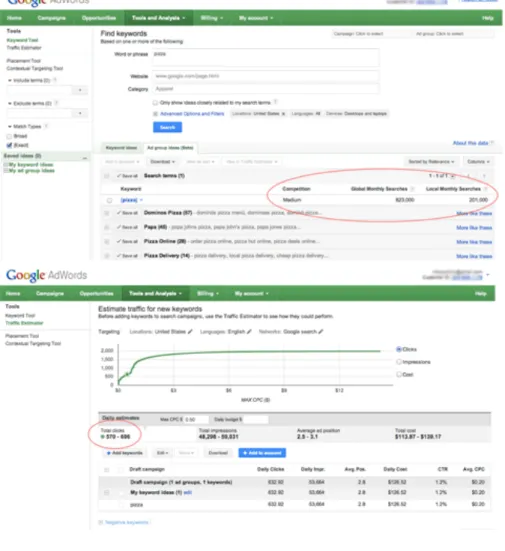
(https://adwords.google.com/o/KeywordTool) consists of two tools: Keyword Tool and Traffic Estimator. Keyword Tool provides related terms, search volume estimates, search trends, and ad cost estimates for any keyword or URL that a user enters, while Traffic Estimator enables website owners to get estimates of traffic on di↵erent keywords (see Figure 7). Essentially, SEO practitioners must pay careful attention to the numbers circled in the diagram below - for example, how competitive a keyword is, what its global/local monthly searches are, and what its potential click-through rate is.
These numbers indicate whether a keyword is too broad or too narrow and whether it will bring any advantage to a website.
4.1.2 Google Trends
Google Trends (www.google.com/trends/) enables SEO prac-titioner to compare two or more search terms to see their relative popularity, as well as seasonality/trending over a specific time range. Additionally, it will also provide loca-tion informaloca-tion of a keyword’s market. Figure 8 compares the trend of keywords ”pepperoni pizza” to ”sausage pizza” in the United States within the past year. Google Trends shows that pepperoni pizza has more interest than sausage pizza, especially in Oklahoma, Ohio, and Kansas.
4.2 Indexing
This section examines methods related to the accessibil-ity of a website to search engines spiders. Ensuring that a website’s content and links can be found and crawled by search engines is an important step toward creating visibil-ity in search results. First, the common reasons why pages may not be indexable are given. Next, methods that can be used to increase the chance of website crawlability will be discussed. Last, the use of thesite: search operator will be explained to examine which pages of a website have been crawled by Googlebot. Using the techniques in this section, website owners will be able to determine whether informa-tion architecture can be improved for more crawlability.
4.2.1 Crawlable Content and Link Structure
To rank well in SERP, content material for end users must be in HTML text form. Despite the significant progress in technology, crawlers are by nature optimized to handle plain HTML text instead of images and third party multimedia platforms such as Flash. From a relevance perspective, it is difficult for search engines to analyze text content that are embedded inside of an image or Flash file. Crawlers will only be able to read the text in a filename for Flash files and text in the filename, title, and alt attribute for images,.Therefore, indexing preference is almost always given to HTML-based text files.
In terms of links, crawlers give preference to links that use descriptive keywords that describe linked content instead of, for instance, using a simple ”click here” to label anchor links on pages. Furthermore, common reasons why pages may not be reachable to spiders such as Googlebot are listed below:
• Links in submission-required forms
• Links in Javascript AJAX calls
• Links in Flash, Java, or other plug-ins
• Links in PowerPoint and PDF files
• Links pointing to pages blocked by the meta robots tag,rel="NoFollow", or robots.txt
• Links on pages with many hundreds or thousands of other links
• Links in frames or iFrames
• Some of the points above will be discussed in other sections of the paper.
4.2.2 Index Optimization
Beside the obvious method of linking a newly created page from an already indexed site, there are other methods dis-cussed in this section that will ensure new pages are crawled and indexed. They consist of submitting new content di-rectly to Google and using sitemap.xml for the main site and images.
According to Matt Cutts, the head of the webspam team, Google is able to discover and index new content within 24 hours [7]. However, there may be instances where a manual submission of sites is necessary. Page owners can submit an unindexed page directly to Google at
www.google.com/submityourcontent/ Another way to com-plement search engines’ normal, link-based crawl is the use of a protocol known as XML Sitemaps. Using the Sitemaps protocol, page owners can supply the search engines with a list of all the pages they would like them to crawl and index. Additionally, sitemaps can also increase visibility of images that are listed within. Sitemaps use a simple XML format defined in detail at http://www.sitemaps.org and must re-side within the highest-level directory, or the root directory.
4.2.3 Inspecting Indexed Pages
Google supports a number of advanced search operators that can be used to help diagnose SEO issues. The site: operator in particular can be used to execute a domain-restricted search (.com, .net, or .org) and narrow a search to one or more specific subdomain or directories. To show approximately how many URLs are indexed by Google, one may use site:example.com. Additionally, to show indexed URLs from a specific directory, subdomain, or top-level do-main (TLD), one may use site:example.com/directory,
site:subdomain.example.com, orsite:orgrespectively.
4.3 On-page Optimization
On-page optimization refers to the alteration of numerous on-page elements to help search engine spiders determine what the page is about and how it may be useful for users. During this optimization stage, it is important to remember the notion of building primarily for end users, not for search engines. Every element on the page - document text, image, or links - must ultimately provide value for end users.
In order to drive traffic, the targeted keywords from the previous stage must be included in the pages to be opti-mized. Keyword relevance must be aligned with the usabil-ity of a page from a human perspective, thus the practice of excessively placing keywords into every HTML tag possible is strongly discouraged and can, in fact, lead to penaliza-tion from search engines. This secpenaliza-tion explores some of the more prominent places where site owners can strategically place targeted keywords. It provides a brief suggestion re-lated to keyword placement in specific tags, according to the literature surveyed.
4.3.1 Title Tags
For keyword placement, title tags are the most critical element for search engine relevance. Located in the<head>
section of an HTML document, it is the only piece of ”meta” information about a page that influences relevancy and rank-ing. A page’s title tag content must align with its actual visible content. Aside from incorporating keyword phrases in the title tag, a brief list of best practices that yield the most search engine benefits is provided below:
Figure 7: Google AdWords.
Figure 9: Meta Description Tag in SERP.
• Place targeted keywords at the beginning of the title tag
• Limit length to 65 characters (including spaces)
• When needed, use|(pipe), -, :, or>as dividers
• Target searcher intent by using verbs in keywords
4.3.2 Meta Description Tags
The<meta name="description" content="...">is pri-marily used to describe the content of the page accurately and succinctly, and to serve as a short advertisement text in the search result (see Figure 9).
Aside from incorporating keyword phrases in the descrip-tion, a brief list of best practices that yield the most search engine benefits is provided below:
• Describe brand and content honestly
• Limit length to 165 characters (including spaces)
• Do not employ descriptions universally
• Test, refine, rinse, and repeat
4.3.3 Heading Tags
Heading tags are designed to indicate a headline hierarchy in a document. An<h1>tag might be considered the head-line of the page as a whole, whereas<h2>tags would serve as subheading,<h3>tags as tertiary-level headlines, and so forth. Search engines have shown preferences for keywords appearing in heading tags, especially the <h1> tag. SEO professionals have claimed that it is safe to use the content of<title>tag as heading tags.
4.3.4 Other On-Page Optimization Techniques
This subsection discusses other important guidelines re-garding on-page optimization.
Beside the aforementioned important keyword placements, other common places for keywords that will yield most search engine benefits are links and texts near the top of the page, URLs, the body, alt and title attributes of<img>, and image filename.
As far as URL is concerned, search engines have shown preference for short, readable URLs with targeted keywords included. The use of hyphen as a separator in URLs is en-couraged. Complex query parameters can result in lower overall ranking and indexing.
Another important technique is that of redirection. There are two major types of redirects that are typically used to in-dicate when content has moved from one location to another:
301 Moved Permanentlyand302 Moved Temporarily. Crawlers treat these di↵erently. A302 HTTP status code instructs the crawler to not pass any PageRank from the old to the new page since the move is temporary. On the other hand, a
301redirect will ensure that PageRank and any other page metrics will be transferred to the new page.
Pagination can also be optimized using the
<link rel="next" href="url-of-next-page"> and <link rel="prev" href="url-of-previous-page">markup in the
<head>section of every paginated page. This allows crawlers to index paginated pages more thoroughly, especially if a section of a website is heavily paginated. For instance, if a section of a website is divided into 3 pages, the first page will only contain arel="next" since there is not any page before it, the second page will contain bothrel="prev"and
rel="next", and the last page will only contain arel="prev"
since there is not any page after it.
4.4 Off-page Optimization
O↵-page optimization refers to the link building process that influences how search engines rank a web page. It is clear that links play a critical role in ranking — it is the decisive vote in SERP. This section is divided into two parts:
link building and social signals.
4.4.1 Link Building
Link building is the practice of actively marketing a web-site with the intent to obtain links from other web-sites. Link building is a fundamental part of SEO and is an ongoing aspect of marketing a website. Search engines use links not only to discover web pages, but also to determine rankings and how frequently and deeply a website is crawled. Google measures the value of links by PageRank and a few other factors:
• Anchor Text
The clickable part of a link is a strong ranking element that helps search engines understand what the page receiving the link is about.
• Relevance
Fundamentally, relevance refers to more weight that is given to links that originate from sites or pages on the same topic, or sites or pages that are closely related to the owner’s site.
• Authority
Although it is not clear how Google carries out its topical relevance analysis, authority is closely related to the notion of link analysis through the hubs and authorities model. Hubsare sites that link to most of the important sites relevant to a particular topic while
authorities are sites that are linked to by most of the sites relevant to a particular topic [8].
• Trust
It is likely that Google utilizes some form ofTrustRank, a purely algorithmic approach to determine the trust of a site [9]. The trust level of a site is based on how many clicks away it is from one or more seed sites — a set of highly trusted sites selected by manual human review. A site that is one click away accrues a lot of trust; two clicks away, a bit less; three clicks away, even less; and so forth.
There are many di↵erent link building strategies that are beyond the scope of this paper. However, these strategies usually share some common characteristics:
• Use some form of link baiting
Building content that plays to the emotions of pottial linkers - for example, a website with useful or en-tertaining content.
• Provide unique and quality information to users
Creating quality reference material that authoritative site owners find to be of value to their audience.
• Leverage business relationships
For instance, having a network of distributors and re-sellers for a company’s product that link back to the company’s page as a standard term in the business agreement.
4.4.2 Social Signals
In addition to inbound links, social media and user en-gagement have become significant factors in ranking, as search engines learn to utilize these metrics more e↵ectively. So-cial media sites such as Facebook, Google+, and Twitter are venues that businesses, organization, or individual can take advantage of to reach out to their audience.
As of 2011, it was confirmed that both Google and Bing treat shared links on walls and Facebook Fan pages as votes for the website being shared. More specifically, Google clar-ified that it treats Facebook links in the same way that it treats tweeted links [10]. This suggests that Facebook and Twitter can play an important role in a link-building cam-paign. They are an excellent way to develop exposure and share links of value by using some of the link building ap-proach in the previous section.
In short, excellent link building comes from a simple idea:
create great product or content, tell everyone about it, and motivate them to share. Additionally, as part of their ongo-ing o↵-page optimization strategy, site owners must always consider participating in social media communities, provid-ing an engagprovid-ing user experience, o↵ering unique and di↵ er-entiated content, and building a strong brand.
5. MANIPULATIVE OPTIMIZATION
METHODS
While it is true that a large part of Search Engine Opti-mization involves manipulating the site’s content and HTML tags, there is a limit of how far a page can be manipulated before it raises a red flag for search engines. Certain opti-mization techniques have been categorized as ”Black Hat” or spamdexing techniques, that is, techniques that are gener-ally used in an unethical manner to get higher search rank-ings.
Neglecting the rules set by the search engine will lead to penalties, such as a lower search ranking or, in some cases, a permanent ban from the search engine. In 2006, Google banned the BMW Germany website for using a ”doorway” page — a page designed to present di↵erent content to web crawlers than to human audiences. Google states that it may ”. . . temporarily or permanently ban any site or site authors that engage in tactics designed to distort their rankings or mislead users in order to preserve the accuracy and quality of our search results.” [11]
It is important for SEO practitioners to be aware of tech-niques that are considered unethical and the impact they have on search engine ranking. This section examines spamdex-ing based on two types of spam: content spam and link spam.
Some spamdexing tactics that are still commonly practiced for each type of spam will be explored.
5.1 Content Spam
This category of spamdexing involves techniques that mod-ify the logical view of a page to search engines, such as key-word stuffing, doorway pages, and invisible elements.
5.1.1 Keyword Stuffing
Keyword stuffing involves placing excessive amounts of keywords into the page content and<meta name="keywords" content="...">tag, in such a way that they detract from the readability and usability of a given page. To boost the page’s ranking in the SERP, both relevant and irrelevant keywords are inserted and occasionally repeated. Frequently searched or high-commercial-value spam keywords, such as
mortgage, poker, texas hold ’em, porn, are inserted and re-peated in the page<meta>tag or content.
Common methods of keyword stuffing in page content include hiding keywords on the page by making the text the same color as the background, hiding keywords in com-ment tags, exploiting CSSz-indexorposition: absolute
properties to get keywords behind or o↵-page, and overfilling alt tags with long strings of keywords.
Although it was never mentioned explicitly, search engine experts believe that Google no longer uses keywords in the
<meta> tag as a ranking factor due to past abuses of this tag. Bing, on the other hand, still takes it into account as a signal for ”spammy” content. Furthermore, experts believe that proper usage of keywords in the <meta> tag has no ranking benefits, whereas abusing it will lead to penalized rankings with both Google and Bing [12]. Keyword stuffing is an unethical way to optimize ranking that deceives search engines and its use is strongly discouraged.
5.1.2 Doorway Pages
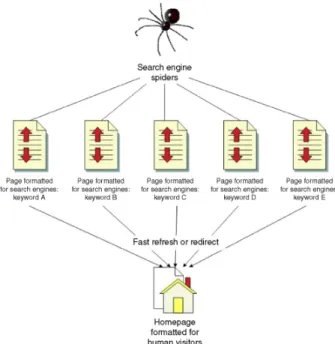
Also known as a ”bridge page” or ”gateway page”, a door-way page is a web page filled with keyword-rich content that does not deliver any useful information other than a redirect to an external site. The primary goal of doorway pages is to gain high rankings for multiple keywords and phrases — to capture search engine traffic through those keywords and send that traffic to a highly commercial web page (see Figure 10).
Typically, doorway pages are created using optimization tools. These tools automatically create separate pages, some-time up to hundreds of pages, for each keyword or phrase and set up an instant redirect to the intended page using
<meta http-equiv="refresh"
content="0;URL=’http://example.com/’">. Search engines have combated this by not indexing pages that contain in-stant meta redirects. However, black hat optimizers have fought back with a variety of other techniques, including the use of Javascript, PHP, and other server-side technologies.
5.1.3 Cloaking
Slightly similar to the doorway pages method is cloaking. Cloaking involves using user agent or IP address detection to recognize incoming visitors as either search engine spi-ders or users, and then delivering di↵erent content to the spiders than that seen by human users. It is used to gain high rankings on multiple major search engines. The pages intended for users will contain images, styling, and other
de-Figure 10: Doorway Pages.
sign elements, whereas the pages for search engines spiders are typically text only. IP address and User-Agent HTTP Header detection are key components to cloaking, since the IP addresses and User-Agent for most of the major search engine spiders are well known. Figure 11 illustrates cloaking.
5.2 Link Spam
This category of spamdexing involves generating links that do not provide end-user value. These links exist for the sole purpose of inflating search engine rankings. Two forms of link spam will be discussed in this section: link farms and comment spam.
5.2.1 Link Farms
A link farm is a group of highly interlinked websites formed for the purpose of inflating link popularity or PageRank. Web pages utilizing manipulative search engine tactics often participate in link farms or reciprocal link exchanges. In-stead of acknowledging relevant content from other authors in the same field by mutual linking, link farms participants inserts cross links that point to irrelevant information that provide no value for the end-user. Link farms are typically created automatically by tools that can generate hundreds of links with little e↵ort. Seeing this as an advantage for lucra-tive income, many spamdexing businesses boost web page rankings instantly by employing this tactic. Search engines such as Google and Bing have identified specific attributes associated with link farm pages and will entirely remove do-mains that they suspect are collaborating in a link farm or reciprocal link exchange scheme. Figure 12 shows the con-cept of link farm with arrows indicating a cross link pair [13].
5.2.2 Comment Spam
Comment spams are comments posted for the purpose of generating an inbound link to another site that will reap the benefit of having higher PageRank. They are typically
Figure 11: Cloaking.
posted on wikis, blogs, and guestbooks by tools that are able to comment on hundreds of blogs at a time. The most commonly used method to combat comment spam is the
rel="nofollow"attribute on anchor tags in the comment section. Furthermore, third-party comment management systems such as Disqus (www.disqus.com) utilize iFrames or Javascript AJAX requests to dynamically render com-ments, making sure they are non-crawlable by search en-gines. Nevertheless, there are still many blogs and wikis that are not using these solutions, making them targets for comment spambots.
6. FUTURE OF SEARCH
Larry Page, co-founder and CEO of Google, once de-scribed the ”perfect search engine would understand exactly what you mean and give you back exactly what you want.” The word ”mean” or ”semantic” is very important in the ever-changing discipline of Information Retrieval. This sec-tion explores Semantic Web, how it relates to search. An example of Semantic Search technology, the Google Knowl-edge Graph, is briefly mentioned.
6.1 Semantic Web
In 2001, the inventor of the World Wide Web, Tim Berners-Lee and a few other computer scientists, emphasized the significance of expressing meaning through the use of Se-mantic Web technologies in order to bring elaborate, precise automated searches. Berners-Lee defines Semantic Web as the ”extension of the current Web in which information is given the well-defined meaning, better enabling computers and people to work in cooperation.” [14] The Semantic Web technologies will ”enable explicit, unambiguous, and shared definitions of domain terms and relations (for humans and machines to interpret) as well as a global system for iden-tification and reuse.” [15] Furthermore, Semantic Web will bring the Web closer to its 3.0 phase, which focuses on mean-ings and connecting knowledge to enable more relevant, use-ful, and enjoyable user experience of the Internet.
6.2 Semantic Search
Semantic search promises to produce precise answers to user’s queries by taking advantage of availability of explicit semantics of information in the semantic web. In other words, instead of relying on dictionary or index retrieval based on keywords, some degree of artificial intelligence will be utilized to understand the searcher’s intent and the con-textual meaning of the query terms. Major players in the search engine world such as Google and Bing have started incorporating some aspects of semantic search and will con-tinue to make significant advancements in this area. Seman-tic search uses the science of meaning in natural language to produce results that are relevant to that specific user. The goal is to deliver the information queried by a user rather than having a user sort through a list of loosely related key-word results.
6.3 Google Knowledge Graph
Incorporated into its search systems in 2012, the Google Knowledge Graph is a knowledge base used by Google to enhance its search engine’s search results with semantic-search information gathered from a wide variety of sources [16]. From the searcher’s point of view, the Knowledge Graph enables Google to become an intelligent information
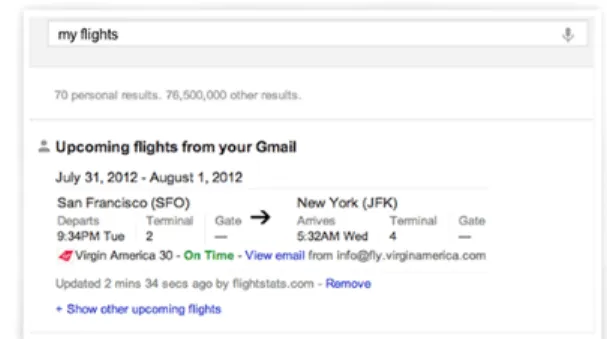
Figure 14: Knowledge Graph displaying user’s data.
assembler. According to Amit Singhal, the head engineer of Google’s core ranking team, the Knowledge Graph de-rived its information not only from public sources such as the CIA World Factbook, Freebase and Wikipedia, but also many other large scale information databases. It currently contains more than 500 million objects, as well as more than 3.5 billion facts about and relationships between these dif-ferent objects [17, 18].
As an information assembler, the searcher does not need to navigate to websites on listed on SERPs to gather use-ful, relevant information. Anything that is closely related to what the searcher intended will be displayed, leading to new, unexpected discoveries. For instance, the query term ”famous jazz composers” will present a carousel UI unit with photos and names of the di↵erent composers. Clicking each name will present a wealth of useful, relevant information, such as key facts, albums recorded, and popular songs com-posed (see Figure 13).
Additionally, the Knowledge Graph also considers the searcher’s personal information to which Google has direct data access, such as via GMail. Precise information that is tailored to that particular user will be laid out based on what Google knows about that individual. For instance, the query term ”my flight” will organize flight confirmation emails for any upcoming trips in a beautifully easy-to-read manner on the search results page [19] as shown in Figure 14.
7.
REFERENCES
[1] "Official Blog: We knew the web was big... - Google Blog."
2008. 28 Apr. 2013
<http://googleblog.blogspot.com/2008/07/we-knew-web-was-big.html>
[2] "How Search Works - The Story – Inside Search – Google."
2013. 28 Apr. 2013
<http://www.google.com/insidesearch/howsearchworks/thest ory/>
[3] "comScore Releases August 2011 U.S. Search Engine
Rankings ..." 2012. 28 Apr. 2013
<http://www.comscore.com/Insights/Press_Releases/2011/9/
[4] Forman, G. 2003. An extensive empirical study of feature
selection metrics for text classification. J. Mach. Learn. Res. 3 (Mar. 2003), 1289-1305.
[5] Brin, Sergey, and Lawrence Page. "The anatomy of a
large-scale hypertextual Web search engine." Computer networks and ISDN systems 30.1 (1998): 107-117.
[6] Matt Cutts. "PageRank sculpting - Matt Cutts." 2009. 28 Apr.
2013 <http://www.mattcutts.com/blog/pagerank-sculpting/>
[7] "Google's Cutts Explains How Google Search Works -
Search Engine ..." 2012. 28 Apr. 2013
<http://searchengineland.com/googles-cutts-explains-how-google-search-works-119288>
[8] "Lecture #4: HITS Algorithm - Hubs and Authorities on the
Internet." 2009. 28 Apr. 2013
<http://www.math.cornell.edu/~mec/Winter2009/RalucaRem us/Lecture4/lecture4.html>
[9] Gyöngyi, Zoltán, Hector Garcia-Molina, and Jan Pedersen.
"Combating web spam with trustrank." Proceedings of the Thirtieth international conference on Very large data bases-Volume 30 31 Aug. 2004: 576-587.
[10]Danny Sullivan. "What Social Signals Do Google & Bing
Really Count?." 2010. 28 Apr. 2013
<http://searchengineland.com/what-social-signals-do-google-bing-really-count-55389>
[11]"CNN.com - Google blacklists BMW Web site - Feb 7,
2006." 2006. 28 Apr. 2013
<http://edition.cnn.com/2006/BUSINESS/02/07/google/>
[12]Danny Sullivan. "The Meta Keywords Tag Lives At Bing &
Why Only Spammers ..." 2011. 28 Apr. 2013
<http://searchengineland.com/the-meta-keywords-tag-lives-at-bing-why-only-spammers-should-use-it-96874>
[13]"Link farm - Wikipedia, the free encyclopedia." 2004. 28
Apr. 2013 <http://en.wikipedia.org/wiki/Link_farm>.
[14]Berners-Lee, Tim, James Hendler, and Ora Lassila. "The
semantic web." Scientific american 284.5 (2001): 28-37.
[15]Janev, Valentina, and Sanja Vranes. "Semantic Web
Technologies: Ready for Adoption?." IT professional 11.5 (2009): 8-16.
[16]"Knowledge – Inside Search – Google." 2012. 28 Apr. 2013
<http://www.google.com/insidesearch/features/search/knowl edge.html>
[17]"Official Blog: Introducing the Knowledge Graph: things,
not strings." 2012. 28 Apr. 2013
<http://googleblog.blogspot.com/2012/05/introducing-knowledge-graph-things-not.html>
[18]"Google Adds Non-Profit Information To Knowledge ... -
TechCrunch." 2013. 28 Apr. 2013
<http://techcrunch.com/2013/04/09/google-adds-non-profit- information-to-knowledge-graph-gives-them-a-boost-with-google-follow-buttons/>
[19]Peshave, Monica, and Kamyar Dezhgosha. "How search
engines work and a web crawler application." Department of Computer Science, University of Illinois, Springfield USA (2005).
[20]Beel, Jöran, Bela Gipp, and Erik Wilde. "Academic search
engine optimization (ASEO)." Journal of Scholarly Publishing 41.2 (2010): 176-190.
[21]Shah, Bimal Pratap. "Search engine visibility of national
tourism promotion websites: a case of Nepal." Proceedings of the 3rd international conference on Theory and practice of electronic governance 10 Nov. 2009: 287-292.
[22]Malaga, Ross A. "Worst practices in search engine
optimization." Communications of the ACM 51.12 (2008): 147-150.
[23]"Search Engine Optimization For Dummies - Peter Kent -
Google Books." 2009.
<http://books.google.com/books/about/Search_Engine_Opti mization_For_Dummies.html?id=i1BqzeU4KzYC>
[24]"The Art of SEO - Eric Enge, Stephan Spencer, Jessie
Stricchiola ..." 2012. 28 Apr. 2013
<http://books.google.com/books/about/The_Art_of_SEO.htm l?id=Pnv_6UJ_KKMC>