Four-Phase Oscillators Employing Two Active Elements
Viera BIOLKOVÁ
1,
Josef BAJER
2, Dalibor BIOLEK
2,31 Dept. of Radio Electronics, Brno University of Technology, Purkyňova 118, 612 00 Brno, Czech Republic 2 Dept. of EE, University of Defense Brno, Kounicova 65, 662 10 Brno, Czech Republic
3 Dept. of Microelectronics, Brno University of Technology, Purkyňova 118, 612 00 Brno, Czech Republic
[email protected], [email protected], [email protected]
Abstract. Two novel four-phase voltage-output oscillators are proposed. These circuits can also be utilized as quad-rature oscillators with floating outputs. Each oscillator employs two DO-CIBA (Differential Output- Current In-verter Buffered Amplifier), two grounded capacitors, and four or three resistors. Independent control of the oscilla-tion frequency (OF) and oscillaoscilla-tion condioscilla-tion is practica-ble in both oscillators. Real measurements on the oscillator specimens confirm the ability of easy OF control and extra low THD, which is less than 0.07%.
Keywords
Four-phase oscillator, DO-CIBA.
1.
Introduction
Four-phase oscillators are a special case of multi-phase sinusoidal oscillators (MSO), the latter generating n
independent harmonic signals with constant phase shifts
= 360/n. Their applications are used in many areas of electrical engineering, signal processing, and measurement [1]. On the other hand, the four-phase oscillator can be regarded as a generalized quadrature oscillator with both quadrature signals and their inverted counterparts being available. Under certain conditions, the four-phase oscil-lator can be used as a floating-output quadrature osciloscil-lator. Many types of the multi-phase oscillators which em-ploy various active elements are described in the literature. Let us mention particularly the conventional operational amplifiers [2], [3], CFOAs (Current Feedback Operational Amplifiers) [4], OTA (Operational Transconductance Amplifier) [5], CCII (Current Conveyor of the 2nd Genera-tion) [6]-[9], CDBA (Current Differencing Buffered Am-plifier) [10], and CDTA (Current Differencing Transcon-ductance Amplifier) [11]-[13]. Some of papers deal with quadrature oscillators [14]-[41] with single-ended voltage outputs or single current outputs. So far no publication of four-phase oscillators has been found in literature which fulfils simultaneously the following conditions:
1) Four low-impedance outputs without the necessity of their additional buffering, with the possibility of
utilizing them as two floating sources of quadrature signals.
2) Employing maximally two simple active elements and only grounded capacitors.
3) The possibility of tuning the oscillation frequency (OF) without violating the oscillation condition (OC), and automatically setting the OC without disturbing the OF.
4) Equal amplitudes of all generated signals. 5) Fulfilling condition 4) also while tuning the OF.
Two oscillators are described in this paper. The first one fulfils all five conditions, the second one the first four. Special active elements with a simple internal structure, namely DO-CIBA (Differential Output- Current Inverter Buffered Amplifier) with differential voltage outputs are used. These elements are briefly described in the following Section. Section 3 contains a description of the oscillator proposed, and the theoretical formulae for OF and OC are analyzed there. An error analysis of real influences is de-scribed in Section 4. The experimental results of Section 5 show a good agreement with the theoretical assumptions.
2.
DO-CIBA
The schematic symbol and behavioral model of the DO-CIBA are shown in Fig. 1 (a) and (b), respectively. Unlike the conventional CDBA, the input current differen-tial unit (CDU) [42] is replaced here by a simpler current inverter, and the output voltage buffer is supplied by the differential output.
The DO-CIBA equations follow from Fig. 1:
Iz 0 0 0 -1 Vz
Vw = 1 0 0 0 Iw w
V = -1 0 0 0 I w
Vn 0 0 0 0 In
The In current flowing to the low-impedance input n is
inverted in the CI (Current Inverter) block, and it flows out of the high-impedance z terminal to the external circuit.
The corresponding voltage drop is buffered to the differential output as voltages Vw and VwVw.
n w z CI In 0V In Iw DO-CIBA Vn Vw (a) (b) n w z Iz Vz Iw Vw w 1 w In Iz= -In DO-CIBA + _ w z w n (c) OPA860 LMH6550 DO-CIBA
Fig. 1. DO-CIBA: (a) schematic symbol, (b) behavioral model, (c) example of DO-CIBA implementation from commercial integrated circuits.
Since the output voltage is of both polarities, the negative as well as the positive feedback can be simply accomplished via external circuits, regardless of the fact that the current input of this element is only inverting (In).
For fast experimental verification of applications of the DO-CIBA element, its implementation from inexpen-sive off-the-shelf components can be used. As shown in Fig. 1 (c), the current inverter can be implemented by means of the so-called diamond transistor OPA860 [43], which is a positive current conveyor of the 2nd generation
with the resistance of the x terminal (emitter) ca 10 [43]. A fast differential-output voltage buffer can be made, for example, via the fully differential OpAmp LMH6550 [44]. This layout was used within the experiments described in Section 5.
The DO-CIBA is used in this paper for the synthesis of oscillators generating either single-ended four-phase signals or two differential quadrature signals. With one of the orthogonal pairs omitted, the circuits can be used as conventional single-ended quadrature oscillators. The first circuit employs two DO-CIBAs, two grounded capacitors, and four resistors. This topology provides several degrees of freedom for independent OF and OC control. A small re-arrangement of this circuit yields a simplification to the canonic structure which utilizes only three resistors, at the cost of decreasing the above degrees of freedom. The inde-pendent OF and OC control is still practicable but the dy-namic range of the OF control is decreased. Both oscillators are made up of integrated circuits as shown in Fig. 1 (c), and their functionality is experimentally verified
with the conclusion that the behavior of the tested circuits corresponds to the theory and to the analysis of real influences.
3.
Proposed Oscillators
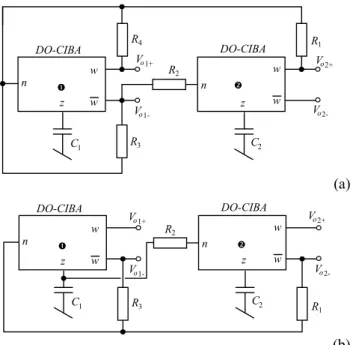
The core of the oscillator in Fig. 2 (a) is a pair of integrators within a feedback loop. Integrator No. i consists of active element No. i and a pair of Ri, Ci, i = 1, 2. Also,
both positive and negative feedbacks via resistors R3 and
R4 are implemented in integrator No. 1. The oscillation
condition is fulfilled when the feedback actions are in equilibrium. Based on this simple consideration, the formulae in Table 1 for the OF and also for the OC (0)
can be derived since the latter frequency is determined by the time constants of both integrators. The inequality in the OC formula designates the predominance of the positive feedback and thus a state of increasing oscillations.
n z w R1 R2 R3 R4 C1 n z C2 Vo2+ Vo1+ w w w Vo1- Vo 2-DO-CIBA DO-CIBA (a) n z w R1 R2 R3 C1 n z C2 Vo2+ Vo1+ w w w Vo1- Vo 2-DO-CIBA DO-CIBA (b)
Fig. 2. Two versions (a) and (b) of the proposed oscillators. circuit version (a) (b) OF 2 1 2 1 1 C C R R OC 1 4 3 R R 1 2 3 R R OF indep. control by R1, RC22, C1, R1, C1, C2 OC indep. control by R3, R4 R3 Vo2/Vo1 2 1 2 1 C C R R j
Tab. 1. Comparison of the parameters of oscillators from Fig. 2 (a)-(b).
An analysis of OF and OC reveals that the oscillation frequency can be set independently of OC via R1, R2, C1,
C2 while the oscillation condition can be adjusted by means
of R3 and R4 without violating OF.
Considering that the signals denoted Vo2+ and Vo1+ in
Fig. 2 (a) are output and input voltages of integrator No. 2, their ratio will be as follows:
2 2 1 2 1 C R j V V o o . (2)
Substituting the formula for OF from Tab. 1 into this equa-tion, the voltage ratio will be as shown in the last row of Tab. 1. It confirms the fact that the signals Vo1+ and Vo2+ are
in the quadrature, and that the circuit in Fig. 2 (a) repre-sents a four-phase oscillator with equally spaced phase shifts. Fulfilling the equality R1 = R2 = R, the oscillation
frequency can be modified through R without modifying the ratios of the amplitudes of the signal generated, and also without disturbing the oscillation condition.
The oscillator in Fig. 2 (a) contains four resistors and thus it is not in the canonic structure. The modification to the canonic form is shown in Fig. 2 (b). The damping of integrator No. 1, accomplished in Fig. 2 (a) by a resistor
R4, i.e. via negative feedback, is now implemented by
re-sistor R2, which is connected between capacitor C1 and
low-impedance input n of CIBA No. 2. R2 serves also to
excite CIBA No. 2 from the output of the first integrator. It is a function similar to that performed by R2 in structure (a)
but R2 is now connected to the non-inverting output voltage
of the CIBA. That is why the global feedback via R1 in
circuit (b) must lead from the inverting output of integrator No. 2. As a result, such an accumulation of two operations in a single element saves one resistor. A more detailed analysis yields the results from Tab. 1: The OF is the same as for circuit (a) because this frequency is still given by the time constants of both integrators. Now R2 appears in the
OC instead of R4. The OF can be controlled by means of
R1, C1, or C2 without disturbing the OC while the OC can
be set without modifying the OF only via R3. Furthermore,
R1 can control the OF within a smaller range than via
a simultaneous modification of R1=R2 for circuit (a), and
such OF control will be also accompanied by a modifica-tion of the ratio of magnitudes of the signals generated. In this sense, circuit (b) is an economical version of circuit (a) with a worse performance when the oscillation frequency must be modified.
4.
Analysis of Real Influences
As follows from the experimental Section 5, the oscillator specimens have shown the proposed performance but with certain differences between the theoretical and real values of the oscillation frequency. The symbolic analysis of both circuits in Fig. 2 revealed the dominant real parameters of active elements which are responsible for these differences: parasitic resistance and capacitance
Rz and Czof the z terminal, resistance Rn of the n terminal,
and current gain = Iz/In of the current inverter, which can
be deflected from its ideal value 1. Equations for OF and OC were again derived but this time with the above factors taken into consideration. The real parameters were indexed by numbers 1 or 2 depending on whether they describe the parameters of DO-CIBA No. 1 or 2 in Fig. 2. The final formulae are given in Tab. 2 in the columns OF (oscillation frequency), OC (oscillation condition) and OF+OC (oscil-lation frequency on the assumption of fulfilling the oscilla-tion condioscilla-tion). Note that the simpler formulae in the OF+OC column can be advantageously used for oscillators which are provided with circuits for automatic stabilization of the amplitude of generated waveforms. Various trends in influencing the OF by parasitic parameters are evident from the data in column OF: decreasing the oscillation frequency via the parasitic resistance of the n terminal of DO-CIBA No. 2 and via the capacitances of the z terminals of both active elements, OF increase/decrease with increasing/decreasing current gains above/below their ideal values 1, and the influence described by the last term in the formula where the effect depends on the mutual configuration of real parameters. However, the results in the OF+OC column clearly show that the frequency is always less than its theoretical value when the OC is ful-filled and when the gains are not greater than 1. In order to minimize this decrease, three influences should be eliminated: parasitic n terminal resistance of the second DO-CIBA (i.e. designing R2 >> Rn2), parasitic capacitances
of both z terminals (i.e. C1 >> Cz1 and C2 >> Cz2), and
para-sitic z terminal resistance of CIBA No. 2 (i.e. maximizing the time constant Rz2C2).
It is obvious from the column OC that, in contrast to the theoretical case, R3 must be a little smaller than R4 in
order to maintain the steady-state oscillations in the circuit in Fig. 2 (a). For the second oscillator, the state is less clear since the result can be influenced by the non-ideal current gain of the current inverter of active element No. 1.
5.
Experimental Verification
Both versions of the oscillator in Fig. 2 were manu-factured from discrete components, whereas the DO-CIBA elements were implemented as shown in Fig. 1 (c). According to [43], the transconductance of OPA860 was set to ca 100 mS via an external resistor with Rset = 330 .
The corresponding resistance of the n terminal is ca 10 . The capacitances used in the circuits were designed as follows: C1 = C2 = 82 pF. Resistor R3 was implemented via
a photoresistor which is a part of the 3WK16341 optron [45] for amplitude stabilization. The internal LED was driven by a current which was derived from the generated signal Vo1+. The oscillation frequency was controlled by
a parallel variation of resistances R1 = R2 for oscillator (a)
and by R1 with a fixed value of R2 = 1.8 k for oscillator
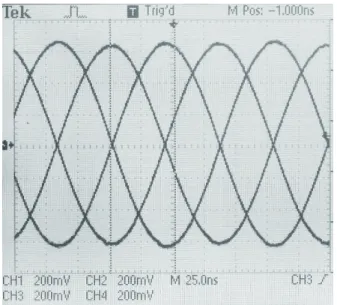
(b). A demonstration of steady-state waveforms for the oscillator (a) is given in Fig. 3.
Fig. 3. Oscillogram of four generated signals Vo1+, Vo1-, Vo2+,
Vo2- for the oscillator from Fig. 2 (a).
0.1 1 10
0.1 1 R [kOhm] 10
f
theoretical - version (a) measured - version (a) theoretical - version (b) measured - version (b) [MHz]
Fig. 4. Oscillation frequency versus resistances R = R1 = R2
(circuit (a)) and R = R1 (circuit (b)).
Fig. 4 illustrates the OF control via the above speci-fied resistors. It is evident that the frequencies measured are decreased below the theoretical values by a systematic error which can be understood from the formulae in the OF+OC column in Tab. 2. This error is approximately 5 % when considering only the influence of parasitic resistance
Rn= 10 . Taking into account also the other real
parame-ters, i.e. C1 and C2 increase by ca 3 pF (2 pF parasitic
ca-pacitance of the collector of the diamond transistor plus 1 pF input capacitance of the buffer), 54 k z-terminal parasitic resistance (collector resistance of the diamond transistor), and real current gains 0.97, then the values
measured correspond well to those from the formulae in Tab. 2, column OF+OC. It confirms that the error analysis from Section 4 describes the dominant real influences.
Owing to the circuit for automatic amplitude stabili-zation, the signals generated have a low harmonic distor-tion. For amplitude of 3V and a frequency of 1 MHz, the THD measured was below 0.07 percent.
6.
Conclusion
It is shown in the paper that the active element CIBA with differential voltage output is useful for implementing the multi-phase sinusoidal oscillators. The reasons are as follows:
In comparison with CDBA, DO-CIBA has a simple internal structure because it contains a current inverter instead of the more complicated current differencing unit. The differential output is implemented in a stan-dard way known from the differential OpAmps.
The differential voltage output together with the input inverter enables an easy realization of inverting and non-inverting integrators. This is important for the parallel implementation of the local positive and negative feedbacks round the active element No. 1 in the oscillator topology, where the oscillation condi-tion is fulfilled without disturbing OF just when the effects of both feedbacks are compensated. The os-cillation frequency is given by the gain of the global feedback loop led through both integrators.
Differential output of DO-CIBA facilitates the utiliza-tion of the generated signals as floating signals with twofold peak-to-peak value in comparison with the single-ended signals of individual phases.
Measurements on the oscillator specimens confirmed the proposed parameters including the frequency control via resistors and an extra low harmonic distortion of gener-ated signals.
Acknowledgements
The research leading to these results has received funding from the European Community's Seventh Frame-work Programme (FP7/2007-2013) under grant agreement
OF 2 0 OC OF+OC 2 0 (a) 2 1 2 1 3 4 1 2 1 2 1 2 1 ( ) C C R G G G C C R R z z 1 1 3 2 3 2 1 1 4 3 1 z z R R R R C C R R 2 2 2 2 2 1 2 1 2 1 1 C R C C R R z (b) 2 1 2 3 1 2 1 2 1 2 1 2 1 C C R G G G C C R R z z 1 3 2 3 2 1 1 2 3 z z R R R R C C R R 2 2 2 2 2 1 2 1 2 1 1 C R C C R R z 2 2 2 R Rn R , C1C1Cz1, C2C2Cz2
no. 230126. The research described in the paper was also supported by the Czech Science Foundation under grant No. 102/09/1628, and by the research programmes of BUT No. MSM0021630503/513 and UD Brno No. MO FVT0000403, Czech Republic.
References
[1] TANGSRIRAT, W., SURAKAMPONTORN, W. Electronically tunable quadrature oscillator using current-controlled current differencing buffered amplifiers. J. of Active and Passive Electronic Devices, 2009, vol. 4, p. 163-174.
[2] GIFT, S. J. G. Multiphase sinusoidal oscillator using inverting-mode operational amplifiers. IEEE Trans. Instrum. Meas., 1998, vol. 47, p. 986–991.
[3] GIFT, S. J. G. The application of all-pass filters in the design of multiphase sinusoidal systems. Microelectron. J., 2000, vol. 31, p. 9–13.
[4] WU, D. S., LIU, S. I., HWANG, Y. S., WU, Y. P. Multiphase sinusoidal oscillator using the CFOA. IEE Proc. Circuits Devices Syst., 1995, vol. 142, p. 37–40.
[5] KHAN, I. A., AHMEDAND, M. T., MINHAJ, N. Tunable OTA-based multiphase sinusoidal oscillators. Int. J. Electron., 1992, vol. 72, p. 443-450.
[6] ABUELMA’ATTI, M. T., AL-QAHTANI, M. A. A grounded-resistor current conveyor-based active-R multiphase sinusoidal oscillator. Analog Integr. Circuits Signal Process, 1998, vol. 16, p. 29–34.
[7] ABUELMA’ATTI, M.T., AL-QAHTANI, M.A. Low-component second-generation current conveyor-based multiphase sinusoidal oscillator. Int. J. Electron., 1998, vol. 84, p. 45–52.
[8] HOU, C. L., SHEN, B. Second-generation current conveyor-based multiphase sinusoidal oscillators. Int. J. Electron., 1995, vol. 78, p. 317–325.
[9] WU, D. S., LIU, S. I., HWANG, Y. S., WU, Y. P. Multiphase sinusoidal oscillator using second-generation current conveyors.
Int. J. Electron., 1995, vol. 78, p. 645–651.
[10] KLAHAN, K., TANGSRIRAT, W., SURAKAMPONTORN, W. Realization of multiphase sinusoidal oscillator using CDBAs. In
Proc. of theIEEE Asia-Pacific Conf.Circ. Sys., 2004, p. 725–728. [11] TANGSRIRAT, W., TANJAROEN, W. Current-mode multiphase
sinusoidal oscillator using current differencing transconductance amplifiers. Cir., Sys., Signal Process., 2008, vol. 21, p. 81-93. [12] TANGSRIRAT, W., TANJAROEN, W., PUKKALANUN, T.
Current-mode multiphase sinusoidal oscillator using CDTA-based allpass sections. Int. J. Electron. Commu. (AEU), 2009, vol. 63, p. 616-622.
[13] JAIKLA, W., SIRIPRUCHYANUN, M., BIOLEK, D., BIOLKOVA, V. High output-impedance current-mode multiphase sinusoidal oscillator based on CDTA-allpass filters. Int. Journal of Electronics, 2010, vol. 97, no. 7, p. 811-826.
[14] ALZAHER, H. A. CMOS digitally programmable quadrature oscillators. Int. J. of Circuit Theory and Applications, 2008, vol. 36, p. 953-966.
[15] HÖLZEL, R. A simple wide-band sine wave quadrature oscillator.
IEEE Trans. on Instrumentation and Measurement, 1993, vol. 42, no. 3, p. 758-760.
[16] KACAR, F., MAHMUT, Ü. DVCC based current-mode first-order all-pass filter and quadrature oscillator. Trakya Univ J. Sci., 2007, vol. 8, no. 1, p. 1-5.
[17] JAIKLA, W., SIRIPRUCHYANUN, M., BAJER, J., BIOLEK, D. A simple current-mode quadrature oscillator using single CDTA.
Radioengineering, 2008, vol. 17, no. 4, p. 33-40.
[18] PROMMEE, P., DEJHAN, K. An integrable electronic-controlled quadrature sinusoidal oscillator using CMOS operational transconductance amplifier. Int. Journal of Electronics, 2002, vol. 89, p. 365-379.
[19] LINARES-BARRANCO, B. et al. A precise 90˚ quadrature OTA-C oscillator tunable in the 50-130-MHz range. IEEE Trans. on CAS-I, 2004, vol. 51, no. 4, p. 649-663.
[20] HORNG, J. W., HOU, C. L., CHANG, C. M., CHUNG, W. Y., TANG, H. W., WEN, Y. H. Quadrature oscillators using CCIIs.
Int. J. Electron., 2005, vol. 92, p. 21-31.
[21] HORNG, J. W. Current-mode quadrature oscillator with grounded capacitors and resistors using two DVCCs. IEICE Trans. on Fundamentals of Electronics, Communications and Computer Sciences, 2003, vol. E86-A, p. 2152-2154.
[22] TANGSRIRAT, W., SURAKAMPONTORN, W. Single-resistance-controlled quadrature oscillator and universal biquad filter using CFOAs. Int. J. Electron. Commun. (AEÜ), 2008, doi:10.1016/j.aeue.2008.08.006.
[23] SOULIOTIS, G., PSYCHALINOS, C. Harmonic oscillators realized using current amplifiers and grounded capacitors. Int. J. Circuit Theory and Applications, 2007, vol. 35, p. 165-173. [24] KESKIN, A. Ü, BIOLEK, D. Current mode quadrature oscillator
using current differencing transconductance amplifiers (CDTA).
IEE Proc. Circ Dev Syst., 2006, vol. 153, no. 3, p. 214-218. [25] BIOLEK, D., BIOLKOVA, V., KESKIN, A. Ü. Current mode
quadrature oscillator using two CDTAs and two grounded capacitors. In Proc. of the 5th WSEAS Int. Conf. on System Science & Simulation in Engineering. Tenerife (Spain), 2006, p. 368-370. [26] TANGSRIRAT, W., TANJAROEN, W., PUKKALANUN, T.
Current-mode multiphase sinusoidal oscillator using CDTA-based allpass sections. Int. J. Electron. Commun. (AEÜ), 2008, doi: 10.1016/j.aeue.2008.05.001.
[27] LAHIRI, A. New current-mode quadrature oscillators using CDTA. IEICE Electronics Express, 2009, vol. 6, no. 3, p. 135-140. [28] TANGSRIRAT, W., PUKKALANUN, T., SURAKAMPON-TORN, W. CDBA-based universal biquad filter and quadrature oscillator. Active and Passive Electronic Components, 2008, Article ID 247171, 6 pages, doi: 10.1155/2008/247171.
[29] MAHESHWARI, S., KHAN, I. A. Novel single resistor controlled quadrature oscillator using two CDBAs. J. of Active and Passive Electronic Devices, 2007, vol. 2, p. 137-142.
[30] HORNG, J. W. Current differencing buffered amplifiers based single resistance controlled quadrature oscillator employing grounded capacitors. IEICE Transactions on Fundamentals of Electronics, Communications and Computer Sciences, 2002, vol. E85-A, p. 1416-1419.
[31] MAHESHWARI, S., CHATURVED, B. High output impedance CMQOs using DVCCs and grounded components. Int. J. Circuit Theory and Applications, 2010, vol. 38, published online, DOI: 1002/cta.636.
[32] SINGTHONG, P., JAIKLA, W., SIRIPRUCHYANUN, M. High-output impedance current-mode quadrature oscillator based-on CCCDTA and OTA. In Proc. of the 1st Int. Conf. on Technical Education (ICTE2009). Bangkok (Thailand), 2010, p. 163-166. [33] JANTAKUN, A., SIRIPRUCHYANUN, M. Systematic synthesis
and practical implementation of electronic controllable quadrature oscillator based on OTAs. In Proc. of the 1st Int. Conf. on Technical Education (ICTE2009.) Bangkok (Thailand), 2010, p. 172-175.
[34] TANJAROEN, W., TANGSRIRAT, W. Resistorless current-mode quadrature sinusoidal oscillator using CDTAs. In Proc. of Asia-Pacific Signal & Information Processing Assoc. Annual Summit& Conf. APSIPA ASC 2009. Hokkaido (Japan), 2009, p. 307-310. [35] KUMNGERN, M., KNOBNOB, B., DEJHAN, K.
Single-resistance-controlled current-mode quadrature sinusoidal oscillator. In Proc. ECTI-CON 2009. Pattaya (Thailand), 2009, p. 534-537.
[36] LAWANWISUT, S., SIRIPRUCHYANUN, M. High output-impedance current-mode third-order quadrature oscillator based on CCCCTAs. In Proc. TENCON 2009. Singapore, 2009, p. 1-4. [37] MAHESHWARI, S., KHAN, I. A. Current controlled third order
quadrature oscillator. IEE Proc.-Circuits Devices Syst., 2005, vol. 152, no. 6, p. 605-607.
[38] HORNG, J. W., LEE, H., WU, J. Y. Electronically tunable third-order quadrature oscillator using CDTAs. Radioengineering, 2010, vol. 19, no.2, p. 326-330.
[39] TANGSRIRAT, W., PRASERTOSM, D., PIYATAT, T., SURA-KAMPONTORN, W. Single-resistance-controlled quadrature oscillator using current differencing buffered amplifiers. Int. J. Electronics, 2008, vol. 95-11, p. 1119-1126.
[40] LAHIRI, A. Explicit-current-output quadrature oscillator using second-generation current conveyor transconductance amplifier.
Radioengineering, 2009, vol. 18, p. 522-526.
[41] BAJER, J., BIOLEK, D. Digitally controlled quadrature oscillator employing two ZC-CG-CDBAs. In Proc. of Int. Conf. EDS-IMAPS 2009. Brno (Czech Republic), 2009, p. 298-303.
[42] BIOLEK, D., SENANI, R., BIOLKOVA, V., KOLKA, Z. Active elements for analog signal processing: Classification, review, and new proposals. Radioengineering, 2008, vol. 17, no. 4, p. 15-32. [43] OP860. Wide Bandwidth Operational Transconductance Amplifier
(OTA) and Buffer. Datasheet, Texas Instruments, SBOS331B, June 2006.
[44] LMH6550. Differential, High Speed Op Amp. National Semiconductor. [Online] Cited May 2006. Available at: www.national.com.
[45] 3WK 163 41. Optocouplers with a Photoresistor. Tesla-Blatna, datasheet. [Online] Available at: www.tesla-blatna.cz.
About Authors...
Viera BIOLKOVÁ received her M.Sc. degree in Electri-cal Engineering from the Brno University of Technology (BUT), Czech Republic, in 1983. She joined the Dept. of Radio Electronics in 1985, and is currently working there as a Research Assistant. Her research and educational interests include signal theory, analog signal processing, and digital electronics.
Josef BAJER was born in 1982. In 2005 and 2008, he received the B.Sc. degree in Electrical and Special Aircraft Equipments and the M.Sc. degree in Avionic Systems from the University of Defense Brno (UDB), Czech Republic. He is currently working towards the Ph.D. degree in Elec-tronic and weapons systems at the Faculty of Military Technologies UDB. His interests include analog and digital signal processing and applications of modern active ele-ments working in current and hybrid modes.
Dalibor BIOLEK received his M.Sc. degree in Electrical Engineering from the Brno University of Technology in 1983, and the Ph.D. degree in Electronics from the Military Academy Brno in 1989. He is currently with the Dept. of EE, UDB, and with the Dept. of Microelectronics, BUT, Czech Republic. His scientific activity is directed to the areas of general circuit theory, frequency filters, and com-puter simulation of electronic systems. For years, he has been engaged in algorithms of the symbolic and numerical computer analysis of electronic circuits with a view to the linear continuous-time and switched filters. He has pub-lished over 250 papers and is author of a book on circuit analysis and simulation. At present, he is professor at the BUT and UDB in the field of Theoretical Electrical Engi-neering. Prof. Biolek is a member of the CAS/COM Czech National Group of IEEE and the president of Commission C of the URSI National Committee for the Czech Republic.