School of Engineering
Department of Mechanical & Manufacturing Engineering
Sensitivity of the damping controlled
fluidelastic instability threshold to
mass ratio, pitch ratio and Reynolds
number in normal triangular arrays.
Beatriz de Pedro & Craig Meskell
Published in Nuclear Engineering and Design (2018)
CITATION INFORMATION:
Sensitivity of the damping controlled fluidelastic
instability threshold to mass ratio, pitch ratio and
Reynolds number in normal triangular arrays.
Beatriz de Pedro Palomara, Craig Meskellb,∗
aSchool of Engineering, Univeristy of Oviedo, Spain bSchool of Engineering, Trinity College Dublin, Ireland
Abstract
Sensitivity of the damping controlled fluidelastic instability threshold of
nor-mal triangular tube arrays has been investigated through a theoretical-CFD
hybrid methodology without the need for experimental data. The
quasi-unsteady model with a theoretical model of the memory function was used
to predict the critical velocity with the static fluid force coefficients obtained
from steady RANS simulations. Five normal triangular tube arrays with
pitch to diameter ratios of 1.25, 1.30, 1.32, 1.375 and 1.44 were investigated.
Pressure on the tube surface for theP/d= 1.32 array, predicted by the CFD,
was compared with empirical measurements from the literature. Force
coef-ficients obtained with the validated numerical model, were used to predict
stability thresholds for the P/d = 1.25 and P/d = 1.375 tube arrays and
the results were compared with previously published experimental critical
velocities. The validated theoretical-CFD hybrid methodology was used to
analyze and quantify the critical velocity specific dependence on three
pa-rameters: mass ratio, Reynolds number and pitch ratio. As expected, the
pitch ratio has the most effect on the critical velocity. It was found that
increased Reynolds number increases the stability threshold over the whole
range of mass-damping parameters, but mass ratio has only a very minor
effect, and this is confined to high mass-damping values.
Keywords:
Fluidelastic Instability, Heat exchanger, Tube arrays
1. Introduction
Flow-induced vibration (FIV) can be a major problem in large heat
ex-changers leading to shut down or even decommissioning. While turbulent
buffeting and the associated wear represents a limit on the long term
in-tegrity of these assemblies, fluidelastic instability (FEI) can lead to failure in
the short term. As a result, FEI represents a limitation on the operational
parameters of the unit. One particular mechanism of FEI, so-called damping
controlled instability, can occur when a single flexible tube is subjected to
cross flow, even within an otherwise rigid array. It is this mechanism which
is the focus of the current study. An exhaustive review of the literature
on damping controlled fluidelastic instability in normal triangular tube
ar-rays is beyond the scope of this paper, but a comprehensive introduction to
FEI in tube arrays can be found in, for example, Chapter 5 of Paidoussis
et al. (2011) and a review of available models for specifically for damping
controlled fluidelastic instability is given by Price (1995). Broadly speaking,
any of the available models require some experimental input or tuning. For
example, even one of the most theoretical the framework proposed by Lever
when it is extended to predict damping controlled instability (Yetisir and
Weaver, 1993a) an empirical delay function is necessary.
Previous models of FEI and schemes for collapsing experimental data
sets of critical velocity have assumed that the Reynolds number and mass
ratio have no effect on levels of critical velocity. However, there is some
experimental evidence that this may not be the case (Mewes and Stockmeier,
1991). Price (2001) in his discussion of the applicability of the Connors
equation noted that a complete model of FEI should also include a Reynolds
number dependency. Mahon and Meskell (2012) have shown that a Reynolds
number dependency is necessary to achieve agreement between the Connors
type equation and the quasi-steady model. Harran (2014) pointed out the
influence of the mass ratio, in an asymptotic approach for the theoretical
situation of an undamped structure.
The viability of using CFD, computational fluid dynamics, to obtain
non-dimensional force coefficients, as well as other previously empirically
deter-mined quantities, and then introduce them into a theoretical framework to
obtain stability thresholds, has been investigated by several authors.
Has-san et al. (2010) investigated pitch to diameter ratio and Reynolds Number
effects on critical velocity for in-line tube arrays by obtaining coefficients
for a unsteady the semi-empirical model framework of Chen (1983) from
numerical simulations. Khalifa et al. (2013) investigated the interaction
between tube vibrations and flow perturbations at lower reduced velocities
and Reynolds numbers, coupling numerical predictions of the phase lag and
the semi-analytical wavy wall model (Lever and Weaver, 1986; Yetisir and
developed a model to account for temporal variations in the flow separation
for in-line arrays. These types of study offer an interesting alternative to
experimental testing which is limited for physical and economical reasons,
allowing more extensive investigation of parameter effects in the reduced
critical velocity.
This study will use steady CFD calculations of the fluid force coefficients
on a displaced tube within an array to predict the critical velocity, using
the quasi-unsteady model of Granger and Paidoussis (1996) with the
mem-ory function obtained from the wake model proposed by Meskell (2009).
The approach is applied to single-phase flow, but it is conceivable that the
approach could be adapted to phase flow if an appropriate model of
two-phase damping is adopted, and an equivalent parameter to Reynolds number
could be well defined.
Gillen and Meskell (2009) completed a preliminary study using a
simi-lar approach, demonstrating that the scheme was promising. However, that
study had significant flaws: the simulations suffered from flow instability in
the far wake; only two geometries were simulated; and the range of
parame-ters investigated was small. It is important to note that the objective in this
study is not to advance a method of determining the critical velocity per se.
Rather, the goal of the current study is to investigate the dependence of the
critical velocity on mass ratio and Reynolds number.
2. Methodology
Consider a single flexible tube in an otherwise rigid array. It will be
(i.e. perpendicular to the mean bulk flow) and that the structure can be
represented by a single degree of freedom model. This excludes the possibility
of (coupled mode) stiffness controlled instability. In addition, streamwise
instability is not possible.
The fluidelastic force E that a tube in an array is subjected to, can be
expressed by the governing equation of motion
msy¨+csy˙+ksy=Fy(¨y,y, y, U˙ 0) (1)
The quantities ms, cs and ks are the structural mass, damping and stiffness
respectively. The effects of both turbulent buffeting and vortex shedding have
been omitted as it is assumed that they do not change the stability behaviour
of this model. This superposition effectively assumes that the dependency
of the fluid force on the tube displacement is linear at low amplitudes (i.e.
at the onset of instability). Note that if the post-stable behaviour was of
interest (i.e. the limit cycle amplitude) then a more sophisticated approach
would be needed, but as the focus of this study is the onset of instability,
the simplification of a linear relationship with displacement is acceptable.
Meskell and Fitzpatrick (2003) demonstrated that the fluidelastic stiffness
and damping were cubic in displacement and tube velocity respectively. As
a result, the onset of dynamic instability will be governed by the linear
pa-rameters. This is generally true in non-linear system dynamics, for example
see Chapter 3 of Virgin (2000). Furthermore, these assumptions are widely
made in models of fluidelastic instability. For example, Price and Paidoussis
(1984) and Lever and Weaver (1986) implicitly assume that the only fluid
force is due to tube displacement.
var-ious models have been developed. One such model used the quasi-steady
approach (Price and Paidoussis, 1984), which assumes the force on the
oscil-lating tube at any moment in time is equal to the force it would experience
at that static displacement, but subject to a time lag. This model was later
improved upon by Granger and Paidoussis (1996), by replacing the time lag
as a function spread over time. In this quasi-unsteady model, the
relation-ship between the instantaneous fluid forces and the static lift and drag force
coefficients is
Fy(t) = −
1 2ρd
2LC
My¨+
1 2ρU
2Ld(dCL
dy h∗y−Cdy˙) (2)
The terms of this equation consist of tube diameter, d, and length, L; the
fluid densityρ; freestream velocity,U; and the mass, lift and drag coefficients
(CM, CL and CD respectively). The tube displacement y is convolved with
the delay function h. The drag, which would normally only be considered
for forces in the x direction is included due to the quasi-steady assumption
which rotates the fluid force system to be aligned with the instantaneous
apparent flow direction. It is worth noting that the strict requirement for
the application of the quasi-steady assumption as stated by Van Oudheusden
(1995) is that it is possible to ”define a steady situation (in which the
struc-ture is in rest with regard to some suitably chosen reference frame) which
is aerodynamically equivalent to the unsteady situation”. But this cannot
be met in a tube array because of the proximity of the neighbouring tubes.
Nonetheless, it is clear that there should be a positive damping associated
with the fluid which will be modified by flow, and so the quasi-steady
as-sumption is included as an imperfect model of this stabilizing effect as its
The convolution integral can be represented as
h∗y=
Z τ
0
h(τ −τ0)y(τ0)dτ0 (3)
with h representing the memory function
h(τ) = dΦ
dτ (4)
where τ = tUd is the non-dimensional time. The convolution can also be
thought of as a low pass filter and so that any response to any vortex
shed-ding and most turbulent excitation will be attenuated, further justifying
the assumption in equation 1 to ignore these excitation mechanisms. The
transient evolution of this memory function, which is essential for damping
controlled FEI, is determined by the function Φ. This transient function
converges monotonically towards 1 as τ approaches infinity (Granger and
Paidoussis, 1996). Without loss of generality, it can be represented this as a
series of decaying exponentials:
Φ = 1−
N
X
i=1
αie−βiτ
!
H(τ) (5)
Granger and Paidoussis (1996) quantified the parameters αi and βi by
fit-ting the model response to experimental data of critical velocity in a normal
triangular array subject to cross flow. Li and Mureithi (2016) have
quan-tified these parameters for a parallel triangular array, also by comparison
with experimental data, although the main focus of their study was the
de-velopment of a frequency domain formulation, equivalent to a Theodorsen
function. However,Paidoussis et al. (2011) pointed out that using
for empirical data, largely negating the benefit of a model. Meskell (2009)
has proposed a wake model to predict theoretically the values of α1 and β1
for a first order model, i.e. N = 1 in eqn. 5 .
This wake model approach assumes that the memory function is the
nor-malized instantaneous bound circulation on the tube. The wake is modeled
as a discretized vortex sheet. The convection of the shed vorticity is assessed
in an idealized velocity field based only on the enforcement of the
continu-ity equation along the gap between tubes. The resulting one dimensional
relationship for the temporal variation in lift force on the tube is an
integro-differential equation which cannot be solved analytically (Saffman, 1992),
but a first order model of the memory function is quantified by numerical
quadrature. The non-dimensional values obtained in that study and used
here are α1 = 1.0 and β1 = 0.1572.
In principle, this approach can be applied to any tube array pattern,
but to date, the particular wake model has only been developed for normal
triangular arrays. Although it is currently limited to a normal triangular
array, this approach has the advantage that no additional experimental data
is needed and it does not produce the large overshoots at low non-dimensional
time observed in both the fitted memory function of Granger and Paidoussis
(1996) or Li and Mureithi (2016).
As the underlying mechanism which gives rises to the memory function is
a convection effect, it will have only a weak dependency on Reynolds number
if at all. Mahon and Meskell (2013) measured experimentally the time delay
associated with the Price and Paidoussis (1984) quasi-steady model (which is
quasi-unsteady model used here). They found that the time delay was independent
of both Reynolds number and reduced velocity. The effect of Reynolds
num-ber will be embedded in the variation of the lift and drag coefficients, which
are obtained from steady simulations.
At the critical flow velocity net damping in the coupled system is zero.
Practically, the value of the critical flow velocity is obtained by transforming
the equation of motion eqn.2 into the Laplace domain by assuming a
sinu-soidal free response. The resulting characteristic equation is a polynomial,
the coefficients of which depend on both the structural parameters and the
fluid force parameters, including the flow velocity. The solution of this scalar
polynomial is a complex number, with the real part being the frequency of
vibration and the imaginary part being the damping. Some manipulation
yields yields a quartic polynomial in the critical velocity:
4
X
i=1
piUci = 0 (6)
in which pi = pi(ζ0, mr, CD,dCdyL, α1, β1). Derivation of these expressions is
tedious, but straight forward. Details can be found in Appendix 1 of Meskell
(2009). The only required input data for the model to predict critical
veloc-ities are the structural properties ζ0 (the damping ratio), and mr (the mass
ratio), along with the static fluid force coefficients CD and dCdyL. Previously
these force coefficients have been obtained via experimental testing.
How-ever, in this study these static fluid force coefficients will be determined from
2.1. Summary of methodology.
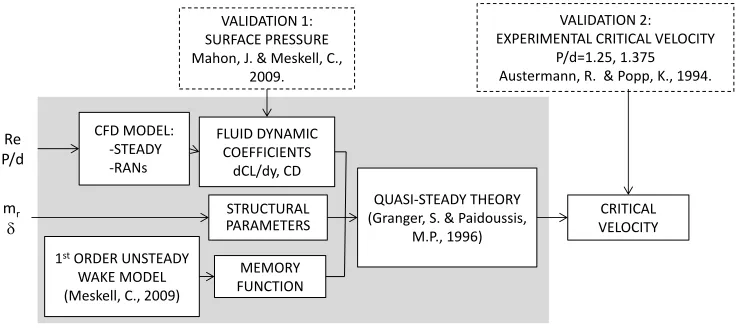
The overall hybrid theoretical-CFD model to predict the critical velocity
is shown schematically in Fig. 1. For a given tube array pitch ratio a series of
steady RANS simulations are conducted to yield the lift and drag coefficients
at a range of static tube displacements. The onset flow velocity is changed
to vary the Reynolds number. The resulting static fluid force coefficients are
then combined with the structural parameters (mass ratio,mrand structural
damping, δ) in the quasi-steady theory proposed by Granger and Paidoussis
(1996) using the memory function obtained from the wake model (Meskell,
2009). By solving eqn 6, the resulting hybrid model yields a prediction of the
critical velocity which can be assessed for across a range of Reynolds number,
mass ratio and pitch ratio, as presented in Section 4.
3. Validation of the hybrid theoretical-CFD model
The aim of the study is to investigate the variation of the critical velocity
with mass ratio, pitch ratio and Reynolds number. In order to demonstrate
that the hybrid model described in Fig. 1 is appropriate for such an
inves-tigation, the approach has been validated at two levels. Firstly, the steady
CFD simulation of flow through a deformed array have been compared to
experimental surface pressure data. This also facilitated the choice of
tur-bulence model. The second level of validation was achieved by comparing
the predicted critical velocity from the entire model to experimental data in
the literature. Five normal triangular tube array geometries were considered
in this study. In all cases the tube diameter was d=38 mm. Pitch ratios
of 1.25, 1.32 and 1.375 were chosen to allow for comparison and validation
of the model, as P/d= 1.32 was used by Mahon and Meskell (2009) in their
surface pressure measurements, while P/d=1.25 and P/d=1.375 were used
by Austermann and Popp (1995) in their experimental estimation of critical
velocity.
3.1. Computational domain and scheme
The commercial CFD package ANSYS Fluent 12.1 was used to perform
steady simulations, using a 2D double precision Reynolds Averaged
Navier-Stokes solver, considering a displaced tube in the central position of the third
row only. A convergence criteria for residuals of 10−5was necessary to achieve
a stable solution. Figure 2 shows a typical velocity magnitude contour plot
obtained in these simulations. The flow field is affected by the top and
bottom boundaries. This is most obvious in the wake, but flow retardation
can also be seen in front of the half tubes. However, in the center of the
array the flow field is unaffected.
In order to minimize the effect of the arbitrary constant pressure outlet
condition the downstream outlet should be distant from the zone of interest
in the array (26th ITTC Specialist Committee on CFD, 2011). However,
this space behind the array allows wake oscillations downstream of the
ar-ray. Note that these oscillations are probably physical rather than numerical
artifacts, but they would not be present in a deep array typical of a steam
generator. A similar problem was reported by Hassan et al. (2010). In this
study the oscillations were suppressed using full-slip guide vans, with
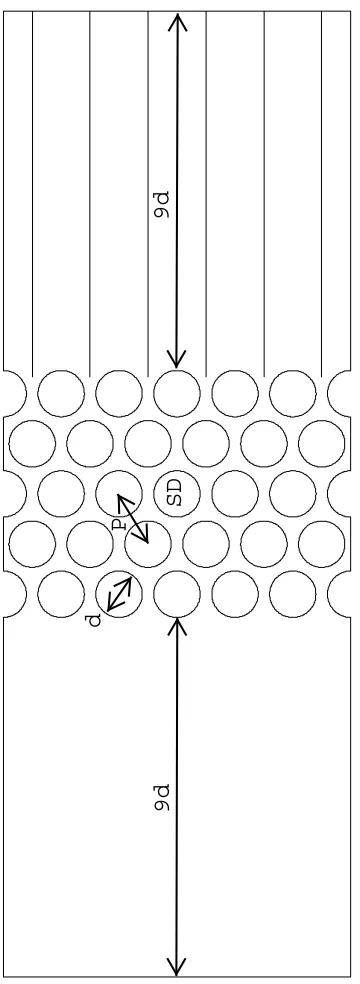
negligi-ble thickness which were placed behind each tube gap of the last row. These
down-stream of the array shown schematically in Figure 3. The inflow condition
is a Dirichlet boundary condition on the velocity field, while the outlet is a
Dirichlet condition on the pressure field. The top and bottom boundaries
are slip walls (i.e. zero shear stress, zero normal velocity). Within the array
200 elements of equal circumferential length were used around each tube.
The cells adjacent to the surface have an initial thickness of 0.06 mm and a
growth factor of 1.15 until the 13throw of the mesh. This allows the mesh to
be deformed to achieve a static displacement, rather than regenerated, and
it provides a maximum y+ value of the order of 1 for all simulations. The
near wall mesh is structured quadrilateral, while away from the surface of
the tubes the mesh is unstructured triangular. A detail of the mesh between
the tubes can be seen in figure 4 . The density and design of the mesh was
arrived at after a mesh dependency study. Further details of the
computa-tional scheme, the mesh and mesh independence can be found in a related
study de Pedro et al. (2016).
3.2. Comparison with experimental surface pressure data
In order to choose an appropriate turbulence model, several simulations
were conducted for theP/d= 1.32 array, so that the simulated data could be
compared directly to the experimental data Mahon and Meskell (2009). This
pitch ratio does not exhibit bi-stable flow, and so it is straight forward to
com-pare the experimental surface pressure. The flow conditions and displacement
range of the experimental data were matched (2.1×10⁴ ≤ Re ≤1.1×10⁵;
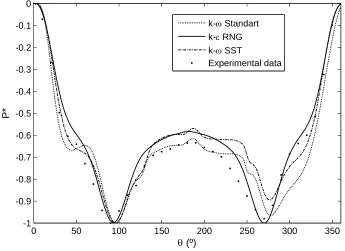
0 ≤ ∆y ≤ 0.1d). Three models were compared: k − RNG with
non-equilibrium wall function, SST and k−ω. The predicted surface pressure
P∗ = Pθ−Pθ|max Pθ|max−Pθ|min
(7)
Figure 5 shows the pressure coefficient (Eqn. 7) on the central tube
ob-tained with the three turbulence models and the experimental measurements
of Mahon and Meskell (2009), for the particular case of Re= 2.1×10⁴ and
∆y = 0. Note that θ is defined as zero at the front of the tube. It is clear,
that both the SST and the k −ω models predict substantial asymmetry in
the pressure distribution. This is particularly acute in the regions around
θ = 90◦ and θ = 270◦, which are the top and bottom of the tubes. Due to the surface normal direction, these regions will contribute most to the
transverse (lift) force and so are of particular concern in estimating the fluid
force coefficients for damping controlled fluidelastic instability. This general
behaviour was found for all velocities and displacements examined. While it
is true that asymmetric flow fields have been observed in tube arrays (Keogh
and Meskell, 2015; Mahon and Meskell, 2009, e.g.), it is unlikely that the
asymmetry observed in fig. 5 is due to bistable flow for two reasons. Firstly,
the numerical model included no-slip guide vanes immediately downstream
of the tube array specifically to suppress the large wake structures that give
rise to bistable flow inside an array. Secondly, and more importantly, the
asymmetric behaviour was observed at all pitch ratios including the lower
values. In normal triangular arrays, Mahon and Meskell (2009) did not
ob-serve any bistable flow behaviour for p/d = 1.32 as shown in fig. 5, but did
for P/d= 1.58. This would suggest that the asymmetry in the pressure field
is an artifact of the numerical scheme.
func-tions wall treatment was chosen. This is a pragmatic decision, based on the
comparison with experimental pressure data. It is not meant as a
recom-mendation for best practice in modelling flow in tube arrays, nor is it argued
that this turbulence model is inherently superior. In fact, it is well known
that the k− performs poorly for separated flows, and indeed, Fig. 5 clearly
shows that this model under-predicts the pressure loss immediately behind
the tube. However, as damping controlled FEI is driven largely by lift forces,
the poor performance of the other models around the top and bottom of the
tube is more important.
Studies of other, quite different, flow systems have also found that ak−
model may be superior to other turbulence models, in certain circumstances.
For example, is a study of heat transfer in a vertical tube Zhang et al. (2017)
concluded that the k−RNG turbulence model was the best of the 5 models
examined. In a comparison of LES and RANS schemes for simulating
un-steady flow in inline tube arrays Iacovides et al. (2014) found that the k−
can give acceptable results. However, it was concluded that the more
satis-factory performance was due to to sources of error effectively canceling. This
serves to underline the fact that it would be dangerous to claim any
general-ity for using the k− RNG with non-equilibrium wall treatment. However,
given that thek− RNG provides the best comparison to experimental data
in this case, it is concluded that it is the most appropriate for the study.
3.3. Comparison with experimental critical velocity data
In order to validate the hybrid theoretical-CFD method, simulations of
the P/d= 1.25 and P/d= 1.375 arrays, matching the experimental setup of
number range of laboratory tests, (2.1×10⁴ ≤ Re ≤ 7.4×10⁴). Using the
values for dCL
dy and CD obtained from these simulations, the critical velocity
was calculated, for the appropriate mass ratio and a structural damping range
(mr = 493,0.02≤δ ≤0.14).
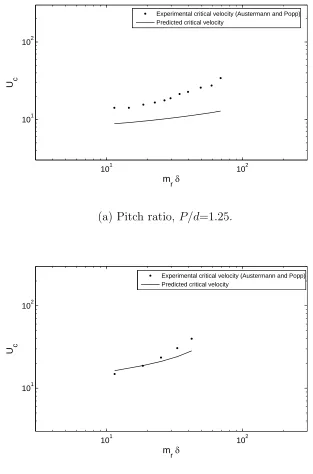
The comparison between the predictions and the experimental critical
velocities (Austermann and Popp, 1995) for the two P/d arrays is shown in
Fig. 6. Quantitatively, this methodology consistently under predicts the
crit-ical velocity for the P/d= 1.25 array, with a relative difference in the range
37% → 62%, while for the P/d = 1.375 array the relative differences are
somewhat lower, within a range of (0%→28%). There are two possibilities
for the deviation. Either the negative fluid damping is over predicted, which
is certainly possible given the embedded assumptions of the wake model.
Alternatively, the positive fluid damping associated with the drag may be
under-predicted. This is very likely as this effect is modeled with the
quasi-steady assumption as discussed above. In qualitative terms, the threshold
trend was captured for the two arrays. As the study envisioned here is
com-parative, focused on the trend rather than on the accuracy of the predictions,
it is concluded that the approach may be sufficient to conduct the parameter
dependency analysis proposed.
4. Sensitivity of the predicted critical velocity to parameter values
It is well known that the pitch ratio effects the critical velocity and has
been noted above, there is some evidence in the literature that the critical
impact of mass ratio is usually bundled into the mass-damping parameter,
but this implicitly assumes that damping and mass are equivalent. There
may be other non-dimensional numbers that may influence the critical
veloc-ity. One candidate might be the Stokes number. The Stokes number posed in
terms of the tube diameter is simply the ratio of Reynolds to critical velocity,
and as such is a ”twice reduced” quantity as Paidoussis et al. (2011) refer to
the mass-damping parameter, with the dependent quantity of interest (i.e.
the critical velocity) embedded in the parameter being varied. It should be
noted that although it is possible to construct a dimensionally correct
pa-rameter, it is not clear what length scale or time base should be used. Stokes
number finds application in the context of entrainment of particles (e.g. PIV
seeding) with the particle size as the length and so may be important in
two-phase flow in tube arrays, typical of flow in the center of steam generators.
However, this is beyond the scope of the current study, which will focus on
the Reynolds number.
Using the hybrid theoretical-CFD method described and validated above,
the effect of Reynolds number, mass ratio and pitch ratio (Re, mr, P/d) has
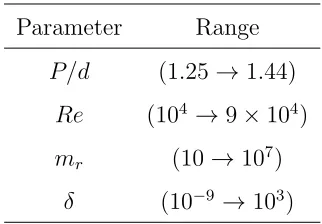
been estimated, and the relative importance assessed. Ninety steady
simula-tions, corresponding to the 5 pitch to diameter ratios (P/d= 1.25,1.30,1.32,1.375,1.44),
9 Reynolds numbers (Re= 104 →9×10⁴) and two positions of the displaced
tube (±0.005d) were carried out. The resulting fluid force coefficients were
used in the quasi-unsteady model (Granger and Paidoussis, 1996; Meskell,
2009) with 7 mass ratios and 13 structural damping values. The combination
of these parameters produced 8190 stability thresholds estimates. Table 1
Parameter Range
P/d (1.25→1.44)
Re (104 →9×10⁴)
mr (10→107)
[image:18.612.224.385.124.236.2]δ (10−9 →103)
Table 1: Parameters range considered in the study of the critical velocity dependency.
4.1. Effect of Reynolds number
The Reynolds number was varied in the steady CFD simulations by
al-most one order of magnitude from Re = 104 to Re = 9 ×10⁴. This was
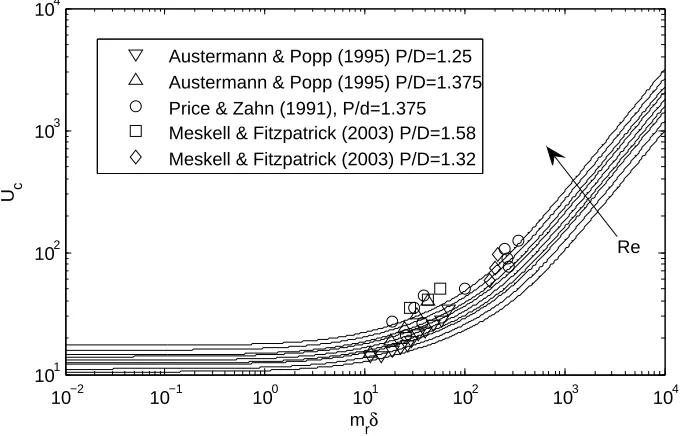
achieved by changing the onset flow velocity. Figure 7 shows the stability
threshold for the 9 Reynolds numbers considered, for a pitch ratio P/d =
1.375, and a mass ratio mr = 100. It was found that increased Reynolds
number increases the critical velocity over the entire stability threshold, and
this effect was seen for all pitch ratios. In the case shown in Fig. 7,
in-creasing the Reynolds number by a factor of 9 resulted in a factor of 1.6
increase in critical velocity at the lowest mass-damping value (mrδ= 10−2).
These results would indicate that the Reynolds number effect is moderate.
Furthermore, considering experimental or numerical inputs obtained at low
Reynolds numbers in the theoretical models, would yield conservative
esti-mates of critical velocity.
4.2. Effect of mass ratio
The simple time lag embedded in the quasi-steady theory Price and
mass and damping become combined into a single parameter, the so called
mass-damping parameter. This is actually the product of two independent
non-dimensional numbers: the mass ratio,mrand the logarithmic decrement,
δ. In the quasi-unsteady model Granger and Paidoussis (1996), the use of a
memory function means that the mass and the damping do not always
ap-pear together in the governing equation of motion. Thus, the mass-damping
parameter does not naturally appear in the coefficients of the characteristic
equation (Meskell, 2009). As a result, at a given value of mass-damping,mrδ,
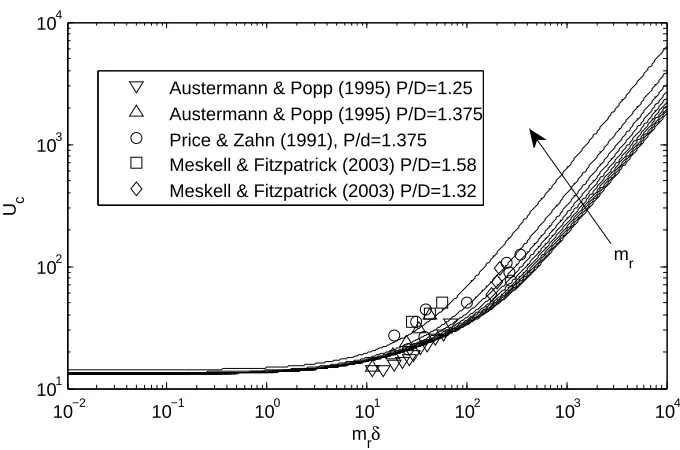
the mass ratio mr may have a wide range of values. In order to assess the
effect of the varying the mass ratio, the critical velocity for the same array as
in Fig. 7 was assessed for 10≤mr ≤107 . The higher values of this range are
obviously unrealistic ( 104 would be a more realistic upper limit), but this
large range was use to achieve a comparable change in critical velocity to that
observed for the Reynolds number. Therefore, the first obvious conclusion
is that mass ratio is less significant than Reynolds number. However, it is
still worth considering if the mass ratio changes the effect of Reynolds
num-ber. In order to allow comparison of critical velocities for different Reynolds
numbers and mass ratios a renormalized critical velocity can be defined:
Uc∗ = Uc Ucref
= Uc
Uc(Re=5×10⁴)
(8)
The reference value is chosen as the critical velocity at Re= 5×10⁴ as this
is the center of the Reynolds number range considered. Note that mass ratio
and structural damping are almost fixed for a given tube array installation,
but Reynolds number can be varied by the choice of flow velocity.
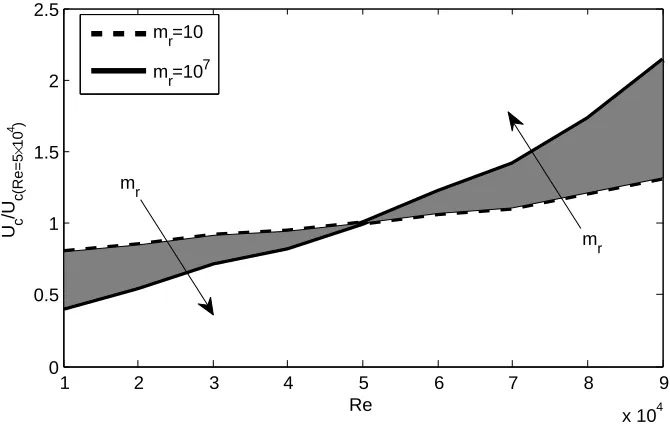
Fig-ure 9 shows the variation of the renormalized critical velocity over a range
associated with structural damping is δ = 0.1. As can be seen, the effect of
increasing Reynolds number is more-or-less linear, but increasing mass ratio
increases the sensitivity of critical velocity to Reynolds number: the slope of
the trend is steeper for high mass ratio.
Figure 10 shows the effect of varying the structural damping δ with a
fixed mass ratio mr = 100. The effect of varying Reynolds number is linear,
but again increased damping increases the sensitivity of critical velocity to
Reynolds number. However, the degree to which the slope of the trend is
changed by increasing damping is not as great. The fact that increasing
damping and increasing mass ratio act to move the critical velocity in the
same direction suggests that the two parameters can be combined in a single
parameter (i.e. the mass-damping parameter), but they are not completely
interchangeable, as increased damping has less effect than increased mass
ratio and this depends on the value of mass-damping parameter, as already
seen in Fig. 7.
In order to show the net effect of increasing the mr at a constant
mass-damping, the behaviour at three mass damping parameters (mrδ = 10−2,
mrδ = 104 and mrδ = 104) were calculated for increasingmr and decreasing
δ and is shown in Fig. 11. For the lowest mass-damping parameter value
(mrδ = 10−2) the variation of the critical velocity with Reynolds numbers
shows almost no dependency on mass ratio. As the mass-damping parameter
increases, the influence of mass ratio, mr, becomes stronger.
The range ofmr evaluated was extremely wide, spanning seven orders of
magnitude, and yet the effect on critical velocity is modest. Furthermore,
Pitch Ratio,P/d 1.25 1.30 1.32 1.375 1.44
∂CL
∂y −46.23 −21.79 −17.63 −8.023 −4.87
[image:21.612.140.472.126.192.2]CD 8.99 6.59 5.89 4.85 3.67
Table 2: Fluid force coefficients for Re=5×10⁴
the critical velocity, but this effect is confined to high values of mass-damping
parameter. At low values of mass-damping, where the critical velocity will be
lowest, the mass ratio has almost no effect. There is theoretical evidence (e.g.
Yetisir and Weaver, 1993b) that for high mass-damping values, damping
controlled FEI will occur at higher velocities than stiffness controlled FEI,
and so this would suggest that the effect of mass ratio might practically
be ignored. This explains why the widely adopted pragmatic approach to
consider the mass-damping parameter is actually valid, even though the mass
ratio and structural damping (logarithmic decrement) are separate physical
quantities.
4.3. Effect of pitch ratio
It is well known that pitch ratio is important for the critical velocity.
The mechanism for this dependency is that the static fluid force coefficients
depend strongly on the pitch ratio, for a given Reynolds number. For
exam-ple, Table 2 lists the fluid force coefficients obtained from the steady CFD
simulations for a Reynolds number of 5×10⁴.
The sensitivity of the critical velocity to pitch ratio has been evaluated
by considering five pitch ratios: P/d = 1.25,1.30,1.32,1.375 and 1.44. In
order to compare the behaviour of different pitch ratios at various Reynolds
this case, the reference value was critical velocity at P/d = 1.375, and the
particular Reynolds number.
Uc∗ = Uc Ucref
= Uc
Uc(P /d=1.375)
(9)
it was found that even after normalization with respect to the reference pitch
ratio (1.375), there was still a significant variation due to both Reynolds
num-ber and mass-damping parameter. Figure 12 shows the range of normalized
critical velocity Uc∗ for various pitch ratios over the range of Reynolds num-bers (104 ≤ Re ≤ 9× 10⁴). Note that the apparent lack of variation at
P/d= 1.375 does not mean there is no variation with Reynolds number, but
rather that the dataset is referenced to this condition. The mass-damping
parameter considered is mrδ = 10. At the lowest Reynolds number (104)
the critical velocity for a pitch ratio of 1.25 is only 50% of what would be
expected in an array with a pitch ratio of 1.375. In comparison, Chen’s
em-pirical correlation Chen (1984) would yield a ratio of 74%. At the highest
Reynolds number (9× 10⁴) for P/d = 1.44, the current study predicts a
ratio, Uc∗ of 120% , while Chen’s factor is 114%. The fact that the trend and order of magnitude are similar is encouraging, but there is significant
variation associated with Reynolds number. Furthermore, the variation with
Reynolds number depends on the mass-damping parameter. For this reason,
it has not been practical to develop a simple correction factor which
cap-tures the Reynolds number effect, the effect of pitch ratio and the effect of
5. Conclusions
A theoretical-CFD hybrid method has been proposed, in which force
co-efficients estimated in steady simulations are used as the inputs of the
quasi-unsteady model Granger and Paidoussis (1996) and combined with a
theo-retical memory function Meskell (2009). This allows predictions of critical
velocity without the need of any experimental data. Data from the literature
was used to validate the CFD simulations and the predictions obtained by the
hybrid theoretical-CFD approach. Results of these two comparisons showed
reasonable agreement in the pressure distribution in the tube surface and the
critical velocity predictions. However, as the discrepancy between the
exper-imental critical velocity and the predicted value is comparable in magnitude
to the variations observed, some caution must be exercised. Nonetheless,
using this approach the sensitivity of the predictions of critical velocity to
values of mass ratio, Reynolds number and pitch ratio was assessed. The
main conclusions derived from these studies were:
1. Reynolds number was found to increase levels of critical velocity for
the whole stability threshold, by as much as 60 % .
2. While mass ratio has an appreciable effect, it is relatively small, and so
it is reasonable to lump the mass ratio and structural damping together
in a single parameter, as is commonly done.
3. Pitch ratio was found to have the most significant effect, however, the
magnitude of the effect of pitch ratio depends on the Reynolds number.
Although work is need to improve the absolute accuracy of the predictions
quasi-usnteady formulation), the hybrid theoretical-CFD method has yielded some
useful insights into damping controlled FEI.
6. Acknowledgment
The authors gratefully acknowledge the financial support of: the
Princi-pality of Asturias Government under the PhD grant BP-12054 awarded to
Ms. de Pedro.
26th ITTC Specialist Committee on CFD, 2011. Practical guidelines for ship
cfd application. ITTC-Recommended Procedures and Guidelines.
Anderson, B., Hassan, M., Mohany, A., 2014. Modelling of fluidelastic
in-stability in a square inline tube array including the boundary layer effect.
Journal of Fluids and Structures. 132 (48), 362–375.
Austermann, R., Popp, K., 1995. Stability behaviour of a single flexible
cylin-der in rigid tube arrays of different geometry subjected to cross-flow.
Jour-nal of Fluids and Structures 9 (3), 303 – 322.
Chen, S., 1984. Guidelines for the instability flow velocity of tube arrays in
crossflow. Journal of Sound and Vibration 93, 439–455.
Chen, S. S., 1983. Instability mechanisms and stability criteria of a group
of circular cylinders subjected to cross-flow. part i: Theory. Journal of
Vibrations, Acoustics, Stress, Reliability and Design 105, 51–58.
de Pedro, B., Parrondo, J., Meskell, C., Oro, J., 2016. Cfd modelling of
forced vibrations or fluidelastic instability. Journal of Fluids and Structures
64, 67–86.
Gillen, S., Meskell, C., 2009. Numerical analysis of fluidelastic instability in
a normal triangular tube array. Proceedings of Flow Induced Vibrations.
Prague, Czech Republic.
Granger, S., Paidoussis, M., 1996. An improvement to the quasi-steady model
with application to cross-flow-induced vibration of tube arrays. Journal of
Fluid Mechanics 320, 163–184.
Harran, G., 2014. Influence of mass ratio on the fluidelastic instability of a
flexible cylinder in a bundle of rigid tubes. Journal of Fluids and Structures
47, 71–85.
Hassan, M., Gerber, A., Omar, H., 2010. Numerical estimation of
fluidelas-tic instability in tube arrays. Journal of Pressure and Vessel Technology
132 (4), 041307 (11 pp.) –.
Iacovides, H., Launder, B., West, A., 2014. A comparison and assessment
of approaches for modelling flow over. International Journal of Heat and
Fluid Flow 49, 69–79.
Keogh, D., Meskell, C., 2015. Bi-stable flow in parallel triangular tube arrays
with a pitch-to-diameter ratio of 1.375. Nuclear Engineering and Design
285, 98–108.
Khalifa, A., Weaver, D., Ziada, S., 2013. Modeling of the phase lag causing
fluidelastic instability in a parallel triangular tube array. Journal of Fluids
Lever, J., Weaver, D., 1986. On the stability of heat exchanger tube bundles.
part i: modified theoretical model. part ii: numerical results and
compar-ison with experiment. Journal of Sound and Vibration 107, 375–410.
Li, H., Mureithi, N., 2016. Development of a time delay formulation for
fluidelastic instability model. In: Flow-Induced Vibration and Noise 2016.
TNO, pp. 653–662.
Mahon, J., Meskell, C., 2009. Surface pressure distribution survey in normal
triangular tube arrays. Journal of Fluids and Structures 25, 1348–1368.
Mahon, J., Meskell, C., 2012. Surface pressure survey in a parallel triangular
tube array. Journal or Fluids and Structures 34, 123–137.
Mahon, J., Meskell, C., 2013. Estimation of the time delay associated with
damping controlled fluidelastic instability in a normal triangular tube
ar-ray. Journal of Pressure Vessel Technology, Transactions of the ASME
135 (3).
URL http://dx.doi.org/10.1115/1.4024144
Meskell, C., 2009. A new model for damping controlled fluidelastic instability
in heat exchanger tube arrays. Proceedings of the Institution of Mechanical
Engineers, Part A: Journal of Power and Energy 223 (4), 361–368.
Meskell, C., Fitzpatrick, J. A., 2003. Investigation of nonlinear behaviour
of damping controlled fluidelastic instability in a normal triangular tube
array. Journal of Fluids and Structures 18, 573–593.
vibrations of tube bundles in crossflow. In: Flow-induced vibration. I. Mech
E. London, pp. 231–242.
Paidoussis, M., Price, S., deLangre, E., 2011. FuidStructure Interactions
-Cross flow instabilities. Cambridge University Press, Cambridge.
Price, S. J., 1995. A review of theoretical models for fluidelastic instability of
cylinder arrays in cross-flow. Journal of Fluids and Structures 9, 463–518.
Price, S. J., 2001. An investigation on the use of connors’ equation to
pre-dict fluidelastic instability in cylinder arrays. Journal of Pressure Vessel
Technology 123, 448–453.
Price, S. J., Paidoussis, M. P., 1984. An improved mathematical model for
the stability of cylinder rows subject to cross-flow. Journal of Sound and
Vibration 97 (4), 615–640.
Saffman, P. G., 1992. Vortex Dynamics. Cambridge University Press.
Van Oudheusden, B., 1995. On the quasi-steady analysis of
one-degree-of-freedom galloping with combined translational and rotational effects.
Non-linear Dynamics 8 (4), 435–451.
Virgin, L. N., 2000. Introduction to experimental nonlinear dynamics : a
case study in mechanical vibration”. Cambridge Univeristy Press.
Yetisir, M., Weaver, D., 1993a. An unsteady theory for fluidelastic instability
in an array of flexible tubes in cross-flow. part i: Theory. Journal of Fluids
Yetisir, M., Weaver, D., 1993b. An unsteady theory for fluidelastic instability
in an array of flexible tubes in cross-flow. part ii: Results and comparison
with experiments. Journal of Fluids and Structures 7 (7), 767–783.
Zhang, Z., Zhao, C.-R., Yang, X.-T., Jiang, P.-X., Tu, J.-Y., Jiang, S.-Y.,
2017. Numerical study of the heat transfer and flow stability of water at
supercritical pressures in a vertical tube. Nuclear Engineering and Design
325, 1 – 11.
1st ORDER UNSTEADY
WAKE MODEL (Meskell, C., 2009)
QUASI-STEADY THEORY (Granger, S. & Paidoussis,
M.P., 1996)
VALIDATION 2: EXPERIMENTAL CRITICAL VELOCITY
P/d=1.25, 1.375 Austermann, R. & Popp, K., 1994.
STRUCTURAL PARAMETERS
MEMORY FUNCTION FLUID DYNAMIC
COEFFICIENTS dCL/dy, CD CFD MODEL:
-STEADY -RANs
CRITICAL VELOCITY VALIDATION 1:
SURFACE PRESSURE Mahon, J. & Meskell, C.,
2009.
Re P/d
[image:29.612.124.496.304.468.2]mr d
Figure
2:
T
ypical
v
elo
cit
y
magnitude
con
tours
obtained
in
st
e
ady
sim
ulations
(
P
/d
=1.25,
U0
=0.89
P
d
9
d
9d
SD
Figure
3:
Sc
hematic
of
computational
[image:31.612.201.381.146.638.2]Displaced
Tube
0 50 100 150 200 250 300 350 -1
-0.9 -0.8 -0.7 -0.6 -0.5 -0.4 -0.3 -0.2 -0.1 0
P*
(º)
k- Standart k- RNG k- SST
[image:33.612.125.470.249.500.2]Experimental data
Figure 5: Comparison of pressure coefficient,P∗, on tube surface computed from different
turbulence models, with experimental data Mahon and Meskell (2009). P/d = 1.32,
101 102 101
102
m
r
U c
Experimental critical velocity (Austermann and Popp) Predicted critical velocity
(a) Pitch ratio,P/d=1.25.
101 102 101
102
m
r
U c
Experimental critical velocity (Austermann and Popp) Predicted critical velocity
[image:34.612.140.453.88.562.2](b) Pitch ratio,P/d=1.375.
Figure 6: Comparison of critical velocity (Uc) predictions with experimental
10−2 10−1 100 101 102 103 104
101
102
103
104
mrδ
U c
Austermann & Popp (1995) P/D=1.25 Austermann & Popp (1995) P/D=1.375 Price & Zahn (1991), P/d=1.375 Meskell & Fitzpatrick (2003) P/D=1.58 Meskell & Fitzpatrick (2003) P/D=1.32
[image:35.612.128.468.272.490.2]Re
Figure 7: Effect of Reynolds number on the stability threshold, compared with
10−2 10−1 100 101 102 103 104
101
102
103
104
mrδ
U c
Austermann & Popp (1995) P/D=1.25 Austermann & Popp (1995) P/D=1.375 Price & Zahn (1991), P/d=1.375 Meskell & Fitzpatrick (2003) P/D=1.58 Meskell & Fitzpatrick (2003) P/D=1.32
mr
[image:36.612.127.467.274.499.2]1 2 3 4 5 6 7 8 9
x 104
0 0.5 1 1.5 2 2.5
Re
U c
/U
c
(Re=5
×
10
4 )
mr=10
mr=107
mr
m
[image:37.612.129.464.285.498.2]r
1 2 3 4 5 6 7 8 9
x 104
0.4 0.6 0.8 1 1.2 1.4 1.6 1.8 2
Re
U c
/U
c
(Re=5
×
10
4 )
δ=10−4
δ=102
[image:38.612.127.464.282.503.2]δ δ
1 2 3 4 5 6 7 8 9 x 10⁴ 0.4 0.6 0.8 1 1.2 1.4 1.6 1.8 2 2.2 2.4 Re U* c
mr=107; mr=104;
m
r=10 7; m
r=10;
m
r=10 7;m
r=10 -2;
m
r=10; mr=10 4;
m
r=10; mr=10;
m
r=10; mr=10 -2;
mr mr
mr=10
mr=10-2
[image:39.612.121.481.264.507.2]mr=104
1.24 1.26 1.28 1.3 1.32 1.34 1.36 1.38 1.4 1.42 1.44 0.5
0.6 0.7 0.8 0.9 1 1.1 1.2 1.3
P/d
U c
*
Re=9104
Re=104
[image:40.612.120.484.262.519.2]Re