econ
stor
www.econstor.eu
Der Open-Access-Publikationsserver der ZBW – Leibniz-Informationszentrum Wirtschaft
The Open Access Publication Server of the ZBW – Leibniz Information Centre for Economics
Nutzungsbedingungen:
Die ZBW räumt Ihnen als Nutzerin/Nutzer das unentgeltliche, räumlich unbeschränkte und zeitlich auf die Dauer des Schutzrechts beschränkte einfache Recht ein, das ausgewählte Werk im Rahmen der unter
→ http://www.econstor.eu/dspace/Nutzungsbedingungen nachzulesenden vollständigen Nutzungsbedingungen zu vervielfältigen, mit denen die Nutzerin/der Nutzer sich durch die erste Nutzung einverstanden erklärt.
Terms of use:
The ZBW grants you, the user, the non-exclusive right to use the selected work free of charge, territorially unrestricted and within the time limit of the term of the property rights according to the terms specified at
→ http://www.econstor.eu/dspace/Nutzungsbedingungen By the first use of the selected work the user agrees and declares to comply with these terms of use.
zbw
Leibniz-Informationszentrum Wirtschaft Leibniz Information Centre for EconomicsGeiger, Michael
Working Paper
Monetary Policy in China (1994-2004) :
Targets, Instruments and their
Effectiveness
Würzburg economic papers, No. 68
Provided in cooperation with:
Julius-Maximilians-Universität Würzburg
Suggested citation: Geiger, Michael (2006) : Monetary Policy in China (1994-2004) : Targets, Instruments and their Effectiveness, Würzburg economic papers, No. 68, http:// hdl.handle.net/10419/22361
W. E. P.
Würzburg Economic Papers
No. 68
Monetary Policy in China (1994-2004):
Targets, Instruments and their
Effectiveness
Michael Geiger
April 2006
Universität Würzburg
Lehrstuhl VWL 2
Sanderring 2, D-97070 Würzburg
[email protected]
Postal Address
Michael Geiger, Rue Pestalozzi 13, 1202 Geneva, Switzerland.
Phone: +41-76-5066150, Email:
[email protected]
.
Monetary Policy in China (1994-2004): Targets, Instruments and their Effectiveness
Michael Geiger*
* The author thanks: Kang Yitong, Yin Xiaobing and Chao Chen from the Graduate School of the Peo-ple’s Bank of China for all the help and discussions during the stay in Beijing; the Deutsche Bundes-bank, the People’s Bank of China and the German Academic Exchange Service (DAAD) for making this stay possible; Peter Bofinger and Heiner Flassbeck for their continuous support; and Nicolas Schlotthauer and Zhang Bin for their valuable comments.
Content
1 Preface... 4
2 Targets of the monetary policy in China... 5
2.1 Intermediate targets... 5
2.2 Final targets ... 6
2.3 Other tasks and targets ... 7
3 Monetary policy instruments in China ... 8
3.1 Instruments of the People’s Bank of China as the central bank of China ... 9
3.1.1 Price-based indirect instruments ... 9
3.1.1.1 PBC lending and deposit rates ... 10
3.1.1.2 Discount and rediscount rate ... 11
3.1.1.3 Reserve requirements... 12
3.1.1.4 Open market operations (OMO) ... 13
3.1.2 Quantity-based direct instruments... 14
3.1.2.1 Window guidance... 14
3.1.2.2 Direct PBC lending... 16
3.1.2.3 Capital controls ... 16
3.2 Other non-monetary policy instruments ... 19
3.2.1 Price controls ... 19
3.2.2 Wage controls ... 22
4 Effectiveness of the Chinese monetary policy... 27
4.1 Intermediate targets... 27
4.1.1 Monetary aggregates... 27
4.1.1.1 Controllability... 29
4.1.1.2 Relationship to inflation ... 33
4.1.2 Domestic loan increase ... 35
4.1.2.1 Controllability... 35 4.1.2.2 Relationship to inflation ... 37 4.2 Final targets ... 39 4.2.1 Inflation rate ... 40 4.2.2 GDP growth rates ... 41 4.2.3 Exchange rate... 42
4.3 Monetary policy transmission process... 43
4.3.1 Ineffective interest rate channel... 43
4.3.2 Distortions through an unsound banking sector and a lack of competition ... 49
4.4 Influence of quantity-based monetary and non-monetary policy instruments... 51
4.4.1 Window guidance... 51
4.4.2 Price controls ... 52
4.4.3 Wage level controls ... 54
5 Concluding remarks... 58
Figures and Tables
Figure 1: Porosity of Chinese capital controls, 1994-2004 (billion USD) ... 18
Figure 2: Inflation rate and targeted and actual values of money M2 in China, 1994-2004 ... 34
Figure 3: Inflation rate compared to targeted and actual values of domestic loan increase,... 37
Figure 4: Interest rates, monetary aggregates and domestic loan increases in China, 1994-2004... 44
Figure 5: Development of the lending rate and the inflation rate in China, 1987 to 2004 ... 48
Figure 6: Unit labor cost growth and the inflation rate, 1987-2000 ... 55
Figure 7: Wage growth in different ownerships and sectors, 1987-2000... 57
Table 1: Open market operations in China, 4th January 2000 - 1st June 2004... 14
Table 2: Criteria for government control of prices ... 20
Table 3: Products, public utilities and services under government control ... 20
Table 4: State-owned industrial enterprises and their share of the Chinese wage bill, 1991-2001 ... 24
Table 5: Potential scope of the 1994/1995 I wage reform... 25
Table 6: Potential scope of the 1994/1995 II wage reform... 26
Table 7: The potential impact of the 1994/1995 wage reform on China's total wage bill... 26
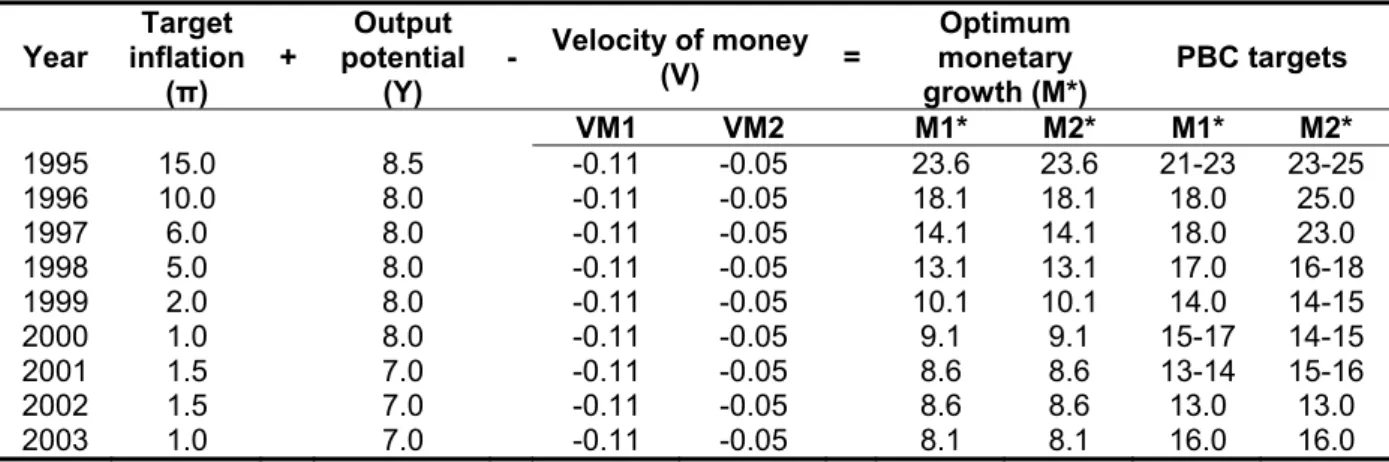
Table 8: Testing the ECB potential formula for the PBC, 1995-2003 ... 28
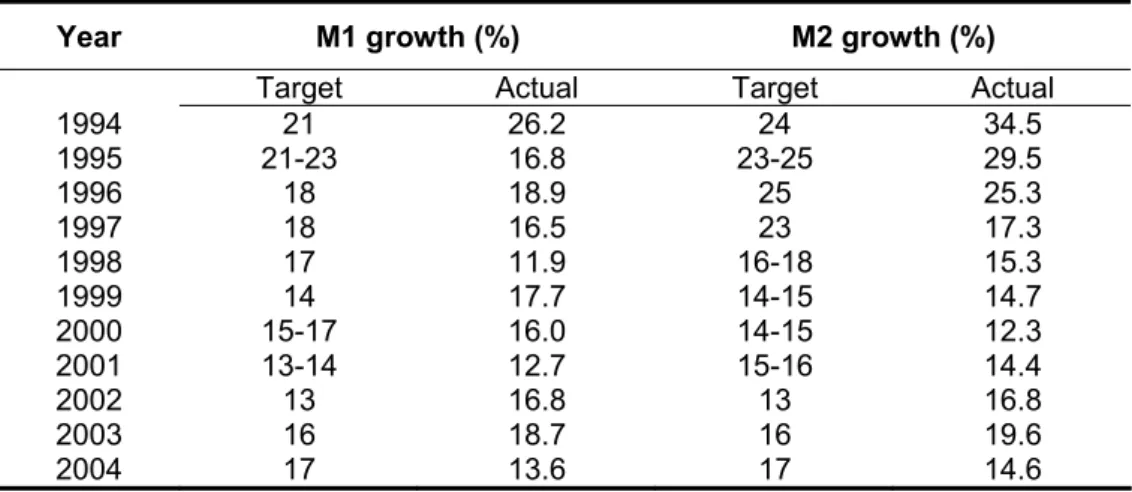
Table 9: Targeted and actual values for the PBC's monetary aggregates, 1994-2004 ... 29
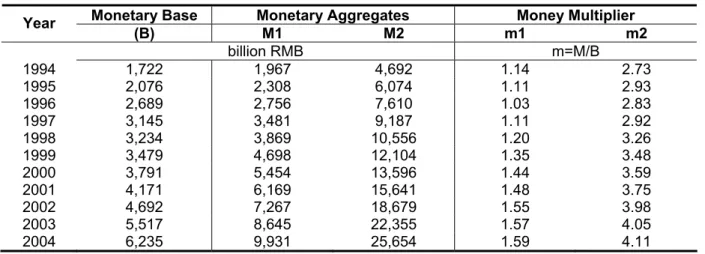
Table 10: Monetary base, monetary aggregates and the money multiplier, 1994-2004... 32
Table 11: Targeted and real values for domestic loan increases in China, 1998-2004... 36
Table 12: Targeted and real values for the inflation rate and GDP growth, 1994-2004 ... 39
Table 13: Monetary targeting policy reaction and actual PBC reaction, 1994-2004 ... 46
Table 14: Approximate share of government controlled prices in China, 2001/2002 ... 52
Monetary Policy in China (1994-2004): Targets, Instruments and their Effectiveness
Michael Geiger1
Abstract
China’s monetary policy disposes of two sets of monetary policy instruments: In-struments of the central bank, the People’s Bank of China (PBC) and non-monetary policy instruments. Additionally, the PBC’s instruments include price-based indirect and quantity-price-based direct instruments. The simultaneous usage of these instruments leads to various distortions that ultimately prevent the inter-est rate channel of monetary transmission from functioning. Moreover, the strong influences of quantity-based direct instruments and non-monetary policy instruments question the approach of indirect monetary policy in general.
1 Preface
The analysis argues that the monetary policy in China in the last decade not only was con-ducted and influenced by the People’s Bank of China (PBC), the Chinese central bank, but also by other authorities, mainly the central government. The PBC is neither goal, nor in-strument independent. I.e. the PBC can neither set its final targets, nor its inin-struments with-out approval of the state council. Moreover, non-monetary policy instruments are in place, which are not controlled by the central bank, but have a direct influence on the final targets of monetary policy.
Thus the description of the instruments of monetary policy in China incorporates both the instruments of the central bank and other non-monetary instruments. The instruments of the central bank are divided into two parts: Price-based and quantity-based monetary policy in-struments. While the major Chinese particularities of the price-based instruments are de-scribed shortly, the main focus is on the quantity-based and non-monetary policy instruments. The centrepiece of the work is the analysis of the effectiveness of the monetary policy in China. It is dedicated to the explanation of the interdependency and the interaction between the three types of instruments, the:
Central bank’s price-based instruments,
Central bank’s quantity-based instruments, and
Non-monetary and non-central bank instruments.
This distinction pays tribute to the fact that China’s economy and financial system is under transition from a planned towards a market- and price-based system. Having chosen a
1 The author is an external Ph.D. student at the Department of Economics, University of Würzburg. He now works for the International Trade Centre UNCTAD/WTO in Geneva, Switzerland.
ual approach of transformation it is in the very nature that during the period of transition price- and quantity-based measurements are in place simultaneously. Moreover, there are certain non-monetary instruments that particularly helped to reach price stability throughout the decade.
2 Targets of the monetary policy in China 2.1 Intermediate targets
After 1985, along with the quiet transformation of the People’s Bank of China into a central bank within a two-tier banking system and the starting transformation of the credit plan to-wards more market-related measurements, monetary aggregates became a more prominent role in the strategy of the monetary authorities. Until 1993 money MO, the currency in circula-tion together with the credit supply have been the main point of interest for the monetary au-thority. However, on the search for a nominal anchor, the PBC started to set up target values for the monetary aggregates M1 und M2 in 1993 and 1994. Two years later the PBC an-nounced M1 and M2 growth rates as the official intermediate targets of China’s monetary policy. Nowadays, after the abolishment of the credit plan as the major instrument in mone-tary policy in 1998, monemone-tary base targeting and the usage of M1 and M2 as the intermediate targets for the monetary policy of the PBC is commonly accepted. Money supply is the most important monetary figure for the conduct of monetary policy under the rule of the People’s Bank of China (Xia et al., 2001: 35; and Xie, 2004a: 2; Yu, 2001). Through its strong empha-sis on monetary aggregate M2 the PBC indicates in its series of monetary policy reports and other publications on its webpage2 that M2 represents the main intermediate target of its
pol-icy concept. Additionally, domestic loan increase serves as an intermediate target (Xie, 2004a; and Yu, 2001)
According to Bofinger (2001) monetary variables need to show a close relationship to the final target of the price level and have to be controllable via the monetary policy instruments at the same time to be eligible to serve as intermediate target in the concept of monetary targeting. Chapter 4 analysis the effectiveness of the Chinese monetary policy, and deals with the question whether these two prerequisites can justify the usage of monetary aggre-gates and domestic loan increase to serve as intermediate targets in China. There it will be shown that a satisfactory relationship between monetary aggregate M2 and domestic loan increase with the inflation rate exists, but no full controllability of the intermediate targets is identifiable.
2.2 Final targets
The final targets of the PBC are stated in the “Law of the People’s Republic of China on the People’s Bank of China“. Article 3 says, “the aim of monetary policies shall be to maintain the stability of the value of the currency and thereby promote economic growth” (N.A., 1995; N.A., 2003). Therefore the central bank is committed to two different final targets in pursuing its monetary policy: First, the bank should aim for a policy that realizes price stability, second the banks’ policy should support the general economic policy and help to promote economic growth.
Mehran et al. (1996) interpret this as the insight of Chinese officials that long-term economic growth only can be realized if long-term price stability predominates, i.e. in their view price stability is the prominent target of the PBC (Mehran et al., 1996: 19f.). The PBC itself also claims to pursue the stability of the currency as the sole target of its monetary policy. Asked about the two official final targets of price stability and economic growth and their ranking in terms of importance, a PBC official unambiguous made clear that the PBC is not supporting the two but only the first target. Only if the target of price stability is reached, he concluded, the central bank would help to pursue other targets, e.g. the promotion of economic growth.3
However, in the context of the PBC, a non-independent central bank, it has to be doubted that the central bank is strong enough to ignore the goal of economic growth. In China the central banks’ decision process is not sufficiently independent from the State Council’s direc-tive.4 And governments rather have an economic growth bias than a low-inflation bias.5 Thus,
the interpretation of Mehran et al. (1996) can only be supported in the context of an inde-pendent central bank constitution as it is, for instance, in the case of the European Central Bank (ECB). Therefore, based on the Law of the People’s Republic of China on the People’s Bank of China, it has to be concluded that the PBC pursuits at least two final targets, a paramount economical target and a less important political target.
Additionally, between 1997 and 2005, China maintained a de facto peg of the RMB to the
USD. According to Anderson (2003) the peg needed to have the add-on of de facto or quasi,
since the official regulation allows the RMB to fluctuate within a certain bandwidth (Anderson, 2003: 4). The de facto peg officially appeared to be a crawling peg with very narrow bands.
With predominating higher trading bands between 1994 and 1996 the crawling peg arrange-ment was literally used and the RMB showed an 18 months appreciation path from 8.7 RMB per USD in 1994 to 8.3 RMB per USD in 1996. Facing the outbreak of the Asian crises the
3 Interview with Mr. Huang, Secretary of the Monetary Policy Committee of the PBC on June 8, 2004. 4 Article 2 of the central bank law says: “The People's Bank of China shall, under the leadership of the State Council, formulate and implement monetary policies” (N.A., 1995).
5 E.g. facing rising unemployment problems and sluggish growth in recent years European leaders repeatedly asked the ECB to lower interest rates. On February 27, 2004 the German speaking news-paper “Die Welt” headlines “Schroeder and Raffarin call for an ECB interest rate cut [own translation]”.
PBC narrowed the trading band and established the de facto peg of the RMB versus the
USD with a trading band of 0.4 per cent around the RMB/USD 8.28 peg. The trading band was further tightened in November 2000 and stood at about 0.01 per dent fluctuation around the central parity of RMB/USD 8.277 until July 21, 2005. The RMB was not completely fixed, but the trading band was very narrow. However, the strictness of the de facto exchange rate
peg to the USD leads to the conclusion that the de facto peg served as a final target of
Chi-nese monetary policy.
The new exchange rate system introduced on July 21, 2005 does not lead to a different as-sessment. The main changes of the move were an immediate appreciation of the RMB against the USD of around 2 per cent, the change from a peg versus the USD solely towards a peg against a basket of currencies, and the reversion to the crawling peg system where the RMB can be allowed to fluctuate against the USD up to 0.3 per cent against the exchange rate of the previous day (Anderson, 2005: 10). However, the first month of the new exchange rate regime showed that the scope of the trading band was not used at all. In fact, it ap-peared that the Chinese authorities revalued the exchange rate as a one-time effect without increasing flexibility. Governor Zhou Xiaochuan of the PBC made clear that that the expecta-tion of more flexibility was a misinterpretaexpecta-tion made mainly by foreign scholars (PBC, 2005b).
To sum up, one can conclude that since 1994 the Chinese monetary policy has three final targets:
An inflation target,
An economic growth target, and
An exchange rate target vis-à-vis the USD.
2.3 Other tasks and targets
In the amendment of the Law of the People's Republic of China on the People's Bank of China of December 27, 2003, 14 major functions and tasks of the central bank of China have
been formulated (PBC, 2003a). Beside those tasks the PBC has to pursue not legally formu-lated targets whose emergence is based on the fact that the Chinese financial system is in transition with a mix of price-based and quantity-based instruments. For instance, according to statements of PBC officials during a seminar in Beijing in April 2004,6 the PBC is
respon-sible to maintain the profitability of the commercial banks (CB) within the Chinese financial system. This task results out of the fact that the interest rate liberalisation is not yet fully es-tablished. The PBC still steers the deposit rates that commercial banks can grant to custom-ers. Thus, the central bank has to make sure that the commercial banks have access to
6 Joint China-IMF Training Program,
High Level Seminar on China’s Monetary Policy Transmission Mechanism, April 12-13, 2004, Beijing.
funds at rates below the deposit rates. The lending rates, on the other hand, can be set more freely. Since October 2004 the commercial banks can set their interest rates without any up-per limit around the fixed benchmark rate of the PBC. Only for rural and urban credit coop-eratives there is still an upper limit of 230 per cent of the benchmark rate in place. For all financial institutions a lower limit of 90 per cent of the benchmark rate applies (PBC, 2004g). Those mixes of liberalised and non-liberalised areas make it increasingly difficult to manage the interdependent measures in a consistent and effective way.
3 Monetary policy instruments in China
The PBC classifies its present set of monetary policy instruments into four categories (Xie, 2004a: 19):7
1. Instruments with ratios, e.g. reserve requirements,
2. Instruments with interest rates, e.g. central bank lending rates, 3. Quantitative instruments, e.g. open market operations (OMO), and 4. Other instruments, e.g. central bank bills.
The classification used in this work somewhat differs from the four categories. First, two main categories of central bank instruments are distinguished: Price-based and quantity-based instruments. Second, all four above mentioned categories are subsumed under the category of price-based instruments.
Certainly, open market operations (OMO) are originally designed to control the monetary base and therefore could be counted as a quantity-based instrument. But, in a market based financial system, every amount of monetary base has its corresponding price. Thus, the ma-jor central banks in the world use OMOs to control the money market rate rather than the monetary base. The PBC is no exception to this. For instance, the PBC carried out 24 repur-chase operations (“repos”) in 2001.8 In 19 operations quantity tenders with a fixed interest
rate were used. In the same year, in 26 reverse repos, solely quantity tenders with fixed in-terest rates were operated.9
Quantity-based instruments are those instruments that are non-market conform, i.e. instru-ments that change the amount of money in the financial system without taking into account the price of money. Instruments that would fall into this category are the nowadays-abolished credit plan or newly introduced instruments like window guidance. Capital controls also can be counted to this category since they leverage on the quantity of capital and not on its price.
7 Xie also mentioned that the PBC introduced and tested 14 monetary policy instruments since 1983. 8 According to own calculations, based on data published on www.chinabond.com.cn
9 The ratio of fixed interest rate tenders diminished in recent years due to the emergence of central bank bills to sterilise exchange rate inflows. To sterilise certain amounts of money the focus is on the quantity rather than the interest rates. Still, the interest rate on the money market showed a rather stable course.
As a third kind of instruments price and wage controls as non-monetary instruments will be highlighted. Non-monetary instruments influence the final targets of the monetary policy in China without being primarily monetary policy instruments.
3.1 Instruments of the People’s Bank of China as the central bank of China 3.1.1 Price-based indirect instruments
Monetary policy textbooks describe the transmission of monetary impulses, among others, via the interest rate channel of monetary policy transmission (cf. Bofinger, 2001). I.e. in the case of a too expansionary monetary stance the monetary authorities would increase their primary lending rate. In a completely market-based environment the stance of the lending rate will be displayed in the inter-bank money market and via the expectations channel trans-formed into all different maturities. Thus, the commercial banks’ refinancing costs will in-crease due to the inin-crease in the primary lending rate. The higher costs of financing for the commercial banks will lead to higher interest rates for outflowing credits to third parties. Higher interest rates in turn will lead to less demand for credits from the non-banking sector and thus lead to a slowing of the real sector. The reverse logic would apply for the situation of a too restrictive monetary stance. The interest rate instrument influences final targets via its interaction with intermediate targets.
In China the interest rate channel of monetary transmission is blurred. Due to the partially interest rate liberalisation, price-based instruments in China have two different underlying mechanisms of action. First, there are instruments that transform the central bank’s policy stance via the interest rate channel of monetary transmission, e.g. OMOs or minimum re-quirements. Second, there are instruments that are (a) not yet subject of full liberalisation and thus act under the disguise of price-based instruments, e.g. PBC lending and deposit rates. Additionally, whether PBC lending functions via the traditional interest rate channel may vary (b) for each of the commercial banks depending on their underlying circumstances: In terms of (a), only some administered interest rates can have a price-theoretical influence as certain of them are used as benchmark rates. The PBC administers two different bench-mark interest rates, the benchbench-mark lending rate, which is the one year PBC lending rate and the benchmark rate of central bank lending that is the rediscount rate. The first benchmark gives the commercial banks a certain degree in setting their interest rates according to their assessment.10 The benchmark for the central bank lending rate gives the PBC the authority
10 In the beginning of 2004 the upper limit of the lending rate for commercial banks and urban credit cooperatives was set to 170 percent of the PBC benchmark rate; the ceiling for rural credit coopera-tives at 200 per cent, respectively. The lower limit of the lending rate for all financial institutions was installed at 90 per cent of the PBC’s benchmark rate. In October 2004, the ceiling for commercial
to set the interest rates of certain maturities according to its assessment without necessary approval from the State Council (PBC, 2004e).
In terms of (b), the PBC lending rate has a price-theoretic influence when other instruments for financing are exhausted. Only then a commercial bank has to revert to the short-term fi-nancing instrument of the PBC lending facility as the last possibility to balance its liquidity. Thus, in this case the rate will influence the market interest rate via the costs of refinancing. For the case that a commercial bank has enough central bank funds available, e.g. through direct PBC lending, the PBC lending rate constitutes an order to the commercial bank to is-sue the available funds at a certain rate. In this case, the costs for financing the central bank money do not find consideration in the rate for credits to third non-bank parties.
To sum up, due to the not yet completed interest rate liberalisation there are two different ways of transmission of interest rate changes in China:
1. The transmission of interest rate changes according the textbook interest rate channel
Interest rate change (PBC)
Change of interest rate to 3rd parties
Æ
Change of refinancing costs of commercial banks (CBs)Æ
2. The transmission of interest rate changes as result of administered interest rate changes
Interest rate change
(PBC)
Æ
CBs have to change the interest rate for money already at their disposalÆ
Change of interest rate to 3rd parties3.1.1.1 PBC lending and deposit rates
In the case of the ECB commercial banks can use the ECB facilities, the marginal refinancing facility and the deposit facility to finance their short-term liquidity (Bofinger, 2001). They also can use funds from the money market to balance their positions. All credit businesses to non-bank third parties have to be backed-up by central non-bank money. If the operations expire the commercial banks have to get new funds via the central bank or the money market. Through the interconnection to the money market, the marginal refinancing and the deposit facility constitute the upper and lower limit of the money market interest rates. Eventually, according the interest rate channel of monetary transmission the levels of the ECB’s facilities influence the rates of lending businesses between commercial banks and non-bank third parties. Xie (2004a) tries to show that the PBC lending and deposit rates work in a similar market-oriented way as the ECB facilities. Accordingly Xie argues that the PBC lending rate consti-tutes the upper limit of the money market rate since 1998 and that the lower limit of the
banks and urban credit cooperatives was abolished and the cap for rural credit cooperatives increased to 230 per cent. The lower limit for all financial institutions remained unchanged.
money market from 1998 to 2002 was defined by the interest rate on required and excess reserves (Xie, 2004a: 20).11
While there is certainly progress towards a price-theoretic underpinning of monetary opera-tions since the mid-1990s, the situation described by Xie (2004a) does not cover the whole financial system. As described above, in certain circumstances the PBC lending and deposit rates have to be seen as an administrative order from the monetary authority that leverages on existing money already at the disposal of the commercial banks. Thus, credits to non-bank third parties are not necessarily based on a utility-calculation in terms of costs for refi-nancing from the PBC (the same logic applies for deposits, respectively).12
Indeed, the high ratios of voluntarily hold excess reserves throughout the 1990s proof that there was a very high level of liquidity in the banking system. Excess reserve ratios have been well above the 10 per cent margin and just in recent years came down to 7.61 per cent in 2001; as of June 2004 they stood at 3.75 per cent (China Monetary Policy Reports, vari-ous issues; and Cheng et al., 1996). Cheng et al. explain the extensive supply of central bank money with the need to meet the ever rising credit plan in the 1980s and in the begin-ning of the 1990s. And still, after the abolishment of the credit plan in 1998 there are quan-tity-based instruments in place that prevent pure price-theoretic mechanisms to work.
But, if this is true, where does all the central bank money come from? The relatively high amount of central bank money permanently being in the financial system to a great extend came and still comes from long-term central bank loans that are subject to rather low interest rates without a link to the predominant monetary policy stance. Thus, the long-term loans can be seen as a “planned economy-style" fixed-quantity contribution from the central bank to the commercial banks. Direct central bank lending appears to be the main source of such provi-sion of central bank money. The total amount of outstanding central bank lending was over 200 billion USD in 2002, which was about 9 per cent of the monetary aggregate M2 (Xie, 2004a: 20f.).
3.1.1.2 Discount and rediscount rate
Before 1998 the discount and rediscount rates were set within a floating range of 5 per cent to 10 per cent below the commercial banks’ loan and PBC lending rates respectively. Since 1998, the rediscount rate was determined in line with other central bank lending rates. In 2004, the rediscount rate was installed as the benchmark rate of central bank lending, i.e. the PBC was given the possibility to change central bank lending rates within a floating range around the rediscount rate without prior approval of the State Council. However, the turnover
11 In fact, however, the money market rate was constantly below the interest rates on the reserves for the time from 1996 to 1999.
12 The add-on problem that huge parts of credits are not negotiated according to project risks is not subject of this analysis.
of operations within the rediscount instrument itself is too small to have any significant influ-ence on the growth of monetary base. Thus, today the rediscount policy primarily aims at influencing the commercial paper market (PBC, 2004e; PBC, 2004f; and Xie, 2004a: 3ff.).
3.1.1.3 Reserve requirements
The PBC introduced minimum reserve requirements in the year 1984 in order to control the financial sectors liquidity. At first, the officials set different reserve obligations for the different deposits with regard to their origin and the institution actual holding the reserves.13 In 1985
the PBC combined all different reserve requirements and set one minimum reserve require-ment at 10 per cent. But only since 1998 the instrurequire-ment of the reserve requirerequire-ment was more active and in a more westernised sense used.14 That year also marks the time when the PBC
shift its monetary policy from direct control to more indirect control and made open market operations (OMO) the main instrument of its monetary policy. Since then, the reserve re-quirement ratio has undergone four major changes. In March 1998 the ratio was cut from 13 to 8 percent, in September 1999 it was decreased from 8 to 6 percent and in September 21, 2003 the ratio was adjusted to 7 percent for all financial institutions15 except the rural and
urban credit cooperatives, which were still subject to 6 percent reserve requirement (cf. Wei, 1999: 145 f.; PBC, 2000; and PBC, 2003c).
The third rise was soon followed by a surprising fourth change of reserve ratios in April 2004, mainly aimed at dampening the expansionary Chinese economy in the 2003/2004 cycle. The PBC raised the required reserve ratio from 7 to 7.5 percent and at the same time introduced a policy of “differentiated required reserve ratio for different financial institutions” (PBC, 2004b). I.e. financial institutions with capital adequacy ratio below the 8 percent capital ade-quacy ratio of the Basel Accord are subject to an 8 percent required reserve ratio. For rural and urban credit cooperatives, the ratio remains at 6 percent (PBC, 2004c; and PBC, 2004d). The Chinese reserve requirement regime has two particular features: First, minimum and excess reserves are interest bearing. According to Schlotthauer (2003), during the 1990s the interest paid on the reserves was so high that there have been years where the dominant strategy of a commercial bank was to hold reserves at the central bank instead of granting a risky loan to an enterprise (Schlotthauer, 2003: 212). However, the PBC argues in favour of
13 For instance, the Agricultural Bank of China (ABC), the Industrial and Commercial Bank of China (ICBC), and the Bank of China (BOC) had to hold 20 percent on deposits of companies, as well as 40 percent on money of urban and 25 percent of rural origin. The China Construction Bank (CCB) had a requirement of 30 percent regardless of the money’s origin.
14 Excess reserves can be voluntarily hold only since 1998.
15 Such as the four big state-owned commercial banks (ABC, BOC, CCB, and ICBC), joint-stock com-mercial banks, city comcom-mercial banks, rural comcom-mercial banks (rural cooperative banks), China Agri-cultural Development Bank (a policy bank), trust and investment companies, finance companies, fi-nancial leasing companies and relevant foreign funded fifi-nancial institutions.
the interest bearing component that it through this is able to constitute a lower limit for the money market rate (Xie, 2004a: 20). This, however, could not be constantly achieved (PBC, 2000).
Second, the financial system holds high ratios of excess reserves, as showed above. Inter-estingly, rural credit cooperatives (RCCs) hold the highest ratios of excess reserves amongst all financial institutions in recent years (PBC, 2004a: 6). And RCCs are subject to credits in the direct central bank lending scheme as they are subsidized with central bank money at a very low lending rate. Thus, the example of the RCCs shows clearly that that the adminis-tered command style PBC lending rates blur the price-theoretic interest rate channel of the Chinese financial system.
3.1.1.4 Open market operations (OMO)
In 1993, the PBC introduced the instrument of open market operations (OMO) into its mone-tary policy toolbox. But the authorities soon had to realize that the institutional foundation with the absence of an inter-bank market and only rudimentarily liberalised interest rates was not strong enough to establish well functioning OMOs. Thus, in the following years only few OMOs have been carried out and on a very low scale. Thus, the central bank decided to suspend OMOs in the year 1997.16
On May 26, 1998 the authorities officially re-introduced OMOs. Under new circumstances with a better institutional foundation, the operations were an immediate success. Ever since, OMOs represent a key instrument for the conduct of monetary policy in China.17 The
follow-ing two years until mid-2000 were characterised by a constant operation of repurchase agreements to issue base money.
Since mid-2000, however, a major shift in the conduct of OMOs was recognisable: The PBC started to use repurchase agreements to withdraw base money from the financial system. This became necessary as increasing amounts of foreign exchange inflows had to be pur-chased with RMB to keep the de facto peg of the exchange rate. In turn, these foreign
ex-change interventions increased the amount of RMB base money. To cope with these inflows repurchase operations are one tool to withdraw these inflows.
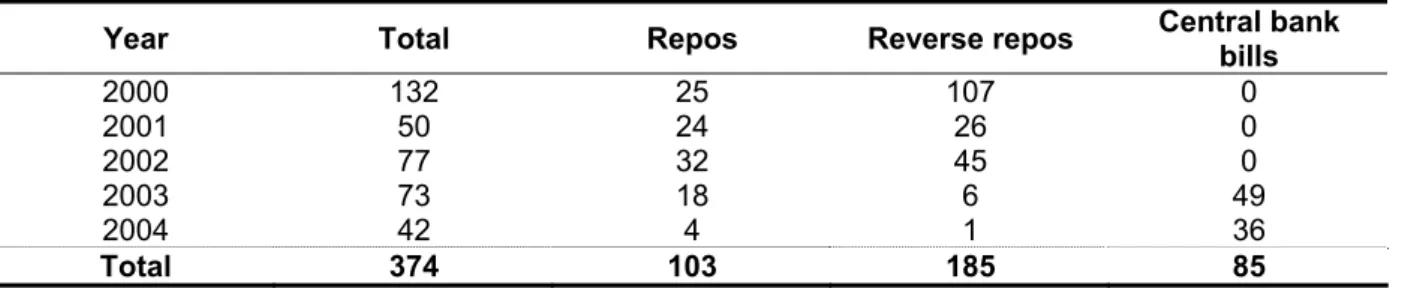
In 2003, within the framework of open market operations, another tool to reduce the amount of RMB in the financial system was introduced: The central bank started to issue central bank bills. In 2004, the issuance of central bank bills was the major operation conducted within the OMO framework. In the 22 days with operations from January 16, 2004 to June 10,
16 Please refer to Mehran et al. for a detailed description for the early years of OMOs (Mehran et al., 1996: 47).
17 Please refer to Dai, who delivers a detailed explanation of the conduct of OMOs in China (Dai, 2003: 57).
2004 the PBC conducted 36 central bank bills operations, 1 repurchase business and 6 re-verse repurchase deals (table 1).
Table 1: Open market operations in China, 4th January 2000 - 1st June 2004
Year Total Repos Reverse repos Central bank bills
2000 132 25 107 0 2001 50 24 26 0 2002 77 32 45 0 2003 73 18 6 49 2004 42 4 1 36 Total 374 103 185 85
Source: Own calculations, based on data from www.chinabond.com.cn.
3.1.2 Quantity-based direct instruments
Before the reform era, the credit plan acted as the financial framework for the state invest-ment plan. Necessary credits to reach the given output targets have been summed-up. Since the 1980s, the instrument of the credit plan has been adjusted several times according to the new financial and economical environment. In 1996, still, the credit plan was the most impor-tant monetary policy instrument of the PBC (Mehran et al., 1996: 41f.). Only in 1998, when the credit plan was officially abolished and OMOs have been established the latter became the main monetary policy instrument in the PBC’s toolbox.
Today preferential lending to certain areas and industries is still observable. Thus credit allo-cation in those areas does not follow cost-utility criteria, i.e. credit alloallo-cation is not steered by the price but by the required and/or desired amount of money. In a nutshell, there still is a
quasi credit plan in effect. However, compared to the long-term determination of the official
credit plan(s) of former times, the amount-driven credit allocation of today serves on an ad-hoc basis. The two instruments of window guidance and direct PBC lending are mainly used for the quantity-based allocation of credits in the Chinese financial system.
3.1.2.1 Window guidance
The PBC started to adopt the policy of “window guidance“18 in 1998.The framework for the
Chinese window guidance was closely modelled according the Japanese system, which was in place for more than 40 years until its abolishment in the early 1990s. This policy uses be-nevolent compulsion to persuade banks and other financial institutions to stick to official guidelines. Central banks put moral pressure on financial players to make them operate con-sistent with national needs (N.A., 2004). A major point of the concept is the temptation to influence the market participants through words rather than strict rules. Despite the phrase
18 This is the translation of the Japanese expression. It is also known as “moral suasion” and “jawbon-ing”.
guidance, which implies a voluntarily aspect in the system, the PBC has a major influence on the lending decisions especially of the four state-owned commercial banks (Ikeya, 2002: 2ff.). A description of the attempts to curb the expansionary tendency in certain sectors, especially the real estate sector in the economic cycle 2003/2004 delivers a good way to illustrate the mechanism of window guidance. On June 5, 2003, the PBC started this guidance process with publishing a notice about “Further Strengthening the Management of Real Estate Credit Business”. Following that, the PBC asked for window guidance meetings three times in the second half of 2003. In those meetings on July 18, August 11 and September 12 the PBC invited representatives of all Chinese financial institutions and repeatedly asked them to pay attention to the proper capital adequacy ratio and to prevent credit and liquidity risks. Facing a very fast growth of commercial bank loans to the real estate sector at that time, “the PBC timely signalled risks on real estate loans in June to further standardize its development and strengthened window guidance on commercial bank loans” (PBC, 2004a: 2). This was a rather strong urge to calm down the commercial banks lending for real estate businesses. Since the beginning of 2004, monthly assessments of the PBC “to review economic and fi-nancial development and strengthen warnings for the commercial banks to guard against potential risks” (PBC, 2004h) have been added to the window guidance policy. Then, in monthly meetings credit guidance and information about risks were provided to the commer-cial banks as an outcome of the assessments (PBC, 2004i). Additionally, a large-scale win-dow guidance meeting with all commercial banks took place on March 23, 2004, with the target to set up a credit restriction mechanism according to the commercial banks risk-control abilities and their capital adequacy (PBC, 2004h).
The reasons for window guidance being relatively successful in China is to a great extend in the fact that the governor of the PBC is a higher-ranking official than the leaders of the com-mercial banks. Thus, according to the hierarchical system the comcom-mercial bank leaders have to adhere to orders made within the policy of window guidance. However, the responsibility to provide window guidance is somehow unclear.
All of the mentioned measures have been defined for and carried out by the PBC itself. But, in April 2004 the China Banking Regulatory Commission (CBRC) and not the PBC advised 11 state-owned shareholding commercial banks19 to limit lending to certain sectors. This
ad-vice clearly is a measure within the framework of window guidance. One observer stated that the CBRC in 2004 “gave strict window guidance to major local banks” (Hagiwara, 2004: 5). Moreover, in a press conference on March 7, 2005 the CBRC stated, “in 2004, the CBRC enhanced its roles in providing window guidance and risk signaling for banks” (CBRC, 2005). However, with regards to the advice to limit lending in April 2004, the CBRC acted without
the approval of the PBC.20 In a subsequent move to provide more transparent window
guid-ance policy the PBC together with the CBRC and several ministries issued a joint guideline for bank lending by sector in May 2004 (Ma et al., 2004a: 3). This was a first important step since window guidance is currently one of the most actively used instruments of the PBC to pursue its monetary policy. For this, strict transparency about the authority for providing win-dow guidance is necessary. To avoid future confusion about the central bank’s influence over its instruments there is the need to install the PBC as the sole institution for the provision of window guidance.
3.1.2.2 Direct PBC lending
Direct PBC lending is an instrument in the legacy of the planned economy that is officially abolished but still appears to be present. Today’s central bank lending occurs in very differ-ent ways: As indirect subsidy for rural credit co-operatives with very low lending rates to those institutions and as “lender of last resort” to bail-out financial institutions as well as lender to local governments, asset management companies and rural credit co-operatives to get rid of NPLs. The total amount of outstanding central bank lending was over 200 billion USD in 2002 (Xie, 2004a: 20f.).
3.1.2.3 Capital controls
A third instrument within the quantity-based instrument toolbox of the central bank is capital controls.21 However, the instrument of capital controls differs fundamentally from window
guidance and direct PBC lending as the capital controls’ aim is not the amount-driven credit allocation but the quantitative limitation and guidance of financial flows between China and the rest of the world. The case for capital controls in China can be derived out of three ob-servations of China's development story.
First, the international assessment of the Asian crisis. For instance, UNCTAD’s Trade and Development Report 1998, stated that the “management of a country’s external assets and liabilities is linked […] [to factors like] good macroeconomic fundamentals, effective financial regulation and supervision, and even good corporate governance” (UNCTAD, 1998: 101). The report proceeds that these are necessary but not sufficient conditions to avoid financial crisis. Moreover, “a key role here is played by policies aimed specifically at external assets and liabilities - most importantly capital controls but also certain other measures” (UNCTAD, 1998: 101). Krugman pointed into the same direction when he assessed a way out of the crisis: “Yes, there is [a way out],” he concluded, “but it is a solution so unfashionable, so
20 Interview with Mr. Huang, Secretary of the Monetary Policy Committee of the PBC on June 8, 2004. 21 In fact capital controls in China are administrated by the
State Administration of Foreign Exchange
stigmatized, that hardly anyone has dared to suggest it. The unsayable words are ‘exchange controls’” (Krugman, 1998).
Second, various reports emphasise the importance of the extraordinary high Chinese sav-ings rate in the countries' development story (cf. Worldbank, 1997: 4ff.). Based on this as-sessment a key concern for the Chinese authorities is to be to keep alive the peoples’ confi-dence into the banking and financial sector. Preserving this conficonfi-dence, however, becomes increasing difficult in a situation with mounting non-performing loans and significant implicit future financial burdens due to the absence of a pension scheme and ever increasing envi-ronmental destruction. Thus, for the time being a restricted capital account is favourable. A free capital account without a comprehensive reform of the financial sector is a risky opera-tion. As Kato put it in 2004: “Given the magnitude of the task that is required, it will be some time before the financial system is fully strengthened. Until then, maintaining China’s steady and gradual approach to capital account liberalization is appropriate” (Kato, 2004).
A third argument for capital controls in present China takes into account that the authorities follow a de facto fixed exchange rate target since the Asian crisis in 1998. Based on
Padoa-Schioppa’s “inconsistency triangle” or “unholy trinity”, pursuing autonomous monetary policy in a fixed exchange rate regime is incompatible with a free movement of capital. There are several ways out of the “unholy trinity” towards a “consistency triangle”. Bofinger (1999) ar-gues in favour of a solution that leaves free capital flows and guarantees an autonomous monetary policy with the introduction of a semi-fixed exchange rate that is adjusted by the interest rate differential (“managed floating”). The most obvious solution, however, would be to constrain the capital mobility and thus reach a fixed exchange rate regime that still enables an autonomous monetary policy. And that is what is done in China.
The responsible institution to carry out the capital controls in China is the State Administra-tion of Foreign Exchange (SAFE). SAFE acts under the leadership of the PBC but at the
same time also maintains direct links to the State Council.22 SAFE is in charge of managing
and monitoring foreign exchange transactions under the capital account, including inward and outward remittance and payments. Additionally, SAFE’s responsibility is the supervision of transactions under the current account, which is fully convertible since 1996. According to SAFE’s Annual Report 2003, 50 per cent of the Chinese capital account transactions were lightly or not restricted, 30 per cent were more and 20 per cent tightly controlled. There are no exact definitions of the scopes. However, the figures show that there is no complete opaqueness of the Chinese control system, since some areas purposefully are not subject to controls. Adding to this is a certain porosity of the control system. However great efforts the
22 Thus, there are issues that SAFE is reporting to the PBC and other matters, which SAFE is directly reporting to the State Council. However, to bring SAFE’s policies in line with the PBC the head of SAFE is recruited within the vice-governors of the PBC.
Chinese authorities put into the establishment of impermeable capital controls it was never possible to set up a completely impervious system. Throughout the decade from 1994 to 2004 billions of dollars were able to cross the Chinese boarder. A good proxy for the porosity of the Chinese system of capital controls can be derived from the errors and omission figures in the Chinese balance of payments. Accordingly, around 170 billion USD of unrecognised capital in- and outflows occurred between 1994 and 2004 (figure 1).
Figure 1: Porosity of Chinese capital controls, 1994-2004 (billion USD)
-25 -20 -15 -10 -5 0 5 10 15 20 25 1994 1995 1996 1997 1998 1999 2000 2001 2002 2003 2004
Errors & Omissions
Source: IMF, International Financial Statistics.
While the 1990s were characterised by huge amounts of capital outflows, the flows changed direction in 2002. Within the two years of 2003 and 2004 capital of over 44 billion USD came into the country. Large parts of this inflows can be accounted to rising expectations for RMB appreciation and thus constitute speculative inflows. The speculation for appreciation is also displayed by a shift in the prices for non-deliverable forward (NDF) RMB quotes. As Ander-son (2003) shows, the market was expecting devaluation until mid-2002; then the market shifted its expectations and traded the USD at an increasing discount against the RMB (cf. Anderson, 2003: 6; and Ma et al., 2004: 9).
The authorities decided to take a gradual approach for capital account liberalisation and, up to now achieved a certain degree of free capital account transactions. The reason for these liberalisation steps lies among others in the fact that these steps are thought to ease the net inflow of capital. According to Ma et al. (2004) the basic balance of payments became creasingly positive within the recent years. Under a fixed exchange rate, however, an in-creasing basic balance of payments boosts pressure on the fixed peg itself. To keep the peg at the fixed rate, the central bank has to use foreign exchange market interventions that in turn will increase the monetary base in China. The central bank has two possibilities to deal
with the problem: It can apply sterilised interventions or can try to trigger the outflow of capi-tal via a partly liberalisation of the capicapi-tal account. In 2003 and 2004, the authorities in China applied both measurements. However, Liu warns to not jeopardise the development story through an “ad-hoc and piecemeal approach to capital account liberalisation” (Liu, 2004: 15). It certainly is important to take into account the lessons learned from the Asian crisis that China survived very well. A capital account liberalization that does not consider the current problems of the financial system with its implicit future burdens is sentenced to fail.
3.2 Other non-monetary policy instruments
This chapter examines the role and the scope of two measures of the macroeconomic man-agement toolbox in China, which are not monetary policy instruments in the traditional sense. None the less, they can have and have a certain influence on the achievement of the final targets of monetary policy. The two measures under consideration are price and wage con-trols. An assessment of the actual influence follows in the chapter about the effectiveness of the monetary policy.
3.2.1 Price controls
Since 1998, three kinds of prices are predominant in China (N.A., 1998a; and WTO, 2001): (a) Market-regulated prices, which are set by the market through supply and demand and
are not faced with any intervention from authorities.
(b) Government guidance prices, which can come either as a benchmark price or a floating
range set by the government. The floating band is usually between 5 and 15 percent. (c) Government prices, which are fixed prices set by the responsible government authorities
and are unchangeable unless the approval of this authority.
There are prices that have to be set by the central government and others that can be set and controlled on the province, the autonomous region or the municipality level. They can be set either by the relevant price department or other related departments. Basis for the control is the listing on so called price catalogues, which can be issued by both central and local governments.23 Centrally controlled prices need the approval of the State Council and prices
for the local catalogues need the approval of the government of the applicable level.24
Gov-ernments below the province, autonomous region or municipality level cannot issue own
23 According to the WTO Report of the Working Party on the Accession of China, the authorities are obliged to publish these catalogues in the Pricing Monthly of the People’s Bank of China, which is partly available in the Internet via www.hebwj.gov.cn.
24 In fact it is not possible to distinguish the different price catalogues and show clearly which prices are subject to central or local control. Local governments have to inform the central government about their decision of controls, which then incorporate the prices in its catalogue. In turn, local price logues contain centrally administered prices, too. Thus, the central and local governments’ price cata-logues are fairly similar.
price controls. Goods, public utilities and services are only eligible when they fall in one of the categories of the following table (table 2).
Table 2: Criteria for government control of prices
Item Facts / Prerequisite
Great importance for the development of the economy and the people’s living Scarcity
Products
Goods of a monopoly in nature
Public utilities Important public utilities
Services Important services of public welfare
Source: Price Law of the People’s Republic of China, Article 18 (N.A., 1998a).
The report of the working party on the accession of China into the World Trade Organization (WTO) of October 1, 2001, defined the scope of price controls allowed to be in place in China after the WTO entry. Annex 4 of the report lists all products, public utilities and services, which are subject to price controls according the classifications of government pricing and government guidance pricing (table 3). The report emphasizes that controls “shall not be ex-tended to goods or services beyond those listed (…) and China shall make best efforts to reduce or eliminate these controls" (WTO, 2001: 77ff.).
Table 3: Products, public utilities and services under government control
Item Description Classification
Tobacco Edible salt Natural gas Pharmaceuticals Grain Government pricing Vegetable oil Processed oil Fertilizer Silkworm cocoons Products Cotton
Government guidance pricing
Gas for civil use Tap water Electricity Heating power Public
utilities
Water supplied by irrigation works
Government pricing
Postal and telecommunication services charges Entrance fee for tour sites
Education service charges
Government pricing Transport services
Professional services, e.g. architectural, engineering and legal services
Commission agent’s services, e.g. commission for trade marks and bidding agents
Settlement, clearing and transmission services of banks Purchasing and renting of residential apartments Services
Health related services
Government guidance prices
As the eligible criteria show, one strong motive in favour of the introduction of price controls is the securitisation of the provision of goods and services of national importance.25 For this
work of importance is the question about the effect of price controls on the final targets of monetary policy, as well as whether the management of the general price level is a motiva-tion for the listing at all. The first quesmotiva-tion will be subject to the next chapter. The answer for the latter question can be derived from the Price Law of the People’s Republic of China. Arti-cle 26 of the law, which falls in the chapter “Control and Adjustment to General Price Level” states: “To stabilize the general price level is one of the major objectives of macro-economic policy.” Without directly referring to price controls the law leaves no doubt that price controls are seen as one measurement of macro-economic policy to influence the general price level. And there is evidence of the government’s active usage of the tool of price controls even in the post-WTO era. The recent threat of an overheating economy with growing inflation rates prompted the authorities to employ price-controlling measures more frequently again, for instance:
The National Reform and Development Commission (NRDC) in China instructed the pro-vincial authorities in March 2004 to freeze any approval for price increases for the next quarter of the year. The freeze applies if either the m-o-m local CPI growth reaches 1 per-cent or higher or y-o-y monthly local CPI reaches 4 perper-cent or higher for three consecutive months (Wu, 2004b).
Using a more indirect measure, the NDRC also asked local governments to set ceilings for profit rates for fertiliser wholesales, e.g. three per cent in Heilongjiang and two per cent in Hunan Province. Additionally, a 50 per cent rebate on VAT in the fertiliser industry was re-introduced. The move is aimed on raising the output of crop and thus to reduce the infla-tionary prices in the food sector (cf. People's Daily, 2004a; and Tan, 2004).
The recent development reminds of the call for more effective price controls during the high inflation period of 1994/1994. In June 1995 the China Daily published an article with the title “Strong measures need to guide pricing system” (Fu, 1995). The article quotes a research fellow of a research centre of the State Council who pointed that the lack of price controls in the market economy had a strong influence to the increasing inflation during that time. This was the begin of a discussion that ended with the introduction of the Price Law of the Peo-ple’s Republic of China in 1998.
There are no signs that the authorities want to turn back the time and re-introduce controls beyond the Price Law and the WTO agreement. However, it is evident that the authorities use their discretion in setting price controls more actively in times of inflationary or
25 It is arguable if price controls can pursue such a target at all. Please refer to Rockoff’s “Price Con-trols” at www.econlib.org/ for a detailed discussion.
ary pressure. In 1998, for instance, the first year of the deflationary period of the late 1990s the authorities used the instrument and set minimum prices in 21 industries to ease the defla-tionary pressure (Roberts, 1998). The results have been moderate; the defladefla-tionary environ-ment lasted for four years. This fact might indicate the limitations of the instruenviron-ment of price controls.
To sum up, the instrument of price controls in China is a comprehensive tool that is actively used during phases of price instability. While the tool certainly has the power to influence the general price level in the Chinese economy, the exact effects on the inflation rate are hardly to specify. This is, among others, due to unclear responsibilities of central and local govern-ments and the uncertainty about the strictness of government guidance prices. As a result, the standing of the instrument within the macroeconomic management toolbox remains blurred.
3.2.2 Wage controls26
Historically, in 1978, China’s wage regime was characterised by a centrally regulated salary system that, among other things determined the wages according regions, occupations, in-dustries and sectors. The heart of the system was a classification scheme with more than 300 standardized occupational classifications used for the salary formation. After 1978 the wage regime has undergone three sets of reforms in 1985, 1992 and 1994/1995, respec-tively (Yueh, 2004). In the context of this paper, the main focus will be on the latter reforms in 1994/1995. However, a short explanation of the prior reforms helps to apprehend the 1994/1995 reform more comprehensively.27
The two reforms in 1985 and 1992 had one important thing in common: They both had, in different kind and degree, any sort of indexation to the development of inflation. The 1985 reform, for instance, introduced profit-oriented factors to the existing system. Thus, the cen-trally planned budget for the allocation of wages became subject to regional differences in economic conditions: And the local consumer price index constituted one of these important regional factors. Then, in 1992, enterprises got more authority in setting their wages
26 Parts of this section were published earlier in Flassbeck et al. (2005).
27 It is important to point that the issues to be discussed in the 1994/1995 reform analysis relate pri-marily to the wage settings in state-owned or partly state-owned units in the industry sector. Therefore any effects of the reforms are decreasing with a declining importance of state-owned enterprises in the Chinese economy. For instance, from 1991 to 2001, the employment in the state-owned industrial sector declined sharply from 44.7 million to 18.2 million people, whereas employment in the non-state-owned sector increased sharply from 1.82 million to 15.5 million people (National Bureau of Statistics of China, China Statistical Yearbook, several issues).
Another obstacle in the calculation of wage control effects is the definition of “employment” in the con-text of state owned enterprises. In 1998 around 8.8 million workers of the 15.7 million workers who have been laid-off within the state-owned sector have been subject to “xiagang”, i.e. affected employ-ees are still registered at their work unit but do not go to work and do not receive any wages.
The remarks show that any discussions of the impacts of the reforms on the price level have to be seen as potential impacts.
ing their own needs within the centrally planned budget through two possibilities: First, the degree of discretionary wage setting was connected to the economic performance of the cer-tain enterprise. Second, the more active option, which enabled the enterprises to propose a wage budget based on their own calculations. The central authorities then had to review the proposal in terms of inflation and the context of local wages (Yueh, 2004). Thus, since both reforms incorporated an indexation of wages to the development of the consumer price index, high inflation had an impact on the wage level setting; higher wages, in turn triggered higher inflation rates. This constituted circles that easily lead to an inflationary spiral via ever in-creasing inflationary expectations.28
In 1994/1995, the authorities decided to undergo a wage reform that uncoupled the wage setting from the inflation rate and thus attempted to burst the circle of accelerating inflation expectations during the high inflation period of the early 1990s. The reform can be divided into a stricter rules-based (1994/1995 I) and a more blurred recommendation-based part (1994/1995 II). Companies eligible to set their wages according the rules-based component could use their discretion within the framework of two standards: First, the growth rate of the total salaries of an enterprise had to be below the growth rate of after-tax profitability. Second, the growth rate of per-capita wages ought to be less than the growth rate of labour productiv-ity. Within the second, the recommendation-based part of the reform the “MOL [Ministry of Labour (by MG)] suggested to enterprises that wages are set not only according to occupa-tion and rank, but also based on skills and productivity” (Yueh, 2004: 153).
Eligible companies for the 1994/1995 I reform are those companies that are publicly listed on the Shanghai or Shenzhen stock exchange. There was no distinction made between private and state ownership. However, it can be argued that private companies would welcome any productivity related discretion in their wage setting and therefore apply to set their wages according to the reform scheme. As will be shown later, a great part of the publicly listed companies were and still are subject to state control. Thus, the impact of the reform scheme heavily depends on the state's capability in enforcing its' rules.
Companies eligible for the 1994/1995 II reforms are those SOEs that underwent a partly ownership-transformation without being listing on the stock exchange (Yueh, 2004). It will be argued that the number of companies and their employees falling under the 1994/1995 II wage scheme is much higher than it is in the case of the 1994/1995 I reform.
The two reform approaches differ fundamentally in terms of the content as well as the scope of companies eligible. The second part of the reform represents a guideline, which
28 For a detailed discussion of the development of the inflation rate in China for the period of 1978 to 1995 please refer to Imai (1997).
prises are suggested to follow rather than it stands for a strict rule. Due to data constrains the number of companies that actually follow the guideline is hardly to be figured out. Additionally, it is not clear how many employees do fall under the reform agenda at all. Thus, the next step is to assess the approximate number of employees that are subject to the reforms as well as the rough dimension of their income.
The 1994/1995 wage setting reform
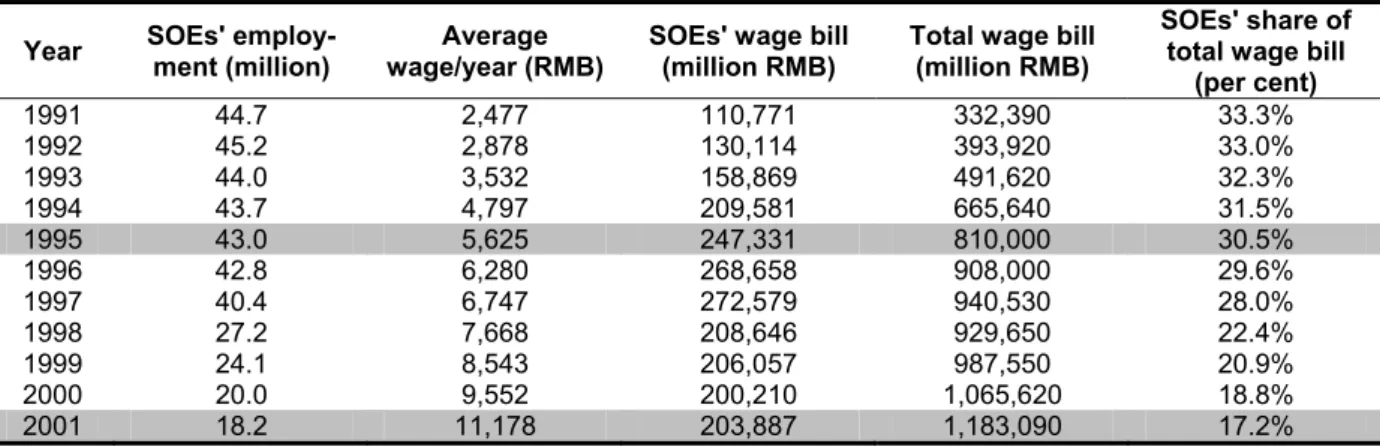
Any assessment of the impact of the wage reform of the mid-1990s has to estimate the num-ber of employees the reform can cover as well as the amount of their wage bills relative to the total Chinese wage bill.29 Table 4 shows the share of the state-owned wage bill in the
total Chinese wage bill from 1991 to 2001. Particular emphasise is put on the years 1995 and 2001.
Table 4: State-owned industrial enterprises and their share of the Chinese wage bill, 1991-2001
Year SOEs' employ-ment (million) wage/year (RMB) Average SOEs' wage bill (million RMB) Total wage bill (million RMB)
SOEs' share of total wage bill
(per cent) 1991 44.7 2,477 110,771 332,390 33.3% 1992 45.2 2,878 130,114 393,920 33.0% 1993 44.0 3,532 158,869 491,620 32.3% 1994 43.7 4,797 209,581 665,640 31.5% 1995 43.0 5,625 247,331 810,000 30.5% 1996 42.8 6,280 268,658 908,000 29.6% 1997 40.4 6,747 272,579 940,530 28.0% 1998 27.2 7,668 208,646 929,650 22.4% 1999 24.1 8,543 206,057 987,550 20.9% 2000 20.0 9,552 200,210 1,065,620 18.8% 2001 18.2 11,178 203,887 1,183,090 17.2%
Source: Own calculations, based on China Statistical Yearbook, various issues; and Thomson
Datastream.
State-owned units contributed to around 33 per cent of all Chinese wages paid in the year 1991. The relation declined along the decreasing trend of people employed in the state-owned sector in the course of the 1990s. The declining share constitutes the upper limit of the wage reform's impact: In case that the wage reform had a guiding influence on all state-owned units in the industrial sector the impact was 30.5 per cent in 1995 and 17.2 per cent in 2001. However, since the wage reform did not apply to all state-owned units, in the next step the number of the actually effected companies and their employment level has to be as-sessed.
29 Even though the 1994/1995 I reform scheme affects state-owned as well as privately owned com-panies, all companies are lumped together. This is justified by the fact that the share of purely private enterprises within the public listed companies is between 16 and 35 per cent only, that the overall impact of the 1994/1995 I wage reform is very limited in general and that the reported wage spread of private and state-owned companies is a mere 8 per cent.
1994/1995 I wage reform
Table 5 shows, there were 323 and 1160 listed companies on China’s stock exchanges in 1995 and 2001, respectively.30 In 2001, 415 out of 1,160 companies had no state shares or
no shares subscribed by the state, which account for around 36 per cent of all listed compa-nies (China Internet Information Center, 2003).31
Table 5: Potential scope of the 1994/1995 I wage reform
Year Companies Average em-ployment in sample (a) Projected em-ployment (million) Listed compa-nies' wage bill
(billion RMB)
Listed compa-nies' share of total wage bill
1995 323 --- insufficient data available ---
2001 1,160 2,700 3.1 35.1 3%
Source: Own calculations, based on data from China Security Regulatory Commission, Statis-tical Information Online Database; China StatisStatis-tical Yearbook, various issues; and Thomson ONE Banker.
Note: (a) The sample covers 1,137 companies as data is provided by Thomson ONE Banker.
By assumption, non-state controlled public listed companies welcome any increase in pro-ductivity-linked discretion in their wage setting. And, it is supposed that the state is able to enforce its rules and all state-controlled public companies adhere to the 1994/1995 I wage reform scheme.32 Thus, an estimation that covers all listed companies has to be carried out.
Employment data is available for 1,137 companies that on average employed 2700 employ-ees each. This makes around 3.1 million people in 2001 for the sample. The figure of 3.1 million employees is also taken as the proxy for the projection of 1,160 companies (table 5). Multiplying 3.1 million people with the average wage of RMB 11,178 in 2001 results to RMB 35.1 billion, which represented around 3 per cent of the total Chinese wage bill in that year. For 1995, there is employment information available only for 47 listed companies. Therefore, due to data constrains, an assessment of the reform’s effect on employment and wage bill in 1995 is impossible. However, with only 323 listed companies in 1995 the effect should be less than the 3 per cent impact in 2001.
1994/1995 II wage reform
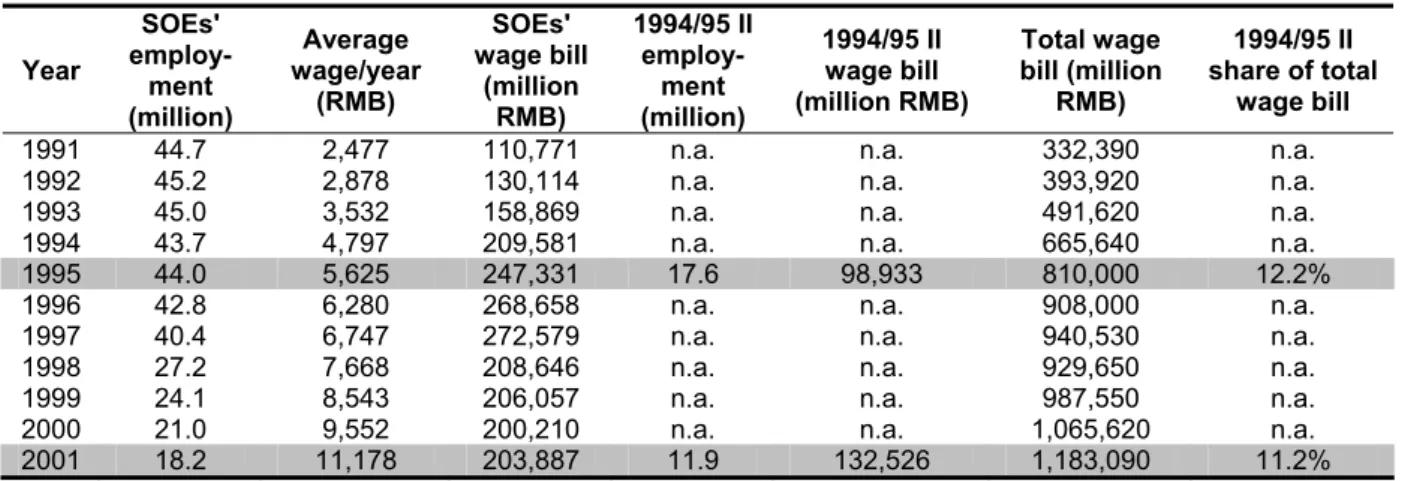
In the mid-90s around 40 per cent of the state-owned enterprises fell under the category of the recommendation-based wage regime 1994/1995 II (Yueh, 2004). In 2001 around 65 per cent of all state-owned enterprises have undergone (partly) ownership transformation without being listed on one of the stock exchanges (China Internet Information Center, 2003). Based
30 Cf. China Securities and Regulatory Commission, Statistical Information Online Database (www.csrc.gov.cn).
31 In contrast, Qu (2003) argues that only around 16 per cent of all public listed companies were non-state controlled.
32 The reported average wage level of state-owned units and non-state-owned units is rather similar at RMB 11,178 and RMB 12,140 in 2001. For simplification RMB 11,178 is underlying this calculation.