EDISON Discussion Document
Data Science Body of Knowledge (DS-BoK): Approach and Initial
version
Project acronym: EDISON
Project full title: Education for Data Intensive Science to Open New science frontiers Grant agreement no.: 675419
Date 20 March 2016
Document Author/s Yuri Demchenko, Andrea Manieri, Adam Belloum Version 0.1 (initial version based on EDISON deliverable D2.1)
Dissemination level PU
Status DRAFT
Document approved by
This work is licensed under the Creative Commons Attribution 4.0 International License. To view a copy of this license, visit http://creativecommons.org/licenses/by/4.0/
Document Version Control
Version Date Change Made (and if appropriate reason for change)
Initials of Commentator(s) or Author(s)
0.1 22/01/2016 Overview of existing AM
0.2 5/03/2016 Initial version for discussion (based on
deliverable D2.1) YD
0.3 18/03/2016 Updated version for ELG discussion YD, AM, AB
Document Change Commentator or Author Author
Initials
Name of Author Institution
YD Yuri Demchenko University of Amsterdam
AB Adam Belloum University of Amsterdam
AM Andrea Manieri Engineering
TW Tomasz Wiktorski University of Stavanger
This work is licensed under the Creative Commons Attribution 4.0 International License (CC BY). To view a copy of this license, visit http://creativecommons.org/licenses/by/4.0/
This license lets others distribute, remix, tweak, and build upon your work, even commercially, as long as they credit you for the original creation.
Executive summary
The EDISON project is designed to create a foundation for establishing a new profession of Data Scientist for European research and industry. The EDISON vision for building the Data Science profession will be enabled through the creation of a comprehensive framework for Data Science education and training that includes such components as Data Science Competence Framework (CF-DS), Data Science Body of Knowledge (DS-BoK) and Data Science Model Curriculum (MC-DS). This will provide a formal basis for Data Science professional certification, organizational and individual skills management and career transferability.
This document presents initial results of the Data Science Body of Knowledge (DS-BoK) definition that is linked to and based on the Data Science Competence Framework described in another document. The presented DS-BoK definition is based on overview and analysis of existing bodies of knowledge that are relevant to intended frameworks for Data Science and required to fulfil identified in CF-DS competences and skills.
The definition of the Data Science Body of Knowledge will provide a basis for defining the Data Science Model Curriculum and further for the Data Science professional certification.
The intended EDSION framework comprising of mentioned above components will provide a guidance and a basis for universities to define their Data Science curricula and courses selection, on one hand, and for companies to better define a set of required competences and skills for their specific industry domain in their search for Data Science talents, on the other hand.
The presented DS-BoK defines six groups of knowledge areas (KA) that are linked to the identified competence groups: DSA Data Analytics; DSDM Data Management, DSE Data Science Engineering, KGA-DSRM Research Methods; and KGA-DSBM Business Process Management. Defining the domain knowledge groups both for science and business will a subject for further development in tight cooperation with domain specialists.
Further work will be required to develop consistent DS-BoK that can be accepted by academic community and professional training community. The DS-BoK will be presented to EDISON Liaison Group for feedback and will undergo wide community discussion via EDISON community forum and by presentation at community oriented workshops and conferences.
TABLE OF CONTENTS
1 Introduction ... 5
2 EDISON Data Science framework and activities ... 6
2.1 EDISON Data Science framework components ... 6
2.2 EDSION project objectives and structure of activities ... 6
3 Overview of BoKs relevant to DS-BoK ... 8
3.1.1 ACM Computer Science Body of Knowledge (CS-BoK) ... 8
3.1.2 ICT professional Body of knowledge ICT-BoK ... 9
3.1.3 Software Engineering Body of Knowledge (SWEBOK) ... 9
3.1.4 Business Analysis Body of Knowledge(BABOK) ... 10
3.1.5 Data Management Body of Knowledge (DM-BoK) by DAMAI ... 11
3.1.6 Project Management Professional Body of knowledge (PM-BoK)... 11
3.2 Components and concepts related to CF-DS and DS-BoK definition ... 12
3.2.1 Scientific Data Lifecycle Management Model ... 12
3.2.2 Scientific methods and data driven research cycle ... 13
3.2.3 Business Process Management lifecycle ... 14
4 Data Science Body of Knowledge (DS-BoK) definition (first version) ... 16
4.1 Defining the structure and content of DS-BoK ... 16
4.1.1 Process Groups in Data Management ... 17
4.1.2 Data Analytics Knowledge Area ... 18
4.2 Data Science Body of Knowledge Areas... 18
5 Conclusion and further developments ... 21
5.1 Summary of findings ... 21
5.2 Further developments to formalize CF-DS and DS-BoK ... 21
6 Topics for discussion (targeted for ELG and experts interview) ... 22
7 References ... 23
Acronyms ... 25
Appendix A. Overview of Bodies of Knowledge relevant to Data Science ... 26
A.1. ICT Professional Body of knowledge ... 26
A.2. Data Management Professional Body of knowledge ... 27
A.3. Project Management Professional Body of knowledge ... 29
Appendix B. Defining Data Science Taxonomies ... 32
B.1. ACM Computer Science classification structure ... 32
B.2. Taxonomy of Scientific Disciplines and Knowledge Areas related to Data Science ... 34
Appendix B. EDISON definition of the Data Science Competence Framework (CF-DS) ... 37
C.1. Identified Data Science Competence Groups ... 37
1
Introduction
This document presents initial results of the Data Science Body of Knowledge (DS-BoK) definition that is linked to and based on the Data Science Competence Framework described in another document. The presented DS-BoK definition is based on overview and analysis of existing bodies of knowledge that are relevant to intended frameworks for Data Science and required to fulfil identified in CF-DS competences and skills.
The intended EDSION framework comprising of mentioned above components will provide a guidance and a basis for universities to define their Data Science curricula and courses selection, on one hand, and for companies to better define a set of required competences and skills for their specific industry domain in their search for Data Science talents, on the other hand.
The definition of the Data Science Body of Knowledge will provide a basis for defining the Data Science Model Curriculum and further for the Data Science professional certification.
The presented DS-BoK defines six groups of Knowledge Areas (KA) that are linked to the identified competence groups: DSA Data Analytics; DSDM Data Management, DSE Data Science Engineering, KGA-DSRM Research Methods; and KGA-DSBM Business Process Management. Defining the domain knowledge groups both for science and business will a subject for further development in tight cooperation with domain specialists.
The DS-BoK definition is based on the proposed CF-DS that defines the five groups of competences for Data Science that include the commonly recognised groups Data Analytics, Data Science Engineering, Domain Knowledge (as defined in the NIST definition of Data Science) and extends them with the two new groups Data Management and Scientific Methods (or Business Process management for business related occupations) that are recognised to be important for a successful work of Data Scientist but are not explicitly mentioned in existing frameworks.
Further work will be required to develop consistent DS-BoK that can be accepted by academic community and professional training community. The proposed initial version will be used to initiate community discussion and solicit contribution from the subject matter expects and practitioners. The DS-BoK will be presented to EDISON Liaison Group for feedback and will undergo wide community discussion via EDISON community forum and by presentation at community oriented workshops and conferences.
The presented document has the following structure. Section 2 provides an overview of the EDISON Data Science framework and related project activities that coordinate the framework components development and pilot implementation. Section 3 provides overview of existing BoKs related to Data Science knowledge areas. Section 3 also includes other important components for the DS-BoK definition such as data lifecycle
management models, scientific methods, and business process management lifecycle models. Section 4 described the proposed DS-BoK structure and provides the initial definition of the DS-BoK. Section 5 provides summary of the achieved results and section 5 suggests questions for discussion to collects community feedback and experts opinion.
Appendices to this document contain important supplementary information: detailed information about reviewed bodies of knowledge related to identified Data Science knowledge areas; taxonomy of the Data Science knowledge areas and scientific disciplines built as a subset of the ACM CCS (2012) classification; and a short summary of the proposed CF-DS that includes identified competence groups and skills, required technical knowledge of relevant Big Data platforms, analytics and data management tools, and programming languages.
2
EDISON Data Science framework and activities
2.1
EDISON Data Science framework components
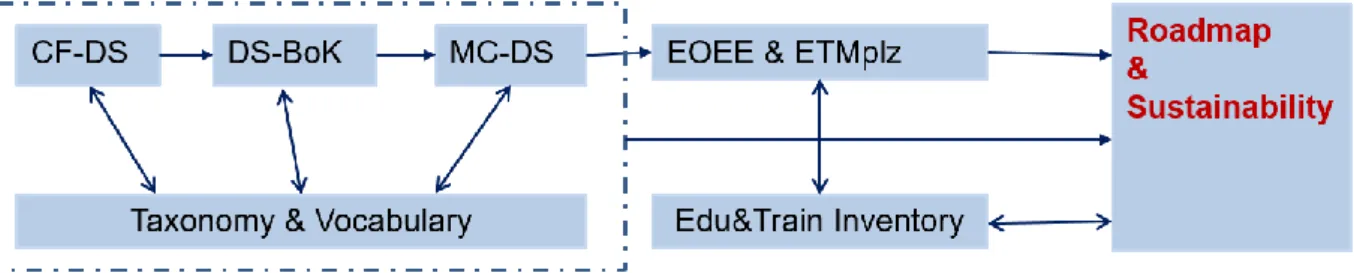
Figure 1 below illustrates the main components of the EDISON framework that provides conceptual basis for the development of the Data Science profession and includes components that to be implemented by the main stakeholder of the supply and demand side: universities, professional training organisations, standardisation bodies, accreditation and certification bodies, companies and organisations and their Human Resources department to successfully manage competences and career development.
Figure 1. EDISON Data Science framework components
2.2
EDSION project objectives and structure of activities
The EDISON project objectives are defined as follows:
1 Promote the creation of Data Scientists curricula by an increasing number of universities and professional training organisations.
2 Provide conditions and environment for re-skilling and certifying Data Scientists expertise to graduates, practitioners and researchers throughout their careers.
3 Develop a sustainable business model and a roadmap to achieve a high degree of competitiveness for European education and training on Data Science technologies, provide a basis for formal recognition of the Data Scientist as a new profession, including supporting the future establishment of formal
certification for practicing “self-made” Data Scientists.
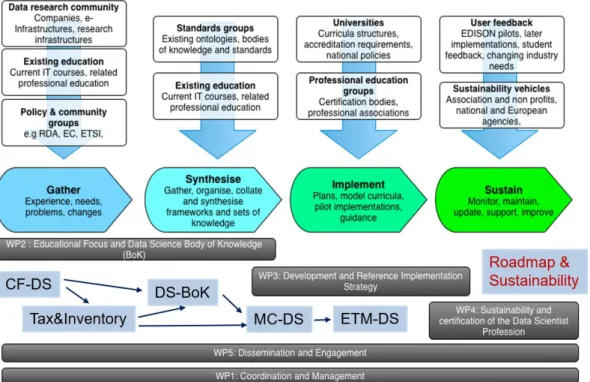
The project will achieve these objectives through an integrated framework of activities based around the creation of some key documents: the Data Science Competence Framework (CF-DS) as a basis for definition of the Body of Knowledge and a Model Curriculum for Data Science education and training. The following diagram Figure 2 provides an overview of the project activities linked to the framework components. The individual work packages will develop and facilitate implementation of the mentioned above elements, including project wide execution of the Dissemination and Engagement Plan (DEP) by WP5 that will ensure engagement of multiple stakeholders into the project activity.
Figure 2. Project workflow, related activities and work packages
All work packages will work in tight cooperation to deliver products and components that will smooth execution of the complex of tasks from the definition of the Data Science domain and Data Scientist as a new profession to providing the strong basis for implementing and delivering necessary education and training by universities and professional training organisation, and ensuring sustainability of this process after the project ends.
3
Overview of BoKs relevant to DS-BoK
The following BoK’s have been reviewed to provide a basis for initial definition of the DS-BoK: ACM Computer Science Body of Knowledge (ACM CS-BoK) [10, 11]
ICT professional Body of Knowledge (ICT-BoK) [35] Business Analytics Body of Knowledge (BABOK) [36]
Software Engineering Body of Knowledge (SWEBOK) [37]
Data Management Body of Knowledge (DM-BoK) by Data Management Association International (DAMAI) [38]
Project Management Professional Body of Knowledge (PM-BoK) [39]
In the following sections we give a short description of each body of knowledge. The presented analysis provides a motivation that the intended/proposed DS-BoK should incorporate two dimensions in constructing DS-BoK: using Knowledge Areas (KA) and organisational workflow often linked to Project Phases (PP) or industry business process management (BPM). The DS-BoK should also reflect the data-lifecycle management1. Each process is defined as one or more activity, related knowledge and tools needed to execute it, inputs from other processes and expected output.
The presented analysis allowed to identify what existing BoK’s can be used in the DS-BoK definition or mapped to ensure knowledge transferability and education programmes combination. From this initial analysis the relevant best practices have been identified to structure the DS-BoK and provide basis for defining the EDISON certification scheme and sustainability model.
3.1.1
ACM Computer Science Body of Knowledge (CS-BoK)
In the ACM-CS2013-final report [8, 9] the Body of Knowledge is defined as a specification of the content to be covered in a curriculum as an implementation. The ACM-BoK describes and structures the knowledge areas needed to define a curriculum in Computer Science, it includes 18 Knowledge Areas (where 6 KAs are newly introduced in ACM CS2013):
AL - Algorithms and Complexity AR - Architecture and Organization CN - Computational Science DS - Discrete Structures GV - Graphics and Visualization HCI - Human-Computer Interaction
IAS - Information Assurance and Security (new) IM - Information Management
IS - Intelligent Systems
NC - Networking and Communications (new) OS - Operating Systems
PBD - Platform-based Development (new) PD - Parallel and Distributed Computing (new) PL - Programming Languages
SDF - Software Development Fundamentals (new) SE - Software Engineering
SF - Systems Fundamentals (new)
SP - Social Issues and Professional Practice
Knowledge areas should not directly match a particular course in a curriculum (this practice is strongly discouraged in the ACM report), often courses address topics from multiple knowledge areas. The ACM-CS2013-final report distinguish between two type of topics: Core topics subdivided into “Tier-1” (that are mandatory for each curriculum) and “Tier-2” (that are expected to be covered at 90-100% with minimum advised 80%), and elective topics. The ACM classification suggests that a curriculum should include all topics in Tier-1 and all or almost the topics in Tier 2. Tier 1 and Tier 2 topics are defined differently for different
programmes and specialisations. To be complete a curriculum should cover in addition to the topics of Core
1 Such assumption has been also confirmed by user experience and expert interviews conducted in the project task T4.4.
Tier 1 and 2 significant amount of elective material. The reason for such a hierarchical approach to the structure of the Body of Knowledge is a useful way to group related information, not as a structure for organizing material into courses.
The ACM for computing Education in Community Colleges [10, 11] defines a BoK for IT outcome-based learning/education which identifies 6 technical competency areas and 5 work-place skills. While the technical areas are specific to IT competences and specify a set of demonstrable abilities of graduates to perform some specific functions, the so called work-place skills describe the ability the student/trainee to:
(1) function effectively as a member of a diverse team, (2) read and interpret technical information,
(3) engage in continuous learning,
(4) professional, legal, and ethical behavior, and
(5) demonstrate business awareness and workplace effectiveness
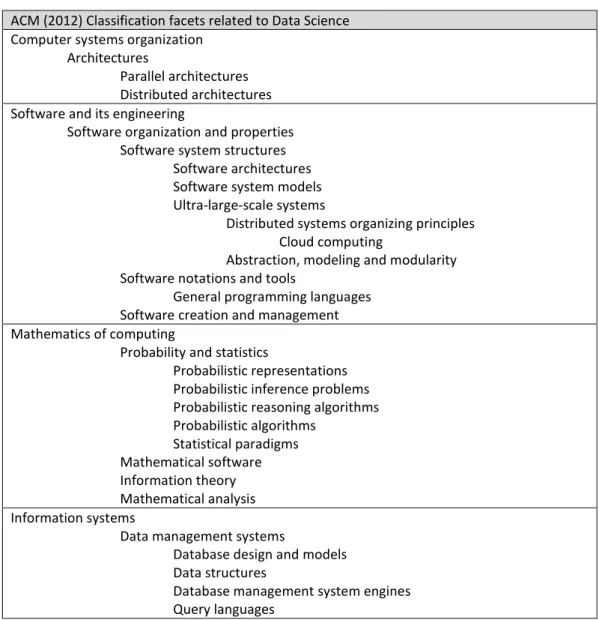
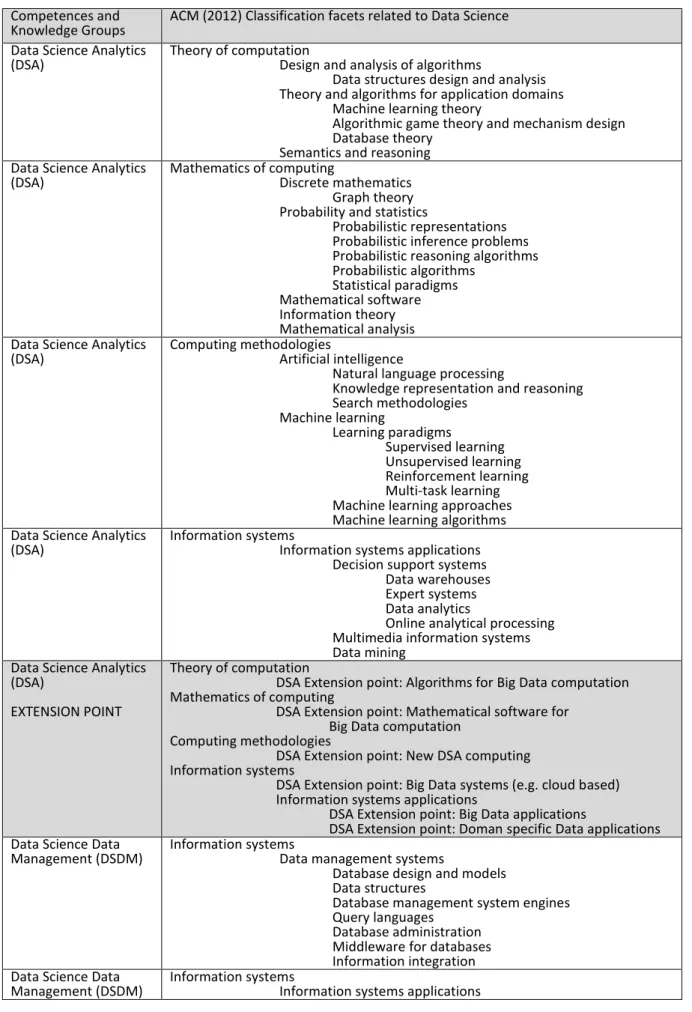
The CS-BoK uses ACM Computing Classification System (CCS) which is standard and widely accepted what makes it a good basis for using it as a basis for building DS-BoK and providing necessary extensions/KAs related to identified Data Science competence groups (see section 3.4) which majority require background knowledge components from the general CS-BoK.
3.1.2
ICT professional Body of knowledge ICT-BoK
The ICT-BoK is an effort promoted by the European Commission, under the eSkills initiative
(http://eskills4jobs.ec.europa.eu/) to defines and organises the core knowledge of the ICT discipline. In order to foster the growth of digital jobs in Europe and to improve ICT Professionalism a study has been conducted to provide the basis of a “Framework for ICT professionalism” (http://ictprof.eu/). This framework consists of four building blocks which are also found in other professions:
i) body of knowledge (BoK); ii) competence framework;
iii) education and training resources; and iv) code of professional ethics.
A competence framework already exists and consists in the e-Competence Framework (now in its version 3.0 and promoted by CEN). However, an ICT Body of Knowledge that provides the basis for a common
understanding of the foundational knowledge an ICT professional should possess, is not yet available. The ICT-BoK is suggested to be structured in 5 Process Groups, defining the various phases of the project development or organisational workflow: Initiating, Planning, Executing, Monitoring and Controlling, Closing. The ICT-BoK aims at informing about the level of knowledge required to enter the ICT profession and acts as the first point of reference for anyone interested in working in ICT. Even if the ICT-BoK does not refer to Data Science competences explicitly the identified ICT processes can be applied to data management processes both in industry and academia in the context of well-defined and structured projects.
3.1.3
Software Engineering Body of Knowledge (SWEBOK)
The Software Engineering Body of Knowledge (SWEBOK) is an international standard ISO/IEC TR 19759:20152 specifying a guide to the generally accepted Software Engineering Body of Knowledge. The Guide to the Software Engineering Body of Knowledge (SWEBOK Guide) has been created through cooperation among several professional bodies and members of industry and is published by the IEEE Computer Society. The standard can be accessed freely from the IEEE Computer Society (http://www.computer.org/web/swebok/v3).3
2 ISO/IEC TR 19759:2015 Software Engineering - Guide to the software engineering body of knowledge (SWEBOK)
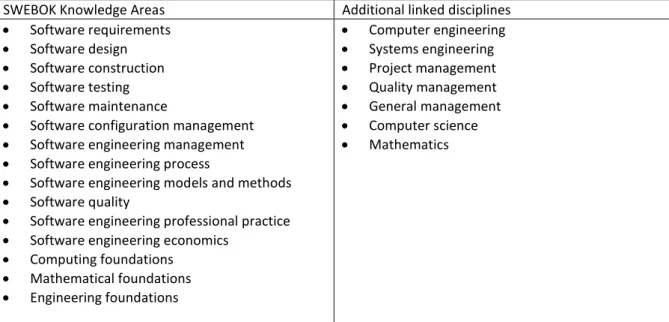
The published version of SWEBOK V3 has the following 15 knowledge areas (KAs) within the field of software engineering: and 7 additional disciplines are recognized as linked and providing important background knowledge that are beneficial for Software engineering:
Table 4.1. SWEBOK Knowledge Areas and related disciplines
SWEBOK Knowledge Areas Additional linked disciplines
Software requirements Software design Software construction Software testing Software maintenance
Software configuration management Software engineering management Software engineering process
Software engineering models and methods Software quality
Software engineering professional practice Software engineering economics
Computing foundations Mathematical foundations Engineering foundations Computer engineering Systems engineering Project management Quality management General management Computer science Mathematics
3.1.4
Business Analysis Body of Knowledge
(BABOK)
BABOKGuide was first published by International Institute of Business Analysis (IIBA) as a draft document version 1.4, in October 2005, for consultation with the wider business analysis and project management community, to document and standardize generally accepted business analysis practices. Current version 3 was released in April 2015.
The Business Analysis Body of Knowledge provides interesting example of business oriented body of knowledge that covers important for Data Science knowledge domain. BABOK is published in a Guide to
the Business Analysis Body of Knowledge(BABOKGuide). It is the globally recognized standard for the
practice of business analysis. BABOKGuide reflects the collective knowledge of the business analysis community and presents the most widely accepted business analysis practices.
BABOKGuide recognizes and reflects the fact that business analysis is continually evolving and is practiced
in a wide variety of forms and contexts. It defines the skills, knowledge, and competencies required to perform business analysis effectively. It does not describe the processes that people will follow to do business analysis.
BABOKGuide includes chapters on:
Business Analysis Key Concepts: define important terms that are the foundation of the practice of business analysis.
Knowledge Areas: represents the core content of BABOKGuide and contain the business analysis tasks that are used to perform business analysis.
Underlying Competencies: describes the behaviours, characteristics, knowledge, and personal qualities that help business analysts be effective in their job.
Techniques: describes 50 of the most common techniques used by business analysts.
Perspectives (new to version 3): describes 5 different views of business analysis (Agile, Business Intelligence, Information Technology, Business Architecture, and Business Process Management).
BABOKGuide organizes business analysis tasks within 6 knowledge areas. The knowledge areas logically organize tasks but do not specify a sequence, process, or methodology. Each task describes the typical
knowledge, skills, deliverables, and techniques that the business analyst requires to be able to perform those tasks competently.
The following knowledge areas of BABOKGuide are defined:
Business Analysis Planning and Monitoring: describes the tasks used to organize and coordinate business analysis efforts.
Elicitation and Collaboration: describes the tasks used to prepare for and conduct elicitation activities and confirm the results.
Requirements Life Cycle Management: describes the tasks used to manage and maintain requirements and design information from inception to retirement.
Strategy Analysis: describes the tasks used to identify the business need, address that need, and align the change strategy within the enterprise.
Requirements Analysis and Design Definition: describes the tasks used to organize requirements, specify and model requirements and designs, validate and verify information, identify solution options, and estimate the potential value that could be realized.
Solution Evaluation: describes the tasks used to assess the performance of and value delivered by a solution and to recommend improvements on increasing value.
BABOK knowledge areas organisation by tasks allows easy linking to Business Analysis competences what can be implemented in the intended DS-BoK.
3.1.5
Data Management Body of Knowledge (DM-BoK) by DAMAI
The Data Management Association International (DAMAI) has been founded in 1988 in US with the aim: (i) to provide a non-profit, vendor-independent association where data professionals can go for help and assistance; (ii) to provide the best practice resources such as the DM-BoK and DM Dictionary of Terms; (iii) to create a trusted environment for DM professionals to collaborate and communicate.
The DM-BoK version2 “Guide for performing data management” is structured in 11 knowledge areas covering core areas in data management:
(1) Data Governance, (2) Data Architecture,
(3) Data Modelling and Design, (4) Data Storage and Operations, (5) Data Security,
(6) Data Integration and Interoperability, (7) Documents and Content,
(8) Reference and Master Data,
(9) Data Warehousing and Business Intelligence, (10) Metadata, and
(11) Data Quality.
Each KA has section topics that logically group activities and is described by a context diagram. There is also an additional Data Management section containing topics that describe the knowledge requirements for data management professionals. Each context diagram includes: Definition, Goals, Process, Inputs, Supplier roles, Responsible, Stakeholder, Tools, Deliverables, and Metrics (See Appendix B).
When using DM-BoK for defining Data Management knowledge area for DS-BoK (DS-DM) it needs to be extended with the recent data modelling technologies and Big Data management platforms that address generic Big Data properties such as Volume, Veracity, Velocity. New data security and privacy protections need to be addressed as well (see CSA Top 10 Big Security challenges [40]).
3.1.6
Project Management Professional Body of knowledge (PM-BoK)
The PM-BoK is maintained by the Project Management Institute (PMI) the provides research and education services to Project Managers through publications, networking-opportunities in local chapters, hosting
conferences and training seminars, and providing accreditation in project management. PMI, exploit volunteers and sponsorships to expand project management's body of knowledge through research projects, symposiums and surveys, and shares it through publications, research conferences and working sessions. The “A Guide to the Project Management Body of Knowledge" (PM-BoK), has been recognized by the American National Standards Institute (ANSI) and in 2012 ISO adapted the project management processes from the PMBOK Guide 4th edition (see Appendix B).
The PMI-BoK defines five Process Groups related to project management: Initiating - Processes to define and authorize a project or project phase
Planning - Processes to define the project scope, objectives and steps to achieve the required results. Executing - Processes to complete the work documented within the Project Management Plan.
Monitoring and Controlling - Processes to track and review the project progress and performance. This group contains the Change Management.
Closing - Processes to formalize the project or phase closure. The nine Knowledge Areas are linked to the Process Groups:
Project Integration Management - Processes to integrate various parts of the Project Management. Project Scope Management - Processes to ensure that all of the work required is completed for a successful
Project and manages additional "scope creep".
Project Time Management - Processes to ensure the project is completed in a timely manner.
Project Cost Management - Processes to manage the planning, estimation, budgeting and management of costs for the duration of the project.
Project Quality Management - Processes to plan, manage and control the quality and to provide assurance the quality standards are met.
Project Human Resource Management - Processes to plan, acquire, develop and manage the project team. Project Communications Management - Processes to plan, manage, control, distribute and final disposal of
project documentation and communication.
Project Risk Management - Processes to identify, analyse and management of project risks.
Project Procurement Management - Processes to manage the purchase or acquisition of products and service, or result to complete the project.
Project Stakeholder Management – Process to identify stakeholders, determine their requirements, expectations and influence
Each Process Group contains processes within some or all of the Knowledge Areas. Each of the 42 processes has Inputs, Tools and Techniques, and Outputs. (It is not the scope of this analysis enter into the details of each process).
3.2
Components and concepts related to CF-DS and DS-BoK definition
This section provides important definitions that are needed for consistent CF-DS definition in the context of organisational and business processes, e-Infrastructure and scientific research. First of all, this includes definition of typical organisational processes and scientific workflow or research data lifecycle.
3.2.1
Scientific Data Lifecycle Management Model
Data lifecycle is an importance component of data centric applications, which Data Science and Big Data applications belong to. Data lifecycle analysis and definition is addressed in many domain specific projects and studies. Extensive compilation of the data life cycle models and concepts is provided in the CEOS.WGISS.DSIG document [14].
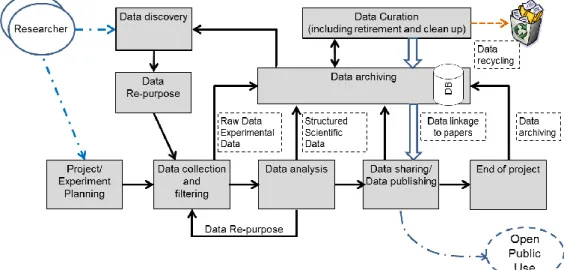
For the purpose of defining the major groups of competences required for Data Scientist working with scientific applications and data analysis we will use the Scientific Data Lifecycle Management (SDLM) model [15] shown in Figure 5 (a) defined as a result of analysis of the existing practices in different scientific communities. Figure 5 (b) illustrates the more general Big Data Lifecycle Management model (BDLM) involving the main
components of the Big Data Reference Architecture defined in NIST BDIF [1, 16, 17]. The proposed models are sufficiently generic and compliant with the data lifecycle study results presented in [14].
The generic scientific data lifecycle includes a number of consequent stages: research project or experiment planning; data collection; data processing; publishing research results; discussion, feedback; archiving (or discarding). SDLM reflects complex and iterative process of the scientific research that is also present in Data Science analytics applications.
(a) Scientific data lifecycle management - e-Science focused
(b) Big Data Lifecycle Management model (compatible with the NIST NBDIF definition)
Figure 5. Data Lifecycle Management in (a) e-Science and (b) generic Big Data Lifecycle Management model. Both SDLM and BDLM require data storage and preservation at all stages what should allow data re-use/re-purposing and secondary research on the processed data and published results. However, this is possible only if the full data identification, cross-reference and linkage are implemented in Scientific Data Infrastructure (SDI). Data integrity, access control and accountability must be supported during the whole data during lifecycle. Data curation is an important component of the discussed data lifecycle models and must also be done in a secure and trustworthy way. The research data management and handling issues are extensively addressed in the work of the Research Data Alliance4.
3.2.2
Scientific methods and data driven research cycle
For Data Scientist that is dealing with handling data obtained in the research investigation understanding of the scientific methods and the data driven research cycle is essential part knowledge that motivate necessary
competences and skills for the Data Scientists for successfully perform their tasks and support or lead data driven research.
The scientific method is a body of techniques for investigating phenomena, acquiring new knowledge, or correcting and integrating previous knowledge [18, 19, 20]. Traditional steps of the scientific research were developed over time since the time of ancient Greek philosophers through modern theoretical and experimental research where experimental data or simulation results were used to validate the hypothesis formulated based on initial observation or domain knowledge study. The general research methods include: observational methods, opinion based methods, experimental and simulation methods.
The increased power of computational facilities and advent of Big Data technologies created a new paradigm of the data driven research that enforced ability of researchers to make observation of the research phenomena based on bigger data sets and applying data analytics methods to discover hidden relations and processes not available to deterministic human thinking. The principles of the data driven research were formulated in the seminal work “The Fourth Paradigm: Data-Intensive Scientific Discovery” edited by Tony Hey [21].
The research process is iterative by its nature and allows scientific model improvement by using continuous research cycle that typically includes the following basic stages:
Define research questions
Design experiment representing initial model of research object or phenomena Collect Data
Analyse Data Identify Patterns Hypothesise Explanation Test Hypothesis
Refine model and start new experiment cycle
The traditional research process may be concluded with the scientific publication and archiving of collected data. Data driven and data powered/driven research paradigm allows research data re-use and combining them with other linked data sets to reveal new relations between initially not linked processes and phenomena. As an example, biodiversity research when studying specific species population can include additional data from weather and climate observation, solar activity, other species migration and technogenic factor.
The proposed CF-DS introduces research methods as an important component of the Data Science
competences and knowledge and uses data lifecycle as an approach to define the data management related competences group. This is discussed in section 3.4 below.
3.2.3
Business Process Management lifecycle
New generation Agile Data Driven Enterprises (ADDE) [22] use Data Science methods to continuously monitor and improve their business processes and services. The data driven business management model allows combining different data sources to improve predictive business analytics what allows making more effective solutions, faster adaptation of services, and more specifically target different customer groups as well as do optimal resources allocations depending on market demand and customer incentives.
Similarly, to the research domain the data driven methods and technologies change how the modern business operates attempting to benefit from the new insight that big data can give into business improvement including internal processes organisation and relation with customers and market processes. Understanding Business Process Management lifecycle [23, 24] is important to identify necessary competences and knowledge for business oriented Data Science profiles.
The following are typical stages of the Business Process Management lifecycle: Define the business target: both services and customers
Design the business process Model/Plan
Monitor and Control Optimise and Re-design
The need for the Business Process management competences and knowledge for business oriented Data Science profiles is reflected in the proposed CF-DS definition as described in section 3.4.
4
Data Science Body of Knowledge (DS-BoK) definition (first version)
To define consistently the DS-BoK as a new emerging technology and knowledge domain, we need tounderstand the commonly accepted approaches to defining education and training programmes and put them in the context of the European education system and policies. Two approaches to education and training are followed in practice, the traditional approach which is based on defining the time students have to spend learning a given topics or concept like the European Credit Transfer and Accumulation System (ECTS) [33] or Carnegie unit credit hour [34]. The former is also known as competence-based education or outcomes-based learning (OBE), it is focusing on the outcome assessing whether students have mastered the given
competences, namely the skills, abilities, and knowledge. There is no specified style of teaching or assessment in OBE; instead classes, opportunities, and assessments should all help students achieve the specified
outcomes. In 2012, the EC has called for a rethinking of education towards OBE approach. The motivation for such a rethinking is to ensure that education is more relevant to the needs of students and the labour market, assessment methods need to be adapted and modernised. Not like the traditional BoK which is defined in term of Knowledge Areas (KA), in OBE the BoK is defined in term of the core learning outcomes which are grouped into technical competence areas and workplace skills.
The term “Body-of-Knowledge” (BoK) is commonly referred as the set (from the Latin corpus) of knowledge (intended as concepts, terms and activities) that constitutes the common ground of a discipline or science. The constitution of this common ground is essential to create a professional community around this knowledge since its creation is done by the community itself. In most cases the BoK is created and maintained by a
designed profession organisation that ensures the BoK that is up to date and reflect the constituent community needs and vision. With the BoK the community usually creates a vocabulary or lexicon where all the terms are defined and clarified in their meaning within this community.
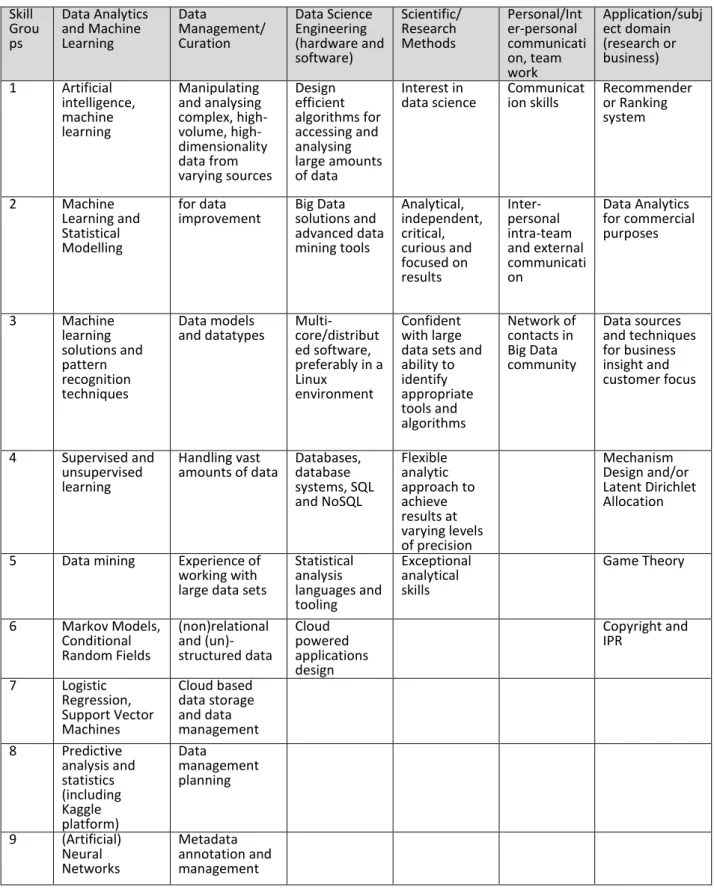
The DS-BoK is defined based on the proposed competences model CF-DS that identified five competence areas that should be mapped into corresponding knowledge areas and groups (refer to the recent CF-DS version online5., it is also included into Appendix C for details and visual presentation in Figure C.1 (a) and (b)). The DS-BoK definition will require combination and synthesis of different domain knowledge areas with necessary selection or adaptation of educational and instructional models and practices.
4.1
Defining the structure and content of DS-BoK
The intended DS-BoK can be used as a base for defining Data Science related curricula, courses, instructional methods, educational/course materials, and necessary practices for university post and undergraduate programs and professional training courses. The DS-BoK is also intended to be used for defining certification programs and certification exam questions. While CF-DS (comprising of competences, skills and knowledge) can be used for defining job profiles (and correspondingly content of job advertisements) the DS-BoK can provide a basis for interview questions and evaluation of the candidate’s knowledge and related skills.
Following the CF-DS competence group definition the DS-BoK should contain the following Knowledge Area groups (KAG):
KAG1-DSA: Data Analytics group including Machine Learning, statistical methods, and Business Analytics KAG2-DSE: Data Science Engineering group including Software and infrastructure engineering
KAG3-DSDM: Data Management group including data curation, preservation and data infrastructure KAG4-DSRM: Scientific or Research Methods group
KAG5-DSBP: Business process management group
KAG6-DSDK: Data Science Domain Knowledge group includes domain specific knowledge
The subject domain related knowledge group (scientific or business) KAG6-DSDK is recognized as essential for practical work of Data Scientist what in fact means not professional work in a specific subject domain but understanding the domain related concepts, models and organisation and corresponding data analysis methods and models. These knowledge areas will be a subject for future development in tight cooperation with subject domain specialists.
It is also anticipated that due to complexity of Data Science domain, the DS-BoK will require wide spectrum of background knowledge, first of all in mathematics, statistics, logics and reasoning as well as general computing and cloud computing in particular. Similar to the ACM CS2013 curricula approach, background knowledge can be required as an entry condition or must be studied as elective courses.
The ACM CS-BoK can be used as a basis for DS-BoK definition, in particular the following KAs from CS-BoK can be used:
AL - Algorithms and Complexity AR - Architecture and Organization CN - Computational Science GV - Graphics and Visualization IM - Information Management
PBD - Platform-based Development (new) SE - Software Engineering
It is important to understand that ACM CS-BoK is originally defined for native Computer Science curricula but for the DS-BoK mentioned above KAs need to be re-structured and may be combined with other Data Science oriented courses.
The DS-BoK will re-use where possible existing BoK’s taking necessary KA definitions combining them into defined above BoK knowledge area groups. The following BoK’s can be used or mapped to the selected DS-BoK knowledge groups: Software Engineering SWEBOK, Business Analysis BABOK, and Project Management PM-BoK, and others
Building on the assumption that the Data Scientist will need to work across different stages of organizational workflow and understand the whole data lifecycle management model, it is reasonable to suggest at this stage that the DS-BoK incorporate the Process Group concept proposed in PM-BoK and business process support approach proposed in BABOK.
4.1.1
Process Groups in Data Management
The following Process Groups can be identified based on discussed in section 3.2.1 existing data lifecycle models that reflect the major functions or activities in Data Management:
1. Data Identification and Creation: how to obtain digital information from in-silico experiments and instrumentations, how to collect and store in digital form, any techniques, models, standard and tools needed to perform these activities, depending from the specific discipline.
2. Data Access and Retrieval: tools, techniques and standards used to access any type of data from any type of media, retrieve it in compliance to IPRs and established legislations.
3. Data Curation and Preservation: includes activities related to data cleansing, normalisation, validation and storage.
4. Data Fusion (or Data integration): the integration of multiple data and knowledge representing the same real-world object into a consistent, accurate, and useful representation.
5. Data Organisation and Management: how to organise the storage of data for various purposes required by each discipline, tools, techniques, standards and best practices (including IPRs management and compliance to laws and regulations, and metadata definition and completion) to set up ICT solutions in order to achieve the required Services Level Agreement for data conservation.
6. Data Storage and Stewardship: how to enhance the use of data by using metadata and other techniques to establish a long term access and extended use to that data also by scientists and researchers from other disciplines and after very long time from the data production time.
7. Data Processing: tools, techniques and standards to analyse different and heterogeneous data coming from various sources, different scientific domains and of a variety of size (up to Exabytes) – it includes notion of programming paradigms.
8. Data Visualisation and Communication: techniques, models and best practices to merge and join various data sets, techniques and tools for data analytics and visualisation, depending on the data significant and the discipline.
4.1.2
Data Analytics Knowledge Area
Data Analytics, although formally may be treated as a part of data lifecycle, form the purpose of DS-BoK needs is defined as a separate process group and knowledge area group. Data analysis includes the modelling and inspecting of data with the goal of discovering useful information, providing recommendations, and supporting decision-making. The following are commonly defined Data Analytics Knowledge Areas:
Machine learning and related methods for information search, image recognition, decision support, classification;
Predictive analytics focuses on application of statistical models for predictive forecasting or classification. Data mining is a particular data analysis technique that focuses on modelling and knowledge discovery for
predictive rather than purely descriptive purposes;
Business intelligence covers data analysis that relies heavily on aggregation and different data sources and focusing on business information;
Text analytics applies statistical, linguistic, and structural techniques to extract and classify information from textual sources, a species of unstructured data;
Statistical methods, including
o Descriptive statistics, exploratory data analysis (EDA) focused on discovering new features in the data, and confirmatory data analysis (CDA) dealing with validating formulated hypotheses;
4.2
Data Science Body of Knowledge Areas
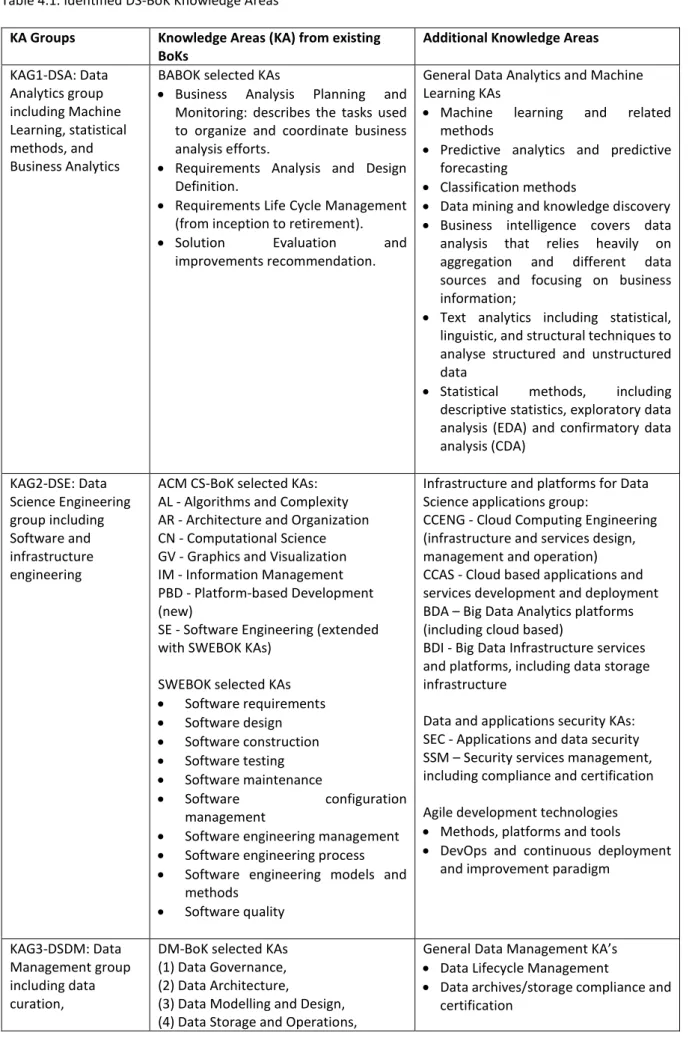
Presented analysis allows us to propose an initial version of the Data Science Body of Knowledge implementing the proposed DS-BoK structure as explained in previous section. Table 4.1 provides consolidated view of the identified Knowledge Areas in the Data Science Body of Knowledge. The table contains detailed definition of the KAG1-DSA, KAG2-DSE, KAG3-DSDM groups that are well supported by existing BoK’s and academic materials. General suggestions are provided for KAG4-DSRM, KAG5-DSBP groups that corresponds to newly identified competences and knowledge areas and require additional study of existing practices and
contribution from experts in corresponding scientific or business domains.
The KAG2-DSE group includes selected KAs from ACM CS-BoK and SWEBOK and extends them with new technologies and engineering technologies and paradigm such as cloud based, agile technologies and DevOps that are promoted as continuous deployment and improvement paradigm and allow organisation implement agile business and operational models.
The KAG3-DSDM group includes most of KAs from DM-BoK however extended it with KAs related to RDA recommendations, community data management models (Open Access, Open Data, etc) and general Data Lifecycle Management that is used as a central concept in many data management related education and training courses.
The presented DS-BoK high level content is not exhaustive at this stage and will undergo further development based on feedback from the project Task 3.1 that will use the presented DS-BoK for developing Data Science Model Curriculum (MC-DS). The project will present the current version of DS-BoK to ELG to obtain feedback and expert opinion. Numerous experts will be invited to review and contribute to the specific KAs definition.
Table 4.1. Identified DS-BoK Knowledge Areas
KA Groups Knowledge Areas (KA) from existing BoKs
Additional Knowledge Areas KAG1-DSA: Data Analytics group including Machine Learning, statistical methods, and Business Analytics
BABOK selected KAs
Business Analysis Planning and Monitoring: describes the tasks used to organize and coordinate business analysis efforts.
Requirements Analysis and Design Definition.
Requirements Life Cycle Management (from inception to retirement). Solution Evaluation and
improvements recommendation.
General Data Analytics and Machine Learning KAs
Machine learning and related methods
Predictive analytics and predictive forecasting
Classification methods
Data mining and knowledge discovery Business intelligence covers data
analysis that relies heavily on aggregation and different data sources and focusing on business information;
Text analytics including statistical, linguistic, and structural techniques to analyse structured and unstructured data
Statistical methods, including descriptive statistics, exploratory data analysis (EDA) and confirmatory data analysis (CDA) KAG2-DSE: Data Science Engineering group including Software and infrastructure engineering
ACM CS-BoK selected KAs: AL - Algorithms and Complexity AR - Architecture and Organization CN - Computational Science GV - Graphics and Visualization IM - Information Management PBD - Platform-based Development (new)
SE - Software Engineering (extended with SWEBOK KAs)
SWEBOK selected KAs Software requirements Software design Software construction Software testing Software maintenance Software configuration management
Software engineering management Software engineering process Software engineering models and
methods Software quality
Infrastructure and platforms for Data Science applications group:
CCENG - Cloud Computing Engineering (infrastructure and services design, management and operation) CCAS - Cloud based applications and services development and deployment BDA – Big Data Analytics platforms (including cloud based)
BDI - Big Data Infrastructure services and platforms, including data storage infrastructure
Data and applications security KAs: SEC - Applications and data security SSM – Security services management, including compliance and certification Agile development technologies Methods, platforms and tools
DevOps and continuous deployment and improvement paradigm
KAG3-DSDM: Data Management group including data curation,
DM-BoK selected KAs (1) Data Governance, (2) Data Architecture,
(3) Data Modelling and Design, (4) Data Storage and Operations,
General Data Management KA’s Data Lifecycle Management
Data archives/storage compliance and certification
preservation and data infrastructure
(5) Data Security,
(6) Data Integration and Interoperability, (7) Documents and Content,
(8) Reference and Master Data, (9) Data Warehousing and Business Intelligence,
(10) Metadata, and (11) Data Quality.
New KAs to support RDA
recommendations and community data management models (Open Access, Open Data, etc)6
Data type registries, PIDs
Data infrastructure and Data Factories TBD – To follow RDA and ERA
community developments KAG4-DSRM:
Scientific or Research Methods group
There are no formally defined BoK for research methods
Suggested KAs to develop DSRM related competences:
Research methodology, research cycle (e.g. 4 step model Hypothesis – Research Methods – Artefact – Validation)
Modelling and experiment planning Data selection and quality evaluation Use cases analysis: research
infrastructures and projects TBD further extensions KAG5-DSBP: Business
process management group
PMI-BoK selected KAs
Project Integration Management Project Scope Management Project Quality
Project Risk Management
General Business processes and operations KAs
Business processes and operations Agile Data Driven methodologies,
processes and enterprises
Use cases analysis: business and industry
TBD further extensions
6 Example courses provided by RDA community and shared between European Research Infrastructures https://europe.rd-alliance.org/training-programme
5
Conclusion and further developments
The presented work on defining the DS-BoK and other foundational components of the whole EDISON framework have been done with wide consultation and engagement of different stakeholders, primarily from research community and Research Infrastructures, but also involving industry via standardisation bodies, professional communities and directly via the project network.
5.1
Summary of findings
The provided document contains initials results of the Data Science Body of Knowledge definition that are based on the two other components Data Science Competence framework and Data Science knowledge area classification. In particular the DS-BoK uses the CF-DS competence and skills groups that include:
Data Analytics (also referred to as Business Analytics or Machine Learning) Engineering or Programming
Subject/Scientific Domain Knowledge Data Management, Curation, Preservation
Scientific or Research Methods (for research profiles) and Business Process management (for business related profiles)
Consequently the CF-DS competence groups are presented in the DS-BoK Knowledge Area groups (KAG): KAG1-DSA: Data Analytics group including Machine Learning, statistical methods, and Business Analytics KAG2-DSE: Data Science Engineering group including Software and infrastructure engineering
KAG3-DSDM: Data Management group including data curation, preservation and data infrastructure KAG4-DSRM: Scientific or Research Methods group
KAG5-DSBP: Business process management group
KAG6-DSDK: Data Science Domain Knowledge group includes domain specific knowledge
5.2
Further developments to formalize CF-DS and DS-BoK
It is anticipated that the presented here the first versions of the Data Science Body of Knowledge will require further development and validation by experts and communities of practice that will include the following specific tasks and activities:
Define specific knowledge areas related to the identified knowledge area groups by involving experts in the related knowledge areas, possibly also engaging with the specific professional communities such as IEEE, ACM, DAMA, IIBA, etc.
Finalise the taxonomy of Data Science related knowledge areas and scientific disciplines based on ACM CCS (2012), provide suggestion for new knowledge areas and classifications classes.
Provide input to the Data Science Model Curriculum development and obtain necessary feedback for DS-BoK improvement and extension.
Engage with the partner and champion universities into pilot implementation of DS-BoK and collecting feedback from practitioners.
Validation is an important part of the products that could be widely accepted by community. Validation of the proposed DS-BoK will be done in two main ways (similar to CF-DS). First is presenting the proposed
development to the communities of practice and soliciting feedback and contribution from the academic and professional community, including experts’ interviews. The second way suggests involving the champion universities into validation and pilot implementation of the proposed DS-BoK and Model Curriculum.
It is anticipated that real life implementation and adoption of the EDISON Data Science framework will includes both approaches top-down and bottom-up that will allow universities and professional training institutions to benefit from EDISON recommendations and adopt them to available expertise, resources and demand of the Data Science competences and skills.
6
Topics for discussion (targeted for ELG and experts interview)
The following questions are presented as initial suggestions for the discussion at the first ELG meeting and can be used for future experts’ interview.
DQ1: Top down vs bottom up approach in developing Data Science curricula
DQ2: Role of champion universities in contributing, adopting, reviewing Data Science curricula
DQ3. Benefits and challenges in adopting ACM Computer Science curriculum guidelines: How to extend current ACM classification to reflect required competences for Data Science.
DQ4. Importance of including the general data management subjects into the Data Science curricula. This kind of subject should include technologies and methodologies being develop by Research Data Alliance (RDA) that are currently supported by numerous
7
References
[1] NIST SP 1500-1 NIST Big Data interoperability Framework (NBDIF): Volume 1: Definitions, September
2015 [online] http://nvlpubs.nist.gov/nistpubs/SpecialPublications/NIST.SP.1500-1.pdf
[2] European eCompetences Framework http://www.ecompetences.eu/
[3] European e-Competence Framework 3.0. A common European Framework for ICT Professionals in all
industry sectors. CWA 16234:2014 Part 1 [online]
http://ecompetences.eu/wp-content/uploads/2014/02/European-e-Competence-Framework-3.0_CEN_CWA_16234-1_2014.pdf
[4] User guide for the application of the European e-Competence Framework 3.0. CWA 16234:2014 Part 2.
[online]
http://ecompetences.eu/wp-content/uploads/2014/02/User-guide-for-the-application-of-the-e-CF-3.0_CEN_CWA_16234-2_2014.pdf
[5] European ICT Professional Profiles CWA 16458 (2012) (Updated by e-CF3.0) [online]
http://relaunch.ecompetences.eu/wp-content/uploads/2013/12/EU_ICT_Professional_Profiles_CWA_updated_by_e_CF_3.0.pdf
[6] European Skills, Competences, Qualifications and Occupations (ESCO) [online]
https://ec.europa.eu/esco/portal/home
[7] The 2012 ACM Computing Classification System [online] http://www.acm.org/about/class/class/2012
[8] ACM and IEEE Computer Science Curricula 2013 (CS2013) [online] http://dx.doi.org/10.1145/2534860
[9] ACM Curricula recommendations [online] http://www.acm.org/education/curricula-recommendations
[10] Information Technology Competency Model of Core Learning Outcomes and Assessment for
Associate-Degree Curriculum(2014) http://www.capspace.org/uploads/ACMITCompetencyModel14October2014.pdf
[11] Computer Science 2013: Curriculum Guidelines for Undergraduate Programs in Computer Science
http://www.acm.org/education/CS2013-final-report.pdf
[12] The U.S. Department of Labor IT Competency Model is available at
www.careeronestop.org/COMPETENCYMODEL/pyramid.aspx?IT=Y
[13] Bloom's taxonomy: the 21st century version. [online]
http://www.educatorstechnology.com/2011/09/blooms-taxonomy-21stcentury-version.html
[14] Data Life Cycle Models and Concepts, CEOS Version 1.2. Doc. Ref.: CEOS.WGISS.DSIG, 19 April 2012
[15] European Union. A Study on Authentication and Authorisation Platforms For Scientific Resources in Europe.
Brussels : European Commission, 2012. Final Report. Contributing author. Internal identification
SMART-Nr 2011/0056. [online] Available at
http://cordis.europa.eu/fp7/ict/e-infrastructure/docs/aaa-study-final-report.pdf
[16] Demchenko, Yuri, Peter Membrey, Paola Grosso, Cees de Laat, Addressing Big Data Issues in Scientific Data
Infrastructure. First International Symposium on Big Data and Data Analytics in Collaboration (BDDAC 2013). Part of The 2013 International Conference on Collaboration Technologies and Systems (CTS 2013), May 20-24, 2013, San Diego, California, USA. ISBN: 978-1-4673-6402-7; IEEE Catalog Number: CFP1316A-CDR.
[17] NIST SP 1500-6 NIST Big Data interoperability Framework (NBDIF): Volume 6: Reference Architetcure,
September 2015 [online] http://nvlpubs.nist.gov/nistpubs/SpecialPublications/NIST.SP.1500-6.pdf
[18] E. Bright Wilson Jr., An Introduction to Scientific Research, Dover Publications; Rev Sub edition, January 1,
1991
[19] Scientific Methods, Wikipedia [online] https://en.wikipedia.org/wiki/Scientific_method
[20] Research Methodology [online] https://explorable.com/research-methodology
[21] The Fourth Paradigm: Data-Intensive Scientific Discovery. Edited by Tony Hey, Stewart Tansley, and Kristin
Tolle. Microsoft Corporation, October 2009. ISBN 978-0-9825442-0-4 [Online]. Available: http://research.microsoft.com/en-us/collaboration/fourthparadigm/
[22] Demchenko, Yuri, Emanuel Gruengard, Sander Klous, Instructional Model for Building effective Big Data
Curricula for Online and Campus Education. 1st IEEE STC CC and RDA Workshop on Curricula and Teaching Methods in Cloud Computing, Big Data, and Data Science, in Proc.The 6th IEEE International Conference and Workshops on Cloud Computing Technology and Science (CloudCom2014), 15-18 December 2014, Singapore.
[23] Business process management, Wikipedia [online]
https://en.wikipedia.org/wiki/Business_process_management
[24] Theodore Panagacos, The Ultimate Guide to Business Process Management: Everything you need to know
and how to apply it to your organization Paperback, CreateSpace Independent Publishing Platform (September 25, 2012)
[25] Harris, Murphy, Vaisman, Analysing the Analysers. O’Reilly Strata Survey, 2013 [online]
http://cdn.oreillystatic.com/oreilly/radarreport/0636920029014/Analyzing_the_Analyzers.pdf
[26] Skills and Human Resources for e-Infrastructures within Horizon 2020, The Report on the Consultation
[27] Tobias Weigel, Timothy DiLauro, Thomas Zastrow, RDA PID Information Types WG: Final Report,
Research Data Alliance, 2015/07/10 [online]
https://b2share.eudat.eu/record/245/files/PID%20Information%20Types%20Final%20Report.pdf
[28] Research Data Alliance Interest Group on Education and Training on Handline of Research Data (IG-ETRD)
wiki [online] https://rd-alliance.org/node/971/all-wiki-index-by-group
[29] Auckland, M. (2012). Re-skilling for research. London: RLUK. [online]
http://www.rluk.ac.uk/files/RLUK%20Re-skilling.pdf
[30] Big Data Analytics: Assessment of demand for Labour and Skills 2013-2020. Tech Partnership publication,
SAS UK & Ireland, November 2014 [online]
https://www.e-skills.com/Documents/Research/General/BigData_report_Nov14.pdf
[31] Italian Web Association (IWA) WSP-G3-024. Date Scientist [online]
http://www.iwa.it/attivita/definizione-profili-professionali-per-il-web/wsp-g3-024-data-scientist/
[32] LERU Roadmap for Research Data, LERU Research Data Working Group, December 2013 [online]
http://www.leru.org/files/publications/AP14_LERU_Roadmap_for_Research_data_final.pdf
[33] European Credit Transfer and Accumulation System (ECTS) [online]
http://ec.europa.eu/education/ects/users-guide/docs/year-2009/ects-users-guide-2009_en.pdf
[34] Carnegie unit credit hour [online] https://www.luminafoundation.org/files/resources/carnegie-unit-report.pdf
[35] ICT professional Body of Knowledge (ICT-BoK) [online]
http://www.ictbok.eu/images/EU_Foundationa_ICTBOK_final.pdf
[36] Business Analytics Body of Knowledge (BABOK) [online] http://www.iiba.org/babok-guide.aspx
[37] Software Engineering Body of Knowledge (SWEBOK) [online] https://www.computer.org/web/swebok/v3
[38] Data Management Body of Knowledge (DM-BoK) by Data Management Association International (DAMAI)
[online]
http://www.dama.org/sites/default/files/download/DAMA-DMBOK2-Framework-V2-20140317-FINAL.pdf
[39] Project Management Professional Body of Knowledge (PM-BoK) [online]
http://www.pmi.org/PMBOK-Guide-and-Standards/pmbok-guide.aspx
[40] Expanded Top Ten Big Data Security and Privacy Challenges, April 2013, Cloud Security Alliance [online]
https://downloads.cloudsecurityalliance.org/initiatives/bdwg/Expanded_Top_Ten_Big_Data_Security_and_ Privacy_Challenges.pdf
Acronyms
Acronym Explanation
ACM Association for Computer Machinery BABOK Business Analysis Body of Knowledge CCS Classification Computer Science by ACM CF-DS Data Science Competence Framework
CODATA International Council for Science: Committee on Data for Science and Technology
CS Computer Science
DM-BoK Data Management Body of Knowledge by DAMAI DS-BoK Data Science Body of Knowledge
EDSA European Data Science Academy EOEE EDISON Online E-Learning Environment ETM-DS Data Science Education and Training Model EUDAT http://eudat.eu/what-eudat
EGI European Grid Initiative
ELG EDISON Liaison Group
EOSC European Open Science Cloud ERA European Research Area
ESCO European Skills, Competences, Qualifications and Occupations EUA European Association for Data Science
HPCS High Performance Computing and Simulation Conference ICT Information and Communication Technologies
IEEE Institute of Electrical and Electronics Engineers IPR Intellectual Property Rights
LERU League of European Research Universities LIBER Association of European Research Libraries MC-DS Data Science Model Curriculum
NIST National Institute of Standards and Technologies of USA PID Persistent Identifier
PM-BoK Project Management Body of Knowledge PRACE Partnership for Advanced Computing in Europe RDA Research Data Alliance
Appendix A. Overview of Bodies of Knowledge relevant to Data Science
This section provides detailed information about existing Bodies of Knowledge relevant to the Data Science Body of Knowledge definition which can be linked to or mapped to the future DS-BoK.A.1. ICT Professional Body of knowledge
Character Explanation
Name of the Profession ICT professional
Reference Community (potentially) all ICT Professional
Leadership Capgemini Consulting and Ernst & Young for the European Commission, Directorate General Internal Market, Industry, Entrepreneurship and SMEs
Organisation structure N/A
Partners N/A
Ethical Code N/A
Estimated #members N/A
Link to BoK http://www.ictbok.eu/images/EU_Foundationa_ICTBOK_final.pdf
Year/Edition 2015/1st
Structure of BoK There are 12 Knowledge Areas: 1. ICT Strategy & Governance 2. Business and Market of ICT 3. Project Management 4. Security Management 5. Quality Management 6. Architecture
7. Data and Information Management 8. Network and Systems Integration 9. Software Design and Development 10. Human Computer Interaction 11. Testing
12. Operations and Service Management Each Knowledge Area is defined by;
List of items required as foundational knowledge necessary under this Knowledge Area;
List of references to the e-Competence Framework (dimension 4: knowledge);
List of possible job profiles that require having an understanding of the Knowledge Area;
List of examples of specific Bodies of Knowledge, certification and training possibilities
Proposed use of BoK Education providers: as a source of inspiration for curricula design and development;
Professional Associations: to promote the Body of Knowledge to their members, ICT professionals;
HR Department and Managers within industry with a need to understand the range of knowledge and the entry level required by ICT professionals in order to improve recruiting and people development processes (together with skills and competencies).
A.2. Data Management Professional Body of knowledge
Character Explanation
Name of the Profession
Data Management Professional Reference
Community
Mainly US Data managers, professionals and scholars. Relevant chapters in UK and Australia.
Leadership DAMAI a Volunteer US-based organization governed by an Executive Board of Directors. Directors are voted in for a 2 year term of office and may stand for re-election
Organisation structure
The members adhere through the nearest local chapter and through that (autonomous organisations affiliated with the central associations) participate to the life of the community
Partners US-based organisation of medium relevance that provide educational resources (Dataversity, DEBtech, IRM UK, Technics Publications) or instruments and tools (VoltDB)
Ethical Code Yes (available for members https://www.dama.org/content/chapter-kit-behind-login)
Estimated #members Conferences are attended by a thousand people, 16 Chapters worldwide. No references about number of subscriptions
Link to BoK BoK Framework
http://www.dama.org/sites/default/files/download/DAMA-DMBOK2-Framework-V2-20140317-FINAL.pdf
DAMA International Guide to Data Management Body of Knowledge (on purchase)
https://technicspub.com/dmbok/ - [52€ on Amazon] Other resources
DAMA International Dictionary of Data Management Terms (on purchase) https://technicspub.com/dmbok/ - [54€ on Amazon]
Edition/version 2012/v.2
Structure of BoK The document is structured in 11 knowledge areas covering core areas in the DAMA - DMBOK2 Guide for performing data management.
The 11 Data Management Knowledge Areas are:
1. Data Governance – planning, oversight, and control over management of data and the use of data and data-related resources. Governance covers ‘processes’, not ‘things’, hence the common term for Data Management Governance is Data Governance.
2. Data Architecture – the overall structure of data and data-related resources as an integral part of the enterprise architecture
3. Data Modelling &Design – analysis, design, building, testing, and maintenance (was Data Development in the DAMA - DMBOK 1st edition)
4. Data Storage & Operations – structured physical data assets storage deployment and management (was Data Operations in the DAMA-DMBOK 1st edition)
5. Data Security – ensuring privacy, confidentiality and appropriate access
6. Data Integration & Interoperability – acquisition, extraction, transformation, movement, delivery, replication, federation, virtualization and operational support ( a Knowledge Area new in DMBOK2)
7. Documents & Content – storing, protecting, indexing, and enabling access to data found in unstructured sources (electronic files and physical records), and making this data available for integration and interoperability with structured (database) data.