Contributions to Network Planning
and Operation of Flex-Grid/SDM
Optical Core Networks
by
Rubén Rumipamba-Zambrano
A thesis submitted in fulfillment for the degree of Doctor of
Philosophy
in the
Broadband Communications Research Group (CBA)
Computer Architecture Department (DAC)
Contents
List of Figures ... 7
List of Tables ... 11
Abbreviations and Symbols ... 13
Summary ... 19 Resumen ... 21 Resum ... 23 Acknowledgments ... 27 1 Introduction ... 1 1.1 Motivation ... 1 1.2 Objectives ... 2 1.3 Methodology ... 3 1.4 Thesis Organization... 4
2 Background and related work ... 7
2.1 Flex-grid technology ... 7
2.2 Space Division Multiplexing (SDM) technology ... 8
2.2.1 SDM transmission medium ... 9
2.3 Flex-Grid/SDM networks ... 11
2.3.1 SDM-ROADM solutions ... 12
2.3.2 Super-channel allocation required by SDM-ROADMs ... 17
2.4 Resource allocation in Flex-Grid/SDM networks ... 19
2.4.1 Network planning scenarios ... 21
2.4.2 Network operation scenarios ... 22
3 Spatially fixed Flex-Grid/SDM optical networks ... 25
3.1 Network operation scenario ... 26
3.1.1 TR estimations for Flex-Grid/SDM networks ... 26
3.1.2 Impact of spatial super-channel guard-bands ... 28
3.1.2.1 Characteristics of spatial super-channels ... 28
3.1.3 Cost-effective spatial super-channel configuration ... 32
3.1.3.1 Full Space Assignment (FSA) strategy ... 34
3.1.3.2 Partial Space Assignment (PSA) strategy ... 35
3.1.3.3 Comparison of PSA and FSA strategies ... 36
3.1.3.4 ICXT Impact Analysis ... 40
3.1.4 Network throughput vs. spatial multiplicity analysis ... 42
3.1.4.1 SCh allocation in spatially fixed Flex-Grid/SDM networks ... 43
3.1.4.2 Simulation results ... 46
3.1.5 Dynamic end-to-end spatial traffic grooming ... 49
3.1.5.1 Methodology for dynamic e2e-grooming ... 49
3.1.5.1.1 RMSSA heuristic ... 51
3.1.5.2 Simulation results ... 51
3.2 Planning of optimal MIMO assignment for MCF-enabled networks ... 54
3.2.1 Problem statement ... 56
3.2.2 Optimal problem solution ... 57
3.2.2.1 Candidate lightpath pre-computation ... 58
3.2.2.2 ILP formulations ... 59
3.2.3 Heuristic approaches ... 60
3.2.4 Simulation results ... 64
3.2.4.1 Scenario under study ... 65
3.2.4.2 Metaheuristic Performance Validation ... 65
3.2.4.3 MIMO equalization and spectral requirements benefits ... 69
3.2.4.4 MIMO complexity and crosstalk compensation... 72
3.3 Conclusions ... 75
4 Operation of Spectrally and Spatially Flexible Optical Networks (SS-FONs) ... 77
4.1 SCh allocation in SS-FONs ... 77
4.1.1 Weighted Spectral and Spatial Allocation (WSSA) ... 79
4.1.2 RMSSA greedy heuristic for SS-FONs ... 81
4.2.1 Impact of SCh configuration on network throughput... 83
4.2.2 Network throughput vs. spatial multiplicity analysis ... 87
4.2.3 BVT complexity analysis ... 91
4.3 Conclusions ... 93
5 SDM-ROADMs without spatial conversion for SS-FONs ... 95
5.1 SDM-ROADM architectures with/without spatial conversion ... 96
5.2 Impact of spatial conversion on the performance and cost of SS-FONs ... 99
5.2.1 Network planning scenario ... 100
5.2.1.1 Problem statement ... 100
5.2.1.2 Optimal problem solution ... 101
5.2.1.3 Heuristic approach ... 103
5.2.1.4 Simulation results ... 104
5.2.2 Network operation scenario... 110
5.2.2.1 RMSSA heuristic ... 111
5.2.2.2 Impact of spatial conversion on network performance ... 112
5.2.2.3 Impact of spatial conversion on network cost ... 118
5.3 Conclusions ... 120
6 Final Discussion and Future Work ... 123
Appendix A ... 127
A Reference transport networks ... 127
Appendix B ... 131
B Publication List ... 131
B.1 Publications in Journals ... 131
B.2 Publications in Conferences ... 131
List of Figures
Fig. 1.1. PhD thesis methodology ... 3
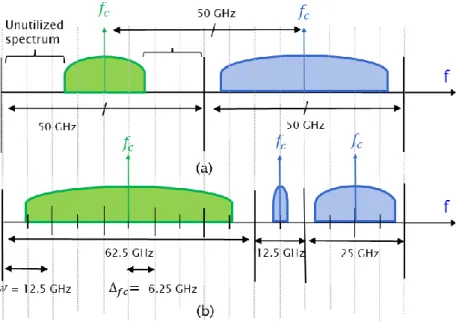
Fig. 2.1. Frequency grid for: (a) fixed and (b) flexible WDM channels. ... 8
Fig. 2.2. Evolution of transmission capacity in optical fibers [1] ... 9
Fig. 2.3. Different SDM fibers (a) MF (bundle of SMFs), (b) Few-Mode Fiber (FMF), (c) weakly-coupled MCF, and (d) strongly-weakly-coupled MCF. ... 10
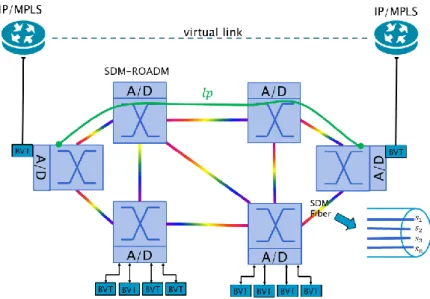
Fig. 2.4. Transparent Flex-Grid/SDM network ... 12
Fig. 2.5. InS with LC support SDM-ROADM for one degree [49] ... 13
Fig. 2.6. InS without LC support SDM-ROADM for one degree [49] ... 14
Fig. 2.7. JoS SDM-ROADM for one degree [49] ... 14
Fig. 2.8. FJoS SDM-ROADM for one degree: (a) without LC support, and (b) with LC support [49] ... 15
Fig. 2.9. AoD SDM-ROADM [40] ... 16
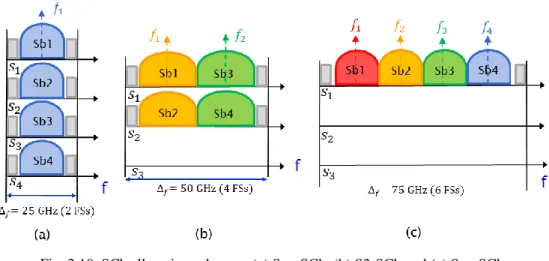
Fig. 2.10. SCh allocation schemes: (a) Spa-SCh, (b) S2-SCh and (c) Spe-SCh ... 19
Fig. 2.11.Spectrum accommodation for (a) WDM vs. (b) Flex-Grid networks. ... 21
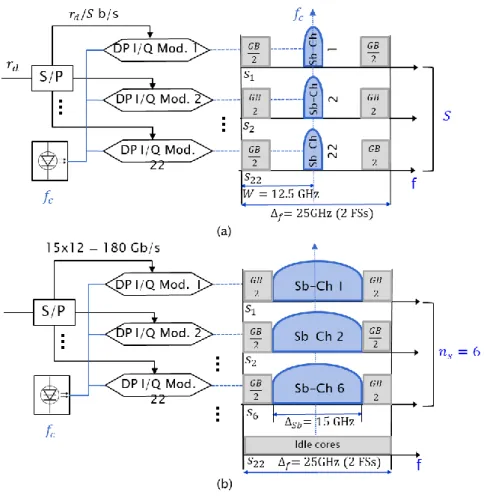
Fig. 3.1. Simplified integrated Spa-SCh BVT diagram with: (a) SC and (b) MC ... 29
Fig. 3.2. Spa-SCh allocation with different GB: (a) GB=10GHz and (b) GB=5GHz ... 30
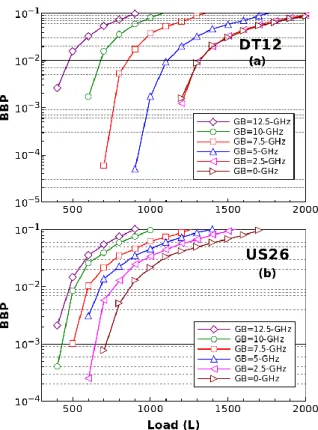
Fig. 3.3. BBP metric vs. offered network load in the DT12 (a) and US26 (b) network assuming 22-core MCFs per link, for different GB widths. ... 32
Fig. 3.4. Spa-SCh allocation using FSA (a) and PSA (b) strategies. 22-core MCFs are considered. There, a Spa-SCh has to be allocated to support a 1 Tb/s demand. Optical modulators with maximum flexible baud-rate of 32 GBaud employing DP-64QAM are assumed. GBs are set to 10 GHz. ... 36
Fig. 3.5. 𝑚𝑇𝑅𝑥 histogram in the DT12 network with 22-core MCFsusing FSA (in blue) and PSA (in purple) strategies. An offered load yielding a 1% BBP has been considered. ... 37
Fig. 3.6. 𝑚𝑇𝑅𝑥 histogram in the US26 network with 22-core MCFs using FSA (in blue) and PSA (in purple) strategies. An offered load yielding a 1% BBP has been considered. ... 38
Fig. 3.7. Transceiver operational baud-rate histogram in the DT12 (a) and US26 (b) network. An offered load leading to BBP around 1% has been considered. ... 39
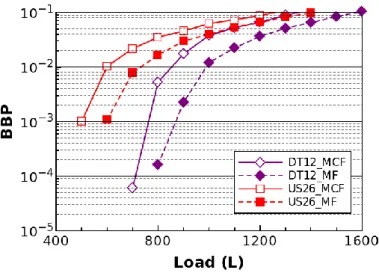
Fig. 3.8. BBP vs. offered load in DT12 and US26 network topologies with MCF- and MF-enabled links. 22-core MCFs or bundles of 22 fibers per link are assumed in each case. GB=7.5 GHz. 41 Fig. 3.9. Distribution of the usage of modulation formats in each network, DT12 and US26, for MCF-enabled and equivalent MF scenarios. An offered load leading to 1% BBP is assumed. . 42
Fig. 3.10. 𝑚𝑇𝑅𝑥 CDFs in DT12 and US26 networks for MCF- and the equivalent MF-enabled solution. ... 42
Fig. 3.12. Network Throughput (in Pb/s) versus 𝑆 in JoS-enabled Flex-Grid/SDM networks for: (a) DT12 under TP1, (b) DT12 under TP2, (c) US26 under TP1, (d) US26 under TP2. ... 49 Fig. 3.13. Candidate SCh configurations for 𝑟𝑑 = 400 Gb/s using DP-QPSK modulation format with SE at the Nyquist limit (4 b/s∙Hz), 𝑆=9, 𝑊=12.5 GHz and GB=7.5 GHz. ... 50 Fig. 3.14. Dynamic e2e-grooming for two co-routed demands ... 51 Fig. 3.15. RSSA algorithm for JoS-enabled Flex-Grid/SDM networks with dynamic end-to-end spatial traffic grooming ... 52 Fig. 3.16. BBP vs. Offered Load (in Pb/s) for different TPs, (top): fixed 𝜇 and increasing 𝜎, (bottom): fixed 𝜎 and increasing 𝜇 ... 53 Fig. 3.17. MIMO-DSP for: (a) uncoupled and (b) strongly-coupled SDM fiber ... 54 Fig. 3.18. Spectrum usage versus number of MIMO lightpaths for: (a) DT12 network with 19-core MCF, (b) DT12 network with 22-19-core MCF, (c) DT12 network with 30-19-core MCF (d) NSF15 network with 19-core MCF, (e) NSF15 network with 22-core MCF, and (f) NSF15 network with 30-core MCF. ... 70 Fig. 3.19. 7-core MCF: (a) cross-sectional view (b) MIMO equalizer matrix ... 73 Fig. 3.20. Spectrum usage vs. number of lightpaths with 1-dB/km, 3-dB/km and 6-dB/km MIMO ICXT compensation in the (a) DT12 (b) NSF15 network. ... 74 Fig. 4.1. Simplified diagram of integrated Spe-SCh BVT ... 78 Fig. 4.2. SCh allocation for d1=1 Tbps, d2=100 Gbps, d3=400 Gbps with 64QAM,
PM-16QAM, PM-QPSK, respectively, S=7 with: (a) 𝛼=0, (b) 𝛼=0.5 and (c) 𝛼=1. ... 81 Fig. 4.3. Network throughput versus α with 𝑆=19 MF&MCF solutions in: (a) DT12 network, and (b) US26 network. ... 84 Fig. 4.4. Throughput gain (%) for 𝛼𝑜𝑝𝑡 vs. 𝛼 = 0 in DT12 and US26 networks with 19-core MCFs. ... 86 Fig. 4.5. 𝑛𝑠 Histogram with 𝑆=19 (MCF), 𝛼𝑜𝑝𝑡 , US26 for: (a) 𝜇=0.4 Tbps, (b) 𝜇=2 Tbps,(c) 𝜇=4 Tbps; and (d) 𝑆=19 (MF), 𝛼𝑖, DT12, 𝜇=4 Tbps. ... 87 Fig. 4.6. Network Throughput (in Pb/s) versus 𝑆 with spectrally-spatially flexible SChs for: (a) DT12 under TP1, (b) DT12 under TP2, (c) US26 under TP1, (d) US26 under TP2. ... 89 Fig. 4.7. BBP versus Offered Load (in Pb/s) for US26 network and TP2: (a) 𝛼 = 0, 𝛼𝑜𝑝𝑡, 𝑆 =12, (b) 𝛼 = 0, 𝛼𝑜𝑝𝑡, 𝑆 =22, (c) 𝛼 = 1, 𝑆 =12 and (d) 𝛼 = 1,𝑆 =22 ... 91 Fig. 5.1. Simplified SDM-ROADM architecture with spatial conversion. Two degrees are shown for simplicity. ... 97 Fig. 5.2. Simplified architecture for: (a) ROADM for standard SMFs, (b) SDM-ROADM without spatial conversion. Two degrees are shown in both cases for simplicity. ... 98 Fig. 5.3. Device connected at input ports of (SDM)-ROADMs by using: (a) a SSS for R&S scheme, and (b) a power splitter for B&S scheme. ... 99
Fig. 5.4. Net2Plan framework in a Flex-Grid/MCF scenario. (a) geo-positioned nodes
interconnected by MCF links, and (b) carried traffic using optimized lightpaths ... 106
Fig. 5.5. Occupied FSs vs. throughput for: (a) Heuristic in T7S, (b) ILP in T7S, (c) Heuristic in I2 and (d) ILP in I2 ... 107
Fig. 5.6. Maximum carried traffic by heuristic algorithm for different topologies and core count: (a) 7, (b) 12 and (c) 19 cores. ... 109
Fig. 5.7. Average Carried Traffic (in Pb/s) vs. spatial multiplicity with Spe-SChs in DT12 network under (a) TP1, (b) TP2, and in EON16 network under (c) TP1 and (d) TP2. ... 114
Fig. 5.8. BBP versus Offered Load (in Pb/s) for EON16 network and TP2 when Spe-SCh are allocated with (a) 𝑆=12, (b) 𝑆=22. ... 115
Fig. 5.9. Average Carried Traffic (in Pb/s) vs. spatial multiplicity when supporting Spa-SChs in DT12 network under (a) TP1, (b) TP2, and in EON16 network under (c) TP1 and (d) TP2. ... 117
Fig. 5.10. BBP versus Offered Load (in Pb/s) for EON16 network and TP2 when Spa-SCh are allocated with (a) 𝑆=12, (b) 𝑆=22. ... 118
Fig. A.1. Deutsche Telekom National backbone network (DT12) ... 127
Fig. A.2. TEST1 optical backbone network ... 128
Fig. A.3. Continental European Optical Backbone Network (EON16) ... 128
Fig. A.4. Continental US optical backbone network (US26) ... 129
Fig. A.5. TEST2 optical backbone network ... 129
List of Tables
Table 2.1: SSSs metrics for different SDM-ROADM designs ... 17
Table 3.1: Measured worst aggregated ICXT in dB/km ... 28
Table 3.2: Transmission reach in km ... 28
Table 3.3: RMSA heuristic for Spa-SCh configuration ... 34
Table 3.4: RMSSA heuristic for spatially fixed Flex-Grid/SDM networks ... 45
Table 3.5: e2e-grooming algorithm for JoS-enabled Flex-Grid/SDM networks... 46
Table 3.6: Candidate lightpath pre-computation algorithm ... 59
Table 3.7: RMMSA LISA/BLSA heuristic ... 62
Table 3.8: RMMSA MRSA heuristic ... 63
Table 3.9: SA-RMMSA metaheuristic ... 64
Table 3.10: Performance Validation in TEST1 topology with 19-core MCF ... 66
Table 3.11; Performance Validation in TEST1 topology with 22-core MCF ... 66
Table 3.12: Performance Validation in TEST2 topology with 19-core MCF ... 68
Table 3.13: Performance Validation in TEST2 topology with 22-core MCF ... 68
Table 4.1: RMSSA heuristic for SS-FONs ... 82
Table 4.2. Compute SCh configuration ... 82
Table 4.3: Metrics for Different SCh Configurations for DT12 and US26 networks with 𝑆=19 (MF) and TP2 ... 92
Table 4.4: Metrics for Different SCh Configurations for DT12 and US26 networks with 𝑆=19 (MCF) and TP2 ... 93
Table 5.1: Number of Required Input Ports per SSS ... 99
Table 5.2: Summary of SDM-ROADM characteristics under B&S and R&S schemes ... 99
Table 5.3: Candidate optical channels pre-computation algorithm ... 102
Table 5.4: Heuristic algorithm pseudo-code for RTSSA w/ and w/o spatial conversion ... 104
Table 5.5: Main characteristics of reference networks ... 105
Table 5.6: TR in km for different 𝑟𝑡 in Gb/s according to the considered modulation format and MCF type ... 105
Table 5.7: Maximum throughput in T7S network using ILP vs. Heuristic (in Tb/s) ... 108
Table 5.8: Maximum throughput in Internet 2 network using ILP vs. Heuristic (in Tb/s) ... 108
Table 5.9: Network economic efficiency ... 110
Table 5.10: RMSSA heuristic without spatial conversion considering Spa-SCh and Spe-SCh 112 Table 5.11. Normalized Cost per SSS [60] ... 119
Table 5.12. Network-wide cost ... 120
Abbreviations and Symbols
AbbreviationsACO Ant Colony Optimization
A/D Add/Drop
ASE Amplified Spontaneous Emission
AWG Arrayed Waveguide Grating
AoD Architecture on Demand
B&S Broadcast-and-Select
BBP Bandwidth Blocking Probability
BLSA Balanced Load Spectrum Allocation
BV-OXC Bandwidth Variable Optical Cross Connect
BVT Bandwidth Variable Transponder
BF Best-Fit
CapEx Capital Expenditures
DAC Digital-to-Analog Converter
DCN Data Center Networks
DP Dual-Polarization
DSDM Dense Space Division Multiplexing
DSP Digital Signal Processing
DT12 12-node Deutsche Telekom Optical Network
EDFA Erbium-doped Fiber Amplifier
EGN Enhanced Gaussian noise
EON Elastic Optical Network
EON16 16-node European Optical Network
e2e-grooming end-to-end spatial traffic grooming
F Set of frequency slots per spatial channel
FF First-Fit
FEC Forward Error Correction
FJoS Fractional Joint Switching
FMF Few-Mode Fiber
FM-MCF Few-Mode Multi-Core Fiber
FNB Fully Non-Blocking
FS Frequency Slot
FSA Full Space Assignment
GN Gaussian noise
GER 50-node GERmany optical network
GoS Grade-of-Service
GMPLS Generalized Multi-protocol Label Switching
GRASP Greedy Randomized Adaptive Search Procedure
HT Holding Time
IAT Inter-Arrival Time
ICXT Inter-Core crosstalk
ILS Iterated Local Search
InS with LC Independent Switching with Lane Change support InS w/o LC Independent switching without Lane Change support
I2 Internet 2
JoS Joint Switching
L Offered Load
LC Lane Change
LISA Lowest Indexed Spectrum Allocation
LF Last-Fit
LS Local Search
MC Multi-Carrier
MCF Multi-Core Fiber
MIMO Multiple-Input Multiple-Output
MF Multi-Fiber
MMF Multi-Mode Fiber
MRSA Maximum Reuse Spectrum Allocation
NETCONF Network Configuration
NFDM Non-linear Frequency-Division Multiplexed
NLI Non-Linear Interference
NP Non-deterministic Polynomial
NSF15 15-node National Science Foundation optical network
NWDM Nyquist-Wavelength Division Multiplexing
OAM Operation, Administration, and Maintenance
OC Optical Carrier
OpEx Operational Expenditures
OSNR Optical Signal-to-Noise-Ratio
PM Polarization Multiplexing
PON Passive Optical Network
PSA Partial Space Assignment
RA Resource Allocation
RF Random-Fit
R&S Route-and-Select
ROADM Reconfigurable Optical Add Drop Multiplexer
RMMSA Route, Modulation Format, MIMO, Space and Spectrum Assignment
RMSSA Route, Modulation Format, Space and Spectrum
Assignment
RSA Route, Spectrum Assignment
RSSA Route, Space and Spectrum Assignment
RTSSA Route, Transponder, Space and Spectrum Assignment
RWA Routing and Wavelength Assignment
SA Simulated Annealing
Sb-Ch Sub-Channel
SC Single-Carrier
SCC Space Continuity Constraint
SCh Super-Channel
SDM Space Division Multiplexing
SDM-ROADM SDM-capable ROADM
SDN Software Defined Networks
SE Spectral Efficiency
SMF Single Mode Fiber
SNR Signal-to-Noise-Ratio
SP Shortest Path
Spa-SCh Spatial Super-Channel
Spe-SCh Spectral Super-Channel
S2-SCh Spectral-Spatial Super-Channel
SP Shortest Path
SS-FON Spectrally-Spatially Flexible Optical Network
SSS Spectrum Selective Switch
TP Traffic Profile
TR Transmission Reach
TRx Transceiver
T7S Top 7 Spain
US26 26-node US Optical Network
WDM Wavelength Division Multiplexing
WSSA Weighted Spectral and Spatial Allocation
YANG Yet Another Next Generation
Symbols
𝛼 Weighting parameter in WSSA method
𝛼𝑖 Highest 𝛼 which yields the same throughput as 𝛼 = 0
𝛼𝑜𝑝𝑡 Weighting parameter which yields the highest throughput
b Function that weights spectral and spatial resources
𝛽 Set of b values
𝑑 Demand
𝒟 Set of demands 𝑑
∆𝑓
Bandwidth per spatial channel necessary to allocate an Spa-SCh,including guard-bands
∆𝑓𝑐 Central frequency granularity
∆𝑆𝑏 Sb-Ch spectral width (occupied bandwidth per Sb-Ch)
𝑒 Network link
ℰ Set of unidirectional network links 𝑒
ℱ Set of frequency slots
𝑓𝑐 Central frequency
𝛾 Cooling rate
𝐺 Size of group of spatial channels for FJoS
ℎ𝑝 Number of hops of path 𝑝
𝐾 Number of candidate physical paths over which a lightpath
can be established
ℒ𝑒 Lightpaths traversing link 𝑒
ℒ𝑒𝑓 Lightpaths traversing link 𝑒 and using FS 𝑓
𝑙𝑝 Lightpath
𝐿𝑝 Set of active lightpaths
𝐿𝑝𝑠,𝑡
Set of active lightpaths with source node 𝑠and destination node 𝑡
𝑀 Set of modulation formats
𝑚𝑇𝑅𝑥 Number of active transceivers
𝑛 Number of bits per symbol
𝜂 Maximum number of lightpaths with MIMO
𝒩 Set of network nodes
𝑛𝑓𝑠 Number of frequency slots needed to serve d
𝑛𝑂𝐶 Number of optical carriers needed to serve d
𝑛𝑂𝐶
̅̅̅̅̅ Mean number of optical carriers needed to serve d
𝑛𝑠 Number of spatial channels needed to serve d
𝑛𝑡 Number of FSs occupied by transponder 𝑡
𝑛𝑇𝑅𝑥
̅̅̅̅̅̅ Mean number of transceivers per super-channel
Ω Set of candidate super-channel configurations
𝒪𝑡
Set of all pre-computed candidate optical channels for transponder 𝑡
Φ Objective function
Φ𝑀𝐶𝐹 Objective function for MCF
Φ𝑀𝐹 Objective function for MF
ψ Objective function worsening
𝑝 Routing path
𝑃𝑎𝑐𝑐 Acceptance probability
𝒫𝑑 Feasible candidate paths for demand 𝑑
𝑅𝐵 Baud-rate
𝑅𝐵𝑚𝑎𝑥 Maximum operational baud-rate
𝑟𝑑 Requested bit-rate of demand d
𝑆 Spatial channel count
𝑠𝑑 Source node of demand d
𝑡 Transponder
𝒯 Set of transponders 𝑡
𝑡𝑑 Destination node of demand d
𝜇 Mean bit-rate per connection
𝜔 Current solution
𝜔′ Neighboring solution
𝜔∗ Incumbent solution
𝑊 Frequency Slot width
Summary
The ever demanding bandwidth requirements for supporting emerging telecom services such as ultra-high-definition video streaming, cloud computing, connected car, virtual/augmented reality, etc., bring to the fore the necessity to upgrade continuously the technology behind transport networks in order to keep pace with this exponential traffic growth. Thus, everything seems to indicate that fixed-grid Wavelength-Division Multiplexed (WDM) networks will be upgraded by adopting a flexible-grid, thus providing finer bandwidth allocation granularities, and therefore, increasing the Grade-of-Service by packing more information in the same spectral band of standard Single-Mode Fibers (SMFs). Nevertheless, unfortunately, the fundamental Shannon’s limit of SMFs is rapidly approaching, and, then, the research efforts to increase the SMFs' capacity will be useless.
One solution to overcome this capacity crunch effect is to enable one extra dimension in addition to the frequency one, namely, the spatial dimension, thus deploying 𝑆 parallel paths in order to multiply, in the best case, by 𝑆 the capacity of SMF-based networks. However, additionally, it is necessary to decrease the cost and energy per bit in order to provide economically attractive solutions. For this purpose, a smooth upgrade path has to be carried out as new integrated devices and system components are developed for Space Division Multiplexing (SDM).
This thesis is concentrated on the planning and operation of the combined flexible WDM and SDM networks (i.e., Flex-Grid/SDM networks) proposing several strategies aimed at optimizing network resources usage with hardware complexity analysis. For this purpose, firstly, network problems are carefully studied and stated, and then, mathematical and/or heuristic algorithms are designed and implemented in an optical network simulator.
Specifically, after an introduction to the thesis, chapter 2 presents the background and related work. Next, chapter 3 concentrates on the study of spatially fixed Flex-Grid/SDM networks, i.e., when a rigid number of spatial channels are reserved per allocated traffic demand. In its turn, chapter 4 studies the case of Spectrally-Spatially Flexible Optical Networks (SS-FONs), as the ones providing the upper-bound network capacity. Costs and hardware requirements implied on providing this flexibility are analyzed. Network nodes aimed at reducing the cost of SS-FONs are presented and evaluated in chapter 5. Finally, this thesis ends with the presentation of the main contributions and future research work in chapter 6.
It shall be mentioned that this thesis has been mainly carried out in the framework of the projects SUNSET and ALLIANCE founded by the Spanish Ministry of Economy and Competitiveness under contracts TEC2017-90034-C2-1-R and TEC2017-90034-C2-2-R, respectively.
Resumen
La demanda de ancho de banda cada vez más exigente para soportar servicios de telecomunicación emergentes tales como la transmisión de video de alta calidad, computación en la nube, vehículo conectado, realidad virtual/aumentada, etc.…, ha puesto de manifiesto la necesidad de actualizar constantemente la tecnología detrás de las redes de transporte óptico con la finalidad de ir a la par de este incremento exponencial del tráfico. De esta manera, todo parece indicar que las redes basadas en la multiplexación por division de longitud de onda (Wavelength Division Multiplexing, WDM) de ancho espectral fijo serán actualizadas adoptando un ancho de banda espectral flexible, que ofrece asignaciones de ancho de banda con granularidad más fina acorde a las demandas de tráfico; y por lo tanto, incremanta el Grado de Servicio de la red, ya que se permite acomodar mayor información en la misma banda espectral de las fibras monomodo (Single Mode Fibers, SMFs). Sin embargo, desafortunadamente, el límite de Shannon de las fibras monomodo se está aproximando cada vez más, y cuando esto ocurra las investigaciones para incrementar la capacidad de las fibras monomodo serán infructuosas.
Una posible solución para superar este colapso de las fibras monomodo es habilitar la dimensión espacial a más de la frecuencial, desplegando 𝑆 caminos paralelos con la finalidad de multiplicar por 𝑆 (en el mejor de los casos) la capacidad de las fibras monomodo. No obstante, es necesario disminuir el costo y la energía por bit con la finalidad de proveer soluciones comerciales atractivas. Para tal propósito debe llevarse a cabo una actualización moderada conforme nuevos dispositivos y componentes integrados son desarrollados para la implementación de la tecnología basada en la multiplexación por división de espacio (Space Division Multiplexing, SDM).
Esta tesis se concentra en la planificación y operación de la combinación de las redes WDM flexibles y SDM (es decir, de las redes Flex-Grid/SDM) proponiendo varias estrategias dirigidas a optimizar el uso de los recursos de red junto con el análisis de la complejidad del hardware que viene acompañada. Para este fin, primeramente, los problemas de red son cuidadosamente estudiados y descritos. A continuación, se han diseñado e implementado algoritmos basados en programación lineal entera o heurísticas en un simulador de redes ópticas.
Después de una introducción inicial, el capítulo 2 de esta tesis presenta el marco teórico sobre los conceptos tratados y los trabajos publicados anteriormente. A continuación, el capítulo 3 se concentra en el estudio de las redes Flex-Grid/SDM con la dimensión espacial rígida; es decir, cuando un número fijo de canales espaciales son reservados por cada demanda de tráfico establecida. Por su parte, el capítulo 4 estudia las redes Flex-Grid/SDM considerando flexibilidad tanto en el dominio espacial como espectral (Spectrally and Spatially Flexible Optical Networks, SS-FONs), las cuales proveerían la capacidad máxima de las redes SDM. Adicionalmente, los
costos y requerimientos de hardware implicados en la provisión de esta flexibilidad son analizados. El capítulo 5 presenta la evaluación de nodos orientados a reducir los costos de las SS-FONs. Finalmente, el capítulo 6 expone las principales contribuciones y las posibles líneas de trabajo futuro.
Cabe mencionar que esta tesis ha sido principalmente llevada cabo dentro de los proyectos SUNSET y ALLIANCE financiadas por el Ministerio de Economía y Competividad de España bajo los contratos TEC2017-90034-C2-1-R y TEC2017-90034-C2-2-R, respectivamente.
Resum
Els requisits incessants d’ample de banda per al suport de nous serveis de telecomunicació, com poden ser la difusió en directe de vídeo de molt alta definició, la informàtica en el núvol, els cotxes intel·ligents connectats a la xarxa, la realitat virtual/augmentada, etc…, han exigit una millora contínua de les tecnologíes de les actuals xarxes de transport de dades. Tot sembla indicar que les xarxes de transport òptiques actuals, basades en la tecnologia de multiplexació per divisió de longitud d’ona (Wavelength Division Multiplexing, WDM) sobre un grid espectral rígid, hauran de ser reemplaçades per tecnologies òptiques més flexibles, amb una granularitat més fina a l’hora de suportar noves connexions, incrementat el grau de servei de les xarxes gràcies a aprofitament major de l’ample de banda espectral proporcionat per les fibres òptiques monomode (Single Mode Fibers, SMFs). Tanmateix, estem exhaurint ja la capacitat màxima de les fibres òptiques SMF segons ens indica el límit fonamental de Shannon. Per tant, qualsevol esforç enfocat a millorar la capacitat d’aquestes xarxes basades en SMFs pot acabar sent infructuós.
Una possible solució per superar aquestes limitacions de capacitat és explorar la dimensió espacial, a més de l’espectral, desplegant 𝑆 camins en paral·lel per tal de multiplicar per 𝑆, en el millor cas, la capacitat de les SMFs. Tot i això, és necessari reduir el cost i el consum energètic per bit transmès, per tal de proporcionar solucions econòmicament viables. Amb aquest propòsit, pot ser necessària una migració progressiva, a mesura que es desenvolupen nous dispositius i components per aquesta nova tecnologia de multiplexació per divisió espacial (Spatial Division Multiplexing, SDM).
La present tesi es centra en la planificació i operació de xarxes òptiques de nova generació que combinin tecnologies de xarxa WDM flexible i SDM (és a dir, xarxes Flex-Grid/SDM), proposant estratègies per a l’optimització de l’ús dels recursos de xarxa i, en definitiva, el seu cost (CapEx). Amb aquest propòsit, s’analitzen en primer moment els problemes adreçats. Tot seguit, es dissenyen algorismes per tal de solucionar-los, basats en tècniques de programació matemàtica i heurístiques, els quals s’implementen i es proven en un simulador de xarxa òptica.
Després d’una introducció inicial, el capítol 2 d’aquesta tesi presenta tots els conceptes tractats i treballs relacionats publicats amb anterioritat. Tot seguit, el capítol 3 es centra en l’estudi de les xarxes Flex-Grid/SDM fixes en el domini espai, és a dir, on sempre es reserva un nombre rígid de canals espacials per qualsevol demanda suportada. El capítol 4 estudia les xarxes flexibles en els dominis espectrals i espacials (Spectrally-Spatially Flexible Optical Nextworks, SS-FONs), com aquelles que poden proporcionar una capacitat de xarxa màxima. En aquest context, s’analitzen els requeriments en termes de cost i hardware per tal de proporcionar aquesta flexibilitat. Llavors, en el capítol 6 es presenten opcions de node de xarxa capaces de reduir els
costos de les xarxes SS-FONs. Finalment, en el capítol 7 es repassen totes les contribucions de la tesi, així com posibles línies de treball futur.
Aquesta tesi s’ha desenvolupat en el marc dels projectes SUNSET i ALLIANCE, finançats pel Ministerio de Economía y Competitividad de España, amb referències TEC2017-90034-C2-1-R i TEC2017-90034-C2-2-R.
to my wife Tannia, my sons Matías and Leire for their love, great comprehension and support during this stage of our lifes, to my parents and brothers, key pillars in the consecution of this goal.
Acknowledgments
First, I want to thank God for all His blessings, for making me strong in the adversity and the opportunity to achieve this goal.
Special thanks to my advisors Dr. Jordi Perelló and Dr. Salvatore Spadaro for all their technical support and guidance in the realization of this thesis as well as for the opportunity to be involved in the SUNSET and ALLIANCE research projects.
I would like to thank Dr. Joan M. Gené for his important scientific assistance in the initial studies of this thesis. Also, thanks to the Group of Optical Communications (GCO) from the Polytechnic University of Catalonia, especially to Albert Pagès and Fernando Agraz for their valuable discussions and assistance.
To the researchers Dr. Pablo Pavón-Mariño and Francisco J. Moreno-Muro from Technical University of Cartagena, Dr. Krzysztof Walkowiak and Piotr Lechowicz from Wroclaw University for their valuable collaboration and discussions during the elaboration of joint scientific articles of this thesis. I would like also to thank Dr. Raul Muñoz and Dr. Ramón Casellas from Centre Tecnològic de Telecomunicacions de Catalunya (CTTC) for the opportunity and guidance during my research stay in this prestigious research center.
To all my good teachers from my first steps in primary school until University for their important contributions in my professional formation and for encouraging me that every thing is possible with effort and honesty.
I want to express my gratitude to the Secretaría Nacional de Educación Superior, Ciencia, Tecnología e Innovación (SENESCYT) - Ecuador for the financial support by means of a full doctoral scholarship, without it, it would have been very hard to achieve this goal. Also, my recognize for its wise policy decision of investing in the human talent training. Finally, I want to thank the Corporación Nacional de Telecomunicaciones (CNT E.P.) - Ecuador for the granted work license in order to do my PhD.
Rubén Rumipamba Zambrano February 2019
Chapter 1
1
Introduction
1.1
Motivation
The emerging telecommunications services require each time more bandwidth requirements. Indeed, all traffic load of access networks coming from Passive Optical Networks (PONs), Data Center Networks (DCNs), future 5G technology (with all its verticals), etc., has to be supported by core networks demanding each time more sophisticated fiber-optic-based systems. Thereby, core networks dimensioning is a crucial aspect; otherwise, they could become thebottleneck part of end-to-end services.
This vertiginous increment of bandwidth requirements follows a 10-fold exponential growth every 4 years [1]; but optical fibers, as any transmission medium, have finite and scarce resources to cope with it. Frequency/wavelength dimension has been one of the first explored physical dimensions to increase the capacity of fiber-optic communications. For instance, conventional linear Wavelength-Division Multiplexing (WDM) networks based on a fixed frequency grid have achieved transmissions up to 100 Gb/s per channel [2], while, recently, a record of 400 Gb/s has been achieved for the under research Non-linear Frequency-Division Multiplexed (NFDM) systems [3]. In order to go beyond WDM capacity, coping with heterogeneous traffic demands avoiding spectrum wastage, it has been proposed using flexible frequency grid arising the concept of Flex-Grid or Elastic Optical Networks (EONs) [4], [5], capable of multiplexing finer granularities than, e.g., 50-GHz-spaced WDM channels. Nowadays, the technology around Flex-Grid networks continues attracting the interest of the research community to optimize the spectrum usage as well as to solve the control and management of different bandwidth-variable network elements. Other explored physical dimensions are time, polarization and quadrature [6]. Nevertheless, the capacity of Single-Mode Fibers (SMFs) is rapidly approaching the theoretical limit (nonlinear Shannon) estimated at 100 Tb/s [1]. To overcome this limit, spatial dimension [7], [8] (as the only one pending to be explored) has gained enormous interest over the last years, thus achieving transmissions in the order of Pb/s [9].
The promising SDM technology relies on several candidates to be realized. For instance, on parallel SMFs, fibers with multiple cores within same cladding, fibers with a single-core transmitting multiple guided modes, and even fibers with multiple cores and modes per each. Each SDM fiber candidate has to deal with physical impairments, which limit its application
scope. Furthermore, new SDM-capable devices facilitating integration and sharing of system components are expected to be developed in order to reduce both Capital (CapEx) and Operational (OpEx) Expenditures.
In principle, frequency and spatial dimensions are orthogonal; however, their combination, namely, Flex-Grid/SDM networks is expected to be realized in the long-term horizon in the form of Spectrally-Spatially Flexible Optical Networks (SS-FONs) [10] to increase the Grade-of-Service (GoS) of core networks. However, as said, both technologies have to deal with several physical issues in order to reduce the energy and cost per bit, thus paving the way for attractive commercial solutions. For example, tunability, fine resolution, control, integration, Digital Signal Processing (DSP), physical-aware network planning and optimization algorithms, are some of the concerns subject to ongoing research efforts.
This PhD thesis is concentrated on the planning and operation of Flex-Grid/SDM optical core networks taking into account both fixed and flexible spatial dimension from the Resource Allocation (RA) point of view. Moreover, both SDM fibers with and without crosstalk are considered to propose various strategies aimed at optimizing spectral as well as hardware requirements, thus leading to also cost reductions.
1.2
Objectives
The main goal of this thesis is to study the RA problem in Flex-Grid/SDM networks dealing with different physical impairments specially related to SDM transmission medium. Specifically about SDM, in analogous way to frequency dimension, the spatial one can be operated either in a fixed or flexible manner. In this context, the planning and operation studies are specifically oriented to the following cases:
1. Spatially fixed Flex-Grid/SDM networks
2. Spectrally and spatially flexible optical networks
3. Spatial conversion for spectrally and spatially flexible optical networks
Each case study has several specific objectives as follows:
1. Spatially fixed Flex-Grid/SDM networks 1.1 To propose an spatial super-channel configuration
1.2 To evaluate the performance impact of spatial super-channel guard-band width 1.3 To analyze the scalability when a fixed spatial dimension is considered
1.4 To propose an spatial traffic grooming strategy
1.5 To apply Multiple-Input Multiple-Output (MIMO) assignment to counteract the negative effects of crosstalk
2. Spectrally and spatially flexible optical networks
2.1 To analyze the scalability when flexible spatial dimension is considered
2.2 To evaluate the impact of super-channel configurations on the network performance and cost
3. Spatial conversion for spectrally and spatially flexible optical networks
3.1 To analyze the SDM-capable Reconfigurable Optical Add/Drop Multiplexer (ROADM) configuration with/without spatial conversion
3.2 To evaluate the network performance and cost impact of spatial conversion
1.3
Methodology
This PhD thesis is carried out by simulating several network scenarios composed of different reference network topologies, traffic profiles, spectral and spatial resources, transponders, etc. Most the results of this thesis have been obtained with a Java-based ad-hoc simulator, while others with the Net2Plan simulator [11] in collaboration with researchers from the Technical University of Cartagena (UPCT). Fig. 1.1 shows the methodology carried out in the realization of this PhD thesis. Firstly, a given network problem is properly studied and stated. Then, it is mathematically formulated; or, directly, a specialized algorithm is proposed to solve it. Following the diagram of Fig. 1.1, designed algorithms are implemented in the ad-hoc simulator, specifically, in a first component called planning/operation tool by means of a heuristic or an Integer Linear Program (ILP) (optimization techniques presented in next chapter 2). In turn, these algorithms interact with a second component, namely, the network model representing all available network elements and resources. Moreover, they are responsible for properly changing the status of different network elements and resources for control, management or accounting purposes. If results are not what we are expecting or errors are found, then the proposed algorithms should be redesigned.
The network model consists of a directed graph, where vertexes are the network nodes and edges are the network links. Different resources are associated to network elements. For example, spectral and spatial resources are components of network links, while transponders are components of network nodes. Each network element or resource is defined with different parameters. Some of them should provide access to query/modify/monitor their status during provisioning tasks.
It is worth mentioning that the network model of the developed ad-hoc simulator was initially validated by reproducing some previous works available in the literature.
1.4
Thesis Organization
The rest of this thesis is organized as follows.
Chapter 2 presents the background of Flex-Grid and SDM technologies. Specifically about SDM, different SDM fibers are discussed with emphasis on those considered in this thesis. Moreover, State-of-The-Art (SoTA) about network planning and operation of Flex-Grid/SDM networks is presented.
Chapter 3 concentrates on spatially fixed Flex-Grid/SDM optical networks addressing both network planning and operation scenarios. For network operation, firstly, the configuration of spatial super-channels is studied for Flex-Grid/SDM networks. Later on, the performance impact of the necessary Guard Bands (GBs) during spatial super-channel configuration is discussed. Due to spatial rigidity, some spectral-spatial resources could be wasted during provisioning tasks. To counteract this issue, a mechanism called end-to-end spatial traffic grooming enhances network throughput. Although this procedure improves spatial and spectrum usage, a spatial multiplicity increase does not always entail a throughput increment. Therefore, the relationship between spatial multiplicity and network throughput is also assessed for both SDM fibers with and without crosstalk. Finally, a mechanism called dynamic end-to-end spatial traffic grooming is proposed to exploit the huge capacity of spatially fixed Flex-Grid/SDM networks under several traffic conditions. Regarding network planning scenario, the last part of this chapter concentrates on the analysis of SDM fibers with crosstalk. To this end, firstly, the penalties introduced by crosstalk on the spectral resource requirements are analyzed. Then, in order to counteract this negative effect, MIMO processing is proposed to be assigned to the least amount of lightpaths, thus saving costs and computational complexity.
Chapter 4 concentrates on the operation of SS-FONs. For this purpose, firstly, different super-channel allocation options for SS-FONs are surveyed. Then, a cost-effective methodology to configure super-channels is proposed. Finally, the relationship between spatial multiplicity and network throughput under different super-channel allocation options is evaluated.
Chapter 5 focuses on the evaluation of capable ROADMs (hereinafter called SDM-ROADMs or simply nodes) performance without spatial conversion for SS-FONs in comparison to the ones where spatial conversion is supported. For this purpose, both network planning and operation scenarios are used to evaluate the impact of restricting the spatial conversion on network throughput and cost.
Chapter 2
2
Background and related work
2.1
Flex-grid technology
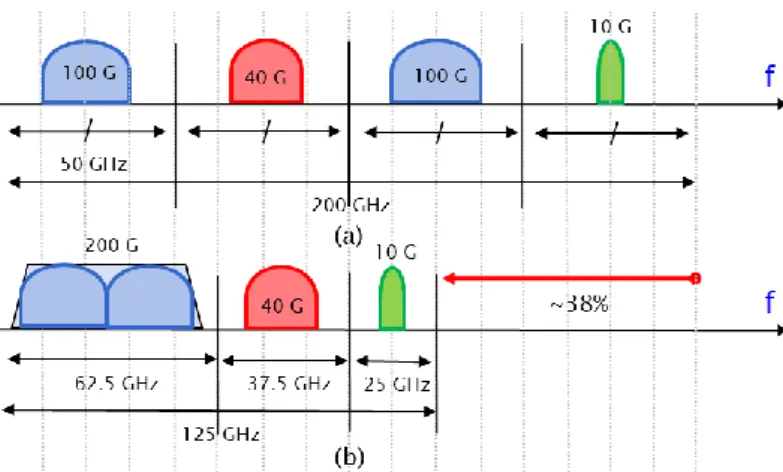
Since early 1990s, the natural evolution of digital communications has led to the application of typical frequency-division multiplexing techniques of wireless systems to fiber-optic ones. The idea is to combine multiple connections (lightpaths) by assigning them different Frequency Slots (FSs) or wavelengths (colors). Initially the frequency grid, introduced by G.694.1 ITU-T recommendation in 2002, was exactly equal to 100 GHz (about 0.8 nm) for traditional WDM transport networks. Later on, in 2012 the second edition of such G.694.1 ITU-T recommendation [12] included a variety of channel spacing ranging from 12.5 GHz to 100 GHz and wider. That is, the minimum FS granularity is 12.5 GHz and the central frequency granularity is 6.25 GHz. In addition, the concept of flexible WDM grid (Flex-Grid) was incorporated stating that flexible spectrum ranges, in terms of an integer number of FSs, can be allocated to traffic demands. This allows dealing with mixed bit-rate and mixed modulation format transmission systems, thus optimizing the spectrum usage. To illustrate this, Fig. 2.1 shows the frequency grid for fixed (Fig.
2.1.a) and flexible (Fig. 2.1.b) WDM channels with FS width (𝑊) equal to 12.5 GHz. As seen in
Fig. 2.1.a, a fixed 50 GHz width is allocated to traffic demands regardless the required bandwidth, thus causing unutilized spectrum. In contrast, the allocated spectrum according to bandwidth requirements in multiples of 12.5 GHz is shown in Fig. 2.1.b. There, three traffic demands are allocated in a flexible manner by using 62.5 GHz (5 FSs), 12.5 GHz (1 FS) and 25 GHz (2 FSs), respectively, where central frequencies (𝑓𝑐) are set-up with 6.25 GHz granularity (∆𝑓𝑐).
One of the advantages of Flex-Grid technology is that ultra-high bit-rate transmissions are possible in the order of hundreds of Gb/s and even Tb/s by varying modulation format, baud-rate and/or number of Optical Carriers (OCs). The latter parameter allows forming Super-Channels (SChs) by concatenating multiple adjacent Sub-Channels (Sb-Chs). SChs are seen as a single entity and they are generated/detected by devices known as Bandwidth Variable Transponders (BVTs). Moreover, SChs are compactly switched at intermediate nodes called Bandwidth Variable Optical Cross Connects (BV-OXCs). In particular, BV-OXCs with additional capabilities of injecting/extracting optical channels originating/terminating at network nodes are implemented as ROADMs, based on Spectrum Selective Switches (SSSs).
Fig. 2.1. Frequency grid for: (a) fixed and (b) flexible WDM channels.
Flex-Grid technology relies on the programmability of several transceiver (main component of BVTs, see Fig. 3.1) parameters such as modulation format (commonly adapted according to transmission distance), baud-rate, Forward Error Correction (FEC) overhead, launch-power, operational central frequency of tunable lasers, etc. All bandwidth-variable devices can be controlled and managed via software, e.g., by means a Software Defined Network (SDN) controller. In fact, several works available in the literature address the challenge of configuring/programing these enabling devices of Flex-grid technology according to traffic needs. For example, in [13], [14] Operation, Administration, and Maintenance (OAM) as well as control and management tasks of BVTs are proposed by means of Network Configuration (NETCONF) protocol and Yet Another Next Generation (YANG) model. In [15], an SDN-enabled sliceable BVT based on a Generalized Multi-protocol Label Switching (GMPLS) control plane is demonstrated, while [16] addresses the interoperability of multi-domain and multi-vendor EONs. Essentially, this work demonstrates the interoperation of several GMPLS/BGP-LS-based controllers for BVTs and BV-OXCs.
2.2
Space Division Multiplexing (SDM) technology
Although Flex-Grid technology proposes a better way to use the spectrum, the aggregate capacity per fiber cannot surpass the so-called non-linear Shannon’s limit of 100 Tb/s [1], [17]. Indeed, estimations have shown that the current technology research reached this limit in 2011 (see Fig.
2.2), phenomenon known as capacity crunch [7]. The fact is that according to trends the traffic is
multiplied by 10 every 4 years, as shown in Fig. 2.2. In order to go beyond 100 Tb/s the exploitation of the space dimension has been brought to the fore by the Space Division Multiplexing (SDM) technology [18].
Fig. 2.2. Evolution of transmission capacity in optical fibers [1]
SDM is considered as the “next-frontier” of fiber optics, able to scale up the capacity of current WDM systems [18] and keep pace with the exponential traffic growth. Indeed, the enablement of
𝑆 parallel optical paths multiplies by 𝑆 the Spectral Efficiency (SE) instead of increasing the order of modulation formats. For instance, a system of 32 GBaud Dual-polarized (DP)-QPSK with 6 parallel optical paths would achieve an aggregate bit-rate of 768 Gb/s (32 ∙ 2 ∙ 2 ∙ 6) per channel. This means that the transmission would scale from 4 to 24 bits/symbol. Unfortunately, the alternative of increasing the order of modulation format is not scalable specially for long-haul communications because the use of regenerators would be mandatory due to limited transmission reach [19]. Moreover, advanced modulation formats would multiply transponder count by the number of regenerators plus one per connection. Hence, SDM seems to be the most promising solution for network capacity growth by packing more information into the limited ~5 THz bandwidth of single-band systems.
Although having parallel systems would potentially reduce the network cost, it is not yet the economically sustainable solution since 𝑆 parallel systems yield 𝑆 times the capacity at 𝑆 times the cost and 𝑆 times the power consumption. That is, the cost and energy per bit would be the same as today’s single systems. Therefore, in addition to parallelization, integration and sharing of system components is necessary [6], [18], [20], [21]. In this regard, fiber design plays an important role. The straightforward SDM fiber solution is to upgrade current SMFs links to bundle of parallel SMFs, acting as a Multi-Fiber (MF) solution. However, novel designs [1], [22] are also attractive to facilitate SDM system integration, which are going to be presented in the following subsection.
2.2.1 SDM transmission medium
Spatial multiplicity can rely on different fiber designs shown in Fig. 2.3. As said before, already deployed MF (parallel SMF within the same fiber ribbon cable, see Fig. 2.3.a) infrastructures can
be leveraged by some telecom operators. However, new ways of exploiting the spatial dimension include the transmission of multiple guided modes over a single core, i.e., Multi-Mode Fiber (MMF). In addition, if only few modes are considered, these SDM fibers are referred to as Few-Mode Fibers (FMFs), as the case of Fig. 2.3.b. Another interesting design is to increase the core count within the same fiber cladding, namely, Multi-Core Fibers (MCFs, see Fig. 2.3.c and Fig. 2.3.d). Furthermore, if each of these cores transmits few modes, this kind of fibers is referred to as FM-MCFs.
Nevertheless, these novel fibers introduce a new impairment to deal with. Namely, the coupling between modes or cores has to be considered in order to determine if equalization based on end-to-end MIMO processing is necessary. In fact, MIMO equalization is mandatory for MMFs in order to undo the mode coupling. Meanwhile, coupling between cores, i.e., Inter-Core Cross Talk (ICXT), originating by the continuity of the electromagnetic field in adjacent dielectric regions [23], mainly depends on the distance between cores, called core pitch. Indeed, Saitoh et al. [24] classify MCFs in two categories, namely, weakly- (Fig. 2.3.c) and strongly-coupled MCFs (Fig.
2.3.d), basically by considering the core pitch (Λ) and coupling coefficient (𝜅). Weakly-coupled
ones have a typical Λ higher than 30 𝜇m and 𝜅 lower than 10-2 m-1, keeping ICXT below -30 dB
per 100 km (i.e., -50 dB/km) [25]. In contrast, strongly-coupled MCFs present lower Λ and higher
𝜅 values, mandating MIMO equalization.
Fig. 2.3. Different SDM fibers (a) MF (bundle of SMFs), (b) Few-Mode Fiber (FMF), (c) weakly-coupled MCF, and (d) strongly-coupled MCF.
Weakly-coupled MCFs are particularly attractive, given their extremely low ICXT [26]–[31] that they introduce during the optical signal propagation, even with high core density, thus alleviating the need for MIMO equalization and, therefore, the complexity and cost of the receivers. Even
so, to further reduce ICXT, heterogeneous MCFs (cores with different characteristics) have been designed, which may be required for long-haul communications with core counts higher than 30 (Dense SDM –DSDM–) [32], [33]. Besides low ICXT, MCFs are economically attractive candidates to realize SDM as well [34], [35]. The interest reader can review more details about fabrication, theoretical analysis of physical impairments and applications of MCFs in [23].
2.3
Flex-Grid/SDM networks
As mentioned before, in order to overcome the capacity of current WDM networks the adoption of SDM technology is an attractive solution. Furthermore, the combination of Flex-Grid and SDM technologies allows optimizing the spectrum usage of each parallel optical path enabled by SDM. In this sense, Flex-Grid/SDM backbone networks, or the synonym term SDM-EONs, have gained enormous interest of the research community over the last years [36]–[38], in order to take full advantage of the vast amount of spectral resources, as spatial multiplicity increases. In particular, Flex-Grid/MCF networks have been advocated by many works in the literature as a promising implementation of SDM-EONs [39]–[45].
Fig. 2.4 shows a typical transparent1 Flex-Grid/SDM network, basically, composed of
ROADMs linked by SDM fibers and BVTs connected to Add/Drop (A/D) modules of SDM-ROADMs. In this scenario, optical amplifiers are implicit in between nodes typically for every fiber span of 80-100 kilometers, while signal regenerators are not considered in the context of this thesis. By doing a zoom to one SDM fiber link, we can appreciate the parallel 𝑆 optical paths, each one identified by index 𝑖.
Typical traffic demands ask for an optical connection established in form of lightpath (𝑙𝑝) from one source node (𝑠𝑑) to another destination node (𝑡𝑑) and transmitting 𝑟𝑑 b/s. That is, one demand
𝑑 can be defined by a triplet (𝑠𝑑, 𝑡𝑑, 𝑟𝑑). Over one active lightpath a virtual connection can be established, e.g., between two IP/MPLS nodes forming what is known a multilayer IP/MPLS over Flex-Grid/SDM network. Lightpaths, as stated before, are essentially defined in WDM networks by one routing path plus the wavelength (color) of the signal. When parallel optical paths are enabled by SDM and each one of them is independently used, the routing path should include an attribute with the sequence of 𝑠𝑖 spatial channels used for OAM tasks.
In particular, SDM-ROADMs determine the form in how optical channels are switched and, therefore, how they have to be allocated. There are some node designs available in the literature, which are going to be explained in next subsection.
1 Term used for network without wavelength conversion and all-optical transmission (i.e., without optical to electrical conversion).
Fig. 2.4. Transparent Flex-Grid/SDM network
2.3.1 SDM-ROADM solutions
ROADMs are in charge of automatically adding, dropping or bypassing (transparent switching) lightpaths in Flex-Grid networks. The ROADM design includes SSS devices, which are able to switch any FS at any of its input ports, to any of its outputs ports [46]. The SSSs are the most expensive elements in the ROADM design.
ROADM functions are typically implemented based on two alternative schemes, the so-called Broadcast-and-Select (B&S) and Route-and-Select (R&S) ones. On the one hand, the B&S scheme offers cost, power consumption and optical/electronic complexity reductions, as well as low overall system penalties. On the other hand, the R&S practically doubles the number of SSSs to provide superior isolation on the blocking ports and a low insertion loss regardless of the port count [47]. According to [47], the B&S architecture seems the best choice for ROADMs with nodal degree (𝐷) lower or equal than 9, while for 𝐷>9, R&S benefits compensate its extra cost. Commercial ROADMs commonly use the B&S scheme to switch traffic. However, for next generation optical networks deploying high-port-count SSSs that will require high isolation between ports, the prevalence of the R&S scheme is foreseen [48].
Bypassing operation of ROADMs is realized by switching any spectral range to any output port. This can be called spectrum switching granularity. Nevertheless, when spatial dimension is introduced, this opens some additional options to switch optical channels. For instance, following the criterion of spectrum granularity and extending it in order to switch to any spatial channel index of any output port, the so-called space and spectrum switching granularity is realized [49]. As any spectrum range can be independently switched with spatial conversion, this SDM-ROADM is known in the literature as Independent Switching (InS) with Lane Change (LC) support SDM-ROADM [49], [50].
Fig. 2.5. InS with LC support SDM-ROADM for one degree [50]
This SDM-ROADM design, shown in Fig. 2.5 considering R&S scheme, provides a fully flexible interconnection among all ports and available spatial channels but requiring a huge amount of SSSs, two per spatial channel and degree. Therefore, the total number of SSSs per ROADM would be 2 ∙ 𝑆 ∙ 𝐷. Spatial channels at output/input ports are joined/separated by SDM MUX/DEMUX (e.g., the cores of a MCF by means of Fan-In/Fan-Out [49], [51]) and each spatial channel is connected to one SSS. As these SSSs have one additional port to A/D operation, then the size of each SSS is 1 × [𝑆 ∙ (𝐷 − 1) + 1]. Consequently, when conventional ROADMs for SMFs turn into SDM-ROADMs the number of required SSS devices and its individual size must be multiplied by 𝑆, resulting in an 𝑆2 complexity increase. In order to reduce the system complexity and cost as spatial multiplicity and nodal degree increase, some alternative designs have been proposed:
1) One alternative to simplify node design is to restrict the spatial conversion capability of InS SDM-ROADMs, what is known as InS without LC support nodes. This design consideration has the advantage of reducing the internal SDM-ROADM connections between all ports (and spatial channels) forcing to use a unique spatial channel index (𝑠𝑖) along the end-to-end lightpaths. Such InS without LC support SDM-ROADM is depicted in Fig. 2.6, where spatial channels at output/input ports are joined/separated by means of SDM MUX/DEMUX and each 𝑠𝑖 is connected to 1 × 𝐷 SSSs. The total number of SSSs per SDM-ROADM is 2 ∙ 𝑆 ∙ 𝐷 (equal to InS w/ LC support SDM-ROADM) taking into account the R&S scheme as well. 2) Following the requirement of integration for SDM technology, switching operation can be
done based on spectrum granularity but extending across all spatial channels. That is, one spectrum range is switched in all spatial channels at once. This node design is called Joint
Switching (JoS) SDM-ROADM [51] and allows reducing the number of SSSs to only two per degree, as shown in Fig. 2.7. In contrast, the number of required ports per SSS is multiplied by S (total spatial channel count per fiber link). That is, for a JoS SDM-ROADM, the conventional SSS of 1× 𝐷 ports has to scale up to 𝑆 × (1 × 𝐷) ports. This new configuration is supported by reprogramming conventional SSSs. For example, a 7 × (1 × 2) SSS can be configured by means of 1×20 conventional SSSs [51]. Under this design, the number of required SSSs per node is S times lower than those required by InS with/without LC support SDM-ROADMs.
Fig. 2.6. InS without LC support SDM-ROADM for one degree [50]
Fig. 2.7. JoS SDM-ROADM for one degree [50]
3) Fractional Joint Switching (FJoS) is an intermediate switching solution between InS and JoS. This strategy groups spatial channels into subgroups and JoS is independently applied to
them. The smaller the subgroup size 𝐺 (number of spatial channels per subgroup), the higher the flexibility in the spatial domain. Unlike InS, where is needed 2 ∙ 𝑆 SSSs per nodal degree, FJoS reduces the number of SSSs to 2 ∙ ⌈𝑆/𝐺⌉. For example in Fig. 2.8 with 𝑆=4 and 𝐺=2, 2 SSSs per degree are required. That is, this node design trades switching flexibility for complexity and cost. The switching between subgroups is also possible and suitable for small subgroup sizes. This leads to two versions of FJoS with LC and without LC, shown in Fig. 2.8.a and Fig. 2.8.b, respectively. As for the number of ports per SSS considering one A/D module, it depends on spatial conversion. This will be equal to ⌈𝑆/𝐺⌉ ∙ (𝐷 − 1) + 2 if spatial conversion is supported, otherwise equal to 𝐺 + 𝐺 ∙ 𝐷. The first FJoS node with LC support, for 𝑆=4 and 𝐺=2, has been recently demonstrated in [52] in a four-node meshed network.
Fig. 2.8. FJoS SDM-ROADM for one degree: (a) without LC support, and (b) with LC support [50] 4) Architecture on Demand (AoD) [53], shown in Fig. 2.9, avoids underutilized hardware
modules by sharing them on demand via node programmability capabilities. All input/output ports, A/D ports, as well as hardware components, like SSSs, splitters/combiners, amplifiers, mux/demux, etc., are connected to a backplane and interconnected in a customized manner according to the network traffic requirements. However, processing complexity and resilience mechanisms of the backplane are important aspects to be considered. Ref. [54] experimentally demonstrates an SDN-controlled AoD node for SDM networks.
Several works in the literature evaluate the performance and cost of InS (w/o LC support), JoS and FJoS SDM-ROADMs [55]–[61], which have been mainly carried out in the framework of the FP INSPACE European Project [62]. Summing up these works, they conclude that the most economically attractive switching solution is JoS, followed by FJoS and InS in the last place. In contrast, taking into account the network performance measured in terms of Bandwidth Blocking Probability (BBP) or throughput, this order can be inverted. Nevertheless, according to [57] the
network performance strongly depends on the traffic profile observing that in some cases, particularly for large traffic demands, the performance of JoS can meet the one of FJoS or even InS w/o LC. In addition, if lightpaths are reused by traffic demands considering partial or full coincidence of routing paths, then performance of JoS can be improved, as demonstrated in [59]. Cost analysis with other components of SDM-ROADMs like A/D modules, amplifiers and BVTs of network nodes are also addressed in [58], [60]. In these references can be appreciated that the most expensive network equipment in SDM networks are the BVTs. As for AoD, Ref. [41] demonstrates that, for a MCF-enabled network, with this node design the number of SSSs can be reduced by 20-60% with respect to a hard-wired SDM-ROADM, which in practice is an InS with LC support SDM-ROADM. In addition, AoD performance in terms of throughput can be roughly equivalent to InS with LC for this experiments. In any case, as stated before, the resulting SDM-ROADM design with AoD depends on the network scenario and traffic requirements.
Fig. 2.9. AoD SDM-ROADM [41]
Finally, Table 2.1 summarizes the quantification of the number of SSSs per degree and its size from previous designs considering R&S scheme, some of them presented in [60], [61]. Reference [60] provides general information about SSS metrics for group of spatial channels switched with or without LC support. In fact, all switching strategies, except the one used in AoD, can be generalized as spatial group switching [56], [60], [61], e.g., going from 𝐺=1 for InS to 𝐺=𝑆 for JoS. However, we show the SSS information in different rows for clarification purposes. As observed, the required number of SSSs by InS (w/ or w/o LC support) is S times higher than those required by the JoS. Conversely, the port count per SSS (therefore, SSS size) for InS (w/ and w/o LC support) SDM-ROADMs is lower than for JoS ones. That is, JoS SDM-ROAMDs demand a lower number of SSSs in exchange for increasing their size. It is worth noticing that currently available commercial SSSs (with maximum size of 1x35 [63]) could not support JoS. Instead, high-port-count SSSs are necessary, for example, for 𝑆=9 and 𝐷=4, at least 45 ports would be required. Nevertheless, although these high-port-count SSSs are not commercially available yet,
it is foreseen that cost per port decreases with the SSS size [60]. As for AoD, resultant SSS metrics depends on network scenario and traffic requirements.
Table 2.1: SSSs metrics for different SDM-ROADM designs
SDM-ROADM
Number of SSSs per Degree
SSS port count SSS size Required
SCh allocation InS w/o LC support 2 ∙ 𝑆 𝐷 + 1 1 × 𝐷 Any InS w/ LC support 2 ∙ 𝑆 𝑆 ∙ (𝐷 − 1) + 2 1 × [𝑆 ∙ (𝐷 − 1) + 1] Any JoS 2 𝑆 + 𝑆 ∙ 𝐷 𝑆 × (1 × 𝐷) Spa-SCh FJoS w/o LC support 2 ∙ ⌈𝑆/𝐺⌉ 𝐺 + 𝐺 ∙ 𝐷 𝐺 × (1 × 𝐷) Spa-SCh FJoS w/ LC support 2 ∙ ⌈𝑆/𝐺⌉ 𝑆 ∙ (𝐷 − 1) + 2 ∙ 𝐺 𝐺 × {1 × [⌈ 𝑆 𝐺⌉ ∙ (𝐷 − 1) + 1]} Spa-SCh AoD Network- and traffic-dependent Network- and
traffic-dependent Network- and traffic-dependent Any
Finally, different SDM transmission medium types restrict the application of one or other switching scheme of SDM-ROADMs. For example, if the parallel SDM paths are coupled together, InS (with or without LC support) or FJoS could not be applied requiring JoS instead in order to jointly process all coupled signals at the receiver end, e.g., by applying MIMO equalization. Conversely, if SDM transmission medium is uncoupled or weakly-coupled, InS (with or without LC support) and FJoS can be applied because MIMO is not mandatory in this kind of SDM fibers. As for AoD, there are no studies available about the AoD implementation for strongly-coupled SDM fibers, but we can expect that the concept of adaptability proposed by AoD can be also applied to switch spectrum ranges across all spatial channels. Finally, one can think in heterogeneous scenarios, i.e., where network links are equipped with different SDM fiber types. For instance, in Ref. [64], a network interoperation with three types of SDM fibers has been demonstrated, where the coupling between cores and modes mandates to apply JoS.
2.3.2 Super-channel allocation required by SDM-ROADMs
Likewise as SDM transmission medium imposes the switching scheme to be implemented in an SDM-ROADM, these switching schemes determine the form of allocating optical channels. Taking into account the limited aggregate bit-rate achieved by Single Carrier (SC) systems and the each time more demanding traffic connections having to be supported by SDM networks, we concentrate on Multi-Carrier (MC) systems where optical channels are accommodated in the form of SChs. In this subsection, we present a brief summary of the main characteristics of different SCh allocations and we associate them with the corresponding switching scheme.
The introduction of the space dimension enables different SCh allocation options, as described in [65]. Indeed, the SCh configuration depends on how its Sb-Chs are arranged across both spectral
and spatial domains. For instance, Sb-Chs of a Spectral Super-Channel (Spe-SCh) are contiguously allocated in the spectral domain over the same spatial channel using MC systems, whereas those of a Spatial Super-Channel (Spa-SCh) are allocated across the spatial domain over an SC. The accommodation of multiple Sb-Chs across both spatial and spectral domains, namely, Spectral-Spatial Super-Channel (S2-SCh) is also feasible in SDM networks. Results reported in [55] show that Spe-SChs may yield better performance (in terms of Bandwidth Blocking Probability, BBP), as they require much less spectral overhead due to GBs. In fact, GBs between Sb-Chs can be eliminated by employing Nyquist-WDM (NWDM) [66], whilst GBs between SChs are always necessary.
Fig. 2.10 illustrates these SCh allocations. An Spa-SCh, as the one shown in Fig. 2.10.a, requires a single Optical Carrier (OC) at frequency 𝑓1, whilst the S2-SCh of Fig. 2.10.b is configured with two OCs at frequencies 𝑓1 and 𝑓2. S2-SCh can be seen as a MC Spa-SCh. According to the definition of JoS operation, it requires that traffic demands be allocated in the form of (SC or MC) Spa-SChs. In fact, the allocation of the same spectrum portion in all (S) spatial channels allows jointly switching all optical channels at once. For this purpose, GBs are required to allow SSS filters to properly capture these optical channels. From the channel routing point of view, JoS treats all spatial channels as if they were a single one. Consequently, when a lightpath is established, a spectrum range is reserved in all S spatial channels over the end-to-end routing path.
Fig. 2.10.c illustrates an Spe-SCh. As observed, it requires to setup four OCs at frequencies from
𝑓1 to 𝑓4, instead of the one or two OCs required for SC or MC Spa-SCh, respectively. If Nyquist-WDM is employed, GBs between Sb-Chs can be eliminated, requiring only GB/2 at each spectral end of the SCh. That is why Spe-SChs can achieve the best performance. In contrast, a BVT supporting Spa-SChs does not require frequency combs or Arrayed Waveguide Gratings (AWGs) [21], [67], uses shared lasers and joint digital signal processing of spatial sub-channels at the receivers by means of integrated chips [68]. All these aspects potentially reduce the power consumption and cost of the SDM networks.
InS (w/ and w/o LC support) SDM-ROADMs, since they have the finest switching granularity, they do not impose any SCh allocation. In fact, their flexibility allows supporting any of the three SCh types at the same cost. The spatial and spectral resources can be assigned freely to any traffic demand. As seen in Table 2.1, Spa-SChs can be routed by all SDM-ROADM designs, while Spe-SChs are only supported by InS (w/ and w/o LC support) or AoD SDM-ROADMs [41], i.e., for uncoupled or weakly-coupled MCFs.
Fig. 2.10. SCh allocation schemes: (a) Spa-SCh, (b) S2-SCh and (c) Spe-SCh
2.4
Resource allocation in Flex-Grid/SDM networks
RA is one of the important problems in optical networks during provisioning tasks since an efficient strategy increase the GoS and, thereby, the revenues of telecom operators. In this section, we present different aspects to be considered during RA process for both network planning and operation scena
![Fig. 2.2. Evolution of transmission capacity in optical fibers [1]](https://thumb-us.123doks.com/thumbv2/123dok_us/520214.2561290/37.892.228.661.114.388/fig-evolution-transmission-capacity-optical-fibers.webp)
![Fig. 2.5. InS with LC support SDM-ROADM for one degree [50]](https://thumb-us.123doks.com/thumbv2/123dok_us/520214.2561290/41.892.145.745.102.480/fig-ins-lc-support-sdm-roadm-degree.webp)
![Fig. 2.6. InS without LC support SDM-ROADM for one degree [50]](https://thumb-us.123doks.com/thumbv2/123dok_us/520214.2561290/42.892.284.642.159.1074/fig-ins-lc-support-sdm-roadm-degree.webp)