The Role of Cognitive Biases for Users’
Decision-Making in IS Usage Contexts
Am Fachbereich Rechts- und Wirtschaftswissenschaften der Technischen Universität Darmstadt
genehmigte
Dissertation
vorgelegt von Miglena Amirpur, M.Sc.
geboren am 13.04.1988 in Gabrovo, Bulgarien
zur Erlangung des akademischen Grades Doctor rerum politicarum (Dr. rer. pol.)
Erstgutachter: Prof. Dr. Alexander Benlian Zweitgutachter: Prof. Dr. Thomas Hess Tag der Einreichung: 28.03.2017
Tag der mündlichen Prüfung: 27.09.2017 Erscheinungsort und –jahr:
Hochschulkennziffer:
Darmstadt 2017 D17
Ehrenwörtliche Erklärung
Ich erkläre hiermit ehrenwörtlich, dass ich die vorliegende Arbeit selbstständig angefertigt habe. Sämtliche aus fremden Quellen direkt oder indirekt übernommenen Gedanken sind als solche kenntlich gemacht.
Die Arbeit wurde bisher nicht zu Prüfungszwecken verwendet und noch nicht veröffentlicht.
Abstract
Human cognition and decision-making related to information systems (IS) is a major area of interest in IS research. However, despite being explored since the mid-seventies in psychology, the phenomenon of cognitive biases has only recently gained attention among IS researchers. This fact is reflected inter alia in the lack of a comprehensive literature review of research on cognitive biases in IS, on which authors could build their work upon. Against this backdrop, this thesis presents a scientometric analysis of 12 top IS outlets covering the time period between 1992 and 2012, providing a comprehensive picture of the current state of research on cognitive biases in IS. Building on its results and considering the current trends in IS usage practice, this thesis further presents three articles in the IS usage contexts ‘personal productivity software’ and ‘e-commerce’. These articles investigate the influence of cognitive biases on IS users’ decision-making and the potential reasons thereof on the example of software updates and purchase pressure cues. The first two studies draw on expectation-confirmation theory and the IS continuance literature. Within the first study, a laboratory experiment reveals that feature updates have a positive effect on users’ continuance intention (CI) – the update-effect. According to this effect, software vendors can increase their users’ CI by delivering updates incrementally rather than providing the entire feature set right with the first release. However the results show that the update-effect only occurs if the number of updates does not exceed a tipping point in a given timeframe, disclosing update frequency as crucial boundary condition. Additionally, the study indicates that this effect operates through positive disconfirmation of expectations, resulting in increased user satisfaction. The second study expands the focus of the first study by considering feature as well as non-feature updates and elaborating on the explanatory role of satisfaction (SAT), perceived ease of use (PEOU) and perceived usefulness (PU). Besides update frequency, the findings demonstrate update type as another boundary condition to the repeatedly identified update-effect, that is, it occurs only with functional feature updates and not with technical non-feature updates. Moreover, by analyzing the practice of employing purchase pressure cues (PPCs) on commercial websites, the third study provides another example of the effect of cognitive biases on users’ decision making in the IS usage context ‘e-commerce’. The results show that
while limited time (LT) pressure cues significantly increase deal choice, limited product availability (LPA) pressure cues have no distinct influence on it. Furthermore, perceived stress and perceived product value serve as two serial mediators explaining the theoretical mechanism of why LT pressure cues affect deal choice.
Overall, the thesis highlights the role of human cognition and decision-making, and specifically of cognitive biases, for IS related users’ decisions. It further emphasizes the importance of an alterable and malleable IS for the occurrence of biased decision-making. Moreover, the findings shed light on the underlying explanatory mechanisms of how and why biased decision-making takes place, thus answering several calls for research and elaborating on existing theories from psychology and IS. Software vendors and online retailers may use the findings described in the thesis to better understand how and why cognitive biases can be applied in a targeted way to achieve positive revenue effects. Specifically, software vendors are advised to distribute software functionality over time via updates, because feature updates can induce a positive state of surprise, which, in turn, increases users’ CI. However, while the thesis’ results disclose the update-effect as a useful measure for software vendors to achieve customers’ satisfaction regarding a software product, it is also necessary to consider its boundary conditions in order to achieve the desired outcomes. Finally, online retailers are advised to carefully select the PPCs on their websites. While the thesis’ results show that some of them are cost-effective solutions to stimulate positive value perceptions, which in turn impact online purchases, they also reveal that others have no effect on users’ purchase decisions and can even be perceived as an attempt at deception.
Zusammenfassung
Menschliches Denken und Entscheidungsfindung bezogen auf Informationssysteme (IS) ist ein bedeutendes Interessengebiet in der IS Forschung. Doch auch wenn es im Bereich der Psychologie seit Mitte der siebziger Jahre erforscht wurde, hat das Phänomen der kognitiven Verzerrungen (cognitive biases) erst vor kurzem die Aufmerksamkeit der IS-Forscher auf sich gezogen. Darauf deutet unter anderem das Fehlen einer umfassenden Literaturanalyse über den Stand der Bias-Forschung in IS hin, die als Grundlage künftiger Forschungsarbeiten auf dem Gebiet dienen könnte. Vor diesem Hintergrund präsentiert die vorliegende Dissertation eine wissenschaftliche Analyse der 12 Top-IS-Zeitschriften für den Zeitraum zwischen 1992 und 2012, deren Ergebnisse zu einem umfassenden Bild des aktuellen Forschungsstandes zu Cognitive Biases in IS zusammengefügt werden. Auf Grundlage dieser Ergebnisse und unter Berücksichtigung der aktuellen Trends in der IS-Nutzung (IS Usage), werden im Rahmen dieser Dissertation weiterhin drei Artikel präsentiert. Diese sind in den IS Usage-Bereichen ‚Personal Productivity Software‘ und ‚E-Commerce‘ angesiedelt und untersuchen den Einfluss von Cognitive Biases auf Nutzer-Entscheidungen und dessen potentiellen Gründen am Beispiel von Software-Updates und Purchase Pressure Cues (graphische Darstellungen auf einer Webseite, die Kaufdruck erzeugen sollen). Die ersten beiden Studien basieren auf der Expectation-Confirmation-Theorie und der IS- Post Adoption Literatur. Die Ergebnisse eines Laborexperiments in der ersten Studie zeigen, dass Feature-Updates einen positiven Effekt auf die Absicht der Anwender zur Weiternutzung der Software haben – den sogenannten Update-Effekt. Der Update-Effekt besagt, dass, im Vergleich zu einer Lieferung der gesamten Feature-Set direkt mit der ersten Software-Version, die inkrementelle Bereitstellung von Updates Softwareherstellern dazu verhelfen kann, die Weiternutzungsabsicht ihrer Kunden zu erhöhen. Die Ergebnisse jedoch zeigen auch, dass der Update-Effekt nur dann zustande kommt, wenn die Anzahl an Updates in einem bestimmten Zeitraum einen kritischen Punkt nicht übersteigt und stellen somit die Update-Häufigkeit als entscheidende Rahmenbedingung des Update-Effekts heraus. Darüber hinaus zeigen die Ergebnisse der ersten Studie, dass der Update-Effekt durch die positive Bestätigung der Erwartungen des Anwenders getrieben ist, die wiederum zu einer erhöhten Benutzerzufriedenheit führt. Die zweite Studie erweitert den Fokus der ersten Studie, indem sie auf der einen Seite sowohl Feature- als auch Non-Feature-Updates berücksichtigt, und auf der anderen Seite die Bedeutung von Zufriedenheit, wahrgenommene Nützlichkeit und wahrgenommene Benutzerfreundlichkeit für den Update-Effekt weiter erforscht. Die Ergebnisse deuten darauf hin, dass neben der Update-Häufigkeit
auch der Update-Typ eine entscheidende Rolle für das Auftreten des Update-Effekts spielt, so, dass dieser nur mit Funktionen bringenden Feature-Updates, nicht aber mit technischen Non-Feature-Updates, funktioniert. In der dritten in dieser Dissertation enthaltenen Studie wird weiterhin die Praxis der Verwendung von Purchase Pressure Cues (PPCs) auf kommerziellen Webseiten analysiert. Somit stellt die dritte Studie ein weiteres Beispiel für die Wirkung von Cognitive Biases auf die Entscheidungsfindung von Nutzern im IS Usage Kontext ‚E-Commerce‘ dar. Die Ergebnisse zeigen auf, dass, während Limited Time Pressure Cues (LT Pressure Cues)1 eine positive Kaufentscheidung deutlich beeinflussen, Limited Product Availability Pressure Cues (LPA Pressure Cues)2 keinen bedeutenden Effekt darauf nehmen können. Sie verdeutlichen weiterhin, wie LT Pressure Cues die Kaufentscheidung beeinflussen. Es konnte gezeigt werden, dass wahrgenommener Stress und wahrgenommener Produktwert zwei serielle Mediatoren darstellen, die den theoretischen Einflussmechanismus erklären.
Zusammenfassend lässt sich sagen, dass die vorliegende Dissertation die Rolle von menschlicher Kognition und Entscheidungsfindung, und insbesondere von Cognitive Biases, für Nutzerentscheidungen in IS hervorhebt. Dies geschieht am Beispiel der IS Usage Bereiche ‚Personal Productivity Software‘ und ‚E-Commerce‘, und insbesondere der Praxisphänomene Software-Updates und Purchase Pressure Cues. Die Dissertationsergebnisse unterstreichen ferner die Bedeutung eines veränderbaren und verformbaren IS für das Auftreten von Cognitive Bias-getriebener Entscheidungsfindung. Darüber hinaus beleuchten sie die zugrundeliegenden Erklärungsmechanismen, d.h. wie und warum Cognitive Bias-getriebene Entscheidungsfindung zustande kommt, indem sie auf etablierte Theorien aus Psychologie und IS zurückgreifen. Dadurch stellen sie zugleich eine Antwort auf wiederholten Forschungsaufforderungen dar. Softwareanbieter und Online-Händler können die in der Dissertation beschriebenen Ergebnisse nutzen, um besser zu verstehen, wie Cognitive Biases zum Erzielen positiver Einnahmeeffekte angewendet werden können. Insbesondere wird Softwareherstellern empfohlen, Software-Funktionalität im Laufe der Zeit über Updates zu verteilen, da Feature-Updates einen positiven Überraschungszustand induzieren können, was wiederum die Weiternutzungsabsicht der Nutzer erhöht. Obwohl die Ergebnisse der Dissertation den Update-Effekt als eine nützliche Maßnahme für Softwarehersteller
1
Graphische Darstellungen auf einer Webseite, die signalisieren, dass für den Kauf eines Produkts nur eine begrenzte Zeit zur Verfügung steht, und nach Ablauf dieser festgelegten Zeit das Produkt nicht mehr verfügbar ist (e.g. Suri and Monroe 2003).
2
Graphische Darstellungen auf einer Webseite, die signalisieren, dass für den Kauf eines Produkts nur noch
eine bestimmte Menge dieses Produkts verfügbar ist, d.h. dass das Produkt bald ausverkauft sein könnte (e.g. Jeong and Kwon 2012).
offenbaren, um die Kundenzufriedenheit bezüglich eines Softwareprodukts zu erhöhen, zeigen sie ebenfalls, dass Softwarehersteller darauf achten sollten, seine Rahmenbedingungen zu berücksichtigen, um die gewünschten Ergebnisse erzielen zu können. Schließlich wird Online-Händlern empfohlen, die PPCs auf ihren Webseiten sorgfältig auszuwählen. Während die Dissertationsergebnisse bestätigen, dass einige von ihnen kostengünstige Mittel zur Förderung positiver Produktwahrnehmung sind, die wiederum die Online-Einkäufe positiv beeinflusst, zeigen sie auch, dass andere PPCs keine Auswirkungen auf die Kaufentscheidung haben und sogar als Täuschungsversuch des Anbieters wahrgenommen werden können.
Table of Contents
Ehrenwörtliche Erklärung ... iii
Abstract ... v
Zusammenfassung ... vii
Table of Contents ... x
List of Tables ... xv
List of Figures ... xvii
List of Abbreviations ... xix
1 Introduction ... 1
1.1 Motivation and Research Questions ... 1
1.2 Theoretical Foundation ... 5
1.2.1 Heuristic Cognitive Processing and Cognitive Biases ... 5
1.2.2 Software Updates and Information Systems Continuance ... 9
1.2.3 Purchase Pressure Cues and the Stimulus-Organism-Response Model ... 10
1.2.4 Positioning of the Thesis ... 13
1.3 Structure of the Thesis ... 14
2 Article 1: Scientometric Analysis on Cognitive Biases in IS ... 19
2.1 Introduction ... 20
2.2 Scientometric Analysis ... 22
2.2.1 Scope of Literature Search ... 22
2.2.2 Search Procedure ... 23
2.2.3 Procedure of Analysis ... 24
2.3 Results of the Scientometric Analysis ... 27
2.3.1 Cognitive Biases in IS Research Over the Past 20 Years ... 27
2.3.2 Different Types of Cognitive Biases in the IS Discipline ... 27
2.3.3 Cognitive Biases and Their Context ... 29
2.3.5 Bias Position in Paper, Prior Research Goal and Level of Analysis ... 31
2.4 Discussion and Research Opportunities ... 31
2.4.1 Key Findings ... 31
2.4.2 Avenues for Future Research ... 33
2.5 Limitations and Conclusion ... 36
3 Article 2: Role of Feature Updates on Users’ Continuance Intention ... 39
3.1 Introduction ... 40
3.2 Theoretical Foundations ... 42
3.2.1 Feature Updates ... 42
3.2.2 Information Systems Continuance ... 42
3.3 Hypotheses Development ... 44
3.3.1 The Effect of Unexpected Feature Updates on Users’ Continuance Intentions . 44 3.3.2 The Effect of Expected Feature Updates on Users’ Continuance Intentions ... 45
3.3.3 The mediating Effect of Satisfaction for Feature Updates ... 46
3.4 Method ... 47
3.4.1 Experimental Design ... 47
3.4.2 Manipulation of Independent Variables ... 48
3.4.3 Measures ... 50
3.4.4 Participants, Incentives and Procedures ... 51
3.5 Data Analysis and Results ... 52
3.5.1 Control Variables and Manipulation Check ... 52
3.5.2 Measurement Validation ... 52
3.5.3 Hypotheses testing ... 53
3.6 Discussion ... 54
3.6.1 Implications for Research ... 55
3.6.2 Implications for Practice ... 56
3.6.3 Limitations and Future Research ... 57
4 Article 3: Software Updates and Update-Effect in IS Continuance ... 59
4.1 Introduction ... 60
4.2 Theoretical Foundations ... 62
4.2.1 Software Updates ... 62
4.2.2 Information Systems Continuance ... 63
4.3 Hypotheses Development ... 65
4.3.1 The Effect of Feature Updates on Users’ Continuance Intentions ... 65
4.3.2 The Role of Frequency in the Delivery of Feature Updates ... 66
4.3.3 The Effect of Non-Feature Updates on Users’ Continuance Intentions ... 68
4.3.4 The Role of Frequency in the Delivery of Non-Feature Updates ... 68
4.3.5 The Mediating Roles of Disconfirmation, Perceived Usefulness and Satisfaction 69 4.4 Method ... 70
4.4.1 Experimental Design ... 70
4.4.2 Manipulation of Independent Variables ... 72
4.4.3 Measures ... 75
4.4.4 Participants, Incentives and Procedures ... 76
4.5 Data Analysis and Results ... 77
4.5.1 Control Variables and Manipulation Check ... 77
4.5.2 Measurement Validation ... 78
4.5.3 Hypotheses Testing ... 79
4.6 Discussion ... 83
4.6.1 Implications for Research ... 85
4.6.2 Implications for Practice ... 86
4.6.3 Limitations and Future Research ... 87
4.6.4 Conclusion ... 88
5 Article 4: Purchase Pressure Cues and E-Commerce Decisions ... 89
5.2 Theoretical Foundations ... 92
5.2.1 Decision-Making under Pressure and Purchase Pressure Cues ... 92
5.2.2 Purchase Pressure Cues as Environmental Signals ... 94
5.2.3 Limited Time (LT) Pressure Cues ... 95
5.2.4 Limited Product Availability (LPA) Pressure Cues ... 96
5.3 Hypotheses Development ... 97
5.3.1 Direct Effects of LT and LPA Pressure Cues on Deal Choice ... 97
5.3.2 The Mediation Process between LT Pressure Cues and Deal Choice ... 99
5.3.3 Control Variables ... 101
5.4 Research Methodology ... 101
5.4.1 Experimental Design and Product Selection ... 101
5.4.2 Manipulated Stimuli ... 102
5.4.3 Measured Variables and Measurement Validation ... 103
5.4.4 Participants, Incentives and Procedures ... 105
5.5 Data Analyses and Results ... 106
5.5.1 Control Variables and Manipulation Checks ... 106
5.5.2 Hypothesis Testing ... 107
5.6 Discussion ... 110
5.6.1 Limitations, Future Research and Conclusion ... 112
5.6.2 Acknowledgements ... 114
6 Thesis Conclusion ... 115
6.1 Summary of Key Findings ... 115
6.2 Theoretical Contributions ... 117
6.3 Practical Contributions ... 119
6.4 Limitations, Future Research and Conclusion ... 120
References ... 122
List of Tables
Table 1-1: Bias Category and IS Context of the Cognitive Bias Phenomena Included in the
Thesis ... 13
Table 1-2: Thesis Structure and Overview of Articles ... 14
Table 2-1: Categorization of Biases, n=120. ... 28
Table 3-1:Results of Confirmatory Factor Analysis for Core Variables... 53
Table 3-2:Mean Differences and Significance Levels. ... 53
Table 3-3: Results from Serial Multiple Mediation Analysis, Groups A and B (Bootstrapping Results* for Indirect Paths). ... 54
Table 4-1: Results of Confirmatory Factor Analysis for Core Variables... 78
Table 4-2: Means, Standard Deviations, and Correlation Matrix for Core Variables... 79
Table 4-3: Mean Values for Dependent Variables ... 79
Table 4-4: Mean Differences from Baseline (No Updates, Control Group A) and Significance Levels ... 80
Table 4-5: Direct Comparisons of Update Types ... 80
Table 4-6: Direct Comparisons of Update Frequencies ... 80
Table 4-7: Results from Serial Multiple Mediation Analysis, Groups A and E ... 82
Table 5-1: Results from Serial Multiple Mediation Analysis (Coefficients and Model Summary Information) ... 109
Table 5-2: Results from Serial Multiple Mediation Analysis (Bootstrapping Results* for Indirect Paths) ... 109
List of Figures
Figure 1-1: Conceptual Overview of the Thesis ... 3
Figure 1-2: Decision-making according to Welford’s (1965) Model of the Human Sensory-Motor System ... 7
Figure 1-3: Overview of the Main Content Emphasis Examined in the Research Articles ... 15
Figure 2-1: Publications on Cognitive Biases in IS between 1992 and 2012. ... 27
Figure 2-2: Bias Category – IS Research Field Results Matrix. ... 29
Figure 3-1:Experimental Setup, Groups, and Treatments. ... 47
Figure 3-2: Sample Screenshots of Text Editor – a) Group A (Control Group, no Updates) b) Group B (One Feature Update) after 10 min. ... 49
Figure 4-1: Research Model ... 70
Figure 4-2: Experimental Setup, Groups, and Treatments. ... 72
Figure 4-3: Sample Screenshots of Text Editor. ... 73
Figure 4-4: Mediation Analysis for Groups A and E ... 82
Figure 5-1: Research Model ... 95
Figure 5-2: Displays of DoD website and PPCs for control and experimental groups ... 104
List of Abbreviations
AIS Association for Information Systems ANOVA Analysis of Variance
AVE Average Variance Extracted CI Continuance Intention
CFA Confirmatory Factor Analysis CRM Customer Relationship Management DISC Positive Disconfirmation
DoD Deal-of-the-Day
DSS Decision Support Systems
ECIS European Conference on Information Systems ECT Expectation-Confirmation Theory
EJIS European Journal of Information Systems
ICIS International Conference on Information Systems ICT Information and Communications Technology IJEC International Journal of Electronic Commerce IS Information System(s)
ISJ Information Systems Journal ISR Information Systems Research IT Information Technology
JAIS Journal of the Association for Information Systems JIT Journal of Information Technology
JMIS Journal of Management Information Systems JSIS Journal of Strategic Information Systems LLCI Lower Limit of Confidence Interval LPA Limited Product Availability
LT Limited Time
NAICS North American Industry Classification System PEoU Perceived Ease of Use
PPC Purchase Pressure Cues PU Perceived Usefulness
RQ Research Question
SAT Satisfaction
SIC Standard Industry Classification S-O-R Stimulus-Organism-Response ULCI Upper Limit of Confidence Interval
1
Introduction
1.1
Motivation and Research Questions
In recent years, human cognition and decision-making related to information systems (IS) has become a ubiquitous phenomenon in IS practice as well as a growing area of interest in IS research. Crowdsourcing (e.g. Thies et al. 2016), electronic marketplaces (e.g. Benlian et al. 2012), web personalization (e.g. Benlian 2015b) or recommendation systems (e.g. Scholz et al. 2017), to name but a few, are examples from the IS practice, characterized by increasing information richness and interactive decision-making. Issues such as privacy, trust and security, which arise from these environments, are all closely connected to behavioral aspects (Goes 2013; Benlian and Hess 2011).
In times of fierce competition, predicting IS users’ adoption, usage and particularly post-adoption decisions, for instance, is a task of crucial importance (Davis 1989; Venkatesh et al. 2003; Venkatesh et. al. 2012). Moreover, better understanding the effects of constantly changing software on users’ beliefs, attitudes and behaviors regarding the software product, could be decisive as well in achieving higher user loyalty and sustained revenue streams (e.g., Jasperson 2005; Benbasat and Barki 2007; Benlian 2015a). Besides IS post-adoption behaviors, another prominent example from the IS practice regarding the role of human cognition and decision making provides the extensive use of core visual pressure cues on commercial websites. These visual cues are seeking to capture users’ attention, to subliminally put customers under pressure and to become a nudge to a purchase decision. Considering the fact that more than 45% of Internet users in the United States and Europe already purchase goods online (Kollmann et al. 2012; Poncin et al. 2013) and that the competition among online shopping websites for regular and new customers is further intensifying, knowing about the influence of such graphical depictions on websites is becoming a clear advantage for online retailers (Benlian 2015b; Koch and Benlian 2015). The above-mentioned economic relevance of human decision-making for IS practice has been also reflected in a growing stream of research in diverse IS fields like IS management, software development, application systems and IS usage (e.g. Gonzalez et al. 2006; Lacity et al. 2010; Arnott and Pervan 2005; Arnott and Pervan 2008; Venkatesh et al. 2003; Venkatesh et. al. 2012). In all this research, the body of psychological knowledge, used by advancing
different psychological theories in IS, was able to facilitate IS researchers in order to provide valuable recommendations for further IS research and practice.
One particular and thoroughly investigated phenomenon from psychology, however, that directly refers to human decision-making, has only recently gained attention in IS research – the so called cognitive biases. Cognitive biases are defined as systematic errors in human decision-making. Cognitive biases lead to objectively non-rational decisions that are suboptimal for the decision-maker or other individuals affected by the decision (Kahneman and Tversky 1973, Kahneman and Tversky 1979; Simon 1990; Thaler and Sunstein 2008; Wilkinson and Klaes 2012). Consequently, the application of these behavior-influencing cognitive biases, similar to other psychological theories and theoretical concepts, hold enormous potential to supplement and innovate IS research. Therefore, it is all the more surprising that research on cognitive biases in IS has still remained comparatively sparse. Moreover, the existing individual research studies are loosely connected and feature mostly inconsistent terminology and methodology (e.g. Mann et al. 2008). The identification of links between existing research studies however is important, for it would disclose possible avenues for future research and would contribute to cumulative knowledge building in IS. A primary goal of this thesis is hence to provide a comprehensive picture of the current state of research on cognitive biases in IS, guided by the overarching research question:
RQ1: What is the current state of research on cognitive biases in the IS discipline?
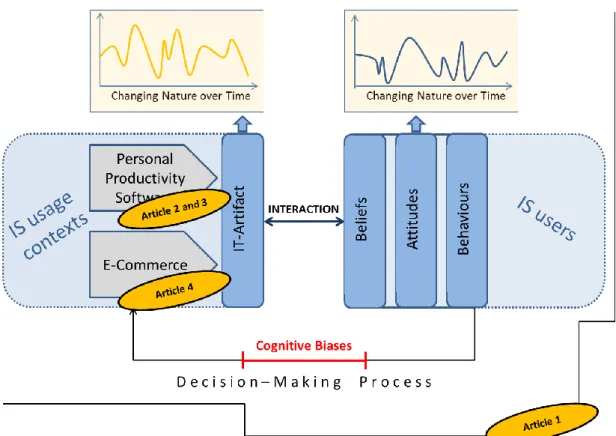
As already discussed, IS contexts are characterized by increasing information abundance. Furthermore, in the course of the omnipresent digitalization of everyday life, like the use of Internet and smartphones, the opportunities for a mass of users for interaction with IS are increasing drastically as well (e.g. Campbell and Park 2008; Wajcman et al. 2008). Whether buying products online or using one app or another, users come nearly every day to decision situations within their interaction with IS - an interaction between users, changing their beliefs, attitudes and behaviors over time and constantly alterable and malleable IS (e.g., Jasperson 2005; Benbasat and Barki 2007). However, the dynamic nature characterizing both – IS users and IS – impedes the predictability of the decision-making process and outcome. This, in turn, provides excellent ground for the closer investigation of cognitive biases, for the instability of a decision context increases the probability of the application of heuristics, and thus the occurrence of cognitive biases (e.g. Kahneman and Tversky 1979; Simon 1990). Figure 1-1 represents the described interplay.
Figure 1-1: Conceptual Overview of the Thesis
Furthermore, the ever-growing competition on commercial market places (Benlian 2015b; Koch and Benlian 2015) and the less time available for customers to make an individual purchase decision makes the ‘e-commerce’ context particularly interesting for research on
cognitive biases. How do customers form their product preferences when processing information heuristically? Which cognitive biases can occur and influence this process? Is it necessary to avoid cognitive biases? Or the other way around, is it expedient to use heuristic cognitive processing and cognitive biases to nudge customers to a purchase decision?
Besides ‘e-commerce’, similarly relevant to research on cognitive biases is the ‘personal productivity software’ context. Users are flooded with information and advertising for various smartphone apps or software programs (e.g. Venkatesh et. al. 2012). This abundance of products and vendors supports heuristic information processing when it comes to which app or software to select, or continue to use. How can software vendors stand out from the competition, being aware of the fact that their customers often do not choose rationally but rather heuristically? Can cognitive biases be a meaningful measure to impact customers’ decisions in the desired direction?
Taken all together, there is a need for more research on cognitive biases in IS (e.g. Browne and Parsons 2012), especially in contexts like ‘personal productivity software’ and ‘e-commerce’. Therefore, after providing a comprehensive picture of the current state of research on cognitive biases in IS, the focus of this thesis further lies in answering the overall
research question of whether, when and how cognitive biases influence IS related users’ decisions in the IS usage contexts ‘personal productivity software’ and ‘e-commerce’:
RQ2: Do cognitive biases influence users’ decisions in the IS usage contexts ‘personal productivity software’ and ‘e-commerce’ and if so how and why?
To investigate this second main research question, two cognitive biases, corresponding to current practices used in IS, are exemplarily chosen: the update-effect (related to post-adoption behavior and, respectively, to the IS usage context ‘personal productivity software’) and the pressure cues limited time and limited product availability (related to purchase behavior and, respectively, to the IS usage context ‘e-commerce’). The update-effect describes a positive user reaction to software updates. Specifically, delivering software features incrementally through updates, during ongoing usage, can increase users’ intentions to continue using the information system. The thesis’ articles not only empirically demonstrate the occurrence of this bias-related effect. They also shed light on the explanatory mechanism behind the update-effect.
Furthermore, limited time (LT) or simply time pressure has been defined as the perceived constriction of the time available for an individual to perform a given task. Time pressure is a form of stress expressed in the perception of being hurried or rushed (Ackerman and Gross 2003; Iyer 1989). This perception triggers and directs subsequent heuristic cognitive processing (Simon 1959). In the ‘e-commerce’ context, heuristic cognitive processing may result in a biased purchase decision. In addition, LPA pressure cues refer to written statements or visual icons attached to products that inform consumers that only a limited number of products are available for purchase. LPA pressure cues are thus considered to be environmental signals that may also induce pressure and heuristic cognitive processing, resulting in a biased decision outcome.
In summary, investigating the role of cognitive biases on users’ continuance and buying decisions is a topic of outstanding practical importance for vendors and online retailers. Specifically, being aware of heuristic cognitive processing and knowing about the potential influence of cognitive biases may help them better understand their clients’ decision-making processes. This in turn may enable software vendors and online retailers to take influence on customers’ decision outcome. Parallel to this economic relevance, understanding the role of cognitive biases on users’ beliefs, attitudes and behaviors, emanating from the interaction with an alterable and malleable IT artifact, is a response to several calls forresearch from IS
scholars (Browne and Parsons 2012; Mann et al. 2008; Benbasat and Zmud 2003; Hevner et al. 2004). Therefore, this dissertation contributes to closing an existing research gap regarding the role of cognitive biases on users’ continuance and buying decisions, both from a theoretical and an empirical perspective.
To contribute answering the thesis’ overall research questions, four empirical studies were conducted published across four articles. The next section is devoted to the thesis research context and principal theories. Following afterwards, the structure of the thesis is presented and summarized.
1.2
Theoretical Foundation
In this chapter, the theoretical foundations of the thesis are presented in order to clarify the fundamental concepts. To do so, the first section 1.2.1 describes the importance of heuristic cognitive processing for the occurrence of cognitive biases and elaborates on how cognitive biases are currently defined and categorized. In section 1.2.2 the concept of software updates and the theory of information systems continuance are introduced. Section 1.2.3 is devoted to the concept of purchase pressure cues (PPCs) and, specifically, to limited time (LT) and limited product availability (LPA). It further provides insights into the role of PPCs as environmental signals within the framework of the stimulus-organism-response (S-O-R) model. Based on these preceding sections, the positioning of the thesis in the research context is presented (section 1.2.4), concluding this chapter.
1.2.1
Heuristic Cognitive Processing and Cognitive Biases
Heuristic cognitive processing was initially studied in cognitive science and psychology. Daniel Kahneman and Amos Tversky (e.g. 1973; 1979) demonstrated how human judgments and decisions may differ from “classical” concepts of rationality. Consequently, they developed prospect theory that more closely corresponds to actual choice behavior. As an alternative to rational choice theories, prospect theory claims that a change of one’s reference point through current experience alters the preference order for prospects. That is, the reference point corresponds to an asset position that one had expected to attain (Kahneman and Tversky 1979). Simon (1990) furthermore emphasizes that a small collection of heuristics “have been observed as central features of behavior in a wide range of problem-solving behaviors where recognition capabilities or systematic algorithms were not available for reaching solutions” (p.10). According to Simon (1990), the prevalence of heuristic search is a
search is an example of rational adaptation to complex task environments that take appropriate account of computational limitations. Thus, Simon (1990) defines heuristics not as optimizing techniques, but as “methods for arriving at satisfactory solutions with modest amounts of computation” (p.11). Moreover, while decision heuristics may or may not alter the
qualities of decision outcomes, biases occur when cognitive abilities limit capacities and culminate in inferior decisions (Haley and Stumpf 1989). That is, cognitive biases are systematic deviations to rationality. “The word ‘systematic’ is important because we often err in the same direction. For example, it is much more common that we surpass our knowledge than underestimate it. A mathematician would speak of a skewed distribution of our mental deficiencies” (Dobelli 2016, p. 2).
Furthermore, over the last decades several cognitive biases like framing, anchoring, the halo effect, social loafing or overconfidence have been identified and described. These cognitive biases have comparatively precise definitions. They have been well investigated in psychology and increasingly in IS research (see Article 1). The fact that each individual has the potential to process information heuristically, however, suggests that there is a potential for new cognitive biases to be “discovered”. Moreover, particular phenomena, already being used in practice, can be “disclosed” as prerequisite for heuristic cognitive processing and, thus, for the occurrence of cognitive biases, yet not being documented or defined.
In addition, to date there are several categorizations of cognitive biases like the ones suggested by Burow (2010), Kahneman et al. (2011), Lovallo and Sibony (2010), Haley and Stumpf (1989) or Browne and Parsons (2012). All these categorizations aim to assign individual cognitive biases to root categories based on their influence on the decision-making process. However, the above mentioned categorizations are not completely consistent and uniform, and not exhaustive as well. Taking into account one of the main purposes of this thesis—presenting a comprehensive overview of research for cognitive biases in IS— an inclusive approach for bias categorization was selected, by integrating the proposed bias categories. A detailed description of each bias category is presented in Article 1.
On the following, in order to better understand the logic of categorizing cognitive biases, the phases of the decision-making process are presented, as suggested by Welford (1965; 1968). In addition, two cognitive biases are exemplarily introduced, considering their definitions, their assignment to individual phases of the decision-making process and their potential to influence IS users’ decision-making.
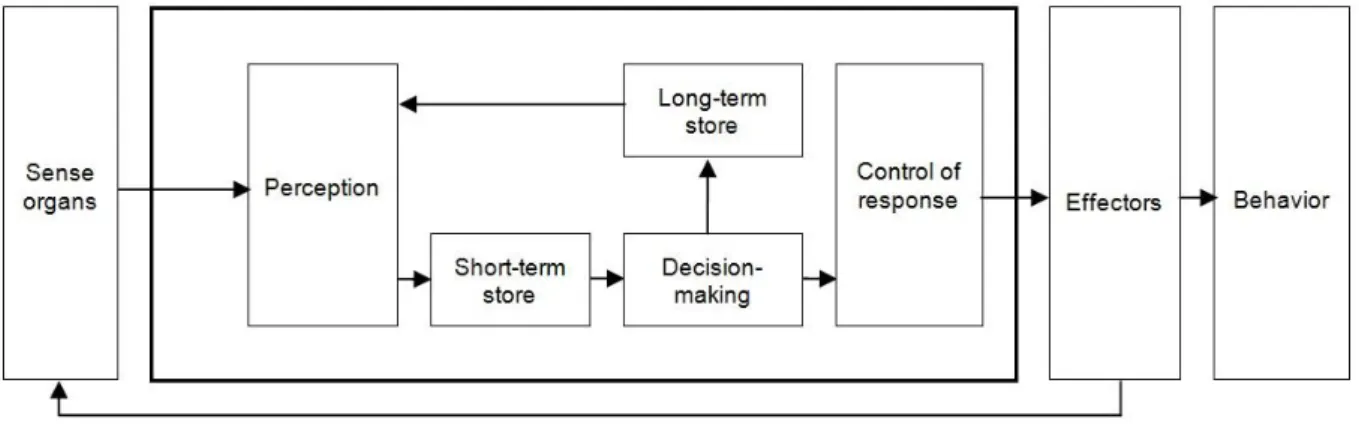
Welford’s (1965, p. 6) model of the human sensory-motor system is known to provide a holistic view on human’s decision-making process (see Figure 1). Due to its comprehensive lens ranging from humans’ perceptions to their actual behaviors, this model allows for identifying the individual stages in this process where various cognitive biases might originate.
Figure 1-2: Decision-making according to Welford’s (1965) Model of the Human Sensory-Motor System
According to Welford’s (1965) model, sense organs receive and transport environmental stimuli, which are subsequently processed at the perception stage. This first processing of information takes place unconsciously. After its perception, information is then stored in the
short-term store before it is utilized for actual decision-making. The information, utilized for the decision-making is on the one hand provided by the short-term store and on the other hand retrieved from the long-term store. Information, which is retrieved from the long-term store, flows through the perception stage into the short-term store, from where it is included into the
decision-making process. After a particular decision has been made, it is stored in the long-term store and at the same time translated into action by the effectors (e.g. hands, organs of speech). However, before a decision is translated into action it has to pass a cognizant, controlling instance, which Welford (1968) labels control of response. Numerous feedback loops between these individual stages can occur. If a decision is translated into action by the
effectors, we can observe actual behavior.
In the context of the decision-making process, Welford (1968) points out two modes of operation of the human mind. On the one hand, there are unfamiliar tasks requiring a lot of cognitive effort in decision-making. On the other hand, there are familiar tasks, which he describes as well-learnt relationships, which enable fast, effortless decision-making. This decision-making is based on relationships that are built into the brain and enable it “to be bypassed for routine actions” (Welford, 1968, p. 18). Remarkably, Wellford’s (1968)
distinction between two modes of operation is in many ways similar to Kahneman’s (e.g. 2011) concept of System 1 and System 2, which he refers to as the explanation for bias formation. Similar to Welford’s (1968) well-learnt relationships, Kahneman’s (e.g. 2011)
System 1 works with little cognitive effort, can provide quick solutions to (familiar) problems, and escapes voluntary control. This takes place by relying on heuristics. System 2, on the other hand, enables complex computations by allocating attention to these more intensive mental activities.
Based on Welford’s (1965) and Kahneman’s (2011) corresponding theoretical understanding of decision-making, the presented model of the human decision-making process (see Figure 1) provides a solid basis for categorizing cognitive biases. In particular, the stages of the core decision-making process from perception to control of response can be the foundation for categorizing biases. For example, inferring from its definition, the saliency bias (e.g. Schenk 2010) should occur at the perception stage in the decision-making model. In case of the
saliency bias, individuals “systematically focus on items or information that is prominent or salient and ignore items or information that is less visible” (Schenk 2010, p. 253). Regarding
IS, the saliency bias may be useful in some cases and impedimental in others. In the ‘e-commerce’ context, for instance, online retailers may consider the saliency bias in their advertising or marketing strategies. Salient items or information on commercial websites may be instrumental in attracting customers’ attention and evoking interest in products and services. On the contrary, in the context of ‘IS management’, IT manager and CIO’s are advised to be aware of the saliency bias when making decisions. In meetings and discussions for example they should not only consider the opinion of very actively participating employees, or information that is prominent at the point of decision-making. They should take into account less known facts and the arguments of more cautious employees as well. Otherwise they may fall into the saliency bias, impeding the quality of their decisions.
Another cognitive bias, relevant to the IS Management context, is the overconfidence bias
(e.g. Van der Vyver 2004). The overconfidence bias is expected to occur at the decision-making stage of this model. In the case of the overconfidence bias, “people are systematically overconfident about the outcomes of their decisions. This effect has been observed in experts and laypeople alike and can be a major impediment to sound decision making” (Van der
Vyver 2004, p. 1894). Overconfidence has been already offered as explanation for severe failures in decision making, like entrepreneurial failures or stock market bubbles (e.g. Glaser and Weber 2007). For the IS Management context this would mean, that it would be
important to sensitize CIO’s for the existence of this bias. This is because “Managers who fall prey to various heuristics and biases [like overconfidence] while making decisions […] are a major source of risk [for good decisions]” (Khan and Stylianou 2009, p. 64). In some cases, it even may be expedient to independently revise a CIO’s decision regarding its potential outcomes, in order to avoid the overconfidence bias.
After presenting the importance of heuristic cognitive processing for the occurrence of cognitive biases and emphasizing the role of cognitive biases for IS users’ decision-making, following next, the main theoretical concepts for the IS usage context ‘personal productivity software’ are presented (1.2.2).
1.2.2
Software Updates and Information Systems Continuance
Software updates have been described as self-contained modules of software. In generally, these are provided to the user for free in order to extend or modify software, while it is already in use (e.g. Dunn 2004). The software engineering literature has repeatedly addressed the concept of software updates (Sommerville 2010). Software release planning, software maintenance and evolution, and software product lines can be introduced here by way of example (Svahnberg et al. 2010; Shirabad et al. 2001; Weyns et al. 2011).
Moreover, software updates can be categorized in two basic types: feature updates and non-feature updates (e.g. Microsoft 2015). Via non-feature updates, core functionality can be added to or removed from the original software version. While feature updates directly affect users’ interaction with the software by changing its core functionality, technical non-feature updates only correct system flaws. Because non-feature updates change software properties that are not directly related to its core functionality, they do not directly affect the users’ interaction with the software (Popovic et. al. 2001).
Furthermore, to better understand users’ reactions on software updates, it is necessary to take a closer look on the existing post-adoption literature. Regarding the importance of the software post adoption phase, Bhattacherjee (2001, p.351-352) emphasizes that “while initial acceptance of IS is an important first step toward realizing IS success, long-term viability of an IS and its eventual success depend on its continued use rather than first-time use.”
Therein, Jasperson et al. (2005) criticize that researchers often define post-adoptive use of an IS as increasing, as individuals gain experience in using the IS. However, in reality, post-adoptive behaviors may also diminish or change over time. The various features of an IS may be treated with indifference or used in a limited fashion (Jasperson et al. 2005). These are
alterations, originating from changes in users’ beliefs, attitudes and behaviors over the time (Benlian 2015a). The change in post-adoptive behaviors may also be a result of the dynamic nature of the IS itself that is constantly modified, for example, via software updates. Or it may originate from the interaction between changing users’ attitudes and changing IS. Kim and Malhotra (2005), Kim (2009), Ortiz de Guinea and Markus (2009) and Ortiz de Guinea and Webster (2013), for instance, have provided research evidence in this direction.
In order to explore users’ intentions to continue or discontinue using an IS, Bhattacherjee (2001) adopts expectation-confirmation theory (ECT). Later on, ECT has been successfully applied in several IS contexts like software-as-a-service (e.g. Benlian et al. 2011), mobile data services (e.g. Kim 2010), e-learning (e.g. Lee 2010) or knowledge creation in online communities (e.g. Chou et al. 2010), to name just a few. In ECT users’ expectations are referred to as relative, subjective reference point or baseline (e.g. Helson 1964). Bhattacherjee’s (2001) IS continuance model thus suggests that users compare their perception of the IS performance during actual usage with their pre-usage expectations. If perceived performance exceeds the users’ expectations-baseline, they are positive disconfirmed, that in turn increases their PU and SAT regarding the IS. Building on Bhattacherjee’s (2001) model that has a static perspective on the IS continuance setting, Bhattacherjee and Premkumar (2004) introduced a more dynamic perspective, showing that beliefs and attitudes change during the ongoing usage of an IS as well (Kim and Malhotra 2005). While this dynamic perspective already provides valuable insights into the drivers of post-adoption behavior, it still neglects the previously discussed changing and malleable IT artifact’s nature. Therefore, one of the central research goals of this thesis is to address both - the dynamic nature of IS users and of IS itself, during ongoing IS usage.
After presenting the main theoretical concepts of the IS usage context ‘personal productivity software’, following next 1.2.3 introduces the theoretical foundations for the ‘e-commerce’ context. Specifically, the purchase pressure cues ‘limited time’ and ‘limited product availability’ are described. Furthermore, their importance as environmental stimuli is discussed against the background of the stimulus-organism-response (S-O-R) model.
1.2.3
Purchase Pressure Cues and the Stimulus-Organism-Response Model
The retail and commerce sector has recognized the potential of pressure situations to stimulate positive purchase decisions for decades (e.g., Dawar and Parker 1994; Inman et al. 1990; Lynn 1991; Zhu et al. 2012). To create such pressure environments, marketers often use
pressure cues also called “persuasion claims” (Jeong and Kwon 2012). In the following, the role of constrictions in time (also Limited Time or Time Pressure) and product availability (Limited Product Availability) on users’ purchase decisions is presented, as discussed in the marketing literature. The S-O-R model is further introduced as a theoretical framework to explain the role of PPCs for online purchase decisions.
Decision making under time pressure is a ubiquitous phenomenon of many people’s daily lives. Time is considered one of the primary resources upon which decision making and choice draw. Taking into account that the quality of decision making depends heavily on time, requiring individuals to make decisions within a limited time frame may create pressure and stress for them. That is, time pressure may increase the level of arousal and psychological stress. Furthermore, when the level of stress is very high, an individual may make decisions without generating all the available alternatives. Consequently, a decrease in human judgment’s accuracy and an increase in the likelihood of heuristic processing can be observed, aiming to simplify the cognitive task (Ahituv et al. 1998). In addition, time pressure increases the weight placed on the more meaningful and salient features and in particular may increase the attention devoted to negative information (Dhar and Nowlis 1999). This suggests that LT pressure cues could have a positive effect on consumer choice behavior because they represent negative information, i.e. the product is soon no longer available. Moreover, investigating LT pressure cues as environmental signals in the marketing field, most attention have been paid to the offline in-store context (e.g., time-limited sales promotions, discounts, or coupons). However, LT pressure cues are a widespread phenomenon in the online retail context as well. Despite their prevalence in the online commercial environment, only few studies in IS research have investigated the effects of time pressure on users’ decision behavior. While those few studies have focused on user reactions in non-commercial environments (Eckhardt et al. 2013; Marsden et al. 2006), there is still a lack of research on the role of LT pressure cues for affecting consumers’ buying decisions on commercial websites.
Furthermore, consumers tend to place higher value on objects they own, compared to objects they do not own. They tend to evaluate a product they possess more positively even before actual ownership or consumption. Therefore, if consumers once possess an object, even temporarily as with in-store hoarding, the prospect of losing it is framed as a relatively large loss (e.g. Byun and Sternquist 2012; Kahneman and Tversky 1979). In addition, commodity theory (Brock 1968) suggests that the value of a commodity will increase to the extent that it
is perceived as being unavailable. Drawing on this theory, people may desire scarce commodities more strongly than comparable available products (Byun and Sternquist 2012). In online settings however the availability of a product cannot be guaranteed until an actual transaction occurs. The generalizability of the positive effects of LPA on users’ purchase decisions (Byun and Sternquist 2012) for the ‘e-commerce’ context is, thus, restricted. Moreover, suspicion of firms’ manipulative intent results in resistance to persuasion, leading to less favorable brand or vendor attitudes. Some message cues make manipulative intent more salient than others do (Kirmani and Zhu 2007). The assessment of product availability
in online shopping environments, for instance, is more restricted than the assessment of the
time available for a product purchase. Consumers may therefore consider LPA pressure cues rather as a marketer’s manipulative tactic, and consequently waive the purchase. Considering the inconsistent findings in offline and online environments, Jeong and Kwon (2012) call for further research clarifying the role of LPA pressure cues in online commercial contexts. Additionally, in order to explain how websites’ features may affect consumers’ internal preferential choice processes and the resulting choice behaviors, several IS studies drew on the Stimulus-Organism-Response (S-O-R) model from environmental psychology (Parboteeah et al. 2009; Xu et al. 2014). Belk (1975) defines stimuli as contextual cues external to the consumer that determine consumer’s responses. In the ‘e-commerce’ setting, examples for stimuli are the product display, reccommendation systems and online store’s visual design (e.g. Jacoby 2002; Xu et al. 2014). Organism represents the cognitive and emotional reactions of the consumer to the stimuli on commercial websites. These intervening processes finally lead to behavioral or internal response. Behavioral response refers to actual acquisition of products or services. Internal response is expressed as formation or change in beliefs and attitudes regarding product brands and online providers (Mehrabian and Russell 1974). Consequently, considering PPCs as environmental signals, S-O-R seems to be an appropriate theoretical framework for investigating their effects on users’ purchase behavior in the ‘e-commerce’ context.
1.2.4
Positioning of the Thesis
While the concept and resulting insights on cognitive biases have been around for more than 40 years now (Tversky and Kahneman 1974), research on cognitive biases in IS has remained comparatively sparse. Consequently, there are several calls for research in this direction (e.g. Browne and Parsons 2012). Specifically, there is to date no comprehensive literature review on cognitive biases in IS, on which authors could build their work upon. Furthermore, in well investigated areas of IS like IS usage, there is also still little understanding of the user’s perspective on interacting with an IT artifact, as well as the role of cognitive biases within this interaction. In particular, the behavioral dimension, i.e. how an IT artifact is perceived by users, is still an area that has so far received only minimal research attention (Hong et al. 2011; Sandberg and Alvesson 2011; Benlian et al. 2012a). In the thesis’ conceptual framework, the introduced research gaps (see Figure 1-1) are addressed and several calls for research from IS scholars who criticize the negligence of the IT artifact’s role in IS research (Benbasat and Zmud 2003; Hevner et al. 2004; Orlikowski and Iacono 2001) are considered. In summary, on the one hand, this thesis yields insights regarding the influence of cognitive biases on IS related users’ decisions, by focusing on the IS usage contexts ‘personal productivity software’ and ‘e-commerce’. On the other hand, it elaborates on the potential reasons explaining their influence.
Furthermore, regarding both cognitive bias-phenomena investigated in this thesis – the
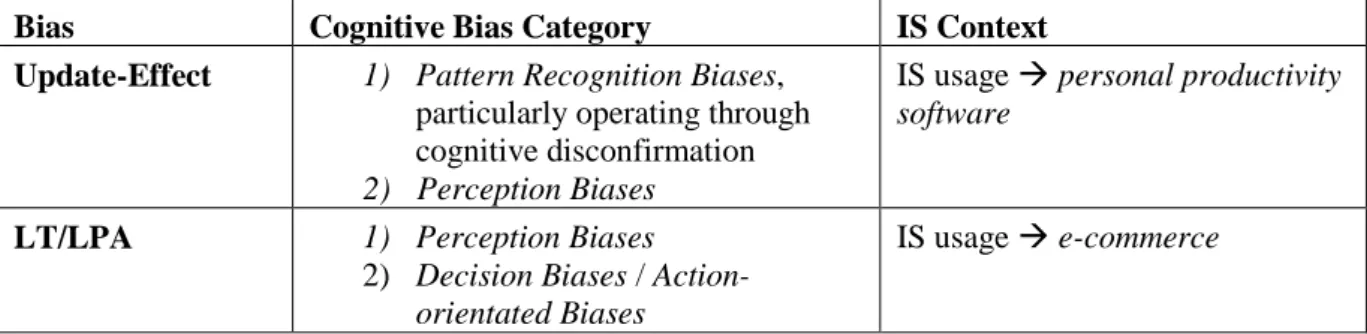
update- effect and the purchase pressure cues LT and LPA, Table 1-1 provides an overview of their assignment to bias category and IS research context respectively. The particular IS context originates from their application in the IS practice and can be clearly defined. On the contrary, their assignment to a cognitive bias category is a quite ambiguous task, for these cognitive bias-phenomena may take influence on different phases of the decision-making process. Considering the bias category descriptions discussed in article 1, however, the categorization in Table 1-1 seems to be the most plausible one.
Table 1-1: Bias Category and IS Context of the Cognitive Bias Phenomena Included in the Thesis
Bias Cognitive Bias Category IS Context Update-Effect 1) Pattern Recognition Biases,
particularly operating through cognitive disconfirmation
2) Perception Biases
IS usage personal productivity
software
LT/LPA 1) Perception Biases
2) Decision Biases / Action-orientated Biases
1.3
Structure of the Thesis
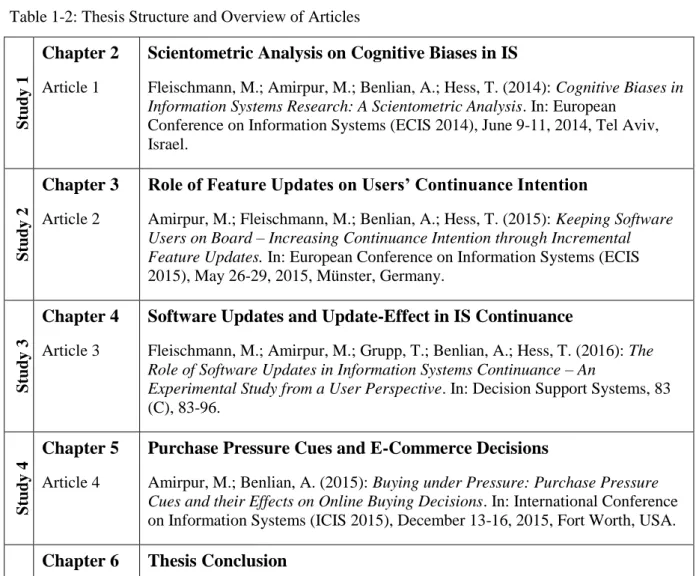
In order to contribute to the principal research questions of the thesis, four studies were conducted, published across four scientific articles, which investigate the role of cognitive biases for IS-related users’ decisions with different foci. The overall thesis is organized into six chapters. Following the introductory chapter, chapters 2 to 5 present the four published articles. These articles were slightly revised in order to achieve a consistent layout throughout the thesis. Chapter 6 concludes the thesis with a summary of key findings, contributions, limitations and opportunities for future research. Table 1-1 shows an overview of the chapters and articles.
Table 1-2: Thesis Structure and Overview of Articles
Study 1
Chapter 2 Article 1
Scientometric Analysis on Cognitive Biases in IS
Fleischmann, M.; Amirpur, M.; Benlian, A.; Hess, T. (2014): Cognitive Biases in
Information Systems Research: A Scientometric Analysis. In: European Conference on Information Systems (ECIS 2014), June 9-11, 2014, Tel Aviv, Israel.
Study 2
Chapter 3 Article 2
Role of Feature Updates on Users’ Continuance Intention
Amirpur, M.; Fleischmann, M.; Benlian, A.; Hess, T. (2015): Keeping Software
Users on Board – Increasing Continuance Intention through Incremental Feature Updates. In: European Conference on Information Systems (ECIS 2015), May 26-29, 2015, Münster, Germany.
Study 3
Chapter 4 Article 3
Software Updates and Update-Effect in IS Continuance
Fleischmann, M.; Amirpur, M.; Grupp, T.; Benlian, A.; Hess, T. (2016): The
Role of Software Updates in Information Systems Continuance – An
Experimental Study from a User Perspective. In: Decision Support Systems, 83 (C), 83-96.
Study 4
Chapter 5 Article 4
Purchase Pressure Cues and E-Commerce Decisions
Amirpur, M.; Benlian, A. (2015): Buying under Pressure: Purchase Pressure
Cues and their Effects on Online Buying Decisions. In: International Conference on Information Systems (ICIS 2015), December 13-16, 2015, Fort Worth, USA. Chapter 6 Thesis Conclusion
Additionally, Figure 1-3 presents an overview of the main content emphasis examined in the research articles and shows how they are positioned in the overall research context.
Figure 1-3: Overview of the Main Content Emphasis Examined in the Research Articles
Following the introductory chapter that presents motivation, research questions, theoretical foundations and positioning of the thesis, the main focus of chapter 2 (article 1) is to provide a first literature review of research on cognitive biases in IS, using a scientometric analysis. This study reveals research gaps and highlights common practices regarding the measurement of cognitive biases. It constitutes the foundation of this thesis and to great extent substantiates the subjects of investigation for the following research studies. Moreover, the first research area of the thesis – ‘personal productivity software’ – is represented by articles 2 and 3 (chapters 3 and 4). They disclose the role of software updates for IS continuance decisions, as well as crucial boundary conditions for the identified update-effect, like update type and update frequency. The second research area – ‘e-commerce’- is elicited by article 4 (chapter 5), which is focused on the role of purchase pressure cues in influencing consumers’ online buying decisions and the potential reasons thereof. Finally, chapter 6 concludes the thesis with a summary of key findings, contributions, limitations and opportunities for future research. Following next, each chapter (i.e., article) is briefly summarized, including the main motivation and contributions to the research questions, as well as the linkages between the articles. Given that the articles and corresponding studies were written and conducted with co-authors, first person plural (i.e., “we”) is used throughout the thesis when applicable.
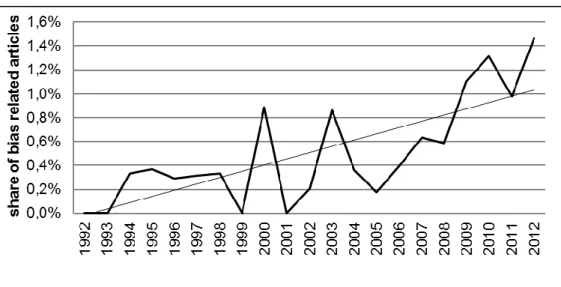
Chapter 2 (Article 1): The phenomenon of cognitive biases has been explored since the mid-seventies in psychology, but its potential to influence IS users’ decision-making only recently gained attention among IS researchers. Consequently, there is still a comparatively sparse set of mostly disconnected publications, sometimes using inconsistent terminology and methodology. The purpose of the first article is to address this issue by providing a comprehensive picture of the current state of research on cognitive biases in IS. Therefore we conducted a systematic literature review – a scientometric analysis – of 12 top IS outlets, covering the time period between 1992 and 2012. We identified 84 publications related to cognitive biases. A subsequent content analysis shows a strong increase of interest in cognitive bias research in the IS discipline in the observed timeframe, yet uncovering a highly unequal distribution across IS fields and industry contexts. With regard to IS fields, the most widely examined category is IS usage with the clusters ‘e-commerce’ and ‘personal
productivity software’. Given this fact and considering its practical relevance, outlined in the introductory chapter, the field IS usage further determines the research domain of this thesis. In addition, we found that the most commonly examined cognitive bias categories are
perception and decision biases. This was a reason to choose cognitive bias-phenomena for further investigation that can be classified in these two bias categories (see Table 1-1). To summarize, the first article is a constituting element of this thesis, for its results build the foundation and determine the direction of the whole thesis. This article mainly contributes to answering the first overall research question RQ1.
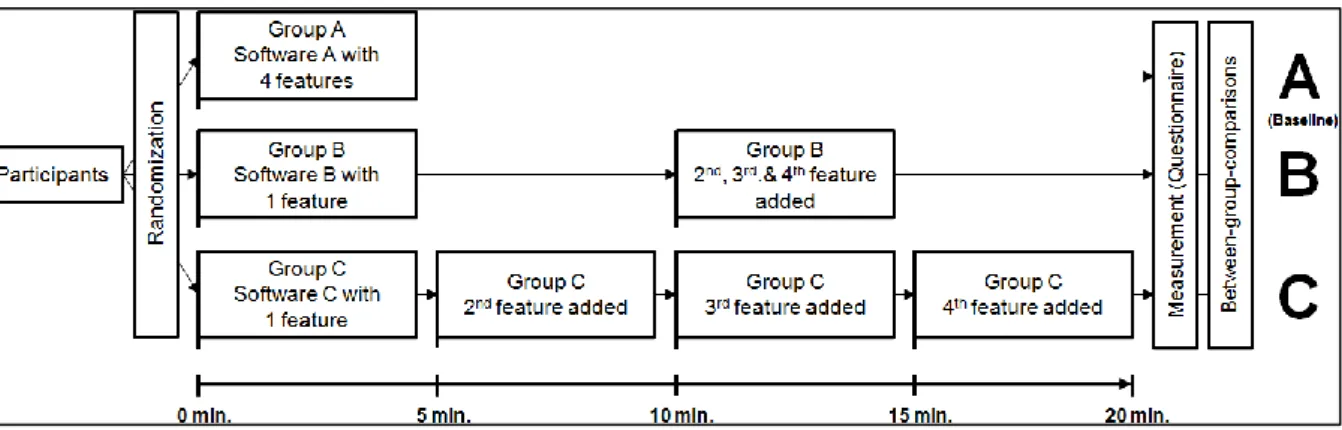
Chapter 3 (Article 2): The study presented in the second article of the thesis is concerned with the effects of feature updates on users’ CI. Drawing on expectation-confirmation theory (ECT) and the IS continuance model (Bhattacherjee 2001), it is plausible to assume that perceived positive disconfirmation during software use will increase users’ CI regarding the updated software. In the context of software features, ECT implies that positive disconfirmation from feature updates depends on a relative change in functionality, compared to a user’s subjective reference point (the initial configuration of the software), rather than an absolute change (Helson 1964; Oliver 1980). Consequently, if some features of the initial software version are simply held back and subsequently delivered through updates, they are likely to elicit positive disconfirmation and thus a biased product perception and evaluation. The results of a controlled laboratory experiment could confirm a positive effect of feature updates on users’ CI. They however also revealed a crucial boundary condition to this effect – update frequency, showing that CI diminishes when the number of updates exceeds a tipping point in a given timeframe. This study therefore contributes to answering the overall research
question RQ2 by showing whether and how the common practice of delivering feature updates influence users’ IS continuance intentions. Given that in article 2 we focus only on
feature updates, disclosing update frequency as one crucial boundary condition, in article 3 we expand the examination field, including feature as well as non-feature updates, thus providing an additional moderator to the update-effect - software type.
Chapter 4 (Article 3): Article 3 analyzes how the granularity of software and its changes through software updates, i.e. feature and non-feature updates, influence the fluctuation of users’ beliefs, attitudes, and behaviors over time. First, the results of a laboratory experiment show that while feature updates increase users’ continuance intentions – the so-called update-effect, technical non-feature updates (e.g. bug fixes) have no effect on the intention to continue using the software. Second, the study provides evidence that users prefer the delivery of features in individual updates over a delivery in larger but less frequent update packages comprising several features. Third, article 3 contributes to opening up the theoretical black box of how software updates influence IS continuance intention by highlighting the complementary roles of cognition and affect for the occurrence of the update-effect. Consequently, this study contributes largely to research question RQ2, underlining and extending the results of article 2. It not only demonstrates the differential effects of feature and non-feature updates on users’ continuance intention. Its results also emphasize the interplay of rational and emotional component in explaining the bias-driven update-effect. Chapter 5 (Article 4): The research studies presented in articles 2 and 3 provide insights into the role of biased decision making in the IS usage context ‘personal productivity software’, as
well as the potential reasons thereof. The study described in article 4 further contributes to RQ2 by demonstrating another example for the effect of cognitive biases on users’ decision making in the IS usage context ‘e-commerce’. Although purchase pressure cues (PPC) that
signal limited time (LT) or limited product availability (LPA) are widely used features on commercial websites to boost sales (Benlian 2015), research on whether and why PPCs affect consumers’ purchase choice in online settings has remained largely unexplored (e.g. Jeong and Kwon 2012). The results of a controlled laboratory experiment with 121 subjects in the context of Deal-of-the-Day (DoD) platforms show that while LT pressure cues significantly increase deal choice, LPA pressure cues have no distinct influence on it. Furthermore, the study’s results demonstrate that perceived stress and perceived product value serve as two serial mediators explaining why LT pressure cues affect deal choice. Complementary to these results, we could also show that higher perceived stress is accompanied by significant changes
in consumers’ physiological arousal. As such, the article contributes to research question
RQ2, showing how and why purchase pressure cues provoke biased purchase decisions in the ‘e-commerce’ context.
In addition to the articles included in the thesis, the following articles were also published during my time as a PhD candidate within the thesis’ project, which are, however, not part of the thesis:
Fleischmann, M.; Grupp, T.; Amirpur, M.; Benlian, A.; Hess, T. (2015): When Updates Make a User Stick: Software Feature Updates and their Differential Effects on Users’ Continuance Intentions. In: International Conference on Information Systems (ICIS 2015), December 13-16, 2015, Fort Worth, USA.
Fleischmann, M.; Grupp, T.; Amirpur, M.; Hess, T.; Benlian, A.: Gains and Losses in Functionality – An Experimental Investigation of the Effect of Software Updates on Users’ Continuance Intentions. In: International Conference on Information Systems (ICIS 2015), December 13-16, 2015, Fort Worth, USA. Based on the established basic theoretical background and considering Figure 1-2, the following chapters 2 to 5 present the aforementioned articles.
2
Article 1: Scientometric Analysis on Cognitive Biases
in IS
Titel: Cognitive Biases in Information Systems Research: A Scientometric Analysis (2014)
Authors: Fleischmann, Marvin, Ludwig-Maximilians-Universität München, München, Germany
Amirpur, Miglena, Technische Universität Darmstadt, Darmstadt, Germany Benlian, Alexander, Technische Universität Darmstadt, Darmstadt,
Germany
Hess, Thomas, Ludwig-Maximilians-Universität München, München, Germany
Published in: European Conference on Information Systems (ECIS 2014), June 9-11, 2014, Tel Aviv, Israel.
Abstract
Human cognition and decision-making related to information systems (IS) is a major area of interest in IS research. However, despite being explored since the mid-seventies in psychology, the phenomenon of cognitive bias has only recently gained attention among IS researchers. This fact is reflected in a comparatively sparse set of mostly disconnected publications, sometimes using inconsistent theory, methodology, and terminology. We address these issues in our scientometric analysis by providing the first review of cognitive bias-related research in IS. Our systematic literature review of 12 top IS outlets covering the past 20 years identifies 84 publications related to cognitive bias. A subsequent content analysis shows a strong increase of interest in cognitive bias research in the IS discipline in the observed timeframe, yet uncovers a highly unequal distribution across IS fields and industry contexts. While previous research on perception and decision biases has already led to valuable contributions in IS, there is still considerable potential for further research regarding social, memory and interest biases. Our study reveals research gaps in bias-related IS research and highlights common practices in how biases are identified and measured. We conclude with promising future research avenues with the intent to encourage cumulative knowledge-building.
2.1
Introduction
Human decision-making is one of the