Virginia Commonwealth University Virginia Commonwealth University
VCU Scholars Compass
VCU Scholars Compass
Theses and Dissertations Graduate School
2019
Electric Load Forecasting Using Long Short-term Memory
Electric Load Forecasting Using Long Short-term Memory
Algorithm
Algorithm
Tianshu YangFollow this and additional works at: https://scholarscompass.vcu.edu/etd
Part of the Electrical and Electronics Commons, and the Power and Energy Commons
© The Author
Downloaded from Downloaded from
https://scholarscompass.vcu.edu/etd/6027
This Thesis is brought to you for free and open access by the Graduate School at VCU Scholars Compass. It has been accepted for inclusion in Theses and Dissertations by an authorized administrator of VCU Scholars Compass. For more information, please contact [email protected].
Electric Load Forecasting Using Long
Short-term Memory Algorithm
A dissertation submitted in partial fulfillment of the requirements for the degree of Master of Philosophy at Virginia Commonwealth University
By Tianshu Yang
M.S in Electrical Engineering
Advisor: Zhifang Wang, Ph.D.
Associate Professor, Department of Electrical and Computer Engineering
Virginia Commonwealth University Richmond, Virginia
Acknowledgment
I want to recognize Professor Zhifang Wang for her support and help throughout the study, which enabled me to understand the principles and operations of the entire model more thoroughly and to implement this project. Her support and help are that I better use software to model and optimize theoretical principles to improve and achieve satisfactory results and data.
I would also like to thank Dr. Motai and Dr. Thang Dinh, who agreed to be a member of this committee.
Table of Contents
ACKNOWLEDGMENT ... 4
ABSTRACT ... 9
1.1 APPLICATION OF LOAD FORECASTING ... 10
1.2BASIC METHOD OF LOAD FORECASTING ... 11
1.2.1 Neural network method ... 11
1.2.2 Time series method ... 11
1.2.3 Regression analysis ... 12 1.3 MOTIVATION OF THE LSTM ... 12 1.4 CHALLENGES OF THE LSTM ... 13 A. hardware acceleration ... 13 B. Vanishing gradients ... 13 1.5 CONTRIBUTIONS ... 13 2 DEEP LEARNING ... 15 2.1 PERCEPTRON ... 16 2.2LINEAR UNIT ... 16
2.3 SUPERVISED LEARNING AND UNSUPERVISED LEARNING ... 17
2.4 THE OBJECTIVE FUNCTION OF A LINEAR UNIT ... 17
2.5GRADIENT DESCENT OPTIMIZATION ALGORITHM ... 19
2.5.1 Derivation of ∇E(w) ... 20
2.6 STOCHASTIC GRADIENT DESCENT, SGD ... 21
3 ARTIFICIAL NEURAL NETWORK ... 23
3.1 NEURONS ... 25
3.2CALCULATE THE OUTPUT OF THE NEURAL NETWORK ... 26
3.3 BACK PROPAGATION ... 28
3.4 DERIVATION OF THE BACKPROPAGATION ALGORITHM ... 30
3.4.1 Output layer weight training ... 32
4 RECURRENT NEURAL NETWORK ... 35
4.1 BASIC RECURRENT NEURAL NETWORK ... 35
4.2 TRAINING ALGORITHM FOR RECURRENT NEURAL NETWORKS: BPTT ... 36
5 LONG SHORT-TERM MEMORY NETWORK ... 43
5.1FORWARD CALCULATION OF LSTM ... 44 5.1.1 Forgotten gate ... 45 5.1.2 Input gate ... 46 5.1.3 Output gate ... 48 5.1.4 Final output ... 49 6 TRAINING OF THE LSTM ... 50
6.1 TRAINING PROCESS OF LSTM IN MATLAB ... 50
6.1.1 Initial Weights and Biases ... 51
6.1.2 Initial learning rate ... 51
6.2 TRAINING PROCESS RESULTS ... 51
7 PREDICT RESULTS ... 56
7.1 PREDICT AND UPDATE STATE ... 56
7.1.1 PREDICT BY THE TRAINING MODEL ... 56
7.2 CONCLUSION OF THE PREDICT RESULT ... 62
8 CONCLUSION AND FUTURE WORK ... 63
List of Figures
FIGURE1. STRUCTURE OF THE NEURAL NETWORK ... 15
FIGURE 2. STRUCTURE OF PERCEPTRON ... 16
FIGURE 3. STRUCTURE OF THE LINEAR UNIT ... 16
FIGURE 4. OPTIMIZATION OF GRADIENT DESCENT ... 19
FIGURE 5. DIFFERENCE BETWEEN SGD AND BGD. ... 22
FIGURE 6. FULL CONNECTED NEURAL NETWORKS ... 24
FIGURE 7. STRUCTURE OF A NEURON ... 25
FIGURE 8. SIGMOID FUNCTION ... 26
FIGURE 9 NEURAL NETWORK ... 27
FIGURE 10. NEURAL NETWORK ... 29
FIGURE 11. NEURAL NETWORK ... 31
FIGURE 12. RECURRENT NEURAL NETWORK ... 35
FIGURE 13. RECURRENT LAYER ... 36
FIGURE 14 RECURRENT LAYER ... 40
FIGURE 15. TRANSMISSION IN LSTM ... 44
FIGURE 16. CALCULATION OF THE FORGOTTEN GATE ... 46
FIGURE 17. CALCULATION OF 𝒊𝒕 IN THE INPUT GATE ... 46
FIGURE 18. CALCULATION OF 𝒄𝒕 IN THE INPUT GATE ... 47
FIGURE 19. CALCULATION OF 𝒄𝒕 IN THE INPUT GATE ... 48
FIGURE 20. CALCULATION OF THE OUTPUT GATE ... 49
FIGURE 21. CALCULATION OF THE FINAL OUTPUT ... 49
FIGURE 22. TRAINING PROCESS WITH LEARNING RATE 0.001 ... 52
FIGURE 24. TRAINING PROCESS WITH LEARNING RATE 0.1 ... 53
FIGURE 25. TRAINING PROCESS WITH TIME STEPS SIZE IS 50 ... 54
FIGURE 26. TRAINING PROCESS WITH TIME STEPS SIZE IS 300 ... 55
FIGURE 27. TRAINING PROCESS WITH TIME STEPS SIZE IS 600 ... 55
FIGURE 28. PREDICT RESULT WHICH UPDATE STATE WITH PREDICT DATA ... 57
FIGURE 29. PREDICT RESULT WITH LEARNING RATE 0.001 ... 58
FIGURE 30. PREDICT RESULT WITH LEARNING RATE 0.01 ... 58
FIGURE 31. PREDICT RESULT WITH LEARNING RATE 0.1 ... 59
FIGURE 32. PREDICT RESULT WITH TIME STEPS SIZE IS 50 ... 60
FIGURE 33. PREDICT RESULT WITH TIME STEPS SIZE IS 150 ... 60
FIGURE 34. PREDICT RESULT WITH TIME STEPS SIZE IS 300 ... 61
FIGURE 35 PREDICT RESULT WITH TIME STEPS SIZE IS 600 ... 61
FIGURE 36 SUMMARY OF PREDICT RESULT WITH TIME STEPS SIZE ... 62
FIGURE 37 SUMMARY OF PREDICT RESULT WITH INITIAL LEARNING RATE ... 62
List of Tables
TABLE 1 SUMMARY OF PREDICT RESULT WITH INITIAL LEARNING RATE 62 TABLE 2 SUMMARY OF PREDICT RESULT WITH TIME STEPS SIZE ... 62Abstract
Power system load forecasting refers to the study or uses a mathematical method to process past and future loads systematically, taking into account important system operating characteristics, capacity expansion decisions, natural conditions, and social impacts, to meet specific accuracy requirements. Dependence of this, determine the load value at a specific moment in the future. Improving the level of load forecasting technology is conducive to the planned power management, which is conducive to rationally arranging the grid operation mode and unit maintenance plan, and is conducive to formulating reasonable power supply construction plans and facilitating power improvement, and improve the economic and social benefits of the system.
At present, there are many methods for load forecasting. The newer algorithms mainly include the neural network method, time series method, regression analysis method, support vector machine method, and fuzzy prediction method. However, most of them do not apply to long-term time-series predictions, and as a result, the prediction accuracy for long-term power grids does not perform well.
This thesis describes the design of an algorithm that is used to predict the load in a long time-series. Predict the load is significant and necessary for a dynamic electrical network. Improved the forecasting algorithm can save a ton of the cost of the load. In this paper, we propose a load forecasting model using long short-term memory(LSTM). The proposed implementation of LSTM match with the time-series dataset very well, which can improve the accuracy of convergence of the training process. We experiment with the difference time-step to expedites the convergence of the training process. It is found that all cases achieve significant different forecasting accuracy while forecasting the difference time-steps.
1 Introduction
Electric load forecasting has become one of the required fields in power engineering. The desirable forecast method can achieve satisfactory forecasting accuracy without high computation cost. Load forecasting can maintain the safety and stability of the grid operation, reduce the unnecessary rotating reserve capacity, and rationally arrange the unit maintenance plan. To ensure the average production and life of the society, effectively reduce the cost of power generation, and improve economic and social benefits
The results of load forecasting can also help determine the installation of new generator sets in the future, determine the size, location and time of installed capacity, determine the capacity expansion and reconstruction of the power grid, and determine the construction and development of the power grid.
Therefore, the level of power load forecasting work has become one of the significant indicators to measure whether an electrical network system management is modernizing. Power load forecasting has become an important and arduous task to solve the problem of electricity management.
In this paper, we pay attention to solving the problem to deal with the long-time data forecasting in the electrical network. We try to find a new Neural network algorithm that can give a higher forecasting accuracy in a long time sequence.
1.1 application of load forecasting
Load forecasting (electric load forecasting, power demand forecasting). Although "load" is a vague term, in load forecasting, "load" usually means demand (in kW) or energy (in kWh), and because the power and energy of the hourly data are the same, Therefore, it is usually not necessary to distinguish between demand and energy. Load forecasting involves accurate prediction of size and geographic location at different times during the planning period. The necessary amount of interest is usually the total system (or area) load per hour. However, load forecasting also involves hourly, daily, weekly, and monthly load and peak load forecasts.
Load forecasting is a technique used by electricity or energy supply companies to predict the power/energy needed to satisfy demand and supply equilibrium. The accuracy of the
forecast is essential to the operational and management of the load in a utility electrical network.
Load forecasting has long been considered the initial building block for all utility planning efforts, and it will decide the expected future energy sales and peak demand. The benefits of reasonable and accurate load forecasts are not only manifested in the economic field but also bring positive benefits to the development of the whole society. Therefore, the method of load forecasting is becoming more and more popular, and new methods are continually being put into use and continuously be improved.
1.2 Basic method of load forecasting
Due to various factors such as weather changes, social activities and festival types, the load appears as a non-stationary random process in time series, but most of the factors affecting system load have regularity, to achieve effective prediction. Foundation. In order to predict the load better, people use many methods to increase the accuracy of the short-term load. The newer algorithms mainly include the neural network method, time series method, regression analysis method, support vector machine method, and fuzzy prediction method[2]. The core problem of power load forecasting research is how to use existing historical data to establish a predictive model to predict the load value in future time or period. Therefore, the reliability of historical data information and prediction model are the central factors that affect load forecasting accuracy.
1.2.1 Neural network method
The neural network method is currently the most advanced load forecasting method. The application of neural network method in load forecasting is mainly divided into an artificial neural network (ANN) and recurrent neural network (also known as a recurrent neural network, referred to as RNN). Among them, RNN is an algorithm that works better than ANN. LSTM is an advanced neural network algorithm, and we will discuss its technical details in the following sections.[2]
1.2.2 Time series method
The historical data of the power load is an ordered set of samples and records at regular intervals is a time series. The time series method is based on historical data of load by using
a mathematical model describing the change of electrical load. Based on the model, establish the expression of the load forecast, and predict the future load.
The model has high requirements for the stationarity of the original time series, and is only suitable for short-term predictions with uniform load changes; If this model meets instability factors such as weather, holidays, the predicted result will have a huge error. 1.2.3 Regression analysis
The regression analysis prediction method is based on the change rule of historical data and the factors affecting the load change, find the correlation between the independent variable and the dependent variable; get its regression equation, determine the model parameters; and predict the load value at the later time.
The shortcomings are that the historical data is relatively high, and the linear method is used to describe the complicated problems. The structural form is too pure, and the precision is not excellent. The model cannot describe various factors affecting the load in detail. The model's initialization is complicated and needs abundant Experience and skills.
1.3 motivation of the LSTM
The emergence of RNNs is mainly because they can link the previous information to the present and solve the current problems. For example, using the previous screen can help us understand the content of the current screen. If RNNs can do this, then it is helpful for our mission.
Sometimes, when we are dealing with the current task, we only need to look at some of the more recent information. When need to predict a sentence word while it only has tens of letter, the RNN will be okay. However, while the number of the letter increasing to hundreds or thousands, the predicted error will increase fast. As the interval between prediction information and related information increases, it is difficult for RNNs to associate them.
In theory, RNNs can link such long-term dependencies ("long-term dependencies") and solve such problems by choosing the right parameters. However, unfortunately, in practice, RNNs can't solve this problem.
However, fortunately, LSTMs can help us solve this problem. The LSTM algorithm is a neural network algorithm used to predict long-term time series. It can significantly improve
the gradient explosion and gradient disappearance of neural network algorithms in the face of long time series data.[1]
1.4 challenges of the LSTM
A. hardware acceleration
A big problem with LSTM is that training them requires very high hardware. Also, it still requires many resources when we do not need to train these networks quickly. Running these models in the same cloud also requires a lot of resources. Training the nightmare of LSTM, LSTM training is difficult because they require storage bandwidth binding calculations, which is the worst nightmare for hardware designers and ultimately limits the applicability of neural network solutions. In short, LSTM requires four linear layers per unit to run in each sequence time step. Linear layers require a large amount of storage bandwidth to calculate. They cannot use many computing units, usually because the system does not have enough storage bandwidth to satisfy the computing unit. Moreover, it is easy to add more compute units, but it is hard to add more storage bandwidth (note that there are enough wires on the chip, from the processor to the long wires stored). Therefore, LSTM and its variants are not a good match for hardware acceleration.
B. Vanishing gradients
LSTM can reduce the problem of gradient disappearance (explosion) to a certain extent, but in essence, it's training still follows a sequential path from the past unit to the current unit. Moreover, this path is now more complicated, adding a lot of additional components. This path can now remember historical information for an extended time-series, but it is not infinite. As the number of time series increases, the degree of retention of historical information will decrease. Therefore LSTM is generally applied to sequences of 100 orders of magnitude instead of 1000 orders of magnitude, or longer sequences.
1.5 contributions
With the develop research of the LSTM algorithm, the application of LSTM has been continuously promoted, but the implementation of LSTM in long-term prediction of the power grid is rare. People still prefer to use the traditional RNN algorithm for prediction. Therefore, this paper focuses on the application of LSTM in the field of load forecasting
and compares the prediction efficiency and accuracy of the algorithm under different time series. In this process, we can find a more optimal prediction model.
This thesis describes the design of an algorithm that is used to predict the load in a long time-series. Predict the load is significant and necessary for a dynamic electrical network. Improved the forecasting algorithm can save a ton of the cost of the load. In this paper, we propose a load forecasting model using long short-term memory(LSTM). The proposed implementation of LSTM match with the time-series dataset very well, which can improve the accuracy of convergence of the training process. We experiment with the difference time-step to expedites the convergence of the training process. It is found that all cases achieve significant different forecasting accuracy while forecasting the difference time-steps.
2 Deep learning
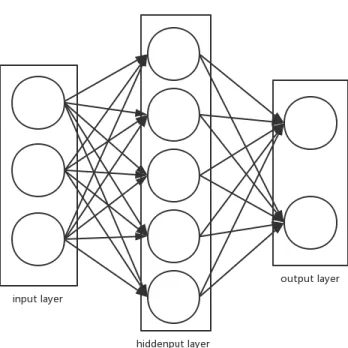
There is a method called machine learning in the field of artificial intelligence. In the machine learning method, there is a class of algorithms called neural networks. The neural network is shown below[14]:
Figure1. structure of the neural network
Each circle in the above picture is a neuron, and each line represents the connection between neurons. We can see that the above neurons are divided into multiple layers, the neurons between the layers are connected, and the neurons in the layers are not connected. The leftmost layer is called the input layer. This layer is responsible for receiving input data. The rightmost layer is called the output layer. We can get the neural network output data from this layer. The layer between the input layer and the output layer is called a hidden layer.
A neural network with more hidden layers (greater than 2) is called a deep neural network. deep learning is one of the branch which use machine learning method in deep architectures(such as deep neural networks).
So what are the advantages of deep networks compared to shallow networks? Merely speaking, deep networks can express more power. An only one hidden layer neural network can fit any function, but it requires many neurons. Deep networks can fit the same function with much fewer neurons. That is to fit a function, either use a shallow and wide network or use a deep and narrow network, the latter tends to be more resource-efficient.
2.1 Perceptron
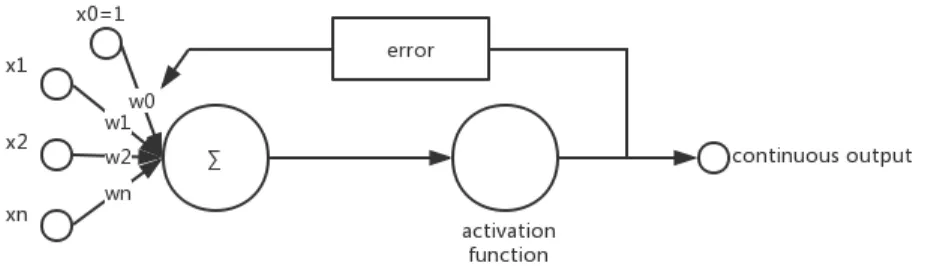
The figure below is a perceptron[3]:
Figure 2. structure of perceptron
In the figure, a perceptron has the following components:
1.Input Weights: A perceptron can receive multiple inputs 𝑥&, each with a weight 𝜔&, and
an offset term 𝑏, as shown in the figure above 𝜔).
2.Activation function
3.Output: the output of perceptron is calculated by the following formula
𝑦 = 𝑓(𝜔 ∙ 𝑥 + 𝑏)
2.2 Linear unit
There is a problem with perceptrons. When the datasets that are facing are not linearly separable, the "perceptron rules" may not converge, which means that we can never complete a perceptron training. To solve this problem, we use a conductive linear function instead of the step function of the perceptron. This perceptron is called a linear unit. Linear units converge to an optimal approximation when faced with a linearly inseparable data set. The linear unit is shown below
After replacing the activation function, the linear unit will return a real value instead of a 0,1 classification. Therefore linear units are used to solve regression problems rather than classification problems.
2.3 Supervised learning and unsupervised learning
Machine learning has a learning method called supervised learning[4]. It means that to train a model, we need to provide a bunch of training samples: each training sample includes both the input feature x and the corresponding output y. In other words, we have to find a lot of people, we know their characteristics (working years, industry...) and know their income. We use this sample to train the model so that the model sees each of our questions (input feature x) and the answer to the corresponding question (true value 𝑦∗). When the model sees enough samples, it can summarize some of these rules. Then, you can predict the answer to the input that it has not seen.
Another type of learning method is called unsupervised learning[4]. The training sample of this method has only x and no y. The model can summarize some rules of the feature x, but can't know its corresponding answer 𝑦∗.
Many times, training samples with both x and y are rare, and most samples only have x. For example, in speech-to-text (STT) recognition tasks, x is speech and 𝑦∗ is the text corresponding to this speech. It's easy to get a lot of voice recordings, but it's very laborious to split the voice into sections and mark the corresponding text. In this case, to compensate for the shortage of labeled samples, we can use the unsupervised learning method to do some clustering first, let the model summarize which syllables are similar, and then use a small number of labeled training samples to tell the model. Some syllables correspond to the text. In this way, the model can match similar syllables to the corresponding text and complete the training of the model.
2.4 The objective function of a linear unit
Under supervised learning, for a sample, we know its characteristic x and the true value
𝑦∗. At the same time, we can also calculate the output y based on the model h(x). Note
that we use 𝑦∗ to indicate the true value in the training sample, which is the actual value; the 𝑦 indicates the predicted value calculated by the model. We certainly hope that the y and 𝑦∗ calculated by the model are as close as possible.
There are many ways to express the closeness of y and 𝑦∗ in mathematics. For example, we can use the square of the difference between y and 𝑦∗ to indicate their closeness.
𝑒 =
1
2
(
𝑦∗−
𝑦)
7(1)
We call
𝑒
the error of a single sample. It is convenient for later calculation multiplied by 1/2.If there are N samples in the training data, We can use the sum of the errors of all the samples in the training data to represent the error E of the model, that is,
𝐸 = 𝑒: + 𝑒7+ 𝑒;+ ⋯ + 𝑒& (2)
𝑒: of the above formula represents the error of the first sample, and 𝑒7 represents the
error of the second sample…
For convenience, we can also write the above formula as a summation formula.
𝐸 = 𝑒: + 𝑒7+ 𝑒;+ ⋯ + 𝑒& (3) = > 𝑒? & ?@: (4) = 1 2>B𝑦∗(?)− 𝑦(?)C 7 & ?@: (5) Among them, 𝑦(?) = ℎB𝑥(?)C (6) = wHx(J) (7)
x(J) represents the feature of the i-th training sample, 𝑦∗(?) represents the true value of the
i-th sample, and we can also use the tuple (x(J), 𝑦∗(?)) to represent the i-th training sample.
𝑦(?) is the predicted value of the model for the i-th sample.
For a training data set, the error needs to be as small as possible, which means the value in the formula (5) need to be small. For a particular training data set, the values of (x(J), 𝑦∗(?)) are known, so formula (5) is a function of the parameters.
𝐸(w) =1 2>B𝑦∗(?)− 𝑦(?)C 7 & ?@: (8)
=1 2>B𝑦∗(?)− wHx(J) C 7 & ?@: (9)
The training of the model is actually to obtain the appropriate w, so that (Formula 5) obtains the minimum value which is called the optimization problem in mathematics, and
𝐸(w) is the goal of our optimization, called the objective function.
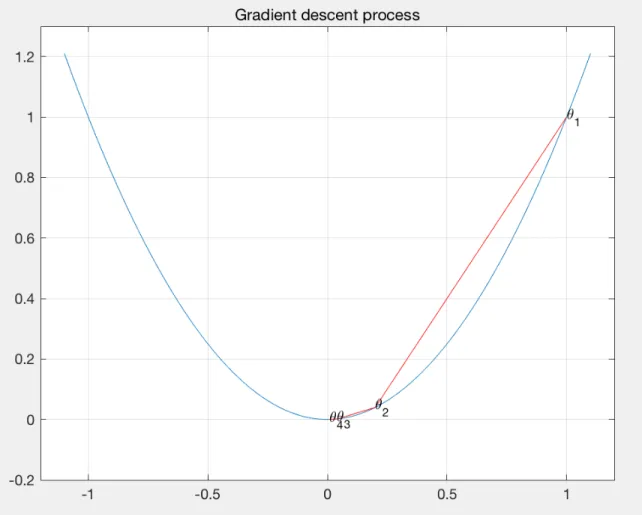
2.5 Gradient descent optimization algorithm
Figure 4. optimization of gradient descent
First of all, we choose a point to start, such as the point above[5]. Next, each iteration is modified to reach the function minimum point after several iterations finally. How can we move in the direction of the minimum value of the function, we need to modify the opposite direction of the gradient of the function y=f(x). The gradient is a vector that points to the fastest rising direction of the function value. The opposite direction of the gradient is, of course, the direction in which the function value drops the fastest. Each time we modify
the value of x along the opposite direction of the gradient, we can, of course, go near the minimum of the function(3).
According to the above discussion, we can write the formula of the gradient descent algorithm.
wN = w − 𝜂∇𝑓(𝑥) (10)
From the formula (5)
𝐸(w) =1 2>B𝑦∗(?)− 𝑦(?)C 7 & ?@: (11)
if we need the maximum value of the objective function, we should use the gradient ascent algorithm, and its parameter modification rule is
wN = w + 𝜂∇𝑓(𝑥) (12)
The gradient of the objective function is
∇𝐸(w) = − >B𝑦∗(?)− 𝑦(?)Cx? &
?@:
(13)
Therefore, the parameter modification rule of the linear unit is finally like this
wN = w + 𝜂 >B𝑦∗(?)− 𝑦(?)Cx? &
?@:
(14)
2.5.1 Derivation of ∇E(w)
We know that the definition of the gradient of a function is it is partial derivative relative to each variable[5], so we write the following formula
∇𝐸(w) = 𝜕 𝜕w𝐸(w) (15) = 𝜕 𝜕w 1 2>B𝑦∗(?)− 𝑦(?)C 7 & ?@: (16)
We know that the derivative of a sum is equal to the sum of the derivatives, so we can first find the derivatives in the summation symbol Σ, and then add them together
𝜕 𝜕w 1 2>B𝑦∗(?)− 𝑦(?)C 7 & ?@: (17) = 1 2> 𝜕 𝜕wB𝑦∗(?)− 𝑦(?)C 7 & ?@: (18)
Focus on the derivative inside 𝜕 𝜕wB𝑦∗(?)− 𝑦(?)C 7 (19) =STS (𝑦∗(?)7− 2𝑦(?)𝑦∗(?)+ 𝑦(?)7)
We know that 𝑦∗ is a constant that is independent of w, and 𝑦 = wHx. Let us follow the chain-based derivation rule
𝜕𝐸(w) 𝜕w = 𝜕𝐸(𝑦) 𝜕𝑦 𝜕𝑦 𝜕w (20)
Calculate the two partial derivatives to the right of the equal sign in the above equation
𝜕𝐸(w) 𝜕w = 𝜕 𝜕𝑦B𝑦∗(?)7− 2𝑦(?)𝑦∗(?)+ 𝑦(?)7C (21) = −2𝑦∗(?)+ 2𝑦(?) (22) 𝜕𝑦 𝜕w= 𝜕 𝜕wwHx (23) = x
Substituting the result, we find that the partial derivative in Σ is
𝜕 𝜕wB𝑦∗(?)− 𝑦(?)C 7 (24) = 2B−𝑦∗(?)+ 𝑦(?)Cx (25) Finally, calculate ∇𝐸(w) ∇𝐸(w) =1 2> 𝜕 𝜕wB𝑦(?)− 𝑦∗(?)C 7 & ?@: (26) =1 2> 2B−𝑦∗(?)+ 𝑦(?)Cx & ?@: (27) = − >B𝑦(?)− 𝑦∗(?)Cx & ?@: (28)
2.6 Stochastic Gradient Descent, SGD
If we train the model according to formula 14, then we update the iterations of w every time, we have to traverse all the samples in the training data for calculation. We call this algorithm called Batch Gradient Descent. If our sample is extensive, such as millions to
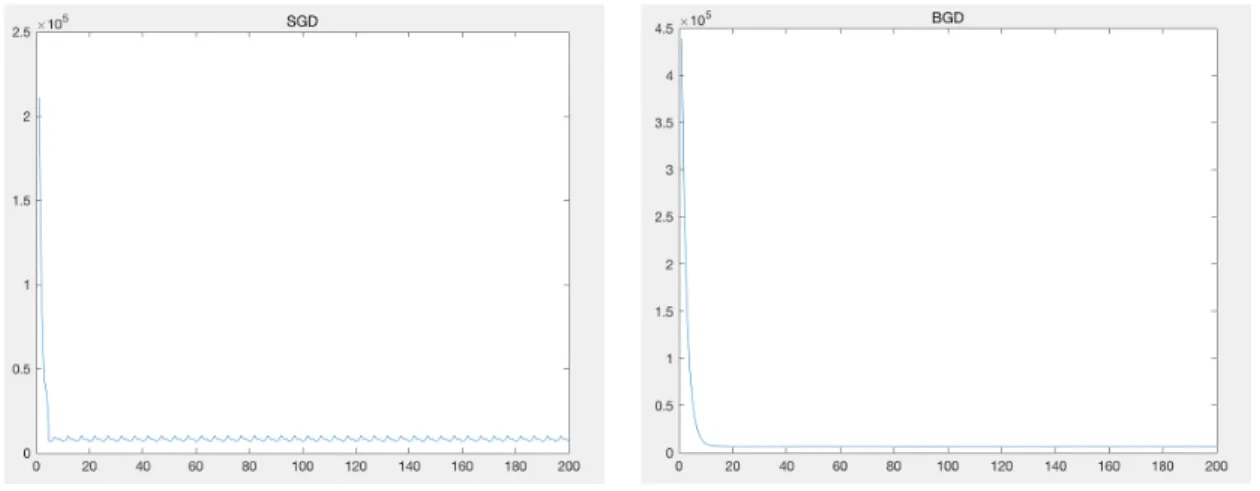
hundreds of millions, then the amount of calculation is enormous. Therefore, a practical algorithm is the SGD algorithm[6]. In the SGD algorithm, only calculate one sample each time with the iteration of updated w. In this way, for training data with millions of samples, a traversal will update millions of times, and the efficiency will be significantly improved. Due to the noise and randomness of the sample, each update w does not necessarily follow the direction of decreasing E. However, although there is some randomness, a large number of updates generally progress in the direction of E reduction, and therefore can finally converge to near the minimum. The figure below shows the difference between SGD and BGD.
Figure 5. difference between SGD and BGD.
As shown above, ellipse represents the contour of the function value, and the center of the ellipse is the minimum point of the function. Red is the approximation curve of BGD, and purple is the approximation curve of SGD. We can see that BGD has been moving towards the lowest point, and SGD has obviously moved a lot, but overall, it is still approaching the lowest point.
We can see that SGD is not only efficient, but randomness is sometimes a good thing. The objective function in the figure is a "convex function" that finds a globally unique minimum along the opposite direction of the gradient. However, for non-convex functions, there are many local minima. Randomness helps us escape some very bad local minima to get a better model.
3 Artificial Neural Network
Artificial Neural Network (ANN), referred to as Neural Network (NN) or neural network in the field of machine learning and cognitive science, is a mimicking biological neural network. In particular, mathematical models or computational models of the structure and function of the brain used to estimate or approximate functions. The neural network is calculated by a large number of artificial neuronal connections. In most cases, artificial neural networks can change the internal structure based on external information. It is an adaptive system. In general, it has a learning function. New neural networks are a kind of non-linear statistical data modeling tools.
An artificial neural network (ANN) or a connected system is a computational system that is ambiguously inspired by the biological neural network that makes up the animal's brain. Neural networks are a combination of many different machine learning algorithms that handle advanced complex data inputs rather than a single algorithm. This kind of system goes through the sample to complete the task of learning, usually without any specific task rules. For example, in image recognition, they may learn to identify images containing cats as "cats" or "no cats" by analyzing manual sample images and use the advanced model to identify the target in the test images, they do this without any basic knowledge about the cat; for example, they have fur, tail, beard, and cat-like faces. Instead, they automatically generate recognition features from the learning materials they process. The structure of an original ANN is showed below.
Figure 6. full connected Neural Networks
A neural network is a plurality of neurons connected according to specific rules. The above figure shows a fully connected (FC) neural network. By observing the above diagram, we can find that its rules include:
1. Neurons are always layered and generally consist of three layers in the neural network. The input layer is the first layer and is responsible for receiving input data. The last layer is called the output layer. We can get the neural network output data from this layer. The layers after the input layer and before output layer are called hidden layers because they are invisible to the outside.
2. Each neuron is independent of each other in the same layer。
3. Each neuron in the Nth layer is connected to all neurons in the N-1th layer (this is the meaning of full connected), and the output of the N-1th layer of neurons is the input to the Nth layer of neurons.
4. Each connection has a weight.
The above rules define the structure of a fully connected neural network. There are many other structural neural networks, such as Convolutional Neural Networks (CNN) and Recurrent Neural Networks (RNN), which all have different connection rules.
3.1 Neurons
Neurons and perceptrons are mostly the same, except that when we say the perceptron, its activation function is a step function; when we say neurons, the activation function is often chosen to be a sigmoid function or a tanh function. As shown below:
Figure 7. structure of a neuron
The method of calculating the output of a neuron is the same as calculating the output of a perceptron. Suppose the input of the neuron is vector 𝑥̅, the weight vector is 𝑤W (the bias term is 𝑤W)), and the activation function is sigmoid function[8], then its output y:
𝑦 = 𝑠𝑖𝑔𝑚𝑜𝑖𝑑(𝜔^^⃗H∙ 𝑥⃗) (29)
The definition of the sigmoid function is below
𝑠𝑖𝑔𝑚𝑜𝑖𝑑(𝑥) = 1
1 + 𝑒`a (30)
Bring it into the previous formula and get
𝑦 = 1
1 + 𝑒`b^^^⃗c∙a⃗ (31)
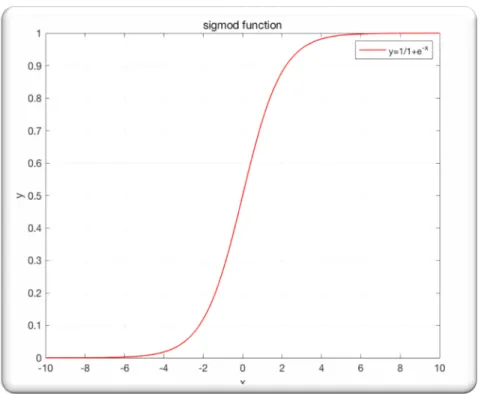
The sigmoid function is a nonlinear function with a value range of (0,1). The function image is shown below
Figure 8. sigmoid function
The derivative of the sigmoid function Let
𝑦 = 𝑠𝑖𝑔𝑚𝑜𝑖𝑑(𝑥) (32)
Then
𝑦N = 𝑦(1 − 𝑦) = 𝑠𝑖𝑔𝑚𝑜𝑖𝑑(𝑥) (33)
As we can see, the derivative of the sigmoid function is special; the sigmoid function itself can represent it. Thus, once calculate the value of the sigmoid function, it is convenient to calculate the value of its derivative.
3.2 Calculate the output of the neural network
A neural network is a function of an input vector 𝑥⃗ to an output vector 𝑦⃗,
𝑦⃗ = 𝑓&defghi(𝑥⃗) (34)
To calculate the output of the neural network according to the input, it is necessary to first assign the value of each element 𝑥⃗? of the input vector 𝑥⃗ to the corresponding neuron of
the input layer of the neural network, and then calculate each neuron of each layer in turn according to formula 1. The calculate process finished until the values of all neurons in the
last layer of the output layer are calculated. Finally, the output vector 𝑦⃗ is obtained by stringing together the values of each neuron in the output layer.
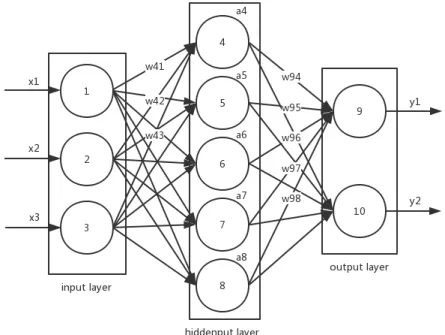
Let's take an example to illustrate this process. First number each cell of the neural network.
Figure 9 neural network
As shown in the figure above, the input layer has three nodes, which we numbered as 1, 2, and 3 in sequence; the four nodes in the hidden layer are numbered 4, 5, 6, and 7 in sequence; the last two nodes in the output layer are number 8 and 9. Because our neural network is fully connected, we can see that each node is connected to all nodes in the upper layer. For example, we can see node 4 of the hidden layer, which is connected to the three nodes 1, 2, and 3 of the input layer, and the weights on the connection are 𝜔j: 𝜔j7, 𝜔j;
In order to calculate the output value of node 4, we must first obtain the output values of all its upstream nodes (which are nodes 1, 2, 3). Nodes 1, 2, and 3 are nodes of the input layer, so their output value is the input vector 𝑥⃗ itself. According to the corresponding relationship in the above picture, the output values of nodes 1, 2, and 3 are 𝑥:, 𝑥7and 𝑥;
respectively. We require that the dimensions of the input vector be the same as the number of input layer neurons, and which input node of the input vector corresponds to which input node is freely determinable.
Once we have the output values of nodes 1, 2, and 3, we can calculate the output value 𝑎j
of node 4 according to formula 29:
𝑎j = 𝑠𝑖𝑔𝑚𝑜𝑖𝑑(𝜔^^⃗H∙ 𝑥⃗)
= 𝑠𝑖𝑔𝑚𝑜𝑖𝑑(𝜔j:∙ 𝑥: + 𝜔j7∙ 𝑥7+ 𝜔j;∙ 𝑥;+ 𝜔jl)
The above formula 𝜔jl is the offset term of node 4, which is not shown in the figure.
𝜔j:, 𝜔j7, and 𝜔j; are the weights of the nodes 1, 2, and 3 to node 4, respectively. When
number the weight 𝜔m? , we put the number j of the target node in front of the number i of
the source node.
Similarly, we can continue to calculate the output values 𝑎n, 𝑎o, 𝑎p, 𝑎r of nodes 5, 6, 7
and 8. Thus, the output values of the four nodes of the hidden layer are calculated, and we can then calculate the output value 𝑦: of node 9 of the output layer:
𝑦: = 𝑠𝑖𝑔𝑚𝑜𝑖𝑑(𝜔^^⃗H∙ 𝑎⃗)
= 𝑠𝑖𝑔𝑚𝑜𝑖𝑑(𝜔sj∙ 𝑎j + 𝜔sn∙ 𝑎n+ 𝜔so ∙ 𝑎o+ 𝜔so∙ 𝑎o+ 𝜔sp∙ 𝑎p+ 𝜔sr∙ 𝑎r+ 𝜔rl)
Similarly, we can also calculate the value of 𝑦7. Calculate the output values of all nodes
in the output layer, and we get the output vector 𝑦⃗ = [𝑦𝑦:
7] of the neural network when the
vector 𝑥⃗ = [
𝑥:
𝑥7 𝑥;
] is input. We can also see that the output vector has the same number of dimensions as the output layer neurons.
3.3 Back Propagation
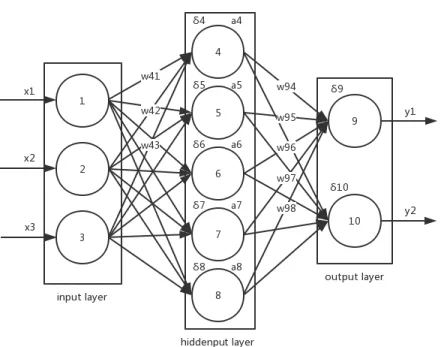
We are using supervised learning as an example to explain the backpropagation algorithm[7,9]. We assume that each training sample is (𝑥⃗, 𝑡⃗), where vector 𝑥⃗ is the characteristic of the training sample, and 𝑡⃗ is the target value of the sample.
Figure 10. neural network
First, based on the algorithm introduced in the previous section, we use the feature 𝑥⃗ of the sample to calculate the output 𝑎? of each hidden layer node in the neural network and the output 𝑦? of each node in the output layer.[9]
Then, we calculate the error term 𝛿? of each node as below:
For output layer node 𝑖,
𝛿? = 𝑦?(1 − 𝑦?)(𝑡? − 𝑦?) (35)
Where 𝛿? is the error term of node 𝑖, 𝑦? is the output value of node 𝑖, and 𝑡? is the target
value of the sample corresponding to node 𝑖. For example, according to the above figure, for the output layer node 9, its output value is 𝑦:, and the target value of the sample is 𝑡:,
use the equation into the above gives the error term 𝛿s of the node 9 should be:
𝛿s = 𝑦:(1 − 𝑦:)(𝑡:− 𝑦:)
For hidden layer nodes[9],
𝛿? = 𝑎?(1 − 𝑎?) > 𝜔i?
i∈gyezye{
Where 𝑎? is the output value of node 𝑖, 𝜔i?is the weight of the connection of the node
𝑖 to its next layer node 𝑘, and 𝛿i is the error term of the node of the next layer of node
𝑘. For example, for hidden layer node 4, the calculation method is below:
𝛿j = 𝑎j(1 − 𝑎j)(𝜔sj𝛿s+ 𝜔:),j𝛿:))
Finally, update the weights on each connection:
𝜔m? ← 𝜔m? + 𝜂𝛿m𝑥m? (37)
Where 𝜔m? is the weight of node 𝑖 to node 𝑗, 𝜂 is a constant that becomes the learning
rate, 𝛿m is the error term of node 𝑗, and 𝑥m? is the input that node 𝑖 passes to node 𝑗.
Obviously, to calculate the error term of a node, we need to calculate the error term of each node that connects to this node. This requires that the order of the error terms must be calculated from the output layer, and then calculate the error terms of each hidden layer reversely, until the hidden layer connected to the input layer. This is the reason why we called this algorithm of the backpropagation algorithm. When the error terms of all nodes are calculated, we can update all the weights according to Equation 37.
3.4 Derivation of the backpropagation algorithm
The backpropagation algorithm is the application of the chained derivation rule[9]. Next, we use the chain derivation rule to derive the backpropagation algorithm, which is the formula 35, 36, and 37 in the previous section.
According to the general routine of machine learning, we first determine the objective function of the neural network and then use the stochastic gradient descent optimization algorithm to find the parameter value at the minimum of the objective function.
We take the sum of the squared errors of all the output layer nodes of the network as the objective function:
𝐸€ = 1
2 > (𝑡?− 𝑦?)7
?∈gyezye{
(38)
Where 𝐸€ represents the error of sample d.
We use the stochastic gradient descent algorithm optimizes the objective function:
𝜔m? ← 𝜔m? − 𝜂𝜕𝐸€
The stochastic gradient descent algorithm also needs to find the partial derivative of the error 𝐸€ for each weight 𝜔m?
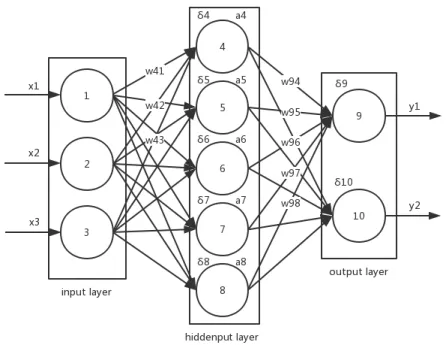
Figure 11. neural network
From the above figure, we find that the weight 𝜔m? can only affect other parts of the network by affecting the input value of the node 𝑗. Let 𝑛𝑒𝑡mbe the weighted input of the
node 𝑗
𝑛𝑒𝑡m = 𝜔^^⃗m∙ 𝑥⃗m (40) = > 𝜔m?𝑥m?
?
(41) 𝐸€ is a function of 𝑛𝑒𝑡m, and 𝑛𝑒𝑡m is a function of 𝜔m?. According to the chain derivation
rule, we can get:
𝜕𝐸€ 𝜕𝜔m? = 𝜕𝐸€ 𝜕𝑛𝑒𝑡m 𝜕𝐸€ 𝜕𝑛𝑒𝑡m (42) = 𝜕𝐸€ 𝜕𝑛𝑒𝑡m 𝜕 ∑ 𝜔? m?𝑥m? 𝜕𝑛𝑒𝑡m (43) = 𝜕𝐸€ 𝜕𝑛𝑒𝑡m𝑥m? (44)
In the above formula, 𝑥m? is the input value that node 𝑖 passes to node 𝑗, also is the output
value of node 𝑖.
For the derivation of S&deSƒ„
…, it is necessary to distinguish between the output layer and the
hidden layer.
3.4.1 Output layer weight training
For the output layer, 𝑛𝑒𝑡m can only affect the rest of the network by the output value 𝑦m
of node 𝑗, that is, 𝐸€ is a function of 𝑦m, and 𝑦m is a function of 𝑛𝑒𝑡m, where 𝑦m =
𝑠𝑖𝑚𝑜𝑖𝑑(𝑛𝑒𝑡m). So we can use the chain derivation rule again:
𝜕𝐸€ 𝜕𝑛𝑒𝑡m = 𝜕𝐸€ 𝜕𝑦m 𝜕𝑦m 𝜕𝑛𝑒𝑡m (45)
First part of the above formula:
𝜕𝐸€ 𝜕𝑦m = 𝜕 𝜕𝑦? 1 2 > (𝑡? − 𝑦?)7 ?∈gyezye{ (46) = 𝜕 𝜕𝑦? 1 2B𝑡m− 𝑦mC 7 (47) = −B𝑡m− 𝑦mC (48)
Second part of the above formula:
𝜕𝑦m 𝜕𝑛𝑒𝑡m =
𝜕𝑠𝑖𝑔𝑚𝑜𝑖𝑑B𝑛𝑒𝑡mC
𝜕𝑛𝑒𝑡m (49)
= 𝑦?B1 − 𝑦mC (50)
Bring the first and second part into the above formula:
𝜕𝐸€
𝜕𝑛𝑒𝑡m = −B𝑡m− 𝑦mC𝑦?B1 − 𝑦mC (51)
If 𝛿m = −S&deSƒ„
…, that is the error term 𝛿 of a node is the inverse of the partial derivative of
the network error input to this node. Bring into the above formula, get
𝛿m = B𝑡m− 𝑦mC𝑦?B1 − 𝑦mC (52)
Which is the formula (35).
𝜔m? ← 𝜔m?− 𝜂
𝜕𝐸€ 𝜕𝜔m?
= 𝜔m? + 𝜂B𝑡m− 𝑦mC𝑦?B1 − 𝑦mC𝑥m? (53)
= 𝜔m? + 𝜂𝛿m𝑥m? (54)
Which is the formula (37)
3.4.2 Hidden layer weight training Now we have to derive the S&deSƒ„
… of the hidden layer.
First, we need to define a set 𝐷𝑜𝑤𝑛𝑠𝑡𝑟𝑒𝑎𝑚(𝑗) of all direct downstream nodes of the node
𝑗. For example, for node 4, its next downstream node is node 8, node 9. We can see that
𝑛𝑒𝑡m can only affect 𝐸€ by affecting 𝐷𝑜𝑤𝑛𝑠𝑡𝑟𝑒𝑎𝑚(𝑗). Let 𝑛𝑒𝑡i be the input to the
downstream node of node 𝑗, then 𝐸€ is a function of 𝑛𝑒𝑡i, and 𝑛𝑒𝑡i is a function of
𝑛𝑒𝑡m. Since there are multiple 𝑛𝑒𝑡is, we apply the full derivative formula and can make
the following derivation:
𝜕𝐸€ 𝜕𝑛𝑒𝑡m = > 𝜕𝐸€ 𝜕𝑛𝑒𝑡i 𝜕𝑛𝑒𝑡i 𝜕𝑛𝑒𝑡m i∈ˆgf&{ehd‰Š(m) (55) = > −𝛿i 𝜕𝑛𝑒𝑡i 𝜕𝑛𝑒𝑡m i∈ˆgf&{ehd‰Š(m) (56) = > −𝛿i𝜕𝑛𝑒𝑡i 𝜕𝑎m 𝜕𝑎m 𝜕𝑛𝑒𝑡m i∈ˆgf&{ehd‰Š(m) (57) = > −𝛿i𝜔im 𝜕𝑎m 𝜕𝑛𝑒𝑡m i∈ˆgf&{ehd‰Š(m) (58) = > −𝛿i𝜔im𝑎mB1 − 𝑎mC i∈ˆgf&{ehd‰Š(m) (59) = −𝑎mB1 − 𝑎mC > 𝛿i𝜔im i∈ˆgf&{ehd‰Š(m) (60) Bring 𝛿m = −S&deSƒ„
… to the above formula, get
𝛿m = B1 − 𝑎mC > 𝛿i𝜔im
i∈ˆgf&{ehd‰Š(m)
4 Recurrent Neural Network
Some tasks need to be able to process the sequence information better, that is, the previous input is related to the subsequent input. For example, when we understand the meaning of a sentence, it is not enough to understand each word in isolation. We need to deal with the whole sequence of these words. When we process the video, we cannot just go alone. Analyze each frame and analyze the entire sequence of connections of these frames. At this time, we need another significant neural network in the field of deep learning: Recurrent Neural Network.
4.1 Basic Recurrent Neural Network
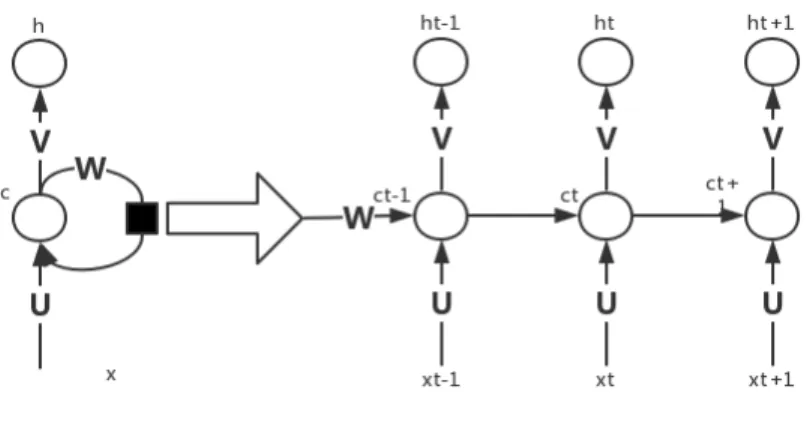
The following figure is a simple recurrent neural network, which consists of an input layer, a hidden layer, and an output layer[10]:
Figure 12. Recurrent neural network
After the network receives input 𝑥e at time t, the value of the hidden layer is 𝑠eand the
output value is ℎe. The critical point is that the value of st depends not only on 𝑥e but also
on 𝑐e`:. We can use the following formula to represent the calculation method of the
recurrent neural network[6]:
ℎe = 𝑔(𝑉𝑐e) (62)
𝑐e = 𝑓(𝑈𝑥e+ 𝑊𝑐e`:) (63)
Equation 62 is the calculation formula of the output layer. The output layer is fully connected; That is each of its nodes connect to each node of the hidden layer. 𝑉 is the weight matrix of the output layer, and 𝑔 is the activation function. Equation 63 is a calculation formula for the hidden layer, which is a recurrent layer. 𝑈 is the weight matrix
of the input x, 𝑊 is the last value as the weight matrix for this input, and f is the activation function.
If we repeatedly bring Equation 63 into Equation 62, we will get[7]:
ℎe = 𝑔(𝑉𝑐e) (64)
= 𝑉𝑓(𝑈𝑥e+ 𝑊𝑐e`:) (65)
= 𝑉𝑓B𝑈𝑥e+ 𝑊𝑓(𝑈𝑥e`:+ 𝑊𝑐e`7)C (66)
= 𝑉𝑓 •𝑈𝑥e+ 𝑊𝑓B𝑈𝑥e`:+ 𝑊𝑓(𝑈𝑥e`7+ 𝑊𝑐e`;)C‘ (67) = 𝑉𝑓 ’𝑈𝑥e+ 𝑊𝑓 •𝑈𝑥e`:+ 𝑊𝑓B𝑈𝑥e`7+ 𝑊𝑓(𝑈𝑥e`;+ ⋯ )C‘“ (68)
From the above, we know that the output value 𝑜e of the recurrent neural network is
affected by the previous input values 𝑥e, 𝑥e`:, 𝑥e`7, 𝑥e`;, ..., which is why the recurrent
neural network can look forward with any number of input values
4.2 Training Algorithm for Recurrent Neural Networks: BPTT
The BPTT algorithm is a training algorithm for the recurrent layer. Its basic principle is the same as the BP algorithm. It also contains the same three steps:
1.Forward calculation of the output value of each neuron;
2.Calculating the error term 𝛿m value of each neuron in reverse, which is the partial
derivative of the weighted input 𝑛𝑒𝑡m of the error function 𝐸 to the neuron 𝑗;
3.Calculate the gradient of each weight.
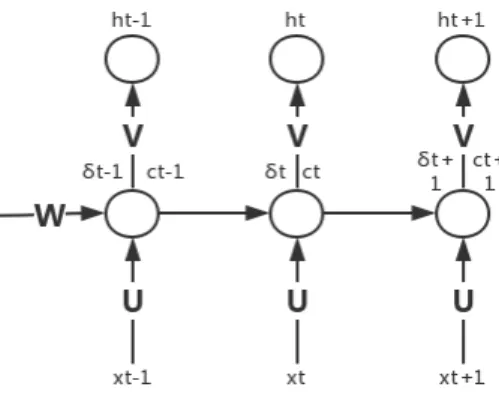
Finally, the weight is updated by the stochastic gradient descent algorithm. The recurrent layer is shown below:
1.Forward calculation
Forward calculation of the recurrent layer using formula 63:
𝑐e = 𝑓(𝑈𝑥e+ 𝑊𝑐e`:)
Note that the above 𝑐e, 𝑥e, and 𝑐e`: are vectors, which are represented by bold letters;
and U and V are matrices, which are represented by uppercase letters. The subscript of the vector represents the time, for example, 𝑐e represents the value of the vector s at time t.
We assume that the dimension of the input vector x is m, the dimension of the output vector c is n, then the dimension of the matrix U is 𝑛 × 𝑚, and the dimension of the matrix W is
𝑛 × 𝑛. Then we get the matrix from the above formula
⎣ ⎢ ⎢ ⎢ ⎡𝑐:e 𝑐7e ∙ ∙ 𝑐&e⎦⎥ ⎥ ⎥ ⎤ = 𝑓 ⎝ ⎜ ⎛ ⎣ ⎢ ⎢ ⎢ ⎡𝑢𝑢:: 𝑢:7 … 𝑢:Š 7: 𝑢77 … 𝑢7Š ∙ ∙
𝑢&: 𝑢&7 … 𝑢&Š⎦
⎥ ⎥ ⎥ ⎤ ⎣ ⎢ ⎢ ⎡𝑥𝑥:7 ∙ ∙ 𝑥Š⎦ ⎥ ⎥ ⎤ + ⎣ ⎢ ⎢ ⎢ ⎡𝜔𝜔:: 𝜔:7 … 𝜔:& 7: 𝜔77 … 𝜔7& ∙ ∙
𝜔&: 𝜔&7 … 𝜔&&⎦
⎥ ⎥ ⎥ ⎤ ⎣ ⎢ ⎢ ⎢ ⎡𝑐:e`: 𝑐7e`: ∙ ∙ 𝑐&e`:⎦ ⎥ ⎥ ⎥ ⎤ ⎠ ⎟ ⎞ (69)
Here we use handwritten letters to represent an element of a vector, its subscript indicates that it is the first element of the vector, and its superscript indicates the first few moments. For example, 𝑐me represents the value of the 𝑗th element of the vector 𝑠 at time t. 𝑢m?
represents the weight of the 𝑖-th neuron in the input layer to the 𝑗-th neuron in the recurrent layer. 𝜔m? represents the weight of the 𝑖-th neuron at the 𝑡-1th point of the
recurrent layer to the 𝑗-th neuron at the tth moment of the recurrent layer. 2 Calculation of error terms
The BTPP algorithm propagates the error term 𝛿e£ value of the 𝑙 layer time 𝑡 in two directions. One direction is that transmitted to the upper layer network to obtain 𝛿e£`:. This part is only related to the weight matrix U; The other is that the direction is along its timeline pass to the initial time 𝑡:, to get yields 𝛿:£, which is only related to the weight
matrix 𝑊.
We use the vector 𝑛𝑒𝑡e to represent the weighted input of the neuron at time t:
𝑛𝑒𝑡e = 𝑈𝑥e+ 𝑊𝑐e`: (70)
𝑐e`:= 𝑓(𝑛𝑒𝑡e`:) (71)
𝜕𝑛𝑒𝑡e 𝜕𝑛𝑒𝑡e`:= 𝜕𝑛𝑒𝑡e 𝜕𝑐e`: 𝜕𝑐e`: 𝜕𝑛𝑒𝑡e`: (72)
We use a for the column vector and 𝑎H as the row vector. The first term of the above formula is the vector function to vector the derivative, and the result is the Jacobian matrix:
𝜕𝑛𝑒𝑡e 𝜕𝑠e`: = ⎣ ⎢ ⎢ ⎢ ⎢ ⎢ ⎢ ⎢ ⎡𝜕𝑛𝑒𝑡:e 𝜕𝑐:e`: 𝜕𝑛𝑒𝑡7e 𝜕𝑐:e`: 𝜕𝑛𝑒𝑡:e 𝜕𝑐7e`: 𝜕𝑛𝑒𝑡7e 𝜕𝑐7e`: ∙ ∙ … … 𝜕𝑛𝑒𝑡:e 𝜕𝑐&e`: 𝜕𝑛𝑒𝑡7e 𝜕𝑐&e`: 𝜕𝑛𝑒𝑡&e 𝜕𝑐:e`: 𝜕𝑛𝑒𝑡&e 𝜕𝑐7e`: … 𝜕𝑛𝑒𝑡&e 𝜕𝑐&e`:⎦ ⎥ ⎥ ⎥ ⎥ ⎥ ⎥ ⎥ ⎤ (73) = ⎣ ⎢ ⎢ ⎢ ⎡𝜔𝜔::7: 𝜔𝜔:7 77 ∙ ∙ … … 𝜔:& 𝜔:&
𝜔&: 𝜔&7 … 𝜔&&⎦
⎥ ⎥ ⎥ ⎤ (74) = 𝑊 (75)
Similarly, the second item of the above formula is also a Jacobian matrix.
𝜕𝑐e`: 𝜕𝑛𝑒𝑡e`:= ⎣ ⎢ ⎢ ⎢ ⎢ ⎢ ⎢ ⎢ ⎡ 𝜕𝑐:e`: 𝜕𝑛𝑒𝑡:e`: 𝜕𝑐7e`: 𝜕𝑛𝑒𝑡:e`: 𝜕𝑐:e`: 𝜕𝑛𝑒𝑡7e`: 𝜕𝑐7e`: 𝜕𝑛𝑒𝑡7e`: ∙ ∙ … … 𝜕𝑐&e`: 𝜕𝑛𝑒𝑡&e`: 𝜕𝑐7e`: 𝜕𝑛𝑒𝑡&e`: 𝜕𝑐&e`: 𝜕𝑛𝑒𝑡:e`: 𝜕𝑐&e`: 𝜕𝑛𝑒𝑡7e`: … 𝜕𝑐&e`: 𝜕𝑛𝑒𝑡&e`:⎦⎥ ⎥ ⎥ ⎥ ⎥ ⎥ ⎥ ⎤ (76) = ⎣ ⎢ ⎢ ⎢ ⎡𝑓N(𝑛𝑒𝑡:e`:) 0 0 𝑓N(𝑛𝑒𝑡 7e`:) ∙ ∙ … … 0 0 0 0 … 𝑓N(𝑛𝑒𝑡 &e`:)⎦ ⎥ ⎥ ⎥ ⎤ (77) = 𝑑𝑖𝑎𝑔[𝑓N(𝑛𝑒𝑡 e`:)] (78)
𝑑𝑖𝑎𝑔(𝑎) = ⎣ ⎢ ⎢ ⎢ ⎡𝑎0: 𝑎0 7 ∙ ∙ … … 0 0 0 0 … 𝑎&⎦⎥ ⎥ ⎥ ⎤ (79)
Finally, combine the two items, we can get:
𝜕𝑛𝑒𝑡e 𝜕𝑛𝑒𝑡e`:= 𝜕𝑛𝑒𝑡e 𝜕𝑠e`: 𝜕𝑐e`: 𝜕𝑛𝑒𝑡e`: (80) = 𝑊𝑑𝑖𝑎𝑔[𝑓N(𝑛𝑒𝑡 e`:)] (81) = ⎣ ⎢ ⎢ ⎢ ⎡𝜔::𝑓N(𝑛𝑒𝑡:e`:) 𝜔7:𝑓N(𝑛𝑒𝑡 :e`:) 𝜔::𝑓N(𝑛𝑒𝑡 7e`:) 𝜔77𝑓N(𝑛𝑒𝑡 7e`:) ∙ ∙ … …
𝜔:&𝑓N(𝑛𝑒𝑡&e`:)
𝜔7&𝑓N(𝑛𝑒𝑡&e`:)
𝜔&:𝑓N(𝑛𝑒𝑡:e`:) 𝜔&7𝑓N(𝑛𝑒𝑡7e`:) … 𝜔&&𝑓N(𝑛𝑒𝑡7e`:)⎦
⎥ ⎥ ⎥ ⎤
(82)
The above formula describes the rule of passing 𝛿 a period forward along time. With this rule, we can find the error term 𝛿i at any time k:
𝛿iH = 𝜕𝐸 𝜕𝑛𝑒𝑡i (83) = 𝜕𝐸 𝜕𝑛𝑒𝑡e 𝜕𝑛𝑒𝑡e 𝜕𝑛𝑒𝑡i (84) = 𝜕𝐸 𝜕𝑛𝑒𝑡e 𝜕𝑛𝑒𝑡e 𝜕𝑛𝑒𝑡e`: 𝜕𝑛𝑒𝑡e`: 𝜕𝑛𝑒𝑡e`7⋯ 𝜕𝑛𝑒𝑡i¥: 𝜕𝑛𝑒𝑡i (85) = 𝑊𝑑𝑖𝑎𝑔[𝑓N(𝑛𝑒𝑡 e`:)]𝑊𝑑𝑖𝑎𝑔[𝑓N(𝑛𝑒𝑡e`7)] ⋯ 𝑊𝑑𝑖𝑎𝑔[𝑓N(𝑛𝑒𝑡i)]𝛿e£ (86) = 𝛿eH¦ 𝑊𝑑𝑖𝑎𝑔[𝑓N(𝑛𝑒𝑡 ?)] e`: ?@i (87)
formula 87 is an algorithm that propagates the error term back in time. The recurrent layer passes the error term back to the upper layer network, which is the same as the standard full connection layer.
The weighted input 𝑛𝑒𝑡£ of the recurrent layer is related to the weighted input 𝑛𝑒𝑡£`: of the previous layer as follows
𝑛𝑒𝑡e£ = 𝑈𝑎e£`:+ 𝑊𝑐e`: (88)
𝑎e£`: = 𝑓£`:B𝑛𝑒𝑡
In the above formula, 𝑛𝑒𝑡e£ is the weighted input of the 𝑙 layer of neurons (assuming that
the 𝑙 layer is the circular layer); 𝑛𝑒𝑡e£`: is the weighted input of the 𝑙 − 1th layer of
neurons; 𝑎e£`: is the output of the 𝑙 − 1th layer of neurons; 𝑓£`: is The activation function of layer 𝑙 − 1. 𝜕𝑛𝑒𝑡e£ 𝜕𝑛𝑒𝑡e£`:= 𝜕𝑛𝑒𝑡e£ 𝜕𝑎e£`: 𝜕𝑎e£`: 𝜕𝑛𝑒𝑡e£`: (90) = 𝑈𝑑𝑖𝑎𝑔§𝑓N£`:B𝑛𝑒𝑡 e£`:C¨ (91) So we get (𝛿e£`:)H = 𝜕𝐸 𝜕𝑛𝑒𝑡e£`: (92) = 𝜕𝐸 𝜕𝑛𝑒𝑡e£ 𝜕𝑛𝑒𝑡e£ 𝜕𝑛𝑒𝑡e£`: (93) = (𝛿e£)H𝑈𝑑𝑖𝑎𝑔§𝑓N£`:B𝑛𝑒𝑡 e£`:C¨ (94)
Formula 94 is the algorithm pass the error term to the previous 3 Weight gradient calculation
First, we calculate the gradient S©Sƒ in weight matrix W with the error function E.
Figure 14 recurrent layer
The figure above shows the amount we have calculated so far in the first two steps, including the output value 𝑐e of the recurrent layer at each time t, and the error term 𝛿e.
According to the weight gradient calculation algorithm of the fully connected network: as long as the error term 𝛿e at any one time and the output value 𝑐e`: of the recurrent layer
at the previous time are known, the gradient ∇𝑊e𝐸 of the weight matrix at time t can be
∇©ª𝐸 = ⎣ ⎢ ⎢ ⎢ ⎡𝛿:e𝑐:e`: 𝛿7e𝑐 :e`: ∙ ∙ 𝛿:e𝑐 7e`: 𝛿7e𝑐 7e`: … … 𝛿: e𝑐 &e`: 𝛿7e𝑐 &e`: 𝛿&e𝑐
:e`: 𝛿&e𝑐7e`: … 𝛿&e𝑐&e`:⎦
⎥ ⎥ ⎥ ⎤
(95)
In formula 95, 𝛿?e represents the 𝑖 component of the error term vector at time t;
𝑐?e`:represents the output value of the 𝑖 neuron in the cyclic layer at time 𝑡 − 1. Then we
carry out the derivation of formula 95 . 𝑛𝑒𝑡e = 𝑈𝑥e+ 𝑊𝑐e`: (96) ⎣ ⎢ ⎢ ⎢ ⎡𝑛𝑒𝑡:e 𝑛𝑒𝑡7e ∙ ∙ 𝑛𝑒𝑡&e⎦⎥ ⎥ ⎥ ⎤ = 𝑈𝑥e+ ⎣ ⎢ ⎢ ⎢ ⎡𝜔𝜔:: 𝜔:7 … 𝜔:& 7: 𝜔77 … 𝜔7& ∙ ∙
𝜔&: 𝜔&7 … 𝜔&&⎦
⎥ ⎥ ⎥ ⎤ ⎣ ⎢ ⎢ ⎢ ⎡𝑐:e`: 𝑐7e`: ∙ ∙ 𝑐&e`:⎦ ⎥ ⎥ ⎥ ⎤ (97) = 𝑈𝑥e+ ⎣ ⎢ ⎢ ⎢
⎡𝜔::𝑐:e`:+ 𝜔:7𝑐7e`:⋯ 𝜔:&𝑐&e`:
𝜔7:𝑐:e`:+ 𝜔
77𝑐7e`:⋯ 𝜔7&𝑐&e`:
∙ ∙
𝜔&:𝑐:e`:+ 𝜔&7𝑐7e`:⋯ 𝜔&&𝑐&e`:⎦
⎥ ⎥ ⎥ ⎤
(98)
Because the derivation of W has nothing to do with 𝑈𝑥e, so we ignore it. Now we consider
the weighting term 𝜔m?. By observing the above formula, we can see that 𝜔m? is only
related to 𝑛𝑒𝑡me, so: 𝜕𝐸 𝜕𝜔m? = 𝜕𝐸 𝜕𝑛𝑒𝑡me 𝜕𝑛𝑒𝑡me 𝜕𝜔m? (99) = 𝛿me𝑐 ?e`: (100)
From the rule in formula 100, we can get formula 95
We have obtained the gradient ∇©ª𝐸 of the weight matrix W at time t, and the total
gradient ∇©𝐸 is the sum of the gradients at each moment.
∇©𝐸 = > ∇©«𝐸
e
?@:
= ⎣ ⎢ ⎢ ⎢ ⎡𝛿:e𝑐:e`: 𝛿7e𝑐 :e`: ∙ ∙ 𝛿:e𝑐 7e`: 𝛿7e𝑐 7e`: … … 𝛿: e𝑐 &e`: 𝛿7e𝑐 &e`: 𝛿&e𝑐
:e`: 𝛿&e𝑐7e`: … 𝛿&e𝑐&e`:⎦
⎥ ⎥ ⎥ ⎤ + ⋯ + ⎣ ⎢ ⎢ ⎢ ⎡𝛿:e𝑐:) 𝛿7e𝑐 :) ∙ ∙ 𝛿:e𝑐 7) 𝛿7e𝑐 7) … … 𝛿: e𝑐 &) 𝛿7e𝑐 &) 𝛿&e𝑐
:) 𝛿&e𝑐7) … 𝛿&e𝑐&)⎦
⎥ ⎥ ⎥ ⎤
(102)
Formula 102 is a formula for calculating the gradient of the recurrent layer weight matrix W.
Similar to the weight matrix W, we can get the calculation method of the weight matrix U.
∇¬ª𝐸 = ⎣ ⎢ ⎢ ⎢ ⎡𝛿:e𝑐:e 𝛿7e𝑐 :e ∙ ∙ 𝛿:e𝑐 7e 𝛿7e𝑐 7e … … 𝛿: e𝑐 Še 𝛿7e𝑐 Še
𝛿&e𝑐:e 𝛿&e𝑐7e … 𝛿&e𝑐Še ⎦
⎥ ⎥ ⎥ ⎤
(103)
Formula 103 is the gradient of the error function to the weight matrix U at time t. The same as the weight matrix W, the final gradient is also the sum of the gradients at each moment:
∇¬𝐸 = > ∇¬«𝐸
e
?@:
5 Long Short-Term Memory Algorithm
Long Short-Term Memory Algorithm (LSTM), which successfully solves the defects of the original cyclic neural network, has become the most popular RNN and has been successfully applied in many fields such as speech recognition, picture description, and natural language processing.
Among them, it is an important reason to be able to deal with gradient explosions and gradient hours that occur in ordinary RNN. From the last section, we know that The formula for the error term to propagate back in time:
𝛿iH = 𝛿
eH¦ 𝑊𝑑𝑖𝑎𝑔[𝑓N(𝑛𝑒𝑡?)] e`:
?@i
(104)
We can get the upper bound of the modulus of 𝛿iH according to the inequality below (the
modulo is a measure of the size of each value in 𝛿iH):
‖𝛿iH‖ ≤∥ 𝛿 iH ∥ ¦ ∥ e`: ?@i 𝑑𝑖𝑎𝑔[𝑓N(𝑛𝑒𝑡 ?)] ∥∥ 𝑊 ∥ (105) ≤∥ 𝛿iH ∥ B𝛽 ±𝛽©C e`i (106)
We can see that the error term 𝛿 passed from time t to time k, and the upper bound of its value is an exponential function of 𝛽±𝛽©. 𝛽±𝛽© is the upper bound of the diagonal matrix𝑑𝑖𝑎𝑔[𝑓N(𝑛𝑒𝑡?)and the matrix W absolute value, respectively. Obviously, unless the
value of the product 𝛽±𝛽© is around 1, when the t-k is large (that is, when the error
transmitted for many times), the value of the whole expression becomes extremely small (when the 𝛽±𝛽© product is less than 1) or (When the 𝛽±𝛽© product is greater than 1),
the former is the gradient disappears, and the latter is the gradient explosion[11].
In general, gradient explosions are easier to handle. Our program will receive a NaN error when the gradient explodes. We can also set a gradient threshold that can be intercepted directly when the gradient exceeds this threshold.
The vanishing gradient is more challenging to detect and more difficult to handle. We have proved that the final gradient of the weighted array W is the sum of the gradients at each moment. When the vanishing gradient, starting from this time t and going
forward, the resulting gradient (almost zero) will not contribute to the final gradient value, which is equivalent to what the network state h is before the time t, In training,
it will not affect the update of the weight array W, that is, the network has actually ignored the state before the time t.
That’s why we try to use LSTM algorithm to make the load forecasting. The hidden layer of the original RNN has only one state, h, which is very sensitive to short-term inputs. Then, if we add another state, c, let it save the long-term state, the newly added state c, called the cell state, is expanded according to the time dimension, as shown in the following figure:
Figure 15. transmission in LSTM
The above figure is just a schematic diagram. We can see that at time t, there are three inputs to the LSTM: the input value 𝑥e of the current time network, the output valueℎe`:
of the previous time LSTM, and the unit state 𝑐e`: of the previous moment; There are two
outputs of LSTM: the current time LSTM output value ℎe, and the current unit state 𝑐e. Note that 𝑥, ℎ, and 𝑐 are all vectors.
The key to LSTM is how to control the long-term state 𝑐. Here, the idea of LSTM is to use three control gates. The first gate is responsible for controlling to continue saving the long-term state 𝑐; the second gate is responsible for controlling the input of the immediate state to the long-term state c; the third gate is responsible for controlling whether the long-term state 𝑐 is the output of the current LSTM.
5.1 Forward calculation of LSTM
How is the switch described earlier implemented in the algorithm? This uses the concept of a gate. The gate is actually a layer of fully connected layers whose input is a vector and the output is a real vector between 0 and 1. Assuming 𝑊 is the weight vector of the gate, which 𝑏 is an offset term, the gate can be expressed as:
𝑔(𝑥) = 𝜎(𝑊a+ 𝑏) (107)
The use of the gate is to multiply the element's output vector by the vector we want to control. Since the output of the gate is a real vector between 0 and 1, then when the gate output is 0, any vector multiplied will result in a 0 vector, which is equivalent to nothing can pass; when the output is 1, any vector There is no change in multiplication, which is equivalent to passing. Since the value range of x (the sigmoid function) is (0, 1), the state of the gate is half-open and half-closed.
The LSTM uses two gates to control the contents of the unit state 𝑐. One is the forget gate, which determines how much the unit state of 𝑐e`: is retained to the current time 𝑐e at the
previous time; The other is the input gate, it determines how much the input 𝑥e of the
network is saved to the unit state 𝑐e at the current moment. The LSTM uses an output gate
to control how much of the unit state 𝑐e is output to the current output value ℎe of the
LSTM.
5.1.1 Forgotten gate
First we calculate the forgotten gate[12]:
𝑓e= 𝜎B𝑊±∙ [ℎe`:, 𝑥e] + 𝑏±C (108)
In the above formula, 𝑊± is the weight matrix of the forgotten gate, [ℎe`:, 𝑥e] represents the connection of two vectors into a longer vector, 𝑏± is the bias term of the forgetting
gate, and 𝑥 is the sigmoid function. If the dimension entered is 𝑑, the dimension of the hidden layer is 𝑑Ë, and the dimension of the cell state is 𝑑Ì (usually 𝑑Ì=𝑑Ë), then the
weight matrix of the forgetting gate wf dimension is 𝑑Ì*(𝑑Ë+𝑑a). In fact, the weight
matrix 𝑊± is a combination of two matrices: one is 𝑊±Ë, which corresponds to the input
ht-1, its dimension is 𝑑Ì*𝑑Ë; one is 𝑊±a, which corresponds to the input 𝑥e, and its
dimension is 𝑑Ì*𝑑a. 𝑊± can be written as:
§𝑊±¨ Íℎe`:
𝑥e Î = [𝑊±Ë 𝑊±a] Íℎ𝑥e`:e Î = 𝑊±Ëℎe`:+ 𝑊±a𝑥e
Figure 16. calculation of the Forgotten gate
5.1.2 Input gate
Then let us see the input gate[12]
𝑖e= 𝜎(𝑊? ∙ [ℎe`:, 𝑥e] + 𝑏?) (109)
In the above formula, 𝑊? is the weight matrix of the input gate, 𝑏? is the offset term of the input gate. The calculation process of the Forgotten Gate input gate is below:
Next, we calculate the state of the cell used to describe the current input 𝑐̃e which is
calculated based on the last output and this time input[12]:
𝑐̃e = tanh(𝑊Ð∙ [ℎe`:, 𝑥e] + 𝑏Ð) (110)
The figure below is the calculation of 𝑐̃e:
Figure 18. calculation of 𝑐̃e in the Input gate
Then we calculate the cell state 𝑐e at the current time. It is multiplied by the last forgetting
gate 𝑓e by the element state 𝑐e`:, and then multiplied by the input cell 𝑖e, by the
element state 𝑐̃e of the current input, and then generate the sum of the two products[12] :
𝑐e = 𝑓e∘ 𝑐e`:+ 𝑖e∘ 𝑐̃e (111)
The symbol ∘ indicates multiplication by element. The figure below is the calculation of