FACULTY OF ENGINEERING AND SUSTAINABLE DEVELOPMENT
Department of Industrial Development, IT and Land Management
Third party logistics development
An investigation of factors influencing third party logistics companies’
success in China based on two case studies
Guobin Li
December, 2014
Student thesis, Bachelor degree, 15 HE Industrial Management
Study Programme in Industrial Management and Logistics Supervisor: Rose-Marie Lö f
Abstract
China has undergone rapid economic development. The growth has led to rapid development of logistics industries, especially the third party logistics (3PL) business. Many international 3PL companies have entered this market. Although some Chinese 3PL companies have used information technologies to effectively improve their financial performance, most of Chinese local providers are not competitive enough to increase their market share. With the increasing fierce competition, it is not enough for the Chinese 3PL companies to focus on cost, but also to improve their operational performance and added values. Therefore, it is important for these companies to learn from some competitive and successful companies so that they can explore a way to develop their business. This study focuses on two successful 3PL companies in China and explores the factors influencing these companies‟ success. They are Anji logistics and APL logistics. Through conducting secondary and interview research, it is found that the first one has cost advantages and the second one has value advantages. Information technology systems and at least one competitive operations performance are both important to these companies‟ success. Besides that, it is found that Anji Logistics‟ success is also related to strategic alliance, while APL Logistics‟ success is also related to customer service and human resource. These two companies should learn from each other because the industry will become more intensively competitive and both cost and value advantages are important to the success in the future.
List of abbreviations
3PL---Third party logistics APLL---APL logistics CSCMP---Supply Chain Management Process Standards DMS---Distribution Management System EDI---Electronic data interchange GDP--- Gross Domestic Product GPS--- Global Positioning System JIT---Just In Time LMS---Labor Management System NOL---Singapore-based Neptune Orient Lines OA---Office Automation RFID---Radio frequency identification SCM---Supply Chain Management Shanghai GM---Shanghai General Motors Co., Ltd SOM--- Shipment Optimizer Management TMS---Transportation Management System WTO---World Trade Organization WFOE---Wholly foreign-owned enterprise WMS---Warehouse Management System
Table of Contents
1. Introduction ... 1
1.1 Background and rationale ... 1
1.2 Aim and objectives ... 3
1.3 Outline of the thesis ... 3
2. Methodology ... 5 2.1 Research approach ... 5 2.2 Research strategy ... 5 2.3 Data collection ... 6 2.3.1 Primary data ... 6 2.3.2 Secondary data ... 7
2.4 Reliability and validity ... 7
3. Literature review... 9
3.1 Logistics management ... 9
3.2 Logistics and competitive advantages ... 11
3.3 The 3PL ... 14
3.3.1 Definition of third-party logistics ... 14
3.3.2 Advantages and disadvantages of using 3PL companies ... 16
3.4 Factors influencing 3PL companies‟ success ... 18
3.4.1 Customer service ... 19
3.4.2 Information technology systems ... 22
3.4.3 Human resource ... 23
3.4.4 Competitive operational performance ... 24
3.4.5 Strategic alliance... 25
3.5 3PL business in China ... 26
3.5.1 Opportunities in Chinese market ... 27
3.5.2 Challenges in Chinese 3PL Market ... 28
4. Findings ... 30
4.1 Findings about Anji Logistics ... 30
4.2 Findings about APL logistics ... 31
4.3 Advantages provided by the two 3PL companies ... 32
4.4 Factors influencing two 3PL companies‟ success ... 35
4.4.1 Information technology systems ... 35
4.4.2 Competitive operational performance ... 36
4.4.3 Anji Logistics‟ strategic alliance ... 36
4.4.4 APL Logistics‟ customer service and human resource ... 37
4.5 Opportunities and threats confronting two 3PL companies ... 39
5. Discussion ... 40
5.1 Advantages of 3PL companies ... 40
5.2 Factors influencing 3PL companies ... 40
5.3 Opportunities and threats confronting 3PL companies in China ... 42
6. Conclusions and recommendations ... 44
6.1 Conclusions ... 44 6.2 Recommendations ... 45 6.3 Theoretical contribution ... 46 6.4 Managerial implications ... 47 6.5 Future studies ... 47 Reference ... 48 Appendices ... 55
Appendix 1. Questions asked in interview ... 55
1
1.
Introduction
1.1Background and rationale
In the 1990s, the supply chain management (SCM) has been put forward. SCM is a wider concept than logistics but it has close relationship with logistics management. Today, SCM has become a complex sequence of activities aiming at value capture. Under the impact of global economic integration, the supply chain between different countries and different regions also becomes integrated. Many international companies have to establish integrated supply chain network to support their international business activities and enhance organisational competitiveness (Christopher, 2005). With the increasing importance of SCM, logistics have played a significant important role to business success. A kind of companies which focuses on logistics service emerges. They are third party logistics (3PL) companies, which are focused in this research. Because they are expertise in logistics, companies are willing to outsource their logistics activities to these companies. According to the definition given by Berglund et al. (1999), 3PL companies are the logistics service providers who are active and expert in management and execution of transportation and warehousing. Besides these basic service and management activities, 3PL companies might also provide other added activities. Hong et al. (2004) claim basic and added services of 3PL companies can reduce cost and improve supply chain efficiency for their clients, which can then concentrate on their core competencies after outsourcing logistics activities.
The business of 3PL is expanding in the global market in these years. Figure 1 shows the 3PL market by geography in 2009, which shows that Europe has the largest market, followed by North America and Asia Pacific (Mindpower Solutions, 2011).
2 Figure 1: 3PL market by geography in 2009 (Mindpower Solutions, 2011).
In the 21st century, with an annual Gross Domestic Product (GDP) growth rate of 10 percent recent years, China has become the second largest economic entity in the world. Its large population has made it an attractive international market for multinational companies in the world. By the year of 2003, more than 80 percent of Fortune 500 companies had already invested in China to share this great market potential. China has become the most attractive country for foreign companies to investment (Bolton and Wei, 2003). The increasing expansion of manufacturing requires sufficient support from an effective logistics system. Therefore, logistics becomes an important success factor for companies.
With China‟s accession to the WTO, China‟s economic market becomes more open. More international logistics companies step into Chinese market with advanced technology, high efficiency and high quality. Some Chinese local logistics companies also adopt advanced technologies to improve their service quality and organizational performance. Wang et al. (2008a) have found that some Chinese 3PL companies have used information technologies to effectively improve their financial performance. Tian et al. (2010) found that some Chinese 3PL companies have effectively provided customized service and added values to satisfy their clients. However, both of these studies focus on a small sample of Chinese 3PL companies. In a large sample research by Wang et al. (2010) who surveyed 105 Chinese 3PL providers, it is found that these companies have been focused on low price due to the fierce competition in this market. Today, there are competitive 3PL providers in China, from both home country and
3
foreign countries. However, there are few studies comparing these two groups of companies. This study will fill this gap.
Because comparison is planned to do, two successful 3PL companies respectively from China and foreign country are chosen. They are Anji Logistics and APL Logistics. Anji Logistics is a wholly owned subsidiary company under Shanghai Automotive Industry Corporation. It is now the biggest automotive logistics service provider in China. APL Logistics is a wholly owned subsidiary of Singapore-based Neptune Orient Lines (NOL), a global transportation and logistics company engaged in shipping and related businesses. Through investigating the factors which influence these 3PL companies‟ success, the other Chinese 3PL companies can learn and develop their business through implementing responsive practices and management. It is also valuable to foreign 3PL companies which have entered or plan to enter China. Through comparing the domestic and foreign competitive 3PL companies, the current competition situation in this industry and its future trend can be explored. This study is valuable to any people who are interested in the logistics industry in China.
1.2Aim and objectives
The main aim of this research is to investigate the factors influencing the 3PL companies‟ success in China. There are four objectives:
1) To explore what advantages 3PL companies can provide to their clients (cost or value advantages)
2) To compare the factors influencing 3PL companies‟ success between domestic and foreign companies
3) To analyze the opportunities and threats in the 3PL market in China 4) To explore the spaces for 3PL companies to continuous improvement
by learning from each other and considering the current external environment (opportunities and challenges)
1.3Outline of the thesis
This thesis is composed of 7 chapters. Chapter 1 tells the background of 3PL logistics industry in China and the rationale to conduct this research. The aim and objectives of this research project are also stated. Chapter 2 is about the method which has been chosen and used to achieve the research aim and objectives. Chapter 3 includes the
4
existing theories and some early research about the factors influencing 3PL companies‟ success. The definition and some basic theories about logistics management are also presented in this chapter. Chapter 4 shows brief introduction about the two case companies. In chapter 5, the collected data is analyzed and the findings are presented. In Chapter 6, the findings are discussed with the use of theories showed in chapter 3. The last chapter makes conclusions and recommendations based on the data analysis and discussion.
5
2.
Methodology
2.1Research approach
Methodology is the core part of the research design, which presents the basic structure for scientific research, and also offers rules and criteria to data collection and analysis. Briefly, the methodology helps to define the “rules of the game” (Nachmias and Nachmias, 1996). This chapter discusses the overall research methodology which and why has been chosen to achieved the purpose of this thesis.
Research approach is classified into two categories: qualitative and quantitative (Creswell, 1998). Qualitative research is analysis that based on the "quality" of the object. Quantitative research is scientific research to determine the amount of certain provisions of things (Punch, 2005). Quantitative research is typically taken to be exemplified by the social survey and by experimental investigations (Bryman, 1988). Qualitative research tends to be associated with participant observation, focus groups and in-depth interviewing (Houman, 2006). Between these two approaches, qualitative research is more effective in explaining reasons (Punch, 2005). Since this study is based on a recent phenomenon, qualitative research is effective in explaining reasons. This would be useful to explain the factors influencing the success of 3PL companies in China. Therefore, qualitative research is selected as the approach of this research.
2.2Research strategy
Case study can provide detail information about one company‟s development process (Saunders et al., 2003). In order to explore the factors influencing 3PL companies‟ success in China, case study on successful 3PL companies in China is an effective research strategy. As mentioned in the first chapter, the two case companies in this research are Anji Logistics and APL Logistics. The Anji Logistics is the biggest automotive logistics service provider in China. APL Logistics is the first one to step into China as a wholly foreign-owned enterprise (WFOE). They can be examples for other 3PL companies in China to learn.
Through case study, the author has gathered abundant materials about the development of these two companies, and these materials are useful in analyzing the factors influencing these companies‟ success.
6 2.3Data collection
After deciding the research approach and research strategy, the next step is to decide the data collection method. Data collection means gathering information to address the research questions. Data is mainly used to support the total research. Briefly, data collection is obtaining useful information. Once a research problem has been formulated, the relevant data should be collected and analyzed in order to draw conclusions. Data collection methods can be divided into two types: secondary research and primary research (Walliman, 2005).
2.3.1 Primary data
Primary data is the data has been collected from researchers‟ own. It is the first hand information. It has not appeared on the internet, books and any published materials before. The primary data can answer the questions that secondary data cannot answer. There are studies about Chinese 3PL companies, but there are few studies doing comparison or studying foreign 3PL companies in China. Therefore, there is not so much information available in the secondary channels. Consequently, primary research is needed. It is the major data collection method of this research.
Primary data is mainly obtained through the interview and survey (Gene, 1976). Interviewing is particularly useful when qualitative data are required (Harrel and Bradley, 2009). Qualitative interview is effective in collecting comprehensive data to describe one social topic and issues from multiple perspectives.
The interview is “a method of collection data in which selected participants are asked questions in order to find out what they do, think and feel” (Collis et al., 2003). The use of the interview can help investigators to gather valid and reliable data related to their research questions and objectives (Saunders et al., 2003). This research aims at analyzing the reasons why these 3PL companies are successful. One company‟s success is related to many factors rather than one simple reason. Therefore, there are many possible reasons before the researcher conducts the research. The researcher needs a research method which enables multiple perspectives to analyze one topic. Therefore, interview is one appropriate choice. Through asking the people from the two logistics companies to introduce their company‟s development process, competitive advantages
7
and excellences in what management ways, the factors influencing their success can be effectively identified.
This research is based on the interview of the employee of HR department of the case companies. The researcher has contacted them by telephone and email. In the interview, several questions have been asked by using the questionnaire to help my study. Questionnaire is a way to quickly gather data from a potentially respondents (VanBaren, et al, 2011). It is also used to support the interview. It has effectively helped the researcher quickly collect data about the business these two companies have done currently.
Appendix 1 and appendix 2 respectively show the interview and questionnaire design. Both of interview questions and questions were given to these interviewees.
2.3.2 Secondary data
The sources of secondary information contain the internet, the libraries and archives, museums, government departments and so forth (Walliman, 2005). Briefly, the secondary is the source that has already been published in any form. It is collected for certain purposes. The analysis of secondary data is an important part for the definition of problem. In this thesis, the secondary is mainly from the internet. The researcher has gathered the secondary data from the official website of the two case companies and some other related website. The e-newspapers and e-journals have also been used to collect the statistical data.
In order to increase reliability and validity, the researcher has researched every detail piece of information from the website through Google again. After confirming that these pieces of information have been reported by other media, they are evaluated as reliable and valid information. In terms of the information from newspapers and e-journals, the researcher has researched the quality of these e-newspapers and e-journals. Only the large newspaper and journal companies‟ online channels are selected.
2.4Reliability and validity
In order to improve the research quality and the applications of the research findings to the other companies, researchers should pay particular attention to the reliability and
8
validity of the research design (Saunders et al., 2003). Reliability refers to the consistency of measurement and assessment, while validity refers to the accuracy of measurement and assessment. In this research, the managers in the two case companies were interviewed and their sayings are consistent with the findings from the secondary research about the companies. The reliability of this research is ensured. Validity determines whether the research truly measures that which it was intended to measure or how truthful the research results are (Joppe, 2000). In order to increase the validity of this work, the author got the primary data from the interview of the manager of the HR department. They have worked for the case companies for many years. So, their answers can reflect the actual and basic operations and management of their companies. However, the limitation is that these managers are working in the HR department. They might not present the operations and management of their companies better than the managers from the operations, customer service and marketing departments. Because of limited access, these HR managers are the only managers that the researcher can contact. Therefore, validity is not extremely high in this research, but it is still enough to analyse the factors influencing 3PL companies‟ success.
9
3.
Literature review
3.1Logistics management
The logistics activities have been exist thousands years ago. The idea of coordinated management can be traced back at least to 1844 (Ballou, 2007). Recent years, the business environment has become more and more complicated (Christopher, 2005). Effective logistics management can be a key opportunity to improve both the profitability and competitive performance (Ballou, 2007).
With the resources integration and the growth of the globalization, logistics has become more and more important in today‟s business environment. In order to find out an effective logistics management for company to gain the competitive strengths, companies should understand how to effectively do logistics management and understand its critical role to supply chain management. The definitions of logistics management and supply chain management are given below.
Christopher (2005) defines logistics management as the process organizations managing the movement, storage and procurement of information flows, materials, semi-finished and finished products and distributing the finished products to the marketing channels. Logistics management aims to maximize profits through cost-effective fulfillment of orders. Christopher (1993) summarized the objectives of logistics as a mission “to plan and coordinate all those activities necessary to achieve desired levels of delivered service and quality at lowest possible cost”. The logistics fundamental objective is to “add value”. It has become a tool to help accomplish corporate strategic objectives which are reducing working capital, taking assets off the balance sheet, accelerating cash-to-cash cycles, increasing inventory turns, and so on (Zygiaris, 2000). Lambert, et al., (1998) claim the objectives of logistics is to ensure the service level of customer desired with the lowest logistics costs.
Different from logistics management, supply chain management (SCM) is defined as the process of planning and management of all activities involved in sourcing, conversion and logistics activities, added with coordination with channel partners such as suppliers, third party service providers, intermediaries, and customers. Supply chain
10
management aims to integrate supply and demand and the final objective is also profits maximization (Ballou, 2007).
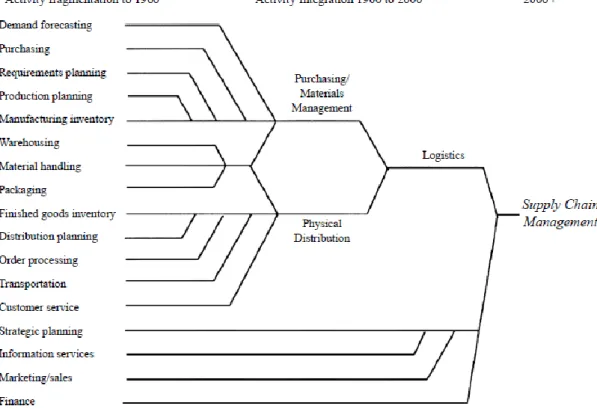
From the above definitions, logistics management is one component of supply chain. In the history, the concept of supply chain management is also later than logistics management. Figure 2 displays the evolution of logistics and supply chain management.
Figure 2: Evolution of logistics and supply chain management (Ballou, 2007).
As Figure 2 shows, after the 1960s logistics management has integrated many activities such as warehousing, packaging, transportation and inventory. After the 1990s, in order to control and manage the whole flow of products and services, the SCM has been put forward. SCM is important to companies and logistics management is one important part of SCM, which makes logistics management important to modern companies (Bloomberg et al., 2002). Christopher (2005) has said that the SCM is a wider concept than logistics. It is an extension of logistics management. In his opinion, logistics is a framework that creates a plan for the flow of product and information through a business. SCM builds upon this framework and seeks to achieve linkage and co-ordination between the processes of other entities. Today, SCM has become a complex sequence of activities aiming at value capture. Generally speaking, the evolution of
11
logistics and SCM can be described as an integration process. It is a key area for future productivity improvements.
From the management functions‟ perspectives, the importance of logistics management can also be indicated. Today, manufacturing and marketing are still two key factors to help enterprises gain the competitive advantages. Logistics management is to coordinate the manufacturing and marketing from the beginning to the end. Therefore, logistics has become one of the key factors influencing companies‟ competitiveness in the industry (Christopher, 2005).
In the next part, the relationship between logistics and competitive advantages of companies is expanded, which is related to the reason that 3PL companies exist.
3.2Logistics and competitive advantages
There are many success factors which can help companies get competitive advantages in the marketplace. However, the kinds of competitive advantages can be simply classified into two types. One is related to cost and the other is related to value. Figure 3 shows the triangular linkage among company, customer and competitor, which shows how companies can develop their competitive advantages in the marketplace (Ohmae, 1983).
As Figure 3 shows, from customer‟s view, they would purchase products with higher value at the same price, or products with the same values at a lower price. Customers always seek benefits at acceptable prices. From company and competitor‟s view, they need care about the value and cost. First, they need increase their ability to differentiate themselves from their competitors. Second, they need to operate at lower cost and provide an acceptable price for customer. The cost and value advantage can ensure company gets a sustainable competitive advantage.
12 Figure 3: Competitive advantages and the ‘Three Cs’(Ohmae, 1983).
In order to gain the cost advantages, companies need provide a multitude ways to increase efficiency, productivity and cumulative volume to reduce unit costs. In order to gain value advantages, companies have to provide added value services or improve their product quality and technologies to satisfy customers (Christopher, M. 2005). Besides improving companies‟ internal operations and management, there is another way for companies to gain these advantages – through outsourcing their logistics activities. From the perspective of these companies, outsourcing logistics activities can reduce logistic cost and improve logistics efficiency. Secondly, when they do not need to worry about the logistics activities, they can concentrate more money and human resource in production and technology development and other management functions. In other words, they can focus on the activities which can create more values to customers. Thirdly, professional logistics service providers are high efficient. They help deliver products to customers quickly, which is also one kind of values to customers.
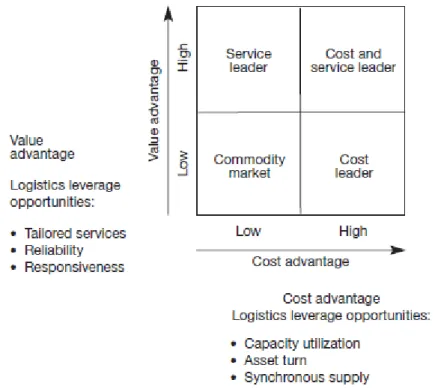
Christopher created a matrix to illustrate the influence of logistics management on cost and value advantages. See Figure 4. Companies do not have neither cost nor value advantage in the bottom left hand corner of the matrix. In other words, their products and services are exactly the same with their competitors. They do not have any cost advantage. These are typical commodity market situation. It is difficult for them to survive under that situation. Their final purpose is become the cost and service leader. In order to become the cost leader, one way is to increase the product market share and sales volume. A better asset turns can make a rational planning for the development of the company. In order to become the value leader, the main way to differentiate from
13
competitor is service. It is not to say that the more service provided the better. Companies need provide the most suitable service for customer, such as the tailored services (Fuller et al., 1993). The high level of responsiveness and reliability also can help company to gain the value advantage and become the service leader. Through logistics management outsourcing, companies can gain cost or value advantages.
Figure 4: Logistics and competitive advantage (Christopher ,2005).
As mentioned above, logistics management aims to provide a high level of service at lower cost for customers during the process. Companies can use internal logistics management or outsource logistics service to other professional logistics companies to achieve these advantages. When considering outsourcing, 3PL companies are one good choice. Below, 3PL companies are focused.
14 3.3The 3PL
3.3.1 Definition of third-party logistics
As mentioned above, in order to survive and develop in the marketplace, companies have to develop their own competitive advantages, which might be related to cost or value. Logistics management can make effects on cost or value advantages. For companies, they can outsource the logistics activities to professional logistics service providers and focus on their core business. It is not rationale for all companies to develop their own logistics systems because of high cost. Outsourcing logistics to a professional logistics company has been viewed as an effective strategy. 3PL companies are the companies which focus on professional logistics management for other businesses or individuals (Berglund et al. 1999).
Tian et al. (2010) define 3PL companies are the external logistics service providers to businesses. They provide management, control and delivery of logistics activities. Bolumole (2003) claims 3PL companies perform all or part of other companies‟ logistics operations.
The 3PL evolution follows the logistics process of development. It can be divided into five phases according to service it provided.
Single service
3PL companies provide only transportation or warehousing services. Separated services
3PL companies provide either transportation or warehousing services. Integrated services
3PL companies provide a combined transportation and warehousing services. Combined services
3PL companies provide extra services on top of the transportation and warehousing functions such as planning services.
Complex combined services
3PL companies provide a network of different services, such as delivery services, technology services, distribution services, and after sale services (Novick, 1993)
According to the five different phases, the main task in the beginning of 3PL development period is providing the basic logistics service for customers, such as
15
warehousing, distribution and delivery. In recent years, with the dynamic changing and development of SCM, 3PL providers have moved their focus to strategy development (Hertz et al, 2003). 3PL companies have capabilities to act as experts for all kind of logistics service. They are not simple delivery and warehousing any more. They provide the value-added services as well. They rather offer the logistics solution service and coordination. Various services create opportunities for companies to improve customer satisfaction (Knemeyeret al., 2003).
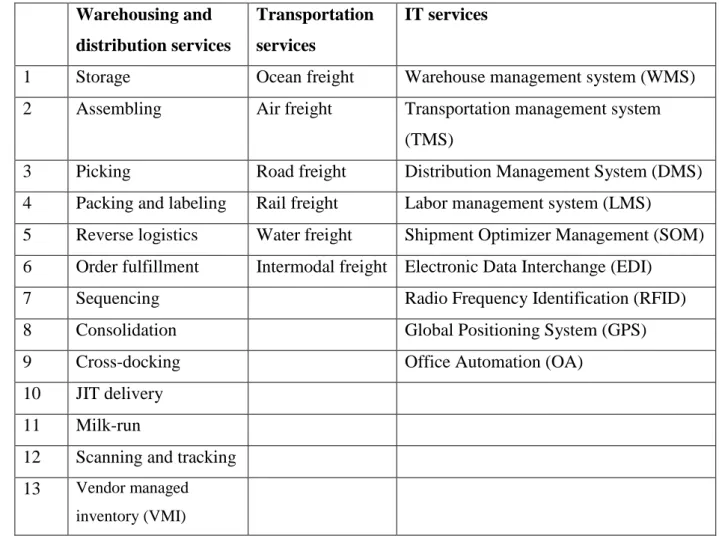
In order to get a deep understanding of logistics service, it is necessary to have a review of the logistics services. Logistics service can be divided into several areas according to it functions, such as transportation service, warehousing services, distribution services and information technology services as shown in Figure 5(Lambert et al. 1998, Vitasek, 2006). Warehousing and distribution services Transportation services IT services
1 Storage Ocean freight Warehouse management system (WMS)
2 Assembling Air freight Transportation management system (TMS)
3 Picking Road freight Distribution Management System (DMS)
4 Packing and labeling Rail freight Labor management system (LMS)
5 Reverse logistics Water freight Shipment Optimizer Management (SOM) 6 Order fulfillment Intermodal freight Electronic Data Interchange (EDI)
7 Sequencing Radio Frequency Identification (RFID)
8 Consolidation Global Positioning System (GPS)
9 Cross-docking Office Automation (OA)
10 JIT delivery 11 Milk-run
12 Scanning and tracking 13 Vendor managed
inventory (VMI)
Figure 5: Three logistics service according to it functions (Lambert et al. 1998, Vitasek, 2006).
16
With the rapid development of economy and logistics, the global logistics market keeps an increasing trend. Among those logistics companies, the 3PL companies especially keep the most rapid development speed. More companies continue to outsource their logistics activities to 3PL providers to reduce their logistics costs. 3PL is becoming a source for companies to gain competitive advantages by reducing logistics cost, enhancing core competency, and improving service quality (Huo et al., 2008; Wang et al., 2006).
3.3.2 Advantages and disadvantages of using 3PL companies
Lau et al. (2006) summarized some common key factors that motivate organizations
to use 3PL companies. These factors were broadly categorized as economic, strategic, and environmental perspectives in Figure 6. Solakivi et al. (2011) agree outsourcing logistics activities to 3PL companies can make the cost reduction, cost saving and capital investment reduction. According to those factors, it can improve profitability, efficiency, return on assets and add value to product. Brewer et al. (2013) state, for strategic factors, it can make companies focus on core competence, acceleration of business process re-engineering and enhancement flexibility. Influenced by those factors, 3PL can improve performance, competitiveness and achieve competitive advantages. Meanwhile, companies can leverage the organization‟s skills and resources and improve business focus. Finally, it can reduce organization‟s own productive capacity, increase responsiveness to market change and reduce risks. For environmental factors, it refers to IT development, globalization and capability of supplier. The IT development can meet increasing demand and manage resources more efficiently and economically (Christopher, 2005). The globalization can help companies gain global competitive advantage. The capability of supplier enables partnering to improve service quality and customer service.
17 Figure 6: Advantages of using 3PL companies (Lau et al,2006).
However, there have some problems for outsourcing logistics to 3PL companies during it provide convenience for organizations. Lau et al. (2006) also summarized the drivers against 3PL usage in Figure 7. Kumar et al (2012) agree there are many potential problems of using 3PL companies. The loss of control made the companies loss core competencies and alienating customers. The loss of critical skills made organizations loss of competitive advantage and increased number of competitors. The low capabilities of 3PL providers made organizations loss of market share. The loss of flexibility reduced responsiveness for the fast changing market. Failure to realize hidden costs of contract increased operating cost. Indecisiveness on which activities to
18
outsource and less support from organization increased chances of failure. The fear of job loss increased resistance to change and lower staff morale.
Figure 7: Disadvantages of outsourcing logistics to 3PL companies (Lau et al,2006).
To sum up, the advantages of using 3PL companies are to gain service improvement cost saving and operation efficiency. The disadvantages are there are risks of loss of control, loss of critical skills, loss of flexibility and less support from organization which increased the operating cost, increased chances of failure and loss of competitive advantage. However, it does not mean 3PL is negative. Outsource logistics activities to 3PL providers have more advantages than disadvantages. Choose an outstanding partner reasonably and successfully will help organization achieve competitive advantages.
3.4Factors influencing 3PL companies’ success
From the above studies, the demand for 3PL companies is significant in modern business world. For the existing 3PL companies, they need to meet the needs of their clients (particularly the businesses). It is important for them to understand the key
19
factors which can significantly influence their success. In this part, the author will review the current literature about this topic.
3.4.1 Customer service
Customers are the most important factor in the business environment. All of the products and services are provided to satisfy the customers‟ needs. Therefore, providing a high level of customer service is quite important. Customer service is an important factor influencing companies‟ success (Fuller et al., 1993), and 3PL companies have no exception.
Customer service can be considered as the relationship between companies and customers during the delivery of products and services. This relationship is not only including the purchasing, shipping and receiving; but also include the after sale service and the whole flow of information during the delivery. Lalonde and Zinszer (1976) suggested that the customer service could be examined under three headings: pre-transaction elements, pre-transaction elements and post-pre-transaction elements.
20 Figure 8: The components of customer service (Lalonde and Zinszer, 1976).
The Figure 8 shows some of the elements of customer service. The pre-transaction elements refer to organization policy and program. The statement of customer service policy must write clearly. The system flexibility, accessibility and organization culture are also very important. The transaction elements are physical distribution functions that customer service involved during the delivery. For example, the order cycle time, inventory availability, order fill rate and order status information. The post-transaction
21
elements of customer service are indicated the after-sale supportive. The elements include product warranty, product repair and customer claims, etc.
The companies need to provide the same level of service during the different phase to maintain customer satisfaction. Customer service is an essential aspect during the logistics process. The poor customer service will increase the higher costs; lost business and bad reputation. The high level of customer service can ensure customer goes a long way with companies (Bhatnagar et al., 1999). Then the 3PL companies can gain long term development, which is equal to success.
According to a research by Rajesh et al (2011), it is found that 3PL companies depend on its professional logistics service to provide values to their clients. As mentioned above, the reasons that 3PL companies existing in the market because they can create cost or value advantages to clients. When they can provide competitive cost or value advantages to clients, they can have a competitive position in the marketplace. For instance, through warehouse management, 3PL companies can help their clients reduce the cost. Through cooperation with their clients, they can help these clients achieve strategic objectives and improve their clients‟ organizational performance. Both of the achievement of these performances needs the support of service. Kumar (2007) also agrees with the importance of service to 3PL companies‟ success. He claims that the competition in this industry is increasingly intense and only the 3PL companies which can reduce cost and increase customer satisfaction can make a success. In order to increase customer satisfaction, it must depend on service. Kumar (2007) claims many successful 3PL companies have established a good customer relationship with their clients.
The customer service provided by logistics companies might not always related to cost. Chang and Fong (2010) claims that the environmental awareness in the global market is increasing and companies which can reduce their impact on the environment can gain customer satisfaction. When 3PL companies can reduce CO2 emission and other environmental impact activities, they can gain the satisfaction of clients as well. China Federation of Logistics and Purchasing (2011) found that some logistics companies have started to do such a business and the development is promising. From these studies,
22
it is found that there are many viewpoints to explain why customer service is important to the success of 3PL companies.
Gupta et al (2013) also agree with the role of customer service to the success of 3PL companies. However, they argue that the effectiveness of customer service is strongly determined by the information technology and systems used by the 3PL companies. In the next section, technology is focused.
3.4.2 Information technology systems
As introduced in section 3.3.1, 3PL companies have applied many IT systems, such as WMS, TMS, DMS, LMS, SOM, EDI, RFID, GPS, and OA. For a successful 3PL companies, the integration among these systems is important and necessary. Gupta et al (2013) claim 3PL companies can provide better logistics solutions to their clients because they have established a strong and integrated supply chain management system. The reduction of cost and added values provided to clients are achieved with the help of information technologies as well. Some 3PL companies can provide distinguished service to business is also related to advanced technologies. Therefore, from the viewpoint of Gupta et al (2013), information technology is more important to the success than customer service because it is the foundation of high quality of customer service.
In the beginning of the 21st century, increasing information technologies are applied in logistics management. The development of the 3PL is based on logistics low operation cost and high efficiency. By using advanced information technology can not only expand logistics enterprise profit space, but also make the 3PL has more advantages in the logistics competition, thereby promote the development of the 3PL industry is very important (Alshawi, 2001). Accelerate technology innovation and standardization, introduce information network technology are the guarantee for improve the efficiency of logistics services (Bourlakis and Bourlakis, 2006). 3PL information management strategy not only optimizes the enterprise internal resource allocation, but also unit the network and users, manufacturers and suppliers to achieve resource sharing, information sharing, real-time tracking, control and management efficiency during the whole logistics activities (Lai et al., 2006). However, Jiang (2002) argues that Chinese logistics companies are weak in technology. They strongly depend on low cost labors.
23
Gupta et al (2013) claims that information technology is the foundation of customer service, and the above studies prove the significantly important role of integrated information systems to the success of 3PL companies, but there are different viewpoints. Cheng et al. (2009) states employees and managers are the key to customer service, and also the success of 3PL companies. In the next part, this factor is focused.
3.4.3 Human resource
According to the research of Cheng et al. (2009), there are three factors which significantly influence the success of 3PL companies. They are leadership, human resource management, and degree of information. The first and second factors are related to the management on human resource. Leadership means leaders‟ influence and motivation on employees, and human resource management is motivation, evaluation and reward activities conducted by companies. The degree of information means the degree to which companies provide timely, reliable and accurate information about their logistics service to the clients. Although this research is focused on the human resource, it is found that this research has confirmed that customer service is also one important factor.
From the perspective of human resource, it is because logistics service must be conducted by employees. From receiving the products from clients and delivering the products to clients, employees are participating in the whole process. Therefore, 3PL companies cannot completely depend on information technologies and systems. The technologies and systems are the tools, and clients interact with employees. This makes human resource important to the success of 3PL companies.
Laarhoen et al. (2000) have analyzed the performance of 3PL companies from the perspective of their clients. From the clients who evaluate the 3PL companies as high performance, it is found that the 3PL companies would arrange managers to monitor the day-to-day activities for their clients. On the one hand, this proves the importance of service; on the other hand, it is proved that managers are important to the success of 3PL companies. These studies prove that there is close relationship between human resource and customer service. The efforts and performance of human resource of 3PL companies can determine their development and success.
24 3.4.4 Competitive operational performance
The operational efficiency of 3PL companies determines their competitiveness and success. Min and Joo (2006) studied the US 3PL companies and confirmed this relationship. It is found that the ones with higher operational performance would have higher financial performance. Operational performance is generally evaluated from five perspectives, including quality, cost, speed, flexibility and dependability (Brown, 2005). To link the theories of operations management to the business of 3PL companies, it is found that operations management can help companies reduce cost, improve quality, speed and flexibility, and enhance dependability. This is related to the cost and value advantages of 3PL business. In other words, 3PL companies must have some competitive operational performance, such as low cost or high service quality, so that they can make success in business.
Many companies have depended on operations excellence to reduce cost (Brown, 2005). For 3PL companies, when their operational performance is excellent in terms of both cost and quality, they would be competitive in the marketplace. Chen et al. (2004) studied Haier‟s logistics management and found that standardization of operations and manufacturing and improving employee capabilities through training have effectively improved their logistics competitiveness. This study shows that not only operations management but also human resources are important factors to logistics success.
From the research of Min and Joo (2006), it is found that 3PL companies can use operations management to optimize their service process and then improve their service quality. Then clients would trust these 3PL companies and outsource the logistics activities to 3PL companies. From this logic, it is found that this study actually supports that both operations management and customer service are the factors influencing these companies‟ success.
In a word, a successful 3PL company must have at least one competitive operational performance. They can choose from the five performance objectives – quality, cost, speed, flexibility and dependability (Brown, 2005).
25 3.4.5 Strategic alliance
The above factors have been agreed by many scholars. Besides these factors, some scholars pay attention to some specific factors, such as strategic alliance. It is found that in some countries where the competition is fierce, 3PL companies have to establish strategic alliance to maintain their competitive position in the marketplace. The 3PL companies need develop logistics market, reduce logistics cost and improve logistics efficiency with the principle „advantage complementary, interests sharing‟. These companies would establish a logistics resource league, get together the small and medium size enterprise and collect the scattered logistics resources, and then form a logistics integrated resource advantage. Implementing logistics alliance in a certain geographic area can form a highly efficient operation system. What is more, development of a 3PL alliances union to coordination and guidance the relationship between logistics enterprises can develop 3PL efficient (Goh et al., 2003). In addition, the local companies and international companies establish joint ventures also can be a choice (Hong et al., 2004). Through joint ventures, the local companies can achieve the advanced IT systems, professional staff and various services. The international companies can have a better understanding of Chinese idea and a better chance to enter Chinese market. Therefore, strategic alliance can also become one factor influencing the success of 3PL companies.
However, according to a research by Min and Joo (2009), it is found that there is a negative relationship between strategic alliance and financial performance. They found that strategic alliance requires 3PL companies to do restructuring and re-branding. The cost is high and negatively influences the competitiveness of companies. If conflicts occur, the problems would be more than the time before strategic alliance.
To summarize the above findings, it is found that scholars have identified different factors which influence the success of 3PL companies. The following table summarizes these factors and the relative empirical studies.
26 Rajesh et al (2011) Kumar (2007) Gupta et al (2013) Lai et al. 2006) Cheng et al. (2009) Bhatnagar et al. (1999) Min and Joo (2006) Chen et al., 2004 Goh et al., 2003) Customer service
√
√
√
√
√
√
Information Technology systems√
√
Human resource√
√
√
√
Competitive operational performance√
√
Strategic alliance√
Figure 9: Summary of factors influencing 3PL companies’ success.
In this research, these factors will be under investigation in two case companies.
3.53PL business in China
As mentioned in the first chapter, Chinese 3PL market is “a booming phenomenon” and still in an early stage compared with 3PL in development countries. The Chinese 3PL market develops with annual growth rate about 25% from 2000 to 2007 (Wang et al., 2008b). Thus, Chinese 3PL market offers a great potential for future business. Meanwhile, the huge market and complex business environment present both opportunities and challenges for logistics companies. In this research, before providing suggestions to the two case studies, a general perspective on the business environment for 3PL companies to do business in China should be reviewed. This is because companies‟ business strategy and development is significantly influenced by the external environment.
27 3.5.1 Opportunities in Chinese market
Companies‟ success is not only related to internal factors, but also external factors. The same, for successful 3PL companies in China, there must be some positive factors influencing their development. According Lau et al. (2006), there are three positive macro environment factors. See Figure 10.
Figure 10: Opportunities for Chinese 3PL market (Lau et al. 2006).
In recent years, the Chinese government has recognized that the logistics activities is become one of the important business activities in the economic market. First, the Chinese government strive to develop and investment in logistics infrastructure due to the late start and poor infrastructure. Such as nationwide multi-modal transportation networks and large-scale modernized logistics and distribution centers (Trunick, 2003). Perfect transportation and distribution network encouraged companies to outsource their logistics activities to 3PL providers. Second, the accession of China to the WTO has opened some sectors for high-quality foreign 3PL providers to enter (Hertzell, 2001). The relaxation of regulations for 3PL providers enabled more companies outsources more functions. Third, the economic reform and development enlarged the consumer market which increased the demand for logistics solution. Finally, the consolidation in industries and emergence of national chains also increased the need for transportation and logistics solutions (Hertzell, 2001). From these words, it is found that some factors are extremely positive for domestic 3PL companies, while some are positive for foreign 3PL companies. They will be analyzed in this research.
28 3.5.2 Challenges in Chinese 3PL Market
Although the growth and government support are the opportunities for 3PL companies in China, there are also many challenges confronting them. Due to the increasing demand in the market, 3PL companies all around the world make their movement step into Chinese market, while most of Chinese 3PL companies are viable small and middle-size logistics companies (Matteo, 2003). The small and middle-size companies offer low price service, while the international companies provide professional and high quality service. The competition is extremely fierce.
Besides the intense competition, Lau et al. (2006) identify another three groups of factors which are related to the background of China, as Figure 11 shows. According to the research of Lau et al. (2006), the challenges confronting 3PL companies in China are related to poor infrastructure, regulation issues and unprofessional staff.
Figure 11: Challenges in Chinese 3PL market (Lau et al, 2006).
The infrastructure and equipment in China are still less developed than western countries. The lack transportation networks, IT systems, warehousing and distribution facilities make the Chinese transportation costs higher than western countries. Meanwhile, the high transportation damage risk leads to high warehousing costs (Zhao et al, 2009). This is not good for operational performance improvement. As mentioned above, operations management is important to the success of 3PL companies.
29
The Chinese government does not have one unified regulatory authorities. There are many government departments participate in logistics activities. Although the government formulates some regulations, there is no one unified regulatory authorities in charge of macro-management and coordination. Thus the logistics activities will interrupt many times from suppliers to customers. In addition, the logistics technology standard has not been established. Manufacturing logistics equipment manufacturers belonging to different departments, each department standards are not consistency, resulting in logistics equipment, such as automotive, packaging containers, pallets, containers and other standards are not consistency. Another example is that two different departments have their own systems, cannot be networked with each other, and the technical standards are not consistency. Non-standardized increased invalid operations, logistics speed reduced, logistics accidents increased, increasing logistics costs, reducing the effectiveness of the logistics enterprises (Forrest, 2005). The local protection is also a weakness for develop 3PL in China. The business activities are operated on provincial level which hinders the creation of national networks (Kerr, 2005).
Human resource is one of the factors influencing 3PL companies‟ success. However, in China, there has been a huge lack of qualified logistics staff. The shortage of talent is huge obstacles for logistics and distribution (Yu et al, 2010). In such a situation, the low-quality of providers cannot fully meet customers‟ requirements.
30
4.
Findings
4.1Findings about Anji Logistics
Anji Logistics is a wholly owned subsidiary company under Shanghai Automotive Industry Corporation. Taking “Technology in services and products” as its business principle, Anji Logistics is become the biggest automotive logistics service provider in China, with more than 10,300 employees. It has 10 professional sedan-transportation subsidiary companies, providing delivery services by using water, rail and road. With 50 distribution centers, around 3,700,000 square meters warehousing space and over 2 million cars being transported every year. Anji Logistics has also formed its comprehensive multi-mode transportation network in operations.
Anji Automotive Logistics focuses on finished vehicle logistics, auto parts logistics, port logistics and relevant logistics service planning, solution designing, technology consulting and management trainings. It provides integrated, technical and transparent network logistics supply chain service with reliable and unique logistics solutions. Anji Logistics established several subsidiary companies according to their services provided: Anji finished vehicle Logistics Company, Anji auto parts Logistics Company and Anji port Logistics Company. Anji auto parts Logistics Company was funded jointly by Anji Logistics and CEVA Logistics. CEVA Logistics was formed in August 2007 as a result of the merger of Thomas Nationwide Transport Logistics (TNT) and Eagle Global Logistics (EGL). Anji port Logistics Company was funded jointly by Anji Logistics, Nippon Yusen Kaisha (NYK) and Wallenius Wilhelmsen Logistics.
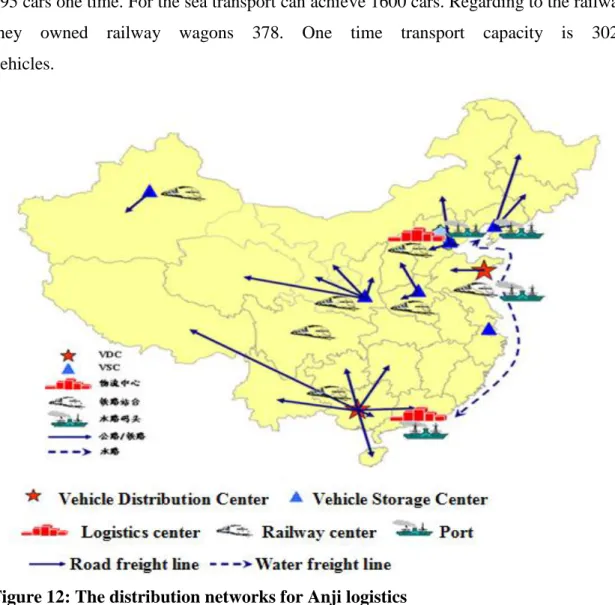
The physical distribution networks of the company have been established across most central cities with the storage area more than 3.5 million square meters in China. Railway and waterway transport resources is their special characteristic. Diversification transportation structure of highway, railway and waterway can provide a low cost, safety and efficient transportation service. Meanwhile, the mode of transportation depends on the cost and customer satisfaction. The highway transportation capacity is in the highest flight of automotive logistics. Anji have three highway transportation subsidiaries. Another three transport companies perennial for Anji service. There business spread all over China with 1639 transport cars. They have set up the waterway lines along the river and sea line. The transportation capacity inland river can achieve
31
995 cars one time. For the sea transport can achieve 1600 cars. Regarding to the railway, they owned railway wagons 378. One time transport capacity is 3024 vehicles.
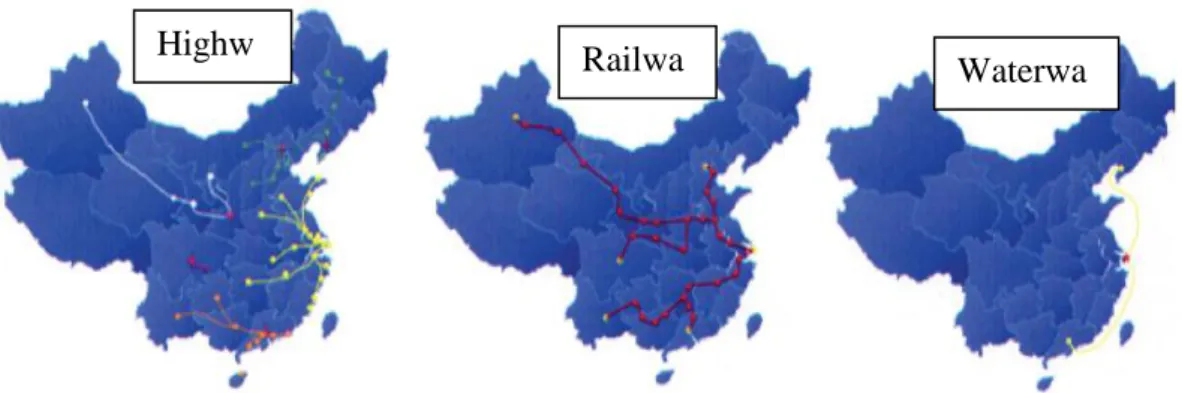
Figure 12: The distribution networks for Anji logistics
4.2Findings about APL logistics
APL logistics is a wholly owned subsidiary of Singapore-based Neptune Orient Lines (NOL), a global transportation and logistics company engaged in shipping and related businesses. APL Logistics is a global 3PL provider. APL Logistics provide globally door-to-door logistics and supply chain services. Their major industries served include automotive, chemical, High-tech, retail, industrial and consumer packaged goods. It has 4,500 employees‟ in 55 countries and 269 regional areas around the world. APL Logistics manages about 172 logistics center (distribution center) in over 150 cities worldwide with their lean equipment and information systems. With its long history and extensive industry background, APL Logistics plays a unique advantage in the 3PL market. It provides comprehensive logistics services and solutions.
32
APLL is one of the wholly foreign-owned enterprise (WFOE) has been steps into China earliest. It has the business license of all the major markets in China. It has 10 branches and 29 representative offices in China. Changan Minsheng-APL Logistics (CMAL) was funded jointly by APLL and Mingsheng Logistics. It was one of China's largest automotive 3PL. APLL and another well-known Chinese company Lenovo established a joint venture called Zhiqin-APLL Technology Logistics Company in 2002. The company provided SCM services for Chinese IT market.
APL Logistics has covered the most regions of China for its distribution networks. APL Logistics has comprehensive a network of 19 offices supported by over 700 logistics professionals in China. The distribution networks of its highway, railway and waterway are shown in Figure 13. APL Logistics networks concentrated in the central and eastern regions of China. Then make a close contract with the world through the ocean way. The bases have been equipped with modern warehousing facilities and advanced information systems.
Figure 13: the distribution networks for APL Logistics
The basic business information of the two 3PL companies is presented above. In the next chapter, the author would present the findings from data collection process, particularly the interview, and then discuss these findings.
4.3Advantages provided by the two 3PL companies
Based on the interview, it has been found that Anji Logistics is currently mainly providing automotive logistics services for about 15 main customers. Among these customers, there are famous international brands such as Mercedes-Benz, BMW and Cadillac. However, most of the customers are Chinese domestic companies and joint
Highw
ay Railway Waterwa
33
ventures. Domestic companies include: BYD, Roewe, Yutong, Chery, Geely, and JAC. Joint ventures are Shanghai General Motor, Faw Volkswagen, Faw Toyota, Gac Honda, Beijing Hyundai and Dongfeng Nissan. Differently, APL Logistics has provided service to more industries‟ companies, including automotive, computers, electronics industries, consumer goods, food, industrial, and retail/apparel. Most of the customers served by APL Logistics are international companies such as Dell Computer, General Motors, Procter and Gamble, Nike, Val-mart stores, Samsung and Chevron. The second largest customers are joint ventures, such as Changan Ford, Changan Suzuki and Dongfeng Peugeot. They also provided services for the domestic companies, such as Lenovo and Huawei.
APL Logistics have served many worldwide known companies in the world. This proves that it has competitive advantages. Although Anji Logistics serve fewer customers than APL Logistics, it has focused on the automotive industry and become the leader of 3PL business in this industry in China. This also shows it has competitive advantages.
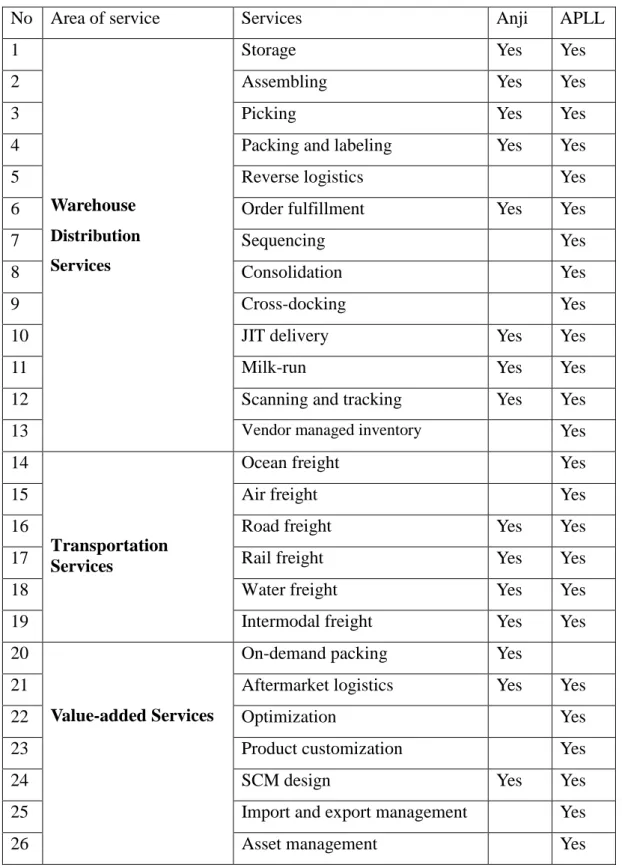
From the interview, it is found that these two 3PL companies have similarities and differences. This can be reflected from the services provided by these two companies, as
34
No Area of service Services Anji APLL
1
Warehouse
Distribution Services
Storage Yes Yes
2 Assembling Yes Yes
3 Picking Yes Yes
4 Packing and labeling Yes Yes
5 Reverse logistics Yes
6 Order fulfillment Yes Yes
7 Sequencing Yes
8 Consolidation Yes
9 Cross-docking Yes
10 JIT delivery Yes Yes
11 Milk-run Yes Yes
12 Scanning and tracking Yes Yes
13 Vendor managed inventory Yes
14
Transportation Services
Ocean freight Yes
15 Air freight Yes
16 Road freight Yes Yes
17 Rail freight Yes Yes
18 Water freight Yes Yes
19 Intermodal freight Yes Yes
20
Value-added Services
On-demand packing Yes
21 Aftermarket logistics Yes Yes
22 Optimization Yes
23 Product customization Yes
24 SCM design Yes Yes
25 Import and export management Yes
26 Asset management Yes
Figure 14: Services provided by Anji Logistics and APL Logistics.
Today, Anji Logistics share more than 30% business in Chinese automotive logistics market. Anji Logistics can become the leader in the automotive 3PL business is due to its low cost of service. From the interview, it is found that this company has made good of its local advantages and establish good relationship with local partners and
35
governments. Due to these advantages, it can minimize its service cost to attract clients. High market share further brings the low operation cost and provides low price for customers. Differently, APL Logistics has a higher cost when doing a same business compared with a local company. APL Logistics does not have a deep understanding of Chinese culture. It is not easy to get a good communication with Chinese customers. They do not know what Chinese customers performed and how Chinese customers will think. This might result in a misunderstanding between companies and customers. Thus, it leads to an extra cost. Second, APL Logistics have an imperfect distribution networks. APL Logistics have an advanced global transportation system due to it belongs to Singapore-based Neptune Orient Lines (NOL), a global cargo transportation and logistics company. But APL Logistics has a weak distribution networks in China. All of these reasons make its price higher than the one of Anji Logistics.
4.4Factors influencing two 3PL companies’ success 4.4.1 Information technology systems
Both of the interviewees claim that information systems have played an important role to the businesses. These two companies have both made effort to adopt many kinds of systems to support customer service.
From the interview, it is found that both of them currently adopt IT systems including Warehouse Management System (WMS), Transportation Management System (TMS), Distribution Management System (DMS), Electronic Data Interchange (EDI), GPS global positioning system and Radio frequency identification (RFID). According to the interview, it shows that RFID is available in Anji Logistics but currently no customers. APL Logistics use some more advanced IT system, such as Shipment Optimizer Management (SOM), Labor management system (LMS) and Office Automation (OA). APL Logistics‟ IT systems are more mature compared with Anji Logistics.
36
APL Logistics Anji Logistics
Figure 15: IT systems in case companies.
4.4.2 Competitive operational performance
From the interview, it is found that another important factor influencing their competitive advantages is related to operations management. The managers claim that sufficient logistics networks and the operations in the network are important to their competitiveness (cost or value). Today, these two companies‟ distributions of business offices, branches, and logistics facilities have reached all the main cities, most of the provincial cities, and some of the small cities in China. Both of them have invested in and owned a range of vehicles to support the operation of transport and distribution. According to the interview, Anji Logistics has spread their networks all around China. It has developed and expanded their distribution networks to the places where the customer requirements can be satisfied, such as Tibet and some small place. APL Logisitcs‟ operational performance is higher than the one of Anji Logistics, while its network is smaller than Anji Logistics. The interviewees from APL Logistics claim that they can quickly serve their clients because their service quality and process have been standardized. Operations management in this company is highly effective.
4.4.3 Anji Logistics’ strategic alliance
Anji Logistics mainly established joint ventures in automotive market. Anji Logistics has established Anji auto parts Logistics Company with CEVA Logistics. Anji port
Shipment Optimizer Management (SOM), Labor management system (LMS)
Office Automation (OA)
WMS, EDI, RFID, TMS, DMS, GPS,