TESIS DOCTORAL
Identification and quantification of
crystal components of
Bacillus
thuringiensis
strains and their
contribution to insecticidal activity
JAVIER CABALLERO SÁNCHEZ
Pamplona 2019
Universidad Pública de Navarra Unibertsitate Publikoa Nafarroako
JAVIER CABALLERO SÁNCHEZ
para optar al grado de Doctor por la Universidad Pública de Navarra
Identification and quantification of
crystal components of
Bacillus
thuringiensis
strains and their
contribution to insecticidal activity
Directores:
Research and Development Department, Bioinsectis S.L
Institute for Multidisciplinary Research in Applied Biology
Universidad Pública de Navarra
Pamplona, 2019
Dr. PRIMITIVO CABALLERO MURILLO
Catedrático de Universidad
Departamento de Agronomía, Biotecnología y
Alimentación
Universidad Pública de Navarra
Dra. Mª CARMEN ANCÍN AZPILICUETA
Catedrático de Universidad
Departamento de Ciencias
Universidad Pública de Navarra
Dra. NEREA JIMÉNEZ MORENO
Colaborador Doctor Proyecto Tipo 2
Departamento de Ciencias
Presidente
Dr. Jesus Murillo Martínez
Departamento de Agronomía,
Biotecnología y Alimentación
Universidad Pública de Navarra
Secretaria
Dra. Flor Budia Marigil
Departamento de Producción Agraria
Universidad Politécnica de Madrid
Vocal
Dr. Baltasar Escriche Soler
Departamento de Genética
Universidad de Valencia
Suplente de Presidente
Dra. Delia Muñoz Labiano
Departamento de Agronomía,
Biotecnología y Alimentación
Universidad Pública de Navarra
Suplente de Secretaria
Dra. Mª Pilar Medina Velez
Departamento de Producción Agraria
Universidad Politécnica de Madrid
Suplente de Vocal
Dr. Juan Ferré Manzanero
Departamento de Genética
Universidad de Valencia
Revisores externos
Titulares
Dra. Flor Budia Marigil
Departamento de Producción Agraria
Universidad Politécnica de Madrid
Dr. Baltasar Escriche Soler
Departamento de Genética
Universidad de Valencia
Suplentes
Dra. Mª Pilar Medina Velez
Departamento de Producción Agraria
Universidad Politécnica de Madrid
Dr. Juan Ferré Manzanero
Departamento de Genética
Universidad de Valencia
Producción Vegetal del Departamento de Agronomía, Biotecnología y Alimentación
y Director del Grupo de Investigación Bioinsecticidas Microbianos del Institute for
Multidisciplinary Research in Applied Biology, Universidad Pública de Navarra
Dra. Mª CARMEN ANCÍN AZPILICUETA
, Catedrático de Universidad del área de
Química Analítica, Universidad Pública de Navarra.
Dra. NEREA JIMÉNEZ MORENO,
Colaborador Doctor de Proyecto Tipo 2 del área
de Química Analítica, Universidad Pública de Navarra.
INFORMAN
que la presente memoria de Tesis Doctoral titulada “Identification and quantification
of crystal components of
Bacillus thuringiensis
strains and their contribution to
insecticidal activity“ elaborada por Don
JAVIER CABALLERO SÁNCHEZ
ha sido
realizada bajo nuestra dirección y que cumple las condiciones exigidas por la
legislación vigente para optar al grado de Doctor.
Y para que así conste, firman la presente en Pamplona a 23 julio de 2019
Fdo. Dr. Primitivo Caballero Murillo
Fdo. Dra. Carmen Ancín Azpilicueta
Fdo. Dra. Nerea Jiménez Moreno
Resumen
... 3
Summary
... 7
Chapter I
Introduction ... 11
Aims of the thesis ... 63
Chapter II
Unravelling the composition of insecticidal crystal proteins in
Bacillus thuringiensis
by genome sequencing and mass
spectrometry ... 87
Chapter III
Activity of the individual crystal proteins of
Bacillus thuringiensis
serovar
aizawai
strain ABTS-1857 for
Spodopteran
species:
insecticidal effect of artificial protein mixtures ... 115
Chapter IV
General discussion
...
135
Conclusiones
... 149
Conclusions
... 153
List of publications
... 157
RESUMEN
Bacillus thuringiensis (Berliner, 1915) (Bt) es una bacteria Gram positiva que forma una espora de resistencia durante la fase estacionaria de crecimiento y un cristal parasporal compuesto por d-endotoxinas (proteínas Cry y Cyt) con actividad insecticida por ingestión. Bt es el agente entomopatógeno más empleado para el control de plagas en campo y su uso es compatible con otros métodos de control que tienen cabida en programas de Gestión Integrada de Plagas (GIP). La diversidad de las toxinas Bt, y su amplio espectro de huéspedes, hacen que esta bacteria sea utilizada: i) como recurso genético para la obtención de factores tóxicos utilizados en la construcción de plantas resistentes contra las plagas, y ii) para el desarrollo de insecticidas basados en Bt.
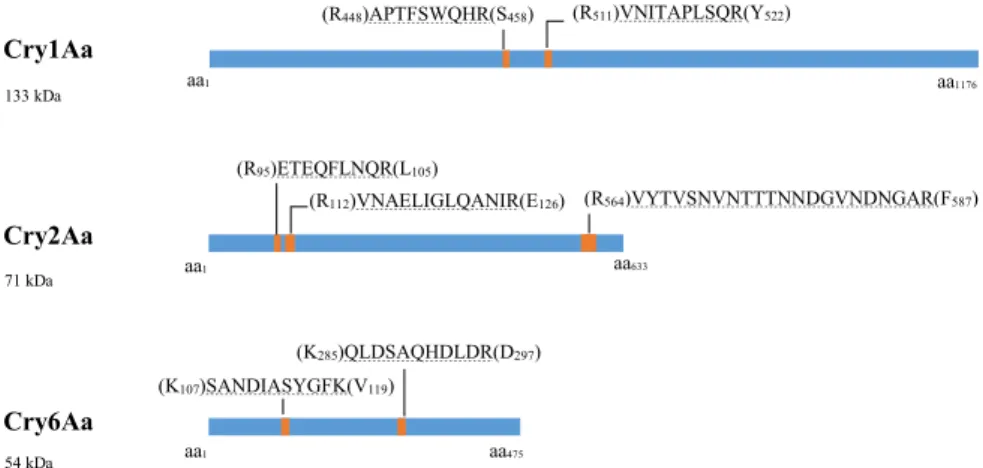
Desde los años 70, la potencia de los insecticidas basados en Bt se expresa en Unidades Internacionales (UI). Este valor, se determina para cada lote de producto técnico comparandolo con la potencia de una cepa estándar de Bt a la cual se le ha atribuido un valor arbitrario frente a larvas de un insecto de referencia. Sin embargo, este dato no aporta ninguna información relevante sobre la actividad insecticida del producto cuando el objeto del tratamiento son otras especies plaga distintas al insecto de referencia. El principal objetivo de esta tesis ha sido desarrollar un método proteómico que permite analizar cualitativa y cuantitativamente las proteínas que componen el cristal producido por distintas cepas silvestres de Bt. El método emplea un sistema de cromatografía líquida acoplada a un espectro de masas (LC-MS/MS) en combinación con una monitorización de múltiples reacciones (MRM). Para llevar a cabo el análisis, es necesario conocer la secuencia del genoma de la cepa Bt para determinar los potenciales genes insecticidas que podrían formar parte del cristal parasporal. El uso de herramientas bioinformáticas permite la selección de péptidos proteotípicos que detectan de forma específica la presencia de cada una de las proteínas de la mezcla. Estos péptidos proteotípicos, marcados isotópicamente, permiten determinar la proporción relativa de cada proteína en el cristal. El método fue validado utilizando dos mezclas artificiales de tres proteínas recombinantes (Cry1Aa, Cry2Aa y Cry6Aa), donde la proporción relativa de cada proteína era conocida. La aplicación del método permitió detectar las tres proteínas de forma independiente y cuantificar la proporción relativa de cada una de ellas con gran
fiabilidad y precisión. Una vez verificada su validez, el método fue aplicado para determinar la composición del cristal de cuatro cepas Bt silvestres que component el ingrediente activo de los productos comerciales más vendidos a nivel mundial para el control de distintos órdenes de insecto: DiPel® y XenTari® para lepidópteros, VectoBac® para dípteros, y Novodor® para coleópteros. El cristal parasporal de la cepa ser. kurstaki ABTS-351 (DiPel®) resultó estar compuesto por cuatro proteínas: Cry1Aa (13-22%), Cry1Ab (16-29%), Cry1Ac (6-12%) y Cry2Aa (40-64%); al igual que la cepa ser. aizawai ABTS-1857 (XenTari®) Cry1Aa (26-33%), Cry1Ab (57-60%), Cry1Ca (7-11%) y Cry1Da (3-4%). La cepa AM65-52 (VectoBac®) sintetizó un cristal formado por Cry4Aa (2-4%), Cry4Ba (10-28%), Cry11Aa (10-27%), Cry60Aa (2-4%), Cry60Ba (5-12%) y Cyt1Aa (38-61%) y el ingrediente activo de Novodor®, la cepa ser. tenebrionis NB-176, contenía Cry3Aa (70-75%), Cry23Aa (14-16%) y Cry37Aa (10-14%). Adicionalmente, se determinó la actividad de la cepa ABTS-1857 en larvas de tres especies del género Spodoptera: S. exigua, S. littoralis y S. frugiperda. S. exigua fue la especie más susceptible (CL50= 7.8 ng/µl), seguida de S. littoralis (CL50= 28 ng/µl). S. frugiperda se mostró como la especie más tolerante (CL50= 120.2 ng/µl). Para determinar la contribución de cada proteína individual a la toxicidad general de la cepa ABTS-1857 contra cada una de las tres especies de insectos, se construyeron cepas Bt recombinantes que producían individualmente las proteínas Cry1Aa, Cry1Ab, Cry1Ca y Cry1Da. Los resultados de los bioensayos, utilizando el “droplet feeding method”, revelarón una elevada toxicidad de Cry1Ca para las larvas de S. exigua y S. littoralis y de Cry1Da frente a S. littoralis y S. frugiperda. Las mezclas artificiales de dos o tres proteínas produjeron mortalidades atribuibles a la cantidad de Cry1Ca, en el caso de S. exigua, de Cry1Ca y Cry1Da, en el caso de S. littoralis, y de Cry1Da en el caso de S. frugiperda. La mezcla artificial de cuatro proteínas, que reflejaba la composición natural del cristal, dio valores de actividad concordantes con los producidos por el cristal natural de la cepa ABTS-1857. Aumentos de la proteína Cry1Da, en detrimento de las proteías Cry1Aa y Cry1Ab, produjo incrementos en la actividad insecticida para larvas de S. littoralis y S. frugiperda. Estos resultados indicaron que la metodología empleada para el análisis de los cristales es válida para su empleo en la caracterización y estandarización de los productos comerciales basados en Bt, aportando la información necesaria para expresar su potencia insecticida.
SUMMARY
Bacillus thuringiensis (Berliner, 1915) (Bt) is a Gram-positive bacterium that forms a resistance spore during the stationary phase of growth and a parasporal crystal which is comprised by d-endotoxins (Cry and Cyt proteins) that show insecticidal activity when ingested. Bt is the most commonly used entomopathogenic agent for pest control in the field and its use is compatible with other control methods in Integrated Pest Management (IPM) programs. The diversity of Bt toxins, and their broad spectrum of hosts, allow the use of this bacterium: 1) as a genetic resource for obtaining toxic factors used to engineer plants resistant to pests, and 2) for the development of Bt-based insecticides.
Since the 1970s, the potency of Bt-based insecticides is expressed in International Units (IU). This value is determined for each batch of technical product by comparison with the potency of a standard Bt strain, which has been assigned an arbitrary value against larvae of a reference insect. However, this data does not provide any relevant information concerning the insecticidal activity of the product when the targets of the treatment are other pest species than the reference insect. The main aim of this thesis has been the development of a proteomic method that allows a qualitative and quantitative analysis of the proteins that make up the crystal produced by different wildtype Bt strains. The method uses a liquid chromatography system coupled to a mass spectrum (LC-MS/MS) in combination with a multiple reaction monitoring (MRM). To carry out the analysis, it is necessary to know the genome sequence of the Bt strain to determine the potential insecticidal genes that could be part of the parasporal crystal. The use of bioinformatic tools, allow the selection of proteotypic peptides that specifically detect the presence of each of the proteins in the mixture. These proteotypic peptides, isotopically labelled, allow to determine the relative proportion of each protein within the crystal. The method was validated using two artificial mixtures containing three recombinant proteins (Cry1Aa, Cry2Aa and Cry6Aa), in a known relative proportion. The application of the method allowed the detection of the three proteins independently and the quantification of the relative proportion of each of them with great reliability and precision. Once the method was validated, it was applied to determine the crystal composition of the Bt strains used as active ingredients of four of the best sold commercial products worldwide for the control of different insect orders: DiPel® and
XenTari® for Lepidoptera, VectoBac® for Diptera, and Novodor® for Coleoptera. The parasporal crystal of the Bt subsp. kurstaki strain ABTS-351 (DiPel®) was comprised by four proteins, including: Cry1Aa (13-22%), Cry1Ab (16-29%), Cry1Ac (6-12%) and Cry2Aa (40-64%); in the Bt subsp. aizawai strain ABTS-1857 (XenTari®) four proteins were also detected: Cry1Aa (26-33%), Cry1Ab (57-60%), Cry1Ca (7-11%) and Cry1Da (3-4%). The Bt subsp. israelensis strain AM65-52 (VectoBac®) synthesized a crystal formed by Cry4Aa (2-4%), Cry4Ba 28%), Cry11Aa (10-27%), Cry60Aa (2-4%), Cry60Ba (5-12%) and Cyt1Aa (38-61%). Finally, the active ingredient of Novodor®, the Bt subsp. tenebrionis strain NB-176, contained Cry3Aa (70-75%), Cry23Aa (14-16%) and Cry37Aa (10-14%). Additionally, the activity of the strain ABTS-1857 was determined for three species of the genus Spodoptera, including: S. exigua, S. littoralis and S. frugiperda. S. exigua was the most susceptible species (LC50 = 7.8 ng/μl), followed by S. littoralis (LC50 = 28 ng/μl). S. frugiperda was the most tolerant insect (LC50 = 120.2 ng/μl). To determine the contribution of each individual protein to the overall toxicity of the strain ABTS-1857 against each of the three insect species, recombinant Bt strains producing Cry1Aa, Cry1Ab, Cry1Ca and Cry1Da proteins, were engineered.
The results of the bioassays, using the droplet feeding method, revealed a high toxicity of Cry1Ca for S. exigua and S. littoralis larvae and Cry1Da against S. littoralis and S. frugiperda. Artificial mixtures containing two or three proteins produced mortalities attributed to the amounts of Cry1Ca, in the case of S. exigua, of Cry1Ca and Cry1Da, in the case of S. littoralis, and of Cry1Da in the case of S. frugiperda. The obtained activity values for the artificial mixture containing the four proteins, which reflected the natural composition of the crystal, were consistent with those obtained with the natural crystal of the strain ABTS-1857. Increasing amounts of Cry1Da protein, in combination with decreasing quantities of either Cry1Aa or Cry1Ab proteins, produced an enhanced insecticidal toxicity for S. littoralis and S. frugiperda larvae. These results indicated that the method used for the analysis of the Bt crystals is valid for its use in the characterization and standardization of Bt based commercial products, providing the necessary information to express its insecticidal potency.
Introduction
1. General introduction ... 15 2. The entomopathogenic bacterium Bacillus thuringiensis ... 17 2.1. Discovery and history ... 17 2.2. Interspecific classification ... 17 2.3. Intraspecific classification ... 18 2.4. Genome ... 19 2.5. Life cycle ... 20 2.6. Ecology ... 21 3. B. thuringiensis toxic factors ... 22 3.1. Toxin nomenclature and classification ... 22 3.2. Toxic factors produced during the vegetative phase of growth ... 24 3.2.1. Vip proteins ... 24 3.2.2. Sip proteins ... 25 3.2.3. Other secreted toxic factors ... 26 3.3. Toxic factors produced during the stationary phase of growth ... 26 3.3.1. Cry proteins ... 26 3.3.2. Cyt proteins ... 27 3.4. Structure and function of delta-endotoxins ... 28 3.4.1. The three-domain proteins ... 28 3.4.2. Cyt proteins ... 31 3.5. Models of action of Cry proteins in lepidopteran species ... 31 3.5.1. The classical model ... 32 3.5.2. The sequential binding model ... 34 3.5.3. The signalling pathway model ... 34 4. Bioassays of B. thuringiensis against lepidopteran pests ... 35 4.1. Artificial diet ... 35 4.2. Natural food ... 36 4.3. Toxin supply ... 36 4.3.1. Superficial contamination of diet ... 36 4.3.2. Leaf contamination ... 37 4.3.3. Plotted-plant and field bioassays ... 37 4.3.4. Diet incorporation bioassays ... 38
4.3.5. Droplet feeding method ... 39 4.4. Types of bioassays ... 40 4.4.1. Concentration-mortality response ... 40 4.4.2. Mortality-response ... 40 4.4.3. Feeding inhibition assays ... 41 5. Formulation ... 41 5.1. Additives that counter foliage factors ... 41 5.2. Wetters ... 42 5.3. Stickers ... 42 5.4. Phagostimulants ... 43 5.5. Sunscreens ... 43 5.6. Synergists ... 43 6. Commercial products based on Bacillus thuringiensis ... 43 6.1. Bt-based insecticides ... 43 6.2. Insecticidal potency of a Bt-based product ... 46 6.3. Transgenic crops ... 49 6.3.1. Bt plants resistant to lepidopteran species ... 49 6.3.2. Bt toxicity factors used in Bt plants ... 49 7. Insect resistance to Bacillus thuringiensis ... 52 7.1. Mechanisms of resistance ... 52 7.2. Cross-resistance ... 54 7.3. Strategies to evolve resistance in transgenic plants ... 55 8. Insect target pests ... 57
8.1. Taxonomic position and geographical distribution of Spodoptera
species ... 57
8.2. Biology of Spodoptera species ... 57
8.2.1. Egg ... 57 8.2.2. Larval stage ... 58 8.2.3. Pupa stage ... 59 8.2.4. Adult ... 60 8.3. Economic damage ... 60 8.4. Control Methods ... 61 9. Aims of the thesis ... 63 10. References ... 64
1. GENERAL INTRODUCTION
In 1939, the Swiss Paul Hermann Müller discovered the insecticidal properties of DichloroDiphenylTrichloroethane (DDT) (Metcalf, 1973). The use of this synthetic chemical became significantly extensive during the second half of World War II to prevent Allied soldiers from contracting insect-transmitted diseases, such as malaria, dengue fever and schistosomiasis (Fishel, 2016). By the end of the war, its use was confined to solving problems related to crop protection. Since then, synthetic pesticides such as organochlorines (e.g. DDT), organophosphates (e.g. glyphosate, malathion), carbamates (e.g. aldicarb) and synthetic pyrethroids (e.g. fenvalerate) (Nicolopoulou-Stamati et al., 2016), were massively sprayed in agricultural practices. This lead to the rise of the chemical industry, initiating a new era in pest control (Fishel, 2016).
Chemical insecticides in general have contributed to significantly increase agricultural production by providing season-long protections against a wide variety of insect pests at a relatively low cost. DDT and other synthetic organic pesticides work through similar mechanisms either by disrupting the ion balance of nerve axons, thus producing tremors, convulsions and eventually death; or by inhibiting cholinesterase, leading to the accumulation of acetylcholine at the neuron synapsis and causing paralysis (Das, 2013). Due to their unspecific mode of action, non-target organisms such as beneficial insects or pollinators may be negatively affected. As a result, reductions in the yield and quality of crops or outbreaks of secondary pests may occur (Devine and Furlong, 2007; Sánchez-Bayo et al., 2016). One of the most notorious disadvantages of chemical pesticide usage is the appearance of resistant insect biotypes in the pest populations due to a high selection pressure (Tabashnik, 2008). A few years after the introduction of DDT as the ultimate solution for crop protection, populations of resistant insects arose and in some cases even developed cross resistance to all classes of chemical insecticides (Das, 2013). High stability (low degradation) and long persistence of chemical residues played an important role in their effectiveness, but at the same time they were also key factors in producing negative impacts on the environment. In 1962, Rachel Carson published The Silent Spring (Carson et al., 2002), where she expressed her concerns for generic pesticides and their negative impact as they
bioaccumulated in the adipose tissue of animals and lead to their biomagnification higher up in the food chain (Jarman and Ballschmiter, 2012). A decade later, the U.S Environmental Protection Agency (EPA) banned the use of DDT in the United States (Fishel, 2016).
Concerning human health, skin contact, inhalation, ingestion or high occupational exposure to synthetic chemical insecticides may result in cancer, immune system disorders and dermatological, gastrointestinal, neurological, respiratory, reproductive and endocrine effects (Alewu B, 2018; Gunnell et al., 2007; Nicolopoulou-Stamati et al., 2016; WHO, 1990). Usually the limits of pesticide residues that can be found in fruit juices, water or cooked meals among others, do not exceed the safety levels indicated in the legislation. Nevertheless, the potential risk on human health when exposed to two or more of these substances simultaneously has been traditionally overlooked(Kortenkamp, 2007; WHO, 1990). Moreover, the chemical compounds found in these type of insecticides are often bioaccumulated in the fatty tissues of the human body, which may affect neonates through breast feeding, endangering their health (Pirsaheb et al., 2015).
The increasing awareness of chemical pesticide hazards has resulted in a critical need for the development of new safe control products from a health and environment viewpoint (Nicolopoulou-Stamati et al., 2016). Such urge for an alternative strategy to conventional pesticides has been made evident by the EU through Directive 2009/128/EC, which aims at the use of sustainable pesticides in order to reduce the risk and negative impact of chemical molecules in human health and the ecosystems. According to this, Integrated Pest Management (IPM) must be promoted and new techniques for crop protection that avoid the introduction of chemicals should be explored. Microbial insecticides based on bacteria, virus, fungi or protozoa constitute a real alternative and have been proven as a potential alternative for pest management (Chandler et al., 2011; Lacey et al., 2001). When compared to chemical pesticides, microbial control agents (MCA) present numerous advantages in terms of efficacy and cost. Similar to natural enemies, many entomopathogens are often specific to certain species or group of insects, which translates into high safety levels for humans and other nontarget organisms such as honey bees, parasitoids or predators (Hokkanen and Hajek, 2003). Analogously, reduction of pesticide residues on food and increased activity of natural enemies
and biodiversity in managed ecosystems are considered beneficial side effects of the use of MCAs in comparison with chemical pesticides. However, their brief persistence in the field, reduced speed of kill and elevated production costs are some of their still unresolved limitations. Despite their numerous advantages, MCAs should not be used as a unique solution for crop protection. Instead they may be considered as invaluable components of integrated pest management programs with natural enemies, resistant plants or even soft pesticides (Lacey, 2016). Although several researchers experimented with MCA in the late 19th century, it was not until the development of Bacillus thuringiensis (Bt) based biopesticides that the use of microbes for pest control became widespread. This bacterium produces highly specific toxins to target insects which are innocuous to humans, mammals and plants, and are completely biodegradable (Meher et al., 2002), making it a viable alternative for pest control and disease vectors of importance in human public health.
2. THE ENTOMOPATHOGENIC BACTERIUM Bacillus thuringiensis 2.1. Discovery and history
B. thuringiensis was first identified in 1902 by the Japanese biologist Shigetane Ishiwata, who found the microorganism infecting a silkworm larva (Bombix mori) and named it Bacillus sotto (Beegle and Yamamoto, 1992). About a decade later, in the region of Thuringia (Germany), Ernest Berliner isolated a Gram-positive bacterium causing an infection to the Mediterranean flour moth larvae (Ephestia küehniella) and named it Bacillus thuringiensis. Although it was the same bacterial species previously described by Ishiwata, the new name was quickly adopted by the scientific community and has persisted until our days (Melo et al., 2016). Berliner observed that a crystal inclusion body was formed when the microorganism reached the sporulation phase. Later, Angus demonstrated that such parasporal crystals that were formed during the sporulation were responsible for Bt insecticidal activity (Angus, 1956).
2.2. Interspecific classification
The genus Bacillus is a very diverse genera in the class Bacilli and includes Gram-positive, spore-forming, rod-shaped, aerobic and facultative
anaerobic bacteria with a G+C content ranging from 32-69% (Garbeva et al., 2003).
B. thuringiensis has been included as a member of the Bacillus cereus group, also known as B. cereussensu lato (Helgason et al., 2000), in the Bacillaceae family (de Barjac and Frachon, 1990). It comprises six closely related species: B. cereus, B. anthracis, B. thuringiensis, B. mycoides, B. pseudomycoides and B. weihenstaphanensis. Although these species share a similar genetic background they clearly differ in virulence, host range and environmental distribution (Vilas-Bôas et al., 2007). B. anthracis is responsible for anthrax, an acute disease that might be lethal for humans and animals (Mock and Fouet, 2001). Some strains of B. cereus
are opportunistic human pathogens causing food poisoning leading to diarrhoeas, eye infections and periodontal disease (Drobniewski, 1993; Helgason et al., 2000), while other strains may be non-pathogens acting as animal probiotics and biostimulant promoting plant growth (Jadamus et al., 2001; Saharan et al., 2011).
B. thuringiensis is mainly distinguished from other Bacillus species due toits ability to synthetize a crystalline inclusion of proteinaceous nature in the mother cell during the sporulation process, making it phenotypically different (Baumann et al., 1984). However, the bacteria may occasionally lose this ability and become indistinguishable from other Bacillus as the genes coding for the crystal proteins are generally conferred to plasmids which can be transferred by matting to different subspecies (González and Carlton, 1984; Yamamoto, 2001). Within Bt strains, these may be distinguished among others according to crystal characteristics at the structural and size level and their host range. The crystal inclusion body has shown to be specifically toxic to some insect pests and some of them have been developed as biological control agents against a range of insect species of different orders (Van Frankenhuyzen, 2009).
2.3. Intraspecific classification
Since the early 1960s several characteristics, such as biochemical and serological, along with toxicity records, have been used in order to classify the uprising number of Bt isolated worldwide ever since (Sanchis et al., 1996). The immunological reaction to the bacterial flagellar antigen (H serotyping) was stablished as a typing method of choice for the characterization within Bt isolates (de Barjac and Bonnefoi, 1962) and has been used until date (de Barjac and
of flagellin, the protein that gives the immunological reaction in H serotyping.
Specific flagellin amino acid sequences correlates to specific Bt serotypes, and today, B. thuringiensis strains are classified into at least 69 H serotypes (Lecadet et al., 1999). Although generally serotypes do not contain H antigen variation, some of them have shown to contain few antigen distinct subfactors, which has led to the subdivision of the 69 H serotypes into 82 serological varieties, referred to as serovars (Xu and Côté, 2008). Although there is a good correlation between Bt subspecies and host range at the family level, a classification of isolates based on their pathotype turns into a hopeless task. Frequently, multiple toxin genes are present in a single isolate, and combinations of them can be endless, so an overlapping of the host profiles may occur breaking down the correlation at the genus and species level (Lecadet et al., 1999). Besides, phylogenetic analysis of the bacterium have been performed by using the gyrB gene (Yamamoto and Harayama, 1995) to complement the 16S rRNA gene and discrimination among Bt H serotypes, serovars belonging to the same serotype and strains from the same serovar has been accomplished (Soufiane and Côté, 2009). Today, the serotyping techniques seem to be in disuse due to the inability to certainly correlate H serotype with biological activity. Thus, different tools including determination of number and size of plasmids, characterization of toxic genes, analysis of protein fragments by polyacrylamide gel electrophoresis (SDS-PAGE) and toxicity bioassays may be applied in order to characterize a Bt isolate (Iriarte et al., 2000).
2.4. Genome
B. thuringiensis has a larger genome than B. cereus and B. anthracis,
consisting of a circular chromosome ranging from 2.4 to 5.7 Mb (Carlson et al., 1994). Its organization near the replication origin is similar to the one that occurs in
B. cereus, but greater variability can be adverted in the terminal half of it (Carlson et al., 1996). The pathogenicity exerted by Bt is due to virulent components that reside in large circular or linear plasmids (Carlson et al., 1994). Some strains, like Bt subsp. kurstaki, may harbor up to 17 virulence plasmids ranging from 2 to 250 kb (Baum and Gonzalez, 1992; Lereclus et al., 1982) and horizontal plasmid transfer by conjugation between strains may happen. It is well known that these plasmids are the main reservoir for cry and cyt genes (Berry et al., 2002; Li et al., 2015) which encode crystal proteins (Cry proteins) and cytolytic toxins (Cyt proteins),
respectively, although they may be also present in the chromosome (Kronstad et al., 1983).
2.5. Life cycle
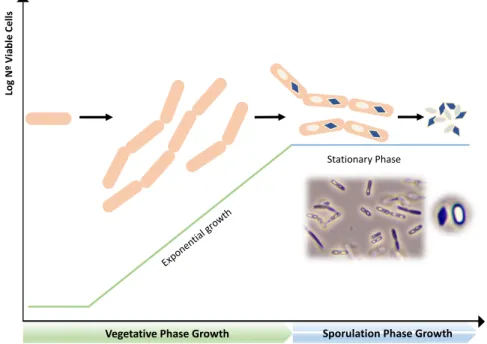
The cycle life cycle of B. thuringiensis has two clearly differentiated growth phases (Bulla et al., 1980). The first phase, also known as the vegetative phase of growth, takes place when favourable conditions occur, in terms of nutrients and aeration, the spore germinates, rising a vegetative cell where the formation of a septum through the plasma membrane will divide the mother cell into two identical daughter cells, and so on (Figure 1) (Osman et al., 2015). Although the growth temperature may vary between 15-45 °C, the optimal range goes from 26 to 30 °C, as above 42 °C plasmids containing the insecticidal genes may be cured (Mikesell and Vodkin, 1985). In terms of pH, conditions may vary from 5.5 to 8.5, but normally pH around 7 is the most suitable for its proliferation (Bernhard and Utz, 1993).
Figure 1. Schematic representation of the life cycle of Bacillus thuringiensis. During the vegetative phase of growth, the bacterium experiences an exponential growth forming collar chains. The lack of nutrients forces the bacterium to enter a stationary phase in which it sporulates and the proteins aggregate to form the parasporal crystal. Finally, the cell lysis releases the crystal and the spore, which will germinate again in favorable conditions, closing the cycle of this bacterium.
Vegetative Phase Growth Sporulation Phase Growth Expon entia l grow th Stationary Phase Time Lo g N º Vi abl e Ce lls
The cells form pairs or short chains, during the exponential proliferation of the bacterium, until the nutrients in the medium become scarce. At that moment the cell enters the stationary phase of its cycle, otherwise referred as the sporulation phase, in which the formation of a resistance spore takes place in the apical extreme of the cell, leaving room for the formation of a parasporal crystal of a proteinaceous nature at the other end. In the whole process the microorganisms undergoes up to 7 stages where the division turns asymmetric (Figure 1) (Bechtel and Bulla, 1982). The production of delta endotoxins is genetically regulated and give the microorganism a survival advantage, by exerting a lethal action against the insect host, providing sufficient nutrients for the germination of the dormant bacterial spores initiating the vegetative growth phase (de Maagd et al., 2001).
2.6. Ecology
B. thuringiensis is a Gram-positive, rod shaped, facultative anaerobe spore-forming bacterium (Claus and Fritze, 1989) which size varies between 1-1,2 µm in width and 2-5 µm in length. It has been isolated worldwide from many diverse environments, including soil samples (Vilas-Bôas and Lemos, 2004), the rhizosphere, the phylloplane (Smith and Couche, 1991), aquatic systems, grain dust, and dead insects (Iriarte et al., 1998; Raymond et al., 2010). Recently new isolates from marine sediments (Maeda et al., 2000) and Antarctic soil samples (Forsyth and Logan, 2000) have been reported. Despite its ubiquity, it has been always linked to the soil, presumable deposited by insects, where it may remain latent even in adverse conditions for its development (Glare and O’Callaghan, 2000) until the nutrients layout and growth conditions are propitious once again (Saleh et al., 2010). Unlike other Gram positive spore-forming bacteria, B. thuringiensis is able to live in the environment free and independent, without the need to interact with other microorganisms, even in unique environments such as the midgut and the hemocoel of insects (Nielsen-LeRoux et al., 2012; Raymond et al., 2010; Schnepf et al., 1998). Nonetheless, its role of the crystal in ecology is poorly understood and stills an enigma. Bt is an opportunistic pathogen, but it is not generally known for causing natural epizootics, although it occurred when it was first isolated by Ishiwata (Milner, 1994). It is part of the natural inhabitants that occur inside arthropods and may not provoke any injury to its host unless it is weakened by an infection caused by other pathogen (Eilenberg et al., 2000). Crystal toxins may provide a greater
chance for the proliferation of the bacterium in these situations by binding to the brush border, which seems to stimulate spore germination in the insect gut (Du and Nickerson, 1996) and subsequent vegetative cell proliferation (Hendriksen and Hansen, 2003) even in the dead corpse. When nutrients start to be limited sporulation occurs along with toxin production (Hansen and Salamitou, 2000) until suitable conditions arise. These crystal proteins may suppose up to 25-30% of the dry weight of the bacteria (Agaisse and Lereclus, 1995). In the case of mammals Bt appears as a transient microorganism in the intestine that have shown no harm for animals (Swiecicka et al., 2002) or humans after long term exposure (Jensen et al., 2002).
3. B. thuringiensis TOXIC FACTORS
Different toxins, including alpha(a)-exotoxin, beta(b)-exotoxin, gamma(g )-exotoxin, delta(d)-endotoxin, enterotoxin, louse and mouse factor exotoxins, water-soluble exotoxin and vegetative toxins (Heimpel, 1966; Osman et al., 2015), have been describe in B. thuringiensis strains. Thus toxins reporting insecticidal activity have been the most widely studied due to their commercial exploitation as active ingredients of biopesticides in the agricultural industry (Montesinos, 2003; Sanchis, 2011).
During the vegetative phase of growth Bt is capable of secreting soluble proteins to the medium, starting at mid-log phase and extending during sporulation, named vegetative insecticidal proteins (Vip) and secreted insecticidal proteins (Sip) (Palma et al., 2014). During the stationary phase of growth cry and cyt genes will encode the d-endotoxins that accumulate in the cell forming the parasporal crystal, which may be composed by a single protein or a combination of Cry proteins and also, but less frequently, Cry and Cyt proteins (de Maagd et al., 2003).
3.1. Toxin nomenclature and classification
Since the earlies 1980s, when the first crystal protein gene was cloned in
E. coli from the Bt strain HD1 (Schnepf and Whiteley, 1981), more than 700 cry
genes, coding for Cry proteins have been reported during the last decades, and around two hundred of these have already been cloned (Crickmore, 2013). The
the need for an organized nomenclature system (Crickmore et al., 1998).The first nomenclature system was based on the toxicity spectra of the crystal proteins and grouped them in four classes: CryI for lepidopteran-active toxins, which were 130-140 kDa in size; CryII for proteins yielding 65kDa that targeted both, lepidopterans and dipterans; CryIII consisted of proteins exhibiting toxicity against coleopterans; and CryIV was constituted of proteins exclusively toxic for dipterans (Höfte and Whiteley, 1989). A separate nomenclature was adopted for a toxin from a Bt subsp.
israelensis that showed to have cytolytic activity, and so named CytA (Ward et al., 1986). But this system soon led to problems as toxins had to be tested against a wide range of insects in order to classify them, some did not show the expected activity and many others were named the same by their discoverers mixing up the classification. That how the B. thuringiensis Toxin Nomenclature Committee was created and a new nomenclature system, accepted until date, was proposed (Crickmore et al., 1998). This new system classified toxins exclusively on their amino acid sequence, not considering their structure, mode of action or biocidal activity. The nomenclature was based in a four-rank name according to the degree of pairwise amino acid identity to previously named toxins. For the first and fourth rank Arabic numbers were used and uppercase and lowercase letters for the second and third rank, respectively (Figure 2).
Figure 2. Nomenclature system adopted for insecticidal toxins produced by Bacillus thuringiensis. Four ranks are used to group up toxins according to their amino acid sequence identity. Primary, secondary and tertiary rank distinguish proteins with at least 45, between 45 and 78 and up to 95% sequence identities, respectively. Quaternary rank differentiates between alleles of the same gene found in different Bt isolates, although they may share the exact same sequence.
< 45%
≤ 78% ≤ 95% > 95%
Proteins that shared at least 45% sequence identity were assigned a different primary rank (an Arabic number, e.g. Cry1 and Cry2); a different secondary rank was used to distinguish proteins sharing between 45% and 78% pairwise identity (an uppercase letter, e.g. Cry1A and Cry1B); a tertiary rank was reserved for differentiating those proteins between 79% and 95% identity (a lowercase letter, e.g. Cry1Aa and Cry1Ab); and finally different clones sharing more than 95% pairwise identity were assigned a different quaternary rank (an Arabic number, e.g. Cry1Aa1 and Cry1Aa2) (Crickmore et al., 2018). This nomenclature system is applied to d-endotoxins (Cry and Cyt proteins), vegetative insecticidal proteins (Vip) and secreted insecticidal proteins (Sip).
3.2. Toxic factors produced during the vegetative phase of growth
3.2.1. Vip proteins
The vegetative insecticidal proteins (Vip) (Estruch et al., 1996) are synthetize and secreted to the culture medium during the vegetative phase of growth. The transcription of vip genes is detected at the start of the logarithmic phase of growth, reaching a high level of expression during the stationary phase (Bi et al., 2015; Shi et al., 2004). In contrast to crystal toxins, which can be effective in absence of a viable Bt cell, a vegetative growing cell is clearly required for secreted toxins to exert a pathogenic effect (Donovan et al., 2001; Zhu et al., 2006). The increasing cases of resistance to Cry proteins promoted the activation of screening programs focused on the identification of new insecticidal components, contained in the supernatant of Bt strains. These components were evaluated and found to be proteinaceous, rendering different band patterns when resolved in acrylamide gels (SDS-PAGE). Their toxicity was evaluated against different insect orders. To date, a total of four different classes of Vip proteins (Vip1, Vip2, Vip3 and Vip4) have been classified (Crickmore et al., 2018). The vip1 and vip2 genes encode proteins of 885 (80 kDa) and 462 (45 kDa) amino acidic residues, respectively. These proteins act as binary toxins, such as the cholera toxin, where two functional domains or subunits must assemble in order to compose a toxicity complex (Madshus and Stenmark, 1992). Although the molecular mechanism of their insecticidal activity is not well understood, it is believed that Vip1 inserts in the membrane and forms a pore
(Leaber et al., 2006) providing Vip2 a pathway to enter the cell via endocytosis in order to exert the lethal toxicity to the host (Barth et al., 2004). A total of 15 Vip1 and 20 Vip2 proteins have been reported, exhibiting insecticidal toxicity against species of the order Coleoptera (e.g. Diabrotica spp) (Shi et al., 2004) and Hemiptera (e.g.,
Aphis spp) (Sattar and Maiti, 2011). No activity has been reported when inoculated individually, supporting the fact that these toxins must act together to exhibit activity (Chakroun et al., 2016). The vip3 genes encode proteins of 791 amino acids (88.5 kDa) which are processed in the insect midgut and consequently activated, binding to brush border membrane vesicles where ion channels are formed, provoking the disruption of the epithelial cells (Lee et al., 2006). Until date, 101 Vip3 proteins (http://www.btnomenclature.info/) with insecticidal activity against a broad spectrum of lepidopteran insect larvae of economic importance, that are less susceptible to d -endotoxins (Estruch et al., 1996), have been described. So far, a new subfamily composed by the vip4 gene has been classified, encoding a protein of 965 amino acids (108 kDa). No target insects have been found yet, although phylogenetically Vip4 seems to be closer to Vip1, sharing up to 34% amino acid identity, than to the rest of Vip proteins. An interesting feature of Vip proteins is that no homology with d-endotoxins is shared, showing a different mode of action and binding to non-competitive sites in the insect midgut (Lee et al., 2006, 2003; Sena et al., 2009). This feature opens a new field for control strategies where Vip proteins could be included to overcome resistance problems that have arisen due to constant applications of Bt sprays (Ferré and Van Rie, 2002). Also, combination of secreted and crystal toxins may broaden the host range of Bt-based biopesticides (Bravo et al., 2011).
3.2.2. Sip proteins
The secreted insecticidal proteins (Sip) are also synthetized and secreted to the culture medium during the vegetative phase of growth. The first and only sip
gene described in this new Bt insecticidal family, was identified in the strain EG2158 and encodes a protein of 367 amino acidic residues (41 kDa). Although the mode of action of this protein remains unknown, its limited homology with Mtx3 mosquitocidal toxins (Liu et al., 1996), suggests that pore formation would be responsible for its insecticidal activity against coleopteran larvae, including
Leptinotarsa decemlineata (Coleoptera: Chrysomelidae) or Diabrotica undecimpunctata howardi (Coleoptera: Chrysomelidae) (Donovan et al., 2006). No homology in the amino acidic sequences has been found with Cry or Vip proteins (Donovan et al., 2001).
3.2.3. Other secreted toxic factors
Bt also produces several other toxins, such as a-exotoxin, hemolysin, enterotoxins, phospholipases and chitinases (Hansen and Salamitou, 2000). In some cases, certain Bt strains are capable of producing the well-studied ß-exotoxin, also referred to as thuringiensin (Šebesta et al., 1981; Vafskov, 1978), a heat-stable adenine-nucleotide analog which inhibits DNA directed RNA-polymerase competing with ATP (Gohar and Perchat, 2001; Horská et al., 1976; Šebesta and Horská, 1970). Although it is believed that the role of this low molecular weight molecule (700 Da) is to regulate the transcription of d-endotoxins, its toxicity affects a wide range of animals, including mammals (McClintock et al., 1995). This feature impedes its inclusion Bt-based insecticidal formulations (Glare and O’Callaghan, 2000). Nowadays, improved high-performance liquid chromatography separation techniques are used for the detection and quantification of ß-exotoxin in B. thuringiensis culture supernatants (Hernández et al., 2003; Levinson et al., 1990). 3.3. Toxic factors produced during the stationary phase of growth
During the stationary phase the bacterium synthetize the d-endotoxins, oligomers commonly known as Cry and Cyt proteins, that will accumulate and crystallize forming the parasporal crystal. This is the defining feature of Bt. The bacterium will lysate and this inclusion body will be released to the medium along with the spore after the cell wall disintegrates. In some strains the crystal is found within the exosporium (Aronson and Fitz-James, 1976), but usually these two structures are not physically connected.
3.3.1. Cry proteins
Parasporal crystals can be composed by a single or a combination of Cry proteins cross-linked by disulphide bonds. The shape of the crystal keeps a certain correlation with the type of proteins that make it up. Those formed by Cry1 are
bipyramidal, Cry2 produce cubic forms, Cry3 form flat-rectangular crystals, those composed of Cry4 are spherical and Cry11 proteins form rhomboidal crystals. (Schnepf et al., 1998). The most common shapes among natural isolates are mainly bipyramidal and spherical (Bernhard et al., 1997; Martin and Travers, 1989). Usually, cry genes are conferred to one or more plasmids, although copies of them can also be located in the bacterial chromosome (Kronstad et al., 1983). The expression of these insecticidal genes is controlled at the transcriptional, post-transcriptional and post-translational level, and represents a huge metabolic investment, as the crystal may represent up to 20-30% of the dry weight in the sporulated cell. Cry proteins report a high and specific toxicity to a wide range of insect species, including different insect orders, such as Lepidoptera, Coleoptera, Diptera, Hemiptera, Hymenoptera, Orthoptera, Mallophaga, (Schnepf et al., 1998; Van Frankenhuyzen, 2009) but also nematodes, mites and protozoa (Iatsenko et al., 2014). However, there are many Bt strains obtained from diverse environments which have no known invertebrate target (Abulreesh et al., 2012) and are referred to as parasporins for exhibiting strong and cytocidal activity against human cancer cell lines of various origins (Okassov et al., 2015). This parasporin group of Cry proteins have both, Cry and Parasporin designations: parasporin-1 (PS1 or Cry31), parasporin-2 (PS2 or Cry46), parasporin-3 (PS3 or Cry41), parasporin-4 (PS4 or Cry45), parasporin-5 (PS5 or Cry64 ) and parasporin-6 (PS6 or Cry63), respectively (Ohba et al., 2009). Although the toxicity effect of Bt strains resides in the inclusion crystal proteins, as these have proved effective against arthropods when tested alone, it is believed that the spore may act as a synergistic factor enhancing the toxicity effect (Burges et al., 1976). This has been confirmed by irradiating the spores in order to avoid germination, which resulted in a reduction of the synergistic effect as expected (Asano et al., 2002). Also spore-coat proteins have shown to be contributors for this matter (Du and Nickerson, 1996). Nevertheless, it does not seem to be an universal fact, as it depends on the strain, the spore, the toxin and the proportion of them in the mixture (Liu et al., 1998).
3.3.2. Cyt proteins
Cytolytic (Cyt) proteins are parasporal inclusion toxins also referred to as d-endotoxins. The characteristic features of these toxins are their cytolytic activity in
vitro, against a range of cultured cells, and their haemolytic effect in erythrocytes (de Maagd et al., 2003; Thomas and Ellar, 1983). According to the Bt Toxin Nomenclature Committee (Crickmore et al., 2018), putative proteins with a high sequence similarity with other previously described Cyt toxins are also defined as cytolytic protein. No sequence similarities are found with Cry or Vip toxins. Until date, three cyt gene families have been described, including a total of 11 holotypes according to their toxin nomenclature (Soberón et al., 2013). These were first detected as low molecular proteins specific to Bt subsp. israelensis (Tyrell et al., 1981) and showed to be soluble in alkaline buffers in absence of reducing agents, unlike the well-known lepidopteran-specific toxic proteins (Thomas and Ellar, 1983). In contrast to Cry proteins, Cyt proteins are mostly found in Bt strains active against dipteran species, being able to kill mosquitoes and blackflies (de Maagd et al., 2003) although activity against some coleopteran insects has also been reported (Guerchicoff et al., 1997; Van Frankenhuyzen, 2009). An interesting feature about Cyt toxins is their ability to synergize the activity of Cry or Vip proteins reducing the resistance levels in some pest species (Becker, 2000; Guerchicoff et al., 1997). 3.4. Structure and function of delta-endotoxins
The d-endotoxins belong to a class of bacterial toxins known as the pore-forming toxins (PFT). Generally, PFT-producing bacteria secrete their toxins which interact with specific receptors located in the membrane brush border. There are two main groups of PFT: (i) the a-helical toxins, in which a-helix regions form the trans-membrane pore (3-domain Cry proteins), and (ii) the b-barrel toxins, that insert into the membrane by forming a b-barrel composed of b-sheet hairpins from each monomer (Cyt proteins) (Parker and Feil, 2005). The crystal protein family should be divided into four distinct homology groups which are not phylogenetically related, a) the 3-Domain Cry family, b) the MTX-like toxins, related to B. sphaericus, c)the binary-like toxins, and d) the parasporins.
3.4.1. The three-domain proteins
The three-domain Cry toxins are globular molecules containing three differentiated domains connected by single linkers. The three-dimensional structure of Cry3Aa was the first to be resolved using X-ray crystallography (Li et al., 1991).
Since then, the structure of different Cry proteins, such as Cry1Aa (Grochulski et al., 1995), Cry2Aa (Morse et al., 2001), Cry3Bb1 (Galitsky et al., 2001), Cry4Aa (Boonserm et al., 2006), Cry4Ba (Boonserm et al., 2005) and Cry8Ea1 (Guo et al., 2009) has been determined and provided considerable insight into the mechanism of toxin function, elucidating differences in toxin specificity (Figure 3). Multiple alignments of the aminoacidic sequences of several Cry proteins have revealed a low sequence similarity among them, with over 50 different subgroups with more than 200 members. This high diversity of toxins is responsible for the wide insect range specificities, although a high similarity in the overall topology structure is observed (de Maagd et al., 2003). Despite this low sequence identity, five conserved blocks of amino acidic residues (1 – 5) located in the N-terminal of protoxins, are defined among diverse Cry toxins (Höfte and Whiteley, 1989; Schnepf et al., 1998). A particular feature concerning the three-domain Cry protoxins is their production during sporulation of the bacteria as protoxins of two different lengths: either 130-140 kDa or approximately 70 kDa. The main difference between these is that in large protoxins the C-terminal cleaved by proteases in the insect midgut that remove about 500 to 600 amino acid residues and about 20-25 at the N-terminal. Nevertheless, short protoxins are only processed at the N-terminal. This suggests that C-terminal extension found in 130 kDa protoxins is dispensable for toxicity. In both cases the resulting activated toxin constitutes a protease resistant core of 60 kDa that presents the three mentioned domains (de Maagd et al., 2001). The mentioned five conserved blocks are located along the toxic core sequence (Höfte and Whiteley, 1989), while three additional blocks (6 – 8) are distributed in the C-terminal halves of large protoxins, where an extra domain, not found in smaller proteins, is found.
Domain I (the N-terminal domain) was first described in Cry3Aa (Li et al., 1991). It comprises a bundle of seven a-helices, in which six of them (amphipathic) surround a central helix (a5) which is hydrophobic. Its structural similarity to the pore-forming domain of colicin (Parker et al., 1989), along with its proteolytic cleavage during toxin activation, led to the hypothesis that Domain I may be responsible for membrane insertion and pore formation in Cry proteins (Li et al., 1991; Xu et al., 2014). Domain I contain the conserved blocks 1 and 2 (the C-terminal half of helix a6 and all of a7) (Figure 3). Site-directed mutagenesis
experiments showed alterations in toxicity when amino acidic residues were altered, but interactions of the toxin with the brush border were not disturbed (Ahmad, 2003; Wu and Aronson, 1992). Nevertheless, substitutions or mutations of Domain I targeting block 2 suggested its importance in crystallization and stability (Park and Federici, 2004).
Figure 3. Primary and tertiary structure of Cry toxins. A. Position of the conserved five blocks, if present, among different Cry protoxins. The three domains are marked for protoxin Cry1. Domain I contains the conserved block 1 and part of block 2. Domain II contains the rest of the conserved block 2 and part of block 3. Domain III contains the rest of the conserved blocks 3, 4 and 5. The rest of the protoxins follow a similar structure with an N-terminal (20-40 amino acidic residues) before the conserved block 1 and a C-terminal followed by block 2 in long protoxins, which is digested when activated in the midgut of the insect. B. Three-dimensional structure of a Cry1A protein. Three domains can be differentiated: domain I (red) is involved in membrane insertion and pore formation; domains II and III (blue and green, respectively) are involved in specific recognition and receptor binding. (de Maagd et al., 2001).
Domain II consists of three anti-parallel b-sheets, forming a b-prism, with exposed loop regions. It is the most variable of the toxin domains and plays an important role in toxin-receptor interactions which is determinant for host specificity (Boonserm et al., 2006; Li et al., 1991). Domain II contains part of the conserved blocks 2 (the first b-strand) and 3 (the last b-strand). Mutations in loops of this domain have revealed their role in specific interaction with host receptors, suggesting that toxins with high sequence similarity in this region may share some
binding sites in the epithelial cells of the midgut (Hernández and Ferré, 2005; Jurat-Fuentes and Adang, 2001). Domain III is a two antiparallel b-sheet sandwich, each of them composed by five strands (Li et al., 1991). It is proteolytically cleaved in some three-domain Cry proteins and is also involved in receptor binding, pore formation and host range definition, although it shows less structural variability than Domain II (Schnepf et al., 1998). Domain III contains the conserved blocks 3 (the N-terminal segment of the first b-strand), 4 (the second b-strand) and 5, located at the C-terminus of the domain (Jurat-Fuentes and Jackson, 2012). Mutations in block 4 in Cry1Aa revealed alterations in toxicity by forming truncated channels in brush border membrane vesicles (Chen et al., 1993; Wolfersberger et al., 1996), while block 5 showed to be involved in toxin stability in Cry4A, providing higher protection against protease digestion (Nishimoto et al., 1994).
3.4.2. Cyt proteins
Cyt proteins have a single a-b domain that comprises two outer layers of a-helix hairpins wrapped around a b-sheet. The three-dimensional structures of three Cyt proteins (Cyt1Aa, Cyt2Aa and Cyt2Ba) have been solved by crystallography showing similar topology. Although the mechanism of action of Cry and Cyt families is thought to be the same, no similarities are shared between them (Li et al., 1996, 1991). Both toxins produce a 1-2 mm pore in the membrane of epithelial insect cells that lead to an osmotic decompensation (Knowles and Ellar, 1987). After solubilization, the proteolytic activation of Cyt protoxins is required for toxicity. Insect gut enzymes cleave the C and N-terminal of the protoxin (27 kDa) and the active toxin (24 kDa) (Thomas and Ellar, 1983) is released as a monomer that interacts directly with membrane lipids forming a pore (Promdonkoy and Ellar, 2005, 2000) or by a detergent-like interaction (Butko, 2003).
3.5. Models of action of Cry proteins in lepidopteran species
Bt insecticidal proteins exhibit insecticidal activity against a wide range of different insect orders like Lepidoptera, Coleoptera, Diptera, Hemiptera and also other non-insect organisms such as mites (Van Frankenhuyzen, 2013) and nematodes (Wei et al., 2003). The mode of action of Cry proteins has been deeply studied during the last decade mainly focused on lepidopteran species. The
knowledge of how these insecticidal toxins interact with the host producing a lethal effect is of crucial interest for pest control and avoidance of resistance appearance. Crystal proteins sharing molecular elements in their mode of action may promote the premature selection of resistant biotypes in the insect population. Three different models for the mode of action of crystal proteins have been proposed.
3.5.1. The classical model
The “classical” model mode of action (Bravo et al., 2007) proposes that when the inert crystal proteins are ingested by a susceptible host the alkaline conditions of the insect midgut promotes its solubilization, releasing them in their protoxin form. These are then proteolytically converted to smaller protease-resistant toxic polypeptides, either by host proteases, spontaneous proteolysis or by the intervention of proteases associated to the spore (Cannon, 1996), yielding the active toxin. Solubilization and protease activation are two interactive processes, where the first one promotes a structural change in the insecticidal molecule facilitating the access of proteases to the target residues. Regardless of the size of the protoxin (130kDa for Cry1 and 70 kDa for Cry2 and Cry3 proteins) the active crystal proteins usually present a size of 60 kDa, so in some cases, these enzymes remove about half of the crystallized toxin in a process believed to activate it(Bravo et al., 2002). The activated toxin subsequently binds to specific receptors located on the brush border membrane of the midgut epithelium columnar cells before inserting into the membrane. Toxin subunits oligomerize to form pore structures in the microvilli of apical cell membranes allowing permeability to inorganic ions, amino acids and sugars (Carroll and Ellar, 1993; Kirouac et al., 2002). Such pores cause ion leakage that lead to cell lysis due to massive influx of solutes from the midgut lumen (Knowles and Ellar, 1987) and midgut disarrangements ending in insect death (Figure 4).
Figure 4. Mode of action of Cry toxins. After ingestion the parasporal crystal is dissolved in the insect gut due to alkaline conditions. A proteolytic activation of the protoxin clips off the C-terminal of long proteins (130 kDa) and a small fraction of the N-C-terminal. The toxin core binds to specific receptor located in the brush border of epithelial cells where domain II and III are involved. Finally, domain I forms a lytic pore that cause ion disarrangements resulting in cell lysis and insect death.
However, there are some details including the assembly of the toxins and the structure of the pore that still need to be clarified. In contrast, some advances have been made in the toxin-receptor recognition process and resistance to toxins (Gómez et al., 2007; Likitvivatanavong et al., 2011). In some occasions spores may colonize the hemocoel where they may germinate, replicate and cause a septicaemia killing the insect (Höfte and Whiteley, 1989; Schnepf et al., 1998). These mentioned conditions are responsible for the narrow spectrum of the microorganism and its safety for mammals.
Forma&on ly&c pore Specific interac&on with epithelial receptors Peritrophic membrane Inges&on spore/crystal mixture
Solubiliza&on pH 11 Epithelial cells Cell lysis Massive influx solutes Insect death Proteoly&c ac&va&on
3.5.2. The sequential binding model
The sequential binding model attempts to explain the pore formation event as a consequence of a multiple receptor contribution (Bravo et al., 2004; Gómez et al., 2002; Pacheco et al., 2009). The solubilization and proteolytic activation of the toxin would follow the same steps as the “classical” model. However, the first interaction takes place between the activated toxin and two specific receptors located on the luminal membrane of midgut epithelial cells. The toxin binds to a cadherin-like protein (receptor 1) that promotes a conformational change in the insecticidal molecule that favours a proteolytic cleavage of the N-terminal of the pore-forming domain of the toxin. This leads to removal of helix a1 and oligomerization of the toxic molecule that will form a pre-pore structure (Gómez et al., 2002). The oligomer then binds to a glycosyl-phosphati-dylinositol (GPI)-anchored aminopeptidase N (receptor 2), showing a greater affinity to it than the monomeric form of the toxin (Bravo et al., 2004). Finally, insertion into the membrane results in the formation of a pore structure that leads to a major permeability of the epithelial cells. This model suggest that alteration in the expression of either of the two mentioned receptors, cadherins or aminopeptidase N (Gahan et al., 2010; Morin et al., 2003; Xu et al., 2005; Zhang et al., 2009), can cause resistance events to Cry proteins, without undergoing any structural modification.
3.5.3. The signalling pathway model
The signalling pathway model of Bt mode of action, however, discards the importance of pore formation in toxicity as a cause but as a consequence (Zhang et al., 2006, 2005). This model is partially based on the observation that insect cell cultures expressing the BT-R1 cadherin are sensible to Cry1Ab binding that activates a magnesium-dependent signalling pathway associated with cell death.
4. BIOASSAYS OF B. thuringiensis AGAINST LEPIDOPTERAN PESTS
A bioassay is a technique used to measure the amount of a substance, such as a toxin, needed to cause an effect on a living organism (Robertson et al., 2017). Bioassays are performed for several purposes, such as assessment of the activity of formulated and non-formulated pathogens, to serve as quality control of commercial products or to determine the mode of action of the active ingredients. The experimental design depends on some key parameters including the active ingredient, food source, treatment supply, host range, speed of kill and activity against different larval instars. In order to estimate the pathogenicity of the active ingredient of interest a range of 5-6 concentrations are usually applied to precisely estimate the amount of toxin required to cause mortality in larval insects. Single discriminating concentrations of the active ingredient are recommended in order to fix the appropriate range of dilutions (Navon, 2000).
4.1. Artificial diet
The purpose to use an artificial diet is to accurately evaluate the activity of, for example, a mixture of spores and crystals in absence of the chemical and physical barriers that are present in a host plant. A large number of insects, preferably reared with low cost and high performance (Zou et al., 2015), are employed for laboratory toxicity studies. Diet-based assays overcome the need to maintain a constant supply of plants in the greenhouse or in the field. In order to determine if an artificial diet is appropriate for the production of insects in the laboratory, it should supply the insect all nutrients needed, be innocuous to use and easy to prepare, have a long term shelf storage, and at least a total insect viability above 75% should be reached (Singh, 1983). A first diet was proposed to determine the activity of the French E-61 standard Bt subsp. thuringiensis against Trichoplusia ni or Ephestia küehniella (Dulmage et al., 1971). However, the increasing interest to characterize new Bt isolates against the wider possible insect range required the development of new bioassay diets specific to each pest. Thus, some authors proposed standardized diet recipes for rearing a wider range of lepidopteran insect species (Han et al., 2012; Navon et al., 1990; Singh, 1983).
4.2. Natural food
The main difference with dietary bioassays is the presence of chemical and physical barriers that provide the crop a particular defence. The plant generate an alkaline environment on the leaf surface due to the exudation of magnesium and potassium cations (Ellman and Entwistle, 1982; Navon et al., 1988) that may negatively affect the activity of d-endotoxins if the pH rises above 10 (Behle et al., 1997). This feature opens the opportunity to test different adjuvants, that can be included in formulation recipes, in order to determine their effect on the potency of Bt and the insect feeding behaviour. Cotton is one of the most common hosts used as natural food, as several lepidopteran species can feed on it. Plants also grow fast, so within a few weeks the size and the number of leaves may be appropriate for either leaf or plotted-plant experiments.
4.3. Toxin supply
4.3.1. Superficial contamination of diet
Knowledge about the feeding behaviour of the target insect is crucial in order to determine the most suitable way to supply the toxin. For example,
Spodoptera exigua, Helicoverpa armigera or Mamestra brassicae,feed by grazing across the surface, so superficial contamination of the synthetic diet seems to be the most suitable option. An important factor to take into account is that the active ingredient used must be stable in the diet, as many recipes include antimicrobial agents that could affect the activity of bacteria. This is the reason why a conscientious screening to determine the role of diet ingredients in the activity of B.
thuringiensis is mandatory. In order to conduct this type of bioassay a known volume of the aqueous toxin solution is added to cover the semi-synthetic diet, contained in plastic cups, followed by agitation to ensure even coverage. The dosage is thus expressed in ng/cm2. Larvae are then added individually one per well (if gregarious, mass feeding can be employed) and fed on the diet for a certain period of time. This method can be used either to calculate the median lethal dose (LD50) or the median lethal concentration (LC50), depending on whether the amount of active ingredient ingested by the treated larva is known or not. In the first case the entire amount of diet, which must be ascertained by trial and error, is consumed in a known short
time. In the second case a known concentration of the treatment is applied on the surface of the diet, but it is not entirely consumed (Evans and Shapiro, 1997). 4.3.2. Leaf contamination
Some insects cannot be reared on artificial diets so natural food plant should be used instead. Leaf discs, submerged in a treatment aqueous suspension, can be also used as source of food for the insect during the experiment. Individuals will ingest the toxin with the plant material, which will determine mortality. If the target insect shows cannibalistic tendencies, it is advisable to offer a leaf disk to individually confined larvae, however, an alternative using the whole leaf is available for lepidopteran species that can be grouped together without eating each other. For leaf disc bioassays a standardized size is used, and discs are submerged in an aqueous concentration of toxin to be evaluated (Iriarte et al., 1998). A wetting agent (0.1% concentration), is generally used to avoid the formation of drops by reducing surface tension and to improve the correct and homogeneous impregnation of the surface. These are then dried at room temperature and transferred to individual wells of 2 cm2 containing a layer of 1.5-3 % agar (w/v) to maintain moisture of the leaf tissue. Larvae are individualized in wells by means of a camel-hair brush, and boxes are maintained at controlled conditions during the appropriate period of time before mortality is registered. For whole leaf bioassays a similar procedure is followed. The serial aqueous solutions (0.1% wetter) are poured over the leaf tissue and allowed to dry. The petiole is cut at 2 cm distance from the leaf and inserted into the agar layer. Then a certain number of neonate larvae are carefully placed on the leaf and mortality is registered after 3 days (Navon and Ascher, 2000).
4.3.3. Plotted-plant and field bioassays
Whole plants can be used to conduct a toxicity assay by caging first, second or third instars on leaves of potted plants. Several factors, including percentage of mortality, leaf consumption and feeding inhibition under greenhouse conditions (Navon et al., 1987) can be evaluated. Important advantages over leaf bioassays can be highlighted, such as; testing the activity of B. thuringiensis